Provincial Government Ignores the Problems, so I Have to Go To the Federal…

This letter is part of my ongoing fight for the health and welfare of not only my son, but all children

who stand to suffer from the noise and infrasound from Industrial Wind Turbines.  This is the reason

that I started the “Mothers Against Wind Turbines”group.

To:

The Right Honourable Stephen Harper,

Prime Minister of Canada

The Honourable Peter Gordon MacKay,

Minister of Justice and Attorney General

Dear Prime Minister Harper and Attorney General and Minister of Justice,

Re: Request to meet regarding the UN Rights of the Child, and Industrial Wind Energy


Purpose:  The purpose of this message is to request a meeting with the

Attorney General – Minister of Justice to discuss:

• the opportunity for the Government of Canada to take action

in order to ensure that wind energy developers are not allowed

to risk harm to my son, or to any other child

• how quickly will the Government of Canada act on this serious matter?

This message may be shared with others.

Background:

• At my request, Ms Carmen Krogh has been assisting with compiling evidence
regarding risks to the health of children including those with special needs which
are associated with noise in general and from industrial wind energy facilities.

• Ms. Krogh has communicated concerns to Canadian Federal and Ontario
Provincial authorities and others regarding risk of effects on children in general
and those relating to my son.


Page 2 of 3

• My son is vulnerable to noise emissions in general. Industrial wind turbine

emissions will risk his health. Attached is a letter from my son’s specialist

physician.

• I have met and appealed to Federal, Provincial Ontario authorities and

representatives from the wind developer. Examples are: Premier Kathleen Wynne;

Mr. Dean Allison, MP for Niagara-West Glanbrook; Mr.Tim Hudak, [former]

Conservative Leader; Ms.Andrea Horwath, N.D.P. Leader; Mr. Chiarelli, Energy

Minister; Niagara Region’s Medical Health Officer; Ms.Valerie Jaeger; the

Niagara Regional Council; the West Lincoln Council; the Children’s Aid Society;

and others.

• At my request, Ms. Krogh has appealed for assistance under the UN Convention

Rights of the Child.

• Letters have been written to the Prime Minister; Attorney General and Minister of

Justice; and Minister of Health on this matter.

• My son is vulnerable to noise whether at home or at school. However, I have not

received assurance that my son will not be exposed to industrial wind energy

facilities either at home and at school.

Current Status:

• The responses I have received from Canadian Federal and Ontario Provincial

authorities have not addressed the serious risks associated with wind energy

facilities and children.

• There is no indication provisions will be protective of children in general, or how

my son will be protected.

• Indications are the Government of Canada is committed to the protection of

children; however, what avenue does it suggest I take to make sure that my son is

not harmed by the known noise and infrasound from the wind turbines, which are

proposed to be built very close to our home.

• The letter written by my son’s specialist has been ignored at every level so far, and

I need to know what channels to take, now.

Request:

My son will be directly harmed by wind turbines, unless the wind company is stopped from

installing them.

I request a meeting as soon as possible to discuss:

• What are the steps the Government of Canada will take to make sure that the wind

company is not allowed to expose my son or any other child to a wind energy

facility?

• How quickly will the Government of Canada respond to this serious risk

Page 3 of 3

• Will the Government of Canada take immediate measures to ensure health

protection from wind energy facilities for Canadian children?

Respectfully submitted,

Ms Shellie Correia

 Elcho Rd. RR#3

Wellandport, Ontario L0R2J0

3 of 3
View all

Noise Levels In Homes Near Wind Turbines Are Intolerable for Many!!

Bad news on wind turbine noise

Credit:  The Tablelander | 17/06/2014 | ~~


The Mount Emerald wind farm developers should be ashamed. They have released an impact assessment for public comment, including an updated noise report that proposes noise levels even higher than their original plan.

Commenting on the original plan, the Council’s noise expert stated that at night residents would hear wind farm noise on a consistent basis. He stated that individuals susceptible to sleep disturbance or low frequency pressure variations will be affected up to 3km away, and residents at greater distances may also be affected. He recommended the wind farm should NOT be approved as it couldn’t meet Queensland’s noise regulations.

So why have the developers submitted an even noisier plan? They expect our community to endure noise which would not be permitted for any other industrial project in rural Queensland including mines, factories, refineries and power plants.

We want to know our families will be safe from the effects of noise from industrial wind turbines. Unfortunately, at this stage, the National Health and Medical Research Council can offer us no guarantees. The only Australian research accepted for review by the Research Council reports on the adverse health effects (including sleep disturbance, tinnitus, headaches) being experienced by residents living within 10km of large turbines. These reports are consistent with the findings of two other surveys conducted at Australian wind farm sites. Some Australian families have been forced to leave their homes as they can no longer tolerate the noise and vibration from large-scale turbines, such as the ones proposed for Mt Emerald. More information can be found here: www.waubrafoundation.org.au

Now is your first and last opportunity to comment on the wind farm’s social, economic and environmental impacts by making a submission about the developers’ reports, see: (www.mtemeraldwindfarm.com.au/pages/technical_eis_docs.html) Be warned: there are thousands of pages to read and the developers have only given us until 2 July 2014 to make submissions. You must make sure your views are heard, and copy your comments to the Deputy Premier Jeff Seeney (deputypremier@ministerial.qld.gov.au).

We are not happy with the developer’s consultation process so we have posted surveys to property owners within 5km of the Mount Emerald site. A substantial number have been returned but there are still some outstanding. If you haven’t had a chance to return your form or you’ve lost yours, please contact tablelandswta@gmail.com or phone 4093 4392 for assistance. Even if you have filled out a survey, make sure you write a separate submission on the developer’s impact assessment.

Stephen Lavis
Spokesperson
Tablelands Wind Turbine Action

Sign a Wind Contract in Haste….Repent at Your Leisure!

Concerned about health affects of wind turbines

The wind companies have talked to people in McBain and I believe they know there are problems with noise and with health. Why don’t they take action? Why didn’t they tell us about the health problems before we signed leases?

I signed a wind turbine lease in 2008. If I had known then what I know now, I wouldn’t have signed.

Since the turbines went up I have had frequent headaches lasting three days. I never had these before. My mother has ringing in her ears and headaches. I have spoken to others in the community who have been affected by the turbines. One has dizzy spells. Another does not feel healthy until she leaves McBain. They are now planning on moving, but have been told by realtors that they will have trouble selling their home because of the turbines.

Because it takes so long for the entire wind farm to become operational, the signs of how the turbines worsen health and quality of life take a long time to be noticed. One person I talked with thought her dizziness was “just getting older,” but this person is young.

Why hasn’t anyone spoken out before? People are afraid of being shunned. They don’t want anyone to know they are having problems.

Is money more important than health? Is this what we gave away for $10,000 a turbine and monthly payments, with leases that will never end? We gave up our beautiful community, we are giving up our health, our electric bills have risen, and there doesn’t seem to be anyway out except leaving.

The wind companies have talked to people in McBain and I believe they know there are problems with noise and with health. Why don’t they take action? Why didn’t they tell us about the health problems before we signed leases?

I now believe that the only safe place for turbines is at least a mile and a half from anyone’s home


Source: http://www.cadillacnews.com…

JUN192014

An Innocent Life is Gone….Another Victim of the Wind Scam!!!

Dear Ontario Government, how “serious and irreversible” is a death?

I saw this story early this morning. I hesitate to use the word ‘story’ – it’s not a news story, it’s a life gone way too early, and family that will suffer and hope that their son will recover, while having already lost their daughter. Two weeks ago, before I moved out of province,  I lived my whole life about a kilometre from the crash that killed this young local woman, and critically injured her brother. Extremely tragic, so hard to imagine. Some may think it was another unavoidable death on our roads. That it was not.

The car left Napperton Dr., (North of Kerwood) rolled and hit a hydro pole. That hydro pole… wasn’t there 6 months ago. That hydro pole had no reason being there, except that a wind developer, WPD, struck a deal with Hydro One to relocate the poles, that had been safely in a farmers field for decades, far from the road, on to the County road Right of Way (ROW), where they could colocate their lines on it. You may recall some of the photos earlier this year of this very stretch of road as the lines were going up. The turbines for these poles have not been installed, yet, but have full approval and will probably go in this summer.

[Here are some pictures of WPD’s Napier Wind project poles being installed – you can see the former poles safely out in the farmers field.]

And they aren’t the only new poles in the area. Anyone who has driven down Kerwood Rd lately knows that this is just the new norm, for dozens of kilometres. Those lines on Kerwood and Elginfield Rd would be NextEra and Suncor’s. I’m infuriated that these companies have been allowed to compromise our community’s safety.

[Pictures from along Kerwood Rd. of NextEra/Suncor poles]

It’s not that we didn’t try to stop these poles from being installed so close to our roads. A presentation was made to Middlesex County as well as taking our concerns to the OEB. And protests. All of this fell on deaf ears. Those who allowed these poles understood the risks. The county eventually hammered out a road user agreement that was used for all the wind turbine infrastructure on their ROW. Including the poles that killed this woman last night.

It measures 168” (4.27m) from edge of roadway to the face of the pole – this is less than 5m which would be the minimum for a road with a design speed of 80 – 90 km/h and according to the Middlesex County submissions to the OEB last year, it should be at least 5m – but realistically, even that is too close. These poles aren’t in compliance, which leads me to wonder… is the OPP taking this into account in their investigations?

The same situation exists south of Kerwood where the poles are actually in the road shoulder – that’s unacceptable for a road with a design speed of 110km/h. But who’s checking anyways?

My anger then surfaces in these questions, maybe to the ERT, maybe to the MOE, the wind developers, or even to the Premier herself:

How “serious and irreversible” is this woman’s death?

Did the infrastructure in this project cause her death?

If those poles were not there, would she have stood a chance of survival?

And how the hell is one supposed to predict and prove without a doubt that
a) the wind company won’t comply with the setbacks and
b) that this particular accident was going to happen?

Are we supposed to just let these accidents happen FIRST and then act (or not)? This is my worst nightmare, watching this unfold in the community I was born and raised.

This is why I couldn’t stay – and still this hurts too much, even watching from afar. I knew it would be just one casualty after another, and not a damn thing I could do about it when the government has stacked every thing it has against protecting your communities health and safety. Rest in peace Michelle Day.

School Head Warns of Dangers from Close Proximity to Wind Turbines!


School head raises concerns over proximity of turbines.

Published date: 17 June 2014 | 

Published by: Staff reporter
Read more articles by Staff reporterEmail reporter


A HEADTEACHER has written to parents alerting them to a wind turbine proposed for a site less than two miles from the school.
Lakelands Academy headteacher Ian Sanders wrote to parents to raise awareness of the 99.7-metre turbine application for land off Ellesmere Road near Tetchill.
He wrote that the application is “a concerning planning development which is being proposed very close to the site of the academy.
“Quite apart from the aesthetic impact on the countryside, there has been concern raised by communities, in areas where such turbines have been sited, over the potential health issues associated with the subsonic sound that turbines of this magnitude generate. On a practical note, the generation of subsonic sound may also disturb the concentration of students in lessons and during public examinations,” he added.

Applicant Angela Williams, who runs agricultural business Seven Sisters along with her husband, Robert, said she does not believe the turbine will have adverse effects on health.
She said: “In terms of health implications I haven’t heard anything about turbines to suggest that it will be detrimental to health.
“It is a very quiet machine and the manufacturers have done a lot of research into the aesthetic and other effects of the turbine,” she added.
Nicol Perryman, from Intech Clean Energy UK added: “I believe the school is around 1.2km away from the site. When we were looking at the site of the turbine we looked at impacts to do with health and noise and shadow flicker were taken into account.
“The school is well outside the affected area. There can be impacts if people live close to turbines but all properties are outside that area of impact.”

Wind Pushers Don’t Feel Obligated, to “Obey Laws”!


Turbines spin without approval in West Lincoln

Ministry says company is ‘operating out of compliance’

Grimsby Lincoln News

WEST LINCOLN — They’ve only been running a few days and already residents living near wind turbines say they are feeling the effects.

“I don’t hear the refrigerator or anything anymore,” said Zlata Zoretic, seated at neighbour Wendy Veldman’s kitchen table Tuesday afternoon. “Just this low hum.”

Zoretic said she has felt pressure in her ears since the turbines in the HAF Wind Energy Project were turned on June 12. Her bedroom window gives her an uninterrupted view of the turbine that is just 640 metres from her home.

“Is it in my head? I don’t know,” she said. “It’s driving me crazy.”

The turbines were switched on without warning last week for a 24-hour and have not stopped turning since.

Project proponents,  Vineland Power Inc. and Rankin Wind Energy, notified the Ministry of Environment last week that they intended to turn the turbines on for a 24-hour test period. The company had also indicated at the time that it was considering starting up operations, said a ministry spokesperson.

“The ministry has told the company not to operate while the amendment application is under review,” said Kim Groombridge, MOE district supervisor for Niagara. “They are operating out of compliance.”

The project was delayed after it was discovered that several of the turbines were built closer than the 95-metre property line setback. The West Lincoln Glanbrook Wind Action Group used a rangefinder to measure the distances between the towering turbines and neighbouring property lines. It found four of the five turbines infract the minimum setback — the height of the tower from base to hub, which in this case is 95 metres.

Property owner Anne Meinen said the location of the turbine impedes on her ability to farm her land — something she has been doing for more than 40 years. She said the location limits her aerial abilities for seeding and spraying her land as well as prohibits the use of new technology she has been looking into.

“I am very concerned that the presence of this turbine so close will not enable me to utilize these production tools and will therefore limit my ability to operate my farming business,” she wrote to the ministry. “I believe that begging for forgiveness rather than asking for permission is a poor way to do business that should not be rewarded.”

Of the women in the room, Carole Kaufhold lives closest to the wind turbines. Her Sixteen Road home is just 553 metres from turbine No. 3 — just three metres over the provincial limit of 550.

Kaufhold has had a severe case of anxiety since the turbines went into operation.

“I became very anxious and irritated,” she said of returning home from work to find the blades swooping through the air. “My heart has been pounding, it’s hard to concentrate.”

Kaufhold said she feels nauseous every time she looks at the turbines.

All claim the turbines are much louder than the low hum — like that of a refrigerator — they were told about.

Anne Fairfield said she heard a low-pitched whine coming from the machine nearest her home around 3 a.m. on Sunday. Her partner, Ed Engel, can feel the vibrations in his bedroom which faces the turbine.

Fairfield and Engel along with Kaufhold and her husband participated in a pre-commissioning sleep study being conducted by a graduate student at the University of Waterloo. Though it was uncomfortable and awkward to sleep hooked up to a bunch of machines, all agree there is value in participating in a study which could show the impacts of industrial wind turbines on sleep. A total of 22 people are involved in the study and a second round of testing will be completed now that the turbines are in operation.

The residents hope the results prove that turbines do impact human health — a claim they have been making since they learned of the project in 2010.

“I’ve had PTSD — pre-turbine stress disorder — since Aug. 25, 2010,” said Fairfield, mentioning the date of the first public meeting held on the project. “It’s very stressful. All I do is worry and wonder.”

Fairfield is most concerned about a gas well near her home that is only five metres from a collector line for the project.

Though the turbines are now spinning near her country home, Veldman isn’t done fighting.

“I’m not going to stop calling until they take them down,” she said. “I’m not going to listen to the squealing and girding of the turbines. I’m used to agricultural noise, this isn’t agriculture. This is industrial noise.

“It has to stop,” she said. “I don’t want to see anymore.”

The ministry’s investigations and enforcement branch is investigating the matter, said Groombridge as the project is still under review by the ministry and has not been approved for operation.

The turbines were shut down as of 5 p.m. June 18.

Climate Alarmists Are Not Speaking the Truth!

GREENPEACE CO-FOUNDER SAYS THAT MAN-MADE CLIMATE CHANGE

FAILS THE MOST BASIC PRINCIPLES OF SCIENTIFIC METHOD

James Delingpole — Breitbart.com — June 19, 2014

“Climate change” is a theory for which there is “no scientific proof at all” says the co-founder of Greenpeace. And the green movement has become a “combination of extreme political ideology and religious fundamentalism rolled into one.”

Patrick Moore, a Canadian environmentalist who helped found Greenpeace in the Seventies but subsequently left in protest at its increasingly extreme, anti-scientific, anti-capitalist stance, argues that the green position on climate change fails the most basic principles of the scientific method.

“The certainty among many scientists that humans are the main cause of climate change, including global warming, is not based on the replication of observable events. It is based on just two things, the theoretical effect of human-caused greenhouse gas emissions, predominantly carbon dioxide, and the predictions of computer models using those theoretical calculations. There is no scientific “proof” at all.”

Moore goes on to list some key facts about “climate change” which are ignored by true believers.
1. The concentration of CO2 in the global atmosphere is lower today, even including human emissions, than it has been during most of the existence of life on Earth.
2. The global climate has been much warmer than it is today during most of the existence of life on Earth. Today we are in an interglacial period of the Pleistocene Ice Age that began 2.5 million years ago and has not ended.
3. There was an Ice Age 450 million years ago when CO2 was about 10 times higher than it is today.
4. Humans evolved in the tropics near the equator. We are a tropical species and can only survive in colder climates due to fire, clothing and shelter.
5. CO2 is the most important food for all life on earth. All green plants use CO2 to produce the sugars that provide energy for their growth and our growth. Without CO2 in the atmosphere carbon-based life could never have evolved.  Continue reading here…..

Antarctic2-2

John Madigan, an Australian Hero! (If Only We Had a Man Like Him!!!)

A First Rate Senator (John Madigan) Skewers

a Third Rate Human Being (Simon Chapman)

Victorian Senator, John Madigan delivered an utterly brilliant speech in the Commonwealth Senate this week. See the video below; Hansard (transcript) follows.

As to the Senator, John Madigan provides a salient example of what can happen when decency, integrity and courage all combine in defence of the weak and vulnerable among us; and in pursuit of the truth. The man is made of fearless stuff; and, in our view, stands as one of the Parliamentary Greats: William Wilberforce and his 26 year campaign to end slavery readily springs to mind. The passion with which he delivers this speech is, self evidently, the product of the man’s compassion and empathy; as he says: “every life matters and every life is important”. Hear, hear!

As to the speech, it can be covered in two words: “truly wonderful”.

***

COMMONWEALTH OF AUSTRALIA
SENATE
Hansard
TUESDAY, 17 JUNE 2014
BY AUTHORITY OF THE SENATE
PROOF

Senator MADIGAN (Victoria) (23:20): I rise to speak tonight on the privilege of this parliament to operate without fear or favour. Members and senators have the right to undertake their duties freely to represent their constituents — it is the reason we are here. Any attempt to gag a senator or member of parliament, any attempt to exert influence by means of threat or intimidation is a breach of parliamentary privilege. This could incur the most serious penalties. Tonight I will speak of such an attempt by a high-profile Australian academic. This academic has a track record of making fun of people in regional and rural communities who are sick. He trades in scuttlebutt. He makes consistent attacks on anyone who makes a complaint against his network of corporate buddies. This academic has become the poster boy for an industry which has a reputation for dishonesty and for bullying.

I have a policy of playing the issue, not the man. Policies should always go before personalities. It is a personal credo, one I have practised all my life and specifically in my professional duties since my election in 2010. But since I have been investigating matters related to wind turbines for almost 10 years now I have recorded a consistent track record of vilification, denigration and attack by those on the other side of this debate. This is an industry that sucks hundreds of millions of dollars in subsidies from the public purse. This industrial power generation sector is an industry that masquerades under a false veneer of ‘saving the environment’.

The wind industry is about one thing in this country: it exists to make people rich at the expense of many rural and regional Australians, their lives and their communities. My investigation shows it does not decrease carbon dioxide, it does not reduce power costs, it does not improve the environment. And this academic in question stands shoulder to shoulder with the wind industry companies and their colourful — and I use that term deliberately — executives. He promotes their products. He attacks their critics. He attends their conferences. He rubs shoulders with their henchmen. He is, in the words of the former member for Hume, Alby Schultz — who was a great campaigner on this issue, I might add — devoid of any decency and courage.

But, first, some background. My party, the Democratic Labour Party, has a long tradition of standing up for principle in the face of enormous opposition. My party was born in conflict and forged in sacrifice. No other political party in Australia can boast that its parliamentary founders — 51 in total, including 14 ministers and a state Premier — were prepared to sacrifice promising political careers to uphold the belief dedicated to freedom from undue and corrupt influence. The DLP was the first Australian political party to promote the vote for 18-year-olds. We were the first political party to call for equal pay for equal work and equity in education funding. We were the first political party to call for an end to the White Australia policy. And when our veterans returned from Vietnam, bloody but unbowed, DLP parliamentarians marched in their ranks while the rest of Australia turned their backs.

The DLP is a party of principle. We respect the dignity and the sanctity of life. From the womb to the grave, from the primary school to the factory floor, we see every life as unique and having intrinsic value. This is the cornerstone of the DLP; this is the foundation upon which I place every vote. That is why my attention has been turned to the wind industry for almost a decade now, even before my election to the Senate. I have seen firsthand the devastation it has caused communities. I have listened firsthand to the stories of wrecked families’ lives: family farms destroyed and small outback areas torn apart. I have seen the empty homes in Victoria at Waubra, Macarthur, Cape Bridgewater and Leonards Hill. I have listened to country people tell me stories of corporate bullying and deceit, and of corporate fraud in matters of compliance. I have repeatedly called for one thing on this issue: independent Australian research into the health problems that wind farms apparently cause. That is all — independent research. It is a question of justice. It is about getting to the bottom of this issue.

So when I spoke with Alan Jones onto 2GB on 27 March, I made one simple point. I told Mr Jones we need to be careful about people who profess to be experts in this area. For the benefit of the Senate I repeat what I said in
that interview:

… when we talk about people, using the title, using a title, such as Professor, let us be clear crystal clear here Alan. Most people in the community assume that when you use the title Professor, that you are trained in the discipline of which you speak. And I ask people, look and check. What is the person making these proclamations about other people’s health? What is the discipline they are trained in of which they speak? Because most people in the public assume when you speak of an issue of health, that you are trained in the discipline of which you speak, and there are people making pronouncements and denigrating people who are not trained in human health.

I stand by this statement. It is fair and reasonable to encourage people to look behind the blatant campaigning done by people like Professor Chapman of the University of Sydney.

But it is the statement that has prompted him to threaten me, utilising a law firm that was instrumental in the set-up of Hepburn Wind. He has threatened to sue me for libel over this statement unless I pay him $40,000 plus costs. He has threatened to sue me for libel unless I organise an apology on the website of 2GB and an anti-wind farm website called Stop These Things. He has threatened me with contempt of parliament and a breach of parliamentary privilege if I raise these matters in the Senate. This reaction by Professor Chapman is something that my more experienced parliamentary colleagues have labelled a blatant try-on. It is another attempt by the wind industry to silence me, to scare me off and to intimidate me. It is a case of a Sydney university academic firing shots across the bow of the blacksmith from Ballarat.

This is something he has done before now, tweeting about my position on this issue, always in the context of my background as a blacksmith — a background, I add, that I am enormously proud of. I remain one of the wind industry’s most stubborn and outspoken critics. I will not be silenced. I will not give up on the injustice inflicted on people who claim to be impacted by living near turbines. I will not stop. My comments to Alan Jones were a series of rhetorical statements or questions about the assumptions members of the public should be entitled to make when somebody professes to be qualified to speak about an issue of public health. In other words, I was asking people to check that so-called experts on this issue are relevantly trained and qualified. It is a reasonable request. Our media and the internet are crawling with self-appointed experts. Daily we operate in a cacophony of opinion presented as fact.

Professor Chapman has been an outspoken critic of those who have dared to question the wind farm orthodoxy. But is Professor Chapman a medical doctor? Is he legally entitled to examine and treat patients? Is he qualified in acoustics or any other aspect of audiology? Is he a sleep specialist? Does he hold any qualifications in bioacoustics or physiology or neuroscience? How many wind farm victims has he interviewed directly? How many wind farm impacted homes has he visited? Professor Chapman claims to receive no payment from the wind industry. How many wind industry conferences, seminars and events has he spoken at? How many wind industry events has he attended? Writing on the Crikey website in November 2011, Professor Chapman lamented how many conferences do not pay speaker’s fees, and, when one conference organiser refused to pay his hotel bill, he withdrew. This is the same Professor Chapman who was photographed at a campaign launch in Melbourne by the Danish wind turbine manufacturer Vestas. Did Vestas pay your hotel bill and other costs, Professor Chapman? These are reasonable questions — they put in context his actions.

I take this opportunity to draw the attention of the Senate to the discovery of a 2004 PowerPoint presentation by Vestas employee Erik Sloth to the former Australian Wind Energy Association, now the Clean Energy Council. This demonstrated Vestas knew a decade ago that safer buffers are required to protect neighbours from noise. Vestas knew their preconstruction noise models were not accurate. I draw the attention of the Senate to a quote from the presentation that Vestas knew then that ‘noise from wind turbines sometimes annoys people even if the noise is below noise limits.’ This is confirmation that the global wind industry have known for more than a decade that their turbines impact on nearby residents. How can Professor Chapman reconcile his ridicule of the reasons numerous people have been forced to abandon their homes with the knowledge that the company initiating this campaign he attended knew a decade ago there were problems?

As a public health academic, Professor Chapman displays a lack of compassion for people who claim to be suffering debilitating effects from pervasive wind turbine noise. Professor Chapman’s undergraduate qualifications were in sociology. His PhD looked into the relationship between cigarette smoke and advertising. I question his expertise, I question his qualifications and I question his unbridled motivation to promote and support the wind industry at the cost of people’s lives, homes and communities. I question Professor Chapman’s lack of interest in speaking with wind industry victims. Professor Chapman has a record of public denigration of victims. I refer to his tweet in February this year about ‘wind farm wing nuts’.

One of the important things about this fight that is going on across rural Australia is that it is country women who are in the front line. Farmers’ wives are running hard, fighting to save their families, fighting to save their homes, fighting to save their communities. It is often these women who suffer the most denigration. It is a roll call of honour — people like Mary Morris of South Australia; Dr Andja Mitric Andjic in Victoria; Sonia Trist,Joanne Kermond and Melissa Ware at Cape Bridgewater; Colleen Watts in New South Wales; and, of course, the extraordinary Sarah Laurie in South Australia.

One more example: Annie Gardner and her husband, Gus, have lived and worked happily and healthfully for 34 years on their farming property in south-west Victoria. This came to a sudden halt in October 2012 when the first 15 turbines of the Macarthur wind farm began operation. In a recent letter to the AMA Annie said she is now able to get only two or three hours sleep each night in her own home. She writes: ‘At the time of writing this letter, I am suffering terribly from the infrasound emitted by the 140 turbines located far too close to our property. I have a bad headache. I have very strong pains shooting up through the back of my neck and into my head. I have extremely sore and blocked ears and very painful pressure in my nose. I have pressure in my jaws and my teeth. My heart is pounding. I can feel the vibration going through my body through the chair like an electric charge. The infrasound in our bedroom was appalling. I could feel the vibration through the mattress and the pillow like an electric charge through my body. My head felt as if a brick was on it, and the pressure and pain in my nose was extreme.’

Annie Gardner would be what Professor Chapman would call a ‘wind farm wing nut’. Writing on a green movement website earlier this year, Professor Chapman said protesting against wind farms is a fringe activity as if to suggest that the hundreds of people who attended and spoke at anti-wind farm forums I have held across my home state of Victoria and interstate are simply collateral damage. I cannot live with such a utilitarian view. As I said, even putting aside the highly questionable environmental, social and economic benefits of wind farms, every life matters and every life is important. I have sat in people’s homes and kitchens. I know firsthand the suffering they experience from these industrial developments. Professor Chapman’s attempts to gag me are the same as his attempts to silence those who object to the great wind farm scam. It is part of a greater attempt to silence open and transparent debate on this issue. It does no service to academia or to science already under much attack. It does nothing to advance discussion or progress.

Surely the big businesses behind this attempt — the entities who are funding it, like Bleyer Lawyers, who have worked for Hepburn Wind — should remember cases such as McDonald’s and Gunns. For the environmental movement to attempt this shallow legal shooting of a mere messenger is poor judgement in my view. Bullies corporate or otherwise never get far. Surely it is apparent that companies that use the courts to silence opposition lose out in the court of public opinion. To borrow words from the great human rights campaigner Malcolm X:

I’m for truth, no matter who tells it. I’m for justice, no matter who it’s for or against.

If Professor Chapman proceeds with this action, I look forward to having him answer in court those questions I have raised here tonight — questions about his qualifications, his expertise and his links with the wind industry financial or otherwise. I look forward to his cross-examination under oath as equally as I look forward to mine. I say this: his action, if it proceeds, is doomed in a legal setting or elsewhere for one reason; it is not based on the truth.
Senator Madigan 

One phrase sums up the Senator’s attitude and approach to the wind industry’s vast (and, as he puts it, “colourful”) cast of bullies and thugs: Sic semper tyrannis – “thus always to tyrants.” More power to John Madigan.

John Madigan


Excellent Article About Reading, and Understanding Scientific Papers…for all of us!

How to read and understand a scientific paper: a guide for non-scientists

Jennifer Raff 

Last week’s post (The truth about vaccinations: Your physician knows more than the University of Google) sparked a very lively discussion, with comments from several people trying to persuade me (and the other readers) that their paper disproved everything that I’d been saying. While I encourage you to go read the comments and contribute your own, here I want to focus on the much larger issue that this debate raised: what constitutes scientific authority?

It’s not just a fun academic problem. Getting the science wrong has very real consequences. For example, when a community doesn’t vaccinate children because they’re afraid of “toxins” and think that prayer (or diet, exercise, and “clean living”) is enough to prevent infection, outbreaks happen.

“Be skeptical. But when you get proof, accept proof.” –Michael Specter

What constitutes enough proof? Obviously everyone has a different answer to that question. But to form a truly educated opinion on a scientific subject, you need to become familiar with current research in that field.  And to do that, you have to read the “primary research literature” (often just called “the literature”). You might have tried to read scientific papers before and been frustrated by the dense, stilted writing and the unfamiliar jargon. I remember feeling this way!  Reading and understanding research papers is a skill which every single doctor and scientist has had to learn during graduate school.  You can learn it too, but like any skill it takes patience and practice.

I want to help people become more scientifically literate, so I wrote this guide for how a layperson can approach reading and understanding a scientific research paper. It’s appropriate for someone who has no background whatsoever in science or medicine, and based on the assumption that he or she is doing this for the purpose of getting a basic understanding of a paper and deciding whether or not it’s a reputable study.

The type of scientific paper I’m discussing here is referred to as a primary research article. It’s a peer-reviewed report of new research on a specific question (or questions). Another useful type of publication is a review article. Review articles are also peer-reviewed, and don’t present new information, but summarize multiple primary research articles, to give a sense of the consensus, debates, and unanswered questions within a field.  (I’m not going to say much more about them here, but be cautious about which review articles you read. Remember that they are only a snapshot of the research at the time they are published.  A review article on, say, genome-wide association studies from 2001 is not going to be very informative in 2013. So much research has been done in the intervening years that the field has changed considerably).

Before you begin: some general advice
Reading a scientific paper is a completely different process than reading an article about science in a blog or newspaper. Not only do you read the sections in a different order than they’re presented, but you also have to take notes, read it multiple times, and probably go look up other papers for some of the details. Reading a single paper may take you a very long time at first. Be patient with yourself. The process will go much faster as you gain experience.

Most primary research papers will be divided into the following sections: Abstract, Introduction, Methods, Results, and Conclusions/Interpretations/Discussion. The order will depend on which journal it’s published in. Some journals have additional files (called Supplementary Online Information) which contain important details of the research, but are published online instead of in the article itself (make sure you don’t skip these files).

Before you begin reading, take note of the authors and their institutional affiliations. Some institutions (e.g. University of Texas) are well-respected; others (e.g. the Discovery Institute) may appear to be legitimate research institutions but are actually agenda-driven. Tip: google “Discovery Institute” to see why you don’t want to use it as a scientific authority on evolutionary theory.

Also take note of the journal in which it’s published. Reputable (biomedical) journals will be indexed by Pubmed. [EDIT: Several people have reminded me that non-biomedical journals won’t be on Pubmed, and they’re absolutely correct! (thanks for catching that, I apologize for being sloppy here). Check out Web of Science for a more complete index of science journals. And please feel free to share other resources in the comments!]   Beware of questionable journals.

 As you read, write down every single word that you don’t understand. You’re going to have to look them all up (yes, every one. I know it’s a total pain. But you won’t understand the paper if you don’t understand the vocabulary. Scientific words have extremely precise meanings).

Step-by-step instructions for reading a primary research article

1. Begin by reading the introduction, not the abstract.

The abstract is that dense first paragraph at the very beginning of a paper. In fact, that’s often theonly part of a paper that many non-scientists read when they’re trying to build a scientific argument. (This is a terrible practice—don’t do it.).  When I’m choosing papers to read, I decide what’s relevant to my interests based on a combination of the title and abstract. But when I’ve got a collection of papers assembled for deep reading, I always read the abstract last. I do this because abstracts contain a succinct summary of the entire paper, and I’m concerned about inadvertently becoming biased by the authors’ interpretation of the results.

2. Identify the BIG QUESTION.

Not “What is this paper about”, but “What problem is this entire field trying to solve?”

This helps you focus on why this research is being done.  Look closely for evidence of agenda-motivated research.

3. Summarize the background in five sentences or less.

Here are some questions to guide you:

What work has been done before in this field to answer the BIG QUESTION? What are the limitations of that work? What, according to the authors, needs to be done next?

The five sentences part is a little arbitrary, but it forces you to be concise and really think about the context of this research. You need to be able to explain why this research has been done in order to understand it.

4. Identify the SPECIFIC QUESTION(S)

What exactly are the authors trying to answer with their research? There may be multiple questions, or just one. Write them down.  If it’s the kind of research that tests one or more null hypotheses, identify it/them.

Not sure what a null hypothesis is? Go read this, then go back to my last post and read one of the papers that I linked to (like this one) and try to identify the null hypotheses in it. Keep in mind that not every paper will test a null hypothesis.

5. Identify the approach

What are the authors going to do to answer the SPECIFIC QUESTION(S)?

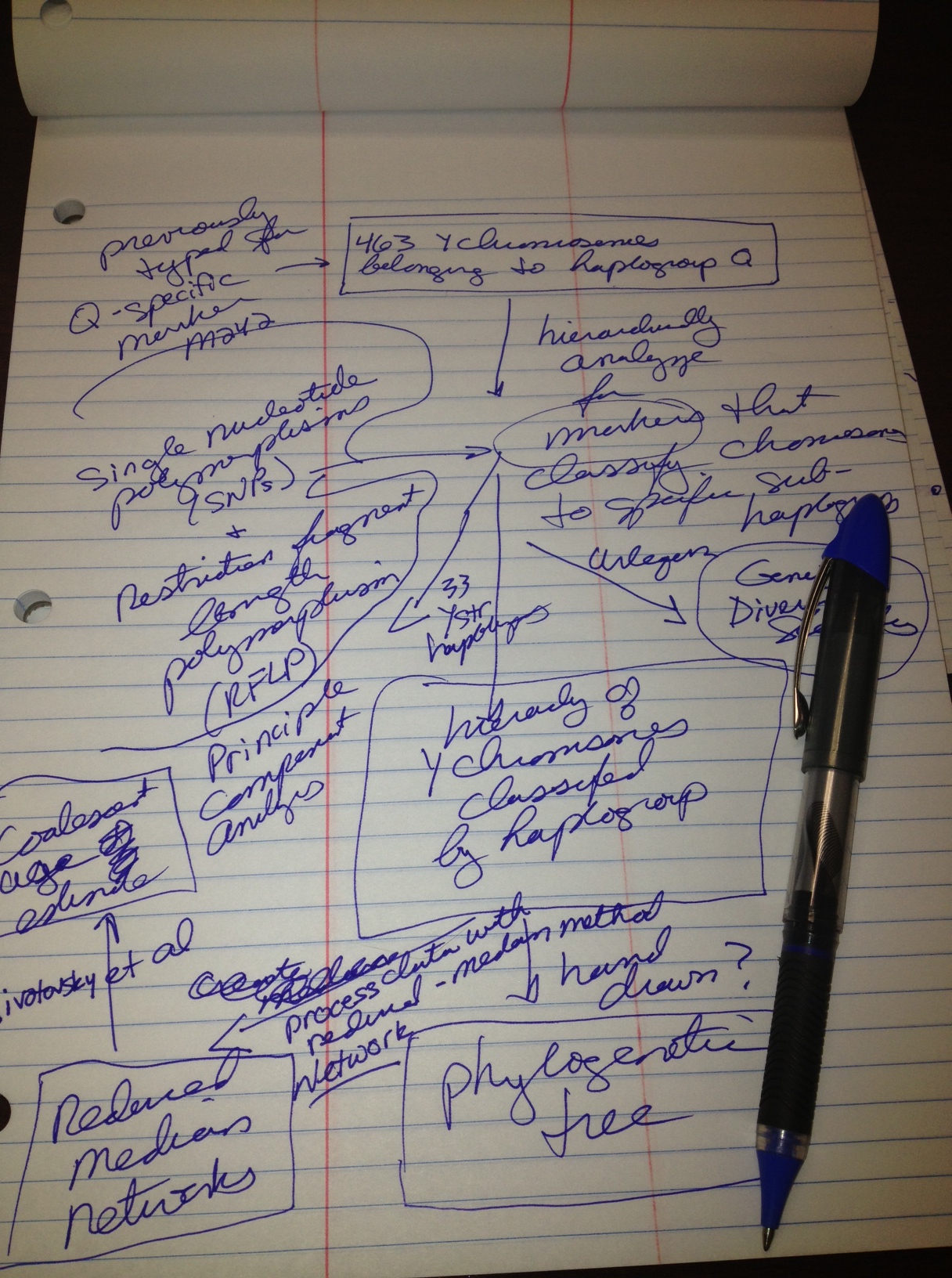
 6. Now read the methods section. Draw a diagram for each experiment, showing exactly what the authors did.

I mean literally draw it. Include as much detail as you need to fully understand the work.  As an example, here is what I drew to sort out the methods for a paper I read today (Battaglia et al. 2013: “The first peopling of South America: New evidence from Y-chromosome haplogroup Q”). This is much less detail than you’d probably need, because it’s a paper in my specialty and I use these methods all the time.  But if you were reading this, and didn’t happen to know what “process data with reduced-median method using Network” means, you’d need to look that up.

Battaglia et al. methods

You don’t need to understand the methods in enough detail to replicate the experiment—that’s something reviewers have to do—but you’re not ready to move on to the results until you can explain the basics of the methods to someone else.

7. Read the results section. Write one or more paragraphs to summarize the results for each experiment, each figure, and each table. Don’t yet try to decide what the resultsmean, just write down what they are.

You’ll find that, particularly in good papers, the majority of the results are summarized in the figures and tables. Pay careful attention to them!  You may also need to go to the Supplementary Online Information file to find some of the results.

 It is at this point where difficulties can arise if statistical tests are employed in the paper and you don’t have enough of a background to understand them. I can’t teach you stats in this post, butherehere, and here are some basic resources to help you.  I STRONGLY advise you to become familiar with them.

 THINGS TO PAY ATTENTION TO IN THE RESULTS SECTION:

-Any time the words “significant” or “non-significant” are used. These have precise statistical meanings. Read more about this here.

-If there are graphs, do they have error bars on them? For certain types of studies, a lack of confidence intervals is a major red flag.

-The sample size. Has the study been conducted on 10, or 10,000 people? (For some research purposes, a sample size of 10 is sufficient, but for most studies larger is better).

8. Do the results answer the SPECIFIC QUESTION(S)? What do you think they mean?

Don’t move on until you have thought about this. It’s okay to change your mind in light of the authors’ interpretation—in fact you probably will if you’re still a beginner at this kind of analysis—but it’s a really good habit to start forming your own interpretations before you read those of others.

9. Read the conclusion/discussion/Interpretation section.

What do the authors think the results mean? Do you agree with them? Can you come up with anyalternative way of interpreting them? Do the authors identify any weaknesses in their own study? Do you see any that the authors missed? (Don’t assume they’re infallible!) What do they propose to do as a next step? Do you agree with that?

10. Now, go back to the beginning and read the abstract.

Does it match what the authors said in the paper? Does it fit with your interpretation of the paper?

11. FINAL STEP: (Don’t neglect doing this) What do other researchers say about this paper?

Who are the (acknowledged or self-proclaimed) experts in this particular field? Do they have criticisms of the study that you haven’t thought of, or do they generally support it?

Here’s a place where I do recommend you use google! But do it last, so you are better prepared to think critically about what other people say.

(12. This step may be optional for you, depending on why you’re reading a particular paper. But for me, it’s critical! I go through the “Literature cited” section to see what other papers the authors cited. This allows me to better identify the important papers in a particular field, see if the authors cited my own papers (KIDDING!….mostly), and find sources of useful ideas or techniques.)

Now brace for more conflict– next week we’re going to use this method to go through a paper on a controversial subject! Which one would you like to do? Shall we critique one of the papers I posted last week?

UPDATE: If you would like to see an example, you can find one here
———————————————————————————————————