Danish High Court Raises Amount of Compensation Set for Victims of Wind Turbine Noise!

Compensation for noise from wind turbines: precedent-setting court decision in Denmark

The High Court for Western Denmark sets compensation over and above the amount assessed by the government.

By Søren Stenderup Jensen

Søren Stenderup Jensen

The judgment is significant as it granted compensation after the erection of the wind turbines. This is contrary to the main rule in the Promoting Renewable Energy Act; however, both the city court and the high court found sufficient legal authority under the act to admit the claim after the erection of the wind turbines.

“Moreover, both courts paid considerable attention to the evaluation of the court-appointed expert. While this is quite normal in Danish case law, it is unusual in cases where an authority such as the assessment authority has previously dealt with the matter.

“Finally, the high court paid attention to the city court’s own observations of the property. It is quite unusual to see such a reference to the observations of a lower court in a higher court’s grounds of judgment.

“The judgment gives cause for optimism to those who intend to challenge decisions of the assessment authority under the Promoting Renewable Energy Act. From a procedural point of view, it seems to be important for the court to see the property at issue to form its own opinion of the level of noise pollution caused by wind turbines.”

International Law OfficeSeptember 1, 2014DenmarkDanmark

High Court rules on compensation for noise from wind turbines

By Søren Stenderup Jensen

Background

Depending on their location, wind turbines can cause noise, visual interference and light reflections.

These issues are governed by public and private law, including neighbour law. The main rules regarding noise from wind turbines can be found in Executive Order 1284 of December 15 2011 on wind turbine noise, issued pursuant to the Environmental Protection Act. To some extent, the order safeguards neighbours from noise inconvenience by establishing maximum noise levels from wind turbines in outdoor areas. The noise limit varies depending on the surroundings.

Wind turbines may also cause visual interference which may negatively affect the value of surrounding properties. Thus, the location of wind turbines on land has proved a difficult political issue for years. Every municipality supports the idea of more wind turbines – just not within its own borders.

In order to promote local support for wind energy projects, the Parliament passed the Promoting Renewable Energy Act, which establishes a compensation scheme for neighbours of wind turbines. Under the scheme, those who build one or more wind turbines are obliged to compensate their neighbours for any reduction in property value that the wind turbines may cause, regardless of whether the wind turbines accord with the necessary permits.

The compensation scheme departs from the court-based neighbour law in that it does not operate with a tolerance limit which the neighbour must prove has been exceeded.

The starting point is that the issue of compensation must be settled before the wind turbines are built. However, the Promoting Renewable Energy Act does allow neighbours to claim compensation in certain circumstances thereafter. The competent authority to deal with claims for compensation is the assessment authority set up by the act.

Compensation granted to neighbours under the act has been relatively low so far.

Facts

In a recent case before the High Court for Western Denmark the plaintiffs had been awarded Dkr250,000 in compensation for the erection of eight wind turbines by the assessment authority. They brought the matter before the courts seeking higher compensation.

Before the erection of the wind turbines, an environmental study had concluded that the noise level at their property would amount to 38.8 decibels at wind speeds of 12 knots and 40.9 decibels at wind speeds of 16 knots.

Before the city court, a court-appointed expert stated that the reduction in the value of the property amounted to between Dkr600,000 and Dkr800,000. The city court also arranged a visit to the property.

Where the assessment authority found that the plaintiffs’ property would be subject to limited noise pollution, the city court found the level to be more significant. The court further ruled that the plaintiffs had documented their loss of value at Dkr600,000 and thus awarded them an additional Dkr350,000.

Finally, the court held that the plaintiffs had suffered no other economic loss covered by the Promoting Renewable Energy Act. In particular, the court held that the fact that the wind turbines had been erected with all necessary permits prevented the plaintiffs from claiming compensation under neighbour rules.

The High Court for Western Denmark upheld the city court’s judgment, but fixed the compensation at Dkr500,000 because, among other things, there were certain deficiencies in the masonry of the house. However, the court also considered the findings of the court-appointed expert witness who had seen the plaintiffs’ house after the erection of the wind turbines – which the assessment authority had not done – as well as the city court’s own observation of the property. Finally, the court ruled that the Promoting Renewable Energy Act does not restrict the courts’ competence to review decisions from the assessment authority.

Comment

The judgment is significant as it granted compensation after the erection of the wind turbines. This is contrary to the main rule in the Promoting Renewable Energy Act; however,both the city court and the high court found sufficient legal authority under the act to admit the claim after the erection of the wind turbines.

Moreover, both courts paid considerable attention to the evaluation of the court-appointed expert. While this is quite normal in Danish case law, it is unusual in cases where an authority such as the assessment authority has previously dealt with the matter.

Finally, the high court paid attention to the city court’s own observations of the property. It is quite unusual to see such a reference to the observations of a lower court in a higher court’s grounds of judgment.

The judgment gives cause for optimism to those who intend to challenge decisions of the assessment authority under the Promoting Renewable Energy Act. From a procedural point of view, it seems to be important for the court to see the property at issue to form its own opinion of the level of noise pollution caused by wind turbines.

For further information on this topic please contact Søren Stenderup Jensen at Plesner by telephone (+45 33 12 11 33), fax (+45 33 12 00 14) or email (ssj@plesner.com). The Plesner website can be accessed at www.plesner.com.
Big Wind’s Energy Has Trickled to a Light Breeze!

Big Wind’s Last Gasp?

Wind energy development in the United States has slumped.

Despite record installations in 2012, and eking out a 1-year, $12 billion extension of the wind production tax credit (PTC), new wind capacity last year fell to just 1,087 megawatts, a level not seen in more than a decade. Development in 2014 is showing signs of improvement but the year may not fare much better.

The industry blames Congress and the uncertainty surrounding the PTC for the slowdown, but such thinking is overly simplistic and ignores the fundamental challenges facing big wind. This slump, like others that plagued wind development in prior years, can be traced directly to generous government assistance, current energy prices, and the inherent limitations of wind power.


Reasons for the slowdown

The Section 1603 cash grants enacted under ARRA fueled a wind bubble as developers raced to build and qualify their sites. By the end of 2012, the industry’s project pipeline was exhausted with just 43 MW of wind under development in two states. The surge in new capacity created a glut in RPS-qualified generation and eroded demand for wind as states met and/or exceeded their renewable mandates. The shale gas boom further hampered growth by driving down energy prices and harming wind’s economic competitiveness against cheaper, more reliable fuels.

Proponents insist wind energy is a few short years away from thriving without government assistance, but the trends do not support the claim.

For wind to go it alone, average wind capacity factors need to increase dramatically and/or project construction costs must drop dramatically. But that’s not happening according to the U.S. Department of Energy’s (DOE) Wind Technologies Market Report 2013, just released.

The authors, Ryan Wiser and Mark Bolinger from the Lawrence Berkeley National Laboratory (LBNL), report that average capacity factors for projects built after 2005 have been stagnant despite advances in turbine technology. The interior region of the country covering Texas and the plains states continues to show the best capacity factors (36-38%) and lowest project costs ($/kw) but it’s also the most remote. A smaller population means miles of expensive new transmission is needed to transport the energy to higher demand centers east and west.

Turbine prices and project costs may have declined somewhat from 2012, but with only 11 projects in LBNL’s 2013 sample, drawing a firm conclusion about construction costs is premature. The same applies for average wind pricing. According to the report, the national average price for wind dropped to a surprising $25/MWh in 2013, but again, the small sample of power purchase agreements examined was skewed by projects sited in the lowest-priced interior region of the country.

We agree that wind PPAs from 2012-13 have seen some decline in prices but nowhere near $25/MWh in most areas of the country and not for the reasons cited. Wind power is not more competitive. Rather, its pricing in the U.S. is under severe pressure because of the shale gas boom and the accumulation of new wind capacityconcentrated in just twelve states, which has lowered demand.

Also, by constructing tens of thousands of megawatts of generation that produces largely off peak, wind developers actually hurt their own energy sales by driving down wholesale prices, which makes the PTC even more critical.


Subsidizing Big Wind

The PTC offsets the high price of wind energy, giving the false impression that wind is competitive with other resources, but at 2.3¢/kWh, the subsidy’s pre-tax value (3.5¢/kWh) equals, or exceeds the wholesale price of power in much of the country! The tax credit provides a significant out-of-market revenue source for developers by shifting costs to taxpayers at large. At current energy prices, we’re not convinced wind power can demonstrate sustained growth without the PTC, and this is confirmed in EIA’s latest Annual Energy Outlook 2014.

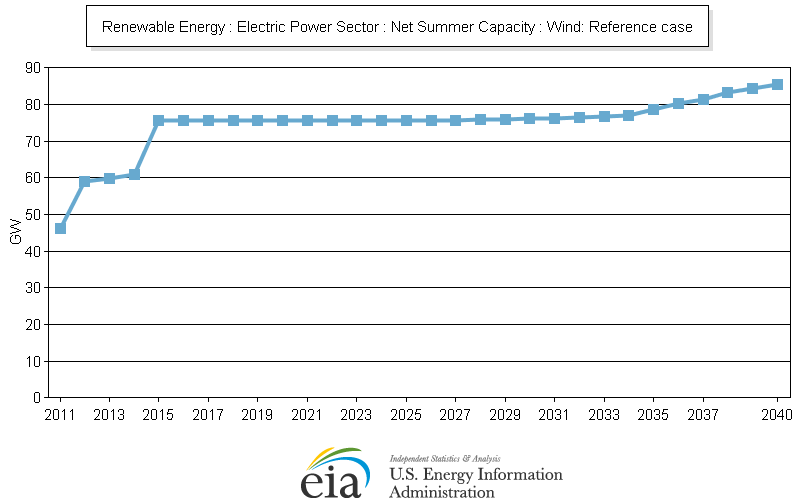
According to EIA, if the expired PTC is allowed to stay expired, their models show an expected stair-step increase in wind capacity by 2015 that flattens out for the next decade until gas prices rise and technology improvements make wind more competitive (see chart). If the PTC and the 30% ITC were made permanent EIA shows it would drive more renewables, particularly wind and solar, but at a significant cost: $4.5 billion/year from 2014 to 2040.


So what’s next

Big wind grew up on the tax credit, developed market plans and forecasts that relied on it, and now the wind PTC appears to be a required component of the industry’s economics. That was never the intent of Congress when this temporary tax credit was enacted 24 years ago. The PTC and ITC are now expired and we can expect roughly 15,000 MW of new wind to be built in response to the 1-year extension passed in 2013. After that, it’s over. It’s now time for taxpayers to consider better ways to spend their money.


Wind Turbines – “Novelty Energy”, Requires 100% back-up, for times with “no”, or “too much wind.

Reliance on Wind Power: Playing a Lethal Game

swiss winter2

A power generation system that can’t produce power on demand is no system at all. Wind power – entirely dependent on the weather – has consistently proven itself incapable of supplying meaningful power – requiring 100% of its capacity to be backed up by fossil fuel generation sources 100% of the time, both here (see our posts here and here andhere and here and here and here and here and here) and in Europe (seeour post here).

While the greentard shrugs and mumbles something about “battery technology improving” when presented with the fact that wind power can only ever be delivered at crazy, random intervals (see our post here) – those in touch with reality point to the social and economic catastrophe just waiting for the next occasion when wind power output plummets.

Here’s a great little piece from the Independent outlining the lunacy of our reliance on wind power and the potentially fatal consequences of placing faith in pure fantasy.

Energy policy based on renewables will win hearts but won’t protect their owners from frostbite and death due to exposure
Kevin Myers
Independent.ie
7 February 2012

Russia’s main gas-company, Gazprom, was unable to meet demand last weekend as blizzards swept across Europe, and over three hundred people died. Did anyone even think of deploying our wind turbines to make good the energy shortfall from Russia?

Of course not. We all know that windmills are a self-indulgent and sanctimonious luxury whose purpose is to make us feel good. Had Europe genuinely depended on green energy on Friday, by Sunday thousands would be dead from frostbite and exposure, and the EU would have suffered an economic body blow to match that of Japan’s tsunami a year ago. No electricity means no water, no trams, no trains, no airports, no traffic lights, no phone systems, no sewerage, no factories, no service stations, no office lifts, no central heating and even no hospitals, once their generators run out of fuel.

Modern cities are incredibly fragile organisms, which tremble on the edge of disaster the entire time. During a severe blizzard, it is electricity alone that prevents a midwinter urban holocaust. We saw what adverse weather can do, when 15,000 people died in the heatwave that hit France in August 2003. But those deaths were spread over a month. Last weekend’s weather, without energy, could have caused many tens of thousands of deaths over a couple of days.

Why does the entire green spectrum, which now incorporates most conventional parties across Europe, deny the most obvious of truths? To play lethal games with our energy systems in order to honour the whimsical god of climate change is as intelligent and scientific as the Aztec sacrifice of their young. Actually, it is far more frivolous, because at least the Aztecs knew how many people they were sacrificing: no one has the least idea of the loss of life that might result from the EU embracing “green” energy policies.

Frau Merkel has announced that Germany is going to phase out nuclear power, simply because of the Japanese tsunami. Well, that is like basing water-collection policies in Rhineland-Westphalia on the monsoon cycle of Borneo.

As I was saying last week, the Germans have a powerfully emotional attachment to everything that is “green”, and an energy policy based on renewables will usually win German hearts. But it will not protect the owners of those hearts from frostbite and death due to exposure, for wind can often be not so much a Renewable as an Unusable, and also an Unpredictable, an Unstorable, and – normally when it’s very cold – an Unmovable.

The seriousness of this is hard to exaggerate. The temperature in the Baltic countries last weekend was -33 degrees Celsius. The Eurasian landmass from Calais to Naples to Siberia was an icefield in which hundreds of millions of people were trapped. Without coal, oil and nuclear energy, mass deaths of the old and the young would have occurred on the first night. Three nights of such conditions, and even the physically fit would have been dying of exposure, as the temperature inside dwellings fell and began to match that of the outside, an inverse image of what happened during the French heatwave 10 years ago, when there was no escape from the heat.

Yet you will see nowhere in Dail Eireann, or Brussels, or the Palace of Westminster, a serious discussion about energy policies based on these realities, or which acknowledges that wind usually doesn’t blow when it is very cold, or that even when you have strong and steady winds blowing, you will still have to have created a parallel and duplicate energy supply to provide cover for when the wind stops. And merely to create that standby energy system will generate a zillion tons of carbon dioxide.

Wind power in Ireland actually produces only 22pc of its capacity: would you spend €100,000 on a car if it meant that €78,000 of the purchase price was wasted? It gets worse. On a really cold day, we actually need about 5,000 megawatts, but yesterday wind was producing under 50 megawatts: a grand total of 1pc of requirements.

Yet despite such appalling figures, we legally prohibit civil servants from even looking at the nuclear option. They won’t even take a phone-call on the subject. Instead, the fiction has taken hold amongst our media classes that we are close to being an exporter of renewable energy through the much-vaunted interconnector with Britain. But this is grotesquely untrue. We shall actually be exporting through the connector only 3pc of the time, and importing 86pc, with the system otherwise idle.

Mad, isn’t it? And madder still that RTE or the BBC will continue to trot out their pet wind-enthusiasts to bluster balderdash and poppycock about global warming and how renewables are the solution – and without the contrary point of view ever being given an airing.

This is dogma, as created, promulgated and enforced by the John Charles McQuaids of our time – and if sceptics are not actually anathematised from the pulpit, they are ruthlessly and systematically ignored. These dishonest, hypocritical and deceitful energy policies are now widely accepted by our political and teaching classes as being the very embodiment of environmentalist virtue. Such imbecilic virtue, if implemented as energy policy across Europe, could have brought about a human catastrophe last weekend.
Independent.ie

ICU Respiratory_therapist

Wind Turbines – “Novelty Energy”, Requires 100% back-up, for times with “no”, or “too much wind.

Reliance on Wind Power: Playing a Lethal Game

swiss winter2

A power generation system that can’t produce power on demand is no system at all. Wind power – entirely dependent on the weather – has consistently proven itself incapable of supplying meaningful power – requiring 100% of its capacity to be backed up by fossil fuel generation sources 100% of the time, both here (see our posts here and here andhere and here and here and here and here and here) and in Europe (seeour post here).

While the greentard shrugs and mumbles something about “battery technology improving” when presented with the fact that wind power can only ever be delivered at crazy, random intervals (see our post here) – those in touch with reality point to the social and economic catastrophe just waiting for the next occasion when wind power output plummets.

Here’s a great little piece from the Independent outlining the lunacy of our reliance on wind power and the potentially fatal consequences of placing faith in pure fantasy.

Energy policy based on renewables will win hearts but won’t protect their owners from frostbite and death due to exposure
Kevin Myers
Independent.ie
7 February 2012

Russia’s main gas-company, Gazprom, was unable to meet demand last weekend as blizzards swept across Europe, and over three hundred people died. Did anyone even think of deploying our wind turbines to make good the energy shortfall from Russia?

Of course not. We all know that windmills are a self-indulgent and sanctimonious luxury whose purpose is to make us feel good. Had Europe genuinely depended on green energy on Friday, by Sunday thousands would be dead from frostbite and exposure, and the EU would have suffered an economic body blow to match that of Japan’s tsunami a year ago. No electricity means no water, no trams, no trains, no airports, no traffic lights, no phone systems, no sewerage, no factories, no service stations, no office lifts, no central heating and even no hospitals, once their generators run out of fuel.

Modern cities are incredibly fragile organisms, which tremble on the edge of disaster the entire time. During a severe blizzard, it is electricity alone that prevents a midwinter urban holocaust. We saw what adverse weather can do, when 15,000 people died in the heatwave that hit France in August 2003. But those deaths were spread over a month. Last weekend’s weather, without energy, could have caused many tens of thousands of deaths over a couple of days.

Why does the entire green spectrum, which now incorporates most conventional parties across Europe, deny the most obvious of truths? To play lethal games with our energy systems in order to honour the whimsical god of climate change is as intelligent and scientific as the Aztec sacrifice of their young. Actually, it is far more frivolous, because at least the Aztecs knew how many people they were sacrificing: no one has the least idea of the loss of life that might result from the EU embracing “green” energy policies.

Frau Merkel has announced that Germany is going to phase out nuclear power, simply because of the Japanese tsunami. Well, that is like basing water-collection policies in Rhineland-Westphalia on the monsoon cycle of Borneo.

As I was saying last week, the Germans have a powerfully emotional attachment to everything that is “green”, and an energy policy based on renewables will usually win German hearts. But it will not protect the owners of those hearts from frostbite and death due to exposure, for wind can often be not so much a Renewable as an Unusable, and also an Unpredictable, an Unstorable, and – normally when it’s very cold – an Unmovable.

The seriousness of this is hard to exaggerate. The temperature in the Baltic countries last weekend was -33 degrees Celsius. The Eurasian landmass from Calais to Naples to Siberia was an icefield in which hundreds of millions of people were trapped. Without coal, oil and nuclear energy, mass deaths of the old and the young would have occurred on the first night. Three nights of such conditions, and even the physically fit would have been dying of exposure, as the temperature inside dwellings fell and began to match that of the outside, an inverse image of what happened during the French heatwave 10 years ago, when there was no escape from the heat.

Yet you will see nowhere in Dail Eireann, or Brussels, or the Palace of Westminster, a serious discussion about energy policies based on these realities, or which acknowledges that wind usually doesn’t blow when it is very cold, or that even when you have strong and steady winds blowing, you will still have to have created a parallel and duplicate energy supply to provide cover for when the wind stops. And merely to create that standby energy system will generate a zillion tons of carbon dioxide.

Wind power in Ireland actually produces only 22pc of its capacity: would you spend €100,000 on a car if it meant that €78,000 of the purchase price was wasted? It gets worse. On a really cold day, we actually need about 5,000 megawatts, but yesterday wind was producing under 50 megawatts: a grand total of 1pc of requirements.

Yet despite such appalling figures, we legally prohibit civil servants from even looking at the nuclear option. They won’t even take a phone-call on the subject. Instead, the fiction has taken hold amongst our media classes that we are close to being an exporter of renewable energy through the much-vaunted interconnector with Britain. But this is grotesquely untrue. We shall actually be exporting through the connector only 3pc of the time, and importing 86pc, with the system otherwise idle.

Mad, isn’t it? And madder still that RTE or the BBC will continue to trot out their pet wind-enthusiasts to bluster balderdash and poppycock about global warming and how renewables are the solution – and without the contrary point of view ever being given an airing.

This is dogma, as created, promulgated and enforced by the John Charles McQuaids of our time – and if sceptics are not actually anathematised from the pulpit, they are ruthlessly and systematically ignored. These dishonest, hypocritical and deceitful energy policies are now widely accepted by our political and teaching classes as being the very embodiment of environmentalist virtue. Such imbecilic virtue, if implemented as energy policy across Europe, could have brought about a human catastrophe last weekend.
Independent.ie

ICU Respiratory_therapist

Would you Mind Waiting Till the Wind blows, if you want Electricity? (but not too much)

Of Unicorns & Pink Elephants: “Reliance” on Wind Power is Pure “Green” Fantasy

Unicorn Drinking from a River

When it comes to their demand for electricity, the power consumer has a couple of basic needs: when they hit the light switch they assume illumination will shortly follow and that when the kettle is kicked into gear it’ll be boiling soon thereafter. And the power consumer assumes that these – and similar actions in a household or business – will be open to them at any time of the night or day, every day of the year.

For conventional generators, delivering power on the basic terms outlined above is a doddle: delivering base-load power around the clock, rain, hail or shine is just good business. It’s what the customer wants and is prepared to pay for, so it makes good sense to deliver on-demand.

But for wind power generators it’s never about how much the customer wants or when they want it, it’s always and everywhere about the vagaries of the wind. When the wind speed increases to 25 m/s, turbines are automatically shut-off to protect the blades and bearings; and below 6-7 m/s turbines are incapable of producing any power at all.

Even with the most geographically widespread grid-connected set of wind farms in the world (the 3,342 MW of wind power capacity connected to Australia’s Eastern grid across SA, Victoria, Tasmania and NSW) there are dozens of occasions each year when total wind power output struggles to top 2% of installed capacity – and hundreds when it fails to muster even 5% (see our posts here and here and here).

Now, if the power consumer was given advance warning of when these total output failures were going to occur, they might simply reconsider their selfish demands of having illumination after dark or that hot cuppa in the morning. That way, they might still consider wind power a “perfect substitute” for conventional power; and plump for the (purportedly cheaper) former over the latter every time?

But, so far, power consumers remain stubbornly selfish; wedded to the idea that when they hit the switch, their power needs will be satisfied that very instant (the cheek, hey?). And that’s where claims that wind power is a “substitute” for conventional generation fall in a heap.

Power delivered at crazy, random intervals (which in practical terms means no power at all, hundreds of times each year) is NO substitute for power delivered on-demand; anytime of the day or night; every single day of the year – and in volumes sufficient to satisfy all consumers connected to the same network, at the same time.

Wind power cannot, therefore, be considered a “substitute” for power which is available on-demand. With every MW of wind power capacity matched with a MW of conventional generation capacity at all times – needed to keep the grid stable by balancing the wild fluctuations in wind power output (see our post here) and to meet demand when output collapses to nothing (see our post here) – wind power is nothing but childish nonsense.

The only reason turbines have been slung up anywhere is in order for wind power outfits and their backers to reap a fat pile of taxpayer and power consumer subsidies. Here’s a take on the greatest rort of all time from the US.

Obama’s Green Unicorn
US News
Peter Roff
25 August 2014

The true cost of renewable energy is being masked by government subsidies and bailouts.

America is about as likely to become reliant on green energy to meet its baseload power requirements as a unicorn is to stroll down the middle of Washington’s Pennsylvania Avenue during rush hour followed by a pink elephant.

It’s just not happening – but that’s hasn’t deterred the modern day snake oil salesmen and their allies inside the Obama administration from continuing to make a push for wind and solar power as an eventual replacement for energy generated from traditional sources like coal, oil and natural gas. Renewable technology has improved, no doubt, but it’s a long way away from being ready to make a substantial contribution to the heating of our homes and the powering of our businesses unless the generous tax subsidies that create the illusion of cost competitiveness continue.

There’s nothing wrong per se with the pursuit of renewable energy; it’s just that what it actually costs is being masked by taxpayer subsidies, federal loan guarantees and renewable fuels mandates at the state level that force power companies to put wind and solar into the energy mix, sometimes at two to three times what traditional power costs. Ultimately, one way or another, the taxpayers and energy consumers are footing the bill even if they don’t know it.

Congress has taken a few positive steps in the right direction. The federal Wind Production Tax Credit was allowed to expire at the end of the year, meaning new wind projects are going to have to be competitive at market rates to attract funding. Remember it was none other than billionaire Warren Buffett, the “Oracle of Omaha,” who explained recently to a group of investors that the tax credit was the only reason that any sensible person invested in wind projects in the first place.

Unfortunately, some federal agencies are trying to keep the program alive through the backdoor.

The worst offender in this regard may be the IRS, which recently issued new “guidelines” that make it even easier for wind projects currently in development to qualify for the tax credit on the basis of work already contemplated or completed. According to Politico, “The IRS says completed or in-progress facilities can be sold and the costs incurred by the seller will still count toward qualifying for the [credit], except in cases where tangible property (think equipment like wind turbines) bought for one project is sold and used at another site.”

To translate this into English, it’s a move to help keep the whole shell game alive until such time as wind power supporters can get the tax credit reauthorized. “There is a large pipeline of projects that were under development at some stage that by virtue of this guidance will be able to go forward. In that regard it is going to permit a lot of projects to be developed,” said one wind energy expert cited by Politico.

Outside groups are also weighing in, including the Sierra Club, which has targeted nine members of Congress in a pressure campaign over the August recess to push for re-authorization of the Wind Production Tax Credit. That is in addition to the online ad buys in 16 other districts that started in June.

The Democrats who run the Senate want to keep the now-expired credit alive and have, in the Senate Finance Committee, already approved a package of so-called “extenders” that would breathe new life into it. The House has thus far refused to go along – and kudos to Texas Republican Rep. Randy Weber, who deserves credit for successfully introducing an amendment to shut the whole business down permanently. But he’s not just fighting the lobbyists and green groups in favor of the credit, but the entire federal bureaucracy which, once a program has been established, is loath to let it die.

Major government investment in speculative green projects may have at one time made sense. But even if that were once the case, it is so no longer. The Obama green energy push has enriched more than a few politically well-connected liberals who used tax credits and government bailouts to enlarge their portfolios, but it has done little to make energy more abundant or lower costs to consumers, which is the justification in the first place to get the taxpayers involved.

If people want to build wind farms – on land or offshore – and they want to reap the benefits of their investments, then they should be willing to take the same risks as everyone else. The way the bureaucrats have it structured now, the taxpayers are making payments on both ends through subsidies for construction and higher rates on consumption. It’s a system only a bureaucrat could love.
US News

yacht

Investing in the Wind Turbine Scam, is a Risky Business!

Australia’s wind turbines may stop spinning as banks foreclose


Australian analysts have warned that some of the country’s wind farms could be forced to close down under proposals made by the Abbott government’s RET Review panel.

Insiders are aghast at the assumptions made by the panel about the possibility of closing the scheme to new entrants and providing “grandfathering” arrangements for existing assets.

They say the proposals – and the assumption that LGCs, the certificates that are the currency of the scheme – will hold value are flawed, and the panel has not considered the basic refinancing risks of all projects under any scenario.

“I’m amazed at how flawed this document is,” said one close observer. “It is internally inconsistent, it is intellectually flawed … and it doesn’t even try to cover up its bias. It is 160 pages of self-serving logic.”

Another noted that almost every wind farm in the country will be up for refinancing for next 3 years. “They will be in major financial distress, and they are all at risk of falling over.”

While wind farms in Australia can have long term power purchase agreements out to 2030, the financing arrangements are much shorter, usually around 5 years.

This means that most, if not all, wind farms, will be up for refinancing in the next few years. When that happens, the major banks will review the state of the market, and are either likely to raise the price of debt, or do an “equity sweep” – calling on project owners to invest more cash.

None are likely to do so.

And in some cases – because the value of the LGCs will be effectively zero – as Bloomberg New Energy Finance has pointed out – and the price of wholesale electricity has fallen due to the removal of the carbon price and over-capacity brought about by the construction of thousands of megawatts of gas-fired generation – many wind farms will struggle to make debt obligations under current terms.

In its report, BNEF warned that a “whole host of Australian and foreign companies and lenders could be exposed to asset impairments, and almost all will suffer significant write-downs in the mark-to-market value of their investments.”

This dire situation was confirmed last week by Infigen Energy, which warned of potential bankruptcieslast week (an extraordinary enough statement for a listed company). Infigen Energy head Miles George – who doubles as the chair of the Clean Energy Council – warned that many other companies are in a similar situation.

Those wind farms on merchant contracts are most at risk, but even those with PPAs have clauses which allow bankers to review the financing arrangements.

Analysts suggest that Australian banks will be mortified when they understand the full implications of the review panel’s recommendations.

“Every time there is a refinancing, banks redo the base case model for the project. As the situation gets worse – with a lower LGC price – they will have to squeeze all of their parameters to make sure they get repaid,” one said.

“When they pull all those levers – a shorter amortisation period, a higher debt-equity ratio, then the equity holders are going to have to tip in additional capital to keep the projects going. The project owners are not in position to do that.

“And if the equity holders start falling over, banks might be left with wind farms to run and operate. But there will be no real market left, and no real market value in those projects. It may be that they have to turn them (the wind turbines) off.”

Even the other scenario recommended by the RET Review panel – that of downgrading the target from its current level of 41,000GWh to a “real” 20 per cent target of around 25,000GWh with targets set annually, would not be practical.

Analysts warn that there would unlikely be any new entrants because of the price uncertainty with rolling targets and – as a result – the higher cost of capital.  It is highly unlikely that any Australian bank would provide debt finance in these circumstances.

All of Australia’s big four banks are at risk, but particularly NAB and ANZ, who have project financed most wind farms in Australia.

bnef debt

Look at the Kind of Nonsense, the On-Line Health and Safety Course was promoting!

Is There Anything At All, Nowadays, that Cannot be Attributed to “Global Warming”?  The Alarmists will soon resort to walking the streets, with sandwich boards, warning us, that the end is near!

VIOLENCE IN THE WORKPLACE

INTRODUCTION

Violence in the Workplace has been increasing over the last five years due to changes in both lifestyle and climate.

Lifestyles have changed in the last 20 years. People are expected to work longer hours, and there is more pressure to get more work completed with fewer workers mainly due to downsizing.

We have seen more than a 50% increase in 2006 – 2007 and 2008 due to climate change.  These companies have not taken steps to be proactive in such areas as:

  • Makeup Air Systems
  • Air Movement
  • Changes to Remove
  • Heat from Equipment
  • Companies have not Developed Policies to Deal with Climate Change
  • New Procedures and Programs to Deal with Increase in Heat and Relative Humidity (R.H%).

The Wind Turbine Scam is Destroying Our Economies, as Well as Our Communities!

Professor Ross McKitrick: Wind turbines don’t run on wind, they run on subsidies.

economics101

As STT followers are acutely aware, wind power is an economic and environmental fraud. Because wind power can only ever be delivered at crazy, random intervals – and, therefore, never “on-demand” – it will never be a substitute for those generation sources which are – ie hydro, nuclear, gas and coal (see our posts here and here and here and hereand here and here and here and here).

Were it not for government mandates – backed by a constant and colossal stream of subsidies (see our post here) – wind power generators would never dispatch a single spark to the grid, as they would never find a customer that would accept power delivered 30% of the time (at best) on terms where the vendor can never tell customers just when that power might be delivered – if at all (see our post here).

Ultimately, it’ll be the inherently flawed economics of wind power that will bring the greatest rort of all time to an end. The policies that created the wind industry are simply unsustainable and, inevitably, will either fail or be scrapped.

The Canadians are reeling under the ludicrous wind power policies of a hard-green-left Liberal government, clearly intent on committing economic suicide. Power prices – driven by exorbitant guaranteed rates to wind power outfits – have rocketed – tripling in less than a decade, driving energy intensive businesses – like manufacturing – out of business or offshore – stifling business investment – killing off or threatening thousands of sustainable (unsubsidised) jobs across Canada and otherwise creating economic chaos (see our post here).

The scale and scope of Canada’s wind power disaster hasn’t been lost on top energy market economists, like Ontario’s Professor Ross McKitrickfrom the University of Guelph.

Downwind - Ross McKitrick - Uni of Guelph (Time 0_06_00;22)

Ross was interviewed for the brilliant Sun News documentary ‘Down Wind’ by presenter, Rebecca Thompson, which has been extracted in the video below. The transcript appears below.

****

Downwind – Ross McKitrick – Uni of Guelph

Downwind – Ross McKitrick – Uni of Guelph


Rebecca Thompson: First we turn to Professor Ross McKitrick, an economist. He recently published a very scathing review of how economically unsound the Ontario Liberal government’s Green Energy Act is.

Professor Ross McKitrick: Well the important thing to understand about wind turbines is that they don’t run on wind, they run on subsidies.

Rebecca Thompson:  We went to see McKitrick at the University of Guelph.

Professor Ross McKitrick:  All the arguments that they’ve put forward for the Green Energy Act they really turned out to be phoney once we looked at them closely. They said that it would improve the economy, reduce air pollution emissions and it would replace coal fired power. And the problem is with the first one, it is not going to improve the economy because of what you are doing is replacing power that costs 3 to 5 cents per kilowatt hour to generate, and you’re replacing it with power that costs at least 13 1/2 cents per kilowatt hour to generate. So you’re raising the cost of doing business, it will drive down the rate of return in manufacturing and mining and that has to translate into job losses and reduced investment and shrinking the economy.

Rebecca Thompson: So you’ve pointed out that wind energy in fact, isn’t in the public interest in the short term but will it be in the long term?

Professor Ross McKitrick:  Nobody was building wind turbines in Ontario until the government started throwing money at it. It is not a profitable source of electricity, it’s not cost-effective. Wind turbines can’t compete on the wholesale market without a lot of government support.

Rebecca Thompson: The system used to fund wind energy in many places around the world is called a Feed-In-Tariff (FIT).

Professor Ross McKitrick:  And that means if you build a bank of wind turbines somewhere, and you get the contract that everyone is looking for you get a guarantee of 20 years being paid 13 1/2 cents per kilowatt-hour for the electricity that’s generated while the wholesale rate in Ontario is typically between 2 – 4 cents per kilowatt hour.

Rebecca Thompson: The Ontario government piggybacked off what is a European idea of a feed in tariff policy where the prices are locked in for 20 year contracts. And here’s another head scratcher …

Professor Ross McKitrick: The other provision of the contracts is that the system has to buy the power from you whenever you produce it. So the standard power plants, nuclear plants and hydro plants and so forth – there is no guarantee for them to buy their power, they have to compete on a wholesale market they have to price their product, in this case electricity, so that the system operator will buy it. With wind turbines, if the blades are running, the system operator has to buy it. Now they have adjusted that slightly in the last year because of this problem of the system operator being forced to buy tons and tons of power when it doesn’t need it, at 13 1/2 cents per kilowatt hour and sell it on the export market at one or two cents per kilowatt-hour – it was costing hundreds of millions of dollars a year for the system operator to do that. So the province now allows the system operator to reject some of the power that the wind turbines produce and instead the province will pay the wind turbine owners a benefit for what they call ‘deemed production’. So it’s really just transferred that same costs on to the taxpayer now.

Rebecca Thompson: The bottom line is pretty good for the wind energy sector.

Professor Ross McKitrick:  They get a 20 year contract to sell wind power at far above market rates and it doesn’t matter that they are generating power at times when the province absolutely doesn’t need it, and we can’t use it, and we just have to try to find some neighbouring jurisdiction to buy it from us. We used to have a few large power plants in Ontario and we had our grid that was optimised to source electricity from a few large central locations. We’re now shutting down the large central locations and replacing them with this proliferation of tiny little unreliable wind farms and you have to build a whole new grid to accommodate that. So that’s again an extra cost to get something that we already had.

Rebecca Thompson: What’s more is that the Green Energy Act hasn’t even come close to creating the number of jobs the Liberals claimed it would.

Professor Ross McKitrick: It turned out that the province had claimed that there were going to be 50,000 new jobs created from the Green Energy Act. When the Auditor General asks them to back that up because it doesn’t really make sense that this would create any jobs – what they admitted was they were really talking about were temporary construction jobs – as you put up wind turbines you need some workers in to do that. But then once the wind turbines are built, then those jobs disappear and there are no ongoing jobs. In economics, it’s an old fallacy, what’s called the broken window fallacy. If you go around breaking shopkeeper’s windows, since they have to hire repair people to fix the windows then you’ve somehow improved the economy. But, you haven’t. All you have done is increase the cost of having what you had before – which was windows in stores.

Rebecca Thompson: If the new shift to green power is so inefficient why hasn’t anyone working in the system spoken out?

Professor Ross McKitrick:  There are a couple of reasons. The power workers union has spent money on advertisements. They did try to fight against the closing of Lambton and Nanticoke – they understood that this was a bad deal for the workers in the province. But they did want they could. But it’s hard to be up against a government that is pushing so much propaganda on coal. There were people certainly in the power generating sector that understood that the government’s numbers weren’t correct and didn’t add up. But, they were effectively muzzled.

Rebecca Thompson: McKitrick speaks to people all the time about the changes in the system.

Professor Ross McKitrick:  I do find people working in the power sector, they know that this is a crazy system. These wind farms are displacing hydro electricity which is just a waste on every level because we have the hydroelectric facilities, they don’t generate any air pollution emissions. They give us reliable, predictable baseload power. And now we run wind turbines and let those hydro-facilities sit idle. So people who work in the sector, they can see what’s going on and they know that this is a waste. But, for understandable reasons they’re not about to make a big noise about it because they could lose their jobs if they do.

Rebecca Thompson: Whether any government would actually be able to get out of existing contracts is debatable. Ross McKitrick says it’s possible.

Professor Ross McKitrick: One option might be to buy out some of the wind turbine companies and take those wind turbines off the grid, or only use their power when they’re competitive. In Europe, what governments have started to do though is put on special new taxes on renewable sources, solar and wind, to try and recover some of these costs. Alternatively, the government may look to try and tear up the contracts and accept the legal liability that goes with it, but it’s not going to be easy.
Sun News: Down Wind

Down Wind, which runs for 96 minutes, can be purchased as a file and downloaded or as a DVD for those in the US and Canada (here’s the link). For those outside the US and Canada the file can be purchased and downloaded (using this link). If you’re in there fighting the great wind power fraud, Down Wind is essential viewing.

For a detailed synopsis of Down Wind – see our post here.

down wind

Wind Industry Denies Health Problems Cause by Wind Turbines, to Avoid Being Held Accountable!

Sunday Express 24th August, 2014

I’m abandoning my home over wind turbine illness

Credit: Paula Murray

A Pensioner is abandoning her Scottish dream home after more than a quarter of a century because wind turbines are making her life a “living hell”.

Kay Siddell, 69, and her husband John, 64, moved to their rural retreat at Old Dailly, near Girvan, Ayrshire, in 1988 to enjoy the peace and quiet of the countryside.

They saved for years to renovate their home, but after a 53 turbine wind farm, Hadyard Hill, was built, the pair put everything on hold.

For the past eight years they have tried to come to terms with the noise and visual impact, but now, with Mrs Siddell’s health failing and further turbines planned, they have finally decided to move away.

Remarkably, Mrs Siddell and her retired Army sergeant spouse plan to abandon the steading and a sizeable parcel of land in a bid to prevent any more wind farms being built.

The pensioner said: “The turbines are forcing us out. We don’t want to sell our property – which comes with 10 acres of land – because we object to wind farms and want to make sure the operators cannot buy this land for more turbines.

“So rather than trying to sell our home we are just abandoning it in a bid to make sure at least that small area remains turbine free.”

The mother – of – one said there was an application to extend Hadyard Hill by another 55 turbines and planning permission to construct another 20 within the vicinity of their property.

She said: “That would bring the number to well over 100.

“We already have the TV and radio on at all times to try and block out the noise. There’s the obvious noise you hear and the flicker which comes in, especially in the winter because of the low sun, and that’s terribly disturbing.

“Then there’s the noise you can’t hear which is infrasound.

“Within two weeks of the turbines being switched on in 2006 our cats refused to go out and eat or drink – eventually we had to put them down. I think it was because of the sensation or noise they got from the wind farm which we couldn’t feel or hear.”

Mrs Siddell, who used to work for the Ministry of Defence, is adamant the turbines are damaging her health – adding to the growing number of cases since the issue was first exposed by the Scottish Sunday Express.

She is even willing to have a biopsy to prove her internal organs have been damaged by low-frequency noise.

She said” “Air stewards and people working on ships develop a hardening in their internal organs related to the vibration brought on by infrasound.

“I would like to have a biopsy to test if I have any signs of this vibroacoustic disease. If the evidence is there the only reason it would be there is the wind farm, as I’ve never worked on board planes and I am no cruise goer.

What’s magical with this marker is that it could not be anything but infrasound damage.

“It could explain my stress levels which are causing other physiological problems.”

Using the money they saved for the planned renovation, the Siddells are now packing up their belongings and moving to England to be near their son.

The first removal load was due to leave their home last week, and the rest will follow soon.

Mrs Siddell said: “We were here long before any turbines went up. We always knew that because of our remote location, the day would come we would have to move out. However the day came much sooner than we expected because of the wind farm.”

Wind farm operators and trade groups insist there are no proven links between turbines and ill health.

Credit: Paula Murray, Sunday Express, Scotland

Wind Pushers are Allowed to Slaughter Birds, With Impunity!

Bye Bye Birdie
Does the government give green-energy firms a free pass on bird deaths?

Death from Above: A wind-power tower (Dreamstime)
 
Two former U.S. Fish and Wildlife Service investigators tell National Review Online that the federal government acted with a bias, giving renewable-energy companies a pass on unlawful bird deaths while rigorously prosecuting traditional energy companies for the same infractions.

“If birds were electrocuted or in oil pits, we prosecuted those companies,” says Tim Eicher, a special agent who handled cases involving migratory birds, eagles, and endangered species until his retirement three years ago. But the Fish and Wildlife Service “has drunk the Kool-Aid on global warming,” Eicher tells NRO. When it comes to wind- and solar-energy companies, “the end, to them, justifies the means: They’re saving the planet, and if eagles die in the process, so be it.”


Dominic Domenici, a former Fish and Wildlife Service investigator who worked with Eicher in Wyoming, says the bias is obvious because, when unlawful bird deaths occur, the federal government “prosecutes everything except for wind and solar — and they give [those renewable companies] permits” for bird-killing. That bias, Domenici says, is “top-down” within the Fish and Wildlife Service.

“They have chosen to do everything they can to make wind energy look perfect,” Domenici says. He adds: “I think they just want an alternative energy so badly that they’re prepared to turn a blind eye on all the bad parts of it. And it may be the best thing in the world, and it may be the answer — but they still need to enforce the laws to put the incentives [against bird-killing in place].”

Potential bias in the enforcement and prosecution of bird deaths has piqued the interest of the House Natural Resources Committee, which in March subpoenaed the case files for all Obama-administration investigations conducted under the Migratory Bird Treaty Act or the Bald and Golden Eagle Protection Act.

But to date, the Fish and Wildlife Service has not provided all of the records, says the committee’s press rep, Michael Tadeo.

“Our subpoena has not been fully complied with,” Tadeo says. “The documents we have received have been heavily redacted, and the administration continues to stonewall us on this issue.”

Republican Kevin Cramer, a North Dakota congressman who’s on the Natural Resources Committee, tells NRO: “The Obama administration is clearly not just biased but hard-biased against fossil-fuel development, and it is willing to selectively enforce federal laws and rules to favor what they consider to be clean energy. It’s certainly not played out any clearer than it is with [the administration’s] enforcement of things like the Migratory Bird Act. . . . It’s a clear-cut bias. I think it’s hypocrisy at its worst. On one hand, they want to be environmentally clean. On the other, they don’t care how many birds they kill doing it.”

But Mike Daulton, vice president of government relations at the Audubon Society, says he’s skeptical of claims or suspicions of bias on the part of the Fish and Wildlife Service.

“I think it’s a stretch to say that the law is being applied more to oil or gas, or that it’s being disproportionately applied,” Daulton tells NRO. “This is looking for an excuse to attack the administration. In the past, [the Migratory Bird Treaty Act] has been applied in very narrow circumstances. The application of the law to wind could be broader. . . . I’ve heard that there are cases in the pipeline at the Department of Interior and Justice.”

But Bob Johns, director of public relations at the American Bird Conservancy, says, “The numbers don’t lie — and those numbers say that the wind- and the solar-energy industries have not been held to the same standards that other industries have.”

Johns noted that the Altamont Energy wind farms in California, for example, kill between 70 and 80 golden eagles a year — and have never been prosecuted. He adds that he’s not aware of any prosecutions against solar companies.

Testifying to the House committee in March, the director of the Fish and Wildlife Service said the agency was investigating 17 incidents at wind farms, along with 21 at oil and gas sites. It’s unclear whether any investigations have occurred at solar-energy sites, even as reports emerge that California’s Ivanpah solar plant alone may be responsible for up to 28,000 bird deaths annually.

Frauds, Crooks and Criminals

Demonstrating daily that diversity is not strength!

Family Hype

All Things Related To The Family

DeFrock

defrock.org's principal concern is the environmental and human damage of industrial wind turbines on rural communities

Gerold's Blog

The truth shall set you free but first it will make you miserable

Politisite

Breaking Political News, Election Results, Commentary and Analysis

Canadian Common Sense

Canadian Common Sense - A Unique Perspective from Grassroots Canadians

Falmouth's Firetower Wind

a wind energy debacle

The Law is my Oyster

The Law and its Place in Society

Illinois Leaks

Edgar County Watchdogs

stubbornlyme.

My thoughts...my life...my own way.

Oppose! Swanton Wind

Proposed Wind Project on Rocky Ridge

Climate Audit

by Steve McIntyre

4TimesAYear's Blog

Trying to stop climate change is like trying to stop the seasons from changing. We don't control the climate; IT controls US.

Wolsten

Wandering Words

Patti Kellar

WIND WARRIOR

John Coleman's Blog

Global Warming/Climate Change is not a problem