Letter from Ontario PC Leader Tim Hudak to Elections Ontario
MAY 28

MAY 28
1) Germany’s Green Jobs Miracle Collapses
Die Welt, 26 May 2014
Daniel Wetzel
Renewable energy was supposed to create tens of thousands of green jobs. Yet despite three-digit Euro billions of subsidies, the number of jobs is falling rapidly. Seven out of ten jobs will only remain as long as the subsidies keep flowing.

The subsidisation of renewable energy has not led to a significant, sustainable increase in jobs. According to recent figures from the German Government, the gross employment in renewable energy decreased by around seven per cent to 363,100 in 2013.
Counting the employees in government agencies and academic institution too, renewable energy creates work for about 370,000 people.
This means, however, that only to about 0.86 percent of the nearly 42 million workers, which are employed in Germany, work in the highly subsidized sector of renewable energy. Much of this employment is limited to the maintenance and operation of existing facilities.
Further job cuts expected
In the core of the industry, the production of renewable energy systems, only 230,800 people were employed last year: a drop of 13 percent within one year, which is primarily due to the collapse of the German solar industry.
There is no improvement in sight, according to the recent report by the Federal Government. It says: “Overall, a further decline of employees will probably be observed in the renewable energies sector this and next year.”
15 years after the start of green energy subsidies through the Renewable Energy Sources Act (EEG), the vast majority of jobs from in this sector are still dependent on subsidies.
Hardly any self-supporting jobs in Green energy
According to official figures from the Federal Government, 70% of gross employment was due to the EEG last year. Although this is a slight decrease compared to 2012, seven out of ten jobs in the eco-energy sector are still subsidized by the Renewable Energy Sources Act (EEG).
Around 137,800 employees work in the wind sector which was the only eco-energy sector, besides geothermal, that increased employment. About 56,000 employees in photovoltaic sector depend on EEG payments.
Investments drop by 20 percent
Subsidies for the generation of green electricity have been paid for almost 15 years and have piled up into a three-digit billion sum, which has to be paid over 20 years by electricity consumers through their electricity bills. This year alone, consumers must subsidize the production of green electricity to the tune of around 20 billion Euros. A lasting effect on the labour market is not obvious.
The report, “Gross employment in renewable energy sources in Germany in 2013″, commissioned by the Federal Ministry of Economy and Energy, was jointly written by the institutes DLR, DIW , STW , GWS and Prognos. According to the researchers, the cause of the decrease in employment is the declining investments in green energy systems.
The investments in renewable energy sources in Germany fell by a fifth, to 16.09 billion Euros in the past year. Only about half as many solar panels were installed in Germany as the year before. Investment in biomass plants and solar thermal dropped as well.
“Nothing left from the job miracle“
The researchers do not expect that the production of high quality green energy systems will still lead to a job boom in Germany. For this year and the next they expect a further decline in employment instead. Thereafter, low-tech sectors such as “operation and maintenance” as well as the supply of biomass fuels are expected to „stabilise the employment effect”.
„A few years ago the renewable sector was the job miracle in Germany, now nothing is left of all of that,” said the deputy leader of the Greens in the Bundestag, Oliver Krischer.
The Green politician is sceptical about the attempts by the Federal Government to reduce the subsidy dependence of the green energy sector: „The brakes on the expansion of renewables by the previous conservative-liberal government is now fully hitting the job market,” said Krischer: “Thanks to the current EEG reform by the Union and SPD, the innovative and young renewables industry will lose more jobs.”
The bottom line, no jobs remain
The report by the Federal Government explicitly estimates only the „gross employment“ created primarily by green subsidies. The same subsidies, however, have led to rising costs and job losses in many other areas, such as heavy industry and commerce as well as conventional power plant operators. For a net analysis, the number of jobs that have been prevented or destroyed as a result would have to be deducted from the gross number of green jobs.
Official figures for the net effect of renewables on employment in Germany were originally supposed to be presented in July, according to the Federal Economics Ministry. However, the presentation has now been delayed until the autumn.
Researchers such as the president of the Munich-based IFO institute, Hans-Werner Sinn, believe that the net effect of subsidies for renewable energy on the labour market is equal to zero:
“Whoever claims that net jobs have been created must prove that the capital intensity of production in the new sectors is smaller than in the old ones. There are no indications for that. ”
“There is no positive net effect on employment by the EEG,” said Sinn: “Through subsidies for inefficient technologies not a single new job has been created, but wealth has been destroyed. “
Translation Philip Mueller

2) Reminder: Gordon Hughes: The Myth of Green Jobs
Global Warming Policy Foundation, September 2011
“Claims by politicians and lobbyists that green energy policies will create a few thousand jobs are not supported by the evidence. In terms of the labour market, the gains for a small number of actual or potential employees in businesses specialising in renewable energy has to be weighed against the dismal prospects for a much larger group of workers producing tradable goods in the rest of the manufacturing sector,” said Professor Gordon Hughes.
Full GWPF report: The Myth of Green Jobs


Dr Gordon Hughes is a Professor of Economics at the University of Edinburgh and a while back produced this cracking study which destroyed yet another wind industry myth about the longevity of their giant fans: windfarm peformance UK hughes.19.12.12.
Instead of the much touted 25 years, the output from modern turbines starts to drop significantly after about 8 – and they’re well and truly ready for the scrapheap by the time they hit their teens. Here’s a story on Dr Hughe’s findings by The Courier.
Wind turbines’ lifespan far shorter than believed, study suggests
The Courier
29 December 2012
SCOTLAND’S LANDSCAPE could be blighted by the rotting remains of a failed regeneration of windfarms, according to a scathing new report.
A study commissioned by the Renewable Energy Foundation has found that the economic life of onshore wind turbines could be far less than that predicted by the industry.
The “groundbreaking” research was carried out by academics at Edinburgh University and saw them look at years of windfarm performance data from the UK and Denmark.
The results appear to show that the output from windfarms — allowing for variations in wind speed and site characteristics — declines substantially as they get older.
By 10 years of age, the report found that the contribution of an average UK windfarm towards meeting electricity demand had declined by a third.
That reduction in performance leads the study team to believe that it will be uneconomic to operate windfarms for more than 12 to 15 years — at odds with industry predictions of a 20- to 25-year lifespan.
They may then have to be replaced with new machinery — a finding that the foundation believes has profound consequences for investors and government alike.
Members of the renewables industry have attacked the findings, questioning the Edinburgh University research and describing them as “misleading”.
Scottish Renewables for one said that its oldest commercial windfarms in Scotland were around 16 years old and that none of them have been decommissioned or repowered.
Nonetheless, anti-windfarm campaigners believe that the evidence should be enough to halt the pace of development and force the Scottish Government to rethink its backing of the energy source.
Conservative MSP Murdo Fraser said that parts of the USA, where the industry is further advanced, were already home to what amounted to windfarm graveyards.
And he said the difficulties associated with the decommissioning of such machinery could blight the Scottish landscape for years.
“We already know that the average wind turbine must be in operation for a minimum of two years to pay back the carbon cost of construction,” he said.
“If the average lifespan of a wind turbine is only 10 years then the Scottish Government must seriously question wind energy’s role in displacing carbon emissions.
“However, the rapid wear and tear of wind turbines comes as no surprise. We need only cast our eye across the Atlantic to see 12,000 turbines rotting in the Californian desert.
“I have particular concerns surrounding the environmental costs of decommissioning and exactly who bears these burdens.
“With question marks raised over intermittency, noise, cost, efficiency, placement and now lifespan, when will the Scottish Government see sense and pull at the reins of wind energy?”
The Renewable Energy Foundation is a registered charity promoting sustainable development for the benefit of the public by means of energy conservation and the use of renewable energy. It claims to have “no political affiliation or corporate membership” and believes its findings have worrying implications for the investment being made in the UK in wind power.
The study also reports that the decline in the performance of Danish offshore windfarms had been greater than that of UK onshore windfarms.
Director Dr John Constable said: “This study confirms suspicions that decades of generous subsidies to the wind industry have failed to encourage the innovation needed to make the sector competitive.
“Put bluntly, wind turbines onshore and offshore still cost too much and wear out far too quickly to offer the developing world a realistic alternative to coal.”
The Courier
California has something like 14,000 giant fans that have been abandoned – erected in the late 1980s they lasted less than 20 years – most were clapped-out by 1998 – before the enormous cost of maintaining them saw them left to rust:

In Hawaii a stack went up at Kamaoa in 1985 – by 2004 they too were left to the elements:
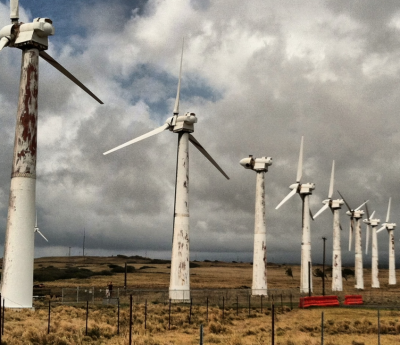
So, you’re thinking, only in America could wind power outfits get away with leaving thousands of giant fans to rust in the paddock. Well, think again.
The company that wind power outfits use to hold the land holder agreements with farmers is usually a $2 company with no real assets and, therefore, the “promise” contained in those agreements to decommission turbines isn’t worth the paper it’s written on: the parent company will simply let the company with the land holder agreement be wound up in insolvency; and host farmers were too gullible to obtain decommissioning bonds to ensure the clean-up costs are covered. And planning authorities were just as stupid – they could have easily forced developers to provide decommissioning bonds as a condition of granting planning consent, but generally failed to do so.
So, once these things are past their economic use by dates, their owners will cut and run in a heartbeat. Expect to see fleets of dilapidated fans rusting on Australian ridge-lines in the not too distant future.

The Ontario Liberals have quietly pushed their tall tales, saying the PC government under Mike Harris gutted Ontario’s health-care system.
Their tales go beyond spin and enter the realm of self-serving lie. It is most telling that the Liberals never bring this lie into public debate, they merely use it as part of a whisper campaign, repeating it until it begins to take hold among the general populace.
For example, references to hospital closures that I’ve found suggest that in total the Liberals claim that the PC government closed 39 hospitals in Ontario. They arrive at this number in two ways. Several places in Ontario, including Thunder Bay, Cobourg, Peterborough and Sault Ste. Marie, had two aging hospital facilities. The PCs closed these old, outdated hospitals and built new ones.
The Liberals have lied by omission, in failing to account for the new hospitals that were built in Ontario, some to replace aging buildings and several entirely new hospitals to serve growing populations. By my count we closed 12 hospitals in this manner and opened 17 new ones.
In addition, several hospitals located in close proximity were amalgamated to save on administrative costs. For example, Oakville Trafalgar, Milton District and Georgetown hospitals were amalgamated into Halton Healthcare Services. Liberal Party math says we closed three hospitals. The truth is we simply streamlined the costs — the facilities never closed. We repeated this in major urban centres across Ontario.
The truth is we streamlined costs, opened new facilities to replace aging buildings, significantly grew health-care facilities and increased services in Ontario.
The Liberals conveniently forget the PC government opened new facilities across the province to house 20,000 long-term care patients, people who were taking spaces in acute-care hospitals. In addition, we upgraded existing long-term care facilities for 16,000 Ontarians.
This isn’t only about hospitals. If the PCs gutted health care, how do they explain the expansion of nursing positions? How do they explain our creation of home-care services? How do they explain our substantially-increased funding for cardiac and cancer care and expanded cancer care centres across Ontario? How do they explain 52 new MRIs the PCs brought to Ontario where only 12 existed and the addition of 55 CT scanners? At what point does partisan political spin damage our society? At what point do lies like this get punished by voters?
Ted Chudleigh is the Conservative MPP for Halton.

Alan talks to the English columnist and novelist about wind power and alternative energy fraud
Sun News Network will air the television premiere of the documentary film DOWN WIND on Wednesday, June 4 at 8:00 p.m. ET and 11:00 p.m. ET.
DOWN WIND is a tell-all film that deals head on with how Ontario politicians rammed through green energy laws and dashed forward with the installation of thousands of wind turbines across the province’s farmland and countryside.
The film exposes how the lights of liberty went out for Ontario citizens deeply opposed to wind turbine projects. It tells the stories of communities torn apart, and the rural warriors now fighting for their rights, health and happiness.
Sun News Network host and contributor Rebecca Thompson joined Surge Media Productions to create this passionate, yet alarming story of a flawed attempt to green Ontario’s electricity grid.
DOWN WIND debunks the Ontario Liberal government’s propaganda that wind power is economically and environmentally sound, by pointing to jaw-dropping wind subsidies and a fossil fuel back-up system.
The film tells the ugly truth about lucrative big wind power contracts, skyrocketing electricity prices, and the political connections behind it all.
It uncovers the skeptical sales pitch that wind turbines are good for the air and won’t impact health. And it provides a glimmer of hope that this nightmare can be overcome with fair-minded solutions.
Passionate stories, eye-dropping footage and never-before seen interviews are showcased in this highly anticipated Sun News Network film backed financially by hundreds of concerned citizens.
A DVD version, including bonus features, will be available for purchase atwww.DownWindMovie.com following the television release.
Sun News Network is available on cable and satellite across Canada; check your local listings to find it on your dial.


Apart from the insane cost of propping up near bankrupt wind power outfits – like Infigen – with $ billions in subsidies in the form of the REC Tax/Subsidy – the wind industry gets to “free-ride” on the Australian electricity consumer in at least 2 ways.
The first is getting preferential distribution of the power wind farms manage to dispatch to the grid at crazy, random intervals – at no cost to wind power outfits.
Because the mandatory RET carries with it the threat of a $65 per MWh fine for retailers failing to satisfy the RET, wind power outfits have been able to “encourage” retailers into signing Power Purchase Agreements at rates ($90-120 per MWh) 3-4 times the cost of conventional power generation; under which the retailer receives a Renewable Energy Certificate. The retailer, therefore, avoids the $65 per MWh fine by purchasing a MW of wind power (as part of the PPA) and surrendering a REC as proof of purchase.
With ludicrously high and guaranteed rates under their PPAs, wind power generators are able to underbid all-comers in the dispatch market and – on those occasions when the wind is blowing (usually at night-time) – are happy to drive the dispatch price towards zero and even into negative territory – simply because they will continue to make money at the phenomenal rates guaranteed by their PPAs (see our post here).
The consequence of this Federally mandated market distortion, is that wind power takes precedence over all other forms of generation and – on every occasion when the wind is blowing – results in wind power jumping to the head of the queue.
This results in thermal gas and coal generators having to throttle back their generators; and ramping down output by disengaging turbines. However, boilers continue to run – gas and coal continue to burn – with the plant ready to re-engage the generator at a minute’s notice – ramping up output in order to take up the slack when the wind inevitably – but unpredictably – stops blowing (see our post here).
Forcing thermal plants to ramp output up and down means those plants run much less efficiently than they should – and leads to mountains of wasted coal and gas and, therefore, increased CO2 emissions (see thisEuropean paper here; this Irish paper here; this English paper here; and this Dutch study here).
Wind power outfits don’t bear any of the additional and unnecessary costs suffered by conventional generators in this regard.
And worse, network operators don’t charge wind power operators a cent for the privilege of getting their power into the system on a preferred basis; nor are they charged for the disruption and chaos their utterly unpredictable efforts cause grid managers and conventional generators. So far, so pointlessly costly.
The second way in which wind power gets a “free-ride” at power consumers’ expense is the cost of having other conventional generators supply power to “balance the grid”: which means ensuring that the “voltage”, “phase” and “frequency” of power within the entire grid is kept relatively stable and constant; within defined tolerances. For a brief outline of the fundamentals of grid balancing – see this link.
In a widely dispersed, distributed power generation network – like Australia’s Eastern Grid – this means having sufficient reserve capacity to increase generation output (and, therefore, input to the grid) on a second by second (or minute by minute) basis to maintain “frequency”. This is done largely with “spinning reserve” held by base-load gas and coal thermal plants – which can be added to the grid in seconds – and hydro generation, which can be called upon to start generating within minutes (see our post here).
Maintaining “voltage stability” and “phase” is done on a much faster time scale – a few cycles (ie Hz) or less. The extra power needed in this respect is already in the grid: it then becomes a matter of matching positive and negative voltage balances that simultaneously exist within the grid to maintain equilibrium throughout the grid as a whole. This is done – in simple terms – by grid managers “pushing” power around the grid using transformers, switching gear and circuit breakers.
In Australia, supplying the power used to maintain “voltage” and “phase” stability largely comes from hydro power. That power is not “sold” to retail customers, but is simply absorbed by the grid to keep it stable (ie to prevent blackouts, which would otherwise occur). In other words, a substantial volume of the power generated and dispatched to the grid is used up within it and never sees a kettle or a light globe. However, because it is critical to grid stability, generators supplying power for that purpose charge grid operators a premium price for it. The introduction of substantial – but wildly fluctuating – volumes of intermittent wind power has made the task of maintaining grid stability more difficult; and requires an even greater volume of conventional power to do so.
With 2,660 MW of installed (nameplate) wind power capacity connected to the Eastern Grid, the task of grid managers in trying to balance the grid has become a nightmare – the fluctuations in wind power output vary enormously, second by second, minute by minute and hour by hour – and bring with it a serious risk of widespread blackouts (see our post here).
On the opposite side of each and every one of those utterly unpredictable fluctuations in wind power output, there has to be an equal amount of power already within the grid to compensate. If not, the grid collapses. Despite necessitating the provision of a substantial volume of additional power from conventional sources (dispatched to the grid for no other purpose than balancing it) wind power outfits pay nothing towards that cost.
In respect of all of the above – where wind power outfits escape Scott free – power consumers are ultimately lumbered with the entire cost of providing preferential network distribution for wind power – as well as paying for the additional power generated (and essential) to maintain a balanced grid – through high and rising power bills.
In the US, conventional generators and grid operators have just cottoned on to the manifest unfairness in having their customers pay for wind power’s “free lunch”.
Here’s the Denver Business Journal on one effort to make the freeloaders pay.
Xcel asks federal regulators to ensure wind power pays its own way
Denver Business Journal
Cathy Proctor
23 May 2014
As wind energy grows as a power source in Colorado, Xcel Energy Inc. is asking federal regulators for permission to change the way it charges other utilities that use Xcel’s transmission lines to move their wind-based power to their customers.
Xcel wants the utilities to pay for its costs associated with having supplies of reserve power ready to go in case the wind suddenly dies, said Terri Eaton, Xcel’s director of federal regulatory and compliance efforts.
Currently, those costs are paid by Xcel’s business and residential customers, Eaton said.
If the transmission lines customers can supply their own back-up power supplies, they wouldn’t be charged under the proposed rates, she said.
Readily available, back-up power supplies are critical to keep the transmission grid in balance and avoid blackouts that can occur when a big source of power suddenly disappears, Eaton said.
Under the proposal Xcel filed with the Federal Energy Regulatory Commission (FERC) on May 15, the new rates would bring in about $727,000 a year, according to the filing.
The new rates, if approved, would become effective Jan. 1, 2015.
“What we’re trying to do is to have the costs we’re now paying to integrate wind on our system allocated to all the parties who have wind on our system — as well as those who will add wind on our system in the future,” Eaton said.
While FERC has discussed the challenges with adding wind to the nation’s grid, Xcel’s filing is the first to ask for a special charge, or tariff, to pay for backup power supplies in case the wind suddenly dies, Eaton said.
“We’ve seen some dramatic wind fall-offs in really short periods of time,” Eaton said.
Xcel has already experienced such falls offs, when “several hundreds of megawatts of wind” drops dramatically — and swiftly — due to changes in the wind, she said.
“Sometimes the wind is just howling, and an hour later the wind has calmed — and it’s in those circumstances that we need to have reserves available to pick up the load,” Eaton said.
In such cases, backup power supplies typically come from natural gas-fueled power plants, she said.
If FERC approves the new charges, the rates only would be applicable to Xcel’s power lines in Colorado, she said.
Xcel worked hard with representatives of the wind industry to draft its proposed rates, said Michael Goggin, director of research for the American Wind Energy Association, an industry trade group.
“We plan on taking a close look at the filing to ensure that Xcel’s proposal is consistent with FERC precedent and cost allocation rules,” Goggin said.
“It’s important that all energy sources be treated fairly, particularly because ratepayers pick up the tab for the integration cost of accommodating the abrupt failures of conventional power plants,” he said.
Xcel’s Colorado transmission lines currently carry about 25 megawatts of wind power owned by other utilities, specifically the Platte River Power Authority and the Arkansas River Power Authority, Eaton said.
It’s not a big amount, but the total is expected to grow as other rural cooperatives and city-owned utilities add wind farms to their power portfolios and need to use Xcel’s transmission lines to move the power to their customers, Eaton said.
Xcel currently has about 2,200 megawatts of its own wind power moving across its transmission lines in Colorado, and expects to add about 450 megawatts of wind power by 2018.
Rural cooperatives must get 20 percent of their power supplies from renewable energy by 2020 under a controversial 2013 bill, Senate Bill 252, that Gov. John Hickenlooper signed into law in June 2013.
Under the proposal, the new rates would raise transmission costs for the Arkansas River Power Authority by $105,144 a year, while the Platte River Power Authority’s rates would rise an estimated $326,447 per year, according to Xcel.
Eaton stressed that the proposal doesn’t mean Xcel is hostile toward wind energy, or renewable power.
“This isn’t a money maker for the company,” Eaton said.
Lee Boughey, a spokesman for Tri-State Generation and Transmission Association, said the association doesn’t currently send the its wind power over Xcel’s transmission lines, but understands Xcel’s concerns.
Tri-State supplies power to 18 member electric cooperatives in Colorado, which are affected by the new renewable energy goal, in addition to serving customers in Nebraska, Wyoming and New Mexico.
“As more intermittent resources are added in the region, we understand the need to address the higher costs of integrating and balancing power,” Boughey said.
“It’s important that costs be addressed in a transparent fashion,” he added.
Denver Business Journal
The wind industry and its parasites are quick to trumpet anything that looks remotely like a “benefit” purportedly attached to wind power; but have, so far, avoided being called to account for the true and hidden costs of wind power generation – just like those detailed above.
STT is aware of several submissions to the RET Review Panel from Australia’s leading energy market economists that specifically address these issues.
The Panel has made it plain that they are principally concerned “with the cost impacts of renewable energy in the electricity sector” – so there’ll no place for the wind industry to hide this time around (see our post here).
Forcing power consumers to pay for the wind industry’s giant “free lunch” is just another reason why the mandatory RET simply has to be scrapped now.

The Australian government is holding an unnecessary enquiry into whether to abolish the Renewable Energy Target (RET), which mandates that 20% of Australian electricity must come from renewable sources by 2020.
There is only one “renewable” energy source that makes sense for grid power in Australia — hydro-power. But all the good hydro dam sites are either already equipped, or have been sterilized by the same people who demand that we use renewable energy.
Geothermal energy works, but Australia’s geology does not have many attractive geothermal sites. Nuclear is also “emissions free” but it is politically prohibited. And we have zero chance of getting approvals to clear-fell forests of timber for burning as biomass.
Which leaves wind and solar. Neither can ever produce continuous power at their “rated” capacity. They are intermittent energy producers. The sun sets every day and there are cloudy days, stormy days and windless days. No amount of “research” will change these laws of nature.
Wind and solar power can be useful in some situations such as remote locations, but when connected to the grid they are energy cripples that can only exist on crutches supplied by reliable power plants using hydro, coal, or gas, and subsidized by consumers or tax payers.
The costly RET can have no measurable effect on global warming. It imposes needless costs on poorly utilized backup facilities, and increases transmission costs, network instability, capital destruction and operating losses for existing generators. Germany has already showed how to create renewable energy chaos — let’s not follow their sad example.
This enquiry is an excuse for inaction and delay. The minister could have dictated the answer to his secretary before smoko one morning: “If we are serious about providing Australian industry and consumers with economical reliable electricity, we must abolish the RET now.”
And if the green Senate refuses to abolish the act, the minister can use his regulatory powers to change the renewables target from 20% to 2%, and the time limit from 2020 to 2120.
Page Printed from: http://www.americanthinker.com/blog/2014/05/abolish_renewable_energy_targets_now.html at May 26, 2014 – 09:10:50 PM CDT
A LAW firm representing residents living near the Macarthur wind farm has called on Moyne Shire to step in and order the facility to stop operating at nights.
The Piper Alderman firm says the council has an obligation to take action after it received 20 official complaints from residents about noise coming from AGL’s 140-turbine wind farm last year.
The council has begun investigating the nuisance complaints under the Public Health and Wellbeing Act, which the lawyers have labelled “a serious risk to public health”.
They say their clients are farmers and graziers and include families with young children who do not have the individual means to prosecute a private claim of nuisance against a company with the resources of AGL.
“Our clients consider that the council has a duty, not only to remedy the nuisance detailed in the notifications in accordance with the act, but also a duty of common law to protect our clients from reasonably-foreseeable harm,” the firm said in a letter to the council.
It suggested a prohibition notice could be issued to prevent AGL from operating the wind farm at night, avoiding the “serious and adverse consequences” of sleep disturbance and deprivation suffered by the 20 clients and their 16 children.
Lawyers also urged the council to write to Health Minister David Davis, requesting a health-impact assessment and a public inquiry into the wind farm.
The shire’s energy and major projects co-ordinator Russell Guest said council had to ensure the wind farm complied with noise standards set out in the original planning permit.
Councils were being left to resolve complex and little understood matters relating to wind farms, he said.
In a report to council, Mr Guest recommends it consider the request to support a health-impact assessment once it finishes investigating the noise complaints.
Demonstrating daily that diversity is not strength!
All Things Related To The Family
defrock.org's principal concern is the environmental and human damage of industrial wind turbines on rural communities
The truth shall set you free but first it will make you miserable
Breaking Political News, Election Results, Commentary and Analysis
Canadian Common Sense - A Unique Perspective from Grassroots Canadians
a wind energy debacle
The Law and its Place in Society
Edgar County Watchdogs
My thoughts...my life...my own way.
Proposed Wind Project on Rocky Ridge
by Steve McIntyre
Trying to stop climate change is like trying to stop the seasons from changing. We don't control the climate; IT controls US.
Wandering Words
WIND WARRIOR
Global Warming/Climate Change is not a problem
 "Mothers Against Wind Turbines™" Phoenix Rising...