The Alarmists changed “Global warming”, to “Climate Change”, so they could blame all “weather” on Humans…LOL!

David Little: It’s all the fault of climate change

Chico Enterprise-Record

POSTED:   05/24/2014 04:12:15 PM PDT


I have a couple of flaws when it comes to believing anything I’m told.

First, I’m old. Second, I’m a journalist. Both of those unalterable traits make me worse than just a skeptic. I’m a skeptic squared.

I see things like Gov. Jerry Brown’s dog-and-pony show Monday in Sacramento and think more about his motivation than I do about his message. Brown spoke at a conference about climate change, and the media in attendance relayed his concern that global warming threatens our state.

He said California is at the “epicenter” of global climate change. He said the state must prepare for longer fire seasons, for rising oceans and for extended droughts. And he had charts and graphs to prove his points, so it must be true.

If I wasn’t on the downhill side of my journey up and over the hill, I’d be very worried — because while going up the hill, I remember a similar warning. I’m old enough to remember the ’70s, a truly forgettable decade. Growing up back then, there was talk about a “Mini Ice Ace” that was coming. It scared the heck out of me. As an impressionable young lad with a love for swimming in creeks and running around in cutoffs during the hot Northern California summers, I didn’t want to give that up.

I had a love of books and all natural things, so I knew the story of the real Ice Age. I’d never been north of Chico and didn’t want to go anywhere near snow and ice. To think the whole planet could be covered in the stuff truly frightened me.

The talk of the Mini Ice Age was an explanation dreamed up by scientists who couldn’t figure out why the earth was suffering such cruel winters. They figured that’s where we were headed, back to days of woolly mammoths and men wearing furs. Magazines and newspapers fed into the hysteria, with earnest pieces trying to figure out how we would survive a long-term polar event.

We never had to deal with it. Mother Nature let up. I could still swim in the summer.

I read the newspaper when I was young, and the prospect of a Mini Ice Age spooked me. I guess there’s one bright side to fewer kids reading newspapers today — they won’t get frightened by the story talking about raging fire, rising seas and widespread death of many living things.

Here’s the problem I have with the global warming boogeyman: It gets blamed for everything. Only now it’s called climate change, because it needs to encompass more than just hot weather.

Summer heat waves? Climate change. Tornadoes in the Midwest and heretofore mostly untouched places like the north valley? Climate change. Last winter’s polar vortex? Climate change. Our current drought? Climate change? Floods in other parts of the country? Climate change.

And if torrential rains come next winter, courtesy of El Niño? That will be blamed on climate change too.

It’s one heck of a scapegoat, an explanation for anything unpredictable. But that’s the thing — the weather is unpredictable. We don’t need to explain why it might rain hard the year after a drought. It’s weather. Weather happens.

I’ve lived through three pronounced droughts. The first two ended and I’m betting the third one will eventually. I’ve also lived through the third-wettest winter in Eureka history. The next winter was normal again. (At least, that’s what I’m told. I don’t know firsthand. I moved. It rained too much.)

We don’t need to find an explanation for why the weather is unpredictable. Maybe people have a hard time admitting there’s something they can’t predict. Not me. I like mystery.

I like variety, too. I’m thrilled to live in a state where we see it all, from a Eureka winter to a Chico summer, and everything inside or outside that spectrum.

Case in point: The same day the story about the governor’s climate change warning was published in the newspaper, I kept flipping pages until I came to the weather page. I always check the highest and lowest temperatures from the previous day in the lower 48 states.

Amazingly on this day, both were in California. The high was 102 in Death Valley. The low was 24 in Bridgeport. They are just a couple hundred miles apart.

Are those extremes in such proximity a product of climate change, or just climate?

Excellent Research in Ontario, Showing Proof of Harm to Humans from Wind Turbines

Systematic Review 2013: Association between Wind Turbines and Human Distress


Abstract

Background and Objectives: The proximity of wind turbines to residential areas has been associated with a higher level of complaints compared to the general population. The study objective was to search the literature investigating whether an association between wind turbines and human distress exists.

Methods: A systematic search of the following databases (EMBASE, PubMed, OvidMedline, PsycINFO, The Cochrane Library, SIGLE, and Scirus) and screening for duplication led to the identification of 154 studies. Abstract and full article reviews of these studies led to the identification of 18 studies that were eligible for inclusion as they examined the association of wind turbines and human distress published in peer-review journals in English between 2003-2013. Outcome measures, including First Author, Year of Publication, Journal Name, Country of Study, Study Design, Sample Size, Response Rate, Level of Evidence, Level of Potential Bias, and Outcome Measures of Study, were captured for all studies. After data extraction, each study was analyzed to identify the two primary outcomes: Quality of Study and Conclusion of Study Effect.

Results: All peer-reviewed studies captured in our review found an association between wind turbines and human distress. These studies had levels of evidence of four and five. Two studies showed a dose-response relationship between distance from wind turbines and distress, and none of them concluded no association.

Conclusions: In this review, we have demonstrated the presence of reasonable evidence (Level Four and Five) that an association exists between wind turbines and distress in humans. The existence of a dose-response relationship (between distance from wind turbines and distress) and the consistency of association across studies found in the scientific literature argues for the credibility of this association. Future research in this area is warranted as to whether or not a causal relationship exists.

Introduction

Unlike most industries, the global wind industry grows annually by 21% despite the recent economic challenges. Canada is the ninth largest producer of wind energy in the world with a 45-fold growth in the industry in the year 2012 relative to 2000 [1-2].

The invention of the wind turbine as an electricity generating machine dates back to 1887 by James Blyth, a Scottish academic, and it used to light his holiday home in Marykirk, Scotland [3]. Wind turbines were at first welcomed by the public as being a source of energy that is both renewable and carbon emission-free. The need to generate electrical power on a large scale was the main driver in establishing the industrial wind turbines (IWTs) [4].

Wind turbines can be located as solo wind or in groups called “Wind Farms”. In either form and for various reasons (e.g., minimizing transmission costs), wind turbines are usually positioned in close proximity to residential areas (farms, villages, towns, and cities). This proximity to residential areas has been associated with a higher level of complaints compared to the general population [5]. These complaints are coined in research conducted and articles written on the subject under different terms, such as “Extreme Annoyance”, “Wind Turbine Syndrome (WTS)”, and “Distress”, among others. In this article, the term “distress” will be used unless we are quoting other articles.

Complaints resulting from the proximity to wind turbines vary in their nature, and distress is often attributed to different mechanisms, such as noise, visual impact, sleep disturbance, infrasound, and others [5-7]. Noise is the complaint that has been studied most often, especially given that environmental noise has become one of the major public health concerns of the 21st century [8].

These complaints triggered the debate about possible mechanisms of effect. Several hypothetical mechanisms have been suggested to explain the possible link(s) between wind turbines and the reported distress; some of these hypotheses attribute distress to one or more of the following: chronic noise exposure, infrasound effect, visual impact, perceived lack of control over noise, attitudes, personality, and age [5-6].

To assess the possible effects of wind turbines on human health, different outcome measures have been suggested, including annoyance, sleep disturbance, and cortisol levels. An alternative approach to health assessment involves the subjective appraisal of health-related quality of life, a concept that measures general well-being in all domains, including physical, psychological, and social domains [8].

Although the focus on researching mechanisms of effect may very well be a good first step to identifying the cause, finding an association is a cornerstone of establishing any causality, according to Hill’s Criteria of Causality [9]. A key missing piece of the scientific literature is that of an up-to-date and thorough review that examines the possible existence of an association between wind turbine and human distress. Therefore, the objective of our study was to search the literature investigating whether or not an association between wind turbines and human distress exists.

Materials & Methods

Study design

A systematic review of the existing literature of published peer-reviewed studies investigating the association between wind turbines and human distress between January 2003 – January 2013 was undertaken. This study was conducted as a collaboration between the Northern Ontario School of Medicine (NOSM), Sudbury, and Grey Bruce Health Unit, Owen Sound, Ontario, Canada.

Eligibility criteria

Inclusion Criteria:

– Peer-reviewed studies

– Studies examining association between wind turbines and distress

– Studies published in peer-review journals

– English language

– Studies involving humans

– Studies published between January 2003 – January 2013

Exclusion Criteria:

– Non-English language reports

– Investigations reporting interim analysis that did not result in stopping the study

– Secondary and long-term update reports

– Duplicate reports

– Cost effectiveness and economic studies

– Engineering studies

– Studies involving animals

Information sources

The following bibliographic databases were searched: EMBASE, PubMed, Ovid Medline, PsycINFO and The Cochrane Library, SIGLE, and Scirus, the last two of which deal with grey literature (materials that cannot be found easily through conventional channels, such as publishers; for example, thesis, dissertations, and unpublished peer-reviewed studies). Authors who published multiple studies included in our review were also contacted to identify any additional studies.

Search

Two search approaches were taken: subject heading and keyword searching. Electronic keyword searches were conducted in EMBASE, PubMed, PsycINFO, The Cochrane Library, SIGLE, and Scirus for published peer-reviewed studies according to the study inclusion criteria. All search strategies included the same search terms and combinations ([Wind power OR wind farm OR air turbine OR wind turbine] AND [Distress OR annoyance, sleep disturbance, noise OR sound OR infrasound OR sonic OR low-frequency OR acoustic OR hear OR ear OR wind turbine syndrome]).

Appropriate subject headings and limiters were identified in consultation with the corresponding author and were used to conduct electronic searches in the following bibliographic databases: EMBASE, PsycINFO, Ovid Medline, and PubMed. In order to retrieve all relevant published studies, subject headings were exploded; select subject headings were also chosen as the major focus of the search. Searches were refined by setting a publication restriction of 2003 to current and limiting results to humans.

Study selection

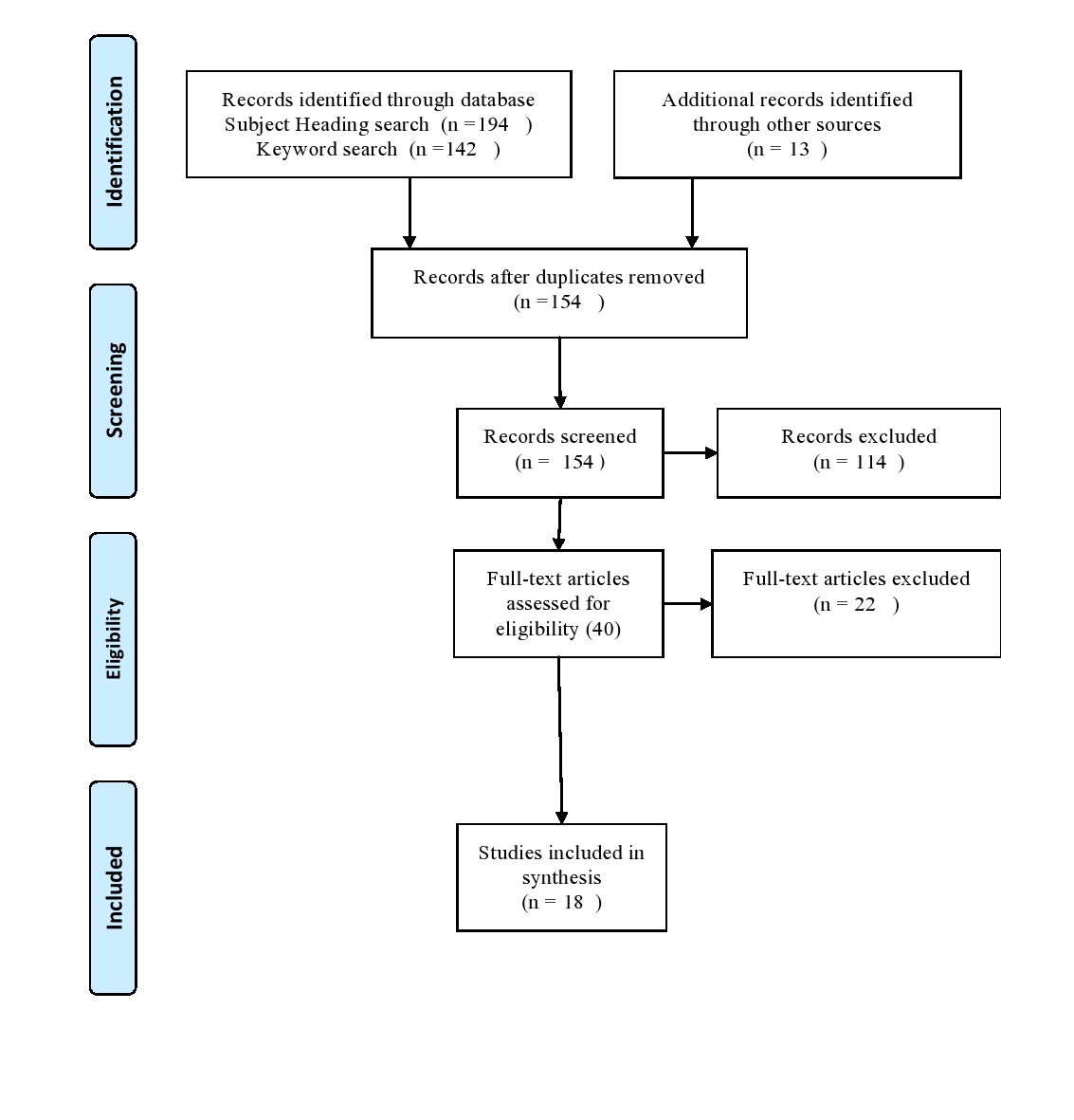
Study selection was performed in three stages (Figure 1):

Stage 1: Database Search

The studies that were identified through the database subject heading search (194 studies), the keyword search (142), and other sources (13 studies) were screened for duplication, yielding 154 studies.

Stage 2: Titles and Abstract Review

Screening of the titles and abstracts of the 154 retrieved studies was conducted by one qualified reviewer (the first author) in order to exclude any obvious non-eligible studies. Of these, 40 studies were deemed eligible for inclusion in a full article review.

Stage 3: Full Article Review

Two qualified reviewers conducted a full article review of the 40 studies. This review had two goals: first, to exclude any studies of non-eligible trials; second, to extract data on specific variables for further analyses. Of the 40 studies, 18 studies were deemed eligible for inclusion in our analysis.


Flowchart of the Review Screening Process

Data collection process

Data extraction was conducted by a qualified reviewer (the first author) during the full article review of the 18 included studies. The source of data in the individual studies was confirmed by contacting investigators who authored multiple studies included in the review, due to the aggregated weight of these studies potentially affecting our conclusion. The confirmation aimed to verify whether the data examined in the individual studies were collected from a single population and used in more than one study, or from different independent populations.

Data items

Primary Outcomes:

– Quality of Study: The quality of the study was categorized into three groups (Low, Moderate, High) (categorical variable)

– Conclusion of Study Effect: (whether the study concluded association of wind turbines with the effect on human health that was under investigation) (binary variable)

Variables (Outcome Measures of Individual Studies):

– First Author: The name of the first author (nominal variable)

– Year of Publication: The year in which the study was published (ordinal variable)

– Journal Name: The name of the publishing journal (nominal variable)

– Country of Study: The name of the country where the trial was originated (nominal variable)

– Study Design: The design of the study (nominal variable)

– Sample Size: The study sample size (continuous variable)

– Response Rate: The response rate of subjects in the study (continuous variable)

– Level of Evidence: The Level of evidence of the study (nominal variable)

– Level of Potential Bias: The level of risk of bias. Categorized into three groups according to Cochrane’s recommendations [10]. (Low risk of bias: Plausible bias unlikely to seriously alter the results; Unclear risk of bias: Plausible bias that raises some doubt about the results; High risk of bias: Plausible bias that seriously weakens confidence in the results) (categorical variable)

– Outcome Measures of Study: The outcome measure under investigation in the study (nominal variable); these outcome measures are:

– Annoyance (Sensitivity to Noise)

– Sleep disturbance

– Visual impact

– Well-being (Quality of Life/Mental Effect)

– Dose-response (description of the change in distress caused by differing distances from a wind turbine)

– Infrasound effect

– Existing background noise (comparison of stress associated with wind turbines to stress associated with road traffic noise/quiet rural environment)

– Attitude to wind turbines (whether people who complain have negative personal opinions toward wind turbines)

– Economical benefit (whether people who benefit economically from wind turbines have a decreased risk of distress)

Risk of bias in individual studies

Assessing the risk of bias of individual studies was performed at both the study level (study design, sample size, response rate, direction and magnitude of any potential bias and how it was handled, limitations, and reporting quality) and the outcome level (a cautious overall interpretation was drawn of the study’s conclusions, whether effect of human distress exists, considering the specific study’s objectives).

Summary measures and synthesis of results

After data extraction, each study was analyzed to identify the two primary outcomes: First, quality of study, taking into account the study’s principle outcome measures; all outcomes, exposures, predictors, potential confounders, and effect modifiers; how the study size was arrived at; how quantitative variables were handled in the analyses; description of all statistical methods; and how loss to follow-up and missing data were addressed. Second, conclusion of study effect as a cautious overall interpretation of the study’s conclusions, taking into account the specific study’s objectives and how well these conclusions were supported by the study results.

Risk of bias across studies

To reduce potential sampling bias (for example, the quality of study could be confounded by journal name and name of first author), the reviewers blinded themselves to the name of the journal and authors until all data on the other variables of interest were collected. To reduce potential measurement bias, the following three measures were undertaken: The data were directly entered into the database instead of using collection forms, quality assurance on all steps of data collection and management was performed, and in any case of uncertainty in deciding the quality of study, the reviewer consulted one of our senior authors to confirm the decision. Furthermore, the source of data was confirmed by contacting investigators who authored multiple studies included in the review, due to the weight their aggregated studies would have in affecting our conclusions.

Ethics approval

This study used previously published data making it exempt from institutional ethics board approval.

Results

Study selection

Figure 1 presents a flowchart depicting the study screening process. The database searches produced 154 publications. From this group, 40 publications were eligible following screening the titles and abstracts. From this group, 18 publications were eligible for inclusion after full article review. These 18 studies, shown in Table 1, consist of six original studies and 12 non-original studies (secondary analyses and literature reviews based on some of these original studies). Only the six original studies were included in the final analysis shown in Table 2. The 12 non-original studies were excluded from the analysis to minimize potential bias associated with repeated results.

This review used previously published data; therefore, there was no missing data for any of the variables of interest.


                                                                                  Study Characteristics

1st Author, Year Country Design Sample Size Response Rate % Level of Evidence Risk Of Bias Within Studies Quality of Study
Bakker [11] 2012 ^ Netherlands Cross-sectional 725 37 4 Unclear risk of bias Moderate
Hanning [12] 2012 ^ UK Expert Opinion/Review N/A N/A 5 Unclear risk of bias Moderate
Nissenbaum [13] 2012 ¥ USA Cross-sectional 106 75 4 Low risk of bias Moderate
Knopper [6] 2011 ^ Canada Review 15 N/A 4 Unclear risk of bias High
Shepherd [14] 2011 ¥ New Zealand Cross-sectional 39, 158 34, 32 3,4 Low risk of bias High
Janssen [15] 2011 ^ Netherlands Secondary analysis 1820 68, 58,  <30 4 Low risk of bias High
Pedersen [16] 2011 ^ Sweden Secondary analysis 1755 * 4 Low risk of bias High
Bolin [17] 2011 ^ Sweden Review N/A N/A 4 Unclear risk of bias Low
Pedersen [18] 2010 ^ Sweden Secondary analysis 725 37 4 Low risk of bias High
Salt [7] 2010 ¥ USA Expert Opinion Report N/A N/A 5 Unclear risk of bias High
Pedersen [19] 2009 ¥ Netherlands Cross-sectional 1948 37 4 Low risk of bias High
Keith [20] 2008 ^ Canada Expert Review N/A N/A 5 Unclear risk of bias High
Pedersen [21] 2008 ^ Sweden Secondary analysis 1095 N/A 4 Low risk of bias High
Pedersen [22] 2008 ^ Sweden Secondary analysis 1822 60 4 Low risk of bias High
Pedersen [23] 2007 ^ Sweden Qualitative Study 15 N/A 5 Low risk of bias High
Pedersen [5] 2007 ¥ Sweden Cross-sectional 754 58 4 Low risk of bias High
Leventhall [24] 2006 ^ UK Report N/A N/A 5 Unclear risk of bias High
Pedersen [25] 2004 ¥ Sweden Cross-sectional 351 68 4 Low risk of bias High

 View larger


1st Author, Year

Does-response

Road Traffic Noise / quiet rural environment

Sleep Disturbance

Annoyance/ sensitivity to noise

visual impact

attitude to wind turbines

Infrasound effect

Well being (Quality of Life / mental effect)

Economical Benefit

Nissenbaum [13] 2012 p < 0.05   p = 0.03         p = 0.002  
Shepherd [14] 2011     Rs = 0.43

p < 0.001

Rs = 0.44

p < 0.001

      Rs = 0.20

p < 0.01

 
Salt [7] 2010       Exp     Exp    
Pedersen [19] 2009 Rs = 0.50

p < 0.001

Rs = 1.07-

p < 0.01

  Rs = 0.35

p < 0.001

Rs = 1.04

p <0.001

Rs = 0.54

p < 0.001

    Rs = -2.77

p < 0.001

Pedersen [5] 2007   OR = 1.1 (95% CI

0.91 to 1.21)

  OR = 1.1 (95% CI

1.01 to 1.25)

OR = 1.1 (95%  CI 0.97 to 1.21) OR = 1.1 (95%  CI 1.00 to 1.25)      
Pedersen [25] 2004     Rs = 0.35

p < 0.001

Rs = 0.42

p < 0.001

Rs = 0.52

p < 0.001

Rs = 0.33

p < 0.001


 View larger

Study characteristics and risk of bias within studies

Table 1 shows data on the 18 peer-reviewed studies captured in our review, including individual study characteristics, level of potential bias, and quality of study.

Results of individual studies

Table 2 shows summary data on the six original studies’ objectives, p-values, and outcome measures.

Risk of bias across studies

One main source of potential bias across these studies was that 10 of them, listed below, were mainly based on three data sets. The first data set (SWE00) was collected in Sweden in the year 2000 in agricultural areas, the second (SWE05) was collected in different environments in Sweden 2005, and the third (NL07) was collected all over the Netherlands in 2007. This potential bias was eliminated by using only the three original studies that collected the data sets [5, 19, 25].  The rest of the 10 studies (non-original studies) were excluded from the analysis to avoid repeated results.

– Bakker [11] 2012 Science of the Total Environment (NL07)

– Pedersen [16] 2011 Noise Control Eng J (SWE00) + (SWE05) + (NL07)

– Janssen [15] 2011 Acoustical Society of America (SWE00) + (SWE05) + (NL07)

– Pedersen [18] 2010 Energy Policy (NL07)

– Pedersen [19] 2009 Acoustical Society of America (NL07)

– Pedersen [21] 2008 Journal of Environmental Psychology (SWE00) + (SWE05)

– Pedersen [22] 2008 Environ Res Lett (SWE00) + (SWE05)

– Pedersen [23] 2007 Qualitative Research in Psychology (SWE00)

– Pedersen [5] 2007 Occup Environ Med (SWE05)

– Pedersen [25] 2004 Acoustical Society of America (SWE00)

Another source of bias was that three of the studies were reviews of previous literature [6, 12, 17].

Key results

– All 18 peer-reviewed studies captured in our review found an association between wind turbines and one or more types of human distress. These studies had a level of evidence of four and five.

– None of the studies captured in our review found any association (potential publication bias).

– These studies were published in a variety of journals (representative sample).

– Two of these studies showed a dose-response relationship between distance from wind turbines and distress (Table 2).

– There is still no evidence of whether or not a causal relationship between distance from wind turbines and distress exists.

Discussion

Summary of evidence

The peer-reviewed studies we reviewed provide reasonable evidence (Levels Four and Five) that an association exists between wind turbines and distress in humans.

Two of these studies showed a dose-response relationship between distance from wind turbines and distress, and none of the 18 studies concluded no association (consistency of association). The existence of a dose-response relationship and consistency, two of the Hill’s Criteria of Causality, argues for the credibility of the association.

All the evidence comes from expert opinion, case studies, and cross-sectional studies. No higher level of evidence observational studies, namely case-control and cohort studies, were utilized to investigate the subject. For example, although Shepherd, et al’s study [14] had a sound design and was well conducted and reported, it is considered at a lower level of evidence as a cross-sectional study has an increased potential for bias of its results.

Although three of the studies [6-7, 24] suggested that low-frequency sound energy wind turbines (i.e., infrasound below 20 Hz) may directly and negatively affect health, the level of evidence for these studies is also weak (expert opinions [7, 24] and a review [6] citing these two studies).

Economic benefit found in two of the studies [15, 19] could be intuitively and prematurely viewed as a factor lowering the credibility of the complaint. However, in our opinion, compensation would have lowered the credibility of the complaint only if these people had no distress following compensation. People in the studies who benefited economically from wind turbines had a decreased risk of distress but not a complete elimination of distress. Furthermore, the fact that the level of distress could be altered with financial compensation only speaks to the existence of distress.

It is worth pointing out that no causality has been established. The distress could be due to factors other than actual noise exposure. For example, the distress experienced by the participants in the original studies may have been generated or exaggerated by exposure to negative opinions on wind turbine.

Limitations

This study has a number of limitations and sources of bias. One source of bias is the exclusion of non-English studies. For example, China is the world’s leading country in the number of wind turbines [1]. The exclusion of non-English studies might have affected the overall conclusions of our review.

Another source of bias is the fact that the reviewer could not be completely blinded to the journals’ or authors’ names. There might be a theoretical incline to give studies in high impact journals higher quality because of their reputation (potential sampling bias). Nevertheless, if this bias took place, it would have an effect on the magnitude of evidence and not on the existence of the association due to the dichotomous nature of this variable (the number of studies that speaks for an association will not change).

Publication bias could be the reason for the finding that none of the 18 peer-reviewed studies captured in our review found no association. However, potential publication bias was decreased by conducting a search in two major grey literature databases (SIGLE, and Scirus).

Generalizability

The 18 studies were published in a variety of journals, making the captured studies a representative sample, which in turn increases our results’ generalizability (external validity).

The fact that the data in two of the three mentioned data sets were collected in Sweden may decrease the external validity, but simultaneously may increase the internal validity following the above logic. Furthermore, although these data were collected from one country, it still would be a safe assumption that the people and their experience with wind turbines, on which these data were collected, are not fundamentally different from people and experiences in other countries.

Future research

Further research in the area of exposure assessment and measurement is needed. The mechanism and physiology of harm needs to be confirmed. There is a need to identify the actual risk of harm and the health outcomes in people exposed. Until research can separate out specific sets of significant factors for the exposure with higher-level evidence than is available now, our ability to mitigate the harm is limited. Possible future research could be conducting longitudinal studies, performing measurements before wind turbines and after, and observing what happens to people over time.

Conclusions

We have demonstrated in our review the presence of reasonable evidence (Levels Four and Five) supporting the existence of an association between wind turbines and distress in humans. The existence of a dose-response relationship between distance from wind turbines and distress as well as the consistency of association across studies found in the scientific literature argues for the credibility of this association. Future research in this area is warranted.


References

  1. The Global Wind Energy Council. Accessed: October 30, 2013. http://www.gwec.net/?s=canada.
  2. The Global Wind Energy Council.. 2012, Accessed: October 30, 2013.http://www.gwec.net/wp-content/uploads/2012/06/Top-10-Cumulative-Capacity-December-2012.jpg.
  3. Price, TJ: Oxford Dictionary of National Biography Oxford University Press; 2004.
  4. Krogh C, Gillis L, Kouwen N, Aramini J: WindVOiCe, a self-reporting survey: adverse health effects, industrial wind turbines, and the need for vigilance monitoring. Bull Sci Technol Soc 2011, 31:334-45.
  5. Pedersen E, Hallberg L, Waye KP: Living in the vicinity of wind turbines–a grounded theory study. Qualitative Research in Psychology 2007, 4:49–63.
  6. Knopper LD, Ollson CA: Health effects and wind turbines: A review of the literature. Environ Health 2011, 10:78. doi: 10.1186/1476-069X-10-78
  7. Salt AN, Hullar TE: Responses of the ear to low frequency sounds, infrasound and wind turbines. Hear Res 2010, 268:12-21. doi: 10.1016/j.heares.2010.06.007
  8. World Health Organisation: Night noise guidelines for Europe. 2009, Accessed: October 30, 2013. http://www.euro.who.int/__data/assets/pdf_file/0017/43316/E92845.pdf.
  9. Hill AB: The Environment and Disease: Association or Causation?. Proc R Soc Med 1965, 58:295-300.
  10. Higgins JPT, Altman DG, Sterne JAC on behalf of the Cochrane Statistical Methods Group and the Cochrane Bias Methods Group: 2011, Chapter 8: Assessing risk of bias in included studies. Cochrane Handbook for Systematic Reviews of Interventions Version 5.1.0:http://handbook.cochrane.org/chapter_8/8_assessing_risk_of_bias_in_included_studies.htm. Accessed: October 30, 2013.
  11. Bakker RH, Pedersen E, van den Berg GP, Stewart RE, Lok W, Bouma J: Impact of wind turbine sound on annoyance, self-reported sleep disturbance and psychological distress. Sci Total Environ 2012, 425:42-51. doi: 10.1016/j.scitotenv.2012.03.005
  12. Hanning CD, Evans A: Wind turbine noise. BMJ 2012, 344:e1527. doi: 10.1136/bmj.e1527
  13. Nissenbaum MA, Aramini JJ, Hanning CD: Effects of industrial wind turbine noise on sleep and health. Noise Health 2012, 14:237-43. doi: 10.4103/1463-1741.102961
  14. Shepherd D, McBride D, Welch D, Dirks KN, Hill EM: Evaluating the impact of wind turbine noise on health-related quality of life. Noise Health 2011, 13:333-9. doi: 10.4103/1463-1741.85502
  15. Janssen SA, Vos H, Eisses AR, Pedersen E: A comparison between exposure-response relationships for wind turbine annoyance and annoyance due to other noise sources. J Acoust Soc Am 2011, 130:3746-53. doi: 10.1121/1.3653984
  16. Pedersen E: Health aspects associated with wind turbine noise—Results from three field studies. Noise Control Eng J 2011, 59:47-53.
  17. Bolin K, Bluhm G, Eriksson G, Nilsson ME: Infrasound and low frequency noise from wind turbines: Exposure and health effects. Environ Res Lett 2011, 6:1-6. doi: 10.1088/1748-9326/6/3/035103
  18. Pedersen E, van den Berg F, Bakker R, Bouma J: Can road traffic mask the sound from wind turbines? Response to wind turbine sound at different levels of road traffic. Energy Policy 2010, 38:2520–2527. doi: 10.1016/j.enpol.2010.01.001
  19. Pedersen E, van den Berg F, Bakker R, Bouma J: Response to noise from modern wind farms in The Netherlands. J Acoust Soc Am 2009, 126:634-43. doi: 10.1121/1.3160293
  20. Keith SE, Michaud DS, Bly SHP: A proposal for evaluating the potential health effects of wind turbine noise for projects under the Canadian Environmental Assessment Act. Low Freq Noise Vib Active Control 2008, 27:253-65.
  21. Pedersen E, Larsman P: The impact of visual factors on noise annoyance among people living in the vicinity of wind turbines. J Environ Psychol 2008, 28:379–89. doi:10.1016/j.jenvp.2008.02.009
  22. Pedersen E, Waye KP: Wind turbines – low level noise sources interfering with restoration?. Environ Res Lett 2008, 3:1–5.
  23. Pedersen E, Waye KP: Wind turbine noise, annoyance and self-reported health and well-being in different living environments. Occup Environ Med 2007, 64:480-6.
  24. Leventhall HG: Low frequency noise and annoyance. Noise Health 2004, 6:59-72.
  25. Pedersen E, Waye KP: Perception and annoyance due to wind turbine noise–a dose-response relationship. J Acoust Soc Am 2004, 116:3460

Tim Hudak and the Conservatives will End the Money-Grabbing Wind Scam!

wilson
Simcoe-Grey Progressive Conservative candidate Jim Wilson (second from right) makes a campaign announcement during a stop at the Collingwood Regional Airport, Friday, May 23, 2014. With Wilson are, from left, pilot Alexander Younger, pilot and airport board chair Charlie Tatham, and pilot Kevin Elwood. Morgan Ian Adams/Collingwood Enterprise-Bulletin/QMI Agency

CLEARVIEW Twp. —The Progressive Conservative candidate for Simcoe-Grey says he’d put a stop to a company’s plans to erect wind turbines near the local airport should his party form the next government.

In a campaign stop at the Collingwood Regional Airport Friday morning, during which he slammed the existing Green Energy Act and the impact he says it has had on electricity bills, Jim Wilson promised a Progressive Conservative government would do what it could to halt WPD Canada’s plans to erect turbines near the facility should his party win the June 12 provincial election.

WPD’s proposal is to erect eight turbines in the area north of County Road 91; at least two of the proposed 500-foot-tall turbines are within an area the municipal services board that manages the airport say are a potential safety hazard to aircraft, especially in the landing or take-off phase, while another three turbines are considered on the edge of that area.

WPD’s plans are presently under technical review by the Ministry of Environment.

“We’ll do whatever it takes to stop WPD Canada from putting the wind turbines in this vicinity,” said Wilson. “It is in process, and it may end up in a lawsuit, but we just can’t allow it.”

“If you’re going to prevent death, you do everything you can to do that — you have a moral obligation to do that.”

The airport board, and several landowners in the area, have been fighting the proposal for several years; both Collingwood and Clearview Township municipal councils have also voiced their opposition.

One of those landowners, Kevin Ellwood — who has a private aerodrome on his farm on County Road 91, and is faced with the prospect of having a turbine in the path of his landing strip — has filed 39 access-to-information requests of various ministries on WPD’s proposal.

Some of those requests are now before an adjudicator to see if the information will be released.

The turbines, said Ellwood, are “dangerous and significant threats to pilots and their passengers.”

Ellwood and Wilson both point to a crash in South Dakota in April that killed four, after a Piper 32 aircraft collided with a turbine in poor weather conditions. The National Transportation Safety Board is investigating, but authorities have not released any details on the crash.

Regional airport board chair Charlie Tatham, who was on hand for Wilson’s announcement, said he’s tried to point out to provincial officials that the location of the turbines “pose a lethal danger… yet they choose to ignore it.

“To ignore it could lead to someone’s death at some point,” he said.

WPD’s position has been the location of the turbines will have a negligible effect on airport movements.

Wilson, however, remains unconvinced, and says the location of the turbines is just one of the problems with the Green Energy Act, which the Conservatives claim will cost electricity customers $46 billion over the next 20 years, paying out contracts for wind and solar power at rates that far exceed current electricity prices.

“Hopefully we can stop it, that there’s some escape clauses (in the agreements)… but I don’t know the full extent of these (contracts and what’s hidden in them,” said Wilson. “There are thousands, tens of thousands of these contracts that are essentially secret and covered up from the public. This one just keeps on rolling ahead and (government) doesn’t seem to be listening to anybody.”

Wilson said a former provincial Liberal cabinet minister warned the legal costs of putting a halt to some of these contracts would be in the billions of dollars, but that point is irrelevant when considering the long-term cost of paying out energy contracts — or worse, if someone dies because a plane hits a wind turbine located close to the airport.

“It’s a lot cheaper than paying people 20 years of contracts when they get paid whether the wind blows or the sun shines. It’s going to bankrupt the province, so you might as well just cut your losses,” said Wilson.

“It’s a moral choice, it’s an expensive choice, but it’s one we’re going to have to make. Hopefully we can get to the bottom of this on day-one (of a new government)… it may require that we talk to our lawyers, it may require new legislation to undo the Green Energy Act, and if we have to do that… well (the legislature) is supreme.”

By Morgan Ian Adams
Published in the Barrie Examiner, May 23, 2014

20 Lies the Liberals Told Us…(there are many, many more!)

With five provincial by-elections on Aug. 1, now’s the time to remember that the most reliable indicator of future political performance is past political practice.

Here then, are 20 lies the Dalton McGuinty/Kathleen Wynne Liberals told you, promises they made in their own words when they first came to power in 2003 — and then broke.

1. “We will hold the line on taxes” — McGuinty’s signature promise in the 2003 election campaign, which he shredded with a $2.6 billion tax grab, the largest in Ontario history. The HST, which massively extended the reach of the province’s 8% sales tax to such necessities as gasoline, electricity and home heating fuels, soon followed.

2. “We will not raise the debt” — The Liberals have doubled Ontario’s debt to $281 billion since taking office. Paying interest on debt, at $10.6 billion annually, is now our third-largest expenditure, after health and education.

3. “We will make sure the debt goes in only one direction, down” — See above.

4. “We will stop the waste of taxpayers’ dollars” — The Ornge, eHealth and gas plant scandals alone, in which billions of tax dollars were wasted, put the lie to this Liberal promise.

5. “We will respect your hard-earned tax dollars” — See above.

6. “We will balance the budget” — See above.

7. “We will live by the balanced budget law” — In 2003, McGuinty pledged, in writing: “I … promise if my party is elected as the next government, that I will: Not raise taxes or implement any new taxes without the explicit consent of Ontario voters. And not run deficits.” After the election, he broke all three promises.

8. “We will measure every investment against results.” If the Liberals had kept this promise, the eHealth, Ornge and gas plant scandals would never have happened.

9. “We will make sure your health care dollars are invested wisely” — See Ornge and eHealth, above.

10. “We will bring peace and stability to our schools” — Ontario students have just lived through a year of teacher unrest, including the shutdown of extra-curricular activities, over the Liberals’ belated attempt to rein in teacher salaries and benefits, after nine years of throwing our money at them.

11. “We will ensure there is transparency in public education” — Instead, the Liberals unleashed a controversial sex education curriculum with no warning to ordinary parents. Now we’ve learned Education Minister Liz Sandals doesn’t even read the curriculum documents she signs.

12. “We will ease gridlock with a seamless transportation network across the Greater Toronto Area” — After 10 years in power, gridlock across the GTA is worse than ever and the Liberals are making exactly the same broken promise again.

13. “We will shut down Ontario’s coal-burning plants by 2007” — The Liberals still haven’t closed them, now promising to do so in 2014.

14. “We will bring clean, renewable energy to Ontario” — Under the Liberals, wind and solar power are producing minuscule amounts of unneeded, unreliable, inefficient and expensive electricity, which has to be backed up by fossil fuels. This will, according to the Auditor General, cost Ontarians billions of dollars extra on their hydro bills, for decades to come.

15. “We will bring stability to Ontario’s electricity market” — See above.

16. “We will respect the views of rural constituents by giving their MPPs free votes” — If that was true, Liberal MPPs wouldn’t be responding to furious complaints from their constituents about having industrial wind turbines rammed down their throats with form letters.

17. “We will ensure that all developers play by the rules” — Unless they’re wind developers, where the Liberals took away the rights of local citizens to oppose wind projects.

18. “We will give real legal rights to victims of crime” — In 2007, Ombudsman Andre Marin described Ontario’s Criminal Injuries Compensation Board as “unreasonable, oppressive, unjust (and) wrong,” stooping so low as to humiliate a grieving father when he asked for funds to help bury his five-year-old daughter, who had been raped and murdered.

19. “We will lift the veil of secrecy on government agencies and appointments” — In fact, the Liberals routinely resort to obfuscation, stonewalling, misdirection and deceit when answering even basic questions about who does what in their government. Think of their farrago of lies in the gas plants scandal.

20. “We will help create jobs and spur economic growth” — According to the Auditor General, Ontario is losing two to four jobs for every “green” job the Liberals create, due to skyrocketing electricity costs.


We need to Get the Message Out! Only Hudak is Willing and Able to Repair Damage!

Pretty radical stuff

During the present campaign a great deal has been made of the Conservative plan to create 1,000,000 private sector jobs and reduce public sector jobs by 100,000 to 2006 levels.

Much criticism has been levelled at Tim Hudak and his Party for these election promises.

Funny thing is, even Smokey Thomas, head of OPSEU, agrees there are probably 60,000 superfluous management positions in the Provincial bureaucracy.

The Premier is Tim Hudak’s most vocal critic on these promises. She claims reducing the Public Service by 10% will destroy Ontario’s economy.

Yet she has never told the voters what her own government’s Ministry of Finance concluded in a confidential report on the impact of her proposed Ontario Pension Plan. It found that her plan would result in the loss of 150,000 private sector jobs.

Yet she still promises to implement an Ontario Pension Plan.

The million jobs plan has been derided, but even if it is only an aspirational goal some think it is very achievable. Even the Star agrees. One can understand however why a government, which over 8 years has only managed to double the Ontario debt and deficit while destroying over 300,000 jobs in the Province, wouldn’t understand the plan.

The Conservatives have promised to stop signing contracts for more unneeded wind and solar generation, cancel any applications that have not already been approved and re-evaluate, on a case-by-case basis any approved projects that aren’t already connected to the grid.

He would also give municipalities more control over the siting of wind projects:

“If people can have a say about a hot dog stand going in for a Canada Day celebration, shouldn’t they have a say about massive industrial wind turbines in their backyard?” Hudak said.

This is indeed good news to those of us that have been fighting Ontario’s insane energy policy for the past few years – maybe it is an indication that someone in government has listened.

Premier Kathleen Wynne said her government remains committed to its overall plan for renewable energy, including wind power.

Hudak’s campaign is disconcerting:

He’s trusting voters to assess the situation and make their choice based on a full understanding of the options. He evidently believes voters understand the damage that’s been done to the province under the Liberals, and the danger of continuing down that path, and being mature enough to choose between repairing it, or continuing along the same route.
– Kelly McParland

Trusting voters? Telling them what you’re really going to do?

Pretty radical stuff!

On the other hand we have promises that no jobs will be endangered, no impact will be felt, and spending can continue to grow at the same old unsustainable pace, or even increase. In the past decade that’s certainly been the approach to winning elections in the province.

It will be interesting to see whether this faith in Ontario voter’s ability to appreciate the options, and in their maturity is justified.

To many of us, companies and individuals, it will signal whether out future remains in this Province or not.

Agenda 21 principles built on Junk Science, and Socialism!


Interest In Bioenergy On the Rise

Robert Bryce – Senior Manhattan Institute Fellow – gave a vibrant talk yesterday in New York City at a gathering called to launch his latest book “Smaller Faster Lighter Denser Cheaper,” which he describes as a “rebuke to the catastrophists.”

The premise is that technology and innovation are helping people live healthier, longer, more fulfilled lives than at any other point in history. Bryce started his talk with statistics about the computing power of smart phones – which surpass that used in early moon missions – nanotechnology, aviation advancements and state-of-the-art internal combustion engine design. Despite all the bad news carried by mainstream media concerning disease, famine and hardship, people are better off today than ever before, says Bryce.

“The catastrophists want degrowth,” Bryce said, as he rattled off quotes from famous activists whose message is that a return to a pastoral existence is the way forward. Societies around the world powered their needs by burning wood for centuries, but most people would probably be against returning to that system today. He describes this view as “slouching toward dystopia.”

Climate activist Bill McKibben is famous for saying “do the math” when it comes to climate change and fossil fuel consumption. Bruce riffs on this theme in the book, turning the phrase around to show that renewable energy alone is not sufficient to meet the world’s incremental energy consumption requirements – let alone existing consumption levels.

“We’re not going to save climate change with solar panels on Walmart roofs in California,” Bryce said.

He is not anti-renewable energy, but does not believe wind and solar alone can power the global economic growth engine and Bryce uses loads of statistics to back up his view. “We need [energy] density, density is green. A smaller environmental footprint is the ideal,” he said.

Responding to a question about nuclear power, Bryce joked that “if you are anti-carbon and anti-nuclear, then you are pro darkness.” Overall, his message is positive and certainly entertaining, so stay tuned for a book review once we’ve had a chance to read it.

Breaking Energy Breaking Energy provides access to news, analysis, thought leadership, reference materials and discussions about the day’s most important energy market trends. Breaking Energy participants stay ahead of breaking news, participate in high-profile events and enjoy access to the central hub of the industry community as it transforms in response to fast-moving changes in energy politics and regulation, deals with financial challenges and leads technological advances.

Liberals are Throwing Away our Children’s (and Grandchildren’s), Future!

Warning: Reading about How the Ontario Liberals Keep on Winning Might Make You Sick

Enough is enough.

You would think the sheer waste of taxpayer dollars through scandals and mismanagement would be enough to hang the Liberals.

Especially since, at the same time your money swirls down the toilet, the Liberals continue to run deficits (seven in a row) andIllustration: Truth and Lie pile up debt that your grandchildren’s children will still be paying off.

Yet in spite of their mistakes and outright lies (the hit parade includes: the billion-dollar gas plant cancellation and the failure to provide proper oversight of Ornge air ambulance expenses and out-of-control spending at the Ontario Lottery and Gaming Corporation and elsewhere) they’ve managed to hold onto power for 11 years. How is that?

I’ll give you three reasons. (Hold on, it’s a long explanation.)

1. They buy votes with big spending promises.

George Bernard Shaw got it right. “A government that robs Peter to pay Paul can always depend on the support of Paul.”

When even the tax-the-rich NDP recognize that Ontarians are taxed to the hilt and refuse to put up with any “new taxes, tolls or fees that hit middle-class families,” you know Ontario must be in financial trouble.

Net debt is projected to climb to $269.2 billion for 2013–14 and hit $324.5 billion by 2017–18 (nearly 40% of Ontario’s economy). In fact, Ontario’s debt has more than doubled since the Ontario Liberals came to power in 2003–04 when the provincial debt stood at $138.8 billion (or 27.5% of the economy).

Interest payments are the third largest expense in the budget. And right now interest rates are low. When rates go back up, each point will add another $3 billion to our annual interest payment, points out economist Jack Mintz.

But in spite of repeated warnings about the need for spending cuts, from former Liberal finance minister Dwight Duncan (who conveniently woke up to the Ontario’s debt problem in his last few months in office) and public servants in Ontario’s finance ministry, what did the Liberals propose in the budget that forced an election?

Big spending promises, of course. Billions for schools and hospitals, roads and bridges, billions more for corporate grants, and millions for a smorgasbord of social services.

With this budget, the Liberals are in fact driving toward a deficit $2.4 billion higher(or 24% more) than they previously projected—in spite of hiking taxes by almost $1 billion. The deficits planned for 2015–16 and 2016–17 also increased by $1.7 billion and $1.8 billion.

In other words, the Liberals forecast spending to jump by $3.4 billion this year, $900 million more than projected in the 2013 budget, with program spending expected to climb by nearly $3 billion to $119.4 billion.

With Ontario already in a fiscal mess, the NDP (yes, the NDP, a party not known for financial responsibility), criticized the budget as “a mad dash to escape the scandals by promising the moon and the stars.”

2. They pander to unions, whose members make up a big chunk of the electorate.  

The real beneficiary of the tax-and-spend Liberals has been the unions.

For starters, over half of Ontario’s program spending goes to pay public-sector workers their salaries and pension benefits.

What’s more, when the Liberals came into power in 2003, only 14,926 public-sector employees were making $100,000 or more. Today, 97,796 Ontario public-sector workers are on the so-called Sunshine List, an increase of 655% in just 10 years.

But, really, who can be surprised when about 70 percent of public-sector employees are unionized (compare this to the roughly 15 percent unionization rate in the private sector)?

The fact is the Liberals have pandered to unions, especially teacher’s unions, handing out massive, unaffordable pay hikes.

From 2003 to 2011, the McGuinty Liberals increased education spending by 45%, hiring 14,000 more teachers (up 10%) and increasing salaries by 24%—all while student enrollment actually dropped by 6%.

And teachers repaid the favour, “volunteering and voting for McGuinty’s Liberals in huge numbers during the past three elections.”

But following a narrow election win in 2011 (voters were angry over broken promises and higher taxes), McGuinty shifted direction, proposing to freeze teacher wages for two years and curb benefits to reduce the government’s alarming $14.4 billion deficit.

The teachers reacted with predictable outrage.

So despite all their talk about austerity, the Liberals just couldn’t say “no” to their vote-rich cash cow.

While the McGuinty government was calling for wage freezes publicly, it secretly negotiated a three percent wage increase with the Ontario Public Service Employees Union, which represents 35,000 voters, er, government workers.

And forget about Kathleen Wynne taking a firm stance on public-sector wages and benefits.

In a clear bid to win back union support, one of her first moves as premier was to negotiate an LCBO contract that gave 7,000 unionized workers a $1,600 signing bonus over two years—about $9 million— and wage increases of two% in 2015–16.

Her education minister also renegotiated new contracts with the province’s two biggest teachers unions, the Ontario Secondary School Teachers’ Federation and the Elementary Teachers’ Federation of Ontario, offering better maternity benefits, fewer unpaid days off, and an improved “sick-day bank.”

And the quid pro quo?

Millions of dollars spent on attack ads directed exclusively against Tory leaders in Ontario’s 2003, 2007, and 2011 elections—by a powerful coalition of special interest unions that includes the Ontario English Catholic Teachers Association, the Canadian Auto Workers, and the Ontario Secondary School Teachers’ Federation and calling itself the Working Families Coalition.

The so-called Working Families coalition first “came together in 2003 to discredit then Tory premier Ernie Eves and get Dalton McGuinty elected.” Their ad campaigns had such a big impact on the election results, they followed up with more of the same in the 2007 and 2011 elections. For this campaign, they’re just getting started, but expect a barrage of attack ads aimed squarely at Tim Hudak.

The coalition’s negative ads effectively doubles the advertising budget of the Liberals at the expense of the Tories through loose election laws around third-party advertising. Unlike political parties, third parties “can spend as much as they want, take contributions as large as they want and keep their financial backers hidden until long after the campaign is over.”

In Ontario’s 2011 general election, Working Families spent $1.6 million to help the Liberals.

Other big spenders included the Elementary Teachers’ Federation—$2.6 million—and the English Catholic Teachers’ Association, which spent $1.9 million to help defeat the PC party. For comparison’s sake, out of 21 registered political parties, only two spent more than $2 million on advertising. The Elementary Teachers’ Federation, the biggest third-party advertiser, spent more on advertising than nineteen political parties combined.

Spending records for the 2007 election (the first year third parties had to register with Elections Ontario) show a similar story. A shocking “90 per cent of the $2.3 million raised by third-party advertisers for the 2007 campaign went to organized labour or groups opposed to specific Tory policy positions.”

Plainly, Ontario’s election laws are giving Liberals with their deep-pocketed union allies an unfair advantage.

3. They reward party insiders with lucrative contracts.

In Ontario, it’s not what you know, but who you know.

From eHealth Ontario and Cancer Care Ontario to the Local Health Integration Networks, the Liberals have a history of rewarding party loyalists with “cushy, untendered contracts” and well-paid appointments.

In 2004, Mike Crawley, the then-president of the Ontario Liberals, was awarded awind power contract that guarantees his company AIM PowerGen $66,000 a day for 20 years. That’s a total of $475 million dollars.

In 2010, nearly two-thirds of the $68 million of taxpayers’ money spent on the 14 LHINs went to cover the salaries and remuneration of government-appointed board members.

Pat Dillon, the business manager of the Provincial Building and Construction Trades Council and the head of the infamous Working Families Coalition, has received a number of appointments—to Premier Wynne’s Transit Panel, the Ontario College of Trades, the WSIB Board, Infrastructure Ontario, and more.

The Globe and Mail recently reported that Ontario Liberal friends and allies were awarded millions of dollars in taxpayer-funded contracts because of loopholes in the rules surrounding government expenditures. The report goes on to say that, “while there is no indication that any of the transactions were illegitimate, the lack of transparency makes it difficult to determine what services were provided at taxpayers’ expense.”

The sad truth? It pays to be a friend of the Liberals. Ontario taxpayer, not so much.

The Ontario Liberals are long past their best-before date

After 11 years, it’s time to hold the Liberals to account.

Imagine if some pimply-faced thug robbed a gas station and got caught, he’d get what? A thousand dollars tops and some jail time.

But the Liberals who have “stolen” billions of taxpayer money through incompetence and cronyism remain unpunished.

It’s time to throw the Liberals out. They’ve inflicted enough damage on the province. It’s time they answered for their crimes against taxpayers.
 

McGuinty and Wynne….Same Evil Person, in a Different Outfit? LIARS!

Liars: The McGuinty-Wynne Record
by: Daniel Dickin

About the book
Daniel Dickin sees a clear split in Ontario’s wealth and prosperity. For the first 136 years following Confederation, Ontario was known for its balanced budgets, responsible spending, and prudent political, fiscal, and economic policies. These policies made Ontario the “economic powerhouse” of Canada and the envy of the other provinces.

Unfortunately, all of that changed when Dalton McGuinty’s Liberals took the reigns of power in Ontario in 2003. The 136 years of substantial progress and good governance were thrown to the side in favour of expensive government experiments, reckless green energy programs, record-setting deficit spending, a ballooning debt and scandal after scandal after scandal – along with all the lies to cover it up.

While the average Ontario citizen benefitted under the Big Blue Conservative governments of the 20th century, the only people benefiting from the Ontario Liberals are the public sector unions and Liberal Party elites.

Kathleen Wynne took over Dalton McGuinty’s legacy in 2013 and had the opportunity define her new government. She had the opportunity to get Ontario back on track and set herself apart from the scandal-plagued McGuinty past. Unfortunately, Kathleen Wynne only continued McGuinty’s legacy of scandals and lies, digging Ontario deeper into the hole of higher debt, more taxes, and fewer jobs.

Dickin’s book provides the hardhitting analysis and inconvenient facts that have been public information for years yet never organized into one strong, cohesive argument. This book presents a compelling argument for the real legacy of Dalton McGuinty and the Ontario Liberal Party – and it isn’t pretty – they are liars who have covered up the mismanagement and derailment of a once great and prosperous Ontario.

*BONUS*
Get a free bumper sticker with this purchase.

About the author
Daniel Dickin is a grassroots community leader and self-described political junkie. He obtained his Bachelor’s degree in law and political science from Carleton University in 2011. He has worked on federal and provincial election campaigns, including in Dalton McGuinty’s former riding of Ottawa South. Daniel is also a legal and political affairs columnist for the Prince Arthur Herald and Huffington Post Canada publications.

*BUNDLES*

 
$40.95
 

Wynne’s Pension Plan will Eliminate 150,000 Jobs…and NOT Through Attrition!

Internal, confidential government document’s confirmed the 150,000 jobs losses, stating –

  • “payroll taxes would have the largest negative impact on employment.”
  • the Ministry of Finance calculated that for every $2-billion increase in Ontario payroll taxes, 18,000 people would lose their job

Canada Free Press — May 22, 2014

Canadian workers and employers contribute $42 billion a year nationwide to the Canada Pension Plan.  Ontario’s share of these annual contributions is roughly $16.5 billion. The payroll tax will mean 150,000 fewer private sector jobs.

Internal, confidential government document’s confirmed the 150,000 jobs losses, stating –

  • “payroll taxes would have the largest negative impact on employment.”
  • the Ministry of Finance calculated that for every $2-billion increase in Ontario payroll taxes, 18,000 people would lose their job

Ontarians already pay the highest payroll taxes in Canada. On average, families pay $9,970 a year in government payroll taxes in addition to their personal income taxes

The McGuinty-Wynne Liberal payroll tax will increase taxes by:

  • $788 a year for someone making $45,000
  • $1,263 a year for someone making $70,000
  • $1,643 a year for someone making $90,000

Ontario small business has been unanimous in their opposition to this job killing tax:

  • In particular, CFIB is vehemently opposed to the proposed Ontario Retirement Pension Plan, which will hurt small business owners and their employees by taxing everyone who issues and receives a paycheque and does not currently have a workplace pension. “In one of the worst Ontario budgets ever, the government is picking the pockets of Ontarians, especially the middle class, to pay for it.” (Dan Kelly, President, Canadian Federation of Independent Business)
  • The OCC does not support a stand-alone Ontario pension plan, as the plan will create administrative duplication with the CPP, further fragment Canada’s pension landscape, and potentially deter job creation. (Ontario Chamber of Commerce)


broke bankrupt

Frauds, Crooks and Criminals

Demonstrating daily that diversity is not strength!

Family Hype

All Things Related To The Family

DeFrock

defrock.org's principal concern is the environmental and human damage of industrial wind turbines on rural communities

Gerold's Blog

The truth shall set you free but first it will make you miserable

Politisite

Breaking Political News, Election Results, Commentary and Analysis

Canadian Common Sense

Canadian Common Sense - A Unique Perspective from Grassroots Canadians

Falmouth's Firetower Wind

a wind energy debacle

The Law is my Oyster

The Law and its Place in Society

Illinois Leaks

Edgar County Watchdogs

stubbornlyme.

My thoughts...my life...my own way.

Oppose! Swanton Wind

Proposed Wind Project on Rocky Ridge

Climate Audit

by Steve McIntyre

4TimesAYear's Blog

Trying to stop climate change is like trying to stop the seasons from changing. We don't control the climate; IT controls US.

Wolsten

Wandering Words

Patti Kellar

WIND WARRIOR

John Coleman's Blog

Global Warming/Climate Change is not a problem