|
|||
Shale gas could be fuelling British homes for the first time by late 2015, under plans from fracking firm Cuadrilla. The company is preparing to submit planning applications by the end of this month to frack at two sites in Lancashire next year. Francis Egan, Cuadrilla chief executive, said that, if successful, it planned to connect the test fracking sites up to the gas grid, in what would be a milestone first for the fledgling British shale gas industry. –Emily Gosden, The Daily Telegraph, 12 May 2014
 Subsidies that have driven the spread of large solar farms across Britain are to be scrapped under plans to stop the panels blighting the countryside. Energy companies that build solar farms currently qualify for generous consumer-funded subsidies through the so-called ‘Renewable Obligation’ (RO) scheme, and had expected to keep doing so until 2017. But the Department of Energy and Climate Change announced on Tuesdaythat it planned to shut the RO to new large solar farms two years early, from April next year. –Emily Gosden, The Daily Telegraph, 13 May 2014Lord Lawson hailed George Osborne as an ally in his fight to change the government’s energy policy. –Francis Elliott, The Times, 13 May 2014
Last week the House of Lords’ Economic Affairs committee revealed that appalling confusion and complexity is deterring vital investment in Britain’s energy industry. Today Lord Lawson of Blaby, who sits on that committee, tells The Times the coalition is not merely misguided on energy but “doesn’t have an energy policy” at all. His remarks will irritate ministers, as well-aimed criticism often does… What Britain lacks is politicians with the courage and vision to embrace it. –Editorial, The Times, 13 May 2014 For years now, this and previous governments have postponed the tough decisions needed to secure Britain’s energy supply for the future and make it affordable for business as well as domestic customers. What passes for a coalition energy policy is in fact a tangle of regulations, subsidies and incentives that is delaying investment, driving up prices over the long term and making blackouts a real possibility by as soon as next year. Britain’s lack of a coherent energy strategy is an emergency that will not go away just because of a short-term outlook of warm weather and long summer evenings. It is, as Dieter Helm, of Oxford University, told the Lords’ committee, a “very slow-motion car crash” that is already happening. –Editorial, The Times, 13 May 2014 They were crazy dreamers who dared to believe that oil and gas could be produced from beneath England’s rolling green hills. No one imagined that oil and gas could be fracked from almost impermeable shales buried thousands of feet below the surface. But Britain’s small onshore energy companies are now in the midst of a mini boom as they seek to capitalise on the new-found interest from investors to consolidate their holdings and raise external finance. Sceptics might suggest Britain’s shale gas companies are on the cusp of a bubble, with more investment being made before anyone is certain that the shale formations will yield commercially meaningful amounts of gas and oil. But bubble-type enthusiasm is essential to the success of any new technology. —John Kemp, Reuters, 12 May 2014 In the wake of the American shale gas boom and the resulting cheaper power, U.S. manufacturers have been moving their work back home from overseas, and now foreign manufacturers, especially from Europe, are moving their facilities to the U.S. While prices in the U.S. power market have fallen due to cheap natural gas, prices in Europe’s power market are much higher, lifted by subsidies for renewable wind and solar power projects. While a decade ago, American manufacturing jobs were flowing to China, this year, more than 50 percent of $1 billion-plus U.S. companies with operations in China are considering moving all or part of their production back home, according to Boston Consulting Group. –Meagan Clark, International Business Times, 10 May 2014 1) First British Shale Gas ‘Could Fuel Homes Next Year’ – The Daily Telegraph, 12 May 2014 2) Britain Pulls Plug On Solar Farm Subsidies – The Daily Telegraph, 13 May 2014 3) Times Leader: Wanted: An Energy Policy – The Times, 13 May 2014 4) Britain’s Shale Flurry: A Game Of Skill And Chance – Reuters, 12 May 2014 5) Shale Boom Attracting Manufacturing to The US From Overseas To Take Advantage Of Cheaper Fuel & Feedstock – International Business Times, 10 May 2014 1) First British Shale Gas ‘Could Fuel Homes Next Year’ Emily Gosden Shale gas could be fuelling British homes for the first time by late 2015, under plans from fracking firm Cuadrilla. The company is preparing to submit planning applications by the end of this month to frack at two sites in Lancashire next year. Francis Egan, Cuadrilla chief executive, said that, if successful, it planned to connect the test fracking sites up to the gas grid, in what would be a milestone first for the fledgling British shale gas industry. He also suggested homeowners hostile to fracking beneath their land should be entitled to only minimal compensation, if any. Cuadrilla hopes to gain planning permission for its two sites, near the villages of Roseacre and Little Plumpton, in time to start drilling at the end of this year. They could then be fracked next summer “in a best case scenario”. “After the initial flow test period, which is up to 90 days, if the flow rates look good then we would want to tie the well into the gas transmission system and flow it for a longer period to assess the flow rate over 18 to 24 months,” Mr Egan said. Just one shale gas well has been partially fracked in the UK to date, by Cuadrilla in 2011, with work halted when it caused earthquakes. Cuadrilla, however, faces a number of hurdles if it is to proceed as planned at its new sites. As well as planning permission it must obtain numerous permits from the Environment Agency. Industry sources fear any permission to frack may face judicial review challenge from environmental campaigners. Cuadrilla could also find its optimal drilling routes blocked by hostile homeowners. The company intends to drill down vertically at each of its sites then out horizontally west for up to two kilometres. It has signed agreements with farmers at each site allowing it to drill under their land – meaning at least some drilling will be possible – but not with all homeowners above the potential underground drilling area. “If we were unable to get permission from householders we would have a smaller area, but we could still drill,” Mr Egan said. Under current trespass law Cuadrilla would have to take hostile landowners to court to gain the right to drill beneath them, but the government is planning give companies an automatic right to drill. Asked whether compensation should be paid to landowners, Mr Egan said: “I don’t think there’s any disturbance. If someone flies two miles above your house, do you get compensation?” 2) Britain Pulls Plug On Solar Farm Subsidies Emily Gosden Green energy subsidy scheme will be shut to large solar farms as ministers attempt to curb blight to countryside  A solar farm near Diptford in the South Hams, Devon DECC admits that the spread of solar farms has been “much stronger than anticipated in government modelling” and some have been sited “insensitively”. Photo: ALAMYSubsidies that have driven the spread of large solar farms across Britain are to be scrapped under plans to stop the panels blighting the countryside.
Energy companies that build solar farms currently qualify for generous consumer-funded subsidies through the so-called ‘Renewable Obligation’ (RO) scheme, and had expected to keep doing so until 2017. But the Department of Energy and Climate Change announced on Tuesday that it planned to shut the RO to new large solar farms two years early, from April next year. The decision follows an admission by ministers that far more projects have been built than expected, leading to an rising subsidy bill for consumers and increasing local opposition. Greg Barker, the energy minister, pledged last month that solar farms must not become “the new onshore wind” and said he wanted solar panels installed on factory rooftops instead. Although a separate, new subsidy scheme will be made available to large solar farms, it is expected to be far more difficult for solar farms to gain funding under the new regime. 3) Times Leader: Wanted: An Energy Policy Muddled thinking on renewable energy and national priorities has left Britain with no clear strategy for powering growth and keeping the lights on  Last week the House of Lords’ Economic Affairs committee revealed that appalling confusion and complexity is deterring vital investment in Britain’s energy industry. Today Lord Lawson of Blaby, who sits on that committee, tells The Times the coalition is not merely misguided on energy but “doesn’t have an energy policy” at all.His remarks will irritate ministers, as well-aimed criticism often does. For years now, this and previous governments have postponed the tough decisions needed to secure Britain’s energy supply for the future and make it affordable for business as well as domestic customers.
What passes for a coalition energy policy is in fact a tangle of regulations, subsidies and incentives that is delaying investment, driving up prices over the long term and making blackouts a real possibility by as soon as next year. Britain’s lack of a coherent energy strategy is an emergency that will not go away just because of a short-term outlook of warm weather and long summer evenings. It is, as Dieter Helm, of Oxford University, told the Lords’ committee, a “very slow-motion car crash” that is already happening. Like Heathrow airport, Britain’s power generation system is operating at close to capacity. The country has a capacity margin of just 2 per cent. Ofgem warns this could shrink to zero by the winter of 2015-16 if predicted gains in the efficiency of power usage are not realised. With zero margin for error, power cuts are virtually inevitable. Britons are in fact becoming more efficient in their use of energy. Overall consumption has fallen slightly since the 1970s and markedly since 2005. A crisis looms despite this trend because of steadily declining North Sea output and the planned obsolescence of ageing power stations. Estimates from Ofgem and elsewhere suggest that the UK needs between £100 billion and £200 billion in investment in new generating capacity and “smart grid” technology by 2030 to keep the lights on and minimise dependence on unreliable energy suppliers, such as Russia. This investment has ground to a halt. Work has begun on just one new gas-fired power station in the past 18 months. British and foreign investors are deciding not to risk capital in what should be one of the world’s safest energy markets partly because of uncertainty caused by Labour’s pledge to freeze retail prices should it win the general election next year. The coalition is to blame, too. It has sown confusion with its varying commitment to expensive renewables subsidies, which have a direct effect on household bills but also on industry’s appetite for investment in new gas-powered generating capacity. It has given the competition and markets authority far too long (two years) to report on the pricing strategies of the big six domestic energy suppliers. Above all, it has failed to recognise the potential of shale gas. America’s shale gas revolution has delivered gas prices two thirds cheaper than those paid by British consumers. British shale gas output may never approach America’s, but the Bowland basin with Sheffield at its centre is one of the world’s largest reserves of its type. Even so, not one new fracking application was received by the Environment Agency in the year after the government’s decision to allow the process to proceed. The reasons are clear. A screen of red tape deterring commercial fracking has been created by multiple agencies, chief among them the department for energy and climate change, the health and safety executive and the environment agency. Scientists are working on energy sources that leave no soot and cool the planet. In the meantime there is gas, the “inescapable” transitional fuel, as Professor Helm has called it. Britain has it in abundance. What it lacks is politicians with the courage and vision to embrace it. 4) Britain’s Shale Flurry: A Game Of Skill And Chance John Kemp They were crazy dreamers who dared to believe that oil and gas could be produced from beneath England’s rolling green hills. Small companies such as Alkane, Egdon, Cuadrilla, Dart, Island Gas, Newton and Star bid for and won Petroleum Exploration and Development Licences (PEDLs) in Britain’s 13th onshore licensing round held back in 2008. Some of these firms were hoping to find small onshore oil and gas fields. Others thought money could be made from capturing the fugitive methane emissions from abandoned coal mines or by drilling into unworked coal seams and capturing methane directly from the source. No one imagined that oil and gas could be fracked from almost impermeable shales buried thousands of feet below the surface. But Britain’s small onshore energy companies are now in the midst of a mini boom as they seek to capitalise on the new-found interest from investors to consolidate their holdings and raise external finance. […] A GAME OF SKILL AND CHANCENo shale gas has actually been produced in Britain yet. Only one well has been hydraulically fractured, at Preese Hall in Lancashire, and that triggered a series of small earthquakes in April and May 2011, leading to a moratorium on future fracking treatments that has only recently been lifted.
The political appetite for fracking on a large-scale remains untested, though the idea has received powerful backing from finance minister George Osborne and strong endorsement from a recent report by the House of Lords Committee on Economic Affairs. “The UK will certainly feel the impact of the shale gas revolution. It has its own shale gas resource. The question is whether the UK is to be a producer or simply an importer,” the committee wrote, urging the government to streamline the permitting process. Environmental groups remain staunchly opposed, and many communities object to large-scale oil and gas drilling. It remains unclear whether drilling firms will ultimately be able to overcome these obstacles. Sceptics might suggest Britain’s shale gas companies are on the cusp of a bubble, with more investment being made before anyone is certain that the shale formations will yield commercially meaningful amounts of gas and oil. But bubble-type enthusiasm is essential to the success of any new technology. The same criticisms could have been levelled at George Mitchell, who pioneered shale drilling in Texas amid much scepticism in the 1990s and early 2000s but is now hailed as a genius and one of the most influential businessmen of the late 20th and early 21st centuries. “Businessmen play a mixed game of skill and chance,” as John Maynard Keynes observed. “If human nature felt no temptation to take a chance, no satisfaction (profit apart) in constructing a factory, a railway, a mine or a farm, there might not be much investment merely as a result of cold calculation.” Shale pioneers in the United States, and now in Britain, all have something of the characteristics of the successful entrepreneur, including an obsession with commercial ideas that appear to have long odds. Ultimately, if shale development proves successful, the small pioneering companies will sell their rights to established operators. There is no guarantee of success for the industry as a whole or in individual licence areas. But if shale is eventually produced in large quantities and draws in more majors like Total, some of these early licence holders could become very rich indeed. 5) Shale Boom Attracting Manufacturing to The US From Overseas To Take Advantage Of Cheaper Fuel & Feedstock Meagan Clark In the wake of the American shale gas boom and the resulting cheaper power, U.S. manufacturers have been moving their work back home from overseas, and now foreign manufacturers, especially from Europe, are moving their facilities to the U.S.  While prices in the U.S. power market have fallen due to cheap natural gas, prices in Europe’s power market are much higher, lifted by subsidies for renewable wind and solar power projects. European utilities have been decommissioning thousands of gigawatts from turbines in an effort to minimize losses.One of the latest examples of a European company moving its manufacturing to the U.S. is Germany’s Siemens AG, which supplies equipment to companies that extract and ship natural gas, converts the fuel into power, and uses electricity on a large scale for manufacturing.
“Even though we have already missed a few opportunities, especially in unconventional oil-and-gas exploration, we still have excellent market-entry opportunities, especially in North America,” Siemens CEO Joe Kaeser said at a news conference on Wednesday. On Tuesday, Kaeser named former Royal Dutch Shell PLC strategy head and American Lisa Davis as the new chief of the power business for Siemens. She will work from the U.S, a first for Munich-based Siemens, the Wall Street Journal reported. Siemens competes with Conneticut-based General Electric Co. Germany’s BASF, the world’s largest chemical company, announced this month it was considering building a $1.4 billion plant in the U.S. to convert natural gas into propylene, used in many petrochemicals. Austria-based steelmaker Voestalpine AG announced plans last year to invest more than $760 million in a Texas plant, motivated by inexpensive shale gas. While a decade ago, American manufacturing jobs were flowing to China, this year, more than 50 percent of $1 billion-plus U.S. companies with operations in China are considering moving all or part of their production back home, according to Boston Consulting Group. |
liberal fail!
Get your money out of Wind & Solar!!
Energy companies–a grim future, Texas company belly up.
This is close to home, a Texas based energy company on the ropes.
Thanks to the enviros and their running dogs in the chattering class, energy companies are in a bit of a bind. After all the Bamster promises to make coal-fired energy a museum piece–right? One thing leftist can do is destroy, that’s actually pretty easy.
Many years ago I worked with an engineer who had moved over to work for Texas Utilities in public relations/legislative affairs. We were battling the air pollution fanatics from the EPA and all their allies in the NGO community, along with people like Laura Miller, an ex consumer greenie advocate who was Mayor of Dallas and put together a coalition of enviros to stop coal energy development. TXU at one point was going to put up 10 coal fired plants and Miller and her hysterical friends were opposed. So along comes KKR, big NY investment outfit and they guy TXU.
I stopped having anyone to work with, cause they caved and scrapped the 10 plants plan. Now they have maneuvered themselves into bankruptcy, a big bust.
You might say that I have spent a lot of time on a losing cause–because the army arrayed on the other side is flush with the 20 billion a year that goes to the lefty green movement.
Here’s a story by Tucker on the death of Energy Futures, a company that came out of the buy out many years ago of Texas Utilities and the decision by the investment firm to try to make Texas Utilities a green friendly company. Nice going boys.
Kathleen Wynne lives in her own little world….
Campaign without a clue

BY JOHN ROBSON ,PARLIAMENTARY BUREAU
How can we expect good government from politicians so clueless about themselves? I mean, take Ontario Premier Kathleen Wynne. Please.
She seems quite pleasant. But she exhibits an eerie lack of self-awareness.
Consider that she chose to kick off her re-election campaign in the old riding of disgraced former Premier Dalton McGuinty. She knew enough to make sure he wasn’t there and did not, when she dared speak his name aloud, appear with a flash and a bang. But she said, “What better place to get started” than a riding “known for a rich history of leaders we can all be proud of.”
Oh, you mean the guy who lied about not raising taxes, whether they were taxes, and whether he’d run deficits, ripped a Tory plan to fund religious schools when his wife taught in the separate Catholic system and he personally had endorsed a separate Jewish system, reversed himself on funding intensive autism treatment for older kids, public-private partnerships for hospitals and abortion and just generally lied a lot before vanishing like an incriminating e-mail after wasting a billion dollars cancelling power plants to save Liberal seats.
You’re seriously proud of that? Or did you somehow not notice it even though you were there the whole time?
Wynne then claimed Ontario voters face a “critical choice.” We don’t. But the constant atmosphere of crisis in politics is fuelled by people unable to grasp that half of all elections are less important than the average even if they’re in them, because they have no perspective on themselves.
Thus she warned “This is a pivotal time, we really cannot risk veering off track — whether we go to the far left or to the far right… We need to move forward with a steady, balanced approach.” And she urged citizens to choose wisely between “risky tactics” and “safe hands.”
Now this is a preposterous misread of her adversaries. The far left wants to nationalize industry and disarm the West, the far right wants to eliminate social programs and ban abortion. Horwath and Hudak are boring fiddlers solidly within the mainstream of contemporary political thought. Unfortunately.
Of course you might say well, she’s just lying about her opponents, a fitting tribute to D. McGuinty in his old riding. But before leaping to that conclusion, consider that a woman entirely clueless about herself and her colleagues could certainly be in that state regarding her adversaries. And if Wynne ever heard the Delphic maxim “Know thyself” she plainly didn’t understand it.
For instance this “safe hands” business. To work, a lie has to be plausible. But the gas plant scandal wasn’t just sleazy. It was panicky and amateurish. Deleting e-mails and thinking we wouldn’t find out has “run in circles, scream and shout” written all over it. And it’s just one in a series of bungling scandals from eHealth to Ornge.
Then there’s the core notion, common among Liberals, that they hold the vital centre against the sterile extremes haunted by ideologues. Forget calling the others far left and far right. How can she depict herself as moderate?
The Ontario Liberals have doubled spending, doubled the debt, and expanded government in every direction they can think of. Look how fast they ditched the Drummond Report to preserve all-day kindergarten which their steady hands then botched. They are well left of Andrea Horwath judging by their record. But Wynne does not acknowledge it because, I maintain, she doesn’t know it.
What she said, startling as it may seem, really is what she thinks. She’s is running on a record she doesn’t understand, to implement a platform she doesn’t understand, against opponents she doesn’t understand, for reasons she doesn’t understand.
Business as usual in politics, I’m afraid.
Wind Turbines….A Travesty in Rural Ontario, that Affects Everyone!!!
Ontario Wind Turbines
Ontario has the most expensive electricity in North America
leading to unaffordable hydro bills, manufacturing leaving, high unemployment and a stagnant economy.
This is the result of over-priced wind power; an industry Ontario doesn’t need and can’t afford.
(Comparing to the other provinces and the continental U.S.)
“Ontario is probably the worst electricity market in the world,”
Pierre-Olivier Pineau, Associate Professor and Electricity Market Expert, University of Montreal HEC Business School.
Ontario’s Energy Policy affects every person in Ontario.
Eleven years ago, Ontario had a vibrant energy sector. It has changed since then.
The following is a summary of the energy policy that is being implemented by the Ontario Government.
All supporting information is under Sources.
 Ripley-Kincardine, Lake Huron
Over the next 20 years, your household will pay an additional $40,000 for electricity.
The cost of wind power will add $110,000,000,000.00 to our electrical bills.
To appreciate the cost, $100 billion can buy 5,000,000 Honda Civics.

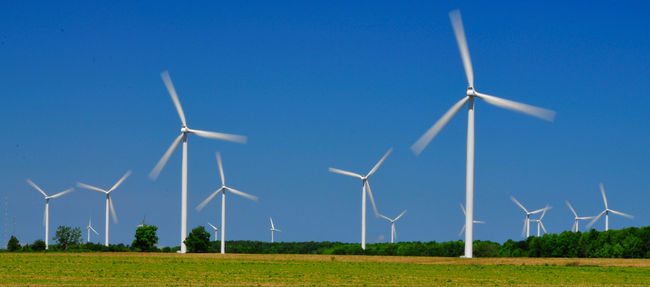
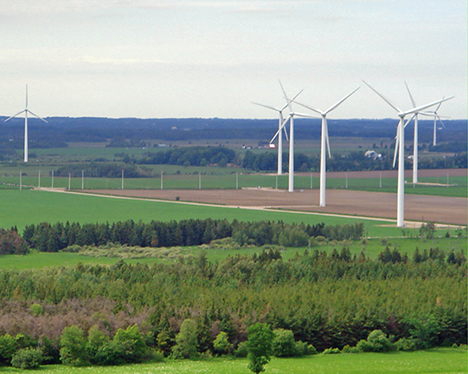
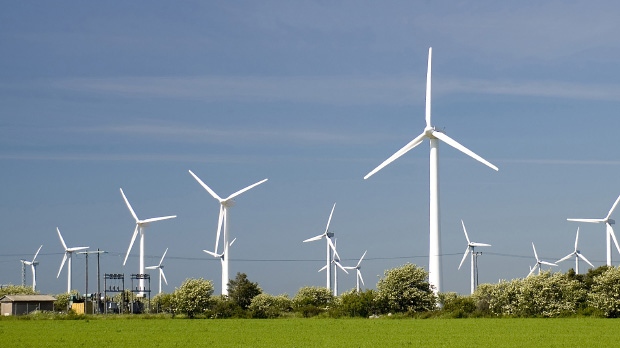
Ontario is building 6736 Wind Turbines.
We already have clean and excess power from water, nuclear and gas.
Bruce Peninsula
We pay more for wind power than any province/state in North America.
We are subsidizing the wind industry.
The Ontario Government pays the wholesale price of 11-13.5 cents per kwh for wind power.
The average retail price for wind power in the U.S. is 7 cents.
The average retail price for Ontario nuclear, water and gas is 7 cents.
Ontario hydro consumers pay for a debt that was actually paid off in 2010.
The 10% clean energy rebate on your hydro bill is charged to Ontario tax payers.
Ontario is the only province/state that charges HST, delivery, and regulatory fees on electricity.
Your hydro rates increase every May and October.
In 2007, you paid 7 cents per kwh.
In 2014, you pay 14-27 cents per kwh, depending on usage and location.
Check your hydro bill; divide the total (including HST, delivery and regulatory fees) by your usage.
1699 kwh costs $210 = 14 cents per kwh.
288 kwh costs $79 = 27 cents per kwh.
Compare our rates to: 6.8 cents in Quebec and 7.9 cents in Manitoba.
Pro-wind groups claim that our expensive electricity is due to expensive nuclear power.
However, the Ontario Power Generation states otherwise as per the link below:
http://www.opg.com/generating-power/nuclear/Pages/nuclear.aspx
Shelburne
Manufacturing is leaving Ontario.
“Ontario has the highest industrial rates in North America.”
Association of Major Power Consumers in Ontario. Refer to Sources for complete report.
Caterpillar (2 plants), United Steel. Heinz, Bicks, International Trucking,
General Motors, Navistar, Kellogg’s, John Deer, Lance Bakeries, Kraft Foods, Unilever.
NOVA Chemicals says the cost of power is critical in its decision to locate a multi-billion-dollar polyethylene expansion in Sarnia Ontario.
Their alternative is the U.S. Gulf Coast where rates are a fraction of ours.
Since 2006, power usage has decreased by 6%.
Ontario has almost 1 million people out of work.
Ontario’s $227 billion debt is the worst in North America.
“Ontario’s economy has not performed on par with the rest of Canada,
due in part to its slow economic growth and spiralling public debt.”
Fraser Institute, April 2014. Refer to Sources for complete report.
Bruce Peninsula
Gone are the days of beautiful Ontario….
“These wind projects will change this place more totally, more rapidly and more permanently
than anything in the past 10,000 years”
James Corcoran, South Huron, Ontario
30 years experience, environmental assessments on behalf of developers.
The Human & Environmental Impact
To appreciate the full impact of turbines on our people, please find the time to read this:
http://www.southwesternontario.ca/news/public-fills-gallery-to-hear-wind-turbine-concerns/
Wind companies pay proportionally less taxes than the rest of us; turbines are assessed at a fraction of the actual value.
Farmers who sign 20 years leases with Wind Companies also sign a gag order whereby they must promote turbines and cannot criticize.
Wind companies are exempt from many Ontario laws.
Examples: municipal bylaws, building permits, road weight restrictions, proximity to highways, drainage.
Example: The restriction on rural bridges with 1/2 ton limits, where the heaviest load is usually a tractor,
are lifted during the construction of a wind project.
Example: Wind Projects can violate the Labour Act.
These cranes from the Adelaide wind project were left in this position overnight.

The Ministries of Environment and Natural Resources have changed laws that apply only to wind companies.
Example: there is no protection of wetlands; death or harm to endangered species.
Example: If you destroy an eagle’s nest, the fine is $10,000; whereas wind companies are exempt.
Wind companies routinely sue municipalities/persons who get in their way.
The government supplies lawyers to back a wind company;
but has never backed a municipality, group or person.
Laws were passed where municipalities have no rights regarding wind projects in their jurisdiction.
Over 80 municipalities are “unwilling hosts” to turbines, but are not acknowledged.
Every turbine will permanently destroy 3 acres of land; roughly 21,000 acres of farmland lost forever.
Ontario turbines are closer to humans than any place in the world.
People are suffering from constant turbine noise and wind turbine syndrome which can be life threatening.
People are abandoning their homes at a unprecedented pace; very few want to live in or buy a house surrounded by turbines.
The fortunate ones are bought out by the wind companies, but sign a gag order as to why they left.
Areas in rural Ontario are becoming ghost towns.
The Birds
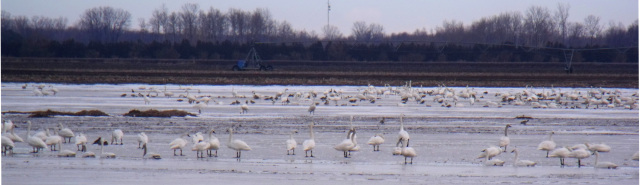 March 2014 – Lambton Shores – Rest area for Migrating Tundra Swans
March 2015 – Lambton Shores – Rest area for newly built wind turbines.
People call turbines bird blenders because they slice, maim and slaughter birds.
Turbines will be built in the paths of the millions of birds that migrate to or through Ontario.
Turbines kill more bats than birds (their lungs explode from the turbine’s drop in air pressure). Don’t neglect the importance of bats to our eco-system.
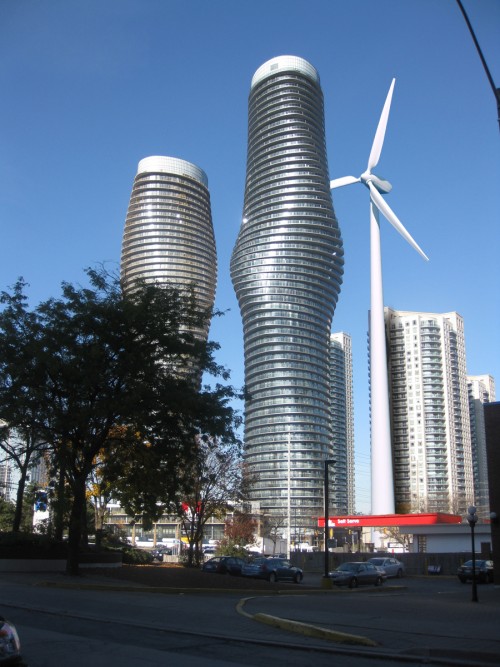
A Perspective of Turbine Height
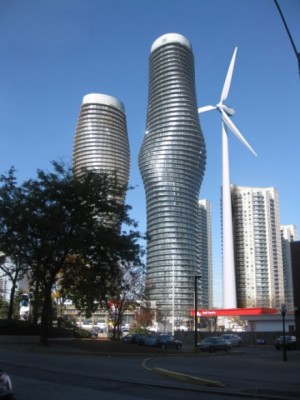
Using the Absolute Towers in Mississauga rendered in as a backdrop:
Absolute Towers is 56 storeys.
The small turbine is the CNE turbine – 299 feet high.
The mid-size is the average Ontario turbine – 380 feet high.
The tall one is the new Ontario turbine – 550 feet and taller.

The rendering below provides a perspective of Ontario’s new turbines.
The building behind is 38 storeys.
Ontario’s wind energy policy is convoluted and wastes money.
- Nuclear, hydro, & gas is clean, cheap and has a 100% reliability, but, wind is given priority to our grid.
- Wind power is expensive and unreliable; available 20-30% of the time.
- When there is no wind, there is no wind power available.
- For every kwh of wind power, we need one kwh of backup, that could otherwise be used as our sole source.
- Ontario is spending $11 billion building transmission lines to feed power from every wind project.
That’s an additional $2750 cost to your household - Ontario has too much power and we either, pay the USA & Quebec to get rid of the excess or charge 2.5 per kwh.
In 2013 alone, the loss was $1 billion which will cost your household an additional $250. - Quebec turns around and sells our hydro at 5 cents per kwh to bordering States.
- When there is too much power, Ontario pays $1 million dollars a day to take a nuclear plant off-line ($66 million in 2013)
and pays wind companies to shut down their turbines. - $6 billion was spent to increase the power at Niagara Falls; only to divert the water when there is excess power.
- Ontario pays gas plants to run as backup for wind power.
- The first weekend in August, Ontario lost $10 million because of highly windy days resulting in unexpected power to the grid.
The same occurred on November 9 & 10, where Ontario lost another $20 million. - September 11, 2013: Ontario agreed to pay Wind Energy companies $200,000 per mw not to supply power,
The government says it’s “cheaper than paying the USA & Quebec to use it”.
Since then, new wind projects continue to be approved. - The plan to build two new nuclear reactors at Darlington was abruptly cancelled in October 2013 at a cost of $180 million.
- During the 2011 election, the Liberals cancelled the construction of 2 gas plants to win Liberal seats.
These cancellations totaled $1.1 billion which will cost your household an additional $250. - The Lambton coal plant had just been upgraded at a cost of $1 billion to produce clean coal before it was closed in October 2013.
That will cost your household another $250.
Ironically, the Lambton coal plant is 1 km from a coal plant in Michigan that is still active.
“This situation is expected to get much worse over the next several years as significant amounts of wind,
hydraulic and nuclear generation will be coming into service while expected electrical demand will continue
to be stagnant.”
Ontario Society of Professional Engineers. Refer to Sources for complete report
Truth is stranger than fiction
Ontario pays 11-13.5 cents for wind power.
Ontario pays or charges Quebec 2.5 cents take our excess.
The loss is subsidized by Ontario consumers.
Quebec sells it to border States for 5 cents.
Consequently:
Manufacturers can move to the States and get cheap power; where a portion is sourced from Ontario and subsidized by Ontario consumers.
New York State sees an opportunity.
Promotional information was sent to Ontario’s Manufacturing sector citing Ontario’s high energy costs as a good reason to relocate to New York State.http://www.theglobeandmail.com/news/politics/soaring-energy-prices-making-ontario-look-dim-for-manufacturers/article17560172/
Wolfe Island – photo rendering shows pre-turbine days
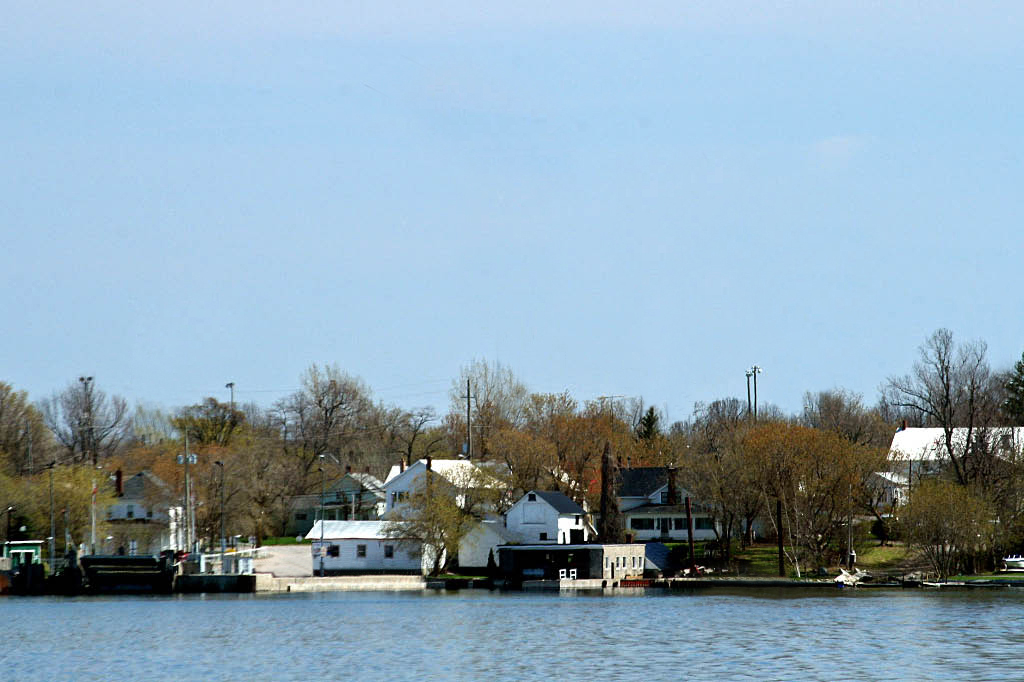
Wolfe Island – actual photo

The Vulnerability of our Grid
- When produced, power has to be used immediately; there’s no technology to store it for a later time.
- There is excess power almost every hour of every day, and Ontario scrambles to find a state/province that will take it.
- Depending on their power needs at the time, we either give it away (spill it), pay to take it (spill it) or charge a very low rate.
- Because wind power is so unpredictable, the IESO staff are continually manipulating the grid; telling the nuclear, gas and hydro suppliers to adjust their output accordingly; and the excess is then sent to Quebec, Manitoba and the States.
According to the Ontario Society of Professional Engineers:
Carbon Dioxide Emissions will increase by 48% in 2030,
because gas plants constantly starting up and shutting down expel more emissions than if they ran continually.
Much of our wind power will go to Quebec and the States.
Wind blows mostly at night and in the winter when we need power the least.
There is no wind on a hot summer day, when our air conditioners need it the most.
Constant changes to the grid are prone to error and Ontario’s grid wasn’t built to handle such.
Be prepared for frequent and long blackouts or worse, as in complete failure of our energy grid.

Rondeau Bay
Ontario has more than enough power with Nuclear, Hydro (water) and Gas.
Ontario’s average demand for power is roughly 18,000 mw.
In the last 8 years, Ontario’s highest demand for power was 27,005 mw on August 1, 2006.
The amount of available reliable power is 30,806 mw which far exceeds the demand.
Nuclear = 12947 mw: Hydro = 7939 mw; Gas = 9920 mw.
The Liberals will have added 3725 mw of installed wind energy by the end of 2014;
with intentions of adding more.
“Ontario will phase in wind, solar and bioenergy
….with 10,700 MW online by 2021.”
Ministry of Energy
(Ontario is offering 44-88 cents per kwh for solar and bioenergy.)
Chatham Kent – photo rendering shows pre-turbine days

Chatham Kent – actual photo
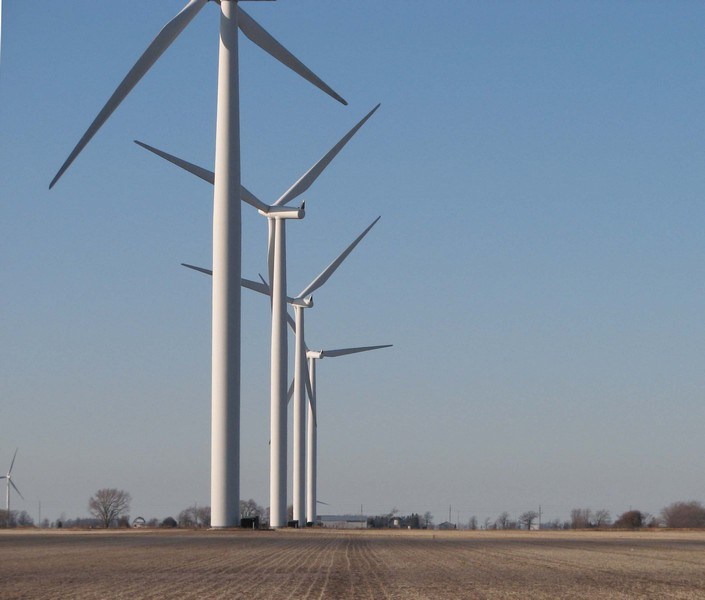
Does this make sense to you??
”The province’s wind and solar power initiatives were decided and implemented in such haste
that “no comprehensive business-case evaluation was done to objectively evaluate the impacts
of the billion-dollar commitment.”
Auditor General of Ontario
There are about 50 resident wind lobbyists in Toronto.
The Liberals introduced and passed the Green Energy Act 2009.
The NDP have supported the Liberals on wind energy since its inception.
The PC’s do not support subsidized wind power. They want it stopped.
This has been going on for years. One example:
In 2004, Mike Crawley, the (then) President for the Ontario Liberals,
was awarded a wind power contract that guarantees his company $66,000 a day for a total of $1/2 Billion dollars.
Since then, Mike Crawley continues to build additional Wind Projects.
The Wind Industry held a fundraising event for Kathleen Wynne in April 2013.
Those who promote Wind power, benefit financially by doing so.
David Suzuki, Pembina Institute, Cleantech, MaRs, Environmental Defence,
Friends of the Wind, Windfacts and CANWEA.
A wind company is getting a pass on violating the law?
In the Niagara region, four turbines that were built too close to residents, are violating the law and need to be dismantled.
The Minister of Energy has done nothing.
http://www.niagarathisweek.com/news-story/4390620-enforce-the-law-hudak-to-energy-minister
Lake Ontario – photo rendering shows pre-turbine days

Lake Ontario – actual photo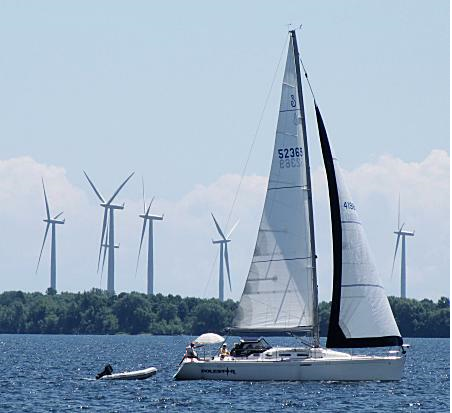
Every project could be stopped today; if the Liberals want to.
The Ontario Government has the discretionary power to cancel or modify these contracts but it’s clear they don’t want to.
An Ontario court ruling in the decision of Trillium vs. Ontario, 2013, clearly states that:
“Governments are free to alter policies in the public interest.”
“Companies in the renewable power business participate in government subsidy programs ‘at their own risk’.”
As of March, 2014, the Liberals are continuing with the 55 incomplete wind power projects (about 4900 turbines) that could be stopped legally.
“If you are asking me, will you cancel those [wind project] contracts outright? The answer is no we won’t!”
Kathleen Wynne, in Kincardine, April 24, 2014
For ruling, refer to Discussion at the bottom of this page
http://www.osler.com/NewsResources/Appeal-Court-Allows-2-Billion-Wind-Farm-Action-to-Proceed-Against-Government-of-Ontario/
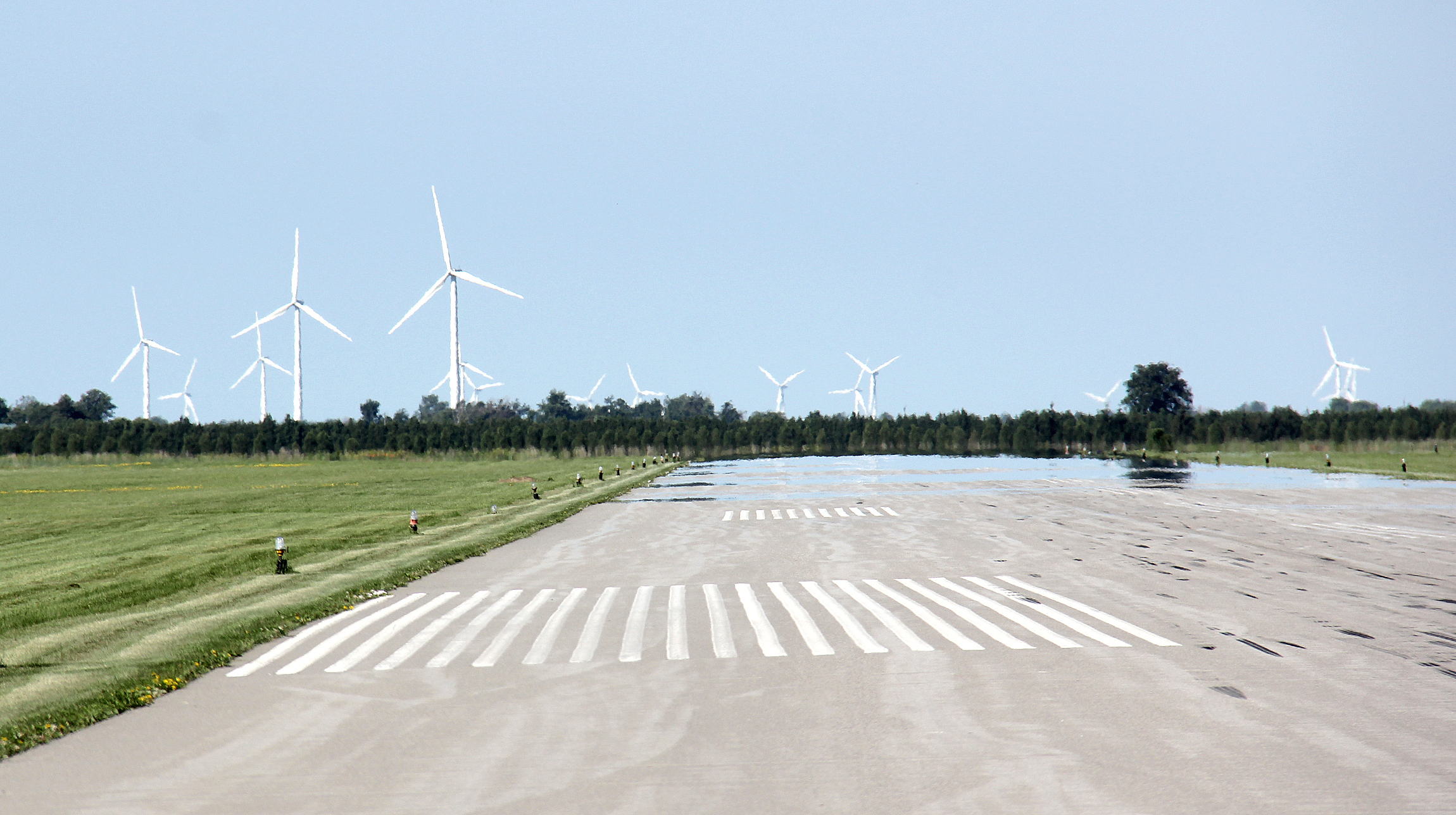
Chatham Kent Airport – Location of turbines was denied by Transport Canada,
fought by the municipality, but approved by the Ontario Government.
The same is happening in Collingwood, Peterborough, Goderich, Kincardine, Huron Park, Grand Bend and the Niagara Region.
The sky-diving club in Niagara Region will have to shut down.
Energy Platform by Party
The PC’s introduced Bill 42 in 2012 and Bill 39 in 2013 to eliminate wind subsidies and give control back to municipalities.
The NDP’s and Liberals voted against these bills. Refer to Sources.
Liberal
Will be pursuing additional wind power projects in 2015 and again in 2016.
Remove the Ontario Hydro Debt charge on January 1, 2016. (About $60 a year decrease in costs).
Discontinue the Clean Energy Rebate on December 31, 2015. (About $170 a year increase in costs).
Introduce a surcharge for families making over $40,000, to subsidize lower income families.
NDP
Committed to “aggressively expand renewable energy”.
Honour existing green energy contracts
Place a moratorium on all renewable power projects starting in 2018.
Progressive Conservatives
Scrap Ontario’s wind energy policy.
Give control back to municipalities.
Put a moratorium on wind energy projects.
Eliminate wind subsidies, which would substantially reduce our hydro bills.
“We propose scrapping the Green Energy Act and implementing an immediate moratorium
on industrial wind turbines until the jury is in on health and environmental studies.
We will not sign any more FIT contracts and will take a look at the existing ones.”
PC MPP Toby Barrett, April 2, 2014
Wolfe Island
Wolfe Island before & after the Liberal’s energy policies
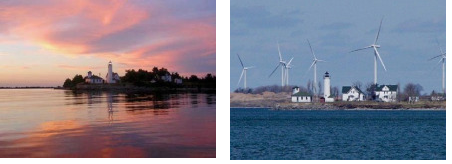
Is Nothing Sacred?

Near Peterborough, a $40 million project to build the largest Buddhist complex outside of China is in jeopardy.
The Liberals knowingly approved wind turbines to surround the complex.
The people in charge of the development say these turbines will have a negative impact on the serenity of the complex.
This complex would have attracted about 45,000 visitors a year and generated more than $20 million for Ontario.
Wind Farms slated for Ontario
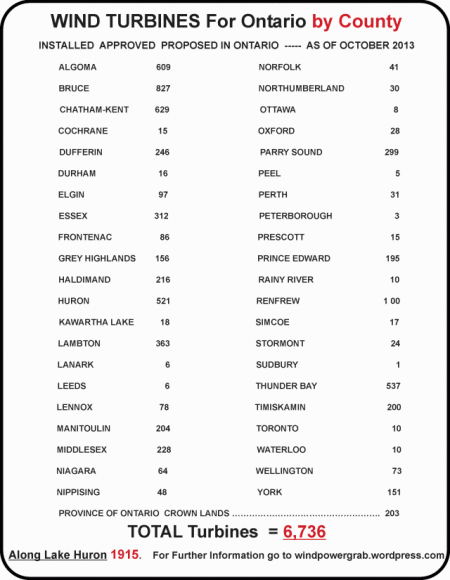
Click here to see maps of these projects
Rondeau Bay – photo rendering showing pre-turbine days
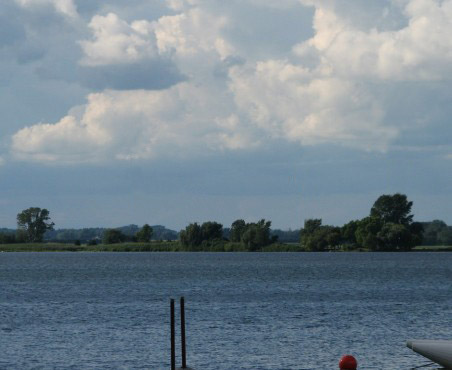
Rondeau Bay – Actual photo

Wind verses Nuclear
- Nuclear power costs 6.8 cents per kwh, period.
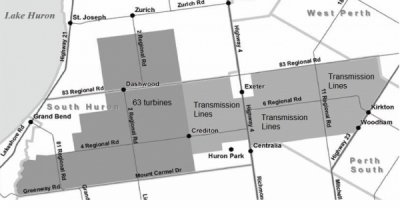
Wind power costs 11-13.5 cents per kwh, plus all other costs mentioned above. - One wind project approved for the area east of Grand Bend is approximately 34 km long and 16 km wide.
The nuclear footprint is 9 sq. kilometers. - It will have 63 wind turbines with a maximum output of 102 mwh.
- Applying efficiency factor of 30%, actual output will be 30 mwh.
- Ontario average usage is 18,000 mwh.
- Nuclear can provide approximately 12,947 mwh 24/7.
- This wind project has the potential of providing .16% (1/6th of one percent) our energy needs.
- When there is no wind, it will provide 0% of our energy needs.
Map
In 10-20 years
- The Niagara Falls hydro generating stations are 100 years old, but wind turbines are good for only 10-20 years.
- Each turbine construction consists of 800 tonnes of cement for support, approximately 250 tonnes of unrecyclable materials, 700 litres of hydraulic fuel and, 600 kilograms of rare earth metals. Multiply these numbers by 6736 and Ontario is facing a potential ecological conundrum.
- The are no bonds posted to ensure these turbines will be dismantled at the end of their life cycle. It is estimated that a turbine, depending on size, will cost $400,000 to $1,000,000 to dismantle.
- Given that wind companies are predominantly foreign, change ownership or, go bankrupt, it is quite realistic to expect 100′s or 1,000′s of dead turbines in 20 years and left standing.
- This is happening already. Wind Companies usually don’t fix or dismantle broken turbines and, Ontario already has many non-functioning turbines.
If companies won’t dismantle a couple of turbines now; what about the future ones?. - The Liberals have no plans as to where to dispose these materials, nor have indicated that wind companies will be responsible for the costs of building the landfill sites or depots.
- One can only assume, that the cost to dispose 6736 turbines will be covered by the people of Ontario.
In 10-20 years, we could be faced with a landscape of old, rusted out, broken down turbines.

The Canadian Taxpayers Federation:
Launched a petition to dismantle the Liberal Green Energy Act.
https://www.taxpayer.com/resource-centre/petitions/petition?tpContentId=84
128,202 total views since Mar
Wind Power? Wind = Powerless!
Wind Power Myths BUSTED
May 13, 2014 by 2 Comments

As the Australian wind industry’s house of cards collapses, its parasites and paid spruikers – like the Clean Energy Council – have been working up a real sweat in their efforts to make a case for the retention of the mandatory Renewable Energy Target – upon which that house of cards entirely depends.
All manner of fictions are being relied upon, most of which we’ve all heard before – crackers like: wind power has REDUCED household power bills; wind power has created thousands of “green” jobs; wind power is cost competitive with conventional power generation sources; and that giant fans are literally sucking CO2 out of the atmosphere.
In this episode of STT Mythbusters, we thought we’d tackle 3 of the biggest myths peddled about wind power by its dwindling group of hard-pressed supporters.
Myth #1: “the distributed network myth”.
This is the often told tale about wind power providing “base-load” power (ie available on-demand and around-the-clock) when wind farms are spread over a large geographical area and connected to the same grid. This myth is based on the story that the “wind is always blowing somewhere” – spread fans far and wide and there will always be oodles of wonderful “free” wind power available on-demand.
Myth #2: “wind farms in Australia produce enough energy to power 1.7m homes”.
Variants of this myth pop up as: “the Woodlawn [insert name] wind farm will “power” 32,000 homes [or simply insert any made-up figure you like]” (see our post here).
Myth #3: “wind power is a substitute for fossil fuel generation sources”.
This myth is trotted out to support wild claims about wind power completely displacing coal and gas-fired power plants, thereby eliminating CO2 emissions in the electricity sector, altogether. This myth is tied up with Myth #1 – relying upon the myth that wind power provides “base-load” power. One lesser version of the myth is that wind power is capable of being a perfect substitute for coal and gas (some day) – provided that 10s of thousands of new giant fans are added to the grid.
At STT Mythbusters we don’t just tell the myths, we put them to the test. So let’s take a look at some data from the last month, courtesy ofhttp://windfarmperformance.info/.
In this episode, we’ll look at data for the entire Eastern Grid – which covers every wind farm in Victoria, Tasmania and New South Wales, as well as including the 1,203 MW of installed capacity that comes from Australia’s “wind power capital” – South Australia. All of these wind farms are connected to the Eastern Grid and together have a total installed capacity of 2,660 MW. Oh, and if our data looks a little fuzzy, click on the image, it will pop up in a new window, use your magnifier and it will look crystal clear.

Entire Eastern Grid – 16 April 2014 – from 8am to 12 noon (4hrs) and from 6pm to midnight (6hrs):
Total wind farm output: 8am to 12 noon – less than 165 MW, falling to 90 MW; 6pm to midnight – less than 80 MW, falling to less than 50 MW.
Output as a percentage of total installed wind farm capacity: 8am to 12 noon – 6.2%, falling to 3.3%; 6pm to midnight – 3%, falling to 1.9%.
Total demand (average): 22,000 MW.
Contribution to total demand as a percentage: 0.75%, falling to 0.22%.

Entire Eastern Grid – 17 April 2014 – from midnight to 11am (11hrs) and from 6pm to 9pm (3hrs):
Total wind farm output: midnight to 11am – less than 80 MW and generally less than 60 MW; 6pm to 9pm – less than 140 MW, falling to 80 MW.
Output as a percentage of total installed wind farm capacity: midnight to 11am – 3%, falling to 2.2%; 6pm to 9pm – 5.2%, falling to 3%.
Total demand (average): 22,000 MW.
Contribution to total demand as a percentage: midnight to 11am and 6pm to 9pm – between 0.27% and 0.63%.

Entire Eastern Grid – 19 April 2014 – from 8am to 1pm (5hrs) and from 7pm to 11pm (4hrs):
Total wind farm output: 8am to 1pm – less than 180 MW, falling to 90 MW; 7pm to 11pm – around 45 MW.
Output as a percentage of total installed wind farm capacity: 8am to 1pm – between 3.4%, and 6.7%; 7pm to 11pm – 1.7%.
Total demand (average): 19,000 MW.
Contribution to total demand as a percentage: 8am to 1pm and 7pm to 11pm – between 0.23% and 0.94%.

Entire Eastern Grid – 30 April 2014 – from 8am to midnight (16hrs):
Total wind farm output: 8am to midnight – never more than 380 MW, generally less than 300 MW, and falling to less than 40 MW (10pm to midnight).
Output as a percentage of total installed wind farm capacity: 8am to 10pm – between 5% and 14%; 10pm to midnight – 1.5%.
Total demand (average): 23,500 MW.
Contribution to total demand as a percentage: 8am to midnight – between 0.17% and 1.62%.

Entire Eastern Grid – 1 May 2014 – from midnight to 10am (10hrs):
Total wind farm output: midnight to 10am – never more than 150 MW and generally less than 100 MW.
Output as a percentage of total installed wind farm capacity: midnight to 10am – between 3.75% and 5.6%.
Total demand (average): 23,500 MW.
Contribution to total demand as a percentage: midnight to 11am – between 0.42% and 0.64%.

Entire Eastern Grid – 6 May 2014 – from 10am to midnight (14hrs):
Total wind farm output: from 10am to midnight – never more than 280 MW, dipping to 210 MW around 3pm.
Output as a percentage of total installed wind farm capacity: from 10am to midnight – around 10.5%, dipping to 7.8% around 3pm.
Total demand (average): 23,500 MW.
Contribution to total demand as a percentage: 10am to midnight – between 0.89% and 1.2%.

Entire Eastern Grid – 11 May 2014 – from 4am to 4pm (12hrs); and 5pm to midnight (7hrs):
Total wind farm output: from 4am to 4pm – never more than 370 MW; from 5pm to midnight – never more than 240 MW, dipping to 130 MW around 11pm.
Output as a percentage of total installed wind farm capacity: from 4am to 4pm – around 14%; from 5pm to midnight – around 9%, dipping to 4.9% around 11pm.
Total demand (average): 21,500 MW.
Contribution to total demand as a percentage: 4am to midnight – between 0.60% and 1.72%.

Entire Eastern Grid – 12 May 2014 – from midnight to 7pm (19hrs):
Total wind farm output: (from midnight to 7pm) never more than 240 MW, generally less than 170 MW and dipping to around 100 MW between 5pm and 6pm.
Output as a percentage of total installed wind farm capacity: from midnight to 7pm – no more than 9%, generally around 6.4% and dipping to 3.8% around 5pm.
Total demand (average): 23,500 MW.
Contribution to total demand as a percentage: (from midnight to 7pm) between 0.42% and 1.02%.
For more STT Mythbuster’s data see our posts here and here and hereand here and here.
Now back to the workshop with the data to test the myths.
Myth #1: “the distributed network myth”.

On the Eastern Grid Australia’s wind farms are spread from: Jamestown in the Mid-North, west to Cathedral Rocks on lower Eyre Peninsula and south to Millicent in South Australia; down to Cape Portland (Musselroe) and Woolnorth (Cape Grim) in Tasmania; all over Victoria; and right up to Cullerin on the New South Wales Tablelands.
Those wind farms have hundreds of fans spread out over a geographical expanse of 632,755 km². That’s an area which is 2.75 times the combined area of England (130,395 km²) Scotland (78,387 km²) and Wales (20,761 km²) of 229,543 km².
Nowhere else in the world are so many interconnected wind farms spread over such a large geographical expanse. If there was a shred of substance to the distributed network myth, then we’d see it in the data above. But it just ain’t there.
When you have 2,660 MW of installed capacity – connected and spread over an area more than twice the size of Great Britain – producing less than 200 MW for hours on end – and, on plenty of occasions, less than half that figure – the idea that wind power is providing (or could ever provide) “base-load” power – or even power “on demand” – by having wind farms spread far and wide is just silly.
Verdict: Myth #1 – BUSTED.
Myth #2: “wind farms in Australia produce enough energy to power 1.7m homes”.
True it is that, STT Mythbusters has only presented data from the Eastern Grid, overlooking the roughly 420 MW of installed wind farm capacity in Western Australia (which represents around 14% of the 3,080 MW Australian total). So let’s test Myth # 2 as a myth about “Eastern Australian wind farms “powering” 1.4 million homes.”
At STT Mythbusters the term “powering” means exactly what it says: that when someone – at any time – in any and all of those 1.4 million homes flicks the switch the lights go on or the kettle starts boiling.
The claim about wind farms powering 1.4 million homes depends upon all 2,660 MW of total installed capacity operating and pumping all of that power into the grid.
So, how many homes were, in fact, “powered” by wind farms on 12 May 2014 when – from midnight to 7pm (a period of 19 hours) – every single fan hooked up to the Eastern Grid never produced more than 240 MW, generally produced less than 170 MW and was producing about 100 MW around 5-6pm that day?
STT Mythbusters viewers can run the numbers on any of the data we’ve gathered, and get much the same results.
On rare and brief occasions – and then only for very short spurts – the installed wind farm capacity connected to the Eastern Grid has generated around 2,000 MW, but for the most part produces half that and much, much less.
Hundreds of times each year – for hours on end – those same wind farms collectively produce less than 5% of their installed capacity (see our post here). At the abstract level, that means that 70,000 homes (5% of 1.4 million) could be “powered” by output from wind farms. But that’s not what the myth says.
From the data seen above, there are long periods when actual output struggles to exceed more than 4% of total installed capacity, which completely demolishes Myth #2.
Verdict: Myth #2 – BUSTED.
Myth #3: “wind power is a substitute for fossil fuel generation sources”.
The data above kills this myth stone dead. Intermittent and unpredictable wind power output means that wind power is not – and can never be – a substitute for on-demand generation sources, which obviously includes gas and coal generators.
There are hundreds of occasions each year – like those seen in our data above – when, for hours on end – total wind farm output is less than 10% of installed capacity (or half that and less), but the power that householders and businesses need simply has to come from somewhere.
The alternative, of course, is for households to break out the candles and eat cold tins of baked beans while they wait for the wind to pick up. Some might see a wind power “blackout” as a good opportunity to defrost the deep freeze and everything in it. But every other day?
Widespread blackouts are relatively rare occurrences where a grid relies upon base-load gas and coal plants, with sufficient intermediate (on-demand) generating capacity to meet spikes in demand. A grid trying to rely upon wind power would collapse into chaos within 24 hours.
And it wouldn’t matter if there were 100,000 giant fans connected to the Eastern Grid – the result would be identical. As soon as the wind stops blowing, output plummets and – in the absence of coal and gas powered plants – every home and business would be plunged into silent darkness.
The critical point – as our data shows – is that wind power is not available “on-demand”; and never will be. It will never be a substitute for “on-demand” power sources, which – at the present time – in Australia means gas, coal and hydro power.
Verdict: Myth #3 – BUSTED.

ONE HUNDRED AND SIX…Compelling Reasons Not to Vote Liberal!
Just a few facts on the past 11, almost 12 years of Liberal government;
Green
Energy Act (20 billion)
eHealth scandal (almost 2
billion)
Gas
plant scandal (1.1 billion theft and cover-up of our tax
dollars)
Deleting
e-mails
ORNGE scandal (700
million)
Ontario Northland Railway
scandal (820 million)
Caledonia Hydro Line scandal
(116 million)
Lobbyist scandal (two
multi-million dollar scandals)
Eco-Fee Reversal scandal (18
million)
CancerCare Ontario scandal
(millions of dollars)
Slush Fund scandal (32
million)
Niagara Falls Commission
scandal
Ontario Power Generation
scandal
Children’s Aid Society
scandal
Nanticoke Coal Power Plant
Shutdown scandal
G20 Secretly Approved Police
Power scandal
Auto Insurance
scandal
Foreign Scholarships scandal
(our students pay the highest tuition in Canada while foreign students
get free university educations)
Offshore Wind Turbines
scandal
Samsung scandal
(sole-sourcing)
Pan Am scandal (cost increase
from 1.4 to 2.5 billion)
MPAC scandal (over and
under-valuation of properties)
OLG scandal (millions of
dollars)
Isotape Shortage
scandal
Chemotherapy Dosage
scandal
Payout for Pan Am CEO (250
million)
Trillium Wind Power and Sky
Power Limited lawsuit (500 million)
Cement company lawsuit (275
million) – Quarry outside Hamilton was scuttled for political
reasons
School bus service
lawsuit
Augusta/Westland lawsuit as it
pertains to ORNGE
Elliot Lake Collapse lawsuits
(two lives lost due to recovery delays)
Ontario Medical Association
lawsuits – applied to Superior Court alleging McGuinty not negotiating
in “good faith”
Breast Screening scandal
(ensuing lawsuits due to thousands of misread mammograms, one life
lost)
Class-action lawsuit for autism
funding cancellation
Over 650 new agencies, boards,
commissions and entities such as LHIN’s and CCAC’s
Over 300,000 new public servants
many of whom, are on the sunshine list
Public sector employment in
health care increased by 39%
Public sector employment in
social services increased by 39%
Public sector employment in
education increased by 34%
Paying more Liberal taxes only
to receive fewer services as taxes now being spent to pay the salaries
and perks of newly-assigned, Liberal-friendly public
servants
Gutted our manufacturing base
(job growth across Canada except in Ontario)
Nearly one million Ontarians now
out of work
Increased spending by 80% while
our economy grew by only 9%
More than doubled our debt to
288 billion
Running a 11.3 billion annual
deficit
Debt
servicing costs will rise from 11.4 billion today to 14.5 billion once
the debt exceeds 300 billion by 2017-18
Interest payments on our debt
now the third largest budget expenditure after health and
education
Task Force on Competitiveness,
Productivity and Economic Progress confirmed that McGuinty’s Green
Energy Act grossly underestimated the cost to consumers and
overestimated the number of new jobs that would be
created
Tax
collectors getting 45,000.00 severance packages for switching job titles
from provincial to federal
Two ministries under an OPP
criminal investigation – ORNGE and gas plant
scandals
Pharmacy war
Illegal green
taxes
Increased smart meter,
electricity, hydro, tuition and car insurance costs
Implemented tire tax,
electronics tax, eco fee, health premium (tax), WSIB tax increase, HST,
beer surtax
Failing grade on ADHD
education
Ranking the lowest of all
provinces for fiscal performance
Delisting eye exams,
physiotherapy, chiropractic care, diabetic strips,
etc.
Increasing wait time for
cataract surgery
No longer covered for eye exams
yet taxpayers paying for sex changes
Wait
time for nursing home bed tripled
Failure to disclose elevated
radiation levels
OES missed its collection and
recycling targets by 59%
Not correcting the foreign
ownership of our beer market
Acceptance of garbage striker
extortion
Harassing labour
inspectors
Kowtowing to green energy
lobbies
Imposing blood alcohol rules
that punish people who are not impaired
Public utilities donating to
Liberals
Voting to cover up the Niagara
Parks Commission scandal
Emergency room wait times not
meeting provincial targets
Put on notice by Standard and
Poor, credit rating downgraded, under a very serious credit
watch
Have-not province for the first
time in Canadian history
Borrowing more debt than any
province except NB
Dramatic cuts in health care
services in schools
Nurses getting bonuses despite a
wage freeze
Insufficient senior homecare
services
Failing grade of Family
Responsibility Office
Abstained from vote to
investigate CBC expenses
Cash kickback scheme involving
government cleaning contracts
Talked about a two-year freeze
on wages for public sector while previously giving the OPP a 5% wage
increase – the OPP received another raise of over 8% in January,
2014
Energy
now unaffordable yet we must pay Quebec and some north-eastern States to
take our surplus energy
Encouraging farmers to build
small-scale solar projects but having no way to connect them to the
power grid
Laid up in US hospital beds as
no beds available in Ontario
Refusing public inquiry into G20
fiasco
Giving those who hire only
newcomers a 10,000.00 tax credit
Third highest user of food
banks
Announced pay freezes knowing
that 38,000 were getting a 3% salary increase after the
election
Hiding hospital errors from the
public
Teachers skipping classes to
assist with anti-Conservative campaign
Failing grade in northern
forestry management
Almost 40 C. difficile deaths to
date
Loss of
6,500 cancer patient health records
Highest rent increase rate in
years
Ignoring evidence that wind
turbines can cause poor health
Workers at eHealth suing for not
receiving bonuses
Liam denied eye care that
another child is receiving under OHIP
Ontarians pleading for their
lives or dying because they aren’t getting the health care they
need
Lady
with a brain tumor denied help to cover costs which costs are covered in
Manitoba
Electricity rates to rise 42%
over five years
Prior loss of 60,000 jobs in the
horse racing industry – now attempting to correct
this
Presto
Ring of Fire
Cleaning kick-back scheme that
ended with the conviction of three persons (two of whom were employed by
Wynne’s ministry at the time …)
Muslim prayers allowed in our
publicly-funded school system while the Lord’s Prayer has been
banned
Testimony from David Michaud, from Health Canada. (from Julian Falconer)
David Michaud (Health Canada Study) testimony – Falconer LLP

Executive Summary
Dr. Michaud is a researcher with Health Canada. He is the principal investigator for a Health Canada study into the effects of noise generated by wind turbines on human beings.
Dr. Michaud was called as a witness before the Environmental Review Tribunal by counsel for communities and individuals affected by wind farm development in rural areas of Ontario. The primary finding elicited from Dr. Michaud’s testimony is that no studies have been completed in Canada on the dose-response relationship between noise generated by wind turbines and certain health effects. In particular, Dr. Michaud referred to a “knowledge gap” in respect of low frequency noise and infrasound generated by wind turbines. Dr. Michaud cited studies in other jurisdictions which lead him to conclude that there is credible scientific support for an association between noise generated by wind turbines and certain negative health effects.
Tim Hudak refuses to Carry On with the Wind Scam! Windweasels will scurry!!!
Hudak vows to pull the plug on wind power
BY ANTONELLA ARTUSO ,QUEEN’S PARK BUREAU CHIEF
It’s time to blow off expensive subsidies to wind and solar power, PC Leader Tim Hudak says.
The Progressive Conservatives would, if elected to govern, refuse to sign any more renewable energy deals at high rates of return and focus on creating an electricity system reliant on gas, hydro operations and nuclear power.
A Tory government would also give more control to local municipalities over the siting of wind projects, he said.
“If people can have a say about a hot dog stand going in for a Canada Day celebration, shouldn’t they have a say about massive industrial wind turbines in their backyard?” Hudak said.
The PCs say they will not proceed with any wind or solar applications that have not been already approved.
Those projects that have been approved but not yet connected to the grid would be evaluated on a case-by-case basis.
Such a move would save $20 billion and help businesses create 40,000 jobs through more affordable electricity — numbers confirmed by an independent economist brought in by the PCs, Hudak said.
The election campaign brought Hudak to Stanpac Inc. Monday, a food, dairy and beverage packaging manufacturer located in Smithville which is in the Niagara Region.
Murray Bain, Stanpac’s vice president of marketing, said the company would like to expand its Ontario operations but the rising cost of electricity in the province makes it more likely that those jobs will be added to its Texas plant.
“Every dollar we spend on energy could be a dollar that we would use for new jobs and higher pay cheques in Ontario,” Bain said. “We need to remember that government experiments that drive up energy costs will also end up taking jobs away. High energy prices are a self-inflicted wound on Ontario’s economy. It’s time to heal that.”
Premier Kathleen Wynne said Monday that her government has renegotiated a renewable energy deal with Samsung to find savings, but remains committed to its overall plan for renewable energy, including wind power.
Ontario’s green electricity initiatives had created 42,000 jobs by the end of 2013 in construction, installation, energy auditing, operations and maintenance, engineering, consulting, manufacturing, finance, information technology and software, the Liberals say.
Northern Ontario companies and lower income families benefit from government programs to keep their hydro costs manageable, Wynne added.
Hudak said the cost of hydro has gone up $630 a year for the average family under the Ontario Liberals.
Government has NO Business Funding Useless Wind Turbines!
May 11. 2014
George Fenwick: Taxpayers should
not be forced to subsidize bird-killing
wind turbines
SINCE EARLY in our nation’s founding, we have placed a high value on conserving native wildlife so that future generations will be able to experience and benefit from wild species as we do today. Yet even as our federal government has ’sequestered’ federal funds and been forced to shutter national parks during contentious government shutdowns, we taxpayers have been regularly tapped, year after year, by large corporate wind companies to provide them with tax credits they demand in order to make a profit of their ventures.
Taxpayers may not be aware that they have funded for several years — through the federal government’s Production Tax Credit (PTC) — a public subsidy that can create a perverse incentive to put wind turbines in areas that produce little electricity but would have a devastating impact on migratory birds.
As presently configured, the PTC provides 2.3 cents per kilowatt generated, largely to wind energy companies. Poorly sited wind energy development kills significant numbers of birds and bats and alters sensitive wildlife habitat. At the current estimated mortality rate, the wind industry is killing hundreds of thousands of birds and bats per year and is expected to kill well over one million per year as projects are built to reach the federal goal of 20 percent renewable energy by 2030.
While these numbers represent a relatively small percentage of the total number of birds and bats estimated to reside in or breed in North America, many of the species being killed are already declining for other reasons, and this mortality can exacerbate these declines. In fact, the North American Breeding Bird Survey shows that between 1966 and 2010, 40 percent of neotropical migratory birds (55 of 137 species assessed) had significant negative population trends. The mortality due to wind turbines is just one more factor contributing to the cumulative impact of humans on wild bird and bat populations.
In addition, many species are protected under the Migratory Bird Treaty Act, Endangered Species Act, and the Bald and Golden Eagle Protection Act. Killing them is a violation of federal law punishable by significant fines.
We all want clean, renewable energy, but wind power cannot be considered “green” if it is unnecessarily killing large numbers of birds and bats. However, we truly can have it both ways. Making wind power a win-win proposition for conservation-minded taxpayers is not overly complicated. Two key actions need to be taken.
The first is that “no-go” zones need to be established for the industry in the most sensitive locations where the toll on birds simply outweighs the benefits of wind development. American Bird Conservancy has already developed maps showing those areas.
The second is that the voluntary U.S. Fish and Wildlife Service (FWS) permitting guidelines, by which the wind industry is currently guided, need to be made mandatory. Since the Energy Policy Act of 1992 established the PTC, the federal government has doled out billions of dollars and hoped that the for-profit wind industry would voluntarily do the right things to minimize impacts to birds and bats.
In addition to their inherent beauty and cultural and scientific importance, birds and bats also have an incalculable value by maintaining the ecosystems on which humans depend. For example, birds and bats eat billions of insects each year that left unchecked could decimate our crops, damage our forests, or lead to more use of troubling pesticides. Bats are equally valuable. In one eight-county region of Texas, Brazilian free-tailed bats saved local farmers an estimated $740,000 annually in crop damage and pesticide costs by feeding on corn earworm and cotton bollworm.
Unfortunately, in the case of wind energy, rapid development has gotten way out ahead of the science and regulatory framework. Setting reasonable regulatory sideboards for the industry and putting key, sensitive areas off limits are two principles that should be non-negotiable as renewal of the PTC is considered. It harkens back to an old standard in business dealings to which most of us have grown accustomed. It is called quid pro quo.
George Fenwick is president of the American Bird Conservancy in Washington, D.C.
Kathleen Wynne is destroying our Province. Time Hudak will turn things around!
Kathleen Wynne says Tim Hudak will
plunge Ontario into recession as
PCs take aim at Liberals’ ‘bloated’ energy bureaucracy

Keith Leslie, Canadian Press | May 12, 2014 | Last Updated: May 12 2:11 PM ET
More from Canadian Press

THE CANADIAN PRESS/Nathan DenetteOntario PC Leader Tim Hudak, left, walks in with employees before he makes an announcement at a packaging plant about creating 40,000 jobs in Ontario with affordable energy during a campaign stop in Smithville, Ont., on Monday, May 12, 20
TORONTO — Ontario’s opposition parties started the second week of the campaign for the June 12 election Monday by focusing on soaring electricity bills, which they blamed on the Liberal government’s green energy policies.
Progressive Conservative Leader Tim Hudak said he’d end generous subsidies for wind and solar power, cut the “bloated” bureaucracy at Hydro One and Ontario Power Generation to help get electricity rates low enough to generate 40,000 new jobs.
“We need to pare down that massive hydro bureaucracy,” Hudak said at a factory in Smithville, in the Niagara Peninsula.
“They have 11,000 people in the hydro bureaucracy making $100,000 a year, can you believe that?”
After announcing plans last Friday to trim 100,000 public sector jobs, Hudak also said he would reduce the number of provincial electricity agencies created after the breakup of the old Ontario Hydro.
Liberal Leader Kathleen Wynne says Hudak’s plan for the province would plunge Ontario back into a recession.
Wynne says Hudak’s “reckless” election campaign pledge to shrink the public sector by 100,000 jobs would “sacrifice our fragile economic recovery.”
Speaking at the Carpenters’ Union local 27 training centre in Vaughan, Wynne said Hudak would fire many of the people who hire skilled tradespeople for home renovations.
“We believe this is exactly the wrong way to go,” she said.
“His approach would sacrifice our fragile economic recovery and would plunge us back toward recession. That may be his approach but it’s not mine and it is not ours.”
Wynne says when people can’t afford to build or renovate their homes, highly skilled apprentices would have trouble finding work.
She says a Liberal government would safeguard those jobs by investing $130 billion over a decade in infrastructure projects across the province.
Hudak has said that if his party wins the June 12 provincial election, he wants to shrink the public sector to increase efficiencies and spur job creation in the private sector.
“Unlike Tim Hudak, we believe that jobs are more important than cuts,” Wynne said. “Tim Hudak is proposing a reckless and really devastating cut that would take 100,000 jobs and would replace those with pink slips. He’s making a pink-slip pledge.”
Campaigning in Thunder Bay, Ont., New Democrat Leader Andrea Horwath promised to scrap the provincial portion of HST on hydro bills if she becomes premier, which she said would save homeowners about $120 a year.
“Instead of making life affordable, the Liberals decided to add an unfair tax on top of the highest electricity rates in the country,” said Horwath. “We’re going to take it off and make life affordable for families.”
Premier Kathleen Wynne spent the first part of her day on the radio, defending the Liberals’ decisions to cancel two gas plants in Oakville and Mississauga, which could cost taxpayers up to $1.1 billion.
They have 11,000 people in the hydro bureaucracy making $100,000 a year, can you believe that?
Wynne said former premier Dalton McGuinty did “what he believed was right,” but added that she has tried to rectify mistakes that she believes were made.
Campaigning later in Vaughan, north of Toronto, Wynne said hydro rates went up in large part because the government had to make massive investments to repair and upgrade Ontario’s electricity system after years of neglect.
“There’s a cost associated with that, and so we are working to make sure that there are programs and supports in place for people who are struggling to pay for their electricity,” she said. “But are we going to back away from clean, renewable energy? No, we’re not going to do that.”

THE CANADIAN PRESS/Darren CalabreseOntario Liberal Leader Kathleen Wynne speaks in front of carpenter apprentices and other Liberal candidates during a campaign stop at the Carpenters’ Union Local 27 Training Centre in Vaughan, Ont. on Monday, May 12, 2014.
Hudak lashed out at both the Liberals and the NDP for rising electricity bills.
“A billion dollars in the gas plants scandal to save a couple Liberal seats and you folks got stuck with the bill,” he said.
“And the NDP, they’re really just the great pretenders. They say they care about hydro rates but they voted with the Liberals each and every time.”
Wynne went on the attack against Hudak’s plan to wipe out tens of thousands of public sector jobs in an effort to eliminate the $12.5-billion deficit in just two years.
“We have a plan to cut ribbons at construction sites. Tim Hudak’s plan is to cut jobs at construction sites,” she said.
“Our steady balanced approach would invest in transit, invest in infrastructure, and it invests in skills training to help the people of Ontario get good jobs.”
Hudak said he’s giving people the “hard talk and the plain truth,” while the Liberals and NDP are making promises Ontario can’t afford.
“If this were a popularity contest, you’d promise everything under the sun to all people,” he said. “I’m actually proposing some pretty tough choices, but I think we owe it to Ontarians to be honest with them about the mess that we’re in.”
— With files from Maria Babbage, Diana Mehta and Colin Perkel
 "Mothers Against Wind Turbines™" Phoenix Rising...