Elected officials suppressed key report, failed to halt project or recover taxpayer dollars
“It was heartbreaking to see this project desecrate such a historically and culturally significant landscape, and it’s even worse when you find out that it was built on false claims by the developer, and with the assistance of the BLM. “– Anthony Pico, Chairman, Viejas Band of Kumeyaay Indians

By Miriam Raftery
April 30, 2014 (Ocotillo) – An international wind energy expert has concluded that Pattern Energy appears to have defrauded the federal government in order to obtain lucrative tax subsidies for a wind energy development in southern California that has failed to live up to the developer’s claims.
“I believe we have a clear case for the False Claims Act,” Nicolas Boccard told East County Magazine, after reviewing full first-year wind production data for the Ocotillo Wind Energy Facility on U..S. Bureau of Land Management (BLM) public land. The project produced only about half of the energy that Pattern claimed it would produce—far below levels deemed viable for a wind project, a second expert confirms.
These dismal results are no surprise to Boccard, who predicted in a report written before construction of the project was completed that Ocotillo lacks sufficient wind speeds to sustain a viable wind energy project.
So were Pattern’s lofty wind speed claims nothing more than spin?
Boccard, an international energy expert and assistant professor of economics at the University of Girona, Spain, has written and published in Energy Policy prior reports exposing exaggerated wind production claims made by energy companies in Europe. The Ocotillo report authored by Boccard was commissioned by the Desert Protective Council but its findings have since been independently validated by multiple experts.
Concerned tribal leaders, environmentalists and residents initially kept the Boccard report on Ocotillo confidential, but did share copies only with their public officials– members of Congress and the Legislature, who failed to take action to prevent the project from being built—with one exception; one Congressman sent a letter to the U.S. Treasury Department asking that funds for the project be halted pending an investigation of wind speeds, but the agency failed to act. The other political leaders appear to have done nothing to investigate the fraud allegations before the project was built. Confronted with the year-end wind speed data, however, a second Congressional member has now taken action, asking the U.S. Department of Energy to investigate fraud claims.
The citizens’ coalition also provided evidence strongly suggesting fraud to the North American Development Bank, which financed the project, but the evidence was ignored. Documents obtained by East County Magazine, which were provided to NADB, suggest that Pattern falsified maps to make it appear that wind turbines would be built atop windy ridges 3,000 feet higher in elevation than the flat desert sands on which the project was actually built. 
Boccard’s report has not been published—until now. East County Magazine received the Boccard report on Ocotillo Wind before the Federal Energy Regulatory Commission (FERC) released its data on the project’s actual wind production, under condition that we withhold publication until the first full year of wind speed data was available and analyzed. That analysis is now complete, confirmed by multiple experts.
The project was offline for several weeks due to dropping a multi-ton blade on a Jeep trail on public land. But even after accounting for the missing months using several different calculations, all with very generous estimates for how much power the project might have produced if not for the accident, the full-year results are still very poor. Moreover, experts agree, there is no reason to believe this project will ever produce significantly more power. After all, Boccard noted, “California winds for 2013 were not unduly weak.”
 Decommission Ocotillo Wind Now (DOWN), a coalition of environmentalists, Native American tribal representatives and Ocotillo residents has formed and is calling on the federal government to take action and order the decommissioning of the project on public lands, which has a long track record of serious and in some cases, dangerous problems. (Photo, left: protesters beneath turbine section on passing truck)
Pattern Energy has not responded to our requests for comment on this story.
The finds raise doubts not only about the Ocotillo project’s viability, but about the fast-tracking process and the potential viability of other projects proposed in our region. Pattern Energy has indicated it aims to expand to add a future phase at Ocotillo. Federal agencies and San Diego County have approved Tule Wind, a massive project slated to be built in McCain Valley. Plus San Diego’s Supervisors recently enacted a controversial county wind ordinance that would open wide much of East County to industrial-scale wind energy development.
Scroll down for details with links to full documentation regarding the dubious claims in Ocotillo and citizens’ efforts to expose what they contend is fraud.
Why the Boccard report was commissioned
“ We thought this was a terribly inappropriate and destructive project to begin with,” Terry Weiner with the Desert Protective Council told East County Magazine. The DPC, along with Native American tribes, residents and others, had grown frustrated that new federal fast-tracking procedures had failed to heed serious concerns raised by the project—including doubts about the developer’s wind speed projections raised by Jim Pelley, an aerospace engineer and Ocotillo resident, and others.
So the DPC with help from consultant John Kennedy of San Diego sought out Boccard, a University of Girona, Spain faculty member and wind energy expert who had authored a prior report which found that the wind industry in Europe had published wind production estimates that were overly optimistic, given the experiences of Denmark and Germany.
That earlier report found that though the wind industry had claimed a capacity factor of 35% overall in Europe, the actual wind capacity for 2003-2007 was only about 21%, thus making “costs 66% higher than previously thought.”
Kennedy had learned about Boccard after reading peer-reviewed materials in the book Green Illusions: the Dirty Secrets of Clean Energy and the Future of Environmentalism, by Ozzie Zehner.
Weiner recalls, “We told Boccard, ‘We don’t want you to alter the report in any way, shape or form. We want the truth.”
Boccard report predicted failure of Ocotillo project
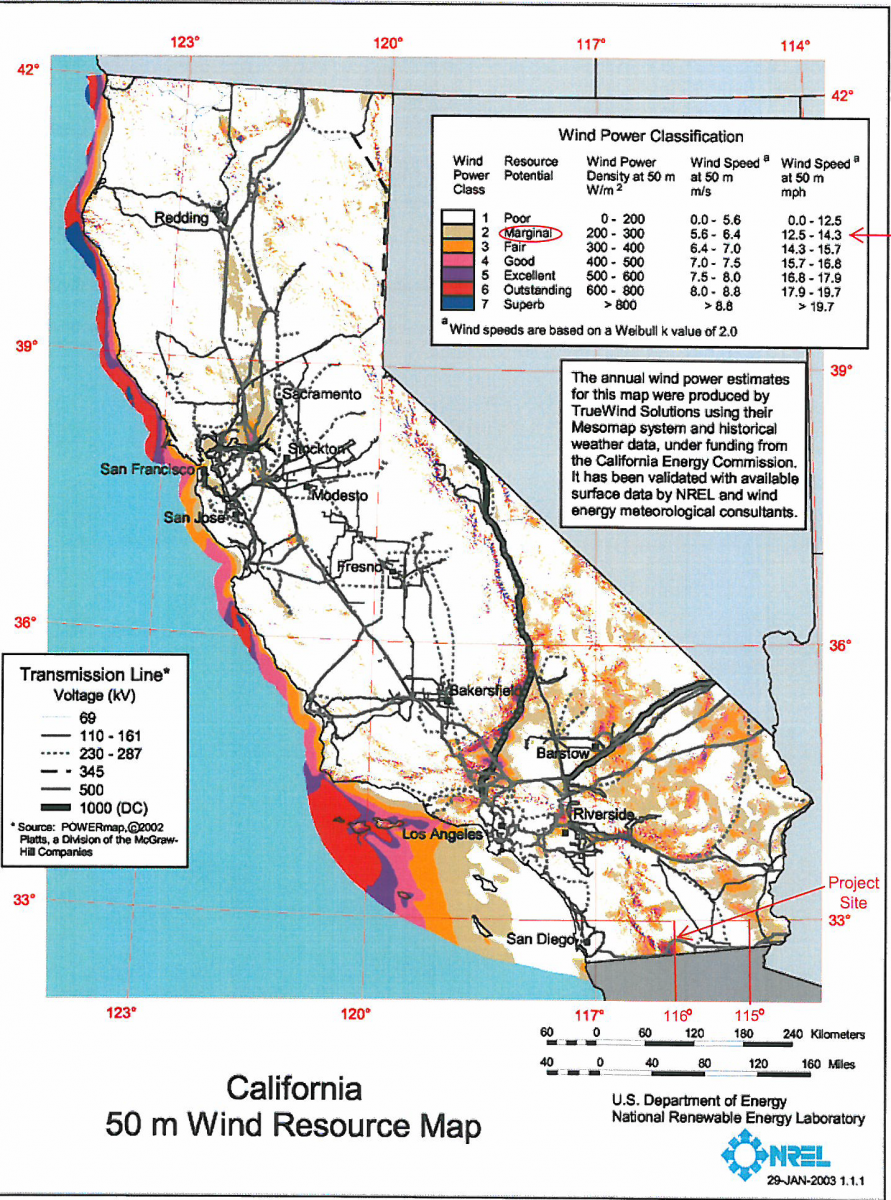
Boccard’s Ocotillo Wind Resource Study examined numerous documents including wind density maps from the federal government. He concluded that the Ocotillo project design was “suboptimal” due to its location in what he found to be a class 2 wind resource area—class 1 being the worst on a scale of 1 to 7. “If one is to follow the standard rule, this site should be listed as `unsuitable for the development of wind-powered electricity,’” Boccard concluded while the project was being built. He concluded the report with: “The 34% capacity factor claimed by the Ocotillo developer is far off the mark and shall never be achieved.”
How inflated were Pattern Energy’s claims, in Boccard’s estimation? To produce as much power as Pattern projected would require wind speeds higher than some of the windiest places on earth, such as Ireland’s Atlantic coast wind projects. Overall, Ireland had a 30% wind capacity factor for the past decade, Boccard found. He then predicted that the actual power produced at Ocotillo would likely range between 20% and 23%.
Actual wind production at Ocotillo during first year
 In fact, wind production at Ocotillo during its first year was even lower than Boccard forecasted. After obtaining federal data from FERC following a long day delay due to a website upgrade at the agency, we had four different sources crunch the numbers based on a standard mathematical calculation for wind capacity factor. Below are the results.
Over the year 2013, the Ocotillo Wind capacity factor was somewhere between 15.7% and 17.7%. Expert calculations varied slightly, due to minor variables and whether turbine sizes were 2.3 or 2.37 MW, how long each turbine was actually offline, and so forth. All turbines were off line for the last half of May, and some remained offline for June and a portion of July due to the fallen blade.
But even if we look at only the 9 months with full data, the capacity factor is still only 18.9%.
If we make a generous estimate of strong winds for those months (purely a guess) and estimate how much the project might have produced if it hadn’t dropped a multi-ton blade and been forced offline, the number would still be only about 21.5% in a best case scenario for Pattern.
Overall for the year, Pattern’s project generated only 334 gigawatts (Gwh of power. That’s astonishingly short—less than 52%–of the 646 Gwh that Pattern claimed in its application to the NADB. It falls even more short—just 37.5% of an even higher claim, 891 Gwh, that SDG&E claimed the project would produce in a resolution sent to the California Public Utilities Commission. Even allowing for a fallen blade, it’s clear that this project could not have come close to the wind production claims made to secure financing, a 30% cash grant under Section 1603, and an approved Power Purchase Agreement funded by SDG&E ratepayers.
The following calculations were made by Parke Ewing and Jim Pelley, a former construction superintendent and an aerospace engineer in Ocotillo. Since both are on record opposed to the project, East County Magazine’s staff ran the calculations and confirmed their estimates.
We then sent the data to Reza Alam, a wind energy expert and assistant professor of mechanical engineering at the University of California, Berkeley College of Engineering. At the time, we had the first 11 months of data. “Yes, capacity factors are calculated correctly,” Alam confirmed.
He added, “Anything below 30% capacity factor for wind is considered relatively low.” He added that other factors may impact output such as storms, long-term weather patterns, turbine models and efficiency.
OCOTILLO ACTUAL WIND PRODUCTION CHART:

Shown the first year of wind data at Ocotillo, Boccard’s initial reaction was, “Told ya. There’s no rocket science here.”
Boccard calculated that if the blade had not fallen, Ocotillo might have reached at best a 17.7% capacity factor and 379 Mwh for the full year—far below Pattern’s projections.
 Boccard subsequently crunched some more numbers, comparing data from the Kumeyaay Wind facility in nearby Campo atop a ridgeline. He found that the Kumeyaay facility lived up to its projected capacity factor, actually hitting 33.9% for the year overall—nearly spot on the 34% that Pattern predicted for Ocotillo.
Pattern Energy’s predecessor built the Kumeyaay wind facility (photo, right), so the company had good reason to know that wind speeds at the higher elevations were strong. But why would Pattern claim an identical capacity factor for Ocotillo, knowing the site is on flat desert, at several thousand feet lower in elevation in an area ranked only a class 2 wind resource area?
Boccard observed, “The builder may be excellent but if you do that at the bottom of a valley you’re doomed.” He predicted, “There is no reason to believe it will improve, since performance is driven by Mother Nature alone, unless the local shaman put a spell on local winds.”
Boccard stated that he would support decommissioning (tearing down) the Ocotillo project and moving the turbines to a good location since many Californians favor this type of electricity. Further, he stated, he believes the U.S. government should seek financial redress from Pattern. “After all, “ he said, “they lied to their funding bank and the authorities, for they must have seen the wind maps.” He added that he hoped such action would “set a precedent against stupid, rushed locations.”
The False Claims Act, also known as the Lincoln Law, imposes liability on companies or people who defraud the U.S. government, typically federal contractors. Over 70% of such cases are initiated by whistleblowers, who can share in a portion of any financial recoveries. Over $35 billion has been recovered under the False Claims Act from 1987 to 2012.
Alam stated that he, too, might support decommissioning if turbines could be reassembled elsewhere.
A Pattern of misrepresentation
 Pattern’s spokesperson, Matt Dallas, failed to respond to multiple requests for comment including requests sent to his email list listed as a current contact on an April 25, 2014 press release on Pattern Energy’s website. We also asked Pattern to disclose proprietary wind data now that the project is built, but the company ignored our requests over several weeks.
John Calloway from Pattern Energy, at a public Bureau of Land Management scoping meeting on Ocotillo wind, made this statement, “Why here in Ocotillo?” He then showed a map from the National Renewable Energy Laboratory of wind resources at 50 meters above ground. “As you can see, almost all of Imperial County is absolutely no wind,” he stated, then later added that their measurements confirm that “as the wind comes off of the mountains, as it hits the flat area it starts to dissipate out and it just goes away,” confirming that Pattern knew the flat desert area lacks wind, unlike the ridgelines above. View video with embedded clip from the meeting.
Pattern put up meteorological (MET) wind testing towers for two to three years, the Imperial Valley Press reported and residents confirm. But Patternsubmitted less than a year of data (7,700 hours from 2010, according to the Final Enviornmental Impact Report section on meteorological resources) to the federal government. Why? Pattern also claims to have conducted additional wind speed testing with equipment such as “Sodar” and “Lidar” system (or as residents derisively call it, “Lie-dar”) . An Imperial Valley Pres article quoted Pattern’s Matt Dallas stating these “showed the Ocotillo area to have a strong wind resource.”
Numerous interested parties have sought to obtain the full data on all testing, but neither the federal government nor Pattern would release that information, claiming it is proprietary data. In other words, your government wants to keep secret whether or not your tax dollars are being paid out for projects that may have been funded based on incomplete, inaccurate, or outright falsified reports.
“I have argued to all decision makers that they should include public access to the MET tower data in any permits that get issued,” Donna Tisdale with the Protect Our Communities Foundation said. “At a minimum, the agency with jurisdiction should require access to that data in order to make an informed decision before handing over public land and funds for private profit.”
It gets worse.
In its application for financing and certification sent to the Border Environmental Cooperation Commission (BECC) Pattern again claimed the project has “excellent wind resources” and that the “area boasts strong winds…”
But William C. Pate, an attorney representing Ocotillo residents, has concluded in a letter he sent seeking to block funding of the project that Pattern falsified data to make it appear that the project would be situated atop ridgelines –where winds actually are strong.
The North American Development Bank (NADB) and its sister institution, BECC, were created by the governments of the U.S. and Mexico in a joint effort to “preserve and enhance environmental conditions and the quality of life of people living along the U.S. –Mexico border.”
Numerous opponents of the Ocotillo project sent letters to the NADB or BECC urging that funds be withheld on a wide range of grounds. But Pate’s letter stood out for bold-faced allegation that Pattern provided misleading data on not only wind speeds, but the location of the project itself.
In a letter to the BECC, Pate overlaid maps from Pattern and from the National Renewable Energy Lab (a California wind resources map). His shocking conclusion: the NREL map that Pattern submitted with its application “has been altered to remove longitude lines and Interstate 8 as a point of reference…GPS coordinates do not lie.” But Pattern did lie, Pate contends. “GPS confirms that contrary to Pattern’s statement in this federal financing proposal, none of the project boundary is where wind speeds achieve “excellent” and above cla ssifications.”
According to the maps Pate provided, Pattern’s application for certification and financing falsely indicated that the project would be located 3,000 feet higher in elevation and substantially further west than where it was actually built. Pattern’s mapping (click to see enlarged copy of map, right) would have placed the project atop the Mountain Springs grade at Boulder Park, where the Desert View Tower in Jacumba is located –a place known for his strong winds—and a place off-limit to development due to bighorn sheep habitat and other factors.
Moreover, Pate noted, the Record of Decision approving the project lists blade diameters that were never included when the project was built. “Complete bait and switch,” he said.
He called for the loan proposal to be rejected “because Pattern has materially misrepresented the wind resources for the project.”
Pate wasn’t the only one to alert the NADB.
Edie Harmon, a biologist, wrote in her comments to the NADB, that a review of San Diego-Imperial Counties at the NREL website revealed that, “Indeed, the project area for Ocotillo wind is not even mentioned as one of the places with records of high wind potential at . Similarly, a review of the Wind Atlas map for southern California suggests that the site for the Ocotillo Wind Energy Project is not a good wind resource. ,” she wrote.
Harmon added, “Because I could not locate the source of any map for Southern California which looks anything like the overlay on BECC Figure 6, I conclude that the NREL maps are more likely to be an accurate assessment of wind resource potential. Failure of the OWEF EIS/EIR to provide the results of any wind speed data at the site should raise considerable concerns with the BECC staff about a potential recipient of a NADB loan.”
Many similar complaints were made to elected officials in Congress and to the Bureau of Land Management (BLM), but the project was built anyhow atop 12,000 acres of publicly owned BLM land.
Before construction, residents were so confident that the area lacked winds that they staged a public kite-flying contest and invited the media, offering cash prizes for any child who could fly a kite for at least one minute. None could.
Since construction, Pelley has taken videos nearly every day documenting in almost all cases, turbines not moving, or barely moving due to no or low winds far below what a viable project would need. View sample videos. Also read about serious questions about wind production vs. claims around the world and at Ocotillo raised in our January 2013 special report, Where is the Wind?
Another possible red flag suggesting Pattern has something to hide occurred when Pelley and Ewing videotaped Ocotillo’s wind project manager giving a tour at the project on public land. Asked how many homes the project would power, he gave a figure that was one-tenth the number Pattern had promised the federal government the project would power. The manager, Russell Graham, later threatened both photographers with violence and physically attacked Ewing, attempting to take his camera as he demanded the video be taken offline. Ewing recorded the exchange on his camera as Graham threatened to “kick a hole in your f***ing throat.”
A judge later issued restraining orders against Graham to protect both photographers. Graham claimed in court that he made a mistake on the wind production remark. So why didn’t he simply ask to have his statement /explanation added to the photographer’s story, which was published on ECM?
Edi Harmon, a biologist and Ocotillo resident, wants to know if Pattern misled the government and is upset that records on wind tests are kept secret.
If this was not fraud, she asks, “What is the alternative explanation of why turbines are motionless ghosts so much of the time? I wonder if ratepayers and investors in SDG&E might be having similar questions and awaiting answers.”
Warnings ignored by elected officials
Consultant John Kennedy says the FERC findings on poor energy output in Ocotillo demonstrate that Boccard’s predictions were accurate and Pattern’s were wrong. “The Boccard report serves as a big `We told you so’ and all the while, local Congressmen had the Boccard report and sat on their hands,” he concluded.
Robert Scheid, vice president of community and public relations at Viejas, observed, “It was frustrating to all of us that it [the Boccard report] didn’t blow things wide open. It’s been a tough battle.”
“We were hoping that our legislators, both Democratic and Republican, would pick up on this and realize that this is a great example of what not to do with people’s tax funds and our stimulus dollars,” Weiner told ECM. “We have a wind project that’s not producing wind.”
The DPC wanted to release the Boccard report immediately, but after consulting with other stakeholders, decided to wait in hopes that their Congressional members would agree to hold a joint press conference to expose what increasingly looked like a taxpayer-funded boondoggle, Weiner told ECM.
 Despite the Boccard report bearing out this forecast, however, officials largely ignored such concerns and one official, Congressman Darrell Issa, led residents and tribal representative to believe his House Oversight Committee would take action, but dropped the ball entirely.
Members of the coalition opposed to the Ocotillo project met with Congressman Issa’s staffer, John Franklin in August 2012, Kennedy confirmed. “He said he needed more than our interpretation of the data to set up a meeting with the Congressman. It was at that point we contracted with Dr. Boccard to do the study. The study was completed in October 2012 and forwarded to John Franklin immediately.”
At all of the meetings, Kennedy emphasized “We asked the same question. How can Pattern Energy achieve an above average capacity factor with the sub-standard winds in Ocotillo?” He elaborated, “If the average of all the projects in the U.S. for the last 40 years is only 24%, how can Ocotillo generate significantly higher capacity factor with a below average wind resource?”
But three months passed, and nothing was done. A string of emails from Issa’s office to concerned citizens revealed repeated promises of a full investigation, but we could find no evidence that any such investigation was ever done. Our pointed request to Issa, including asking if defrauding taxpayers should be a matter his committee should investigate, never received a response.
The project opened in December 2012. Congressman Issa declined to meet with his concerned constituents until January 2013, at which time he said his staff needed to vet Dr. Boccard’s finding. “We have been waiting for 12 months for any word from his office,” Kennedy said. ECM contacted several Issa staffers with a detailed list of questions, but did not receive any response.
The group also asked then-Congressman Bob Filner and later, Congressman Juan Vargas to ask the U.S. Treasury Department to withhold all stimulus funds pending an investigation into the wind speed claims. “To date, there has been a deafening silence,” Kennedy said.
Rep. Filner, before stepping down from Congress to become Mayor of San Diego, did send a letter to Treasury Secretary Timothy Geitner asking that the funds be withheld. Written shortly after the Solyndra scandal over a failed solar company in which the government had invested taxpayer funds, Filner’s letter included this hand-written note in the margin: “Mr. Secretary–this could be another embarrassment for the Administration.” A Treasury official, Richard Gregg, wrote back to Filner indicated the agency would look into the matter. The letter said payment is required to any applicant meeting statutory criteria, but that a review of the application would be conducted as in all applications to determine if eligibility criteria had been met. Geitner subsequently has been replaced as Treasury Secretary.
ECM sent a public records request to the Treasury Department asking to see results of its “review.” We received hundreds of pages in response, with more than a thousand pages more withheld on various grounds including proprietary data. However all the key portions that might have proved informative had been redacted, or blacked out. The agency also refused to turn over any correspondence with Pattern, members of Congress, or the White House.
 Viejas Chairman Anthony Pico, along with Kennedy, met with Aaron Allen, a staffer for Congressman Juan Vargas, who replaced Filner. A Vargas staffer read a statement on behalf of the Congressman into the record at a California Native American Heritage Commission (NAHC) hearing in San Diego. Vargas supported Viejas’ request, granted by the NAHC, to declare Ocotillo a scared cemetery and chastised the BLM for building atop a site that tribes had testified repeatedly to federal and local agencies had been a burial site for over 10,000 years. The NAHC Chairman indicated he believed the Ocotillo project should be torn down for desecrating Native American cultural resource sites that should have been protected under federal and state law.
Chairman Pico said, “It was heartbreaking to see this project desecrate such a historically and culturally significant landscape, and it’s even worse when you find out that it was built on false claims by the developer, and with the assistance of the BLM. We absolutely support renewable energy but the costs of this project clearly outweighed the benefits. It’s a travesty, not only to Native Americans but to all area residents and taxpayers.”
Vargas office did not initially respond to constituents’ requests for help to stop taxpayer funding of what increasingly appeared to be a boondoggle project in Ocotillo. Last June, in a meeting with Vargas staffer Jason Moore in Chula Vista, Kennedy recalled, “He already had seen the Boccard report or was aware of it because it had been given to the Congressman at the Chairman Pico meeting. We discussed fully all of the issues.” He was referred to Vargas’ El Centro office and further, advised that since the project was now operational, this was a state issue (despite being a federally funded project on federal land) and referred them to State Senator Ben Hueso.
“We met with Ben Hueso on October 18, 2013,” said Ocotillo resident Parke Ewing. But Hueso’s office took no actions.
Our initial request for records of correspondence to Vargas office was rejected because Congress has exempted itself from the Freedom of Information Act. However, at a meeting with constituents of the Congressmen at his Imperial Valley office, a Vargas staffer , Rebecca Terrazas Baxter, did obtain FERC data on wind records that had been unavailable previously despite repeated requests from FERC.
After ECM forwarded analysis of the wind data for Ocotillo’s first year, along with other documentation such as the claims of map falsification and more, we received a response from Dianna Zamora in Rep. Vargas’ office in Washington D.C. on March 1, 2014.
 “I would like to thank you and our constituents, as it is clear that you did your due diligence,” she stated. The Congressman takes any accusations of impropriety or fraud very seriously. He has reached out to the Department of Energy to share with them the information you have provided.” She added that Vargas has asked the best method for evaluating the information to “determine if any wrongdoing has occurred,” she added, promising to get back to us “as soon as we hear details of the Department’s evaluation.” Two months later, we have not received a response.
Congresswoman Susan Davis’ office also made efforts to obtain the FERC records on our behalf, questioning whether FERC’s delays in providing data may have violated federal law.
We also reached out to Senator Barbara Boxer’s office with a detailed list of concerns and requests, since Senator Boxer chairs the Senate Environmental committee. Her staff referred our request to the committee, which in turn passed the buck back to her office. Neither ever responded to our requests, other than to refer us to Matt Weiner, legislative director for Rep. Henry Waxman, to assist us in getting wind speed data. He didn’t.
In each of our inquiries to officials – Issa, Vargas, Davis, and Boxer, we attached the Boccard report, Filner’s letter, additional documentation and a sked how many other “green” projects might be similarly questionable or even fraudulent.
Nor is this the only indication of misleading claims made by Pattern. ECM has previously documented dubious claims made about earthquake seismic safety, distances from homes and earthquake faults, avian radar, health, safety and jobs, and wildlife issues at a project that has also been linked to Dust Bowl-scale dust storms and pollution of Ocotillo waterways and residential areas with a flammable dust suppression chemical.
The company also drew criticism from multiple Native American tribes for desecrating sacred sites and burial grounds. In addition, the project also destroyed groves of century-old Ocotillo plants for which the town was named, as this video and the photo (right) shows.
Follow the Money
Why didn’t public officials do more to prevent taxpayer dollars from being squandered on a wind project that appears to lack adequate wind resources?
We don’t know. What we can tell you, however, is that officials in both parties have taken substantial sums of money in campaign contributions from vested special interests including energy companies, utilities, and labor unions that all backed construction of the Ocotillo wind project.
According to Open Secrets, Rep. Issa’s top 20 contributors in 2009/2010 included Leidos Engineering (formerly SAIC). Leidos, which has wind projects, contributed $20,000 to Issa and its executives or employees donated another $9,600 for a total of $29,600. In 2011/2012, Leidos and its representatives gave even more–$41,150 –to Issa. Issa had other energy industry donations including oil companies; Carlyle Group, Pattern’s parent corporation, also has oil interests. Carlyle was also a major donor to the Republican National Committee, giving $35,000.
Rep. Vargas received $52,000 in his 2012 campaign for the state legislature from the building trades union, which supports wind project construction to create jobs. His second highest contribution in his 2014 Congressional race was the International Brotherhood of Electrical Workers, which backs construction of industrial wind projects and power lines.
State Senator Hueso received $8,000 from Sempra Energy and $28,200 from electric utilities, as well as $175,300 from general trade unions.
Responses and reactions
 We asked SDG&E to review the Boccard report and respond. Jennifer Ramp replied that SDG&E is not in a position to comment or critique validity of the Boccard report. As for whether SDG&E is disappointed in the first year energy production levels, or might consider cancelling its power purchase agreement for the project, she said, “It would be imprudent to review the first year of operation to make assumptions as to the longer term viability of any project.”
Could ratepayers be stuck with a higher bill? Not according to Ramp. “SDG&E only pays a developer for the amount of energy actually produced. In the event that the amount of energy falls short of initial expectations in any year, then SDG&E’s customers are protected.”
Perhaps. But if a project repeatedly fails to produce the power promised, where will replacement power come from? Building additional power plants, power lines and substations are costs that in part have historically flowed back to ratepayers to absorb.
Ramp added that SDG&E had to comply with state law requiring it to meet renewable portfolio obligations. She said Pattern placed successful bids and received all required state and federal approvals to construct the project. In addition, SDG&E’s contracts were reviewed and approved by the California Public Utilities Commission (CPUC) as being “in the best interest of SDG&E’s customers,” Ramp stated.
Terrie Prosper, director of news and information at the CPUC, told ECM, “The contract terms are based on the electricity actually produced, so if the facility is underperforming, ratepayers pay less. The risk of underperformance is on the developer and not SGD&E ratepayers.”
But federal tax subsidies are coming directly out of taxpayers’ pockets—and not just for construction. Wind projects reap subsidies for years or even decades on each wind turbine—and Ocotillo has 112. This amounts to many millions of dollars per project. Moreover, KCET reported that the IRS recently revealed that many energy companies have been illegally double-dipping, taking both stimulus funds and wind production tax credits—but that the agency has no mechanism to check and find out how many companies may have engaged in this form of theft from taxpayers. ECM has asked the IRS whether Pattern Energy was among companies found double-dipping in an initial check, but has not yet received a response.
Greener options
 The Washington Post recently ran an editorial calling for an end to wind production tax credits, noting that the credits have been renewed repeatedly “with a cockroach-like resilience” despite evidence of what the Post calls a “boondoggle” as “industries develop to chase federal handouts.” The Post calls for a simple, transparent tax on carbon credits instead.
Others, including the DPC, favor shifting tax credits to homeowners and business owners to install solar on rooftops (distributed generation with power produced near where it is used instead of remote industrialization of public lands). Rooftop solar increasingly is being shown to be available at lower cost than wind projects and with far fewer negative impacts on the environment, wildlife, public health and safety.
Ironically, utilities are required to produce 33% of their power from renewable sources by 2030 in California—but due to utility lobbying, state law does not allow utilities to even consider rooftop solar as alternatives to utility-scale projects such as Ocotillo wind. Utilities make money charging back costs to ratepayers for every mile of transmission lines, so remote projects are far more profitable for utilities such as Sempra Energy, owner of SDG&E.
Utilities also support construction of backup gas-fired “peaker” power plants such as Quail Brush proposed near Mission Trails Regional Park for when the wind doesn’t blow, which in Ocotillo is the vast majority of the time. Cogentrix, applicant for the Quail Brush project, is owned by the Carlyle Group—the same company that owns Pattern Energy, developer of Ocotillo wind. Carlyle’s 2009 Annual Report confirms that Carlyle founded Pattern Energy. Riverstone Holdings, parent of Pattern Energy, formed a joint venture partner of the Carlyle Report, Bloomberg News reported.
 Thus if the Quail Brush gas plant is approved by the CPUC, Carylye would be poised to make money regardless of whether Ocotillo produces significant power or not.
For area residents, tribes, and environmentalists, destruction of the Ocotillo desert now seems not only heartbreaking, but senseless.
Tom Budlong, an outdoor enthusiast recently met with a Bureau of Land Management representative at a community meeting and asked why data on a project built on public land was kept secret from the public. If it had been made public, he concluded, “It might have revealed that the wind resources here were indeed insufficient.”
After discovering that the project is generating electricity at only half the capacity factor of a well-sited wind energy facility, he lamented that while Pattern pocketed profits off tax subsidies, “A lot of very good land got chewed up. Added together, it is all a farce.”
Miriam Raftery is a national award-winning journalism who has won more than 200 major journalism prizes, including top honors from the Society of Professional Journalists in San Diego and the San Diego Press Club, for her investigative reporting on issues involving the Ocotillo Wind Energy Facility. She is the editor and founder of East County Magazine, a nonprofit, nonpartisan media outlet which has won over 58 awards. You can help support independent reporting in the public interest by donating online atwww.EastCountyMagazine.org.
 Lambrigg Wind Farm near Kendal in the Lake District in northern EnglandAlamy


 "Mothers Against Wind Turbines™" Phoenix Rising...