Spain Dumps the Renewable Energy Scam, Before it Destroys Their Economy, Completely!

Spain’s Renewable Energy Disaster Draws to a Close

spain unemployment

Spain has been held up by the gullible and naïve (some might say, cynical and malign) hard-green-left as the model for our “new” energy future. Some “model”!!

The Spaniards have thrown 100s of billions of euros in subsidies at solar and wind power, and have achieved nothing but economic punishment in return.

The power generated is delivered at chaotic, random intervals: the sun sets every day and the wind stops blowing, just like everywhere else in the world; requiring 100% of wind and solar capacity to be matched by fossil fuel generation sources.

As a result, in the last decade, the true cost of power has spiralled out of control. However, the Spanish government used price caps in an effort to keep prices artificially low. But that simply left taxpayers with an even greater burden to cover the massive cost of renewables subsidies (which represent a state-mandated transfer from the poorest to the richest) – add mounting government debt used to keep the subsidy stream flowing – and it can be fairly said that Spain’s energy policy is nothing short of an economic disaster.

The much touted promise of thousands of so-called “green” jobs never materialized. No surprises there. Instead, the insane cost of subsidising wind and solar power has killed productive industries, with the general unemployment rate rocketing from 8% to 26% (and still rising) – youth unemployment is nearer to 50% in many regions.
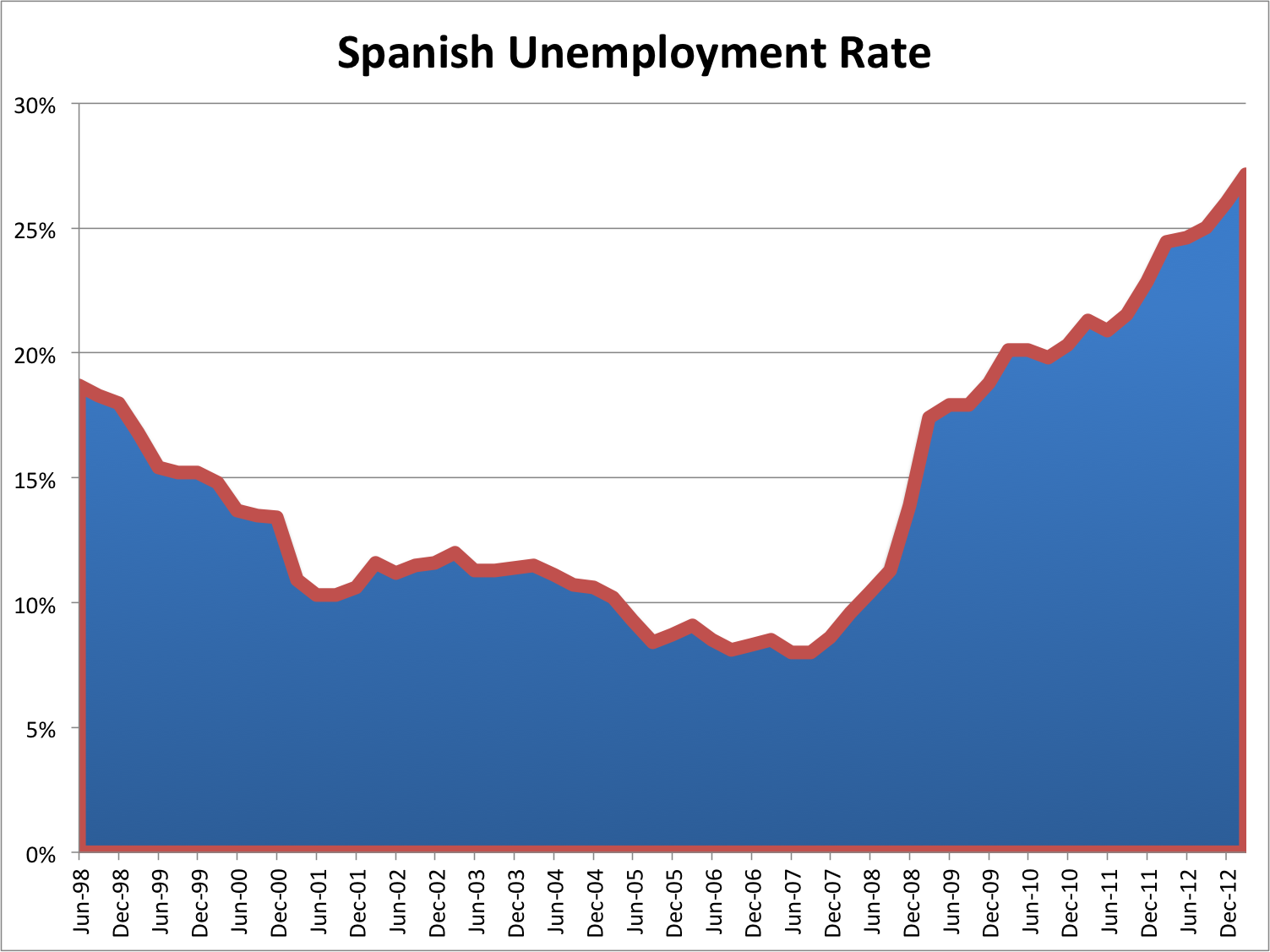
spanish-unemployment-rate-2

The Spanish government is faced with a choice between salvaging what’s left of a moribund (and shrinking) economy and keeping the renewables gravy train rolling.

Here are two reports on Spain’s belated efforts to bring its renewable energy disaster to a close.

Spain close to approving new renewable energy rules: minister
Reuters
29 May 2014

MADRID (Reuters) – The Spanish cabinet could approve on Friday a law that will cut renewable energy subsidies as part of a drive to reduce a 30 billion euro ($41 billion) power tariff deficit, built up during years of keeping prices below regulated costs.

The new law, the thrust of which was announced by the government in July last year, set the rate of return for existing renewable energy facilities at 7.4 percent and at 7.5 percent for future operations.

Many renewable energy companies have made double-digit returns on investment under hefty subsidies. Spain has passed a series of measures over the past two years cutting, and in some cases eliminating, renewable energy subsidies and a number of investors have filed international legal complaints.

“(The decree) is ready to go,” Industry Minister Jose Manuel Soria told reporters on Thursday, adding that the decision to approve it at Friday’s weekly cabinet meeting would be taken later on Thursday.

The minister acknowledged the reform was bad news for companies that invested expecting higher returns.

According to documents annexed to the reform, to which Reuters had access last week, the government plans to cut renewable energy subsidies by 15 percent this year to 7.63 billion euros.

The new rules will be retroactive to July 2013 and many companies have already made massive provisions and writedowns in their 2013 financial results, anticipating the impact of the decree.

The regulation includes variations for a range of technologies – including wind, thermosolar, photovoltaic and biomass – and the year the assets were installed.

For example, assets installed before 2005 will receive no subsidy and will only be awarded with the wholesale power price, while newer assets will receive the wholesale price plus a separate remuneration.

(Reporting by Jose Elias Rodriguez, writing by Tracy Rucinski; editing by Julien Toyer and Keiron Henderson)
Reuters

Jose-Manuel-Soria--en-una-imagen-de-archivo-

Spanish Lesson For Obama: Green Energy Transition Unaffordable, May Soon Crash
Die Welt
Ute Müller
31 May 2014

Lawsuits may force Spain to bring its renewable energy experiment to an end, a green policy fiasco that has gone terribly wrong due to astronomical costs. It’s a powerful lesson for the White House that has often cited the Spanish model as one to emulate.

Only recently, Spain was widely praised as the champion of wind energy in Europe. What is more, all over the country new solar parks were built and renewable energy had become the main source of energy supply on the Iberian Peninsula. Those days, however, may soon be over. That’s because Spain’s industry ministry intends to drastically cut back on subsidies for “clean energy.” The whole country has to cut back, the industry ministry argues drily, and energy producers have to do too.

This argument seems irrefutable since the figures that are now assessed by the government are astronomical indeed. The subsidies that are going to flow into green energy projects on the Iberian Peninsula amount to a staggering 200 billion euros. Approximately 56 billion euros have already been paid out. The lion’s share of this sum went into rather generous feed-in tariffs for wind and solar energy which, since 1995, have attracted numerous investors from both home and abroad.

The remaining 143 billion euros are due to be paid out in the next 20 years for green energy projects that have already been connected to the grid, foremost for solar farms.

Given these sums, it would appear that industry minister Jose Manuel Soria has come to the conclusion that the only option left is to put his foot down. He now plans to cut green subsidies for the energy sector by about 20 percent, to 7.5 billion euros per annum. The minister, however, has not reckoned with affected green investors who are up in arms and fighting the planned subsidy cuts.

Moratorium on new solar farms 

This is not the first time that Spain intends to take advantage of solar investors retrospectively. Numerous foreign investment funds, especially from the US, have invested heavily in Spain’s renewable energy in recent years, expanding solar energy production significantly. They were lured by promises by the then socialist industry minister who had agreed a fixed rate of return of 14 percent per annum for solar park investments.

“The sun can be yours,” huge billboards claimed. Thousands of Spanish investors were keen not to miss this golden opportunity either. As a result, solar power production on the sun-drenched Iberian Peninsula increased from 53 to 313 gigawatt hours (GWh) between 2007 and 2010.

Surprised by the huge demand, the government of socialist Prime Minister José Luis Rodríguez Zapatero introduced a moratorium for new solar farms, guaranteed feed-in tariff were reduced to 25 years and the premiums were paid only for a certain number of hours of sunshine per year. After a change of government at the end of 2012, the new conservative administration upped the ante and introduced a new electricity tax of 7.5 percent, causing the profits for the solar industry to fall by around 30 percent.

A good opportunity for nuclear power? 

This week, U.S. energy company Nextera Energy has summoned Spain before the International Centre for Settlement for Investment Disputes (ICSID) to demand redress. The U.S. company regards the new rules as a retroactive change to the original guarantees. Nextera Energy has invested heavily in the Spanish solar power plant Termosol.

Other large investors, such as a Deutsche Bank investment fund, involved in the Andalusian power plant Andasol, and French bank BNP have asked ICSID, a World Bank organization, for arbitration. Another group of foreign investors issued first lawsuits in 2011, based on the European Energy Charter which promises investment protection and prohibits expropriation.

If the investors win their case, Spain can expect claims for damages amounting to billions of euros. In such a case, the further expansion of renewable energy in Spain would then come to end end at once. The industry minister is not the only one who is aware of the potential consequences. Two traditional power generators, Endesa and Iberdrola, even see a good chance for new deals with nuclear power. They have requested an extension of the operating license for the Garoña nuclear power plant which had already been taken off the grid. Garoña is now expected to provide electricity until 2031. The investors believe that despite new security investments the nuclear power plant will be profitable. They expect that after the boom and bust of recent years the share of renewable energy will decline.
Die Welt (translation by Global Warming Policy Foundation)

Spain provides the perfect “model” for any Country looking to destroy itself in blind pursuit of “green” energy ideology.

Trying to power a (notionally) first world economy with intermittent and unreliable wind and solar power is nothing more than an infantile delusion. When the cost of the insanity is borne by millions of struggling (and probably unemployed) power consumers and 100s of thousands thrown on the unemployment scrap heap, it borders on the criminal.

Spaniards can only hope that their political betters’ efforts to unwind the mess haven’t come too late.

spain_bullfighting_2

Rural Ontario Fights Back Against Wind Turbine Fiasco!

Agricultural issues take centre stage at all-candidates forum in Listowel

By Mike Beitz, The Beacon Herald

Perth-Middlesex candidates, from left, Irma DeVries (Family Coalition), Matthew Murphy (independent), Romayne Smith Fullerton (NDP), Chris Desjardins (Green), Randy Pettapiece (Progressive Conservative), Robby Smink (Freedom) and Stewart Skinner (Liberal), participate in a forum in Listowel Wednesday night hosted by the Perth and Middlesex federations of agriculture. (MIKE BEITZ, The Beacon Herald)

Perth-Middlesex candidates, from left, Irma DeVries (Family Coalition), Matthew Murphy (independent), Romayne Smith Fullerton (NDP), Chris Desjardins (Green), Randy Pettapiece (Progressive Conservative), Robby Smink (Freedom) and Stewart Skinner (Liberal), participate in a forum in Listowel Wednesday night.
A small group of protesters with “Stop the Turbines” and “Not a Willing Host” signs standing outside of the St. Joseph’s Parish Centre in Listowel Wednesday night foreshadowed a key issue that would be discussed inside. Industrial wind turbine projects were raised several times during a well-attended all-candidates forum hosted by the Perth and Wellington federations of agriculture. But it wasn’t until well into the evening that the seven participating provincial candidates – Irma DeVries (Family Coalition Party), Matthew Murphy (independent), Romayne Smith Fullerton (NDP), Chris Desjardins (Green Party), Randy Pettapiece (Progressive Conservative Party), Robby Smink (Freedom Party) and Stewart Skinner (Liberal Party), were asked directly if they support them. Predictably, none of them gave an outright yes. Murphy suggested several times that turbines belong offshore, where their impact on communities would be minimized, and also advocated for more local control over where they’re located. “I think you have a right to say, ‘We don’t want them nearby. We don’t want them here,'” he said. Smith Fullerton agreed with the need for more local control, and suggested that the issue has been “devastating” for rural Ontario. The NDP would consult with the auditor general to determine if contracts could be opened up again, she added. Desjardin argued that wind turbine projects should be “community owned,” with the community deciding where they’re placed. When told by someone in the audience that 70 Ontario communities have declared themselves unwilling hosts for wind turbines, he looked shocked. “We do want the community to say where they’re going, and if you’re an unwilling host, I guess they’re not going in your community,” said Desjardins. Pettapiece said it was unfortunate that wind turbine opponents in rural Ontario are given the NIMBY (not in my backyard) label. “We would cancel the FIT program that deals with these projects,” he said, “and we would certainly investigate the contracts that have been handed out on anything that’s not hooked up to the grid.” Smink, who prefaced most of his responses with a criticism of government interference, did the same when describing his stance on the “windmill idiocy.” “This is exactly the type of problems that you have when you have big government basically telling you how to run your life,” he said. DeVries, who repeated a similar “smaller government” mantra throughout the evening, said the Family Coalition Party would introduce legislation to restore the rights of municipalities to refuse turbines. Even Skinner, whose Liberal Party implemented the Green Energy Act, said that changes are in order, particularly when it comes to protecting fertile soil like those found in Perth-Wellington. “Going forward, I’m going to advocate for protection for prime farmland, that we’re not placing turbines on good Class 1 and Class 2 lands,” he said, adding that he would push for minimum distance separation between turbines and livestock operations. His suggestion that neither he nor any of the other candidates could stop the controversial wind turbine projects planned just outside of Listowel, and that “it’s done,” prompted a sharp response from the crowd. “It’s not done,” several people called out loudly. The wind turbine issues was just one of a number of rural-focused topics on which the candidates were quizzed at the forum Wednesday. Preserving prime agricultural land, extending natural gas lines to rural areas, keeping electricity rates affordable, protecting front-line health care workers and supporting agriculture education in schools were just a few of the issues on which there was general – but not total – agreement. The candidates are expected to square off again tonight in Stratford at a forum organized by the Stratford and District Chamber of Commerce. mike.beitz@sunmedia.ca ​

DownWind is an Amazing Opportunity, to Educate the Public! Don’t Miss It!

Canadians Fight Back Against Ontario’s Wind Farm Onslaught

Ezra Levant_jpg_1274831cl-8

Canada’s Sun News was among the first news outfits worldwide to grasp the scale and scope of the great wind power fraud; and the associated harm inflicted on hard-working rural people. And Sun’s Ezra Levant led the charge, doing what real journalists do: getting the truth out, despite the efforts of those who seek to profit from burying it (check out this broadcast).

Exposing the wind industry for what it is, Sun has produced a truly ground-breaking documentary on how wind power outfits have fleeced power consumers for $billions, while happily destroying the lives hundreds of farming families across Ontario.

The documentary, “Down Wind” will screen on Wednesday, on 4th June; and will be available online, thereafter. Here’s the trailer:

Meanwhile, Kevin Marriott, Mayor of Enniskillen has reminded residents of their right to remain silent, in a clever effort to stymie a developer’s ability to subsequently claim that it had “consulted” with those whose lives it is hell-bent on destroying. Fair call, Kevin.

The “community consultations” run by developers are nothing more than occasions for baseless wind industry propaganda delivered by a pack of lying, sociopaths (see our post here).

These are the people that publicly feign genuine interest in community “concerns”, but are quick to ridicule, bully and berate anyone who has the temerity to point out that losing the ability to sleep in one’s own home due to the incessant low-frequency noise generated by giant fans isn’t a “concern”, it’s a State sponsored and funded crime (see our post here).

Here’s the Sarnia Observer on the Ontario community back lash.

Mayor urging township residents to not speak to wind developers
Sarnia Observer
Paul Morden
15 May 2014

Enniskillen Township residents should feel free to exercise their right to remain silent when wind energy companies come calling, says Mayor Kevin Marriott.

EDF EN Canada has reportedly been approaching residents and groups about its Churchill Wind Project proposal, a 100 to 150-MW wind farm it wants to build in Enniskillen and neighbouring Plympton-Wyoming.

Marriott said he turned down a request from the company to meet with township council, and urged others in the community to do the same.

“We’re unwilling hosts,” Marriott said. “We’re not interested, end of discussion.”

Enniskillen was among approximately 80 Ontario municipalities declaring themselves unwilling hosts for wind turbines after the provincial government said it was changing how it awards renewable energy contracts.

The 2009 Green Energy Act took away municipalities’ planning powers for wind projects, leading to an outcry from many rural communities and municipal councils. Last year, the province said a new system of awarding renewable energy projects will require companies to work with municipalities.

“It will be very, very difficult for a developer to be approved without municipal engagement, in some significant way,” Energy Minister Bob Chiarelli said last June.

But, Marriott said that until the province clarifies what it means by municipal engagement, “We’re being vigilant.”

He advised the anti-wind turbine group, Conservation of Rural Enniskillen (CORE), against meeting with the company.

“I said, ‘Whatever you do, don’t consult with them because they may be able to use that as a check mark,’” Marriott said.

“Who knows what could be construed as public consultation.”

CORE also ran newspaper ads urging township residents to not speak with wind company representatives.

Lambton County has 14 wind turbines in Lambton Shores and Brooke-Alvinston Township, but construction has begun on the 92-turbine Jericho wind project, and Suncor Energy is awaiting provincial approval for its 46-turbine Cedar Point project. Both new projects sit north of Highway 402 in Lambton.

Brooke Leystra, president of the Lambton Federation of Agriculture, said it also turned down the wind company’s request to meet because the group represents farmers on both sides of the turbine debate.

“We didn’t want it to be misconstrued as us working with them, in any way,” Leystra said.

By early June, Ontario is expected to finalize its plan for awarding contracts for up to 300 megawatts of new wind-generated electricity this year, and a similar amount in 2015.

“The government has been really wishy-washy on what this new process does consist of,” Marriott said.
Sarnia Observer

And here’s a fantastic letter from Martina Hayward that captures the seething rage that’s building across Ontario.

Letter to southwesternontario.ca
14 May 2014

We are not willing hosts
Dear Editor:

Influenced to write yet another article overflowing with concerns related to the Goliath that is Industrial Wind, I feel burdened yet galvanized to transcribe the Whole Truth.

The article in the Regional Country News appears to praise the encroachment of these industrial skyscrapers as a “new crop” that must be “liked or lumped.” I, for one, decline the offer to endure these monuments of destruction.

Apparently “owners of the land eventually will share in a harvest of the wind.” The yield we will be forced to consume is the serious, irreversible harm to human health, animal health and the natural environment.

The repercussions of these mechanized tempest power plants seems untold as of late. Perhaps the season of Truth harvest has also arrived.

Communities worldwide are sadly experiencing the environmental, social and economic impacts of wind projects. These towers are merely a tool for energy companies and investment banks to make billions of dollars in subsidies that are subsequently added to the existing debt.

Industrial wind turbines do not reduce greenhouse gases or fossil fuel use. They can reduce your property values by 40 per cent or more.

The Green Energy Act overrides ALL local laws and grants foreign corporations unrestricted power to DO whatever they want, WHEREVER they want. The Canadian Wind Energy Association requested the Ministry of the Environment EXCLUDE the measurement of Low Frequency Noise at wind development sites. Low Frequency Noise has been found to cause nausea, headaches, dizziness, vertigo, tinnitus, memory and concentration problems, fatigue, sleep disturbances in humans. In animals such as goats, it just kills them dead. Sheep, horses, cattle are all afflicted similarly.

According to the Canadian Charter of Rights and Freedoms, Section 7, “Everyone has the right to life, liberty and security of the person, and the right not to be deprived thereof, except in accordance with the principle of fundamental justice.” Section 7 also “guarantees life, liberty and personal security of all Canadians.” It also “demands that governments respect the basic principles of justice whenever it intrudes on those rights.”

Finally, the article in Regional Country News quotes NextEra’s site safety manager, Tim Cole: “We have to win the hearts and minds of the community by being nice.”

Well, Mr. Cole, is it nice to break the hearts and beleaguer the minds of hard-working people in our communities?

I conclude, absolutely not. We are NOT WILLING HOSTS. No still means no.

Please take the time to read Wind Turbine Syndrome (Dr. Nina Pierpont) and The Constitution Act of 1982 (The Canadian Charter of Rights and Freedoms), and Acoustics Today Winter 2014, and go towww.howgreenisthis.org. Educate yourselves.

Martina Hayward,
Priceville

Mandated subsidies for wind power is a policy that is inherently unsustainable. Any policy that is unsustainable will be scrapped or surely fail: it’s only a matter of time.

In the meantime, keep fighting, Martina: justice and sanity will soon prevail.

churchill hell

101, (out of over a Billion) reasons NOT to Vote for Wynne & the Liberals!


Title - Chris Savard
Choose Cornwall

Follow OurHometown.ca on... Follow Us on Facebook Follow Us on Twitter Follow us on RSS Follow Us with E-Mail Updates!
Ontario Election: 101 reasons not to vote for Kathleen Wynne
By Chris Savard

OurHometown.ca
Ontario Election: 101 reasons not to vote for Kathleen Wynne
The reality is that this $5 million in funding for children with special needs is literally a drop in Lake Ontario compared to the wasteful spending practices of the McGunity-Wynne Liberals over the last 11 years. This amount works out to the equivalent of less than $50,000 per riding across the province.
PHOTO CREDIT – KathleenWynne.ca

Stoney Point – May 20, 2014 –OurHometown.ca recently received a media release from the Ontario Liberal Party, touting how they plan to invest an additional $5 million to help children with special needs. The release went on to say that NDP leader Andrea Horwath has put this funding at risk by not supporting the budget.

The reality is that this $5 million in funding for children with special needs is literally a drop in Lake Ontario compared to the wasteful spending practices of the McGunity-Wynne Liberals over the last 11 years. This amount works out to the equivalent of less than $50,000 per riding across the province.

In 2007 when I ran for a seat in the provincial legislature, I heard from many families who expressed concern about the lack of support and length of wait times for assistance for children with Autism. Since that time, our son Tristan has been diagnosed with autism. While I thought I understood the magnitude of the problem then, I most certainly do now.

We have been told that Windsor-Essex has some of the shortest wait times in the province, yet Tristan has been on the wait list for over 18 months for IBI therapy. The coordinators and therapists we deal with are great but their hands are tied on how quickly the list can move simply because there is not enough money to meet the ever growing demand. Current stats suggest that 1 in 68 children will be diagnosed with autism.

Needless to say, the release from Kathleen Wynne hit a nerve with us, as we can see the wasteful spending and how it detracts from assistance for children like Tristan. In this instance, I am drawing analogies to the special needs funding shortfall but there are countless other provincial priorities that could put additional funding to good use – health care, education, job development, tourism and the list goes on.

The Liberals are running a tag line on their website today – “What Leadership is”. How ironic.

I was recently sent a list compiled by Marilyn E. Taylor of McGuinty-Wynne scandals and poor management practices. It clearly provides 101 reasons not to vote Liberal on June 12th.

Green Energy Act (20 billion)

eHealth scandal (almost 2 billion)

Gas plant scandal (1.1 billion theft and cover-up of our tax dollars)

Deleting e-mails

ORNGE scandal (700 million)

Ontario Northland Railway scandal (820 million)

Caledonia Hydro Line scandal (116 million)

Lobbyist scandal (two multi-million dollar scandals)

Eco-Fee Reversal scandal (18 million)

CancerCare Ontario scandal (millions of dollars)

Slush Fund scandal (32 million)

Niagara Falls Commission scandal

Ontario Power Generation scandal

Children’s Aid Society scandal

Nanticoke Coal Power Plant Shutdown scandal

G20 Secretly Approved Police Power scandal

Auto Insurance scandal

Foreign Scholarships scandal (our students pay the highest tuition in Canada while foreign students get free university educations)

Offshore Wind Turbines scandal

Samsung scandal (sole-sourcing)

Pan Am scandal (cost increase from 1.4 to 2.5 billion)

MPAC scandal (over and under-valuation of properties)

OLG scandal (millions of dollars)

Isotape Shortage scandal

Chemotherapy Dosage scandal

Payout for Pan Am CEO (250 million)

Trillium Wind Power and Sky Power Limited lawsuit (500 million)

Cement company lawsuit (275 million) – Quarry outside Hamilton was scuttled for political reasons

School bus service lawsuit

Augusta/Westland lawsuit as it pertains to ORNGE

Elliot Lake Collapse lawsuits (two lives lost due to recovery delays)

Ontario Medical Association lawsuits – applied to Superior Court alleging McGuinty not negotiating in “good faith”

Breast Screening scandal (ensuing lawsuits due to thousands of misread mammograms, one life lost)

Class-action lawsuit for autism funding cancellation

Over 650 new agencies, boards, commissions and entities such as LHIN’s and CCAC’s

Over 300,000 new public servants many of whom, are on the sunshine list

Public sector employment in health care increased by 39%

Public sector employment in social services increased by 39%

Public sector employment in education increased by 34%

Paying more Liberal taxes only to receive fewer services as taxes now being spent to pay the salaries and perks of newly-assigned, Liberal-friendly public servants

Gutted our manufacturing base (job growth across Canada except in Ontario)

Nearly one million Ontarians now out of work

Increased spending by 80% while our economy grew by only 9%

More than doubled our debt to 288 billion

Running a 11.3 billion annual deficit

Debt servicing costs will rise from 11.4 billion today to 14.5 billion once the debt exceeds 300 billion by 2017-18

Interest payments on our debt now the third largest budget expenditure after health and education

Task Force on Competitiveness, Productivity and Economic Progress confirmed that McGuinty’s Green Energy Act grossly underestimated the cost to consumers and overestimated the number of new jobs that would be created

Tax collectors getting 45,000.00 severance packages for switching job titles from provincial to federal

Two ministries under an OPP criminal investigation – ORNGE and gas plant scandals

Pharmacy war

Illegal green taxes

Increased smart meter, electricity, hydro, tuition and car insurance costs

Implemented tire tax, electronics tax, eco fee, health premium (tax), WSIB tax increase, HST, beer surtax

Failing grade on ADHD education

Ranking the lowest of all provinces for fiscal performance

Delisting eye exams, physiotherapy, chiropractic care, diabetic strips, etc.

Increasing wait time for cataract surgery

No longer covered for eye exams yet taxpayers paying for sex changes

Wait time for nursing home bed tripled

Failure to disclose elevated radiation levels

OES missed its collection and recycling targets by 59%

Not correcting the foreign ownership of our beer market

Acceptance of garbage striker extortion

Harassing labour inspectors

Kowtowing to green energy lobbies

Imposing blood alcohol rules that punish people who are not impaired

Public utilities donating to Liberals

Voting to cover up the Niagara Parks Commission scandal

Emergency room wait times not meeting provincial targets

Put on notice by Standard and Poor, credit rating downgraded, under a very serious credit watch

Have-not province for the first time in Canadian history

Borrowing more debt than any province except NB

Dramatic cuts in health care services in schools

Nurses getting bonuses despite a wage freeze

Insufficient senior homecare services

Failing grade of Family Responsibility Office

Abstained from vote to investigate CBC expenses

Cash kickback scheme involving government cleaning contracts

Talked about a two-year freeze on wages for public sector while previously giving the OPP a 5% wage increase – the OPP received another raise of over 8% in January, 2014

Energy now unaffordable yet we must pay Quebec and some north-eastern States to take our surplus energy

Encouraging farmers to build small-scale solar projects but having no way to connect them to the power grid

Laid up in US hospital beds as no beds available in Ontario

Refusing public inquiry into G20 fiasco

Giving those who hire only newcomers a 10,000.00 tax credit

Third highest user of food banks

Announced pay freezes knowing that 38,000 were getting a 3% salary increase after the election

Hiding hospital errors from the public

Teachers skipping classes to assist with anti-Conservative campaign

Failing grade in northern forestry management

Almost 40 C. difficile deaths to date

Loss of 6,500 cancer patient health records

Highest rent increase rate in years

Ignoring evidence that wind turbines can cause poor health

Workers at eHealth suing for not receiving bonuses

Liam denied eye care that another child is receiving under OHIP

Ontarians pleading for their lives or dying because they aren’t getting the health care they need

Lady with a brain tumor denied help to cover costs which costs are covered in Manitoba

Electricity rates to rise 42% over five years

Prior loss of 60,000 jobs in the horse racing industry – now attempting to correct this

Cleaning kick-back scheme that ended with the conviction of three persons (two of whom were employed by Wynne’s ministry at the time …)


The Documentary, “DOWNWIND”, Premiers – JUNE 4, AT 8 PM. & 11 pm… Don’t Miss It!

TELEVISION PREMIERE OF DOWN WIND ON

SUN NEWS NETWORK — JUNE 4TH AT 8 AND 11 P.M.

Sun News Network will air the television premiere of the documentary film DOWN WIND on Wednesday, June 4 at 8:00 p.m. ET and 11:00 p.m. ET.

DOWN WIND is a tell-all film that deals head on with how Ontario politicians rammed through green energy laws and dashed forward with the installation of thousands of wind turbines across the province’s farmland and countryside.

The film exposes how the lights of liberty went out for Ontario citizens deeply opposed to wind turbine projects. It tells the stories of communities torn apart, and the rural warriors now fighting for their rights, health and happiness.

Sun News Network host and contributor Rebecca Thompson joined Surge Media Productions to create this passionate, yet alarming story of a flawed attempt to green Ontario’s electricity grid.

DOWN WIND debunks the Ontario Liberal government’s propaganda that wind power is economically and environmentally sound, by pointing to jaw-dropping wind subsidies and a fossil fuel back-up system.

The film tells the ugly truth about lucrative big wind power contracts, skyrocketing electricity prices, and the political connections behind it all.

It uncovers the skeptical sales pitch that wind turbines are good for the air and won’t impact health. And it provides a glimmer of hope that this nightmare can be overcome with fair-minded solutions.

Passionate stories, eye-dropping footage and never-before seen interviews are showcased in this highly anticipated Sun News Network film backed financially by hundreds of concerned citizens.

A DVD version, including bonus features, will be available for purchase atwww.DownWindMovie.com following the television release.

Sun News Network is available on cable and satellite across Canada; check your local listings to find it on your dial.

Capture

Finally, Some Sanity Returning to Decision-making about Wind Turbines in the UK!

Campaigners claim victory in Thornholme wind farm fight

jonathan owen

jonathan owen


Coun.Owen said: “It’s been a long time coming but we are delighted at the Secretary of State, Eric Pickles, decision to refuse the windfarm application at Thornholme Fields. At last government are now listening to the views of local people and supporting the large number of local objections to the development.

“We hope this is the start of a much firmer stance being taken on windfarm development in the countryside, which is threatening to destroy the very fabric that makes the Yorkshire Wolds such an unique and beautiful place.

“It is hoped that this establishes new ground rules for development and that we look to offshore developments in the future for which the region is well prepared”

Coun Evison added: “Time and time again East Riding planning committee members have refused windfarm applications, representing the views of local people whom they represent, only to have the decision overturned on appeal by the Planning inspectorate. I am pleased that we now have a decision taken that truly reflects local views and I welcome the decision and hope this will send a strong message to any future developers that there is an increasing objection to further on-shore development”

Burton Agnes resident Sue Burt, who campaigned against the development, said: “It was always the wrong development in the wrong location. I think Eric Pickles summed it up, the Wolds landscape is very sensitive to this sort of development and it would have cost damage to Burton Agnes Hall, impacted homes and tourism. Also the cumulative impact of the number of wind turbines in the area is just getting silly.

“I would imagine that those of us who have campaigned against it since 2011 are highly delighted that in our view common sense and local democracy has prevailed.

“It has been a long time coming but I think Eric Pickles has delivered on his statement that the view of the local communities must not be ignored.”

Wind Power Takes….Far More Than it Gives! NO Net Benefit!

Wind Farms: Nothing More than Power-Grid-Parasites

mosquito-7192_lores

Apart from the insane cost of propping up near bankrupt wind power outfits – like Infigen – with $ billions in subsidies in the form of the REC Tax/Subsidy – the wind industry gets to “free-ride” on the Australian electricity consumer in at least 2 ways.

The first is getting preferential distribution of the power wind farms manage to dispatch to the grid at crazy, random intervals – at no cost to wind power outfits.

Because the mandatory RET carries with it the threat of a $65 per MWh fine for retailers failing to satisfy the RET, wind power outfits have been able to “encourage” retailers into signing Power Purchase Agreements at rates ($90-120 per MWh) 3-4 times the cost of conventional power generation; under which the retailer receives a Renewable Energy Certificate. The retailer, therefore, avoids the $65 per MWh fine by purchasing a MW of wind power (as part of the PPA) and surrendering a REC as proof of purchase.

With ludicrously high and guaranteed rates under their PPAs, wind power generators are able to underbid all-comers in the dispatch market and – on those occasions when the wind is blowing (usually at night-time) – are happy to drive the dispatch price towards zero and even into negative territory – simply because they will continue to make money at the phenomenal rates guaranteed by their PPAs (see our post here).

The consequence of this Federally mandated market distortion, is that wind power takes precedence over all other forms of generation and – on every occasion when the wind is blowing – results in wind power jumping to the head of the queue.

This results in thermal gas and coal generators having to throttle back their generators; and ramping down output by disengaging turbines. However, boilers continue to run – gas and coal continue to burn – with the plant ready to re-engage the generator at a minute’s notice – ramping up output in order to take up the slack when the wind inevitably – but unpredictably – stops blowing (see our post here).

Forcing thermal plants to ramp output up and down means those plants run much less efficiently than they should – and leads to mountains of wasted coal and gas and, therefore, increased CO2 emissions (see thisEuropean paper here; this Irish paper here; this English paper here; and this Dutch study here).

Wind power outfits don’t bear any of the additional and unnecessary costs suffered by conventional generators in this regard.

And worse, network operators don’t charge wind power operators a cent for the privilege of getting their power into the system on a preferred basis; nor are they charged for the disruption and chaos their utterly unpredictable efforts cause grid managers and conventional generators. So far, so pointlessly costly.

The second way in which wind power gets a “free-ride” at power consumers’ expense is the cost of having other conventional generators supply power to “balance the grid”: which means ensuring that the “voltage”, “phase” and “frequency” of power within the entire grid is kept relatively stable and constant; within defined tolerances. For a brief outline of the fundamentals of grid balancing – see this link.

In a widely dispersed, distributed power generation network – like Australia’s Eastern Grid – this means having sufficient reserve capacity to increase generation output (and, therefore, input to the grid) on a second by second (or minute by minute) basis to maintain “frequency”. This is done largely with “spinning reserve” held by base-load gas and coal thermal plants – which can be added to the grid in seconds – and hydro generation, which can be called upon to start generating within minutes (see our post here).

Maintaining “voltage stability” and “phase” is done on a much faster time scale – a few cycles (ie Hz) or less. The extra power needed in this respect is already in the grid: it then becomes a matter of matching positive and negative voltage balances that simultaneously exist within the grid to maintain equilibrium throughout the grid as a whole. This is done – in simple terms – by grid managers “pushing” power around the grid using transformers, switching gear and circuit breakers.

In Australia, supplying the power used to maintain “voltage” and “phase” stability largely comes from hydro power. That power is not “sold” to retail customers, but is simply absorbed by the grid to keep it stable (ie to prevent blackouts, which would otherwise occur). In other words, a substantial volume of the power generated and dispatched to the grid is used up within it and never sees a kettle or a light globe. However, because it is critical to grid stability, generators supplying power for that purpose charge grid operators a premium price for it. The introduction of substantial – but wildly fluctuating – volumes of intermittent wind power has made the task of maintaining grid stability more difficult; and requires an even greater volume of conventional power to do so.

With 2,660 MW of installed (nameplate) wind power capacity connected to the Eastern Grid, the task of grid managers in trying to balance the grid has become a nightmare – the fluctuations in wind power output vary enormously, second by second, minute by minute and hour by hour – and bring with it a serious risk of widespread blackouts (see our post here).

On the opposite side of each and every one of those utterly unpredictable fluctuations in wind power output, there has to be an equal amount of power already within the grid to compensate. If not, the grid collapses. Despite necessitating the provision of a substantial volume of additional power from conventional sources (dispatched to the grid for no other purpose than balancing it) wind power outfits pay nothing towards that cost.

In respect of all of the above – where wind power outfits escape Scott free – power consumers are ultimately lumbered with the entire cost of providing preferential network distribution for wind power – as well as paying for the additional power generated (and essential) to maintain a balanced grid – through high and rising power bills.

In the US, conventional generators and grid operators have just cottoned on to the manifest unfairness in having their customers pay for wind power’s “free lunch”.

Here’s the Denver Business Journal on one effort to make the freeloaders pay.

Xcel asks federal regulators to ensure wind power pays its own way
Denver Business Journal
Cathy Proctor
23 May 2014

As wind energy grows as a power source in Colorado, Xcel Energy Inc. is asking federal regulators for permission to change the way it charges other utilities that use Xcel’s transmission lines to move their wind-based power to their customers.

Xcel wants the utilities to pay for its costs associated with having supplies of reserve power ready to go in case the wind suddenly dies, said Terri Eaton, Xcel’s director of federal regulatory and compliance efforts.

Currently, those costs are paid by Xcel’s business and residential customers, Eaton said.

If the transmission lines customers can supply their own back-up power supplies, they wouldn’t be charged under the proposed rates, she said.

Readily available, back-up power supplies are critical to keep the transmission grid in balance and avoid blackouts that can occur when a big source of power suddenly disappears, Eaton said.

Under the proposal Xcel filed with the Federal Energy Regulatory Commission (FERC) on May 15, the new rates would bring in about $727,000 a year, according to the filing.

The new rates, if approved, would become effective Jan. 1, 2015.

“What we’re trying to do is to have the costs we’re now paying to integrate wind on our system allocated to all the parties who have wind on our system — as well as those who will add wind on our system in the future,” Eaton said.

While FERC has discussed the challenges with adding wind to the nation’s grid, Xcel’s filing is the first to ask for a special charge, or tariff, to pay for backup power supplies in case the wind suddenly dies, Eaton said.

“We’ve seen some dramatic wind fall-offs in really short periods of time,” Eaton said.

Xcel has already experienced such falls offs, when “several hundreds of megawatts of wind” drops dramatically — and swiftly — due to changes in the wind, she said.

“Sometimes the wind is just howling, and an hour later the wind has calmed — and it’s in those circumstances that we need to have reserves available to pick up the load,” Eaton said.

In such cases, backup power supplies typically come from natural gas-fueled power plants, she said.

If FERC approves the new charges, the rates only would be applicable to Xcel’s power lines in Colorado, she said.

Xcel worked hard with representatives of the wind industry to draft its proposed rates, said Michael Goggin, director of research for the American Wind Energy Association, an industry trade group.

“We plan on taking a close look at the filing to ensure that Xcel’s proposal is consistent with FERC precedent and cost allocation rules,” Goggin said.

“It’s important that all energy sources be treated fairly, particularly because ratepayers pick up the tab for the integration cost of accommodating the abrupt failures of conventional power plants,” he said.

Xcel’s Colorado transmission lines currently carry about 25 megawatts of wind power owned by other utilities, specifically the Platte River Power Authority and the Arkansas River Power Authority, Eaton said.

It’s not a big amount, but the total is expected to grow as other rural cooperatives and city-owned utilities add wind farms to their power portfolios and need to use Xcel’s transmission lines to move the power to their customers, Eaton said.

Xcel currently has about 2,200 megawatts of its own wind power moving across its transmission lines in Colorado, and expects to add about 450 megawatts of wind power by 2018.

Rural cooperatives must get 20 percent of their power supplies from renewable energy by 2020 under a controversial 2013 bill, Senate Bill 252, that Gov. John Hickenlooper signed into law in June 2013.

Under the proposal, the new rates would raise transmission costs for the Arkansas River Power Authority by $105,144 a year, while the Platte River Power Authority’s rates would rise an estimated $326,447 per year, according to Xcel.

Eaton stressed that the proposal doesn’t mean Xcel is hostile toward wind energy, or renewable power.

“This isn’t a money maker for the company,” Eaton said.

Lee Boughey, a spokesman for Tri-State Generation and Transmission Association, said the association doesn’t currently send the its wind power over Xcel’s transmission lines, but understands Xcel’s concerns.

Tri-State supplies power to 18 member electric cooperatives in Colorado, which are affected by the new renewable energy goal, in addition to serving customers in Nebraska, Wyoming and New Mexico.

“As more intermittent resources are added in the region, we understand the need to address the higher costs of integrating and balancing power,” Boughey said.

“It’s important that costs be addressed in a transparent fashion,” he added.
Denver Business Journal

The wind industry and its parasites are quick to trumpet anything that looks remotely like a “benefit” purportedly attached to wind power; but have, so far, avoided being called to account for the true and hidden costs of wind power generation – just like those detailed above.

STT is aware of several submissions to the RET Review Panel from Australia’s leading energy market economists that specifically address these issues.

The Panel has made it plain that they are principally concerned “with the cost impacts of renewable energy in the electricity sector” – so there’ll no place for the wind industry to hide this time around (see our post here).

Forcing power consumers to pay for the wind industry’s giant “free lunch” is just another reason why the mandatory RET simply has to be scrapped now.

John Candy Ol 96er


Renewable Energy Targets are Ridiculous! It’s a Scam!!

Abolish Renewable Energy Targets, Now

Viv Forbes

The Australian government is holding an unnecessary enquiry into whether to abolish the Renewable Energy Target (RET), which mandates that 20% of Australian electricity must come from renewable sources by 2020.

There is only one “renewable” energy source that makes sense for grid power in Australia — hydro-power. But all the good hydro dam sites are either already equipped, or have been sterilized by the same people who demand that we use renewable energy.

Geothermal energy works, but Australia’s geology does not have many attractive geothermal sites. Nuclear is also “emissions free” but it is politically prohibited. And we have zero chance of getting approvals to clear-fell forests of timber for burning as biomass.

Which leaves wind and solar. Neither can ever produce continuous power at their “rated” capacity. They are intermittent energy producers. The sun sets every day and there are cloudy days, stormy days and windless days. No amount of “research” will change these laws of nature.

Wind and solar power can be useful in some situations such as remote locations, but when connected to the grid they are energy cripples that can only exist on crutches supplied by reliable power plants using hydro, coal, or gas, and subsidized by consumers or tax payers.

The costly RET can have no measurable effect on global warming. It imposes needless costs on poorly utilized backup facilities, and increases transmission costs, network instability, capital destruction and operating losses for existing generators. Germany has already showed how to create renewable energy chaos — let’s not follow their sad example.

This enquiry is an excuse for inaction and delay. The minister could have dictated the answer to his secretary before smoko one morning: “If we are serious about providing Australian industry and consumers with economical reliable electricity, we must abolish the RET now.”

And if the green Senate refuses to abolish the act, the minister can use his regulatory powers to change the renewables target from 20% to 2%, and the time limit from 2020 to 2120.


Page Printed from: http://www.americanthinker.com/blog/2014/05/abolish_renewable_energy_targets_now.html at May 26, 2014 – 09:10:50 PM CDT

Lawyers Ask for Action, on Macarthur Wind Farm Noise!

Law firm asks Moyne council to act on Macarthur wind farm noise

A LAW firm representing residents living near the Macarthur wind farm has called on Moyne Shire to step in and order the facility to stop operating at nights.

The Piper Alderman firm says the council has an obligation to take action after it received 20 official complaints from residents about noise coming from AGL’s 140-turbine wind farm last year.

The council has begun investigating the nuisance complaints under the Public Health and Wellbeing Act, which the lawyers have labelled “a serious risk to public health”.

They say their clients are farmers and graziers and include families with young children who do not have the individual means to prosecute a private claim of nuisance against a company with the resources of AGL.

“Our clients consider that the council has a duty, not only to remedy the nuisance detailed in the notifications in accordance with the act, but also a duty of common law to protect our clients from reasonably-foreseeable harm,” the firm said in a letter to the council.

It suggested a prohibition notice could be issued to prevent AGL from operating the wind farm at night, avoiding the “serious and adverse consequences” of sleep disturbance and deprivation suffered by the 20 clients and their 16 children.

Lawyers also urged the council to write to Health Minister David Davis, requesting a health-impact assessment and a public inquiry into the wind farm.

The shire’s energy and major projects co-ordinator Russell Guest said council had to ensure the wind farm complied with noise standards set out in the original planning permit.

Councils were being left to resolve complex and little understood matters relating to wind farms, he said.

In a report to council, Mr Guest recommends it consider the request to support a health-impact assessment once it finishes investigating the noise complaints.