The Truth is….Wind Turbines are NOT Good for our Environment!

What’s the footprint of a Wind Turbine? Ask Howard Hayden

The green thugs claim that Wind Tubines have a positive impact on the enviornment. Birds and Bats might disagree–but there’s more, courtesy of Howard Hayden

Howard is emeritus prof of physics at U Conn. I asked him if I could put up his essay on developments related to Catastrophic Anthropogenic Warming, now called climate disruption (apparently carbon dioxide is now a toxic air pollutant, and we mammals are just like diesel trucks, spewing evil CO2).

An item that deserves attention for Howard Hayden’s last newsletter is his short essay on the imprint and substructure of a typical 2.5 Mega Watt wind turbine, much like the wind turbines that were spread out over Mills County, Texas, in the past year–100 turbines on the ridge next to the road I travel to go to Fort Hood to work.

100 wind turbines built for more than 100 million dollars and they would produce about one-third of their rated capacity over a year, so they would produce about 90 Megawatts but require on-line backup for windless days.

However they make it because of mandated alternative energy portfolios in Texas, tax credits and subsidies. Farmers and ranchers are easy targets for the lease payments or royalties, whatever the arrangements are.

10 miles of open country spoiled by 300 foot bird and bat Cuisinarts, sitting on a prominent 50-100 foot ridge. Ruins the vista for hunters and retirees, and anyone who loves the country, pockmarks the land with access roads and transmission lines, and the land use is 500 acres at about 5 acres per fan. Electricity output is, at best, one tenth of a typical 1000 Mega watt coal plant that is on-line all the time and reliable, and takes about 100 acres and can be built where the grid is readily accessible and where the plant is not a sore on the horizon.

However, the power lines and the scarred up ranch land is factor–and the actual site is another matter, ranch land is not so valuable as farmland for ag production, and in Texas the fans are on ridges in pastureland–imagine when they site them in Mid Western row and field crop farmland.

When installed the fans have to have a stout substructure.

Howard explains.

The Energy Advocate
A monthly newsletter promoting energy and technology
May 2014 (Vol. 18, No. 10) P.O. Box 7609, Pueblo West, CO 81007 Copyright © by The Energy Advocate

STEM Notes: Wind Power
Wind turbines exert considerable leverage (a.k.a. torque, lever-arm length multiplied by force) on the base of the structure. The force is never published, but it is easy to calculate: Power = force times velocity. For a 2.5-MW wind machine in Cashton Greens Wind Farm in Wisconsin, at 25 m/s wind speed (above which the machine must be turned off) 2.5  106 W  25m/s = 100,000 newtons (  22,500 pounds). The tower height is 117 meters (385 ft).
For this case wind turbine’s torque on the ground is equivalent to the weight of a large school bus at the end of a plank the length of a football field from field-level spectator to field-level spectator. Accordingly, the base of the structure must be very substantial.

The circular part of the structure shown in the Cashton Greens picture will be the only part that shows after the rest has been covered with dirt, and it will contain 63 metric tons of concrete; the rest of the base will contain 570 metric tons. The base will contain 41 metric tons of rebar.

Dunn note: let’s see, what’s the carbon imprint of making and installing all that concrete? How about the carbon imprint of building a fan and tower? We don’t start the first day with a 0 imprint, do we and they have to be linked to a reliable source of energy–so what’s the benefit except to the gamers playing the tax credits and the mandates, and the subsidies. Warren Buffett recently stated that wind power goes nowhere without the tax credits so i have to look at 100 ugly fans and wonder how many birds are going to killed for what? So anxious greenies and gamers can do their projects?

What Windpushers do to Rural Residents, is Outrageous! Corruption!!!


Written by an Ontario Wind Victim

by ashbee2

Remember the days when you used to go to the local outdoor market to buy fresh baked goods, flowers and honey, and not to drag 120 “STOP THE WIND TURBINE” signs from the trunk of your car in hopes of educating the visitors.

Remember the days when you went to a council meeting because your neighbour two farms down wanted to sever a lot and build their parents a home, but not to beg the council to uncover some hidden ancient by-law to protect the sanctity of your health and home from swarming developers.

Remember when you could contact your health department with a concern and they would do everything in their power to help you, whatever it took, and they did not dismiss, insult and deny you with an issue serious enough that forced you to leave your home.

Remember when you used to get together once a year with your neighbours at the local town hall to have potluck just to catch up, not to line up at microphones wondering how you were going to protect each other?

Remember when children and the elderly were protected and cherished as those who may be considered at a disadvantage or needed extra loving care, not some extras in the household with “collateral damage” signs hanging from their necks.

Remember when someone asked what your favourite thing is and you said just going home, having a drink on the deck and forgetting my cares for the day, instead of locking the windows and doors up tight to block out the invasion and running away when you have to.

Remember when you used to go to family weddings and birthdays and could get lost in the excitement celebrating with everyone else, not sitting glumly in a corner with no recall of how to carry on a conversation that wasn’t slamming the government or railing against developers.

Remember the friends that used to come and visit once in a while, for some good conversation and a bite to eat, who now don’t come near you because you have been taken into the netherworld and you can’t get out.

Remember when you used to get in the car and drive for miles in anticipation of a great trip to a new unknown, and not driving for miles because you have to try to convince someone you’re having a big problem and you need them to listen.

Remember when you could come home, respond to your emails in 10 minutes and carry on with your family, and not sit in front of your computer researching, preparing and communicating until 12 AM and rising at 6 to start all over again.

Remember your Dad, pointing out the bird species and flora so you could recognize it when they graced your home, and not staring into the back yard and wondering where all the birds went and are they safe?

Remember the sounds on a warm summer night?

The sounds……

english_countryside_blue_fields


A Conservative Government is What we Need, to Save our Economy!

Governments rip up renewable contracts

Europe’s renewable energy investors are facing a harsh reality – that the promises from politicians can be taken away at any moment. Canada’s renewable energy investors may soon face that same reality.

Postmedia NewsEurope’s renewable energy investors are facing a harsh reality – that the promises from politicians can be taken away at any moment. Canada’s renewable energy investors may soon f

Companies ‘do not have a right [to expect the compensation] not to be changed’

Governments across Europe, regretting the over-generous deals doled out to the renewable energy sector, have begun reneging on them. To slow ruinous power bills hikes, governments are unilaterally rewriting contracts and clawing back unseemly profits.

In Italy, one of Europe’s largest economies and one that lavished billions in subsidies on the renewable sector, the government in 2013 applied its so-called “Robin Hood tax” to renewable energy producers. Under the new rule, renewable energy producers with more than €3 million in revenue and income greater than €300,000 must now pay a tax of 10.5%.

That follows a 2012 move to charge all solar producers a five cent tax per kilowatt hour on all self-consumed energy. The government also told solar producers that it would stop taking their power – and would offer no compensation – when their output overwhelms the system.

The result of these and other changes, says the solar industry, has been a surge in bankruptcies and a massive decrease in solar investment.

In Belgium – where both regional and federal bodies hand out renewable subsidies – a number of retroactive changes have capped the largesse renewable producers once received. In one region the price for “green certificates” – which producers received for renewable energy – was slashed by 79%. The government original committed to buy green certificates at a benchmarked price for 20 years, then cut it to 10 years.

Belgium’s regulators tried to impose a fee on all energy added to the grid from small- to medium-sized solar producers. While the country’s court of appeals struck down that fee, a defiant regional government plans to reintroduce it next year, forcing all solar producers to pay an annual fee that varies with the power they pump into the grid. Various municipalities, meanwhile, are introducing taxes on new and existing wind turbines.

As in Italy, Belgium’s renewable sector in the county has gone dark –“imploded” in the view of a solar industry publication. Many companies shrank or went bankrupt.

In France the government last year cut by 20% the “guaranteed” rate offered to all solar producers, and retroactively applied it to projects connected to the grid in the previous three months. The government is also considering ending an 11% tax break on solar energy producers.

Perhaps the most dramatic moves occurred in Spain, for years the poster child for those touting a transition to green energy. Since 2000, Spain has given renewable producers $41-billion more for their power than it has fetched on the open market. To recover those subsidies, the Spanish government recently killed its Feed In Tariff (FIT) program for renewables, which paid them an outlandishly high guaranteed price for their power, replacing it with the market price for their power plus a subsidy deemed more “reasonable.” Companies’ profits are now capped at a 7.4% return, following which they must then sell their power at market rates. That measure is retroactive, with renewable energy producers who got too fat off their profits now being starved until they reach the 7.4% cap.

For example, if a company spent $100-million on a solar installation in Spain and was posting a return of 14%, or $14-million, annually on that investment, then the government would cut it off from subsidies until its total return – starting from when it was first built – fell to 7.4%, or $7.4 million, a year.

Wind projects built before 2005 will no longer receive any form of subsidy – a move a wind energy trade group called a “sacking” of the sector that will see more than a third of wind producers lose their subsidy.

The fallout in Spain was immediate. Its solar sector, which once employed 60,000 workers, now employs 5,000. The wind sector is estimated to have laid off 20,000 workers. Ikea – the Swedish furniture retailer that became enamoured of renewables – announced it was cutting its losses and abandoning a solar plant it had built in Spain. Investment in the sector also collapsed. In 2011, Spain attracted $10 billion in solar investment. In 2013, the level of investment dropped by almost 90%.

Spain’s Supreme Court offered no sympathy to the solar industry, in ruling against its argument that the government’s retroactive changes were wrong.  “The evolution of the energy sector …  was putting the financial sustainability of the electricity system at risk,” the court decided, adding that the companies “do not have a right [to expect the government compensation regime] not to be changed.”

Europe’s renewable energy investors are facing a harsh reality – that the promises from politicians can be taken away at any moment. Canada’s renewable energy investors may soon face that same reality.

Brady Yauch is an economist and executive director of Consumer Policy Institute, a division of Energy Probe Research Foundation.

Memorial Day for Wind Turbine Victims in Massachusetts!

Memorial Day Fairhaven & Falmouth Massachusetts

http://falmouth.patch.com/groups/opinion/p/memorial-day-fairhaven–falmouth
Memorial Day Fairhaven & Falmouth – Remember the Wind Turbine Victims Massachusetts

Memorial Day Fairhaven & Falmouth

Posted by Frank Haggerty , May 26, 2014

Memorial Day Wind Turbine Victims

Memorial Day Fairhaven & Falmouth Massachusetts
Remember the Massachusetts wind turbine victims on Memorial Day
The Massachusetts Democratic Party Platform has declared an actual war on fossil fuels. The party has prioritized its attention and action on the scale equivalent to a major war. The decision has been made to take immediate action at all levels of government.
Massachusetts has a renewable energy goal of 2000 megawatts of renewable energy by the year 2020.
Reference : Climate Crisis in this link; http://massdems.org/state-committee/governance/platform/
There is a war brewing in American over commercial wind turbines that, in times past, could not have been predicted or imagined. This is a war that involves the invasion of American’s rights and freedoms and will, if allowed to continue unabated, lead to the destruction of the U.S. Constitution as well as our democracy.
Investigative journalists should understand that their reckless ignorance of wind turbine victims rights could have an adverse effect on this nation’s Constitutional right of the freedom of speech as exercised by its journalistic community.
There are those who are not afraid to expose serious government abuses.
On Veterans Day ,November 14, 2011 the Town of Fairhaven and wind turbine contractors used that day to start construction of two massive megawatt wind turbines. The work continued through the Veterans Day weekend to clear land. The abutters to the wind turbine site were taken by surprise with no formal warning. Where was the respect for all the Veterans on this weekend ?
The common problem with commercial wind turbines is the two types of noise described in a wind turbine study done for the Town of Mattapoisett in 2005. The reference to the two distinct types of noise was dropped in order to build the Falmouth wind turbines in 2010. State officials were aware of noise issues in 2005. No turbines were ever built in Mattapoisett because of the reference to the two types of noise.
Residents of Falmouth & Fairhaven in order to file a noise complaint against the turbines had to fill out special written certified noise complaints which had to be documented by local town officials. The state felt that people would huff and puff and just go away. Today, Massachusetts is faced with thousands of certified noise complaints.
For the last four years state and local boards of health officials have ignored the documented noise complaints. They have taken no action.
The Massachusetts Department of Environmental Protection has found the turbines out of state noise regulations and has taken no action.
The war on fossil fuels declared by the Massachusetts Democratic Party Platform is ongoing. Laws and regulations are being ignored that effect the wind turbine victims around the wind turbines. These victims are viewed as collateral damage in the war on fossil fuels.
The general public has been conditioned over the past years to expect the abutters of the wind turbines to sacrifice their health and constitutional property rights so the rest of us can breathe clean air.
Massachusetts officials in the executive branch of government have used obfuscation as a method to stop the thousands of wind turbine noise complaints. Massachusetts appointed wind turbine advocates to conduct a state wind turbine study with a predetermined conclusion.
The Massachusetts Clean Energy Center is now paying the Town of Falmouth up to 1.8 million dollars to pay court costs of the wind turbines against the wind turbine victims.
How much longer can local residents fight for their health and rights without resources.
The war continues in Falmouth with the town filing lawsuit after lawsuit against itself.
Folks, The wind turbine victims in Massachusetts are veterans of the actual war declared by the Massachusetts Democratic Party Platform. These people are not dead but are and have been wounded by the poor placement of commercial wind turbines.
Ed & Sue Hobart of Falmouth put up a brave fight against the wind turbines. The cost of litigation, health and noise from the turbines caused them to give up their dream home on six acres of land in Falmouth.
They are the real heroes today.
On this Memorial Day I ask you all to remember all the victims of the wind turbines and the ongoing war on fossil fuels.
Remember NIMBY used to mean “not in my back yard.” Today it means “next it could be you. “


Government needs to Stop the Abuse of Citizens, by Unscrupulous Wind Pushers!

Federal Government’s Mandatory RET

pays Pac Hydro to Steal Sonia Trist’s Home

Sonia Trist

As STT followers are well aware, the mandatory Renewable Energy Target and the Renewable Energy Certificates issued to wind power generators under it amount to a Federal Tax on all Australian power consumers. The value of the REC Tax is then transferred to wind power outfits – like Union Super Fund backed, Pacific Hydro – to the tune of $billions each year.

As a direct consequence of the Federal government’s RET policy, Pac Hydro speared 29 giant fans into the heart of the peaceful Victorian coastal community of Cape Bridgewater back in 2008: no RET, no RECs, no wind farm – pure and simple.

Pac Hydro’s Cape Bridgewater wind farm does not – and will never – comply with the noise conditions of its planning permit. The Victorian government are well aware of that fact but – in a form of malign acquiescence – aid and abet the offender, by doing nothing.

One of Pac Hydro’s numerous Cape Bridgewater victims, Sonia Trist has finally had enough and has decided to abandon her beautiful seaside home. Sonia’s decision was made for no other reason than to escape the incessant low-frequency noise and infrasound generated by Pac Hydro’s turbines – and the impact that noise has on her ability to sleep, to use and enjoy her (otherwise) perfectly comfortable home.

Here is Sonia talking a while back about the merciless nature of the noise generated by Pac Hydro’s non-compliant wind farm.

****

****

Here’s local rag, the Portland Observer talking about Sonia’s anguished decision to leave the place she dearly loves – but then the paper otherwise acts as an apologist for Pac Hydro – as Bill Meldrum lets its execs entirely off the hook. So much for hard-hitting journalism.

Turbines forces owner to quit home
Portland Observer
Bill Meldrum
17 April 2014

A CAPE Bridgewater resident is on the verge of abandoning her dream property because of the impacts nearby wind turbines are having on her health.

Sonia Trist said on Friday she was resigned to inevitability that she will have to leave her 2.2 hectare property on the cape.

The closest turbine to Miss Trist’s house is about 600 metres away, and is one of a cluster of five on the north side of Pacific Hydro’s Cape Bridgewater wind farm.

She said she bought the property in 2006-07, saying she was fully aware a wind farm would be built in the area, but it was only when the construction started in 2007 and finished in 2008 that she became aware of the size of the turbines.

“It has become unbearable, there is the proximity of the turbines, the shadow flicker caused by them and the noise – in an easterly wind they are really noisy and in a south-westerly there is a rumble,” she said.

She said that she had lived at the property full-time since 2011 since she sold her previous property in Brisbane, but that whenever she has lived at the house since the turbines started her health had deteriorated.

“I have palpitations, anxiety connected to sleep deprivation … I would love to sleep with the windows open, enjoy the fresh air, but had to close the windows because of the noise,” she said.

“It is really difficult to explain the different impacts these turbines have on different people … The best example I can draw on is that some people get seasick when they are on a boat, others don’t.”

She said it was a very emotional decision to abandon a property.

“You don’t make a decision like that without a great deal of thought … The natural environs are really beautiful here,” she said.

It is not the first time Miss Trist has mentioned abandoning her property, having done so previously in 2012.

“It is an emotional attachment here … The property is not on the market and I have received legal advice saying there is a definite liability I would have if I rented it out and the tenants found they were unable to sleep ,” she said. “I have been looking at rental properties in Hamilton to live in short term so I am close enough to see the acoustic testing being done by Steven Cooper (Sydney-based noise engineer) and being arranged by Pacific Hydro at the property … he will need access to the property and house,” she said.

“I will be leaving for six months from July to be with my daughter in Great Britain, after that I just don’t know … all I know is that in all reality I won’t be living at Cape Bridgewater.”

Pacific Hydro government and corporate affairs executive manager Andrew Richards confirmed last Friday that the testing at three properties including the Trist property would start soon.

“From our point of view, it is likely to be the most extensive testing undertaken relating to noise from a wind farm,” he said.

Mr Richards said the tests would involve audible sound, vibration and infrasound.

“The reason it has taken so long to get a start on the actual testing is the scope of the testing, it will be interested on people and the fact that there will be equipment, wires and access to their properties needed,” he said.

Both Mr Richards and company commercial head Rachel Watson said they were disappointed with Miss Trist’s decision to abandon her property.

“We have found her feedback valuable at the meetings, we are disappointed that she has made a decision to leave,” they said.
Portland Observer

A few posers Bill Meldrum (or anyone professing to be a journalist) might have put to Pac Hydro are:

  • a large number of your neighbours have been complaining about turbine noise since 2008, so why has it taken you 6 years to bother doing any serious testing?
  • have you ever simply considered shutting your turbines off at night to let your neighbours sleep? And if not, why not?
  • what does Pac Hydro propose doing if Steven Cooper’s noise testing proves non-compliance? Will Pac Hydro shut its turbines down then? Will it inform the Clean Energy Regulator that it does not comply with the conditions of its planning consent and is, therefore, ineligible to receive RECs?
  • does Pac Hydro plan to compensate Sonia Trist for the loss of the use and enjoyment of her home? And if not, why not? (At this point, a real journalist would hit Pac Hydro’s spin doctors with the hypocritical fact that Pac Hydro – and a bunch of other rent-seeking wind power outfits – are currently bullying the Federal government with nonsense claims for “compensation” if the mandatory RET is scaled back or scrapped.)

Although, in fairness to Bill, he’s probably never spent a single night trying to sleep with turbine noise – let alone 6 years of being pounded night after night by the incessant grinding, metallic, low-rumbling of the gearbox and generator – combined with the roaring, thumping, air-tearing-blade noise.

For Bill’s benefit (and the benefit of those fortunate enough to have never suffered through it) here is a video recording taken at Sonia Trist’s home, providing a minute fraction of what Sonia has had to put up with for 6 years – and maybe, just maybe a logical reason as to why Sonia is set to abandon her home.

****


****

The “screech” heard in the video is a “special” feature that was added in 2011 to the “Psychopath’s Symphony” that Pac Hydro has faithfully rendered, whenever the wind is blowing, since 2008 (see our post here).

So, in the end result, a law-abiding Australian citizen is driven from her own home, to which the offender’s glib response is that it’s “disappointed” with her decision.

The offender was only placed in the position to ruin that person’s life (andmany other citizens’ lives) by virtue of a perverse Federal government industry subsidy scheme, that has added $billions to power consumers’ bills – lining the pockets of outfits like Pac Hydro – and which has done nothing at all to reduce CO2 emissions in the electricity sector (its stated aim).

In substance, the mandatory RET/REC scheme is financing outfits like Pac Hydro to take peoples’ homes (some 40, so far) without paying any valuable consideration – or, in simpler terms again, Pac Hydro and other wind power outfits are literally stealing Australian citizens’ homes with Commonwealth government assistance (see our post here).

Call us old fashioned, but in STT’s view there’s something very wrong with that picture.

thief


If Global Warming is the problem….Wind turbines are NOT the Solution!

Ken Braun: If the climate is ablaze, why waste time

and money on wind-powered fire trucks?

NUKE PLANT.jpg
Palisades Nuclear Power Plant in Covert Township. ((Mark Bugnaski | MLive/Kalamazoo Gazette/FILE))

The UN’s Intergovernmental Panel on Climate Change predicts we can’t stop the impact of rising seas and flooded cities, and demands radical cuts to carbon emissions or Doomsday will be worse. The loudest climate alarmists demand energy options that produce zero carbon, and show it by supporting the continued river of tax dollars washing toward promises of producing lots of our power from pleasant breezes and rays of sunshine: wind and solar.

It would be easier to take this all more seriously if they’d propose realistic solutions. Skeptics of the Doomsday scenarios are constantly beat about the head regarding the overwhelming “scientific consensus” regarding the implications of climate change.

Yet where is the overwhelming statement of scientific consensus in favor of pouring all these tax subsidies into options that really work, such as low carbon natural gas and zero carbon nuclear?

If the emergency is as dire as advertised, climate scientists should be united in loudly denouncing the wind welfare lobby for wasting so much of the rescue money.

A report from the Brookings Institution demonstrates that wind doesn’t always blow, and often blows most when needed least. Windmills run at just 25 percent capacity (versus 90+ percent for coal, gas and nuclear.) The story is more sad for solar: 15 percent. Factoring this in, wind power is 50 percent more expensive than coal or natural gas.

Tens of billions of dollars (or more) have already flooded down this rathole, and the wind lobby wants more, calling for a continuation of the recently cancelled federal wind power subsidy. This would chew up another $60 billion over ten years.

Low carbon natural gas provides the cheapest and most readily available electricity source there is. But instead of demanding it receive the corporate welfare, climate alarmists instead attack the hydraulic fracking technology that makes natural gas so attractive.

Well, is the world on fire or not?

Brookings supports a carbon tax, but is very critical of the wind subsidies. The report says nuclear energy is a more costly alternative than coal and natural gas, but is vastly cheaper than wind.

Leaving aside low carbon – yet not zero carbon – natural gas, if climate-saving corporate welfare really must be used to produce power without any carbon emissions at all, then nuclear is the place to spend it. Excluding the safety scofflaws of the former Soviet Empire, nuclear power has an excellent safety record: Nobody died from Fukushima, compared to 65 American coal miners killed just since 2001.

A new nuclear plant in Georgia is expected to cost its owner something north of $14 billion (let’s round up crazy to $20 billion.) When operational, just this plant will crank out power equal to ten percent of the total electricity produced by every single wind farm in America last year.

With the objective of cooling the climate, $60 billion from the 2009 federal “Stimulus” Bill went to subsidize green energy, public transit, energy efficiency and the like. Now the wind welfare lobby wants another $60 billion to save its own dubious corporate welfare.

That $120 billion could provide a ten percent subsidy to build 60 nuclear plants like the one in Georgia. Those sixty plants would create six times more electricity than every wind farm currently in operation.

If climate scientists believe the planet is in peril, then they owe it to their cause to denounce climate alarmists who burn our cash on bogus solutions. Otherwise, the advice they’re giving us is this: “The town is ablaze right now, but please waste billions of dollars and hours building wind-powered fire trucks.”

Pardon the skepticism.

Liberal Wind Turbines Invading Ontario!

KAGAWONG – Looks like Martians landed on Manitoulin Island this spring. Liberal Martians.

They hulk on McLean’s Mountain behind Little Current, Manitoulin’s metropolis, pop. 1,500.

What a shocking sight it is as you approach the century-old iron swing bridge, the only land link.

When I left last October, there was nothing between that ridge and God but treetops and clouds.

Now? Someone call Orson Welles.

“It’s like we’ve been invaded,” Deb Turner tells me at Turners of Little Current, a 135-year-old department store.

The War of the Worlds giants also march along the Cup and Saucer trail behind M’Chigeeng, the closest Ojibwa reserve to my woodsy shack near Kagawong, “Ontario’s Prettiest Village.”

“They’re a blight,” says Deb’s husband, Jib, who is running for Tim Hudak’s Tories.

Jib’s great-great-grandmother was migrating west when her boat arrived at this Paradise and she declared, “I don’t know about you, but I’m staying right here.”

Who could blame her? Or the Martians? The Ojibwa call this Spirit Island with reason.

The invaders, of course, are not really Martians, but windmills. McGuinty Mushrooms. Dalton’s Big Wind. Built so Liberals could feel warm and fuzzy.

There are 24 on McLean’s Mountain and two at M’Chigeeng, each 150 metres, including blade. They dwarf the Peace Tower, the Taj Mahal, Rogers Centre, even Adam Vaughan’s ego. They are higher than Rob Ford on a Saturday night.

You could live with them, I guess, if they were productive or cost-effective or were going to save us from Doomsday …

But here’s the rub: At 10 a.m. Sunday, of 13,116 megawatts total output across Ontario, just 130 megawatts came from windmills, according to a government website (ieso.ca) where nuclear and hydro still reign.

The “others” category even out-produced windmills. “Other” what, the solar reflection from Kathleen Wynne’s spectacles?

The province has 1,026 windmills to date. So according to my solar-powered calculator we’ll need 1,035,234 of the beasts to meet our energy needs. You’ll have one in your driveway.

I doubt there’ll be one in Ms Wynne’s backyard. No need to go NIMBY when you’re premier. I poke my head out of the deep woods long enough to be dumbfounded that polls give her a good shot at retaining power.

What are we, masochists? The most cynical, interfering, scandalous, overripe government in memory is even-money to repeat?! McGuinty, Wynne, McWynnety?

The Liberals’ Green Energy Act (GEA) has foisted “wind farms” on rural Ontarians while blindly ignoring wind’s unreliability, the millions it costs to connect to the grid, and minimal ecological gains.

But you know this already. Everyone from the Fraser Institute to the auditor general has slammed the GEA as hasty and wasteful — and a key reason your hydro bills are soaring.

Windmills are a boondoggle on par with Ornge, eHealth, the $270-billion debt and the infamous gas plants.

In the real world, heads would fall. The fact this election is still close does not say much for Tim Hudak but anyone’s better than Premier Mom and, before her, Premier Dad. Surely.

Island voters seem discombobulated, too. As of noon Sunday, an online poll in the superb little Manitoulin Expositor had Jib Turner at 26.4%, the NDP at 25.4% and Liberals at 25.05%.

Tighter than a deer’s arse in fly season.

Algoma-Manitoulin was longtime Liberal, before the NDP stole it in 2011.

As for windmills, opposition ran 68% in a Sudbury Star poll as construction began.

There are supporters, too. I bump into Audrey Jones, whose family’s dairy farm is newly decorated with windmills. (They reportedly earn landowners up to $30,000 rent.)

When I suggest the behemoths are alien to this idyllic, summery isle, she says:

“We live here year-round and make a living from our land to the best of our ability. Is that wrong?”

On the other hand, Dr. Bill Studzienny, a dentist in Gore Bay, down the shore from me, declared last summer he would not work on the teeth of pro-windmill politicians.

Studzienny told me he feared his hand would shake in anger during a root canal.

“I’m only human,” he said. “Would a woman want to see a gynecologist who has no respect for her (views)?”

Makes sense to me, long as it’s no emergency, but the Royal College of Dental Surgeons of Ontario disagrees. It recently charged Studzienny with “disgraceful, dishonourable or unethical conduct.”

Mmmm. “Disgraceful, dishonourable, unethical …”

If Kathleen McWynnety and company were dentists, they’d be outta here.

Tories will take the Wind out of the Wind Scam! Fantastic!

Ill wind blows for turbines if Tories win: Wilson 18

By Morgan Ian Adams, Enterprise-Bulletin

Simcoe-Grey Progressive Conservative candidate Jim Wilson (second from right) makes a campaign announcement during a stop at the Collingwood Regional Airport, Friday, May 23, 2014. With Wilson are, from left, pilot Alexander Younger, pilot and airport board chair Charlie Tatham, and pilot Kevin Elwood. Morgan Ian Adams/Collingwood Enterprise-Bulletin/QMI Agency

Simcoe-Grey Progressive Conservative candidate Jim Wilson (second from right) makes a campaign announcement during a stop at the Collingwood Regional Airport, Friday, May 23, 2014. With Wilson are, from left, pilot Alexander Younger, pilot and airport board chair Charlie Tatham, and pilot Kevin Elwood. Morgan Ian Adams/Collingwood Enterprise-Bulletin/QMI AgencCLEARVIEW Twp. —The Progressive Conservative candidate for Simcoe-Grey says he’d put a stop to a company’s plans to erect wind turbines near the local airport should his party form the next government.

By Morgan Ian Adams, Enterprise-Bulletin
CLEARVIEW Twp. —The Progressive Conservative candidate for Simcoe-Grey says he’d put a stop to a company’s plans to erect wind turbines near the local airport should his party form the next government.

In a campaign stop at the Collingwood Regional Airport Friday morning, during which he slammed the existing Green Energy Act and the impact he says it has had on electricity bills, Jim Wilson promised a Progressive Conservative government would do what it could to halt WPD Canada’s plans to erect turbines near the facility should his party win the June 12 provincial election.

WPD’s proposal is to erect eight turbines in the area north of County Road 91; at least two of the proposed 500-foot-tall turbines are within an area the municipal services board that manages the airport say are a potential safety hazard to aircraft, especially in the landing or take-off phase, while another three turbines are considered on the edge of that area.

WPD’s plans are presently under technical review by the Ministry of Environment.

“We’ll do whatever it takes to stop WPD Canada from putting the wind turbines in this vicinity,” said Wilson. “It is in process, and it may end up in a lawsuit, but we just can’t allow it.”

“If you’re going to prevent death, you do everything you can to do that — you have a moral obligation to do that.”

The airport board, and several landowners in the area, have been fighting the proposal for several years; both Collingwood and Clearview Township municipal councils have also voiced their opposition.

One of those landowners, Kevin Ellwood — who has a private aerodrome on his farm on County Road 91, and is faced with the prospect of having a turbine in the path of his landing strip — has filed 39 access-to-information requests of various ministries on WPD’s proposal.

Some of those requests are now before an adjudicator to see if the information will be released.

The turbines, said Ellwood, are “dangerous and significant threats to pilots and their passengers.”

Ellwood and Wilson both point to a crash in South Dakota in April that killed four, after a Piper 32 aircraft collided with a turbine in poor weather conditions. The National Transportation Safety Board is investigating, but authorities have not released any details on the crash.

Regional airport board chair Charlie Tatham, who was on hand for Wilson’s announcement, said he’s tried to point out to provincial officials that the location of the turbines “pose a lethal danger… yet they choose to ignore it.

“To ignore it could lead to someone’s death at some point,” he said.

WPD’s position has been the location of the turbines will have a negligible effect on airport movements.

Wilson, however, remains unconvinced, and says the location of the turbines is just one of the problems with the Green Energy Act, which the Conservatives claim will cost electricity customers $46 billion over the next 20 years, paying out contracts for wind and solar power at rates that far exceed current electricity prices.

“Hopefully we can stop it, that there’s some escape clauses (in the agreements)… but I don’t know the full extent of these (contracts and what’s hidden in them,” said Wilson. “There are thousands, tens of thousands of these contracts that are essentially secret and covered up from the public. This one just keeps on rolling ahead and (government) doesn’t seem to be listening to anybody.”

Wilson said a former provincial Liberal cabinet minister warned the legal costs of putting a halt to some of these contracts would be in the billions of dollars, but that point is irrelevant when considering the long-term cost of paying out energy contracts — or worse, if someone dies because a plane hits a wind turbine located close to the airport.

“It’s a lot cheaper than paying people 20 years of contracts when they get paid whether the wind blows or the sun shines. It’s going to bankrupt the province, so you might as well just cut your losses,” said Wilson.

“It’s a moral choice, it’s an expensive choice, but it’s one we’re going to have to make. Hopefully we can get to the bottom of this on day-one (of a new government)… it may require that we talk to our lawyers, it may require new legislation to undo the Green Energy Act, and if we have to do that… well (the legislature) is supreme.”

Excellent Research in Ontario, Showing Proof of Harm to Humans from Wind Turbines

Systematic Review 2013: Association between Wind Turbines and Human Distress


Abstract

Background and Objectives: The proximity of wind turbines to residential areas has been associated with a higher level of complaints compared to the general population. The study objective was to search the literature investigating whether an association between wind turbines and human distress exists.

Methods: A systematic search of the following databases (EMBASE, PubMed, OvidMedline, PsycINFO, The Cochrane Library, SIGLE, and Scirus) and screening for duplication led to the identification of 154 studies. Abstract and full article reviews of these studies led to the identification of 18 studies that were eligible for inclusion as they examined the association of wind turbines and human distress published in peer-review journals in English between 2003-2013. Outcome measures, including First Author, Year of Publication, Journal Name, Country of Study, Study Design, Sample Size, Response Rate, Level of Evidence, Level of Potential Bias, and Outcome Measures of Study, were captured for all studies. After data extraction, each study was analyzed to identify the two primary outcomes: Quality of Study and Conclusion of Study Effect.

Results: All peer-reviewed studies captured in our review found an association between wind turbines and human distress. These studies had levels of evidence of four and five. Two studies showed a dose-response relationship between distance from wind turbines and distress, and none of them concluded no association.

Conclusions: In this review, we have demonstrated the presence of reasonable evidence (Level Four and Five) that an association exists between wind turbines and distress in humans. The existence of a dose-response relationship (between distance from wind turbines and distress) and the consistency of association across studies found in the scientific literature argues for the credibility of this association. Future research in this area is warranted as to whether or not a causal relationship exists.

Introduction

Unlike most industries, the global wind industry grows annually by 21% despite the recent economic challenges. Canada is the ninth largest producer of wind energy in the world with a 45-fold growth in the industry in the year 2012 relative to 2000 [1-2].

The invention of the wind turbine as an electricity generating machine dates back to 1887 by James Blyth, a Scottish academic, and it used to light his holiday home in Marykirk, Scotland [3]. Wind turbines were at first welcomed by the public as being a source of energy that is both renewable and carbon emission-free. The need to generate electrical power on a large scale was the main driver in establishing the industrial wind turbines (IWTs) [4].

Wind turbines can be located as solo wind or in groups called “Wind Farms”. In either form and for various reasons (e.g., minimizing transmission costs), wind turbines are usually positioned in close proximity to residential areas (farms, villages, towns, and cities). This proximity to residential areas has been associated with a higher level of complaints compared to the general population [5]. These complaints are coined in research conducted and articles written on the subject under different terms, such as “Extreme Annoyance”, “Wind Turbine Syndrome (WTS)”, and “Distress”, among others. In this article, the term “distress” will be used unless we are quoting other articles.

Complaints resulting from the proximity to wind turbines vary in their nature, and distress is often attributed to different mechanisms, such as noise, visual impact, sleep disturbance, infrasound, and others [5-7]. Noise is the complaint that has been studied most often, especially given that environmental noise has become one of the major public health concerns of the 21st century [8].

These complaints triggered the debate about possible mechanisms of effect. Several hypothetical mechanisms have been suggested to explain the possible link(s) between wind turbines and the reported distress; some of these hypotheses attribute distress to one or more of the following: chronic noise exposure, infrasound effect, visual impact, perceived lack of control over noise, attitudes, personality, and age [5-6].

To assess the possible effects of wind turbines on human health, different outcome measures have been suggested, including annoyance, sleep disturbance, and cortisol levels. An alternative approach to health assessment involves the subjective appraisal of health-related quality of life, a concept that measures general well-being in all domains, including physical, psychological, and social domains [8].

Although the focus on researching mechanisms of effect may very well be a good first step to identifying the cause, finding an association is a cornerstone of establishing any causality, according to Hill’s Criteria of Causality [9]. A key missing piece of the scientific literature is that of an up-to-date and thorough review that examines the possible existence of an association between wind turbine and human distress. Therefore, the objective of our study was to search the literature investigating whether or not an association between wind turbines and human distress exists.

Materials & Methods

Study design

A systematic review of the existing literature of published peer-reviewed studies investigating the association between wind turbines and human distress between January 2003 – January 2013 was undertaken. This study was conducted as a collaboration between the Northern Ontario School of Medicine (NOSM), Sudbury, and Grey Bruce Health Unit, Owen Sound, Ontario, Canada.

Eligibility criteria

Inclusion Criteria:

– Peer-reviewed studies

– Studies examining association between wind turbines and distress

– Studies published in peer-review journals

– English language

– Studies involving humans

– Studies published between January 2003 – January 2013

Exclusion Criteria:

– Non-English language reports

– Investigations reporting interim analysis that did not result in stopping the study

– Secondary and long-term update reports

– Duplicate reports

– Cost effectiveness and economic studies

– Engineering studies

– Studies involving animals

Information sources

The following bibliographic databases were searched: EMBASE, PubMed, Ovid Medline, PsycINFO and The Cochrane Library, SIGLE, and Scirus, the last two of which deal with grey literature (materials that cannot be found easily through conventional channels, such as publishers; for example, thesis, dissertations, and unpublished peer-reviewed studies). Authors who published multiple studies included in our review were also contacted to identify any additional studies.

Search

Two search approaches were taken: subject heading and keyword searching. Electronic keyword searches were conducted in EMBASE, PubMed, PsycINFO, The Cochrane Library, SIGLE, and Scirus for published peer-reviewed studies according to the study inclusion criteria. All search strategies included the same search terms and combinations ([Wind power OR wind farm OR air turbine OR wind turbine] AND [Distress OR annoyance, sleep disturbance, noise OR sound OR infrasound OR sonic OR low-frequency OR acoustic OR hear OR ear OR wind turbine syndrome]).

Appropriate subject headings and limiters were identified in consultation with the corresponding author and were used to conduct electronic searches in the following bibliographic databases: EMBASE, PsycINFO, Ovid Medline, and PubMed. In order to retrieve all relevant published studies, subject headings were exploded; select subject headings were also chosen as the major focus of the search. Searches were refined by setting a publication restriction of 2003 to current and limiting results to humans.

Study selection

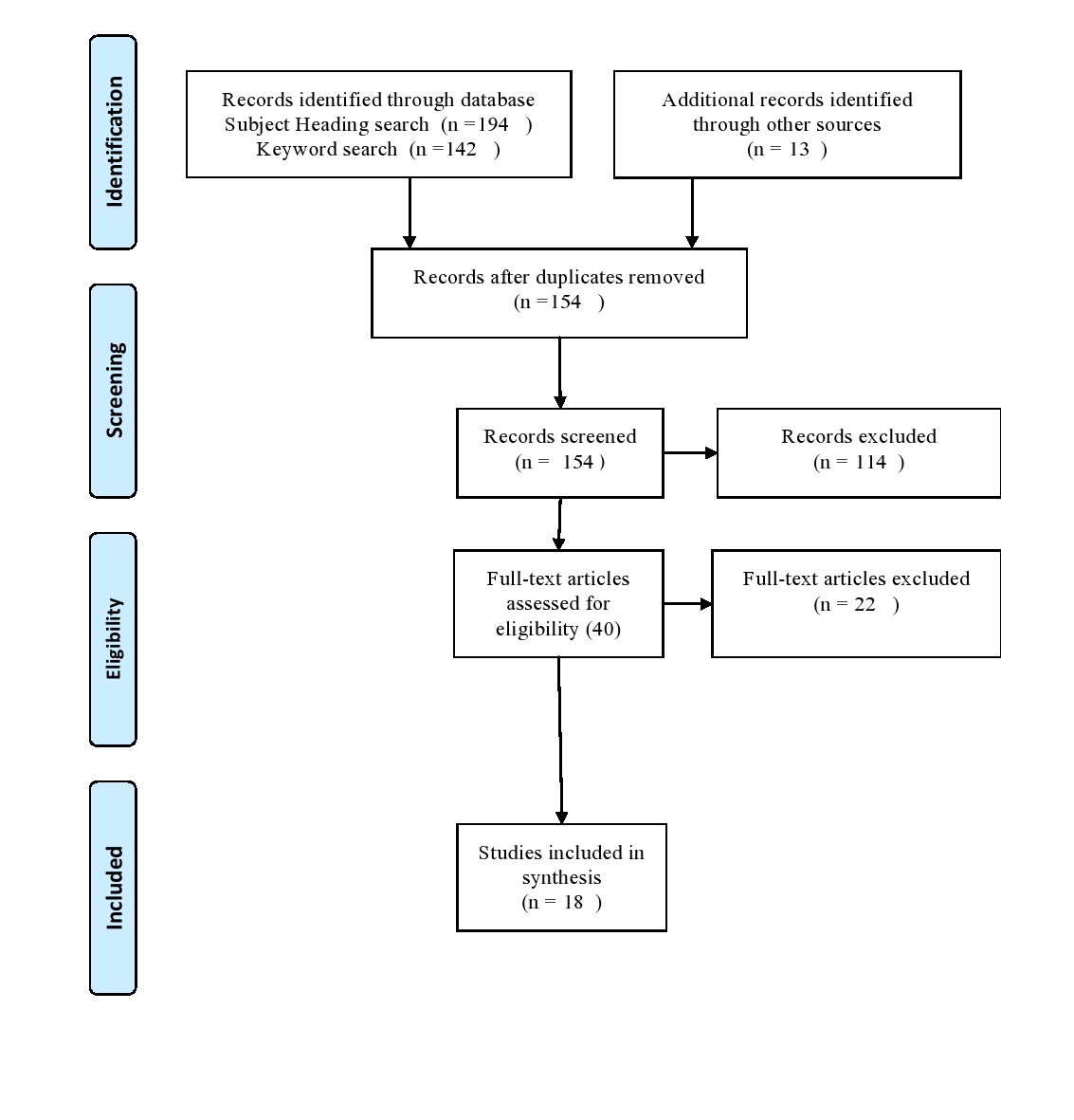
Study selection was performed in three stages (Figure 1):

Stage 1: Database Search

The studies that were identified through the database subject heading search (194 studies), the keyword search (142), and other sources (13 studies) were screened for duplication, yielding 154 studies.

Stage 2: Titles and Abstract Review

Screening of the titles and abstracts of the 154 retrieved studies was conducted by one qualified reviewer (the first author) in order to exclude any obvious non-eligible studies. Of these, 40 studies were deemed eligible for inclusion in a full article review.

Stage 3: Full Article Review

Two qualified reviewers conducted a full article review of the 40 studies. This review had two goals: first, to exclude any studies of non-eligible trials; second, to extract data on specific variables for further analyses. Of the 40 studies, 18 studies were deemed eligible for inclusion in our analysis.


Flowchart of the Review Screening Process

Data collection process

Data extraction was conducted by a qualified reviewer (the first author) during the full article review of the 18 included studies. The source of data in the individual studies was confirmed by contacting investigators who authored multiple studies included in the review, due to the aggregated weight of these studies potentially affecting our conclusion. The confirmation aimed to verify whether the data examined in the individual studies were collected from a single population and used in more than one study, or from different independent populations.

Data items

Primary Outcomes:

– Quality of Study: The quality of the study was categorized into three groups (Low, Moderate, High) (categorical variable)

– Conclusion of Study Effect: (whether the study concluded association of wind turbines with the effect on human health that was under investigation) (binary variable)

Variables (Outcome Measures of Individual Studies):

– First Author: The name of the first author (nominal variable)

– Year of Publication: The year in which the study was published (ordinal variable)

– Journal Name: The name of the publishing journal (nominal variable)

– Country of Study: The name of the country where the trial was originated (nominal variable)

– Study Design: The design of the study (nominal variable)

– Sample Size: The study sample size (continuous variable)

– Response Rate: The response rate of subjects in the study (continuous variable)

– Level of Evidence: The Level of evidence of the study (nominal variable)

– Level of Potential Bias: The level of risk of bias. Categorized into three groups according to Cochrane’s recommendations [10]. (Low risk of bias: Plausible bias unlikely to seriously alter the results; Unclear risk of bias: Plausible bias that raises some doubt about the results; High risk of bias: Plausible bias that seriously weakens confidence in the results) (categorical variable)

– Outcome Measures of Study: The outcome measure under investigation in the study (nominal variable); these outcome measures are:

– Annoyance (Sensitivity to Noise)

– Sleep disturbance

– Visual impact

– Well-being (Quality of Life/Mental Effect)

– Dose-response (description of the change in distress caused by differing distances from a wind turbine)

– Infrasound effect

– Existing background noise (comparison of stress associated with wind turbines to stress associated with road traffic noise/quiet rural environment)

– Attitude to wind turbines (whether people who complain have negative personal opinions toward wind turbines)

– Economical benefit (whether people who benefit economically from wind turbines have a decreased risk of distress)

Risk of bias in individual studies

Assessing the risk of bias of individual studies was performed at both the study level (study design, sample size, response rate, direction and magnitude of any potential bias and how it was handled, limitations, and reporting quality) and the outcome level (a cautious overall interpretation was drawn of the study’s conclusions, whether effect of human distress exists, considering the specific study’s objectives).

Summary measures and synthesis of results

After data extraction, each study was analyzed to identify the two primary outcomes: First, quality of study, taking into account the study’s principle outcome measures; all outcomes, exposures, predictors, potential confounders, and effect modifiers; how the study size was arrived at; how quantitative variables were handled in the analyses; description of all statistical methods; and how loss to follow-up and missing data were addressed. Second, conclusion of study effect as a cautious overall interpretation of the study’s conclusions, taking into account the specific study’s objectives and how well these conclusions were supported by the study results.

Risk of bias across studies

To reduce potential sampling bias (for example, the quality of study could be confounded by journal name and name of first author), the reviewers blinded themselves to the name of the journal and authors until all data on the other variables of interest were collected. To reduce potential measurement bias, the following three measures were undertaken: The data were directly entered into the database instead of using collection forms, quality assurance on all steps of data collection and management was performed, and in any case of uncertainty in deciding the quality of study, the reviewer consulted one of our senior authors to confirm the decision. Furthermore, the source of data was confirmed by contacting investigators who authored multiple studies included in the review, due to the weight their aggregated studies would have in affecting our conclusions.

Ethics approval

This study used previously published data making it exempt from institutional ethics board approval.

Results

Study selection

Figure 1 presents a flowchart depicting the study screening process. The database searches produced 154 publications. From this group, 40 publications were eligible following screening the titles and abstracts. From this group, 18 publications were eligible for inclusion after full article review. These 18 studies, shown in Table 1, consist of six original studies and 12 non-original studies (secondary analyses and literature reviews based on some of these original studies). Only the six original studies were included in the final analysis shown in Table 2. The 12 non-original studies were excluded from the analysis to minimize potential bias associated with repeated results.

This review used previously published data; therefore, there was no missing data for any of the variables of interest.


                                                                                  Study Characteristics

1st Author, Year Country Design Sample Size Response Rate % Level of Evidence Risk Of Bias Within Studies Quality of Study
Bakker [11] 2012 ^ Netherlands Cross-sectional 725 37 4 Unclear risk of bias Moderate
Hanning [12] 2012 ^ UK Expert Opinion/Review N/A N/A 5 Unclear risk of bias Moderate
Nissenbaum [13] 2012 ¥ USA Cross-sectional 106 75 4 Low risk of bias Moderate
Knopper [6] 2011 ^ Canada Review 15 N/A 4 Unclear risk of bias High
Shepherd [14] 2011 ¥ New Zealand Cross-sectional 39, 158 34, 32 3,4 Low risk of bias High
Janssen [15] 2011 ^ Netherlands Secondary analysis 1820 68, 58,  <30 4 Low risk of bias High
Pedersen [16] 2011 ^ Sweden Secondary analysis 1755 * 4 Low risk of bias High
Bolin [17] 2011 ^ Sweden Review N/A N/A 4 Unclear risk of bias Low
Pedersen [18] 2010 ^ Sweden Secondary analysis 725 37 4 Low risk of bias High
Salt [7] 2010 ¥ USA Expert Opinion Report N/A N/A 5 Unclear risk of bias High
Pedersen [19] 2009 ¥ Netherlands Cross-sectional 1948 37 4 Low risk of bias High
Keith [20] 2008 ^ Canada Expert Review N/A N/A 5 Unclear risk of bias High
Pedersen [21] 2008 ^ Sweden Secondary analysis 1095 N/A 4 Low risk of bias High
Pedersen [22] 2008 ^ Sweden Secondary analysis 1822 60 4 Low risk of bias High
Pedersen [23] 2007 ^ Sweden Qualitative Study 15 N/A 5 Low risk of bias High
Pedersen [5] 2007 ¥ Sweden Cross-sectional 754 58 4 Low risk of bias High
Leventhall [24] 2006 ^ UK Report N/A N/A 5 Unclear risk of bias High
Pedersen [25] 2004 ¥ Sweden Cross-sectional 351 68 4 Low risk of bias High

 View larger


1st Author, Year

Does-response

Road Traffic Noise / quiet rural environment

Sleep Disturbance

Annoyance/ sensitivity to noise

visual impact

attitude to wind turbines

Infrasound effect

Well being (Quality of Life / mental effect)

Economical Benefit

Nissenbaum [13] 2012 p < 0.05   p = 0.03         p = 0.002  
Shepherd [14] 2011     Rs = 0.43

p < 0.001

Rs = 0.44

p < 0.001

      Rs = 0.20

p < 0.01

 
Salt [7] 2010       Exp     Exp    
Pedersen [19] 2009 Rs = 0.50

p < 0.001

Rs = 1.07-

p < 0.01

  Rs = 0.35

p < 0.001

Rs = 1.04

p <0.001

Rs = 0.54

p < 0.001

    Rs = -2.77

p < 0.001

Pedersen [5] 2007   OR = 1.1 (95% CI

0.91 to 1.21)

  OR = 1.1 (95% CI

1.01 to 1.25)

OR = 1.1 (95%  CI 0.97 to 1.21) OR = 1.1 (95%  CI 1.00 to 1.25)      
Pedersen [25] 2004     Rs = 0.35

p < 0.001

Rs = 0.42

p < 0.001

Rs = 0.52

p < 0.001

Rs = 0.33

p < 0.001


 View larger

Study characteristics and risk of bias within studies

Table 1 shows data on the 18 peer-reviewed studies captured in our review, including individual study characteristics, level of potential bias, and quality of study.

Results of individual studies

Table 2 shows summary data on the six original studies’ objectives, p-values, and outcome measures.

Risk of bias across studies

One main source of potential bias across these studies was that 10 of them, listed below, were mainly based on three data sets. The first data set (SWE00) was collected in Sweden in the year 2000 in agricultural areas, the second (SWE05) was collected in different environments in Sweden 2005, and the third (NL07) was collected all over the Netherlands in 2007. This potential bias was eliminated by using only the three original studies that collected the data sets [5, 19, 25].  The rest of the 10 studies (non-original studies) were excluded from the analysis to avoid repeated results.

– Bakker [11] 2012 Science of the Total Environment (NL07)

– Pedersen [16] 2011 Noise Control Eng J (SWE00) + (SWE05) + (NL07)

– Janssen [15] 2011 Acoustical Society of America (SWE00) + (SWE05) + (NL07)

– Pedersen [18] 2010 Energy Policy (NL07)

– Pedersen [19] 2009 Acoustical Society of America (NL07)

– Pedersen [21] 2008 Journal of Environmental Psychology (SWE00) + (SWE05)

– Pedersen [22] 2008 Environ Res Lett (SWE00) + (SWE05)

– Pedersen [23] 2007 Qualitative Research in Psychology (SWE00)

– Pedersen [5] 2007 Occup Environ Med (SWE05)

– Pedersen [25] 2004 Acoustical Society of America (SWE00)

Another source of bias was that three of the studies were reviews of previous literature [6, 12, 17].

Key results

– All 18 peer-reviewed studies captured in our review found an association between wind turbines and one or more types of human distress. These studies had a level of evidence of four and five.

– None of the studies captured in our review found any association (potential publication bias).

– These studies were published in a variety of journals (representative sample).

– Two of these studies showed a dose-response relationship between distance from wind turbines and distress (Table 2).

– There is still no evidence of whether or not a causal relationship between distance from wind turbines and distress exists.

Discussion

Summary of evidence

The peer-reviewed studies we reviewed provide reasonable evidence (Levels Four and Five) that an association exists between wind turbines and distress in humans.

Two of these studies showed a dose-response relationship between distance from wind turbines and distress, and none of the 18 studies concluded no association (consistency of association). The existence of a dose-response relationship and consistency, two of the Hill’s Criteria of Causality, argues for the credibility of the association.

All the evidence comes from expert opinion, case studies, and cross-sectional studies. No higher level of evidence observational studies, namely case-control and cohort studies, were utilized to investigate the subject. For example, although Shepherd, et al’s study [14] had a sound design and was well conducted and reported, it is considered at a lower level of evidence as a cross-sectional study has an increased potential for bias of its results.

Although three of the studies [6-7, 24] suggested that low-frequency sound energy wind turbines (i.e., infrasound below 20 Hz) may directly and negatively affect health, the level of evidence for these studies is also weak (expert opinions [7, 24] and a review [6] citing these two studies).

Economic benefit found in two of the studies [15, 19] could be intuitively and prematurely viewed as a factor lowering the credibility of the complaint. However, in our opinion, compensation would have lowered the credibility of the complaint only if these people had no distress following compensation. People in the studies who benefited economically from wind turbines had a decreased risk of distress but not a complete elimination of distress. Furthermore, the fact that the level of distress could be altered with financial compensation only speaks to the existence of distress.

It is worth pointing out that no causality has been established. The distress could be due to factors other than actual noise exposure. For example, the distress experienced by the participants in the original studies may have been generated or exaggerated by exposure to negative opinions on wind turbine.

Limitations

This study has a number of limitations and sources of bias. One source of bias is the exclusion of non-English studies. For example, China is the world’s leading country in the number of wind turbines [1]. The exclusion of non-English studies might have affected the overall conclusions of our review.

Another source of bias is the fact that the reviewer could not be completely blinded to the journals’ or authors’ names. There might be a theoretical incline to give studies in high impact journals higher quality because of their reputation (potential sampling bias). Nevertheless, if this bias took place, it would have an effect on the magnitude of evidence and not on the existence of the association due to the dichotomous nature of this variable (the number of studies that speaks for an association will not change).

Publication bias could be the reason for the finding that none of the 18 peer-reviewed studies captured in our review found no association. However, potential publication bias was decreased by conducting a search in two major grey literature databases (SIGLE, and Scirus).

Generalizability

The 18 studies were published in a variety of journals, making the captured studies a representative sample, which in turn increases our results’ generalizability (external validity).

The fact that the data in two of the three mentioned data sets were collected in Sweden may decrease the external validity, but simultaneously may increase the internal validity following the above logic. Furthermore, although these data were collected from one country, it still would be a safe assumption that the people and their experience with wind turbines, on which these data were collected, are not fundamentally different from people and experiences in other countries.

Future research

Further research in the area of exposure assessment and measurement is needed. The mechanism and physiology of harm needs to be confirmed. There is a need to identify the actual risk of harm and the health outcomes in people exposed. Until research can separate out specific sets of significant factors for the exposure with higher-level evidence than is available now, our ability to mitigate the harm is limited. Possible future research could be conducting longitudinal studies, performing measurements before wind turbines and after, and observing what happens to people over time.

Conclusions

We have demonstrated in our review the presence of reasonable evidence (Levels Four and Five) supporting the existence of an association between wind turbines and distress in humans. The existence of a dose-response relationship between distance from wind turbines and distress as well as the consistency of association across studies found in the scientific literature argues for the credibility of this association. Future research in this area is warranted.


References

  1. The Global Wind Energy Council. Accessed: October 30, 2013. http://www.gwec.net/?s=canada.
  2. The Global Wind Energy Council.. 2012, Accessed: October 30, 2013.http://www.gwec.net/wp-content/uploads/2012/06/Top-10-Cumulative-Capacity-December-2012.jpg.
  3. Price, TJ: Oxford Dictionary of National Biography Oxford University Press; 2004.
  4. Krogh C, Gillis L, Kouwen N, Aramini J: WindVOiCe, a self-reporting survey: adverse health effects, industrial wind turbines, and the need for vigilance monitoring. Bull Sci Technol Soc 2011, 31:334-45.
  5. Pedersen E, Hallberg L, Waye KP: Living in the vicinity of wind turbines–a grounded theory study. Qualitative Research in Psychology 2007, 4:49–63.
  6. Knopper LD, Ollson CA: Health effects and wind turbines: A review of the literature. Environ Health 2011, 10:78. doi: 10.1186/1476-069X-10-78
  7. Salt AN, Hullar TE: Responses of the ear to low frequency sounds, infrasound and wind turbines. Hear Res 2010, 268:12-21. doi: 10.1016/j.heares.2010.06.007
  8. World Health Organisation: Night noise guidelines for Europe. 2009, Accessed: October 30, 2013. http://www.euro.who.int/__data/assets/pdf_file/0017/43316/E92845.pdf.
  9. Hill AB: The Environment and Disease: Association or Causation?. Proc R Soc Med 1965, 58:295-300.
  10. Higgins JPT, Altman DG, Sterne JAC on behalf of the Cochrane Statistical Methods Group and the Cochrane Bias Methods Group: 2011, Chapter 8: Assessing risk of bias in included studies. Cochrane Handbook for Systematic Reviews of Interventions Version 5.1.0:http://handbook.cochrane.org/chapter_8/8_assessing_risk_of_bias_in_included_studies.htm. Accessed: October 30, 2013.
  11. Bakker RH, Pedersen E, van den Berg GP, Stewart RE, Lok W, Bouma J: Impact of wind turbine sound on annoyance, self-reported sleep disturbance and psychological distress. Sci Total Environ 2012, 425:42-51. doi: 10.1016/j.scitotenv.2012.03.005
  12. Hanning CD, Evans A: Wind turbine noise. BMJ 2012, 344:e1527. doi: 10.1136/bmj.e1527
  13. Nissenbaum MA, Aramini JJ, Hanning CD: Effects of industrial wind turbine noise on sleep and health. Noise Health 2012, 14:237-43. doi: 10.4103/1463-1741.102961
  14. Shepherd D, McBride D, Welch D, Dirks KN, Hill EM: Evaluating the impact of wind turbine noise on health-related quality of life. Noise Health 2011, 13:333-9. doi: 10.4103/1463-1741.85502
  15. Janssen SA, Vos H, Eisses AR, Pedersen E: A comparison between exposure-response relationships for wind turbine annoyance and annoyance due to other noise sources. J Acoust Soc Am 2011, 130:3746-53. doi: 10.1121/1.3653984
  16. Pedersen E: Health aspects associated with wind turbine noise—Results from three field studies. Noise Control Eng J 2011, 59:47-53.
  17. Bolin K, Bluhm G, Eriksson G, Nilsson ME: Infrasound and low frequency noise from wind turbines: Exposure and health effects. Environ Res Lett 2011, 6:1-6. doi: 10.1088/1748-9326/6/3/035103
  18. Pedersen E, van den Berg F, Bakker R, Bouma J: Can road traffic mask the sound from wind turbines? Response to wind turbine sound at different levels of road traffic. Energy Policy 2010, 38:2520–2527. doi: 10.1016/j.enpol.2010.01.001
  19. Pedersen E, van den Berg F, Bakker R, Bouma J: Response to noise from modern wind farms in The Netherlands. J Acoust Soc Am 2009, 126:634-43. doi: 10.1121/1.3160293
  20. Keith SE, Michaud DS, Bly SHP: A proposal for evaluating the potential health effects of wind turbine noise for projects under the Canadian Environmental Assessment Act. Low Freq Noise Vib Active Control 2008, 27:253-65.
  21. Pedersen E, Larsman P: The impact of visual factors on noise annoyance among people living in the vicinity of wind turbines. J Environ Psychol 2008, 28:379–89. doi:10.1016/j.jenvp.2008.02.009
  22. Pedersen E, Waye KP: Wind turbines – low level noise sources interfering with restoration?. Environ Res Lett 2008, 3:1–5.
  23. Pedersen E, Waye KP: Wind turbine noise, annoyance and self-reported health and well-being in different living environments. Occup Environ Med 2007, 64:480-6.
  24. Leventhall HG: Low frequency noise and annoyance. Noise Health 2004, 6:59-72.
  25. Pedersen E, Waye KP: Perception and annoyance due to wind turbine noise–a dose-response relationship. J Acoust Soc Am 2004, 116:3460

Conference Warns: Health Effects of Wind Turbines, Should be Taken Seriously!

Sleep disturbance emerging as major public health concern, particularly affecting children and older people

Alun Evans, Professor Emeritus of Epidemiology in Queens University, Belfast said it was “quite possible” if the Dublin array, a proposed €2 billion project which would see 145 wind turbines constructed 10km off the east coast, goes ahead that up to two million people could be exposed to infrasound, a “sizeable minority” of who could potentially experience sleep disturbance.  Photo: David Sleator/The Irish Times

Alun Evans, Professor Emeritus of Epidemiology in Queens University, Belfast said it was “quite possible” if the Dublin array, a proposed €2 billion project which would see 145 wind turbines constructed 10km off the east coast, goes ahead that up to two million people could be exposed to infrasound, a “sizeable minority” of who could potentially experience sleep disturbance. Photo: David Sleator/The Irish Times

 Health studies into the effect of wind turbines on those living in their vicinity must be explored to prevent potential health problems, a conference on public health heard yesterday.

Alun Evans, Professor Emeritus of Epidemiology in Queens University, Belfast was speaking at the 2014 Summer Scientific Meeting at the Royal College of Physicians the second day of which was held in Dublin yesterday.

He said it was “quite possible” if the Dublin array, a proposed €2 billion project which would see 145 wind turbines constructed 10km off the east coast, goes ahead that up to two million people could be exposed to infrasound, a “sizeable minority” of who could potentially experience sleep disturbances.

Prof Evans said there was “clear evidence” that, as the size of wind turbines had increased, so has the infrasound and low frequency sounds generated by them and that they were now emitting “serious amounts of noise”.

“When you measure them with the correct filters you find they are producing noise levels which are far above what’s supposed to be permitted,” he said.

He said while many people are not affected, that others could experience sleep disturbance, adding this in turn leads to increased blood pressure which he said is a major risk factor for cardiovascular disease.

Prof Evans said that, while he did not want to sound alarmist, the effects were such that they needed to be taken seriously and investigated further.

Quoting a 2009 WHO report on night noise, Prof Evans said sleep disturbance was emerging as one of the major public health concerns of the 20th century and something which particularly affected children and older people.

He said sleep was “absolutely essential, central to the normal physiological function of the brain and the body” and was necessary for facilitating learning.

However, he said the noise generated by wind turbines were particularly intrusive and incessant, describing it being “like a train that does not pass”.

Citing a 2012 editorial which he co-wrote with Chris Hanning, an honorary consultant in sleep medicine for the British Medical Journal, he said there could be no reasonable doubt that industrial wind turbines, either singly or in groups of wind farms, generated sufficient noise to disturb the sleep of those living nearby.

Prof Evans said wind turbine syndrome – a controversial term coined for the symptoms reportedly experienced by people living in the vicinity of windfarms including sleep disturbances, headaches, dizziness, nausea, tinnitus and inability to concentrate – was real and should be further explored.

He also pointed to other potential health implications including blade flicker and stress caused by impact on house prices, an inability to sell the property and impacts on the community.

Prof Evans said “proper evaluation and proper monitoring” of the potential effects of wind turbines, including cohort studies and smaller intervention studies needed to be carried out, including sleep laboratory studies.

He also called for the Government to carry out a full economic appraisal of wind turbines.