Wind Turbines….A Travesty in Rural Ontario, that Affects Everyone!!!

Ontario Wind Turbines

Ontario has the most expensive electricity in North America
leading to unaffordable hydro bills, manufacturing leaving, high unemployment and a stagnant economy.
This is the result of over-priced wind power; an industry Ontario doesn’t need and can’t afford.
(Comparing to the other provinces and the continental U.S.)

“Ontario is probably the worst electricity market in the world,”
Pierre-Olivier Pineau, Associate Professor and Electricity Market Expert, University of Montreal HEC Business School.


Ontario’s Energy Policy affects every person in Ontario.

Eleven years ago, Ontario had a vibrant energy sector. It has changed since then.
The following is a summary of the energy policy that is being implemented by the Ontario Government.
All supporting information is under Sources.

Ripley-KincardineRipley-Kincardine, Lake Huron


Over the next 20 years, your household will pay an additional $40,000 for electricity.

The cost of wind power will add $110,000,000,000.00 to our electrical bills.
To appreciate the cost, $100 billion can buy 5,000,000 Honda Civics.


Ontario is building 6736 Wind Turbines.

We already have clean and excess power from water, nuclear and gas.


Bruce Peninsula


We pay more for wind power than any province/state in North America.

We are subsidizing the wind industry.

The Ontario Government pays the wholesale price of 11-13.5 cents per kwh for wind power.
The average retail price for wind power in the U.S. is 7 cents.
The average retail price for Ontario nuclear, water and gas is 7 cents.

Ontario hydro consumers pay for a debt that was actually paid off in 2010.
The 10% clean energy rebate on your hydro bill is charged to Ontario tax payers.
Ontario is the only province/state that charges HST, delivery, and regulatory fees on electricity.
Your hydro rates increase every May and October.

In 2007, you paid 7 cents per kwh.
In 2014, you pay 14-27 cents per kwh, depending on usage and location.
Check your hydro bill; divide the total (including HST, delivery and regulatory fees) by your usage.

1699 kwh costs $210 = 14 cents per kwh.
288 kwh costs $79 = 27 cents per kwh.

Compare our rates to: 6.8 cents in Quebec and 7.9 cents in Manitoba.

Pro-wind groups claim that our expensive electricity is due to expensive nuclear power.
However, the Ontario Power Generation states otherwise as per the link below:
http://www.opg.com/generating-power/nuclear/Pages/nuclear.aspx


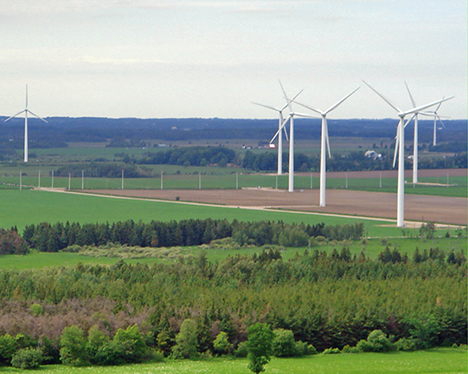
Shelburne


Manufacturing is leaving Ontario.

“Ontario has the highest industrial rates in North America.”
Association of Major Power Consumers in Ontario. Refer to Sources for complete report.

Caterpillar (2 plants), United Steel. Heinz, Bicks, International Trucking,
General Motors, Navistar, Kellogg’s, John Deer, Lance Bakeries, Kraft Foods, Unilever.

NOVA Chemicals says the cost of power is critical in its decision to locate a multi-billion-dollar polyethylene expansion in Sarnia Ontario.
Their alternative is the U.S. Gulf Coast where rates are a fraction of ours.

http://www.theglobeandmail.com/report-on-business/economy/ontario-drives-manufacturers-away-with-overpriced-electricity/article14854752/

Since 2006, power usage has decreased by 6%.
Ontario has almost 1 million people out of work.
Ontario’s $227 billion debt is the worst in North America.

“Ontario’s economy has not performed on par with the rest of Canada,
due in part to its slow economic growth and spiralling public debt.”

Fraser Institute, April 2014. Refer to Sources for complete report.


Bruce Peninsula


Gone are the days of beautiful Ontario….

“These wind projects will change this place more totally, more rapidly and more permanently
than anything in the past 10,000 years”
James Corcoran, South Huron, Ontario
30 years experience, environmental assessments on behalf of developers.

The Human & Environmental Impact 

To appreciate the full impact of turbines on our people, please find the time  to read this:
http://www.southwesternontario.ca/news/public-fills-gallery-to-hear-wind-turbine-concerns/

Wind companies pay proportionally less taxes than the rest of us; turbines are assessed at a fraction of the actual value.
Farmers who sign 20 years leases with Wind Companies also sign a gag order whereby they must promote turbines and cannot criticize.

Wind companies are exempt from many Ontario laws.

Examples: municipal bylaws, building permits, road weight restrictions, proximity to highways, drainage.
Example: The restriction on rural bridges with 1/2 ton limits, where the heaviest load is usually a tractor,
are lifted during the construction of a wind project.
Example: Wind Projects can violate the Labour Act.
These cranes from the Adelaide wind project were left in this position overnight.

cranes

The Ministries of Environment and Natural Resources have changed laws that apply only to wind companies.

Example: there is no protection of wetlands; death or harm to endangered species.
Example: If you destroy an eagle’s nest, the fine is $10,000;  whereas wind companies are exempt.

Wind companies routinely sue municipalities/persons who get in their way.

The government supplies lawyers to back a wind company;
but has never backed a municipality, group or person.

Laws were passed where municipalities have no rights regarding wind projects in their jurisdiction.
Over 80 municipalities are “unwilling hosts” to turbines, but are not acknowledged.

Every turbine will permanently destroy 3 acres of land; roughly 21,000 acres of farmland lost forever.
Ontario turbines are closer to humans than any place in the world.
People are suffering from constant turbine noise and wind turbine syndrome which can be life threatening.
People are abandoning their homes at a unprecedented pace; very few want to live in or buy a house surrounded by turbines.
The fortunate ones are bought out by the wind companies, but sign a gag order as to why they left.
Areas in rural Ontario are becoming ghost towns.


The Birds

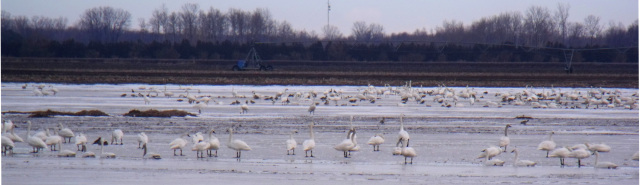
swans-thedford-bogMarch 2014 – Lambton Shores – Rest area for Migrating Tundra Swans
March 2015 – Lambton Shores – Rest area for newly built wind turbines.


People call turbines bird blenders 
because they slice, maim and slaughter birds.
Turbines will be built in the paths of the millions of birds that migrate to or through Ontario.
Turbines kill more bats than birds (their lungs explode from the turbine’s drop in air pressure). Don’t neglect the importance of bats to our eco-system.


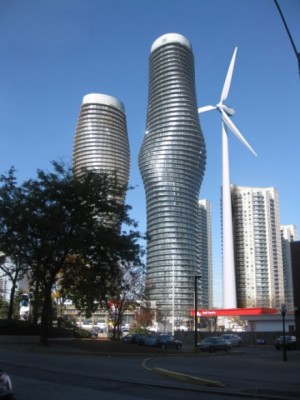
A Perspective of Turbine Height

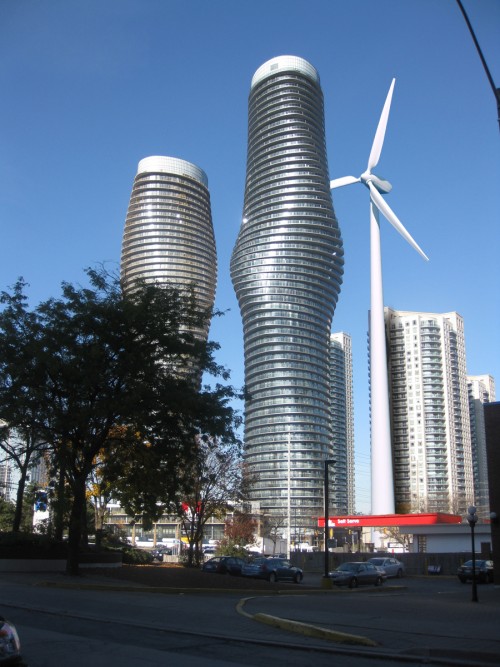
Using the Absolute Towers in Mississauga rendered in as a backdrop:
Absolute Towers is 56 storeys.
The small turbine is the CNE turbine – 299 feet high.
The mid-size is the average Ontario turbine – 380 feet high.
The tall one is the new Ontario turbine – 550 feet and taller.

Three

The rendering below provides a perspective of Ontario’s new turbines.
The building behind is 38 storeys.

TheMega


Ontario’s wind energy policy is convoluted and wastes money.

    • Nuclear, hydro, & gas is clean, cheap and has a 100% reliability, but, wind is given priority to our grid.
    • Wind power is expensive and unreliable; available 20-30% of the time.
    • When there is no wind, there is no wind power available.
    • For every kwh of wind power, we need one kwh of backup, that could otherwise be used as our sole source.
    • Ontario is spending $11 billion building transmission lines to feed power from every wind project.
      That’s an additional $2750 cost to your household
    • Ontario has too much power and we either, pay the USA & Quebec to get rid of the excess or charge 2.5 per kwh.
      In 2013 alone, the loss was $1 billion which will cost your household an additional $250.
    • Quebec turns around and sells our hydro at 5 cents per kwh to bordering States.
    • When there is too much power, Ontario pays $1 million dollars a day to take a nuclear plant off-line ($66 million in 2013)
      and pays wind companies to shut down their turbines.
    • $6 billion was spent to increase the power at Niagara Falls; only to divert the water when there is excess power.
    • Ontario pays gas plants to run as backup for wind power.
    • The first weekend in August, Ontario lost $10 million because of highly windy days resulting in unexpected power to the grid.
      The same occurred on November 9 & 10, where Ontario lost another $20 million.
    • September 11, 2013: Ontario agreed to pay Wind Energy companies $200,000 per mw not to supply power,
      The government says it’s “cheaper than paying the USA & Quebec to use it”.
      Since then, new wind projects continue to be approved.
    • The plan to build two new nuclear reactors at Darlington was abruptly cancelled in October 2013 at a cost of $180 million.
    • During the 2011 election, the Liberals cancelled the construction of 2 gas plants to win Liberal seats.
      These cancellations totaled $1.1 billion which will cost your household an additional $250.
    • The Lambton coal plant had just been upgraded at a cost of $1 billion to produce clean coal before it was closed in October 2013.
      That will cost your household another $250.
      Ironically, the Lambton coal plant is 1 km from a coal plant in Michigan that is still active.

“This situation is expected to get much worse over the next several years as significant amounts of wind,
hydraulic and nuclear generation will be coming into service while expected electrical demand will continue
to be stagnant.”

Ontario Society of Professional Engineers. Refer to Sources for complete report


Truth is stranger than fiction

Ontario pays 11-13.5 cents for wind power.
Ontario pays or charges Quebec 2.5 cents take our excess.
The loss is subsidized by Ontario consumers.
Quebec sells it to border States for 5 cents.
Consequently:
Manufacturers can move to the States and get cheap power; where a portion is sourced from Ontario and subsidized by Ontario consumers.

New York State sees an opportunity.
Promotional information was sent to Ontario’s Manufacturing sector citing Ontario’s high energy costs as a good reason to relocate to New York State.http://www.theglobeandmail.com/news/politics/soaring-energy-prices-making-ontario-look-dim-for-manufacturers/article17560172/


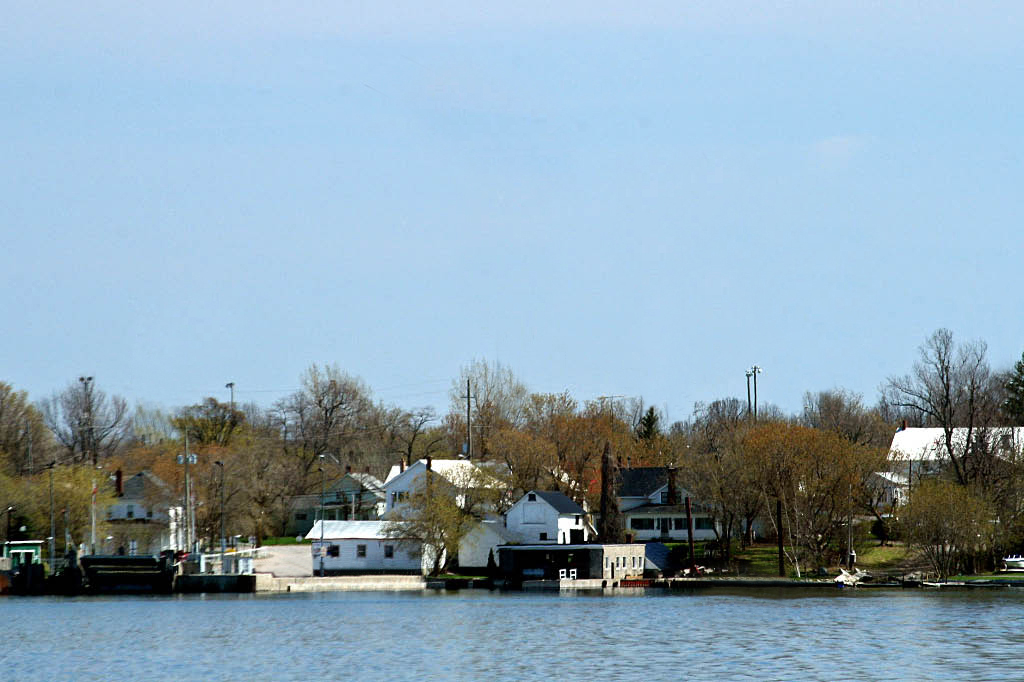
Wolfe Island – photo rendering shows pre-turbine days
Wolfe Rendering

Wolfe Island – actual photo
8


The Vulnerability of our Grid

    • When produced, power has to be used immediately; there’s no technology to store it for a later time.
    • There is excess power almost every hour of every day, and Ontario scrambles to find a state/province that will take it.
    • Depending on their power needs at the time, we either give it away (spill it), pay to take it (spill it) or charge a very low rate.
    • Because wind power is so unpredictable, the IESO staff are continually manipulating the grid; telling the nuclear, gas and hydro suppliers to adjust their output accordingly; and the excess is then sent to Quebec, Manitoba and the States.


According to the Ontario Society of Professional Engineers:

Carbon Dioxide Emissions will increase by 48% in 2030,
because gas plants constantly starting up and shutting down expel more emissions than if they ran continually.

Much of our wind power will go to Quebec and the States.
Wind blows mostly at night and in the winter when we need power the least.
There is no wind on a hot summer day, when our air conditioners need it the most.

Constant changes to the grid are prone to error and Ontario’s grid wasn’t built to handle such.
Be prepared for frequent and long blackouts or worse, as in complete failure of our energy grid.

Chatham-Kent-wind-turbines-from-Lake-Erie-and-Rondeau-Bay15
Rondeau Bay


Ontario has more than enough power with Nuclear, Hydro (water) and Gas.

Ontario’s average demand for power is roughly 18,000 mw.
In the last 8 years, Ontario’s highest demand for power was 27,005 mw on August 1, 2006.

The amount of available reliable power is 30,806 mw which far exceeds the demand.
Nuclear  = 12947 mw:  Hydro = 7939 mw;  Gas = 9920 mw.

The Liberals will have added 3725 mw of installed wind energy by the end of 2014;
with intentions of adding more.

“Ontario will phase in wind, solar and bioenergy 
….with 10,700 MW online  by 2021.”
Ministry of Energy

(Ontario is offering 44-88 cents per kwh for solar and bioenergy.)


Chatham Kent –  photo rendering shows pre-turbine days
chatham kent 1

Chatham Kent – actual photo
chatham-kent-ontario-kruger-energy-port-alma-wind-from-hwy3-talbot-trail-4


Does this make sense to you??

 ”The province’s wind and solar power initiatives were decided and implemented in such haste
that “no comprehensive business-case evaluation was done to objectively evaluate the impacts
of the billion-dollar commitment.”

Auditor General of Ontario

There are about 50 resident wind lobbyists in Toronto.

The Liberals introduced and passed the Green Energy Act 2009.
The NDP have supported the Liberals on wind energy since its inception.
The PC’s do not support subsidized wind power. They want it stopped.

This has been going on for years.  One example:
In 2004, Mike Crawley, the (then) President for the Ontario Liberals,
was awarded a wind power contract that guarantees his company $66,000 a day for a total of $1/2 Billion dollars.
Since then, Mike Crawley continues to build additional Wind Projects.

The Wind Industry held a fundraising event for Kathleen Wynne in April 2013.

Those who promote Wind power, benefit financially by doing so.
David Suzuki, Pembina Institute, Cleantech, MaRs,  Environmental Defence,
Friends of the Wind, Windfacts and CANWEA.

A wind company is getting a pass on violating the law?
In the Niagara region, four turbines that were built too close to residents, are violating the law and need to be dismantled.
The Minister of Energy has done nothing.
http://www.niagarathisweek.com/news-story/4390620-enforce-the-law-hudak-to-energy-minister


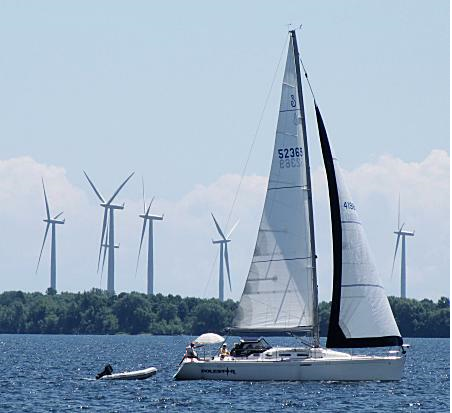
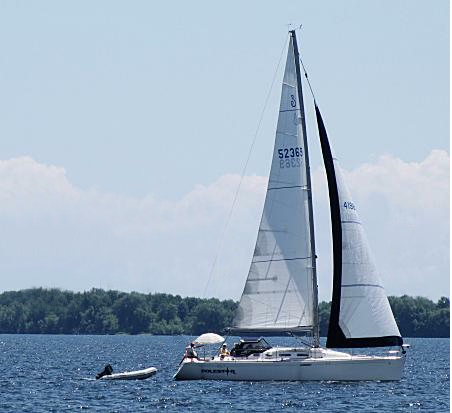
Lake Ontario – photo rendering shows pre-turbine days
sail copy

Lake Ontario – actual photosail


Every project could be stopped today; if the Liberals want to.

The Ontario Government has the discretionary power to cancel or modify these contracts but it’s clear they don’t want to.

An Ontario court ruling in the decision of Trillium vs. Ontario, 2013, clearly states that:
“Governments are free to alter policies in the public interest.” 
“Companies in the renewable power business participate in government subsidy programs ‘at their own risk’.”

As of March, 2014, the Liberals are continuing with the 55 incomplete wind power projects (about 4900 turbines) that could be stopped legally.

“If you are asking me, will you cancel those [wind project] contracts outright? The answer is no we won’t!”
Kathleen Wynne, in Kincardine, April 24, 2014

For ruling, refer to Discussion at the bottom of this page
http://www.osler.com/NewsResources/Appeal-Court-Allows-2-Billion-Wind-Farm-Action-to-Proceed-Against-Government-of-Ontario/


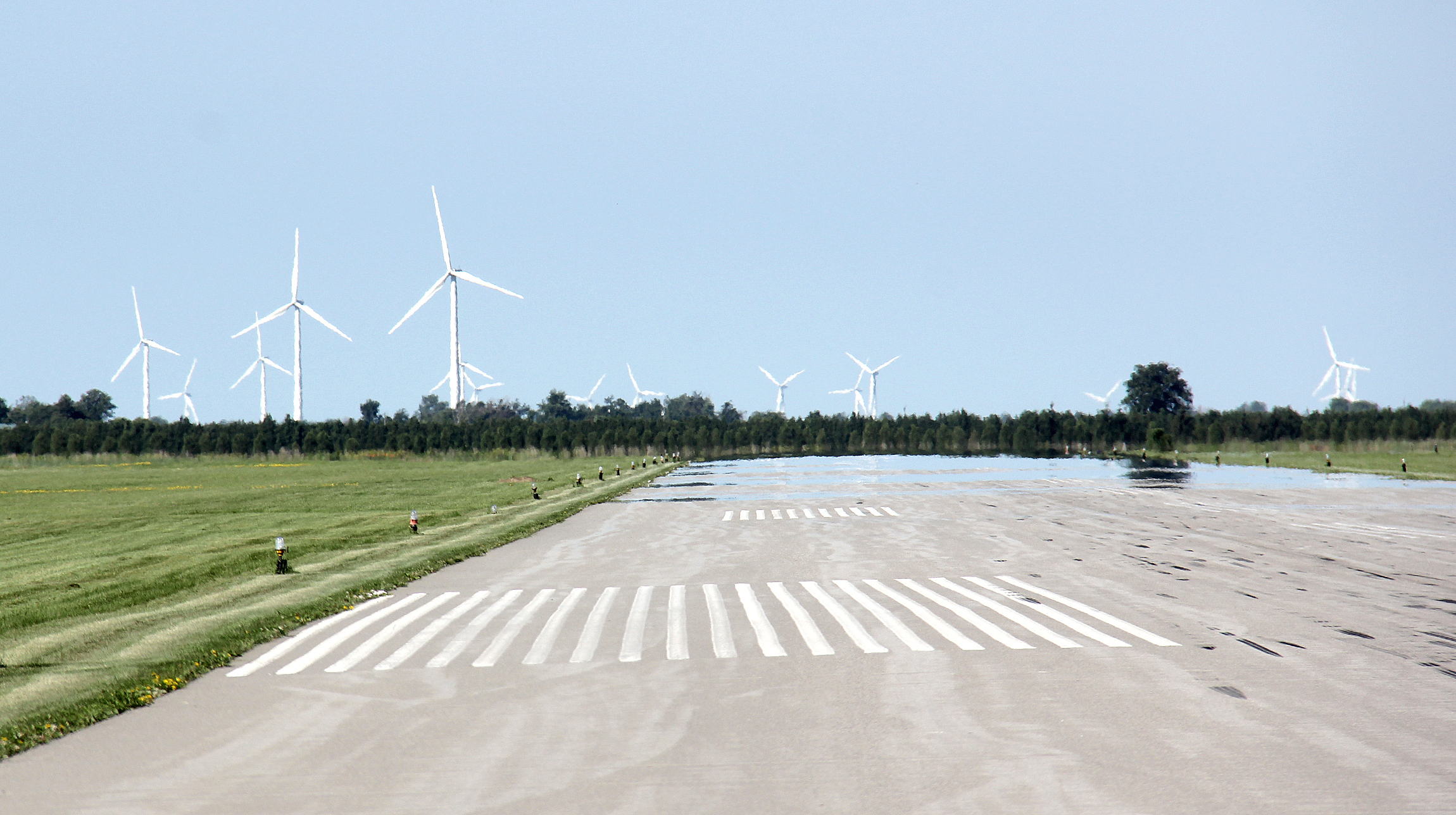
Chatham Kent Airport
Chatham Kent Airport – Location of turbines was denied by Transport Canada,
fought by the municipality, but approved by the Ontario Government.
The same is happening in Collingwood, Peterborough, Goderich, Kincardine, Huron Park, Grand Bend and the Niagara Region.
The sky-diving club in Niagara Region will have to shut down.

Energy Platform by Party

The PC’s introduced Bill 42 in 2012 and Bill 39 in 2013 to eliminate wind subsidies and give control back to municipalities.
The NDP’s and Liberals voted against these bills. Refer to Sources.

Liberal

Will be pursuing additional wind power projects in 2015 and again in 2016.
Remove the Ontario Hydro Debt charge on January 1, 2016. (About $60 a year decrease in costs).
Discontinue the Clean Energy Rebate on December 31, 2015. (About $170 a year increase in costs).
Introduce a surcharge for families making over $40,000, to subsidize lower income families.

NDP

Committed to “aggressively expand renewable energy”.
Honour existing green energy contracts
Place a moratorium on all renewable power projects starting in 2018.

Progressive Conservatives

Scrap Ontario’s wind energy policy.
Give control back to municipalities.
Put a moratorium on wind energy projects.
Eliminate wind subsidies, which would substantially reduce our hydro bills.

“We propose scrapping the Green Energy Act and implementing an immediate moratorium
on industrial wind turbines until the jury is in on health and environmental studies.
We will not sign any more FIT contracts and will take a look at the existing ones.”

PC MPP Toby Barrett, April 2, 2014


Wolfe Island121


Wolfe Island before & after the Liberal’s energy policies


Is Nothing Sacred?

Temple_Rendering___Content

Near Peterborough, a $40 million project to build the largest Buddhist complex outside of China is in jeopardy.
The Liberals knowingly approved wind turbines to surround the complex.
The people in charge of the development say these turbines will have a negative impact on the serenity of the complex.
This complex would have attracted about 45,000 visitors a year and generated more than $20 million for Ontario.


Wind Farms slated for Ontario

Click here to see maps of these projects

Rondeau Bay – photo rendering showing pre-turbine days
Rondeau Bay Rendering

Rondeau Bay – Actual photo
chatham-kent-ontario-internaional-power-gdf-suez-from-across-rondeau-bay-from-erieau-2


Wind verses Nuclear

  • Nuclear power costs 6.8 cents per kwh, period.
    Wind power costs 11-13.5 cents per kwh, plus all other costs mentioned above.
  • One wind project approved for the area east of Grand Bend is approximately 34 km long and 16 km wide.
    The nuclear footprint is 9 sq. kilometers.
  • It will have 63 wind turbines with a maximum output of 102 mwh.
  • Applying efficiency factor of 30%, actual output will be 30 mwh.
  • Ontario average usage is 18,000 mwh.
  • Nuclear can provide approximately 12,947 mwh 24/7.
  • This wind project has the potential of providing .16% (1/6th of one percent) our energy needs.
  • When there is no wind, it will provide 0% of our energy needs.

Map

tmap


 In 10-20 years

  • The Niagara Falls hydro generating stations are 100 years old, but wind turbines are good for only 10-20 years.
  • Each turbine construction consists of 800 tonnes of cement for support, approximately 250 tonnes of unrecyclable materials, 700 litres of hydraulic fuel and, 600 kilograms of rare earth metals. Multiply these numbers by 6736 and Ontario is facing a potential ecological conundrum.
  • The are no bonds posted to ensure these turbines will be dismantled at the end of their life cycle. It is estimated that a turbine, depending on size, will cost $400,000 to $1,000,000 to dismantle.
  • Given that wind companies are predominantly foreign, change ownership or, go bankrupt, it is quite realistic to expect 100′s or 1,000′s of dead turbines in 20 years and left standing.
  • This is happening already. Wind Companies usually don’t fix or dismantle broken turbines and, Ontario already has many non-functioning turbines.
    If companies won’t dismantle a couple of turbines now; what about the future ones?.
  • The Liberals have no plans as to where to dispose these materials, nor have indicated that wind companies will be responsible for the costs of building the landfill sites or depots.
  • One can only assume, that the cost to dispose 6736 turbines will be covered by the people of Ontario.

In 10-20 years, we could be faced with a landscape of old, rusted out, broken down turbines.


The Canadian Taxpayers Federation:
Launched a petition to dismantle the Liberal Green Energy Act.
https://www.taxpayer.com/resource-centre/petitions/petition?tpContentId=84


128,202 total views since Mar

The Windweasels KNOW they are Harming people, and wildlife…..They don’t care!!!

WIND FARMS SEVERELY HARMFUL TO WILDLIFE, NEW STUDY FINDS

HAWAII’S WIND TURBINES DEADLY TO BIRDS,…
According to the U.S. Fish and Wildlife Service, 195 birds and other flying animals have been killed by turbines at five of the largest wind farms on Maui and Oahu since Aug. 2007.

A new study from the Swedish University of Agricultural Sciences, combining an impressive six hundred other studies, describes the severe effects wind turbines can have on wildlife. Not only are the disturbances and noise of the building of turbines an issue but also the sound of the windmills rotating and electromagnetic fields (EMF) caused by transferring the electricity produced to the mainland.

At the construction phase, for example, “extreme noise from pile-driving” is observed to cause “significant avoidance behaviour in marine mammals” and “highly likely to cause mortality and tissue damage in fish.”

On the noise of the blades there was “avoidance of the offshore wind farm (OWF) area by harbour porpoise, and possibly a habituation over time.”

EMF affects “cartilaginous fish, which use electromagnetic signals in detecting prey” and EMF could also disturb fish migration patterns.”

The OWF “may also alter local biodiversity patterns and lead to undesired effects.”

Onshore wind farms also have severe effects on animals and birds. A paper published in 2013 from Poland looked at domestic geese (Anser anser f domestica) bred 50m from a wind turbine against 500m for the control group.

After twelve weeks monitoring noise levels and the stress measuring cortisol levels the researchers concluded: “Lower activity and some disturbing changes in behavior of animals from group I (50m) were noted.

“Results of the study suggest a negative effect of the immediate vicinity of a wind turbine on the stress parameters of geese and their productivity.”

In Portugal a study also found that foals born near wind turbines developed Equine Flexural Limb Deformities.

Biologist Dr. Lynne Knuth, in a letter to the Public Service Commission of Wisconsin,testified: “The problems with animal reproduction reported in the wind farms in Wisconsin are lack of egg production, problems calving, spontaneous abortion (embryonic mortality), stillbirth, miscarriage and teratogenic effects:

In chickens: Crossed beaks, missing eyeballs, deformities of the skull (sunken eyes), joints of feet/legs bent at odd angles. In cattle: missing eyes and tails.”

While these effects seem to occur in the immediate vicinity of a wind turbine they are hugely important to humans. It has long been reported that those living near wind farmssuffer from ill health.  Sleep deprivation, headaches, tinnitus, balance problems, motivational difficulties and depression are just some of the alleged effects.

Wind farms continue to be a controversial subject both on and offshore. Not only is the power in need of government subsidies, the comparative cost of producing a Megawatt (MWh) of power ranges from £60 to £65 for coal and gas through to £90 to £150 respectively for onshore and offshore wind farms. Certainly in the UK there is increasing resistance from the population, being the proverbial blot on the landscape.

Many wind farm proponents point to psychogenesis and its subset psychsomaticism, where the person has the real symptoms but they are psychological induced, rather than physically induced. One has to say with animals it is highly unlikely.

When the West Country band The Wurzels release a new record bemoaning wind farms, resistance has to be taken seriously.


The Only ones who Gain, are the Rich Wind Pushers….the rest Lose, Big-time!

Dick Warburton: is the RET worth the Pain inflicted on Families & Business?

bread and water for dinner

As STT followers know, the RET Review Panel is headed up by Dick Warburton – a man who’s acutely aware of the pain being inflicted on Australian families and business by the mandatory Renewable Energy Target.

Since Dick was appointed to conduct the first thorough cost/benefit analysis of the mandatory RET ever undertaken, the wind industry and its parasites have been reduced to screaming “climate change denier” – as if that were some kind of immunising hex.

As pointed out previously, these boys are just working through the 5 stages of grief: denial, anger, bargaining, depression and acceptance. From the hysterical ranting emanating from eco-fascist blogs – like the Climate Speculator, yes2ruining-us and ruin-economy – it appears they’ve got a lot more work to do before they finally come to grips with the demise of their beloved wind industry.

Adding to their grief is the fact that Dick Warburton is a hardened business-man, who couldn’t care less about the juvenile hectoring coming from the lunatic fringe of the hard-green-left. You know, the same sort of megaphone “diplomacy” seen on university campuses whenever the government proposes that the students might actually contribute a little more to their own education: same intellectually underdeveloped crowd, different ideological rant.

Here’s Dick being interviewed last Thursday on ABC Radio.

Wealthy can afford deficit tax levy: Dick Warburton
ABC Radio (AM)
Chris Uhlmann
8 May 2014

CHRIS UHLMANN: Treasurer Joe Hockey wanted a national conversation about the challenges facing the budget and he’s certainly got one. There’s been no end of the advice he’s received from interest groups and last week’s release of the Commission of Audit helped to pour rocket fuel on the debate.

Businessman Dick Warburton has advised governments from both sides and is currently heading the review of the Renewable Energy Target. Welcome to AM.

DICK WARBURTON: Oh thank you Chris, good to be here.

CHRIS UHLMANN: Well, Dick Warburton, is there a compelling need to reduce the size of government and to do it quickly?

DICK WARBURTON: I believe it is. I believe we’ve got not so much a crisis but the potential of a crisis if we don’t do something fairly quickly.

And one of the key areas that I would like to see is the reduction in the size of the government per se. Now that can be both federal and at state level. Admittedly this is a federal budget, I understand that, but nevertheless you need to start at both levels and there’s a lot of duplication between federal and state bureaucratic areas.

CHRIS UHLMANN: The footprint of government of course though is big and if you withdraw that money quickly from the economy you could crash it. Is that a risk?

DICK WARBURTON: Yes, it is a risk. Quickly clearly it’s a risk. It’s a matter of trying to do it as gently as possible without harming the growth as much as you can. You will harm growth, there’s no two ways about that, but not to crash the growth.

CHRIS UHLMANN: What do you think about having a deficit tax of 2 per cent levied on the those who pay the top tax bracket?

DICK WARBURTON: Look, I guess I’m one of those in that bracket and I’d have to say from a personal point of view, I don’t like to have an increase in tax. However, I do believe that is something that should be done. I believe this is a tax on some people who can afford to do it because the middle to the lower income people are likely to be hit with some of the cuts in some of their health and welfare and other social budget areas.

CHRIS UHLMANN: And you don’t buy the argument again that that’s taking money out of the economy which will affect demand?

DICK WARBURTON: I don’t think it will take that much money out of the economy because I think at that level it won’t have such a big impact as something in the smaller, lower to middle income areas would have. I don’t think it will have that much of an effect.

CHRIS UHLMANN: Now, of course you’ve got a background in manufacturing as well. Should the age of entitlement for business be over too? Should we see an end to many of the industry assistance programs that government provides?

DICK WARBURTON: I think we should be looking at all those. Now which ones you do or use again is a matter of how to balance the area between cutting expenditure and trying to make sure you maintain growth. Yes, I believe we should look at those but I don’t have any particular ones that I think you should focus on and say let’s cut those.

CHRIS UHLMANN: Look, as manufacturing declines everyone talks about the jobs of the future. Where do you think those jobs will come from? How will we manufacture the jobs of the future?

DICK WARBURTON: Well, in the past we’ve always seen, I mean – and always is the word I use – always seen how those jobs eventually get absorbed into the rest of the community.

I remember living in South Australia when Mitsubishi stopped in South Australia and it was an absolute case of doom and gloom. But within a space of one year to two years, those jobs were all repositioned throughout the rest of the economy. And I think that will be the case – and remember the number of jobs lost is quite traumatic to those who are affected by it, significantly affected, but in the totality of the working force, it’s actually a relatively small proportion.

CHRIS UHLMANN: What has been the thing that’s hammering the economy most recently? Is it the high Australian dollar? Is it something that really is out of the Government’s hand?

DICK WARBURTON: Well, the dollar, the exchange rate is definitely out of the, totally out of the Government’s hand. That is a monetary policy factor. But remember the exchange rate, there’s a good and bad thing. It depends what side of the fence you’re on. There are certain people who would love to see a higher exchange rate, it would affect, it would help them immensely. Other would like to see a lower one. So I’ve always seen the exchange rate as being something in the eye of the beholder.

CHRIS UHLMANN: And do you think that the monetary policy settings are right at the moment, 2.5 per cent? We’ve moved from an easing bias, if you like, with the Reserve Bank to one where it’s now neutral.

DICK WARBURTON: Yes, I think it’s exactly in the right position.

CHRIS UHLMANN: Now, you are reviewing the Renewable Energy Target at the moment; that is that Australia have 20 per cent of its energy sourced from renewables by 2020. That is driving up the cost of power, but is that a cost that is worth bearing because of the long-term environmental benefit?

DICK WARBURTON: Well, what we’ve got to look at in this review is not just the environmental benefits; we’re looking at the economic benefits, we’re looking at the social benefits. We have to take into account the effect on the electricity prices, which we’re doing, and we’re modelling to see just exactly what that is. And when we’ve completed all of those studies and the review of all the submissions that have come in and the modelling, then we’ll come up with a decision to give to the Government.

CHRIS UHLMANN: Is it your sense at the moment that the economic costs are too high because the cost of power is too high?

DICK WARBURTON: Well, it’s certainly having an effect, Chris. Whether it’s too high, we’ll find out as we get into the study.

CHRIS UHLMANN: What kind of effect is it having? Just give us a sense of the cost of power and how the renewable energy target has driven that up over time.

DICK WARBURTON: Well, we’re looking at emissions, we’ve got a target for an emission control of 5 per cent. That’s a bipartisan approach. And certainly renewables have their place in that particular equation.

I’d like to believe that we’ll look at this and say, now, is the cost of the RET worth the economic pain that you get by imposing it on the electricity consumers?

CHRIS UHLMANN: And there’s no doubt that there is economic pain because of that?

DICK WARBURTON: Yes there is, yes there is economic pain. It is one part of the equation. It is not the whole part of the equation.

CHRIS UHLMANN: Is the cost of energy doing damage to business in Australia?

DICK WARBURTON: Depends on the business, Chris. Some of the businesses that use relatively small bits of electricity, obviously it hasn’t got a great effect. But there are industries that use large quantities of electricity and in those places they’ve been telling us this is having a major impact on their cost side of the balance sheet.

CHRIS UHLMANN: Well, one of the areas where Australia always had a competitive advantage was that energy in the past here was relatively cheap and abundant. That equation has changed. Are you concerned about that?

DICK WARBURTON: Well, it is still cheap and abundant if you look at the black coal and the brown coal.

CHRIS UHLMANN: But we’re not looking at that though, are we? We’re looking at more renewables.

DICK WARBURTON: Well, no we’re not necessarily looking at all, we are looking at renewables in our study but we’re trying to look at the overall generation of electricity, what are the factors that affect the generation, and we’ll be looking at all types including renewables.

CHRIS UHLMANN: And when will your review report?

DICK WARBURTON: We’re due to report in July, Chris.

CHRIS UHLMANN: That is businessman Dick Warburton who is currently reviewing the Renewable Energy Target.
ABC

STT thinks that Dick was simply being politic, by faintly suggesting the economic pain being inflicted by the RET on families and business might (somehow) be worth it.

When the Panel met with miners, business groups and wind industry rent-seekers a few weeks back he was less circumspect – telling the audience that the review has nothing to do with “climate change” or CO2 emissions – and that it’s primarily “concerned with the cost impacts of renewable energy in the electricity sector” (see our post here).

The consultants, ACIL Allen have already found that the mandatory RET (set to expire in 2031 – unless scrapped beforehand) will involve a transfer of (at least) $53 billion from power consumers to wind power generators – in the form of RECs issued to them and added to all Australian power bills. That, in anybody’s books, is a whopping cost. And the cost of the REC Tax to power consumers is just the tip of the power-price-punishment iceberg (see our post here).

Wind power cannot and will never reduce CO2 emissions in the electricity sector – simply because 100% of its capacity is backed up 100% of the time by fossil fuel generation to account for the fact it disappears for hours every day – and for days on end – producing nothing more than hollow promises of “powering” millions of Australian homes (see our posts hereand here and here and here and here and here).

Thanks to the mandatory RET – in less than a decade – Australia has gone from having the lowest power prices in the world to the highest. And, despite wild claims from the wind industry about reducing CO2 emissions, it has failed to produce a shred of credible evidence to that effect: indeed, all the evidence points in the opposite direction (see this European paper here; this Irish paper here; this English paper here; and this Dutch study here).

And there is, of course, the renewables “pinup girl”, Germany as the perfect empirical (and disastrous) case study. The Germans have poured 100s of €billions into subsidising wind and solar over the last decade and, despite all that pain, Germany has seen its CO2 emissions increase not decrease (see our post here). A very costly “oops”.

The conclusion of any cost/benefit analysis of the mandatory RET – and its bastard child – wind power – can only be: ALL PAIN and NO GAIN.

Why not let the Panel know what you think (see our post here). Submissions close on 16 May.

all pain no gain

Some facts about Wind turbines in Ontario….from people who KNOW!

Ontario Wind Turbines

Ontario has the most expensive electricity in North America
leading to unaffordable hydro bills, manufacturing leaving, high unemployment and a stagnant economy.
This is the result of over-priced wind power; an industry Ontario doesn’t need and can’t afford.
(Comparing to the other provinces and the continental U.S.)

“Ontario is probably the worst electricity market in the world,”
Pierre-Olivier Pineau, Associate Professor and Electricity Market Expert, University of Montreal HEC Business School.

Ontario’s Energy Policy affects every person in Ontario.

Eleven years ago, Ontario had a vibrant energy sector. It has changed since then.
The following is a summary of the energy policy that is being implemented by the Ontario Government.
All supporting information is under Sources.

Ripley-KincardineRipley-Kincardine, Lake Huron

Over the next 20 years, your household will pay an additional $40,000 for electricity.

The cost of wind power will add $110,000,000,000.00 to our electrical bills.
To appreciate the cost, $100 billion can buy 5,000,000 Honda Civics.

Ontario is building 6736 Wind Turbines.

We already have clean and excess power from water, nuclear and gas.

Bruce Peninsula

We pay more for wind power than any province/state in North America.

We are subsidizing the wind industry.

The Ontario Government pays the wholesale price of 11-13.5 cents per kwh for wind power.
The average retail price for wind power in the U.S. is 7 cents.
The average retail price for Ontario nuclear, water and gas is 7 cents.

Ontario hydro consumers pay for a debt that was actually paid off in 2010.
The 10% clean energy rebate on your hydro bill is charged to Ontario tax payers.
Ontario is the only province/state that charges HST, delivery, and regulatory fees on electricity.
Your hydro rates increase every May and October.

In 2007, you paid 7 cents per kwh.
In 2014, you pay 14-27 cents per kwh, depending on usage and location.
Check your hydro bill; divide the total (including HST, delivery and regulatory fees) by your usage.

1699 kwh costs $210 = 14 cents per kwh.
288 kwh costs $79 = 27 cents per kwh.

Compare our rates to: 6.8 cents in Quebec and 7.9 cents in Manitoba.

Pro-wind groups claim that our expensive electricity is due to expensive nuclear power.
However, the Ontario Power Generation states otherwise as per the link below:
http://www.opg.com/generating-power/nuclear/Pages/nuclear.aspx
Shelburne

Manufacturing is leaving Ontario.

“Ontario has the highest industrial rates in North America.”
Association of Major Power Consumers in Ontario. Refer to Sources for complete report.

Caterpillar (2 plants), United Steel. Heinz, Bicks, International Trucking,
General Motors, Navistar, Kellogg’s, John Deer, Lance Bakeries, Kraft Foods, Unilever.

NOVA Chemicals says the cost of power is critical in its decision to locate a multi-billion-dollar polyethylene expansion in Sarnia Ontario.
Their alternative is the U.S. Gulf Coast where rates are a fraction of ours.

http://www.theglobeandmail.com/report-on-business/economy/ontario-drives-manufacturers-away-with-overpriced-electricity/article14854752/

Since 2006, power usage has decreased by 6%.
Ontario has almost 1 million people out of work.
Ontario’s $227 billion debt is the worst in North America.

“Ontario’s economy has not performed on par with the rest of Canada,
due in part to its slow economic growth and spiralling public debt.”
Fraser Institute, April 2014. Refer to Sources for complete report.

Bruce Peninsula

Gone are the days of beautiful Ontario….

“These wind projects will change this place more totally, more rapidly and more permanently
than anything in the past 10,000 years”
James Corcoran, South Huron, Ontario
30 years experience, environmental assessments on behalf of developers.

The Human & Environmental Impact

To appreciate the full impact of turbines on our people, please find the time to read this:
http://www.southwesternontario.ca/news/public-fills-gallery-to-hear-wind-turbine-concerns/

Wind companies pay proportionally less taxes than the rest of us; turbines are assessed at a fraction of the actual value.
Farmers who sign 20 years leases with Wind Companies also sign a gag order whereby they must promote turbines and cannot criticize.

Wind companies are exempt from many Ontario laws.

Examples: municipal bylaws, building permits, road weight restrictions, proximity to highways, drainage.
Example: The restriction on rural bridges with 1/2 ton limits, where the heaviest load is usually a tractor,
are lifted during the construction of a wind project.
Example: Wind Projects can violate the Labour Act.
These cranes from the Adelaide wind project were left in this position overnight.

cranes

The Ministries of Environment and Natural Resources have changed laws that apply only to wind companies.

Example: there is no protection of wetlands; death or harm to endangered species.
Example: If you destroy an eagle’s nest, the fine is $10,000; whereas wind companies are exempt.

Wind companies routinely sue municipalities/persons who get in their way.

The government supplies lawyers to back a wind company;
but has never backed a municipality, group or person.

Laws were passed where municipalities have no rights regarding wind projects in their jurisdiction.
Over 80 municipalities are “unwilling hosts” to turbines, but are not acknowledged.

Every turbine will permanently destroy 3 acres of land; roughly 21,000 acres of farmland lost forever.
Ontario turbines are closer to humans than any place in the world.
People are suffering from constant turbine noise and wind turbine syndrome which can be life threatening.
People are abandoning their homes at a unprecedented pace; very few want to live in or buy a house surrounded by turbines.
The fortunate ones are bought out by the wind companies, but sign a gag order as to why they left.
Areas in rural Ontario are becoming ghost towns.

The Birds
swans-thedford-bogMarch 2014 – Lambton Shores – Rest area for Migrating Tundra Swans
March 2015 – Lambton Shores – Rest area for newly built wind turbines.

People call turbines bird blenders because they slice, maim and slaughter birds.
Turbines will be built in the paths of the millions of birds that migrate to or through Ontario.
Turbines kill more bats than birds (their lungs explode from the turbine’s drop in air pressure). Don’t neglect the importance of bats to our eco-system.

A Perspective of Turbine Height

Using the Absolute Towers in Mississauga rendered in as a backdrop:
Absolute Towers is 56 storeys.
The small turbine is the CNE turbine – 299 feet high.
The mid-size is the average Ontario turbine – 380 feet high.
The tall one is the new Ontario turbine – 550 feet and taller.

Three

The rendering below provides a perspective of Ontario’s new turbines.
The building behind is 38 storeys.
TheMega

Ontario’s wind energy policy is convoluted and wastes money.

Nuclear, hydro, & gas is clean, cheap and has a 100% reliability, but, wind is given priority to our grid.
Wind power is expensive and unreliable; available 20-30% of the time.
When there is no wind, there is no wind power available.
For every kwh of wind power, we need one kwh of backup, that could otherwise be used as our sole source.
Ontario is spending $11 billion building transmission lines to feed power from every wind project.
That’s an additional $2750 cost to your household
Ontario has too much power and we either, pay the USA & Quebec to get rid of the excess or charge 2.5 per kwh.
In 2013 alone, the loss was $1 billion which will cost your household an additional $250.
Quebec turns around and sells our hydro at 5 cents per kwh to bordering States.
When there is too much power, Ontario pays $1 million dollars a day to take a nuclear plant off-line ($66 million in 2013)
and pays wind companies to shut down their turbines.
$6 billion was spent to increase the power at Niagara Falls; only to divert the water when there is excess power.
Ontario pays gas plants to run as backup for wind power.
The first weekend in August, Ontario lost $10 million because of highly windy days resulting in unexpected power to the grid.
The same occurred on November 9 & 10, where Ontario lost another $20 million.
September 11, 2013: Ontario agreed to pay Wind Energy companies $200,000 per mw not to supply power,
The government says it’s “cheaper than paying the USA & Quebec to use it”.
Since then, new wind projects continue to be approved.
The plan to build two new nuclear reactors at Darlington was abruptly cancelled in October 2013 at a cost of $180 million.
During the 2011 election, the Liberals cancelled the construction of 2 gas plants to win Liberal seats.
These cancellations totaled $1.1 billion which will cost your household an additional $250.
The Lambton coal plant had just been upgraded at a cost of $1 billion to produce clean coal before it was closed in October 2013.
That will cost your household another $250.
Ironically, the Lambton coal plant is 1 km from a coal plant in Michigan that is still active.
“This situation is expected to get much worse over the next several years as significant amounts of wind,
hydraulic and nuclear generation will be coming into service while expected electrical demand will continue
to be stagnant.”
Ontario Society of Professional Engineers. Refer to Sources for complete report

Truth is stranger than fiction

Ontario pays 11-13.5 cents for wind power.
Ontario pays or charges Quebec 2.5 cents take our excess.
The loss is subsidized by Ontario consumers.
Quebec sells it to border States for 5 cents.
Consequently:
Manufacturers can move to the States and get cheap power; where a portion is sourced from Ontario and subsidized by Ontario consumers.

New York State sees an opportunity.
Promotional information was sent to Ontario’s Manufacturing sector citing Ontario’s high energy costs as a good reason to relocate to New York State.http://www.theglobeandmail.com/news/politics/soaring-energy-prices-making-ontario-look-dim-for-manufacturers/article17560172/

Wolfe Island – photo rendering shows pre-turbine days
Wolfe Rendering

Wolfe Island – actual photo
8

The Vulnerability of our Grid

When produced, power has to be used immediately; there’s no technology to store it for a later time.
There is excess power almost every hour of every day, and Ontario scrambles to find a state/province that will take it.
Depending on their power needs at the time, we either give it away (spill it), pay to take it (spill it) or charge a very low rate.
Because wind power is so unpredictable, the IESO staff are continually manipulating the grid; telling the nuclear, gas and hydro suppliers to adjust their output accordingly; and the excess is then sent to Quebec, Manitoba and the States.

According to the Ontario Society of Professional Engineers:

Carbon Dioxide Emissions will increase by 48% in 2030,
because gas plants constantly starting up and shutting down expel more emissions than if they ran continually.

Much of our wind power will go to Quebec and the States.
Wind blows mostly at night and in the winter when we need power the least.
There is no wind on a hot summer day, when our air conditioners need it the most.

Constant changes to the grid are prone to error and Ontario’s grid wasn’t built to handle such.
Be prepared for frequent and long blackouts or worse, as in complete failure of our energy grid.

Chatham-Kent-wind-turbines-from-Lake-Erie-and-Rondeau-Bay15
Rondeau Bay

Ontario has more than enough power with Nuclear, Hydro (water) and Gas.

Ontario’s average demand for power is roughly 18,000 mw.
In the last 8 years, Ontario’s highest demand for power was 27,005 mw on August 1, 2006.

The amount of available power is 30,806 mw which far exceeds the demand.
Nuclear = 12947 mw: Hydro = 7939 mw; Gas = 9920 mw.

The Liberals will have added 3725 mw of installed wind energy by the end of 2014;
with intentions of adding more.

“Ontario will phase in wind, solar and bioenergy
….with 10,700 MW online by 2021.”
Ministry of Energy

(Ontario is offering 44-88 cents per kwh for solar and bioenergy.)

Chatham Kent – photo rendering shows pre-turbine days

chatham kent 1

Chatham Kent – actual photo
chatham-kent-ontario-kruger-energy-port-alma-wind-from-hwy3-talbot-trail-4

Does this make sense to you??

”The province’s wind and solar power initiatives were decided and implemented in such haste
that “no comprehensive business-case evaluation was done to objectively evaluate the impacts
of the billion-dollar commitment.”
Auditor General of Ontario

There are about 50 resident wind lobbyists in Toronto.

The Liberals introduced and passed the Green Energy Act 2009.
The NDP have supported the Liberals on wind energy since its inception.
The PC’s do not support subsidized wind power. They want it stopped.

This has been going on for years. One example:
In 2004, Mike Crawley, the (then) President for the Ontario Liberals,
was awarded a wind power contract that guarantees his company $66,000 a day for a total of $1/2 Billion dollars.
Since then, Mike Crawley continues to build additional Wind Projects.

The Wind Industry held a fundraising event for Kathleen Wynne in April 2013.

Those who promote Wind power, benefit financially by doing so.
David Suzuki, Pembina Institute, Cleantech, MaRs, Environmental Defence,
Friends of the Wind, Windfacts and CANWEA.

A wind company is getting a pass on violating the law?
In the Niagara region, four turbines that were built too close to residents, are violating the law and need to be dismantled.
The Minister of Energy has done nothing.
http://www.niagarathisweek.com/news-story/4390620-enforce-the-law-hudak-to-energy-minister

Lake Ontario – photo rendering shows pre-turbine days
sail copy

Lake Ontario – actual photosail

Every project could be stopped today; if the Liberals want to.

The Ontario Government has the discretionary power to cancel or modify these contracts but it’s clear they don’t want to.

An Ontario court ruling in the decision of Trillium vs. Ontario, 2013, clearly states that:
“Governments are free to alter policies in the public interest.”
“Companies in the renewable power business participate in government subsidy programs ‘at their own risk’.”

As of March, 2014, the Liberals are continuing with the 55 incomplete wind power projects (about 4900 turbines) that could be stopped legally.

“If you are asking me, will you cancel those [wind project] contracts outright? The answer is no we won’t!”
Kathleen Wynne, in Kincardine, April 24, 2014

For ruling, refer to Discussion at the bottom of this page
http://www.osler.com/NewsResources/Appeal-Court-Allows-2-Billion-Wind-Farm-Action-to-Proceed-Against-Government-of-Ontario/
Chatham Kent Airport
Chatham Kent Airport – Location of turbines was denied by Transport Canada,
fought by the municipality, but approved by the Ontario Government.
The same is happening in Collingwood, Peterborough, Goderich, Kincardine, Huron Park, Grand Bend and the Niagara Region.
The sky-diving club in Niagara Region will have to shut down.

Energy Platform by Party

The PC’s introduced Bill 42 in 2012 and Bill 39 in 2013 to eliminate wind subsidies and give control back to municipalities.
The NDP’s and Liberals voted against these bills. Refer to Sources.

Liberal

Will be pursuing additional wind power projects in 2015 and again in 2016.
Remove the Ontario Hydro Debt charge on January 1, 2016. (About $60 a year decrease in costs).
Discontinue the Clean Energy Rebate on December 31, 2015. (About $170 a year increase in costs).
Introduce a surcharge for families making over $40,000, to subsidize lower income families.

NDP

Committed to “aggressively expand renewable energy”.
Honour existing green energy contracts
Place a moratorium on all renewable power projects starting in 2018.

Progressive Conservatives

Scrap Ontario’s wind energy policy.
Give control back to municipalities.
Put a moratorium on wind energy projects.
Eliminate wind subsidies, which would substantially reduce our hydro bills.

“We propose scrapping the Green Energy Act and implementing an immediate moratorium
on industrial wind turbines until the jury is in on health and environmental studies.
We will not sign any more FIT contracts and will take a look at the existing ones.”
PC MPP Toby Barrett, April 2, 2014

Wolfe Island121
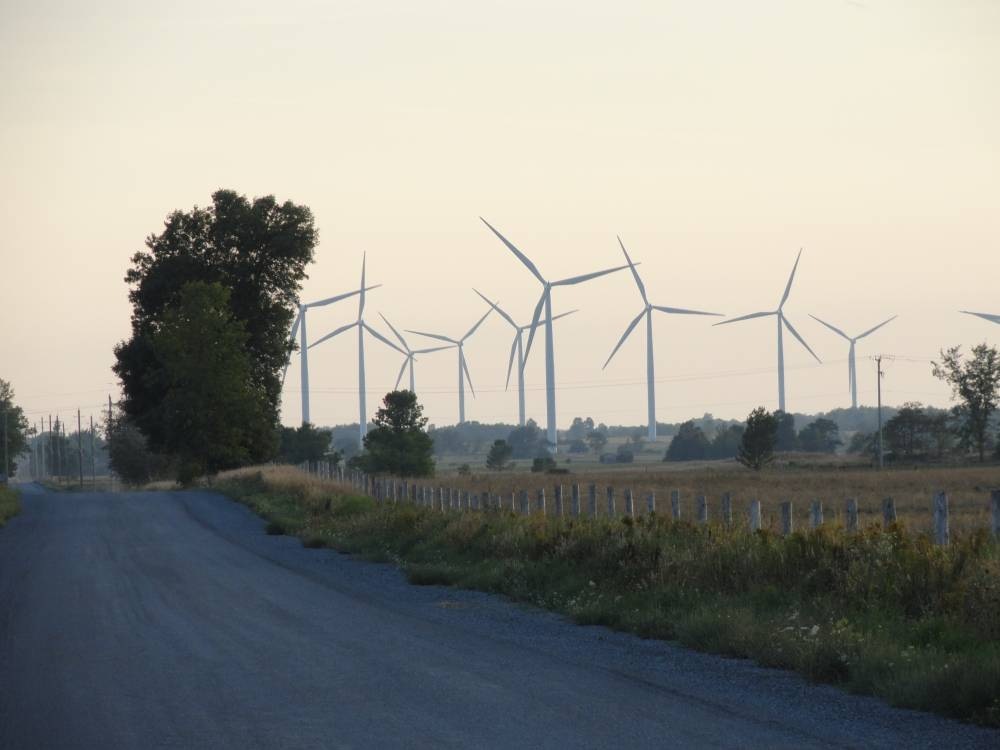
Wolfe Island before & after the Liberal’s energy policies

Is Nothing Sacred?

Temple_Rendering___Content

Near Peterborough, a $40 million project to build the largest Buddhist complex outside of China is in jeopardy.
The Liberals knowingly approved wind turbines to surround the complex.
The people in charge of the development say these turbines will have a negative impact on the serenity of the complex.
This complex would have attracted about 45,000 visitors a year and generated more than $20 million for Ontario.

Wind Farms slated for Ontario
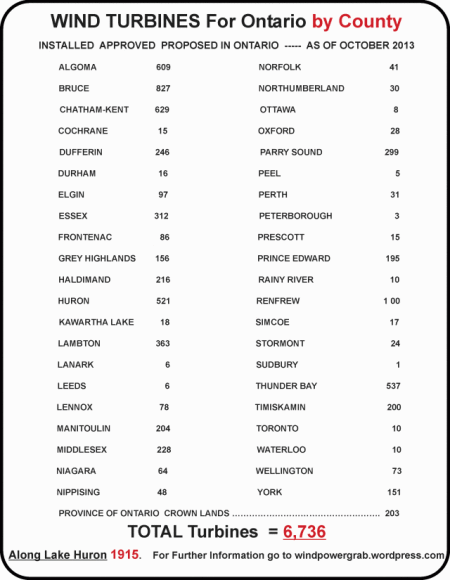
Click here to see maps of these projects

Rondeau Bay – photo rendering showing pre-turbine days
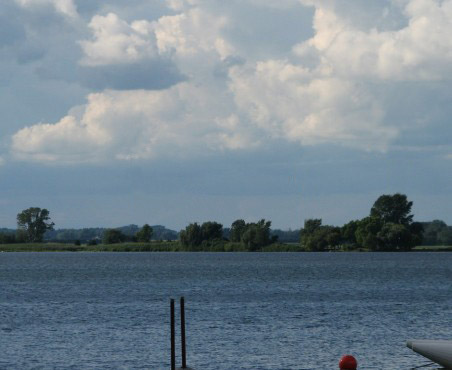
Rondeau Bay Rendering

Rondeau Bay – Actual photo
chatham-kent-ontario-internaional-power-gdf-suez-from-across-rondeau-bay-from-erieau-2

Wind verses Nuclear

Nuclear power costs 6.8 cents per kwh, period.
Wind power costs 11-13.5 cents per kwh, plus all other costs mentioned above.
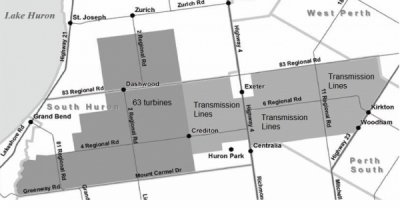
One wind project approved for the area east of Grand Bend is approximately 34 km long and 16 km wide.
The nuclear footprint is 9 sq. kilometers.
It will have 63 wind turbines with a maximum output of 102 mwh.
Applying efficiency factor of 30%, actual output will be 30 mwh.
Ontario average usage is 18,000 mwh.
Nuclear can provide approximately 12,947 mwh 24/7.
This wind project has the potential of providing .16% (1/6th of one percent) our energy needs.
When there is no wind, it will provide 0% of our energy needs.
Map
tmap

In 10-20 years

The Niagara Falls hydro generating stations are 100 years old, but wind turbines are good for only 10-20 years.
Each turbine construction consists of 800 tonnes of cement for support, approximately 250 tonnes of unrecyclable materials, 700 litres of hydraulic fuel and, 600 kilograms of rare earth metals. Multiply these numbers by 6736 and Ontario is facing a potential ecological conundrum.
The are no bonds posted to ensure these turbines will be dismantled at the end of their life cycle. It is estimated that a turbine, depending on size, will cost $400,000 to $1,000,000 to dismantle.
Given that wind companies are predominantly foreign, change ownership or, go bankrupt, it is quite realistic to expect 100′s or 1,000′s of dead turbines in 20 years and left standing.
This is happening already. Wind Companies usually don’t fix or dismantle broken turbines and, Ontario already has many non-functioning turbines.
If companies won’t dismantle a couple of turbines now; what about the future ones?.
The Liberals have no plans as to where to dispose these materials, nor have indicated that wind companies will be responsible for the costs of building the landfill sites or depots.
One can only assume, that the cost to dispose 6736 turbines will be covered by the people of Ontario.
In 10-20 years, we could be faced with a landscape of old, rusted out, broken down turbines.

The Canadian Taxpayers Federation:
Launched a petition to dismantle the Liberal Green Energy Act.
https://www.taxpayer.com/resource-centre/petitions/petition?tpContentId=84

This Amazing Documentary is Being Funded Very Eagerly, and Should be Ready Soon!

Down Wind

Down Wind is a documentary film project about the destructive impact of wind turbines being forced into communities across Ontario.
DOWN WIND
This documentary examines the human and economic consequences of the Ontario Liberal government’s headlong rush into wind power. It’s a huge story, but it’s also a personal story, focusing on individual families and the damage these turbines have caused.

Down Wind reveals the trauma suffered by those whose lives were turned upside down when the towering turbines went in. It exposes the health and psychological problems that followed, and the warnings of medical experts about “wind turbine syndrome.”

From economists we’ll hear about the mind-boggling costs, including the massive taxpayer funded subsidies going to mega corporations.

And we’ll look at the cosy Liberal connections to Big Wind, and how cronies of Dalton McGuinty and Kathleen Wynne have made a fortune off the backs of taxpayers.

Please contribute now to tell this important story.


Kevin McGee, Farmer and Activist


We Need Your Help

With your support, we’ll be able to tell this important story, and keep a focus on it in the future. In gratitude for your generosity, we’ll send you one of the packages listed on the side of this page.


$23,273CAD
RAISED OF $30,000 GOAL
78%
 24 days left
This campaign started on May 07 and will close on June 01, 2014 (11:59pm PT).
Help make it happen

Julian Falconer prepares to Fight for Justice in the Wind Turbine Scam!

ONTARIO COMMUNITY GROUPS ARE

STILL FIGHTING WITH ENERGY COMPANIES

OVER WIND TURBINES

By Colin Graf

Photo via Creative Commons

While the controversy swirling around wind turbines in Ontario may be a ticking time bomb in the just-begun election campaign, Toronto human-rights lawyer Julian Falconer may have lit the fuse Monday night at a meeting organized by a Plympton-Wyoming community group near Sarnia, a city in southwest Ontario.

Speaking to around 400 people in a community hall, Falconer challenged all three political parties to declare a moratorium on turbine construction until a comprehensive study is completed by the federal health ministry. “None of these parties has done the right thing. A courageous, responsible political leader would put a halt to any more turbine construction, until the Health Canada study is completed,” he told the approving crowd.

Falconer was asked to the meeting by the organizers of a local group fighting plans by energy company Suncor to build 46 wind turbines in their area. The group has convinced their local council to fight Suncor by demanding turbines be placed at least two kilometers (1.2 miles) apart, as opposed to only 550 meters (600 yards), as decreed by Ontario’s Green Energy Act. Suncor took the municipality to court last winter to stop the by-law, claiming the provincial legislation trumps local by-laws. A decision is expected soon, the local mayor told the meeting.

Since the Green Energy Act came into force in 2009, wind developments have sprouted around southern Ontario, and local opposition groups have been fighting them tooth and nail. The Act, meant to promote the growth of alternative energy sources, has created a political backlash which has been credited with partially reducing the governing Liberal party to minority status in 2012. With more than 50 citizen action groups across the province listed on the website of Ontario Wind Resistance, an umbrella organization for wind opponents, the protesters are stepping up for an even bigger fight as a new election gets underway.

Challenging that law on behalf of wind power opponents, even as far as the Supreme Court of Canada, is Falconer’s goal. “It may be ‘a novel argument’ to use the Charter of Rights and Freedoms for this purpose, but if people don’t challenge the Liberal government in court, these turbines will be everywhere,” he told the audience. Section seven of the Charter protects Canadians’ rights to security of the person, and “the courts have recognized that health issues can be one means of being protected,” Falconer told VICE in an interview after his speech.

Julian Falconer in the crowd. Photo via the author

To effectively challenge turbine construction in Ontario, one has to prove turbines will cause “serious harm to human health,” according to Falconer. Building turbines without clear understanding of health effects is like the government saying, ”if you want to avoid swallowing this pill we’re giving you, you have to prove it won’t kill you,” he said. He hopes to continue building support for the Charter challenge by appealing to other anti-wind groups across the province to join in the coming months.

Wayne Couture, living just south of the Kincardine province of Ontario, told the audience he has been forced to leave his home every day for a year by the effects of living near turbines: dizziness and ringing in his ears. “You have to shut them [turbines] down. You are the guinea pigs,” he warned the group.

Health effects are at the heart of opposition to wind turbines, believes Carman Krough, co-author of a recent article in the Canadian Journal of Rural Medicine that reviewed previous health effects studies. The study found that, if placed too close to residents, industrial wind turbines can negatively affect the physical, mental, and social well-being of people, and that there is sufficient evidence to support the conclusion that noise from turbines is a potential cause of health effects. Formal studies from around the world point to symptoms that repeat, she says—sleep disturbance, feeling of vibrations, tinnitus (ringing in the ears), and vertigo.

These studies, along with the personal stories of individuals, leaves Krogh with “no doubt” the effects are real. “You don’t pack up and leave your home lightly,” she says. With a background in “vigilance monitoring” of adverse effects of pharmaceuticals, Krogh found herself applying the same techniques in monitoring people who reported effects from living near turbines, when she experienced headaches after being near the giant towers, she tells VICE.

The effects on children are especially worrying, Krogh says, as they have not been studied very well. There is some evidence that conditions in children such as autism, asthma, migraine, or epilepsy can be affected by turbine noise, and that such effects could possibly by irreversible, she told the audience.

There is “credible scientific support” for a link between noise from turbines and health effects,according to a report commissioned by the Ontario Environment Ministry, Krogh claims—the same ministry that is approving wind projects across the province.

Joining Falconer’s challenge will not come cheaply for the town of Plympton-Wyoming. The group is hoping to raise $300,000 to count themselves in. With a donation of $20,000 from Lambton County Council, and their municipal council already paying legal bills to defend against Suncor, the group is asking the 7,500 residents to dig deep in their own pockets.

They’re hoping the money will give them a chance to avoid the noise and breeze of the wind turbines, while at the same time, they also hope the election will force politicians to feel the wind down their own necks.N’T

Burden of Proof Should be on Wind Proponents!

HALT won’t back down after ERT rejects Armow Wind appeal

Credit:  By Steven Goetz, Kincardine News | Tuesday, May 6, 2014 | www.shorelinebeacon.com ~~

The Environmental Review Tribunal (ERT) dismissed an appeal filed against the approved Armow Wind project, rejecting claims the project will cause serious harm to human health.

But instead of backing down, a local group of anti-wind activists — Huron-Kinloss Against Lakeside Turbines (HALT) — will take the fight to divisional court and beyond.

“We have always seen this as having the potential to go all the way to the Supreme Court,” said HALT’s Kevin McKee in a telephone interview on May 2.

McKee said the group never expected to win at the ERT, but had to file the appeal before divisional court would consider their legal challenge.

“We weren’t surprised by the result,” he said. “Citizen groups like our own have been 0-for-25 at these ERT hearings. It is nearly impossible to win.”

“By their standard, it would be hard to prove asbestos would cause harm,” he said.

Barring intervention from a court, the April 22 decision clears the way for Samsung-Pattern to erect a 92-turbine, 180-megawatt wind farm in the Municipality of Kincardine, on land northeast of the North Line and Highway 21.

The appeal was organized and funded by HALT and its partners, but filed on behalf of Ken and Sharon Kroeplin — whose 100-acre family farm is located within 600 metres of one of the planned turbines.

The ERT dismissed their claims, writing in its lengthy decision that the Kroeplins “failed to establish, on a balance of probabilities” that the project “will cause harm to human health.”

In its findings, the ERT wrote that it wasn’t enough for the Kroeplins to show “the potential for harm,” but the onus was on them to “prove that a project will cause harm.”

The ERT wrote that so-called “post-turbine witnesses” — people who have reported health conditions and symptoms they believe have been caused or exacerbated by living near wind turbines — did not prove that turbines were the cause of their ailments during their testimony at the nine days of hearings held on Kincardine.

[rest of article available at source]

Austrian Medical Association Not Willing to turn a Blind Eye to Wind Turbine Victims!

Austrian Medical Association Issues Warning,

Calls for Comprehensive

Studies on Wind Turbine Noise

AUSTRIA — National Noise Day 30th April, 2014:

The Medical Chamber (equivalent to the Austrian Medical Association) is issuing a warning on behalf of large-scale wind turbine installations. The Chamber is calling for comprehensive studies on potential negative health effects as well as minimum safety distances to populated areas.

Vienna — Noise problems, caused by the operation of wind turbines, are drawing increasingly more attention from scientists. This was pointed out todday, Wednesday, by the Medical Chamber on the occasion of the International Noise Awareness Day. The Medical Chambe is now calling for comprehensive studies on potential negative health effects as well as a minimum safety distance to populated areas.

Wind power plants are — as opposed to individual wind turbines — very large scale operations and clustered into “wind parks”. The rotor diameter of current turbines can measure up to 114 metres — almost the length of a soccer pitch. Rotational speeds of the rotor blades lie in between 270 and 300km/h, which is causing distinct acoustic patterns and noise.

This is the point the Medical Chamber is making: “It has to be our objective to prevent sleep disorders, psychological effects and irreversible hearing damages, as they are also caused by wind farms” says Piero Lercher, the Chamber’s spokesperson for environmental medicine.

As complaints from residents about excessive and especially low-frequency noise and infrasound near wind farms are mounting, full scale investigations of potentially health-damaging effects are indispensable.

The phenomena currently observed in connection with the operations of large-scale wind power plants justify the demand for adequate safety distances — which is consistent with most expert’s view on following a precautionary principle on that issue. Says Lercher: impairments of well-being have to be taken seriously from a medical perspective, even if they are frequently attributed to a so-called “nocebo” phenomenon.

Lercher requires from manufacturers the use of environmentally friendly technologies and substances. “For example, so-called “permanently exited generators” contain large amounts of rare earths, whose mining processes lead to toxic and radioactive contaminations of vast areas in the mining regions” warns the environmental physician.

Source: http://www.ots.at/presseaussendung/OTS_20140430_OTS0071/tag-des-laerms-aerztekammer-warnt-vor-gross-dimensionierten-windkraftanlagen

Corruption is the Only Reason Why they won’t Research Health Effects from Wind Turbines!

Nurses for Safe Renewable Power

Looking for a healthy environment for everyone

RNAO two years ago: a sad day for nursing

CEO of the Registered Nurses Association of Ontario Doris Grinspun is directing the RNAO’s annual event which consists of meetings, a gala banquet, and of course, the Annual General Meeting for members.

We recall the AGM of two years ago, when two nurses plus an RNAO chapter, put forward a resolution to ask for support for clinical research into the field of environmental noise produced by industrial-scale wind turbines, and further, as a second part of the resolution, that a moratorium on wind power developments be requested until the results of such research are released and analyzed.

The motion was defeated but not before there were dirty tricks aplenty on the part of RNAO staff (the director of research actually interrupted the resolution proponents’ session with voting delegates, so much so that delegates complained they were not able to speak or ask questions), misdirection was given about how much information could be provided to the delegates, and  finally, the proponents’ presentation time was cut off by the chair—who incidentally, and completely illegally, spoke out against the motion before introducing it to the assembly. Easily a dozen delegates abstained from the vote, calling out to the chair that they wanted to hear more, but to no avail. The motion was defeated. (The chair also, erroneously, told the proponents that they would not be able to bring the resolution forward again for TWO YEARS. This is false and is not in the RNAO bylaws.)

So, where are we today? We actually have two clinical studies ongoing in Canada, one by Health Canada, and the other by the Renewable Energy Technology and Health (RETH) team at the University of Waterloo. The RETH team has already presented very preliminary results in poster format at a meeting earlier this year, showing a significant association between the noise from turbines and sleep disturbance.

We also have more studies from a variety of sources, including a recent article by otolaryngologist Dr Alec Salt whose work is increasingly showing a DIRECT link between the noise and vibration/infrasound produced by the machines used to generate power from wind energy and health effects.

http://oto2.wustl.edu/cochlea/wind.html

The growing research on the effects of exposure to the noise and infrasound on children is disturbing.

We also have in Ontario an approval process for wind power projects that is being revealed as sloppy and indicative of the provincial government’s blind support for wind power. Requests have been made for a review by the Ombudsman of the review and approval process, because documents being presented as complete are in fact inaccurate, incomplete, or sometimes completely absent. There are also judicial reviews pending for the approval of individual projects, such as Amherst Island, as the inaccuracies of the documentation supporting the safety of the proposed power developments are egregiously incomplete.

The Chief Medical Officer of Health for Ontario prepared a report that was released in 2010 based on work done in 2009, which maintained there were no direct causal links between the turbine noise and health (the government does not believe infrasound is important and will not even have a protocol to measure it until 2015), which the government and successive Environmental Review Tribunals rely on today expediently.

Complaints of excessive noise and poor health are in the hundreds in Ontario: the Ministry of the Environment has admitted in Tribunal hearings that it relies on the computer noise modelling supplied by the power developers. In other words, if a power project modelling shows it isn’t supposed to make noise at a certain level, then it surely can’t, and the Ministry does not even bother to send staff out to check.

Ontario families have become homeless. In December of the year the RNAO engineered the failure of the resolution of members to support research, 20 families went to Council in the City of Kincardine, requesting funds for emergency housing, as they had had to leave their homes due to the noise.

Today, more than 80 communities have passed bylaws or resolutions to say they are Not Willing Hosts to wind power because of the problems. Today, a coalition of communities is working together to create a noise nuisance bylaw to protect their residents at night from the turbine noise. Today, Ontario communities are taking advantage of every loophole, or minor power they have left after the Draconian Green Energy Act removed all democracy for Ontario’s rural and small-town communities.

And today, Ontario citizens are having to deal with higher electricity bills than ever seen before in this province, traceable to the government’s unproven zeal for renewable sources of power (a cost-benefit analysis as recommended by the Auditor-General was never done). The results are widely feared to be energy poverty as families must choose whether to buy food or pay their electricity bill, as well as job losses and business failure.

All this because a group of business people persuaded Ontario to adopt wind power as a source of power generation to replace coal—wind power cannot replace anything because of its inefficiency and unreliability. Coal has been replaced in Ontario by natural gas. The power developers (many with ties to the Ontario Liberal Party) have made millions–billions–in provincial subsidy dollars for very little benefit to the people of Ontario. One of the strategies suggested to the wind power development lobby by a consultant, the Sussex Strategy Group, was to persuade health-related groups to support wind power as a way to engender public support for the development of power from wind; it appears the RNAO fell in line with the developers’ corporate strategy.

The Registered Nurses Association of Ontario had a chance two years ago to at least listen to a burgeoning community health problem and at least listen to its members whose concern was well founded and genuine.

But it did not.

That was a sad day for nursing in Ontario, and leaves many questions as to the quality of leadership and the ties between politicians and nursing leadership.

In the meantime, the people of rural and small-town Ontario, and the health care professionals who live there and work within these communities, got no support from the organization that claims to “speak out for health.”