Aussies Prepare to Scrap Their Renewable Energy Targets!!

Time to let the RET Review Panel Know What You Think

writing_a_letter

As STT’s loyal followers know, Australia is all set to decouple itself from the international economic suicide pact entered when gullible and unwitting governments all over the world signed up to ludicrously expensive and utterly pointless renewables policies.

The Coalition are itching to scrap the Renewable Energy Target – and the RET Review Panel appear more than ready to give them the ammunition to do so.

The Panel formerly called for submissions on 5 April 2014 (see this document) – setting out the terms of reference and the criteria that submissions should meet (see our post here).

The closing date for submissions is 16 May 2014 and STT hears that it’s about to be inundated by submissions from Australia’s top energy market economists and Australia’s leading power retailers all slamming the lunacy of the mandatory RET. However, the opportunity to make submissions is open to one and all – so don’t just leave it to the boffins – why not make a submission yourself?

STT contains a welter of facts, evidence and information detailing the greatest economic and environmental fraud of all time – piecing that together in a cogent argument as to why the RET simply must go is something that anyone with a computer and time on their hands can do. Remember though, submissions have to address the terms of reference set out in the document linked above – and that, with less than 10 days to go, you’ll need to get cracking.

Set out below is one very solid example put together by STT Champion, Dr Alan Watts. STT recommends it as a basis and template for anyone making their own submissions to the Panel. Although, we have a few comments of our own aimed at strengthening Alan’s arguments – matters of emphasis, really – and which should assist in preparing your own submissions (see below).

Review of the Renewable Energy Target
Expert Panel
RETReview@pmc.gov.au

Re: ‘Renewable Energy Target Review Expert Panel Call for Submissions, Commonwealth of Australia 2014’.

SUBMISSION

This submission deals primarily with the RET as it relates to wind power energy production, LRECs and the effects of these on electricity pricing and production efficiency.

The Call for Submissions summarises the objects of the REE Act as being:

a) to encourage the additional generation of electricity from renewable sources;

b) to reduce emissions of greenhouse gases in the electricity sector; and

c) to ensure that renewable energy sources are ecologically sustainable.

The RET has succeeded in its first object to promote the roll out of renewable energy, particularly translated to the construction of an increasing number of industrial wind turbine (IWT) installations.

The RET has totally failed in its other two objects, i.e. it has failed to reduce emissions of greenhouse gases in the electricity sector and the renewable energy sources have not been shown to be ecologically sustainable.

The RET has as a consequence of renewable energy promotion created a great deal of damaging social and economic effects and has caused in the case of IWTs enormous damage to the Australian nation and way of life by the reckless promotion of:-

1. A system of unpredictable, inefficient and intermittent electricity generation which by every measure is not fit for purpose and therefore is totally without merit;

2. An industry which has a degree of government protection like no other;

3. A system when idle, due to lack of or excessive wind, requireselectricity for maintenance and for restart;

4. A system incapable of base load power generation;

5. A system which does not in any meaningful way lessen greenhouse gas emissions;

6. A system which has not and cannot reduce our foreseeable coal dependency;

7. A system which requires constant coal or gas fired back up running at almost full capacity (stated 90%) due to the very variable and unreliable nature of wind. This represents the most wasteful, inefficient and expensive use of coal and gas;

8. Electrical generation costing at least three times that of coal;

9. A system which has contributed to a lowering of Australia’s standard of living and comfort, especially for those Australians of lower socioeconomic means, due to increased electricity bills;

10. A system which has destroyed Australia’s once comparative manufacturing advantage due to cheap electricity and with it our ability to compete internationally;

11. A system of visual blight due to industrialisation of the rural landscape;

12. A system that causes untold harm and destruction of wild life and unique remnant bushland (important because much of the original vegetation has disappeared from the Tablelands areas and locations favourable to the wind industry);

13. An industrial development resulting in significant reduction in rural land valuation and agricultural land usage especially cropping, fertilizer application, weed control, fencing and farm based disease containment;

14. A system with inherent industrial problems of hazardous fire (and the inherent difficulties of fighting both turbine fire and bushfires), blade throw, flicker and glint as well as dangers to all forms of flight;

15. A development which has serious legal consequences for land owners because of access, disease spread, sale and subdivision rights. And also by “gag” clauses incorporated into IWT contracts effectively removing any host’s freedom of speech;

16. An industrial structure which requires one tonne of a rare earth, Neodymium, to increase the magnetic strength and which is sourced primarily from China (Inner Mongolia which has 95% of the world’s resource). Its extraction process involves boiling sulphuric acid which is highly toxic to both the environment and the operators;

17. An industrial complex with commonly disputed ownership at the time of decommissioning which is typically 120,000 hours or 15-25 years, although international research now estimates the functional life of an industrial wind turbine may be closer to 12-15 years;

18. IWT decommissioning and disassembly that does not remove the huge concrete foundations and which will remain forever present;

19. An electrical system which legally requires the farmer host to decommission and remove the wind towers at the end of their functional life if a legal entity cannot be located with provable ownership. There are international examples of derelict “wind farms” with disputed ownership being left to rot, in excess of 14,500 in California alone;

20. A system where payment of a decommissioning bond by the proponents has been strenuously fought by them, again indicating the fragile economic nature and in some cases the insolvency of this transient industry;

21. A system of electrical generation with such fragile economics that frequent change of ownership is common. This adds to the legal confusion as to who has most direct responsibly for decommissioning and removal of these structures;

22. A system which has produced social disharmony, family destruction and economic hardship in rural communities rivalling only that of coal mining and coal seam gas extraction, and war;

23. A system which has polarised debate to such an extent and level that truth and fairness are now completely compromised;

24. A system based on myth, greed, ignorance, subsidy and institutional deceit that has generated such wealth that there now exists no honourable or honest return from these entrenched self-interested opinions;

25. An industry so inefficient that it is entirely dependent on taxpayer subsidy to exist and without it, it would cease to exist;

26. A system which has captured all irrational thought, concentrated greed, distorted science, befriended the gullible and has ransomed genuine research with the assistance of the politically naïve;

27. A system which has deflected energies and funding away from what can only be described as the most sensible renewable source of energy on earth, namely geothermal. Geothermal is infinite, clean, truly green and possible, as in Iceland. The largest natural nuclear power source on earth is beneath the Earth’s crust as molten magma, an unimaginable source of heat. Geothermal energy is the only renewable energy on earth capable of providing base load power and as such cannot in any way be compared to any other renewable energy source.

28. A system of production which is totally unique to the Australian political landscape and which enjoys political and legislative protection like no other.

Initially conceived by the Coalition Government, the Australian Green-Labor alliance allowed this industry in Australia to flourish and in so doing created a scam that was:

a. Totally and completely devoid of any merit, green, environmentally or climatically;

b. Subsidised to ensure survival;

c. Ineffectual and inefficient;

d. Providing an end product that energy suppliers were required to compulsory purchase, with legislated penalties for noncompliance;

e. Ensuring its future with increasing and possibly endless targets;

f. Artificially supported with industry forward payments and prepayments;

g. Supported with undeclared tax concessions;

h. Overseeing contracts that currently have no Australian companies involved in turbine manufacture of any consequence;

i. Currently operating beyond their legal guidelines;

j. Currently operating beyond conditions of consent with no financial penalty for illegal operation;

k. Placing the Australian Government in a position of implicit state sponsored fraud;

l. Causing adverse health effects (AHE) to Australian families which are disgracefully ignored;

m. Devoid of significant Australian content, ensuring expatriation of Australian funds off shore via foreign companies.

It is now the responsibility of the current Coalition Federal Government to reverse this despicable fraud, remove the RET and withdraw the Recs.

Further, I have been requesting, along with other concerned Australians:

1. A moratorium on further installation of these structures until their safety has been established by;

2. Independently conducted research which justly requires that the industrial wind proponents fund since they alone profit from the establishment of Industrial Wind Turbines; and

3. That all 7 recommendations proposed by the June 2011 Federal Senate Community Affairs References Committee on the Social and Economic Impact of Rural Wind farms, which have not been introduced by any Federal, State or Local Government anywhere in Australia, be implemented immediately.

The previous Labor Federal Government’s 20/20 renewable energy target (RET) and generous taxpayer subsidies are driving an enormous amount of foreign company investment in industrial wind turbines of very dubious effectiveness and efficiency.

While the environmental and social impacts of non-renewable energy production (eg. coal and gas mining, and the production of energy from these sources) are not dismissed lightly, it is counter-intuitive to attempt to replace them with renewable sources of energy which research has shown SAVE VERY LITTLE IF ANY CO2 (see paper by Le Pair et al – attached file)We leave aside the question of whether increasing CO2 poses any sort of threat and whether it is economically viable or necessary to expend large sums of money nationally and internationally for nil or little result.

Your “Call for Submissions” sets out very well the current position with respect to the RET and some of the problems related to it. Worth emphasising however is the fact that the RET scheme including the feed-in tariffs for roof-top solar already adds 7 per cent to the cost of electricity to households, a cost that will more than double on present policies. By 2020 the scheme, if unchanged, will add over 40 per cent to the wholesale cost of electricity and largely negate the benefits from the demise of the carbon tax (should that occur).

The impact on households will increase. Energy poverty is defined as requiring to pay more than 10% of household income on energy and a recent finding states that already 20 per cent of Australian households are now energy poor (Chester, 2013 – see attached file). As the cost of energy inevitably rises – caused in no small way by the contribution of unaffordable renewable energy subsidies (both direct and indirect) – this figure of 20% must increase in tandem.

Concomitantly is the situation where major energy intensive industries are departing Australia in large part because our electricity prices have risen to be among the highest in the world; this from the enviable position of being one of the lowest less than a decade ago.

Whatever else the Review of the RET does it must address the problems of electricity affordability both for Australian households, and for the manufacturing and industrial sectors which implacably hold the key to national prosperity. With prosperity comes the prospect of being better able to address National social and environmental problems.

A fresh approach is undoubtedly required. Firstly there must be a recognition that, to paraphrase the title of the by Le Pair et al, “Wind turbines are as yet unsuitable as electricity providers”. The paper sets out many of the problems attached to the production of energy by IWT and reinforces the insanity of pouring money into an industry which is not and, at the moment, cannot produce energy in an economic, reliable, efficient, non- health adverse, environmentally and socially acceptable manner. Where is the sense?

Good governance demands the overdue withdrawal of RECs from this industry. If the wind industry is correct when it says it is a mature industry and that it is viable, then let it pay its own way and let it stand alone without the buttress of the RET.

If government (i.e. tax payers’) money is to be spent it would be better directed towards:

a. Ensuring that research and development of “true” renewables is the focus and that forthcoming and future sources of energy are tested and matured before being foisted on a hapless public;

b. Ensuring that mining and electricity production from non-renewable sources (which is often forgotten will still be responsible for 80% of our electricity production) are conducted with improving levels of environmental impacts, health consequences, and minimisation of community disruption. Air and water pollution problems in particular require dedicated monitoring and reduction.

The deployment of industrial wind turbines is often met with support because they are considered “clean and green” and will “save the planet” through the claimed reduction of CO2 emissions. But what if they don’t? One is reminded of the fairy story of the Emperor with no clothes! Expensive clothes at that.

Le Pair’s conclusion therefore bears repeating:

“Quantifying the decrease in efficiency of the electric power system and the extra fuel consumption induced by wind developments is by no means a simple matter. To our knowledge there are presently not sufficient data in the public domain to substantiate a definite answer to the question how much fuel and CO2 emission is saved. It depends on the actors, the equipment, the kind of fuel, the amount of wind penetration, the behaviour of the regional wind, the amount of storage, the interconnection of regional grids etc.

“Decisions to install large-scale wind-powered electricity generation are based more on the expectation to save significant amounts of fossil fuel and CO2 emission than on any evidence that this is indeed the case. 

“Wind technology is not suited for large-scale application without a good buffer and storage system. We propose to stop spending public money on large-scale use of wind. This money should be spent on R&D of future power systems. We expect that wind will not play an important role in these future systems.”

Yours faithfully,

Dr. Alan C. Watts OAM

Here are links to the papers referred to in Alan’s submission:

Le Pair et al -Wind turbines as yet unsuitable as electricity providers

Chester – Impacts_Consequences_Low_Income_Households_Rising_Energy-Bills_Oct2013

Alan’s submission is characteristically passionate, but still conveys the scale and scope of the economic and environmental fraud that is wind power.

In our view, submissions should seek to emphasise the following matters:

The panel must refute any claims by the wind industry that it has (or is capable of) reducing CO2 emissions in the electricity sector in the absence of actual data which has been independently peer reviewed. Any such data must include CO2 emissions from all power generation sources in order to capture the increased emissions caused by base-load coal and gas thermal plants holding increased “spinning reserve” – and the increased use of highly inefficient Open Cycle Gas Turbines – which are both needed in order to compensate for the intermittency of wind power.

The panel must refute claims by the wind industry that wind power has reduced power prices for consumers, as claimed by the Clean Energy Council. The Panel must call for the production of Power Purchase Agreements between wind power generators and retailers in order that the prices fixed under those agreements are known to the Panel and its consultants, ACIL Allen. The wind industry and its advocates refuse to make these agreements public and refer only to wholesale prices, which do not determine the price retailers pay for wind power; whereas, the terms of Power Purchase Agreements do. The impact of the prices set by PPAs with wind power generators is a critical part of any analysis of the impact of the RET on retail power prices.

The panel must consider the impact that the intermittent delivery of wind power and its inherent unreliability has on retail power prices. The cost of maintaining spinning reserve – and building capacity in fast start-up generation sources, principally OCGTs – is ignored by the wind industry. So too is the impact on retail power prices from using high cost OCGTs as backup for a substantial proportion of installed wind power capacity. The panel must, therefore, consider the cost of delivering power using fast start-up generation sources, including OCGTs, which are critical to maintaining grid integrity and power supply when wind power output falls to insignificant levels every day – and on hundreds of occasions each year. There have been numerous occasions when wind power output has collapsed across the entire Eastern Grid and, as a result, dispatch prices have soared from the normal average of $30-40 per MWh to reach the regulated cap of $12,500 per MWh (and many occasions when the dispatch price has reached 8-10 times the average – ie $280-300 per MWh, which is the price range needed for OCGT operators to break even and at which they commence supplying power to the grid). These costs are directly attributable to wind power generation – costs ultimately borne by power consumers – and which must, therefore, be included in any consideration of the cost impacts of the RET on retail power prices.

More generally, STT finds it hard to fault anything appearing in Alan’s well structured and detailed argument. However, we disagree with his point 27 when he says that geothermal is the only base-load renewable alternative. Geothermal has tremendous prospects and has, under the current RET policy, clearly been starved of the investment needed to develop it (see our post here). However, with respect, Alan overlooks hydro power.

STT is a huge fan of hydro power – as we have made plain on a number of occasions (see our posts here and here).

Hydro is not only the original renewable, it also satisfies the principal objective of the mandatory RET – as it does not produce CO2 emissions when generating power – and, because it is reliable and always availableon-demand, it does not require backup from fossil fuel generation sources. Accordingly, hydro does in fact reduce CO2 emissions in the electricity sector by actually displacing fossil fuel generation sources and/or properly supplementing those sources – which is as simple as turning on the sluice gate.

Hydro can be used to deliver “base-load” power, but in the Australian energy market is largely used these days as “intermediate power” – balancing the grid during periods of peak demand. The critical point is that hydro is available on demand – whereas wind power will never be.

The Snowy Hydro scheme is – and remains – the greatest and most beneficial renewable energy system in Australia.

Moreover, without it, long-term water management in the Murrumbidgee and Murray River systems (the life-blood for NSW, Victoria and SA) would be impossible: Adelaide would have died of thirst during periods of drought at least a dozen times without the Snowy scheme.

There is huge potential for further investment in hydro power in Australia – all up and down the Great Divide – bringing with it the ability to harvest huge volumes of water in times of flood – and to beneficially manage that water during periods of drought. However, the perverse nature of the mandatory RET provides every advantage to unreliable and costly wind power at the expense of hydro power: the former takes a matter of months to construct and begin earning revenue; whereas the latter takes years and sometimes decades to complete and for investors to start earning a return. Investors looking for a quick return on their cash have simply plumped for the soft option and piled in to wind power, with disastrous results on every level.

The Snowy Hydro scheme was Nation building stuff and took a generation. It should be repeated and policies put in place to ensure that it is, which means the current RET legislation must be amended or repealed.

But, all that is to quibble, Alan’s submission is a great starting point – so use it to best advantage – get cracking and let the RET Review Panel know precisely what you think of the greatest fraud of all time.

subsidies

Julian Falconer to fight for the Rights of Rural Ontarians….

Prominent lawyer slams Ontario wind power

Credit:  By Lee Michaels on May 6, 2014 | blackburnnews.com ~~

Over 600 people tried to cram into the Camlachie Community Centre last night with the overflow standing outside.

We’re Against Industrial Turbines hosted a town-hall meeting to ramp up opposition to Suncor’s 46-turbine Cedar Point Wind Power Project.

WAIT is now trying to raise $300,000 to hire prominent Canadian lawyer Julian Falconer to help challenge the Ontario government’s policy on industrial turbines under the Canadian Charter of Rights and Freedoms.

Falconer was a guest speaker at last night’s meeting.

He tells Blackburn News that any suggestion there’s no impact on peoples’ health is “Alice in Wonderland fantasy.”

And he’s skeptical the June 12 Ontario election will change anything.

Falconer says the constitutional challenge that’s been mounted questions the appropriateness of government subjecting its citizens to projects without knowing the health effects currently under study by Health Canada.

He says the cash grab by wind companies has been extreme and the financial genie that’s been let out of the bottle is very difficult to control.

Wind Turbines…..NOT a Good Investment. (Pyramid schemes never are!)

Wind Power Investors: Get Out While You Can

exitsigns

For anyone still foolish enough to have their hard earned cash invested in wind power companies the warnings to grab your money and run couldn’t be louder or clearer.

The members of the RET review panel has signalled their intention to take an axe to the RET: spelling out the fact that the review has absolutely nothing to do with “climate change” or CO2 emissions – their task is simply to analyse, model and forecast “the cost impacts of renewable energy in the electricity sector” (see our post here).

The Treasurer, Joe Hockey entered the fray last week – during an interview with Alan Jones – when he branded wind turbines “a blight on the landscape” and “utterly offensive”. However, it’s what he went on to say about the “age of entitlement” that should have wind power investors quaking in their boots (see our posts here and here).

Joe outlined the Coalition’s plans to scrap a raft of public sector departments and agencies ostensibly charged with controlling the climate (there are currently 7 climate change agencies, 33 climate schemes and 7 departments).

Joe went on to say that the Coalition’s attack on the “age of entitlement” will be directed at “business as much as it applies to each of us.” If ever there was a beneficiary of the “age of entitlement” it was the wind industry and the rort created in its favour by the mandatory RET/REC scheme – quite rightly described by Liberal MP, Angus “the Enforcer” Taylor as: “corporate welfare on steroids” (see our post here).

The chances of the mandatory RET surviving the RET Review panel – and a Coalition itching to scrap it – are slimmer than a German supermodel.

With the wind industry on the brink of collapse there are three main groups facing colossal financial losses: retailers, financiers and shareholders.

Wind power companies – like any company – raise capital by borrowing (debt) or issuing shares (equity). Bankers price the risk of lending according to the likelihood that the borrower will default and, if so, the ability to recover its loan by recovering secured assets. Share prices reflect the underlying value of the assets held by the company and projected returns on those assets (future dividends). Share prices fall if the value of the assets and/or the projected returns on those assets falls.

Retail power companies saw the writing on the wall as the Green-Labor Alliance disintegrated at the end of 2012, presaging the Coalition’s election victory in September 2013. The risk point for retailers sits in their Power Purchase Agreements with wind power generators – the value of which depends on the amount of “renewable” energy fixed by the mandatory Renewable Energy Target and the value of Renewable Energy Certificates. Scale back the mandatory RET and the price of RECs will plummet; scrap it and RECs won’t be worth the paper they’re written on. Faced with that increasingly likely scenario, (sensible) retailers stopped entering PPAs around December 2012.

RECs are transferred from wind power generators to retailers under their PPAs, and the retailer gets to cash them in at market value. Retailers that haven’t signed PPAs can thank their lucky stars – chances are they will have avoided the very real prospect of being left with millions of worthless RECs.

Bankers have also baulked at lending to new wind power projects, keeping their cheque books firmly in the top drawer over the last 18 months or so. However, having lent $billions to wind power developers over the last 13 years, Australian banks have more than their fair share of exposure – exposure, that is, to the insolvency of the wind power company borrowing from it.

Ordinarily, bankers protect themselves by holding valuable security over the assets held by the borrower (eg the mortgage you granted over your patch of paradise when you borrowed to buy it). However, the value of the security granted by a wind power company is principally tied up in the future stream of income guaranteed under its PPA with its retail customer (the true value of which is tied to the value of RECs).

In the event that the RET were scaled back or scrapped it is highly likely that retailers (left with a bunch of worthless RECs) will seek to get out of their PPAs, making the bank’s security largely worthless. A wind farm with a fleet of worn-out Suzlon s88 turbines – on land owned by someone else – is unlikely to yield all that much for a receiver or liquidator charged with recovering the assets of an insolvent wind power company for its creditors.

Were banks forced to write off $billions in loans to wind power companies as bad and doubtful debts, then shareholders in that bank can expect to see the value of their shareholdings fall. Now would be a prudent time for those with shareholdings in banks to find out just how much that the bank has lent to wind power companies and, therefore, the bank’s exposure and risk they face as shareholders of that bank.

Shareholders in wind power companies, of course, have direct exposure to the declining fortunes of the wind industry. A decline in the share price obviously reduces the value of the shareholder’s investment. However, in the event of insolvency shareholders rank last behind all creditors, which means their shares are, ordinarily, worthless. In the case of wind power companies this will be invariably the case, as the companies in question are merely $2 companies with no real assets to speak of.

However, it is superannuation funds that have, by far, the greatest total exposure to the imminent collapse of Australian wind power companies. Australian superannuation funds (particularly industry and union super funds) have invested very heavily in wind power. These investments are either directly through shareholdings (equity) or through investment banks lending to wind power companies (debt). Examples include Members Equity Bank and IFM Investors (outfits run by former union heavy weight, Gary Weaven and Greg Combet) which have channelled $100s of millions into wind power operator, Pacific Hydro.

If you think that superannuation funds are somehow magically immune from the risk of the financial collapse of the companies they invest in, then cast your mind back to the wholesale corporate collapse of companies involved in Managed Investment Schemes that saw banks and super funds lose $100s of millions (see this story).

Anyone with their money in superannuation should be asking their fund just how much exposure their fund has to wind power companies?

Since the RET review panel outlined their mission a couple of weeks ago it seems that the word “RISK” – associated with investing in, or lending to, wind power companies – is the word that’s on everyone’s lips. Here’s the Australian Financial Review.

Green energy on tenterhooks
Australian Financial Review
Tony Boyd
30 April 2014

Contrary to popular opinion, leading businessman Dick Warburton does not have any pre-determined views about the future of Australia’s $20 billion Renewable Energy Target scheme.

While it is reassuring he is determined to be completely impartial in his rapid fire review of the RET scheme, Warburton makes it clear in an interview with Chanticleer that there will not necessarily be a grandfathering of existing arrangements.

“We have not made a decision on that – how could we when we have just started consulting with the industry,” he says.

In other words, it is possible that Warburton’s committee will abandon the RET targets and the accompanying certificates that are used by renewable energy developers to subsidise operations.

That helps explain why the renewables industry is starting to be priced for a disastrous outcome that could wipe out billions of dollars in existing investments and see a wave of bankruptcies and restructuring.

Shares in wind farm operator Infigen Energy have fallen 25 per cent since the RET scheme review was announced. Its shares are being priced for a negative outcome from Warburton’s review.

Chief executive Miles George says Infigen’s Australian business would lose roughly 40 per cent of its revenue in the event of existing targets and certificate arrangements not being honoured.

“Our business would fail, along with most other wind farms in Australia,” he says. Infigen has 20,000 shareholders split about one third between mums and dads and two thirds institutions. They could lose their entire investments.”

Infigen is not the only company worried about the potential damage to its business from changing the RET target, which is 41,000 GWh. One of Australia’s largest infrastructure investors, IFM Investors, is concerned its renewable energy business, Pacific Hydro, will have to shut down and move its investment offshore. Garry Weaven, chairman of IFM Investors and Pacific Hydro, tells Chanticleer that while he respects Warburton’s independence and ability as a businessman, he is particularly worried by the “climate change vibes” emanating from the Abbott government.

Weaven told CEDA in a speech last month that renewable energy development in Australia has been severely handicapped by inconsistent and untimely interventions by successive governments.

He makes the perfectly valid point that investors in renewables have to measure their investments over at least 25 to 30 years.

“It is simply not possible to generate an acceptable project IRR for a wind farm without that assumption, and other forms of renewable energy generation are still less economic and also require a very long investment life-cycle,” he told CEDA.

Weaven’s broader point is that with the plan to scrap the carbon tax and the uncertainty surrounding the government’s Direct Action policy, there is no new investment in any form of energy generation in Australia at the moment. Banks are unwilling to go anywhere near power generation investment unless it is the purchase of existing assets, such as Macquarie Generation, which is being sold by the NSW Government. Warburton says George and Weaven should not be barking at shadows, especially since the expert panel has only just begun speaking to industry participants.

But he is also crystal clear that every aspect of the RET scheme is up for grabs.

As Warburton says, there is good reason why sovereign risk is one of the five key areas being examined by an expert panel which also includes Brian Fisher, Shirley In’t Veld and Matt Zema. The key words used in the terms of reference in relation to sovereign risk are as follows: “The review should provide advice on the extent of the RET’s impact on electricity prices, and the range of options available to reduce any impact while managing sovereign risk.”

Sovereign risk is not something normally associated with investment in Australia. It last raised its ugly head when the former Labor government introduced the Mineral Resources Rent Tax. But investors around the world are getting used to escalating sovereign risk in democratic countries with normally predictable long term policies.

Recently in Norway, the Canadian Pension Plan Investment Board (CPPIB) was severely burned when the government changed the tariff that can be charged by a private company that bought the rights to manage a gas pipeline.

CPPIB’s return from its company, Solveig, was slashed from 7 per cent to 4 per cent.

Warbuton says potential management of sovereign risk would not have been a part of the terms of reference for the RET scheme review if all options were not on the table. Warburton, chairman of Westfield Retail Trust and Magellan Flagship Fund, will use a cost-benefit analysis from ACIL Allen as the foundation of the RET review. ACIL Allen has been accused of being in the pocket of the fossil fuel lobby but its data was used on Tuesday by the Clean Energy Council in a document in support of keeping the RET scheme in its current form.

The Clean Energy Council report, which was prepared by ROAM Consulting, modelled three scenarios: a business as usual case, a no RET scenario, where the RET is repealed, with only existing and financially committed projects being covered by the scheme and an increased and extended RET scenario where the RET is increased by 30 per cent by 2030 target and extended to 2040. The report concluded that the legislated large scale RET can be met under the business as usual scenario.

It also says that both RET scenarios result in lower net electricity costs to consumers in the medium to long term.

Australian Financial Review

When AFR refers to “the $20 billion Renewable Energy Target scheme” – it underplays the cost of the RET by at least $30 billion (probably just small change to the AFR?).

The energy market consultants engaged by the RET review panel, ACIL Allen produced a report in 2012, that showed that the mandatory RET – with its current fixed target of 41,000 GW/h – would involve a subsidy of $53 billion, transferred from power consumers to wind power generators via Renewable Energy Certificates and added to all Australian power bills. From modelling done by Liberal MP, Angus “the Enforcer” Taylor – and privately confirmed by Origin Energy – ACIL Allen’s figure for the REC Tax/Subsidy is pretty close to the mark.

Adding $53 billion to power consumers’ bills can only increase retail power costs, making the Clean Energy Council’s claims about wind power lowering power prices complete bunkum. And that figure is a fraction of the $100 billion or so needed to roll out the further 26,000 MW in wind power capacity needed to meet the current RET – and the duplicated transmission network needed to support it (see our post here).

Yet again, the wind industry and its parasites seek to hide behind the furphy of “sovereign risk”. “Sovereign risk” and “regulatory risk” are two entirely different animals: the wind industry is the product of Federal Government regulation which, of course, is prone to amendment or abolition at any time.

Sovereign risk” is the risk that the country in question will default on its debt obligations with foreign nationals or other countries; and, by some definitions, includes the risk that a foreign central bank will alter its foreign-exchange regulations thereby significantly reducing or completely nulling the value of foreign-exchange contracts.

It has nothing at all to do with changes in legislation that impact on industry subsidy schemes – which is precisely what the mandatory RET/REC scheme is: the prospect that a subsidy might be reduced or scrapped is simply “regulatory risk”.

To claim that the alteration of a government subsidy scheme is “sovereign risk” is complete nonsense.

At one point during the RET review panel’s meeting in Sydney, as Dick Warburton spelt out the panel’s mission, the boys from Infigen howled from the back of the room: “but, what about sovereign risk?!?” To which a nonplussed Warburton retorted: “what about it? Sovereign risk is your problem, it’s not our problem.”

And, indeed, it appears that Infigen has serious problems (whether or not “sovereign risk” is one of them).

Infigen is bleeding cash (it backed up a $55 million loss in 2011/12 with an $80 million loss, last financial year). It’s been scrambling to get development approvals for all of its projects so they can be flogged off ASAP. If it finds buyers it can use the cash to retire debt and fend off the receiver – who must be circling like a vulture all set to swoop.

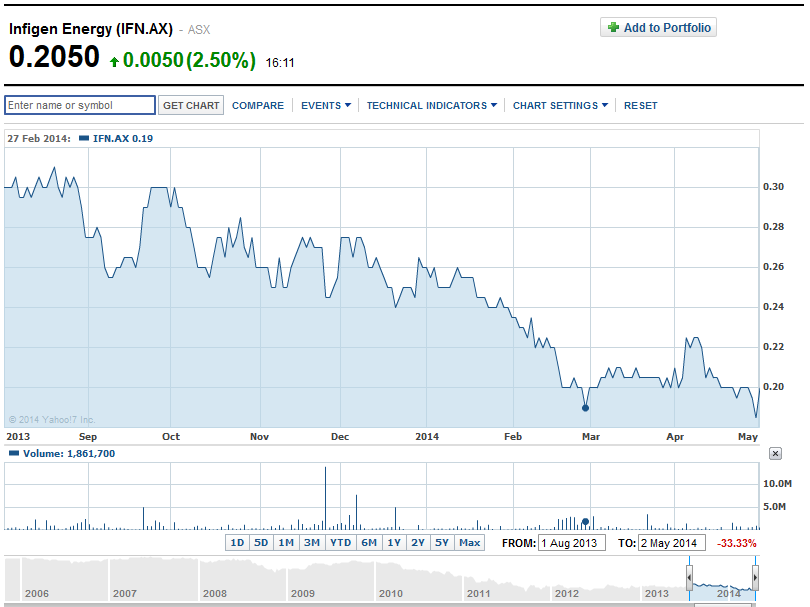
Reflecting its fading fortunes, Infigen’s share price has taken a pounding in the last 8 months (if the graphs below look fuzzy, click on them, they’ll open in a new window and look crystal clear):

Infigen 1.8.13-5.5.14

Note the drop after the Coalition took office in September; the dive after the RET Review was announced in January; and the plummet in April, when the Panel defined what its mission was about, as it called for submissions (see our post here).

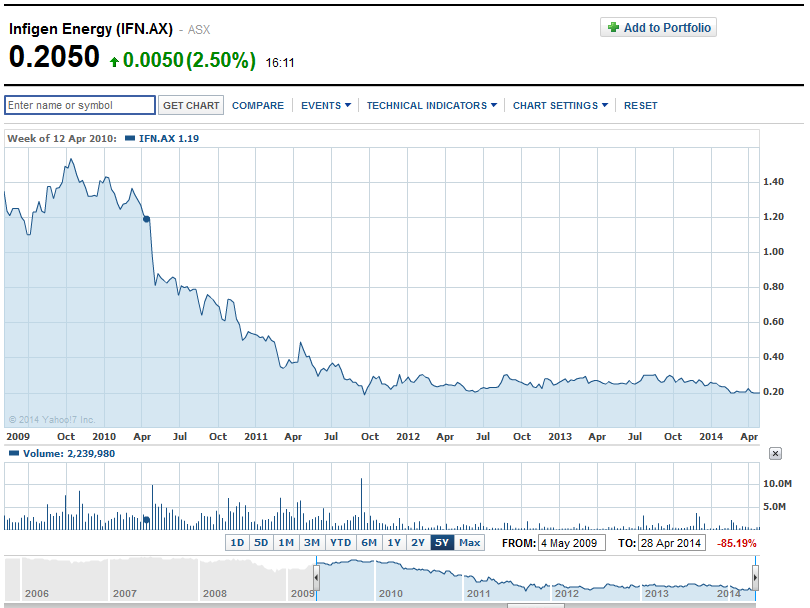
The drop seen above – from the year high of $0.32 (in August 2013) to $0.20 (now) – represents a 36% loss for investors who bought in at the top of the market this financial year. But spare a thought for those that bought in back in 2009 – when Infigen emerged from the ashes of Babcock and Brown:

Infigen 2009-5.5.14

The early movers have seen their shares freefall from over $1.40 to $0.20 – representing an 80% loss. Ouch!

The collapse in Infigen’s share price simply highlights our warning to bankers and investors. Remember this is an outfit that used to be called Babcock and Brown – which collapsed spectacularly in 2009 – taking $10 billion of investors’ and creditors’ money with it on the way out (see this story). Get set for a replay.

Consider this STT’s fair warning to anyone with exposure to wind power companies – be it shareholders, bankers or those who face exposure through their super fund’s investments – grab your money and get out while you can.

please-take-a-moment-and-look-around-and-find-the-nearest-exit

Please Support us at Carmen Krogh’s Talk at University of Waterloo!

Capture

WE NEED YOUR SUPPORT!

Here is a map of the University.  Parking available.    Please have exact change…($4.00)

We are in Building DC.  About “F” (horizontal) “3” (vertical) approx.

“Visitor parking lots” are shown as black circles.   Coin operated (4 dollars).

From University Ave use lots H, C.

From Columbia use lots M, R (south of Columbia) first, then (farther away, north of Columbia) X.


UK is Wising Up to the Windscam….JUST SAY NO!!!

New! Manage Your Group
See pending posts, member requests and reported posts for the group in which you are an admin.
Okay

Close popup and return

STOP SUBSIDIZING USELESS, INEFFICIENT WIND!

Perverse Renewables Policy turns Wind Power into Super-Predator

great white shark

The RET turned me into an occasional Super-Predator.

On the rare occasions when wind power is able to deliver meaningful output to the grid – usually at night-time – generators are more than happy for the dispatch price (the price paid by the grid operator to generators) to hit zero – and have even paid the grid operator to take their output, on occasions.

In Australia, that perverse market outcome is a product of the mandatory Renewal Energy Target – which forces retailers to take wind power output ahead of every other generation source (failure to take wind power and Renewable Energy Certificates (RECs) that go with it, leaves the retailer liable to pay a fine (the “shortfall charge”) of $65 for each MW/h the retailer falls short of the mandated target; the REC that is issued to wind power generators for each MW of wind power dispatched (currently worth around $28); and the Power Purchase Agreements wind power generators hold with retailers, containing fixed and guaranteed guarantee minimum prices of between $90-120 per MW/h (3-4 times the cost of conventional power).

As a result of the above, when they’re delivering to the grid, wind power generators are happy to watch the dispatch price plummet, punishing base-load generators, while having no impact on their own returns.

Some might call it “predatory pricing” – Travis Fisher an American economist with the Institute for Energy Research certainly does.

Here’s a very detailed analysis of the US energy market by Travis in which he demonstrates just how perverse renewable energy policy is.

What Travis says about predatory pricing by wind power generators in the US has direct relevance to what’s happening in the Australian energy market. In the piece below just substitute the “Clean Energy Council” for the “American Wind Energy Association (AWEA)”; and substitute “Renewable Energy Target (RET) and Renewable Energy Certificate (REC)” for “Renewable Portfolio Standards (RPS) and Production Tax Credit (PTC)”.

AWEA’s Bold Push for More Wind Welfare Wind
Institute for Energy Research
Travis Fisher
23 April 23

The American Wind Energy Association (AWEA) is making an all-out effort to convince Congress to renew the wind production tax credit (PTC), the wind industry’s lucrative subsidy that expired at the end of 2013. AWEA is desperate to revive the PTC and, unfortunately, its most recent lobbying push relies heavily on misinformation and half-truths in order to divert attention away from the PTC’s many critics.

To set the record straight, this article addresses some of AWEA’s flawed arguments and glaring omissions. The PTC, while incredibly valuable to owners of wind power facilities, hurts U.S. taxpayers and undermines the economic efficiency and physical reliability of the U.S. power grid.

Background

AWEA is a well-funded and well-organized industry association with 40 years of experience influencing public policy and an annual budget of more than $30 million. Perhaps due to AWEA’s skilled lobbying efforts, four different administrations and countless lawmakers have sided with AWEA and provided the wind industry a direct hand-out from American taxpayers.

Initially signed into law by George H. W. Bush as part of the Energy Policy Act of 1992, the PTC has expired and been renewed multiple times. Each renewal lasted only a short period, designed to extend the industry’s coveted subsidy for just one or two more years. Most recently, the PTC was extended through the 2013 calendar year as part of the “fiscal cliff” legislation passed in early 2013. A PTC extension for 2014 recently passed the Senate Finance Committee after being added to a tax extenders package by one of the wind industry’s most enthusiastic supporters, Senator Chuck Grassley. The Joint Committee on Taxation projects that a one-year extension of the PTC will cost American taxpayers over $6 billion.

The Institute for Energy Research (IER) has consistently argued against the PTC and highlighted its negative effects, which range from threatening grid reliability to redistributing federal tax dollars to a minority of U.S. states.

AWEA and Exelon Spar Over the PTC

As part of AWEA’s push to renew the PTC, it recently published a 28-page report that attempted to show that the PTC does not distort electricity markets and does not harm nuclear plant owner-operators. The policy report comes as a direct response to Exelon Corporation, the owner of the largest fleet of nuclear plants in the U.S. The issue at the center of the policy debate is “negative pricing.”

What is Negative Pricing?

Unlike the stable and predictable price of electricity at the retail level, market prices for wholesale electricity can fluctuate widely throughout the day – usually referred to as on-peak and off-peak prices – and across seasons. For example, wholesale prices tend to range between $30 and $50 per megawatt-hour but can drop into the negative or spike well above $500 per megawatt-hour. When the price becomes negative, electric generators are actually paying the grid to take their electricity. Several factors influence wholesale prices, namely supply, demand, and transmission constraints. Fundamentally, negative wholesale prices send a distress signal to markets that the supply and demand balance on the grid is economically unsustainable and suppliers need to reduce their output.

Why do sellers not drop out of the market when negative pricing occurs? As the Energy Information Administration (EIA) notes, “negative prices generally occur more often in markets with large amounts of nuclear, hydro, and/or wind generation.” That is because each of these technologies has an incentive to continue operating even when its facilities are temporarily paying the grid to take their power.

Nuclear plants are designed to run at full output and not “ramp” up and down, making them very reliable but inflexible. In times of very low demand, nuclear plants will sometimes take negative prices rather than go through the long and expensive process of lowering their output. Similarly, hydroelectric plants sometimes take negative prices in power markets because they are forced to run in order to comply with environmental requirements that force them to release water, regardless of whether the electricity is needed.

Unlike nuclear or hydro producers, the wind industry actually profits from negative prices because the PTC is such a large subsidy. Wind producers receive PTC payments per unit of power produced (even when the power has no value whatsoever to the grid), so they flood the grid with uneconomic power and ignore the distress signal sent by negative prices. Specifically, wind producers are paid the equivalent of $35 per megawatt-hour in PTC subsidies, so a wind producer taking the PTC can still profit while paying the grid to take its electricity.

Wind’s inflexibility in the face of negative prices is therefore a policy problem with a policy solution (let the PTC expire), not a matter of physics or environmental restrictions.

The threat to baseload generation from negative prices is very real. Already, Dominion closed its Kewaunee Nuclear Plant in Wisconsin 20 years ahead of schedule and Entergy plans to retire its Vermont Yankee Nuclear Plant at the end of this year. Both companies cited economic considerations as the reason for closing the plants. While it is true that low-cost natural gas is partially responsible, it is also clear that artificially low prices caused by the PTC during off-peak hours played a role. In fact, the Department of Energy’s assistant secretary for nuclear energy referred to this emerging pattern of nuclear plants shutting down early as “a trend we are clearly very, very concerned about.”

Exelon’s Argument

Exelon argues that the PTC wreaks havoc on baseload or “around-the-clock” generation such as nuclear power by encouraging negative prices in wholesale electricity markets. In contrast to baseload units, electricity production from wind peaks at night and in the early morning when electricity demand is low, which contributes to a situation of over-supply. A 2012 study commissioned by Exelon maintains that PTC-related negative prices harm baseload power and grid reliability because they “directly conflict with the performance and operational needs of the electric system.” Essentially, if the PTC is extended, it will induce more negative pricing events during off-peak hours, and make more baseload units uneconomic. In other words, the PTC perpetuates a system of predatory negative prices that attack reliable (and far less subsidized) baseload producers.

The power grid reliability implications are straightforward. The PTC is making reliable generation uneconomic, while subsidizing unreliable wind power. Without reliable generation up and running, many regions will struggle to meet seasonal peak demand in winter or summer. For most of the country, the highest peaks occur in the summer months. The following chart from a study on the intermittency of wind power illustrates just how little wind contributes to those summer peaks (click on the graph for a clearer view).

ERCOT-Wind-Power

On these arguments against the PTC, IER is not alone – energy experts across the board agree with Exelon. The Congressional Research Service (CRS) acknowledged the problem of negative pricing, noting in 2012 that “[n]egative power prices associated with wind power might generally occur at night when wind is producing at high levels. Large amounts of wind power generation can potentially contribute to transmission congestion and result in negatively priced wholesale power in certain locations.” The EIA also specifically lists the PTC as a cause of negative prices.

The same CRS report from 2012 outlined the reliability issues associated with wind, predicting that “should wind power continue to experience growth, it is uncertain whether current [regional transmission organization] market designs would function to ensure availability of the types of generation that would be necessary to both maintain resource adequacy and manage the variable and intermittent nature of wind power.”

Last December, the New York Times published an article about how wind and nuclear power “are trying to kill each other off” and noted the “cannibal behavior” of wind in power markets.

Focusing on Texas, which is the U.S. market hit hardest by wind power, Public Utility Commission Chairman Donna Nelson testified in 2012 that “[t]he market distortions caused by renewable energy incentives are one of the primary causes I believe of our current resource adequacy issue … [T]his distortion makes it difficult for other generation types to recover their cost and discourages investment in new generation.” And as the non-partisan Center for Strategic and International Studies wrote in May of 2013, “[a] growing number of analytical reports … point to the negative impact of renewable energy mandates and subsidies (direct and indirect) on the competitiveness of nuclear power.”

In fact, some environmentalists are troubled by wind power’s parasitic effect on nuclear power. James Hansen’s observation relating to a similar policy – renewable portfolio standards – actually underscores Exelon’s argument regarding the PTC:

The asymmetry finally hit me over the head when a renewable energy advocate told me that the main purpose of renewable portfolio standards (RPS) was to “kill nuclear”. I had naively thought that the purpose was simply to kick-start renewables. Instead, I was told, because utilities were required to accept intermittent renewable energies, nuclear power would become less economic, because it works best if it runs flat out.

In short, the predatory pricing enabled by the PTC is real, it is harmful to reliable generation, and it hits nuclear generation the hardest. AWEA cannot shrug off the harmful effects of the PTC or pretend they do not exist. As an Exelon executive said recently, “[w]e can work with AWEA on a clean energy future but we can’t deny the truth.”

AWEA’s Fuzzy Math

AWEA’s policy report, titled “The facts about wind energy’s impacts on electricity markets: Cutting through Exelon’s claims about ‘negative prices’ and ‘market distortion,’” attempts to turn the negative pricing arguments on their head by narrowly focusing on the wind industry’s side of the story. Specifically, AWEA flatly misrepresents the effect of the PTC on wholesale markets by omitting important information and making bogus comparisons.

AWEA claims the impact of wind on wholesale markets is “entirely market-driven” and “widely seen as beneficial.” The first claim is patently false and the second is very misleading.

No one at AWEA can claim with a straight face that the growth in the wind industry is “entirely market-driven.” AWEA spends millions of dollars a year lobbying for renewable energy mandates in the states and for the PTC and other support at the federal level. If wind were truly “market-driven,” there would be no need for AWEA’s massive lobbying effort for mandates and subsidies. The mandates and subsidies AWEA supports are the exact opposite of “market-driven.”

AWEA knows better than any other organization just how much government support the wind industry receives – support that simply does not exist for baseload generation and should not exist for any power generation source whatsoever. Because of AWEA’s lobbying efforts to mandate the use of their product, 29 states and the District of Columbia mandate certain levels of renewable energy generation (these laws are commonly called Renewable Portfolio Standards or RPSs). Because the vast majority of the power being used to satisfy these requirements comes from wind plants, the wind industry currently enjoys a government-mandated market share. This alone is enough to discredit AWEA’s comment about Exelon obscuring the “real story of wind energy successfully competing against more expensive forms of energy in the market.” AWEA knows the wind industry is winning on government support, not the free market.

State-level mandates aside, AWEA attempts to downplay the role of the PTC specifically in undermining baseload generation. It is vitally important to realize that negative prices are not the only indicator of market distortion. AWEA draws a false dichotomy in its report between the “real economic savings” from wind and the “exceedingly rare” negative prices that cause market distortions. Here, AWEA downplays the possibility that market distortion can exist without negative prices. But just as the PTC subsidy causes negative prices at the extreme, it regularly causes artificially low power prices in off-peak hours that can be just as damaging to baseload generation.

AWEA then makes the stretch that, because the negative pricing problem was less rampant in 2013 than it was in 2012, market distortions from the PTC no longer exist or are “extremely rare.” This argument is fatally flawed as demonstrated by the following analogy. Consider if a thief said, “I didn’t do anything wrong in 2013. I only stole half as often as I did in 2012.” Such a statement would be silly because theft is theft. The same is true of harmful market distortions.

Just because there were fewer hours in 2013 with negative prices, it does not follow that the PTC is any less of a problem. Even in a world where prices were never to fall below zero, market distortion caused by the PTC could still render baseload units uneconomic. For example, reliable power plants would still close if prices were consistently at or very near zero. As discussed above, this is what we are seeing in practice, AWEA’s distractions notwithstanding.

Also, the 2012 data are so bad that 2013 was bound to be a less damaging year – in fact, one of Exelon’s plants took negative prices for 8.3 percent of all hours in 2012. The fact that this statistic fell to 4.3 percent in 2013 is little consolation. Essentially, we can debate the extent to which the PTC continues to cause negative prices, but to recast the PTC as incapable of distorting power markets is disingenuous on AWEA’s part.

Finally and perhaps most disturbingly, AWEA’s report fails to capture any long-term effects of the PTC. For example, in several places the AWEA report talks about wind power “replacing the most expensive and polluting sources of energy.” In practice, wind cannot do this because wind is unreliable. Wind cannot replace the most expensive source of electricity generation because those generation sources only run at peak times. The wind does not blow when AWEA wants it to and millions of dollars spent on lobbying cannot change that simple fact of the physical world.

Furthermore, as James Hansen and others have observed, heavily subsidized wind power is actually displacing zero-emission nuclear power rather than the “most polluting” sources AWEA references. If the goal of the PTC was to wipe out America’s nuclear fleet, then it is succeeding. But if the goal was to support zero-emission generation, then it has backfired miserably. The PTC has wasted billions of taxpayer dollars to replace nuclear, a clean technology that works, with one that only sounds good and is fundamentally unreliable.

Conclusion

The wind production tax credit distorts power markets by allowing wind producers to profit from artificially low prices. Such market distortion undermines the reliability of America’s power grid in the long run by forcing reliable baseload power plants to close -including nuclear plants, which in turn defeats any environmental purpose for keeping the PTC.

AWEA’s recent study is a desperate attempt to obscure the very real and worrisome long-term effects of the PTC by relying on misleading data. The PTC has rightly received scrutiny from energy experts across the political spectrum, and it deserves a more comprehensive analysis than AWEA provides in its report.
IER Economist Travis Fisher authored this post.
Institute for Energy Research

The only significant difference between the Australian energy market and that detailed above, is that Australia doesn’t have any nuclear power generation at all.

Instead, it’s base-load gas generators who are being pounded by wind power generators’ ability to periodically crash the dispatch price.

By base-load gas generators, we’re referring to either gas/thermal plants (where gas is used to fire boilers, create steam and run turbines) or highly efficient Combined Cycle Gas Turbines.

One early casualty was Stanwell (Queensland’s largest power generator) – which back in February took the extraordinary step of announcing it would mothball its biggest gas-fired power station – the Swanbank E power station, near Ipswich – a highly efficient Combined Cycle Gas Turbine (CCGT) plant – and resurrect a coal facility built in the 1980s. Stanwell put its inability to operate its gas-fired plant squarely down to the market distortions created by the mandatory RET (see our post here).

What’s doubly perverse is that generating power using CCGTs produces about 50% less CO2 emissions than coal/thermal. Instead of CCGTs, generators have invested $millions in Open Cycle Gas Turbines (OCGTs) that emit 3-4 times the CO2 per unit of electricity – when compared to a modern coal-fired thermal plant and cost a small fortune to run (between $200-300 per MW/h, compared to $25 for coal/thermal). So much for a policy designed to “save the planet”.

Because wind power can only be ever delivered at crazy, random intervals – 100% of its capacity has to backed up 100% of the time with spinning reserve and inefficient OCGTs – which can be deployed in a heartbeat to keep the grid balanced — and the lights on – whenever wind power output varies or disappears altogether (see our post here).

Wind power generators’ ability to game and distort the dispatch price by operation of the mandatory RET (and the matters outlined above) is about to come under the microscope of the RET review panel.

The top-flight energy market consultancy, ACIL Allen has been directed by the panel to focus on the cost impacts of renewable energy in the electricity sector. And that means the whole electricity market – and the long-run impact the RET will have on power prices, including the impact of periodic predatory pricing by wind power generators knocking out highly efficient base-load gas generators – like Stanwell’s Ipswich plant.

Given the make-up of the panel – and the terms of its brief – we doubt that ACIL Allen will pull any punches.

million_dollar_baby_clint_eastwood_clint_eastwood_060_jpg_pvrk

Now – have I got your attention?

Wind Power is a SCAM….Onshore, or Offshore!

Dave Cameron sends wind power offshore and consigns Brits to economic dustbin

offshorewindturbines

Even more expensive than they look.

David Cameron’s so-called “Conservatives” have seemingly ditched plans to roll out thousands of giant fans across the hills and dales of Old Blighty.

Faced with a brewing voter backlash from their own rural constituents about the negative impacts Britain’s great wind rush has had upon the landscape, property values and the ability of neighbours to enjoy a peaceful night’s sleep, Cameron’s crew has, apparently, retreated.

Instead of lobbing fans far and wide across its bucolic landscape, the Conservatives have decided to plant them out to sea, instead.

The cost of delivering offshore wind power is INSANE – with generators guaranteed obscene returns – being able to charge “three times the current wholesale price of electricity and about 60% more than is promised to onshore turbines.”

In January the Economist reported that “offshore wind power is staggeringly expensive” and “among the most expensive ways of marginally reducing carbon emissions known to man”. But that is merely to compare the insane costs of onshore wind power in the completely insane costs of offshore wind power (see our post here).

While backing away from his planned onshore onslaught might save Cameron a few rural seats at the next election, it will not immunise his party from the consequences of forcing power punters to pay for a policy which is already sending power prices spiralling through the roof – punishing families and crippling business. By backing offshore wind power, Cameron will only accelerate that process.

Britain has struggled to regain any serious economic traction after it was forced to bail out its bankers in 2008; and the European banking crisis struck it and its European trading partners in 2009: GDP growth has been anaemic; and, away from London, unemployment rates remain stubbornly high.

By plumping for the most expensive form of intermittent and unreliable electricity generation known to man, Cameron has consigned Britain to a very dark and very grim future, indeed. Here’s The Telegraph’s Chris Booker on just how dark things are about to get in Britain.

Why does Ed Davey want to keep us in the dark?
The Telegraph
Christopher Booker
26 April 2014

The Energy and Climate Change Secretary is trying to hoodwink us over the value of wind farms

We may think we are so used to politicians trying to pull the wool over our eyes that we accept that this is just what politicians do. But we are still right to think that deliberately trying to deceive people is wrong – on some occasions more than others.

Two examples of this last week again brought home just what a dishonest and disastrous mess Britain’s leaders are making of our national energy policy. The first was the announcement by Ed Davey, who runs the Department of Energy and Climate Change, of eight flagship projects he has chosen to play a leading role in helping to meet the European Union’s requirement that, within six years, we produce 32 per cent of our electricity from “renewables”.

Five of these are giant offshore wind farms. Three more are power stations burning what is known as “biomass”. And most commentators seemed happy to take at face value Davey’s claims that these will bring in £12 billion of private investment, to generate “4.5 gigawatts” of electricity, create “8,500 green jobs”, help give us “energy security”, and enable us to lead the world in the heroic fight against climate change.

Let us look, however, at what Mr Davey carefully didn’t say. For a start, of course, because the wind only blows intermittently, his five wind farms – covering, incidentally, 200 square miles of sea – will not provide anything like the 3GW of power he mentions. He is playing the old trick of confusing “capacity” with actual output. Even using implausibly generous figures from another part of his department’s own website, we can see that the average output of all Mr Davey’s £12 billion worth of projects would only be around 2.2GW: much the same as that of the single gas-fired power station recently built by RWE at Pembroke for a capital cost of just £1 billion.

Because the wind is so unreliable, we would still need 3GW of power from the fossil-fuelled power stations the Energy Secretary so hates, just to provide back-up for when it isn’t blowing at the right speed (on Thursday, for instance, all our 4,500 existing turbines combined were only giving us 215 megawatts, less than 0.6 per cent of what we were using). Mr Davey may pretend that all his projects will help meet our 32 per cent EU target. But those 2.2GW would only raise our output from renewables from 11 per cent to 15 per cent of the total, so we will still have to spend a further £40 billion before 2020.

Mr Davey is similarly not keen to explain why these wind farm companies, all foreign-owned, are so eager to join the bonanza that has made Britain such a magnet to the world. This is because we pay the world’s highest subsidies for electricity, which therefore costs us, through our bills, more than three times that from conventional power stations (and six times more than that from coal).

Even more absurd are Mr Davey’s “biomass” plants, easily the largest being Drax in Yorkshire. This is being driven by subsidies and George Osborne’s “carbon tax” to switch from coal to burning millions of tons of wood. This is specially grown across the Atlantic, then shipped 3,000 miles, and carried by train to the middle of the now-closed Selby coalfield: a process so energy-intensive that even green lobby groups protest that it ends up saving no CO₂ emissions at all.

So Mr Davey’s projects will do little or nothing to achieve any of their declared aims – instead producing, at colossal expense, a comparatively derisory amount of electricity, and adding a further £1.5 billion a year to our bills, equivalent to £60 for every household, which is even more than what we are already paying for Osborne’s “carbon tax”.

But we can get little comfort from the week’s other announcement – the Tories’ pledge that, if re-elected and no longer hamstrung by Mr Davey’s Lib Dems, they will halt the building of onshore wind farms. This is just a cynical bid to allay the ever-growing unpopularity of windmills among the Conservatives’ rural supporters, overlooking the fact that the party’s leaders still favour the offshore wind farms, which get subsidies that are more than twice as high as those onshore.

So yet again we must conclude that only when the lights go out and our computer-dependent economy seizes up – despite all those diesel generators being secretively hooked up in a bid to keep the National Grid “balanced” – will our politicians finally be forced out of their crazy bubble of groupthink, to confront a very dark, cold and hostile real world.
The Telegraph

For the dark days ahead, Dave Cameron is unlikely to be treated well by either British voters or by the pages of history.

SWITZERLAND-WEF-DAVOS-CAMERON

Intent on leaving a lamentable legacy.