Faux-green Energy…..No more than an Over-priced Novelty!

Obama’s Green Unicorn


The true cost of renewable energy is being masked by government subsidies and bailouts.

Wind turbines are silhouetted by the setting sun Friday, Aug. 23, 2013, near Beaumont, Kan. The turbines are part of the 100-unit Elk River Wind Farm in south central Kansas.

Propped up by the government.

By    Aug. 25, 2014 
America is about as likely to become reliant on green energy to meet its baseload power requirements as a unicorn is to stroll down the middle of Washington’s Pennsylvania Avenue during rush hour followed by a pink elephant.

It’s just not happening – but that’s hasn’t deterred the modern day snake oil salesmen and their allies inside the Obama administration from continuing to make a push for wind and solar power as an eventual replacement for energy generated from traditional sources like coal, oil and natural gas. Renewable technology has improved, no doubt, but it’s a long way away from being ready to make a substantial contribution to the heating of our homes and the powering of our businesses unless the generous tax subsidies that create the illusion of cost competitiveness continue.

There’s nothing wrong per se with the pursuit of renewable energy; it’s just that what it actually costs is being masked by taxpayer subsidies, federal loan guarantees and renewable fuels mandates at the state level that force power companies to put wind and solar into the energy mix, sometimes at two to three times what traditional power costs. Ultimately, one way or another, the taxpayers and energy consumers are footing the bill even if they don’t know it

Congress has taken a few positive steps in the right direction. The federal Wind Production Tax Credit was allowed to expire at the end of the year, meaning new wind projects are going to have to be competitive at market rates to attract funding. Remember it was none other than billionaire Warren Buffett, the “Oracle of Omaha,” who explained recently to a group of investors that the tax credit was the only reason that any sensible person invested in wind projects in the first place.

Unfortunately, some federal agencies are trying to keep the program alive through the backdoor.

The worst offender in this regard may be the IRS, which recently issued new “guidelines” that make it even easier for wind projects currently in development to qualify for the tax credit on the basis of work already contemplated or completed. According to Politico, “The IRS says completed or in-progress facilities can be sold and the costs incurred by the seller will still count toward qualifying for the [credit], except in cases where tangible property (think equipment like wind turbines) bought for one project is sold and used at another site.”

To translate this into English, it’s a move to help keep the whole shell game alive until such time as wind power supporters can get the tax credit reauthorized. “There is a large pipeline of projects that were under development at some stage that by virtue of this guidance will be able to go forward. In that regard it is going to permit a lot of projects to be developed,” said one wind energy expert cited by Politico.

Outside groups are also weighing in, including the Sierra Club, which has targeted nine members of Congress in a pressure campaign over the August recess to push for reauthorization of the Wind Production Tax Credit. That is in addition to the online ad buys in 16 other districts that started in June.

[MORE: Cartoons on Gas Prices]

The Democrats who run the Senate want to keep the now-expired credit alive and have, in the Senate Finance Committee, already approved a package of so-called “extenders” that would breathe new life into it. The House has thus far refused to go along – and kudos to Texas Republican Rep. Randy Weber, who deserves credit for successfully introducing an amendment to shut the whole business down permanently. But he’s not just fighting the lobbyists and green groups in favor of the credit, but the entire federal bureaucracy which, once a program has been established, is loath to let it die.

Major government investment in speculative green projects may have at one time made sense. But even if that were once the case, it is so no longer. The Obama green energy push has enriched more than a few politically well-connected liberals who used tax credits and government bailouts to enlarge their portfolios, but it has done little to make energy more abundant or lower costs to consumers, which is the justification in the first place to get the taxpayers involved. If people want to build wind farms – on land or offshore – and they want to reap the benefits of their investments, then they should be willing to take the same risks as everyone else. The way the bureaucrats have it structured now, the taxpayers are making payments on both ends through subsidies for construction and higher rates on consumption. It’s a system only a bureaucrat could love.

When Will All Governments Follow the Aussies lead? Not soon enough!

Australian Wind Industry Doomed: Tony Abbott Signals the End of the Mandatory RET

wind_turbine_fire

STT followers have been delighted with news that Tony Abbott, Joe Hockey and Mathias Cormann have teamed up to axe the mandatory RET (see our post here).

In response to the PM’s mooted plan, the wind industry and its parasites have been reduced to making idle threats of “revenge” and bleating about “sovereign risk”. Despite a rear-guard effort by Environment Minister, Greg Hunt to salvage something of the mandatory RET, his boss has confirmed that his mission is to kill it outright. And that pretty much means the end of the wind industry as we’ve known and grown to despise it. Here’s the Australian Financial Review on the beginning of the end.

Coalition fails to budge on RET pruning
Australian Financial Review
Phillip Coorey
26 August 2014

Pleas by solar and wind companies to leave the Renewable Energy Target untouched have fallen on deaf ears with the government deciding to proceed with a phasing down of the scheme.

While a final position will not be announced until next month, The Australian Financial Review understands the intent is to cut the scheme harder than a compromise scenario that was being pursued by the Environment Minister, Greg Hunt.

The end result will be closer to the abolition scenario advocated by Prime Minister Tony Abbott which would end the scheme by closing it to new entrants and grandfathering existing large scale projects.

Seeking to overcome the cabinet split, Mr Hunt, Mr Abbott and Industry Minister Ian Macfarlane met on Sunday to discuss a policy position to be put to the bureaucracy for analysis and then to the cabinet for a final decision.

The government is being guided by the findings of the review into the RET conducted by businessman Dick Warburton, a person the industry has argued is ill-suited to the task because he is a climate-change sceptic.

The guiding principles of the final decision will be to balance investor risk with the impact of the RET on household and business power bills. Mr Abbott claims the RET has had a significant impact on power prices. The government’s own modelling shows while the RET has added $40 a year to average household power bill, prices will fall over the medium term as more renewable energy is produced.

The industry is ramping up its warnings that any dilution of the current scheme will not only jeopardise more than $11 billion in the renewable energy investment pipeline, but create a broader sovereign risk perception for Australia.

Close watch on outcome

Philip Green, the London-based partner of the Children’s Investment Master Fund (TCI), which has a 33 per cent stake in renewable energy company Infigen, said the issue was being watched closely. “Sovereign risk has already increased in Australia given the media coverage of the carbon debate and now the RET. Sovereign risk will increase more if the stories about cuts to the RET are confirmed,” he said in a statement.

“This comes at a cost to the nation through higher capital costs as it seeks future investment in infrastructure. The Australian RET had strong bi-partisan political support [including from the current prime minister]. It can take a long time to restore trust and in some cases this is only achieved with a change in leadership/policy/party.”

Under the RET, a policy which hitherto had bipartisan support, 20 per cent of Australian’s energy production by 2020 would come from renewable sources. Based on earlier predictions of power production in 2020, this 20 per cent target was calculated at an annual production of 41,000 gigawatt hours.

But the 2020 production total has been downgraded following the decline of the manufacturing sector, including automotive and aluminium.

Consequently, 20 per cent of the revised production target is 27,000 GWh. This is the “real 20 per cent” scenario for which Mr Hunt is advocating.

Under the push by Mr Abbott, renewable energy output would be frozen at current levels of about 16,000 GWh.

Any proposed change faces a near impossible passage through the Parliament with Labor and the Greens opposed to any alteration, while Clive Palmer says he will not allow any change unless Mr Abbott goes to the next election in 2016 and wins a mandate.
Australian Financial Review

dick-warburton

STT thinks the constant reference to Dick Warburton as a “climate-change sceptic” is just churlish bitterness from the vanquished. From STT’s viewpoint, Dick did precisely what he was supposed to do: standing up for Australian power consumers and helping to bring an end to the most costly and pointless piece of policy ever devised.

And, yet again, the wind industry – and those with shirts to lose when it collapses – trot out the furhpy about “sovereign risk”. Not only is it utter bunkum (see our posts here and here and here and here), harping on about it won’t save the wind industry from the inevitable demolition of the mandatory RET.

The AFR talks about Australia risking “$11 billion in the renewable energy investment pipeline” as if that were some kind of loss to Australian power consumers, in an already over-supplied market. As we’ve previously pointed out, the threatened “investment” is hardly a “no-strings attached-gift”. The would be investors are after annual gross returns in the order of 20% on that figure – ie, a cool $2.2 billion, every year – which can only be recouped from power consumers through higher power bills – with a fat pile of RECs underwriting the “investment” (see our post here).

As a piece of friendly advice, we wouldn’t be betting the house on Clive Palmer blocking any changes to the RET in the Senate. Horse trading is the life-blood of politics; and a week can be a very long time for anyone engaged in the political caper. As you’d expect, STT hears that Tony Abbott is already doing business with the Senate’s cross-benchers, including the PUP in order to come up with a workable solution to the debacle that is the mandatory RET, which has utterly failed as a cost-effective CO2 abatement policy.

Clive Palmer wants an Emissions Trading Scheme (albeit with the price of credits set at zero). So the Coalition’s Direct Action policy is being reworked by top energy market economist, Danny Price in a manner that will not only resemble something like what Clive is after, but in a way that will slash the value of the subsidies to wind power outfits (as promised by the RET) by around 90%. One of the cross-benchers, Nick Xenophon – who works closely with Danny Price – is in on the mission to kill off the wind industry, by introducing some tweaks of his own to Coalition policy, aimed at achieving least-cost CO2 abatement (see our posts here andhere). Another cross-bencher, David Leyonhjelm penned a piece for The Australian today (we’ll cover it shortly) setting out his eagerness to kill the mandatory RET, which he sees as “just government mandated corporate welfare” that will cost power consumers $billions “for no measurable environmental benefit”. No, STT didn’t write David’s article.

But, in the result, whether or not changes to the mandatory RET occur during the life of this parliament is a matter of passing academic interest. The wind industry is doomed simply because – from here on – NO retailer in touch with their earthly senses will enter a long-term Power Purchase Agreement with a wind power outfit – which means that those desperados still hoping to build wind farms will never obtain the finance needed to do so. Moreover, the REC price is bound to head south over the coming weeks and months, placing outfits with current wind farm operations in mortal financial jeopardy.

One of those facing an early exit from the stage is our old favourite, Infigen. These boys have just announced an $8.9 million loss for 2013/14, which follows a $55 million loss in 2011/12 and an $80 million loss for 2012/13 (see our posts here and here). Those hefty losses were all racked up at a time when the mandatory RET was set in stone, such that the regulatory cards were all firmly stacked in Infigen’s favour.

With the mandatory RET set for the chop, Infigen is preparing to emulate its predecessor (Babcock & Brown) with another spectacular financial collapse. Here’s the Australian Financial Review setting the scene for Babcock & Brown Mk II.

Infigen at risk if RET wound up
Australian Financial Review
Angela Macdonald-Smith
26 August 2014

Wind power producer Infigen Energy has warned it could fall into breach of its debt covenants within three months should the 2020 Renewable Energy Target be wound back with no compensation for affected investors.

Managing director Miles George said either of the two outcomes apparently being favoured by the government for the overhaul of the RET would be “disastrous” for both the industry and Infigen.

He said significant write-downs would follow, with the loss of value for Infigen more than its current market cap of about $185 million.

The government is thought to be considering two potential outcomes for its RET review, one involving reining the 2020 target back to represent a “real” 20 per cent of electricity use, rather than the 26 per cent to 28 per cent it is currently expected to represent.

The other involves closing off the scheme to new entrants, while honouring existing contracts only.

“Either of these scenarios is disastrous for our industry,” Mr George said, after Infigen posted an $8.9 million full-year net loss, affected by the regulatory uncertainty. “They are both death for the renewable energy industry and, to be frank, they are death for Infigen.”

He said if no compensation was provided for investors, the resulting weakness in the price of large-scale renewable energy certificates would cut cash flow for debt servicing. As a result, Infigen would be at risk of breaching its covenants within three months.
Australian Financial Review

This couldn’t be happening to a nicer bunch of lads.

dirtyrottenscoundrelsoriginal

Finally…the Scam is Being Exposed! They Know They Are NOT Helping Our Environment!

It’s about something

Ms. McCarthy is now saying that the Clean Power Plan is not about climate. Ms. McCarthy’s July 23 testimony on the Clean Power Plan was that it is not about climate or pollution control.  This contradicts the June testimony, the web site and the federal register notice.  So it’s about something.  

From the Bonner Cohen, Heartland.org:

EPA’s recently announced restrictions on carbon dioxide emissions have nothing to do with reducing pollution, EPA Administrator Gina McCarthy admitted in Senate hearings. Instead, said McCarthy, EPA imposed the restrictions based on a belief imposing expensive renewable energy on the electricity marketplace will stimulate the economy.

‘Not About Pollution Control’
“The great thing about this proposal is that it really is an investment opportunity. This is not about pollution control,” McCarthy told the Senate Environment & Public Works Committee July 23. “It’s about increased efficiency at our plants. It’s about investment in renewables and clean energy. It’s about investments in people’s ability to lower their electricity bills by getting good, clean, efficient appliances, homes, rental units.”

McCarthy’s comments came as a shock to utilities facing steep costs attempting to comply with the proposed restrictions. The comments also came at a time when the Obama administration’s prior EPA restrictions have pushed U.S. electricity prices to an all-time record high.

Contradicts Prior Testimony
McCarthy’s Senate testimony represents a significant departure from the way EPA defended its proposal before lawmakers just a month earlier. At a June hearing before the House Energy and Commerce Committee, Acting Assistant Administrator for Air and Radiation Janet McCabe offered a different explanation. Citing Section 111 (b) of the Clean Air Act, which authorizes EPA to regulate certain pollutants, McCabe made that argument in her testimony:

“Chairman Upton, this is not an energy plan. This is a rule done within the four corners of 111 (b) that looks to the best system of emission reduction to reduce emission.… This is a pollution control rule as EPA has traditionally done under section 111 (d).”

McCarthy’s comment didn’t escape the attention of climatologist Roy Spencer.

“This gaffe could come back to bite the EPA,” Spencer wrote on his website. “The Endangerment Finding was all about the negative effect of ‘carbon pollution’ on the environment. Now we find out ‘this is not about pollution control’?”

In her testimony, McCarthy repeatedly emphasized EPA views its rule as an investment opportunity for the business community, while downplaying the cost it would impose on consumers.

“This is an investment strategy that will not just reduce carbon pollution but will position the United States to continue to grow economically in every state, based on their own design,” she said.

So CO2 restrictions are not about climate and all the supposed health benefits are not about pollution control, they are energy efficiency, jobs and economic programs.  Sounds like EPA is getting caught with a reg that obviously doesn’t do what they said it was designed to do and are scrambling.

James Delingpole shares a Few “Inconvenient Truths”, About Tom Steyner

TOM STEYER’S EPIC GREEN FAIL: PART II


Tom Steyer, the fossil-fuel powered hedge funder has suffered further setbacks on his $100 million mission to save the world from ‘global warming’ by destroying the US economy.

He is hoping to raise $50 million from left-wing environmentalist billionaire donors for his NextGen political action committee. But so far, it emerged at a renewable energy conference in Aspen, Colorado this week, he has managed to raise just $7 million.

“He wants to raise $50 million that he can match,” a conference organizer told FOX31 Denver. “Right now, he’s raised about $7 [million].

Steyer is continuing to put a brave face on affairs.

Acknowledging that some donors prefer to give to organizations other than NextGen, Steyer believes activists demanding action on climate change will have an impact on the November election. “The ultimate question will be will we have enough money to run the programs we need to run and the answer is yes,” Steyer said. “Definitely, yes.”

But prospective donors may have decided that Steyer is tainted beyond redemption by a string of recent revelations about his murky financial background. As Breitbart reported last month, a fair chunk of this green evangelist’s fortune came from his hedge fund Farallon Capital’s investments in the coal industry. With help from Steyer’s financing, coal production from Indonesia to China increased annually by 70 million tons – the equivalent, some experts have speculated, of around one melted glacier and thirty drowned baby polar bears per annum.

Though Steyer has since detached himself from his Big Coal financed hedge fund and claims to have seen the light, the suspicion remains that he is rather less interested in saving the planet than he is in lining his own pockets and those of fellow Democrats in the left wing Billionaires Club.

Consider, for example, his mutually beneficial dealings with Nancy Pelosi. Steyer has been a great supporter of the former House speaker, financially and politically. By strange coincidence, Steyer’s business projects have been boosted by around $1 billion in government aid, much of it announced by Pelosi herself.

In 2004, reports Free Beacon,  Steyer’s Farallon Capital bought two million feet of commercial real estate in the Mission Bay area. At the time, according to the San Francisco Business Times, it was “decrepit and seemingly abandoned.”

But, reports the Daily Signal, with the help of fairy godmother Pelosi this soon changed. She waved her wand (made of yew, it is rumoured, like Lord Voldemort’s) and showered the area with taxpayer-funded gifts: a $942 million public transportation link between Mission Bay and downtown San Francisco; $10 million in stimulus funds for a Mission Bay biotech cluster; $25 million for the repair or removal of piers in the area. Steyer has claimed there is no link between his political donations and these government grants – but Farallon has certainly benefited handsomely from this non-arrangement.

Another of Steyer’s completely un-business-related enthusiasms is his fervent opposition to the Keystone XL pipeline. This, of course, has nothing whatsoever to do with the fact that he has long had a stake in a rival pipeline called Kinder Morgan. Though he promised that he would divest himself of financial interests in Kinder Morgan by the end of 2013, it is not clear that he has yet done so.


Wind Turbines are NOT Green, they are Bad for People, Wildlife, and the Environment

Special Investigation: Toxic wind turbines

Part Two of The Sunday Post’s hard-hitting probe into the true impact of wind farms.

Damning evidence of wind farms polluting the Scottish countryside can today be revealed by The Sunday Post.

Scotland’s environmental watchdog has probed more than 100 incidents involving turbines in just six years, including diesel spills, dirty rivers, blocked drains and excessive noise.

Alarmingly, they also include the contamination of drinking water and the indiscriminate dumping of waste, with warning notices issued to a handful of energy giants.

The revelations come just a week after our investigation showed

£1.8 billion in Government subsidies have been awarded to operators to build turbines since Alex Salmond took office in 2007.

Anti-wind farm campaigners yesterday insisted Scotland’s communities are now “under siege” and demanded an independent inquiry into the environmental damage.

Murdo Fraser MSP, convener of Holyrood’s Economy, Energy and Tourism Committee, said: “I am both surprised and concerned by the scale of these incidents.

“The fact there were more than 100 complaints is a dismal record.

“This should serve as a wake-up call that wind energy is not as clean and green as is being suggested.”

He added: “What’s worse is that the current Scottish Government seems to have an obsession about wind power and the expansion in the number of turbines shows no signs of relenting any time soon.”

Promotion of green energy, particularly the growth of onshore and off-shore wind farms, has been one of the SNP’s key policies since 2007.

The Scottish Government’s target is to generate the equivalent of 100% of the country’s electricity consumption, and 11% of heat demand, from renewables by 2020.

In recent years, ministers have invested heavily in the sector, insisting Scotland has a quarter of all of Europe’s wind energy potential.

But wind power is becoming increasingly unpopular, with giant turbines now scattered across much of the Scottish countryside.

There are now 219 operational wind farms in Scotland, with at least 2,400 turbines between them.

Moray has the most sites, with 20 in operation, while Orkney has the most turbines, with 600 across the archipelago, although the majority are owned by farmers and other individuals.

Now, we can reveal the Scottish Environment Protection Agency has investigated 130 ‘pollution reports’ connected to wind farms or turbines over the past six years. In June 2012, elevated levels of the banned insecticide Dieldrin were found in samples from a private drinking water supply in Aberdeenshire.

A redacted SEPA report, obtained under Freedom of Information, states: “It was noted a wind turbine had recently been erected by the nearby farmer.”

Run-off from the construction of a wind farm near Loch Fyne in February 2012 caused concern that fish had stopped feeding, with SEPA officers discovering a burn was “running brown” and that “a noticeable slick on Loch Fyne was visible”.

In another incident in November 2011, 1,000 litres of oil leaked from a turbine at the Clyde wind farm in Abington, Lanarkshire, resulting in an emergency clean-up operation.

Warning letters have been sent by the environment agency to a number of operators, including Siemens, after another fuel spill at the same 152-turbine site four months later.

A report on that incident states: “Siemens…maintained it was under control. However…operators who then visited the area did not see any action being taken and fuel ponding at the base of the generator”.

A warning was issued to Scottish and Southern Energy in February 2011 after the Tombane burn, near the Griffin wind farm in Perthshire, turned yellow as a result of poor drainage.

The same firm was sent another letter in June that year after SEPA found high levels of silt in a burn near a wind farm in Elvanfoot, Lanarkshire.

Officers also then discovered “significant damage” to 50 metres of land and found “the entire area had been stripped of vegetation” as a result of unauthorised work to divert water.

Other incidents investigated since 2007 include odours, excessive noise from turbines and heavy goods vehicles and the indiscriminate dumping of waste and soil.

Dr John Constable, director of the Renewable Energy Foundation, a charity that publishes data on the energy sector, said: “The new information from SEPA deepens concerns about the corrupting effect of overly generous subsidies to wind power.

“Many will wonder whether wind companies are just too busy counting their money to take proper care of the environment.”

Linda Holt, spokeswoman for action group Scotland Against Spin, said: “A lot of environmentalists actually oppose wind farms for reasons like this. If you go to wind farms they are odd, eerie, places that drive away wildlife, never mind people.

“The idea they are environmentally-friendly is not true — they can be hostile. We have always suspected they can do great harm to the landscape and now we have proof.”

Officials at SEPA stressed not all 130 complaints were found to be a direct result of wind farms, with some caused by “agricultural and human activities” near sites and others still unsubstantiated.

A spokesman added: “While a number of these complaints have been in connection with individual wind farms these are generally during the construction phase of the development and relate to instances of increased silt in watercourses as a result of run-off from the site.

“SEPA, alongside partner organisations, continues to actively engage with the renewable energy industry to ensure best practice is followed and measures put in place to mitigate against any impact on the local water environment.”

Joss Blamire, senior policy manager at Scottish Renewables, insisted the “biggest threat” to the countryside is climate change and not wind farms.

He added: “Onshore wind projects are subject to rigorous environmental assessments. We work closely with groups, including SEPA, the RSPB and Scottish Natural Heritage to ensure the highest conservation and biodiversity standards are met.”

• The revelations come just months after evidence emerged of contamination in the water supply to homes in the shadow of Europe’s largest wind farm.

People living near Whitelee, which has 215 turbines, complained of severe vomiting and diarrhoea with water samples showing high readings of

E. Coli and other coliform bacteria.

Tests carried out between May 2010 and April last year by local resident Dr Rachel Connor, a retired clinical radiologist, showed only three out of 36 samples met acceptable standards.

Operators ScottishPower denied causing the pollution, but admitted not warning anyone that drinking water from 10 homes in Ayrshire was, at times, grossly contaminated.

Dr Connor said: “I would expect this likely contamination of drinking water must be happening all over Scotland.

“If there is not an actual cover-up, then there is probably complacency to the point of negligence by developers and statutory authorities.”


UK Government Intends to Lead It’s Citizens Into Poverty…Sounds familiar!

Households face higher bills to cover

£250 billion cost of upgrading UK’s

crumbling roads, railways and utilities

and poor will be hit hardest, MPs warn

  • Most costs will be passed on to consumers through higher bills
  • Projects costing more than £375billion planned for the next 15 years 
  • ‘No one seems to be sticking up for the consumers in all this,’ said committee chair Margaret Hodge 

By RACHEL RICKARD STRAUS

Major energy, water and transport projects have all been planned over the next 15 years, but no regulator or government department has worked out whether households will be able to pay for them, they said.

 Energy and water bills have been rising considerably faster than wages in recent years and this trend is likely to continue, the Commons Public Accounts Committee warned.

Forking out: Upgrading Britain’s energy, road and rail infrastructure will cost billions over the next couple of decades

 But although pressure on cash-strapped families is likely to continue ‘no one seems to be sticking up for the consumers in all this,’ the committee’s chair Margaret Hodge said.

 The MPs urged government to step in to assess whether consumers can afford years of rising bills under plans to modernise Britain’s infrastructure.

The Treasury is planning to splash out more than £375billion to replace old assets that don’t comply with EU regulation, to support economic growth and prepare for the needs of a growing population.

As much as two-thirds of this investment will be taken on by private companies, but paid for by consumers through utility bills and user charges such as rail fares.

This is likely to lead to higher household bills, hitting poorest families hardest as they spend a higher proportion of their incomes on bills.

Energy bills alone are predicted to be 18 per cent higher in real terms in 2030 than in 2013, MPs warned.

‘Energy and water bills have risen considerably faster than incomes in recent years, and high levels of new investment in infrastructure mean that bills and charges are likely to continue to rise significantly,’ the MPs said.

 The report said that ‘no one in Government is taking responsibility for assessing the overall impact of this investment on consumer bills and whether consumers will be able to afford to pay’.

The cross-party committee said the Treasury should ensure that an assessment of the long-term affordability of bills is carried out.

Margaret Hodge added: ‘Currently, consumers rely solely on Government and regulators to protect their interests. But it doesn’t take much nous to work out that this is going to have a tough impact on the consumer.

‘This is of particular concern given that the poorest households are hit hardest by increases in bills. Poorer households spend more of their incomes on household bills relative to richer households, meaning that funding infrastructure through bills is more regressive than doing so through taxation.

Warning: MPs said household bills will have to rise to pay for the planned infrastructure projects

‘We are calling for the Treasury to produce and publish an assessment of the long-term affordability of bills across the sectors. They need to establish with departments and regulators who is responsible for what in each sector when it comes to assessing the long-term affordability of bills, and pull all the information together.

‘Crucially, they need to assess the combined impact of increased bills on different household types, including those households most vulnerable to price rises.’

The Commons Public Accounts Committee also warned that uncertainty caused by Government policies could potentially add to rising energy bills, with investment in new power stations being delayed and a ‘lack of urgency’ in replacing coal-fired plants.

The MPs heard there was planning consent for 15 gigawatts of gas-powered electricity generation but ‘investors are not going ahead due to a combination of unfavourable market prices for gas and electricity, and lack of certainty with regard to the Government’s electricity market reforms’.

The Committee said: ‘There is a challenge to the adequacy of supply which is made more difficult by current market interventions. There appears to be a lack of urgency in DECC (Department of Energy and Climate Change) when so much of our coal fired plants are being decommissioned before the end of 2015.’

The MPs said Energy Secretary Ed Davey’s department ‘needs to act quickly to give certainty and unlock much needed energy investment or the consequences for consumer bills will be worsened’.

A DECC spokesman said: ‘We’re preventing the predicted energy crunch by turning round a legacy of underinvestment and neglect. We have put reforms in place to drive up to £100billion of private sector investment in electricity between now and 2020 with £45billion invested already.

‘If we do not take action now, we are at risk of becoming over-reliant on expensive imported gas and demand for electricity could double by 2050.

‘Our analysis shows that household energy bills in 2020 are expected to be, on average, around £166 lower as a result of policies than they would have been without policies.’

Holding to account: Chair Margaret Hodge said no one was looking out for the consumer

Holding to account: Chair Margaret Hodge said no one was looking out for the consumer

 A Treasury spokesman said: ‘The country will pay a heavy price if we don’t invest in the infrastructure essential for our future.

‘The National Infrastructure Plan provides unprecedented certainty about what those investments are and making sure they are built in a way that delivers value for consumers and taxpayers is at the centre of it. The analysis in the PAC report fails to make a proper assessment of this.

‘We uphold a robust independent regulatory regime with powers to ensure the interests of consumers are properly protected, including the establishment of a new Competition and Markets Authority this year.

‘We are cutting taxes and have taken targeted action to reduce bills. At the last Autumn Statement alone we announced a series of steps which are saving the average household around £50 on their energy bills, and a cap on rail fare increases saving quarter of a million annual season ticket holders an average of £25 this year.

‘It is only because of the Government’s credible economic plan that we have been able both to invest in infrastructure and take action on bills. The single biggest risk now would be abandoning that plan – which would mean worse infrastructure, higher bills, and a weaker economy.’

But Richard Lloyd, executive director of consumer group Which?, said that the government has not gone far enough to ensure that costs are being kept down. ‘Despite calls from Which?, the NAO and the PAC, the Government has still not published an affordability assessment of the impact on consumer bills of infrastructure costs or made a convincing case that these are being kept under tight enough control,’ he said.

‘Today’s findings show why it’s vital that the Government and regulators get a tighter grip on the massive costs that are being passed on to household bills. We need to see rigorous, independent scrutiny to ensure that these costs are affordable and provide value for money for consumers.’

Lenar Whitney calls Global Warming, “the Greatest Deception in the History of Mankind!”

Republican Congressional Candidate Lenar Whitney released a video

Friday calling global warming “the greatest deception in the history of mankind.”

While announcing her candidacy for the 6th Congressional District in Louisiana, Whitney called global warming a “hoax.” The video is a response to those she describes as “liberals in the lamestream media” who “became unglued and attacked me immediately.”

Calling Al Gore and other liberal politicians pushing global warming “delusional,” Whitney reminds viewers that “The earth has done nothing but get colder each year since the film’s release.”

Whitney then goes on to cite a litany of other scientific facts to rebut and mock global warming believers, including President Obama, whom she calls “foolish” for blaming his lousy economy on warming.

“Last summer,” Whitney reminds, “Antarctica reached the coldest temperature in recorded history. There’s record sheet ice and a 60% rise of ice in the Arctic Sea.”

Using compelling video and a relentless musical score matched only by Whitney’s relentless list of facts, the candidate, who is proud of being described as “one of the most conservative members of the Louisiana Legislature,” rebuts global warming alarmists point by scientific point before reminding voters of the thousands of hacked emails that proved the Climate Research Center of East Anglia “falsified data.”

The video closes with Whitney making a case for developing America’s energy resources and blasts global warming alarmists for using this hoax as a fear tactic to give the federal government control over every aspect of our lives.

Industrial Wind Turbines….Far Too Close to Human habitation!

Wind Setbacks: Safety First (unless you’re a wind developer)

After years of debate there is still disagreement and uncertainty regarding appropriate safety setback distances. This uncertainty has benefited the wind industry. Thousands of turbines are erected that are dangerously close to where people live.

Last month, Ohio infuriated wind proponents by passing Senate bill 310, a bill that delays the state’s renewable electricity standard for two years and eliminates the requirement that half of the renewables mandate be met with in-state resources.

Within days of SB310 passing, Ohio Governor John Kasich approved a change to the safety setback distances for wind turbines. Under the new law, setbacks will now be measured at the property line of the nearest adjacent property as opposed to the wall of a nearby home. In practice, this will require minimum distances of at least 1,300 feet from property lines to each turbine base.

Wind developers and Ohio’s media cried foul over due process claiming the legislature gave no warning of the setback rule change or opportunity for testimony. They insisted the provision was ‘anti-wind’ driven by coal and oil interests intent on destroying the economics of large-scale wind andcalled on the governor to veto the change.

Industry Setback Recommendations

For decades, the wind industry has advanced the notion that these massive spinning structures can safely be erected a few hundred feet from where people live and gather.

The industry’s preferred setback has been 1.1x to 1.5x the height of the tower (including the blade) which was derived from the fall-zone of the tower. We saw variations on this over the years beginning in California, that measured as much as 3-4x the total tower height. In general, there was no consideration in the setback distances for noise nor did the 1.1 to 1.5x setback adequately address ice/blade throw.

In 2006, the California Energy Commission examined setback standards in the state. The conclusion of the study called for a setback distance just shy of 1000 feet to protect against turbine failure [1]. This distance was less conservative than what Vestas had recommended (although Vestas has since eliminated this standard from its documentation and claims it is not involved in siting decisions.)

Simple math describing motion shows that ice or debris from a 100-foot long blade can be thrown nearly 1700 feet from the base of the turbine [2]. Turbine manufacture, Vestas, has reported debris from its V90 turbine being thrown 1,600 feet.

Assessing Risk from Turbine Failure

In assessing risk to the public, the wind industry typically assumes a probabilistic perspective where they examine the probability of failure and the chances of an individual being present at the time of the event. If the probabilistic assessment assumes that people are infrequently present when a blade might be thrown, for example, then it’s not surprising that the industry reports a low risk of harm even at close range.

According to William Palmer, a utility reliability engineer responsible for analyzing the impact on public safety at a nuclear facility in Ontario Canada, deterministic risk assessments provide a more accurate understanding of risk and necessary mitigation measures. Deterministic risk assessments require analysts to assume that a person is permanently standing at the limit of risk (edge of the safety zone), and are considered to be there during the accident. If people are nearby all the time, their risk of being hurt is high.

Safety cannot take a back seat to statistical probabilities but that’s exactly what communities have accepted from the wind industry for years.

What About Ice Throw?

Project developers often represent that ice throw is unlikely to occur because ice generally melts gradually and slips off the blade and down to the ground below. Iberdrola Renewables made this claim in 2010 prior to receiving approval to construct its Groton Wind facility in New Hampshire. However, according to Iberdrola’s Emergency Plan written for Groton Wind employees and released this year, “shedding ice may be thrown a significant distance as a result of the rotor spinning or wind blowing the ice fragments.”

GE Wind states that rotating turbine blades may propel ice fragments up to several hundred meters if conditions are right depending on turbine dimensions, rotational speed and many other potential factors.

As more turbines are sited in cold climates, the wind industry has considered safety distances based on the level of allowable risk [3]. The figure on the right maps distances from the turbines based on the estimated annual icing events at the project site and degree of risk. In colder climates, icing can occur during non-winter months.

Very little public information is available that documents the frequency of ice throw and the distances flung from the turbines. Surveys have been conducted of large project operators in an effort to track the size and distance of ice fragments being thrown but the results are inconclusive as there is no way to assess how well the area around the turbines was searched, especially at great distances from the towers. One operator of a wind installation admitted large turbines will throw a four hundred pound chunk of ice one thousand feet.

Conclusion

After years of debate there is still disagreement and uncertainty regarding appropriate safety setback distances. This uncertainty has benefited the wind industry. Thousands of turbines are erected throughout the U.S. that are dangerously close to where people live.

In the last 5-6 years, communities have adopted setbacks at or greater than the distance codified under Ohio law. More modern ordinances include two setback protections. The first protects property owners from ice/debris flying off the turbines. This ranges from 1300 feet to 1 mile or more away. The second setback distance is implied based on noise limits that cannot be exceeded either at the property line or the wall of an occupied building. If the noise standards are correctly applied, turbines may be erected 1.25-1.5 (or more) miles from the property line/building.

According to Mr. Palmer, the goal of public safety risk assessment is to ensure that we do not impose risks on unsuspecting members of the public. We agree!

——————————————————————————–

[1] Noise and ice were not considered.

[2] Distance is dependent on the length of the blade, its angle at the time of the incident, the speed of rotation and the vertical distance from the ground.

[3] The distances in the graph are based on turbines with a 50-meter rotor diameter. Newer turbines have rotor diameters well over 100-meters.

JUL12014

Global Warming Alarmists, have Some Bitter Pills to Swallow!

Forget Global Cooling Predictions…It’s Already Happening!

Global Temperature Falling More Than A Decade!

Climate scientists on both sides of the debate agree on one thing: the earth’s surface and atmosphere have (unexpectedly) stopped warming; there’s been no temperature increase in over 17 years and counting.

While global warming scientists insist the pause is only temporary and that warming will resume in earnest sometime in the future (once the missing heat comes out of hiding), other scientists are very skeptical. Today a growing number of distinguished scientists all over the globe believe the earth will be cooling due to the forces of natural cycles that have recently come into play.

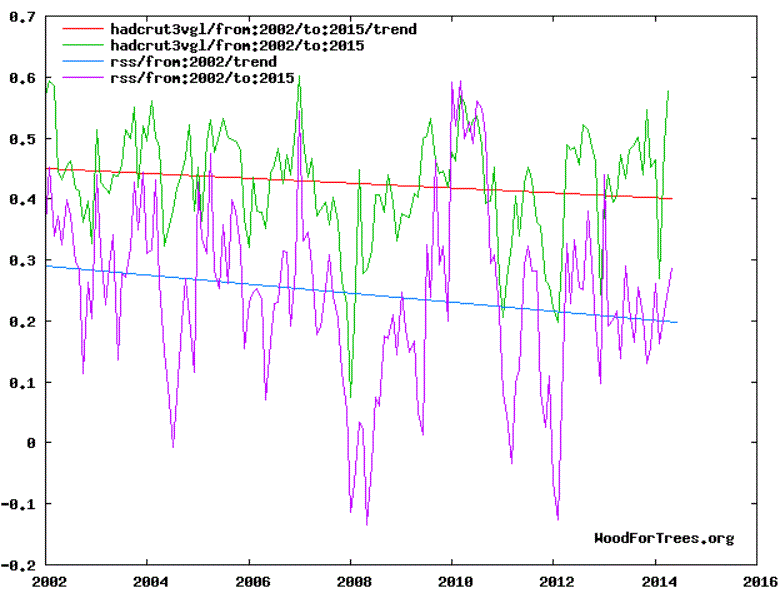
Yet as many scientists are making forecasts of cooling, there’s one fact that seems to have escaped them: the datasets of the world’s leading climate data institutes clearly show that planetary cooling is already taking place and has been happening for over a decade.

2002_Cooling

Chart source: www.woodfortrees.org.

Danish solar scientist Henrik Svensmark recently declared: “Global warming has stopped and a cooling is beginning.” The cold reality, however, is that the cooling actually started 12 years ago!

There are more signs other than temperature readings that show global cooling is in full swing. Antarctica has just set a new record positive sea ice anomaly. Global sea ice has been mostly above average for a year and half, flying in the face of stunned scientists who warned just 5 years ago that the Arctic could soon be ice-free in the summertime. Moreover Asia, Europe and North America have been hard hit by a string of unexpectedly harsh winters.

So how cold is it going to get and for how long?

Although a large number of scientists agree on cooling, they differ widely on how much and for how long.

Geologist and climate researcher Sebastian Lüning of Germany in a just released video forecasts a global cooling of 0.2° by 2030, before it starts to warm up again. However, many scientists see this as too mild of a forecast. Russian solar physicist Habibullo Abdussamatov, for example, predicts another Little Ice Age by 2055. Also Russia’s Pulkovo Observatory claims we “could be in for a cooling period that lasts 200-250 years.”

Long list of experts

At his Climate Depot website, Marc Morano has a list of a number of renowned scientists who believe the data are clear on what’s ahead.

Prominent geologist Dr. Don Easterbrook warns that “global cooling is almost a slam dunk” for up to 30 years or more. The Australian Astronomical Society warns of global cooling as the sun’s activity “significantly diminishes”.

The reason for the cooling? Scientists agree that it’s natural solar and oceanic cycles overpowering the overhyped effects of greenhouse trace-gas CO2.


– See more at: http://notrickszone.com/2014/06/30/forget-global-cooling-predictions-its-already-happening-global-temperature-falling-more-than-a-decade/#sthash.iiRucSUK.dpuf