Green/Greed Energy Act, a Travesty in Ontario!

Projects ‘a disaster’

By Elliot Ferguson, Kingston Whig-Standard

PLEVNA — A Brule Lake resident is challenging some of the arguments the Ontario government is using to support its push to build more renewable energy projects.

Chris Albinson responded to Tuesday’s announcement by the Ontario government that it was launching the second phase of its Large Renewable Procurement.

Phase 2 of the Large Renewable Procurement program announced Tuesday called for up to 930 megawatts of green energy to be added to the province.

Contracts for Phase 1 of the program were offered in March and amounted to about 455 megawatts.

In the announcement, the government said green energy projects had created 42,000 jobs since 2003 and reduced carbon dioxide emissions.

Albinson said neither statements are true and the Liberal government’s Green Energy Act has hurt the province’s economy and increased the cost of electricity for residents and businesses.

“The Green Energy Act was a nice idea that has turned into an economic catastrophe through gross mismanagement and corruption,” he wrote in an email to The Whig-Standard.

Albinson said reports from the province’s auditor general show the expectations about the job creation, environmental benefit and economic value of the renewable energy projects in Ontario are greatly overestimated by the Liberal government.

“Any rational government would look at the facts and the auditor general report and stop the program,” he wrote. “In the bizarre thinking of this government, they are doubling the size of the disaster.”

In 2011, then Ontario auditor general Jim McCarter pointed out that while the Green Energy Act promised 40,000 jobs would be created by renewable energy products, most were short term and that estimate did not account for job losses in other sectors.

“However, about 30,000, or 75 per cent, of these jobs were expected to be construction jobs lasting only from one to three years,” McCarter wrote in his 2011 report.

Government estimates of green energy job creation also did not factor in job losses from other sectors of the economy because of higher electricity prices.

“A 2009 study conducted in Spain found that for each job created through renewable energy programs, about two jobs were lost in other sectors of the economy,” McCarter’s report stated.

Another 2009 study from Denmark noted “that a job created in the renewable sector does not amount to a new job but, rather, usually comes at the expense of a job lost in another sector.” The renewable energy job is often heavily subsidized, the study showed.

Albinson also questioned the government’s assertion that the additional renewable energy will reduce the province’s carbon dioxide emissions.

Again, he referred to reports from the auditor general that showed renewable energy sources — mainly wind and solar — rely on unpredictable weather and must bebacked up by electricity from gas-powered generation stations and nuclear power plants.

In her 2015 report, Ontario auditor general Bonnie Lysyk pointed out that the electricity sector in 2012 produced 14.5 metric tons of carbon dioxide, about nine per cent of the province’s total emissions. Transportation and industry produce 34 per cent and 30 per cent, respectively.

“According to the Ontario Society of Professional Engineers, emission reduction is important, but the cost of reducing emissions from the electricity sector should be evaluated against initiatives taken to reduce emissions from other, higher-emitting sectors such as the transportation industry,” Lysyk wrote.

“Reducing emissions from cars and trucks could very well be more cost-effective than reducing emissions through phasing out coal plants and procuring renewable energy at expensive prices.”

“It is almost as if the Ontario Liberal government has adopted a Donald Trump approach — even if you are lying and everyone knows you are lying, you just have to keep saying it long enough and loud enough that people believe you,” Albinson wrote.
Energy Poverty Killing Thousands in Europe…

Europe’s Wind Power Suicide Pact Killing 40,000 a Year

europe power prices 2

Green Europe is killing 40,000 poor a year
Breitbart
Jame Delingpole
30 March 2016

Europe’s suicidal green energy policies are killing at least 40,000 people a year.

That’s just the number estimated to have died in the winter of 2014 because they were unable to afford fuel bills driven artificially high by renewable energy tariffs.

But the real death toll will certainly be much higher when you take into account the air pollution caused when Germany decided to abandon nuclear power after Fukushima and ramp up its coal-burning instead; and also when you consider the massive increase in diesel pollution –  the result of EU-driven anti-CO2 policies – which may be responsible for as many as 500,000 deaths a year.

But even that 40,000 figure is disgraceful enough, given that greenies are always trying to take the moral high ground and tell us that people who oppose their policies are uncaring and selfish.

It comes from an article in the German online magazine FOCUS aboutEnergiewende (Energy Transition) – the disastrous policy I mentioned earlier this week whereby Germany is committed to abandoning cheap, effective fossil fuel power and converting its economy to expensive, inefficient renewables (aka unreliables) instead.

According to FOCUS around ten percent of the European population are now living in ‘energy poverty’ because electricity prices have risen, on average, by 42 percent in the last eight years. In Germany alone this amounts to seven million households.

The article is titled: The grand electricity lie: why electricity is becoming a luxury.

The reason, of course, is that green energy policies have made it that way. Many of these have emanated from the European Union, which in turn has taken its cue from the most Green-infested nation in Europe – Germany.

Germany has long been obsessed with all things environmental. Besides having invented the dodgy ‘science’ of ecology in the 1880s it was also, of course, between 1933 and 1945 the home of Europe’s official “Greenest government ever” – the first to ban smoking on public transport, an enthusiastic supporter of organic food, national parks and population control.

The Greens have also since the early Eighties been arguably the most influential party in Germany. Though their percentage of the vote has rarely risen above the 10 percent mark, they have punched above their weight either as a coalition partner in government or as a pressure group outside it.

For example, the reason that after Fukushima, Chancellor Angela Merkel completely changed Germany’s policy on nuclear power was her terror of the Greens who were suddenly polling 25 percent of the national vote.

It was the Greens too who were responsible for Energiewende – the policy which is turning Germany into the opposite of what most of us imagine it to be: not the economic powerhouse we’ve been taught to admire all these years, but a gibbering basket case.

This becomes clear in an investigation by the German newspaperHandelsblatt, which reports the horrendous industrial decline brought about by green energy policies.

Hit hardest, of course, are the traditional utilities. After all, the energy transition was designed to seal their coffin. Once the proverbial investment for widows and orphans because their revenue streams were considered rock-solid — these companies have been nothing short of decimated. With 77 nuclear and fossil-fuel power plants taken off the grid in recent years, Germany’s four big utilities — E.ON, RWE, Vattenfall and EnBW — have had to write off a total of €46.2 billion since 2011.

RWE and E.ON alone have debt piles of €28.2 billion and €25.8 billion, respectively, according to the latest company data. Losses at Düsseldorf-based E.ON rose to €6.1 billion for the first three quarters of 2015. Both companies have slashed the dividends on their shares, which have lost up to 76 percent of their value. Regional municipalities, which hold 24 percent of RWE’s shares, are scrambling to plug the holes left in their budgets by the missing dividends.

Thousands of workers have already been let go, disproportionately hitting communities in Germany‘s rust belt that are already struggling with blight. RWE has cut 7,000 jobs since 2011. At E.ON, the work force has shrunk by a third, a loss of over 25,000 jobs. Just as banks spun off their toxic assets and unprofitable operations into “bad banks” during the financial crisis, Germany’s utilities are reorganizing to cut their losses.

Why are the Germans enacting such lunacy? Aren’t they supposed to be the sensible ones?

Well yes, up to a point.

As a seasoned German-watcher explains to me, it’s with good reason that one of Germany’s greatest contributions to the world’s vocabulary is the word Angst.

The Germans are absolutely riddled with it – always have been – and it explains the two otherwise inexplicable policies with which Germany is currently destroying itself.

One, of course, is Energiewende caused by a misplaced, but deeply-held neurosis about stuff like diminishing scarce resources and “global warming” and the evils of Atomkraft (Nuclear power).

The other are its similarly insane immigration policies – the result of the neurosis that if it doesn’t replace its declining population with a supposedly healthy influx of immigrant workers, then it will wither and cease to be the great force it was under people like Frederick the Great, Bismarck and that chap in the 1930s and that no one will know or care where Germany is any more.

Ironically, though, if national decline is what the Germans most fear then the two policies they are pursuing to avoid it happening to be the ones most likely to hasten it.

This is sad. Sad for Germany which, for all its faults, has produced some pretty impressive things over the years: Beethoven; Kraftwerk; Goethe; Porsche; autobahns; those two girls on Deutschland 83.

And even sadder for those of us who, through absolutely no fault of our own happen to be shackled politically and economically to a socialistic superstate called the European Union, most of whose rules are decided by Germans over whom we have no democratic control.

Oh and by the way, Greenies: as I never tire of reminding you, you insufferable tossers, not a single one of the “future generations” you constantly cite in your mantras as justification for your disgusting, immoral and anti-free-market environmental policies actually exists.

But the people you’re killing now as a result of those environmental policies DO exist.

Or rather they did, till you choked or froze them to death, you vile, evil, eco-Nazi scumbags.
Breitbart

Fuel-poverty-activi-005

Wind Scam Always Results in “Energy Poverty”….Heat, or Eat!

Wind Power Costs Crush the Poor

German power prices

The rush to ‘power’ modern economies with a Medieval ‘technology’, abandoned Centuries ago for pretty obvious reasons, has brought with it a banquet of consequences: not least, ‘energy poverty’.

That term is one that has only come into common parlance with the soaring cost of electricity, caused by throwing $billions at a wholly weather dependent power source which, but for those massive subsidies, has NO commercial value whatsoever: wind power operators in Australia’s wind power capital, South Australia, literally pay the grid operator to take their chaotically produced power, andmake a profitfrom the RECs they receive.

There’s an irony in there somewhere, as the ‘policies’ that have wrecked power markets and left grids on the brink of collapse, have been pedalled by so-called political ‘progressives’. However, the only ‘progress’ is towards thoroughly avoidable social and economic misery.

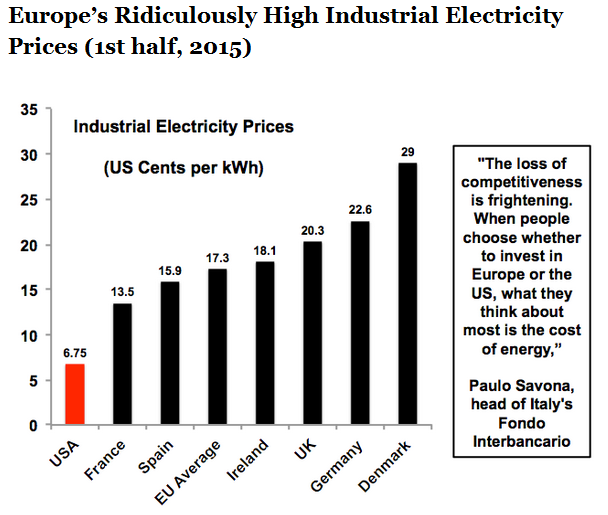
The graph above tells of Germany’s self-inflicted catastrophe, the graph below shows the cause as the wind rushes that broke out, not only in Germany, but in Denmark too.

400fig 1europeelectricprice

Now, here’s a piece from Andrew Follett that tallies up the cost for those who can least afford it.

How the poor bear the brunt of Europe’s obsession with global warming
The Daily Caller
Andrew Follett
25 March 2016

European global warming policies are hurting the continent’s poor, according to a Manhattan Institute study published Thursday.

Europe has tried to fight global warming with cap-and-trade schemes and lucrative financial support to green power since 2005. Though well-meaning, the continent’s environmental efforts have only made life harder for Europe’s poor.

“The European Union’s renewable-energy policies have had one very clear result: they’ve dramatically raised electricity prices,” Robert Bryce, a senior fellow at the Manhattan Institute who authored the study, told The Daily Caller News Foundation.

Between 2005, when Europe adopted these policies, and 2014, residential electricity rates on the continent increased by 63 percent according to the study. Over the same period, residential rates in the U.S. rose by 32 percent. Germany, Spain and the U.K, which intervened the most in their energy markets, saw their electricity bills rise the fastest,according to the study.

The poor tend to spend a higher proportion of their incomes on electricity, gasoline, food and other basic needs. Furthermore, when the price of electricity increases, the cost of producing goods and services that use electricity increases too. Thus, high electricity prices effectively increase the price of most basic goods.

European-style global warming policies hurt the poor 1.4 to 4 times more than they hurt the rich, according to a study by the National Bureau of Economic Research.

“Environmental advocates like to claim that Germany is the role model we should emulate, even though Germany’s residential customers are now paying about 40 cents per kilowatt-hour for their electricity,” Bryce continued. “That’s more than three times the average cost of electricity here in the US.”

Brits alone paid a whopping 54 percent more for electricity than Americans in 2014 while energy taxes cost residents roughly $6.6 billion every year. Green energy subsidies in the U.K regularly exceed spending caps and account for roughly 7 percent of British energy bills, according to government study released last July.

Polling indicates that 38 percent of British households are cutting back essential purchases, like food, to pay for high energy bills. Another 59 percent of homes are worried about how they are going to pay energy bills.

“Policymakers in New York and California, as well as more recently, Oregon, have decided to emulate the EU’s mandates,” Bryce concluded. “If they are concerned about poor and low-income constituents, they should be rethinking those mandates.

The study also illustrates that between 2005 and 2014, Europe reduced its carbon-dioxide emissions by 600 million tons per year. Over that same period, the combined emissions of China, India, Indonesia, and Brazil increased by 4.7 billion tons per year, or nearly eight times the reduction achieved in Europe.
Daily Caller

bread and water for dinner

Definition of “Wind Turbines”….from an “Honest Encyclopedia”

Wind turbine:

Wind turbine.jpg

Wind turbine is the modern day windmill which is marketed as a clean energy solution to replace power from fossil fuel plants. The addition of multiple wind turbines in the same geographical location is referred to as a wind farm. The sales pitch…wind turbines power millions of homes with wonderful “free” energy. The truth is a much different story. “The wind power industry claims switching from conventional power to wind power will save consumers money and spur the economy. However, data from the top 10 wind power states show just the opposite.” [1]

Cost breakdown

Wind energy from turbines are power generating losers when compared to other technologies such as coal, hydro, gas and nuclear. One giant downside is no wind, no power generation. Sources say you need at least 10MPH wind speed to generate power and speeds in excess of 50MPH will shut down turbines to prevent damage. [2] Industry promoters often paint a rosy picture of the benefits of wind power when other sources claim as little as 8% of usable generation.

Not widely known but wind turbines actually use electricity from the grid (coal/gas/hydro/nuclear) to power their hydraulic systems that keep the blades facing in the same direction as the wind. In freezing weather conditions, electricity from the grid is used to keep the bladesspinning at low speeds as a method of de-icing.

The misconception is that youinstall a wind turbine and it will pay itself off within a decade. From that point out, it is a net energy gain at a fraction of a cost. Nothing can be further from the truth. Constant costs are involved to maintain these mechanical structures; Overheating bearings, plastic that melts, gallons of brake oil leaking, gallons of hydraulic fluid leaking, [3] blades that fall off, towers that collapse, replacement of yaw gear drives, bearings, gearboxes, and generators. The cost to put out wind turbine fires, some self-extinguish themselves out but others need fire departments to extinguish turbines and put out the brush fires below.

The cost to manufacture wind turbines prevents any offset gained transitioning to a ‘clean’ energy environment. [4]

A two-megawatt windmill contains 260 tonnes of steel requiring 170 tonnes of coking coal and 300 tonnes of iron ore, all mined, transported and produced by hydrocarbons.

Landscape, seascape wildlife costs are a major downside to power from wind. Eagles, bats, birds of all kinds are killed in the thousands by wind blades. Their rotting carcasses litter the ground below. Estimates place the number of birds killed by wind turbines at 30 million per year. [5]

In Ontario Canada, every turbine destroys 3 acres of land, roughly 21,000 acres of farmland. [6]

Wind Turbine Syndrome

Many people living within 2 km (1.25 miles) of thesespinning giants get sick says a peer-reviewed study by the Johns Hopkins University School of Medicine. [7] Low frequency noise and infrasound appear to be the chief disease-causing culprit according to Dr. Nina Pierpont. In Wisconsin, a study showed noise emanating from the turbines was detectable inside homes within a 6.2-mile radius of the industrial wind plant and declared wind turbines a health hazard. [8]

Government Subsidies and Crony Capitalists

Billions of taxpayer dollars are being shoveled into this inefficient scheme in order to promote Global Warming agendas at the expense of real power sources and the tens of thousands of jobs they replace. Government subsidies keep the growth of wind turbine construction alive and keep this technology running afterinstalled. Without government financial involvement, wind turbines become to costly to operate, go idle and start rusting the landscape. Without government funding, investors sell theirinvestments and shelve plans to expand.[9] The UK’s Labour party insists that wind turbines can’tmake a profit without subsidies. [10] Tax credits are given to companies that manufacture, to companies thatinstall/maintain, to municipalities that own the property. The IRS is giving away $13 Billion per year in wind energy subsidies.[11]

The world’s biggest billion dollar corporations, such as General Electric and Siemens, are reaping the investments made in subsidized wind turbine construction. The U.S. government has laid the groundwork for an endless welfare system devoted to big wind companies. [12]

See also

External links

References

  1. Jump up Electricity Prices Soaring In Top Wind Power States, Forbes, October 17, 2014
  2. Jump up AS BRITAIN FREEZES, WIND FARMS TAKE POWER FROM GRID TO PREVENT ICING, Breitbart.com. January 2, 2015
  3. Jump up 2 Year Old Siemens Turbines Falling Apart: Wind Farm Investors, Get Out While You Can, Stopthesethings.com, Febuary 1, 2015
  4. Jump up Carbon Shift: How Peak Oil and the Climate Crisis Will Change Canada (and Our Lives), Author Thomas Homer-Dixon, 2010
  5. Jump up RIP STEFAN THE STORK – ONE OF 30 MILLION BIRDS KILLED BY WIND FARMS EVERY YEAR, Breitbart, August 17, 2015
  6. Jump up Wind Ontario
  7. Jump up Wind Turbine Syndrome
  8. Jump up Wisconsin Wind Turbines Declared Health Hazard, Michigan Capitol Confidential, November 8, 2014
  9. Jump up Wind Energy’s Ghosts, American Thinker, February 15, 2010
  10. Jump up Tories to end onshore windfarm subsidies in 2016, The Guardian,June 18, 2015
  11. Jump up The IRS Is Giving Away $13 Billion A Year In Wind Energy Subsidies, Without Congressional Authorization, Forbes
  12. Jump up What do we have to show for government subsidies of wind power?, TheHill, February 24,2015

It Should Never Have Taken This Long, to Stop the Windscam!

08/04/16

German Government ‘Plans To Stop

And Reverse Wind Power’

China Plans To Export

Cheap Energy To Europe

If the green energy plans by the German Federal Government are implemented, the expansion of onshore wind energy will soon come to a standstill and then go into reverse. In early March, German Economy Minister Sigmar Gabriel presented a draft for the amendment of the Renewable Energies Act (EEG). The new rules regulate the subsidy levels for renewable energy. The new regulations are to be adopted in coming months. A study by consultants ERA on behalf of the Green Party’s parliamentary group concludes that under these provisions the development of wind energy will collapse fairly soon. –Frank-Thomas Wenzel, Berliner Zeitung, 7 April 2016

China’s proposed investments in long-distance, ultra-high voltage (UHV) power transmission lines will pave the way for power exports as far as Germany, the head of the national power grid said on Tuesday as he launched an initiative for cross-border power connections. Talk of exporting power is a reversal for China, which as recently as 2004 suffered rolling blackouts across its manufacturing heartland. But huge investments in power in the decade since, and the construction of a number of dams, nuclear reactors and coal-fired plants due to begin operating in the next 10 years, mean the country faces a growing surplus. –Lucy Hornby, Financial Times, 31 March 2016

Renewables….Never More than “Novelty Energy”!

Renewables are useless: The Evidence is Overwhelming

de-icing-wind-turbine

Guest essay by Eric Worrall

Al Gore has a problem. He seems to want people to believe that only climate skeptics oppose renewables. The truth is, a small but growing number of prominent greens, openly acknowledge that renewables in their current form are not a scalable replacement for fossil fuels.

In Al Gore’s announcement of a climate witch hunt, titled “AGs United for Clean Power”, Al Gore said the following;

I really believe that years from now, this convening by attorney general Eric Schneiderman and his colleagues today, may well be looked back upon as a real turning point, in the effort to hold to account those commercial interests that have been, according to the best available evidence, deceiving the American people, communicating in a fraudulent way, both about the reality of the climate crisis and the dangers it poses to all of us, and committing fraud in their communications about the viability of renewable energy and efficiency, and energy storage, that together are posing this great competitive challenge to the long reliance on carbon based fuels.

Does Al Gore plan to prosecute James Hansen, Kerry Emanuel, Ken Caldeira and Tom Wigley for Fraud?

To solve the climate problem, policy must be based on facts and not on prejudice. The climate system cares about greenhouse gas emissions – not about whether energy comes from renewable power or abundant nuclear power. Some have argued that it is feasible to meet all of our energy needs with renewables. The 100% renewable scenarios downplay or ignore the intermittency issue by making unrealistic technical assumptions, and can contain high levels of biomass and hydroelectric power at the expense of true sustainability. Large amounts of nuclear power would make it much easier for solar and wind to close the energy gap.

Read more: http://www.theguardian.com/environment/2015/dec/03/nuclear-power-paves-the-only-viable-path-forward-on-climate-change

Will the green believers at Google Corporation join James Hansen in the dock, when Al Gore prosecutes people who think renewables are not up to the job?

At the start of RE<C, we had shared the attitude of many stalwart environmentalists: We felt that with steady improvements to today’s renewable energy technologies, our society could stave off catastrophic climate change. We now know that to be a false hope … Renewable energy technologies simply won’t work; we need a fundamentally different approach.

Read more: http://wattsupwiththat.com/2014/11/22/shocker-top-google-engineers-say-renewable-energy-simply-wont-work/

Will Al Gore prosecute Rob Parker, president of the Australian Nuclear Association, for claiming renewables aren’t up to the job?

“My concern is that renewables won’t get us across the line in terms of emissions reduction,” said Rob Parker, the president of the ANA. “Nuclear is more reliable and it has a smaller resources footprint than renewables.

Read more: http://wattsupwiththat.com/2015/09/29/aussie-nuclear-industry-renewables-wont-get-us-across-the-line/

How about the British Government, whose relentless pursuit of renewables has utterly messed up the British energy market?

The second phase of modern energy policy began when Tony Blair signed the Renewable Energy Target in 2007.

What has this left us with?

We now have an electricity system where no form of power generation, not even gas-fired power stations, can be built without government intervention.

And a legacy of ageing, often unreliable plant.

Perversely, even with the huge growth in renewables, our dependence on coal, the dirtiest fossil fuel, hasn’t been reduced.

Read more: https://www.gov.uk/government/speeches/amber-rudds-speech-on-a-new-direction-for-uk-energy-policy

If Al Gore succeeds in using government bullying, to silence critics of renewables, the same disaster could easily occur in the United States.

Perhaps Al Gore’s real target are the practitioners of the “strange new form of denial”, the growing green schism which opposes the push for 100% renewables, as vigorously as any climate skeptic.

There is no evidence that renewables in their current form are a viable replacement for fossil fuels. But there is plenty of evidence that nuclear power delivers results. Nuclear power, the zero emission alternative to renewables, has been economically supplying 75% of France’s power since the 1970s. Nuclear power works, and works well. France demonstrated by doing, that mass production and economies of scale makes nuclear power affordable.

If the whole world copied what France did in the 1970s, by 2030 the world could cut billions of tons of CO2 emissions, without destroying the global economy.

If you are someone who cares about CO2 reductions, you should listen to scientists like James Hansen, who plausibly claim that nuclear power is the route to decarbonisation, not to scientific illiterates like Al Gore.

Wind Turbines Harmful for Livestock, Too!

The Effect of Varying Distances from the Wind Turbine on Meat Quality of Growing-Finishing Pigs

“Avoiding noise-induced stress is important not only for maintaining meat quality but also for improving animal welfare.”

By Małgorzata Karwowska, Jan Mikołajczak, Zbigniew Józef Dolatowski and Sylwester Borowski
© by Małgorzata Karwowska. This work is licensed under CC BY-NC-ND 4.0

Abstract

This study was conducted to assess the effect of rearing pigs at three different distances from a wind turbine (50, 500 and 1000 m) on the physicochemical properties and fatty acid composition of loin and neck muscles. The experiment was carried out on 30 growing-finishing pigs, derived from Polish Landrace × Polish Large White sows mated to a Duroc × Pietrain boar. The results obtained during the noise measurement showed that the highest level of noise in the audible and infrasound range was recorded 50 m from the wind turbine. Rearing pigs in close proximity to the wind turbine (50 m) resulted in decreased muscle pH, total heme pigments and heme iron as well as reduced content of C18:3n-3 fatty acid in the loin muscle. Loins of pigs reared 50 m from the wind turbine were characterized by significantly lower iron content (6.7 ppm g–1) compared to the loins of pigs reared 500 and 1000 m from the wind turbine (10.0–10.5 ppm g–1). The concentration of α-linolenic acid (C18:3n-3) in loin and neck muscles decreased as the distance from the wind turbine increased. Avoiding noise-induced stress is important not only for maintaining meat quality but also for improving animal welfare.

[…]

Summary

In summary, a significant negative influence of noise generated by the wind turbine with a capacity of 2 MW on the quality of growing-finishing pig loin muscles was determined. Rearing growing-finishing pigs in close proximity to the wind turbine resulted in lower pH, total heme pigments and heme iron as well as lower content of C18:3n-3 fatty acid of loin muscles. In this sense, it is crucial to reduce the exposure of animals to noise generated by wind turbines in order to avoid negative effects on meat quality.

Australian Researchers To Study Health Effects from Wind Turbines.

NHMRC awards funding into wind farms and human health

The National Health and Medical Research Council (NHMRC) has awarded two grants totalling $3.3 million to enrich the evidence-based understanding of the effects of wind farms on human health.

Anne Kelso
NHMRC CEO Professor Anne Kelso

NHMRC CEO Professor Anne Kelso noted that further research is needed to explore the relationships between wind farms and human health.

“Existing research in this area is of poor quality and targeted funding is warranted to support high quality, independent research on this issue.

“To address this, we need well designed studies conducted by excellent researchers in Australian conditions.

“These grants directly support the Australian Government’s commitment to determine any actual or potential effects of wind farms,” Professor Kelso said.

NHMRC funded research at the Flinders University of South Australia will explore relationships between noise from wind farms and effects such as annoyances and reduced sleep and quality of life.

Research at the University of New South Wales will investigate the broader social and environmental circumstances that may influence the health of people living near wind farms.

The outcomes of this research will assist in developing policy and public health recommendations regarding wind turbine development and operations in Australia.

Professor Kelso said it was important to note that the funding will support only high quality, well designed research proposals.

“NHMRC supports only the most outstanding research. Each application for this funding underwent the same stringent independent review process we apply to all NHMRC grant applications,” Professor Kelso said.

These grants are awarded in response to the 2015 Targeted Call for Research into Wind Farms and Human Health, following the release of the NHMRC Statement: Evidence on Wind Farms and Human Health.

Information relating to the individual grants is available on the NHMRC website –nhmrc.gov.au

Contact: NHMRC Media Team (0422 008 512 or media@nhmrc.gov.au)

Grant highlights

Associate Professor Peter Catcheside, Flinders University of South Australia
$1,357,652

Good sleep is essential for normal daytime functioning and health. Wind farm noise includes audible and unusually low frequency sound components, including infrasound, which could potentially disturb sleep through chronic sleep disruption and/or insomnia. This project will, for the first time, directly evaluate the sleep and physiological disturbance characteristics of wind farm noise compared to traffic noise reproduced in a specialised and carefully controlled laboratory environment.

Professor Guy Marks, University of New South Wales
$1,943,934

The human health impact of infrasound that comes from wind turbines has not been well researched. This project will assemble a team of researchers with a broad range of expertise to run a short term and longer term study to investigate whether exposure to infrasound causes health problems. The short term study will be laboratory-based and run for three one week periods. The longer term study will be community based and run for six months. Sleep quality, balance, mood, and cardiovascular health will all be measured.

Download the media release

Windpushers Destroying Economies World-Wide…Energy Poverty!

How Massively Subsidised Wind Power Destroys Power Markets & Economies

economics101

Wind and solar have destroyed the ability of the market to signal price
The Telegraph
Rupert Darwall
7 March 2016

Before the election, high electricity prices made the Big Six energy companies everyone’s favourite whipping boys. A report by the competition watchdog exonerated them. Government-driven social, environmental and network costs were the main drivers of rising electricity bills, the Competition and Markets Authority found. Now the Big Six have put themselves squarely back in the frame.

A 125-page report by the electricity industry lobby group, Energy UK, supports phasing out cheap coal power and demands more subsidies for wind and solar.

It is a high-risk strategy. In capitulating to “Big wind” and solar, the Big Six energy companies have no one to blame but themselves for the heightened political risk caused by rising electricity prices and theinevitable consumer backlash.

Weather-dependent wind and solar power is inherently unreliable and high cost. In addition to subsidies, wind and solar need more grid infrastructure. When the wind blows and the sun shines, they swamp the grid with zero marginal cost electricity, forcing gas, coal and nuclear to reduce their output.

Lower prices and lower output demolish the investment case for building the gas-fired power stations the Government says are vital. These hidden costs are the real killer.

As Amber Rudd, the energy and climate secretary, observed in her “smell the coffee speech” last November, “we now have an electricity system where no form of power generation, not even gas-fired power stations, can be built without government intervention”.

Advocates of wind and solar claim falling costs mean renewables will soon reach “grid parity”. Anyone who knows anything about electricity understands this is highly misleading.

To its great discredit, the Big Six report peddles the grid-parity fib, which ignores the hidden costs imposed on the rest of the system. Rather lamely, the report calls for government and industry to conduct further analysis on the whole-system costs of weather-dependent renewables, something it very well could have done itself.

While the Government insulates wind and solar investors from the damaging effect their output has on the market, the report admits that wind and solar have destroyed the ability of the wholesale market to provide price signals to guide investment decisions.

It envisages more wind and solar on the grid, leading to more electricity priced as garbage that consumers are forced to pay someone else to take away during periods of negative prices.

Since last summer, almost 8.5 gigawatts of conventional capacity has closed or faces closure. In 2014, the Big Six made £556m from renewables and lost £1,615m on their gas and coal-fired power stations.

Without cheap electrical storage, wind and solar can’t keep the lights on. The report foresees storage as the “single most important technological breakthrough” likely in the next 15 years. One thing’s for sure. It hasn’t happened yet.

Thanks to government policies deliberately distorting the market, wehave over-invested in wind and solar. It has blighted investment in reliable capacity that can keep the lights on.

This is the crux of Britain’s energy crunch. Clearly it was a colossal mistake to have embarked on renewables with storage unsolved.

The Big Six could have drawn attention to a situation where, in a world awash with hydrocarbons, Britain has an increasing shortage of generating capacity. There is no shortage of energy in the world. Oil prices have been falling. Last month, the US started exporting natural gas for the first time. In the first decade of electricity privatisation, around half Britain’s generating capacity was renewed. The market worked.

Now that the market has been destroyed, the real choice is between finding a path back to the market or accepting the Government is running the show. Private ownership and state control is the worst of all worlds.

Political risk is borne by the private sector, which in turn means higher electricity bills. Financial efficiency would see new investment being funded off the Government’s balance sheet and reinstating the Central Electricity Generating Board. Instead, the Big Six report calls for more honesty about the impact of more renewables on electricity bills without providing any itself. For the industry, higher bills are primarily a PR problem to be solved by better communication.

Energy UK’s chief, Lawrence Slade, goes out on a limb in advocating a British equivalent of Germany’s disastrous Energiewende (Energy Transition). In 2004, the Green energy minister, Jürgen Trittin, claimed that the extra cost of renewable energy on monthly bills was equivalent to the cost of a scoop of ice cream.

Nine years later, CDU minister Peter Altmaier said Energiewende could cost around €1 trillion by the end of the 2030s. The cost of feed-in tariffs and other subsidies is currently €21.8bn a year; €20bn is being spent on a new north-south high voltage line and investment in other grid infrastructure is likely to double that number.

Thanks to the high volatility of wind and solar output, 25pc of Germany’s green energy is dumped on other countries at low or negative prices, destabilising the grid of Germany’s neighbours. At home, the situation is just as serious.

In 2013, 345,000 households could not pay their electricity bills. In January 2014, Deutsche Bank warned that Germany’s energy cost penalty was already eroding its industrial base.

In a 2013 survey by the German Chambers of Commerce, over half of industrial companies reported that Energiewende was having a negative or very negative impact on their competitiveness.

To see a successful energy transformation, you have to look across the Atlantic. In the most telling indication of the Big Six surrender to the green lobby, there is not a single mention of fracking and the US shale revolution. But, as the report states, it is assumed that the UK remains part of the European Union and continues to try to meet its legally binding renewable energy targets for 2020 under the 2009 renewable energy directive. The underlying message from the Big Six is clear: if you want lower electricity bills, vote leave.

Rupert Darwall is the author of The Age of Global Warming: A History (Quartet, 2013)
The Telegraph

Rupert Darwall

Press Release, from Denmark, WI – Brown County Residents for Responsible Wind Energy

FOR IMMEDIATE RELEASE*** March 20, 2016

County Health Officer Admits Feeling Ill When Near Duke’s Shirley Wind Turbines DENMARK, WI – Brown County appears to be digging a deeper and deeper hole for itself as more facts come to light surrounding Duke Energy’s Shirley Windpower. After an unusually long almost 3 month delay in satisfying a resident’s open records request, the records ultimately provided expose that former Brown County Health Officer Chua Xiong feels ill when visiting the Shirley Wind facility. In an email to her intern Carolyn Harvey she states: “Carolyn the times I have been out there by the Wind Turbines, l get such migraine headaches. I think I should take some preventative Tylenol before I head out there.” Despite this admission, approximately one month later Ms. Xiong went on to make her declaration that “Currently there is insufficient scientific evidence-based research to support the relationship between wind turbines and health concerns.” She then went further in saying that this was her “final decision” and that she would only monitor the situation “on an annual basis”. In this decision she completely ignored the real world health impact of Duke Energy’s wind turbines on Brown County families as evidenced through their sworn affidavits and their documentation of past and continued suffering, not to mention her own repeated migraines when in proximity to Duke’s turbines. So what has happened between Ms. Xiong’s declaration and the March 18th release of the open records showing that Brown County’s Health Officer Chua Xiong suffers migraines when she is by the Shirley Wind turbines? On March 4th, Ms. Xiong submitted her resignation to County Executive Troy Streckenbach. He did not share this with County department heads until just two days prior to March 18th, Ms. Xiong’s last day. This date also coincides with Executive Streckenbach’s announcement of Brown County Corporation Counsel Juliana Ruenzel’s resignation. It is high time that Brown County and its Health Director follow the lead of its own Board of Health who unanimously declared Duke’s wind turbines in Glenmore a “Human Health Hazard”. They need to recognize that residents are sick, homes have been abandoned, that outsiders (even the County’s own Health Director) feel ill while in the project area, and FINALLY do whatever is necessary to protect the health and safety of southern Brown County residents. Brown County does not need Shirley Wind to become its Flint, Michigan. Until the County does the right thing and takes action, families will continue to suffer, the County’s inaction will escalate their legal liability, and this issue will not go away.

Denmark, WI   54208                                                                                                        www.BCCRWE.com