Bill Weir, from CNN, Proves that “Emotion, not Logic”, rules Climate Alarmists!

The ‘Gore effect’ turns ugly – CNN climate bias revealed

You know of the “Gore effect“, Wikipedia describes it as  “…an informal and satirical term which alleges a causal relationship between unseasonable cold weather phenomena and global warming activism”, so it was appropriate to apply to the situation where the Gore’s Climate Reality Project group tried a political ploys that looked stupid: “I’m Too Hot” trucks and offers of free ice cream to this week’s Environmental Protection Agency hearings on power-plant emissions…when it was 58 degrees and raining. Obviously, CNN’s Bill Weir doesn’t understand satire, much less how to be a professional journalist.

From Mediaite:

It’s safe to say CNN anchor Bill Weir is not a fan of climate change deniers.

On Thursday, the Twitter account for Fox Nation, a blog run by Fox News, tweeted a link to a post headlined, “Climate Doesn’t Cooperate With Al Gore’s Group’s Visit to Denver EPA Hearings.”

The story, aggregated from the Washington Times, relates to a Denver visit by former Vice President Al Gore‘s “Climate Reality Project” for EPA hearings on power plant emissions.

The group showed up to hand out ice cream even though it was 58 degrees.

Weir retweeted the link, with his own comment: “Weather is not climate, you willfully ignorant fucksticks.”

BillWeir

[ Twitter: https://twitter.com/BillWeirCNN/status/494670062092296192 ]

==============================================================

One wonders why he didn’t say same the same thing about Gore and his ice-cream trucks to treat the “I’m too hot” weather that never materialized. Oh, yeah, bias.

This is probably the best reason ever to tune out CNN, when they hire emotional children like this instead of journalistic professionals, it’s pretty much pointless to watch any longer.

After what I experienced recently, I’m beginning to think that most climate alarmists are nothing more than emotional children disguising themselves as professionals.

UPDATE: I posted this short message, twice. It was deleted both times, but the second time I saved a screen cap. Apparently Bill Weir has an ego that is easily bruised, or there’s somebody at CNN running interference.

BillWeir_deleted

You can look here as see that it is now missing.

[ Twitter: https://twitter.com/BillWeirCNN/status/494670062092296192 ]

Class act, guys. No bias there at CNN.

Agenda 21 Rears It’s Ugly Head! Do Not Let These People On Your Property!

The Curious Story of the MNR and the University of Waterloo by Shirley Dolan

Published August 1, 2014 

Last month Donna Burns wrote about a scheme cooked up by the Ministry of Natural Resources (MNR) that involved a company called Thunderhouse Forest Services (TFS) from Hearst Ontario whereby TFS, with the support of MNR, were studying trees and species habitat on private property – without the permission of the property owner. See the full story here. The study seemed to be taking place mostly in Renfrew County. We now have a similar story coming from Landowners in the Niagara Region – and it is very bizarre!

The MNR administers two programs for eligible landowners: Conservation Land Tax Incentive Program (CLTIP) and Managed Forest Tax Incentive Program (MFTIP). These two voluntary programs are available to landowners and offer 100% tax exception in the case of the CLTIP and 25% of the municipal tax rate for the MFTIP if the property owner is eligible and complies with the program’s land use restrictions.

Landowners in Ontario have been receiving letters from the University of Waterloo School of Planning, requesting their participation in a research project investigating landowners’ views on these two programs. According to a letter sent to the sampled landowners, the study has the support of the MNR, and according to information about the study, the participants’ names and addresses were drawn from the MNR’s database of CLTIP and MFTIP eligible landowners. Eligible appears to mean “could qualify for the program but not necessarily in the program”. Did you know the MNR keeps a list of landowners who might be eligible for these two programs?

The information sheet goes on to say that “It is anticipated that the results from the study will in time assist decision-making as well as design and administration of programs in order to promote successful environmental stewardship on private lands in Ontario”. This statement combined with the fact that the survey director is from the University of Waterloo School of Planning should set off warning bells with anyone who has received a request to participate in the study.

The story gets even more twisted. The study is funded by the Social Sciences and Humanities Research Council of Canada (SSHRC). Ever heard of them? I hadn’t, so I had a look at their website where it says: leading initiatives that reflect a commitment to ensuring a better future for Canada and the world.

Created by an act of Canada’s Parliament in 1977, SSHRC reports to Parliament through the Minister of Industry.”

Curiouser and curiouser! I’m not sure how the University of Waterloo’s study fits with this mandate, but part of the funding provided by SSHRC was distributed in the form of $5 bills included in the letter sent to the 1200 landowners selected to participate in the study. If this wasn’t bizarre enough, the letter goes on to say that “… because of the rules of the Revenue Canada Agency, we have to let you know that the amount received is taxable and that it is your responsibility to report this amount for income tax purposes.”

So let me get this straight: the University of Waterloo School of Planning is conducting a survey, with the support of the MNR, funded by a federal agency SSHRC, and part of the incentive to participate is an unsolicited gift of $5 of our tax money. And the objective is to learn how to better promote control of private property (my interpretation). Further, the landowner has to remember to claim that $5 bill on his income tax.

Stay tuned! This story warrants more research.

You can’t Play Nice, With Liars and Crooks!

Understanding The Divergence Problem

An amazing story of scientific fraud. Probably the biggest scientific fraud in history.

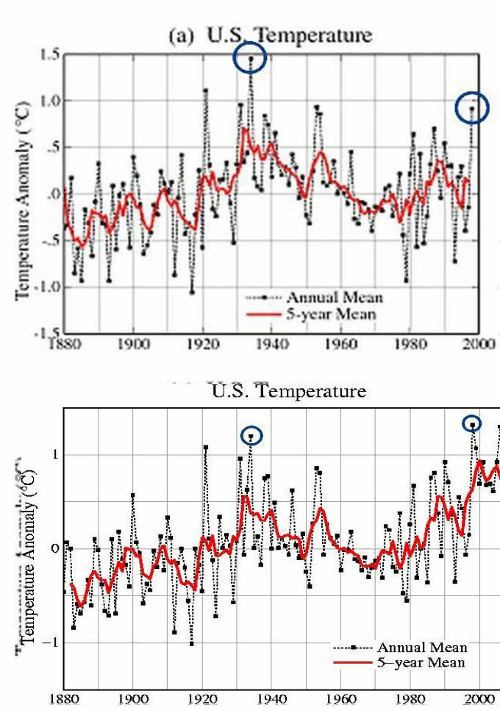
As of 1975, both the instrumental and the tree ring data showed sharp cooling from 1940 to 1970

ScreenHunter_166 Mar. 02 23.33

1975 National Academy of Sciences

screenhunter_165-mar-02-23-27

Briffa’s Trees

The next graph overlays Briffa’s trees on the 1975 National Academy of Sciences graph. Almost a perfect match.

ScreenHunter_168 Mar. 02 23.38

NOAA radiosonde data from the 1070’s also showed the sharp cooling

ScreenHunter_1484 Jul. 31 23.41

There was a unanimous consensus of scientists for global cooling

ScreenHunter_92 Feb. 03 07.49

SCIENTISTS AGREE WORLD IS COLDER – But Climate Experts Meeting Here Fail to Agree on Reasons for Change – View Article – NYTimes.com

None of this fit the global warming agenda, so they simply changed the temperature record to “remove the 1940’s blip” and eliminate the post-1940 cooling.

ScreenHunter_1485 Jul. 31 23.46

After massively altering the temperature record, they were then able to delete Briffa’s trees – by claiming that they didn’t match the massively altered surface record. Deleting Briffa’s trees opened the door for Mikey to make his Hokey Stick, and an even larger bonus was that it gave the team an excuse to turn the US cooling trend into a warming trend – because it didn’t match their massively altered global temperature trend.

Some skeptics believe they are being good citizens, by playing nicely with the crooks behind this fraud.

Watermelons….Faux-green on the outside, Communist-red, on the Inside!

Cloak of Green The Links between Key Environmental Groups, Government and Big Business

This book was published in 1995 and after you read it you will never look at the Green Movement or your govt. the same way again. A massive con of the public by the Greens, govt. and the media. One world govt. is the end game for these groups. Follow the link at the bottom of the page to read the book online, get it at your library or order a copy, but read the book. Follow your tax dollars.

Now that Elizabeth May is in politics, and presumably hoping to attract progressive-minded people, she will have to live down her reputation, so caustically described by Elaine Dewar in her book, Cloak of Green, about the environmental movement, of being on all sides at the same time.

Dewar first ran into May when she (May) was a member of the Canadian government delegation to the preparatory meeting in Nairobi for the upcoming Rio summit on the environment. Since May was national director of the Sierra Club, as well as executive director of Cultural Survival Canada, Dewar found this rather puzzling. After a little further questioning Dewar came to the conclusion that May had become an NGO interface with government.Rogelio A. Maduro 21st Century Science and Technology : “Cloak of Green… is a devastating expose of the shady finances of the international environmental movement… if you’ve been snookered into supporting the groups that raise money to prevent environmental doomsdays, this book just might help save your money for real causes.”

Publishers Weekly : “Cloak of Green probed the dark underbrush of environmental politics…”

Joe Woodard BC Report : “This is a must-read for anyone interested in environmentalism and the “global environment” movement…this account of [the author’s] determined four-year journey through environmentalism is a triumph of truth over ideology.

Cloak of Green is truly honest reporting of a threatening future.”

Book Description
Most concerned citizens trust environmental groups to fight on behalf of the public for sensible solutions to the world’s most pressing problems. But Elaine Dewar discovered that this trust is often misplaced.

In this book the award-winning journalist explores links between key environmental groups, government and big business. Written like a mystery, Cloak of Green follows the author from a Toronto fundraiser for the Kayapo Indians of Brazil to the Amazon rainforest and the global backrooms of Brasilia, Washington and Geneva. Along the way she meets some fascinating people–Anita Roddick of the Body Shop, businessman-politican Maurice Strong, and activists who run key Canadian and American environmental groups. She discovers some disturbing revelations about these groups and their relations to “green” corporations and government.

Cloak of Green is a penetrating investigative study that challenges many established pieties of the environmental movement.

About the Author
ELAINE DEWAR is a prominent journalist and author with many National Magazine Awards to her credit.Cloak of Green can be read on line here

Renewable energy scam! Far Too Much Pain…..Far Too Little Gain!

Renewable energy is not working

Too much cost, not enough output or too little emissions reduction

My Times Column explores why renewable energy has been so disappointing.

On Saturday my train was diverted by engineering works near Doncaster. We trundled past some shiny new freight wagons decorated with a slogan: “Drax — powering tomorrow: carrying sustainable biomass for cost-effective renewable power”. Serendipitously, I was at that moment reading a reportby the chief scientist at the Department of Energy and Climate Change on the burning of wood in Yorkshire power stations such as Drax. And I was feeling vindicated.

A year ago I wrote in these pages that it made no sense for the consumer to subsidise the burning of American wood in place of coal, since wood produces more carbon dioxide for each kilowatt-hour of electricity. The forests being harvested would take four to ten decades to regrow, and this is the precise period over which we are supposed to expect dangerous global warming to emerge. It makes no sense to steal beetles’ lunch, transport it halfway round the world, burning diesel as you do so, and charge hard-pressed consumers double the price for the power it generates.

There was a howl of protest on the letters page from the chief executive of Drax power station, which burns a million tonnes of imported North American wood a year and plans to increase that to 7 million tonnes by 2016. But last week, Dr David MacKay’s report vindicated me. If the wood comes from whole trees, as much of it does, then the effect could be to increase carbon dioxide emissions, he finds, even compared with coal. And that’s allowing for the regrowth of forests.

Despite the best efforts of the Conservatives to rein in their Lib Dem colleagues, the renewable-energy bandwagon careers onward, costing ever more money and doing real environmental harm, while producing trivial quantities of energy and risking blackouts next winter. People keep telling me it’s no good being rude about all renewables: some must be better than others. Well, I’m still looking:

Tidal power remains a (literal) non-starter; if you ask ministers why nothing has been built, they say it’s not for want of proffering ludicrously generous subsidies on our behalf. Yet still no takers.

Wave power: again, the sky’s the limit for what the government will pay if you can figure out how to make dynamos and generators survive the buffeting of waves, corrosion of salt and encrustation of barnacles. Nothing doing.

Geothermal: perhaps great potential in the future for heating homes through district heating schemes, though expensive here compared with Iceland, but not much use for electricity. Air-source and ground-source heat pumps, all the rage a few years ago, have generally proved more costly and less effective than advertised, but they are getting better. Trivial contribution so far.

Solar power: one day soon it will make a big impact in sunny countries, and the price is falling fast, but generating for the grid in cloudy Britain where most power is needed on dark winter evenings will probably never make economic sense. Covering fields in Devon with solar panels today is just ecological and economic vandalism. Solar provides about a third of one per cent of world energy.

Offshore wind: Britain is the world leader, meaning we are the only ones foolish enough to pay the huge subsidies (treble the going rate for electricity) to lure foreign companies into tackling the challenge of erecting and maintaining 700ft metal towers in stormy seas. The good news is that the budget for subsidising offshore wind has almost run out. The bad news is that it is already costing us billions a year and ruining coastal views.

Onshore wind: one of the cheapest renewables but still twice as costly as gas or coal, it kills eagles and bats, harms tourism, divides communities and takes up lots of space. The money goes from the poor to the rich, and the carbon dioxide saving is tiny, because of the low density of wind and the need to back it up with diesel generators. These too now need subsidy because they cannot run at full capacity.

Hydro: cheap, reliable and predictable, providing 6 per cent of world energy, but with no possibility for significant expansion in Britain. The current vogue for in-stream generation in lowland streams in England will produce ridiculously little power while messing up the migration of fish.

Anaerobic digestion: a lucrative way of subsidising farmers (yet again) to grow perfectly good food for burning instead of eating. Contrary to myth, nearly all the energy comes from crops such as maize (once fermented into gas), not from food waste. Expensive.

Waste incineration: a great idea. Yet we are currently paying other countries to take it off our hands and burn it overseas. If instead we burned it at home, we would make cheap, reliable electricity. But Nimbys won’t let us.

Over the past ten years the world has invested more than $600 billion in wind power and $700 billion in solar power. Yet the total contribution those two technologies are now making to the world primary energy supply is still less than 2 per cent. Ouch.

If we had spent that sum on research, and steadily replaced coal with gas as a source of electricity, we would have done far more to cut carbon emissions and kept prices low. A new report by Charles Frank of the Brookings Institution has come to the startling conclusion that if you encourage gas to replace coal, you get fewer emissions per dollar spent than if you use wind or solar.

In Mr Frank’s words: “Solar and wind facilities suffer from a very high capacity cost per megawatt, very low capacity factors and low reliability, which result in low avoided emissions and low avoided energy cost per dollar invested.” In short, we are picking losers.

I would not suggest Drax goes back to burning only coal, partly because I have a vested interest in the coal industry and partly because more than 40 per cent of the coal we burn in this country comes from Russia, so we are more exposed to Vladimir Putin for our coal than for our gas. The answer is staring us in the face. Gas is the cheapest clean way of making electricity, and we are sitting on one of the world’s richest shale-gas fields. Yet investment in gas-fired power is deterred by the government’s preference for renewables.

Lefties Trying To Pretend That “Agenda 21” is a “Good Thing”! Maybe for them…..

Panic in “Sustainable City”

July 30th, 2014 by Tom DeWeese

The attacks came fast and furious, from March through June. A coordinated attack to vilify, ostracize and neutralize efforts by local citizen activists who are standing in opposition to Agenda 21 and its policy called Sustainable Development. The terms “conspiracy theory,” “extremists,” “fear mongers,” and “far right,” are all over these obvious attempts to smear any opposition to the agenda of the Sustainablist planners that now swarm over nearly every community in America.

It started with the American Planning Association (APA) delivering yet another report in a continuing effort to understand the fierce opposition to its “innocent,” “locally- driven” programs. Apparently it is a mystery to the APA why there would be  opposition to its plans to reorganize entire communities which sometimes result in turning people’s lives upside down.  The APA has done a series of studies over the past few years in an attempt to find a way to silence or counter our opposition to planning. The latest report, issued in March, 2014, entitled “The Actions of Discontent,” was perhaps the most honest of the reports the APA has issued, when it said the opposition to planning is “marked by deep philosophical differences between activists and planning proponents…”. That’s certainly better than saying we’re just nuts, unlike most of the usual attacks against us.

Case in point, the next attack came in April from the Southern Poverty Law Center (SPLC), yet again. This makes at least four SPLC reports I’m aware of, to specifically focus on me as the ring leader of the opposition. This report, entitled “Agenda 21, The UN, Sustainability and Right-Wing Conspiracy Theory,” says “it’s time to call out the conspiracy theorists.” It demands that “politicians who spread falsehoods about Agenda 21 and its effects need to be shamed by other politicians, by editorial boards and other commentators and by the citizenry at large.” Those are pretty strong words. Apparently they are getting desperate to stop us.

That report was followed by another from the Natural Resources Defense Council entitled “Agenda 21 Conspiracy Theorists Threaten Cities’ Sustainability Efforts.” Next came another rant from “Treehugger.com,” calling me the “Conspiracy King.” Then came articles in two national news magazines, each relying on the Southern Poverty Law Center’s attack. Newsweek started it with a cover article entitled “The Plots to Destroy America.” Then came Fortune magazine and its smear of activist Rosa Koire, head of Democrats Against Agenda 21. Rosa told me that it started out as an interview, then, just to “even the playing field,” reporter David Morris decided to bring in ICLEI and the Southern Poverty Law Center. Yep. Two against one. That’s a little fairer odds than we usually get.

What we are witnessing is the panic of a collapsing tyranny which they thought was well in hand.  And for a couple of decades it was all going the Sustainablist’s way, until some of us started to expose their hidden truths. Watch and learn America. This is how tyrants react to anyone who dares to challenge them.  As is always the case, their tactic is a scorched earth policy to lash out in every direction with vicious force in hopes that something will stick.

In its complete exasperation, the SPLC demands that the business community, the Chamber of Commerce, local governments and the news media “needs to stop reporting on Agenda 21 as if it were a bona fide controversy and plainly state the facts about the plan.” Further, the SPLC demands that communities “need to be encouraged to return to or start to develop such plans in tandem with responsible groups like the American Planning Association.” In other words, just as in the climate change debate, the SPLC demands that there be no debate, no discussion – just shut up and do it!

Meanwhile the tyranny of sustainable policy builds in town and after town, neighborhood after neighborhood.

In the Western states, the EPA is on a tear to control water, making it impossible to run the ranches. The Interior Department is forcing reintroductions of wolves and Grizzlies at the peril of livestock, family pets, children and natural herds of elk and deer.

In Orem, Utah, Betty Perry was arrested, handcuffed, and put in a holding tank because the grass in her front yard was dying. Violation, said the zoning enforcement officer. More recently, as the drought rages in California, a couple has been threatened with fines of $500 because their grass in their yard was dead. The reason it was dead is because they were obeying a California state government mandate that told them to preserve water or face a $500 fine. Tyrants always want it both ways.

Julie Bass, in Oak Park, Michigan, wanted to plant an organic garden in her yard. She even asked the mayor and city council if it was OK to plant and they both answered yes. But as she went to work on it, she too was arrested by the local zoning enforcement officer and faced 90 days in jail.

In Naperville, IL, two women were arrested for trying to prevent the local power company from installing smart meters that they clearly stated they did not want. The police came to the aid of the installers, cut a lock off their fences and trespassed on their property as the women tried to prevent it.

In Montgomery County, Ohio, Jennie Granato’s home was rendered basically  worthless as the regional government enforced the installation of a bike highway across her front yard, bringing the lane within seven feet of her front door. To date she has not been compensated a red cent for the land they took as the regional government plays games with the legal system to deny Jennie her day in court.

Across the nation, the Food and Drug Administration (FDA) is swarming over producers of unprocessed milk, confiscating products and shutting down plants, arresting producers and buyers alike, even though there have been no reports of sickness or deaths. Not even a complaint. And the assault on small farms continued in Michigan where entire herds of a certain breed of pigs were destroyed, accused of being feral, even though farmers had raised them for decades.

In Fauquier County, VA, the Piedmont Environmental Council (PEC) has colluded with local county government to harass organic farmer Martha Boneta for hosting a children’s birthday party in her little farm store. The store was forced to close as she was threatened with fines of $5000 per day.

The Department of Housing and Urban Development (HUD) announced last summer a decree to make American neighborhoods more “diverse.” It’s called “Affirmatively Furthering Fair Housing,” calling for the federal government to gather and track data on “segregation” and “discrimination across America before deploying a wide range of social-engineering schemes to ensure more “diversity” in U.S. neighborhoods. It’s right out of the UN’s social justice plank.  Bottom line, if your neighborhood lacks the government mandated diversity breakdown, you won’t be able to sell your home to anyone but the racial quota they demand.

And on the international level, smug, arrogant, well-funded, white Sustainablists have determined that it’s a proper use of government power to ensure black residence of Africa continue to live in mud huts without electricity, clean water or an infrastructure to provide jobs. As Paul Driessen (author of Eco-Imperialism: Green Power – Black Death) reports, some 2.5 billion people still do not have electricity or get it only sporadically, and so must burn wood and dung for heating and cooking, which leads to wide-spread lung disease. No electricity means no refrigeration, safe water or decent hospitals. All of this is just fine with the perpetrators of Agenda 21 because such a life style, in their opinion, is sustainable! In reality it’s environmental racism.  And that is the real outcome of “social justice.”

All of these are examples of massive government overreach using the excuse of protecting the environment or controlling development or containing sprawl, or, in short, Sustainable Development. These, and many more outrageous government attacks on our once-free society, are the reasons why Americans are starting to show up at public meetings to demand that their elected officials protect them and their property from such out of control government sprawl. There is no justice, no reason, no compassion under sustainable policy dictates — just the rush to raw power for power’s sake.  Americans are feeling that reality first hand.

As a result, people are starting to listen to my warnings because they can clearly see the results. When they do feel that impact, and when they do ask questions, they are treated to stonewalling, lies and contempt by arrogant officials. So a growing number of Americans have stopped accepting their scare tactics and dire warnings of Environmental Armageddon. I’ve said for years that Agenda 21/Sustainable Development is built on a house of cards – on lies. And when such a foundation is finally challenged – it blows down rapidly. That is what is starting to happen across America. And that’s why the powerful Sustainablists are in such a panic over my efforts to expose these outrages.

Over the past three years pro-freedom activists have managed to convince more than 150 cities to end their memberships with ICLEI, one of the leading NGOs whose declared mission is to entrench sustainable policy into every community in the world.  A close associate of mine reported that the head of ICLEI USA told him they are scared because ICLEI can’t get new American cities to join them – because we made the very name “ICLEI” political poison. ICLEI is panicked.

More and more state legislatures are seriously considering anti-Agenda 21/pro-property rights legislation. Of course, Alabama has already passed such legislation, while  Oklahoma and Tennessee have passed similar attempts in at least one house of their legislatures. The Virginia legislature, after a two year battle waged by property rights activists, passed the Boneta bill to stop local harassment and over reach by local governments over small farmers. The legislation was a direct response by property owners to the enforcement of sustainable policy overreach. And it was a major defeat to the NGO’s pushing it. And it has them panicked!

Almost every day, now, I receive calls and emails from newly elected city councilmen and county commissioners from around the nation asking me what they can do to stop Agenda 21 policy in their community. I am starting to teach them new tactics to block new programs and ways to eliminate existing ones. We are especially focusing on strong language to define and defend private property rights. The fact is, Agenda 21 cannot be enforced without damaging property rights. Stand strong on that one issue and it can be stopped.

Regional governments and planning commissions are a major piece to the sustainable plans to change our government and impilment sustainable policies. With enough of these non-elected councils, sustainable policy can be enforced almost unopposed. The UN Commission on Global Governance defined the reason for the drive toward regionalism; “Regionalism must proceed globalism. We foresee a seamless system of governance from local communities, individual states, regional unions and up through to the United Nations itself.”

Forewarned is forearmed. So property rights activists are focusing on stopping the imposition of non-elected regional government councils that are now springing up across the nation. In just the state of Ohio, several local county and city governments have refused to join regional planning groups. Geauga County commissioners passed a resolution rejecting the Agenda 21 planning objectives put forth by the Northeast Ohio Sustainable Communities Consortium (NEOSCC). A month later the community of Lordstown, Ohio passed a similar resolution. The commissioners in Ohio’s Pickaway County refused to join the Central Ohio Regional Planning Commission. And of course, the outrageous destruction of Jennie Granato’s property for the sake of a bike lane exposed the near untouchable control yielded by the Miami Regional Planning Commission in Montgomery County, Ohio. The local property rights activists now understand the power they face.

Another reason for the Sustainablists to panic was the just-completed Climate Change conference sponsored by the Heartland Institute. This was a gathering of the so-called “skeptics,” the scientists and engineers who actually practice sound science in the pursuit of truth. They all have one thing in common from their research. They can’t find proof of the dire predictions of man-made Global Warming. These men and women of science have suffered greatly for their insistence on truth, no matter the cost. As a result, for years they have been black balled from science journals, denied funding for projects, and ridiculed for their opposition to the Climate Change hysteria. But they have persevered and they are beginning to turn the debate and the conference was full of a positive feeling of accomplishment. And right behind that conference, Australia became the first developed nation to repeal its Cap and Trade program, dumping the center piece of global sustainable policy.  And the Sustainablists are panicked!

And finally, there is this bit of news to turn any “Green” to a gray depression. Carroll County Commissioner Richard Rothschild (the man who led his governing body to be the first in the nation to send ICLEI packing) won his primary reelection bid with 58% of the vote.  Commissioner Rothschild was targeted in the Republican primary by a Democrat-turned-Republican just for the occasion. The labor unions threw all of their massive resources of manpower and money into the effort to make him an example of what will happen to officials who dare oppose them. Richard defied them, speaking clearly and precisely on the dangers of sustainable development and all the policies that go with it. He didn’t try to hide his conservative views. In fact, he put the word “conservative” along with the word “leadership,” on his yard signs. He told the truth. And he won. The battle isn’t over. He still has to win the November election. But he has proven that standing up and openly fighting sustainable development is a winning issue. And the Sustainablists are panicked!!!

To all the individuals and local activist groups who feel overwhelmed and hopeless in your fights – take heart. The Sustainablists are armed with billions of your tax dollars. They are powerful in the back rooms of your government. They have an open mike to any news outlet and they have had nearly a thirty year head start. But it is THEY who are now in a panic as their well-laid plans are starting to crumble under the weight of their own lies and arrogance and rotten policy. Obviously, for those smug, once-powerful NGO forces who thought they could crush their opposition with ridicule, there’s panic in Sustainable City!

The forces of freedom should gain energy from the NGO’s panic and increase our efforts to stamp out these self appointed tyrants once and for all. We certainly have a long way to go to restore our precious Republic. But it’s D-Day on Omaha Beach and, though we continue to face fierce fighting, we have established a beachhead and are moving inland.  And the Sustainablists are panicked.

As you face them in battle after battle, just remember these immortal words from Rocky Balboa; “It ain’t about how hard you hit. It’s about how hard you can get hit…how much you can take and keep moving. That’s how winning is done!”   

– See more at: http://americanpolicy.org/2014/07/30/panic-in-sustainable-city/#sthash.58o1TTKq.dpuf

Too Many People Trying to Cover Up the Truth about our Climate!

PROFESSOR QUITS FIVETHIRTYEIGHT BLOG AFTER ANTI-GLOBAL WARMING ARTICLE BACKLASH


Environmental studies professor Roger Pielke, Jr. has quit Nate Silver’s FiveThirtyEight blog over a controversy that arose after he wrote a post denying that global warming is responsible for the increasing costs of recovery from natural disasters.

Pielke, a professor in the Environmental Studies Program and a Fellow of the Cooperative Institute for Research in Environmental Sciences (CIRES), reported to Discover Magazinethat over the last month he began to find that his work was being rejected by FiveThirtyEight. So, he told editor Mike Wilson that he quit.

The controversy grew after Pielke posted a March 19 story he entitled, “Disasters Cost More Than Ever–But Not Because of Climate Change.”

As soon as he posted the piece, the laymen critics in Silver’s audience began to attack him for daring to deviate from the idea that global warming causes all of the earth’s ills.

In his interview at Discovery, Pielke lamented the editorial cowardice of Nate Silver, who sat back and allowed Pielke’s critics to go so far as to organize an effort to have him fired at the blog, not to mention ultimately showing reluctance to support him by posting new pieces.

“I do wish that 538 had shown a bit more editorial backbone, but hey, it is his operation. If a widely published academic cannot publish on a subject which he has dozens of peer-reviewed papers and 1000s of citations to his work, what can he write on?” Pielke said.

The professor also said that he has a suspicion that Silver “knows very well where the evidence lies on this topic” but refused to fully support him over the whole thing for whatever reason.

Pielke also criticized the whole atmosphere at the blog, saying, “For me, if the price of playing in the DC-NYC data journalism world is self-censorship for fear of being unpopular, then it is clearly not a good fit for any academic policy scholar.”

Pielke was pilloried as a global warming denier–something he most decidedly is not–by such luminaries as Paul Krugman, Slate, and others after the original post went viral. Pielke said that he was shocked at how some of these people and outlets lied about him.

As he told Discovery, “It is remarkable to see people like Paul Krugman and John Holdren brazenly make completely false claims in public about my work and my views. That they make such false claims with apparently no consequences says something about the nature of debate surrounding climate.”

Pielke also noted that too often in the global warming debate people on the left side of the argument resort to name calling almost immediately: “There is a common strategy of delegitimization used in the climate debates. It seems that labeling someone a ‘denier’ offers a convenient excuse to avoid taking on arguments on their merits and to call for certain voices to be banished.”

But despite the attacks on him, Pielke says that the whole controversy probably hasn’t hurt his standing in the academic community too much.

“Ultimately, what I learned from the 538 episode is how small and insular the community of self-professed ‘climate hawks’ actually is,” Pielke insisted. “Sure they made a lot of noise online and got Jon Stewart’s attention. But that was because of Nate Silver’s fame, not mine. Back in the real world, outside the climate blogosphere and the NY-DC data journalism circle virtually no one knew or much cared about the 538 brouhaha, even within academia. I found that encouraging.”

Follow Warner Todd Huston on Twitter @warnerthuston 

Windweasels Cause a Multitude of Horrific Problems….

Wind Power Sends German Power Market Into Chaos

Gaza_Blackout_Main_pic_1

With the introduction of unreliable and intermittent wind power comes the risk of widespread blackouts, social and economic chaos. However, to avoid the consequences, grid managers in Germany are paying conventional generators huge premiums to compensate for wind power “outages” – and the costs of doing so are starting to bite – not that the generators mind. Keeping chaos at bay has created opportunities to milk the system for what it’s worth – with some very handsome upside for savvy marketeers.

Here’s Bloomberg on the market debacle created by German wind power.

German Utilities Bail Out Electric Grid at Wind’s Mercy
Julia Mengewein
Bloomberg Businessweek
25 July 2014

Germany’s push toward renewable energy is causing so many drops and surges from wind and solar power that the government is paying more utilities than ever to help stabilize the country’s electricity grid.

Twenty power companies including Germany’s biggest utilities, EON SE and RWE AG, now get fees for pledging to add or cut electricity within seconds to keep the power system stable, double the number in September, according to data from the nation’s four grid operators. Utilities that sign up to the 800 million-euro ($1.1 billion) balancing market can be paid as much as 400 times wholesale electricity prices, the data show.

Germany’s drive to almost double power output from renewables by 2035 has seen one operator reporting five times as many potential disruptions as four years ago, raising the risk of blackouts in Europe’s biggest electricity market while pushing wholesale prices to a nine-year low. More utilities are joining the balancing market as weak prices have cut operating margins to 5 percent on average from 15 percent in 2004, with RWE reporting its first annual loss since 1949.

“At the beginning, this market counted for only a small portion of our earnings,” said Hartmuth Fenn, the head of intraday, market access and dispatch at Vattenfall AB, Sweden’s biggest utility. “Today, we earn 10 percent of our plant profits in the balancing market” in Germany, he said by phone from Hamburg July 22.

Price Plunge

In Germany’s daily and weekly balancing market auctions, winning bidders have been paid as much as 13,922 euros to set aside one megawatt depending on the time of day, grid data show. Participants stand ready to provide power or cut output in notice periods of 15 minutes, 5 minutes or 30 seconds, earning fees whether their services are needed or not.

German wholesale next-year electricity prices have plunged 60 percent since 2008 as green power, which has priority access to the grid, cut into the running hours of gas, coal and nuclear plants. The year-ahead contract traded at 35.71 euros a megawatt-hour as of 3:54 p.m. on the European Energy Exchange AG in Leipzig, Germany.

Lawmakers last month backed a revision of a the country’s clean-energy law to curb green subsidies and slow gains in consumer power prices that are the second-costliest in the European Union. Chancellor Angela Merkel’s energy switch from nuclear power aims to boost the share of renewables to at least 80 percent by 2050 from about 29 percent now.

Power Premium

Jochen Schwill and Hendrik Saemisch, both 33, set up Next Kraftwerke GmbH in 2009 to sell power from emergency generators in hospitals to the power grid. Today, the former University of Cologne researchers employ about 80 people and have 1,000 megawatts from biomass plants to gas units at their disposal, or the equivalent capacity of a German nuclear plant.

“That was really the core of our founding idea,” Schwill said by phone from Cologne July 21. “That the boost in renewable energy will make supply more intermittent and balancing power more lucrative in the long run.”

Thomas Pilgram, who has sold balancing power since 2012 as chief executive officer of Clean Energy Sourcing in Leipzig, Germany, expects the wave of new entrants to push down balancing market payments.

“New participants are flooding into the market now, which means that prices are coming under pressure,” Pilgram said. “Whoever comes first, gets a slice of the cake, the others don’t because prices have slumped.”

Increased Competition

German grid regulator Bundesnetzagentur welcomes the increase in balancing market participants.

“That’s in our interest as we want to encourage competition in this market,” Armasari Soetarto, a spokeswoman for the Bonn-based authority, said by phone July 18. “More supply means lower prices and that means lower costs for German end users.”

The average price for capacity available within five minutes has dropped to 1,109 euros a megawatt in the week starting July 14, from 1,690 euros in the second week of January, Next Kraftwerke data show. Payments for cutting output within 15 minutes dropped to 361 euros from 1,615 euros in January.

The number of participants has increased as the country’s four grid operators refined how capacity is allocated. In 2007, the grids started one common auction and shortened the bidding periods. Since 2011, power plant operators commit their 5-minute capacity on a weekly basis instead of a month before.
Bloomberg Business week

The same conditions that allow rorting and gaming of the power market in Germany exist in Australia: huge fluctuations in wind power output – with almost daily collapses – allows sharp operators to cash in, with grid managers entirely at their mercy. During wind power “outages” the dispatch price has rocketed from around $40 per MWh to the regulated cap of $12,500 per MWh – see our post: the Great Watt and Pole Swindle.

Wind power has provided Australian generators with the perfect “cover” for pricing tactics of the kind that helped Enron make a killing in the Californian power market during the late 1990s (see our post here.).

The end of the mandatory RET can’t come soon enough.

electricity-price-rise

The Devil Was in The Details, When the EPA Came up With This Scam!

0.02°C Temperature Rise Averted: The Vital Number Missing from the EPA’s “By the Numbers” Fact Sheet

Global Science Report is a feature from the Center for the Study of Science, where we highlight one or two important new items in the scientific literature or the popular media. For broader and more technical perspectives, consult our monthly “Current Wisdom.”


Last week, the Obama Administration’s U.S. Environmental Protection Agency (EPA) unveiled a new set of proposed regulations aimed at reducing carbon dioxide emissions from existing U. S. power plants. The motivation for the EPA’s plan comes from the President’s desire to address and mitigate anthropogenic climate change.

We hate to be the party poopers, but the new regulations will do no such thing.

The EPA’s regulations seek to limit carbon dioxide emissions from electricity production in the year 2030 to a level 30 percent below what they were in 2005. It is worth noting that power plant CO2 emissions already dropped by about 15% from 2005 to2012, largely, because of market forces which favor less-CO2-emitting natural gas over coal as the fuel of choice for producing electricity. Apparently the President wants to lock in those gains and manipulate the market to see that the same decline takes place in twice the time.  Nothing like government intervention to facilitate market inefficiency. But we digress.

The EPA highlighted what the plan would achieve in their “By the Numbers” Fact Sheet that accompanied their big announcement.

For some reason, they left off their Fact Sheet how much climate change would be averted by the plan. Seems like a strange omission since, after all, without the threat of climate change, there would be no one thinking about the forced abridgement of our primary source of power production in the first place, and the Administration’s new emissions restriction scheme wouldn’t even be a gleam in this or any other president’s eye.

But no worries.  What the EPA left out, we’ll fill in.

Using a simple, publically-available, climate model emulator called MAGICC that was in part developed through support of the EPA, we ran the numbers as to how much future temperature rise would be averted by a complete adoption and adherence to the EPA’s new carbon dioxide restrictions*.

The answer? Less than two one-hundredths of a degree Celsius by the year 2100.

0.018°C to be exact.

We’re not even sure how to put such a small number into practical terms, because, basically, the number is so small as to be undetectable.

Which, no doubt, is why it’s not included in the EPA Fact Sheet.

It is not too small, however, that it shouldn’t play a huge role in every and all discussions of the new regulations.

*********

* Details and Additional Information about our Calculation

We have used the Model for the Assessment of Greenhouse-gas Induced Climate Change (MAGICC)—a simple climate model emulator that was, in part, developed through support of the EPA—to examine the climate impact of proposed regulations.

MAGICC version 6 is available as an on-line tool.

We analyzed the climate impact of the new EPA regulations by modifying future emissions scenarios that have been established by the United Nation’s Intergovernmental Panel on Climate Change (IPCC), to reflect the new EPA proposed emissions targets.

Specifically, the three IPCC scenarios we examined were the Representative Concentration Pathways (RCPs) named RCP4.5, RCP 6.0 and RCP8.5.  RCP4.5 is a low-end emissions pathway, RCP6.0 is more middle of the road, and RCP8.5 is a high-end pathway.

The emissions prescriptions in the RCPs are not broken down on a country by country basis, but rather are defined for country groupings.  The U.S. is included in the OECD90 group.

To establish the U.S. emissions pathway within each RPC, we made the following assumptions:

1) U.S. carbon dioxide emissions make up 50 percent of the OECD90 carbon dioxide emissions.

2) Carbon dioxide emissions from electrical power production make up 40 percent of the total U.S. carbon dioxide emissions.

Figure 1 shows the carbon dioxide emissions pathways of the original RCPs along with our determination within each of the contribution from U.S. electricity production.


Figure 1. Carbon dioxide emissions pathways defined in, or derived from, the original set of Representative Concentration pathways (RCPs), for the global total carbon dioxide emissions as well as for the carbon dioxide emissions attributable to U.S. electricity production.

As you can pretty quickly tell, the projected contribution of U.S. carbon dioxide emissions from electricity production to the total global carbon dioxide emissions is vanishingly small.

The new EPA regulations apply to the lower three lines in Figure 1.

To examine the impact of the EPA proposal, we replace the emissions attributable to U.S. power plants in the original RCPs with targets defined in the new EPA regulations. We determined those targets to be (according to the EPA’s Regulatory Impacts Analysis accompanying the regulation), 0.4864 GtC in 2020 and 0.4653 GtC in 2030.  Thereafter, the U.S. power plant emissions were held constant at the 2030 levels until they fell below those levels in the original RCP prescriptions (specifically, that occurred in 2060 in RPC4.5, 2100 in RCP6.0, and sometime after 2150 in RCP8.5).

We then used MAGICC to calculate the rise in global temperature projected to occur between now and the year 2100 when with the original RCPs as well as with the RCPs modified to reflect the EPA proposed regulations (we used the MAGICC default value for the earth’s equilibrium climate sensitivity (3.0°C)).

The output from the six MAGICC runs is depicted as Figure 2.

Figure 2. Global average surface temperature anomalies, 2000-2100, as projected by MAGICC run with the original RCPs as well as with the set of RCPs modified to reflect the EPA 30% emissions reductions from U.S power plants.

In case you can’t tell the impact by looking at Figure 2 (since the lines are basically on top of one another), we’ve summarized the numbers in Table 1.


In Table 2, we quantify the amount of projected temperature rise that is averted by the new EPA regulations.


The rise in projected future temperature rise that is averted by the proposed EPA restrictions of carbon dioxide emissions from existing power plants is less than 0.02°C between now and the end of the century assuming the IPCC’s middle-of-the-road future emissions scenario.

While the proposed EPA plan seeks only to reduce carbon dioxide emissions, in practice, the goal is to reduce the burning of coal. Reducing the burning of coal will have co-impacts such as reducing other climatically active trace gases and particulate matter (or its precursors). We did not model the effects of changes in these co-species as sensitivity tests using MAGICC indicate the collective changes in these co-emissions are quite small and largely cancel each other out.