|
|||
|
Chancellor Angela Merkel’s abrupt exit from nuclear energy after the Fukushima disaster in Japan and aggressive push into renewables has unnerved German industry. A recent overhaul of the country’s complex renewable energy law has done little to alleviate uncertainty over future policy or assuage fears about German energy competitiveness. “Energy intensive industries in particular have lost confidence in the future of Germany as a business location,” said Thomas Mayer, a former chief economist at Deutsche Bank. —Reuters, 16 August 2014 The Green Party has criticised Angela Merkel, the German Chancellor, for cancelling her attendance at the UN Climate Summit on 23 September in New York and accused her of giving preference to lobby interests. “Instead of fighting for global climate protection on the international stage, she rather goes to speak to the lobby group of German industry which is not known to be a haven of climate change activism,” said the party’s parliamentary deputy Oliver Krischer.–Die Welt, 15 August 2014 Indian Prime Minister Narendra Modi, leader of the world’s third-largest greenhouse gas-emitting nation, won’t join his U.S. and Chinese counterparts at a United Nations climate summit next month in New York. Modi will skip the Sept. 23 event, according to the Economic Times, thwarting a potential meeting between the heads of states for the three largest greenhouse gas emitters — arguably the nations that will drive international negotiations next year in Paris. Modi’s absence is a bit of a blow to the summit, as India hasn’t made the type of ambitious gestures that China and the U.S. have floated. –Zack Colman, Washington Examiner, 15 August 2014 According to a group of Norwegian researchers, the prospects for achieving an effective international climate treaty are poor. The measures that are politically feasible are ineffective and the measures that would be effective are politically infeasible. The world is actually further away from achieving an effective international climate agreement today than it was 15 years ago, when the Kyoto Protocol was adopted. Little basis for optimism exists. —The Research Council of Norway, 14 August 2014 The movement to push through a binding international climate change treaty has lost most of its momentum in recent years, having failed at conference after conference, summit after summit, to reach any sort of consensus about how the world ought to respond to the pervasive threats brought on by our warming world. The reason all this chatter is proving futile is that the developing and the developed world are engaged in a showdown. Attempting to reach a global agreement is the same as banging one’s head against the wall. The Global Climate Treaty movement wastes time and jet fuel, but sadly there’s no end to the charade in sight. –Walter Russell Mead,The American Interest, 13 August 2014 The chapter analysing the history of the industry in Spain is laugh-a-minute stuff, a tale of incompetent politicians and civil servants bumbling from one disaster to another and fraudulent investors cheating their way to a slice of public funds. We hear about the diesel generators generating “solar power” at night and that at one point the authorities estimated that half of new solar PV connections to the grid were fraudulent. You can see why the revolution led to disaster. I leave you with this apposite quote from the text: “Modern renewable energies, supposedly born to support a sustainable world, became one jewel of the most unsustainable of human activities, financial greed.” –Andrew Montford, Bishop Hill, 17 August 2014 In the run up to the general election, the mood music among political leaders seems to have become somewhat more cautious on shale development. At this stage in the political cycle, local opposition is bound to be at the forefront of politicians’ minds. But the public understands that shale development is a matter of national interest – recent polling suggests that 57 per cent are in support, while just 16 per cent oppose it. Shale could be a boon to our energy-intensive industries, creating jobs in the north of England, and increasing domestic gas production to keep wholesale prices down. Policymakers should keep these huge potential benefits in mind in the run-up to the general election. –Benny Peiser & Daniel Mahoney, City A.M. 15 August 2014 |
Climate fear mongers
Now We Are Told to be Afraid of Heavy Rains. What Have We Become? Paranoid?
Met Office Advice On What To Do When It’s Raining
AUGUST 18, 2014
What we do without the Met Office?

People should Learn to “Adapt”, Rather than Playing the “Blame Game”!
Spot the Portion on the Map, caused by ‘climate change’
From “The Hill”, even California Democrats aren’t buying the climate BS Obama and Holdren are selling on drought: (h/t to WUWT reader “Green Sand”)
Voters don’t hear the words “climate change” when Democrats in competitive races in California explain what’s causing the worst drought in the state’s history.
President Obama has repeatedly blamed global warming for episodes of severe weather, including wildfires and droughts in the Golden State, but Democrats seeking to unseat Republicans in the hard-hit Central Valley region are balking at that argument.
The drought is an issue in three of the five closest House races in California, but Democrats are opting against drawing a direct link between the drought and climate change.
“The way folks talk about the drought out here is: ‘We have a problem, let’s fix the problem,’” said Amanda Renteria, a Democrat challenging Rep. David Valadao (R).
“Climate change doesn’t really belong in the question, or answer,” said Renteria, one of her party’s best hopes of gaining a House seat this fall.
California’s drought is in its third year, with no signs of ending. It’s expected to cost the state $2.2 billion this year.
Renteria’s race against Valadao in California’s 21st District is smack dab in the middle of the agriculture-heavy Central Valley, where the drought is the single biggest issue for voters.
Renteria isn’t a climate skeptic and thinks there is something “going on” with climate change.
But her campaign isn’t focused on pinning the drought to the effects of global warming.
It’s focused on how federal and state officials were unprepared to deal with the drought, and how Central Valley lawmakers should have pushed Congress to take steps to build water storage infrastructure to help farmers.
“The fact that we need an answer, and needed an answer for years — this has been coming, we knew it was coming — adds to questions about who our leaders are, and what is going on in Congress,” she said.
Other Democrats in California districts impacted by the drought are tacking a similar tack.
OK, spot the portion caused by climate change:

The paper:
North American drought: Reconstructions, causes, and consequences, Cook et al. 2007
PDF here: NADrought
Figure 10 is the source of the above graph:

Fig. 10. Long-term aridity changes in the West (A) as measured by the percent area affected by drought (PDSIb−1) each year (B) (redrawn from Cook et al., 2004). The four most significant ( pb0.05) dry and wet epochs since AD 800 are indicated by arrows. The 20th century, up through 2003, is highlighted by the yellow box. The average drought area during that time, and that for the AD 900–1300 interval, are indicated by the thick blue and red lines, respectively. The difference between these two means is highly significant ( pb0.001).
Climate Change Will Happen With, or Without Us…Fear Mongers Losing Their Power?
Communicating Climate Change Without The Scary Green Monsters (Oxymoron)

If you cry wolf as the fable goes people listen, if however, you keep crying wolf and the wolf never turns up and eats the sheep then eventually people cease to listen.
Here is the crux of the problem facing the Green propaganda machine, not one of their Green Armageddon scenarios has ever come pass, the Arctic was going to ice free by 2012, when that failed happen the date changed to 2020 and then moved on to 2058.
Our children would not know what snow was, there were 50 days to save the world which eventually evolved into 120 months to save the world.
It was Climategate that did the damage to the Green Dream, and in the years since then, the fear stories have been ramped up, where every extreme weather event is immediately linked to Anthropogenic Global Warming, by the new Green science of attribution.
Attribution is a simple science that most people can comprehend, it goes like this everything that has ever happened, or will happen in the future is caused by man made climate change.
In reality it is the science of predictive fear, underlined by the hope a major natural disaster will occur, and that the Greens can profit from the ensuing human misery. Puts a whole new slant on “I told you so.”
The Greens have visited the doubts about the fear meme before, back in December 2013 the Climate Outreach and Information Network (COIN) based in Oxford, England concluded that the public were suffering from fatigue of climate fear stories.
In September 2014 UN Secretary General Ban ki-moon is holding a Climate Summit in New York for world leaders to try and prop up the UN backed AGW boondoggle, PR company Havas have been retained to promote Ban ki-moon’s summit.
It’s a question exercising Pete Bowyer, who heads up the climate arm of PR firm Havas, charged with promoting UN secretary general Ban Ki-moon’s climate summit.
“They say all politics is local – but all communications is local – and that’s particularly true of climate change,” he tells RTCC.
“I think people respond better to the impacts they see and feel on the ground, as opposed to abstract theories of theses. We can say it’s 95% certain it’s man-made, but that doesn’t really mean anything to people.”
Bowyer was once the previous UN Secretary General Kofi Annan’s spokesman on Climate Justice, so Bowyer has the seen rise and continued fall of the AGW scam firsthand.
A one-time spokesperson for former UN secretary general Kofi Annan on climate justice, Bowyer is now kept busy providing strategic communications to clients who want to see a global emissions reduction deal signed in Paris next December.
What has helped, he says, is the publication of the Intergovernmental Panel on Climate Change’s (IPCC) three recent reports, which examined the physical science, global vulnerabilities and possible solutions to climate change.
Bowyer believes the IPCC’s dire warnings – and attempts to chart a cleaner energy future – have raised the political focus.
The Green problem of fear surfaces again, this is supposed to be a story about getting rid of the scary Green monsters, instead we are treated to more dire warnings from the IPCC and its Green NGO contributors.
“There is a political momentum which has evolved over the past 18 months, and I think IPCC has been part of that process, so there is a sense that something does need to be done,” he says.
“Given the failure of Copenhagen, which has taken us six years to get back on track… we need – the community as a whole – to see it as an opportunity to do something about it.”
That would be true had the global political landscape remained the same as it was in 2009, the fall of the socialist regime of Julia Gillard in Australia and that of Gordon Brown in Britain, the death of Hugo Chavez, all champions of Agenda 21 now gone from the world stage.
So as the Climate Scam is back on track world leaders must queuing up for Ban ki-moon’s climate summit.
Well no actually, Indian Prime Minister Narendra Modi wont be going, neither will German Chancellor Angela Merkel, Tony Abbot from Australia and Stephen Harper from Canada are likely no shows, as is British Prime Minister David Cameron, then there is Vladamir Putin not much hope there.
Privately, people close to the preparations admit they are still unclear about what the summit can really achieve. Most of the efforts so far have focused on getting leaders to turn up.
This story is really bad news for the Green Dream, what it really shows is that AGW scam was set back 6 years by Climategate and the best efforts by the UN Secretary General to keep the UN driven climate lie alive are failing.
The plan is to replace one set of lies about impending Green Armageddon, with another set of old lies, Green policies create jobs and wealth.
The Green jobs lie was disproved by a House of Representatives report in September 2011 that concluded after a global study that: “there was no such thing as lasting Green jobs“
So the plan for Big Green is to replace lies drenched in fear, with lies gilded with wealth and jobs and when this fails, inevitably another set of lies will be dusted off and recycled.
Another Ridiculous Climate Change Claim, “Blown out of the Water!
National Wildlife Federation Great Lakes Warning!
Global Warming and the Great Lakes
Already, Lake Superior has increased water temperatures and an earlier onset of summer stratification by about two weeks in just the past 30 years. Within another 30 years Lake Superior may be mostly ice-free in a typical winter.
Lake Erie water levels, already below average, could drop 4-5 feet by the end of this century
Global Warming and the Great Lakes – National Wildlife Federation
Lake Superior obliterated all records for ice this year, and the water level in all of the Great Lakes is above normal.

Why We Can’t Count on the Media, to Give the Whole Story!
How the media distort the news: Lesson 1 — Lies by omission
The Sydney Morning Herald carefully removed the scientific arguments from an article today. Are they afraid their readers are not smart enough to reach the “right” conclusions if exposed to the wrong information? Hey, but its only national policy and billions of dollars at stake.
Today Maurice Newman warned that we are not prepared for climate change (he’s talking about the cold kind). The Australian published his thoughts citing Archibald, Usoskin, Svensmark, Brekke, Lockwood and Curry. Their readers are apparently clever enough to handle discussions of cosmic rays and large hadron colliders.
In Sydney Morning Herald, Latika Bourke and Lisa Cox write an article about Newman’s views, but carefully omit all of the scientific arguments, as well as the potential problems with one sided science funding and the names and credentials of the scientists he talks about. The pair do, however, find space to repeat the litany of the IPCC’s estimate of 95% “probability” (it’s hard to believe Sydney Morning Herald readers have not heard this before). They don’t mention that the IPCC estimate is a speculative and unscientific number which gets paradoxically higher as the IPCC’s predictions are proven wrong. Nor did they interview Newman and ask him his opinion of this.
Rather than talking about possibilities that scientists are discussing, it was more important to remind SMH readers that Prime Minister Abbott once said climate change was “absolute crap”. How that helps the nation decide on national climate policy is not made clear, though the implication is: skeptics only have dumb arguments. No doubt SMH readers will understand which opinion they are supposed to hold, and “lucky” for them, journalists Bourke and Cox are experts on atmospheric physics, particle collisions, and climate modeling. If only they’d explained the flaws in Maurice Newman’s arguments instead of concealing them, the whole nation would have been better off.
One day, the poor SMH readers, like ABC viewers, might be shocked when they discover how they were fed propaganda lines by dutiful journalists who, no doubt, thought they were doing a good job. Still, one great thing about the SMH is that the citizens of Australia don’t have to pay for it if they don’t want to.
The Australian‘s readers already know the IPCC position. The editors there, dare to give us the other side as well:
We’re ill-prepared if the iceman cometh
- MAURICE NEWMAN
- The Australian
- August 14, 2014 12:00AM
WHAT if David Archibald’s book The Twilight of Abundance: Why Life in the 21st Century Will Be Nasty, Brutish, and Short turns out to be right? What if the past 50 years of peace, cheap energy, abundant food, global economic growth and population explosion have been due to a temporary climate phenomenon?
What if the warmth the world has enjoyed for the past 50 years is the result of solar activity, not man-made CO2?
In a letter to the editor of Astronomy & Astrophysics, IG Usoskin et al produced the “first fully adjustment-free physical reconstruction of solar activity”. They found that during the past 3000 years the modern grand maxima, which occurred between 1959 and 2009, was a rare event both in magnitude and duration. This research adds to growing evidence that climate change is determined by the sun, not humans.
Newman talks about the one-sided funding in the US that largely “preordains” scientific conclusions and the cycle of governments funding scientists, who help fund governments, who fund more sympathetic scientists…
This mindset sought to bury the results of Danish physicist Henrik Svensmark’s experiments using the Large Hadron Collider, the world’s most powerful particle accelerator. For the first time in controlled conditions, Svensmark’s hypothesis that the sun alters the climate by influencing cosmic ray influx and cloud formation was validated. The head of CERN, which runs the laboratory, obviously afraid of how this heretical conclusion would be received within the global warming establishment, urged caution be used in interpreting the results “in this highly political area of climate change debate”. And the media obliged.
But Svensmark is not alone. For example, Russian scientists at the Pulkovo Observatory are convinced the world is in for a cooling period that will last for 200-250 years. Respected Norwegian solar physicist Pal Brekke warns temperatures may actually fall for the next 50 years. Leading British climate scientist Mike Lockwood, of Reading University, found 24 occasions in the past 10,000 years when the sun was declining as it is now, but could find none where the decline was as fast. He says a return of the Dalton Minimum (1790-1830), which included “the year without summer”, is “more likely than not”. In their book The Neglected Sun , Sebastian Luning and Fritz Varenholt think that temperatures could be two-tenths of a degree Celsius cooler by 2030 because of a predicted anaemic sun. They say it would mean “warming getting postponed far into the future”.
If the world does indeed move into a cooling period, its citizens are ill-prepared.
The media IS the problem. With better media, we’d have better politicians, better bureaucrats, and better policy.
A Scientist’s Point of View, on CO2….A Must-Read!
Earth’s Response to Increasing CO2: An Example of Hormesis?
August 11th, 2014 by Roy W. Spencer, Ph. D.
One of the dubious assumptions undergirding the environmental movement is that the Earth was in an optimum state of health before humans arrived on the scene and screwed everything up.
But this is a religious assumption…which I don’t have a problem with, until it is foisted on the masses as “science”.
The idea that everything humans do to the environment is bad is an emotional one, not scientific, especially when the “pollution” we are talking about (CO2) is necessary for life on Earth.
There is a concept in toxicology called “hormesis”, around since at least the late 1800s, which states that for many chemicals the biological response is actually positive at low doses, before it becomes negative at high doses. I spent some time last week with Ed Calabrese, who has published extensively on the hormesis concept (here is a review paper by him, which includes a discussion of how the hormesis concept got unfairly grouped in with the homeopathy movement).
For a very simple example, there is a wide variety of minerals necessary for human health in low doses, but which are toxic at high doses. Food and water are also necessary in low doses…but will kill you in high doses.
More generally, there is also evidence that even for chemicals which are notnecessary in the human body, low doses can actually make a person healthier because some level of environmental stress on the body makes the body more resilient. For example, some non-zero level of bacteria and virus exposure helps keep us healthier. I’m told there has been some research that suggests that inhaling low levels of radon is beneficial..or at least benign. Physical exercise tears apart human tissue…but helps build more muscle as a response to the demands placed on the body.
The hormesis concept is anathema to regulatory organizations such as the EPA, which want to regulate “pollution” to infinitesimally small values, no matter how many people those regulations might kill in the process. The supposed justification is linear dose-response curves which basically assume that there is no beneficial level of a “pollutant”, and even that the smallest level of exposure will cause harm.
Needless to say, the possibility that low doses of many pollutants might actually be beneficial to human health would be a real paradigm changer in the regulatory community.
This is the basis of statistical epidemiological studies which claim thousands of deaths each year from exposure to benign things like Justin Bieber’s music.
For those who like graphs, the following cartoon shows what I’m suggesting in qualitative functional form for carbon dioxide:
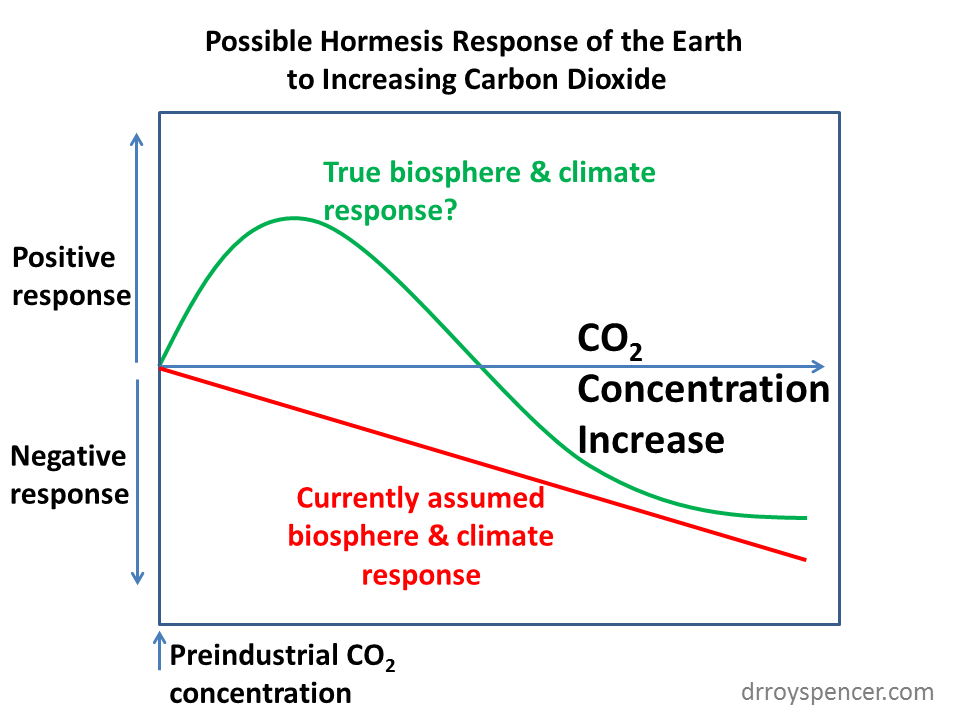
An Earth scientist who has not already sold his soul to the government regulation bureaucracy might legitimately ask, “I wonder if some level of enrichment of atmospheric CO2 is actually a good thing for life on Earth?”, as suggested by the green curve in the above graph.
The straight red line (linear dose response) is, in contrast, what is usually assumed…that any increase beyond that believed to exist before humans arrived is necessarily bad for Mother Earth.
But atmospheric carbon dioxide is necessary for life on Earth, and has risen from a pre-industrial concentration of only 3 parts per 10,000, to (still only) 4 parts per 10,000 today. The result has been global greening and a moderation of global temperatures (at least partly due to more CO2, in my opinion). Theoretically expected negative impacts on severe weather and marine life have, so far, failed to reach any believable level of cause-and-effect, beyond normal natural variability.
(And if you are tempted to cite statistics of a record number of whatever events, I will ask whether humans are also responsible for the recent “grand maximum” record high sunspot activity out of the last 3,000 years? Was that Bieber’s fault, too? Or maybe Manbearpig’s fault?).
I’ve had plant physiologists tell me it’s almost as if nature has been sucking as hard as it can on atmospheric CO2, and has depleted it to the point where only the hardiest life forms can exist. But as we add more CO2 to the atmosphere, nature quickly gobbles up 50% of the extra, leading to a more luxurious and robust biosphere.
So, it is reasonable from an unbiased scientific perspective to examine the possibility that more CO2 is actually good for life on Earth…not just the biosphere, but atmospheric effects as well. After all, we’re not talking about X-rays here…we’re talking about the elixir of life, CO2.
Is there a level beyond which more carbon dioxide would be bad? Probably…but I don’t think we know what that level would be. And, just to be on the safe side, if there was a way to stop producing CO2 without killing millions (if not billions) of people in the process, I might be in favor of that.
But that’s simply not possible with today’s energy technologies. Renewable energy sources cannot contribute to more than 15-20% of total energy demand in the coming decades, so we are stuck with fossil fuels for the time being.
I really don’t care where our energy comes from, as long as it is abundant and affordable for the world’s poor. In the meantime, we need to stop thinking in simple linear dose-response terms which is contrary to so much real world experience and exists mainly to make jobs for regulators and companies that are made rich through subsides rather than through free choice by the public.
Community Opposition to Wind Farms Grows Because Wind Power is a Fraud
August 13, 2014 by

As community and political opposition to the great wind power fraud rolls and builds across the world, the charge that opponents are red-necked climate change deniers, infected with a dose of Not In My Backyard syndrome, starts to ring hollow.
Surely that charge can’t stick to each and every one of the 1,000 who signed the petition against the Mt Emerald wind farm proposal in Far North QLD – and the 92% of locals there who are bitterly opposed to it (see our post here)?
The same level of opposition arises at the local level – wherever wind power outfits are seeking to spear turbines into closely settled agricultural communities (see our post here).
Communities across the Southern Tablelands of NSW, locals are up in arms at efforts by wind farm outfits and the NSW Planning Department to sack and stack “community consultation committees” to ensure their development applications don’t face any real scrutiny. At Rye Park, 91% of locals are opposed to the wind farm being pitched by Epuron (see our post here). And communities like Tarago have erupted in anger at plans to destroy their lives and livelihoods (see our post here).
A little while back, the usual response from those opposed to wind farms was along the lines of: “we’re all in favour of renewable energy, so long as wind farms are built in the right place”.
But that was before people understood the phenomenal cost of the subsidies directed at wind power through the mandatory RET (see our post here) – and the impact on retail power prices (see our post here).
Fair minded country people are usually ready to give others the benefit of the doubt; and, not used to being lied to, accepted arguments pitched by wind power outfits about the “merits” of wind power: guff like “this wind farm will power 100,000 homes and save 10 million tonnes of CO2 emissions” (see our post here).
Not anymore.
Apart from the very few farmers that stand to profit by hosting turbines, rural communities have woken up to the fact that wind power – which can only ever be delivered at crazy, random intervals – is meaningless as a power source because it cannot and will never replace on-demand sources, such as hydro, gas and coal. And, as a consequence, that wind power cannot and will never reduce CO2 emissions in the electricity sector. The wind industry has never produced a shred of actual evidence to show it has; and the evidence that has been gathered shows intermittent wind power causing CO2 emissions to increase, not decrease (see this European paper here; this Irish paper here; this English paper here; and this Dutch study here).
The realisation that the wind industry is built on series of unsustainable fictions has local communities angrier than ever and helps explain the remarkable numbers opposed: 90% is what’s fairly called a solid “majority” in anybody’s book.
This extract from the Mt Emerald survey captures some of the changing mood and the reasons for it.

These days, locals fighting wind power outfits are quick to challenge the wild and unsubstantiated environmental benefits touted by the developers; and will launch into them about the massive subsidies (ie the mandatory RET and the REC Tax) upon which the whole rort depends.
And it’s not because these people are “anti-environment” – it’s simply because they’ve woken up to the fact that wind power is pointless: both as a power source; and as a solution to CO2 emissions reduction. Here’s the Business Report with a take on the same tale from Britain and Europe.
Opposing wind generators is not anti-green
Business Report
Keith Bryer
8 August 2014
The intolerance of dissenting views by the Green Lobby is an unpleasant aspect of some of its members. They are perhaps unaware that tolerance of difference is a pillar of democracy and essential to individual freedom. But, whatever the reasons for vitriolic attacks on those against wind generators, environmentalists should take a closer look at Scottish opposition.
The most prominent in Scotland is the Windfarm Action Group. This group firmly states that everyone should take environmental responsibilities seriously. Whatever the causes of global warming and the varying views on what causes it, we must protect our earth and steward it wisely. It accepts a need to reduce carbon dioxide (CO2) emissions. It wants cleaner, reliable energy. It supports sound scientific solutions with the goal of a cleaner, greener world.
No sane, sensible person can disagree with this. Even the most rabid environmentalist should agree too.
But this green group and 300 others like in Britain, plus another 400 in four EU countries, are against windfarms. They have gone into the subject thoroughly and engineers and scientists back up their conclusions.
To those who accuse them of merely being concerned with their own backyards and not the common good, they say add up our membership and you will find an awful lot of backyards. They are simply against what does not make good sense. They are convinced that wind power:
– Is not a technically legitimate solution.
– Does not meaningfully reduce CO2 emissions.
– Is not a commercially viable source of energy
– Is not environmentally responsible.
They believe there are better solutions to Britain’s energy concerns; solutions that meet scientific, economic, and environmental tests – and they have good reasons.
They point to the massive subsidies that windfarms received initially from the British taxpayer, money that attracts multinational corporations like flies to treacle. These subsidies added to the higher price ordinary British householders pay for their electricity.
This “stealth” tax was considerable. Most consumers were unaware that it was used to make wind-generated economically feasible on the one hand, and to fill the pockets of the manufacturers on the other.
This largess allowed wind-generation companies to make generous payments to landowners for permission to use their land. Such was the temptation that some Welsh farmers trying to raise sheep in arduous and scarcely profitable areas leapt at it.
One told his local newspaper that if it were not for the payments he got, he would have given up farming long ago.
The Wind farm Action Group quotes British government documents that say each wind turbine in Britain still receives an annual subsidy of more than £235,000 (R4.3 million). Britain has about 1,120 turbines in 90 parts of the country.
Among the usual objections to windfarms – they do not work all the time, they are noisy, kill birds and bats, and so on, the group adds a few more. For example, wind generators interfere with radar; dirt and flying insects affect their performance; ice build-up on the propellers affects performance even more; and wind turbulence further reduces their power production.
Finally, there is rust. Britain is a wet place but offshore wind turbines have salt to contend with as well. One Danish offshore wind farm had to be entirely dismantled for repair when it was only 18 months old.
Yes, groups such as these exist almost everywhere there are windfarms. They are often, like this Scottish one, as caring of the environment as anyone, perhaps more so. They are not only concerned with their own backyard; they are concerned about everyone’s backyard.
Yet they say this: “We believe that in time this [windfarms] may well be the greatest environmental disaster that mankind in panic, haste, folly and greed, has ever conceived.”
Britain is an old country and its language is full of folk wisdom like this: “No one ever built a windmill, if he could build a watermill.”
A more modern version of common sense would be: “Using wind power to reduce carbon dioxide emissions is akin to trying to empty the Atlantic Ocean with a teaspoon.”
BusinessReport
The mythical claims of the wind industry and its parasites have all be hinged on a perverse notion of “green” is good. But just what being “green” means these days is a matter of politics, not reason, fact or beneficial environmental outcomes: it’s become little more than a political fashion statement.
Ben Acheson writes for the Huffington Post. He’s also the Energy and Environment Policy Adviser and Parliamentary Assistant to Struan Stevenson MEP at the European Parliament in Brussels. For a taste of Ben’s views on wind power – see our post here.
Here’s Ben taking a swipe at faux “green” politics:
Fracking is by Far….Better than Wind Turbines!
Fracking – Fact or Fantasy |
The green movement doesn’t like Fracking but they do like Wind. Why? Fact is wind is intermittent, drives people into fuel poverty and has to be supported by subsidy. Fracking on the other hand has reduced energy prices in the US, created thousands of jobs as energy prices tumble to the benefit of US industry and needs no subsidy. So why has the Green Lobby reacted so viciously to fracking. Their web sites are a liturgy of lies and obfuscations.

They are the great unwashed, the swampies and the anti capitalist objectors and yet they are also rent a mob. Never has a Wind Farm objection rally needed the police manpower that fracking does. Truth is that it is simply political activism, what Patterson referred to as the Green Blob. How seldom do we see locals in their ranks. Those that are have believed the hype and failed to properly study the fact. Flaming faucets: cold bed methane in groundwater that would be there without any mining. Nothing to do with fracking at 8000ft well below groundwater. There are dangers, but none that cannot be adequately addressed by good management and oversight by an effective regulator. After all it is not in the developers interest to be faced with expensive clear up costs and loss of production.
So what about the real legacy of fracking. In the south we haver been drilling the Whytch oil field for years and few even know it exists. Fracking, as a technique, has been used for the best party of forty years but new equipment and deep wells have brought it into it’s own more recently. Centrica have been fracking wells for gas in Norway for the last few years. Interestingly they are using mostly Scottish engineers. Good well paid jobs for the indigenous population.
So what effect does fracking have. Essentially a fracking site will experience disturbance for about forty weeks after which it will revert to a simple well head.

This is in Marcellus, New York State, and cannot be seen from the road. The alternative is something like this at Ardrossan.

Ardrossan
Of course the first runs 24/7/365 for some forty years and the second runs as about 21% when the wind blows and has a life of about 16 years before it needs re-powering. We have all been promised a maximum of 25 years but do we believe them? No way. Read the small print. In practice what will happen is either the death of the industry with wholesale bankruptcies and rusting hulks littering our scenery or bigger monstrosities here for forty years or more.
For a safe, sustainable, future the truth is we need deliverable energy at a cost we can afford with a mix of clean coal, gas, nuclear and hydro. It is without doubt that as civilisation moves forward we will have an expanding demand for electricity, not because it is green, but because it is easy. Cars, buses, trains will all demand much higher energy requirements than we could currently(sic) supply. So listen to the Royal Geological Scociety, the Nuclear Industry and the engineers in the power industry. Don’t listen to the Swampys and green ideologues as they peddle dis-information. Get your facts from people who know, not the Green lobby with their eschewed values which even their founders now despair of.
We need to build a future based on fact, not fantasy!
Ineffective, Unreliable, Unaffordable, Wind Turbines!
LETTER: Wind turbines are a waste of time and money
The coalition has sanctioned the construction of Rampion, despite the overwhelming evidence that wind turbines are unreliable, grossly inefficient, inflict huge damage on the environment and wildlife, do not reduce greenhouse emissions one iota, and are, by a large margin, the most expensive means of generating electricity.
Thus, one could be forgiven for thinking the two headlines are linked.
Consider, as revealed by the company awarded the contract for the construction of the off-shore wind farm that, although the designed output is 700 megawatts (MW) because of the unreliability of wind turbines, the actual output will be no more than 240MW. Compare this with the output of a gas-fired generator, costing less than half the over £2bn for Rampion, which produces ten times as much electricity 100 per cent of the time.
Some years ago, Centricia, and other electricity-producing companies, made it absolutely clear to the government that, because of the unreliability of the wind, full back-up of conventional power stations is essential.
Therefore, greenhouse gas-emitting generating plants will have to remain permanently in service – thus, there is no point in building wind turbines.
Denmark, which has the greatest number of wind turbines per capita, has the most expensive power in Europe. I have yet to meet
a qualified electrical engineer who thinks the construction of wind turbines to power the national grid is a good idea.
Rampion will cover 60 square miles from Beachy Head to the Isle of Wight. The unreliability, comparatively short life, and huge cost of maintaining the turbines, means that it is only a question of time before Rampion is seen as one of the biggest scrap metal sites in the world.
France, where 80 per cent of electricity is produced by nuclear power, has the cheapest electricity in Europe. To satisfy the Green lobby, nuclear power stations in the UK should employ thorium as the fuel which is much safer than uranium. Nuclear bombs cannot be produced using thorium.
I do hope everyone reading this will write to their MP, county and district councillors, demanding the construction of all wind turbines, both on and off-shore, be halted immediately.
Ideally, those wind turbines already constructed should be dismantled.
Derek Hunnikin
St Leodegar’s Way
Hunston

