The Wind Scam in Germany, (and elsewhere), Keeps on Getting Worse….

Germany’s Wind Power Surges Plunge Their Neighbours Into Darkness

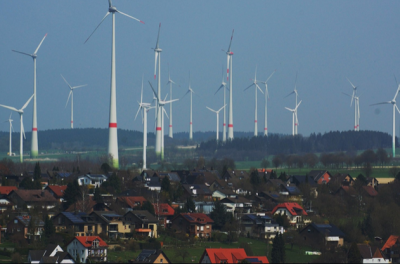
German wind farm

****

The economics of Germany’s “Energiewende” are so bizarre, that you’d think it had been put together by the GDR’s ‘brains trust’, before the Berlin Wall took its tumble in 1989.

In Germany, around €100 billion has already been burnt on renewable subsidies; currently the green energy levy costs €56 million every day. And, the level of subsidy for wind and solar sees Germans paying €20 billion a year for power that gets sold on the power exchange for around €2 billion.

Squandering €18 billion a year on power – which Germans have in abundance from meaningful sources – has them asking the fair and reasonable question: just how much power are they getting for the €billions that they’ve thrown – and continue to throw at wind and solar?

The answer is: NOT MUCH: Germans Spend 100s of €Billions on their “Energiewende” & Get Only 3% of their Power in Return

But that’s merely to focus on the insane cost to German power consumers and taxpayers – and the meagre returns for their hundreds of €billions in subsidies – of what can only be described as an energy market fiasco.

At a more practical – and to power punters more significant – level chaotic unpredictable surges in wind power output have brought the German grid to the brink of collapse:

Germany’s Wind Power Debacle Escalates: Nation’s Grid on the Brink of Collapse

Unable to build any further transmission capacity of its own – principally because Germans are fed up with having their bucolic homeland turned into an industrial wasteland – not to mention the colossal and wholly unnecessary cost of building a duplicated network simply to take occasional bursts of wind power output – Germany is dumping power into its neighbours’ grids.

The result is that their Czech, Polish, Dutch, Belgian and French neighbours’ grids are being swamped with excess power – whenever the wind picks up in Germany’s North – resulting in grid instability and blackouts.

Germany has – from time to time – been a somewhat boisterous neighbour. With Germany dumping excess wind power on an unscheduled basis – into grids which are simply not designed to take rapid increases in volume – neighbours are fuming again about German arrogance and the cost of accommodating it.

Here’s a couple of takes on yet another aspect of Germany’s wind power disaster.

Germany’s Neighbors Rankled by Its Energiewende
The American Interest
4 August 2015

The German energy mix has been radically changed in recent years, predominantly driven by two forces: a desire to expand renewables’ market share (a task accomplished by generous state subsidies called feed-in tariffs), and an aversion to nuclear power following the 2011 Fukushima disaster. Within Germany these changes have had a number of perhaps unforeseen and certainly unfortunate consequences, including jacked-up power bills for businesses and households and, somewhat bizarrely, an increased reliance on the particularly dirty type of coal called lignite. But the ripple effects of Berlin’s energiewende are expanding past national boundaries, and, as Politico reports, Germany’s neighbors are finding their own grids strained by intermittent solar and wind production:

The country’s move away from nuclear power and increase in production of wind or solar energy has pushed it to the point where its existing power grids can’t always cope. And it’s the Czech Republic, Poland, the Netherlands, Belgium and France that have taken the brunt.

“If there is a strong blow of the wind in the North, we get it, we have the blackout,” Martin Povejšil, the Permanent Representative of the Czech Republic to the EU said at a briefing in Brussels recently.

Germany has failed to beef up its energy transmission infrastructure at the same pace as its burgeoning solar and wind industries, that is, and on especially sunny and windy days it relies on the hospitality of its neighbors to distribute those supplies. Poland and the Czech Republic have been forced to pony up $180 million “to protect their systems from German power surges”, while within Germany itself NIMBY-ism is preventing the construction of some key transmission lines.

When examining the costs of boosting renewables, it’s a big mistake to leave out the expense of building out the grids needed to handle production. Germany seems to have made just that error with its energiewende, and central Europe is struggling to cope.
The American Interest

germany

German winds make Central Europe shiver: Junking nuclear power is creating problems for Germany’s neighbors.
Politico
Kalina Oroschakoff
3 August 2015

Germany’s shift to renewable energy has been hailed as an historic policy move — but its neighbors don’t like it.

The country’s move away from nuclear power and increase in production of wind or solar energy has pushed it to the point where its existing power grids can’t always cope. And it’s the Czech Republic, Poland, the Netherlands, Belgium and France that have taken the brunt.

“If there is a strong blow of the wind in the North, we get it, we have the blackout,” Martin Povejšil, the Permanent Representative of the Czech Republic to the EU said at a briefing in Brussels recently.

Germany’s north-south power lines have too limited a capacity to carry all the power that is produced from wind turbines along the North Sea to industrial states like Bavaria or Baden-Württemberg and onto Austria. That means the extra electricity is shunted through the Czech Republic and Poland.

To put an end to the often unexpected power flows from Germany — so-called loop flows — the countries are taking the matter into their own hands. Concerned about the stability of their own grids, additional costs and the ability to export their own power, the Czechs, for example, are installing devices to block the power from 2016 onwards.

Poland is also working on the devices, known as phase shifters, and expects to have some operating this year. To the west, the Netherlands, Belgium and France have also installed phase shifters to deal with the flows.

These separate moves come as Brussels pushes for integration of Europe’s energy markets. The struggle shows how the drive toward more renewables, combined with outdated infrastructure and inconsistent cooperation within the EU, is having unintended consequences.

“In the past, with coal and nuclear power plants, the power system was extremely predictable. Now, with ever more renewable energy coming online, the system isn’t as predictable anymore, which can cause challenges also for the single market debate,” said Joanna Maćkowiak Pandera, a senior associate with German think tank Agora Energiewende.

“We have been telling that to the Germans, ‘Increase your transmission system, or we will shut you off’,” an EU diplomat said at a briefing in Brussels recently.

Power loop flows occur when a country’s power grid infrastructure isn’t sufficient to handle new production, so the electricity is automatically diverted through neighboring countries on its way to its destination in the producing country.

“This also leads to congestion in neighboring systems,” said Georg Zachmann of the Brussels-based Bruegel think tank, adding that to deal with the situation countries can also reduce their own electricity exports to South Germany to make space for the German power. That, however, means that Germany’s energy transition is affecting the export potential of countries like the Czech Republic and France.

Pressure is building on Germany to expand its north-south connection. But the idea has aroused local opposition in Bavaria, with residents unwilling to see their picturesque countryside spoiled by unsightly transmission towers.

“If we want to have a growing share of renewables, we must build the grids,” Walter Boltz, vice chair of the regulators board of the EU’s Agency for the Cooperation of Energy Regulators (ACER), told POLITICO.

The simplest solution, he said, would be for Germany to build up the necessary links. But that will take time. Alternatively, Germany could simply shut down wind power on highly productive days. But the country’s current policy stands in the way.

“It’s an uncomfortable problem and has to do with Germany’s irrational priority dispatch policy under which you cannot shut down renewables,” Boltz said.

Germany’s neighbors aren’t immune from criticism on the issue.

Poland, for instance, could also consume the power it imports from Germany, something it resists to shield its own industry, Boltz said. Further, Poland’s grids needed expansion, he said.

More cooperation

Germany, for its part, has stepped up cooperation with its neighbors to remedy the issue.

Energy Secretary Rainer Baake recently addressed criticism that Germany’s energy transition was an unilateral policy move, Germanmedia reported, saying, “People in this country and also outside of Germany who believe this must be some kind of act of re-nationalization of energy policy […] could not be more wrong.”

In 2014, German transmission operators agreed with the Czechs to regulate cross-border power flows to protect the Czech grid from overloading and reduce the danger of blackouts. A similar agreement was struck between the Polish and German sides.

On a political level in June, Germany signed a pact with 11 “electrical” neighbors, including France, Poland and the Czech Republic, to promote the integration of the respective power markets, counter overcapacity and let the market determine power prices.

Still, Poland’s regulator last year sent a letter to the ACER, asking it to come forward with an opinion on the loop flows from Germany. The response is expected in September.

In 2013, the agency issued an opinion on unscheduled loop flows, concluding that “in most cases these flows are a threat to a secure and efficient functioning of the Internal Electricity Market.”

Energy mix is a national policy

The situation is delicate for the Czech Republic and Poland, which have long insisted that choosing whether power should be generated by solar, wind, coal, nuclear or other ways remains a national issue, not one for Brussels.

So Germany is free to make decisions about how to generate electricity, in this case to shut down its nuclear plants.

Brussels has stepped up efforts to connect the bloc’s energy markets, with the European Commission in a policy paper in February stressing “the interconnection of the electricity markets must be a political priority.”

The Commission released an initial plan in mid-July about how to build a borderless power market that can deal with the rise in renewables. Draft legislation is expected in 2016.

“We haven’t developed the grids,” the EU bloc’s energy chief Miguel Arias Cañete told POLITICO last month, adding that while there has been a lot of investment in renewables, grids aren’t up to standard. That’s also why Brussels is keen on increasing cross-border power interconnections.

It’s making political and financial efforts to finally link up at least 10 percent of the EU’s installed electricity production capacity by 2020.

But it’s a long slog to connect the bloc: EU countries had originally pledged that target in 2002.
Politico

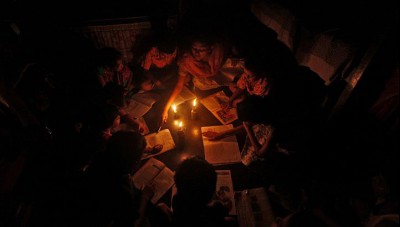
studying candle

Aussies Fighting Back Against the Irresponsible Wind Industry!

An extract from the Senate Select Committee on Wind Turbines Final Report

Professor Chapman and his critics

2.19      Professor Simon Chapman AO, Professor of Public Health at the University of Sydney, has been an outspoken critic of those who suffer ill-effects from wind turbines. In both his written and oral submissions, Professor Chapman cited many of his own publications in support for his view that:

…the phenomenon of people claiming to be adversely affected by exposure to wind turbines is best understood as a communicated disease that exhibits many signs of the classic psychosocial and nocebo phenomenon where negative expectations can translate into symptoms of tension and anxiety.

2.20      Several highly qualified and very experienced professionals have challenged this argument. Dr Malcolm Swinbanks, an acoustical engineer based in the United Kingdom, reasoned:

The argument that adverse health reactions are the result of nocebo effects, ie a directly anticipated adverse reaction, completely fails to consider the many cases where communities have initially welcomed the introduction of wind turbines, believing them to represent a clean, benign form of low-cost energy generation. It is only after the wind-turbines are commissioned, that residents start to experience directly the adverse nature of the health problems that they can induce.

2.21      The committee highlights the fact that Professor Chapman is not a qualified, registered nor experienced medical practitioner, psychiatrist, psychologist, acoustician, audiologist, physicist or engineer. Accordingly:

  • he has not medically assessed a single person suffering adverse health impacts from wind turbines;
  • his research work has been mainly—and perhaps solely—from an academic perspective without field studies;
  • his views have been heavily criticised by several independent medical and acoustic experts in the international community; and
  • many of his assertions do not withstand fact check analyses.

2.22      Professor Chapman has made several claims which are contrary to the evidence gathered by this committee. First, he argues that the majority of Australia’s wind turbines have never received a single complaint. There are various problems with this statement:

  1. wind turbines located significant distances from residents will not generate complaints;
  2. many residents suffering adverse health effects were not aware of any nexus between their health and the impact of wind turbines in order to make a complaint;
  3. just because residents do not lodge a formal complaint does not mean they are not suffering adverse health effects;
  4. data obtained by Professor Chapman from wind farm operators of the numbers of complaints lodged cannot be relied upon; and
  5. the use of non-disclosure clauses and ‘good neighbour agreements’ legally restricts people from making adverse public statements or complaints.

2.23      Second, Professor Chapman has argued that complaints of adverse health effects from wind turbines tend to be limited to Anglophone nations. However, the committee has received written and oral evidence from several sources directly contradicting this view. The German Medical Assembly recently submitted a motion to the executive board of the German Medical Association calling for the German government to provide the necessary funding to research adverse health effects. This would not have happened in the absence of community concern. Moreover, Dr Bruce Rapley has argued that in terms of the limited number—and concentrated nature—of wind farm complaints:

It is the reporting which is largely at fault. The fact is that people are affected by this, and the numbers are in the thousands. I only have to look at the emails that cross my desk from all over the world. I get bombarded from the UK, Ireland, France, Canada, the United States, Australia, Germany. There are tonnes of these things out there but, because the system does not understand the problem, nor does it have a strategy, many of those complaints go unlisted.

2.24      Third, Professor Chapman has queried that if turbines are said to have acute, immediate effects on some people, why were there no such reports until recent years given that wind turbines have operated in different parts of the world for over 25 years. Several submissions to the committee have stated that adverse health effects from wind turbines do not necessarily have an acute immediate effect and can take time to manifest.

2.25      Fourth, Professor Chapman contests that people report symptoms from even micro-turbines. The committee heard evidence that once people are sensitised to low frequency infrasound, they can be affected by a range of noise sources, including large fans used in underground coal mines, coal fired power stations, gas fired power stations and even small wind turbines. As acoustician Dr Bob Thorne told the committee:

Low-frequency noise from large fans is a well-known and well-published issue, and wind turbines are simply large fans on top of a big pole; no more, no less. They have the same sort of physical characteristics; it is just that they have some fairly unique characteristics as well. But annoyance from low-frequency sound especially is very well known.

2.26      Fifth, Professor Chapman contends that there are apparently only two known examples anywhere in the world of wind turbine hosts complaining about the turbines on their land. However, there have been several Australian wind turbine hosts who have made submissions to this inquiry complaining of adverse health effects. Paragraphs 2.11–2.12 (above) noted the example of Mr Clive Gare and his wife from Jamestown. Submitters have also directed attention to the international experience. In Texas in 2014, twenty-three hosts sued two wind farm companies despite the fact that they stood to gain more than $50 million between them in revenue. The committee also makes the point that contractual non-disclosure clauses and ‘good neighbour’ agreements have significantly limited hosts from speaking out. This was a prominent theme of many submissions.

2.27      Sixth, Professor Chapman claims that there has been no case series or even single case studies of so-called wind turbine syndrome published in any reputable medical journal. But Professor Chapman does not define ‘reputable medical journal’ nor does he explain why the category of journals is limited to medical (as distinct, for example, from scientific or acoustic). The committee cannot therefore challenge this assertion. However, the committee does note that a decision to publish—or not to publish—an article in a journal is ultimately a business decision of the publisher: it does not necessarily reflect the quality of the article being submitted, nor an acknowledgment of the existence or otherwise of prevailing circumstances. The committee also notes that there exist considerable published and publicly available reports into adverse health effects from wind turbines.

2.28      The committee also notes that a peer reviewed case series crossover study involving 38 people was published in the form of a book by American paediatrician Dr Nina Pierpont, PhD, MD. Dr Pierpont’s Report for Clinicians and the raw case data was submitted by her to a previous Australian Senate inquiry (2011) to which Dr Pierpont also provided oral testimony. Further, at a workshop conducted by the NHMRC in June 2011, acoustical consultant Dr Geoffrey Leventhall stated that the symptoms of ‘wind turbine syndrome’ (as identified by Dr Pierpont), and what he and other acousticians refer to as ‘noise annoyance’, were the same. Dr Leventhall has also acknowledged Dr Pierpont’s peer reviewed work in identifying susceptibility or risk factors for developing wind turbine syndrome / ‘noise annoyance’. Whilst Dr Leventhall is critical of some aspects of Dr Pierpont’s research, he does state:

Pierpont has made one genuine contribution to the science of environmental noise, by showing that a proportion of those affected have underlying medical conditions, which act to increase their susceptibility.

2.29      Seventh, Professor Chapman claims that no medical practitioner has come forward with a submission to any committee in Australia about having diagnosed disease caused by a wind farm. Again, Professor Chapman fails to define ‘disease’. Nonetheless, both this committee, and inquiries undertaken by two Senate Standing Committees, have received oral and written evidence from medical practitioners contrary to Professor Chapman’s claim.

2.30      Eighth, Professor Chapman claims that there is not a single example of an accredited acoustics, medical or environmental association which has given any credence to direct harmful effects of wind turbines. The committee notes that the semantic distinction between ‘direct’ and ‘indirect’ effects is not helpful. Dr Leventhall and the NHMRC describe stress, anxiety and sleep deprivation as ‘indirect’ effects, but these ailments nonetheless affect residents’ health.

2.31      Finally, Professor Chapman queries why there has never been a complainant that has succeeded in a common-law suit for negligence against a wind farm operator. This statement is simply incorrect. The committee is aware of court judgements against wind farm operators, operators making out of court settlements or withdrawing from proceedings, injunctions or shutdown orders being granted against operators, and properties adjacent to wind turbines being purchased by operators to avoid future conflict. The committee also reiterates its earlier point that contractual non-disclosure clauses have discouraged legal action by victims.

Those Brilliant Aussies, Have Recommended Safeguards Against the Windscam!

Australian Senate’s Recommendations to Curb the Wind Industry – Driven by Common Sense & Compassion

senate review

****

After almost 6 months, 8 hearings in 4 States and the ACT, dozens of witnesses and almost 500 submissions, the Senate Inquiry into the great wind power fraud has delivered its ‘doorstop’ final report, which runs to some 350 pages – available here: Senate Report

The first 200 pages are filled with facts, clarity, common sense and compassion; the balance, labelled “Labor’s dissenting report”, was written by the wind industry’s parasites and spruikers – including the Clean Energy Council (these days a front for Infigen aka Babcock & Brown); theAustralian Wind Alliance; and Leigh Ewbank from the Enemies of the Earth.

Predictably, Labor’s dissenting report is filled with fantasy, fallacy and fiction – pumping up the ‘wonders’ of wind; completely ignoring the cost of the single greatest subsidy rort in the history of the Commonwealth; and treating the wind industry’s hundreds of unnecessary victims – of incessant turbine generated low-frequency noise and infrasound – with the kind of malice, usually reserved for sworn and bitter foreign enemies.

Labor receives $millions in operational and election funding from Union Super Funds – which its members (both past and present) run as political slush funds – funds which are handled with wanton disregard for the working class mum and dads – who unwittingly end up ‘investing’ their hard earned savings in disasters like Pacific Hydro – a wind power outfit that torched $700 million of mum and dad super savings in a single year:

Pacific Hydro’s Ponzi Scheme Implodes: Wind Power Outfit Loses $700 Million of Mum & Dad Retirement Savings

So, with their snouts wedged deep in the wind industry subsidy trough – and with everything to lose, it’s no surprise that Labor’s dissenting report is full of self-serving lies, omissions and half truths.

Fortunately, however, the majority of Senators on the Committee worked overtime to get the truth out – and made a suite of recommendations based on facts and evidence; and driven by those truly human attributes – common sense and compassion.

STT notes and thanks Coalition Members, Senators Chris Back and Matt Canavan – and Senators, John Madigan, David Leyonhjelm, Bob Day and SA’s Favourite Greek, Nick Xenophon for their tireless efforts throughout: efforts which have done more than any other Parliamentary Inquiry – anywhere on Earth – to expose the insane cost and utter pointlessness of the greatest economic and environmental fraud of all time.

Here’s a succinct little wrap-up on the Senate’s recommendations from Senator David Leyonhjelm.

Wind turbine report vindicates Senate scrutiny
Liberal Democratic Party
Monday August 3, 2015

Liberal Democrat Senator for NSW, David Leyonhjelm has hailed the findings of the Select Committee Inquiry on Wind Turbines as vindication of his motion to establish the inquiry and confirmation that regulation of the wind industry needs to change.

“It is abundantly clear from the evidence of regulators, the community, local councils and wind farm operators that the status quo is untenable,” Senator Leyonhjelm said.

“Only the wind industry and its cheer squad disagree. There are glaring planning and compliance deficiencies plus growing evidence, domestic and international, that infrasound and low frequency sound from wind turbines is having an adverse health impact on some people who live in the vicinity of wind farms. This is not something a responsible government can ignore.”

The report is critical of the work previously undertaken by the National Health and Medical Research Council on wind farm noise emissions, which many have relied upon to declare wind farms have no adverse health effects.

The committee is also concerned about “the lack of rigour” behind the position statement of the Australian Medical Association on wind turbine operations. The inquiry report criticised the AMA for refusing to give evidence before the inquiry, describing their position statement as “irresponsible and harmful”.

The final report, tabled in the Senate today, retains the recommendations of the interim report (which the government has accepted) but expands on these and adds more.

Among them is a requirement for wind farms to comply with national noise standards in order to be eligible for consumer funded Renewable Energy Certificates (RECs), that eligibility for RECs cease after five years to lessen the financial burden on consumers, that state EPAs have jurisdiction over wind farms rather than local councils, that the Clean Energy Regulator be subject to a performance audit by the ANAO, and that the Productivity Commission be required to examine the impact of wind power generation on retail electricity prices.

“Senators involved in this inquiry have been attacked by the Big Wind lobby and those who see it is an assault on all renewable energy. The Labor representative on the Committee, Senator Anne Urquhart, joined this criticism following the interim report.

“However, the report shows there is a problem with the wind industry, not renewables such as solar, hydro, geothermal and biomass. There are potentially just as many jobs in these and nobody living close to them is getting sick. Labor’s enthusiasm for renewables needs to incorporate some compassion for those being hurt.”

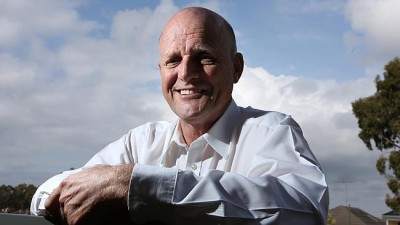
Senator David Leyonhjelm

Senator David Leyonhelm

****

A fair call David – but, then again, common sense rarely needs an advocate.

Meanwhile, Committee Chair, Senator John Madigan went on the offensive in his home state of Victoria – where wind industry front man, Labor Premier, Daniel Andrews has adopted an approach to his constituents that would have made his pin-up boy, Generalissimo Stalin, glow with pride.

Senator Madigan warns Premier Andrews: ‘Don’t gamble with the health of Victorians’
Senator John Madigan
Independent Senator for Victoria
July 16, 2015

Independent Senator for Victoria John Madigan has warned Victorian Premier Daniel Andrews the Victorian Government’s unshakeable commitment to wind energy is putting the health of Victorians at risk, while potentially exposing the state to future legal liabilities.

“There is growing evidence living near wind turbines can be detrimental to health,” Senator Madigan said.

“While for a long time this evidence mainly came from the reports of affected individuals, more recently a number of studies have lent scientific weight to their concerns, such as the German and Japanese studies recently reported on,” Senator Madigan said.

“Yet, in the face of this, we have the Premier telling us his government is ‘unashamedly pro-wind power’ and indicating plans to boost investment in the sector.

“Beyond the detrimental health impacts, this could leave the state liable to future claims by those who suffer ill-health as a result. Where there is a reasonably foreseeable risk of harm the law requires us to act prudently to avoid that harm. If we fail to do so we are expected to compensate those impacted. The Andrew’s government is confronted with just this type of situation.”

Senator Madigan said the Premier had been aware of the potential health impacts of wind turbines since at least June 2010 when, as Health Minister, he attended a community cabinet meeting in Bendigo and was handed a file containing approximately twenty statutory declarations made by people living near Waubra wind farm. Each statutory declaration detailed negative health impacts residents attributed to noise from the wind turbines.

Senator Madigan said: “Given the Premier has known about this for some time, it is completely irresponsible for him to be promoting the construction of more wind farms around the state.

“With peoples’ health at risk, the state government should exercise the precautionary principle and delay the approval of any further wind farms until their health impacts are properly understood. This is the only responsible position under the circumstances.”

Senator Madigan said he would write to the Premier to request a moratorium on the development of further wind farms until their health impacts are properly understood.

Senator John Madigan

John Madigan

The Beginning of the End, for Australia’s Wind Weasels!

Senate Recommendations Spell ‘DOOM’ for the Australian Wind Industry

atomic-bomb-e1355417893840

****

The wind industry in Australia, already belted, battered and bruised, has just been delivered what STT considers the fatal blow.

On Friday just gone, the front page of The Australian carried the headline “Call to curb wind subsidies” in an “exclusive” penned by STT Champion, Graham Lloyd – the full report appeared on page 7 – in which Graham provides a sneak preview of the recommendations made in the final report of the Senate Inquiry into the great wind power fraud, due out next week.

Canberra urged to strip billions from windfarm subsidies
The Australian
Graham Lloyd
31 July 2015

A Senate committee says renewable energy subsidies for new wind farms should be limited to five years from more than 20.

The Abbott government is being urged to strip billions more from subsidies to wind farms in the final report of a Senate committee that has already pushed renewable energy investment to favour solar.

In its recommendations, the committee says renewable energy subsidies for new wind farms should be limited to five years from more than 20.

It also wants the issue of renewable energy certificates restricted to projects in states that adopt federal regulations on infrasound and low frequency noise.

The final report of the Senate investigation into wind farms and their possible health effects will be tabled in parliament on Monday.

The report has been circulated and details have been provided to The Australian.

The call for time limits on subsidies and federal noise oversight is likely to provoke a backlash from the wind industry, already reeling from a federal government directive to the $10 billion Clean Energy Finance Corporation that it stop lending to wind projects.

The lending freeze was agreed with crossbench senators after the federal government adopted the committee’s interim report recommendations.

The deal included crossbench support to include forest waste in the revised renewable energy target legislation.

In a letter tabled in the Senate, Environment Minister Greg Hunt said the federal government would respond “actively and in good faith” to the Senate committee findings.

The final report says a five-year limit on renewable energy certificates, down from more than 20 years, recognised that wind turbine technology was well developed and a “mature” industry.

A ban on issuing RECS to wind farms in states that do not adopt federal guidelines on infrasound is designed to force the hand of governments that rejected a national approach at the last Council of Australian Governments meeting.

At present, noise guidelines are administered by the states, but renewable energy certificates are issued by the commonwealth.

Renewable energy companies are issued RECS for the amount of power they generate.

The RECS are sold to power authorities, which must secure a set portion of their supply from renewable sources under the RET.

The cost of buying RECS is added to consumer electricity bills as a subsidy for renewable energy over other sources of power.

Crossbench senators are confident the federal government will accept the recommendations and the measures can be passed through both houses. Adoption will require legislative changes to the Clean Energy Act.

Legislation would require the support of six non-government senators in the upper house.

The Senate committee has been particularly concerned by complaints from people living near wind farms who believe low-frequency noise and infrasound is having an impact on their health.

The existence of health impacts from wind turbines has been rejected as unproven by health authorities, but as the number of complaints increases the issue is being investigated worldwide.

The final Senate report recommends the scientific committee have the power to provide “guidance, advice and oversight” to bodies funding and undertaking research into infrasound.
The Australian

Nice work, Graham!

As an aside, it’s the Renewable Energy (Electricity) Act 2000 that would be amended (not the Clean Energy Act) – s40 of which sets the target.

However, no doubt due to his desire to be seen as objective, Graham slips a little when he suggests that the health impacts of low-frequency noise and infrasound are somehow a matter of “belief”.

When the next-door neighbour’s rooster fires up at 5 o’clock in the morning (every morning) – and wakes up the entire household, the interruption to decent sleep is viewed pretty dimly by those deprived of it: tempers start to fray over bleary-eyed breakfasts; and forced weariness takes its toll on the functional ability of Foghorn Leghorn’s victims as the day rolls on.

foghorn

****

The same goes for those with neighbours who love cranking up AC/DC at two in the morning – or the early rising gardener, who whips his lawn mower into action well before sun-up on Sunday.

The accepted right to unbroken sleep is the reason why there are strict rules to prohibit rowdy roosters residing in cities and towns; the curbs placed on firing up mowers and leaf blowers before breakfast; and shutting down live music venues in built up areas after midnight – sleep is sacrosanct – the consequences of depriving people of routine sleep are so obvious it goes without saying:

Wind Turbine Noise Deprives Farmers and Truckers of Essential Sleep & Creates Unnecessary Danger for All

As a contrast to the merciless, around-the-clock cacophony dished out by wind power outfits on their neighbours – which all levels of government expect them to tolerate without so much as a whimper – STT noticed this story from Western Australia a while back, where an argument between neighbours over late-night festivities resulted in the (alleged) murder of the party complaining about the noise interfering with his family’s right to a decent night’s sleep: Man, 45, dies after disturbance in Perth suburb of Seville Grove

If someone is complaining about losing sleep due to night-time noise – that complaint is taken as an accepted fact – and their “belief” in the cause has got nothing to do with it: prove that the noise was being generated and the rest follows.

For every other kind of noise source, the authorities take those complaints seriously – roosters get the chop; police get the noisy-neighbour to wind down their stereos; pubs allowing rock bands to rock-on past their curfews, face licensing penalties; and eager-beaver gardeners are told by EPAs or Councils to leave the lawn mowers and leaf blowers in the shed, until the neighbourhood has had a chance of a leisurely weekend lie in – or to expect to get whacked with fines if they don’t: for a few of the rules, see the Victorian EPA’s site here.

But, for some strange reason wind power outfits are permitted (or, rather, encouraged) to operate these things around the clock, with noise ‘rules’ so lax as to be risible.

The impact of incessant turbine generated low-frequency noise and infrasound is well-known to the wind industry – its direct causal impact on sleep deprivation was documented in a decade’s worth of research by NASA – top-tier research that has been ignored by regulators and health authorities – like the disgraced NHMRC – and covered up by the wind industry ever since:

Three Decades of Wind Industry Deception: A Chronology of a Global Conspiracy of Silence and Subterfuge

When farmers being paid $200,000 a year to host these things complain bitterly about sleep deprivation as a regular event, then STT is pretty much satisfied that the noise and vibration generated by turbines is causing what the World Health Organisation has considered to be an adverse health effect in and of itself (for over 60 years):

SA Farmers Paid $1 Million to Host 19 Turbines Tell Senate they “Would Never Do it Again” due to “Unbearable” Sleep-Destroying Noise

Which brings us to the Senate’s recommendation to prevent Renewable Energy Certificates (RECs aka LGCs) being issued to wind power outfits operating in States that refuse to adopt federal regulations on infrasound and low-frequency noise – regulations that will be drawn up as another of the Senate’s recommendations.

The Federal Government has always taken the line that noise regulation is a matter for the States. A position which rudely ignores the fact that the wind industry would not exist in the absence of the massive federally mandated subsidies set up by the Large-Scale Renewable Energy Target (LRET).

It’s a line that’s been spun by PM Tony Abbott who says that the “sites of these things is a matter for the state governments”.

STT has likened that pitch to the ‘defence’ run by the bloke who sells the sawn-off shotgun to an armed robber.

armed robber

****

Sure, the illegal firearm vendor didn’t actually pull the trigger and send a bank teller for an unscheduled trip to the morgue. However, in the absence of the weapon supplied, there may have been no robbery – certainly not an “armed” one – and no harm done to bank tellers, in any event.

In the criminal law, the concept of liability for those who provide the arms to known bandits is picked up in the concepts of accessorial liability – the ol’ chestnuts about aiding and abetting, accessory before the fact and all that.

In this case, though, the Coalition is not only providing the weapon, from now until 2031 it will be supplying the offenders with an endless stream of ammunition – in the form of around 500 million Renewable Energy Certificates; designed to be worth over $90 – as young Gregory Hunt calls them: “a massive $93 per tonne carbon tax” – the $46 billion cost of which will be borne by all Australian power consumers (as we detail below).

The Senators on the Inquiry have worked out that the only way to prevent wind power outfits from stealing any more Australian homes is to disarm the bandits by tying the ‘entitlement’ to wallow in millions of RECs to a meaningful noise standard.

The other “killer” recommendation is that the REC Tax/Subsidy paid to wind power outfits be limited to a period of five years.

There aren’t many people – outside of the parrots profiting from it – who actually understand the fact that the REC is designed as a perpetual subsidy to wind power outfits – recouped through retail power bills as a TAX on all Australian power consumers.

Outside of those engaged in the rort – or keen to aid and abet those involved – hardly anybody understands the quantum of the subsidy; who pays it; and its longevity. And that, until recently, included the Senators involved in the Inquiry.

STT hears that – at the very first hearing in Portland in Victoria on 30 March this year – a number of them were gobsmacked to learn that the REC subsidy is not limited to last for 2 or 3 years, say – but is designed to run for more than a generation – from 2001 to 2031.

STT has set it out before, and for the uninitiated, we’ll set out again.

A REC is issued for every MWh of wind power dispatched to the grid; and a shortfall penalty of $65 per MWh applies to a retailer for every MWh that they fall short of the LRET target – the target is meant to be met by retailers purchasing and surrendering RECs in an effort to avoid the penalty.

Under the latest 33,000 GWh ultimate annual target, assuming that RECs hit $93, as the penalty inevitably begins to apply (RECs are currently trading around $52), the total cost added to power consumers’ bills will top $46 billion (495,600,000 x $93).

The LRET ‘system’ was designed around RECs being worth $93, with the $65 per MWh shortfall charge setting the ‘floor price’ for RECs, and the tax treatment of RECs taking their value to over $90.

Power consumers pay the full cost of the RECs issued to wind power outfits – on top of the wholesale price paid by retailers – in relation to collecting the cost of the REC Subsidy from power consumers in what can only be described as a TAX on retail power bills, Origin Energy’s Grant King correctly puts it:

[T]he subsidy is the REC, and the REC certificate is acquitted at the retail level and is included in the retail price of electricity”.

It’s power consumers that get lumped with the “retail price of electricity” and, therefore, the cost of the REC Subsidy paid to wind power outfits. To call that arrangement anything other than a TAX is pure political and PR nonsense.

To give some idea of how ludicrously generous the REC Subsidy is, consider a single 3 MW turbine. If it operated 24 hours a day, 365 days a year – its owner would receive 26,280 RECs (24 x 365 x 3). Assuming, generously, a capacity factor of 35% (the cowboys from wind power outfits often wildly claim more than that) that single turbine will receive 9,198 RECs annually. At $93 per REC, that single turbine will, in 12 months, rake in $855,414 in REC Subsidy.

turbine collapse 9

****

But wait, there’s more: that subsidy doesn’t last for a single year. Oh no.

A turbine that started operating this year will continue to receive the REC subsidy for 16 years, until 2031 – such that a single 3 MW turbine spinning today can pocket a total of $13,686,624 over the remaining life of the LRET.

Not a bad little rort – considering the machine and its installation costs less than $3 million; and that being able to spear it into some dimwit’s back paddock under a landholder agreement costs a piddling $10-15,000 per year. State-sponsored theft never looked easier or more lucrative! For a more detailed analysis on the impact of the shortfall penalty and the REC Tax/Subsidy see:

Out to Save their Wind Industry Mates, Macfarlane & Hunt Lock-in $46 billion LRET Retail Power Tax

There has never been a subsidy scam like it in the history of the Commonwealth.

When General Motors Holden found itself in financial trouble a couple of years back, the Coalition – railing about ‘corporate welfare’ – decided to stump up a mere $100 million as a ‘rescue package’ – nowhere near enough to have salvaged the troubled carmaker, its 2,000 workers and the tens of thousands more working for the components manufacturers that supported it: Tony Abbott announces $100 million package for Holden workers

Starved of Federal support, and done in by over-generous Union ‘won’ wages and conditions, the last Holden will dribble off the production line early next year – and 10-20,000 South Australians will end up scrambling for manufacturing or mining jobs that simply do not exist:

SA – Australia’s ‘Wind Power Capital’ – Pays the World’s Highest Power Prices and Wonders Why it’s an Economic Basket Case

Now, consider the contrast with the Coalition’s Croesus-like corporate welfare directed at the wind industry.

The wind industry exists – and ONLY exists – to wallow in a subsidy stream which will hit $3 billion annually in 2019; and which continues at that colossal rate until 2031.

True it is, the PM is keen to R.E.D.U.C.E the LRET subsidy for these things, but plenty of other Coalition lightweights and wind industry shills – like Dan Tehan, Sarah Henderson and young Gregory Hunt (and the wind industry plants that work in his office) believe that the cost of the massive subsidies directed to wind power outfits under the LRET is magically picked up by fairies and pixies; and that the policy is a no-cost, family and business friendly vote winner.

However, the Senators on the Inquiry – including Coalition Members,Chris Back and Matt Canavan – have worked out that the truth is all the other way – which has led to the recommendation of a 5 year limit to the rort. That limit will kill the wind industry stone-dead: no ‘investor’ will stump up a penny from here-on, unless the subsidies are written in stone, to last indefinitely.

The wind industry, its parasites and spruikers didn’t see it coming – and have been reduced to wailing about their imminent demise. Oh dear, how sad, never mind.

senate review

Aussies Call to Slash Wind Turbine Subsidies! Can’t be too soon!

Call to slash wind farm subsidies

A Senate committee says renewable energy subsidies for new wind farms should be limited to five years from more than 20.
It also wants the issue of renewable energy certificates restricted to projects in states that adopt federal regulations on infrasound and low frequency noise.

A Senate committee says renewable energy subsidies for new wind farms should be limited to five years from more than 20. Source: Supplied
The AustralianJuly 31, 2015Australia

Canberra urged to strip billions from windfarm subsidies

By Graham Lloyd, Environment Editor, Sydney

The Abbott government is being urged to strip billions more from subsidies to wind farms in the final report of a Senate committee that has already pushed renewable ­energy investment to favour solar.

In its recommendations, the committee says renewable energy subsidies for new wind farms should be limited to five years from more than 20.

It also wants the issue of renewable energy certificates restricted to projects in states that adopt federal regulations on infrasound and low frequency noise.

The final report of the Senate investigation into wind farms and their possible health effects will be tabled in parliament on Monday.

The report has been circulated and details have been provided to The ­Australian.

The call for time limits on sub­sidies and federal noise oversight is likely to provoke a backlash from the wind industry, already reeling from a federal government directive to the $10 billion Clean Energy Finance Corporation that it stop lending to wind projects.

The lending freeze was agreed with crossbench senators after the federal government adopted the committee’s interim report recommendations.

The deal included crossbench support to include forest waste in the revised renewable energy ­target legislation.

In a letter tabled in the Senate, Environment Minister Greg Hunt said the federal government would respond “actively and in good faith” to the Senate committee findings.

The final report says a five-year limit on renewable energy certificates, down from more than 20 years, recognised that wind turbine technology was well developed and a “mature” industry.

A ban on issuing RECS to wind farms in states that do not adopt federal guidelines on infrasound is designed to force the hand of governments that rejected a nat­ional approach at the last Council of Australian Governments meeting.

At present, noise guidelines are administered by the states, but ­renewable energy certificates are ­issued by the commonwealth.

Renewable energy companies are issued RECS for the amount of power they generate.

The RECS are sold to power authorities, which must secure a set portion of their supply from ­renewable sources under the RET.

The cost of buying RECS is added to consumer electricity bills as a subsidy for renewable energy over other sources of power.

Crossbench senators are confident the federal government will accept the recommendations and the measures can be passed through both houses. Adoption will require legislative changes to the Clean Energy Act.

Legislation would require the support of six non-government senators in the upper house.

The Senate committee has been particularly concerned by complaints from people living near wind farms who believe low- frequency noise and infrasound is having an impact on their health.

The existence of health impacts from wind turbines has been ­rejected as unproven by health authorities, but as the number of complaints increases the issue is being investigated worldwide.

The final Senate report recommends the scientific committee have the power to provide “guidance, advice and oversight” to ­bodies funding and undertaking research into infrasound.

Death Knell for the Wind Industry! Subsidies being slashed!

Rocketing Power Prices see Subsidies Slashed, Bringing Europe’s Wind Industry to its Knees

9

****

The Australian wind industry is copping a belting from all sides at the moment.

With the Senate Inquiry about to release its final report on the great wind power fraud; retailers flatly refusing to enter long-term Power Purchase Agreements – essential to obtain finance for new wind farms; and with an increasing number of farmers refusing to host these things and/or hell-bent on getting out of their contracts to do so, its parasites and spruikers have been reduced to making wild and unsubstantiated claims about the continued growth of wind power in European countries such as Germany, Denmark, Spain and the UK.

The only trouble with that story is the fact that all of them have slammed the bag on further subsidies; some of them have, in effect, set upmoratoriums against any more new wind farms; and all of them are facing a furious backlash from power consumers (read ‘voters’) fed up with escalating power bills.

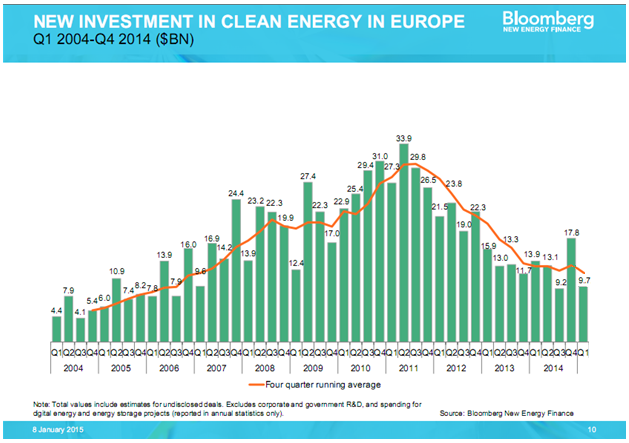
The consequence of the European’s retreat from their respective wind power disasters is that investment in wind power has dropped off a cliff (see the graph above – which tends to suggest a little trend) – in the UK, with David Cameron’s election win, subsidies have been pulled to a halt and, as an inevitable result, hundreds of threatened projects have been blown to the four winds.

The unvarnished truth about the European wind power debacle isn’t something you’re likely to read in any of the struggling Fairfax mastheads; or hear about on your ABC. No, as has often been the case with the mainstream press, it’s down to Graham Lloyd from The Australian, to throw a little light on the subject.

Europe slashes subsidies for renewables as energy prices rise
The Australian
Graham Lloyd
25 July 2015

Shorten’s vow on green energy comes just as other governments scale back

More than three million people a week watch the heute-show, Germany’s answer to The Chaser, which cuts through the pretence to slaughter society’s holy cows.

Last year heute-show host, comedian and journalist Oliver Welke, sacrificed the holiest of them all, Germany’s multi-billion-euro renewable energy transformation that routinely is held up as green-friendly world’s best practice. “Could it be that the Grand Coalition has gone nuts?” Welke said.

His comments followed release of an expert panel report commissioned by the Merkel government that found the much lauded Renewable Energy Act (EEG) a failure.

“So she (Merkel) pays these academic eggheads and as a thank you they give her in writing that she’s dumber than a box of hair!” said Welke. “Her own experts write ‘the green energy policy makes energy prices go up up up … and leads to less climate protection’,” he said.

Cue the canned laughter. Increasingly, however, it is not funny. Particularly not for German electricity consumers whose power bills have risen to become the second highest in Europe, behind Denmark.

And not for German industry, which has threatened to shift manufacturing offshore because it cannot compete with lower energy prices in the US.

Proving that Welke’s quips were not all jest, the German government has since slashed subsidy support for new wind and solar projects after it was forced to face the economic reality of what had been promised.

The German experience is relevant for Australia given the ALP’s pledge this week to boost Australia’s renewable energy target to 50 per cent by 2030 without any real details on how this would be achieved and the possible cost.

Also relevant is the green energy subsidy train wreck unfolding in Britain since the national election. This week, the Cameron government’s Energy and Climate Change Secretary, Amber Rudd, cut the subsidies to small-scale solar projects following earlier cuts to subsidies for onshore wind, large-scale solar and energy efficiency schemes.

The newly re-elected government also has angered the renewable energy industry with the introduction of a tax on producers of green power.

But Britain and Germany are not alone.

Since the global financial crisis, renewable energy subsidies have been slashed across Europe including Spain, Italy, The Netherlands, Denmark and elsewhere.

The lesson around the world is that while projections for future investment in renewables remain high, the free ride from electricity users in developed nations is coming to an end.

Britain’s Department of Energy and Climate Change has estimated the cost of renewables in Britain could reach £9.1 billion ($19.3bn) a year by the 2020-21 tax year compared with a proposed budget of £7.6 bn.

“We can’t have the situation where industry has a blank cheque and that cheque is paid for by people’s bills,” Rudd told BBC radio.

“My priorities are clear,” she told the Financial Times. “We need to keep bills as low as possible for hardworking families and businesses while reducing our emissions in the most cost-effective way. Our support has driven down the cost of renewable energy significantly. As costs continue to fall it becomes easier for parts of the renewables industry to survive without subsidies.”

After all, isn’t that what the renewables industry had promised?

But Jim Watson, from the UK Energy Research Centre, has warned that if solar subsidies disappeared completely the government risks the industry “dropping off a cliff”.

The change of approach to renewables does not suggest that governments in Europe have weakened their concerns about climate change or resolve to cut carbon dioxide emissions as part of a grand compact due to be declared in Paris in December.

But the more tough-love approach being adopted reflects public anger at rising power prices and concerns that public support may stifle innovation rather than promote it.

This is one reading of the report at the centre of the German comedy skit.

The report was prepared by the Commission for Research and Innovation (EFI) and recommended the Merkel government abolish all subsidies for green energy. The EFI report concluded that the system of feed-in-tariffs, under which the green power producers were paid guaranteed above market prices, was fundamentally flawed.

Subsidy support was neither a cost-effective way to address climate change nor was it producing a measurable effect on innovation, when assessed by the registration of patents.

“For both these reasons, there is no justification for a continuation of the EEG,” the report said.

The findings were seized on by German industry, including the BDI Industry Association, which represents about one-quarter of the German economy.

BDI managing director Markus Kerber told Reuters all support for renewable technologies must be designed in a way to “help companies be competitive and to innovate”.

But the EFI report findings were rejected by Germany’s economy ministry and environment groups.

Since the report was released, however, the German government has radically overhauled its feed-in tariff structure and renewable energy subsidy schemes.

Caps have been put on the amount of new onshore wind and solar that can be added to supply and the rates paid for renewable energy supply have been cut.

Support for renewables continues to be granted for a 20-year period but at much lower rates after the first five years.

Except for small plants, most renewables power sales will be sold by “direct marketing”, with payments supplemented by premiums similar to the support rates. The new scheme replaces feed-in tariffs, which the EC has ordered to be phased out over 2016 to 2020.

The government also has pulled back from placing a promised levy on coal-fired power plants and baulked at ordering the immediate shutdown of the most highly polluting.

Coal producers also have been told they will be compensated if they participate in a new “capacity reserve” system where coal-fired plants are kept in reserve and brought online when needed.

The reserve system again highlights a key weakness of the renewables revolution to date, intermittency.

Despite expanding its coal-fired industry to help replace baseload power surrendered through the closure of nuclear plants in the wake of the Fuku­shima disaster in Japan, Germany is still forced to draw heavily on nuclear power from neighbouring countries to back up renewables when the wind fails to blow or sun to shine.

Supporters of the renewable transformation say these pur­chases are balanced by the sale of surplus renewable energy to neighbouring markets at other times.

But this misses the fundamental point that, unlike coal, gas and nuclear, exactly when renewable energy will be available cannot be guaranteed to match when it is needed.

The proof of intermittency in Australia is the extent to which South Australia draws on brown-coal fired generators in Victoria to secure its electricity supply during times of low wind.

The EU is pushing to greatly expand the trade of electricity between states to mirror Australia’s National Electricity Market.

In addition to guaranteed above-markets rates, intermittency helps explain why the addition of large scale renewables can lead to higher prices for electricity consumers.

“When you study the states of Australia that have had dramatic increases in their household power bills in recent years you will find a direct correlation to the number of wind turbines that have been connected to the grid in those states,” independent senator John Madigan told the Senate last month. “You will find the same correlation in European countries.

This is irrespective of whether wholesale electricity prices fall as a result of additional renewable energy forcing its way into an already oversupplied market.

Indeed, Germany has some of the lowest wholesale electricity prices in Europe but some of the highest retail prices.

This is because any money received on the spot market is of only secondary consideration for renewable energy suppliers who receive additional subsidy payments.

But an oversupply of electricity from renewables — and the depressing effect it has on spot prices — is potentially devastating for the economics of traditional generators.

This is why Germany is being forced to consider paying subsidies for coal and gas plants to keep them on standby.

Supporters of renewable energy argue many of these problems will be overcome as electricity grids develop through the take-up of new battery storage technology and more sophisticated monitoring and control systems.

The big generators, in Europe and Australia, are anticipating the change.

In a recent interview, former World Energy Council European chairman Johannes Teyssen said the energy world was diverging.

“On the one hand, the energy world of the future — characterised by renewables, intelligent networks and tailor-made customer-orientated energy solutions — is taking shape rapidly,” he said.

“On the other hand, the classical energy world — of the backbone systems characterised by high-volume production and trading structures for electricity, gas and other commodities — remains irreplaceable for the public good.”

But renewables will not simply replace conventional energy ­sources and, poorly handled, the transition carries grave risks to the security of once-stable electricity supplies.

More than anything, governments are learning that electricity consumers all around the world are becoming more wary of paying twice for power.

With the pullback of government subsidies, the renewable energy industry is challenged to innovate, both on cost of production and security of supply, and prove it is capable of standing on its own.
The Australian

Another solid effort from Graham Lloyd, but – as we’ve pointed out before – the wind industry’s claims about cost-effective storage of bulk electricity is little more than patent nonsense:

The Patent Nonsense of ‘Storing’ Wind Power Smashed

Even Bill Gates has pointed to the bleeding obvious:

“There’s no battery technology that’s even close to allowing us to take all of our energy from renewables,” he said, pointing out – aswe’ve noted on these pages before – that it’s necessary “to deal not only with the 24-hour cycle but also with long periods of time where it’s cloudy and you don’t have sun or you don’t have wind.”

And we’ve dealt with the ludicrous concept of an electricity grid somehow reaching a state of ‘Zen consciousness’ that will overcome the chaotic and only occasional delivery of wind power – on that score, the video of Andrew Dodson at the end of this post is well worth watching:

Germany’s Wind Power Debacle Escalates: Nation’s Grid on the Brink of Collapse

The video of the German skit Graham refers to appears in this post:

Friday Funnies: German Satirical Take on Renewables Disaster

And, for a properly detailed insight into the cost of Australia’s wind power debacle, here’s the speech by Senator John Madigan, referred to by Graham:

Wind Power Fraud Finally Exposed: Senator John Madigan Details LRET’s Astronomical 45 Billion Dollar Cost to Power Consumers

Slowly, but surely – thanks to efforts by journos like Graham – Australians are waking up to the fact that the wind power fraud is precisely the same, the world over.

Nightmare (1962) Jerry wakes up

Windweasels Take a Much-Deserved Beating, At The Hands of the Wonderful Aussies!!

ARREA Spears Wind Industry’s Parasites During Thumping Senate Appearance

senate review

****

The mandatory RET has seen the cost of around $9 billion worth of Renewable Energy Certificates added to retail power prices and recovered from all Australian power consumers.

Under the Large-Scale Renewable Energy Target, a further $45 billion is designed to be transferred from power consumers to wind power outfits via the REC Tax/Subsidy over the next 17 years:

Wind Power Fraud Finally Exposed: Senator John Madigan Details LRET’s Astronomical 45 Billion Dollar Cost to Power Consumers

The latest LRET deal was struck by the Coalition’s wind industry front men, Ian “Macca” Macfarlane and his youthful ward, Gregory Hunt for no other purpose than saving their mates at Infigen, Vestas & Co – and is doomed to fail, in any event (see our posts here and here).

With that phenomenal cost being added to already spiralling power bills – there will be many more households who will be unable to afford power; adding to the tens of thousands of homes already deprived of what was once a basic necessity of (a decent) life. And thousands more destined to suffer “energy poverty” as they find themselves forced to choose between heating (or cooling) and eating:

Victoria’s Wind Rush sees 34,000 Households Chopped from the Power Grid

Casualties of South Australia’s Wind Power Debacle Mount: Thousands Can’t Afford Power

If our political betters in Canberra don’t get a grip and line up to kill the LRET very soon – in less than a decade – Australia will have created an entrenched energy underclass, dividing Australian society into energy “haves” and “have-nots”.

For a taste of an escalating social welfare disaster, here are articles from Queensland (click here); Victoria (click here); South Australia (click here); and New South Wales (click here).

There’s something deeply troubling about thousands of Australian households descending into gloom after dark – unable to afford the power needed for electric lighting; or troubling, at least, for those with a social conscience.

The ONLY justification for the massive stream of subsidies filched from power consumers and directed to wind power outfits is the claim that wind power reduces CO2 emissions in the electricity sector and, therefore, provides a solution to climate change (or what used to be called “global warming”). The former proposition is a proven fallacy (seeour post here). And, because the planet hasn’t reached boiling point (in bitter defiance of the IPCC’s models), the once concrete relationship between CO2 emissions and increasing global temperature now seems murky, at best.

Claiming the “global warming” moral high ground, wind power proponents continue to blindly chant the mantra that wind power reduces CO2 emissions – although they rarely, if ever, talk about the actual cost of the claimed reductions.  Probably because there are, in fact, no reductions.

STT has focused on the fact that industrial scale wind power does not – and will never – reduce CO2 emissions simply because it is intermittent; being delivered at crazy, random intervals, such that 100% of its capacity must be backed up 100% of the time by fossil fuel generation sources (see our post here).  Accordingly, we call it an environmental fraud.

Because wind power fails to deliver on its primary claim (and the wind industry’s only reason for existence) the $billions in subsidies purloined from taxpayers and power consumers have been received on an utterly false premise. Accordingly, we call it an economic fraud. Wind power, whichever way you slice it, is not, and will never be, a meaningful power generation source.

May 2015 National

With that in mind, power consumers and taxpayers are clearly entitled to ask whether the subsidies received by wind power generators represent a cost-effective means of reducing CO2 emissions; if, indeed, there is any such reduction at all.

One such group is the Association for Research of Renewable Energy in Australia (ARREA): a band of hard-hitting, pro-farming and pro-community advocates, with a mission to ensure Australia gets the sensible energy policy it needs. Rather than the present policy fiasco, foisted on power consumers and rural communities by eco-fascist nutjobs – that wouldn’t know the first thing about markets and/or power generation – and the rent-seekers from the wind industry and its parasites that profit from the useful idiots they pay handsomely to run cover on their behalf: like yes2-ruining-us, GetUp!, the Climate Speculator and ruin-economy.

On that score, ARREA went hell-for-leather in an effort to put some of the real facts before the Senate Inquiry into the great wind power fraud.

ARREA lobbed a cracking submission before the Committee – available here: sub372_ARREA

In its submission ARREA has a very solid crack at the most colossal industry subsidy scheme in the history of the Commonwealth; and the fact that, despite the ridiculous cost of the LRET (originally set up as a $3.8 billion a year subsidy for wind power – but – under the latest 33,000 GWh target – a mere ‘snip’ at $3 billion annually), there has never been any cost/benefit analysis of the policy in its 15 years of operation.

ARREA also takes a well-aimed swipe at the ludicrous claims by the wind industry that each and every MWh of wind power dispatched to the grid results in the abatement (or reduction) of 1 tonne of CO2 gas in the electricity generation sector.

It’s that relationship that is said to justify – what Greg Hunt calls – the “massive $93 per tonne carbon tax” imposed on all Australian power consumers under the LRET (see our post here).

Under the LRET, a REC is issued for each MWh of wind power dispatched to the grid, on the assumption that it in fact reduces or abates 1 tonne of CO2, that would otherwise be emitted by a conventional generator. The figure of $93 talked about by Hunt as a 1 “tonne carbon tax” is the full cost of a REC, that will be reached when the shortfall penalty starts to apply: the full cost of the REC is added to retail power bills.

STT hears that young Greg has taken to arguing that there is no such assumption: his argument appears to be that a REC is issued for a MWh of wind power, irrespective of whether any CO2 is abated elsewhere in the electricity sector; which simply begs the question as to what Australians are getting for their $93 per MWh electricity tax? Hmmm …

ARREA’s submission also picks up on the work done by Dr Joseph Wheatley, a graduate of Trinity College Dublin with a PhD in condensed matter physics from Princeton University:

Wind Industry’s CO2 Abatement Claims Smashed by Top Physics Professor – Dr Joseph Wheatley

ARREA’s top operatives, Doug Bucknell, Mark Glover and Sam McGuiness fronted up to the Inquiry to continue their attack on the greatest economic and environmental fraud of all time.

Senate Select Committee on Wind Turbines – 29 May 2015

BUCKNELL, Mr Lionel Douglas Wentworth (Douglas), Member, Association for Research of Renewable Energy in Australia Ltd

GLOVER, Mr Mark Berry, Member, Association for Research of Renewable Energy in Australia Ltd

McGUINESS, Mr Sam, Member, Association for Research of Renewable Energy in Australia Ltd

CHAIR: Welcome. Could you please confirm that the information on parliamentary privilege and the protection of witnesses and evidence has been provided to you?

Mr Bucknell: Yes.

Mr Glover: Yes.

Mr McGuiness: Yes.

CHAIR: The committee has your submission. I invite you to make a brief opening statement. At the conclusion of your remarks, I will invite members of the committee to put questions to you.

Mr Bucknell: Thank you. First I congratulate you on the conduct of this inquiry. We have been engaged observers at public hearings and have intently followed your progress, including the interim report and the wind turbine commissioner proposal. Your work here will last on the public record and be proven over time to have added a great deal to the public understanding around wind turbines and their relative value or otherwise. In our view, you have covered the detail and the terms of reference items with one major exception, and that is why we are here today.

The ARREA submission directly addresses that missing point, which is the economic impact of wind turbines, including the associated matters on how effective the Clean Energy Regulator has been, the adequacy of monitoring, the energy and emission input and output equations and related matters. This issue is fundamental. It goes to the very heart of what the Renewable Energy (Electricity) Act 2000, the act, is supposed to be doing. Specifically, if the second object of the act, reducing greenhouse gas emissions, and the third object being ecologically sustainable are to be met, the encouragement of additional generation, which is the first object, must be achieved by displacing thermal production. In order to assess the economic impact, historical performance data is crucial and a fundamental benchmark. Under the current regime adopted by the CER, it appears that no real effort has been made to verify the claims by the wind industry as to the actual performance of wind turbines as they relate to the fundamental task of reducing greenhouse gases in the electricity sector.

This is why we, ARREA, commissioned the Wheatley study to independently investigate the effectiveness of wind power in reducing greenhouse gas emissions from electricity generation in Australia during 2014, using actual empirical five-minute data from each of the grid-connected generators. We were at the Joe Wheatley teleconference you held in Canberra. We are not here to revisit the technical detail. That is why we and you got the expert in. However, we are here to focus on the outcome, to connect the dots, to explain why this is important to the terms of reference and your final report recommendations.

As a headline reminder, analysis of the actual data in the NEM in 2014 shows that wind power production has overstated the emission reductions by 22 per cent—that is, 100 per cent minus 78. It is 22 per cent overstated. This percentage will continue to increase as the percentage of wind power entering the NEM increases. The current lack of performance measurement is just not acceptable. It would not be tolerated in any other industry, let alone one reliant on mandated subsidies. It should not be up to entities like ARREA to commission this independent research. Performance measurement should be a fundamental and first step in any oversight regime, particularly where taxpayers’ funds and electricity consumers are involved. The CER should have independently commissioned this research, or the Senate, or perhaps in the future the wind turbine commissioner. The CER should be admonished for this failure to properly monitor the true impact of an industry which comes at a high cost to the nation’s economy and electricity consumers in particular.

Many are asking: is this regulator asleep at the wheel? Do we have another HIH royal commission occurring here? Or do they already have the information but are not releasing it? Senators should be concerned about the impact that this lack of measurement has on the CER fulfilling its responsibilities under the act and regulation. There are financial flow-on impacts to electricity consumers and in respect of public moneys received by inappropriately issued RECs. The issue of CER’s effectiveness exists regardless of your political views, regardless of whether you like or dislike wind turbines and regardless of the environmental and social impact issues. This is a public accountability issue. We are urging all to make a joint recommendation on this matter, and that involves an audit of the CER.

In 2014 electricity consumers effectively paid wind farms $100 for emissions reduction and they got only $78 worth of value. The dollar value of these certificates that did not lead to a reduction in emissions was estimated at $70 million in 2014 alone. What is more, it will get worse year by year as more turbines are installed. This 22 per cent or $70 million in ineffective wind production is not ecologically sustainable as defined by the act. The act’s definition of ‘ecologically sustainable’ includes ‘promoting improved valuation, pricing and incentive mechanisms’. That is the act’s definition. Including the 22 per cent ineffective wind production is clearly not consistent with this principle. In particular, it clearly distorts valuation and pricing and creates unjustified incentives. Under regulation 15A(a) electricity omitted from this calculation includes ‘electricity that was generated by using an eligible renewable energy source that is not ecologically sustainable’. Let me restate that: electricity produced by a wind turbine that is not ecologically sustainable cannot be counted. They cannot issue RECs for it.

The approach taken above is what parliament intended for regulation 15A(a). The issue was also the core of the amending act—the Renewable Energy (Electricity) Amendment Act 2006—with the explanatory statement saying that it would:

… enhance market transparency and improve business certainty, provide increased opportunities for solar and bioenergy technologies, and improve the operational effectiveness and efficiency of the Act.

The Wheatley research has now clearly established using the actual empirical 2014 data that 22 per cent of the electricity generated by wind as the eligible renewable energy source in 2014 was not ecologically sustainable and should not have received RECs.

No-one likes being ripped off, but what is worse is when the gatekeeper, the regulator, the CER, is complicit or is turning a blind eye. Please do not add insult to injury to your electors by ignoring this problem, which is only set to get worse. Senator Back has repeatedly asked the CER for details on regulation 15A(a). The CER has responded to those questions, including on notice, with answers relating to other regulations, including regulation 15A and 15A(b). They have tried to answer using ineligible energy sources, which is regulation 15 and not relevant to the question asked. It appears as though the CER is avoiding answering the question or making up its own legislative rules.

ARREA believes renewable energy is very important for the sustainability of Australia’s future. However, the current policy settings in regard to wind turbines are flawed. Their implementation has led to systemic failure. The simple production of electricity from wind, subsidised or otherwise, to the extent that it does not effectively offset thermal production does not serve any material economic purpose. It duplicates electricity production, distorts market signals, especially compared to other renewable energy sources such as solar, and leads to inappropriate public perceptions about the value of wind power, to the detriment of the long-term sustainability of our nation.

Our recommendations as per our report stand, and those recommendations are that this committee:

  1. Receive the full Phase 1 report—CO2 Emissions Savings from Wind Power in the National Electricity Market (NEM), by Dr Joseph Wheatley, Biospherica Risk Ltd, Ireland.
  2. Obtain an assurance from the CER that nominated persons—the wind energy companies—will be advised of the need to apply, consistent with the Act and its regulations, a 0.78:1 relationship when issuing certificates.
  3. Confirm that the Regulator will use its powers under the Act, including Part 15A Civil Penalty Orders and/or Enforceable Undertaking under S15B, to uphold the purposes of the Act.
  4. Seek that the Australian National Audit Office (ANAO), conduct a performance audit on the CER’s compliance with its role under the legislation. In particular:
    1. What information did the CER hold on wind effectiveness in offsetting CO2 emissions at both 30 June 2014 (end of financial year) and 3 May 2015?
    2. What Risk Management and Fraud Mitigation practices and processes are in place, have they been appropriate? If not, who should be held responsible and what rectification actions is required.
    3. If all public monies collected in respect of the Act are appropriate.
    4. If there are financial or other incentives, including but not limited to, the collection of public monies under the Act that are distorting the CER’s role in achieving the Objects of the Act.
    5. If the expenditure of public monies by the CER has been appropriately focused on achieving the Acts objects.

CHAIR: Thank you, Mr Bucknell.

Senator LEYONHJELM: I read your report yesterday, at the end of 550 other pages.

Mr Bucknell: Thank you, Senator.

Senator LEYONHJELM: If my questions were answered in your submission, that is the reason: it has gone in one eye and out the other. I assume the 0.78 ratio which I think you mentioned is attributable to spinning reserve. Is it?

Mr Glover: Can I just answer that one. The Wheatley report basically showed that wind power supplied 4½ per cent of system demand in 2014 but only reduced CO2 emissions by 3½ per cent. Wind power generation is intermittent; in fact, in Australia it fails completely over 100 times a year. The grid must supply sufficient power at all times, and therefore, when the wind is blowing, backup power must be available at all times. In practice, a significant fraction of South Australia’s wind power displaces low-emissions gas generation within South Australia, and in fact in New South Wales we are importing power from South Australia and it is displacing black coal. The dirtiest power of all is brown coal. That is not being displaced at all by wind power generation.

Senator LEYONHJELM: Yes, but the explanation for the 0.78 is this backup that you are referring to?

Mr Glover: He did not measure spinning reserves or cycling. That is not even included in that. In fact, if we go forward, if we can get more data—in the back of Wheatley’s report he lists his requirements—I think that 22 per cent inefficiency will actually become greater, because that was not measured.

Mr Bucknell: If your direct question is in relation to 0.78, 0.45 production by wind only offsets 0.35 in emissions. If you divide one by the other, you get 0.78.

Senator LEYONHJELM: Have you compared that to solar, geothermal and hydro?

Mr Glover: We have not done the studies there. To an extent, what solar is actually doing is reducing demand on the grid. Households that are running on solar reduce the total demand on the grid, so it is a lot harder to measure, because we do not know how much solar is being produced at any one point in time.

Senator LEYONHJELM: I was talking about large-scale solar.

Mr Glover: No, we have not scoped that.

Senator LEYONHJELM: Are you confident that the ANAO is the appropriate organisation to investigate the performance of the Clean Energy Regulator? My impression is that it is primarily concerned with accuracy of financial accounts.

Mr Bucknell: That is correct. There are two types of audits: there are financial accounts audits and there are performance audits. The audit that we are asking for is an audit of the correspondence that is held within the CER, particularly in relation to regulation 15A(a). Why have we got to the point we have got to? Why is this 22 per cent currently being counted? Why is it currently a one to one relationship? When RECs are issued, there are public moneys that are received by the CER, so it is a financial and a performance issue. We think the ANAO is set up to do those types of audits. This is not an unusual request; it is simply a request for an audit.

Senator URQUHART: Thanks very much, Mr Bucknell. How many members does ARREA have?

Mr Bucknell: Seven.

Senator URQUHART: How do you go about becoming a member? I have looked for you on the internet. I cannot find a street address, a website or a Facebook page, so how do you—

Mr Bucknell: We are a public company that has been registered for a number of years. In fact, I can give you some details on that. You are offered membership by the organisation, and we are on the public record.

Senator URQUHART: Okay, but you do not have a website, a street address or a Facebook page? I have not been able to find any.

Mr Bucknell: No.

Senator URQUHART: Can you describe the structure of your organisation. Who are the key personnel?

Mr Bucknell: The three directors are on the public record. We have seven members, as we have described. We are an organisation who are most concerned about ensuring that renewable energy in Australia and the decarbonisation of the Australian economy are done in the most efficient and effective way. That is why we have raised funds to have the Wheatley research done.

Senator URQUHART: I understand that spokespeople for your organisation are Tony Hodgson and Rod Pahl—is that correct? And they were also spokespeople for an opponent wind group called Friends of Collector—is that right?

Mr Bucknell: I understand that to be correct.

Senator URQUHART: You said that you have not received any research grants and that you raised that money yourselves through your organisation.

Mr Bucknell: That is correct. These are privately raised funds. As I said in my opening statement, we think this is research that should have been done independently by the CER or by the Senate. Public moneys should have been used and, in our view, they should be admonished for the fact that they have not done that research, because it is required in order for them to be able to know how many certificates should be issued underneath the act.

Senator URQUHART: Do any of the key office holders within your association have any research qualifications?

Mr Glover: No, I do not think so. We have a number of people in the organisation with a number of different skills. I am actually a qualified geologist, so I have a scientific background. Mr Bucknell used to work for APRA, so he knows how the regulators work. I was also the Australian country treasurer for the Bank of America Merrill Lynch for over 10 years, so I have a strong background in banking. We have backgrounds in PR, economists and stuff like that who are all members. It is a broad background.

Mr McGuiness: I have been a farmer for 29 years and I have dealt with parasites most of that time, so I am pretty well qualified in this area too.

Senator URQUHART: I presume you mean parasites on the backs of sheep or cattle.

Mr McGuiness: Just all parasites. There are an awful lot.

Senator URQUHART: Aside from the work that you commissioned Joseph Wheatley to do, what other research have ARREA undertaken? Have you undertaken any other research or is it just the work that you commissioned Joe Wheatley to do?

Mr McGuiness: That is the only commissioned work that we have done so far. There are other works to do with waste to energy. Part of our group is looking into stand-alone solar as well, especially in regional areas.

Senator URQUHART: You are looking at doing some research into that?

Mr McGuiness: Absolutely.

Mr Bucknell: And we made a submission in relation to the review of the renewable energy target.

Senator URQUHART: Thank you very much.

CHAIR: Gentlemen, in order to accurately measure CO2 abatement going forward and the concerns that you have raised, what additional data and resources are required, do you believe?

Mr Glover: The Wheatley report, as I said earlier, omitted start-up and power plant cycling. CO2 emissions were not calculated for power stations not despatching electricity to the grid. Most coal fired power stations are at their most efficient when running at 100 per cent capacity. As this capacity is reduced, CO2 emissions per megawatt hour rise. If this reduction in capacity is due to wind power generation entering the grid, this increase in CO2 inefficiency needs to be measured. The input data needs to be improved with actual fuel use data by individual generators at short time intervals, preferably five-minute time intervals. An emissions parameter for individual generators is required to include zero load energy consumption data, that is when they are not producing, incremental heat rate slopes—this is starting to get into the engineering side—start-up energy costs and thermal relaxation times. Obviously, if you shut a power station down because wind power comes on, the coal is still burning, the heat has to dissipate out of that power station and CO2 is still being produced.

This data will help measure efficiency of generators at different capacity points, as well as measure CO2 emissions when these generators are not supplying electricity. In many cases these coal fired power stations are on standby, where they are burning coal but not supplying electricity—in essence, waiting for the wind to drop. As we have stated, there have been other reports done that I think show the whole wind power fleet in Australia switches off 130 times a year. The other thing required is: both ‘sent out’ data and ‘as generated’ data are needed for each generator. ‘As generated’ data basically includes the power used in the generation process, whereas ‘sent out’ is the actual power delivered to the grid. Obviously, there is a certain amount of electricity used within the plant; that needs to be picked up as well.

We are proposing that a detailed multi-year CO2 abatement study is needed to reduce the statistical uncertainty and provide clear information about the variability of wind power effectiveness. I suppose really what we are suggesting is that the Clean Energy Regulator would probably need to create a full-time position to properly calculate these CO2 emissions. The computing power is there to do it on a five-minute basis, if we can get the real fuel feed in data and all the other engineering data for each generator. I think it is probably a full-time job for one person.

Mr McGuiness: What happens is: to start a coal fired power station, they might use up to 35,000 or 40,000 litres of diesel to get it up to an operating temperature. This is a small one—say, a 150 megawatt one. When you get it up to temperature—and I will use an example of one that I know a little bit about in the Hunter—that consumes 80 tonnes per hour of coal to keep it ticking along. It might not be generating any electricity, but you cannot stop feeding it coal. They have to have a thermal efficiency where they do not crack and heat and cool down; otherwise they break. Then it gets a bit complicated. You have thermal reserve, where it is hot and generating a small amount of steam. It uses a thermal generator. Then you have spinning reserve, where it is spinning, and then you have spinning reserve that is synchronised to the grid. Basically you just dump the clutch and she is jamming sparks into the grid. All of those have to stay warm the whole time. You only shut a big thermal generator down if you have a breakdown or a maintenance schedule. These people are scheduled generators. They schedule into the grid to supply electricity 12 to 18 months ahead of when they actually generate. When wind comes into the system, they pull down—but only for a very short period of time. They have to be sitting there so, if something happens, that spinning reserve is ready to drop into the grid.

So there are thermal reserves and spinning reserves. The emissions on those, because they are not generating into the grid at the time, are not necessarily calculated. If we got the correct data and the government did the correct job and got their legislation so it worked, rather than nice and fluffy at the moment, you would get some real evidence of what is going on—and then you would be fair dinkum about getting results.

Mr Glover: Interestingly, under the last carbon tax regime, you only paid a carbon tax when you were supplying electricity to the grid. There was no carbon tax charged if you just happened to be burning coal and not supplying electricity.

Senator DAY: Could you just elaborate further, Mr Bucknell, on the difference between ecologically sustainable wind turbines and non-ecologically sustainable ones?

Mr Bucknell: Absolutely. I think this does go to the heart of a number of questions asked in relation to regulation 15 and regulation 15A. Regulation 15, which is how the CER answered the question on 15AA, relates to eligible and not eligible energy sources. For the record, wind farms do only use eligible renewable energy sources under the act, by definition, but it is not relevant to the question. They do not use any ineligible energy sources, but it is not relevant to the question of reg 15AA. Reg 15AA excludes electricity produced by a wind farm that is not ecologically sustainable. That is why the 22 per cent in 2014, and an increasing percentage in future years to probably 30-plus per cent, is not ecologically sustainable.

Perhaps I could just run through that a bit more clearly for you, if I can. ‘Ecologically sustainable’ is defined in the act. It means an action that is consistent with the following principles of ecologically sustainable development:

Decision-making processes should effectively integrate both long-term and short-term economic, environmental, social and equitable considerations.

That is point a). And then it goes on to b), which is irreversible environmental damage—not relevant. It goes on to intergenerational equity, which is not particularly relevant, and the conservation of biological diversity, which is not particularly relevant. But point e) is:

improved valuation, pricing and incentive mechanisms should be promoted.

Actions that improve valuation, pricing and incentive mechanisms are ecologically sustainable. Excluding the 22 per cent is ecologically sustainable. It is defined in the act. We just want them to do it.

CHAIR: There being no further questions, we thank you for your appearance here today before the committee.

Hansard, 29 May June 2015

Mr Bucknell’s, Mr Glover’s and Mr McGuiness’ evidence is available from the Parliament’s website here.

mosquito-7192_lores

Silly German Windpushing Politicians….They can’t Say We Didn’t Warn Them!

Germany’s Wind Power Debacle Escalates: Nation’s Grid on the Brink of Collapse

German wind farm

Calamitous Planning: German Wind Parks Overload Power Grid … “At Its Limits” … Record 50,000 Grid Interventions In May!
NoTricksZone
Pierre Gosselin
1 July 2015

Online German NDR public radio here wrote last week how northern Germany’s power grid had suffered a major bottleneck that led to the overload of the Flensburg-Niebüll power transmission line in Schleswig Holstein last week.

Transformer

North German transformer stations constantly overloaded by wind power. Photo image cropped here (not a German station, for illustration only).

The overload resulted from a power surge from North Sea wind parks when winds picked up a bit. What is unusual in this case, however, is that there was no storm present and the overload was caused by normal wind fluctuations. Thus the incident illustrates the increasing volatility of wind as a power supply, even under regular weather conditions.

At its limits

It turns out that intervening in power grids to avert a widespread power supply breakdown is nothing new in Germany. NDR writes that nowadays power engineer Stefan Hackbusch at the grid’s control center in Northern German increasingly has to intervene even when there are even moderate breezes. The north German public radio media outlet writes: “Because of the strong growth in wind park installations, the power grid up north is at its limits.”

Intervened 50,000 times in May

As winds pick up with little warning, engineers at control centers constantly have to keep a close eye out and be ready to act at a minute’s notice and intervene if the power surges (or drops) to dangerous limits. To prevent overloading of the grid, control centers often have to shut down wind parks until the power supply moves into a safe range. These unplanned wind park shutdowns are occurring more and more often, NDR writes. “Switching off has become much more frequent the workers at the control center confirm. Transformer stations in Schleswig-Holstein had to have their output reduced 50,000 times in May – a record.

“Waste electricity” skyrocketing

Not only is grid stability a problem, but “waste power” is also growing astronomically, NDR writes, citing the Bundesnetzagentur (German Network Agency), that 555 gigawatt-hrs of renewable power went unused in 2013 because of overloading and the surplus had to be discarded. The trend of “waste electricity” is skyrocketing, NDR writes.

According to the provisions of Germany’s EEG renewable energy feed-in act, waste electricity still needs to be paid for, which means that consumers foot a bill for something that is never delivered. Consumers are also required to pay for the electricity that doesn’t get produced when a wind park gets shut down. Wind park operators get paid whether they feed in or not.

Grid bottleneck dampens new installations

One solution for the German grid overloading from the uncontrollable wind and sun sources would be to vastly expand the German national power grid so that wind power produced near the North and Baltic seas power could get transmitted to the industrial south, where demand is big.

But here too the costs of building the such transmission power lines are astronomical and permitting entails a bureaucratic mess.

Moreover political opposition against these lines is mounting rapidly. Experts say that the earliest, most optimistic completion date for a major power transmission expansion is 2022. This however is now looking totally unrealistic, as pie in the sky.

With the German grid often becoming hopelessly overloaded and with no real expansion in sight, the future looks bleak for wind and solar power systems suppliers.

With no place to send the power, there’s no need for new installations. Orders and contracts for new projects have been drying up and wind and solar companies are now being hit hard.
NoTricksZone

studying candle

What appears above isn’t exclusive to Germany, it’s part and parcel of trying to integrate an entirely weather dependent generation “system” into electricity grids designed to operate in a steady, stable state; and that includes Australia.

In the video that follows, an electrical engineer, Andrew Dodson explains – in somewhat technical terms – the lunacy of trying to distribute wind power via a grid deliberately designed around on-demand generation sources. STT recommends it to anyone with even the vaguest interest in how our electrical grid works.

At the simplest level, think of our distribution grid as akin to a mains water distribution system. In order to function, the pipes in such a system need to be filled at all times with a volume of water equal to their capacity and, in order to flow in the direction of a user, the water within the pipes needs to be maintained at a constant pressure.

Where a household turns on a tap, water flows out of the tap (in electrical terms “the load”); at the other end an equal volume of water is fed into the system and pumps fire up to maintain the pressure within it (although gravity often does the work).

In a similar fashion, an electricity grid can only function with the required volume of electricity within it; maintained at a constant pressure (voltage) and frequency (hertz) – all of which fluctuate, depending on the load and the input.

What Andrew Dodson makes crystal clear is that these essential certainties (essential, that is, to maintaining a stable and functioning electricity grid) have been tipped on their head by the chaos that is wind power.

What Andrew has to say about wind power, in general, has special pertinence to Australians; given the fact that our Coalition government has just locked in a $45 billion electricity tax – which is to be directed at wind power outfits; and for no other purpose than to help them spear another 2,500 of these things all over the country.

****

Aussies Have Smartened Up….Will our Government Follow Suit?

Abbott bans more wind power funding: report

Updated: 6:26 am, Sunday, 12 July 2015

Prime Miniser Tony Abbott has reportedly ordered the $10 billion Clean Energy Finance Corporation not to finance new wind power projects.

According to Fairfax Media, Treasurer Joe Hockey and Finance Minister Matthias Corman have issued a directive to the so-called ‘green bank’, prohibiting new wind power funding.

Environment Minister Greg Hunt was reportedly angered at being left out of the decision making process.

The corporation, set up by the former Gillard government, seeks to make investments in different types of renewable energy.

The government has twice failed to abolish the corporation in the Senate.

– See more at: http://www.skynews.com.au/news/politics/national/2015/07/12/abbott-bans-more-wind-power-funding–report.html#sthash.GXkeim4X.j8foG04M.dpuf

Realistic View Of Government-induced Climaphobia, & the Unintended Consequences”.

Editorial by Tom Harris
July 8, 2015
‘Marching with the enemy’
Imagine pro-tobacco groups wanted to participate in fund raising marches for cancer research. ‘We want to help defeat cancer too,’ the tobacco advocates announce.
Anti-cancer campaigners would never march in solidarity with tobacco promoters. They know that if smoking increased, cancer rates would undoubtedly rise as well. Marching arm in arm with those working against one’s interests is irrational.
This logic does not seem to have occurred to the groups concerned with social justice and wildlife protection who participated in the July 5 “March for Jobs, Justice, and the Climate” in Toronto. They were, in effect, marching with the enemy, groups such as  and Citizens’ Climate Lobby which unwittingly encourage outcomes that are harming the poor and disadvantaged, biodiversity, and endangered species.
For example, by promoting the idea that carbon dioxide (CO2) emissions must be reduced to prevent dangerous climate change, climate mitigation activists support the expanded use of biofuels. This is resulting in 6.5% of the world’s grain being diverted to fuel instead of food, causing food price spikes that are a disaster for the world’s most vulnerable people.
The growing demand for biofuels is also creating serious problems for indigenous land owners in developing countries. In a February 2015 open letter to the European Parliament endorsed by 197 civil society organisations from Asia, Africa, and Latin America, it was asserted:
“The destruction of forests and fertile agricultural land to make way for oil palm plantations is jeopardising the food sovereignty and cultural integrity of entire communities who depend on the land as their source of food and livelihoods.”
Replacing virgin forests with monoculture plantations to provide palm oil for biodiesel greatly reduces biodiversity over vast regions.
In another attempt to reduce CO2 emissions, hundreds of thousands of industrial wind turbines (IWT) are being constructed worldwide. For example, the Ontario government is erecting 6,736 IWTs across the province, the most recent as tall as a 61 story building.
Only 4% of the province’s power came from wind energy in 2013 and 1% from solar, yet together they accounted for 20% of the commodity cost paid by Ontarians. Despite massive government subsidies for wind power, electricity rates in Ontario have soared, mostly affecting the poor and seniors on fixed incomes.
IWTs kill millions of birds and bats across the world. Ontario’s situation has drawn the attention of the Spain-based group, Save the Eagles International, which, on May 23, issued the news release “Migrating golden eagles to be slaughtered in Ontario.” They showed that some of the turbines planned for Ontario are being placed directly in the path of migrating golden eagles, which are already an endangered species.
The consequences for people living near IWTs can be severe as well. Besides a significant loss in property value, health concerns abound.
A particularly tragic example is occurring in the West Lincoln and surrounding regions of Southern Ontario.  There, despite the objections of local residents, wind developers have received approval to install at least seventy-seven 3 Megawatt IWTs, each up to 609 ft. tall, the largest such machines in North America.
One resident, Shellie Correia of Wellandport has a particular reason to be concerned.
Her 12 year old son Joey has been diagnosed with Sensory Processing Disorder and it is crucial that he live in an environment free from excessive noise. But as a result of Ontario’s Green Energy Act, the primary focus of which is climate change mitigation, an IWT will be sited only 550 metres from their home.
Correia explained in her January 2015 presentation before the government’s Environmental Review Tribunal, “On top of the incessant, cyclical noise, there is light flicker, and infrasound. This is not something that my son will be able to tolerate.”
But the approvals go ahead anyways. As Correia told the Tribunal, “No one was able to help, because of the Green Energy Act.”
The drive to reduce CO2 emissions makes it difficult for developing countries to finance the construction of vitally-needed hydrocarbon-fueled power plants. For example, in 2010 South Africa secured a $3.9 billion loan to build the Medupi coal-fired power station only because developing country representatives on the World Bank board voted for approval. The U.S. and four European nation members abstained from approval because of their concerns about climate change. They apparently wanted South Africans to use wind and solar power instead, sources too expensive for widespread use even in wealthy nations.
Finally, because of the belief that humans control climate, only 6% of the one billion dollars spent every day across the world on climate finance goes to helping vulnerable people cope with climate change today. The rest is spent trying to stop phenomena that might someday happen.  This is immoral, effectively valuing the lives of people yet to be born more than those in need today.
In all of these cases, climate mitigation takes precedence over the needs of the present. Groups such as Ontario Coalition Against Poverty, Oxfam Canada, and Great Lakes Commons, all of which participated in Sunday’s event, must distance themselves from climate activists, not march with them.
Tom Harris is Executive Director of the Ottawa-based International Climate Science Coalition.
Frauds, Crooks and Criminals

Demonstrating daily that diversity is not strength!

Family Hype

All Things Related To The Family

DeFrock

defrock.org's principal concern is the environmental and human damage of industrial wind turbines on rural communities

Gerold's Blog

The truth shall set you free but first it will make you miserable

Politisite

Breaking Political News, Election Results, Commentary and Analysis

Canadian Common Sense

Canadian Common Sense - A Unique Perspective from Grassroots Canadians

Falmouth's Firetower Wind

a wind energy debacle

The Law is my Oyster

The Law and its Place in Society

Illinois Leaks

Edgar County Watchdogs

stubbornlyme.

My thoughts...my life...my own way.

Oppose! Swanton Wind

Proposed Wind Project on Rocky Ridge

Climate Audit

by Steve McIntyre

4TimesAYear's Blog

Trying to stop climate change is like trying to stop the seasons from changing. We don't control the climate; IT controls US.

Wolsten

Wandering Words

Patti Kellar

WIND WARRIOR

John Coleman's Blog

Global Warming/Climate Change is not a problem

diaryofawindtravesty

bearing witness to the gov't sanctioned abuse of vulnerable children by wind developers