Wind and Solar….Nothing more than Unaffordable Novelty Energy!

Top Danish Economist Bjoern Lomborg Declares Wind And Solar Energies A “Fata Morgana” …”Powerless And Expensive”!

LomborgThe German online Die Welt here has a commentary on wind energy by Danish economist Bjorn Lomborg. The title of his guest commentary: “Wind energy, powerless and expensive“.

Hat-tip Peter H at Facebook.

Wind and sun energy are often viewed by fossil fuel critics as the go-to green energies. But careful analyses show that these energies are in reality impractical due to their haphazard supply and very poor efficiency. Most wind installations fail to reach 20% of their rated capacities; sun only provides power when it’s daytime and not cloudy. The figures that Lomborg presents are sobering, inconvenient and totally discouraging for wind and sun power proponents.

Citing the International Energy Agency, Lomborg writes so far today only 0.4% of global energy comes from wind and sun, despite the tens of billions of dollars invested in the energy sources. He adds:

Even in 2040, if all governments stick to their promises, sun and wind will cover only 2.2 percent of the world’s energy by 2040.”

Lomborg says that the reason why sun and wind will be “no decisive solution against climate change” is the energies’ inability to be effectively stored. He calls the belief that the energies are cheaper than fossil fuels a “Fata Morgana”.

The problem remains that storage technologies today are cumbersome, horrendously expensive and thus unfeasible. Wind and sun remain a luxury for the rich. Lomborg explains to readers how wind energy are dependent on subsidies, and that without them they make no sense. The Danish star economist points out that not only do wind and sun need subsidies, but now also so do fossil fuel plants so that they can remain on standby when the wind and sun go AWOL. He also says that wind and sun only save about half of the claimed CO2 emissions, and that under some circumstances they actually cause greater emissions.

$131 trillion for 1°C less warming

He writes the planned expansion of green energies by the year 2040 will cost 2.3 trillion dollars and result in only in a mere 0.o175 °C less temperature rise by the end of the century (using the climate forcing figures provided by the climate models).

That means 1°C of theoretical less warming would cost 131 trillion dollars! If there ever was a new definition for insanity, that’s it.

– See more at: http://notrickszone.com/2015/10/25/top-danish-economist-bjoern-lomborg-declares-wind-and-solar-energies-a-fata-morgana-powerless-and-expensive/#sthash.BcQQl393.SHzlouYB.dpuf

97% of Climate Scientists Do NOT Agree On AGW!

The claim of a 97% consensus on global warming does not stand up
Consensus is irrelevant in science. There are plenty of examples in history where everyone agreed and everyone was wrong

Richard Tol: ‘There is disagreement on the extent to which humans contributed to the observed warming. This is part and parcel of a healthy scientific debate.’ Photograph: Frank Augstein/AP

Dana Nuccitelli writes that I “accidentally confirm the results of last year’s 97% global warming consensus study”. Nothing could be further from the truth.

I show that the 97% consensus claim does not stand up.

At best, Nuccitelli, John Cook and colleagues may have accidentally stumbled on the right number.

Cook and co selected some 12,000 papers from the scientific literature to test whether these papers support the hypothesis that humans played a substantial role in the observed warming of the Earth. 12,000 is a strange number. The climate literature is much larger. The number of papers on the detection and attribution of climate change is much, much smaller.

Cook’s sample is not representative. Any conclusion they draw is not about “the literature” but rather about the papers they happened to find.

Most of the papers they studied are not about climate change and its causes, but many were taken as evidence nonetheless. Papers on carbon taxes naturally assume that carbon dioxide emissions cause global warming – but assumptions are not conclusions. Cook’s claim of an increasing consensus over time is entirely due to an increase of the number of irrelevant papers that Cook and co mistook for evidence.

The abstracts of the 12,000 papers were rated, twice, by 24 volunteers. Twelve rapidly dropped out, leaving an enormous task for the rest. This shows. There are patterns in the data that suggest that raters may have fallen asleep with their nose on the keyboard. In July 2013, Mr Cook claimed to have data that showed this is not the case. In May 2014, he claimed that data never existed.

The data is also ridden with error. By Cook’s own calculations, 7% of the ratings are wrong. Spot checks suggest a much larger number of errors, up to one-third.

Cook tried to validate the results by having authors rate their own papers. In almost two out of three cases, the author disagreed with Cook’s team about the message of the paper in question.

Attempts to obtain Cook’s data for independent verification have been in vain. Cook sometimes claims that the raters are interviewees who are entitled to privacy – but the raters were never asked any personal detail. At other times, Cook claims that the raters are not interviewees but interviewers.

The 97% consensus paper rests on yet another claim: the raters are incidental, it is the rated papers that matter. If you measure temperature, you make sure that your thermometers are all properly and consistently calibrated. Unfortunately, although he does have the data, Cook does not test whether the raters judge the same paper in the same way.

Consensus is irrelevant in science. There are plenty of examples in history where everyone agreed and everyone was wrong. Cook’s consensus is also irrelevant in policy. They try to show that climate change is real and human-made. It is does not follow whether and by how much greenhouse gas emissions should be reduced.

The debate on climate policy is polarised, often using discussions about climate science as a proxy. People who want to argue that climate researchers are secretive and incompetent only have to point to the 97% consensus paper.

On 29 May, the Committee on Science, Space and Technology of the US House of Representatives examined the procedures of the UN Intergovernmental Panel on Climate Change.

Having been active in the IPCC since 1994, serving in various roles in all its three working groups, most recently as a convening lead author for the fifth assessment report of working group II, my testimony to the committee briefly reiterated some of the mistakes made in the fifth assessment report but focused on the structural faults in the IPCC, notably the selection of authors and staff, the weaknesses in the review process, and the competition for attention between chapters. I highlighted that the IPCC is a natural monopoly that is largely unregulated. I recommended that its assessment reports be replaced by an assessment journal.

In an article on 2 June, Nuccitelli ignores the subject matter of the hearing, focusing instead on a brief interaction about the 97% consensus paper co-authored by… Nuccitelli. He unfortunately missed the gist of my criticism of his work.

Successive literature reviews, including the ones by the IPCC, have time and again established that there has been substantial climate change over the last one and a half centuries and that humans caused a large share of that climate change.

There is disagreement, of course, particularly on the extent to which humans contributed to the observed warming. This is part and parcel of a healthy scientific debate. There is widespread agreement, though, that climate change is real and human-made.

I believe Nuccitelli and colleagues are wrong about a number of issues. Mistakenly thinking that agreement on the basic facts of climate change would induce agreement on climate policy, Nuccitelli and colleagues tried to quantify the consensus, and failed.

In his defence, Nuccitelli argues that I do not dispute their main result. Nuccitelli fundamentally misunderstands research. Science is not a set of results. Science is a method. If the method is wrong, the results are worthless.

Nuccitelli’s pieces are two of a series of articles published in the Guardian impugning my character and my work. Nuccitelli falsely accuses me of journal shopping, a despicable practice.

The theologist Michael Rosenberger has described climate protection as a new religion, based on a fear for the apocalypse, with dogmas, heretics and inquisitors like Nuccitelli. I prefer my politics secular and my science sound.

• Richard Tol is a professor of economics at the University of Sussex

Doctor Stands Up for People, that are Suffering from Wind Turbine Emissions!

Wind turbines proven to be threat to people’s health

Saint Albans Messenger; October 16, 2015

This review is intended to educate the public on the concerns and eventualities of the implementation of Wind Turbine energy on the health and welfare of those who will live close by and within the radius of that construction and the susceptibility to the impact of the noise and light levels that will have an impact Vermonters. There is clinical evidence that substantiates that there is a clear correlation between the dba levels and the distance of the effect of the noise and specifically the infrasound that will adversely affect residencies and the respective residents. This particular stance is not contrived or based on conjecture, the facts stand on the complaints of individuals who have suffered greatly to include lost sleep, severe headaches, increases in blood pressure and increased levels of stress and eventually, having had to abandon homes and properties as a result of their continued deteriorating health and welfare. Here are some responses that offer some insight and come from the study: Wind Turbines and Proximity to Homes:

The Impact of Wind Turbines Noise on Health a review of the literature I discussion of the issues by Barbara J Frey, MA (University of Minnesota) & Pater J. Hadden (Est Man), FRICS January 2012:

“Whereas, assessing the potential health impact of wind turbines has been difficult to measure but if present would be of significant concern. This is especially apparent regarding the noise level and other noise characteristics specific to industrial wind turbines.

“Therefore be it resolved that the Maine Medical Association work with health organizations and regulatory agencies to bring to the public’s attention the scientific information of known medical consequences of wind development.

“Further Resolved that the Maine Medical Association (1) encourage performance of studies on health effects of wind turbine generation by independent qualified researchers at qualified research institutions, (2) ensure that physicians and patients alike are informed of evidence-based research results.” [Maine Medical Association. Resolution Re: Wind Energy and Public Health.

MMA (USA), 2009] Here is one individual’s status: “Her symptoms came on quickly. She experienced bad headaches, dizziness, queasiness, a heart rhythm sensation and a vibration inside her body…”

[Woman Tells a Tale of Turbine Torment: Retired Pharmacist Speaks to Killaloe, Hagarty and Richards about the Effects Industrial Wind Turbines had on her. Health. Barry’s Bay This Week, 11 February 2009] “It was just like the whole room was spinning says Lisa Michaud of Thamesville, Ontario, as she recalled the weeks after the Kent Breeze wind farm began operating in May. The noise at night keeps you awake. But it’s not just the noise that you hear.

It’s something else that’s coming at you constantly that you don’t hear, but you feel. It’s just not right.”

[Seglins D and Nicol J. Wind Farm Health Risks Claimed in $1.5M Suit: Ontario Family Sues Suncor, Alleging Health Problems. CBC News, 21 September 2011http://www.cbc.ca/news/canada/ toronto/story/2011/09/21/seglins- windfarms.html; see also Seglins D and Nicol J. Ontario Wind Farm Health Risks Downplayed: Documents. CBC News, 22 September 2011 This particular study offers many more responses from individuals adversely affected by the con struction of the Wind Turbines. In addition, there is a multitude of articles that one can access and review that substantiate health risks and adverse affects from the construction of the Wind Turbines especially as that relates to a safe radius from residencies and respective residents.

Our group who opposes the construction of the Wind Turbines on Rocky Ridge by Mr. Travis Belisle’s company is not in opposition to embracing alternative energy sources and embracing renewable energy as a means of self-sustaining our economies and advancing our independence from fossil fuels. Our stance and position is that Vermont lives matter and the health and welfare of our residents in the towns of Fairfield, Swanton and St. Albans.

This is especially true for those who have young children who will be affected and the elderly.

As legislators, you need to be concerned as well and should be thinking of the heath issues and not just focusing on the return on investment for grants. When the realities of the noise and dba levels come to fruition and the respective health degradations, you cannot stand on the sidelines and state you were not aware of the consequences; this letter and many more of us who have factored this critical point in our essays have gone on the record and advised you of the facts. The call to question is this; do Vermont lives matter? Your actions will obviously answer that question.

What is the solution? First recognize there is an impact on health and welfare for those who live close to the construction sites. Second, there needs to be disciplined reviews and measurements by third party resources that trend the noise levels and if those levels exceed the recommended levels for safe operations then the turbines will be shut down until they can be successfully run or are run when the noise levels will not aversely affect those residents.

If these points are ignored, many Vermont residents will be adversely affected and we can then argue that Vermont lives do not matter. We need to learn from previous construction sites of Lowell and Georgia, Vermont and the lessons that those resident’s health and welfare and economic security to include homes and property value were adversely impacted.

Robert Perkins PhD, Fairfield

What Will It Take, For People to See the Truth about the Wind Scam? Trillions wasted! $$$

Europe’s ‘Colossal Energy Disaster’: €5.7 trillion ‘Completely Wasted’ on Wind Power ‘Wishes’

pig-trough-ey

****

When the wind industry and its worshippers start chanting their mantras about the ‘wonders’ of wind, it isn’t long before they start preaching about the examples purportedly set by the Europeans; and, in particular, the Nordic nations. The latter have seen economics hit back with a vengeance; wind power investment has thoroughly collapsed:

Wind Power Investment Collapses in Sweden, Denmark, Finland & Norway

Now, Europe as a whole is counting the costs of what is a disaster on a colossal scale. Here’s NoTricksZone detailing the magnitude of the calamity. The video is in German, helpfully translated by Pierre Gosselin. Danke, Pierre.

Europe’s € 5.7 TRILLION Climate Policy Is “Very Expensive”, “Counter-Productive” And “Does Nothing For Climate” … “Completely Wasted”!
NoTricksZone
Pierre Gosselin
8 October 2015

University of Magdeburg economics professor Joachim Weimann held a presentation in Brandenburg highlighting the shortcomings of Germany’s Energiewende (transition to renewable energies) and Europe’s climate policy earlier this year.

****

****

First Weimann calls the climate issue a debate that is emotionally and ideologically charged, and that the facts are almost always suppressed. He also believes that the real facts on climate change and energy policy are unpopular among policymakers and that they all too often “deny” them.

In the presentation Weimann makes it clear that he is an alarmist, and that he believes something needs to be done rapidly.

The thrust of his presentation, however, is about Germany’s Energiewende and Europe’s climate policies, and whether they are really effective. His assessment in a nutshell: The feed-in acts are a colossal disaster.

Coal plants pay less, consumers pay much more

Weimann says that go-it-alone national CO2 reduction programs aren’t functioning and that emissions trading schemes in combination with energy feed-in acts only result in emissions being sourced out and thus lead to no emissions reductions.

In the end the price of emission certificates falls to levels that makes them ineffective. Ironically coal power plants, he says, wind up the ones profiting the most. “Coal is indirectly being subsidized by the feed-in acts,” says Weimann.

Everything about coal suddenly becomes cheap, not only its supply, but also the costs of its emissions.

Greater consumption of resources

For the consumer, however, the price of electricity becomes far more expensive. Weimann also explains that the forced feed-in of renewable energies in fact even leads to greater consumption of resources, and not less.

At the 24:20 mark Weimann presents the costs of eliminating 1 tonne of CO2 emissions for a variety of sources: for a coal power plant 1 ton reduction of CO2 costs only 8 euros, for retrofitting a car it costs 100 euros per ton, for onshore wind 150 euros, offshore wind 320 euros and solar 400 euros a ton.

This does not include the grid costs. Clearly some CO2 reduction measures make little economic sense.

Feed-in acts lead to zero climate protection

At the 26:30 mark Weimmann slams the German EEG energy feed-in act because it promotes the installation of existing technology, rather than research and development in new technology. He says:

– “For climate protection, we do not need the Energiewende.”

– “It is doing nothing for saving resources”.

– “It is also doing nothing for jobs and new technology.”

Substituting coal and nuclear a pipe dream

Next Weimann shows why it is madness to try to replace 18 nuclear power plants (total output 20 GW) with “extremely volatile” wind energy. He says there’s no chance of accomplishing this feat without storage technology, which is still nowhere in sight.

Some 437 pump storage facilities would need to be built to ensure the supply of 18 nuclear power plants – an impossible task he says. He calls stopping nuclear energy and coal energy at the same time a pipe dream.

More coal burned today than in 1990!

Because Germany has already committed to closing its remaining nuclear power plants by 2022, the country will be forced to do 2 things: 1) burn more fossil fuels, and 2) to import more of the unpopular nuclear energy.

The stunning result, so far, Weimann points out: “We are now burning more coal than in 1990!”

Weimann summarizes, saying Germany’s Energiewende resulted in:

– “No energy independence.”

– “Negative job creation.”

– “A price tag of up to 1.2 trillion euros.”

Europe: €5.7 trillion “completely wasted”

Moreover, global greenhouse gas emissions climbed 35% from 2000-2012, clearly dwarfing Europe’s 11% reduction. He says the 5.7 trillion euros committed by all of Europe so far will be “completely wasted”. He says that what is needed is an international coalition and that here Germany is doing nothing to support it.

At the end (38:00) he hands in his final assessment. Germany’s Energiewende:

– “Is very expensive”

– “Is counter-productive”

– “Has had no effect on climate”

– “Disturbs in the decommissioning of nuclear power”

NoTricksZone

Facts

The Pope Acts as a Shill for Climate Alarmists. No Regard for the Poor!

Written by PSI Staff on 21 Oct 2015

Outspoken Australian academic publishes telling new book exposing the Vatican for promoting junk science claims about man-global warming. heaven and hell The Encylical Letter of Pope Francis Laudato Si “care for our common home” was influenced by atheists, communists and green activists, claims Professor Ian Plimer, a world-renowned climate critic.

In Heaven and Hell Professor Plimer, a successful geologist and long-time critic of climate alarmists, takes Pope Francis to task, looking purely at the science rather than the theology.  Plimer shows the failure of the current Pope in his understanding of the real issues causing poverty, especially in Third World countries.

Plimer’s is a trusted voice in the heated climate debate and, as in his previous books, his new publication again shows that ‘anthropogenic global warming’ is a dangerous, ruinously expensive fiction, a ‘first-world luxury’ with no basis in scientific fact.

“The hypothesis that human activity can create global warming is extraordinary because it is contrary to validated knowledge from solar physics, astronomy, history, archaeology and geology,” says Plimer, and while his thesis is not new, you’re unlikely to have heard it expressed with quite such vigour, certitude or wide-ranging scientific authority.

Professor Plimer tells Principia Scientific International that he “hops into Naomi Klein in this book.” (Klein is a trumpeter for the alarmist movement and recently admitted that man-made climate change is not about the science). The book is on general release from October 23, 2015.

Plimer has previously warned that:

The Climate Change Authority and the Greens want more renewables because apparently, human emissions of CO2 drive global warming. I am a patient chap, was fabulously good looking in the long ago and have a dog that’s never bitten me but please, dear readers, can someone show me from basic science and mathematics that the human emissions (3% total) of plant food (CO2) drive climate change yet the 97% of natural emissions of CO2 do not. This has never been done and I’m still waiting for the proof. It’s easy to show that human emissions of CO2 don’t drive climate change and there are many scientific arguments to show that the total atmospheric CO2 does not drive climate change.

The Utterly Futile Experiment with Wind Power, is Showing Signs of Collapse.

Britain’s Insanely Expensive & Utterly Pointless Wind Power Fiasco Exposed

ICU Respiratory_therapist

****

When it comes to their demand for electricity, the power consumer has a couple of basic needs: when they hit the light switch they assume illumination will shortly follow and that when the kettle is kicked into gear it’ll be boiling soon thereafter. And the power consumer assumes that these – and similar actions in a household or business – will be open to them at any time of the night or day, every day of the year.

For conventional generators, delivering power on the basic terms outlined above is a doddle: delivering base-load power around the clock, rain, hail or shine is just good business. It’s what the customer wants and is prepared to pay for, so it makes good sense to deliver on-demand.

But for wind power generators it’s never about how much the customer wants or when they want it, it’s always and everywhere about the vagaries of the wind. When the wind speed increases to 25 m/s, turbines are automatically shut-off to protect the blades and bearings; and below 6-7 m/s turbines are incapable of producing any power at all.

It’s no wonder that the Brits have noticed that wind power is nothing more than a sick joke.

Even with the most geographically widespread grid-connected set of wind farms in the world (the 3,669 MW of wind power capacity connected to Australia’s Eastern grid across SA, Victoria, Tasmania and NSW) there are dozens of occasions each year when total wind power output struggles to top 2% of installed capacity – and hundreds when it fails to muster even 5%:

The Wind Power Fraud (in pictures): Part 1 – the South Australian Wind Farm Fiasco

The Wind Power Fraud (in pictures): Part 2 – The Whole Eastern Grid Debacle

And see our posts here and here and here.

May 2015 National

Now, if the power consumer was given advance warning of when these total output failures were going to occur, they might simply reconsider their selfish demands of having illumination after dark or that hot cuppa in the morning. That way, they might still consider wind power as some kind of “alternative” for conventional power?

But, so far, power consumers remain stubbornly selfish; wedded to the idea that when they hit the switch, their power needs will be satisfied that very instant (the cheek, hey?).

And that’s where the myth about wind power being some kind of “alternative” falls in a heap.

Unless you’re prepared to live like stone-age hermits, power delivered at the whim of mother nature (which in practical terms means no power at all, hundreds of times each year) is NO alternative for power delivered on-demand; anytime of the day or night; every single day of the year – and in volumes sufficient to satisfy all consumers connected to the same network, at the same time.

It was only a matter of time before the data (you know, the stuff that ‘inconvenient’ facts are made of) came to light and exposed the great wind power fraud for what it is: Britain, no exception.

Derek Partington has been perusing the woeful numbers over the last few years and produced the dismal results in this paper: Intermittency of UK Wind Power Generation 2013 and 2014

Derek has a degree in Physics; was formerly a Chartered Engineer and a member of both the Institute of Physics and the Institute of Measurement and Control. He worked for British Steel for 30 years and Local Government for 10 years, in both cases as a Project Manager and Business Analyst; and has been undertaking research into wind turbines for over 6 years.

Here’s the thrust of Derek’s wind industry killing paper.

Intermittency of UK Wind Power Generation 2013 and 2014
Grid, UK
Derek Partington
April 2015

Executive Summary:

This summary covers the principal findings of an analysis of electricity generation from all the UK wind turbines farms which are metered by National Grid, covering the period from January 2013 to December 2014.

The analysis shows:

Monitored wind turbine output (as measured by the National Grid) increased from 5,894MW to 8,403MW over the period.

The average capacity factor of all monitored wind turbines, onshore and offshore, across the whole of the UK, was 29.4% in 2013 and 28.8% in 2014.

The monthly average capacity factor varied from 11.1% (June 2014) to 48.8% (February 2014).

The time during which the wind turbines produced less than 10% of their rated capacity totalled 3,278 hours or 136.6 days over the two year period.

The time during which the wind turbines produced less than 5% of their rated capacity totalled 1,172 hours or 48.8 days over the same period.

Minimum wind turbine outputs averaged 132MW (1.8% of capacity) in 2013 and 174MW (2.1%) in 2014 as measured over 30 minute intervals.

Variations in output of 75 to 1 have been observed in a single month.

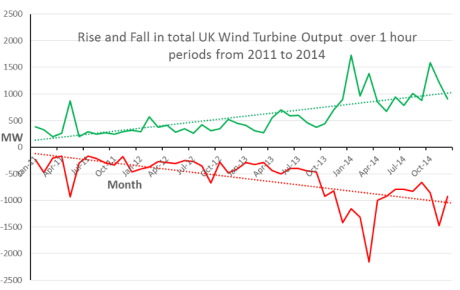
Maximum rise and fall in output over a one hour period was about 1000MW at the end of 2014 with a trend increase of about 250MW per year as measured over four years.

There is no correlation between UK wind turbine output and total UK electricity demand, with output often falling as demand rises and vice-versa.

The conclusions to be drawn from the analysis are that the increase in nominal capacity:

Does not increase the average wind turbine capacity factor.

Does not reduce the periods of low (less than 10% of installed capacity) or very low (less than 5%) output.

Does not reduce intermittency as measured by average monthly minimum output.

Does not reduce intermittency or variability as measured by maximum rise and fall in output over one hour period.

Does not indicate any possibility of closing any conventional, fossil-fuel power stations as there is no correlation between variations in output from wind turbines and demand on the Grid.

Therefore, based on the above, there is no case for a continued increase in the number of wind turbines connected to the Grid, or for the associated subsidies for wind energy, since this is an ineffective route to lower carbon dioxide emissions.

In April 2013 The Scientific Alliance published my analysis of electricity generation from all the UK wind turbines which are metered by National Grid, covering the period from January 2011 to December 2012.

This analysis showed:

The average capacity factor of all monitored wind turbines, both onshore and offshore, across the UK was 33.2% in 2011 and 30.7% in 2012

The average capacity factor in any given month varied from 16.2% to 50.8%.

The time during which the wind turbines produced less than 10% of their rated capacity totalled 3,165 hours and the time during which the wind turbines produced less than 5% of their rated capacity totalled 1,200 hours.

The output from wind turbines was extremely intermittent with variations by a factor of 10 occurring over very short periods.

Despite the fact that wind turbines only operate at about 30% of rated capacity on average and are exceedingly variable in their output, leading to long periods of very low output, the wind turbine fleet in the UK has increased significantly since 2012, driven entirely by government policy.

On 5 January 2015 renewableUK (the organisation representing the wind industry) headlined “Electricity needs of more than a quarter of UK homes powered by wind in 2014”.

They said that official statistics from National Grid showed that record amounts of electricity were generated by wind power in 2014:

Wind generated enough electricity to supply the needs of more than 6.7 million UK households last year; a 15% increase on the amount generated in 2013 (up from 24.5 terawatt hours to 28.1TWh in 2014) – just over 25% of all UK homes all year round.

Wind farms feeding into the grid, as well as smaller sites connected to local networks, provided 9.3% of the UK’s total electricity supply in 2014, up from 7.8% in 2013.

Other records were broken in December, with a new monthly high of 14% of all UK electricity generated by wind, beating the previous record of 13% set in December 2013, as well as a new quarterly record of 12% of electricity from wind in the last 3 months of 2014, breaking the previous record of 11% set in Q1 of 2014.

renewableUK continue to state on the Onshore Wind page of their website, “Onshore wind farms reduce CO2 emissions, provide energy security, and contribute to the local and national economy.

“The page also states, “Onshore wind works well in the UK because of the excellent wind resource. It has also become one of the most cost effective forms of renewable energy, providing over 5,000MW of capacity. A modern 2.5MW (commercial scale) turbine, on a reasonable site, will generate 6.5 million units of electricity each year – enough to make 230 million cups of tea.”

On 12 January 2015, the renewableUK home page gave figures “Powered by Wind”: Energy Produced 29,190,769 MWh, powering the equivalent of 6,963,447 homes and giving CO2 reductions (pa) of 12,552,031 tonnes.

These are very impressive figures if taken at face value, but what are the facts behind these statements – can we rely on wind turbines to power our homes and offset the annual release of carbon dioxide from conventional coal and gas burning power stations?

My previous report showed that this could only be true if the wind blew constantly but it does not, it blows very intermittently.

I have continued to analyse the output from the UK wind turbine fleet during 2013 and 2014, as measured by the electricity fed into the grid, in order to determine whether more turbines being brought into operation:

Improves average capacity factors

Reduces the periods of low or very low output

Reduces intermittency

Makes it possible to close any conventional, fossil-fuel power stations by making up for additional demand on the grid at peak times and, based on the analysis, to conclude whether wind turbines in the UK are making any significant contribution to a reduction in CO2 emissions.

Installed and Monitored Capacity

The installed capacity of wind turbines in the UK was quoted as 11,978MW by renewableUK on 12 January 2015 (7,936MW onshore and 4,042MW offshore). By comparison, on the same date the NETA (New Electricity Trading Arrangements) website quoted a capacity connected to the grid of 8,403MW, i.e. only 70% of the total installed capacity quoted by renewableUK.

This ratio has not changed over the years – at the end of 2011 the installed capacity of wind turbines in the UK was quoted as 5,772 MW whereas the monitored capacity, i.e. that monitored by the National Grid, was 4,006 MW. The equivalent figures for the end of 2012 were installed 7,777 MW, monitored 5,705 MW.

This analysis uses the NETA data throughout – the capacity connected to and monitored by the grid.

From the data on the NETA website, it is not possible to distinguish between onshore or offshore wind generation, or that from different parts of the UK. However, as this report covers the overall generation picture across the UK and does not break it down by region, this is of no consequence.

Do more wind turbines improve average output?

The average monitored capacity in 2011 was 3,340MW and the average output was 1,109.5MW giving a 33.2% capacity factor. In 2012 the equivalent figures were 4,696MW monitored by the grid, with an average output of 1,439.5MW or a capacity factor of 30.7%. The data points for each 30-minute period as monitored by the grid are averaged over the full month and a figure for output as a percentage of monitored power is calculated.

DP1

The figures show a significant variation in the average monthly capacity factor. The July average was 13.7% and that of December 46.7%. So even monthly averages vary by a factor of more than 3, a similar figure to that noted for 2011 and 2012.

DP2

Again the figures show a significant variation from month to month, the June figure being the lowest at 11.1% and February the highest at 48.8% – an increase in variation from month to month of almost 4.4 to1. Therefore from the data analysed the answer is “No, more wind turbines do not, on average, improve the average output.”

This despite there being 2.5 times increase in the installed (average) capacity from 2011 to 2014.

In fact, month to month variation, even in output averaged over the month, has increased significantly in 2014 compared with the previous three years.

If this is to be expected, simply because the installed capacity has increased, then the variation in output may be expected to increase still further as more turbines are added to the Grid, although at this stage we could equally well assume that this is primarily an artifact of the inherent variability of the wind resource.

Do more wind turbines reduce periods of low or very low output?

I have taken low output as being less than 10% of installed capacity and very low output as being less than 5% of installed capacity. Any percentage could have been chosen, but I believe that these are reasonable figures if one is to place any reliance on a sustainable source of supply.

In 2011 there were a total of 485.5 hours, or 20.2 days when output from the total UK wind turbine fleet fell to less than 5% of monitored capacity. The equivalent figures for 2012 were 714.5 hours or 29.8 days.

In 2011 there were a total of 1,370 hours, or 57.1 days when output from the total UK wind turbine fleet fell to less than 10% of monitored capacity. The equivalent figures for 2012 were 1795.5 hours or 74.8 days.

The table below gives the same data for 2013 and 2014, i.e. the total hours per month and per year where total output fell to less than 5% and less than 10% of installed capacity.

DP3

The data show no significant difference between the 2011 and 2013 periods and the 2012 and 2014 periods.

It can be seen that there are significant deviations from month to month. In the “worst” month, September 2014, the output from the total UK turbine fleet was less than 5% of their installed capacity for almost 25% of the time. In the same month the turbines failed to reach 10% of their capacity for over 62% of the time.

The graph for September 2014 is given below.

DP4

Over the 2-year period there was a total of 1,172 hours, or 48.8 days, when the output was less than 5% of nominal installed capacity.

This compares with 50 days over 2011 and 2012.

Looking at where output was less than 10% of installed capacity, for the two year period this was 3,278 hours , or 136.6 days compared with 131.9 days over 2011 and 2012.

It should be noted that 136.6 days is well over 4 months in total over the 24 month period.

Therefore from the data analysed the answer is “No, more wind turbines do not reduce periods of low or very low output”. (Note: low output is a function of natural variation in the strength of the wind – which, of course, is not influenced by having more wind turbines).

Do more wind turbines reduce intermittency?

The Oxford English Dictionary defines intermittent as “occurring at irregular intervals; not continuous or steady”. It is obvious that wind in the UK intermittent. It is not steady – sometimes the wind blows strongly, sometimes weakly and sometimes not at all. But here we are not concerned with the strength of the wind but its effect on the output of the UK wind turbine fleet.

To demonstrate the intermittency I have plotted the total UK wind turbine output for every month over the 24 months studied.

The graph on the following page shows data from a typical month, from March 2014.

It can be seen that during March 2014, the wind was always blowing somewhere in the UK as the output from all the wind turbines feeding the National Grid never fell to zero. However, the output varied dramatically from day to day, with a minimum output of 75MW and a maximum of 5,582MW – a variation of almost 75-fold.

DP5

This graph is quite typical and detailed graphs, with additional data, are given for each of the 24 months analysed in the appendix.

Intermittency can also be presented as daily minima and maxima in any month as shown in the bar chart below for August 2014. This is again a typical month where the average capacity factor was 27.5%.

DP6

On a single day, 2nd August, the variation from minimum to maximum is almost 30-fold.

The following table gives the minimum output during each month over the 2 years for which the data was analysed.

DP7

Therefore the assumption that the wind is always blowing somewhere in the UK may be true, but at times it is barely blowing enough to generate any significant energy.

In 10 out of the 24 months monitored, the minimum output dropped to 1% of capacity or less at some time. It should also be noted that the minimum output levels have not significantly changed since 2011, even with more wind turbines being installed. The equivalent average minima for 2011 and 2012 were 2.1% and 1.5% respectively.

As can be seen the maximum rise and fall has increased significantly as operational capacity has increased. This is the variation which the grid has to cope with, bringing in conventional fossil fuelled stations when output falls and taking them off line when it rises.

The above data can be plotted to give a trend showing the year on year increase.
DP8

It can be seen that The National Grid is now having to cope with variations in output (intermittency) of over 1,100MW over one hour periods. It can also be seen that this variation is increasing by about 250MW per year.

It should also be noted that 1,100MW is 13% of the installed capacity and is over 40% of the average monthly output in 2014.

The peak fall over one hour was 2,153MW in March 2014, a figure which is likely to be exceeded as more turbines are connected to the grid.

Therefore, from the data analysed the answer is “No, more wind turbines do not reduce intermittency. In fact using two alternative measures, minimum output during the month and variation in output over 1 hour, then more turbines increase the impact of intermittency”.

Do more wind turbines make it possible to close any conventional, fossil-fuel power stations by making up for additional demand on the grid on peak times?

If the variation in output matched the increase or decrease in demand on the grid, then there would be no need for back-up in the form of conventional, fossil-fuel power stations.

In order to see if output from wind turbines in any way matches demand, the total output has been plotted against demand on the grid over the last seven months of 2014. In order to fit the graphs on the same scale, UK wind turbine output has been plotted alongside grid demand divided by ten.

A typical week, from October 2014, is shown below. As expected, there is no correlation between output and demand. The output varied over the week from a high of 6,000MW on 6 October to a low of 200MW on 12 October with no form of repetitive pattern in between.

DP9

The graph above does show a pattern on some days where output from wind turbines falls as demand rises and vice versa, which is not atypical. In fact over Christmas Day 2014, if wind were relied on to cook the turkey, then there would have been a public outcry as output dropped steadily from over 6,000MW on Christmas Eve to under 200MW on Boxing Day.

DP10

Therefore, from the data analysed the answer is “No, more wind turbines do not make it possible to close any conventional fossil fuel power stations”.

As expected, analysis shows that there is no correlation between variations in output from wind turbines and demand on the Grid. Often the opposite is true – when demand rises, output from wind turbines falls and vice versa. This has a significant negative effect as back-up has to be provided from conventional, fossil-fuel power stations not only to cater for increase in demand on the Grid at peak times but also to cover for any possible fall in output from the UK wind turbine fleet at the same time. (It is understood that fossil-fuel generators being run in stop-start mode to provide this back up are very inefficient and may be producing significant additional carbon dioxide than when operating in their designed steady state.) So, taking some of the renewableUK statements:

“Electricity needs of more than a quarter of UK homes powered by wind in 2014” – should this be “Electricity needs of more than a quarter of UK homes powered by wind in 2014 some of the time”?

“Wind farms feeding into the grid … provided 9.3% of the UK’s total electricity supply in 2014” – should this read “Wind farms feeding into the grid … provided 9.3% of the UK’s total electricity supply in 2014 when averaged over the year.”

“Other records were broken in December, with a new monthly high of 14% of all UK electricity generated by wind” – should this be counterbalanced by “but in June 2014 electricity generated by wind was only one quarter of this figure”.

“Onshore wind farms reduce CO2 emissions, provide energy security….”. Taking the analysis in this report, and the previous one, there is no basis for this statement.

There is patently a need to provide back-up for wind turbines which are feeding into the Grid and therefore CO2 emissions may possibly be increased rather than decreased as conventional, fossil-fuel power stations have to be operated inefficiently in order to provide this back up. Similarly there is no energy security if output can fall from over 6,000MW to under 200MW over a 42 hour period as it did over Christmas 2014.

Based on the above, I would like to see evidence that any conventional power station has been able to be closed down as a result of the introduction of over 8,000MW of wind turbine capacity feeding into the National Grid. Similarly I would like to see evidence of reductions in CO2 emissions through the introduction of wind turbines where a holistic approach to meeting the demand on the Grid is taken into consideration.

Conclusions

Over the period studied, January 2013 to December 2014 inclusive, wind turbine operational capacity connected to the UK Grid has increased from 5,894MW to 8,403MW. The operational capacity in January 2011 was 2,490MW; therefore there has been an increase of almost 3.4x over the four year period.

The conclusions to be drawn from the data analysis are:

An increase in the operational capacity does not improve average output. In fact the average monthly capacity factor has fallen over the periods studied, dropping from 33.2% in 2011 to 28.8% in 2014.

An increase in the operational capacity does not reduce the periods of low or very low output as measured by the number of hours per year when output was low (less than 10% of installed capacity) or very low (less than 5% of installed capacity). There is a variation from year to year but no pattern emerges. The mean low output over the four years was 1,617 hours/year with a standard deviation of 197 hours/year and the mean very low output was 599 hours with a standard deviation of 96 hours.

An increase in the operational capacity does not reduce intermittency. If taken as a measure of intermittency, the average monthly minimum expressed as a percentage of installed capacity was 1.9% with no significant variation from year to year.

Taking maximum rise and fall in output over one hour period as a further measure of intermittency, the National Grid is now having to cope with variations in output of over 1,100MW over one hour periods, with this variation increasing by about 250MW per year.

This is very significant as it represents the changes in output which the Grid has to cope with and which has to be compensated by conventional fossil fuelled power stations.

An increase in the operational capacity does not indicate any possibility of closing any conventional, fossil-fuel power stations as there is no correlation between variations in output from wind turbines and demand on the Grid. Often the opposite is true – when demand rises, output from wind turbines falls and vice versa.

This has a significant negative effect as back-up has to be provided from conventional, fossil-fuel power stations not only to cater for increase in demand on the Grid at peak times but also to cover for any possible fall in output from the UK wind turbine fleet at the same time.

Therefore, taking the four criteria above, there is no case for a continued increase in the number of wind turbines connected to the Grid.

As stated in my previous report, it is incumbent upon the Government to ensure that the British consumer is getting value for money from industrial wind turbine installations and that they are not just paying subsidies to developers and operators (through ROCs) whilst getting nothing back in return in terms of CO2 emission reductions through the supplanting of fossil-fuelled power generation.

Based on the results of this and my previous analysis I cannot see why any policy for the continued increase in the number of wind turbines connected to the Grid can be justified.
Derek Partington

Derek’s previous paper can be found here: Intermittency of UK Wind Power Generation 2011 and 2012


turbine-2_3153749b

Feisty Aussies Fight Back Against the Corrupt Wind Pushers!

NSW Minister – Pru Goward – Joins Forces with Community Defenders to Kill Plans for Trustpower’s Rye Park Wind Farm Disaster

pru-goward

****

A week or so back we covered the antics of another foreign owned wind power outfit struggling to come to grips with the fact that Australian rural communities have had – as they say – ‘a gutful’ of the wind industry’s lies, treachery and deceit. And they’ve especially had enough of the bully-boy, stand-over tactics adopted by the thugs employed by the likes of Trustpower and Epuron:

Wind Industry Belting its ‘Message’ Home: Trustpower’s Thugs Assault 79-Year-Old Pensioner & Disabled Farmer

Since Trustpower’s thugs set upon highly respected local elder, Jim Field, the Yass and Rye Park communities have galvanised in their furious reaction to the manner in which he was treated. And rightly so.

Jim Field

****

The Yass and Rye Park communities’ brewing anger bubbled to the surface at a packed house meeting held in the Yass Memorial Hall on Friday, October 9.

And standing shoulder to shoulder with them was local State member and Minister for Mental Health and Assistant Minister for Health, Pru Goward. Here’s a little report on proceedings from the local rag.

Wind Turbines continue to create noise
Yass Tribune
Jessica Cole
16 October 2015

yass memorial hall

****

It was a full house at the Yass Memorial Hall on Friday to talk about the future of wind energy projects around the Hume electorate. Of the approximate 150 people who attended, the majority were against the establishment of wind farms.

Federal Member for Hume Angus Taylor and Member for Goulburn Pru Goward both attended the meeting that was hosted by a Rye Park group, attracting people from as far as Crookwell.

The development at the centre of discussion was the Rye Park Wind Farm project. Trustpower is proposing to erect 109 wind turbines, each 157 metres tall, with an approximate capacity of 327MW within the Rye Park area.

Ken Bell opened the meeting reminding people that these proposed turbines will be erected on Ngunnawal land and called for the crowd to respect each other’s views on the sensitive subject.

Angus Taylor

****

Mr Taylor was asked to speak and although he mentioned no particular preference to support nor decline the wind farm proposal he reminded residents that ongoing development was up to them.

“Unfortunately with these topics you will never get a 100 per cent agreement,” he said, “but you have to figure out what you want and come together to have your voice heard.”

Ms Goward took a harder line opposing the developments, supporting the complaints about health, noise and land depreciation. She spoke about the developments being a result of the federal government and assured those present that they can’t legislate wind farms.

“Increasingly, I am on the view that there is some validity on the health effects,” she said.

“There are a number of people with health problems … it is clearly not psychosomatic.”

She argued that securing and protecting residents from the turbines’ noise pollution was important.

“They impact upon the landscape and have an immediate effect upon land value,” Ms Goward continued.

“I am with this community and plan on putting pressure on the state government.

“I want to look after the health, prosperity and look of this beautiful area. We have to make sure not to let these wind farms divide us.”

Ms Goward also called for further land value and environmental reports to be done.
Yass Tribune

Angus Taylor may have simply been keeping his powder dry at Yass. Angus has been an STT pinup boy even before he stepped into the late STT Champion, Alby Schultz’s boots, as member for Hume – going back to his appearance at the Great Wind Power Fraud Rally in June 2013:

Rally – Angus Taylor

And Angus has seen plenty of action on the front foot, since then:

The Wind Industry’s Worst Nightmare – Angus Taylor – says: time to kill the LRET

Angus Taylor Joins the Wind Farm Rumble to Save Rugby & Rye Park

Taylor’s relatively neutral position at Yass, is part and parcel of just where the wind industry sits in Australia at the present time.

The major commercial power retailers have signalled that they will not enter long-term Power Purchase Agreements with wind farm outfits planning wind farms in communities, wherever there is significant and vocal opposition.

Without a PPA, wind power outfits will never obtain the finance necessary to build any new wind farms.

hunt

****

Hence the efforts by wind industry front man, Environment Minister young Gregory Hunt over the last couple of weeks to exhort retailers to hurry up and enter PPAs.

Hunt’s desperate and silly pleas are somewhat amusing. You see, Hunt and his mates at Infigen, Vestas & Co have, hitherto, never made any mention of the PPAs entered into between wind power outfits and retailers.

Those agreements have set guaranteed prices for wind power at between $100-120 per MWh – for power that has no commercial value (apart from the REC Subsidy it attracts): try selling a good on terms where you can never guarantee to supply it when a customer actually wants it; and where you’ll often be supplying it when a customer has absolutely no need for it. Basic commerce, to be sure; but try telling the Wind Gods that:

June 2015 National

Hunt’s wind industry benefactors have been at great pains to keep the terms of their PPAs under wraps (even flatly refusing to provide them to the Senate Inquiry into wind farms), simply because they would completely destroy the wind industry’s ludicrous claims about supplying power at prices cheaper than coal fired power; and equally ludicrous claims that the Large-Scale Renewable Energy Target lowers retail power prices. Notwithstanding that, from hereon, the LRET will add more than$45 billion to retail power bills on account of the REC Tax/Subsidy paid to wind power outfits, alone.

So, when Taylor told residents that ongoing development “was up to them”, it should be taken by community defenders as a ‘call to arms’. As STT has pointed out, just once or twice: fight them; and they will flee.

More pleasing still, was Pru Goward’s front foot approach; seizing on the concepts of community “health and prosperity”; and the fact that those fairly reasonable societal objectives are simply incompatible with fleets of bat-chomping, bird slicing, blade-chucking, pyrotechnic, sonic-torturedevices.

As to her call for “further land value” reports to be done, Pru need only tap into the work put together by highly experienced property valuer, Peter Reardon.

Reardon compiled a 30-page dossier on the impacts of wind farms on adjoining or nearby rural farms; and found that having these things as neighbours led to discounts of between “33 per cent and 60 per cent in the market place”. Reardon’s report and associated press releases are available to download below:

Southern Tablelands – Impact of Wind Farm Development on Surrounding Rural Land Values 2013

MEDIA Release Property devaluation

BDLG – Press Release

What Reardon found is little more than stating the bleeding obvious:

Potential Wind Farm Neighbour Finds Idyllic Property is Now ‘Unsaleable’ at Any Price

Wind Farms: Crushing Property Rights & Values Everywhere

Thankfully, for community defenders in NSW out to protect their hard-won common law property rights (you know, that seemingly forgotten right to own, live in and otherwise enjoy a home free from interference from incessant turbine generated low-frequency noise and infrasound), they have an ally in Pru Goward. But, as Angus Taylor suggests, winning the battle to maintain and preserve those rights is down to each and every community defender. United, you cannot fail.

angry-mob

Wind Turbine Emissions Can Make You Sick….Here’s More Proof!

Irish Wind Farm Study Proves Turbine Noise Causes Disease

Professor Alun Evans

****

WIND FARMS DO MAKE YOU SICK
Irish Daily Mail
Leah McDonald
16 October 2015

Irish scientists link them to cancer, stroke and heart attacks – wind turbines ‘too near family homes’

WIND farms can contribute to people getting diseases such as cancer and heart attacks, two leading Irish health experts have warned.

They say that noises emitting from turbines lead to sleep deprivation that can cause cancer and heart disease, along with a number of other illnesses.

Professor Graham Roberts, head of the Department of Endocrinology at University Hospital, Waterford, and Professor Alun Evans, an expert in public health at Queen’s University, Belfast, met Alan Kelly yesterday to warn the Environment Minister that the current guidelines in Ireland are a cause for alarm.

The rules allow turbines and power lines as close as 500 metres to a family home, while international standards demand they should be at least 2km away.

Prof Evans, recently wrote a report pointing to ‘serious adverse health effects associated with noise pollution generated by wind turbines’. The risks were due to sleep disturbance and deprivation with loud noise being one of the main causes.

He pointed out that sleep deprivation is associated with memory impairment in children and disturbed cognitive function in adults.

He told the Irish Daily Mail yesterday that distances between homes and turbines should be increased.

He said: ‘The bad effects of low frequency noise has been known for at least 40 years, the thing is 500 metres does not protect people. It is insufficient.’ He warned that there is evidence that the ‘infrasonic signatures’ that cause the damage can be picked up from 50 miles way, adding: ‘It is a serious problem. It doesn’t affect everyone the same way. Something like a quarter of people are more susceptible.’

Prof Evans explained: ‘It is a problem, the big thing being noise and sleep deprivation. Once you deprive people of sleep you make them more liable to become overweight and you delay their learning because while we sleep we reinforce memory.

‘Depriving people of sleep is not a good idea, overweight children become obese adults and obese adults are far more likely to [develop] a whole range of diseases particularly cardiovascular disease, cancer and type 2 diabetes.’ He added that the noise doesn’t have to have a direct effect to cause a problem. ‘It can be indirect but it is still very important,’ he said. ‘And you can prevent diseases by preventing the more distant causes.’

And in his recent report, Dr Evans said that there had been no proper cost-benefit analysis in Ireland before the widespread introduction of wind power.

Both he and Dr Roberts believe there are fundamental technical errors in reports on current wind farm and power-line projects here.

They are concerned over the consultation process with the public. Some parents of autistic children have particular fears about the effects turbines and high-voltage pylons have on their quality of life.

John Callaghan has objected to wind farms in Co. Meath, which he fears will affect the environment and health of his autistic son.

The engineer, who has studied renewable energy at postgraduate level, said his seven-year-old son is autistic and very sensitive to noise and says he has ‘grave concerns’ about the impact of the proposed wind farm on his son, himself, his family and the local area, including wildlife, heritage and the cultural landscape.

The meeting between the professors and the minister was organised by community campaigner David Reid of the Westmeath Alliance. Mr Reid said there are significant concerns about noise pollution for people living close to wind turbines. He said the World Health Organisation refers to this as ‘environmental insomnia’, if the noise is above a certain threshold.
Irish Daily Mail

Alun Evans made a brilliant submission to Australia’s Senate Inquiry into the great wind power fraud – available here.

David Reid is right on the money when he points out that “the World Health Organisation refers to noise pollution for people living close to wind turbines as ‘environmental insomnia’”. The WHO has defined noise induced ‘environmental insomnia’ as an adverse health effect, in and of itself, for something like 60 years. Its Night-time Noise Guidelines for Europe – the Executive Summary at XI to XII which covers the point – says:

NOISE, SLEEP AND HEALTH

There is plenty of evidence that sleep is a biological necessity, and disturbed sleep is associated with a number of health problems. Studies of sleep disturbance in children and in shift workers clearly show the adverse effects.

Noise disturbs sleep by a number of direct and indirect pathways. Even at very low levels physiological reactions (increase in heart rate, body movements and arousals) can be reliably measured. Also, it was shown that awakening reactions are relatively rare, occurring at a much higher level than the physiological reactions.

The review of available evidence leads to the following conclusions.

  • Sleep is a biological necessity and disturbed sleep is associated with a number of adverse impacts on health.
  • There is sufficient evidence for biological effects of noise during sleep: increase in heart rate, arousals, sleep stage changes and awakening.
  • There is sufficient evidence that night noise exposure causes self-reported sleep disturbance, increase in medicine use, increase in body movements and (environmental) insomnia.
  • While noise-induced sleep disturbance is viewed as a health problem in itself (environmental insomnia), it also leads to further consequences for health and well-being.
  • There is limited evidence that disturbed sleep causes fatigue, accidents and reduced performance.
  • There is limited evidence that noise at night causes hormone level changes and clinical conditions such as cardiovascular illness, depression and other mental illness. It should be stressed that a plausible biological model is available with sufficient evidence for the elements of the causal chain.

STT tends to think the World Health Organization – after more than 60 years of studying the problem – might just know a thing or two about night-time noise, sleep and health. And, after more than 5 years of suffering, so do Clive and Trina Gare.

Notwithstanding a $200,000 annual pay-cheque, and thousands spent on noise ‘mitigation’, the Gares still can’t sleep properly; or otherwise enjoy their own home – their suffering continues:

SA Farmers Paid $1 Million to Host 19 Turbines Tell Senate they “Would Never Do it Again” due to “Unbearable” Sleep-Destroying Noise

What Alun Evans and his team have done is simply confirm what is simply obvious to any human being gifted with our good friends ‘logic’ and ‘reason’: deprive someone of sleep over an extended period and their health will suffer.

Even after one ‘rough night’, you don’t ever hear the sufferer bubbling about how much better they felt in the morning. No, the usual response is about telling those around them to keep out of their way for the day, or there’ll be trouble (often in terms too ‘blue’ to print). However, that ‘trouble’ manifests as a danger not just to the sufferer and his nearest and dearest, but to a range of others who might end up tangling with the insomniac, as their sleep-deprived day draws on:

Wind Turbine Noise Deprives Farmers and Truckers of Essential Sleep & Creates Unnecessary Danger for All

Alive to the critical importance of regular, quality sleep to health, the common law has recognised a person’s right to a decent night’s sleep in their own home for over two centuries.

STT’s Nuisance “In-a-Nutshell”

Nuisance is a long recognised tort (civil wrong) at common law based on the wrongful interference with a landowner’s rights to the reasonable use and enjoyment of their land.

Negligence is not an element of nuisance, although aspects of the former may overlap with the latter.  Where, as here, the conduct is intentional (ie the operation of the wind turbines is a deliberate act) liability is strict and will not be avoided by the defendant showing that it has taken all reasonable steps to avoid the nuisance created.  Indeed, the conduct of the defendant is largely irrelevant (unless malice is alleged); the emphasis is on the defendant’s invasion of the neighbouring landowner’s interests.

A defendant will have committed the tort of nuisance when they are held to be responsible for an act indirectly causing physical injury to land or substantially interfering with the use or enjoyment of land or of an interest in land, where, in the light of all the surrounding circumstances, this injury or interference is held to be unreasonable.

The usual remedy for nuisance is an injunction restraining the defendant from the further creation or continuance of the nuisance.  Injunctions are discretionary, in all cases, and will not be granted unless the nuisance caused is significant.

Where interference with the enjoyment of land is alleged, the interference must be “substantial” and not trivial.

Interference from noise will be substantial, even if only temporary in duration, if it causes any interference with the plaintiff’s sleep.

The loss of even one night’s sleep through excessive noise has been repeatedly held to be substantial and not trivial in this sense (seeAndreae v Selfridge & Co [1937] 3 All ER 255 at 261, quoted with approval in Munro v Dairies Ltd [1955] VLR 332 at 335; Kidman v Page [1959] St R Qd 53 at 59; see also Halsey v Esso Petroleum Co Ltd [1961] 1 WLR 683 at 701: “a man is entitled to sleep during the night in his own house”).

It is not a defence for the party creating the nuisance to claim that he is merely making a reasonable use of his property.  The defendant’s conduct may well be otherwise lawful, but still constitute actionable nuisance.  The activity engaged in by the defendant may be of great social utility or benefit, but that has been repeatedly held as being “insufficient to justify what otherwise would be a nuisance” (see For example, Munro v Dairies Ltd [1955] VLR 332 at 335; see also Halsey v Esso Petroleum Co Ltd [1961] 1 WLR 683)

Halsey’s case is well worth a read – a real “David and Goliath” battle, as described by the trial Judge: “This is a case, if ever there was one, of the little man asking for the protection of the law against the activities of a large and powerful neighbour.”  And just like David’s epic battle with a thuggish giant, the little bloke won!

Here’s a link to the case: Halsey v Esso Petroleum [1961] 1 WLR 683

Precisely the same principles were at work in the case pursued by Julian and Jane Davis, who successfully obtained a £2 million out of court settlement from a wind farm operator, for noise nuisance; and the resultant loss of property value (the home became uninhabitable due to low-frequency noise, infrasound and vibration).

The Particulars of Julian and Jane Davis’ Claim are available here: Davis Complaint Particulars of Claim

And Jane Davis’ Statement (detailing their unsettling experiences and entirely unnecessary suffering) is available here: davis-noise-statement

What the likes of Alun Evans have done, is to add to the growing body of irrefutable evidence, that is now well-and-truly sufficient to take on wind power outfits in Civil Proceedings; to win back everything that you worked so hard to obtain; and that they were prepared to simply steal from under you, with knowing assistance from your very own governments.

judges-gavel

Wind Pushers Try Everything Possible, to Deny Noises Caused by Their Useless Machines!~

Two decades of Deception of Wind

Turbine Noise!

by mabrake

PRESS RELEASE Two Decades of Deception of Wind Turbine Noise The wind industry and its acousticians have for many years been denying there are noise related problems associated with industrial wind turbines. A report released this week, and presented to the Department of Energy and Climate Change by the Independent Noise Working Group (INWG), shows how a small group of wind industry funded acousticians have taken control of the Institute of Acoustics (IoA) and its noise working groups. This façade of respectability afforded by the Institute of Acoustics has enabled the wind industry to dominate government noise assessment policy and planning guidance by providing inaccurate and misleading scientific advice. The parallels with the Volkswagen emission scandal are quite remarkable. The INWG suggest these two decades of deception are now resulting in serious annoyance and far reaching risks to the health and wellbeing of large numbers of people living in the proximity of wind farms. They have urged the Government to complete an overhaul of the planning conditions that have led to these wind farms being granted planning permission in the first place, and to ensure future developments are more strictly controlled. They also want the Government to provide robust protection for existing wind farm neighbours against the effects of turbine noise – specifically against Excessive Amplitude Modulation (EAM). EAM is a highly intrusive ‘whoosh’ or ‘thumping’ noise characteristic emitted by most wind turbines; a fact which has been continually denied and downplayed by the wind industry. This report is one of a number of elements within a major study which has been prepared for Government by the Independent Noise Working Group (INWG). The INWG is sponsored by Chris Heaton‐Harris MP (Conservative, Daventry). Heaton‐Harris paid tribute to the experts working on the INWG study for the last 12 months: “We have drawn people from a wide range of disciplines. This gives real authority to the final study when I present it to government departments later this autumn”. The INWG reports can be obtained at:http://www.heatonharris.com/reports‐publications Or by contacting us at: wind‐noise@tsp‐uk.co.uk and we can provide links to download all the INWG work packages.

Wind Power Shares Plummeting… “Green” Jobs Axed!

US Wind Power Outfits’ Shares Plummet – Hundreds of ‘Green’ Jobs Axed

share traders

****

Remember all those stories about the wind industry providing millions of groovy, well-paid ‘green’ jobs – as secure as Fort Knox?

No?

Sure, you’ll hear mention of loads of promised wind industry jobs – in fictional retellings from wind industry spruikers – as they wail about dreaded ‘uncertainty’ – causing bankers to baulk and investors to flee; and as they demand (with menaces) that governments maintain essential, massive and endless subsidies until the end of time.

But, as is almost always the case with wind industry drivel, dreams and reality fast become an ugly amalgam, of what passes for wind industry ‘truth’.

When economists scroll through the books, however, claims about wind industry employment evaporate like snowflakes in summer – and, instead, the hard numbers show that the places where these things proliferate, are suffering from declining employment in real industries, particularly those with the tendency to use more than just a little power in the processes of production:

Wind Power Subsidies Crushing Families & Killing Thousands of Real Jobs

The Wind Industry’s Jobs Bonanza Myth Smashed, Again

It’s a confusing paradox, to be sure.

You see, on the one hand we’re told that the wind industry delivers a product, that customers can’t get enough of (at prices starting somewhere near “free” – and getting cheaper all the time), but, strangely, the merest mention or even hint that wind power subsidies might be trimmed or, heaven forbid, chopped, has wind industry parasites descending into a fixed state of apoplexy.

During their descent, wind industry spinners shout even louder about millions of new jobs, that are always just beyond the horizon; attainable – but if, and only if, the massive subsidies presently in place are set in stone. Here are a couple of pieces peppered with precisely that type of self-serving and deluded ranting.

Panel seeks to extend freeze on Ohio green energy targets
Associated Press
Julie Carr Smyth
1 October 2015

Government requirements for the use of solar, wind and other forms of renewable energy by Ohio power companies would be suspended indefinitely under recommendations released Wednesday by a legislative panel. The Energy Mandates Study Committee’s report cites legal uncertainty and a need for “greater clarity” surrounding proposed federal clean power rules among reasons for the recommendation.

COLUMBUS, Ohio — Government requirements for the use of solar, wind and other forms of renewable energy by Ohio power companies would be suspended indefinitely under recommendations released Wednesday by a legislative panel.

The Energy Mandates Study Committee’s report cites legal uncertainty and a need for “greater clarity” surrounding proposed federal clean power rules among reasons for the recommendation. The suggestion drew swift criticism from environmental groups, alternative energy businesses, Democrats and Gov. John Kasich.

Committee chairman Troy Balderson, a Zanesville Republican, said the report represents a starting point for debate as legislation proposing changes to Ohio’s mandates is drafted.

“Look, I know what the headline on the report’s going to be. There’s more to it than that,” he said. “And there will continue to be more to it than that. Now we have to go through the legislative process.”

The panel’s additional recommendations include ultimately switching from mandates to an incentive system to encourage use of renewables and efforts toward energy efficiency; expediting the regulatory process for approving utilities’ energy-efficiency plans; and ensuring advanced-energy projects receive maximum credit.

The panel was charged with reviewing an Ohio law requiring utilities to generate 25 percent of electricity from alternative and advanced sources by 2025 and to meet certain energy efficiency targets.

The committee was created as part of a compromise brokered by Kasich amid efforts to repeal the targets outright. The deal placed a two-year freeze on phasing in existing mandates while the issue was studied. If legislators fail to act, the law would resume as planned in 2017.

The administration signaled dissatisfaction with extending the freeze any further.

“A continued freeze of Ohio’s energy standards is unacceptable and we stand willing to work with the Ohio General Assembly to craft a bill that supports a diverse mix of reliable, low-cost energy sources while preserving the gains we have made in the state’s economy,” Kasich spokesman Joe Andrews said.

Ohio is among states that have sued over the Environmental Protection Agency’s Clean Power Plan, which sets targets for carbon dioxide emissions for existing power plants as a means of reducing emissions from 2005 levels by 32 percent by 2030. Kasich has written to President Barack Obama asking him to hold off on implementing the plan until questions are resolved by the courts.

“The US EPA, by promulgation of the proposed CPP, seeks to change the energy landscape significantly across the United States,” the report states.

Senate President Keith Faber said lawmakers and the governor — who was represented in deliberations over the report — may have to “agree to disagree.”

“I know their EPA director has gone and urged everybody to be cautious until we see the implementation of what the president’s new proposals are,” he said. “And so at this point, I’d like to hear their proposal if they think what we’re putting forward is unacceptable.”

Proponents argue that Ohio’s targets were creating jobs and benefiting the environment before they were frozen, and that the state would continue to do so if allowed to proceed.

State Rep. Michael Stinziano, a Columbus Democrat who sat on the Republican-dominated study committee, said the report’s recommendations ignore expert testimony by a number of witnesses “who attested to the positive impacts these standards had on the state until frozen.”

Senate Democrats called on Kasich to fight for restoration of the mandates.

“Allowing the clean energy industry to prosper could result in better products, a healthier population, cheaper prices, and more jobs over time,” they wrote.

Samantha Williams, attorney and energy policy advocate at the Natural Resources Defense Council, said Ohio’s momentum as “a clean energy trailblazer” has stalled.

“Any policies that block progress to regain Ohio’s leadership will only grow the mountain of missed opportunities and keep the state lagging behind its neighbors that are moving forward with clean energy to create jobs, boost their economy and protect public health,” she said in a statement.
Associated Press

The usual grab bag of nonsense is predictably pitched up by Samantha Williams – about wind power being a “clean energy” source; and a serious source of lasting jobs. Although, when the term “lasting” is used, we tend to think of jobs that don’t disappear with the merest hint of reining in a pointless subsidy.

Then there’s the claims about these things generating a “healthier population”!?!. Here’s a few from our archive that tend to suggest the opposite:

SA Farmers Paid $1 Million to Host 19 Turbines Tell Senate they “Would Never Do it Again” due to “Unbearable” Sleep-Destroying Noise

Labor’s Bill Shorten Publicly Ridicules Joanne Kermond – a Victim of Pacific Hydro’s Non-Compliant Cape Bridgewater Wind Farm

Wind Turbine Infrasound: What Drives Wind Farm Neighbours to Despair

Dr Bruce Rapley Slams Australian Medical Association as Totally Unqualified Wind Industry Propagandists

Audacity is the very essence of propaganda; taking patent nonsense, wrapping it in myth and pitching it up with a straight face, has been the core competence of the wind industry from the get go – it’s a skill that will follow it to its already dug and waiting grave.

Here’s another view of a panicked industry on the run, from Oklahoma.

Bill introduced to end wind tax credit
Washington Examiner
Kyle Feldscher
7 October 2015

A senator from the windswept state of Oklahoma wants to remove a tax credit for wind energy from the tax code.

Republican Sen. James Lankford introduced a bill Wednesday, titled the PTC Elimination Act, that would remove the Production Tax Credit from the tax code entirely. The credit expired at the end of 2014, but a renewal is attached to a tax extenders package making its way through Congress.

Lankford, echoing oil industry groups who spoke against the credit last month, said wind energy has become self-sustaining and no longer needs to be subsidized federally.

“I am a fan of an all-of-the-above energy strategy, and I certainly support wind as a large part of that goal,” he said.

“There is no need for the taxpayer to continue to subsidize a wind start-up tax credit.”

In addition to wind, the Production Tax Credit is tied to 11 other sources of renewable energy.

For wind, the tax credit is 2.3 cents per kilowatt-hour for the first 10 years of a facility’s existence. Lankford estimates the tax credit would cost taxpayers $10.5 billion during the next 10 years.

Right now, projects that began before Jan. 1 still qualify for the tax credit. Under Lankford’s bill, the last day any company could receive funds from the credit would be Dec. 31, 2026.

Lankford has campaigned in the past on relying more on fossil fuels, such as natural gas, instead of renewable sources.

Observers say it’s unlikely the bill will make much progress.

Oklahoma is a major player in wind energy. In 2014, the state was ranked fourth for installed wind capacity, according to the American Wind Energy Association.

There are 2,614 wind turbines in Oklahoma that produced about 17 percent of all electricity produced there in 2014, according to the association.

Lankford contends the tax credit has outlived its usefulness and is a redundancy since 37 states already provide incentives for wind energy production. He said wind generation has grown 5,000 percent since the tax credit was instituted in 1992.

Some business groups disagree.

On Monday, 580 companies working in clean energy from around the country signed a letter urging Congress to extend the credit. Meanwhile, 2,000 businessmen and women signed a letter that also called on Congress to extend the tax credit, according to the wind trade group.

The Senate Finance Committee passed the extension of the credit 23-3. That included yes votes from senators on both sides of the aisle.

Rob Gramlich, senior vice president of government and public affairs at the American Wind Energy Association, said he’s hopeful that, contrary to Lankford’s bill, the wind tax credit will be renewed by the end of 2015.

“Hundreds of American businesses employing American workers have also made it clear extending these incentives is critical to plan their business and keep their doors open,” he said. “We will continue to educate all members of Congress about all of wind energy’s benefits to our economy.”
Washington Examiner

Good to see that the same rubbish pitched up by Samantha Williams in Ohio, being recycled by the AWEA’s Rob Gramlich – eerily familiar stuff; as you’d expect from people chanting the same mantra, from the same playbook.

Now, why would wind industry parasites like Samantha Williams and Rob Gramlich be fighting tooth-and-nail to ensure that the wind power subsidy trough is replenished from now until Armageddon?

Here’s a little clue.

After buying binge, SunEdison to cut 15% of workforce
Energy Wire
David Ferris
6 October 2015

SunEdison Inc., the world’s largest renewable energy developer, plans to cut 15 percent of its personnel after a yearlong spending spree and a precipitous drop in its stock price.

The cuts among the company’s 7,300 staff are even deeper than what was originally reported yesterday by Greentech Media. The board of the company decided a week ago to carry out the layoffs in the face of a slowing market and to eliminate redundancies among its many new arms, according to a document filed yesterday with the Securities and Exchange Commission.

SunEdison plans a phone call with investors tomorrow to provide more details.

In the past month, nervous investors have pushed two of the most ambitious and acquisitive clean-energy companies — SunEdison and NRG Energy Inc. — to trim their plans. Both companies have plowed their moneymaking assets into yieldcos, a new investment vehicle that Wall Street loved a few months ago but has now soured on.

The core business of U.S.-based SunEdison is putting together large, complex solar- and wind-energy projects around the world, with operations as far-flung as India, Brazil, England and Massachusetts. In the past year, those operations became more complicated as the company entered new markets and bought up competitors around the globe.

Last November, the company expanded from solar into wind energy with a $2.4 billion purchase of First Wind. In June it bought Continuum Wind Energy, a wind developer in India, for about $620 million, according to Livemint. That same month, SunEdison snapped up a leading wind and solar developer in Central America. In July, it acquired Vivint Solar, a major U.S rooftop solar developer, for $2.2 billion.

Also this year, SunEdison created two yieldcos, which are essentially holding companies for the company’s completed projects. Since those projects are contracted to last decades, yieldcos were meant to provide investors with a long-term, dependable payback in the unpredictable renewable energy business, while giving their parent companies a cheap supply of capital.

Since 2013, at least 10 yieldcos have been created in the renewable energy sphere and received enthusiastic investment until midsummer, when confidence ebbed.

“The business model for many yieldcos is to issue equity, acquire projects and pay out cash flow. When the equity prices go down, that raises their finance cost, which jeopardizes the business model,” said Travis Miller, director of utilities equity research at Morningstar, a research firm.

This week’s news echoes that of NRG Energy, a company with a portfolio that is both different from and similar to SunEdison’s.

NRG’s principal business is operating one of the country’s largest fleets of traditional power plants running on coal and natural gas. In the past several years, the firm has bought its way into a diverse portfolio of clean energy projects, including large wind and solar farms, a rooftop solar installation business and a network of electric vehicle chargers (EnergyWire, Sept. 9, 2014).

NRG has seen its stock drop from a 52-week high of $32 to $18 per share a few weeks ago and a corresponding slide in its yieldco, called NRG Yield.

Three weeks ago, CEO David Crane announced that the company’s clean energy holdings would be reshuffled into a “GreenCo” that stands apart from the company’s traditional businesses (EnergyWire, Sept. 21). NRG hoped its intentions would increase confidence, but the stock has dropped further, to $14.

Growth, abated

At the time of the Vivint acquisition, SunEdison’s CEO, Ahmad Chatila, told Bloomberg that adding a major rooftop solar installer to the portfolio would give the company “unabated growth for 20 years.”

The firm continued to express confidence in its strategy, even as it took on heavy debt from its new purchases and its stock prices sank.SunEdison stock plunged from a high of $31 in mid-July to $9 at market close yesterday. Its two yieldcos, TerraForm Power and TerraForm Global, have experienced similar declines.

One analyst suggested the company’s bold, deal-making approach to energy projects may have not prepared it for the level of financial restraint it needed when participating in financial markets with its yieldcos.

John Hempton of Bronte Capital wrote in a blog post last week that Chatila ought to step down in favor of “someone whose job it is to ensure — and be seen to ensure — that bad projects are not funded.”

“Mr Chatila has built an institution for which he is profoundly unsuitable to run,” Hempton wrote.

Also yesterday, the man at SunEdison who will presumably carry out the layoffs — head of human resources Stephen Cerrone — acquired stock options worth $360,000, according to an SEC document.
Energy Wire

panic-disorder-971

NRG the outfit that has seen “its stock drop from a 52-week high of $32 to $14” in a few weeks, is among a number of wind power outfits blaming its precarious finances on, of all things, the weather:

US Wind Power Outfits Curse ‘El Niño’ for Massive & Mounting Losses

Wind Power Ponzi Scheme Running Out of Puff

SunEdison – also suffering a “precipitous drop” in its share price, from $31 to $9 – is all set to lay off 15% of its 7,300 employees, which, on STT’s maths, translates to almost 1,100 people.

Now, what was all that talk from Samantha Williams and Rob Gramlich about the wind industry creating millions of well-paid, stable jobs that will outlast religion?

And what ever happened to the spruikers’ claims that, investing in wind power was not only groovy and ‘green’, but a solid, one-way bet?

There’s one thing for sure, and that’s that the wind industry, its parasites and spruikers will never be accused of consistency. But, internal inconsistency and blatant hypocrisy is precisely the stuff that wind industry propaganda is made of.

At its base level, this is all about separating fools from their money. As PT Barnum said: “every crowd has a silver lining”. Make sure you’re not part of this crowd.

dirtyrottenscoundrelsoriginal