Wind Power is the Key to Poverty for Citizens and Insecurity in our Energy Sector.p

Robert Bryce: Want to live in Stone-Age Poverty? Then tie your future to Wind Power

robert bryce 2

Robert Bryce picked the wind power fraud for what it is from the very beginning.

In his 2010 book “Power Hungry: The Myths of “Green” Energy and the Real Fuels of the Future” (Public Affairs), Bryce skewered every one of the myths relied upon by the wind industry to peddle its wares; and went on to predict the massive benefits of the US shale gas revolution – in terms of both cheap energy – operating as a boost to a flagging economy – and as a method of reducing CO2 emissions in the electricity sector.

We’ve covered some of his recent writings on US energy policy and the wind power fraud (see our posts here and here and here). Bryce recently published another cracking book “Smaller Faster Lighter Denser Cheaper: How Innovation Keeps Proving the Catastrophists Wrong” (Public Affairs) that loads up on the nonsense that is US energy policy today: we covered a review of Bryce’s latest by the New York Times in this post.

In this video, Robert lays out the key arguments as to why cheap, reliable sparks are critical to the growth, wealth and development of Nations. While access to power is something we – in the developed world – smugly take for granted, for the billion or so at the bottom of the development heap it is the ONLY path out of poverty. And for those struggling to escape deprivation and darkness, the answer is most certainly not insanely expensive and unreliable wind power. To the contrary, reliable and affordable power is a guarantee of both wealth and freedom.

Energy policy has been over-run by “green” ideologues who are determined to ensure that the poorest remain that way by wedding the world to the fiction that wind power provides a meaningful answer to growing energy demand, while “solving” the climate change “problem”. Tune in to Robert as he skewers that – and other – wind industry myths.

crystal-ball

Climate Alarmism has been going on for a Very Long Time! (It’s never true!)

Time To Silence The Skeptics

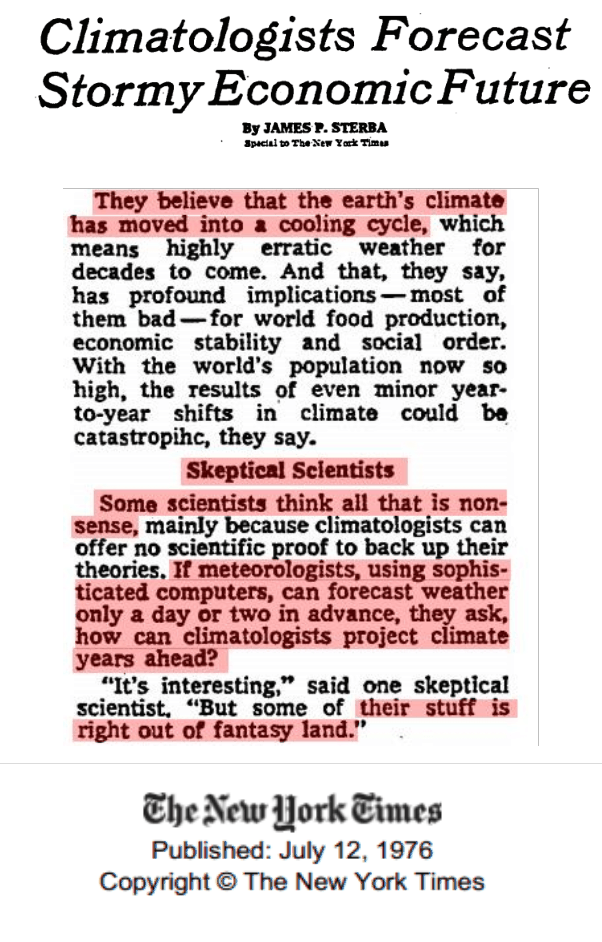
In 1976, foolish skeptics didn’t trust official forecasts of catastrophic global cooling – doubting the ability of climate models to predict the weather years ahead. Forty years later, these same evil skeptics are blocking global warming acceptance for the same reason. Don’t the skeptics ever learn?

ScreenHunter_242 Feb. 06 08.11

Climatologists Forecast Stormy Economic Future – Climatologists Forecasting Dire Effects of Weather on World Economy and Social Order – View Article – NYTimes.com

Agenda 21, and How it Affects Rural Ontario! A MUST-READ!

Rural Ontario is certainly in the throes of a “correction”.

http://cherylgallant.com/2014/08/28/report-parliament-9/

Report from Parliament

August 28, 2014

I hope everyone had an enjoyable summer. Thank-you to all who attended the various constituency clinics that have been held throughout our Renfrew-Nipissing-Pembroke riding. Whether it was just to drop by and say hi, or to share an interest or concern, I appreciate the opportunity of you letting me know what is on your mind.

After the high cost of electricity, one of the issues that has arisen as a topic of concern is the public move by the City of Ottawa to petition the province to use its legislation to restrict growth in places like Renfrew County. That could mean no more provincial funding for roads, sewers, hospitals and other infrastructure renewal. Without infrastructure renewal, employment opportunities would leave as would residents who need services, and particularly our young people who need jobs. It has been suggested this is a result of “Agenda 21”, a United Nations’ policy the provincial government has adopted in an extreme form. This radicalized environmental version is now being pushed in Ottawa by the same liberal advisors behind the so-called “Green Energy Act” that has meant crippling electricity prices, resulting in high provincial unemployment and energy poverty.

In 2005, the liberal government in Ontario passed legislation called the “Places to Grow Act” to align its land use/planning codes and government policies to United Nations Agenda 21. Like many ideas that may sound good on paper, when it comes to implementation by individuals with no real-world experience, these ideas can become dangerous.

While many people support the United Nations for its ‘peacekeeping’ efforts, hardly anyone knows the organization has very specific land use policies they would like to see implemented in every village, town, city, county, province and nation.  The specific plan is called United Nations Agenda 21 Sustainable Development, which has its basis in Communitarianism.  Most Canadians have heard of sustainable development, but are largely unaware of the U.N. initiative Agenda 21. A non-governmental organization headquartered in Toronto called theInternational Council of Local Environmental Initiatives, ICLEI, is tasked with carrying out the goals of Agenda 21 worldwide.

In a nutshell, the plan calls for government to eventually take control of all land use removing decision making from the hands of private property owners.  It is assumed people are not good stewards of their land and “the government” will do a better job if it is in total control.  Individual rights in general are to give way to the needs of communities as determined by the governing body.

Human habitation, as it is referred to in Agenda 21, would be restricted to lands within the “Urban Growth Boundaries” of a city like Ottawa.  Only certain building designs are permitted.  Opponents of Agenda 21 also assert that rural property could be more and more restricted in what uses can be done on it.  The provincial government says it will support agricultural uses, eating locally produced food, and farmer’s markets, etc. In fact there are so many regulations restricting water and land use (there are scenic corridors, inland rural corridors, baylands corridors, area plans, specific plans, redevelopment plans, tree-cutting by-laws, endangered species legislation, huge fees, fines, etc.) that small farmers and rural landowners are struggling to keep their lands altogether.  County roads will not get paved. The push will be for people to get off of the land, become more dependent, and go into the cities.  People will have to move from private homes and into single dwellings like apartments, as homeownership will become largely unaffordable the way it is in many urban areas like Toronto today. More extreme measures like a federal liberal carbon tax will force people out of private cars and onto public transit that only exists in cities.

U.N. Agenda 21 proponents cite the affluence of North Americans as being a major problem which needs to be corrected. The document calls for a redistribution of wealth, lowering the standard of living for Canadians so that maybe the people in poorer countries will have more.  Although people around the world aspire to achieve the levels of prosperity we have in our country, and will risk their lives to get here, North Americans are cast in a very negative light for our energy consumption. Agenda 21 aims to reduce Canadians to a condition closer to average in the world.  Only then, say the promoters of Agenda 21, will there be their social justice which is the so-called cornerstone of the U.N. Agenda 21 plan.

I am pleased to thank members of County Council who are voicing their opposition to provisions of the “Places to Grow Act” ‘Agenda 21-type’ provincial legislation, and against the City of Ottawa’s position,  standing up for the people of Renfrew County. As your Federal Member of Parliament, I will oppose any effort by the liberal party in Ontario to redirect Federal Infrastructure funding away from rural or small town communities the way it takes provincial gas taxes away from rural drivers to pay for Toronto’s subways.

With your support and encouragement, I will continue to expose the hidden agenda of the merged liberal party of Toronto in Ottawa. They have condemned our children to a lifetime of debt repayment by promoting wacky social experiments like Agenda 21, the Places to Grow, Green Energy Acts and similar misguided policies.

Vestas Could Not Get High Court to Believe Their Lies…..Forced to Compensate Victims!

Danish High Court Orders Compensation for Wind Turbine Noise Victims

when-is-wind-energy-noise-pollution

In Denmark struggling fan maker Vestas is synonymous with the Danish wind industry.

In Australia, and elsewhere, Vestas went on a propaganda rampage last year with its “Act-on-Facts” campaign aimed at counteracting known and obvious facts (to anyone with half-a-brain – that is) with crackers such as the wind is NOT intermittent; families with young children can’t wait to have a swag of V112s go up in their back yard to help their young ones sleep; power consumers are delighted with paying 4 times the cost of conventional power for wind power; and are even happier to be paying $2,000 per MW/h and over the Moon to be paying $12,500 per MW/h for peaking power when wind power goes AWOL 100s of times each year – instead of the usual $40.

One other “fact” trotted out to excuse the criminal harm caused by Vestas and Co is that wind turbines are quieter than a fridge at 500m.  In the Clean Energy Council version – the furphy asserts that the noise measured at ANY distance from a turbine is the same as that being measured at a distance of 500m FROM an operating refrigerator.  Here’s Matt Warren – formerly of Wind Energy Australia (aka the Clean Energy Council) making it very clear he’s comparing the noise of a giant industrial wind turbine at ANY distance with the noise FROM a fridge at 500m. For a comparison with a fridge at 500m – see our post here.

It seems that Vestas pulls back on the spin in its home territory and claims that the noise from a turbine at a distance of 500m is the same as a fridge (presumably with measurements taken right next to the fridge) (see our post here).

It seems that Danish fridges must be powered by industrial diesel engines, as the Danish High Court has just slammed Vesta’s ludicrous claims about the noise generated by its turbines matching kitchen appliances, in a case brought by affected neighbours.

The Danish High Court ordered that Vesta’s victims were entitled to Dkr 500,000 (A$93,439) in compensation for the substantial reduction in the value of their home, caused by incessant turbine noise: smashing another well-worn wind industry myth that turbines don’t impact on property values.

High Court rules on compensation for noise from wind turbines
International Law Office
Søren Stenderup Jensen
1 September 2014

Legal Denmark

The judgment is significant as it granted compensation after the erection of the wind turbines. This is contrary to the main rule in the Promoting Renewable Energy Act; however, both the city court and the high court found sufficient legal authority under the act to admit the claim after the erection of the wind turbines.

Background

Depending on their location, wind turbines can cause noise, visual interference and light reflections.

These issues are governed by public and private law, including neighbour law. The main rules regarding noise from wind turbines can be found in Executive Order 1284 of December 15 2011 on wind turbine noise, issued pursuant to the Environmental Protection Act. To some extent, the order safeguards neighbours from noise inconvenience by establishing maximum noise levels from wind turbines in outdoor areas. The noise limit varies depending on the surroundings.

Wind turbines may also cause visual interference which may negatively affect the value of surrounding properties. Thus, the location of wind turbines on land has proved a difficult political issue for years. Every municipality supports the idea of more wind turbines – just not within its own borders.

In order to promote local support for wind energy projects, the Parliament passed the Promoting Renewable Energy Act, which establishes a compensation scheme for neighbours of wind turbines. Under the scheme, those who build one or more wind turbines are obliged to compensate their neighbours for any reduction in property value that the wind turbines may cause, regardless of whether the wind turbines accord with the necessary permits.

The compensation scheme departs from the court-based neighbour law in that it does not operate with a tolerance limit which the neighbour must prove has been exceeded.

The starting point is that the issue of compensation must be settled before the wind turbines are built. However, the Promoting Renewable Energy Act does allow neighbours to claim compensation in certain circumstances thereafter. The competent authority to deal with claims for compensation is the assessment authority set up by the act.

Compensation granted to neighbours under the act has been relatively low so far.

Facts

In a recent case before the High Court for Western Denmark the plaintiffs had been awarded Dkr250,000 in compensation for the erection of eight wind turbines by the assessment authority. They brought the matter before the courts seeking higher compensation.

Before the erection of the wind turbines, an environmental study had concluded that the noise level at their property would amount to 38.8 decibels at wind speeds of 12 knots and 40.9 decibels at wind speeds of 16 knots.

Before the city court, a court-appointed expert stated that the reduction in the value of the property amounted to between Dkr600,000 and Dkr800,000. The city court also arranged a visit to the property.

Where the assessment authority found that the plaintiffs’ property would be subject to limited noise pollution, the city court found the level to be more significant. The court further ruled that the plaintiffs had documented their loss of value at Dkr600,000 and thus awarded them an additional Dkr350,000.

Finally, the court held that the plaintiffs had suffered no other economic loss covered by the Promoting Renewable Energy Act. In particular, the court held that the fact that the wind turbines had been erected with all necessary permits prevented the plaintiffs from claiming compensation under neighbour rules.

The High Court for Western Denmark upheld the city court’s judgment, but fixed the compensation at Dkr500,000 because, among other things, there were certain deficiencies in the masonry of the house. However, the court also considered the findings of the court-appointed expert witness who had seen the plaintiffs’ house after the erection of the wind turbines – which the assessment authority had not done – as well as the city court’s own observation of the property. Finally, the court ruled that the Promoting Renewable Energy Act does not restrict the courts’ competence to review decisions from the assessment authority.

Comment

The judgment is significant as it granted compensation after the erection of the wind turbines. This is contrary to the main rule in the Promoting Renewable Energy Act; however, both the city court and the high court found sufficient legal authority under the act to admit the claim after the erection of the wind turbines.

Moreover, both courts paid considerable attention to the evaluation of the court-appointed expert. While this is quite normal in Danish case law, it is unusual in cases where an authority such as the assessment authority has previously dealt with the matter.

Finally, the high court paid attention to the city court’s own observations of the property. It is quite unusual to see such a reference to the observations of a lower court in a higher court’s grounds of judgment.

The judgment gives cause for optimism to those who intend to challenge decisions of the assessment authority under the Promoting Renewable Energy Act. From a procedural point of view, it seems to be important for the court to see the property at issue to form its own opinion of the level of noise pollution caused by wind turbines.
International Law Office

Wind energy in Denmark : wind turbines in Holstebro , Westjutland


Health Authorities in Ireland, Admitting Wind Turbine Syndrome is Real.

Health authorities admit ‘wind turbine syndrome’ is real.

 March 06, 2014 by: J. D. Heyes

(NaturalNews) An Irish health official has warned that people who live near massive wind turbines of the sort used to generate electricity run the risk of having their physical and psychological health compromised.

According to a report in the Irish Examiner newspaper, the official — Dr. Colette Bonner — says further that people who are at risk of the controversial wind turbine syndrome need to be treated “appropriately and sensitively as these symptoms can be debilitating.”

As the paper reported:

Following a review of international research on the health effects of wind turbine noise, the Department of Health’s deputy chief medical officer concluded that wind turbines are not a threat to public health, but “there is a consistent cluster of symptoms related to wind turbine syndrome which occurs in a number of people in the vicinity of industrial wind turbines”.

What is wind turbine syndrome?

It is supposedly a condition suffered by people living within earshot of the noise made by wind turbine blades as they spin round. The blades are known to make infrasounds, vibrations that we cannot consciously “hear” but still have an effect on the inner ear, Breitbart News reported. Symptoms include fatigue, dizziness, headache, difficulty concentrating and insomnia.

Irish official first ranking expert to give ‘syndrome’ legitimacy

A letter that reporters and editors of the paper claim to have seen tells how, in a review sent by Bonner to the country’s Department of Environment in November, “there are specific risk factors for this syndrome and people with these risk factors experience symptoms.”

“These people must be treated appropriately and sensitively as these symptoms can be very debilitating,” she added, according to the Irish daily.

Experts have disagreed on whether wind turbine syndrome is real or if it is merely a psychological concoction in response to anguish over not wanting to live near a turbine wind farm.

Bonner “has been quoted in a variety of policy proposals related to noise and set back distance, advising Minister Jan O’Sullivan regarding revisions to 2006 standards that ‘there is a consistent cluster of symptoms related to wind turbine syndrome which occurs in a number of people in the vicinity of industrial wind turbines,'” writes Hank Campbell at Science 2.0. “Well, that’s epidemiology right there. You can find almost anything if you try. We have had similar claims in the US, about self-reported mental health issues after wind turbines went up, especially among people who were against the turbines in the first place.”

Following her review, the Irish Department of Health’s Food and Environmental Health Unit wrote a letter to the Department of the Environment asking officials there to consider hiring more experts to further study the health effects of wind turbine syndrome.

The Department of the Environment, however, has dismissed Bonner’s literature review as “preliminary,” adding that it was “not a recommendation of the Department of Health.”

Not everyone is signing on just yet

The Department of Environment is currently conducting a review of the 2006 Wind Energy Development Guidelines, the Irish Examiner reported.

Meanwhile, the Department of Health has said that the deputy CMO’s comments “did not constitute expert advice” but rather were “a general overview of the literature in this area.”

The department went on to confirm that a “range of symptoms have been described by people living close to wind turbines mainly related to general environmental noise exposure.”

“These symptoms include headache, irritability, difficulty concentrating, fatigue, dizziness, anxiety and sleep disturbance, and are often described in relation to annoyance,” a spokesman, who was note named, told the paper.

“Anyone who experiences such symptoms should seek medical advice from their family doctor, who may be able to prescribe suitable medication,” the spokesman continued.

Campbell added sardonically: “They may not be great for people but they sure are terrible for bats and birds. But they can’t hire paid lobbyists, so I bet wind turbines are here to stay.”

Sources:

http://www.breitbart.com

http://www.irishexaminer.com

http://www.science20.com

Learn more: http://www.naturalnews.com/044196_wind_turbine_syndrome_health_authorities_mysterious_illness.html#ixzz3CrreQuOC

Nurses for Safe Renewable Power, Discuss Barnard…. (the Windweasel we’ve seen trolling around!)

Big Wind blogger Barnard taken apart


Grinspun: A nurse in the Top 10? I'm so proud.

We don’t usually pay much attention to the wind power lobby front line soldier Mike Barnard (who is by day an employee of IBM, working in Singapore) but we were amused recently by his diatribe on the claims of health problems from wind turbine noise and low frequency noise. (Mike, it’s this simple: don’t sleep, get sick.)

Claiming that wind power impacts on health have been almost universally dismissed in court, Mr Barnard actually had a “top 10″ list of witnesses who have appeared at Canadian quasi-judicial tribunals, including Ontario community health specialist nurse, Debbie Shubat. Doris Grinspun and the RNAO must be so proud. Anyway, Mr Barnard’s piece prepared for the so-called Energy & Policy Institute is so full of errors it doesn’t need any comment, except perhaps to point out that Ontario’s Environmental Review Tribunals are NOT “court” and the truth is the Green Energy Act and Regulation 359/09 have been so meticulously set up by the wind industry that it is almost impossible for an appeal to be won.

In fact, there was never supposed to be a successful appeal, as lawyer John Terry explained at the Ostrander Point appeal last January, where he represented the wind power lobby, the powerful Canadian Wind Energy Association (CanWEA). He petulantly suggested to the panel of judges that the Ostrander Point success ought never to have happened, and that the judges should provide instructions to the ERT so that this could never happen again.


Open letter regarding Barnard, in an earlier post, today!


STOP lying about the 97% Consensus! It’s FRAUD!

Press Release 08/09/14

New Paper: Fraud, Bias &

Public Relations

Claims of 97% Consensus are based

on research described as fraudulent

and biased 


London, 8 September: A new briefing note published today by the Global Warming Policy Foundation examines claims made by a great many commentators across the world, including President Obama and Ed Davey, of an overwhelming consensus on climate change. These depend on research that has been subject to public and entirely unrebutted allegations that it is fraudulent.

Although the authors of the research claim to have shown that most climate change papers accept that mankind is responsible for the majority of recent warming, in fact the underlying study shows no such thing.

One senior climatologist described the paper as ‘poorly conceived, poorly designed and poorly executed’. Another researcher called it ‘completely invalid and untrustworthy’, adding that there was evidence of scientific fraud.

Andrew Montford, the author of the paper, said: “It has now been shown beyond doubt that the claims of a 97% consensus on climate change are at best misleading, perhaps grossly so, and possibly deliberately so. It’s high time policymakers stopped citing this appalling study.”

Full paper (pdf) – Fraud, Bias And Public Relations: The 97% ‘Consensus’ And Its Critics

Contacts

Andrew Montford
e: awmontford@gmail.com 

Dr Benny Peiser
The Global Warming Policy Foundation
e: benny.peiser@thegwpf.org 

If I Wanted America to Fail…. A Bone-Chilling Classic, becoming reality!

If I Wanted America to Fail

A new group has recently released a video advocating free-market policies from a whole new perspective, and the result is very compelling.

The group is called Free Market America, and its stated mission is to defend economic freedom, particularly from environmental extremism.

The video puts the viewer in the perspective of someone who wants to dismantle the country, and walks them though what they would do to accomplish it. Throughout the video, the viewer becomes aware of how many of today’s ideas match the destructive actions learned through this perspective.

What makes this argument compelling is that this sort of connection cannot be built from anything other than concrete evidence. Leaving the viewer to digest the sobering truth once the video ends.

After watching the video, feel free to read the transcript below if you would like a closer look at the video’s points.

If I wanted America to fail …

To follow, not lead; to suffer, not prosper; to despair, not dream — I’d start with energy.

I’d cut off America’s supply of cheap, abundant energy.  Of course, I couldn’t take it by force.  So, I’d make Americans feel guilty for using the energy that heats their homes, fuels their cars, runs their businesses, and powers their economy.

I’d make cheap energy expensive, so that expensive energy would seem cheap.

I would empower unelected bureaucrats to all-but-outlaw America’s most abundant sources of energy.  And after banning its use in America, I’d make it illegal for American companies to ship it overseas.

If I wanted America to fail …

I’d use our schools to teach one generation of Americans that our factories and our cars will cause a new Ice Age, and I’d muster a straight face so I could teach the next generation that they’re causing Global Warming.

And when it’s cold out, I’d call it Climate Change instead.

I’d imply that America’s cities and factories could run on wind power and wishes.  I’d teach children how to ignore the hypocrisy of condemning logging, mining and farming — while having roofs over their heads, heat in their homes and food on their tables.

I would never teach children that the free market is the only force in human history to uplift the poor, establish the middle class and create lasting prosperity. Instead, I’d demonize prosperity itself, so that they will not miss what they will never have.

If I wanted America to fail …

I would create countless new regulations and seldom cancel old ones. They would be so complicated that only bureaucrats, lawyers and lobbyists could understand them.  That way small businesses with big ideas wouldn’t stand a chance — and I would never have to worry about another Thomas Edison, Henry Ford or Steve Jobs.

I would ridicule as “Flat Earthers” those who urge us to lower energy costs by increasing supply.  And when the evangelists of commonsense try to remind people about the law of supply and demand, I’d enlist a sympathetic media to drown them out.

If I wanted America to fail …

I would empower unaccountable bureaucracies seated in a distant capitol to bully Americans out of their dreams and their property rights.  I’d send federal agents to raid guitar factories for using the wrong kind of wood; I’d force homeowners to tear down the homes they built on their own land.

I’d make it almost impossible for farmers to farm, miners to mine, loggers to log, and builders to build.  And because I don’t believe in free markets, I’d invent false ones.  I’d devise fictitious products — like carbon credits — and trade them in imaginary markets.  I’d convince people that this would create jobs and be good for the economy.

If I wanted America to fail …

For every concern, I’d invent a crisis; and for every crisis, I’d invent the cause.

Like shutting down entire industries and killing tens of thousands of jobs in the name of saving spotted owls.  When everyone learned the stunning irony that the owls were victims of their larger cousins — and not people — it would already be decades too late.

If I wanted America to fail …

I’d make it easier to stop commerce than start it — easier to kill jobs than create them — more fashionable to resent success than to seek it.  When industries seek to create jobs, I’d file lawsuits to stop them.  And then I’d make taxpayers pay for my lawyers.

If I wanted America to fail …

I would transform the environmental agenda from a document of conservation to an economic suicide pact.  I would concede entire industries to our economic rivals by imposing regulations that cost trillions.

I would celebrate those who preach environmental austerity in public while indulging a lavish lifestyle in private.  I’d convince Americans that Europe has it right, and America has it wrong.

If I wanted America to fail …

I would prey on the goodness and decency of ordinary Americans.  I would only need to convince them … that all of this is for the greater good.

If I wanted America to fail, I suppose I wouldn’t change a thing.