Winweasels Will Say Anything, To Try To Protect Their Scam!

Orwellian Eco-Fascist Ideology Ramming Wind Turbines Into Everyone Else’s Backyards

200355536-002

****

Those that accuse community defenders of being nothing more than self-interested ‘NIMBYs’ are hardly what you’d call ‘disinterested observers’.

No, it’s their willful ignorance and lack of human empathy that gives them away – that and the fact that they will never, themselves, have to tolerate a ‘life’, suffering incessant turbine generated low-frequency noise and infrasound.

Reminiscent of the porcine ‘elite’ that ran Orwell’s Animal Farm (with one of its central themes the promised construction of a windmill that was said by its piggy-proponents to offer ‘free electricity’, a life of leisure and wealth for the lower orders) in his obsession to carpet your patch of paradise with hundreds of whirling Danish-Dervishes, the eco-fascist is always ready to line you up to make the sacrifices that they themselveswouldn’t tolerate for a second.

Some might call it ‘green hypocrisy’: STT calls it an inexcusable form of malevolence of the very worst kind – one, long on sanctimony, and short on either scientific or economic logic. Precisely the attributes exhibited by Orwell’s selfish and mean-spirited barnyard overlords.

These days, the characters drawn by George don’t grunt, they rant – and use self-affixed titles such as “Friends of Mother Earth”. Here’s a run-down on how these characters roll, from Virgina.

Van Velzer: Botetourt ignores the hazards of wind energy
The Roanoke Times
Bill Van Velzer
15 February 2016

On Jan. 26, Botetourt County’s Board of Supervisors gave its unanimous blessing to the construction of 25, 550-foot tall wind turbines on North Mountain.

This decision has brought cheers from local environmentalists who identify themselves as “friends of Mother Earth.” As with the siting of any industrial facility, the proposed Rocky Forge project is replete with enough technical minutiae that any complete understanding of its true environmental and human impact requires tremendous attention to hours of intense study.

For this reason, Rockbridge County’s Board of Supervisors requested of Botetourt County a reasonable 90-day delay period. This delay was denied while the project was allowed to proceed.

Wind does not respect arbitrary political boundaries; neither do the impacts that industrial wind facilities have on nearby residents and wildlife. So when one of the speakers referred to a need to push wind turbines into the view sheds of “the wealthy Rockbridge elites,” one wonders if there is another agenda at work that has little to do with the facts of this issue. Unfortunately, this seems to be the world we live in nowadays.

Indeed, it seems that discussions of wind energy fit into a larger political matrix. We must avoid this. This issue — when properly vetted — should transcend political ideology and rest on factual evidence. Each of us has a right to define our own quality of life. When someone insists that their emotionally-driven opinion is more important than my factual analysis, I have to begin wondering if I’m getting too close to a larger ideological vulnerability.

Having said this, there are legitimate issues concerning both Botetourt County’s rush to judgement and the larger assumptions about wind energy. From local to global, here is where we are:

First is the issue of “unconstitutional taking of private property.” In short, your right to enjoy your private property cannot trump my right to the enjoy mine. This is an essential ingredient of American jurisprudence, originating in English common law. It is at the heart of how we define fairness. Yet the precedent set by the Botetourt Board of Supervisors allows 550’-tall wind turbines 605 feet from a neighboring property line, and 820 feet a from a neighbor’s home.

Moreover, the 60dBA noise limit “restriction” is commensurate with sound at a busy urban intersection. North Mountain is clearly a rural environment with an ambient noise level at exactly half of this figure. Will these allowances not impact neighboring property values?

Of course, these issues have everything to do with whether or not prospective purchasers of your property — should you decide to sell — would want to hear this cacophony of noise, and see spinning blades from your deck or picture window at all hours and days of the year.

Infrasound belongs to the above argument, but really deserves space of its own. The wind industry denies its existence like tobacco companies used to deny any link between smoking and lung cancer.

Not surprisingly, Botetourt County doesn’t recognize infrasound, either. This cannot and will not continue, due to the rapidly accumulating evidence that infrasound’s wave pulses are a much greater health concern than is audible sound.

Infrasound deprives people of sleep, causes irritability and loss of concentration, and general anxiety. Don’t take my word for it — scores of YouTube videos have documented the abandonment of homes due to this unforgivable negligence on the part of local government officials.

Impact on wildlife is the flip side of human impact. Infrasound impacts animals in the same way that it impacts humans; the difference is that wildlife simply leaves impacted areas.

sleep with turbines

However for avian populations, the destruction is more graphic. For this reason, wind turbines have been called “Cuisinarts of the air.”

“Windustry” denies this, while claiming that cats, windows and cars take far more birds and bats than do wind turbines. This is beyond disingenuous. How many house cats kill an eagle, a hawk, an owl annually? None other than the American Bird Conservancy documents bird and bat deaths in the U.S. as 573,000 and 888,000 respectively, as of 2012.

dead_eagle_at_base_of_turbine

The “kicker” here is that Botetourt County doesn’t require independent monitoring of bird and bat kills — even for resident eagle populations. Ditto for threatened and endangered bats. Is this prudent?

So while Rocky Forge supporters congratulate themselves, more deliberative minds ponder the future. Unbeknownst to most valley residents, Botetourt County’s master wind resource map identifies 11 ridges and mountains as potential industrial wind energy sites. I’ll leave the last assumption to you.
The Roanoke Times

lake winds

One Billion Dollars to “Fix” Mistakes that Should NOT Have Been Made!

‘Saving’ South Australia from its Self-Inflicted Wind Power Disaster Needs $1 Billion Right NOW!

head slap

****

Wind and solar create headaches for energy market operator
Australian Financial Review
Mark Ludlow
19 February 2016

State governments may have to spend billions of dollars to duplicate the electricity network to cope with the unreliability of renewable energy sources such as wind and solar, according to the national energy forecaster.

As the Australian Energy Market Operator released a report [press release here and the full report here: Joint AEMO ElectraNet Report_19 February 2016] that found there could be reliability issues for the South Australian market, which has embraced renewable technology, its chief executive, Matt Zema, said the rise of wind and solar could also create problems throughout the country.

“It is becoming more and more of a challenge. We might need to build another interconnector to the South Australian market to improve reliability and in the longer term another bigger loop across the nation to be a back-up,” Mr Zema told The Australian Financial Review.

Electricity prices spiked in South Australia late last year after problems with the Heywood interconnector to Victoria, effectively cutting off South Australia from the NEM. South Australia did not have enough of its own locally generated power to cope with demand, which significantly pushed up prices.

A joint report between AEMO and South Australia’s electricity transmission company Electranet found there will be ongoing issues with controlling reliability in the state’s power network either during or following any future loss of the Heywood interconnector and the closure of coal-fired power stations.

Interconnectors are high-voltage transmission cables connecting electricity markets.

“Measures can be taken in the short term to address some of the immediate operational effects, but as the power system continues to evolve, in the longer term there could be an increasing need for changes to market arrangements or infrastructure to continue to meet security and reliability expectations, particularly at times when SA is synchronously islanded [separated] from the remainder of the NEM,” the report found.

AEMO is conducting further studies to maintain power system security in South Australia if it becomes isolated from the NEM.

Grappling with implications

Mr Zema said state governments were still grappling with the implications of moving away from the more reliable coal and gas-fired generation. He said they may have toINVEST billions of dollars in a back-up “loop” of interconnectors to ensure there are not reliability issues which could lead to blackouts.

“South Australia is at the front end of this [renewable] curve, Tasmania is not far behind as they are finding out with Basslink connection to the mainland,” Mr Zema said.

“If you build another interconnector to Victoria you may well extend it from Victoria to NSW.”

A new interconnector between South Australia and Victoria which would cost about $1 billion.

Mr Zema said the only alternative to building back-up interconnectors or more gas-fired power stations to cover for wind and solar – when the sun isn’t shining or the wind is not blowing – would be to dismantle the NEM.

“You either strengthenTHE GRID and have more reliability and more paths or you break it up and its gets smaller and smaller and each state becomes an island,” he said.

“You either become better connected toTHE GRID or you become your own grid which would result in huge price fluctuations.”

South Australia is leading the charge towards renewable energy, especially with the closure of coal-fired power stations, including Alinta Energy’s coal-fired power stations at Port Augusta.

South Australian Premier Jay Weatherill last year said the price fluctuations would not last and the state would benefit from leading the adoption of wind and solar power.

The precarious nature of the electricity network was further demonstrated by Tasmania also being isolated due to problems with the Bass Strait undersea power cable.

Victoria’s energy market could also be facing an overhaul with Alcoa’s Portland smelter – a large energy users – close to closure. It is negotiating with AEMO about an energy subsidy for its poles and wires.
Australian Financial Review

jay weatherill

****

SA’s vapid Premier – a former worker’s compensation solicitor – wouldn’t be STT’s first pick when it came to sorting out a power market in absolute crisis and a grid on the brink of total collapse. His ‘belief’ that betting his beleaguered State’s failing ‘fortunes’ on more of the same smacks of child-like delusion, but, given more sensible (but costly) moves made recently (albeit under pressure) politically driven deception.

Contrary to Jay’s let’s all ‘hold-hands-around-a-turbine’ chanting Kumbaya – and Matt Zema’s line about “moving away from the more reliable coal and gas-fired generation” – SA’s Labor government has just signed their constituents up to throw $50 million a year in subsidies at the French owner of a mothballed CCGT plant at Pelican Point.

That panicked move is all about ensuring something like a reliable power flow (for the time being); and, at the political triage level, is an attempt to avoid any more ‘unhelpful’ wind power blackouts: like the one that plunged almost the entire State into Stone Age darkness last November; and that has businesses, like Uni SA coping with power supply ‘interruptions’ and total blackouts on a regular basis.

email ML

Once upon a time, thanks to the pragmatic vision of its longest-ever-serving Premier, Sir Tom Playford, South Australians enjoyed both energy autonomy and the cheapest and most reliable power in the Country – if not the world; and, with it, unparalleled growth in population, employment and incomes. Now, the reverse is true on all counts.

Always the mendicant State, SA’s Labor government – having willingly signed up to an economic suicide pact – will do what it does best: beg like fury for the Federal Government to bail it out, which means its neighbours will end up footing the bill for the most ridiculous power ‘policy’ ever devised.

tom playford-anzac-parade

Scourge of the WindWeasels, in Australia

How a Band of Criminals, Shysters & Chancers Conjured Up the Wind Industry in Australia

dirtyrottenscoundrelsoriginal

****

Now and again you just get lucky. STT makes no bones about its mission: to destroy the wind industry. So it was with more than just a little delight, that we received a bundle of highly incriminating documents from one of our top-level operatives.

At the risk of sounding a little like the showboats behind WikiLeaks, this stuff is ‘dynamite’.

What we set out below is a few pages from the first tranche of documents sent to us (that entire 47 page bundle is available here as a PDF). And what was sent to us is just the tip of a very stinky iceberg: our operative has secured thousands of pages of documents linking (and showing the dealings between) wind industry lobbyists, MPs and their staffers.

Before we kick off though, it’s both helpful and necessary to identify a few of the characters involved.

First, there’s the convicted criminal, Timothy J Flato.

Back in the 1990s, Tim was a practising attorney and partner at Latham & Watkins. Later on, a number of its partners had a few “billing difficulties”; and were disbarred and/or sent to prison as a result.

But they weren’t the first from the firm to earn a little ‘form’.

Tim, then head of the firm’s project finance practice, admitted to falsifying hundreds of thousands of dollars’ worth of expense reports over a three-year period. Tim’s little billing ‘difficulty’ involved him purchasing airplane tickets, cancelling them, and then submitting the receipts to clients for payment, augmenting his salary by over $100,000 per year. Tim’s accounting fudge amounted to somewhere between $300-400,000; saw him disbarred; and slapped with 6 months home detention for his efforts.

Flato

Having polished up his CV perfectly for the wind industry, Tim Flatohelped set up National Power Company in the US; then headed Downunder and set up another with the mantle ‘National Power Australasia Inc’.

Then there are the shysters and chancers.

Babcock & Brown was absolutely full of them; people like Warren Murphy, Miles George and Adrian Rizza.

These days, Miles & Co head up Infigen, Australia’s most notorious wind power outfit – formerly know as Babcock and Brown – an outfit that was born the bastard child of Enron.

Check out the CVs of the characters in these links here and here and here– a fair number of them brag of ‘solid’ backgrounds with Enron, later lobbed at Babcock and Brown and – when it went into melt-down – scurried off like indestructible cockroaches to hide elsewhere in the wind industry. No surprises there.

During Infigen’s first incarnation as Babcock and Brown, Miles & Co helped to fleece  investors and creditors of something like $10 billion (while its directors pocketed – and somehow managed to retain – 10s of $millions at creditors’ and investors’ expense).

Having spectacularly crashed and burned, Babcock and Brown then shamelessly phoenixed into Infigen – which is about to do it all over again: its losses continue to pile up, it continues to bleed cash and, unable to cut any deals with commercial power retailers or to obtain the finance needed to build any of its threatened projects, it has no hope of surviving its growing mountain of debt (see our post here).

But shysters and chancers like Warren, Miles and Adrian rarely get far without greasing-up helpful political enablers.

In what follows, keep a lookout for the names Patrick Gibbons and Ken McAlpine. Back then, Patrick and Ken were offering up political favours on behalf of Victoria’s Labor Minister for Energy Industries & Resources, Theo Theophanous.

These days, Patrick Gibbons spends every waking hour protecting his mates in the wind industry from inside the Federal Minister for the Environment, Greg Hunt’s office; while his best mate, Ken McAlpine heads up struggling Danish turbine manufacturer, Vesta’s Australian operations (that’s when he’s not spreading malicious falsehoods about Dr Sarah Laurie, or acting like a total prat in front of Federal Senate Committees).

Anyway, that’s probably enough background on the villains.

Let’s take a look at how they cooked up the greatest economic and environmental fraud in history, by first targeting South Australia’s dimwitted Labor government. Oh, and if the images below aren’t so clear, click on them, they’ll pop up in a new window, clear as crystal.

BB1

BB2

BB3

BB4and5

Hmmm…

Now, at the risk of sounding overly critical, what appears above suggests high level ‘imagination’. The protagonists clearly seem to be making it up as they go along.

The ‘XX’s that pepper the document have that second-hand car salesmen’s “pick whatever figure suits you” kind of feel about them. Scratching out the figure of $800 million and replacing it with $1 billion, was clearly aimed at hooking the more gullible fish in the political pond.

However, South Australians (who, as a result of this Memorandum of Understanding and what followed now pay the highest power prices in the Nation – if not the world, on a purchasing power parity basis –  and suffer daily power interruptions and even Statewide wind power blackouts) can only wonder what happened to the promised Vesta’s “blade manufacturing facility”, and the hundreds of ‘groovy-green’ jobs supposed to have been attached to it?

Although we note that the ‘promise’ to establish a blade factory was no “no strings attached” offer; being conditioned on South Australian taxpayers providing “some assistance in establishment costs” with the figure nominated of “XX to cover establishment and other initial non-construction costs associated with” it.

Why beat around the bush with solid XXs? Why not just demand taxpayers hand over an open cheque-book?

Then there’s the fiction about “high winds speeds” at Babcock & Brown’s target site, Lake Bonney.

At Lake Bonney (situated near Millicent in SA’s South-East) winds might occasionally reach ‘high-speeds’. However, the breezes at Lake Bonney are as fickle as anywhere. Infigen’s Lake Bonney operations have a pitiful capacity factor of around 23-25%: Lake Bonney 3 struggles to hit a capacity factor of 23%; and its neighbours produce meaningful power a risible 25% of the time – on AVERAGE.

While Lake Bonney’s performance stats hardly set the world on fire, its Danish-built deadlys have been known to set the ‘country on fire’:

wind turbine fire Lake_Bonney_windfarm

****

Then there’s the furphy about “community support” for wind farms. In fairness, in mid-2002 there weren’t too many South Australians aware of what trying to live with incessant turbine generated low-frequency noise and infrasound is like. That soon changed, once Lake Bonney was up and running.

Far from enjoying community support, Babcock & Brown and later Infigen have spent years trying to deny, ridicule and dismiss constant complaints about turbine noise made by two of its very own contracted turbine hosts, David and Alida Mortimer.

David and Alida (farmers and turbine hosts for Infigen at Lake Bonney) have spent the last few years taking every opportunity to tell the story of their self-inflicted acoustic misery – and to warn rural communities around the globe about the very real impacts on sleep and health caused by incessant turbine generated low-frequency noise and infrasound (see our posts here and here and here).

While the Memorandum of Understanding is littered with waffle and deliberate uncertainty, there can be no uncertainty that the whole rort was premised upon massive taxpayer funded subsidies – as clear as crystal with the statement that: financial assistance by the South Australian government (read ‘taxpayer’) is required in order to facilitate the development of the wind farm proposed by BBWP” (ie Babcock & Brown).

As it always was and continues to be:

The Wind Industry: Always and Everywhere the Result of Massive & Endless Subsidies (Part 1)

The Wind Industry: Always and Everywhere the Result of Massive & Endless Subsidies (Part 2)

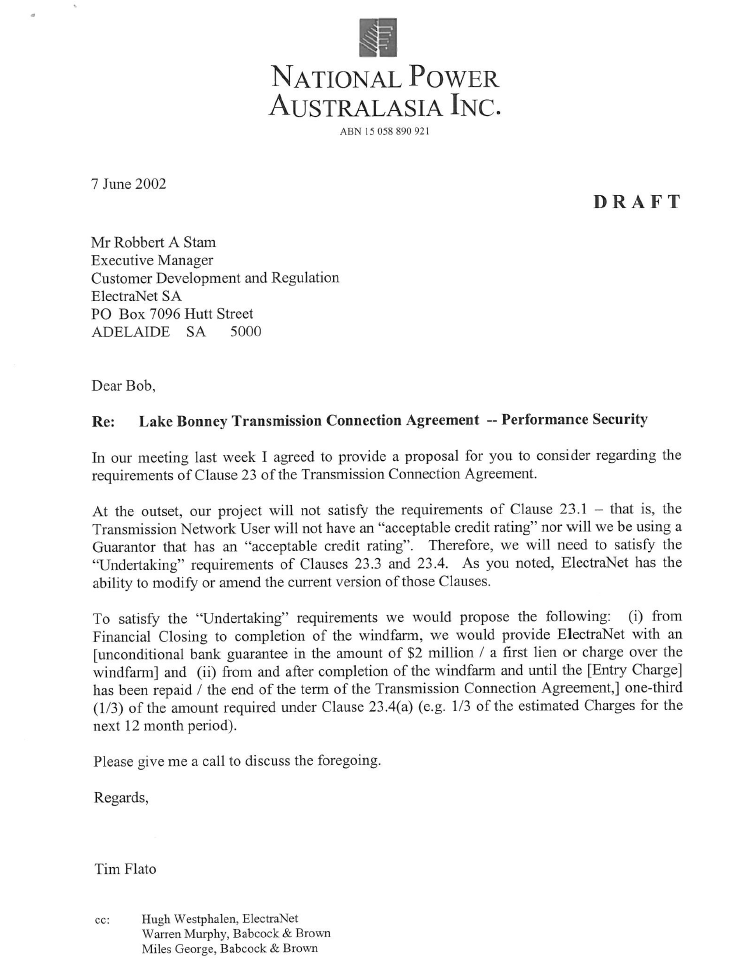
The next item is an effort by Tim Flato to brush aside Babcock & Brown’s perilous financial situation in this letter to the grid operator, ElectraNet SA:

BB6

Audacious and arrogant, the boys at Babcock & Brown were, quite apparently, aware that they would never be able to present financials capable of  earning an “acceptable credit rating”. Probably the only honest statement that ever came out of Babcock & Brown.

When your ‘business’ requires fleecing taxpayers for $billions, there’s the critical need for political endorsement, that has to be ‘engineered’ with a winning mixture of pressure and ‘grease’.

In the next email, note the who’s who cast – including the boys from Babcock & Brown, Pacific Hydro, Patrick Gibbons and Ken McAlpine – all clearly chuffed with their victory in obtaining just such an endorsement in the Communiqué from State Ministers for Energy, that follows.

BB7email

BB8and9

With hindsight, for South Australians, at least, that Communiqué now reads like an economic suicide pact.

The next email exchange shows these boys at their manipulative best, as they set out to scuttle the bid by Forestry Tasmania (referred to as ‘FT’ in the emails) to have the use of forest wood-waste to generate power included in the RET.

BB10and11 email

Note that the reference to ‘Hill’ is a reference to then Federal Minister for the Environment and Heritage, Robert Hill.

While Forestry Tasmania’s bid to include wood waste in the RET had apparent appeal with the Coalition government, Babcock & Brown and the gang were clearly having none of it.

In a piece of ‘astro-turfing’ extraordinaire, the boys from Babcock & Brown set out to have the Greens do their dirty work, correctly anticipating that once they were pointed to the “relevant statutory clauses” they would “go off from there”. And “go off” the Greens most certainly did, mounting a full-scale campaign against inclusion of wood waste in the RET that continues to this day.

The next set of papers are extracts from a powerpoint presentation that details the manner in which Tim Flato’s National Power and Babcock & Brown sought to gloss over its shaky financial footing, while pushing a self-serving strategy built on ever increasing wind power targets and subsidies.

BB12

BB13

BB14

Again, pretty vague on the details, but the critical requirement for massive and endless subsidies in Babcock & Brown’s favour couldn’t be clearer.

If you have ever wondered how the greatest economic and environmental fraud of all time got started in Australia? Well, now you know.

enron guilty

Wind Contracts….Dancing with the Devil!

The Anatomy of a Wind Farm Contract – Part 2

noisy turbines


In my previous blog I explained how a typical wind farm contract consists of two divisible parts, an Option and a Lease. When looking at an Option, I came to the inescapable conclusion that by selling the wind farm developer an Option, the landowner essentially gave up any control over his own land for extended (potentially endless) periods, in return for often trifling sums of money.

.

In this blog I want to start looking at the second part of the contract – the Lease. This part forms the majority of the contract document, and we may need more than one blog to cover it all.

.

These contracts are about money, and clearly we need to know just how much a landowner can make, how quickly he or she can make it, and whether on a purely monetary basis it is a worthwhile exercise for a landowner to consider.

.

So let’s get down to the nitty-gritty. Once the wind farm is up and generating, what sort of money can a landowner make? Remember that as this is now a lease; the landowner is now the “Landlord”, and the wind farm developer is now the “Tenant”:

.

“… the Tenant from the Commencement Date for the Term YIELDING AND PAYING therefore to the Landlord during the first ten years of the Term the Rent of three per cent (3.0 %) of the Gross Operating Proceeds per annum and after the first ten years the Rent of three and a half per cent (3.5%) of the Gross Operating Proceeds subject to the provisions for review as hereinafter contained or €5,000.00 per Megawatt of capacityINSTALLED on the Premises or proportionately in respect of any part of a Megawatt of capacity so installed whichever of (i) or (ii) shall be the higher;

.

The first thing to realise is that the payments made by the developer (the Tenant) to the landowner (the Landlord) are now called ‘Rent’. As the term of contract in my contract is 25 years, what the landowner receives in cold cash is three percent of the Gross Operating Proceeds for ten years, and thereafter three-and-a-half percent of the Gross Operating Proceeds for fifteen years. However, 25 years is actually one of the shorter periods you will find on one of these contracts, so look very carefully at the definition of “Operating Period” when faced with one of these contracts.

.
The first question obviously is: what is meant by ‘Gross Operating Proceeds’? Well, I am not a bookkeeper but I do remember my lessons which told me that “Gross” means all your money as you make it, whilst “Nett” means the money you have left after you have paid what you owe (your “take home”).
.

Wind developers clearly speak a different language compared with the rest of us. Their definition of “Gross Operating Proceeds” is this:

“x-y:
Where x = the gross receipts (excluding VAT or any substituted or similar tax) from electricity sold by the Tenant and generated by the Wind Turbine(s) on the Premises excluding any together with the receipts if any that may arise from the sale of green credits or other similar environmental scheme and;
y = such costs as the Tenant may have to pay in respect of the electricity generated by the Wind Turbine(s) on the Premises but limited to (i) the costs and charges to join and remain a member of the Pooling and Settlement System, if any and; (ii) any non-capital costs or charges associated with the purchase from the Electricity Supply Board or any third party purchaser of electricity for the provision of auxiliary power to the Accommodation Works or the Wind Turbine(s) as certified from time to time by the Auditors Certificate and; (iii) any transmission, metering or distribution costs.”

.

Now that is a different meaning to the “gross” as ordinary people understand it.

“Gross = x-y”.     What?

.

And then when looking at “x”, which is the amount of the so-called “gross receipts”, that is the money received by the developer for electricity actually sold by the developer. If the developer does not sell any electricity, or is forced to dump electricity, that means there is no receipt. And even these ‘receipts’ have deductions made from them, namely tax, green credits, and subsidy payments.

.

And once we reach the nett value of the “gross receipts”, we now have to subtract “y” from those. The value of “y” is essentially all and any operating costs, including the IWEA membership fees, and the cost of electricity to run the back-up power when the wind turbines are not generating their own electricity, which in winter is most of the time as the wind blows too hard and the turbines are shut down, whilst in summer there is little wind.

.

As there is no electricity sold, the landowner loses out. Of course, the developer does not lose out, as it is getting the subsidies (money paid by electricity customers in the form of the PSO Levy) and curtailment payments (money paid to the developer by the taxpayer for not generating). However, as these payments are not for electricity sold, the developer does not have to share that with the landowner. No wonder IWEA are always asking for increased subsidies, and no wonder, in countries other than Ireland, when the subsidies have been withdrawn, the “green” developers have vanished into thin air.

.

Wow! Is there anything left of this “gross” after that? And the landowner gets a measly 3% for the first ten years, at which stage the turbines are probably burnt out and need to be replaced (given what we now know about the life cycle of these giant turbines – you are lucky if you get ten years out of them – more likely three to six years), which in turn means massive operating costs = more money taken off the so-called “gross” amount.

.

I would guess that because of this creative bookkeeping, most landowners will be plumping for the €5000.00 per MWINSTALLED option.

.

Interestingly enough, the word INSTALLED” is not defined in the contract. If something is not specifically defined in a contract, it is given its ordinary meaning. I would suggest thatINSTALLED means up and running and connected to the grid (as opposed to ‘erected’), which might mean more delays before the landowner actually sees some of that cold hard cash.

.
“… and where no turbines are installed on the Premises the following payments will be made:
10,000EURO per annum for a site sub-station and ancillary equipment;
5,000EURO per annum for a Grant of Deed of Right of Way and Wayleave;
2,500EURO per annum for a consent to erect turbines on neighbouring premises and where such consent is needed because of reduced distance to neighbouring boundaries only;
all of which payments shall be exclusive of any Value Added Tax which may from time to time be properly chargeable and charged thereon by the Landlord clear of all deductions save those required by law.”

.

This clause confused me. If these payment options do apply to the landowner that is actually hosting the wind farm, one would think that the host-landowner wouldMAKE MORE MONEY by not having the turbines built, as the Gross Operating Proceeds don’t seem to be enough to feed the dog, let alone make a nice living without all the hard work that constitutes farming (assuming that most landowners that host wind farms will be farmers or at least owners of rural land / farm land).

.
However, It is doubtful that the wind developer is going to enter into the Lease before the wind farm is up and running – that is what the Option is for, and the developer will rather pay you your tenEURO (a year, hopefully) for the Option for as long as the developer can stretch that Option out.

.

One would imagine that the developer will only enter into the Lease with the landowner who is accommodating the actual wind farm when the wind farm is definitely going up, and the Option is exhausted. Otherwise the landowner will be strung along, essentially at the mercy of the developer.

.

I am therefore guessing that these other forms of payment are for landowners with land adjoining the wind farm premises. This might be the landowner hosting the wind farm, where their land is big enough to also take a sub-station, or where the wind farm is situated in the middle of the property, in which case a right of way might be necessary. I am guessing that this contract is a ‘one-size-fits-all’, and can accommodate those landowners who agree to have a wind farm built on their land, but can also be used to bind those landowners that own land adjoining the host property, assuming that they are willing to contract. Of course they might have no choice if their opposition to planning permission was fruitless, and the wind farm is now destroying their health and their livelihood. These secondary payments will only need to occur once the wind farm is built and operating, and not before.

.

€2500.00 per year as compensation for being driven crazy by the noise and flicker from the neighbouring wind farm? Count me out.

.

print money

The final sting in the tail concerning payment?

.

Well, going back to the assumption that theVAST majority of landowners that host wind farms will be farmers or owners of agricultural land, there is the issue of the effect on the zoning of that land.

.

After waiting for ten years, the Option is exhausted and the farmer is now looking to cash in on these larger payments of €5000.00 perINSTALLED MW.

.

Firstly, these payments are fully taxable as rental income, which cannot be set off against ordinary agricultural costs.

.

Secondly, there is the question of agricultural land tax-reliefs. Some lease agreements do say that the wind-farm company will compensate farmers for the loss of certain farm reliefs. These are usually written in such a way that they cover the farm reliefs that exist at the time of signing. They do not cover subsequent or amended farm reliefs that may be introduced in the future. Again, when we consider that I have seen wind farm lease agreements lasting 60 years, many farmers that have entered into these agreements with wind developers must now accept that the loss of future farm reliefs and payments, coupled with the fully taxable nature of the wind-farm payments that they will receive, will mean that they will be in a financially worse position than they are at the moment. Many struggling farmers grabbed the wind farm option with both hands (encouraged all the way by the IFA). Some of these stories might have very sad endings.

.

Thirdly, Revenue has made it clear that farmers may no longer qualify for the significant agricultural tax-relief on their lands should they wish to transfer their lands by gift or inheritance. A wind farm turns your land into an industrial site, which means that you are no longer a ‘farmer’ as defined byTAX LAW, and your lands may fail to satisfy the definition of ‘agricultural land’ under the capital acquisitions tax legislation.

.

While you might getTAX RELIEF as a business, this is a more restricted capital acquisitions tax relief, as the family home does not qualify for business relief. When we consider that most farms and homes are passed through generations of farming families, using the vehicle of the substantial agricultural reliefs available, farmers face a scary future prospect of not being able to afford to remain on their farms if these taxation reliefs are jeopardised. That means that unless the wind developer is paying you more money than you were getting when you qualified for all the agricultural tax relief that is currently available, you are making a nett loss. When the wind farm leaves, it will be a long time before you can have your land rezoned as agricultural land so as to restore those tax reliefs.

.

It is for that reason that I would plead with farmers to obtain good and sound legal advice before entering into one of these wind farm contracts.

.

All that glitters is most definitely not gold.

the Harsh Reality Of Wind Turbines, as an Electricity Source….

SA’s Wind Farm Fiasco: $Millions in Subsidies Thrown at GDF Suez to Reopen Mothballed Gas-Fired Power Plant

May 2015 SA

South Australia has the dubious honour of being referred to as “Australia’s wind farm capital”. That ‘accolade’ has brought with itrocketing power prices, an unstable grid and routine blackouts.

As to the latter, South Australians are learning to live with daily ‘load-shedding’, that even its premier academic institutions have to suffer, along with thousands of other businesses and households.

This telling little email from UniSA’s management was flicked to us by one of our SA operatives (who just happens to be an engineer):

email ML

The source of the “failure to the incoming electricity supply” is, as our engineer contact informs us, all about ‘grid instability’, caused by SA’s chaotic, intermittent and unreliable wind power supply.

Our contact also tells us that UniSA’s Mawson Lakes campus (located north of Adelaide and south of Salisbury) has been experiencing frequent supply ‘interruptions’ and wholesale blackouts for months now. Air-conditioners no longer function; lectures get cancelled; the campus goes into “lock-down”; and the power surges and erratic supply have damaged electrical equipment and appliances, as well as distribution systems on campus.

The cost of repairing or replacing appliances, equipment or electrical systems – due to erratic wind power supplies (and the power surges, grid instability and consequent grid management chaos that comes with intermittent wind power) – is just another cost that gets brushed aside by one-eyed wind-worshippers. Wind power blackouts are, of course, a little harder for the wind-cultist to hide.

On 1 November last year, a sudden and total collapse in SA’s wind power output saw almost the entire State plunged into Stone Age darkness:110,000 homes and businesses were left without power for hours, with their owners in the dark and operators fuming.

SA 1 Nov 15

Business operators, like Port Pirie’s Nyrstar smelter went on the war path and dragged Labor’s Energy Minister, Tom Koutsantonis into a crisis meeting about average spot power prices that are now double those of neighbouring Victoria; and the fact that, no matter how much generators chisel out of householders and businesses, SA’s power supply will never again be called reliable or secure.

Having given up on the idea of ever having affordable power again, SA’s hapless Labor government has been reduced to throwing $millions of taxpayers dollars at the French owner of a mothballed Combined Cycle Gas Turbine (CCGT) power plant in an effort to ensure the lights stay on (at least for now).

Here’s the AFR’s Ben Potter (who’s fast gaining a grip on the scale and scope of the wind power fraud) detailing Labor’s costly, panicked – throw $millions of taxpayers’ money at it – response to SA’s wind farm fiasco.

Gas-fired power station bids for SA ‘low carbon’ contract
Australian Financial Review
Ben Potter
10 February 2016

Adelaide wants to become the world’s first carbon-free city, but the South Australian government is open to giving a gas-fired power station a “low carbon”ELECTRICITY CONTRACT.

The bid by GDF Suez, French owner of the partly mothballed Pelican Point gas power station, angered renewable energy advocates. The contract is worth about $50 million a year.

“If the government was serious about limiting carbon dioxide emissions, the tender would be limited to renewable energy projects only,” said Mark Parnell, Greens energy spokesman and leader in the SA Parliament.

GDF Suez confirmed Pelican Point was a bidder for the contract to supply up to 481 megawatt hours of low-carbon electricity a year to the government. Gas-fired power stations have roughly half the carbon dioxide emissions of coal-fired power stations, while wind and solar power have virtually zero emissions.

The SA Labor government sought expressions of interest for the contract in November as industry alarm mounted at soaring electricity prices in the struggling state.

Treasurer and Energy Minister Tom Koutsantonis this week emailed industry participants at a December 15 crisis meeting on the electricity market, saying the government aimed to ensure a smooth transition to a low-energy future by inviting a broad range of energy technologies to bid for the contract, and stipulating that bids should not harm energy security or push up prices.

Price spikes

The SA government has celebrated the state’s nation-leading penetration of wind and solar power. But large industrial energy users blame its spasmodic weather-dependent supply patterns for sharp spikes inSPOT MARKET prices and contract prices to levels far above neighbouring Victoria and NSW.

Although described as a “low-carbon electricity supply” contract, the document specified that electricity with an average CO2 emissions intensity of up to 400 kilograms per megawatt hour would be considered.

This is just above the level of a relatively efficient gas-fired power station like Pelican Point. GDF Suez withdrew half of Pelican Point’s 479-megawatt capacity two years ago as SA’s rapidly increasing share of renewable power pushed more costly “mid-market” suppliers to the sidelines.

This and other withdrawals left the stateVULNERABLE to sharp electricity price spikes to more than $2000 an hour when the wind didn’t blow and the sun didn’t shine, and heavily reliant on Victorian brown coal power delivered via high-transmission interconnectors.

“The state is primarily interested in wholesale electricity supply solutions which reduce the emissions associated with the state’s energy use. In the past, the state has sought proposals for GreenPower to achieve this objective,” the document says.

“In this process, however, the state is focused on solutions which maximise economic benefits for South Australia.”

Mr Parnell said Mr Koutsantonis “is very wedded to the future of gas, so it doesn’t surprise me that they are trying to place a gas-fired power station in the low-carbon category”.
Australian Financial Review

How delicious! The SA Green’s Muppet-in-Chief, Mark Parnell accusing Tom Koutsantonis of being “very wedded to the future of gas”, whereas Parnell is simply “wedded” to the delusion that a wholly weather dependent power source – that requires 100% of its capacity to beBACKED UP 100% of the time by conventional generation sources – provides for a reliable and secure electricity supply, delivered at an affordable price.

Always keen to express his sweaty-palmed, adolescent love of these things, Parnell has been known to bunk up in a tent underneath one of these things with SA’s other high-priest of the dwindling wind-worship cult, Crystal Brook’s favourite ‘fan-tasist’, Dave Clarke.

Throwing $50 million a year of South Australian taxpayers’ money at GDF Suez to keep its Pelican Point CCGT plant running around the clock, is like a dog chasing its tail.

GDF Suez stopped operating its Pelican Point plant as a direct consequence of the market perversion caused by the Federal Government’s Large-Scale RET.

Wind power is already heavily subsidised under the LRET, which, as we detail below, allows wind power outfits to flood the market when the wind is blowing, literally payingTHE GRID manager to take it – which knocks conventional generators out of the market, leaving them burning coal or gas (and incurring constant expense), but with little revenue (or no revenue whatsoever) to offset that cost (let alone turn a profit).

In short, wind power outfits collect the same amount of revenue, irrespective of theSPOT PRICE. However, conventional generators receive the prevailing price – and, unlike wind power outfits, do not receive any form of subsidy for what they dispatch: the market perversion driven by the LRET and subsidies for wind power is what has caused SA’s conventional generators to become unprofitable; and it’s that lack of profitability that led to Alinta’s decision to close its Port Augusta plant; and led to GDF Suez mothballing half of its Pelican Point CCGT plant 2 years ago (until now, due to the market distortions caused by wind power subsidies, its working half still only gets a return when wind power isn’t being given away).

The Power Purchase Agreements (PPAs) struck between wind power outfits and retailers (which you’ll never see the likes of Infigen or Trustpower talk about publicly) are built around the massive stream of subsidies established by the Large-Scale Renewable Energy Target (LRET) – which is directed to wind power generators in the form ofRENEWABLE ENERGY CERTIFICATES (RECs aka LGCs).

Under PPAs, the prices set guarantee a return to the generator of between $90 to $120 per MWh for every MWh delivered toTHE GRID.

In a company report last year, AGL (in its capacity as a wind power retailer) complained about the fact that it is bound to pay $112 per MWh under PPAs with wind power generators: these PPAs run for at least 15 years and many run for 25 years.

Wind power generators can and do (happily) dispatch power toTHE GRID at prices approaching zero – when the wind is blowing and wind power output is high; at night-time, when demand is low, wind power generators will even payTHE GRID manager to take their power (ie the dispatch price becomes negative)(see our post here). In recent times, wind power outfits in SA have been paying the grid operator up to $20 per MWh to take power with, quite obviously, no commercial value.

However, the retailer still pays the wind power generator the same guaranteed price under their PPA – irrespective of the dispatch price: in AGL’s case, $112 per MWh.

PPA prices are 3-4 times the cost that retailers pay to conventional generators; retailers can purchase coal-fired power from Victoria’s Latrobe Valley for around $25-35 per MWh.

Underlying the PPA is the value of the RECs that are issued to wind power generators and handed to retailers as part of the deal.

The issue and transfer of RECs under the LRET sets up the greatest government mandated wealth transfer seen in Australian history: the LRET is – without a shadow of a doubt – the largest industry subsidy scheme in the history of the Commonwealth. That transfer – which comes at the expense of the poorest and mostVULNERABLE; struggling businesses; and cash-strapped families – is effected by the issue, sale and surrender of RECs. As Origin Energy chief executive Grant King correctly puts it:

“[T]he subsidy is the REC, and the REC certificate is acquitted at the retail level and is included in the retail price of electricity”.

It’s power consumers that get lumped with the “retail price of electricity” and, therefore, the cost of the REC Subsidy paid to wind power outfits. The REC Tax/Subsidy has already added $9 billion to Australian power bills, so far.

Between 2015 and 2031, the mandatory LRET requires power consumers to pay the cost of issuing 490 million RECs to wind power generators. With the REC price currently $82 – and tipped toTRADE around $93 as retailers get hit with the shortfall penalty set by the LRET – the wealth transfer from power consumers to the Federal Government (as retailer penalties) and/or to the wind industry (as REC Subsidy) will be somewhere between $40 billion and $50 billion, over the next 16 years:

What Kills the Australian Wind Industry: A $45 Billion Federal Power Tax

With more wind power capacity per head than any other State, South Australians are going to be lumbered with a disproportionate share of the ludicrous cost of the REC Tax/Subsidy, set by the LRET.

A cost that is already forcing major employers like Nyrstar to consider shutting up shop – with the immediate loss of 750 jobs in economically depressed Port Pirie. And that has already led to more than 50,000 SA households suffering along without any power at all (see our post here).

Now, adding State-subsidy-insult to Federal-subsidy-injury, South Australians are about to be Royally screwed twice: once by being forced to throw $93 per MWh (in REC Tax/Subsidy) at wind power outfits (whenever the wind blows); and, on top of that, being forced to stump up $50 million a year to cover the fact that the former will never amount to a meaningful power source. And then there is all of the commercial and domestic electrical repairs required as a result of such a high penetration of intermittent power sources.

South Australians have Premier Jay Weatherill and his merry band of Labor lunatics to thank for, what can only be described as, an ‘energy debacle’.

Notwithstanding the scale and scope of SA’s brewing economic disaster – and its latest move to subsidise its way out of trouble – Labor still seems wedded to pushing the wind industry’s barrow.

Having directed planning panels all over the State to keeprubberstamping wind farm applications – and otherwise encouraging more of these things to be speared into the heart of thriving rural communities; like those situated in the Eastern Mount Lofty Ranges and on Yorke Peninsula – Labor seems simply incapable of retreating from the brink.

Albert Einstein’s definition of “insanity” springs to mind: “doing the same thing over and over again and expecting different results”.

Backing the likes of New Zealand’s Trustpower or the cowboys behindSenvion (aka REPower, aka Suzlon) in their bids to carpet South Australia’s most agriculturally productive regions with hundreds more of these whirling wonders beggars belief.

What South Australians need is reliable, secure and affordable power – of the kind to be delivered by GDF Suez’s Pelican Point CCGT plant, that – but for the power market perversion caused by the LRET’s massive REC Tax/Subsidy for wind power – would have been happily delivered without costing SA’s taxpayers a red cent.

The very last thing South Australians need is any more of the same.

Not that Weatherill, Koutsantonis & Co will admit it publicly, but the deal done with GDF Suez (using other peoples’ money) to guarantee the 24/365 availability of 479MW of dispatchable (ie ‘controllable’) power, is a monumental concession that SA’s too-long held dream of being powered by the wind has just gone up in smoke.

turbine fire 6

Novelty Energy, Like Wind & Solar, will NOT Keep the Lights ON!

India’s Quest for ‘24/7 Reliable Power’ Means Munching More Coal, Not Praying for the Wind to Blow

poverty india

****

Among the selfish conceits peddled by the wind industry, its parasites and spruikers is the notion that a wholly weather dependent power source – which is 4 times the cost of coal-fired power and which will always require 100% of its capacity to be backed up, 100% of the time by conventional generation sources – represents the ‘salvation’ of nations like India, where some 250 million people have no power at all; and, accordingly, live in Stone Age poverty, cooking on twigs and dung and otherwise living a life of misery.

The pontificators that assembled in Paris, and sought to impose what Indians quite rightly regard as “fake electricity”, couldn’t care less about the world’s huddled masses and are, instead, happy to destine them to a world of eternal darkness and poverty. However, thankfully, India’s Power Minister, Piyush Goyal has other ideas.

India’s challenge is 24/7 electricity for all
The Australian
Greg Sheridan
13 February 2016

Piyush Goyal is a name you haven’t heard. But this week he has made one of the most important interventions of any foreign politician in an Australian political debate.

He is India’s Minister for Power, Coal and Renewable Energy. He is a big success politically and in line for more promotion.

I’ll give you his direct quotes in a moment. But let’s cut to the chase. Here are the important things he said in a lengthy interview with The Australian.

India will increase coal imports from Australia. Quite independently from that, if the Adani mine in Queensland goes ahead it is an integrated project and will be its own main customer, so India’s efforts to increase its coal production would not reduce the viability of the Adani project.

India is passionately committed to caring for the environment but also to economic development. That means a huge increase in coal-fired power stations as well as coal’s role in making steel.

The Indian government wants 24/7 reliable energy for all its people. Some 300 million Indians will move from rural to urban living in the next couple of decades. They will be on proper power grids. India’s baseload power will be provided by coal.

India will expand its renewable energy sector but, as the minister says, renewables have never provided baseload power for anyone.

India also will expand nuclear power and keep its gas power stations at roughly their current level.

The massive urbanisation in India means a surging demand for steel. Goyal says coking coal exports from Australia will increase particularly strongly. (Thermal coal goes to power stations, coking coal makes steel). Already nearly a third of India’s coal imports are coking coal.

Goyal’s remarks could not be more clear. Every Greens spokesman and climate-change jihadist who argues on the ABC that India is turning away from coal is inverting reality. Far from coal being a “dying industry”, as Geoff Cousins argued in a ludicrous article, the International Energy Agency forecasts Indian coal imports more than doubling by 2040.

Goyal does want to crank up India’s domestic production of coal but its coastal power stations are geared to take imported coal and that will continue, he tells me.

Now, dear reader, if you ever again hear anyone on the ABC claim that India is moving away from coal, or that Australian coal is not essential to get hundreds of millions of Indians out of poverty, you will know they are talking pure moonshine.

No one more consistently misrepresents what is happening all over Asia than the green lobby. The general ignorance of Asia among journalists allows these claims to be aired uncritically, especially on the ABC.

So let’s take up the Indian story in Goyal’s own words: “The first challenge of our government is to make sure that all Indians get 24/7 reliable power. We will expand the total energy output significantly.

“We are a very environmentally friendly country. We have been for generations. India is one country that has respected and even worshipped nature. So we will give renewed thrust to our renewable energy program. We are scaling it up massively, from 34 giga­watts to 175GW over the next six years. This is the world’s largest renewable energy rollout in the history of mankind.”

It is statements like this that green propagandists sometimes misuse to pretend renewable will replace coal in India. Nothing could be less true.

Gas power, Goyal says, will remain roughly where it is. But: “We will be expanding our coal-based thermal power. That is our baseload power. All renewables are intermittent. Renewables have not provided baseload power for anyone in the world.

“After all, solar works when the sun is shining, wind works when the wind is blowing, hydro works when there is water in the rivers. You must have coal.” Goyal says India will expand its nuclear power but this is a slow process and although nuclear will increase in absolute terms and as a percentage of India’s power overall, he continually comes back to the expansion of coal and its irreducible part in development.

“India does have certain development imperatives which we expect the world to accept. All ourINVESTMENT in coal is either supercritical power stations or ultra-super critical.” These produce about half the greenhouse emissions per unit of power as do older coal-fired power stations.

He refuses to accept lecturing from the West on India’s environmental responsibilities: “The people of India want a certain way of life. They want jobs for their children, schools and colleges, hospitals with uninterrupted power. This needs a very large amount of baseload power and this can only come from coal.

“I do wish people would reflect on the justice of the situation. Europe and America and Australia have messed up the world and the planet, and they’re saying to us, we’re sorry but you Indians can only have power for eight hours a day. The rest of the time you must live in darkness.

“We are fortunate that countries like Australia and Canada enter into serious agreements and we can rely on an uninterrupted flow of fuel.”

India is the fastest growing substantial economy, with a growth rate above 7 per cent in an anaemic global economy. This growth will be central to global economics. Goyal believes India will hit double-digit growth next year or the year after and stay there for a decade. If he is right, the development, and the economic opportunity this offers for Australia, is enormous, beyond anything that has yet entered the Australian imagination.

He says: “In the next couple of decades, imagine 300 million people moving from rural to urban centres. As we improve productivity in agriculture, the population will shift to manufacturing and services. Energy consumption will go up in agriculture itself with greater use of technology. There will be increased energy use in infrastructure. The government wants decent homes for every Indian by 2022; that means millions of homes will be built.” He points out that India’s per capita energy consumption is still below that of the US in the middle of the 19th century and says it will increase for decades.

India will not commit to a year when its greenhouse emissions will peak. This is “immaterial”, he says. On China’s commitment to such a year, his polite scepticism is robust: “We’ve all seen the reliability of that data. It’s up to you to judge what is optical and what is real.”

He is pro-Australian and wants the warmest relationship, but is utterly unimpressed with lectures from Australians about global warming: “Australia’s power consumption is coming down now anyway. Its economy is not growing, manufacturing is moving overseas, your economy is moving to services. You have jobs for everyone and a society satiated with energy. It’s easy for you to nominate a peak year. We have 250 million Indians without energy now. We have years and decades of growth ahead.”

Every word he says is true. It would be good if Australians listened.
The Australian

piyush goyal

Wind Turbine Scam Destroys Power Supplies in Britain!

UK’s Wind Power Gamble Ends in Power Supply Bankruptcy

roulette-table-2

Until David Cameron’s Conservatives took full control of the UK Parliament, Britain had lumped every last chip on wind power: apparently hoping that a wholly weather dependent power source, that requires 100% of its capacity to beBACKED UP 100% of the time by conventional (dispatchable) power sources, would come up trumps and lead to oodles of secure, reliable and affordable electricity.

After more than just a fewSPINS of the energy wheel, it seems that Britain is blessed with the punter’s curse: a dwindling bag of cash and no hope of better ‘luck’ anywhere in sight.

Government energy policy will hike bills and lead to power supply gap
The Northern Echo
Sandy Richardson
26 January 2016

DAVID Cameron’s decision to close coal-fired electricity stations and scale back nuclearINVESTMENT will lead to massive power shortages and hike energy bills over the next decade, industry leaders have warned.

Growing electricity demand will leave the UK facing a 40 per cent to 55 per cent electricity supply gap, according to a new report by the Institution of Mechanical Engineers.

It says plans to plug the gap by building Combined Cycle Gas Turbine (CCGT) plants are unrealistic, as the UK would need to build about 30 such plants in less than 10 years.

The UK has built just four CCGTs in the last 10 years, closed one as well as eight other power stations. In 2005 twenty nuclear sites were listed for decommissioning, leaving a significant gap to be filled.

According to the report, the country has neither the resources nor enough people with the right skills to build this many power stations in time. It is already too late for any other nuclear reactors to be planned and built by the coal shut-off target of 2025, other than Hinkley Point C.

The report also highlights that a greater reliance on imported electricity from Scandinavia and the Continent is likely to lead to higher electricity costs and leave Britain at the mercy of foreign suppliers.

Dr Jenifer Baxter, Head of Energy and Environment at the Institution of Mechanical Engineers, and Lead Author of the report said:

“The UK is facing an electricity supply crisis. As the UK population rises and with the greater use of electricity use in transport and heating it looks almost certain that electricity demand is going to rise.

“However with little or no focus on reducing electricity demand, the retirement of the majority of the country’s ageing nuclear fleet, recent proposals to phase out coal-fired power by 2025 and the cut in renewable energy subsidies, the UK is on course to produce even less electricity than it does at the moment.

“Currently there are insufficient incentives for companies toINVEST in any sort of electricity infrastructure or innovation and worryingly even the Government’s own energy calculator does not allow for the scenarios that new energy policy points towards. Under current policy, it is almost impossible for UK electricity demand to be met by 2025.

“Government needs to take urgent action to work with industry to create a clear pathway with time frames and milestones for new electricity infrastructure to be built including fossil fuel plants, nuclear power, energy storage and combined heat and power. With CCS now out of the picture, new low carbon innovations must be supported over the course of the next 10 years.”
The Northern Echo

consequences

When Windweasel Lies Meet Reality!

Wind Power Will Never Keep the Lights On: Propaganda Obscures Truth About Where Your Power Really Comes From

mythbusters2

Claims and delivery are a gulf apart, when what’s put up by the wind and solar crowd is measured up against the hard cold facts that reside in ‘reality-land’.

With every new wind farm proposal we’re told how this operation would ‘power’ a hundred thousand homes (for ‘free’) – although these days it’s a line that accompanies moaning by wind power outfits about their inability to obtain power purchase agreements with retailers and, therefore, finance from banks to carry out their threats.

This story highlights the fact that talk about a wind and solar powered future is just that: ‘talk’.

The truth about our electricity supply is too hot to handle
The Australian (BusinessSpectator)
Keith Orchison
26 January 2016

How ordinary Australians are kept informed about arguably their most essential service, electricity supply, is a big issue for companies and competing lobbyists in a game where literally many billions of dollars are at stake.

If it is true that most Australians under 30 get their news from social media rather than newspapers or TV and radio — so claimed by Graham Richardson in a recent op-ed in The Australian — then what appears in the traditional media is no longer the dominant source of public information. (I’m from an era where too many PR types used to present their ‘success’ to their employers via column inches published in newspapers.)

We have had an example of the modern idiom in recent days with a minor hullabaloo about the promise of large-scale solar power based on the official commissioning of the two AGL Energy PV farms near Broken Hill, but not a syllable anywhere about the single biggest issue of the same moment for all electricity consumers: how supply has been sustained as a nasty heatwave baked the east coast.

That our community needs electricity big-time to cope with 40-degree temperatures and high humidity is beyond debate. For day after recent day, the east coast load neared or exceeded 30,000 megawatts, something it hasn’t done often in the past five years as prices (and, in the case of manufacturers, other factors too) pulled down demand.

That the delivery system, so often derided in the recent past as ‘gold-plated’, stood up well to the pressure is obvious. The dozen or so failures of supply (affecting 70,000 homes in one case) were attributable to big storms that ripped down houses and trees as well as poles and wires.

That the network operators have thrown emergency repair crews into the fray to bring back supply as quickly as possible has received little media mention. It’s a given — not that this will stop the networks getting kicked about their charges when the next revenue row arises.

For me, it is particularly notable and regrettable that what is wholly missing from mainstream media coverage is the breakdown of how the much-needed electrons have been generated.

This is not secret engineers’ business. The information is readily available — it’s just not passed on, even briefly, to the hot and sweaty public.

Take New South Wales as an example. It’s home to the largest number of consumers, whether we are talking households (just on three million, or roughly a third of the national total) or business (more than 400,000, also a third of the total).

NSW plus Victoria and Queensland account for roughly 90 per cent of national electricity customers, and on a typical midafternoon in January the trio’s consumers were getting some 73 per cent of their power (by committed capacity) from black and brown coal, with gas turbines accounting for another 11.8 per cent. Hydro-electric capacity (a critical resilience factor on high-demand days for NSW and Victoria) was contributing another 7.5 per cent.

In this situation, the green activists’ love children, wind and solar, accounted for 7.5 per cent of operating capacity, of which rooftop PVs met 5 per cent, a testament to the extra-ordinary emergence of household self-generation in response to public aggravation over retail power bill spikes and over-the-top political largesse (since cut back sharply), demonstrating how fast a fad can become a useful accessory in our affluent society.

Coming back to NSW specifically, at the peak of one of the heatwave days, the state’s generation load pushed past 12,200 megawatts at noon: met by almost 7,500 MW of black coal plant, 1,300 MW of gas plant, almost 2,500 MW of hydro-electric plant, 520 MW of wind power and nearly as much (428 MW) of rooftop solar plus 50 MW of large-scale solar. (The usefulness of rooftop solar, of course, fell away at dusk while, if anything, the heatwave’s grip was being felt more acutely by householders.)

It’s terribly easy to get tendentious about this stuff — you can find the types who do so hard at work all over the media space — but the real bottom line is twofold.

First, the biggest state in the Commonwealth (population, commercially, industrially, economically) would be stuffed without conventional power generation (coal, gas, hydro).

Second, replacing the coal elements of this reliable supply system is a great deal easier to talk about than to do.

Take the two Broken Hill solar farms, officially commissioned with federal and state ministers in attendance and lots of green trumpet blowing. Between them, their 155 megawatts of capacity is expected to produce 259,000 megawatt hours of electricity annually.

By comparison, AGL Energy’s 2,640 MW Bayswater black coal operation sends out 15,000 gigawatt hours a year.

One gigawatt hour is equal to a thousand megawatt hours.

It would take 58 sets of the Broken Hill solar twins to match Bayswater’s output. All the coal plants in the state deliver more than 50,000 GWh a year.

Without doubt, we are in a power transition period where new technology will play an increasing role. To what extent, over what time period and at what cost (in terms of capital outlays, taxpayer subsidies and consumer bills) is a very big question.

An even bigger one, perhaps, is just how much damage can be done to a supply system we take from granted via the posturing of ideologists and rent-seekers, the naivety of politicians and the energy illiteracy of the community?

More than 50 years ago I went to a high school that had as its motto ‘festina lente’ — Latin for “make haste slowly.” Perhaps it should be carved above the entry of our parliament houses and painted on the office walls of ministers (alongside ‘it’s the economy, stupid’).

Keith Orchison, director of consultancy Coolibah Pty Ltd and editor of OnPower, was chief executive of two national energy associations from 1980 to 2003. He was made a Member of the Order of Australia for services to the energy industry in 2004.
The Australian

turbine fire Trent-Wind-Farm

Wind Weasels Don’t Care Who They Destroy!!

Mexican Wind Farm Madness: Wind Industry Crime & Corruption Crush an Ancient Culture

2016_0129energyIstmus-Celestino-1

***

Renata Bessi is a freelance journalist and contributor the Americas Program and Desinformémonos. She has published articles in Brazilian media: The Trecheiro newspaper magazine, Página 22, Repórter Brasil, Rede Brasil Atual, Brasil de Fato, Outras Palavras.

Santiago Navarro is an economist, a freelance journalist, photographer and contributor to the Americas Program, Desinformémonos and SubVersiones.

Together they have determined to expose the wind industry in Mexico for precisely what it is: despicable.

The dark side of clean energy in Mexico
Truthout
Santiago Navarro F. and Renata Bessi
29 January 2016

A palm hat worn down by time covers the face of Celestino Bortolo Teran, a 60-year-old Indigenous Zapotec man. He walks behind his ox team as they open furrows in the earth. A 17-year-old youth trails behind, sowing white, red and black corn, engaging in a ritual of ancient knowledge shared between local people and the earth.

Neither of the two notices the sound of our car as we arrive “because of the wind turbines,” Teran says. Just 50 meters away, a wind farm has been installed by the Spanish company Gas Natural Fenosa. It will generate, at least for the next three decades, what governments and energy companies have declared “clean energy.”

Along with this farm, 20 others have been set up, forming what has come to be known as the wind corridor of the Isthmus of Tehuantepec, located in the southern Mexican state of Oaxaca. The corridor occupies a surface area of 17,867.8 hectares, across which 1,608 wind turbines have been installed. The secretary of tourism and economic development of Oaxaca claims that they will collectively generate 2,267.43 megawatts of energy.

The Tehuantepec Isthmus stretches just 200 kilometers from the Pacific to the Atlantic Ocean, making it the third narrowest strip of land connecting the Americas, after isthmuses in Nicaragua and Panama. In this area, mountains converge to create a geological tunnel, which funnels extremely high-speed winds between the two oceans. Energy investors have focused on the region after the government of Oaxaca claimed that it’s capable of producing 10,000 megawatts of wind energy in an area of 100,000 hectares.

“Before, I could hear all the animals living in the areas. Through their songs and sounds, I knew when it was going to rain or when it was the best time to plant,” Teran said with sadness and rage in his voice. “Now though, it seems the animals have left due to the wind turbines.”

What Teran does not know is whether the turbines, built in accordance with the Clean Development Mechanism (CDM), as defined in the Kyoto Protocol, are generating alternative energy that will actually help to reduce the greenhouse gas emissions of large corporations and industrialized countries. The main objective of these polluters is to prevent global temperatures from rising 2 degrees Celsius before 2100, according to the 21st Session of the Conference of the Parties to the UN Framework Convention on Climate Change (UNFCCC), better known as the COP21, which concluded in December 2015. “I don’t know what climate change is and neither do I know about the COP. I only know that our ancestral lands are being covered by these turbines,” Teran said.

At the Earth Summit held in Rio de Janeiro, Brazil, in 1992, participating countries passed the UNFCCC in response to climate change. With this accord, states set out to maintain their greenhouse gas emissions at the levels reached in 1990. At the third Conference of the Parties (COP3), held in Japan in 1997, the Kyoto Protocol was approved by industrialized countries, with the aim of reducing national emissions to an average of 5 percent below the 1990 levels, between 2008 and 2012. In order to help reduce the costs of this reduction, three “flexibility mechanisms” were designed: emissions trading, joint implementation and the aforementioned Clean Development Mechanism (CDM), under which a large number of the wind farms in the Tehuantepec Isthmus have been constructed.

According to the Kyoto Protocol, these mechanisms are meant to permit industrialized countries and private companies to reduce their emissions by developing clean energy projects in other parts of the world where it is more economically viable, and later include these reductions into national quotas. The second period of engagement of the Protocol is 2013-2020. In this period, countries in the European Union (excluding Iceland) have agreed to a collective emission reduction of 20 percent with respect to 1990 emission levels.

The Clean Energy Extraction and Energy Transition Financing Law statesthat Mexico will install technology to generate 25,000 megawatts of clean energy by 2024. “Mexico has an obligation to limit the electrical energy generated by fossil fuels to sixty-five percent (from the current eighty percent) by 2024,” the law states.

Teran continues sowing his corn while we ask him about the benefits he’s gained from the wind corridor and, a bit irritated, he responds: “They have not provided me or anyone in my family a job, and I don’t want anything to do with these companies or the government; I just want them to leave me in peace on my land. To let me live as I did beforehand.”

Wind Farms for Sale

2016_0129energyIstmus-Corredor-2

***

The US Department of Energy and the US Agency for International Development (USAID), with the justification to help accelerate the use of wind energy technologies in the state of Oaxaca, developed an atlas published in 2003, which mapped the wind potential in the state of Oaxaca. The mapping confirms that the isthmus is the region with the largest wind potential.

“This wind resource atlas is an important element of the Mexican strategy to ensure availability of the necessary information and to define specific renewable energy projects as well as tools access to financing and development support,” according to the atlas document.

The paper organizers say they will not share specific maps related to the respective areas of wind potential due to the confidentiality required in possible contracts signed between companies and the government of Mexico. Although more than a decade later, with the arrival of more parks in this territory, it has become clear which of these sites are mainly located on the shores of Laguna Superior.

For all the good intentions the United States had to cooperate with Mexico to invest in renewable energy, USAID made another document in 2009, called “Study of Export Potential Wind Energy of Mexico to the United States,” which confirms that the greatest potential of this energy is concentrated in the states of Oaxaca (2,600 megawatts) and Baja California (1,400 megawatts). In August 2015, the government of Mexico officially announced that the wind farm “Energía Sierra Juárez” in Baja California, the first wind project between Mexico and the United States, will export energy to California. And they are waiting for an interconnection to export the energy produced in the Isthmus of Tehuantepec.

“This mapping is only one part of a series of mega-projects that are designed for this area,” said biologist and coastal ecology and fishery sciences professor and researcher Patricia Mora, of the Interdisciplinary Research Center for Integral Regional Development of Oaxaca (CIIDIR Oaxaca) based at the Instituto Politécnico Nacional.”Not only is it wind energy, but also oil and gas, and also mining, an infrastructure for the movement of goods. Therefore, this wind mapping is only a pretext to map the full potential of this whole geostrategic area, which functions as a type of catalog to offer it to businesses.”

The wind corridor was designed from the North American Free Trade Agreement (NAFTA), signed in 1994 by Mexico, the United States and Canada, subsequently given continuity with the international agreement, Plan Puebla Panama (PPP), and now remade into Proyecto Mesoamerica. The project’s main objective was to “create favorable conditions for the flow of goods, oil, minerals and energy.”

“Clean energy is part of this context. It’s part of the continuity of the exponential economic growth of capital; it is not something alternative to it. It’s another link that is painted green,” Mora said.

Not-So-Clean Energy

Two-hundred kilometers connect the Pacific Ocean with the Atlantic. Photo archive of the first consultation that occurred in the Isthmus, specifically regarding Southern wind farm.

To set the turbines, hundreds of tons of cement that interrupt water flows are used. “It is worth mentioning that they are using the cement company Cemex, who also has a wind farm in the Isthmus,” Mora said.

The population of Venta, where the first wind farm was built, was literally surrounded by turbines. Insufficient with the already installed complex, under the argument of self-sufficiency and with a capacity of 250 megawatts, the park called Eurus, built in 2009, was auctioned off with capital from the Spanish company Acciona and transnational construction materials company Cemex.

It seems that Cemex is the role model of the CDM, a clean and responsible company that has registered several projects this way. In its 2013 report, Cemex boasts of expanding their projects with the CDM model. “Six new initiatives were registered as CDM in 2013, which include four alternative fuel projects in Mexico and Panama and two wind farms located in Mexico, among those Eurus and Ventika.”

In 2015, the Eurus wind farm won the prize awarded by the Inter-American Development Bank (IDB Infrastructure 360​​°) in the category of “Impact on Population and Leadership,” which recognizes outstanding sustainability practices in infrastructure investments in Latin America and Caribbean.

In February 2015, community activists from the organization Defenders of the Earth and Sea announced, “about 150 wind turbines owned by Acciona and located in the Eurus wind farm and Oaxaca III, have spilt oil, from the blades and main coil, which has polluted the ground and the water, affecting several farmers and ranches surrounding the area.”Both wind farms have 1,500-megawatt turbines, which need 400 liters of synthetic oil, while the 800-megawatt turbines only need 200 liters of oil per turbine per year.

The Costs of Clean Energy

Archaeological remains found by farmers on their land.

***

The dominant development model in the production of electricity from wind power in the Tehuantepec Isthmus is stated as a formula in which everyone wins – the government, developers and industry. The model has been of self-supply, in which a private developer of wind power generates energy production contracts for a wide portfolio of industrial customers (Coca-Cola, Cemex, Walmart and Bimbo, for example) for a certain period. In this way, companies can set prices lower than the market for the long term, and separately they enjoy the financial benefits of carbon trading, which on one hand, allows them to continue polluting and, secondly, to speculate on the sale of these pollution permits to other companies. Developers can access financing schemes for “green” projects through organizations like the Inter-American Development Bank and the Clean Development Mechanism (CDM) of the UN.

The communities are also presented as winners in these projects for the development of self-sufficiency and the income they receive from the lease of their land.

Why the Resistance?

Community women demonstrate against the wind projects on their ancestral land.

***

In November of 2012, the consortium Mareña Renovables set out to build the largest wind farm in Latin America in the Barra de Santa Teresa, in San Dionisio del Mar, Oaxaca. The Barra is a strip of land between two lagoons that connects to the sea in the Isthmus of Tehuantepec. Here the Indigenous community of Binni Záa (Zapotec) and Ikojts (Huave), together with the community of Alvaro Obregon, opposed and blocked all access to this strip of land. In response, the state sent about 500 troops from the state police to unblock access, acting with extreme violence. The Indigenous community resisted until the government suspended construction of the wind park. In response to constant harassment and persecution,the Alvaro Obregon community created a community police force called “Binni Guiapa Guidxi” on February 9, 2013.

What was known as Mareña Renovables has changed its name and its form several times. The Spanish energy company, the Preneal Group, which had signed exploration contracts and obtained permits from the state government, sold the rights to the project for $89 million to FEMSA, a subsidiary of the Coca-Cola Company and the Macquarie Group, the largest investment bank in Australia. These companies quickly sold part of their stakes to Mitsubishi Corporation and Dutch pension fund PGGM, signing at the same time a power purchase agreement with FEMSA-Heineken for 20 years.

They also sought to speculate with the reduction of 825,707 tons of carbon dioxide a year, equivalent to the emissions of 161,903 cars.

“Mother Earth is sick; the disease is global warming. They want to profit with the same disease that they have caused to Mother Earth,” said Carlos Sanchez, a Zapotec activistwho participated in the resistance against the installation of the wind farm in Barra de Santa Teresa Park and the installation of a park by Gas Natural Fenosa in Juchitan de Zaragoza.”Under the pretext of reducing global warming, they come to our territories to control our forests, mountains, our sacred places and our water.”

Sanchez is also founder and member of the community radio station Totopo, created to report on mega-projects in the region of the Isthmus of Tehuantepec. During an intermission of his radio programming, we asked Sanchez about what the Zapotec people know about the CDM. “It is a discourse between businessmen. They are labels exchanged between companies to justify their pollution and do not explain anything to Indigenous peoples,” he said.

“Could we, with our forests, also sell carbon credits, bypassing these companies? Who will buy?” Sanchez asked. “It is no coincidence that only those who understand these mechanisms are the only ones who benefit as employers and the state.”

He added, “We do not even benefit from the energy produced. If you walk by the communities you will notice what the clean development they have brought consists of, and I challenge one of the owners of the companies to see if they want to live in the midst of these turbines.”

Following the demonstrations made by Indigenous peoples on May 8, 2013, the secretary of tourism of the state of Oaxaca, José Zorrilla Diego, announced the cancellation of the proposed Renewable Mareña in the Barra de Santa Teresa. Shortly after the announcement of the cancellation, the state government said the project would continue in other areas of the isthmus.

Human Rights Violations and Perspectives

Community organization against the wind farm in the Barra de Santa Teresa was the first major resistance against the ways in which these companies are developing their projects on the Isthmus of Tehuantepec. Sanchez reports that, not coincidentally, it is in this period that the companies began hiring hit men, with the backing of the state.”We see gunmen escorted to the state police. Some of us have been persecuted with absurd lawsuits, accusing us of kidnapping, attacks on the roads, and damage to other people’s private property. The radio station has undergone several attempts at closing, with the invasion of the federal police and Navy,” Sanchez said.

Sanchez reports that since 2013, he does not go to public places. His mobility is restricted to the community. “We endorse the protection mechanism of the Ministry of Interior. But we have realized that their task of protection has been given to the state police, the same people who attacked us. I do not know whether they have come to protect me or arrest me. So I rejected this protection mechanism and started a small personal protection protocol,” Sanchez said. “The state supports the wind companies,” he added.

The Committee for the Integral Defense of Human Rights Gobixha (CódigoDH) Oaxaca demanded the immediate intervention of the federal and state governments to stop the wave of violence against supporters of the Popular Assembly of the People of Juchitan who have been victims of threats, harassment, persecution and attacks, including the murder of one of its members. This followed the conflict rooted in the construction of the Bii Hioxo wind farm, according to CódigoDH. But there was no response.

The company Gas Natural Fenosa rejects the accusations, ensuring, “While certain groups have filed several allegations regarding violations of human rights of communities affected by the project, Gas Natural Fenosa says they are unfounded, that they lack objective justification, and are incompatible with the commitments made by the company’s Human Rights Policy.”

New Strategy, New Park, Old Problems

Many homes have been surrounded by wind farms across the Isthmus of Tehuantepec.

***

It did not take long for the government’s 2013 promise – to relocate the project from the Barra de Santa Teresa toward another zone in the Isthmus of Tehuantepec – to take shape. In 2014, the company Mareña Renovables, now called Eolica del Sur (Southern Wind), found a new place to develop clean energy and contribute to the goals of reducing greenhouse gases in Laguna Superior.

In 2016, the project foresees the installation of 132 wind turbines of three megawatts each in an area of ​​5,332 hectares, avoiding the emission of 879,000 tons of greenhouse gases per year, according to the company.

An independent report released by researchers from different fields and universities points out various inconsistencies in the environmental impact study submitted by the company and approved by the Secretariat of Environmental and Natural Resources (SEMANART).

The first contradiction is in regards to the company that made the study. The company responsible is Especialistas Ambientales (Environmental Specialists). And according to the constitutive act of the company, it was possible to determine that the founding partner is the engineer Rodolfo Lacy Tamayo, current undersecretary of planning and environmental policy of the SEMANART.

The document warned that there are many inconsistencies with respect to the surface of Baja Espinoza Forest (Selva Baja Espinosa), which is to be cleared for the construction of this project. Evaluating the information available on the environmental impact statement’s (EIS) own field research, “our analysis shows that the developer intends to cut 100% of the tree surface without proposing any measure of compensation.”

“This is particularly worrying,” according to the document. “The Selva Baja Espinoza connecting the Priority Marine Regions: Continental Shelf Gulf of Tehuantepec, and Upper and Lower Laguna; and Terrestrial Priority Regions: Northern Sierras of Oaxaca Mixe and Zoque-La Selva Sepultura.”

According to Eduardo Centeno, director of the Eolica del Sur company, the EIS is submitted in accordance with Mexican law and contains mitigation measures and preventive measures for the environment, including reforestation.

Another concern of communities is in relation to water pollution in the lagoon and sea area as a result of the oil that will drain on the beaches – 300 liters per wind turbine. Biologist Genoveva Bernal of SEMANART explains that the institution responsible for approving the EIS says the park will not affect Laguna Superior at 3.9 kilometers. “With this distance, it will not have an impact,” Bernal said.

***

***

Alejandro Castaneira, professor and researcher at the National School of Anthropology and History, who participated in the creation of the report, says the SEMANART authorized an environmental impact study that was wrongly produced. “It is announced that parks are generating clean energy. Are we going to use clean energy to produce Coca-Cola and Lay’s chips while poverty continues?” Castaneira said.

A Far From Participatory Process

There is currently no established wind farm that respects biodiversity. (Photo: Renata Bessi) There is currently no established wind farm that respects biodiversity.

***

After the events of 2013, Eolica del Sur and the state convened for the first free, prior and informed consultation, under Convention 169 of the International Labor Organization for Indigenous peoples, 22 years since the arrival of the first wind farm in Isthmus of Tehuantepec. This consultation was initiated in November 2014, and completed in July 2015, and is regarded as an essential element for the project to become effective.

On the one hand, both the federal and state governments (as well as the company) claim that the consultation fulfilled its role, which justifies the project, since most of the participants approved. On the other hand, there is enormous pressure for the cancellation of the same consultation because of the irregularities.

At a press conference, Bettina Cruz Velázquez, a member of the Assembly of Indigenous Peoples of the Isthmus of Tehuantepec in Defense of Land and Territory, said that the consultation was carried out after local and federal permits and approvals of land use had already been given by authorities. This shows the federal government’s decision to strip Binni Záa(Zapotec) of its territory. “The consultation is a simulation. They do not respect international standards,” Cruz Velázquez said.

A petition for relief was filed for the 1,166 Indigenous Binni Záa in order to protect Indigenous rights and defend their territory against the wind project. On September 30, 2015, the judge issued an order to suspend all licenses, permits, goods, approvals, licenses and land use changes granted by federal and local authorities, until the final judgment is issued.

“The state allows these projects on the one hand, allowing all the state and federal agencies to expedite permits,” said lawyer Ricardo Lagines Garsa, adviser to the community. “Yet Indigenous peoples are not aware of these legal proceedings, so that they can actually participate in decisions. The whole isthmus territory has been divided between companies [due to] the lack of awareness of the peasant and Indigenous communities who live here.”

Who Benefits From “Clean” Energy?

According to documents from the Commission for Dialogue with the Indigenous Peoples of Mexico, international experience has shown that remuneration paid by energy companies erecting wind farms on leased land oscillates between 1 and 5 percent of the gross income of the energy produced by the turbines. “However, the case of Mexico is drastically different if you take into account the much lower value compared to international standards: here, remuneration is between .025 and 1.53% [of gross income].”

The Tepeyac Human Rights Center states that “because there is no organization that regulates the value of land in Mexico, energy companies pay landowners far less than the actual value, which can provoke tension in communities in which wind farms are set up.”

The criteria that have been used to justify the implementation of wind parks in Mexico as a means of reducing greenhouse gas emissions, as well as total energy production, are insufficient to determine the benefits, risks and broader implications of wind energy production, according to the Commission for Dialogue with the Indigenous Peoples of Mexico. “The criteria ignore or underestimate the complexity and cognitivist and ethical uncertainty of the risks and impacts created by wind parks on a large scale,” the commission stated. “They cannot be seen as a viable energy alternative if they continue to reproduce and deepen socioeconomic and environmental inequalities between countries and between social groups within individual countries.”
Truthout

***

Finally….The Truth is Catching Up with the Wind Industry…

Wind Industry Loses Support of Lunatic Fringe: Green-Left Blog ‘New Matilda’ Turns Against the Wind Power Fraud

turbine-collapse-germany1

****

When the following piece crossed STT’s inbox, the editor thought it to be some kind of April fool’s joke, delivered a few months early.

But, no. Knock us down with a feather, the article that follows did, in fact, appear on ‘New Matilda’ – a politically correct, hard-‘green’-left bastion for all things cuddly and fuzzy (mostly its logic) – and, until now, a safe-haven for the dwindling wind-worship-cult.

But, not any more. The article was penned by Geoff Russell – who would blend in perfectly with the mung bean and tofu crowd, as his PC, CV attests:

Geoff Russell qualified in mathematics and has written software all of his working life. But in the past decade has devoted increasing time to writing non-fiction with a simple goal … make the world a better place. A three decade vegan and member of the Animal Justice Party, his first book in 2009 was “CSIRO Perfidy” a critique of the high-red-meat CSIRO “Total Wellbeing diet”; the most environmentally destructive diet on the planet. His concerns about climate change and the ineffectiveness of renewables led to a reexamination of his lifelong opposition to nuclear power. After considerable research he realised that the reasons people fear nuclear are built on obsolete knowledge about DNA and cancer. His second book “GreenJacked! Derailing environmental action on climate change” is an e-book available on Amazon. He has been a regular contributor to BraveNewClimate.com since 2008 and has had pieces published in “The Monthly”, “Australasian Science” and a number of Australian newspapers.

Now, pinch yourself and enjoy what must have had New Matilda regulars choking on their organic Pinot Gris. Oh, and to help Geoff get his point across we’ve added a few pics, courtesy of the boys over at Aneroid Energy.

Capacity Factors And Coffee Shops: A Beginner’s Guide To Understanding The Challenges Facing Wind Farms
New Matilda
Geoff Russell
13 January 2016

It’s still ‘all about the baseload’, writes Geoff Russell, in this simple guide to understanding the limitations of energy sources like wind farms.

Renewable-only advocates claim that we can build a reliable, clean electricity system using mostly unreliable sources; like wind and solar power. And of course we can; the theory is simple, just build enough of them.

Coffee shops operate rather like our current electricity system; there are a few permanent staff who are analogous to what are called baseloadpower stations. Additional staff are hired to cover the busy period(s) and correspond typically to gas fired generators.

The renewable alternative is like running a coffee shop with a crew of footloose narcoleptics who arrive if and when they feel like it and who can nod off with little notice. Would this work? Of course; just hire enough of them.

Any criticisms of renewable plans is typically subjected to execution by slogan: That’s soooo last millennium; baseload is a myth!

I’ve used something like this coffee shop analogy elsewhere, but it doesn’t capture other critical features of electricity sources … let’s begin with the capacity factor.

Capacity factor

When someone talks about a “100 megawatt” wind farm, this refers to its maximum power output when the wind is blowing hard. Energy is powermultiplied by time, so if it’s windy for 24 hours you’ll get 24 x 100 = 2400 megawatt-hours (MWh) of electrical energy. But actual output over the course of a year is obviously only a percentage of the maximum possible and that percentage is measured and called the capacity factor; typically about 33 percent for wind.

A rooftop solar system is also labelled according to its maximum output and also has a capacity factor… averaging 14 percent in Australia but only 9 or 10 percent in the UK or Germany.

Nuclear plants also have capacity factors because they usually need to be taken off line every year or two for refuelling. Typical percentages are 90 in the US and 96 in South Korea.

You can’t compare electricity sources without understanding capacity factors. Since the capacity factor of a nuclear plant is about 90 percent and that of rooftop solar is about 14 percent and because 90/14 = 6.429, then you’d need to install 9,000 megawatts worth of solar panels to match the amount of electricity you’d get from a 1400 megawatt South Korean APR1400 nuclear reactor over a year (6.429 x 1400 = 9,000).

Which is more than double the 4041 megawatts installed in Australia between 2007 and the end of 2014.

Matching supply and demand

But 9,000 megawatts of solar panels is still very different to 1,400 megawatts of nuclear, even if both produce the same amount of electricity annually. With 9,000 megawatts of PV panels, you don’t control the output and on any day it will range from nothing at night through to 9,000 megawatts if it’s hot, cloudless and the right time of day.

In contrast, 1,400 megawatts of nuclear power can be adjusted to match demand; turn it down, turn it up.

Below is a picture of the output of some German nuclear plants. Note that the output of one plant, KKI 1 (Isar), is pretty constant. That plant began operation in 1979, which is about the vintage of the seemingly immortal but obviously false anti-nuclear claim that nuclear plants can’t follow load; see Margaret Beavis’s recent NM article for a 2015 misstatement.

Brokdorf, on the other hand, is a little newer and has been operating since 1986 and has no trouble ramping up and down. Not only can most nuclear plants load-follow (this is the technical term), it’s increasingly necessary in Germany because of the growth of wind and solar; it’s a thankless task but somebody has to do it!

Nuclear-load-follow-graph

Now you understand why it’s silly to do what non-technical journalists like Bernard Keane have done, and compare costs per kilowatt of solar with those of nuclear without understanding the capacity factor; let alone grid costs or load-following.

But the capacity factor is also important for another deeper reason and it will take us back to that coffee shop.

First, imagine a small city with a constant electrical demand of 1,000 megawatts and a wind farm supplying, on average, 333 megawatts. Assume the rest is supplied by gas. Given the capacity factor of wind, we can infer that the peak output of that wind farm is about 1,000 megawatts.

What happens to excess electricity?

Now consider what happens if you triple the size of your wind farm.

Since you now have (a maximum of) 3,000 megawatts of wind power, you’ll be averaging 0.33 x 3,000 x 24 megawatt-hours (of energy) per day; which is 100 percent of demand; excellent.

But what happens when it’s really windy? The output is then triple the demand; so, without storage, that electricity gets dumped.

Dumping electricity on your neighbours isn’t a nice thing to do if they don’t need it at the time.

Wind farms, like any low capacity factor unreliable electricity source, are fine when they are a small contributor to a large grid, but not so fine when their surges are large relative to the demand on the grid; then they become a veritable bull in a china shop.

June 2015 National

[total output from all wind farms connected to the Eastern Grid, June 2015]

How does this look in coffee shop terms? If you run your coffee shop with a large bunch of narcoleptic staff, then some of the time they’ll all be awake and rearing to go, but there’ll be few customers and your staff will be twiddling their thumbs at best and getting in each others way at worst.

But perhaps the analogy is broken? Instead of a single wind farm, we could have multiple farms spread over a huge area and interconnected so that the wind must surely even out; never blowing hard (nor totally calm) at all sites. Certainly this sounds plausible… but what actually happens?

John Morgan looked at the Australian data on wind power in an article a couple of months ago on bravenewclimate.com.

In the 12 months to September 2015, Australia had 3,753 megawatts of wind power across the National Electricity Market (which excludes WA which isn’t connected) and the daily average output ranged from 2.7 percent (101 megawatts for 24 hours) to 86 percent (3,227 megawatts for 24 hours).

This isn’t so different from what would happen with a single 3,753 megawatt wind farm. So despite expectations, there were times when it was pretty windy almost everywhere and other times, including runs of multiple days, when it was pretty damn still almost everywhere.

The overall capacity factor was measured at 29 percent. So despite expectations, many wind farms, even in a big country like Australia, aren’t that much different to one very big one. And you really do have to worry about being becalmed.

JULY22

[total output from all wind farms connected to the Eastern Grid, 22 July 2014]

I argued in my last New Matilda article that wasting battery capacity papering over the deficiencies of wind and solar will reduce our ability to solve our clean transportation problems.

Copper plates and real networks

Clearly if many wind farms are intended to even out supply, then they need to be interconnected.

A study commonly cited in Australia supporting the feasibility of a 100 percent renewable system is that of Elliston, Diesendorf and MacGill.

One assumption of that study was that electricity can flow freely from where-ever it is generated to where-ever it is needed.

This is called the “copper plate” assumption; it assumes the continent is just one massive copper plate conducting electricity everywhere at high speed.

But real interconnectors have to be built, and how much connectivity do low capacity factor sources need? A European study found that the grid capacity to transfer electricity under a 100 percent renewable scenario needs to be ramped up by between 5.7 and 11.5 times; depending on the quality of service required.

The “flow freely” assumption occupied just one sentence of the Australian study but conceals a wealth of problems and complexity. The EU goal is that member countries provide interconnection capacity equal to just 10 percent of installed capacity… by 2020.

The need for extra national interconnections is mirrored internally within the larger countries by the need for extra internal interconnections. In Germany this is being implemented under the Power Grid Expansion Act (EnLAG) involving 3,800 kilometers of new extra-high voltage lines.

These lines aren’t being built without protest. The path of least resistance will be wildlife habitat; to avoid concerns both real and imagined over reducing property prices and health risks.

To extend the coffee shop analogy to cover distributed wind farms, we move from a single shop to a WindyBucks Chain of shops spread over the country.

The European study implies that making this work will require not just extra staff but a fleet of lightening fast taxis to shunt the staff around from shop to shop. This is so that when we have too many baristas in Cairns, we can shunt them down to cover for those having a kip in Hobart.

Again, the theory is simple; just add another layer of duct tape until it holds together.

Markets, profits and planning

There’s one not so obvious way in which the coffee shop analogy breaks down. Coffee shop staff get paid by the hour, not by the number of coffees they make; but users of electricity pay for what they use, not for what is generated.

Does anybody want to pay 10 times the going rate for a coffee just because there happen to be 10 grinning baristas twiddling their thumbs behind the Espresso machine?

If not, then consider what happens to electricity prices during our imagined tripling of wind capacity. Remember, we started by assuming wind provided about 30 percent of electrical energy, so when we triple the number of farms and the wind is blowing pretty strongly everywhere, they’ll be generating about triple what we want.

In a free electricity market where suppliers bid for electricity, the price will dive. So while it’s very profitable to build a wind farm when total wind energy is less than the capacity factor, it soon becomes very unprofitable because nobody wants your product; you also create a mess that somebody has to clean up by building extra grid magic to handle power surges.

Why didn’t people see this coming a decade ago? Probably somebody did, but they were “Sooo last millennium”!

This market failure gets worse and worse as wind penetration exceeds the capacity factor. Our whole climate mess can be viewed as one massive market failure; which is part of why I’m not a fan of using markets to solve problems of consequence.

People who build solar farms, hospitals, nuclear plants, bridges, aeroplanes, submarines, battery factories and any other bloody thing are unanimous in their use of planning; in contrast, people who love markets are people like politicians, lawyers and market traders who rarely build anything that doesn’t come in an Ikea box.

This article has tried to explain as non-technically as possible some of the problems that arise as penetration rates of intermittent electricity sources rise. I’ve used wind as a concrete example, but the same problems occur with any low capacity factor sources.

It may help people understand why Germany is burning half of her forestry output for electricity to provide some level of baseload power amid the renewable chaos. She could be, and should be, maximally expanding forests to draw down carbon, but instead, her logging and fuel crop industries are booming.

But the German use of baseload biomass to paper over renewable deficiencies isn’t just a love of lumberjacks and hatred for wildlife – when AEMO (Australian Electricity Market Operator) reported in 2013 on the feasibility of 100 percent renewable electricity, both her scenarios were “Sooo Last Millenium” and postulated a baseload system underneath the wind and solar components; either biomass (Log, Slash, Truck and Burn) like the Germans, or geothermal (ironically driven by heat from radioactive decay within the earth).

Technical readers should consult John Morgan’s articles here and here in addition to the various papers and studies he mentions.
New Matilda

What the wind industry hates most is facts: and what a bitter dish they must make, when plated up by the crowd that once loved them so dearly…

Facts