Big Wind Turbine Protest in the UK!

Join the Beverley March to say
“NO MORE TURBINES” 
for East Yorkshire

On the 12th July 2014, men, women and children from all areas of East Yorkshire will march on the town of Beverley to demonstrate to the government that “Enough is Enough”.


REGISTER NOW


East Yorkshire is under siege and awash with Wind Turbines. Many parishes have been battling for over a decade to protect our landscape and heritage. “Enough is Enough”.


As supporters of renewable energy, East Yorkshire has permitted more than their share, now having the second-highest number of Wind Turbines in the whole of England. East Yorkshire is already bearing a disproportionate share of the national onshore wind burden, but yet they continue to come, adding more and more Turbines with their huge rotating blades, turning our county into an industrial wasteland. “Enough is Enough”.


The gentle views and peaceful pastures of the Yorkshire countryside with the Pennine Way, the beautiful Wolds and the landscape that now attracts events like the “Tour de France” and has World Heritage status, are being destroyed by these Turbines. They are too big, we have too many, they are too oppressive. “Enough is Enough”.


Many communities have been fighting endlessly from one application to another, rather than spending time preserving and investing into future growth of the land and its wildlife. All their energy and resources are being spent going from one battle to the next to stop this saturation of Turbines. They are all exhausted. “Enough is Enough”.


Give us back our County and close the door on any more Wind Turbine applications. Leave what is left of East Yorkshire and its countryside for generations to come, who will learn of the sacrifices these campaigners have made to protect their heritage:


We shall not fail or falter,
We shall not weaken or tire,
We shall go on until the end and never surrender,
Until we have liberated the East Yorkshire countryside for all.


“Enough is Enough”.

The Lord Works in Mysterious Ways… Check this out!

Prysmian loses EUR 28m cables at sea

ITALY: Prysmian has revealed that a vessel carrying the cables for two German offshore wind farms has capsized off the coast of Sardinia, losing its cargo.

The AMT Explorer barge was transporting the cables for the Deutsche Bucht and Butendiek wind farms from near Naples in southern Italy to Bermenhaven in northern Germany when it spilled its cargo.

No crew were injured in the incident, Pysmian said in a statement.

The firm said that the cables are valued at around EUR 28 million, but that it has “adequate insurance coverage” to compensate for the loss.

“Prysmian and Tennet are working at their best capabilities to avoid consequences that may affect the project execution timetable,” Prysmian said in a stamtement.

The barge is owned by Augustea Anchor Marine Transportation, while Smit Salvage is handling the wreck following the capsizing.

The event took place in international waters, 93 kilometres south-west of Sardinia.

Medical Associations Should Hang Their Heads in Shame!

UK’s Wind Industry Buys British Medical Association; Aims to Silence Medicos

country gp

In an all too familiar tale, the British Medical Association has been co-opted by the wind industry and is now just another advocate for the great wind power fraud. The same has happened in Australia with the:

  • Australian Medical Association (see our posts here and here andhere and here);
  • Public Health Association; (see our post here) and
  • National Health & Medical Research Council (see our posts here andhere and here).

What’s so insidious about all this, is that Medical Practitioners swear upon an ancient oath that says – among other things – they will “act for the good of their patients” and “do no harm”. Fair enough.

That edict seems to suggest that medicos as a group should be quick to investigate ANY public health issue where the activities of a few are causing physical harm to many; and very slow to dismiss as “wind farm wing nuts”, “climate change deniers”, “NIMBYS” etc those who have the misfortune of suffering from turbine noise induced sleep deprivation and associated health effects. So far, so ethical.

Try as we might, we couldn’t find anything in that oath to suggest that doctors are meant to take any particular line on “renewable” energy, let alone any endorsement that medicos should be out spruiking for the wind industry, while ignoring the suffering of wind farm neighbours. But that’s what they’re doing with our AMA – and the BMA have just grabbed the same rotten baton.

Now, it’s one thing to fall in love with giant fans – strangely, the enamoured never live within a bull’s roar of a wind farm – but it’s quite another to use your peak professional association to ridicule and vilify the victims. Here’s The Sunday Times on a brewing backlash over the pro-wind power stance taken by the BMA.

Ill Wind Blows over BMA’s energy stance
The Sunday Times
Mark Macaskill
6 July 2014

The British Medical Association (BMA) is facing a backlash from doctors and anti-wind farm campaigners in Scotland who claim the body is not doing enough to investigate the impact of giant wind turbines on public health.

Homeowners who live within a few miles of wind turbines have complained that the whirring of blades causes chronic sleep deprivation. Others insist that headaches and nausea are linked to the low-level hum generated by turbines.

The European Platform Against Windfarms (EPAW) has been lobbying the BMA to monitor the health of patients – with the help of GP’s – who live in close proximity to wind farms.

However, at a meeting of BMA representatives in Harrogate last month, the body was urged to support renewables on the basis it will help mitigate the effects of climate change.

It was suggested that any investments held by the BMA be transferred “from energy companies whose primary business relied upon fossil fuels to those providing renewable energy sources” and that the body transfers to electricity suppliers who are “100% renewable”.

The move has angered some doctors who accused senior BMA officials of “ignoring” pleas to address a potential public health impact of onshore wind farms.

A spokeswoman for the BMA rejected the claims last week, insisting EPAW had made contact after a deadline for submissions to the meeting had passed. She said that although the meeting of representatives recommended investing in renewables, the BMA does not make direct investments.

However Susan Crosthwaite, an EPAW spokeswoman, said: “That a vote was subsequently taken at the meeting to divest from fossil fuels and invest in renewable energy without members having had access to the information we sent raises an issue of conflict of interests. Since May, attempts were made to have information given to members concerning adverse health effects of turbines. These attempts failed.”

Dr Angela Armstrong, a GP from Wigtown in Dumfriesshire, said: “As a BMA member I was distressed to hear that our president has ignored pleas to ask doctors to monitor the health of patients living near turbines in view of the ever increasing evidence that there are significant health implications.”

Studies have concluded that noise emitted by wind turbines can affect nearby residents. In Scotland, planning guidance is for turbines to be at least 1.24 miles from residential homes.

A spokeswoman for BMA Scotland said: “The BMA is happy to consider any motions submitted by members for debate to the annual conference – the policy-making body of the BMA. If a member of the BMA wishes our representatives to consider a motion to assess the health impact of wind farms, then there are clear protocols for submitting motions to the agenda committee.”
The Sunday Times

So, the BMA is headed up by a bunch of starry-eyed intellectual infants, seeking to announce their “green” credentials to the world by divesting from fossil fuel generators and cuddling up to giant fans, instead.

A nanosecond’s research would allow these deluded doctors to reach the sound (read “only”) conclusion that wind power is not a substitute for conventional generation sources, requiring 100% of its capacity to be backed up 100% of the time (see our posts here and here and here andhere and here and here and here and here).

As wind power can never displace conventional sources of generation, it cannot reduce CO2 emissions in the electricity sector.

And, indeed, all the evidence points to the contrary: adding wind power to a coal/gas fired grid increases CO2 emissions (see this European paper here; this Irish paper here; this English paper here; and this Dutch study here).

Coal and gas thermal plants – and the Brits have plenty of them – end up burning more coal or gas, not less: so much for doctors “saving the planet”.

There is, of course, a base-load generation source that the Brits have used for years that doesn’t emit a whiff of CO2 in operation, but don’t expect the BMA to come out swinging in favour of nuclear power, any time soon: their members would have to pull the “No Nukes” stickers off the back windows of their Volvos, for a start. It might also grate with some of their other woolly-headed ideology.

go nuke sticker

Public Letter to the Ombudsman, Asking for Help to Protect our Children…

To:
Mr. André Marin
Ombudsman Ontario
info@ombudsman.on.ca
July 5, 2014
Dear Mr. Marin,
Re: File no 222520: Process Issues Associated With Industrial Wind Energy
Implementation
The purpose of this message is to:
• share information regarding reported process issues associated with the
implementation of industrial wind energy facilities; and
• to request a meeting with you as soon as possible.
This message is public and maybe shared and redistributed.
We are aware that many Ontario residents have forwarded process issues to the Ombudsman
Office associated with this topic. The inventory of reported process issues file since July
2009 is not intended to be exhaustive.
Examples include reports/complaints of:
• human adverse health effects, in some cases severe enough that some have
relocated from their homes;
• negative effects of a transformer station;
• negative effects on domestic farm animals;
• negative effects from electromagnetic frequency (EMF) exposure;
• lack of mitigation and resolution;
• the use of an iterative process during the public consultation process;
• lack of stability, i.e., processes are a “moving target” with constant adjustment of
“rules”;
• dissatisfaction with the lack of, and/or the responses received from Ontario
authorities; and
• other.
1. Children: risk of harm
An example of a specific process issue relates to the apparent lack of response to:
• the vulnerability of fetuses, babies and children to noise in general; and • the vulnerability of a child while at home or at school to a proposed industrial
wind energy project.
Attached is Ms Shellie Correia’s submission, including documentation, made to the Ontario
Minister of Health and other Ministers and authorities.
2. An Iterative Process
Another example is the June 29, 2014 message forwarded by Ms Carmen Krogh entitled An
Iterative Process – Environmental Bill of Rights (EBR), Renewable Energy Approval (REA).
This submission relates to a potential process issue associated with the EBR (Environmental
Bill of Rights) and the granting of a REA (Renewable Energy Approval).
3. Background
On June 29, 2009, Ms Beth Harrington, Ms Carmen Krogh and a colleague met with
Mr. Jones, Director, Special Ombudsman Response Team (SORT) and one of its senior
investigators to discuss potential process issues associated with the implementation of
industrial wind energy facilities. During that meeting, we provided some examples of the
research gaps and policy issues relating to this matter.
Within a short period of time, the SORT investigator assigned to the case provided file
number 222520 for submitting documentation of the process issues.
We were encouraged that a SORT investigator was assigned. This indicated interest in
conducting a “specialized systemic investigations on high-profile issues affecting large
numbers of people.”

Subsequent to the June 29, 2009 meeting, Ms Harrington, Ms Ashbee and Ms Krogh
met August 17, 2011 with several members of your staff to reiterate our serious concerns
regarding the implementation process of industrial wind energy facilities throughout the
province of Ontario.
We noted the apparent lack of progress on this file, provided examples of process flaws, and
requested a number of clarifications such as the role of the Office of the Ombudsman as a
last resort. Based on the discussion, it appeared the Office was unable to launch a “systemic
investigation”. During the meeting, it was indicated the Ombudsman had no power over the
renewable energy policy. The reason for this was unclear.
On July 9, 2012, Ms Harrington wrote you and reiterated concerns relating to this topic. See
attached letter.
4. Discussion

Based on feedback from some, it appears members of the public are encouraged to continue
forwarding information to the Ombudsman; however, to date, it does not appear that the
Ombudsman has launched a systemic investigation. It appears some have been advised there
is not enough evidence for the Ombudsman to do so.
Based on the website, the Ombudsman has commented on industrial wind turbines in three
Annual reports:
4.1 2009-2010 Annual Report
http://www.ombudsman.on.ca/Files/sitemedia/Documents/Resources/Reports/Annual/Final-EN-WEB.pdf
It appears that based on the establishment of a Research Chair in Renewable Energy, the
report of the Ontario Chief Medical Officer of Health and the filing of a Judicial Review by
“opponents to wind energy development”, the Ombudsman “ determined “that a systemic
investigation is not warranted at present, but SORT staff will monitor the issue. We continue
to receive updates from the Ministry of the Environment with respect to its efforts to
establish mechanisms to address complaints about wind energy operations.”
We offer several observations:
• The characterisation that residents who wish to protect the health and safety
of their families and communities are labelled as “opponents to wind energy
development” contributed towards a bias which appears to be inconsistent with
the role of the Ombudsman.
• The creation of the Research Chair in Renewable Energy was announced
February 2010 and not in operation. Therefore it was premature to expect it could
assist with the ongoing complaints being filed at that time.
• Regarding the report of the Ontario Chief Medical Officer of Health, see Section
3. SORT assessments in 2011-2012 below.
• The filing of a self-funded Judicial Review by a community should have provided
additional support for the serious nature of the issues being reported.
• The Ministry of Environment should have established “mechanisms to address
complaints about wind energy operations” before proceeding with implementation
of the wind projects. This in itself is a process gap which left residents with a lack
of mitigation or resolution.
4.2 2010-2011 Annual Report http://www.ombudsman.on.ca/Files/sitemedia/Documents/Resources/
Reports/Annual/2011OmbudsmanAR_E.pdf

It appears that based on interviews with staff from the Ministry of the Environment “about
its handling of wind turbine noise complaints”; documentation from the Ministry’s Sector
Compliance Branch “about its inspections of wind farm sites; updates from the
Ministry regarding its work on the “measurement of wind turbine noise: legal actions; and
the Research Chair’s study of potential health effects associated with wind energy, the
Ombudsman “determined that a systemic investigation is still not warranted, but has tasked
SORT to continue to monitor the issue, including ongoing related legal applications.”
We offer several observations:
• Regarding noise measurements, a September 30, 2009 letter from the MOE states
“There is currently no scientifically accepted field methodology to measure wind
turbine noise to determine compliance or to determine non compliance with a
Certificate of Approval limits.”
[Reference number: ENV1283MC-2009-4345]
It is expected a noise measurement process would have been established before
exposing residents to wind energy facilities. Some residents have commented
that they felt like “guinea pigs” or “lab rats” due to the lack of ability to measure
compliance.
• It is unclear whether those who appealed to the Ombudsman for help were
apprised of the documentation provided by MOE and the outcomes of the
interviews with MOE staff for their comments.
• In 2010/2011, there were no results available from the study being conducted by
the Research Chair in Renewable Energy. This indicates the Ombudsman relied,
in part, on a study which did not have results at the time of its Annual Report.
• Again, the self-funded legal actions should have provided additional support for
the serious nature of the issues being reported.

4.3 SORT assessments in 2011-2012
http://www.ombudsman.on.ca/Files/sitemedia/Documents/Resources/Reports/Annual/AR%202011-2012/
Annual-Report-2011-2012-ENG.pdf
Its appears that based on the contention there is “an adequate administrative process for
complaints related to wind turbines”; a “new compliance protocol to measure wind turbine
noise”; an expert report commissioned by the MOE “on infrasound and low-frequency sound
from wind turbines”: the conclusion “that there is no direct health risk from wind turbine
noise; and Ministry’s indication it “would continue to monitor scientific developments in
this area, including developing approaches to address complaints related to indoor
low-frequency sound in specific situations” [It was noted that “[M]many people opposed
to wind turbines did not accept these findings.”]; an Environmental Review Tribunal ruling 2011; the Ontario Research Chair in Renewable Energy study, the Ombudsman “decided not
to launch a systemic investigation, but will continue to monitor this issue.”

We offer several observations:
• In 2011/2012, there were no results from the study being conducted by the
Research Chair in Renewable Energy. This indicates the Ombudsman relied, in
part, on a study not yet completed and for which there were no results, at the time
of its Annual Report.
• The expert report commissioned by the MOE “on infrasound and low-frequency
sound from wind turbines states:
“The audible sound from wind turbines, at the levels experienced at typical
receptor distances in Ontario, is nonetheless expected to result in a non-trivial
percentage of persons being highly annoyed. As with sounds from many sources,
research has shown that annoyance associated with sound from wind turbines can
be expected to contribute to stress related health impacts in some persons. (bold
emphasis added)
Stress symptoms associated with noise annoyance, and in particular low
frequency annoyance, include sleep interference, headaches, poor concentration,
mood swings…”
[Reference: HGC (2010) Low frequency Noise and Infrasound Associated with Wind Turbine
Generation Systems, A Literature Review, Ontario Ministry of Environment RFP December 2010]
This should have alerted the Ombudsman that a non-trivial percentage of persons
being highly annoyed. Annoyance may seem of little consequence in everyday
language; however, in terms of health, the term annoyance is acknowledged as an
adverse health effect.

[References: 1. Health Canada. (2005). Community noise annoyance. http://www.hc-sc.gc.ca/hlvs/iyh-vsv/life-vie/community-urbain-eng.php#he 2. Michaud, D. S., Keith, S. E., & McMurtry, 

D. (2005). Noise annoyance in Canada. Noise Health, 7, 39-47 3. Maschke, C., & Niemann,
A. (2007). Health effects of annoyance induced by neighbour noise. Noise Control Engineering
Journal, 55, 348-356 4. Suter, A. H. (1991). Noise and its effects. Administrative Conference of
the United States. http://www.nonoise.org/library/suter/suter.htm ]

• The Environmental Review Tribunal Decision (2011) involving 26 expert 

witnesses from around the world who testified under oath states:
“This case has successfully shown that the debate should not be simplified to one
about whether wind turbines can cause harm to humans. The evidence presented
to the Tribunal demonstrates that they can, if facilities are placed too close to
residents. The debate has now evolved to one of degree.


[Reference: Case Nos.: 10-121/10-122 Erickson v. Director, Ministry of the Environment
Environmental Review Tribunal, Decision, p 207]
• The indirect pathway has been given a low priority regarding this topic. When
one focuses on a “direct” effect one omits consideration of an equally significant
part of the health equation i.e. indirect effects. The indirect pathway of noise
annoyance, sleep disturbance and stress can lead to consequences such as cardiac
issues. The Tribunal found:
“… The Tribunal has found above that “serious harm to human health” includes
both direct impacts (e.g., a passer-by being injured by a falling turbine blade or a
person losing hearing) or indirect impacts (e.g., a person being exposed to noise
and then exhibiting stress and developing other related symptoms). This approach
is consistent with both the WHO definition of health and Canadian jurisprudence
on the topic.” [p190]
• The Ontario Environmental Review Tribunal expressed concerns with respect
to The Potential Health Impact of Wind Turbines (Chief Medical Officer of
Health (CMOH) Ontario Report) – May 2010 and the need for further work on
precaution:
“…about the Director’s apparent lack of consideration of indirect health effects
and the need for further work on the MOE’s practice of precaution…” [p 206]


• Again, the comment by Ombudsman that “[M]many people opposed to wind
turbines did not accept these findings.” indicates a perception of bias. The lack of:
consistent processes; mitigation or resolution; and acknowledgement that some
are negatively affected and could no longer live in their homes has not been given
the recognition expected by those placed at risk without consent.
5. Historically, the Ombudsman has responded to complex issues. Examples include:
5.1 A commentary on patients’ right to complain
“Unfortunately, when it comes patients’ right to complain, the reality is more
one of regression. When the Office of the Ontario Ombudsman was established
in 1975, it provided millions of ordinary citizens with a much-needed avenue to
address problems with provincial organizations. We still do that today – and our
investigations have sparked many dramatic improvements that touched people across
the province and were welcomed by the Government itself. But over time, many of
the most vulnerable people in our society, including those with mental illnesses, have
found that avenue closed to them, through no fault of their own.


My hope for the future is that Ontario will one day be suitably chastened by its last
place finish in the oversight field, will pick up its pace, and will move to the head of
the oversight pack. Ontarians deserve nothing less.”
[Reference: Nowhere to Turn: Patients’ Right to Complain Keeps Eroding By André Marin,
Ombudsman of Ontario Honouring the Past, Shaping the Future: Psychiatric Patient Advocate Office,
25th
Anniversary Report May 2008]
5.2 A commentary on MUSH and maladministration
(MUSH: Municipalities, Universities, School Boards and Hospitals)
Note: maladministration is defined by Oxford English Dictionary as: “Inefficient or
dishonest administration; mismanagement.
[Reference: http://www.oxforddictionaries.com/definition/american_english/maladministration Cited July
5, 2014]
“This situation reflects a serious accountability gap. Most MUSH agencies are subject
to information and privacy legislation and financial oversight by the Auditor General.
But Ontarians concerned about general maladministration and unfairness cannot
complain to us about MUSH organizations – unlike the hundreds of other provincial
bodies we do oversee.
None of the existing accountability tools in the hospital sector provides recourse to an
independent, external overseer with the Ombudsman’s statutory mandate and powers
to conduct impartial investigations of individual and systemic issues, publicize
results, and exert moral suasion to correct unfairness and maladministration.”
“ It’s really troubling that there is no ombudsman for health-care issues in Ontario. If
there was more accountability, we’d all be safer. ” [Richard Kadziewicz, letter to Toronto
Star, April 15, 2012]
[Reference: Beyond Scrutiny: The push for MUSH Case upate – Annual Report 2012-2013 As the
accompanying chart reflects, the Ombudsman received 2,541 complaints and inquiries in 2012-2013
about the MUSH sector,]
There appears to be analogy regarding the topic of industrial wind energy and that of the two
examples noted above.
It appears that the matter under discussion merits a systemic investigation. In our opinion, all
of the considerations are met::
“SORT investigations are considered where:
• there is a serious and sensitive issue with a high public interest component;
• there are broad systemic implications;
• the facts of the complaint are complex and/or not agreed upon and;


• there is no likelihood of an informal resolution to the complaint.”
[Reference: http://www.ombudsman.on.ca/About-Us/The-Ombudsman-s-Office.aspx%5D
To date, we are not aware that the Ombudsman has initiated a systemic investigation on this
subject matter.
However, we propose that due to the serious risk factors associated with exposing vulnerable
populations of fetuses, children and those children with special needs will motivate the
Ombudsman to launch a systemic investigation.
We are requesting to meet with you as soon as possible to discuss moving forward with a
systemic investigation.
Respectfully submitted,

Ms Carmen Krogh
Ontario
carmen.krogh@gmail.com
Cell 613 312 9663

Ms Beth Harringon
Ontario
beth.harringon@sympatico.ca

Ms Barbara Ashbee
Ontario
barbashbee1@gmail.com

Ms Shellie Correia
Ontario
shelliecorreia@gmail.com

Attachments
Ombudsman Health and Industrial Wind Energy July 5 2014
Ombudsman Letter _July 2012[4] procedural fairness
MOE Iterative Process June 26 2014.pdf
White Pines technical review shared with proponent.pdf
Protecting Children_Industrial Wind Energy Facilities_Jun 28 2014.pdf
Health Canada_Risks to children December 27 2012 FINAL.pdf
Health Canada_Risks to children Correia May 15 2015.pdf
Specialist Dr. Calvert’s letter.pdf

U.S. Fracking Alone, Reduces More CO2 than Wind & Solar, World-wide!

News | June 30, 2014


U.S. Fracking Has ‘Cut Carbon More Than The Whole World’s Wind And Solar’

Fracking in the US has led to a greater reduction in carbon emissions than all the wind turbines and solar panels across the entire globe put together. This is the stark fact presented at a meeting at the Council of Europe in Strasbourg last week.

Chris Faulkner, who is chief executive of Breitling Energy Corporation based in Texas, explained: “Fracking has succeeded where Kyoto and carbon taxes have failed. Due to the shale boom in the US, the use of clean burning natural gas has replaced much more polluting coal by ten per cent. In 2012, the shift to gas has managed to reduce CO₂ emissions by about 300 megatonnes (Mt).

“Compare this to the fact that all the wind turbines and solar panels in the world reduce CO₂ emissions, at a maximum, by 275 Mt. In other words, the US shale gas revolution has by itself reduced global emissions more than all the well-intentioned solar and wind in the world.”

The economic impacts of fracking and shale gas are also indisputable: as natural gas prices in the European Union have doubled since the year 2000, US prices have fallen by about 75 per cent in the past few years. Annually, the global solar and wind subsidies cost $60B, whereas the US is saving at least $100B from cheaper energy

The Economist predicts that by 2020 the fracking revolution will have added 2 to 4 per cent ($380–$690B) to American GDP and created more than twice as many jobs as car makers provide today. US GDP today is about $16T, and US car makers employ about 800,000 people.

Chris Faulkner continued: “Many countries in Europe, and across the world, have similar opportunities to reduce their carbon footprint, and to experience the same economic benefits.”

“These are not opportunities governments should overlook, or discount, as carbon reduction targets will not be achieved through renewables or any other current energy generation technology.

“But shale is not a silver bullet, it is a stop-gap fuel while other energy generation technologies are developed, which will replace carbon-based fuels in the coming years.

“Opponents of fracking and shale exploitations cite various risks. Yet a million and a half wells have been fracked in the US since 1947 and 95 per cent of all wells in the US are fracked today. It is a very safe method of exploration and production. Fracking occurs at several thousand feet below freshwater aquifers. It is virtually impossible for any of the fracking fluid to climb back up through the rock formations between the shale gas deposits and the aquifer.

“As with any energy source,” added Chris Faulkner, “there are risks. But if there is proper regulation and enforcement, those risks can be managed and minimized. In many states in the US there are effective regulations and monitoring in place.”

Chris Faulkner was invited to present at the Council of Europe by UK MP David Davies. The ‘fringe’ meeting was attended by over 30 Council of Europe members from across Europe, including eight UK MPs.

“The UK is the only country in Europe which is progressing with shale exploration,” added Chris Faulkner. “The rest of Europe is watching the UK very closely to see what happens.

“The UK government is making every effort to get this right, albeit without much help from the shale industry which has spectacularly failed to properly engage with governments and, more importantly, with the public at large.

“The handful of companies operating in the field have not made any real effort to engage with local communities around sites, enter into proper discussions with local councils, or discussed fracking with environmentalists, allowing them free range to influence public perceptions using inaccurate, misinterpreted or exaggerated information mainly from the US experience.

“The industry has also failed to come forward with any suggestions for compensating landowners and local communities, seemingly leaving it to government to regulate.

“The UK government has suggested a lump sum payment and then 1 per cent of revenue going forward. This is very limited compared to the model that operates in the US where landowners can get over 20 per cent of revenue over the life of a well.”

About Breitling Energy Corporation
Breitling Energy Corporation is a growing energy company based in Dallas, Texas engaged in the acquisition of lower risk onshore oil and gas properties and the exploration and development of such properties. It intends to utilize a combination of acquisitions and growth through the drill-bit to increase reserve and production value. Its oil and gas operations are focused primarily in the Permian Basin of Texas and the Mississippi oil window of southern Kansas. It also has various properties in North Dakota, Oklahoma and Mississippi. For more information, visit http://www.breitlingenergy.com.

Protect Oak Ridges Moraine, and the Rest of Rural Ontario!

Oak Ridges Moraine wind project a threat to Ontario’s water

The provincial government should revoke its approval of a wind project on the Oak Ridges Moraine and stop allowing development to take precedence over the protection of our water


Sign on a rural property near the proposed development site on the Oak Ridges Moraine.

FRED THORNHILL

Sign on a rural property near the proposed development site on the Oak Ridges Moraine.


The Sumac Ridge wind project is the first industrial wind project approved on the environmentally sensitive and protected Oak Ridges Moraine, the rain barrel of southern Ontario. The approval sets a precedent to open up the Oak Ridges Moraine for other wind projects and industrial development of all kinds. The project is currently under appeal before the Environmental Review Tribunal and has received a record number of 43 requests for status from community and First Nation groups.

Sumac Ridge is one of five proposed wind projects on the Oak Ridges Moraine that residents have been fighting for the last five years. Community members have spent significant amounts of time and money trying to protect and preserve the moraine. When the Sumac Ridge wind project was posted on the Environmental Registry, 2,874 comments were registered. Frustration with the process is mounting along with the fees of lawyers and experts hired to prepare for the Environmental Review Tribunal.

While wind power is a sustainable green energy alternative to the environmental harms associated with fossil fuels, as with every industrial development, it can have important impacts in vulnerable areas and these must be fully assessed. The Sumac Ridge project and the other proposals will require the construction of access roads, clear-cutting of significant woodlands and the delivery of thousands of truckloads of gravel, sand and concrete onto the moraine. The Oak Ridges Moraine is one of the last continuous green corridors in southern Ontario. The remnants of tall grass prairie and oak-pine savannas in the eastern portion of this ancient landform are globally threatened ecosystems and may be impacted by wind development.

The Sumac Ridge wind project will be located in a part of the moraine that provides both terrestrial core and corridor habitat and is a critical refuge for birds, bats, threatened and/or endangered plants and animals, and numerous species at risk. Most importantly, it is a high aquifer vulnerability zone, a groundwater recharge area and at the headwaters of the Fleetwood Creek and Pigeon River. The Ministry of the Environment must revoke its approval of the Sumac Ridge project and stop allowing industrial development to take precedence over the protection of our water.

There is no time to lose. The world is running out of accessible clean water. We are polluting, mismanaging and displacing our finite freshwater sources at an alarming rate. We need a new water ethic that places water and its protection at the centre of all policy and practice if the planet and we are to survive.

This new water ethic should honour four principles.

The first is that water is a human right and must be more equitably shared. The United Nations has recognized that drinking water and sanitation are fundamental human rights and that governments have obligations not only to supply these services to their people but also to prevent harm to source water.

The second principle is that water is a common heritage of humanity and must be protected as a public trust in law and practice. Water must never be bought, hoarded, sold or traded as a commodity on the open market and governments must maintain the water commons for the public good, not private gain.

The third principle is that water has rights, too, outside its usefulness to humans. Water belongs to the earth and other species. Our belief in “unlimited growth” and our treatment of water as a tool for industrial development have put the earth’s watersheds in jeopardy. Water is not a resource for our convenience, pleasure and profit, but rather the essential element in a living ecosystem. We need to adapt our laws and practices to ensure the protection of water and the restoration of watersheds, a crucial antidote to global warming.

Finally, while there is enormous potential for water conflict in a world of rising demand and diminishing supply, water can bring people, communities and nations together in the shared search for solutions. Water can become nature’s gift to humanity and teach us how to live more lightly on the earth and in peace and respect with one another.

Let it start in our own backyards.


Maude Barlow is the national chairperson of the Council of Canadians and served as senior adviser on water to the 63rd president of the United Nations General Assembly. Cindy Sutch is the Chairperson of Save The Oak Ridges Moraine Coalition in Ontario and a Director of The Oak Ridges Moraine Foundation.


Wind Turbines….Who’s getting Rich? Who’s Getting Poor?

Parker Gallant on wind turbines and farming: who got the money?

Farmers Forum, March 2014 edition


Wind turbines: Divisive and useless or welcome easy money?
By Parker Gallant
I recently had the pleasure of being invited to do a presentation to the Prescott Federation of Agriculture by dairy farmer Reg Presley. The presentation explained what is behind the four lines on our electricity bills. Judging by the looks on faces, questions and comments afterwards, I think some of those at the OFA meeting were shocked by what we are all paying for.
Traveling through rural Ontario we frequently encounter strange sights now appearing with regularity. Those sights are industrial wind turbines soaring up to 500 feet, sometimes spinning and other times idle. Meant to displace fossil fuels (coal) those turbines were touted as producers of clean electricity which would save us health costs. That was the spin.
My interest in energy didn’t come from viewing the turbines. It came from a nasty electricity bill received from Hydro One for our place in Prince Edward County; a farming community. The research I put into the electricity system reflected on my banking background and why my bill had jumped. As I delved into the way the system functioned I was shocked to see Ontario had implemented a “renewable energy” strategy with no cost/benefit study! It was initially launched by Dwight Duncan when he sat in the Energy Minster’s chair and later expanded by the passing of the Green Energy Act under George Smitherman.
What I found was the move to renewable energy drove up the cost of what all Ontarians tend to regard as a “necessity of life.” Wind generated electricity presents itself in the middle of the night and in the spring and fall; periods when demand is lowest. Also, their intermittent nature means they need rampable back-up power and gas plants (including those moved at a cost of $1.1 billion) fill that gap. Because wind and solar generators get “first to the grid” rights our grid manager is often faced with conditions that may cause blackouts or brownouts.
In those situations Ontario is forced to either export power at a loss, spill hydro, steam off nuclear or pay wind and solar developers for NOT generating.
Those events cause our bill for electricity to rise and recent estimates indicate our loss on just the export side costs Ontario ratepayers in excess of $1 billion annually.
With another 3,700 MW of wind and 1,200 MW of solar to be added to Ontario’s supply those costs will continue to grow! The Energy Minister recently said rates will increase 33 % over the next three years.
Things looked differently a few years ago when Premier McGuinty in a speech stated: “we know the price of fossil fuels will keep going up, while we know the price of renewable technologies will keep coming down. We know where the world is going. And we choose to lead, not follow.”
As a result wind and solar developers swept through Ontario, signing up farmers, promising cash payments for simply allowing them to erect a wind turbine occupying less than an acre of land. Leases were signed and the money started to flow. Early signers found out later they should have held out for more money. Later on lessors discovered those turbines created friction with their neighbours and even family feuds because of the “global warming” debate. The leases locked in farmers, controlling future actions such as severing land, exiting the lease or negotiating early termination; meaning the friction(s) could not be cured.
Those turbines also kill birds and bats; bats that no longer consume insects that infect or destroy crops and result in the need to use pesticides. The estimated cost of pesticide use by Science Magazine as a result of bat kills by wind turbines in Pensylvania was $74 per acre.
Last year I discovered my neighbour had optioned some of his farmland to a wind developer and we chatted about it extensively, discussing the cash payments versus the down side of wind turbines.
Former Premier McGuinty’s musings have not materialized as that “cash crop” to benefit farmers but has wound up in the wind and solar developer pockets while the rest of us hand it over. The lead McGuinty envisaged has been a blow to our pocketbooks. Perhaps we should have simply been a follower.
 
Parker Gallant is a Toronto-based former Royal Bank vice-president, who has retirement property in Prince Edward County. He is vice president of Ontario Wind Concerns, 


Wind Weasels Don’t Care Who They Hurt!

US Judge Orders Lake Wind’s Noisy Turbines to be Shut Down – AGAIN!

judges-gavel

Back in February, a Michigan Judge ordered wind power outfit, Consumer Energy to produce a plan to rid its Lake Winds wind farm of excessive noise levels (see our post here). It elected not to; and, instead, appealed that decision.

Once again, the court found that noise levels from the operator’s turbines were well in excess of the relevant noise standard. So now the operator will be forced to produce a proper noise mitigation plan – and abide by it – or risk being shut down altogether.

The result is a “we told you so” moment for locals – who had their own acoustic experts predict – long before it was built – that the wind farm could never comply with the criteria set for turbine noise. No surprises there.

Here’s the latest on the Lake Winds saga.

Court Backs Finding of Wind Turbine Noise Problem
Michigan Capitol Confidential
Jack Spencer
28 June 2014

Lake Winds energy plant in Mason County now has to mitigate noise of its windmills

Michigan’s 51st Circuit Court has ruled that Mason County was justified in determining that wind turbines at the Lake Winds Industrial Wind Plant near Ludington are too noisy.

In his June 16 decision, Judge Richard Cooper denied Consumer Energy’s appeal to have the court overturn the county’s finding that the wind plant was exceeding the county’s established decibel level limits.

In a highly technical explanation, Judge Cooper said it was reasonable for the county to take into account the impact of maximum wind speeds that are not outside the norm. He also rejected the argument that excessive noise levels occurring only during certain periods of time should be allowed.

Lake Winds is a 56-turbine facility located south of Ludington. It was the utility company’s first wind plant project in Michigan. Residents who live near the $255 million plant began complaining of health problems shortly after the turbines began operating. They filed a lawsuit on April 1, 2013, arguing that noise, vibrations and flickering lights emanating from the wind plant were adversely affecting their health. Among the symptoms noted in the lawsuit were dizziness, sleeplessness and headaches.

In September 2013, the Mason County Planning Commission determined that the wind plant was not in compliance with safety guidelines. CMS Energy, which is the parent company of Consumers Energy, then appealed that decision to the Mason County Zoning Board of Appeals and lost. In January, CMS took the case to court and it has now lost again.

CMS spokesman Dennis Marvin said the utility has yet to decide whether it will appeal Judge Cooper’s decision to the Michigan Court of Appeals.

“Obviously, we were disappointed by the decision,” Marvin said. “We are still evaluating whether or not to appeal. In accordance with the court’s ruling we are cooperating with Mason County on our mitigation plan.”

Mason County has hired experts to continue tests at the wind plant. However, because wind speeds are generally low in the summer the testing isn’t likely to resume until September, at the earliest. Under the mitigation plan, affected wind turbines are now operating at reduced power levels to lower the sound level.

“CMS energy has no one to blame but themselves,” said Kevon Martis, director of the Interstate Informed Citizens Coalition, a non-profit organization that is concerned about the construction of wind turbines in the region. “The citizens living inside Lake Winds wind plant paid for independent noise studies of the project before it was built. Independent analysis demonstrated that the turbines would not only exceed the noise ordinance as proposed by CMS and adopted by Mason County but that the turbine noise would create widespread complaints and result in legal action by those subjected to this industrial development in a rural environment.”

Lake Winds is part of the utility’s effort to meet Michigan’s renewable energy mandate, which requires that 10 percent of the state’s energy be produced by in-state renewable sources by 2015. Though the mandate was ostensibly aimed at reducing carbon emissions, the 2008 law did not require that emissions be monitored to measure the mandate’s actual impact.

“This should be a warning that there is a price to be paid for ignoring the clear acoustical science that predicted this social disaster long before the first shovel of dirt was ever turned,” Martis said.
Michigan Capitol Confidential

The lead plaintiff in the case, Cary Shineldecker lives in this house. Oh, and you might just pick a teeny weeny turbine that Consumer Energy decided to spear into the Shineldecker’s backyard.

lake winds

Shineldecker Home

What the Ont. Gov’t Told Us, Was Absolutely Untrue!

Attention: If you are a consumer of electricity you are unwittingly involved in a massive fraud!

The Sales Pitch

Hydro bills “may” drop 20%
Deregulation, amalgamation

(“may” definition – shallmust —used in law where the sense, purpose, or policy requires this interpretation)


Toronto Sun – Thursday, June 11, 1998
By James Wallace, Queen’s Park Bureau

Toronto consumers should be the first to benefit from plans to deregulate Ontario Hydro, Energy Minister Jim Wilson said yesterday.

The amalgamation of Toronto’s six local utilities and plans to end Ontario Hydro’s 92-year monopoly should substantially cut power bills in the city, he said.

Toronto Hydro has estimated bills could drop as much as 20%.

The Fraud
Jim Wilson was the Minister of Energy in the Mike Harris PC government and was a central figure in the electrical system scam in Ontario

Mr. Wilson and the Harris government  worked closely with Ken Lay and other Enron lobbyists to build an electrical system designed to hurt consumers and businesses.

The electrical scam in Ont. started with the Bob Rae NDP government when Maurice Strong, Rae’s god-father, broke up Ontario Hydro. The electricity scam continued through the Harris and McGuinty Governments. Today Premier Kathleen Wynne and the liberal party administer the Enron styled electrical rate manipulation scam. The OEB and the government use the frauds/deceptions of conservation and sustainable development “Agenda 21”  as an excuse for the rate increases and as a front for the crimes being committed on the hard-working people of Ontario.

Aleck Dadson a former Enron lobbyist is  COO at the OEB. The OEB sets the ever-increasing electricity rates you pay.

A letter from Ken Lay of Enron to energy minister Wilson in 2001.

The Honorable Jim Wilson                                                                                July 5, 2001

Ministry of Energy, Science & Technology

Hearst Block, 4th Floor,

900 Bay Street

Toronto, ON M7A 2E1

Dear Minister Wilson,

John Lavorato and I would like to thank you, as well as Bryne Purchase, Judy Hubert and Rick Jennings, for taking the time to meet with us in Toronto on June 19. I was pleased to meet you again after your brief visit to Houston and to the Enron building last year.

John and I particularly appreciated the discussion with you and your colleagues about the opening of the Ontario electricity market. In our view, Ontario is well down the path towards creating an effective de-regulated electricity market. We would encourage the Government to move forward to market opening in accordance with the Market Readiness Plan adopted earlier this year by the Ontario Energy Board and the Independent Electricity Market Operator.

We understand that the Government has set a deadline of May 2002 for opening the market. From Enron’s perspective, we remain confident that the market can and should open earlier than that date. Establishing and adhering to an early market opening date will, in our view, assist the Government in ensuring a smooth and successful transition to the new competitive environment. As we discussed in our meeting, the Texas restructuring plan highlights the importance of a fixed date in attracting investment capital to the electricity sector.

My colleagues and I look forward to continuing our dialogue with the Government and, in particular with your Ministry, regarding electricity restructuring and related issues. Again, thank you for the opportunity to meet with you and your colleagues.

Yours sincerely,

Kenneth Lay

Chairman

Enron Corp.

cc: Bryne Purchase

Deputy Minister

Judy Hubert

Assistant Deputy Minister


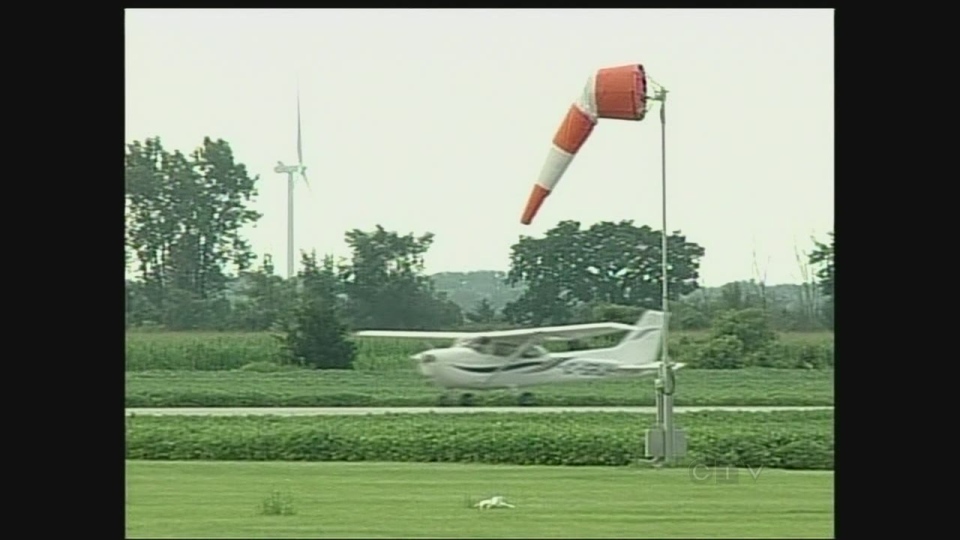
Transport Canada Takes a Stand! Says Wind Turbines Near Chatham Airport, Have to Go!

Transport Canada demanding wind turbines be removed near Chatham airport

CTV Windsor 
Published Sunday, July 6, 2014  

Transport Canada has issued an order requiring the eight wind turbines near Cedar Springs be removed by the end of this year.

The organization originally issued a letter requesting “voluntary compliance” last year.

In a release sent out by the municipality, Chatham-Kent mayor Randy Hope, says,“there is no safety issue so we need to change the regulation rather than force the removal of the turbines.”

The Municipality had been waiting for a reply from Transport Canada on this proposal and was surprised this week to learn that Transport Canada had taken this new step of issuing letters demanding that the turbines be removed by December 31, 2014.

The affected wind turbines are in a “no fly zone” south of the airport.

It is expected that GDF SUEZ, the owner of the affected turbines, will formally object to the order from Transport Canada and seek a hearing before the Minister of Transport through the process laid out in the Aeronautics Act.

Read more: http://windsor.ctvnews.ca/transport-canada-demanding-wind-turbines-be-removed-near-chatham-airport-1.1901446#ixzz36jqEYlxf

Frauds, Crooks and Criminals

Demonstrating daily that diversity is not strength!

Family Hype

All Things Related To The Family

DeFrock

defrock.org's principal concern is the environmental and human damage of industrial wind turbines on rural communities

Gerold's Blog

The truth shall set you free but first it will make you miserable

Politisite

Breaking Political News, Election Results, Commentary and Analysis

Canadian Common Sense

Canadian Common Sense - A Unique Perspective from Grassroots Canadians

Falmouth's Firetower Wind

a wind energy debacle

The Law is my Oyster

The Law and its Place in Society

Illinois Leaks

Edgar County Watchdogs

stubbornlyme.

My thoughts...my life...my own way.

Oppose! Swanton Wind

Proposed Wind Project on Rocky Ridge

Climate Audit

by Steve McIntyre

4TimesAYear's Blog

Trying to stop climate change is like trying to stop the seasons from changing. We don't control the climate; IT controls US.

Wolsten

Wandering Words

Patti Kellar

WIND WARRIOR

John Coleman's Blog

Global Warming/Climate Change is not a problem