Wind Weasels Whine, When Wind Welfare Threatened!

US Wind Industry Wilts as Wind Welfare Gets Slashed
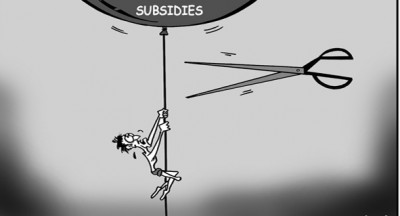
subsidies

The wind industry exists – and ONLY exists – for one single purpose: to wallow in a massive subsidy stream that – in order to keep this monstrous Ponzi scheme alive – will need to outlast religion.

In Australia, the – already overflowing – wind power subsidy trough is designed to be refilled with $3 billion annually from 2019; and to continue being filled at that colossal rate, until 2031.

From hereon, the cost of the greatest subsidy rort in the history of the Commonwealth will exceed $45 billion – every last cent of which will be recovered from Australian power consumers through retail power bills.

But, with commercial retailers boycotting wind power – flatly refusing to sign up to long-term power purchase agreements – wind power outfits here are screaming ‘blue murder’. It’s still all about dreadful ‘uncertainty’ – or so we’re told:

Wind Industry Still Wailing About ‘Uncertainty’ as Australian Retailers Continue to Reject Wind Power ‘Deals’

Faced with a recommendation, made a month or so back, from the Senate Inquiry into the great wind power fraud, that the mandated subsidy – in the form of renewable energy certificates (RECs) – should be limited to a period of 5 years – rather than running from 2001 to 2031 – the wind industry, its parasites and spruikers started  howling like Banshees about their imminent “doom”.

The response has left STT just a little perplexed.

You see, the impression given by the wind industry and its worshippers is that wind power outfits are driven by a kind of ‘divine altruism’, under which their only objective is to power the world for free, while saving the planet from the ‘dreaded’ CO2 gas; and otherwise spreading health, wealth and happiness all over the planet.

But, truth be told, ‘altruism’ is running a poor second to the ‘main wind industry game’ – pocketing massive and endless subsidies:

The Wind Industry: Always and Everywhere the Result of Massive & Endless Subsidies (Part 1)

The Wind Industry: Always and Everywhere the Result of Massive & Endless Subsidies (Part 2)

It shouldn’t be so. You see, on the wind-worshippers’ ‘case’, wind power is the ‘perfect product’: it’s already “free” and, it’s getting cheaper by the day (see this piece of fantasy from ruin-economy).

Back in the real world, however, the ‘perfect product’ is having more than just a little trouble selling itself on its own merits.

Here’s a pair of pieces from the US, that simply confirm the bleeding obvious: THESE THINGS DON’T WORK – on any level.

Wind power growth faces sharp decline without federal aid, report says
Jordan Blum
Fuel Fix
9 September 2015

The growth of wind power projects could come screeching to a halt if Congress fails to extend the renewable energy Production Tax Credit by the end of the year, according to a new American Wind Energy Association report being released later this week.

While critics oppose the continuation of what they call “wind welfare,” Texas leads the nation in wind power, which makes up about 14 percent of the Texas grid’s generation capacity. Failing to extend the renewable energy tax credit could lead to a dramatic 70 percent to 90 percent drop off in new wind power installation projects, said Rob Gramlich, AWEA senior vice president.

“Wind is the unfortunate poster child for unstable government policy,” Gramlich said, adding that the tax credit’s past and current stops and starts “lead to disruption and layoffs.”

For instance, Dokka Fasteners recently said it is closing its Michigan wind power manufacturing plant largely because of uncertainty on U.S. energy policy and the tax credit, as well as congressional gridlock.

The argument for the tax credit is that wind power is becoming increasingly competitive with traditional coal and natural gas-fired power plants, but that cheap natural gas from U.S. shale and other factors are preventing an equal playing field for now. So the AWAE contends the competitive tax credit is needed until wind is truly equally competitive in the next decade as wind turbine costs keep coming down.

“America has been lulled into complacency during downturns in energy prices before, believing cheap energy would last forever, only to be hit harder each successive time when energy prices inevitably increased,” the report states. “Smart energy policy can help us avoid falling into this trap as we have before by ensuring that America maintains a diverse portfolio of energy options.”

Businesses and investors need “long-term clarity” on credits and public policy in order to make decisions on major wind projects that take years to complete, the report added. The AWEA said wind energy supports 73,000 direct jobs nationwide and enough energy to power 18 million homes. The association also argues the growth of wind power saves lives because of the decreased reliance on fossil fuel  power and its carbon emissions.

The Production Tax Credit is competitive and gives a 2.3 cents credit for every kilowatt-hour of electricity sold for the first 10 years of a project’s life. The tax break renewal was estimated to cost $6.4 billion over 10 years. Gramlich added that there are some federal incentives for every type of power generation and that wind is not being singled out. The tax credit still supports wind projects that were already in progress before the end of 2014, but the AWEA report stated that the policy uncertainty will slow the rate of cost reductions in wind power projects.

Still, opponents like the American Energy Alliance argue the AWEA and other groups are guilty of doublespeak for touting the vibrancy of wind power while begging for more government subsidies. The wind industry keeps pushing back the timeline on when it will become truly cost competitive, the alliance adds, so it is time for wind power to stand on its own two feet. Critics also contend wind power is unreliable because wind is intermittent.

Houston-based Calpine, which owns natural gas-fired power plants, opposes the tax credit under the argument that it limits a competitive market.

“Government should not pick winners and losers by subsidizing certain market participants,” Calpine spokesman Brett Kerr said in an email response. “The (tax credit) should not be renewed and market participants should all compete on the same level playing field. Additionally, if the policy goal is carbon reduction, the best approach is to put a price on it and let market sort out most efficient reductions, not having subsidies and set-asides.”

The tax credit is a partisan hot potato that is largely supported by Democrats but has limited GOP backing. The Senate Finance Committee recently approved a bundle of two-year, business tax credit extensions, including the Production Tax Credit, but the full Senate has not yet taken up the legislation. After an August recess, Congress is primarily focusing now on the Iran nuclear deal and government funding legislation.

Gramlich said Congress typically addresses tax credit extensions nearer to the end of the year.

In Texas, the state government requires utility companies to buy a certain amount of their electricity from renewable sources such as wind and solar. An effort to dismantle the state program, called the Renewable Portfolio Standard, failed in the Legislature last spring.
Fuel fix

brat

****

Domestic market for distributed wind turbines faces several challenges
Owen Comstock
Today in Energy
27 August 2015

1

***

The domestic market for distributed wind turbines has weakened since the record capacity additions in 2012. Last year’s installations of mid-size and small wind turbines were the lowest in a decade. Relatively low electricity prices, competition from other distributed energy sources, and relatively high permitting and other nonmaterial costs have presented challenges to the distributed wind market in the United States.

Most distributed wind turbines installed in 2014 were connected directly to distribution lines to serve local loads. Distributed wind turbines can also be installed either off-grid or grid-connected at local sites to offset all or a portion of a site’s electricity consumption. Compared with electric utility wind facilities, distributed wind turbine installations are often smaller units, below 1 megawatt (MW), and thus may not appear on EIA’s survey of utility-scale electric generators, which has a 1-MW threshold at the project level. Although some large-scale turbines (1 MW or greater) are used in distributed generation applications, large-scale turbines are more often used at wind farms for wholesale power generation, which is sent through transmission lines to more distant customers.

Based on information in the U.S. Department of Energy’s Distributed Wind Market Report, most of the 2014 distributed wind capacity was installed on institutional sites, such as schools, universities, and electric cooperatives. Government installations on city, municipal, or military facilities made up more than one quarter of 2014 installed capacity. Other sectors (industrial, commercial, agricultural, and residential) were relatively small in terms of capacity, but larger in terms of number of installations, as the average turbine size on these sites is relatively small compared with institutional and government sites.

2

***

Some customers who install these turbines are eligible for federal tax credits, in particular the investment tax credit (ITC), which provides a 30% cost incentive for turbines with capacities of 100 kilowatts or less. The investment tax credit was one of the largest factors in both the increase in installations from 2010 to 2012 and the decline after 2012. In 2009, as part of the American Recovery and Reinvestment Act, the U.S. Treasury allowed projects to receive cash payments instead of tax credits. To qualify, projects had to be under construction or in service by the end of 2011 and must have applied for a grant by October 1, 2012.

Even though these tax credits are still available, the expiration of the cash payment option drastically reduced the installation of small and mid-size wind turbines. Further affecting the outlook for distributed wind is theU.S. Internal Revenue Service requirement, added this year, that small wind turbines meet performance and safety standards in order to qualify for the ITC.

Other factors cited in the recent decline in distributed wind installations are the relatively low price of grid electricity and lower cost of solar photovoltaic systems, which also receive the 30% ITC. Nonhardware costs associated with distributed wind, such as permitting, financing, installation, and supply chain costs, have not fallen as much as they have for solar photovoltaics. U.S.-based manufacturers and supply-chain vendors in the distributed wind market have been vulnerable to market downturns, preventing the market from growing at a faster rate. For these reasons, U.S.-based manufacturers may look to international opportunities, particularly in Japan and South Korea, to find more favorable markets.
Today in Energy


Money Wasted

Important Information on the MOECC Proposal for Removal off 550m Setbacks…

Click on to read…

https://mail.google.com/mail/u/0/?ui=2&ik=442e1005fd&view=att&th=14fd7eec07ee4bb6&attid=0.1&disp=inline&realattid=c1783546396d8a1_0.1&safe=1&zw

https://mail.google.com/mail/u/0/?ui=2&ik=442e1005fd&view=att&th=14fd7eec07ee4bb6&attid=0.2&disp=inline&realattid=c1783546396d8a1_0.2&safe=1&zw

https://mail.google.com/mail/u/0/?ui=2&ik=442e1005fd&view=att&th=14fd7eec07ee4bb6&attid0.3&disp=inline&realattid=c1783546396d8a1_0.3&safe=1&zw

Acoustics Experts Help to Expose the Corrupt Practices of the Wind Industry…

Incessant Wind Turbine Infrasound: An Acoustic Invader

when-is-wind-energy-noise-pollution

Among the growing list of what’s getting to the wind industry, its parasites and spruikers is the fact that – despite their relentless efforts to cover up both the work and the results – highly skilled people are working flat out around the world to discover the precise mechanism that causes the adverse health effects from incessant turbine generated low-frequency noise and infrasound, including sleep deprivation, vertigo and the like.

It’s not only the fact of their rather obvious conclusions that has wind-spinners in apoplexy, it’s the fact that they’re looking at all.

You see, the line being run is that there is NO problem – a tobacco advertising guru said so – so why on earth should anyone be looking?

For the wind industry and its parasites, the problem is, that there IS a problem: teams of highly skilled scientific investigators don’t generally devote their every waking hour to chase answers and solutions, when there’s nothing to chase.

Here’s just another example of what properly qualified people can do when looking for answers to real problems.

This time the work is that of Rob Rand – a Maine boy, who’s been hunting down acoustic trespassers for 20 years; and who – unlike the wind industry’s pet acoustic ‘experts’ – regards his ethical responsibility to “hold paramount the safety, health and welfare of the public” as a way of professional life, not some throwaway line.

Rob Rand

***

Wind farm and health issues
Lindsey Harrison
New Falcon Herald
September 2015

According to an Aug. 26 El Paso County press release, construction at the NextEra Energy Resources wind farm project in Calhan is nearing completion. “All 145 concrete foundations to support the wind turbine towers have now been completed … and 120 of the authorized 145 turbines are now fully erected, with only electrical work remaining to be completed.”

Although the press release states that the turbines will not be functional until the electrical work has been finished, it also states that the turbines could move in the wind, which is already causing health concerns for residents living within the wind farm’s footprint.

One resident, who wished to remain anonymous, said she knew right away that the turbines were moving because she began to feel nauseous, along with a headache. “I have 100 turbines to the north of me, 25 to the west and 20 to the southwest,” she said. “When the wind was coming out of the north, I woke up feeling dizzy and nauseous.”

She also said her animals were acting strangely. “My donkeys and horses keep wanting to go back into their stalls,” she said. “They have not wanted to leave the barn all day.”

Robert Rand, a Boulder, Colorado, resident and an acoustic investigator and member of the Acoustical Society of America, said the reason for the headaches and nausea is directly related to the wind turbines. It has to do with infrasound and low frequency noise, he said.

According to an article written by acoustic engineer Richard James, published at http://wiseenergy.org Feb. 20, “Infrasound is acoustic energy, sound pressure, just like the low to high frequency sounds that we are accustomed to hearing. What makes infrasound different is that it is at the lowest end of the acoustical frequency spectrum even below the deep bass rumble of distant thunder or all but the largest pipe organ tones.

“As the frequency of an infrasonic tone moves to lower frequencies: 5Hz, 2Hz, 1Hz and lower, the sounds are more likely to be perceived as separate pressure pulsations … . Unlike mid and high frequency sound, infrasound is not blocked by common construction materials. As such, it is often more of a problem inside homes, which are otherwise quiet, than it is outside the home.”

Rand said the separate pressure pulsations are like the “whump, whump, whump,” people sometimes experience when they are riding in a car with the windows down. “I have been attempting to acoustically measure phenomena that could present a conflict to human physiology that could then provide a basis to do more research,” Rand said. “My work in acoustics has really been designing and planning. I don’t need more medical research because I know what they (wind turbines) do to people because it happened to me.”

According to an article accepted into The Journal of the Acoustical Society of America Feb. 4, when the body experiences an external force on the inner ear, such as acoustic pressure pulses — but there is no visual input to associate with that pressure — a sensory conflict occurs. That conflict is felt as motion sickness, and it is felt to the same degree as seasickness.

The wind energy industry has claimed for decades that this phenomenon does not exist, in part, because about one-third of the human population is essentially immune to the effects of motion sickness, which is what these pressure pulsations induce, Rand said. Similarly, about one-third of the population appears to be readily prone to motion sickness, he said. “The third that is not affected by this will never understand it and will not know what you are talking about,” Rand said.

According to an article published in the Bulletin of Science, Technology & Society March 2, 2011, written by Dr. Alec Salt: “Infrasound from wind turbines is unlikely to be harmful in the same way as high-level audible sounds.”

However, Salt also states that numerous reports “are highly suggestive that individuals living near wind turbines are made ill, with a plethora of symptoms, which commonly include chronic sleep disturbance. The fact that such reports are being dismissed on the grounds that the level of infrasound produced by wind turbines is at too low a level to be heard appears to totally ignore the known physiology of the ear.”

Dirty electricity concerns
Rebecca Rivas, a Calhan resident with a wind turbine located about 1 mile from her house, said there are other serious health concerns to consider. “My husband had open heart surgery in 2007 and had a mitral valve replaced,” she said. “It is a metal valve now, and he can’t go through metal detectors or any thing.” Rivas said her husband’s cardiologist told him that, with wind turbines that close to their residence, staying there would be like playing Russian roulette with his life.

Rivas said the reason is because the wind turbines emit not only sound waves or pressure waves, but electromagnetic waves as well.

According to an article published online in the Bulletin of Science, Technology & Society Sept. 30, 2011, “The electromagnetic waves are generated by the conversion of wind energy to electricity. This conversion produces high-frequency transients and harmonics that result in poor power quality … . High-frequency transient spikes that contribute to poor power quality, also known as dirty electricity, can flow along wires, damage sensitive electronic equipment, and adversely affect human and animal health.”

Rivas said she was advised that the electromagnetic waves could send her husband into atrial fibrillation. AFib is a quivering or irregular heartbeat that can lead to blood clots, stroke, heart failure and other heart-related complications, according to the American Heart Association. “I’ve watched doctors flatline my husband (stop his heart) five times to try to get his heart back into rhythm,” Rivas said. “Because my husband’s life is at stake, I have to speak up.”

Brown County, Wisconsin
Residents of Brown County, Wisconsin also decided to speak up when the Shirley Wind Farm, owned by Duke Energy, was under construction.

Barbara Vanden Boogart, vice president of the Brown County Citizens for Responsible Wind Energy, worked with other members of the BCCRWE to present a case in front of the Brown County Wisconsin Board of Health about the dangers of the wind turbines.

Vanden Boogart said the presentation contained various pieces of evidence, including the following: 21 peer-reviewed articles on health and industrial wind turbines; analyses of the effects of wind turbines on property values; personal accounts from residents near the wind farm; and studies done in the homes near the Shirley Wind Farm where infrasound and low frequency noise was detected that emanated from the turbines.

According to the minutes from the Brown County Board of Healthmeeting on Oct. 14, the board voted 4-0 to “declare the Industrial Wind Turbines at Shirley Wind Project in the Town of Glenmore, Brown County, WI a human health hazard for all people (residents, workers, visitors, and sensitive passersby) who are exposed to infrasound/low frequency noise and other emissions potentially harmful to human health.”

“They (Duke Energy) were planning to put up 100 turbines within our town and two other adjacent ones, with six on our country block alone,” Vanden Boogart said. “We fought hard, fast and loud in every way we could, and they succeeded in shutting down the wind farm.

“Wind farms are making people ill and the wind energy industry has known about it since 1979. They knew for decades and instead of notifying people, they have been changing the attention to audible noise. This industry is filthy, dirty, corrupt and committing crimes knowingly against people.”

Laura Wilson, a member of the El Paso County Property Rights Coalition, said Vanden Boogart shared all the information that the BCCRWE presented to their board of health with her; and, on Aug. 26, Wilson and 11 other concerned residents attended the El Paso County Public Health board meeting.

“I gave them all the information and told them everything I knew, and they just looked at me with total indifference,” Wilson said. “They were actually eating their lunches while we were all testifying.”

The EPCPRC has a lawsuit pending against the El Paso County Board of County Commissioners and NextEra, citing that the BOCC “exceeded its jurisdiction when it approved the (Golden West Wind Farm) project” at the Feb. 5 meeting, according to the article, “Wind farm goes to roads,” in the May issue of The New Falcon Herald. No hearing date has been set yet. Because of the pending lawsuit, EPC Public Health declined an interview with the NFH.

David Gil, project manager with NextEra, also declined an interview but sent an email to the NFH, with this statement about the Brown County Board of Health declaration: “I am not aware of the declaration.”

Chris Ollson, who testified on behalf of NextEra at the Feb. 5 BOCC meeting also declined an interview, but sent an email stating he was “on holiday.”

Ollson, vice president of strategic development for Intrinsik Inc., is considered an authority in environmental health issues related to the energy sector and has provided risk communication support for wind turbine projects, according to Intrinsik’s website. Ollson has a doctorate in Environmental Sciences from the Royal Military College of Canada.

Wilson said the property rights coalition is hoping to raise more funds to pay the attorney’s fees for the pending litigation; she and the other coalition members intend to keep fighting.
New Falcon Herald

RobertRand_logo

Wind Turbines….Nothing More than “Novelty Energy”!

Wind Power: Just an Ugly ‘Hood Ornament’ on the Conventional Power System

hood ornament

****

As time marches on, the ability of the wind industry to ‘hood’-wink power punters is running into a deluge of ‘unhelpful’ facts: here’s some more from Michigan Capitol Confidential’s Jack Spencer.

Renewables Just a Hood Ornament on Fossil Fuel Power System
You can’t have renewable energy without fossil fuels backing it up
CapCon
Jack Spencer
4 September 2015

General Electric Co. and the Environmental Protection Agency know better than most that renewable energy sources — which are the recipients of billions of dollars of taxpayer largesse in many forms — are in the end dependent on fossil fuels. In a document submitted to the EPA on June 25, 2012, GE urged the agency to keep this fossil fuel dependency in mind when considering emissions standards:

“However, if flexible generation assets, such as gas turbines, are not available, these renewable technologies will not be deployed. In other words, gas turbines are an essential component of renewable energy sources’ ability to penetrate the market.”

Nevertheless, the public remains mostly unaware of the degree to which the heavily subsidized or mandated renewable energy sources, including wind and solar, rely on fossil fuels. More than half the electric generation nominally credited to wind power is actually produced by fossil fuels, mostly natural gas. And on the rare occasions when renewable energy advocates are forced to admit the fossil fuel dependency, they refer to it as only “backing up” the renewable source.

GE, the huge multinational corporation, has been described as President Barack Obama’s “favorite corporation.” It has contributed heavily to Obama’s political campaigns. And like all other large corporations it is vulnerable to the administration’s regulatory arms. So it is not a company one would expect to state so unambiguously facts that the administration would prefer to downplay, such as descriptions of why renewables are dependent on fossil fuels.

Nevertheless, here’s another example from the GE document:

“Renewable power, especially from wind and solar, will be expected to fluctuate hourly and even minute-to-minute with changes in wind speed, cloud cover, and other environmental factors. With this generation mix, electric supply must be available to quickly compensate for the combined variability of demand and fluctuation in the renewable supply.”

The GE document is titled: “Comments of the General Electric Company: Proposed standards of performance for greenhouse gas emissions for new stationary sources: Electric utility generating units.” The document includes a great deal of technical information and is available for public viewing.

However, as is typical of such documents, it omits the percentage of electricity attributed to the “renewables” that is actually generated by the fossil fuel component. When this information is repeatedly denied to the public it is fair to ask: “What are they trying to hide?”
CapCon

Jack Spencer is on the right track, but the missing answer as to GE’s love of wind power is staring him in the face – as his following pieces detail.

GE isn’t backing the wind power fraud to sell wind turbines – these things are being slapped together in workshops in China and India at a fraction of the cost of the American built GE units.

GE’s real interest in wind power is about selling thousands of fast-start-up Open Cycle Gas Turbines (OCGTs) – which are being rolled out any where that there is any significant wind power capacity.

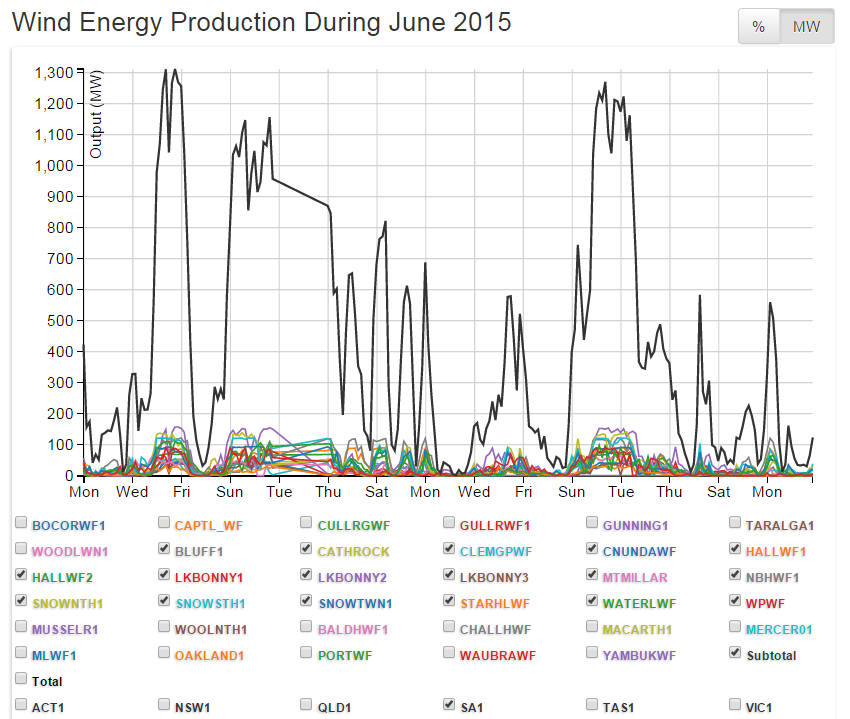
OCGT peaking plants are essential to covering the inevitable, but wholly unpredictable collapses in wind power output that occur almost every day, and for days on end (see our posts here and here).

Whether or not GE sells wind turbines (and it hasn’t sold many in Australia) – as long as these things are being speared into rural communities, GE still gets to sell OCGTs – a market in which it dominates.

In an effort to flog its gas turbines, GE advertised heavily in The Guardian – under the banner “Powering People” and in The Australian – where, earlier this year, GE “sponsored” numerous “features” under its banner “Powering Australia” (see our post here).

OCGTs are used – along with gazillions of gallons of gas, diesel or kerosene that run them – to plug the ‘gaps’ in wind power output around the globe: they’re a daily occurrence; total; and totally unpredictable.

June 2015 SA

We’ll let Jack off the leash again, as he homes in on the fact that wind power’s really just a ‘gas’.

How Wind Energy Creates More Dependence on Fossil Fuels
‘Any informed student of wind energy … understands that’
CapCon
Jack Spencer
2 March 2015

Truth has a habit of emerging from unexpected places. An article in the Daily Kos about the desire to end dependence on fossil fuels for energy needs reveals a “nasty little secret” about wind energy: It relies on fossil fuels. That’s a message wind energy opponents in Michigan have been trying to get across to the news media and the public over the past few years.

The article is part of a series titled “Getting to Zero,” by Keith Pickering, and is written with the premise that global warming is a dire and immediate threat. It states, “If civilization is to survive, we need to get to zero emission of fossil carbon, and we need to get there rapidly.” Overall it paints a pessimistic portrait of efforts to reduce carbon emissions from human sources.

A major aspect of the article’s pessimism about actually “getting to zero” pertains to wind energy. The following paragraphs serve as an example:

Wind farms are dependent on the weather to work, and most of the time they’re sitting idle or underperforming because the wind isn’t strong enough to turn the blades. The capacity factor (CF) for wind varies by location, but Iowa is pretty good, so let’s assume a CF of 35 [percent]. Nuclear has no such dependency and can operate around the clock.

In the [U.S.], nuclear plants have an average CF of 90 [percent].

So when we factor CF into those prices … most of wind’s advantage is wiped out by just that factor alone.

Over the long term it gets even worse for wind, because nuclear plants today are engineered for a 60-year lifetime, and wind generators are engineered for a 20 or 25 year lifetime. … That means that wind is cheaper than nuclear in the short term, but more expensive in the long term. Then there’s the backup problem. … When the wind dies, the lights still have to stay on. Right now that’s done with natural gas. …”

According to Kevon Martis, director of the Interstate Informed Citizens Coalition, a non-profit organization concerned about the construction of wind turbines in the region, what the Daily Kos article shows is that people knowledgeable about the technology understand that wind energy depends more on fossil fuels than on wind, no matter their views on contentious issues like global warming.

“Any informed student of wind energy, regardless of whether they are on the left or the right politically, understands that, far from freeing Michigan ratepayers from fossil-fueled electricity, wind energy actually binds us to fossil fuels at roughly a two-parts-fossil one-part-wind ratio,” Martis said. “Properly understood, wind energy should always be called ‘fossil-wind.’ What’s sad is that the vast majority of Michigan residents and probably members of the news media as well are not aware of this information. That situation needs to be remedied.”

In its assessment of wind energy, the Daily Kos article states: “Wind-plus-gas-backup is certainly better than gas alone, but it’s not the endpoint of a fossil-free grid, and it never will be.”

One of the strongest arguments against wind energy is the assertion that “natural gas alone” would produce fewer emissions than when it is combined with wind. That’s because having to switch natural gas generation on and off, literally at the whim of the way the wind blows, is less efficient and therefore less clean.

However, a news media and public that mistakenly believe wind energy is just wind, rather than two-thirds fossil fuels, cannot be expected to comprehend or participate in such a debate. Restricting important facts or (as some still insist) “alleged facts” about wind energy to the province of “experts only” is an affront to transparency and an obstacle to open public discourse. The Legislature owes the people of Michigan a hearing or series of hearings on this issue.

David Wand, deputy director of strategic communications with the American Wind Energy Association, did not return a phone call offering him the opportunity to comment.
CapCon

coal-seam-gas

****

Natural Gas to Wind Energy: You’re Nothing Without Me
Energy from windmills is mostly backed up by fossil fuels
CapCon
Jack Spencer
11 April 2015

Wind energy in Michigan is approximately two-thirds fossil fuels (predominantly natural gas) used in a less than efficient way, coupled with one-third wind. Most people are unaware of that reality and misinformation flourishes as a result.

Case in point: a new study claims to provide comparisons between wind and natural gas by treating them as if they were two totally separate and distinct forms of energy generation.

The University of Michigan and Lansing-based consulting firm 5 Lakes Energy are touting a joint study based on a “model” produced at the university. The stated purpose of the study is to provide policymakers with a “tool” to help them choose between wind and natural gas. Unfortunately the model upon which the study was based is so flawed that the only “tool” it brings to mind is a toy hammer used in an attempt to force a square peg into the proverbial round hole.

The outputs of the model and resulting study attempt to justify the expansion of wind energy (the term “renewables” is used — but that means wind) in Michigan to meet energy demands resulting from the impending closure of coal plants. Its main argument is that wind energy would be a wise choice because natural gas prices are likely to fluctuate.

The idea here is that wind energy should be seen as a hedge against the possibility that natural gas prices could increase. It is basically an attempt to use the old “don’t put all your eggs in one basket” analogy. This is persuasive only when one ignores the fact that wind energy is 65 percent natural gas, which is precisely what the model does.

For those who understand that a dependable blend which includes wind energy must contain mostly natural gas, the analogy of “not putting all your eggs in one basket” used to promote the study is ludicrous.

“The operative word is ‘or,’” said Tom Stacy, an electricity generation analyst and independent regulatory and policy consultant who signs his correspondence “Ohioan for Afford Electricity.” He explains that the “eggs in one basket” warning doesn’t make sense. “There is no ‘or.’ It is either 100 percent gas or 65 percent gas plus 35 percent wind.”

“The catch,” he continued, “is that compared to the cost of the natural gas basket, consumers are forced to pay triple for baskets because the wind basket costs twice what the gas basket does, yet the gas basket is still required to hold 65 percent of the eggs.” He continued, “The end result: For our dozen eggs, we pay for three baskets when we could have paid for one. In exchange we get four free eggs. The problem is the extra baskets cost far more than the eggs.”

Although fortified with the usual officious-sounding phrases and sprinkled with expert-speak acronyms, the 5 Lakes study is rooted in the popular, but inaccurate, fantasy that wind energy is what wind supporters wish it could be, rather than what it actually is. At one point the study report reveals its imaginary basis with the following statement: “If we choose the natural gas path and natural gas prices rise, we may regret that we are stuck using expensive natural gas when we could have had free wind or solar fuel.”

Free wind? That phrase alone seems contrived to deceive the uninitiated and validate the green faithful. Again, since wind is so unreliable, wind energy has to be backed up by natural gas 65 percent of the time. Under that circumstance — obviously — the cost of wind energy will always largely reflect the price of natural gas. What’s more, the impact of any natural gas price change on wind energy is really more that 65 percent, because natural gas, when hooked up to wind energy, is put to a less efficient use. This is due to the requirement that it be constantly adjusted for when the wind is or is not blowing or not blowing enough. It is exactly the same dynamic that takes place with an automobile’s use of gasoline when driving in city traffic as compared to coasting down the open highway.

In the real “power pool,” wind is not physically paired with just natural gas; it is also paired with coal. The example used in this article gives wind the benefit of the doubt by only using natural gas, and not coal, as the balancing source in the hybrid. The average emissions intensity of coal plus wind is far higher than for gas plus wind. In other words, coal gets terrible “city mileage MPG” compared to natural gas and the pairing of wind with coal results in the excessive inefficiency of stop and go traffic.

The flawed and dishonest premise of the 5 Lakes Energy Study marks it as just the latest attempt by wind energy advocates to promote their product by masking wind energy’s true nature. Wind energy is a less than 30 percent add-on to natural gas. Its effect on emissions, as compared to just natural gas alone, is debatable and at best minimal. The failure of the study to acknowledge this spoils all of its conclusions and suggestions.

A glance at a list of 5 Lakes Energy principle founders reveals more than one official from the administration of former Gov. Jennifer Granholm. Michigan Capitol Confidential emailed the following questions to Douglas Jester, the author of the report on the study, and later to other 5 Lakes Energy officials. They were: Are you denying that wind energy is primarily fueled by natural gas? Why does your study appear to have not accounted for this reality? Is there something we are missing here that you should make us aware of?

Thus far, there has been no response to these questions.
CapCon

yacht

Europeans Regret….Wind Energy is a Bad Deal, No Matter Where You Go!

Europeans Lament their Wind Power Fiasco

German wind farm

The colossal, hugely expensive windfarms that are spread across huge areas of Europe’s land and sea, which are projected to drive up household energy bills by more than 50 per cent in coming years, have achieved … almost nothing in terms of reducing EU carbon emissions.

We here on the Reg energy desk only noticed this particularly this week because of a chirpy press release that flitted past us just the other day, claiming that “wind energy provides 8 per cent of Europe’s electricity.”

Hey, we thought, that sounds almost like it’s getting somewhere! So we looked into it. The eight per cent figure comes from the latest Wind Status Report (pdf) from the EU Joint Research Centre, and sure enough, it’s claimed therein that all those massive wind farms produced no less than 238 terawatt-hours of the 2,942 TWh of ‘leccy used in the EU nations last year.

That’s eight per cent, right enough – and that’d be a noticeable bite out of EU carbon emissions, maybe even one worth tying an energy-prices ball and chain round the ankles of the European economies.

Except it isn’t, of course. Like most developed economies, the EU nations use the great bulk of their energy in non-electric forms: we burn fuels to run transport, to provide heating and cooking and hot water, to power most of our industry. And this accounts for most of our energy use and carbon emissions.

By the most recent figures available, in fact, the EU is using around 1,666 million-tonnes-of-oil-equivalent of energy from all sources every year:that’s 20,710 TWh. Wind electricity makes up just over one measly percentage point of that. Solar? About half that again, for a total renewable-‘leccy contribution of around 1.5 per cent and a roughly corresponding CO2 reduction.

The large majority of the “renewable energy” figure claimed by the EU is produced by optimistic accounting on biomass and renewable-waste, much of which is dubiously renewable at best. Even the proper renewable electricity figures are not to be relied on, particularly in southern Italy where the Mafia is well known to be heavily involved in the industry.

Actual renewables, despite their horrific expense, are not even scratching the surface of real-world modern civilisation’s energy requirements.

Comment

It really is getting clearer and clearer. Bill Gates is right: top Google engineers are right: global-warming high priest James Hansen is right: theUN IPCC is wrong. The renewable energy technologies of today simply cannot provide the power needed to keep the lights on, not at any cost.

Anybody who thinks that carbon emissions are a big threat to humanity – or alternatively, anybody who thinks that becoming ever more dependent on Russian gas and Middle Eastern oil is a bad idea, for instance – needs to get their head around this and move on. The current, cripplingly expensive schemes which crank up the price of energy and channel the resulting cash to windfarms and solar panels need to be scrapped – they will never achieve anything useful.

Perhaps the money saved could be spent on R&D instead, to find some new source of low-carbon energy. But in fact, such a source already exists; the problem is really one of public understanding, rather than a lack of low-carbon energy in the world.
The Register

turbine collapse 9

Windweasels are Definitely a Despicable Bunch of Miscreants!

Scottish Council Demands Copy of Noise Report for Non-Compliant Wind Farm & Its Operator Predictably Runs for Cover

RUN-HIDE-logo_crop

****

One of the slickest moves wind weasels ever made was to have their team write the so-called “wind farm noise guidelines” – which deliberately exclude all reference to the real bane of wind farm neighbours – incessant turbine generated low-frequency noise and infrasound:

Wind Turbine Infrasound: What Drives Wind Farm Neighbours to Despair

Three Decades of Wind Industry Deception: A Chronology of a Global Conspiracy of Silence and Subterfuge

And the next slickest was to write the planning ‘rules’ – designed to have the operators themselves cook up the so-called “compliance data”, which they then hand over to the gullible country bumpkins that work on local Councils; untrained dimwits who simply accept whatever’s dropped on their dreary little desks, by the operator’s highly-paid, pet acoustic consultants.

Fox

****

Some might liken it to handing over security detail at your backyard hen-house to ‘Le Renard & Co’.

That wind power outfits might pull just one or two punches in their obvious commercial interest, might come as a shock to some. However, the same malevolent approach to the manufacture of helpful ‘evidence’ – and the deliberate concealment of the unhelpful stuff – has been adopted all around the globe.

In Australia, Spanish wind conquistadors, Acciona have been turning in fabricated noise data, ever since its Waubra wind farm kicked into gear in 2010.

The operator knows full well that it cannot, and will never, comply with the noise conditions of its planning consent; so does the local Council and the Victorian Planning Department – all of which are sitting on a damming document prepared by an independent consultant, Heggies – which they steadfastly refuse to hand over to their dozens of victims, for obvious reasons:

Victorian Planning Department involved in Waubra Wind Farm Non-Compliance Cover Up

The same ‘method’ has been applied to two other Victorian public health disasters: Macarthur and Cape Bridgewater.

Here’s more of the same from the Highlands of Scotland.

Angus Council may pull plug on Ark Hill windfarm
The Courier
Graham Brown
5 September 2015

Angus planners are on the brink of instigating enforcement action against the operators of the district’s largest windfarm.

The patience of council chiefs is running out over a demand for a noise monitoring report for the eight-turbine Ark Hill windfarm, near Glamis, where the 266-foot structures have been operational since spring of 2012.

A deadline of Friday was set for operators Green Cat Renewables to give an update on the noise monitoring report previously requested by the authority last November.

Residents in the area around the Strathmore site have complained about turbine noise since the windfarm became operational and they said the company was “giving Angus Council the run around”.

Following crunch council discussions within the past week, concerned residents were told that the close of business on Friday was set as the deadline for the operators to give a firm indication of when they plan to submit the monitoring report, or face enforcement action.

The ultimate sanction available to the council is to shut down the windfarm.

One resident said: “These problems have gone on since the turbines went up and they affect our lives, our pets and livestock in the fields around Ark Hill.

“There are so many things which can make a difference to the noise from the turbines, and quite often it is when there is little or no wind.

“People in the area suffering health problems are starting to link them to the windfarm and yet all this time we are still waiting on this noise report.

“The council are not at fault here, they have asked Green Cat for the report and it has not been produced — they are being given the run around.

“No-one can say that there’s not a problem here and it needs to be sorted.”

A council spokesperson said: “Angus Council understands that the wind turbine operator has completed noise monitoring and data gathering at the site and is in the process of preparing a finalised report.

“We have requested a clear timescale for the submission of that report and hope to have clarity on the matter shortly.”

Green Cat Renewables were contacted but made no comment.
The Courier

What? A non-compliant wind farm’s operator running for cover? Who ever heard of such a thing?

Wind Industry RUNS & HIDES as World Wakes Up to the Great Wind Power Fraud

The fact that wind weasels and inconvenient truths are unlikely to appear on the same stage anytime soon, is – these days – pretty much common knowledge – as the following comments to the article above attest.

Anonymous

Green Cat has been dragging its feet for months producing the monitoring report. What have they got to hide?

If anyone has any doubts about the excessive noise visit the site and listen for yourselves.

Disgraceful behaviour from this company.

A public apology from Green Cat would be appropriate. While residents suffer – some without a good night’s sleep – they have dragged their feet in resolving the noise problem.

An appalling stare of affairs.

Concerned Observer

How stupid is this. Has Angus Council learned nothing from the Seed Crushers fiasco in Arbroath?

Asking the offender to provide information is like asking someone to jail themselves – stupid, just plain stupid.

The correct way for noise monitoring is:

1 – the council commission an independent noise monitoring report before any development takes place for which the applicant pays the council.

2 – the noise level above that, then established ambient level, is included in the planning consent as a condition and included in the Environmental Impact Assessment.

3 – the operator is required to keep a noise monitoring log at pre-determined times as part of the planning consent (something like a set date of each month).

4 – any breach is checked against that log.

5 – any continual complaints are investigated by the council, once again commissioning an independent noise monitoring report chargeable to the owners of the site.

6 – any breach of the planning conditions are then rectified by the issuing of an enforcement notice.

Angus Council is at fault here for not applying strict rules to the planning consent and relying on the owners to hang themselves. SEPA who are equally as useless operate in the same way as the council.

It is about time the Scottish government clamped down on the shoddy practices of enforcement and to lackadaisical planning conditions, without any firm pre permission conditions and agreed methods of implementation. Green Cat are at fault, Angus Council are at fault, the Scottish government are at fault. Good luck to the residents but honestly – you are not going to get anywhere now the turbines are up and running and the operator remains responsible for providing evidence.

brave_shield3

Tom Harris, Exec. Director of Int. Climate Science Coalition, Talks to John Counsell, of CFRA, in Ottawa.

Tom Harris speaks on Radio, to John Counsell, of CFRA Radio Stn., in Ottawa

I believe this is one of the all time biggest frauds perpetrated on people world-wide. Wealth transference, from rate payers, to governments and rich investors. We are not improving our environment, in any way. There is no net benefit to wind or solar, over traditional energy sources, burned cleanly, especially hydro and nuclear, which are rejected in favour of this “novelty energy”! The corruption inherent in this incestuous relationship between governments and the renewables industry, has to be investigated. It is a scam! We are being robbed blind. Energy poverty is a reality for many people.  Shellie Correia

Eric Jelinski – A Canadian Energy Engineer, Tells the Truth About Wind Turbines….

Top Canadian Energy Engineer – Eric Jelinski – Slams the Great Wind Power Fraud

engineering-image-4

Provided they haven’t got their trotters in the wind industry subsidy trough, engineers are quicker than most, when it comes to rumbling the great wind power fraud.

Practically minded, and with heads for real numbers, engineers are able to pick apart the complete pointlessness of trying to rely on an energy source that will NEVER be available on demand (can’t be stored) – is entirely dependent upon the weather – and is, therefore, not a generation “system” at all: “chaos” and “system” are words that come from completely different paddocks; and which mean completely different things (see our post here).

And engineers, who build “systems”, don’t like “chaos”.

Google’s top engineers – Stanford PhDs, Ross Koningstein and David Fork – came out and recently tipped a bucket on the nonsense of attempting to run 21st Century economies using a ‘technology’ that was dumped way back in the 19th Century (see our post here).

Now, one of Canada’s leading energy engineers, Eric Jelinski has come out swinging too.

An Engineer Speaks
Windfarm Action
27 January 2015

The following was written by Eric Jelinski, P. Eng., a Canadian engineer who specializes in energy production. Gas plants. Nuclear plants. Wind & solar energy. He explains to his township (Clearview Township, Ontario) why wind energy is folly.

Jelinski

I am writing to express my objections to the installation of Industrial Wind Turbines in Clearview Township, Ontario, Canada.

My wife and I moved here to retire on 50 acres, building a house, market garden, as well as taking many other initiatives to become part of the vital social fabric.

It is bad enough that under Ontario Premier McGuinty, the social fabric in big cities like Toronto is in need of repair, as it happens, in part because those “50,000 jobs” in renewable energy have not materialized, and there is little productive activity for many of the youth in the cities. Guns and drugs are very much part of the social fabric in some neighbourhoods.

What gives McGuinty, with his Toronto constituent Members of the Provincial Parliament (MPP’s), the moral right to tell us in Clearview that we must accept wind turbines “or else”?

One way to stop the wasted energy and environmental impact of urban sprawl is for big city MPP’s to clean up their own yard and make cities safer and more habitable. While they listen to those who object to new gas plants, and cook up a new “plan of the month” for public transport, why do they ignore the issues with wind turbines?

My background is nuclear and chemical engineering, with over 30 years combined working at each of the nuclear plants in Ontario. I teach nuclear engineering at University of Toronto and Georgian College (Power Engineering) in Owen Sound for the purpose of training the next generation of staff who will design plants and work them safely.

I know nuclear reactors and how e=mc2 gets us the energy. I know chemical reactors, e.g. to make gasoline from crude oil, and refining metals. I know solar and wind energy going back to the 1970’s, as energy and exergy are my major fields of study.

The application of Ontario’s “Green Energy Act” is in violation of principles in engineering, where we teach engineers to anticipate unintended consequences and not proceed with implementation until consequences and risks are taken into account.

The Green Energy Act is an abomination that is creating a living hell for almost everybody in rural Ontario, and the provincial government is ignoring the data of emerging health issues, property value issues, setbacks and zoning, impacts on fowl, fauna, and fish, impacts on local weather such as the dew point and foliar uptake by plants that is important in particular to alleviate heat stress on biota.

I have seen firsthand one of my neighbours from the 1980’s near Ripley forced out of his farm home due to wind turbines in Huron Township. Others are putting up with the impacts.

The energy available from wind in Ontario is borderline minimal compared to other countries and areas of the world. 25% to 30% is the capacity factor.

The wind is not available when we need energy the most, i.e. summer air-conditioning and winter heating. The shoulder seasons have the most wind here, yet this is when air-conditioning and heating demands are minimal.

The power equation for wind results in 8 times the energy for a doubling of wind speed, and the excess energy has to be “dumped.” Storage systems are available, but prohibitively expensive. Hythanation is possible, but wind turbines are not economic for hydrogen production given the added infrastructure relative to the cost of natural gas.

Wind turbines use 5 to 7 times the amount of concrete and steel vs. say a nuclear plant on a per Megawatt basis. It will require some 10,000 wind turbines to replace the ~ 6000 MW of coal generation at 25% CF (capacity factor). Back-up gas fired plants have to be added like plug-ins everywhere because the wind is not reliable.

The pastoral scene of a field of wind turbines slowly turning in almost still air has environmentalists dreaming in technicolour.

The truth is that these wind turbines need about 8 km/hour of wind before they will start generating electricity. Any rotation of the blades at wind speeds below 8 km/hour is accomplished by taking power from the grid to get the wind turbine started in anticipation that the wind may pick up.

The economy of scale that has historically brought competitive energy prices in Ontario is not available, given the thousands of wind turbines, and that will also become a maintenance nightmare as machines and contracts approach end of life. Why do we not refuel Nanticoke, Lakeview, Lambton, Lennox and complete Wesleyville to run on natural gas?

What makes McGuinty et al. think they can impose industrial wind turbines on Clearview and all of rural Ontario? Is Clearview thinking of becoming part of this scheme of waste?

This scheme of waste is happening not just by government order, but it is happening because of the salacious relationship between government and the developers.

The most telling example is the head of the Federal Liberal Party is a wind developer. The activity surrounding the recent cancelled “gas plant” in order to preserve seats, and thus preserve the Green Energy Act, is also telling.

We also have the government using engineers from wind developers making recommendations on health impacts. As a P. Eng. I can say that engineers are not the authority on health. The conflict of interest between the engineer being paid for engineering work, vs. the same engineer as proponent and key advisor to the government is quite apparent.

The set-back of 550 meters has no scientific basis. Noise from wind turbines has been measured up to 10 kilometers away in some locations. Medical doctors have noted the health impacts, yet they are being ignored by the Ontario government.

The Feed-in Tariff takes billions of dollars out of communities, out of the province, and out of the country. This is money that is very much needed for healthcare, for schools and teachers, and to replace aging infrastructure and to build much needed new infrastructure such as public transit.

For the first time in decades (I don’t think it ever took place), Ontario is taking equalization payments from the Federal Government, and this points to not only the unsustainability of Ontario as an economy, it is dragging down the rest of the country. It would be different if we owned everything, did local planning, and used a process that garnered respect.

The Ontario government is following the advice of foreign countries and foreign companies to give our money away to them irrespective of the advice of many MP’s. It is most interesting to note that one of the political parties with a labour platform appears in complete agreement with giving away the work and the money and the surplus electricity.

Japan is restarting its nuclear fleet. Russia, China, India, Britain, the US, and even the United Arab Emirates are building or planning to nuclear reactors for electric generation. What is the purpose and value of Ontario energy policy? Every product we buy in Ontario that is made someplace else (most items, can you name one thing that is made here?) has a nuclear energy component in that product.

It is time to stop being altruistic or hypocritical about our energy. There is no rational reason for the 50% cap on nuclear in Ontario. Are we on some unwitting “race to the bottom” being orchestrated by some competitor countries wanting to control us? Having ample low cost energy is crucial to sovereignty, internal peace, and security.

As such, there is no respecting McGuinty, Bentley et al. for this indictment. There is also no need to respect any wind developers as they have already indicated their respect for us. I commented last year on WPD, and sent comments to their consultant as requested, and they have not replied, and their silence speaks volumes. I have sent many an e-mail to the government recommending a moratorium and have not been given the courtesy of any reply.

The purpose of the developer is to make money, i.e. take our money as allowed for by the government, and with minimum effort on their part. This speaks to the quality of the public meetings and their answers to our concerns. The public meetings are a sham.

There are quite a number of lawsuits already taking place and others pending. I thank the Federal government for the recent announcement on the health study. It is also pivotal to learn today that the Ministry of Health is being forced to testify.

My recommendation is for Clearview to take the high road and avoid complicity in matters that are before the courts, and who knows, but it is quite possible (I hope) that the renewed call for a moratorium may take hold for good reasons posted here.

A moratorium in Clearview is very appropriate.

While the WPD wind turbines west of Stayner are quite a few km from our place, they are likely the thin edge of the wedge planned for coming into Clearview. Let me remind you, we came here because this is a good place to live with good opportunities for business. All of that changes if wind turbines are allowed to disrupt the neighbourhood. And 10,000 wind turbines and solar farms are not the answer to Ontario’s energy needs.

As I said before, a province-wide moratorium is needed, and I believe this will come as a matter of time because the inconvenient truth about wind turbines is too big for McGuinty’s carpet. The track record for dictatorial governments throughout history is that all dictatorships eventually capitulate. A moratorium in Clearview would be a “made in Clearview” solution to stop the waste sooner than later.

Eric Jelinski, P. Eng.

What is interesting is that this is not only a UK or European problem and the US and Canada predates much of our wind fleet. But the problems are endemic in the industry and the political myopia of the issues and problems of wind a mystery to the other 97% of the population!
Windfarmaction

wind turbine Screggah-wind-turbine-Padraig-McNulty-2-460x345

Green Energy Ponzie Scheme Lands Clinton’s Buddies in “Hot Water”…

Green Energy Execs Praised by Clinton Foundation Indicted for $54M Ponzi Scheme

Bill Clinton / AP

Bill Clinton / AP

BY: http://platform.twitter.com/widgets/follow

_button.e5e892aa8b

44a208190cd018a89499d8.en.html#_=1441655616597&dnt=false&id=twitter-widget-i1441655616516692086&lang=en&screen_name=lachlan&

show_count=false&show_screen_name=true&size=m
September 5, 2015 2:37 pm

Executives of a Pennsylvania green energy company singled out for praise by Bill Clinton were arrested on fraud charges on Thursday in connection with an alleged Ponzi scheme.

The individuals are facing charges of wire fraud, securities fraud, and conspiracy over their roles in running a green energy company that authorities say was an elaborate $54 million Ponzi scheme, the Associated Press reported.

Prosecutors said the trio lied to investors that their “biochar” technology and “carbon-negative” housing in Tennessee made millions, but they had almost no earnings and used the money to repay earlier investors and for themselves.

The scam allegedly ran from 2005 until 2009, even after the Securities and Exchange Commission filed a civil lawsuit against Wragg and Knorr’s Mantria Corp. They were ordered in 2012 to pay $37 million each. […]

Two months before the SEC civil lawsuit, the company was publicly recognized for its stated commitment to “help mitigate global warming” by former President Bill Clinton’s Clinton Global Initiative. The company was cited for its plans to develop the biochar technology that it said would sequester carbon dioxide and reduce emissions in developing countries. Wragg appeared on stage with Clinton at the event in September 2009.

Praise for Mantria remains on the website of the Bill, Hillary, and Chelsea Clinton Foundation:

Mantria Corporation commits to help mitigate global warming through the use of its Carbon Fields site, where Mantria will perform trials on their product BioChar, a carbon-negative charcoal, to prove how this product can sequester carbon dioxide, improve soil quality when buried, and reduce emissions in developing countries.

Wind Turbines causing a “World of Trouble”!

Turbine protests: Green Energy Act under fire

Credit:  Kingston, ON, Canada / CKWS TV | CKWS Newswatch | September 03, 2015 | www.ckwstv.com ~~

Whether you like them or not, wind and solar panel farms are going up in an area near you. The Liberal government is approving wind and solar farms across the province, most recently here on Amherst Island.

“They continue to approve these wind turbines, they’re doing it in Prince Edward County, they’re doing it on Amherst Island, they’re doing it in Addington Highlands, they’re doing it all across South Western Ontario, it’s not providing a reliable source of electricity and an affordable source.”

The Green Energy Act and the province’s Hydro policy were slammed during a public meeting hosted by MPP Todd Smith in Prince Edward County. About fifty concerned residents from across the region attended the roundtable discussion where Senator Bob Runicman talked about the steps anti-wind turbine groups could take to quash the act …like challenging it in a court of law and calling for a judicial inquiry.

“I think we’ve got to find ways to raise funds to be able to do this and at the very least try and delay it until the next provincial election and hopefully we’ll have a change in government with a different approach.”

Parker Gallant, a writer with the Financial Post and Green Energy Act critic says electricity costs are forcing people to make a tough choice, heat or eat.

“We have just a mess in our electricity sector it’s probably the most complex in all of North America.”

“It’s nothing short of insanity but they continue down that path and we have to fight them with every possible tool available.”

Smith says the green energy act is to blame.

“It’s taken Ontario from having the lowest cost electricity to the highest in North America in just a couple of years.”

“And it’s not only affecting homeowners. Goodyear decided not to expand it’s Napanee location. One of the reasons…rising electricity costs. A recent report from the Ontario Chamber of Commerce suggests that one in 20 Ontario Businesses will close their doors in the next five years due to rising electricity prices. Morganne Campbell CKWS Newswatch Prince Edward County.”