The Wind Scam in Germany, (and elsewhere), Keeps on Getting Worse….

Germany’s Wind Power Surges Plunge Their Neighbours Into Darkness

German wind farm

****

The economics of Germany’s “Energiewende” are so bizarre, that you’d think it had been put together by the GDR’s ‘brains trust’, before the Berlin Wall took its tumble in 1989.

In Germany, around €100 billion has already been burnt on renewable subsidies; currently the green energy levy costs €56 million every day. And, the level of subsidy for wind and solar sees Germans paying €20 billion a year for power that gets sold on the power exchange for around €2 billion.

Squandering €18 billion a year on power – which Germans have in abundance from meaningful sources – has them asking the fair and reasonable question: just how much power are they getting for the €billions that they’ve thrown – and continue to throw at wind and solar?

The answer is: NOT MUCH: Germans Spend 100s of €Billions on their “Energiewende” & Get Only 3% of their Power in Return

But that’s merely to focus on the insane cost to German power consumers and taxpayers – and the meagre returns for their hundreds of €billions in subsidies – of what can only be described as an energy market fiasco.

At a more practical – and to power punters more significant – level chaotic unpredictable surges in wind power output have brought the German grid to the brink of collapse:

Germany’s Wind Power Debacle Escalates: Nation’s Grid on the Brink of Collapse

Unable to build any further transmission capacity of its own – principally because Germans are fed up with having their bucolic homeland turned into an industrial wasteland – not to mention the colossal and wholly unnecessary cost of building a duplicated network simply to take occasional bursts of wind power output – Germany is dumping power into its neighbours’ grids.

The result is that their Czech, Polish, Dutch, Belgian and French neighbours’ grids are being swamped with excess power – whenever the wind picks up in Germany’s North – resulting in grid instability and blackouts.

Germany has – from time to time – been a somewhat boisterous neighbour. With Germany dumping excess wind power on an unscheduled basis – into grids which are simply not designed to take rapid increases in volume – neighbours are fuming again about German arrogance and the cost of accommodating it.

Here’s a couple of takes on yet another aspect of Germany’s wind power disaster.

Germany’s Neighbors Rankled by Its Energiewende
The American Interest
4 August 2015

The German energy mix has been radically changed in recent years, predominantly driven by two forces: a desire to expand renewables’ market share (a task accomplished by generous state subsidies called feed-in tariffs), and an aversion to nuclear power following the 2011 Fukushima disaster. Within Germany these changes have had a number of perhaps unforeseen and certainly unfortunate consequences, including jacked-up power bills for businesses and households and, somewhat bizarrely, an increased reliance on the particularly dirty type of coal called lignite. But the ripple effects of Berlin’s energiewende are expanding past national boundaries, and, as Politico reports, Germany’s neighbors are finding their own grids strained by intermittent solar and wind production:

The country’s move away from nuclear power and increase in production of wind or solar energy has pushed it to the point where its existing power grids can’t always cope. And it’s the Czech Republic, Poland, the Netherlands, Belgium and France that have taken the brunt.

“If there is a strong blow of the wind in the North, we get it, we have the blackout,” Martin Povejšil, the Permanent Representative of the Czech Republic to the EU said at a briefing in Brussels recently.

Germany has failed to beef up its energy transmission infrastructure at the same pace as its burgeoning solar and wind industries, that is, and on especially sunny and windy days it relies on the hospitality of its neighbors to distribute those supplies. Poland and the Czech Republic have been forced to pony up $180 million “to protect their systems from German power surges”, while within Germany itself NIMBY-ism is preventing the construction of some key transmission lines.

When examining the costs of boosting renewables, it’s a big mistake to leave out the expense of building out the grids needed to handle production. Germany seems to have made just that error with its energiewende, and central Europe is struggling to cope.
The American Interest

germany

German winds make Central Europe shiver: Junking nuclear power is creating problems for Germany’s neighbors.
Politico
Kalina Oroschakoff
3 August 2015

Germany’s shift to renewable energy has been hailed as an historic policy move — but its neighbors don’t like it.

The country’s move away from nuclear power and increase in production of wind or solar energy has pushed it to the point where its existing power grids can’t always cope. And it’s the Czech Republic, Poland, the Netherlands, Belgium and France that have taken the brunt.

“If there is a strong blow of the wind in the North, we get it, we have the blackout,” Martin Povejšil, the Permanent Representative of the Czech Republic to the EU said at a briefing in Brussels recently.

Germany’s north-south power lines have too limited a capacity to carry all the power that is produced from wind turbines along the North Sea to industrial states like Bavaria or Baden-Württemberg and onto Austria. That means the extra electricity is shunted through the Czech Republic and Poland.

To put an end to the often unexpected power flows from Germany — so-called loop flows — the countries are taking the matter into their own hands. Concerned about the stability of their own grids, additional costs and the ability to export their own power, the Czechs, for example, are installing devices to block the power from 2016 onwards.

Poland is also working on the devices, known as phase shifters, and expects to have some operating this year. To the west, the Netherlands, Belgium and France have also installed phase shifters to deal with the flows.

These separate moves come as Brussels pushes for integration of Europe’s energy markets. The struggle shows how the drive toward more renewables, combined with outdated infrastructure and inconsistent cooperation within the EU, is having unintended consequences.

“In the past, with coal and nuclear power plants, the power system was extremely predictable. Now, with ever more renewable energy coming online, the system isn’t as predictable anymore, which can cause challenges also for the single market debate,” said Joanna Maćkowiak Pandera, a senior associate with German think tank Agora Energiewende.

“We have been telling that to the Germans, ‘Increase your transmission system, or we will shut you off’,” an EU diplomat said at a briefing in Brussels recently.

Power loop flows occur when a country’s power grid infrastructure isn’t sufficient to handle new production, so the electricity is automatically diverted through neighboring countries on its way to its destination in the producing country.

“This also leads to congestion in neighboring systems,” said Georg Zachmann of the Brussels-based Bruegel think tank, adding that to deal with the situation countries can also reduce their own electricity exports to South Germany to make space for the German power. That, however, means that Germany’s energy transition is affecting the export potential of countries like the Czech Republic and France.

Pressure is building on Germany to expand its north-south connection. But the idea has aroused local opposition in Bavaria, with residents unwilling to see their picturesque countryside spoiled by unsightly transmission towers.

“If we want to have a growing share of renewables, we must build the grids,” Walter Boltz, vice chair of the regulators board of the EU’s Agency for the Cooperation of Energy Regulators (ACER), told POLITICO.

The simplest solution, he said, would be for Germany to build up the necessary links. But that will take time. Alternatively, Germany could simply shut down wind power on highly productive days. But the country’s current policy stands in the way.

“It’s an uncomfortable problem and has to do with Germany’s irrational priority dispatch policy under which you cannot shut down renewables,” Boltz said.

Germany’s neighbors aren’t immune from criticism on the issue.

Poland, for instance, could also consume the power it imports from Germany, something it resists to shield its own industry, Boltz said. Further, Poland’s grids needed expansion, he said.

More cooperation

Germany, for its part, has stepped up cooperation with its neighbors to remedy the issue.

Energy Secretary Rainer Baake recently addressed criticism that Germany’s energy transition was an unilateral policy move, Germanmedia reported, saying, “People in this country and also outside of Germany who believe this must be some kind of act of re-nationalization of energy policy […] could not be more wrong.”

In 2014, German transmission operators agreed with the Czechs to regulate cross-border power flows to protect the Czech grid from overloading and reduce the danger of blackouts. A similar agreement was struck between the Polish and German sides.

On a political level in June, Germany signed a pact with 11 “electrical” neighbors, including France, Poland and the Czech Republic, to promote the integration of the respective power markets, counter overcapacity and let the market determine power prices.

Still, Poland’s regulator last year sent a letter to the ACER, asking it to come forward with an opinion on the loop flows from Germany. The response is expected in September.

In 2013, the agency issued an opinion on unscheduled loop flows, concluding that “in most cases these flows are a threat to a secure and efficient functioning of the Internal Electricity Market.”

Energy mix is a national policy

The situation is delicate for the Czech Republic and Poland, which have long insisted that choosing whether power should be generated by solar, wind, coal, nuclear or other ways remains a national issue, not one for Brussels.

So Germany is free to make decisions about how to generate electricity, in this case to shut down its nuclear plants.

Brussels has stepped up efforts to connect the bloc’s energy markets, with the European Commission in a policy paper in February stressing “the interconnection of the electricity markets must be a political priority.”

The Commission released an initial plan in mid-July about how to build a borderless power market that can deal with the rise in renewables. Draft legislation is expected in 2016.

“We haven’t developed the grids,” the EU bloc’s energy chief Miguel Arias Cañete told POLITICO last month, adding that while there has been a lot of investment in renewables, grids aren’t up to standard. That’s also why Brussels is keen on increasing cross-border power interconnections.

It’s making political and financial efforts to finally link up at least 10 percent of the EU’s installed electricity production capacity by 2020.

But it’s a long slog to connect the bloc: EU countries had originally pledged that target in 2002.
Politico

studying candle

The Wind Scam Proves to be a Huge Waste of Money!

Germans Spend 100s of €Billions on their “Energiewende” & Get Only 3% of their Power in Return

angry german kid

The Germans are rueing the day the bought into the great wind power fraud.

The Germans went into wind power harder and faster than anyone else – and the cost of doing so is catching up with a vengeance. The subsidies have been colossal, the impacts on the electricity market chaotic and – contrary to the environmental purpose of the policy – CO2 emissions are rising fast: if “saving” the planet is – as we are repeatedly told – all about reducing man-made emissions of an odourless, colourless, naturally occurring trace gas, essential for all life on earth – then German energy/environmental policy has manifestly failed (see our post here).

Some 800,000 German homes have been disconnected from the grid – victims of what is euphemistically called “fuel poverty”. In response, Germans have picked up their axes and have headed to their forests in order to improve their sense of energy security – although foresters apparently take the view that this self-help measure is nothing more than blatant timber theft (see our post here).

German manufacturers – and other energy intensive industries – faced with escalating power bills are packing up and heading to the USA – where power prices are 1/3 of Germany’s (see our posts here and hereand here). And the “green” dream of creating thousands of jobs in the wind industry has turned out to be just that: a dream (see our post here).

The ‘gloss’ has well and truly worn off Germany’s wind power ‘Supermodel’ status – as communities fight back against having thousands of these things speared into their backyards – and for all the same reasons communities are fighting back all over the world; those with a head for numbers have called the fraud for what it is; and medicos have called for a complete moratorium on the construction of new wind farms in an effort to protect their patients and quarantine their professional liability:

Germany’s Wind Power ‘Dream’ Becomes a Living Nightmare

German Medicos Demand Moratorium on New Wind Farms

And, on a practical level, those in charge of Germany’s power grid have stepped up calls for an end to the lunacy of trying to absorb a wholly weather dependent generation source into what was never designed to deal with the chaos presented on a daily basis:

Germany’s Wind Power Debacle Escalates: Nation’s Grid on the Brink of Collapse

And the economics are so bizarre, that you’d think its “Energiewende” policy had been put together by the GDR’s ‘brains trust’, before the Berlin Wall took its tumble in 1989.

In Germany, around €100 billion has already been burnt on renewable subsidies; currently the green energy levy costs €56 million every day. And, the level of subsidy for wind and solar sees Germans paying €20 billion a year for power that gets sold on the power exchange for around €2 billion.

Squandering €18 billion on power – which Germans have in abundance from meaningful sources – has them asking the fair and reasonable question: just how much power are they getting for the €billions that they’ve thrown – and continue to throw at wind and solar?

The answer is: NOT MUCH.

Germany gets only 3.3% of its energy consumption from wind and solar. Ignore the headlines
Carbon Counter
Robert Wilson
31 July 2015

“Give a man a reputation as an early riser and he can sleep til noon” – Mark Twain.

There is apparently no greater leader on climate change than Germany. Here is some evidence. This country will build almost 11 GW of new coal power plants this decade, and is in the process of licensing new lignite coal mines. It prematurely shut down 8 zero-carbon nuclear power plants in 2011, closed another one this year, and will prematurely close all remaining nuclear power plants by 2022. Germans have reassured themselves by turning from the disturbing vision of the split atom to the nostalgia of coal fires.

But where does Germany’s climate change reputation come from? It certainly does not come from achievements in reducing greenhouse gas emissions. This decade Germany’s emissions have been essentially flat, and Germany is on course to come a long way short of meeting its 2020 national targets for emissions reductions.

This planet saving reputation instead comes from what Germany has supposedly achieved with renewables. The German renewables revolution is apparently in full gear. If you want to understand what is happening in the world it is better to ignore adjectives and instead count.

Counting is instructive about the realities of renewables in Germany. According to the most recent data, Germany got only 3.3% of its final energy consumption from wind and solar installation (Eurostat data for 2013 available here and here).

Does that sound like a revolution? Obviously not.

The 3.3% figure above tells us that renewables are in fact marginal to Germany’s energy system. So where does this idea that there is a renewables revolution in Germany come from?

The answer is easy to find by googling and searching social media. This will immediately lead you to the following type of headline:

Germany Just Got 78 Percent Of Its Electricity From Renewable Sources

Another popular variant are headlines about German solar output exceeding 50% of electricity demand. The obvious problem with these headlines is that many people come to the mistaken conclusion that these record highs are somehow representative of what goes on the rest of the time. They are not.

Let’s quantify this. The record high renewables output (which included biomass and hydro, a fact rarely pointed out) occurred on the 25th July. Total wind and solar output was around about 39 GW according toFraunhofer ISE data.

How often does this happen? This is relatively easy to find out. All we need to do is add up all hourly wind and solar output and see how it is distributed throughout the year.

I have done this in the graph below. Hourly output was rounded to the nearest gigawatt. I have then added up the number of hours when total wind and solar output fell under each GW bracket. Each bracket covers the average output over an individual hour, in GW.

In total we have about 40 brackets, starting at 0 GW. Yes, German wind and solar falls to zero gigawatts, rounded to the nearest gigawatt. Resist that temptation to write “German wind and solar now meeting 0.1% of Germany energy needs” headlines.

wind_solar

Mean hourly output of German wind and solar was 9.6 GW in 2014, while the median output was 8 GW. The maximum output was almost 39 GW; four times greater than the average, no matter how you define the average.

Furthermore, total wind and solar output was above 30 GW only 2.1% of the time. It was above 25 GW only 9.6% of the time.

The heavily skewed distribution shown above has clearly lead to heavily skewed perceptions about German renewables.

So each time you see headlines about record high renewables output remember this: average output of combined German wind and solar is roughly one quarter of these record highs, and German wind and solar is still just over 3% of final energy consumption in Germany.
Carbon Counter

German wind farm

Once Again, Those Amazing Aussies are Fighting Back!

Three Magnificent Women Take On Australia’s Monstrous Wind Power Outfits & their Pathetic Political Backers

263977-alan-jones

****

The wind industry in Australia is in full-scale panic because the recently completed Senate Inquiry into the great wind power fraud turned a (long-overdue) blowtorch on the biggest rort in Australian history, with their thumping report on Australia’s wind power fraud – available here: Senate Report

The first 200 pages involve a detailed and thorough analysis of every aspect of the most ludicrous piece of energy ‘policy’ ever devised; the balance – written by the wind industry – and headed ‘Labor’s dissenting report’ – requires the suspension of our good friends, ‘logic’ and reason’, in order to digest.

Last Tuesday, STT Champion, Alan Jones picked up on the recommendations – first, on his 2GB breakfast radio show and, later, on Sky News – on ‘Richo + Jones’.

Alan’s morning radio show reaches some 2 million listeners through over 77 Stations, Countrywide; Sky New’s ‘Richo + Jones’ is a top rater, amongst politicians and pundits of all persuasions.  So, when AJ, talks – those in power tend to listen.

Along with applauding the efforts of the Senators on the Inquiry, Alan interviewed three of the most courageous, magnificent and stoic Australians of modern times – in Sonia Trist, Jan Hetherington and Annie Gardner. Each of them are entirely unnecessary victims of Australia’s great wind power fraud; and all of them are fighting back.

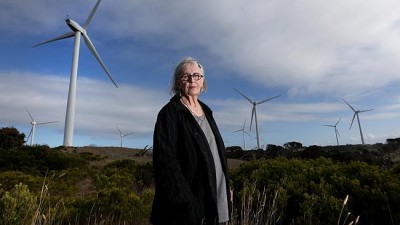
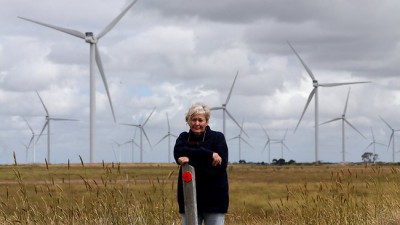
Sonia Trist near wind turbines behind her property at Cape Bridgewater in Victoria’s southwest. Picture: David Geraghty Source: News Corp Australia

****

Sonia Trist had her beautiful seaside home stolen by union super fund backed, Pacific Hydro – aided and abetted by the Federal government’s mandatory Renewable Energy Target:

‘Silly’ Sarah Henderson joins ‘Disappointing’ Dan Tehan, as another ‘Green’ in Conservative Clothing

Jan Hetherington and Annie Gardner have the misfortune of trying to live next door to AGL’s Macarthur wind farm disaster; suffering the daily onslaught of incessant turbine generated low-frequency noise and infrasound from 140 3MW, Vestas V112s.

In modern times, we’re told that the internet is all; when it comes to spreading news and telling peoples’ stories. However, take your time to listen to this little broadcast which demonstrates that – in the hands of a master – radio has lost none of its awesome power to convey human dignity, grace, strength and suffering. STT commends it as one very powerful piece of media.

Alan Jones AO: Well the final report of the latest Senate inquiry into wind farms has been tabled in the Parliament. It’s urged that the Parliament should draw up National rules restricting how wind farms are built and operated and punish States that don’t accept them.

The final report, published yesterday evening by the Senate Committee in wind farms puts forward a range of measures to curb them, including recommendations to reduce support for projects under the National Renewable Energy Target. The report recommended subsidies to new wind farms be limited to 5 years rather than the current period of 20 years.

This is ridiculous isn’t it? Subsidies to wind farms. There are mechanics, and bakers and taxi owners and hire car owners all listening to me this morning-businesses everywhere listening to this program – they don’t get any subsidies at all. Why should foreign-owned wind farms get 2 cents?

But the Clean Energy Council, wind energy’s peak body says ‘limiting wind farm subsidies to 5 years will destroy the future of the industry’. How can an outfit make any sort of claim to commercial viability if its unable to survive without 20 years of subsidies? And a government, which is operating on borrowed money?

Amid the recommendations is a proposal that an independent scientific panel be established which would have the power to block new projects being registered by the government, if it believed human health was at risk. The panel would help draw up “National wind farm guidelines” which the Federal government would introduce and ask State governments to adopt. The guidelines will include – and this by the way is just the Senate Committee’s recommendation- would include National standards on wind farms for infrasound, vibrations, air craft safety, indigenous heritage, birds and bats, shadow flicker, fire risk, electromagnetic interference and blade glint, amongst other things. Remember amazingly wind farms are currently approved and none of these receive any consideration.

The committee recommends that if a State government didn’t accept the new National measure for infrasound and low frequency noise, the Committee recommends that wind projects built in those States should not get Renewable Energy Certificates, that is, money. Yours. Unbelievable. Money – which subsidises these wind farms.

But cop this, this is the ultimate kick in the guts from Canberra. A spokesman for the Environment Minister Greg Hunt said ‘The government had no plans to make further changes to the Renewable Energy Target’. In other words the Senate committee all party committee can get stuffed. In one hit the recommendation seemed to be ruled out. Shouldn’t be available if they’re operated in States which don’t comply with new National noise rules. Remember noise guidelines are a State issue and a number of States refuse to agree to a National noise standard at the last COAG Meeting. Believe me, this renewable energy stuff is money down the drain. The cost of it with subsidies is exorbitant and you’ll pay by your electricity bills or if you’re a business, via your energy costs. And without subsidies this whole industry is not viable.

Yes it’d be nice to have clean quiet cheap energy, a bulk supply of it – everyone would love that, but the reality is that it doesn’t exist. There are wind and solar generators being built all over the world and they only add a small amount to the overall power demand and this is all because of a problem with carbon dioxide. And this is all happening because there’s a Paris conference coming up. And you know the story about carbon dioxide the amount of CO2 in the  atmosphere is 0.04% of all gases. 97% of of that 0.04 of a percent, is naturally occurring. You can’t effect it. Only 3% of it, 0.04 of a percent is caused by human activity. And we, Australia, are responsible for 1% of that 3%. What are we doing? Spending billions of dollars and Bill Shorten says well we’ll have 50% renewable energy, 50% by 2030. Utterly unaffordable, impossible to implement.

And Tony Abbott said when he became Prime Minister he wasn’t going to be chasing Holden up the road with a blank cheque. Why are we chasing foreign owned wind turbine companies up the road with a blank cheque?

Now the problem here is we’ve got ground-breaking research from Germany on low frequency infrasound which concludes that ‘exposure to infrasound below the range of hearing stimulates parts of the brain that warn of danger’. German research. Only a couple of months old. That human beings can ‘hear sounds lower than had been assumed and the mechanisms of sound perception are much more complex than previously thought’. Scientists in Japan have measured brain function and reported last year – it showed the brains of Japanese wind turbine workers could not achieve a relaxed state.  In Tehran a study of 45 people, found that despite all the ‘good benefits’ of wind turbines, it can be stated, this technology has health risks. The German project leader, Christian Cox said, ‘it’s been agreed that infrasound is perceived by human beings and it represents an unknown hazard to human health’.

Well, the people who complain to me in droves are fools, idiots and ignored. Thank God they’re women because women don’t take no for an answer. I’ve got women here who have suffered. Sonia Trist is on the line – Sonia good morning.

Sonia Trist: Good morning Alan.

Alan Jones AO: So you are 620m wind farms from your kitchen window.

Sonia Trist: From my closest wind turbine, yes.

Alan Jones AO: And your Federal member is this Dan Tehan – who is nowhere to be seen.

Sonia Trist: Dan Tehan, nowhere to be seen.

Alan Jones AO: You’ve written to him, no answers.

Sonia Trist: Repeatedly, yes.

Alan Jones AO: Repeatedly. And this Pacific Hydro mob are at Cape Bridgewater, they’ve got 29 wind generators.

Sonia Trist: They certainly have, yes.

Alan Jones AO: And it impacts on you in disturbing and harmful ways.

Sonia Trist: Most certainly, most certainly, extremely disturbing.

Alan Jones AO: But you’re just a dumb complainant.

Sonia Trist: Well, I think one thing that you learn Alan, when you lived near these things for a while, If you can possibly, possibly keep breathing, you don’t give up. And you were saying, you sort of cast a shadow on the possibility of the Senator’s recommendations getting through, well I’ve learned to look at it a different way, I think they’ve opened the window to – they’ve revealed so much, that worked so hard, they’ve open the window to the next step that we have to take, this is a journey.

Alan Jones AO: Sonia, you said something very significant, she wrote to me Sonia, and she said, ‘subsequent generations won’t march in our memory – surrounded by fields of concrete, cabling, collapsed towers and fragmenting fibreglass blades we’ve created layers of industrial graffiti across rural Australia. What a monument to progress in a young country’.

Just hang on Sonia, I’ve got Jan Hetherington on the line. Jan Good morning.

Jan Hetherington

****

Jan Hetherington: Oh hello Alan.

Alan Jones AO: You’ve suffered a range of ailments, haven’t you?

Jan Hetherington: I have yes, I have.

Alan Jones AO:  No one wants to listen to you.

Jan Hetherington: No, nobody wants to listen to me.

Alan Jones AO: You paid $10,000 for testing in your own home.

Jan Hetherington: I did, yes, yes.

Alan Jones AO:  You wake up 4-5 times a night.

Jan Hetherington: Yes, yes.

Alan Jones AO: You wake up with vibrations in your body and your eyes are wobbly.

Jan Hetherington: Yes, yes.

Alan Jones AO: You said the impact on human physiology from low frequency noise has been known for over 50 years.

Jan Hetherington: That’s right.

Alan Jones AO: And you’ve reported to authorities all these studies.

Jan Hetherington: Yes.

Alan Jones AO: And that they have frequent noise and infrasound creates nausea. You’ve talked about vertigo-like symptoms.

Jan Hetherington: Yes.

Alan Jones AO: No one wants to know.

Jan Hetherington: No, nobody does.

Alan Jones AO: AGL are the people that you have been dealing with – they ignore you.

Jan Hetherington: Yes, they do. I send in many, many complaints and I …

Alan Jones AO:  In fact you’ve written to them, you’ve written to all senators and all Federal MPs.

Jan Hetherington: That’s right. and I don’t hear from a lot of them. There’s only the, well only about 4 or 5 that are interested in it – and Senator Madigan and Leyonhjelm and Senator Back and what have you – they are interested. Our local member Dan Tehan, couldn’t ..

Alan Jones AO: Unbelievable this bloke, this bloke Tehan.

Jan Hetherington: He couldn’t care less.

Alan Jones AO: You said to said to me early this morning ‘you woke up at 4.35 with a very sharp ice pick stabbing on the top of my head.

Jan Hetherington: Oh yes.

Alan Jones AO: … behind my right ear.

Jan Hetherington: Yes

Alan Jones AO: ‘This was followed by vibration running through my body, then came the headache in my right temple and right eye. I just had to get out of bed. Unfortunately there’s no running away from this infrasound. Nothing can stop it’.

Jan Hetherington: That’s right, that’s right, it is terrible … oh it’s hard to talk about it because it’s so,  it’s so real, it happens.

Alan Jones AO: I know Jan. I know. Jan has written to me and said ‘I am sick of living like this. This is not what I intended for my future. It was to live my life in peace on my farm and enjoy the natural beauty of the landscape,  not to live in fear for my health and well-being. It’d be nice to think that just one of you reads this and thinks, yes there is a problem and decides to do the right thing by the residents suffering at the hands of the Macarthur wind factory’.

Jan Hetherington: That’s right, that’s right. I just wish somebody would do something. Sorry Alan.

Alan Jones AO: Jan, you hang on – we’re here. But just hang on there, ‘cos I’ve got Annie Gardner. Who’s, well this women is built of concrete and granite. Annie, good morning. You’ve written to everybody.

Annie Gardner: Good morning Alan, yes I do, and I keep doing it in the hope that one day somebody might do something.

Alan Jones AO: Including the ABC and now they no longer accept your emails.

Annie Gardner: Yes that’s been going on since the start of the year Alan. I have a group of journalists, probably about 20, on my complaint list and every time I send complaints to everybody, it bounces back undeliverable. But in actual fact, it’s not just those journalists. I tried someone in the ABC I’d met years ago, which wasn’t on this list, and it bounced back too. I’ve written to the Chairman of the ABC over five weeks ago I think, and still haven’t had any reply from my request.

Alan Jones AO: No, No answer, no answer from those members. And I have spoken to Annie before because this destroyed your ultra-fine merino wool growing enterprise – the sheep simply couldn’t produce in this environment. You’ve written to me to say ‘we suffer badly from infrasound emitted by the turbines in the form of headaches, severe nose pressure, excruciating ear pain, nausea, chest burning, just to mention a few. As a result from being hammered by infrasound, we’re unable to sleep at night. We’re forced to leave our home and property for at least 2 nights a week just to get some sleep’. I mean, how – you wrote that Annabel Crabb on the ABC described you on the Robyn Williams science show, you people who complain about health impacts are ‘dick brains’.

Annie Gardner: That’s correct, she did and I wrote to her, actually inviting her to come and visit us and realise that we’re not necessarily dick brains, we’re actually, some of us are quite intelligent people, if we weren’t, we would have lost our farms years ago because of, you know, unfortunate financial …

Alan Jones AO: But you can’t get local government, or anybody, politicians. And you’ve said and Jan says, and poor Jan can’t even talk about it. There are people who wake up in the early hours suffering from vibrations and dizziness caused by giant wind energy plants and Macarthur, the one you’re exposed to, is the largest of its kind in the Southern hemisphere.

Annie Gardner: That’s correct Alan.

Alan Jones AO: And a farmer, Ron Gelbart said he regularly had to leave his home to sleep in Hamilton. ‘Something is there and we can’t understand but we can not live with’. I mean everywhere, people are writing and telling these stories and Parliamentarians won’t listen.

Annie Gardner: No. That’s correct Alan, not many of them, except for the good Senators.

Alan Jones AO:  Well David Leyonhjelm is but now we’ve got the statement by Greg Hunt’s spokesperson saying we’re not changing anything about the Renewable Energy Target. Just stay there Annie, a quick word, because we are beaten for time. Jan –  just come back to Jan,

Jan Hetherington: Yes

Alan Jones AO:  I just hope…it makes you just a bit better that we do care.

Jan Hetherington: Thank you, at least somebody does. And I’m sorry – I just get emotional.

Alan Jones AO: Don’t apologise. Don’t apologise. These people should be made to live in the circumstances you are enduring.

Jan Hetherington: Well we’ve invited so many people to come and stay with us but nobody will take the offer up.

Alan Jones AO: Invited them … no one comes, no one comes. Sonia, Just to say goodbye to you and keep in touch.

Sonia Trist:  Alan – thank you very much.

Alan Jones AO: Keep in touch.

Sonia Trist:  I certainly will.

Alan Jones AO: You let me know when you write letters to these people and they refuse to answer. You let me know.

Sonia Trist:  I certainly will, and thanks for your work Alan, bye.

Alan Jones AO: Not at all, and Annie, hang in we talk everyday. This is disgraceful, we’ll get somewhere.

Annie Gardner: Thank you very much Alan for your help, we certainly appreciate it.

Alan Jones AO:  Not at all. And we will be looking at this issue again tonight with Riccho and Jones, it’s an absolute national disgrace.

Annie Gardner

That wonderful women like these are reduced to tears on national radio is nothing short of a complete disgrace; that they are left to plead to our political betters through the media, for an end to the misery that they – and hundreds of others like them – have been forced to endure at the hands of an industry that treats all and sundry with callous disregard, is a moral and political outrage.

Not content with that stand-out piece of radio journalism, Alan followed it up that night on Sky, with an equally brilliant effort. This time interviewing Senator David Leyonhjelm about the Senate’s recommendations; and bringing Annie Gardner into the Sky News studio for a reprise of her morning’s efforts on 2GB – only for Annie to excel as a voice for those set upon by an industry and its political backers – all of whom stand shorn of any trace of human empathy or compassion.

****

****

david leyonhjelm

Those Brilliant Aussies, Have Recommended Safeguards Against the Windscam!

Australian Senate’s Recommendations to Curb the Wind Industry – Driven by Common Sense & Compassion

senate review

****

After almost 6 months, 8 hearings in 4 States and the ACT, dozens of witnesses and almost 500 submissions, the Senate Inquiry into the great wind power fraud has delivered its ‘doorstop’ final report, which runs to some 350 pages – available here: Senate Report

The first 200 pages are filled with facts, clarity, common sense and compassion; the balance, labelled “Labor’s dissenting report”, was written by the wind industry’s parasites and spruikers – including the Clean Energy Council (these days a front for Infigen aka Babcock & Brown); theAustralian Wind Alliance; and Leigh Ewbank from the Enemies of the Earth.

Predictably, Labor’s dissenting report is filled with fantasy, fallacy and fiction – pumping up the ‘wonders’ of wind; completely ignoring the cost of the single greatest subsidy rort in the history of the Commonwealth; and treating the wind industry’s hundreds of unnecessary victims – of incessant turbine generated low-frequency noise and infrasound – with the kind of malice, usually reserved for sworn and bitter foreign enemies.

Labor receives $millions in operational and election funding from Union Super Funds – which its members (both past and present) run as political slush funds – funds which are handled with wanton disregard for the working class mum and dads – who unwittingly end up ‘investing’ their hard earned savings in disasters like Pacific Hydro – a wind power outfit that torched $700 million of mum and dad super savings in a single year:

Pacific Hydro’s Ponzi Scheme Implodes: Wind Power Outfit Loses $700 Million of Mum & Dad Retirement Savings

So, with their snouts wedged deep in the wind industry subsidy trough – and with everything to lose, it’s no surprise that Labor’s dissenting report is full of self-serving lies, omissions and half truths.

Fortunately, however, the majority of Senators on the Committee worked overtime to get the truth out – and made a suite of recommendations based on facts and evidence; and driven by those truly human attributes – common sense and compassion.

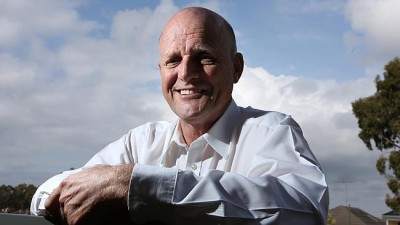
STT notes and thanks Coalition Members, Senators Chris Back and Matt Canavan – and Senators, John Madigan, David Leyonhjelm, Bob Day and SA’s Favourite Greek, Nick Xenophon for their tireless efforts throughout: efforts which have done more than any other Parliamentary Inquiry – anywhere on Earth – to expose the insane cost and utter pointlessness of the greatest economic and environmental fraud of all time.

Here’s a succinct little wrap-up on the Senate’s recommendations from Senator David Leyonhjelm.

Wind turbine report vindicates Senate scrutiny
Liberal Democratic Party
Monday August 3, 2015

Liberal Democrat Senator for NSW, David Leyonhjelm has hailed the findings of the Select Committee Inquiry on Wind Turbines as vindication of his motion to establish the inquiry and confirmation that regulation of the wind industry needs to change.

“It is abundantly clear from the evidence of regulators, the community, local councils and wind farm operators that the status quo is untenable,” Senator Leyonhjelm said.

“Only the wind industry and its cheer squad disagree. There are glaring planning and compliance deficiencies plus growing evidence, domestic and international, that infrasound and low frequency sound from wind turbines is having an adverse health impact on some people who live in the vicinity of wind farms. This is not something a responsible government can ignore.”

The report is critical of the work previously undertaken by the National Health and Medical Research Council on wind farm noise emissions, which many have relied upon to declare wind farms have no adverse health effects.

The committee is also concerned about “the lack of rigour” behind the position statement of the Australian Medical Association on wind turbine operations. The inquiry report criticised the AMA for refusing to give evidence before the inquiry, describing their position statement as “irresponsible and harmful”.

The final report, tabled in the Senate today, retains the recommendations of the interim report (which the government has accepted) but expands on these and adds more.

Among them is a requirement for wind farms to comply with national noise standards in order to be eligible for consumer funded Renewable Energy Certificates (RECs), that eligibility for RECs cease after five years to lessen the financial burden on consumers, that state EPAs have jurisdiction over wind farms rather than local councils, that the Clean Energy Regulator be subject to a performance audit by the ANAO, and that the Productivity Commission be required to examine the impact of wind power generation on retail electricity prices.

“Senators involved in this inquiry have been attacked by the Big Wind lobby and those who see it is an assault on all renewable energy. The Labor representative on the Committee, Senator Anne Urquhart, joined this criticism following the interim report.

“However, the report shows there is a problem with the wind industry, not renewables such as solar, hydro, geothermal and biomass. There are potentially just as many jobs in these and nobody living close to them is getting sick. Labor’s enthusiasm for renewables needs to incorporate some compassion for those being hurt.”

Senator David Leyonhjelm

Senator David Leyonhelm

****

A fair call David – but, then again, common sense rarely needs an advocate.

Meanwhile, Committee Chair, Senator John Madigan went on the offensive in his home state of Victoria – where wind industry front man, Labor Premier, Daniel Andrews has adopted an approach to his constituents that would have made his pin-up boy, Generalissimo Stalin, glow with pride.

Senator Madigan warns Premier Andrews: ‘Don’t gamble with the health of Victorians’
Senator John Madigan
Independent Senator for Victoria
July 16, 2015

Independent Senator for Victoria John Madigan has warned Victorian Premier Daniel Andrews the Victorian Government’s unshakeable commitment to wind energy is putting the health of Victorians at risk, while potentially exposing the state to future legal liabilities.

“There is growing evidence living near wind turbines can be detrimental to health,” Senator Madigan said.

“While for a long time this evidence mainly came from the reports of affected individuals, more recently a number of studies have lent scientific weight to their concerns, such as the German and Japanese studies recently reported on,” Senator Madigan said.

“Yet, in the face of this, we have the Premier telling us his government is ‘unashamedly pro-wind power’ and indicating plans to boost investment in the sector.

“Beyond the detrimental health impacts, this could leave the state liable to future claims by those who suffer ill-health as a result. Where there is a reasonably foreseeable risk of harm the law requires us to act prudently to avoid that harm. If we fail to do so we are expected to compensate those impacted. The Andrew’s government is confronted with just this type of situation.”

Senator Madigan said the Premier had been aware of the potential health impacts of wind turbines since at least June 2010 when, as Health Minister, he attended a community cabinet meeting in Bendigo and was handed a file containing approximately twenty statutory declarations made by people living near Waubra wind farm. Each statutory declaration detailed negative health impacts residents attributed to noise from the wind turbines.

Senator Madigan said: “Given the Premier has known about this for some time, it is completely irresponsible for him to be promoting the construction of more wind farms around the state.

“With peoples’ health at risk, the state government should exercise the precautionary principle and delay the approval of any further wind farms until their health impacts are properly understood. This is the only responsible position under the circumstances.”

Senator Madigan said he would write to the Premier to request a moratorium on the development of further wind farms until their health impacts are properly understood.

Senator John Madigan

John Madigan

The Insanity of Wind Energy…Just ask Southern Australians. It’s Killing their Economy!

South Australia’s Unbridled Wind Power Insanity: Wind Power Collapses see Spot Prices Rocket from $70 to $13,800 per MWh

jay weatherill

****

To call what South Australia’s Labor government has ‘gifted’ their constituents an energy ‘policy’, is to flatter it as involving some kind of genuine ‘design’. It’s an economic debacle, pure and simple.

The current mess started under former Premier, Mike Rann –  a former spin-doctor, whose relatives all lined up at the wind power subsidy trough from the get-go.

Under its current vapid leader, Jay Weatherill, SA’s Labor government has been talking up a wind powered future for months now – he’s presiding over the worst unemployment in the Nation, at 8.2% and rising fast – and seems to thinks the answer is out there somewhere – ‘blowin’ in the wind’. Its wind power debacle has led to South Australians paying the highest power costs in the Nation – if not (on a purchasing power parity basis) the highest in the world – and, yet, the dimwits that run it wonder why it’s an economic train wreck (see our posts here and here).

A few posts back – always ready to rain on the wind industry’s parade – as well as the gullible and corrupt that cheer it on – we spelt it out in pictures – that even the most intellectually interrupted should be able to grasp:

The Wind Power Fraud (in pictures): Part 1 – the South Australian Wind Farm Fiasco

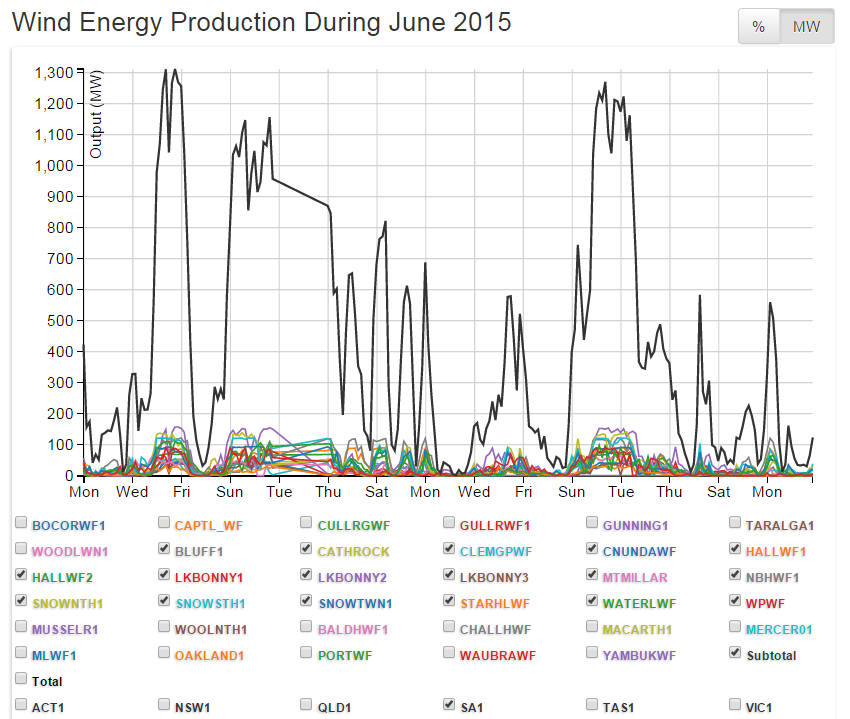
But that woeful missive merely drew focus on the pathetic performance of SA’s 17 wind farms; and their ‘notional’ installed capacity of 1,477MW – it has the greatest number of turbines per capita of all States – and the highest proportion of its generating capacity in wind power by a country mile.

June 2015 SA

Now, we’ll take a look at the effect on SA’s power market when wind-watts go completely AWOL, almost every other day. The chaos that wind power brings with it, has created the perfect opportunity for peaking power operators to make out like bandits at power consumers’ expense – simply because it can predictably ‘relied’ on to disappear without warning.

Wind power driven, market chaos clearly has the Australian Energy Market Operator worried; as its ‘Pricing Event Report’ for July shows.

To make clear just what was driving rocketing spot prices, we’ve added pictures, care of Aneroid Energy.

And when we say ‘rocketing’ we mean with all the thrust of Apollo 11. For the year to date, SA’s average spot price for power is $74 per MWh (compared to Victoria’s $35) – the reason for the price difference might just come from the fact that the Victorians have a relatively tiny proportion of their generating capacity in wind power; and the largest coal-fired generators in the country.

Now, with SA’s average of $74 per MWh in mind, consider the number of occasions in July when – as wind power output collapses – the spot price approaches or hits the Market Price Cap.  That cap – currently $13,800 per MWh – sets the upper limit of what peaking power generators can extort from the system: for a rundown on how the National Energy Market is designed to work, see this paper: AEMO Fact Sheet National Electricity Market

That’s the ‘design’; here’s the reality.

Pricing Event Reports – July 2015

28 July SA

Electricity Pricing Event Report – Tuesday 28 July 2015 (TI ending 1830 hrs)

Market Outcomes: South Australian spot price reached $1,967.51/MWh for trading interval (TI) ending 1830 hrs.

South Australian FCAS prices (Volume Weighted FCAS Prices) and energy and FCAS prices for the other NEM regions were not affected by this event.

South Australia had an actual Lack of Reserve 1 (LOR1) from 1800 hrs to 2030 hrs (Market Notices 49437 and 49438).

Detailed Analysis: 5-Minute dispatch price reached $10,759.20/MWh for dispatch interval (DI) ending 1820 hrs. The high price can be attributed to rebidding of generation capacity and limited interconnector flows during the evening peak demand period. Wind generation was low during this period in South Australia.

The South Australian demand was 2,233 MW for TI ending 1830 hrs. During the same TI, wind generation in South Australia was at 18 MW.

For DI ending 1820 hrs, a total of 38 MW of generation capacity was rebid from Hallett PS and Northern PS unit 2 from bands priced at or below $590.07/MWh to bands priced above $13,333/MWh. South Australian generation capacity was offered at less than $591/MWh or above $10,759/MWh resulting in a steep supply curve.

Cheaper priced generation were restricted by their ramp rates (Mintaro GT) and FCAS profiles (Torrens Island A units 3 and 4). Generation offers at $10,759.20/MWh had to be cleared from Dry Creek GT unit 3 to meet the demand for the DI.

During the affected DI, the target flow towards South Australia on the Heywood interconnector was constrained to 403 MW by an outage constraint equation V::S_XKHTB1+2_MAXG. This transient stability constraint equation manages the Victoria to South Australia flow for the loss of the largest generation block in South Australia during the outage of both parallel Keith – Tailem Bend 132 kV lines.

The target flow on the Murraylink interconnector was limited to 68 MW towards South Australia by the outage constraint equation, V>X_NWCB6022+6023_T1. This constraint equation limits flow from Victoria to South Australia on Murraylink during the planned outage of the Monash – North West Bend No. 2 132 kV line from 22 July 2015.

The 5-minute price reduced to $104.27/MWh in the subsequent DI to the high priced interval when 673 MW of generation capacity was rebid from higher priced bands to the market floor price of -$1,000/MWh.

The high 30-minute spot price for South Australia was forecast in pre-dispatch schedules prior to TI ending 1130 hrs. The pre-dispatch schedule for TI ending 1830 hrs forecast a spot price of $590.07/MWh. The difference in prices between Pre-dispatch and Dispatch was a result of rebidding of generation capacity within the affected trading interval. The wind generation forecast for pre-dispatch was also marginally higher, which also contributed to the difference in prices.

Electricity Pricing Event Report – Tuesday 28 July 2015

Market Outcomes: South Australian spot price reached $2,390.06/MWh for trading interval (TI) ending 0800 hrs.

South Australian FCAS prices and energy and FCAS prices for the other NEM regions were not affected by this event.

Detailed Analysis: 5-Minute dispatch price reached the Market Price Cap (MPC) of $13,800/MWh in South Australia for dispatch interval (DI) ending 0750 hrs. The high price can be attributed to rebidding of generation capacity resulting in a steep supply curve during the morning peak demand period. Wind generation was low during this period in South Australia.

The South Australian demand was 1,915 MW for TI ending 0800 hrs. During the high priced TI, wind generation in South Australia was at 19 MW.

For DI ending 0750 hrs, AGL shifted a generation capacity of 160 MW from Torrens Island B PS from bands priced at or below $124.99/MWh to bands priced at MPC of $13,800/MWh. South Australian generation capacity was offered at less than $591/MWh or above $12,195/MWh resulting in a steep supply curve.

Cheaper priced generation were restricted by their ramp rates (Hallett PS, Mintaro GT, Quarantine PS unit 4) and fast-start profiles (Dry Creek GT unit 3) which required time to synchronise.

Generation offers at Market Price Cap (MPC) of $13,800/MWh had to be cleared from Torrens Island B PS to meet the demand for the DI.

During the affected DI, the target flow towards South Australia on the Heywood interconnector was constrained to 460 MW by the Victoria to South Australia Heywood upper transfer limit thermal constraint equation, V>S_460. The target flow on the Murraylink interconnector was limited to 61 MW towards South Australia by the outage constraint equation, V>X_NWCB6022+6023_T1. This constraint equation limits flow from Victoria to South Australia on Murraylink during the planned outage of the Monash – North West Bend No. 2 132 kV line from 22 July 2015.

The 5-minute price reduced to $109.32/MWh in the subsequent DI to the high priced interval when South Australia demand reduced by 77 MW. Approximately 101 MW of non-scheduled generation came online. Generation capacity was also rebid from higher price bands to the market floor price of -$1000/MWh which also contributed to reducing the dispatch price.

The high 30-minute spot price for South Australia was not forecast in the pre-dispatch schedules, as it was a result of rebidding of generation capacity within the affected trading interval. The wind generation forecast for pre-dispatch was also marginally higher, which also contributed to the difference in prices between pre-dispatch and Dispatch.
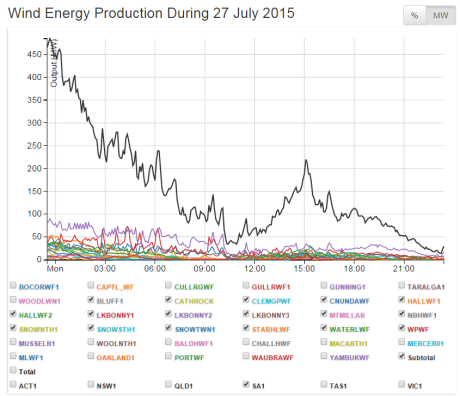
27 July SA

Electricity Pricing Event Report – Monday 27 July 2015

Market Outcomes: South Australian spot price reached $4,449.17/MWh for trading interval (TI) ending 0800 hrs.

South Australian FCAS prices and energy and FCAS prices for the other NEM regions were not affected by this event.

Detailed Analysis: 5-Minute dispatch price reached the Market Price Cap (MPC) of $13,800/MWh and $12,195.07/MWh in South Australia for dispatch intervals (DIs) ending 0755 hrs and 0800 hrs respectively.

The high prices can be attributed to rebidding of generation capacity resulting in a steep supply curve during the morning peak demand period. Wind generation was moderately low during this period in South Australia.

The South Australian demand was 1,896 MW and the temperature in Adelaide was 4.9 °C for TI ending 0800 hrs. During the high priced TI, wind generation in South Australia was at 141 MW.

For DI ending 0755 hrs, AGL shifted a generation capacity of 200 MW from Torrens Island B PS from bands priced at or below $174.99/MWh to bands priced at MPC setting the high price. South Australian generation capacity was offered at less than $591/MWh or above $10,759/MWh resulting in a steep supply curve.

Cheaper priced generation were restricted by their ramp rates (Hallett PS), FCAS profiles (Northern PS unit 2) and fast-start profiles (Dry Creek GT units 2 and 3) which required time to synchronise.

For DI ending 0800 hrs, cheaper priced generation were restricted by fast-start profiles (Dry Creek GT units 2 and 3) which required time to synchronise. Generation offers at $12,195.07/MWh had to be cleared from Hallett PS to meet the demand for the DI.

During the high priced DIs, the target flow on the Heywood interconnector was limited up to 418 MW towards South Australia by the binding transient stability constraint equations, V::S_NIL_MAXG_SECP and V::S_NIL_MAXG_AUTO. The V::S_NIL_MAXG_SECP constraint equation prevents transient instability by limiting flow on the Heywood interconnector from Victoria to South Australia for the loss of the largest generator in South Australia for periods when the South East capacitor is unavailable for switching. The V::S_NIL_MAXG_AUTO constraint equation prevents transient instability by limiting flow on the Heywood interconnector from Victoria to South Australia for the loss of the largest generation block in South Australia.

The target flow on the Murraylink interconnector was limited to 58 MW towards South Australia by the outage constraint equation, V>X_NWCB6022+6023_T1. This constraint equation limits flow from Victoria to South Australia on Murraylink during the planned outage of the Monash – North West Bend No. 2 132 kV line from 22 July 2015.

The 5-minute price reduced to $174.99/MWh in the subsequent DI to the high priced interval when generation capacity from several South Australian generators were shifted to lower priced bands.

The high 30-minute spot price for South Australia was not forecast in the pre-dispatch schedules, as it was a result of rebidding of generation capacity within the affected trading interval. The wind generation forecast for pre-dispatch was also marginally higher, which also contributed to the difference in prices between pre-dispatch and Dispatch.

22 July SA

Electricity Pricing Event Report – Wednesday 22 July 2015

Market Outcomes: South Australian spot price reached $2,296.07/MWh for trading interval (TI) ending 1830 hrs.

South Australian FCAS prices and energy and FCAS prices for the other NEM regions were not affected by this event.

Detailed Analysis: 5-Minute dispatch price reached $13,481.81/MWh in South Australia for dispatch interval (DI) ending 1810 hrs. The high price can be attributed to a steep supply curve of generation capacity offered during evening peak demand period when wind generation was low in South Australia.

The South Australian demand was 2,100 MW for TI ending 1830 hrs. During the high priced TI, wind generation in South Australia was low at 39 MW.

For DI ending 1805 hrs, Energy Australia shifted a generation capacity of 34 MW from Hallett PS from bands priced at $360.81/MWh to bands priced at $13,481.81/MWh. For DI ending 1810 hrs, AGL rebid a generation capacity of 100 MW from Torrens Island B PS from bands priced at or less $64.99/MWh to bands priced at $13,500/MWh. South Australian generation capacity was offered at less than $591/MWh or above $10,750/MWh resulting in a steep supply curve. Cheaper priced generation was restricted by FCAS profiles (Northern PS unit 2 and Torrens Island PS unit A4) and fast-start units (Mintaro PS and Quarantine PS) which required time to synchronise.

Generation offers at $13,481.81/MWh had to be cleared from Hallett PS to meet the demand for the DI.

The target flow on the Heywood interconnector was limited to 447 MW towards South Australia by the binding transient stability constraint equation, V::S_NIL_MAXG_AUTO. This constraint equation prevents transient instability by limiting flow on the Heywood interconnector from Victoria to South Australia for the loss of the largest generation block in South Australia. The target flow on the Murraylink interconnector was limited to 64 MW towards South Australia by the outage constraint equation, V>X_NWCB6022+6023_T1.

This constraint equation limits flow from Victoria to South Australia on Murraylink during the planned outage of the Monash – North West Bend No. 2 132 kV line from 22 July 2015.

The 5-minute price reduced to $53.42/MWh in the subsequent DI to the high priced interval. South Australia demand reduced by 103 MW when 101 MW of non-scheduled generation came online. Generation capacity was also rebid from higher price bands to the market floor price of -$1000/MWh which also contributed to reducing the dispatch price.

The high 30-minute spot price for South Australia was not forecast in the pre-dispatch schedules, as it was a result of rebidding of generation capacity within the affected trading interval. The wind generation forecast for pre-dispatch was also marginally higher, which also contributed to the difference in prices between pre-dispatch and Dispatch.

19 July SA

Electricity Pricing Event Report – Sunday 19 July 2015

Market Outcomes: South Australian spot price reached $2,372.11/MWh for trading interval (TI) ending 1830 hrs.

South Australian FCAS prices and energy and FCAS prices for the other NEM regions were not affected by this event.

Detailed Analysis: 5-Minute dispatch price in South Australia reached $13,333.95/MWh for dispatch interval (DI) ending 1830 hrs. The high price can be attributed to a steep supply curve in generation capacity during the evening peak demand period when wind generation was low in South Australia.

The South Australian demand was 2,066 MW for TI ending 1830 hrs. The high evening peak demand was due to the cool weather in Adelaide, with a low temperature of 7.3°C at 1830 hrs. During the high priced TI, wind generation in South Australia was low at 3 MW for TI ending 1830 hrs.

For DI ending 1825 hrs, Alinta Energy rebid 95 MW of Northern PS generation capacity from bands priced at or less than $286.95/MWh to $13,333.95/MWh. South Australian generation capacity was offered at less than $591/MWh or above $10,750/MWh resulting in a steep supply curve for the high priced DI. Cheaper priced generation were restricted by ramp rates (Torrens Island Unit A4), FCAS profiles (Northern PS Unit 2) or required time to synchronise (Hallett PS).

Generation offers at $13,333.95/MWh had to be cleared from Northern PS units to meet the demand for the DI.

The target flow on the Heywood interconnector was limited to 448 MW towards South Australia by the thermal constraint equation, V>S_NIL_HYTX_HYTX. This system normal thermal constraint equation manages post contingent flow on the Heywood 500/275 kV transformers by reducing Heywood interconnector flow when the actual flow exceeds the pre-defined transformer rating. The target flow on the Murraylink interconnector was limited to 64 MW towards South Australia by the outage constraint equation, V>X_NWCB6225+6021_T1. This constraint equation limits flow from Victoria to South Australia on Murraylink during the planned outage of the North West Bend 132 kV circuit breakers from 13 July 2015.

The 5-minute price reduced to $115.77/MWh in the DI subsequent to the high priced interval when demand reduced by 111 MW and 101 MW of non-scheduled generation came online.

The high 30-minute spot price for South Australia was not forecast in the pre-dispatch schedules, as the forecast demand in pre-dispatch was lower.

17 July 2015 SA

Electricity Pricing Event Report – Friday 17 July 2015 (TI ending 0000 hrs on 18 July 2015): South Australia

Market Outcomes: South Australian spot price reached $2,256.25/MWh for trading interval (TI) ending 0000 hrs (on Saturday, 18 July 2015).

FCAS prices and energy prices for the other NEM regions were not affected by this event.

Detailed Analysis: 5-Minute dispatch price reached $13,333.95/MWh in South Australia for dispatch interval (DI) ending 2340 hrs on 17 July 2015 during high demand period due to hot water load management (ripple control). Between DIs ending 2325 hrs and 2340 hrs, the South Australian demand increased by 311 MW. This additional load represented an 18% increase in the South Australian demand.

Wind generation in South Australia was approximately 120 MW for TI ending 0000 hrs on 18 July 2015.

At DI ending 2335 hrs, a total of 150 MW of generation capacity from Northern PS was shifted from bands priced at or less than $286.95/MWh to $13,333.95/MWh. The high price for DI ending 2340 hrs was set by Northern PS at $13,333.95/MWh. Cheaper priced generation was available from fast-start units (Hallet and Dry Creek unit 3) which required time to synchronise.

The target flow on the Heywood interconnector was limited to 449 MW towards South Australia by a thermal constraint equation, V>S_NIL_HYTX_HYTX for DI ending 2340 hrs. This system normal constraint equation manages post contingent flow on the Heywood 275/500 kV transformers by reducing the Heywood interconnector flow when the actual flow exceeds the pre-defined transformer rating. The target flow on the Murraylink interconnector was limited to 66 MW towards South Australia by an outage constraint equation, V>X_NWCB6225+6021_T1. This constraint equation manages limits flow from Victoria to South Australia on Murraylink during the planned outage of the North West Bend 132 kV circuit breakers from 13 July 2015.

The 5-minute price reduced to $47.13/MWh for the next interval (DI ending 2345 hrs) when the demand reduced by approximately 122 MW and 102 MW of non-scheduled generation came online. A total of 349 MW of generation capacity was also rebid from higher priced bands to the market floor price of -$1,000/MWh.

The high 30-minute spot price for South Australia was not forecast in the pre-dispatch schedules, as it was a result of a 5-minute load increase that caused a price spike in the 5-minute dispatch prices.

7 July SA

Electricity Pricing Event Summary – Tuesday 7 July 2015*

Market Outcomes: South Australia spot price reached $1,221.54/MWh for trading interval (TI) ending 1900 hrs. South Australia FCAS prices and energy and FCAS prices in other regions were not affected.

Summary:

South Australia 5-Minute dispatch price reached $6,794.04/MWh for dispatch interval (DI) ending 1855 hrs due to a steep supply curve in generation capacity during a period of low wind generation. Planned outages affecting the interconnector flow into South Australia also contributed to the high price.

  • Low levels of wind generation in South Australia at approximately 60 MW at TI ending 1900 hrs
  • Rebidding of 20 MW of Hallett PS generation capacity from bands priced at or less than $360.81/MWh to bands priced at $13,481.81/MWh for DI ending 1840 hrs
  • For DI ending 1855 hrs, South Australian generation capacity was offered at less than $590/MWh or above $10,750/MWh resulting in a steep supply curve
  • Cheaper priced generation were restricted by a fast-start unit (Dry Creek GT unit 3) which required time to synchronise
  • The target flow on the Heywood interconnector was limited to 430 MW towards South Australia by a planned outage thermal constraint equation, V>S_APHY2_NIL_HYTX2. This constraint equation manages flow of the Heywood M2 transformer during the outage of APD-HYTS No. 2 500 kV line
  • The target flow on the Murraylink interconnector was limited to 181 MW towards South Australia by a planned outage constraint equation, S>>RBTX1_RBTX2_WEWT. This constraint equation manages post contingent flow of Waterloo East – Waterloo 132 kV line for the trip of Robertstown No. 2 132/275 kV transformer during the outage of Robertstown No. 1 132/275 kV transformer.

South Australia energy price reduced to $46.14/MWh for DI ending 1900 hrs when:

  • Demand reduced by 144 MW and 104 MW of non-scheduled generation came online
  • Generation capacity was rebid from higher price bands to the market floor price of -$1000/MWh which also contributed to reducing the dispatch price.

The high 30-minute spot price for South Australia was not forecast in the pre-dispatch schedules, as the forecast demand in pre-dispatch was lower.

* A summary was prepared as the maximum daily spot price was between $500/MWh and $2,000/MWh

3 July SA

Electricity Pricing Event Report – Friday 03 July 2015

Market Outcomes: South Australian spot price reached $2,296.32/MWh for trading interval (TI) ending 0830 hrs.

South Australian FCAS prices and energy and FCAS prices for the other NEM regions were not affected by this event.

Detailed Analysis: 5-Minute dispatch price reached $13,333.95/MWh in South Australia for dispatch interval (DI) ending 0810 hrs. The high price can be attributed to a steep supply curve of generation capacity offered during morning peak demand period when wind generation was low in South Australia.

The South Australian demand was 1,990 MW for TI ending 0830 hrs. The high morning peak demand was due to the cool weather in Adelaide, with a low temperature of 3.5 °C at 0800 hrs gradually rising to 6.5°C at 0900 hrs at Adelaide Airport. During the high priced TI, wind generation in South Australia was low at 45 MW for TI ending 0830 hrs.

For DI ending 0810 hrs, South Australian generation capacity was offered at less than $590/MWh or above $10,750/MWh resulting in a steep supply curve. Cheaper priced generation were restricted by a fast-start unit (Hallett PS) which required time to synchronise.

Generation offers at $13,333.95/MWh had to be cleared from Northern PS units to meet the demand for the DI.

The target flow on the Heywood interconnector was limited to 444 MW towards South Australia by the binding thermal constraint equation, V>S_NIL_HYTX_HYTX. This system normal thermal constraint equation manages post contingent flow on the Heywood 275/500 kV transformers by reducing Heywood interconnector flow when the actual flow exceeds the pre-defined transformer rating. The target flow on the Murraylink interconnector was limited to 179 MW towards South Australia by a voltage stability constraint equation, V^SML_NSWRB_2. This constraint equation avoids voltage collapse in Victoria for loss of the Darlington Point to Buronga (X5) 220 kV line.

The 5-minute price reduced to $103.93/MWh in the subsequent DI to the high priced interval. South Australia demand reduced by 96 MW when 105 MW of non-scheduled generation came online. Generation capacity was also rebid from higher price bands to the market floor price of -$1000/MWh which also contributed to reducing the dispatch price.

The high 30-minute spot price for South Australia was not forecast in the pre-dispatch schedules, as the forecast demand in pre-dispatch was lower. The wind generation forecast for pre-dispatch was also marginally higher, which also contributed to the difference in prices between pre-dispatch and Dispatch.
AEMO July 2015

yacht

****

Next time you’ve got some wind-worshipper or wind industry parasite claiming that wind power lowers power prices, flick them a link to this post and ask them to explain – if they can? – how a wholly weather dependent power generation source lowers power prices when the wind drops to a zephyr?

When wind power output completely disappears – as it does almost every day – spot prices head north at rates slicker than anything set by Australian Formula One Ace, Mark Webber.

A whole shadow industry has been developed around wind power ‘outages’.

Peaking power at Hallett

****

In the reports above, you’ll see references to the “fast-start unit (Hallett Power Station)”; “fast-start unit (Dry Creek GT)”; “Mintaro GT and “Quarantine PS”. Each of these “fast-start units” use Open Cycle Gas Turbines (OCGTs) – which are little more that jet engines, run on gas or fuel oil (diesel).

The initial capital outlay is low, but their operating costs are exorbitant – depending on the fuel input costs (the gas dispatch price varies with demand, for example) operators need to recoup upwards of $300-400 per MWh before they will even contemplate firing them into action. For a wrap up on “fast-start-peakers” see this paper: Peaker-Case-Histories

As to the insane cost of running them, see this article: OPEN GAS CYCLE TURBINES: Between a rock and a hard place

For peaking power operators, the inevitable and total collapses in wind power output is where the greatest rort of all time begins.

You see, it’s not really about the costs of running OCGTs (or diesel engined generators) is all about what the operator can get away with.

The pattern was set up by the energy market whizzkids from Enron – back in the days when it raped and pillaged the Californian power market, using much the same tactics. Wait for an “outage” – self-generated in Enron’s case – sit back and watch the grid manager panic about widespread blackouts; and then ‘offer’ to solve the problem by delivering power in the nick of time at rates 1000 times the average price: the Enron rort was detailed in the doco “The Smartest Guys in the Room”.

For the purchaser (grid manager), it’s not about how much the vendor ‘needs’ to cover its costs – it’s all about how much the grid manager has ‘got’: some might call it ‘chiselling’; others ‘naked theft’. Hence, the NEM rules that set the upper limit of what can be charged at $13,800 per MWh.

However, there is a serious move to increase the cap to …. be sure you’re seated for this … $80,000 per MWh. See this paper by Dr Jenny Riesz here: Energy-only markets with high renewables: Can they work?

For a ‘wishy-washy’ analysis on the debacle above, note the excuses from wind power fans, Watt-Clarity, here: Why large energy users are concerned about last week’s machinations in South Australia

The ‘alternative’ to increasing the mandatory price cap from its already whopping $13,800 per MWh to a phenomenal $80,000, is to pay baseload generators $millions upfront to hold additional spinning reserve – with plants permanently ready to come online to cover wind power collapses; and, therefore, burning coal and gas around the clock – with what are called “capacity payments”:

Power Punters to Pay Double for Wind Power “FAILS” – REAL Power Generators Paid to Cover Wind Power Fraud

All of this power market insanity is the direct consequence of inevitable but unpredictable wind power output collapses; the criminal scenarios detailed above will only get worse if young Gregory Hunt’s ultimate annual 33,000 LRET were ever met; and would become a complete social and economic disaster if Labor’s 50% renewable target fantasy were ever realised.

One way or another – whether it’s the daily spot price “bonanza” enjoyed by peaking-power-piranhas; or paying millions of dollars in capacity payments to baseload generators, just to keep the grid from collapsing when the wind stops blowing – it’s power punters that pay the ultimate price. And, for South Australians, the only way is up.

Once upon a time, South Australia enjoyed the cheapest power prices in the world; and, with it, an unparalleled burst of economic growth and prosperity:

ETSA: Sir Tom Playford’s Ghost

Today, however, thanks to the most ludicrous power ‘policy’ in the Nation, it’s an economic train wreck. And they wonder why?

runaway train lone ranger

Windpushers Lie About the Cost of Producing Wind Energy!

US Wind Power Spruikers – AWEA – Caught Lying About Wind Power Costs

lies

****

The wind industry was built on lies, half-truths and critical omissions – and it prays on misconception, ignorance and downright stupidity.

The standard tactics are to go on the offensive, with well-oiled spin from the wind industry’s “play-book”. However, as time marches on, the myths and lies are being called for what they are.

The result has the wind industry’s spruikers floundering around with nonsensical and nasty attacks: attacks not just against the opinions and the conclusions of those who challenge the fraud; and personal attacks on those that express them – but – most desperately of all – they’ve been reduced to lying about the black-and-white facts upon which those opinions and conclusions are based.

This insidious feature of the wind industry – and the parasites that dine at its table – is no more evident in their efforts to downplay the insane costs of seeking to rely upon a meaningless power source, which was abandoned in the 18th century, for obvious reasons:

The Wind Power Fraud (in pictures): Part 1 – the South Australian Wind Farm Fiasco

The Wind Power Fraud (in pictures): Part 2 – The Whole Eastern Grid Debacle

June 2015 National

Here’s America’s Institute for Energy Research responding to a raft of rubbish pitched up by the American Wind Energy Association – the equivalent of Australia’s Clean Energy Council.

Wind Lobby’s Critique of IER Study Fails on All Fronts
Institute for Energy Research
24 July 2015

IER recently released a first-of-its-kind study on the cost of electricity from the existing generation fleet, titled “The Levelized Cost of Electricity from Existing Generation Resources.” A major takeaway from the study is that the cost of electricity from new wind resources is three times more expensive than electricity from existing nuclear, hydroelectric, and coal power plants. Power from new combined cycle natural gas plants—the lowest-cost new source of electricity—is about twice as expensive as existing coal-fired electricity.

The bottom line: shutting down existing power plants before the end of their economic lives and replacing them with new generation resources will increase electricity rates.

The American Wind Energy Association (AWEA), the lobbying arm of the wind industry, wrote a response to the IER study. AWEA referred to our study as “a new attack piece” against the wind industry, despite the fact that the study was general in nature and reported on all major sources of electricity including natural gas, coal, nuclear, and hydroelectric power. The central theme in AWEA’s argument is that wind energy “is one of the lowest cost sources of electricity, particularly among low- and zero-emission energy sources.”

AWEA may not like our finding that existing nuclear power plants provide electricity at a levelized cost of $29.60 compared to new wind’s Levelized Cost of Electricity (LCOE) of $106.80. But AWEA’s vitriol towards data-driven reports by IER is nothing new—in the past AWEA has reacted withname-calling when IER publishes facts about the wind industry. Below, we go point-by-point through AWEA’s claims and show that our study stands up to AWEA’s scrutiny.

AWEA Claim #1: the “first trick in their paper The Levelized Cost of Electricity from Existing Generation Sources is using obsolete wind cost assumptions.”

This claim is false, unless data that was current until June 2015 is considered “obsolete” for a study released in the same month. Our study was finalized in June 2015—the same month the Energy Information Administration (EIA) came out with new LCOE data for new sources of electricity. We used EIA’s 2014 data, which was the most recent available at the time. Updating to 2015 data does not change the result of the analysis, as the table below shows.

LCOE-Chart

The LCOE 2015 update from EIA reduces the cost of wind by about $7 per megawatt-hour (MWh) from $80.30 to $73.60. Crucially, even that lower estimate (which excludes some categories of the cost of wind) shows that wind electricity is twice as expensive as existing nuclear ($29.60), hydroelectric ($34.20), and coal-fired power ($38.4).

AWEA Claim #2: “[M]arket data indicate the actual average purchase price for wind energy was $25.59/MWh in 2013, or well under $50/MWh if the impact of the Production Tax Credit (PTC) on long-term wind purchase prices is removed.”

This claim is wildly misleading. It may be true that the average price of recent power purchase agreements (PPAs) is only $25/MWh, but that says little about the true cost of wind power. AWEA lobbyists know better than anyone how many subsidies and mandates are built into PPA prices for wind power. Wind is the beneficiary of dozens of subsidies and other government support, yet AWEA only recognizes one of the largest sources—the wind production tax credit (PTC).

The reality is that AWEA’s own made-up numbers actually show that wind is not competitive with existing sources of generation—and calculating the cost of existing sources of generation was the point of our report. Taking AWEA’s figure above ($50/MWh) indicates that building new wind is already an unattractive option relative to existing resources like nuclear power ($29.60). By failing to recognize this simple math, AWEA seems to miss the point of our study.

However, the PTC is not the only subsidy distorting the PPA price for wind power. Wind is the beneficiary of at least five major subsidies:

  1. Federal Production Tax Credit (PTC)
  2. Accelerated depreciation rules
  3. Federal loan guarantees
  4. Renewable Energy Certificates
  5. State and local utility property tax rebates

But don’t take our word for it. These subsidies are well known. In 2010, a White House report written by Larry Summers, Ron Klain, and Carol Browner explained that the subsidies for wind projects are massive. They explained that total government subsidies for the Shepherds Flats wind project totaled $1.2 billion. The total project cost $1.9 billion. When government subsidies cover nearly 60 percent of the value of a project, the sale price loses meaning as a true measure of cost.

And as we highlighted in our report titled The Case Against the Wind Production Tax Credit, which AWEA did not challenge, the Government Accountability Office counted 82 initiatives across nine federal agencies that supported the wind industry. It is disingenuous for AWEA to point to one subsidy and pretend it tells a complete story about the federal support enjoyed by wind power.

Because of the many subsides artificially lowering the PPA price for wind power, PPA prices do not tell an accurate story of the real cost of electricity from wind facilities. EIA estimates of the LCOE of wind power are much more defensible.

EIA notes that “The LCOE values for dispatchable and nondispatchable technologies are listed separately in the tables, because caution should be used when comparing them to one another.” This is because wind is, by its nature, not reliable. The wind doesn’t always blow. In order to make more apples-to-apples comparisons with other sources of generation, we needed to make some adjustments to EIA’s estimates to reflect wind’s unreliability and need for back up when the wind isn’t blowing.

To EIA’s baseline data, we added in the costs imposed by unreliable wind electricity on other resources—we call these “imposed costs.” Because wind is unreliable, it imposes very real and significant costs on other sources of electricity generation and the power grid. With a more complete picture of the cost of wind power, we estimate that the LCOE for wind is $106.80.

AWEA Claim #3: “Imposed Costs are actually ‘sunk costs.’”

False. By definition, sunk costs are already incurred and hence unavoidable. In contrast to sunk costs, the imposed costs we calculate in our study not only apply to existing generation resources but also new resources. The costs are ongoing and avoidable. In fact, the way we calculated imposed costs ties directly to the most relevant comparison of ongoing—not sunk!—costs in the electricity industry: the pairing of new wind facilities with new combined cycle gas plants. On this point, AWEA fails basic economics.

What are the “imposed costs” of wind? Notably, wind is the only intermittent resource in our study. One implication of wind power’s intermittency is that it has a parasitic effect on the rest of the generation fleet, which has to back down its output—which is controllable or “dispatchable”—in lockstep with any increase in wind generation. By displacing the energy from other generation resources without replacing their capacity to the same extent, wind imposes costs on the dispatchable fleet and raises the LCOE for dispatchable resources.

In the chart below, the dark blue areas represent the “cutting in” effect of wind power on the power grid. The gas plant’s output (light blue) represents the non-wind resources on the power grid, which are forced to back down in order to accommodate the unreliable wind output (dark blue). Our estimate of “imposed costs” shows how this parasitic effect increases the LCOE for non-wind resources using natural gas plants as a proxy.

Chart-2

In our calculation of the imposed cost of wind, we used new combined cycle natural gas output as a proxy for the mix of generation wind might displace. Specifically, we applied the fixed costs of new combined cycle gas at two different capacity factors—best case and fleet average—to estimate the effect on each of intermittent wind generation. This is a reasonable and fair choice for the example because: 1) new combined cycle gas is the most common dispatchable technology being built today, and 2) new combined cycle gas units have the lowest fixed cost per MWh of all new dispatchable generation technologies. If wind displaced resources with higher fixed cost, imposed cost would be higher.

Using conservative estimates, we find that the “imposed cost” of wind power on the dispatchable fleet is between $15.87 and $29.94 per MWh. These costs are in no way “sunk.”

AWEA Claim #4: “EIA’s method shows that a MWh of wind energy has an average economic value of $64.60/MWh, much higher than the current cost of wind energy of under $50/MWh, indicating wind energy provides net benefits for consumers.”

False. Just dead wrong. At this point in the “critique,” AWEA’s sleight of hand reaches new levels.

Even if you agree that the EIA estimate above ($64.60/MWh) reflects the real economic value of wind to the power grid, AWEA’s claim that electricity from wind only costs $50/MWh has no basis in reality. As we explained above, AWEA’s estimate ignores the dozens of subsidies that wind receives in addition to the wind production tax credit.

If AWEA had used EIA data to calculate the “net benefits” of wind power, it would have subtracted EIA’s cost estimate of $73.60/MWh from EIA’s “benefit” estimate of $64.60/MWh to come up with negative $9/MWh. The results only get worse when we adjust the EIA estimates to reflect the imposed costs highlighted above. Using our own updated cost estimate of $106.80/MWh for wind and EIA’s “benefit” estimate, we would have to conclude that wind power falls woefully short in a cost-benefit test—net benefits would be negative $42.20/MWh.

Conclusion

Our study on the cost of electricity from the existing generation fleet is a data-driven analysis of the economics of the power grid. AWEA’s characterization of the study as “a new attack piece” against the wind industry is unfounded—unless AWEA perceives reality as an attack on the wind industry. The fact is, shutting down existing power plants before the end of their economic lives is an incredibly expensive thing to do and, as a result, will increase the cost of electricity. That is true whether the replacement technology is wind, natural gas, or any other new resource.

AWEA’s misinformation surrounding IER’s work is nothing new. As with previous critiques of IER reports, AWEA’s rebuttal to “The Levelized Cost of Electricity from Existing Generation Resources” fails to identify any problems with our paper while exposing AWEA’s own flawed analysis.
Institute for Energy Research

dirtyrottenscoundrelsoriginal

Wind Turbines, are Bird Blenders. Killing Birds and Bats, with Impunity!

Wind Farms: ‘Blending’ ‘Green’ Dreams with Wholesale Avian Slaughter

blender

***

The rampant slaughter of millions of birds and bats – including rare, endangered and majestic species, like America’s iconic bald and golden eagles – is one of the many ‘inconvenient’ facts that moves the wind industry to lie like fury and – when the corpses can no longer be hidden and the lying fails – to issue court proceedings to literally bury those facts (see our post here).

But – in America, at least – it seemed that the ‘inconvenient’ facts were starting to catch up with a vengeance, with US authorities finally doing their jobs, punishing wind power outfits for what is nothing less than thepointless slaughter of thousands of rare, endangered and, what should be, protected birds:

US Wind Power Outfit Whacked with $2.5 million Fine for Rampant Golden Eagle Slaughter

The avian victims of these things in the US, include its National Icon, the bald eagle which – despite their revered status – get sliced, diced and dumped at the bases of turbines in the same unceremonious manner as other less-loved species (see this article). And also include a mounting pile of golden eagle corpses.

dead_eagle_at_base_of_turbine

****

Wherever these things operate, majestic raptors cop a merciless belting: 3MW monsters with 50m blades, have outer tips thundering along at over 350km/h – which tend to make short work of an eagle on the hunt for prey:

Bird Carcass Count proves AGL’s Macarthur Wind Farm is an Avian Slaughterhouse

However, in the US, as the corpses and fines mount up, wind power outfits are looking to slip the noose, by … you guessed it … rewriting the rules.

Sorry, Bald Eagles: Wind Farms Are Allowed to Kill You Now
The Corner
Verinique De Rugy
27 June 2015

If you and I kill a bald eagle or disturb its nest, the consequences can be severe. Under the Bald and Golden Eagle Protection Act, the felony killing of a bald eagle is punished by a fine of $250,000 and prison time. The authorities are taking the killing seriously. Well, sort of.

As it turns out, not everyone is equal under the do-not-kill-bald-eagles law. If you happen to be a favored industry like say, a wind farm, you could get a get-out-of-jail-free card after killing up to five bald eagles if you request a permit and the feds grants it. The Associated Press reports:

A California wind farm will become the first in the U.S. to avoid prosecution if eagles are injured or die when they run into the giant turning blades, the U.S. Fish and Wildlife Service said Thursday. Under President Barack Obama, wind energy has exploded as a pollution-free energy source that can help reduce the greenhouse gases blamed for global warming. But it is not without opposition from wildlife advocates. The Shiloh IV Wind Project LLC will receive a special permit allowing up to five golden eagles to be accidentally killed, harmed or disturbed over five years. Previously, such a violation could potentially draw criminal charges and discourage private investment in wind farms, which are known for catching birds in their rotors.

Fish and Wildlife Service Director Daniel Ashe said the permit encourages development of renewable energy while requiring the wind company to take steps to protect eagles from turbines and power lines. The move will help California reach its goal of producing one-third of its energy from renewable sources by 2020, he said.

“We can’t solve the problem of eagle mortality at wind farms overnight,” Mr. Ashe said in a statement. The Federal government is being sued over the permits, but I wouldn’t hold my breath. Bald eagles watch out, turns out, you are not that special after all. That’s a lesson some 888,000 bats and 573,000 birds had to learn back in 2012.

The Federal government is being sued over the permits, but I wouldn’t hold my breath. Bald eagles watch out, turns out, you are not that special after all. That’s a lesson some 888,000 bats and 573,000 birds had to learn back in 2012.
The Corner

turbines-birds

***

It’s not just raptors that cop a flogging, migratory species are also sliced and diced too – at least you can’t pin the wind industry for being ‘speciest’.

Chaplin, Saskatchewan, is an area with a large salt lake and is also peppered with a number of smaller lakes and wetlands. The brine shrimp that inhabit the salt lakes, attract thousands of migratory birds that turn up to feast on their way North in the summer and South in the winter:see this CBC News report here.

But the weary travellers’ desire to fatten up on their journeys is going to come with a mortal risk, with plans to install 77 giant bird blenders smack in the middle of the lake and wetland complex.

Naturalist opposes wind turbine system in bird sanctuary; 77 wind turbines proposed for bird sanctuary near Chaplin, Sask.
CBC News
29 July 2015

This diagram shows the environmental assessment study area for a wind turbine system, proposed to be built in the area north of Chaplin, Sask.

***

A Saskatchewan-based naturalist and author is worried that migratory birds will be killed by wind turbines proposed to be built near Chaplin, Sask. The proposed development site sits approximately three kilometres north of an internationally recognized bird sanctuary at Chaplin Lake. “The Chaplin Lake area is crucial to several species of shore birds, including some endangered species such as the piping plover,” said Trevor Herriot, who’s based in Regina.

Herriot said he’s unconvinced by assertions in an environmental impact study that 77 wind turbines built north of the Chaplin Lake reserve will pose a low risk to the migratory birds passing north through the area. Ontario-based Algonquin Power Company won SaskPower’s request for proposals to develop and build the wind turbine system. Algonquin is a subsidiary of Windlectric Inc. SaskPower estimates the turbine system will generate an additional 175 megawatts of wind power for the province’s power grid. The project is expected to be finished by the end of 2016.

“There are hundreds of thousands of birds who will pass north of that lake every year, and they will go directly through this gauntlet of 77 wind turbines,” Herriot said. He noted that four per cent of the global population of piping plovers nest there. Other well-known shorebirds, like the sanderling, pass through the area at counts of 50,000 or 60,000 each spring, he said.

In a blog post, referring to the “terms of reference for environmental impact statement” drafted by the engineering firm Stantec, Herriot notes the environmental impact statement was paid for by Algonquin. In an interview on CBC Saskatchewan’s the Morning Edition, Brady Pollock, director of environmental assessment for the province, responded to the potential conflict of interest by Algonquin paying Stantec for the environmental study about land it seeks to build wind turbines on.

Saskatchewan naturalist and author Trevor Herriot says that as many as 40,000 to 50,000 sanderlings, pictured here, have been seen at one time at Chaplin. (Submitted by Trevor Herriot)

***

“This is simply the process. The proponent prepares the document and then it undergoes a rigorous and thorough review by government itself. So it really is an independent, arms-length review of information provided by the proponent,” Pollock said.

Pollock said the process is independent, because the government conducts an independent analysis. “It considers all available information, whether it’s info provided directly in the environmental statement [provided by Algonquin] or various literature sources out there, or previous experiences at our own available data on the existing site,” Pollock said. Once the review is complete, analytical findings based on that review will be made available to the public, along with the environmental impact statement, Pollock said.

For his part, Herriot said he’s not opposed to wind turbine systems for generating power. He does, however, disagree with the proposed location for Algonquin’s system. “It’s one of the birdiest spots on the Great Plains and here we are putting a wind turbine there,” he said. “They’re saying there are very few birds that use the area or move through it. I’d like to see how many days of research they did that. And I’d like to see them take that information to a bird scientist at a university who is independent, and see whether it has any rigor or validity,” Herriot said.

CBC News

For a little taste of what so-called “green” power is all about, we’ve put together this little collection of videos:

Eagle carcass counting in Norway

A flock of partridges try to fly through a wind turbine facility in Germany

Then there are the flocks of vultures crossing the Gibraltar strait.

Eagles maimed and killed in California

The fastest in flight – a white-throated needletail – downed in front of bird watchers in the Hebrides, off the coast of Scotland.

A vulture meets with a wind turbine in Lentas, south Crete, Greece.

In this satirical piece – we learn that wind turbines help us to clear the skies of pesky birds

And this review of environmental harm to birds and bats by wind turbines.

eagle eyes the turbine crop

Games the Windpushers Play…. Rural residents are always on the losing end. It’s Universal!

Falmouth Wind 1 Turbine : Corruption Speaks Out

Falmouth has to face some facts. Those facts are corruption and its not hard to figure it out !

Falmouth Wind 1 Turbine : Corruption Speaks Out

Falmouth Wind 1: Corruption Speaks Out

Falmouth Flushing Taxpayer Dollars Down The Toilet

The Town of Falmouth is wasting money on its commercial wind turbines

You have to ask how do people sit back and allow politicians to flush our money down the toilet ?

The average citizen is always trying to make ends meet. If Jill or Joe citizen waste or lose money, they feel it in their wallet.

It is clear and obvious – corruption is a huge problem, through corruption we are wasting billions and billions of our taxpayer’s money .

Falmouth has to face some facts. Those facts are corruption and its not hard to figure it out !

The town was warned prior to any installations of wind turbines that the Vestas wind turbine known as Falmout Wind 1 generated 110 decibels of noise almost twice the manufacturers specifications. That warning meant the turbine would break state noise regulations. The end result was the courts shut down the turbines because they broke state noise laws. Everyone always knew they would !

The Massachusetts Clean Energy Center in April 2013 gave a memo to the Town of Falmouth admitting they made mistakes in noise studies prior to the installation of the wind turbines. The Massachusetts Clean Energy Center knew well before the installations because they had owned the turbine for several years being held in storage for over $3300.00 a month for several years. They couldn’t sell the turbine even at auction. The turbine was a political embarrassment. They had to dump it on someone.

The Massachusetts Clean Energy Center offered the Town of Falmouth a one million dollar bribe to take the embarrassing old turbine held in storage off their hands as it was becoming a political embarrassment.

In Massachusetts this is called ( One Hand Washes the Other ). Everyone involved with Falmouth Wind 1 knew prior to the installation the turbine generated 110 decibels of noise almost double the specifications. The Falmouth turbine is a Vestas V-82 1.65 megawatt wind turbine. Vestas wind company had just bought out another company,Neg Micon, prior to the Massachusetts Clean Energy Center making the purchase. Falmouth Wind 1 is actually a Neg Micon NM- 82 1.65 megawatt turbine. A turbine that generates 110 decibels of noise.

In order to sell the Falmouth Wind 1 turbine to Falmouth the Massachusetts Clean Energy Center had to get a good noise test to install the turbine in Falmouth. That was simple they made what they call “mistakes” in the noise tests and then admit a few years later after the installation in an April 2013 memo to the Town of Falmouth they made a “mistake.”

Along with the memo Nils Bolgen the wind turbine manager at the Massachusetts Clean Energy Center around the same time as the memo in a press release tells the public the Falmouth Wind 1 turbine was installed “Ad Hoc.”

Prior to the Falmouth wind turbine installation the Massachusetts Clean Energy Center was caught making “mistakes” in a 23 page wind turbine study in Mattapoisett. There was at least one mistake on each page that included contradictions between several sections and some cases up to three “mistakes” per page and it wasn’t spelling or punctuation. Nils Bolgen the wind turbine manager at the time blamed the mistakes on engineering students. Highly unlikely knowing what we know today.

The turbines were not installed in Mattapoisett because of a reference to two distinct types of noise. The distinct types of noise were “regulatory: and “human annoyance.” Today we know “human annoyance” is infra sound or low frequency noise.

To this day it has never been explained why the reference to “human annoyance” was dropped from the Falmouth wind study and there was NO warning to the Town of Falmouth or its citizens. Three guesses why they dropped the reference !

The only conclusion is everyone for years before the installation of Falmouth Wind 1 was aware of major noise issues with the Falmouth Wind 1 turbine. The noise issues included regulatory noise violations and human annoyance noise issues today known as infra sound or low frequency noise. The Massachusetts Clean Energy Center in 2005 described “ human annoyance” yet today acts like it doesn’t exist. Aka the Mass Clean Energy Center caught again in a contradiction.

The Falmouth Zoning Board of Appeals thinks the Town of Falmouth acted in good faith avoiding getting a special permit 240-166 prior to the installation of Falmouth Wind 1 ? Where have these people been ? At the beach with their heads buried in the sand ?

The facts speak for themselves. Had Falmouth applied for special permit 240-166 it would have required additional studies and the turbine would never have been installed. A simple fact.

This wind turbine installation is not just a mishap or “mistake.” The hiding of the noise warning from Vestas wind company, the noise study “Mistakes” by the Mass Clean Energy Center, Admission of an Ad Hoc installation, dropping noise warnings in prior studies about “human annoyance” aka infra sound and then the one million dollar bribe to the Town of Falmouth

The judicial branch of government could only conclude one thing ; C-O-R-R-U-P-T-I-O-N

The question of the 6 million dollars in stimulus funds, ARRA, American Recovery and Reinvestment Act of 2009 was the money for Falmouth Wind II a loan or a grant has never been answered.

Today everyone has got something on everyone else. The Massachusetts Clean Energy Center made its “mistakes” the town avoided the special permit 240-166 and they all knew well in advance the turbine was too loud.

Now the Town of Falmouth has the Massachusetts Clean Energy Center over a barrel and made them fork over 1.8 million dollars to help pay the town litigation fees.

Folks– You the taxpayers are financing this bunco scheme. You the taxpayers are being taken for ride of your life.

Please for the sake of humanity wake up this isn’t a dream. They are taking your health, property and your money.

Windweasels Need A Big Hearty Dose of Reality!!

The Wind Industry’s “Fossil-Fuel-Free” Fantasy Scotched

unicorn

***

At STT we love scotching wind power myths – and all the more so when it can be done with pictures:

The Wind Power Fraud (in pictures): Part 1 – the South Australian Wind Farm Fiasco

The Wind Power Fraud (in pictures): Part 2 – The Whole Eastern Grid Debacle

The ‘arguments’ pitched up by the greentard about these things ‘saving the planet’; and being the ‘answer’ to ‘cataclysmic’ global warming (or ‘climate change’, whichever is your poison) require the suspension of our good friends – ‘logic’ and ‘reason’.

To make it plain – wind power generation has NOTHING to do with the CLIMATE – one way or the other.

STT seeks to completely disconnect claims for and against man-made ‘global warming’, and wind power generation (see our post here).

As laid out in the posts linked above the simple FACT is that wind power can only ever be delivered (if at all) at crazy, random intervals.

It doesn’t matter how many turbines are planted – or how far apart they’re spread – wind power will NEVER amount to a meaningful power source.

It will always require 100% of its capacity to be backed up 100% of the time with fossil fuel generation sources; in Australia, principally coal-fired plant. As a result, wind power generation will never “displace”, let alone “replace” fossil fuel generation sources.

Contrary to the anti-fossil fuel squad’s ranting, there isn’t a ‘choice’ between wind power and fossil fuel power generation: there’s a ‘choice’ between wind power (with fossil fuel powered back-up equal to 100% of its capacity) and relying on wind power alone. If you’re ready to ‘pick’ the latter, expect to be sitting freezing (or boiling) in the dark more than 60% of the time.

June 2015 National

Wind power isn’t a ‘system’, it’s ‘chaos’ – the pictures we’ve thrown up time and time again, tell the story.

When Labor came out to announce its ludicrous 50% renewable energy target (even more ludicrous than the current $45 billion monster) a week or so back (see our post here) – we predicted that the attentions of journos and politicians would be drawn to the great wind power fraud, in much the same way multiple car pile ups draw a crowd.

Much to STT’s delight, what’s occurred is a flurry of mainstream-press-pieces, that are starting to sound a whole lot like the authors have been perusing these very pages: articles that start with facts, instead of fantasy – and which end with the obvious conclusion – that these things will NEVER WORK.

And so it is with the claims being run by the intellectually compromised, who steadfastly “believe” that wind power will ‘kill coal’ and ‘gas’; and everything else their puny little minds have taken a set against.

As we’ve pointed out, diggers and drillers simply love these things, as they provide no threat to their opportunity to sell their wares – on the contrary – coal miners and oil and gas producers would profit very handsomely if the wind power fraud was taken to its illogical ‘conclusion’:

Why Coal Miners, Oil and Gas Producers Simply Love Wind Power

Here’s former Labor man, Gary Johns picking precisely the same theme.

Wind farms use fossil fuels, too … lots
The Australian
Gary Johns
28 July 2015

Bill Shorten should have asked a couple of questions before committing Australia to a 50 per cent renewable target. Can you build a wind turbine, or start a wind turbine, without fossil fuels?

The answer is no and no, you cannot. So what is the point of saddling Australia with an increasing load of wind turbines? (Much is also true for solar.)

Whatever one’s beliefs on the veracity and level of threat from climate change, what is the point in spending hard-earned dollars on expensive and inadequate-for-purpose technology?

The energy density of wind power is a little over one watt a square metre. As Smaller, Faster, Lighter, Denser, Cheaper author Robert Bryce tells, if all the coal-fired generation capacity in the US were to be replaced by wind, it would need to set aside land the size of Italy. Hydrocarbons are denser energy sources than wind. There is nothing that can overcome that fact.

James Hansen, the former NASA climate scientist, wrote in 2011: “Suggesting that renewables will let us phase out rapidly fossil fuels is almost the equivalent of believing in the Easter bunny.”

The other thing about renewables is that they cannot produce the intensity of heat required to not only build turbines but just about anything else that makes the modern world modern.

The material requirements of a modern wind turbine have been reviewed by the US Geological Survey (Wind Energy in the United States and Materials Required for the Land-Based Turbine Industry From 2010 Through 2030). On average, 1 megawatt of wind capacity requires 103 tonnes of stainless steel, 402 tonnes of concrete, 6.8 tonnes of fibreglass, three tonnes of copper and 20 tonnes of cast iron. The blades are made of fibreglass, the tower of steel and the base of concrete.

Robert Wilson at Carbon Counter takes us through the ­science. Fibreglass is produced from petrochemicals, which means that a wind turbine cannot be made without the extraction of oil and natural gas. Steel is made from iron ore. To mine ore requires high energy density fuels, such as diesel. Transporting ore to steel mills requires diesel.

Converting iron ore into steel requires a blast furnace, which requires large amounts of coal or natural gas. The blast furnace is used for most steel production.

Coal is essential, not simply a result of the energy requirements of steel production but of the chemical requirements of iron ore smelting.

Cement is made in a kiln, using kiln fuel such as coal, natural gas or used tyres. About 50 per cent of emissions from cement production comes from chemical reactions in its production.

Then there is the problem of priming windmills. Large wind turbines require a large amount of energy to operate. Wind plants must use electricity from the grid, which is powered by coal, gas or nuclear power.

A host of the wind turbine functions use electricity that the turbine cannot be relied on to generate — functions such as blade-pitch control, lights, controllers, communication, sensors, metering, data collection, oil heater, pump, cooler, filtering system in gearboxes, and much more.

Wind turbines cannot be built and cannot operate on a large scale without fossil fuels.

As important, wind and solar do not have the energy densities to create an economy. Forget trains, planes and automobiles; your humble iPhones, laptops and other digital devices consume huge amounts of electricity and cannot be made with renewables. That most modern of new economy inventions, the computing cloud, requires massive amounts of electricity.

As Mark Mills wrote: ‘‘The cloud begins with coal.’’ The green­ies who got into the ears of Labor leaders to convince them that the era of fossil fuels is over should think again.

Reservoirs of methane hydrates — icy deposits in which methane molecules are trapped in a lattice of water — are thought to hold more energy than all other fossil fuels combined.

The Japanese, among others, hope that the reservoirs will become a crucial part of the country’s energy profile, as Nature reported in April 2013. A pilot project 80km off the country’s shores has produced tens of thousands of cubic metres of gas.

As with any new resources there are risks and much work is to be done for safe extraction, but the UN Environmental Program report in March, Frozen Heat: A Global Outlook on Methane Gas Hydrates, was very keen to ‘‘explore the potential impact of this untapped natural gas source on the future global energy mix’’.

Bill, you are suffering from Big Wind. You have let down the party and the nation.
The Australian

bill shorten

There is Absolutely NO Doubt About It….Wind Turbines Make People SICK!

FACT: Wind Turbines Make You Sick

From a legal point of view what is important is that the courts, including the Supreme Court, accepted the expert evidence of the authors of this paper concerning the terrible toll that infrasound and low-frequency noise has on both humans and animals, whilst it rejected the opposing evidence led by the wind industry lawyers.

By Neil van Dokkum (B. SocSc; LLB; LLM; PGC Con.Lit)

Neil van Dokkum
Neil van Dokkum is a law lecturer.

I have just finished reading a fascinating article “Low Frequency Noise-Induced Pathology: Contributions Provided by the Portuguese Wind Turbine Case” written by Nuno A. A. Castelo Branco, MD, Senior Surgical Pathologist; Mariana Alves-Pereira, PhD, Biomedical Engineer; Augusto Martinho Pimenta, MD, Senior Neurologist; and José Reis Ferreira, MD, Senior Pneumologist; all resident and practising in Lisbon, Portugal. The authors were involved in giving evidence to the Portuguese courts culminating in a Supreme Court action.

Their findings were presented and accepted as expert evidence to Portuguese courts which eventually resulted in the wind farm developer being ordered by the Supreme Court of Justice of Portugal to remove the wind turbines from the vicinity of the applicant’s property (Supreme Court of Justice of Portugal. Decision No. 2209/08.oTBTVD.L1.S1, 30 May 2013).

These legal proceedings involved four wind turbines (although more were built subsequent to the commencement of the legal proceedings).
The four wind turbines were located adjacent to the family farm as follows:

  • No. 1: 321.83m from the house and 182.36m from the stables,
  • No. 2: 539.92m from the house and 439.64m from the stables,
  • No. 3: 579.86m from the house and 565.50m from the stables,
  • No. 4: 642.08m from the house and 503m from the stables.

The distances are important to Irish readers as our current guidelines suggest a clearance of 500m from residential homes (which wind developers routinely ignore in any event). Therefore, three of the listed turbines would be in a permissible position in Ireland.

What are expert witnesses?
As a general rule, witnesses can only testify about facts. It is the task of the jury, or the judge if there is no jury, to draw inferences from the facts presented in court, and witnesses must not be allowed to usurp this central function.

There are two notable exceptions to this general rule. First, expert witnesses may give opinion evidence, which is their primary function. Secondly, non-experts are sometimes allowed to give opinion evidence in defined circumstances, usually where their evidence would not make any sense if it were not accompanied by opinion.

Generally, a witness is considered an expert on the basis of their experience, training and knowledge. An expert witness is there to assist the court in coming to a conclusion in areas where the trial judge or jury might not have considerable expertise.

The expert witness is called for his or her expertise and as such should regard themselves as ‘neutral’ witnesses, there to help the court rather than to help one of the litigating parties. Indeed, the authors point this out very clearly at the end of their paper, saying that they are only interpreting the evidence, and in fact support the push towards renewable energy.

A famous decision setting out what is expected of expert witnesses is National Justice Compania Naviera S.A. v. Prudential Assurance Co. Ltd (“The Ikarian Reefer”) [1993] 2 Lloyd’s Rep. 68 Where the court held:

  • Expert evidence presented to the Court should be, and should be seen to be, the independent product of the expert, uninfluenced as to form or content by the exigencies of litigation.
  • An expert witness should provide independent assistance to the Court by way of objective unbiased opinion in relation to matters within his expertise.
  • An expert witness should state the facts or assumption upon which his opinion is based. He should not omit to consider material facts which could detract from his concluded opinion.
  • An expert witness should make it clear when a particular question or issue falls outside his expertise.
  • If an expert’s opinion is not properly researched because he considers that insufficient data is available, then this must be stated with an indication that the opinion is no more than a provisional one.
  • If, after exchange of reports, an expert witness changes his view on a material matter having read the other side’s report or for any other reason, such change of view should be communicated to the other side.

What is also important to remember is that an expert witness must be recognised as such by the court. The party who wants to lead expert evidence has to prove to the court that their witness is indeed an expert in their field. The opposition (in this case the wind industry) is entitled to attack the qualifications of the expert witness and attempt to convince the court that the witness should not be allowed to give his or her expert evidence. They can also call an opposing expert witness.

In this case the Portuguese Supreme Court not only accepted the expertise of the authors of this article and allowed them to give evidence, but the Court also preferred their evidence to that of the expert witnesses used by the wind industry, whose evidence was rejected.

So what was that evidence?

The family in question consisted of a father, a mother, and two children. Before the wind farm was built, the eldest son was a high achiever and regularly came top of his class at school. The authors take up the story:

“The Industrial Wind Turbines were installed at a distance of 321-642 m from the residential home. Complaints of sleep disturbances were first reported in December 2006. In mid-March, Mr. and Mrs. R received a letter from their 12-year-old son’s schoolteacher, expressing concern for the growing difficulties in an otherwise outstanding student, “particularly in English, Humanities and Physical Education. He progressed in Mathematics, which is a field that naturally attracts his type of intelligence. However, in the above mentioned coursework, it seems that [the child] has lost interest, makes a lesser effort, as if he were permanently tired. In Physical Education, an abnormal amount of tiredness is also observed. Is [the child] leading a healthy life? Does he sleep sufficient hours during the night?”
This immediately prompted the parents to begin legal proceedings and seek medical assistance, and thus, this team’s first contact with Family R.”

The family hired an accredited acoustical firm to conduct continuous acoustical monitoring both inside and outside their home, for a period of 2 weeks, and that included real time wind speed data. Numerical data regarding acoustical and wind speed information, independently collected by the accredited firm, was then provided to these experts (the abovementioned authors) for analysis and these experts deemed the turbine noise to be dangerous to the health of this family.

On that basis the family were sent for medical examination. The authors summarise the findings of the examinations (my emphasis):

“The 12-yearold child received a neurological test assessing cortical nerve conduction times: P300 Event Related Evoked Potentials (ERP). P300 ERP disclosed nerve conduction time to be 352 ms, when expected value should be closer to 300 ms. Brainstem Auditory Evoked Potentials (BAEP) disclosed asymmetries in the right and left nerve conduction times, and the right I-V interval interlatency value was at the threshold of normal (4.44 ms). Mr. and Mrs. R. disclosed slight to moderate pericardial thickening: between 1.7 mm and 2.0 mm (normal for the equipment in use: <1.2mm) [12]. Respiratory drive was below normalized values in both adults (46%-53%, normal: >60%), suggesting the existence ofbrain lesions in the areas responsible for the neurological control of breathing.

Observations made by the family included animal behavioural changes: Horses were seen to lie down and sleep during the day; Dogs were lethargic, and no longer jumped up requesting attention from their owners. Ants simply disappeared.”

Remember that these examinations are carried out in 2007, just a few months after the wind turbines are erected, and already the effects are dramatic.

Alarmed by these symptoms, the mother and children moved into an apartment in the city in 2007. The boy’s health improved immediately and dramatically:

“After the summer vacation in 2007, spent away from the farm, the 12-year-old child had again received the P300 ERP examination that, this time, disclosed nerve conduction times much closer to normal: 302 ms. In 2010, this child was again an outstanding student, top of his class.”

The father, Mr. R, did not have the option of moving into town, as he had to stay with the family business on the farm. In contrast to his son, his health continued to deteriorate rapidly in those three years between 2007 and 2010:

“Over these 3 years, Mr. R’s health and wellbeing had continuously and visibly deteriorated: intolerance to (any) noise had become more severe; situations compatible with an unregulated sympathetic nervous system increased in frequency; and cognitive impairment became more pronounced.”

I would like a medical person to comment on this but to me this sounds like the father became seriously noise-sensitive, nervous and jumpy, and confused in his thinking.

The family’s business was also threatened:

“Between 2000 and 2006, 13 healthy thoroughbred Lusitanian horses were born and raised on Mr. R’s property. All horses born after 2007 (after the wind farm was erected) on his farm developed asymmetric flexural limb deformities. Besides the IWT (Industrial Wind Turbines) installed in November 2006, no other changes (constructions, industries, etc) were introduced into the area during this time.”

This echoes the findings of another study detailing limb deformities in horses caused by industrial wind turbines.

In 2015 the following alarming observations were made on the father’s health:

“Mr. R continues to live away from Mrs. R and the children, and his health has further deteriorated. The respiratory drive value that in 2007 was 46% (normal: >60%) is now at 28%. The development of balance disturbances associated with loss of consciousness has apparently caused several falls, requiring medical treatment for facial and rib fractures. This situation is still under clinical study, as late-onset epilepsy is one of the most severe outcomes of excessive ILFN (Infrasound & Low Frequency Noise) exposure.”

In May 2013 the Supreme Court of Justice of Portugal decided that the remaining 3 turbines had to be removed from the vicinity of Mr. R’s property. The lower court had ordered the removal of the closest turbine but allowed the other three to stay, hence the appeal to the Supreme Court. The developer is apparently appealing the decision to the European Court.

In addition to ordering the removal of the wind turbines, the court also granted damages to the family. The wind farm developer was ordered to pay damages as follows:

  1. For personal injury, the sums of € 250,000.00 to Mr. R, and the sum of € 150,000.00 each to Mrs. R and the two children.
  2. To Mr. and Mrs. R, as co-owners of the land, the difference in value of the land before and after the wind turbines were erected.
  3. The payment of € 200,000.00 to Mr. R, for his business losses.
  4. The payment of all legal fees and costs, whether judicial or extrajudicial, that the family have incurred in order to bring the legal action and the cost of relocation of people and goods during the period of operation of the wind turbines.

A bittersweet victory given that Mr R’s health is ruined and the family’s way of life destroyed. Money cannot fix that sort of damage. Further turbines have also been built in the area as these legal proceedings concerned only the first four that were built (adjoining the family farm) and therefore the battle is not over yet.

From a legal point of view what is important is that the courts, including the Supreme Court, accepted the expert evidence of the authors of this paper concerning the terrible toll that infrasound and low-frequency noise has on both humans and animals, whilst it rejected the opposing evidence led by the wind industry lawyers.

A court is clearly neutral in this matter and has no hidden interests in a decision going one way or the other. A civil court must decide the evidence on a balance of probabilities. This means that before it accepts evidence, the court must be satisfied that the evidence is probable (capable of belief) and that it is more probable than the evidence given by the other side. In this case the Supreme Court accepted the evidence of the independent and neutral expert witnesses concerning the destructive effect of infrasound and low-frequency sound on the health of this family, whilst rejecting the evidence of the wind farm developer’s expert witnesses who claimed that the noise was within acceptable limits.

As the authors conclude:

An effort toward developing and implementing appropriate construction techniques that would minimize the deleterious effects of in-home ILFN could be, perhaps, an excellent beginning. The hindrance to this apparently viable beginning is the sine qua non prior recognition that ILFN is, de facto, a physical agent of disease.

Again, I am not a medical person but I take that to mean: Wind farms are a danger to our health. Period.

Frauds, Crooks and Criminals

Demonstrating daily that diversity is not strength!

Family Hype

All Things Related To The Family

DeFrock

defrock.org's principal concern is the environmental and human damage of industrial wind turbines on rural communities

Gerold's Blog

The truth shall set you free but first it will make you miserable

Politisite

Breaking Political News, Election Results, Commentary and Analysis

Canadian Common Sense

Canadian Common Sense - A Unique Perspective from Grassroots Canadians

Falmouth's Firetower Wind

a wind energy debacle

The Law is my Oyster

The Law and its Place in Society

Illinois Leaks

Edgar County Watchdogs

stubbornlyme.

My thoughts...my life...my own way.

Oppose! Swanton Wind

Proposed Wind Project on Rocky Ridge

Climate Audit

by Steve McIntyre

4TimesAYear's Blog

Trying to stop climate change is like trying to stop the seasons from changing. We don't control the climate; IT controls US.

Wolsten

Wandering Words

Patti Kellar

WIND WARRIOR

John Coleman's Blog

Global Warming/Climate Change is not a problem