A Wonderful Initiative, that Deserves Our Support! Excellent Educational Tool!

TREES, NOT TURBINES!

Thank you Very Much Paul Kuster

 & Laura Griffin, for coming up with,

 and promoting, this wonderful idea!


TREES NOT TURBINES INITIATIVE

There’s no question that over the past 2 decades, there’s been a

heightened awareness for the environment. One of the more important

areas is how we obtain electricity. One of the proposals has been in the

form of Industrial wind turbines.  We feel there’s a better way to answer

the question of how to retain a reasonable quality of life with a view to

enhancing the environment that we could all mutually benefit. We feel trees

are the answer and wherever you may reside, you can participate.

Here are some of the reasons trees are a superior way to enhance the

environment over industrial wind turbines;

  • Trees absorb CO2 and release O2. An acre ( .405 hectares) of trees
  • will absorb enough CO2 to offset a city driven car for a year, while
  • producing enough O2 for 18 people per day. IWT’s can do neither.
  • IWT’s have a large initial carbon footprint before becoming operable.
  • Trees start their work right away with no initial carbon footprint.
  • IWT’s have within their components, many detrimental compounds
  • detrimental to the environment. Turbine blades contain bisphenol A,
  • a known carcinogen and the hubs contain gear oil that has high levels
  • of mercury. Trees, of course, are without these issues.
  • Trees are superior to IWT’s when it comes to preventing erosion,
  • providing shade, providing habitat for birds and attracting many other
  • forms of wildlife. IWT’s in fact enhance erosion, kill bats and birds and
  • provide no attraction to wildlife.
  • IWT’s are infinitely more costly than trees, trees require no electricity
  • to operate and are for the most part, maintenance free. Trees have
  • proven to enhance property values and provide years of enjoyment no
  • matter if you live in a rural or urban environment.
  • IWT’s require to work in tandem with other power generators. While
  • we’ve essentially eliminated coal as a source of generation, gas plants
  • have come on line to replace coal and to act to back-up wind generation.
  • In order to do this, gas plants run in the most inefficient way possible and
  • in the final tally don’t substantially reduce emissions at all. Trees of course
  • require no gas plant backup and can help reduce heating and cooling costs.

     We listed here just a few of the benefits of trees. We can replace IWT’s with trees

                 and accomplish our goals for a better environment.

                                 This is the REAL green movement.


For All the People Who Have Asked or Wondered about the “Copycat” website….

There are 2 people that resigned from my Mothers Against Wind Turbines group, who are trying to run their own group, and are using my name. I am delighted that they are starting their own group, but disgusted, that they are trying to steal my name.  My trademarked name.  It is the name I came up with, while looking for a way to protect my son, as well as help other families protect their children.  My story is on my blog, but surprisingly enough, they have put it on their mothersagainstturbines.com website, and refuse to remove it, even though I have asked them repeatedly, to do so.  I want everyone to know, I do NOT endorse what these people are doing, I have no involvement with these people, and I am working toward resolving this issue.

I want to thank everyone who has been patient while this mess gets straightened out.          Shellie Correia

The Original Mother Against Wind Turbines


  • ® r for a registered trademark. The owner of a registered trademark may commence legal proceedings for trademark infringement to prevent unauthorized use of that trademark. However, registration is not required. The owner of a common law trademark may also file suit, but an unregistered mark may be protectable only within the geographical area within which it has been used or in geographical areas into which it may be reasonably expected to expand.


*****IMPORTANT*****

It has been brought to my attention, that the people using my name, Mothers Against Wind Turbines, with inc stuck at the end of it, are soliciting the people of West Lincoln, for money.  These are the same individuals that resigned, and then snuck around, behind my back, and took all of the money out of my MAWT account.  Thousands of dollars that had been earned by myself, and some supporters from the community.  They had NO right to do this.  I would highly recommend that any donations toward the wind fight go directly to:   http://swearontario.wix.com/swearontario     Thank you,   Shellie Correia

Corruption In The Wind Industry, Drags Weak People In!

Texas is not what you think it is–because of politics on energy

I have a person clown senator–Troy Fraser, who was, before he became a well dressed Texas Senator who walks around the State House like Khan, a guy who made pallets–wooden flats for heavy items.

I first met Fraser when he was handing out cards in front of the Walmart, kind of a dumpy guy on the rise. Now he looks like a million bucks, striding around the capitol like a nobleman.

He is a political oligarch and he paid the price–he wrote bill more than 10 years ago that guaranteed we would be dealing with wind turbines in Texas forever, Texas of the Oil industry–but Fraser is owned by the wind turbine hustlers. Beats hustling pallets for sure.

One of Fraser’s projects in the past was creating the nonsense of a set asides. Fraser wrote up–to cater to his wind campaign supporters–a bill requiring that Texas Electricity/Energy Companies set aside 15% of their portfolios of energy production for alternative sources.

Troy Fraser is a well dressed male whore. Simple as that.

And Texas has an immense investment in a stupid idea–wind.

http://environmentblog.ncpa.org/texas-wind-energys-expensive-wait-and-see-experiment/

Faux-Green Renewable Energy is NOT Good In Any Way! It’s a nightmare!

Green Energy Threatens All Flying Creatures

On July 4, President Obama gave permission for wind farms to kill the national bird.

ScreenHunter_2082 Aug. 19 00.07

Solar is just as bad, or worse

ScreenHunter_2084 Aug. 19 00.09Emerging solar plants scorch birds in mid-air – The Washington Post

Environmental organizations have permitted their mindless fear about CO2, to completely corrupt their core principles.

Wind is a Really Bad Idea…..Former GE Executive, Tells All!

Former GE executive tells us why BigWind is a BAD idea

GE can’t be happy about this, but retirement can loosen the noose that limits free speech…

In a casual conversation, I was asked why wind energy is a bad idea. Once again, I realized that a one or two-word answer could not convey a readily understandable and accurate picture of wind energy.

This article will try to provide such an answer in a few hundred words, where one or two won’t suffice.

There are essentially four reasons why wind energy is a bad idea.

It is unreliable.  It is very, very expensive. It produces electricity when it isn’t needed. It has environmental issues.

Wind can only produce electricity when the wind is blowing at between 6 mph and 55 mph. Above 6 mph, it gradually increases its output until it reaches a maximum output at around 35 mph. Above 55 mph, the wind turbine is shut down to prevent damage to the turbine.

The wind can stop blowing abruptly, so backup power generation must be immediately available to replace the wind generated electricity, or the grid could collapse causing blackouts.

Typically, gas turbine generators are kept running 24/7 so they are available to be rapidly brought online.

A sufficient number of gas turbine generators must kept running at all times to be ready for when the wind stops blowing. This varies by region and on the reliability of day-ahead weather forecasts.

The electricity generated by wind has an intrinsic cost, based on leveled cost of electricity (LCOE) of around 11 cents per kWh. This compares with around 5 cents per kWh for natural gas combined cycle (NGCC) power plants and around 6 cents for coal-fired power plants.

But there are other costs for wind energy that are seldom taken into consideration, and not included in LCOE calculations….

Wind farms also produce electricity at night, when it isn’t needed.

This has resulted in the bizarre situation where the owners of wind farms have sold electricity at a loss, for example, actually paid the regional transmission organization (RTO) 1 cent per kWh, in order to collect the 2.2 cents per kWh subsidy.

More importantly, the nameplate ratings of wind turbines overstate the amount of electricity they can produce. Wind turbines in the United States have had a capacity factor of around 32%, or lower during the recent past.

Capacity factor is the amount of electricity a wind turbine, or any other power generation method, produces over a year, compared with how much it could produce using its nameplate rating.

Coal-powered and NGCC power plants typically have a capacity factor of around 85%, while nuclear power plants have a capacity factor of 90% or higher.

The American Wind Energy Association (AWEA) is constantly bragging about how many Megawatts (MW) are being installed, when wind turbine’s true ability to produce electricity is only one-third the amount claimed by the nameplate rating.

Essentially, wind turbines produce small amounts of electricity compared with the other methods….

via Why Wind Energy is a Bad Idea | Power For USA.

A Scientist’s Point of View, on CO2….A Must-Read!

Earth’s Response to Increasing CO2: An Example of Hormesis?

August 11th, 2014 by Roy W. Spencer, Ph. D.

One of the dubious assumptions undergirding the environmental movement is that the Earth was in an optimum state of health before humans arrived on the scene and screwed everything up.

But this is a religious assumption…which I don’t have a problem with, until it is foisted on the masses as “science”.

The idea that everything humans do to the environment is bad is an emotional one, not scientific, especially when the “pollution” we are talking about (CO2) is necessary for life on Earth.

There is a concept in toxicology called “hormesis”, around since at least the late 1800s, which states that for many chemicals the biological response is actually positive at low doses, before it becomes negative at high doses. I spent some time last week with Ed Calabrese, who has published extensively on the hormesis concept (here is a review paper by him, which includes a discussion of how the hormesis concept got unfairly grouped in with the homeopathy movement).

For a very simple example, there is a wide variety of minerals necessary for human health in low doses, but which are toxic at high doses. Food and water are also necessary in low doses…but will kill you in high doses.

More generally, there is also evidence that even for chemicals which are notnecessary in the human body, low doses can actually make a person healthier because some level of environmental stress on the body makes the body more resilient. For example, some non-zero level of bacteria and virus exposure helps keep us healthier. I’m told there has been some research that suggests that inhaling low levels of radon is beneficial..or at least benign. Physical exercise tears apart human tissue…but helps build more muscle as a response to the demands placed on the body.

The hormesis concept is anathema to regulatory organizations such as the EPA, which want to regulate “pollution” to infinitesimally small values, no matter how many people those regulations might kill in the process. The supposed justification is linear dose-response curves which basically assume that there is no beneficial level of a “pollutant”, and even that the smallest level of exposure will cause harm.

Needless to say, the possibility that low doses of many pollutants might actually be beneficial to human health would be a real paradigm changer in the regulatory community.

This is the basis of statistical epidemiological studies which claim thousands of deaths each year from exposure to benign things like Justin Bieber’s music.

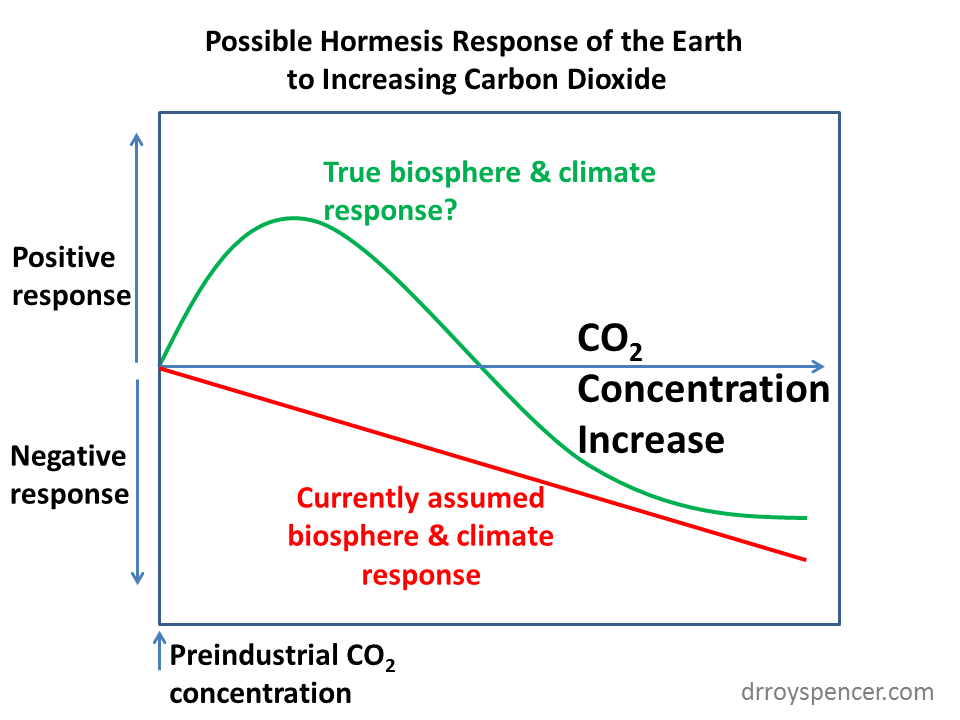
For those who like graphs, the following cartoon shows what I’m suggesting in qualitative functional form for carbon dioxide:

Hormesis-and-CO2

An Earth scientist who has not already sold his soul to the government regulation bureaucracy might legitimately ask, “I wonder if some level of enrichment of atmospheric CO2 is actually a good thing for life on Earth?”, as suggested by the green curve in the above graph.

The straight red line (linear dose response) is, in contrast, what is usually assumed…that any increase beyond that believed to exist before humans arrived is necessarily bad for Mother Earth.

But atmospheric carbon dioxide is necessary for life on Earth, and has risen from a pre-industrial concentration of only 3 parts per 10,000, to (still only) 4 parts per 10,000 today. The result has been global greening and a moderation of global temperatures (at least partly due to more CO2, in my opinion). Theoretically expected negative impacts on severe weather and marine life have, so far, failed to reach any believable level of cause-and-effect, beyond normal natural variability.

(And if you are tempted to cite statistics of a record number of whatever events, I will ask whether humans are also responsible for the recent “grand maximum” record high sunspot activity out of the last 3,000 years? Was that Bieber’s fault, too? Or maybe Manbearpig’s fault?).

I’ve had plant physiologists tell me it’s almost as if nature has been sucking as hard as it can on atmospheric CO2, and has depleted it to the point where only the hardiest life forms can exist. But as we add more CO2 to the atmosphere, nature quickly gobbles up 50% of the extra, leading to a more luxurious and robust biosphere.

So, it is reasonable from an unbiased scientific perspective to examine the possibility that more CO2 is actually good for life on Earth…not just the biosphere, but atmospheric effects as well. After all, we’re not talking about X-rays here…we’re talking about the elixir of life, CO2.

Is there a level beyond which more carbon dioxide would be bad? Probably…but I don’t think we know what that level would be. And, just to be on the safe side, if there was a way to stop producing CO2 without killing millions (if not billions) of people in the process, I might be in favor of that.

But that’s simply not possible with today’s energy technologies. Renewable energy sources cannot contribute to more than 15-20% of total energy demand in the coming decades, so we are stuck with fossil fuels for the time being.

I really don’t care where our energy comes from, as long as it is abundant and affordable for the world’s poor. In the meantime, we need to stop thinking in simple linear dose-response terms which is contrary to so much real world experience and exists mainly to make jobs for regulators and companies that are made rich through subsides rather than through free choice by the public.


Community Opposition to Wind Farms Grows Because Wind Power is a Fraud

lies

As community and political opposition to the great wind power fraud rolls and builds across the world, the charge that opponents are red-necked climate change deniers, infected with a dose of Not In My Backyard syndrome, starts to ring hollow.

Surely that charge can’t stick to each and every one of the 1,000 who signed the petition against the Mt Emerald wind farm proposal in Far North QLD – and the 92% of locals there who are bitterly opposed to it (see our post here)?

The same level of opposition arises at the local level – wherever wind power outfits are seeking to spear turbines into closely settled agricultural communities (see our post here).

Communities across the Southern Tablelands of NSW, locals are up in arms at efforts by wind farm outfits and the NSW Planning Department to sack and stack “community consultation committees” to ensure their development applications don’t face any real scrutiny. At Rye Park, 91% of locals are opposed to the wind farm being pitched by Epuron (see our post here). And communities like Tarago have erupted in anger at plans to destroy their lives and livelihoods (see our post here).

A little while back, the usual response from those opposed to wind farms was along the lines of: “we’re all in favour of renewable energy, so long as wind farms are built in the right place”.

But that was before people understood the phenomenal cost of the subsidies directed at wind power through the mandatory RET (see our post here) – and the impact on retail power prices (see our post here).

Fair minded country people are usually ready to give others the benefit of the doubt; and, not used to being lied to, accepted arguments pitched by wind power outfits about the “merits” of wind power: guff like “this wind farm will power 100,000 homes and save 10 million tonnes of CO2 emissions” (see our post here).

Not anymore.

Apart from the very few farmers that stand to profit by hosting turbines, rural communities have woken up to the fact that wind power – which can only ever be delivered at crazy, random intervals – is meaningless as a power source because it cannot and will never replace on-demand sources, such as hydro, gas and coal. And, as a consequence, that wind power cannot and will never reduce CO2 emissions in the electricity sector. The wind industry has never produced a shred of actual evidence to show it has; and the evidence that has been gathered shows intermittent wind power causing CO2 emissions to increase, not decrease (see this European paper here; this Irish paper here; this English paper here; and this Dutch study here).

The realisation that the wind industry is built on series of unsustainable fictions has local communities angrier than ever and helps explain the remarkable numbers opposed: 90% is what’s fairly called a solid “majority” in anybody’s book.

This extract from the Mt Emerald survey captures some of the changing mood and the reasons for it.

Mt emerald survey2

These days, locals fighting wind power outfits are quick to challenge the wild and unsubstantiated environmental benefits touted by the developers; and will launch into them about the massive subsidies (ie the mandatory RET and the REC Tax) upon which the whole rort depends.

And it’s not because these people are “anti-environment” – it’s simply because they’ve woken up to the fact that wind power is pointless: both as a power source; and as a solution to CO2 emissions reduction. Here’s the Business Report with a take on the same tale from Britain and Europe.

Opposing wind generators is not anti-green
Business Report
Keith Bryer
8 August 2014

The intolerance of dissenting views by the Green Lobby is an unpleasant aspect of some of its members. They are perhaps unaware that tolerance of difference is a pillar of democracy and essential to individual freedom. But, whatever the reasons for vitriolic attacks on those against wind generators, environmentalists should take a closer look at Scottish opposition.

The most prominent in Scotland is the Windfarm Action Group. This group firmly states that everyone should take environmental responsibilities seriously. Whatever the causes of global warming and the varying views on what causes it, we must protect our earth and steward it wisely. It accepts a need to reduce carbon dioxide (CO2) emissions. It wants cleaner, reliable energy. It supports sound scientific solutions with the goal of a cleaner, greener world.

No sane, sensible person can disagree with this. Even the most rabid environmentalist should agree too.

But this green group and 300 others like in Britain, plus another 400 in four EU countries, are against windfarms. They have gone into the subject thoroughly and engineers and scientists back up their conclusions.

To those who accuse them of merely being concerned with their own backyards and not the common good, they say add up our membership and you will find an awful lot of backyards. They are simply against what does not make good sense. They are convinced that wind power:

– Is not a technically legitimate solution.

– Does not meaningfully reduce CO2 emissions.

– Is not a commercially viable source of energy

– Is not environmentally responsible.

They believe there are better solutions to Britain’s energy concerns; solutions that meet scientific, economic, and environmental tests – and they have good reasons.

They point to the massive subsidies that windfarms received initially from the British taxpayer, money that attracts multinational corporations like flies to treacle. These subsidies added to the higher price ordinary British householders pay for their electricity.

This “stealth” tax was considerable. Most consumers were unaware that it was used to make wind-generated economically feasible on the one hand, and to fill the pockets of the manufacturers on the other.

This largess allowed wind-generation companies to make generous payments to landowners for permission to use their land. Such was the temptation that some Welsh farmers trying to raise sheep in arduous and scarcely profitable areas leapt at it.

One told his local newspaper that if it were not for the payments he got, he would have given up farming long ago.

The Wind farm Action Group quotes British government documents that say each wind turbine in Britain still receives an annual subsidy of more than £235,000 (R4.3 million). Britain has about 1,120 turbines in 90 parts of the country.

Among the usual objections to windfarms – they do not work all the time, they are noisy, kill birds and bats, and so on, the group adds a few more. For example, wind generators interfere with radar; dirt and flying insects affect their performance; ice build-up on the propellers affects performance even more; and wind turbulence further reduces their power production.

Finally, there is rust. Britain is a wet place but offshore wind turbines have salt to contend with as well. One Danish offshore wind farm had to be entirely dismantled for repair when it was only 18 months old.

Yes, groups such as these exist almost everywhere there are windfarms. They are often, like this Scottish one, as caring of the environment as anyone, perhaps more so. They are not only concerned with their own backyard; they are concerned about everyone’s backyard.

Yet they say this: “We believe that in time this [windfarms] may well be the greatest environmental disaster that mankind in panic, haste, folly and greed, has ever conceived.”

Britain is an old country and its language is full of folk wisdom like this: “No one ever built a windmill, if he could build a watermill.”

A more modern version of common sense would be: “Using wind power to reduce carbon dioxide emissions is akin to trying to empty the Atlantic Ocean with a teaspoon.”
BusinessReport

The mythical claims of the wind industry and its parasites have all be hinged on a perverse notion of “green” is good. But just what being “green” means these days is a matter of politics, not reason, fact or beneficial environmental outcomes: it’s become little more than a political fashion statement.

Ben Acheson writes for the Huffington Post. He’s also the Energy and Environment Policy Adviser and Parliamentary Assistant to Struan Stevenson MEP at the European Parliament in Brussels. For a taste of Ben’s views on wind power – see our post here.

Here’s Ben taking a swipe at faux “green” politics:


Wynne’s Liberals Out to Bankrupt Ontario, for No Benefit At All!~

Achtung, Ontario! Renewables are a money pit


Brady Yauch, Special to Financial Post | August 12, 2014 

Germany’s decision to support renewable energy at all costs has, ultimately, cost the country’s ratepayers billions of dollars and led to a doubling of monthly electricity bills over the past decade. So, why is Ontario following Germany's lead?

FotoliaGermany’s decision to support renewable energy at all costs has, ultimately, cost the country’s ratepayers billions of dollars and led to a doubling of monthly electricity bills over the past decade. So, why is Ontario following Germany?

Germany, the model for Ontario’s wind and solar developments, now regrets its spending spree

Germany – the country on which Ontario modelled its approach to renewable energy development – has a $412-billion lesson for Ontario. That’s the amount the country has spent on subsidies in support of solar and wind energy, among other renewables, over the past 20 years, all in the push to wean the country off fossil fuel and nuclear generation.

On the surface – and according to many news sites – the program has been a success, and not just because of the 378,000 people renewables now employ.

By the end of 2012 (the most recent year for data), wind and solar provided about 13% of all German electricity consumption. Adding in hydro and biomass, renewables provided more than 23%. And in May, headline writers around the world proudly trumpeted that renewable energy provided 75% of the country’s total electricity consumption.

But scratch a bit below the surface and an entirely different picture emerges – one with households being pushed into “energy poverty” as renewable subsidies lead to soaring power bills, handouts to the country’s big businesses and exporters so they can avoid paying for those subsidies and a systematic bankrupting of traditional utilities. As for that one day in May when headlines celebrated that 75% of power generation came from renewables, well, it was a Sunday when demand for power is at its lowest level.

Germany’s decision to support renewable energy at all costs has, ultimately, cost the country’s ratepayers billions of dollars and led to a doubling of monthly electricity bills over the past decade. Households now pay the second highest rates for electricity in the EU – second only to Denmark, the world leader in wind turbines. The country’s feed-in tariff program – which offers renewable energy producers a guaranteed rate for their power – has already cost $412-billion, but could, according to one estimate from the former Minister of the Environment Peter, produce an $884-billion price tag by 2022. Germany will hand out $31.1-billion of renewable energy subsidies in this year alone.

The price of electricity paid by German households has increased from 14 cents (euro) per kilowatt hour in 2000 to 29 cents per kilowatt hour last year – marking a 107% increase, while inflation over that time period was about 22%. The biggest reason for that increase is the renewable energy subsidy, which amounted to 1.4% of the total bill when it was first introduced in 2000, but now accounts for 18%. That renewable levy now costs the average household in Germany more than $320 a year.

Rising electricity prices for households ledDer Spiegel, one of the country’s most respected magazines, to warn that electricity was becoming a “luxury good.” More than 300,000 households each year are being left in the dark because they can’t afford electricity.

German households are being hit particularly hard by the cost of renewable subsidies because the country’s largest businesses – many of them exporters and in energy-intensive sectors – have been exempt from paying for them. Regulators and politicians – fearing that that high electricity prices would hurt the economy and result in job losses or plant closures – gave big business a free pass and instead shifted the costs to households.

The renewable subsidies have distorted Germany’s power market to such an extent that traditional utilities are being pushed to the brink of collapse. Electricity generated from solar and wind has no relationship with the market. Because the price the producers receive is guaranteed and is not based on demand, they dump their output whenever it is produced. This glut of power has, at times, pushed the price of wholesale power below zero – meaning the utilities need to pay someone to use it. This has skewed the price to such an extent that traditional generators can’t economically produce power – they simply stop producing when the price goes too low.

While the answer would seem to be to close those uneconomic generators, that’s not possible since renewable energy is intermittent – at times it will produce no power, while at others it will produce too much – and traditional generators are needed to provide a secure, reliable source of power. Utilities are being asked to keep producing power even though the economics of it don’t make sense anymore. To prevent utilities in Germany from pulling out of the business of generation, the government now offers more than billion dollars in “balancing payments” – sometimes 400 times the price of power – to stabilize the grid.

The rise of renewable power has also led to coal making a comeback. The amount of generation from coal actually increased from 43% of all output in 2011 to nearly 45% in 2012. Electricity generation from lignite, a cheaper and dirtier form of coal, has also been on the rise because, according to one Germany utility, it’s the only thing that can compete with subsidized renewable energy.

The energy situation in Germany has become so disruptive and politically untenable that the government has recently done everything it can to pull back on subsidies and other support for renewable energy, much to the dismay of renewable producers that still can’t survive on their own.

Far from being a success, Germany’s rush into renewable energy has crushed households, taxpayers and utilities. Ontario needs a better model.

Brady Yauch is an economist and the executive director of Consumer Policy Institute.

Fracking is by Far….Better than Wind Turbines!

Fracking – Fact or Fantasy

by Dougal Quixote

The green movement doesn’t like Fracking but they do like Wind. Why? Fact is wind is intermittent, drives people into fuel poverty and has to be supported by subsidy. Fracking on the other hand has reduced energy prices in the US, created thousands of jobs as energy prices tumble to the benefit of US industry and needs no subsidy. So why has the Green Lobby reacted so viciously to fracking. Their web sites are a liturgy of lies and obfuscations.

fracking objectors

They are the great unwashed, the swampies and the anti capitalist objectors and yet they are also rent a mob. Never has a Wind Farm objection rally needed the police manpower that fracking does. Truth is that it is simply political activism, what Patterson referred to as the Green Blob. How seldom do we see locals in their ranks. Those that are have believed the hype and failed to properly study the fact. Flaming faucets: cold bed methane in groundwater that would be there without any mining. Nothing to do with fracking at 8000ft well below groundwater. There are dangers, but none that cannot be adequately addressed by good management and oversight by an effective regulator. After all it is not in the developers interest to be faced with expensive clear up costs and loss of production.

So what about the real legacy of fracking. In the south we haver been drilling the Whytch oil field for years and few even know it exists. Fracking, as a technique, has been used for the best party of forty years but new equipment and deep wells have brought it into it’s own more recently. Centrica have been fracking wells for gas in Norway for the last few years. Interestingly they are using mostly Scottish engineers. Good well paid jobs for the indigenous population.

So what effect does fracking have. Essentially a fracking site will experience disturbance for about forty weeks after which it will revert to a simple well head.

Fracking well head


This is in Marcellus, New York State, and cannot be seen from the road. The alternative is something like this at Ardrossan.

Ardrossan

Ardrossan

Of course the first runs 24/7/365 for some forty years and the second runs as about 21% when the wind blows and has a life of about 16 years before it needs re-powering. We have all been promised a maximum of 25 years but do we believe them? No way. Read the small print. In practice what will happen is either the death of the industry with wholesale bankruptcies and rusting hulks littering our scenery or bigger monstrosities here for forty years or more.

For a safe, sustainable, future the truth is we need deliverable energy at a cost we can afford with a mix of clean coal, gas, nuclear and hydro. It is without doubt that as civilisation moves forward we will have an expanding demand for electricity, not because it is green, but because it is easy. Cars, buses, trains will all demand much higher energy requirements than we could currently(sic) supply. So listen to the Royal Geological Scociety, the Nuclear Industry and the engineers in the power industry. Don’t listen to the Swampys and green ideologues as they peddle dis-information. Get your facts from people who know, not the Green lobby with their eschewed values which even their founders now despair of.

We need to build a future based on fact, not fantasy!

Ineffective, Unreliable, Unaffordable, Wind Turbines!

LETTER: Wind turbines are a waste of time and money

The coalition has sanctioned the construction of Rampion, despite the overwhelming evidence that wind turbines are unreliable, grossly inefficient, inflict huge damage on the environment and wildlife, do not reduce greenhouse emissions one iota, and are, by a large margin, the most expensive means of generating electricity.

Thus, one could be forgiven for thinking the two headlines are linked.

Consider, as revealed by the company awarded the contract for the construction of the off-shore wind farm that, although the designed output is 700 megawatts (MW) because of the unreliability of wind turbines, the actual output will be no more than 240MW. Compare this with the output of a gas-fired generator, costing less than half the over £2bn for Rampion, which produces ten times as much electricity 100 per cent of the time.

Some years ago, Centricia, and other electricity-producing companies, made it absolutely clear to the government that, because of the unreliability of the wind, full back-up of conventional power stations is essential.

Therefore, greenhouse gas-emitting generating plants will have to remain permanently in service – thus, there is no point in building wind turbines.

Denmark, which has the greatest number of wind turbines per capita, has the most expensive power in Europe. I have yet to meet

a qualified electrical engineer who thinks the construction of wind turbines to power the national grid is a good idea.

Rampion will cover 60 square miles from Beachy Head to the Isle of Wight. The unreliability, comparatively short life, and huge cost of maintaining the turbines, means that it is only a question of time before Rampion is seen as one of the biggest scrap metal sites in the world.

France, where 80 per cent of electricity is produced by nuclear power, has the cheapest electricity in Europe. To satisfy the Green lobby, nuclear power stations in the UK should employ thorium as the fuel which is much safer than uranium. Nuclear bombs cannot be produced using thorium.

I do hope everyone reading this will write to their MP, county and district councillors, demanding the construction of all wind turbines, both on and off-shore, be halted immediately.

Ideally, those wind turbines already constructed should be dismantled.

Derek Hunnikin

St Leodegar’s Way

Hunston

Frauds, Crooks and Criminals

Demonstrating daily that diversity is not strength!

Family Hype

All Things Related To The Family

DeFrock

defrock.org's principal concern is the environmental and human damage of industrial wind turbines on rural communities

Gerold's Blog

The truth shall set you free but first it will make you miserable

Politisite

Breaking Political News, Election Results, Commentary and Analysis

Canadian Common Sense

Canadian Common Sense - A Unique Perspective from Grassroots Canadians

Falmouth's Firetower Wind

a wind energy debacle

The Law is my Oyster

The Law and its Place in Society

Illinois Leaks

Edgar County Watchdogs

stubbornlyme.

My thoughts...my life...my own way.

Oppose! Swanton Wind

Proposed Wind Project on Rocky Ridge

Climate Audit

by Steve McIntyre

4TimesAYear's Blog

Trying to stop climate change is like trying to stop the seasons from changing. We don't control the climate; IT controls US.

Wolsten

Wandering Words

Patti Kellar

WIND WARRIOR

John Coleman's Blog

Global Warming/Climate Change is not a problem