Wind & Solar….Not More than “Novelty Energy”!

Wind & Solar Power can NEVER Replace Conventional Power Generation

turbine collapse michigan3

****

The death of the wind industry didn’t come about because BIG Coal felt ‘threatened‘ and set out in some kind of John Grisham conspiracy to wreck it by fair means or foul. No. What kills it is the fact that a growing band of ‘eco-travellers’ – of the kind who once placed their faith in the Wind Gods – have woken up to the scale and scope of the great wind power fraud.

For the climate change Chicken Littles, their quest to rid the planet of dreaded CO2 gas (query how plants and every other living thing survive without it?) has seen the more sensible of their number turn their backs on the wind; and to nuzzle up to nukes, instead.

Dr. Alan Carlin has, despite his background with America’s top environmental lobby, the Sierra Club, not only reached the obvious conclusion (viz, that wind power will never replace conventional generation sources), but has repeatedly determined to put pen to paper, to make sure his peers know all about it.

Alan received an undergraduate degree in physics from the California Institute of Technology in Pasadena. He then entered the PhD program in economics at MIT, with two summers spent at the RAND Corporation in Santa Monica, CA. His MIT major was in economic development; his thesis research was carried out in India under a Ford Foundation Foreign Area Fellowship. He then took a position as an economist at RAND, where he pursued primarily economic development and transportation economics.

In the mid-1960s he became active in the environmental movement as a result of his outdoor interests, and co-authored economic analyses of proposed dams proposed for the Grand Canyon in Arizona. The dams were turned down by the Federal Government in 1968 after a nationwide campaign by the Sierra Club and other environmental groups. In 1970 he was elected Chairman of the Angeles Chapter of the Sierra Club, then the Club’s second largest Chapter.

Soon after Richard Nixon created the US Environmental Protection Agency in late 1970, he followed his increasing environmental interest by taking a position as a manager in their new Office of Research and Development in Washington, DC, for multidisciplinary research on implementation of environmental pollution control. In the late 1970s he worked for about 7 years primarily as a physical scientist managing the development of criteria documents assessing pollutants for possible regulation by EPA. After Reagan institutionalized the economic analysis of Federal regulations in 1981, he transferred to the EPA Policy Office, where he was a senior analyst and economic research manager.

In the mid-2000s he realized that climate would become the major environmental issue of the decade, and undertook a voyage of personal discovery to understand the issue, including both its economic and scientific aspects. With the advent of the strongly environmentalist Obama Administration in 2009 he found himself at odds with EPA’s misguided attempts to reduce emissions of carbon dioxide, which led to considerable media attention and his retirement in early 2010.

He has authored or co-authored over 35 professional publications in his career to date, mostly in economics and energy/climate. Seventeen of these have been published in journals and 8 as part of books.

Now, here’s Alan’s message to the dwindling band of wind-cultists.

The Total Unreality of Substituting Wind and Solar for Fossil Fuel Electricity
Carlin Economics and Science
Alan Carlin
26 February 2016

One of the crucial unrealistic assumptions of the climate alarmist narrative is the belief that non-hydro renewable sources of energy can be easily substituted for fossil fuels for the generation of electricity.

Proponents pretend that this substitution is simple and mainly involves political will for governments to impose the changes, and occasionally that subsidies must also be provided to encourage it. But the technical problems are actually very daunting for extensive substitution as well as expensive.

As substitution increases, the technical problems become increasingly difficult and with attempted full substitution they become impossible except under special circumstances. This has not prevented advocates from pursuing their campaigns against the use of fossil fuel, nuclear, and hydro power at all levels of American government.

Electric Grids Must Balance Supply and Demand

Electricity grids collapse if supply does not exactly balance demand at all times. Using intermittent and largely unpredictable sources of supply such as wind and solar to meet demand is very difficult, particularly at a modest cost that users can afford.

Grid collapse can be monumentally expensive, as can arbitrary reductions in demand known as load shedding which force users to halt all electricity use, usually on an arbitrary rolling basis between various regional areas. Traffic lights, hospitals, and manufacturing cannot do their jobs without reliable, continuous electric power.

Solar and Wind Cannot Provide Power During Some Periods

There are periods when both solar and wind provide little or no useful electric power because the wind is not blowing and the sun is not shining. These periods can and have lasted for as much as a week in Germany.

Without other sources of supply the grid will collapse during these periods unless demand is arbitrarily reduced–even if the periods are only for a few minutes. Rapid response fossil fuel or hydro backup is required in order to meet demand during these periods.

Many regions have little hydroelectric capacity and the abundant water required to make it productive. In the US only the Pacific Northwest has abundant hydroelectric resources.

Attempts to build enough wind/solar capacity to meet demand during these periods is not practicable and would be extremely expensive if it were practical. During these periods of little sunlight and low wind, solar and wind will produce little power no matter how large or how numerous these facilities may be.

Meeting demand during such periods without huge load shedding would require building huge wind/solar capacity which would almost never be used in order to slightly reduce the chances of grid collapse. And even then full assurance would never actually be achieved because of the high probability that there will be periods when there will be very little or no wind and solar generation.

Alternatives Require Rapid Response Fossil Fuel or Abundant Hydro Capabilities

The alternative is to build and maintain enough fossil fuel capacity which must be in “spinning reserve” in order to respond instantly to fluctuations in demand and wind/solar supplies.

This effectively doubles the cost of supplying electricity since two generating and even transmission fleets must be built and maintained rather than only one–fossil fuel and nuclear generation–except where abundant hydro capacity is available.

In areas where abundant hydro capacity and water to power it are not available, the only way to solve this problem is to build very extensive pumped storage facilities to generate “artificial” hydro power. This is very expensive since power must be used to pump water uphill during off peak periods and the construction of artificial lakes that is often required at two different elevations is quite expensive and is usually opposed by environmental groups.

Adding unreliable, unpredictable electricity sources such as wind and solar will inevitably decrease system reliability–which means increased risks of system collapse with its monumental costs even if every practical safeguard is used.

These problems are not just theoretical. Germany and Great Britain have experienced them in recent years as their percentage of wind/solar has increased, and they have responded by increasing their investment in fossil fueled plants, just the opposite of what they have tried to do.

Like Germany and Great Britain, Denmark also has increasing electricity costs but has solved the wind/solar substitution problem by entering into very high cost arrangements with their Nordic neighbors to supply hydro power when needed.

Despite all these very real problems, the Climate-Industrial Complex (as explained in my book Environmentalism Gone Mad) continues to promote wind and solar, sometimes with the active support of some prominent politicians.
Carlin Economics and Science

Alan Carlin

Poor Planning, on the Part of Britain’s Energy “Experts”…

Britain’s Wind Power ‘Leap of Faith’

leap of faith

The dimwits from DECCs, that coupled Britain’s energy future to wind power, are calling on Britons to trust them in an almighty ‘Leap of Faith’.

With aging, beyond their use by date, coal-fired power plants being closed this year, British power punters are being promised, by the very idiots that created the mess, that everything will be alright; that the wind will blow on cue; and that candles need only be kept for moments of pure romance.

For ‘believers’ it’s all a matter of digging deeper and matching their ‘faith’ with fat piles of cash: in other circumstances it might be called ‘tithe’, but for those in touch with reality and their wallets, it’s state-sponsored theft.

UK energy supply forecasts ‘into the red’ for first time next winter
The Telegraph
Emily Gosden
26 February 2016

Britain will be forced to rely on imports and costly emergency measures to prevent blackouts, official data suggests.

Britain’s energy supply forecasts have plunged “into the red” next winter for the first time on record, suggesting the country will be forced to rely on imports and costly emergency interventions to prevent blackouts.

Figures from National Grid show that on current plans there will not be enough power plants operating in the UK market to keep the lights on for most of December, January and February.

A separate, “last resort” reserve of back-up power plants is highly likely to be called upon to bolster supplies through much of the winter, adding tens of millions of pounds to consumer energy bills, experts have warned.

National Grid data displaying the surplus - or shortfall - in the UK energy market in megawatts for each week of the year, as of 26/02/2016.

National Grid confirmed that next winter is the first time since the published data system began in 2001 that it has not forecast a surplus margin of spare power plants in the UK market, and has instead forecast “negative margins”.

In mid-December and early January the figures show a shortfall of more than two gigawatts (GW) – roughly equivalent to the electricity needs of two million homes.

For those still inclined to ‘believe’ – no time like the present to stock up on candles, and not the holy sort.

Scourge of the WindWeasels, in Australia

How a Band of Criminals, Shysters & Chancers Conjured Up the Wind Industry in Australia

dirtyrottenscoundrelsoriginal

****

Now and again you just get lucky. STT makes no bones about its mission: to destroy the wind industry. So it was with more than just a little delight, that we received a bundle of highly incriminating documents from one of our top-level operatives.

At the risk of sounding a little like the showboats behind WikiLeaks, this stuff is ‘dynamite’.

What we set out below is a few pages from the first tranche of documents sent to us (that entire 47 page bundle is available here as a PDF). And what was sent to us is just the tip of a very stinky iceberg: our operative has secured thousands of pages of documents linking (and showing the dealings between) wind industry lobbyists, MPs and their staffers.

Before we kick off though, it’s both helpful and necessary to identify a few of the characters involved.

First, there’s the convicted criminal, Timothy J Flato.

Back in the 1990s, Tim was a practising attorney and partner at Latham & Watkins. Later on, a number of its partners had a few “billing difficulties”; and were disbarred and/or sent to prison as a result.

But they weren’t the first from the firm to earn a little ‘form’.

Tim, then head of the firm’s project finance practice, admitted to falsifying hundreds of thousands of dollars’ worth of expense reports over a three-year period. Tim’s little billing ‘difficulty’ involved him purchasing airplane tickets, cancelling them, and then submitting the receipts to clients for payment, augmenting his salary by over $100,000 per year. Tim’s accounting fudge amounted to somewhere between $300-400,000; saw him disbarred; and slapped with 6 months home detention for his efforts.

Flato

Having polished up his CV perfectly for the wind industry, Tim Flatohelped set up National Power Company in the US; then headed Downunder and set up another with the mantle ‘National Power Australasia Inc’.

Then there are the shysters and chancers.

Babcock & Brown was absolutely full of them; people like Warren Murphy, Miles George and Adrian Rizza.

These days, Miles & Co head up Infigen, Australia’s most notorious wind power outfit – formerly know as Babcock and Brown – an outfit that was born the bastard child of Enron.

Check out the CVs of the characters in these links here and here and here– a fair number of them brag of ‘solid’ backgrounds with Enron, later lobbed at Babcock and Brown and – when it went into melt-down – scurried off like indestructible cockroaches to hide elsewhere in the wind industry. No surprises there.

During Infigen’s first incarnation as Babcock and Brown, Miles & Co helped to fleece  investors and creditors of something like $10 billion (while its directors pocketed – and somehow managed to retain – 10s of $millions at creditors’ and investors’ expense).

Having spectacularly crashed and burned, Babcock and Brown then shamelessly phoenixed into Infigen – which is about to do it all over again: its losses continue to pile up, it continues to bleed cash and, unable to cut any deals with commercial power retailers or to obtain the finance needed to build any of its threatened projects, it has no hope of surviving its growing mountain of debt (see our post here).

But shysters and chancers like Warren, Miles and Adrian rarely get far without greasing-up helpful political enablers.

In what follows, keep a lookout for the names Patrick Gibbons and Ken McAlpine. Back then, Patrick and Ken were offering up political favours on behalf of Victoria’s Labor Minister for Energy Industries & Resources, Theo Theophanous.

These days, Patrick Gibbons spends every waking hour protecting his mates in the wind industry from inside the Federal Minister for the Environment, Greg Hunt’s office; while his best mate, Ken McAlpine heads up struggling Danish turbine manufacturer, Vesta’s Australian operations (that’s when he’s not spreading malicious falsehoods about Dr Sarah Laurie, or acting like a total prat in front of Federal Senate Committees).

Anyway, that’s probably enough background on the villains.

Let’s take a look at how they cooked up the greatest economic and environmental fraud in history, by first targeting South Australia’s dimwitted Labor government. Oh, and if the images below aren’t so clear, click on them, they’ll pop up in a new window, clear as crystal.

BB1

BB2

BB3

BB4and5

Hmmm…

Now, at the risk of sounding overly critical, what appears above suggests high level ‘imagination’. The protagonists clearly seem to be making it up as they go along.

The ‘XX’s that pepper the document have that second-hand car salesmen’s “pick whatever figure suits you” kind of feel about them. Scratching out the figure of $800 million and replacing it with $1 billion, was clearly aimed at hooking the more gullible fish in the political pond.

However, South Australians (who, as a result of this Memorandum of Understanding and what followed now pay the highest power prices in the Nation – if not the world, on a purchasing power parity basis –  and suffer daily power interruptions and even Statewide wind power blackouts) can only wonder what happened to the promised Vesta’s “blade manufacturing facility”, and the hundreds of ‘groovy-green’ jobs supposed to have been attached to it?

Although we note that the ‘promise’ to establish a blade factory was no “no strings attached” offer; being conditioned on South Australian taxpayers providing “some assistance in establishment costs” with the figure nominated of “XX to cover establishment and other initial non-construction costs associated with” it.

Why beat around the bush with solid XXs? Why not just demand taxpayers hand over an open cheque-book?

Then there’s the fiction about “high winds speeds” at Babcock & Brown’s target site, Lake Bonney.

At Lake Bonney (situated near Millicent in SA’s South-East) winds might occasionally reach ‘high-speeds’. However, the breezes at Lake Bonney are as fickle as anywhere. Infigen’s Lake Bonney operations have a pitiful capacity factor of around 23-25%: Lake Bonney 3 struggles to hit a capacity factor of 23%; and its neighbours produce meaningful power a risible 25% of the time – on AVERAGE.

While Lake Bonney’s performance stats hardly set the world on fire, its Danish-built deadlys have been known to set the ‘country on fire’:

wind turbine fire Lake_Bonney_windfarm

****

Then there’s the furphy about “community support” for wind farms. In fairness, in mid-2002 there weren’t too many South Australians aware of what trying to live with incessant turbine generated low-frequency noise and infrasound is like. That soon changed, once Lake Bonney was up and running.

Far from enjoying community support, Babcock & Brown and later Infigen have spent years trying to deny, ridicule and dismiss constant complaints about turbine noise made by two of its very own contracted turbine hosts, David and Alida Mortimer.

David and Alida (farmers and turbine hosts for Infigen at Lake Bonney) have spent the last few years taking every opportunity to tell the story of their self-inflicted acoustic misery – and to warn rural communities around the globe about the very real impacts on sleep and health caused by incessant turbine generated low-frequency noise and infrasound (see our posts here and here and here).

While the Memorandum of Understanding is littered with waffle and deliberate uncertainty, there can be no uncertainty that the whole rort was premised upon massive taxpayer funded subsidies – as clear as crystal with the statement that: financial assistance by the South Australian government (read ‘taxpayer’) is required in order to facilitate the development of the wind farm proposed by BBWP” (ie Babcock & Brown).

As it always was and continues to be:

The Wind Industry: Always and Everywhere the Result of Massive & Endless Subsidies (Part 1)

The Wind Industry: Always and Everywhere the Result of Massive & Endless Subsidies (Part 2)

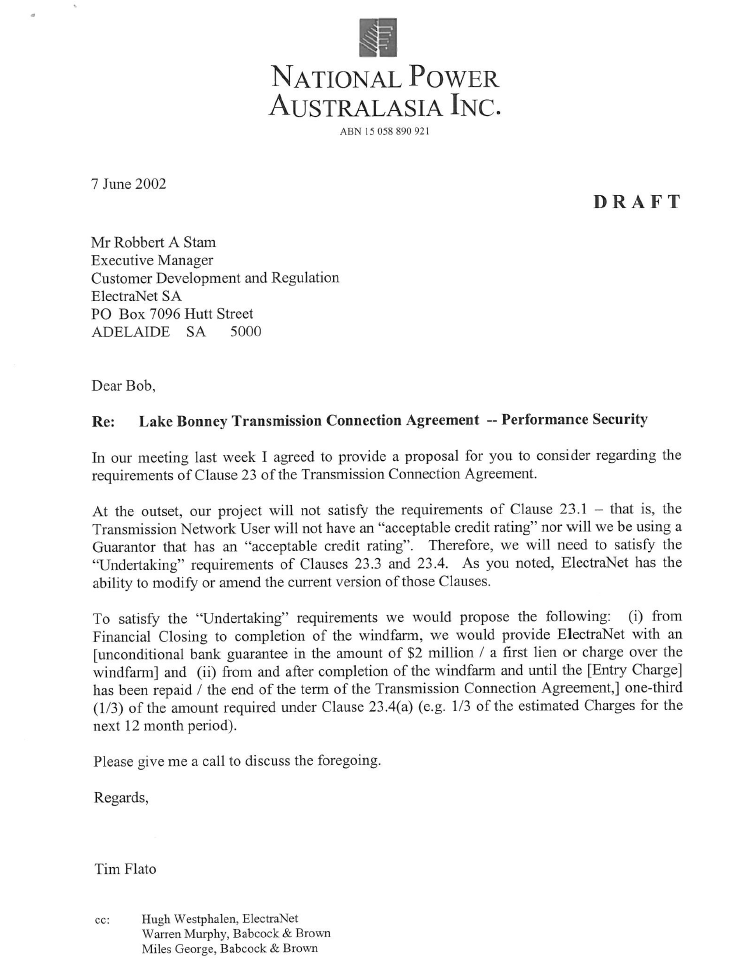
The next item is an effort by Tim Flato to brush aside Babcock & Brown’s perilous financial situation in this letter to the grid operator, ElectraNet SA:

BB6

Audacious and arrogant, the boys at Babcock & Brown were, quite apparently, aware that they would never be able to present financials capable of  earning an “acceptable credit rating”. Probably the only honest statement that ever came out of Babcock & Brown.

When your ‘business’ requires fleecing taxpayers for $billions, there’s the critical need for political endorsement, that has to be ‘engineered’ with a winning mixture of pressure and ‘grease’.

In the next email, note the who’s who cast – including the boys from Babcock & Brown, Pacific Hydro, Patrick Gibbons and Ken McAlpine – all clearly chuffed with their victory in obtaining just such an endorsement in the Communiqué from State Ministers for Energy, that follows.

BB7email

BB8and9

With hindsight, for South Australians, at least, that Communiqué now reads like an economic suicide pact.

The next email exchange shows these boys at their manipulative best, as they set out to scuttle the bid by Forestry Tasmania (referred to as ‘FT’ in the emails) to have the use of forest wood-waste to generate power included in the RET.

BB10and11 email

Note that the reference to ‘Hill’ is a reference to then Federal Minister for the Environment and Heritage, Robert Hill.

While Forestry Tasmania’s bid to include wood waste in the RET had apparent appeal with the Coalition government, Babcock & Brown and the gang were clearly having none of it.

In a piece of ‘astro-turfing’ extraordinaire, the boys from Babcock & Brown set out to have the Greens do their dirty work, correctly anticipating that once they were pointed to the “relevant statutory clauses” they would “go off from there”. And “go off” the Greens most certainly did, mounting a full-scale campaign against inclusion of wood waste in the RET that continues to this day.

The next set of papers are extracts from a powerpoint presentation that details the manner in which Tim Flato’s National Power and Babcock & Brown sought to gloss over its shaky financial footing, while pushing a self-serving strategy built on ever increasing wind power targets and subsidies.

BB12

BB13

BB14

Again, pretty vague on the details, but the critical requirement for massive and endless subsidies in Babcock & Brown’s favour couldn’t be clearer.

If you have ever wondered how the greatest economic and environmental fraud of all time got started in Australia? Well, now you know.

enron guilty

Novelty Energy, Like Wind & Solar, will NOT Keep the Lights ON!

India’s Quest for ‘24/7 Reliable Power’ Means Munching More Coal, Not Praying for the Wind to Blow

poverty india

****

Among the selfish conceits peddled by the wind industry, its parasites and spruikers is the notion that a wholly weather dependent power source – which is 4 times the cost of coal-fired power and which will always require 100% of its capacity to be backed up, 100% of the time by conventional generation sources – represents the ‘salvation’ of nations like India, where some 250 million people have no power at all; and, accordingly, live in Stone Age poverty, cooking on twigs and dung and otherwise living a life of misery.

The pontificators that assembled in Paris, and sought to impose what Indians quite rightly regard as “fake electricity”, couldn’t care less about the world’s huddled masses and are, instead, happy to destine them to a world of eternal darkness and poverty. However, thankfully, India’s Power Minister, Piyush Goyal has other ideas.

India’s challenge is 24/7 electricity for all
The Australian
Greg Sheridan
13 February 2016

Piyush Goyal is a name you haven’t heard. But this week he has made one of the most important interventions of any foreign politician in an Australian political debate.

He is India’s Minister for Power, Coal and Renewable Energy. He is a big success politically and in line for more promotion.

I’ll give you his direct quotes in a moment. But let’s cut to the chase. Here are the important things he said in a lengthy interview with The Australian.

India will increase coal imports from Australia. Quite independently from that, if the Adani mine in Queensland goes ahead it is an integrated project and will be its own main customer, so India’s efforts to increase its coal production would not reduce the viability of the Adani project.

India is passionately committed to caring for the environment but also to economic development. That means a huge increase in coal-fired power stations as well as coal’s role in making steel.

The Indian government wants 24/7 reliable energy for all its people. Some 300 million Indians will move from rural to urban living in the next couple of decades. They will be on proper power grids. India’s baseload power will be provided by coal.

India will expand its renewable energy sector but, as the minister says, renewables have never provided baseload power for anyone.

India also will expand nuclear power and keep its gas power stations at roughly their current level.

The massive urbanisation in India means a surging demand for steel. Goyal says coking coal exports from Australia will increase particularly strongly. (Thermal coal goes to power stations, coking coal makes steel). Already nearly a third of India’s coal imports are coking coal.

Goyal’s remarks could not be more clear. Every Greens spokesman and climate-change jihadist who argues on the ABC that India is turning away from coal is inverting reality. Far from coal being a “dying industry”, as Geoff Cousins argued in a ludicrous article, the International Energy Agency forecasts Indian coal imports more than doubling by 2040.

Goyal does want to crank up India’s domestic production of coal but its coastal power stations are geared to take imported coal and that will continue, he tells me.

Now, dear reader, if you ever again hear anyone on the ABC claim that India is moving away from coal, or that Australian coal is not essential to get hundreds of millions of Indians out of poverty, you will know they are talking pure moonshine.

No one more consistently misrepresents what is happening all over Asia than the green lobby. The general ignorance of Asia among journalists allows these claims to be aired uncritically, especially on the ABC.

So let’s take up the Indian story in Goyal’s own words: “The first challenge of our government is to make sure that all Indians get 24/7 reliable power. We will expand the total energy output significantly.

“We are a very environmentally friendly country. We have been for generations. India is one country that has respected and even worshipped nature. So we will give renewed thrust to our renewable energy program. We are scaling it up massively, from 34 giga­watts to 175GW over the next six years. This is the world’s largest renewable energy rollout in the history of mankind.”

It is statements like this that green propagandists sometimes misuse to pretend renewable will replace coal in India. Nothing could be less true.

Gas power, Goyal says, will remain roughly where it is. But: “We will be expanding our coal-based thermal power. That is our baseload power. All renewables are intermittent. Renewables have not provided baseload power for anyone in the world.

“After all, solar works when the sun is shining, wind works when the wind is blowing, hydro works when there is water in the rivers. You must have coal.” Goyal says India will expand its nuclear power but this is a slow process and although nuclear will increase in absolute terms and as a percentage of India’s power overall, he continually comes back to the expansion of coal and its irreducible part in development.

“India does have certain development imperatives which we expect the world to accept. All ourINVESTMENT in coal is either supercritical power stations or ultra-super critical.” These produce about half the greenhouse emissions per unit of power as do older coal-fired power stations.

He refuses to accept lecturing from the West on India’s environmental responsibilities: “The people of India want a certain way of life. They want jobs for their children, schools and colleges, hospitals with uninterrupted power. This needs a very large amount of baseload power and this can only come from coal.

“I do wish people would reflect on the justice of the situation. Europe and America and Australia have messed up the world and the planet, and they’re saying to us, we’re sorry but you Indians can only have power for eight hours a day. The rest of the time you must live in darkness.

“We are fortunate that countries like Australia and Canada enter into serious agreements and we can rely on an uninterrupted flow of fuel.”

India is the fastest growing substantial economy, with a growth rate above 7 per cent in an anaemic global economy. This growth will be central to global economics. Goyal believes India will hit double-digit growth next year or the year after and stay there for a decade. If he is right, the development, and the economic opportunity this offers for Australia, is enormous, beyond anything that has yet entered the Australian imagination.

He says: “In the next couple of decades, imagine 300 million people moving from rural to urban centres. As we improve productivity in agriculture, the population will shift to manufacturing and services. Energy consumption will go up in agriculture itself with greater use of technology. There will be increased energy use in infrastructure. The government wants decent homes for every Indian by 2022; that means millions of homes will be built.” He points out that India’s per capita energy consumption is still below that of the US in the middle of the 19th century and says it will increase for decades.

India will not commit to a year when its greenhouse emissions will peak. This is “immaterial”, he says. On China’s commitment to such a year, his polite scepticism is robust: “We’ve all seen the reliability of that data. It’s up to you to judge what is optical and what is real.”

He is pro-Australian and wants the warmest relationship, but is utterly unimpressed with lectures from Australians about global warming: “Australia’s power consumption is coming down now anyway. Its economy is not growing, manufacturing is moving overseas, your economy is moving to services. You have jobs for everyone and a society satiated with energy. It’s easy for you to nominate a peak year. We have 250 million Indians without energy now. We have years and decades of growth ahead.”

Every word he says is true. It would be good if Australians listened.
The Australian

piyush goyal

Wind Turbine Scam Destroys Power Supplies in Britain!

UK’s Wind Power Gamble Ends in Power Supply Bankruptcy

roulette-table-2

Until David Cameron’s Conservatives took full control of the UK Parliament, Britain had lumped every last chip on wind power: apparently hoping that a wholly weather dependent power source, that requires 100% of its capacity to beBACKED UP 100% of the time by conventional (dispatchable) power sources, would come up trumps and lead to oodles of secure, reliable and affordable electricity.

After more than just a fewSPINS of the energy wheel, it seems that Britain is blessed with the punter’s curse: a dwindling bag of cash and no hope of better ‘luck’ anywhere in sight.

Government energy policy will hike bills and lead to power supply gap
The Northern Echo
Sandy Richardson
26 January 2016

DAVID Cameron’s decision to close coal-fired electricity stations and scale back nuclearINVESTMENT will lead to massive power shortages and hike energy bills over the next decade, industry leaders have warned.

Growing electricity demand will leave the UK facing a 40 per cent to 55 per cent electricity supply gap, according to a new report by the Institution of Mechanical Engineers.

It says plans to plug the gap by building Combined Cycle Gas Turbine (CCGT) plants are unrealistic, as the UK would need to build about 30 such plants in less than 10 years.

The UK has built just four CCGTs in the last 10 years, closed one as well as eight other power stations. In 2005 twenty nuclear sites were listed for decommissioning, leaving a significant gap to be filled.

According to the report, the country has neither the resources nor enough people with the right skills to build this many power stations in time. It is already too late for any other nuclear reactors to be planned and built by the coal shut-off target of 2025, other than Hinkley Point C.

The report also highlights that a greater reliance on imported electricity from Scandinavia and the Continent is likely to lead to higher electricity costs and leave Britain at the mercy of foreign suppliers.

Dr Jenifer Baxter, Head of Energy and Environment at the Institution of Mechanical Engineers, and Lead Author of the report said:

“The UK is facing an electricity supply crisis. As the UK population rises and with the greater use of electricity use in transport and heating it looks almost certain that electricity demand is going to rise.

“However with little or no focus on reducing electricity demand, the retirement of the majority of the country’s ageing nuclear fleet, recent proposals to phase out coal-fired power by 2025 and the cut in renewable energy subsidies, the UK is on course to produce even less electricity than it does at the moment.

“Currently there are insufficient incentives for companies toINVEST in any sort of electricity infrastructure or innovation and worryingly even the Government’s own energy calculator does not allow for the scenarios that new energy policy points towards. Under current policy, it is almost impossible for UK electricity demand to be met by 2025.

“Government needs to take urgent action to work with industry to create a clear pathway with time frames and milestones for new electricity infrastructure to be built including fossil fuel plants, nuclear power, energy storage and combined heat and power. With CCS now out of the picture, new low carbon innovations must be supported over the course of the next 10 years.”
The Northern Echo

consequences

Vermonters Stand Up Against the Windpushers!

Vermonters in Full-Scale Open Rebellion Against Planned Wind Turbine Roll-Out

Mount Hunger

****

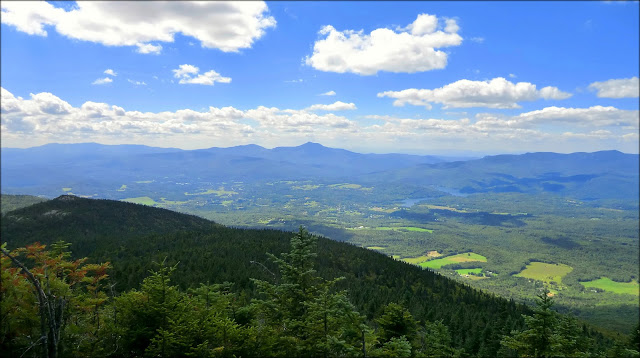
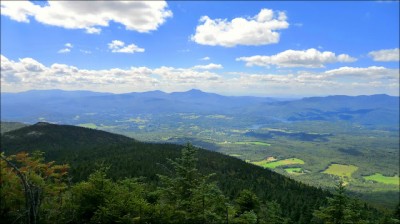
Vermont is the place where dreams of peace and tranquility come true. Rolling waves of verdant hills, interspersed with fertile valleys and filled with a tenacious band that endure bitter winters and short bursts of what those in America’s North-East think passes for ‘Summer’: that’s Vermont.

But the element that’s brewed to the surface in the Green Mountain State– and that’s now reached boiling point – is unbridled anger.

Vermonters are set upon by the same cowardly, callous and criminal chancers found all around the Globe – that appear from nowhere – like flesh-craving zombies – slobbering at the thought of massive and (seemingly) endless subsidies.

While their so-called political betters dance to their back-handing benefactors’ tune, the communities set upon have risen to the point of a full-scale, open rebellion. The following pieces tell the story of a mass movement of Vermonters venting fury and of a few politicians gifted with grace (rather than beguiled by wind industry ‘grease’) who’ve decided to put a halt to the most ludicrous energy ‘policy’ ever imagined.

ridges not renewable

Vermont’s energy siting struggle hits crescendo
Michael Bielawski and Bruce Parker
Vermont Watchdog
21  January 2016

MONTPELIER, Vt. — What started as a letter from Rutland regarding a lack of local control over renewable energy siting has culminated in an 86-town strong “Vermont energy rebellion.”

On Wednesday, more than 100 protesters gathered at the Statehouse to demand local control for energy siting.

Leading the demonstration were state Sen. John Rodgers, D-Essex/Orleans; Karen Horn, policy director for the Vermont League of Cities and Towns; and Don Chioffi, a member of the Rutland Selectboard. Together they argued the energy project siting process as it now stands oversteps the will of ratepayers.

“I would like to acknowledge those here today whose homes and lives have been sacrificed by our state’s energy policy, those of you who have been encroached upon and bullied by energy developers, and those of you who have lost not only property values but the health of your families to industrial wind plants. The process that we use to site energy in Vermont is broken and it’s long past time to fix it,” Rodgers said, opening the event.

According to Rodgers, renewable energy developers, with rubber-stamp support from the Public Service Board, have been given unrestrained power over land use in Vermont to the detriment of cities, towns and the environment, adding that the process had become “anti-environmental and anti-democratic.”

His two-part solution was also the largest applause line of the day: “First, I propose that we ban the development of industrial wind in Vermont. … Second, I propose that we require land use decisions related to energy generation to go through Act 250.”

To that end, Rodgers is sponsoring S210 and a slew of of other bills to ban industrial wind and subject the Public Service Board’s energy development certification process to stipulations found in Vermont’s strict land use and development law.

bear

****

Other community leaders, including Chioffi, offered comments about the problem.

“You may as well throw selectboards and planning boards out the window if you are going to operate the state this way. They are being treated as if they are nonexistent and useless,” Choiffi told Vermont Watchdog. “… There has never been a solar projected rejected by this Public Service Board — there’s the proof in the pudding.”

Mark Whitworth, board member of Energize Vermont, a pro-renewable energy group, attended the event to protest the manner in which renewable energy projects are being implemented.

“They’re industrializing wildlife habitat, they are fragmenting forests,” Whitworth said. “They are developing our ridgelines, which is going to result in a loss of flood resiliency, and they’re converting farm land for meager energy production — so we are jeopardizing our food security. We think that these guys are just worsening the very problems that they claim they are helping us to avoid.”

Vermonters from across the state traveled to the Statehouse to have their voices heard as well.

“There aren’t any constraints on where they put them up or how big they are,” said Rachael Carr, of St. Albans. “If they don’t get some legislation to put some restrictions on these projects, it’s going to be too late.”

vote

****

Her young son, Alex Carr, added an imaginative twist on the problem: “I’m here to protect the state from these huge monsters,” he said. “People think they are good, but they are not.”

Giselle Chevallay, a Newark resident dressed up as a displaced Vermont bear, said, “We want to help make sure we are more careful about our siting choices, whether it’s solar, wind, nuclear, hydro or anything.”

Given such urgency and backing by 86 towns, Rutland’s 2014 letter seems almost prophetic: “We are attempting, through this resolution, to form a coalition of Vermont communities which will support reasonable legislation to restore local community input to the regulatory process when addressing the issue of solar citing in our state.”

Whitworth explained what it means for a town to be part of the rebellion.

“These towns have either signed onto the Rutland resolution or they’ve adopted town plans which have explicit language regarding energy citing or certain energy technology,” Whitworth said, adding that his town of Newark has a town plan that says industrial wind turbines are inappropriate.

Currently, energy projects are exempt from Act 250 requirements. These requirements include adhering to regional municipal plans not unlike those of Newark. Rodgers’ bills attempt to make energy development subject to the same requirements other commercial developers face.

The plan is certain to hit resistance, largely because of the money involved. Chioffi said public money, including federal subsidies of 30 percent and state subsidies of about 8 percent, is what drives these projects. He argues that a 40 percent up-front return is also fueling the green energy rush.

“The best kept secret in the world is that these are really, really big cash cows,” he said. “There’s a lot of money to be made in these things. I’ve always been told if you ever want to get to the bottom of any argument on this kind of stuff, follow the money.”

Whitworth said the state’s renewable portfolio standards — which require every municipality to periodically increase its percentage of renewable energy sources — is another driving force. “It really lit a fire under this,” Whitworth said.

He added that while there are no current calls to freeze or repeal Vermont’s RPS, he thinks if legislators don’t respond to the pushback from communities, that will change. At least four of 29 states with such standards have halted or repealed them.

When asked about the status of Vermont’s RPS, Rodgers expressed concern about the economics of renewable energy. “There are a huge number of manufacture and installation jobs with solar today — I think it’s like 16,000 jobs,” he said. “The problem is, after the construction, we have basically set up a pipeline of our cash out of state because most of the owners of the big installations are out-of-state people or corporations.

“So it’s basically taking the tax credits out of state and the ratepayer money out of state. If we were building more on Vermonter’s homes and businesses, the tax credits and savings would stay more in Vermont” Rodgers said.
Vermont Watchdog

ridgeline destruction

****

Energy Critics Make Strongest Statehouse Push
Terri Hallenbeck
Seven Days
20 January 2016

tubine protest

The makeshift wind turbine erected in front of the Statehouse, emblazoned with the governor’s last name, was the first hint. Then there were the sign-bearing protesters flanking the Statehouse doors.

Inside, in the halls of the Statehouse, the cafeteria and committee rooms, scores more were dressed in bright green vests to highlight their presence and emphasize the danger they feel.

Wednesday brought the biggest show of force yet by Vermonters upset with the state’s siting process for energy projects. What has in recent years been a relatively small group of wind opponents has grown into a legion of people worried about wind and solar, including town leaders from across the state.

“Now, it’s being taken more seriously,” LuAnn Therrien said of the opposition. Therrien has spent years speaking against the Sheffield wind project, which she said drove her family out of town.

The proliferation of solar projects around Vermont has changed the volume of the opposition, said Mark Whitworth, who is with the organization Energize Vermont. The group has long opposed decisions about the siting of wind projects, and it now finds new friends opposed to suggested solar sites. “That is what really has lit a fire under this energy rebellion. When it was wind in the Kingdom, it was pretty easy for people in other parts of the state to ignore it,” Whitworth said.

protest

****

Wind and solar siting opponents filled the Senate chamber. Now, many town officials are also fired up. The Vermont League of Cities and Towns, not exactly a rebellious organization, joined in Wednesday’s event. Nearly a dozen local officials testified to legislative committees about how their towns have spent thousands of dollars and still feel powerless during the process to determine renewable energy sites.

“We’ve been inundated with solar,” Russ Hodgkins, Westminster town manager, told the House Natural Resources and Energy Committee on Wednesday. He said his town supports renewable energy, but the locations chosen so far are taking prime agriculture and industrial sites out of the economy. “There’s not one of them that’s in a great location.”

Whether this growing throng of rebels will get their way is another matter. While they are railing against what they consider poorly sited projects, Gov. Peter Shumlin has been touting the growth of renewable energy and the jobs it brings.

Wednesday’s events — hours of meetings with the Senate and House Natural Resources and Energy committees and a noontime press conference and rally — were organized by Sen. John Rodgers (D-Essex/Orleans), author of a bill calling for a ban on industrial wind projects.

“In 1968, Vermont passed a landmark anti-billboard law,” Rodgers told those gathered for the press conference. The “billboard ban is what inspired me to do what I’ve known to be right for years, and that is introduce S. 210, to ban industrial wind from Vermont.”

Prospects for a ban seem as weak this year as in previous years, however. “We’ll listen, but I think the problem with that proposal is we have an orderly development process,” said Sen. Chris Bray (D-Addison), chair of the Senate Natural Resources and Energy Committee.

Bray insists, though, that he’s working on changes that will help, at least on the solar front. “That is the most urgent need we are responding to,” Bray said.

His committee is putting together a bill — S.230 — that he hopes will offer incentives to build solar projects in specific locations and direct the Public Service Board to consider town plans in approving projects. Changes coming to the state’s net metering regulations will also likely slow down the proliferation of solar projects, he said.

Bray’s House counterpart, Rep. Tony Klein (D-East Montpelier), said he’ll await the Senate’s bill, but he agreed changes to energy-project siting should be made this year, even if there is not yet agreement on what those should be. He said, “There’s a pretty clear message that towns do not think they’re being heard.”
Seven Days

This video pulls together reports on the uprising from Burlington Free Press and NewsChannel 5.

****

Vermonters rally at Statehouse for new rules governing wind projects – Sen. Rodgers sponsors bill to ban more industrial-scale turbines
Stewart Ledbetter
WPTZ-News Channel 5
21 January 2016

MONTPELIER, Vt. — More than 100 Vermonters turned out Wednesday at the Statehouse to demand changes in the law governing the siting of industrial-scale energy projects.

At noon, the noisy crowd jammed into the Statehouse gallery to cheer Sen. John Rodgers, the Essex-Orleans Democrat who has introduced Senate Bill 210.

“This rebellion has spread to dozens of towns across Vermont and I believe it will continue to spread,” Rodgers told the crowd. “We won’t achieve our energy goals in the face of this rebellion. And I offer a solution. First, I propose we ban industrial wind in Vermont.”

The crowd erupted in applause.

Rodgers said Vermonters resent a system which allows wind developers who stand to earn millions from turbines to hire lawyers to argue their case before the Vermont Public Service Board — while citizens most impacted and the towns that host the projects have little voice and no veto power.

S. 210 would make a second key change, shifting permitting for renewable energy projects from the PSB to district environmental commissions and the development review process known as ACT 250. Supporters think Act 250 would provide citizens a far better shake.

Anthony Iarrapino, spokesman for Swanton Wind, a proposed turbine project in Franklin County, said the criticism was unfounded.

“If you look at the polls and the success of the projects we have (in Vermont) the majority of Vermonters understand how important wind is to our economy and getting us to clean energy goals,” he said.

Paul Burns, executive director of the Vermont Public Interest Research Group, said the state’s goal of securing 90 percent of its energy from renewable sources will mean Vermonters have to get used to seeing turbines on mountaintops and large solar arrays in farm fields.

S. 210 has been referred to the Senate Natural Resources Committee for consideration.
WPTZ.com

angry-mob

Funny about all that!

That Vermonters are furious about the destruction of their thriving and healthy communities in ‘exchange’ for a wholly weather dependent power source; that’s intermittent and unreliable, requiring 100% of it’s capacity to be backed-up 100% of the time by conventional power generators; that, accordingly, has NO commercial value (save the massive power consumer and/or taxpayer subsidies it attracts); kills millions of birds and bats; and, with the incessant low-frequency noise and infrasound it generates, drives people mad in their homes, or drives them out of them altogether, is hardly a surprise.

What the wind industry hates most are facts. And anyone with the temerity to present them is targeted in a style and with a zeal that would have made the East German Stasi proud. Here’s just another example of the wind industry’s standard tactics.

AG’S Office investigating complaints against Annette Smith, anti-wind advocate
Mike Polhamus
VT Digger.org
23 January 2016

The state attorney general’s office has opened an investigation into criminal complaints against a prominent champion of Vermonters who are adversely affected by renewable development.

The attorney general’s office is investigating whether Annette Smith, executive director of Vermonters for a Clean Environment, has practiced law without a license — a charge with penalties left entirely to the court’s discretion.

Smith says the complaints that prompted the AG’s investigation are politically motivated.

Attorneys who have argued against Smith’s clients say she gives bad advice, unconstrained by the sanctions licensed attorneys would incur for similar behavior.

Smith says the AG’s investigation “is very intimidating.”

“I don’t know what to do. I think our work’s being shut down,” Smith said. “I believe this has the potential to shut down my organization of 16 years. It clearly falls under the definition of harassment.”

Residents who live near planned and existing renewable projects have claimed she’s their only advocate.

Smith said she represents people who too frequently have nowhere else to turn. Renewable energy developers hire talented attorneys against whom landowners near project sites have no other way of successfully representing themselves.

Many of these cases involve people who can’t afford a lawyer, and who didn’t want to become involved in legal proceedings to protect their interests, she said. Lawyers know it’s impossible to fight renewable energy developers, Smith said, and won’t take on affected landowners’ cases anyway.

“Anybody who does this with a lawyer has wasted tens of thousands of dollars,” she said. “The reason I’m doing this is so people have a voice without bankrupting themselves.”

The attorney general’s office would not offer comment on the case.

“There is a matter under investigation by the criminal division, and we can’t comment on it further, and we never comment on ongoing criminal investigation,” said John Treadwell, Chief of the Criminal Division at the AG’s office.

Practicing law without a license is a charge that has rarely been prosecuted in Vermont, Treadwell said. It carries potentially severe penalties. “It is punished as criminal contempt of the Vermont Supreme Court, and is potentially punishable by fine or imprisonment or both, in the court’s discretion,” Treadwell said.

“In the court’s discretion,” Treadwell said, means there are no maximum defined penalties.

Assistant Attorney General Zachary Chen named five cases in a letter notifying Smith of the investigation, and two attorneys were involved in both cases. Smith said one of them had previously accused her of practicing law without a license. Both have given Smith reason to believe they’ve sought to instigate an investigation against her, she said.

Joslyn Wilschek is one of the attorneys, and in a previous Public Service Board hearing she told hearing officers that Smith had been in that instance practicing law without a license.

Non-lawyers aid participants in legal and other proceedings all the time to good effect, Wilschek said, but Smith represents herself as having training that she actually lacks.

“She gives legal advice to landowners, and she drafts their filings to the Public Service Board, and I think it’s a real disservice, because she puts herself out there as having the knowledge of a lawyer, when she doesn’t,” Wilschek said.

Wilschek said she didn’t file a complaint against Smith with the AG’s office, but said she supports it and said that if asked, and if her clients consented, she’d testify Smith had done what she’s been accused of. Wilschek said her remarks reflect only her personal observation, and not her clients or their positions.

Based on what she’s seen, such charges have no basis in political motives, Wilschek said. “I disagree with people all the time — that’s what a lawyer does — but when someone does something this egregious, it’s not political, it’s protecting the public,” she said. “When you see someone putting themselves out there like a lawyer, it’s a real disservice to people who don’t understand the training a lawyer needs.”

People who Smith has assisted say they have no other effective advocate, and say they’re shut out of the hearing process for renewable projects by the excessive legality of the proceedings.

“What she does is she provides citizens — normal, everyday citizens in the state of Vermont — with a possibility of having any chance at participating in the Public Service Board process,” said Christine Lang.

Lang, with her husband and with Smith’s assistance, is attempting to persuade the Public Service Board to assess penalities on prospective wind developer Travis Belisle for constructing a meteorological tower without a permit. The met tower is a precursor to the wind turbine development project, and she says a permit filed with the board would have given the public advance notice.

State agencies and developers are well-represented by lawyers at Public Service Board hearings, while ordinary citizens are shut out of the process, Lang said.

“I think it’s a witch hunt to distract her from the work she’s trying to do to help citizens, because she’s the only one out there who’s helping citizens,” Lang said. “Does that make sense I should have to have an attorney to participate in what is supposed to be a public process?

“This is why this entire process is completely broken,” she said. “It is a developer-run process run by the developers and their lawyers, and they are getting everything they want, and they are going to destroy this state.”

Leslie Cadwell, another attorney who has represented wind developer David Blittersdorf, says Smith has led her clients to bad ends. Cadwell participated in a case against Smith that complaints with the AG’s office have highlighted as representative of Smith’s alleged illegal behavior.

“As a result of Annette’s participation in a case she was involved with before the Public Service Board, the town of Irasburg has violated open meetings law twice, and has admitted it,” Cadwell said.

Professional ethical standards lawyers abide by prohibit this kind of behavior, Cadwell said.

“If Annette wants to represent people in the Public Service Board process, or advise people about how to participate in the Public Service Board process, she ought to go to law school,” Cadwell said. “Or, in Vermont, she can actually do a four-year clerk program where she can learn how to be a lawyer and understand how to ethically represent her clients in courts.”

Vermont is one of few states that allows lawyers to work as clerks in lieu of law school as a means of studying to become an attorney, Cadwell said.

Cadwell said that she did not file complaints against Smith with the attorney general’s office.
VT Digger

What utter bunkum.

Annette Smith has absolutely no case to answer. She hasn’t represented herself to be legally qualified to practice law (to those she represents or anyone else); hasn’t raised a fee for her services; and hasn’t pretended to have qualifications that she does not possess.

Instead, all she has done, is to have given collective advice to, and advocated for and on behalf of, people who simply cannot afford legal representation; and done so in ‘Mickey Mouse’ hearings before an administrative planning panel (the Public Service Board); which has no Curial authority – and all the Judicial formality of the process required to obtain a driver’s licence at the DMV.

Planning panels and tribunals (indeed, Supreme and High Courts) hear self-presented plaintiffs, applicants and defendants on a routine and regular basis. It’s now so common as to be unremarkable – especially in planning cases.

In Australia, and other common law jurisdictions, otherwise unrepresented litigants are entitled to have what’s called a ‘McKenzie friend‘ represent them in courts of law.

The McKenzie friend openly gives legal advice and assistance in and out of court; and does not need to be legally qualified to do so. The crucial point is that litigants in person are entitled to have assistance, lay or professional, unless there are exceptional circumstances. Provided the McKenzie friend does not represent themselves to be legally qualified to practice law and doesn’t charge for their time (although charging for time is permitted in England and Wales), there can be no complaint from the court hearing the case, other parties or their lawyers about them giving advice, assistance and otherwise advocating for the litigants they help to present their cases.

Given the fact that there is no obligation on litigants, in any forum, to retain and pay for the services of a qualified lawyer, the charge against Annette Smith is pure, unadulterated nonsense; and is nothing more than the usual bullying, stand-over tactics employed by the wind industry and its parasites – tactics that see its goons beating up on pensioners, disabled farmers and middle-aged mothers.

The ridiculous nature of the developer instigated trumped-up charge against Annette Smith was noticed by another famous American community defender, Erin Brockovich – who has endorsed a crowd funding page for Annette’s legal defence costs on her facebook page – Erin Brockovich – noting that:

The head of Vermonters for a Clean Environment, Annette Smith, is under criminal investigation by the Vermont Attorney General’s office for alleged “unauthorized practice of law”. Whoever could have imagined helping people have a voice in regulatory proceedings would lead to this; it is obviously politically motivated. I am outraged. The charge is highly unusual; if there is prosecution, it would be tried at the Vermont Supreme Court. This hasn’t happened since 1962 and only five times in the history of Vermont. The legal community in Vermont is scratching their heads, outraged, and various things in between. A gofundme page was set up yesterday to help with her legal fees https://www.gofundme.com/74kx663w

With its ham-fisted attempt to crush Annette Smith and the communities she helps to defend, the wind industry can expect nothing but fury and revenge in Vermont, from here on. Let’s call it the beginning of a ‘revolution’.

vive la resistance

Wind Weasel Wants To Attack Innocent Victims…

Wind Industry Peopled by Career Criminals: Convicted Felon Launches Ludicrous Defamation Claim Against Opponents

Definition of fraud

The wind industry seems to attract a particular class of bloke, in much the same way that the Prohibition era drew lots of heavy-set Italians to the Mob.

Maybe that seemingly endless stream of massive subsidies filched from taxpayers and power consumers generates the same allure as festering dung does for swarms of flies?

Whatever it is, the whiff that surrounds the wind industry has attracted (and continues to attract) a class that has no hesitation lying, cheating, stealing and even bonking their way to the easy loot on offer.

The Italian Mob were in on the wind power fraud from the get-go: applying their considerable (and perfectly applicable) skills – leading the European wind power fraud, with what economists call “first-mover-advantage” (see our post here).

We’ve reported on just how rotten the wind industry is – from top to bottom – and whether it’s bribery and fraud; vote rigging scandals; tax fraud; investor fraud or REC fraud – wind weasels set a uniform standard that would make most businessmen blush.

Now, here’s another story detailing not only the fact that the wind industry is peopled by career criminals, but also that their audacity knows no bounds.

Wind farm developer sues project opponents for defamation
Arkansas Online
Dan Holtmeyer
16 January 2016

The CEO of the company hoping to build the state’s first wind farm west of Springdale has sued two of the project’s opponents for defamation.

Jody Davis, head of Texas-based Dragonfly Industries International, claims several disparaging posts made by Jonathon and Vivian Hamby on the “Stop the Elm Springs Wind Farm” Facebook page aren’t true and have damaged his and his company’s reputation. Davis filed the lawsuit in Washington County Circuit Court and asks for a judge to order the married couple to remove the posts, compensate Davis for the damage done and pay punitive damages.

The lawsuit cites five examples of the posts, including one in November asking of Davis and another man involved in the project, “Do these look like ‘experts’ in wind energy to you, or do they look like career criminals who scam people out of their hard-earned money?” Davis claims the Hambys knew the statements were false or were published with reckless disregard of the truth.

That post referred to Davis’s history of crimes involving money. Davis pleaded guilty in 2009 to embezzling about $785,000 from three organizations in Oklahoma and served 17 months in prison, according to federal court documents. He was also sentenced to probation in Arkansas for a hot-check violation in 1999.

The Hambys’ attorney, Travis Story, dismissed the complaint in a statement as an attempt to intimidate the Hambys. The truth is “an absolute defense” in defamation cases, Story wrote.

“This is a pathetic and desperate move by Jody Davis,” Jonathon Hamby said Friday evening. “His criminal history is what is causing him problems, not some Facebook post.”

Davis didn’t return an email or phone message requesting comment Friday evening. Last year he said he had paid for and had grown past his mistakes.

“It is really sad that the press and the community wish to put more emphasis on tearing a person down who has truly changed their life and worked hard to build a life and future for their family that is structured around Godly relationships,” Davis wrote in an email last month.

Davis and other Dragonfly representatives have said they plan to build dozens of turbines on a 300-acre site on the western edge of Elm Springs, a town of about 1,700 people. They have said they intend to use a unique turbine design that’s quieter, safer for wildlife and more efficient than the standard design.

The Hambys live next to the land. They and other neighbors worried about the project’s impact on their health and property value and said the turbine design was untested and unproven. After the City Council approved the land’s annexation into Elm Springs last fall, the Hambys were involved with the successful petition drive to put the annexation up for a public vote. The vote’s scheduled for March 1.

Elite Energy, a related company that owns the site, tried to get the land rezoned from residential-agricultural use for the project but dropped the request in December. Hamby said he believed the project could still go forward, because residential-agricultural zoning allows utility facilities under city code.

At the Planning Commission’s meeting Monday, chairman Matt Casey said he agreed the 150-foot turbines could be built on the land as zoned, according to a recording of the meeting. The project would still need building permits and perhaps other permitting before going forward, Casey said. The commission didn’t take any formal action.

Jonathon Hamby attended the meeting and said neighbors’ concerns must be addressed.

“It seems like you’re trying to find a way around this,” he told the commission.

Mayor Harold Douthit said Hamby and others had several public opportunities to speak their minds. Hamby and Douthit argued for a moment before Casey ended public comment and adjourned the meeting.
Arkansas Online

As attorney, Travis Story, correctly points out, “the truth is “an absolute defense” in defamation cases”. Indeed it is.

Now, here’s the unvarnished truth about Jody Davis

Wind Farm Company CEO Responds To Past Embezzlement Conviction
5 News KFSM
Zuzanna Sitek
19 November 2015

ELM SPRINGS (KFSM) — The chief executive officer of a Texas-based company that has proposed building a wind farm on 300 acres in Elm Springs addressed his past embezzling conviction Thursday (Nov. 19).

Jody Douglas Davis is the CEO of Dragonfly Industries International, LLC. On Aug. 10, 2009 he pleaded guilty to 18 counts of wire fraud and 64 counts of money laundering in the U.S. District Court for the Northern District of Oklahoma. Upon sentencing 46 counts of money laundering were dropped and Davis was sentenced to a little over three years in federal prison. Davis was released July 18, 2011 and was put on supervised release until July 17, 2014, according to records from the Federal Bureau of Prisons.

On Thursday, he released the following statement to 5NEWS:

“I made some mistakes in my past. I paid a high price for these mistakes, including a debt to society. The experience transformed me. Since that time, I have tried to live my life as an example, so others might understand how they can be transformed.   I hope and believe my business and personal achievements in recent years reflect that example.”

The Board of Directors of Dragonfly Industries also sent 5NEWS at statement:

“The Board of Directors of Dragonfly Industries International, LLC are completely behind Mr. Davis as our Chief Executive Officer. As a company, we believe that there are such things as second chances when a person does not just modify their behavior but one goes through complete heart change. Mr. Jody Davis has our full support and we eagerly look forward to the future in all our business endeavors.”

Davis embezzled $1,153,627 from Windsong Marketing, LLC, Newsong Assembly and Buyers Assistance, LLC, according to a federal indictment. All three companies were involved in home-buying assistance and Davis was employed as an account executive from about August 2003 to February 2005, the indictment states.

Windsong, Newsong and Buyers would advance money to help home buyers in meeting their financial obligations for their home purchases. When the home purchase was completed, the seller of the home would send Windsong, Newsong and Buyers an amount that equaled or exceeded that which had been advanced to the home buyer. If the sale failed completely, then the home buyer would be obligated to return the amount which had been advanced to him or her to purchase the home.

From January 2004 to February 2005, Davis would contact home buyers and sellers and instruct them to wire transfer the money that was supposed to be returned to Newsong, Windsong and Buyers to a bank account he had set up at First Pryority Bank in Pryor, Oklahoma instead of wiring the money into bank accounts belonging to Newsong, Windsong and Buyers, according to the indictment. Davis had listed the account at First Pryority Bank as belonging to Autos, Inc. even though Davis was not in the business of vehicle sales or servicing, the indictment states.

Davis used the money sent to the Auto, Inc. account to settle prior debts, as well as to purchase vehicles, real estate, building and property improvements, boats, personal water craft, all-terrain vehicles, tractors and jewelry, including a diamond ring and earrings, according to the indictment.

As part of his plea agreement Davis must make restitution to his victims. Newsong, Windsong and Buyers were owned by Gayle Towry before the companies were dissolved, according to court documents. Upon Towry’s death in December 2009, just months after Davis’ guilty plea, restitution payments were transferred to one of his children, Kenneth Towry.

Kenneth Towry spoke with 5NEWS about the case and identified the Jody Davis pictured in the photograph on the Dragonfly Industries website as the same man who embezzled money from his father. Towry said of the amount Davis has been order to pay back, he has seen about $1,000 so far.

Towry’s attorney also confirmed the CEO of Dragonfly Industries and the man who defrauded his client were the same person.

Federal court documents show jurisdiction over Davis’ 2009 case was transferred from the U.S. District Court for the Northern District of Oklahoma to the U.S. District Court for the Eastern District of Arkansas in August 2012.

Documents filed with the Texas Secretary of State’s office show Dragonfly Industries International, LLC filed its certificate of formation Sept. 5, 2014. The registered agent on the formation form is listed as Nadine R. King-Mays, an attorney based out of Dallas, Texas.

On a Texas Franchise Tax Public Information Report filed in 2015 Jody Davis is listed as a governing member of the company. His address on the form is listed as being in Farmington, Arkansas. The other governing members listed on the report are Phillip Ridings and Craig Cook. Both of their addresses are listed as being in Jupiter, Florida. According to the Dragonfly Industries website, Ridings is listed as the inventor of the wind turbine that the company has proposed to use in Elm Springs and Cook is listed as the chief operating officer.

5NEWS contacted the address where Dragonfly Industries has its office and was told the suite is undergoing renovation.

The wind farm project proposed in Elm Springs would be Dragonfly Industries’ first wind farm, according to the company’s website. Mayor Harold Douthit said he didn’t know about Davis’ criminal history, and said it wasn’t his place to ask.

“We give every business that wants to operate in Elm Springs no matter what they are, the same level of scrutiny,” Douthit said. “If they’re approved we welcome them, and we wish them well, but the scope of what we can do is limited to the proposal that’s in front of us.”

The Elm Springs City Council tabled a motion Monday (Nov. 16) to rezone the property for the wind farm to give council members more time to look into Dragonfly Industries and to address residents’ concerns.

Stop the Elm Springs Wind Farm, which opposes the project, issued the following statement Thursday:

“We were surprised to learn of Jody Davis’ criminal history this morning when the news story aired. Needless to say, we have been suspicious of this operation from the beginning. The individuals involved with Dragonfly have no wind energy experience, they have never built one of their “experimental” turbines, and they don’t have a buyer for their energy. In addition, they wanted to build a wind farm in an area that does not have the wind speeds necessary to sustain a wind farm. Mr. Davis is supposed to be present at the Elm Springs Planning Commission meeting on Dec. 14 to answer all of the public’s questions. We look forward to hearing what he has to say on Dec. 14.”

A court records search shows Jody Davis also has a criminal record in Arkansas.

In April 1999, Davis was accused of violating the Arkansas hot check law, according to records filed in Washington County Circuit Court. In January 1999 Davis wrote himself a check in the sum of $10,000 on an account at McIlroy Bank (now Arvest Bank) based on a deposit from Peoples Bank in Westville, Oklahoma which would later deny payment because of insufficient funds on deposit, the documents state.

In June 1999, Davis pleaded guilty and was sentenced to six years probation, according to court records. He was also ordered to pay $10,096 in restitution. Davis satisfied the conditions of his judgement in September 2002, records show.

Records show Davis was also arrested in May 2007 in Faulkner County on possession of a controlled substance. He later pleaded guilty and was sentenced to five years of probation. In 2009, just months before he pleaded guilty to federal embezzlement charges, he was arrested on a probation violation, according to court records.

In a letter from 2009 to a federal judge, Davis asks the court to let him voluntarily surrender to serve his time in federal prison. In the letter, Davis writes he developed a drug problem four years earlier because of a series of tragic events. He also asks the court to give him time to make sure his ill mother is taken care of and to see his children before beginning his federal prison sentence.

As part of his federal prison sentence, the court recommended Davis be put in a facility where he will have the opportunity to participate in the Bureau of Prisons’ Residential Drug Abuse Treatment Program. The court also recommended Davis be placed in a facility as close to Searcy, Arkansas as possible. The closest federal facility to Searcy is in Forrest City.

A search of the Arkansas Secretary of State website also shows Davis had three companies in Northwest Arkansas registered in his name: Global Growth Investments, Inc in Fayetteville in 2001, J.D. Davis, Inc in Springdale in 1998 and Star City Collision Center, LLC in Star City in 2009. The licenses for all three were revoked.
5 News KFSM

jody-davis-mug-shot

****

And it seems that Jody Davis wasn’t the only felon attracted by the wind industry’s impeccable record for probity and integrity ….

Records show proposed wind farm representative has history of financial trouble
5 News KFSM
Zuzanna Sitek and Dillon Thomas
24 November 2015

ELM SPRINGS (KFSM) – Another key player involved in the proposal to build a wind farm in Elm Springs has a history of criminal and civil cases involving his finances.

Court documents obtained by 5NEWS show Cody Fell has a history of financial issues in Arkansas and Oklahoma. According to city council meeting minutes, Fell and two others represented Dragonfly Industries International at initial meetings with Elm Spring city leaders in December 2014. However, Fell’s official role in the company is unclear and he is not listed on the company’s website.

Court documents that go back to May 2003 show Fell has a history of failure to appear, failure to pay for services and a conviction for violating Arkansas’ hot check law.

In 2003, Fell was ordered to pay $5,357 in Washington County when he didn’t appear for a case involving one of his companies, Creative Home Designs, after he failed to pay his account with Smith Tile Company.

Later in March 2004, court records show Fell pleaded guilty to a misdemeanor violation of Arkansas’ hot check law after he knowingly made out a check to Air Control Corporation for $2,462 that wouldn’t clear. Fell was sentenced to 12 months of probation with minimal supervision.

Also in 2004, documents show Fell faced foreclosure on a property in Tontitown after owing Arkansas National Bank more than $316,000.

In 2005, after failing to respond to another court case, Fell and another one of his companies, Builder Services of Northwest Arkansas, were ordered to pay nearly $5,400 to United Bank of Springdale.

Then in 2009, First State Bank of Northwest Arkansas took Fell to court after he failed to make payments on a loan and again didn’t respond to a summons. Fell was ordered to pay nearly $29,000.

Fell also has a record of financial cases in Oklahoma.

In 2007, in Adair County, Fell was order to pay more than $40,500 to the Theodore R. Murray Living Trust after defaulting on a promissory note and mortgage.

That same year, Fell and one of his companies in Oklahoma, Custom Structures, was summoned to court by Tulsa Casting and ordered to pay nearly $3,500. Records show a bench warrant was issued for Fell in 2009, but was returned several months later after Fell couldn’t be located.

In 2008, Fell and another one of his companies, Eagle Management, were summoned to court for breach of contract, although the sum sought in the case was not available in online records. The records show a judge issued several bench warrants for Fell after he failed to appear in court. Fell and his wife filed for bankruptcy, but their case was dismissed “because of various misrepresentations of the defendants,” according to a citation for contempt.

And as recently as 2012, Fell and Eagle Management were once again brought to court for breach of contract after failing to pay a $55,000 contract. Again, the judgment was by default because records show Fell never showed up for court or responded to any summons.

Records show Fell has also been a defendant in several cases in Delaware County. In two of the civil cases the sought monetary relief exceeded $10,000.

Dragonfly Industry’s CEO, Jody Davis, released a statement last week regarding an embezzlement conviction from 2009 for which he served time in federal prison.

5NEWS contacted Davis regarding Fell’s background, but didn’t receive a response.

Elm Springs Mayor Harold Douthit sent the following statement to 5NEWS Tuesday (Nov. 14):

The information brought to light recently surrounding Dragonfly personnel no doubt has put a cloud on the future of the wind farm project. I am confident the Planning Commission and City Council will make the right decisions for the citizens of Elm Springs. I respectfully support those decisions.

According to Washington County real estate records, the plot of land for the proposed wind farm project is located at Tally Gate Road and Kenneth Price Road and was annexed into Elm Springs by the city council in October.

Records indicate the land is owned by Elite Energy, LLC, a company that’s registered to Brandon Smith, and was purchased in February 2015 from Chambers Bank. City council meeting minutes show Smith was also present to discuss the wind farm project with city leaders in December 2014. Fell, Smith and Ron Filbeck are listed in the minutes are representing Dragonfly Industries. None of the three men are listed on the company’s website.

Arkansas Secretary of State records show Fell, Smith and Filbeck listed as managing members of CBR Investments, also Auto Solutions Used Cars, in Springdale.

Documents from the Arkansas Department of Environmental Quality indicate the Arkansas One Elite Energy Wind Facility has been granted a stormwater construction general permit. The permit correspondence was addressed to Arkansas Wind Power, LLC and Jody Davis. Arkansas Secretary of State records indicate Arkansas Wind Power is registered to Phillip Ridings, who is listed as the inventor of the wind turbine technology that will be used in Elm Springs, according to the Dragonfly Industries webpage.
5 News KFSM

cody-fell-mugshot

Corrupt Wind-Pushing Politicians Allowing Abuse of Citizens!

Institutional Malice: Wind Farm Victims’ Government Endorsed Suffering Continues With Greg Hunt’s Knowledge

greg hunt

****

The number of Liberal (Australia’s once small-government, conservative, business and family friendly) Party MPs that hold a bizarre affection for these things can be tallied up on one hand.

The Liberal’s King of the Wind Worship Cult is the hapless Environment Minister, young Gregory Hunt. Hunt’s office is headed up by wind industry plant, Patrick Gibbons – who, along with his best mate, Ken McAlpine are responsible for cooking up the great wind power fraud in Australia.

At the time, they were staffers in the office of Victorian Labor Minister, Theo Theophanous, who with his brother, Andrew added more than alittle ‘colour’ to politics.

In a cosier than cosy turn of events, Gibbons runs Hunt’s office; and McAlpine is now Vestas’ top media manipulator in Oz. How convenient!

Hunt and his office are fully aware of the life-destroying consequences foisted upon the hundreds of unfortunates stuck with these things by their wind industry benefactors. Hard-working rural people, ground down by incessant turbine generated low-frequency noise and infrasound – delivered in merciless, daily onslaughts, at places like Cape Bridgewater, Waubra and Macarthur in Victoria, Gullen Range and Cullerin in NSW, Windy Hill in QLD and Waterloo and Jamestown in SA.

Hunt and his cohorts are always quick to defend their paymasters; jumping on any suggestion that their beloved ‘eco-friendlies’ could harm so much as a fly.

However, try as they might, facts have an uncanny ability of bubbling to the surface; and, once there, ignorance of them is no defence.

When political history is drawn, and the legacies of those involved are measured up, it’s often what the protagonists didn’t do that stains their scorecard, rather than what they did.

For those responsible for enabling the greatest economic and environmental fraud of all time – like Greg Hunt – it will be the fact that they knew full well that their favourite renewable rort caused wholly unnecessary misery to courageous, magnificent and stoic Australian women like Sonia Trist, Jan Hetherington and Annie Gardner:

Three Magnificent Women Take On Australia’s Monstrous Wind Power Outfits & their Pathetic Political Backers

****

That our political betters are fully aware of wholly unnecessary suffering is a matter of no doubt.

You see, people like Greg Hunt and others, with full responsibility for the policies that saw thousands of these things speared into backyards across the country – driving people to the edge of sanity in their own homes; or driving them out of them altogether – get swamped with emails from their victims on a daily basis.

Just like this tragic tale laid out by Jan Hetherington from Macarthur in western Victoria.

But, before you confront what Jan has to deal with, night after punishing night (and it is confronting), take note of the who’s who list of recipients – a group that can never say that they didn’t know.

From: Jan Hetherington
Sent: Friday, 15 January 2016 12:10 PM
To: ‘St. Clair, Nicky’ <Nicky.StClair@environment.gov.au>; ‘Macarthur WindFarm’ <MacarthurWindFarm@agl.com.au>
Cc: ‘Malcolm.Turnbull.PM@aph.gov.au’ <Malcolm.Turnbull.PM@aph.gov.au>; ‘Greg.Hunt.MP@aph.gov.au’ <Greg.Hunt.MP@aph.gov.au>; ‘dan.tehan.mp@aph.gov.au’ <dan.tehan.mp@aph.gov.au>; ‘daniel.andrews@parliament.vic.gov.au’ <daniel.andrews@parliament.vic.gov.au>; ‘matthew.guy@parliament.vic.gov.au’ <matthew.guy@parliament.vic.gov.au>; ‘Sussan.Ley.MP@aph.gov.au’ <Sussan.Ley.MP@aph.gov.au>; ‘Senator.Nash@aph.gov.au’ <Senator.Nash@aph.gov.au>; ‘Frydenberg, Josh (MP)’ <Josh.Frydenberg.MP@aph.gov.au>; ‘lily.d’ambrosio@parliament.vic.gov.au’ <lily.d’ambrosio@parliament.vic.gov.au>; ‘martin.foley@parliament.vic.gov.au’ <martin.foley@parliament.vic.gov.au>; ‘jill.hennessy@parliament.vic.gov.au’ <jill.hennessy@parliament.vic.gov.au>; ‘lisa.neville@parliament.vic.gov.au’ <lisa.neville@parliament.vic.gov.au>; ‘jala.pulford@parliament.vic.gov.au’ <jala.pulford@parliament.vic.gov.au>; ‘richard.wynne@parliament.vic.gov.au’ <richard.wynne@parliament.vic.gov.au>; ‘mary.wooldridge@parliament.vic.gov.au’ <mary.wooldridge@parliament.vic.gov.au>; ‘david.davis@parliament.vic.gov.au’ <david.davis@parliament.vic.gov.au>; ‘david.southwick@parliament.vic.gov.au’ <david.southwick@parliament.vic.gov.au>; ‘david.o’brien@parliament.vic.gov.au’ <david.o’brien@parliament.vic.gov.au>; ‘Brad.Battin@parliament.vic.gov.au’ <Brad.Battin@parliament.vic.gov.au>; ‘Katrina Rainsford’ <krainsford@sthgrampians.vic.gov.au>; ‘bruce.armstrong@sydney.edu.au’ <bruce.armstrong@sydney.edu.au>; ‘Cathy.McGowan.MP@aph.gov.au’ <Cathy.McGowan.MP@aph.gov.au>; ‘goulburn@parliament.nsw.gov.au’ <goulburn@parliament.nsw.gov.au>; ‘senator.Day@aph.gov.au’ <senator.Day@aph.gov.au>; ‘senator.Xenaphon@aph.gov.au’ <senator.Xenaphon@aph.gov.au>; ‘senator.Canavan@aph.gov.au’ <senator.Canavan@aph.gov.au>; ‘senator.Leyonhjelm@aph.gov.au’ <senator.Leyonhjelm@aph.gov.au>; ‘senator.madigan@aph.gov.au’ <senator.madigan@aph.gov.au>

Subject: my 89th formal complaint re-Macarthur wind farm.

Dear Commissioner Dyer, and AGL,

As you have been made aware, from our meeting with you in December, 2015, I am now “sensitised” by the hammering from the excessive pulsating infrasound, low frequency noise and vibration, that saturates my home day in and day out, emitted by the 140, 3MW turbines at the Macarthur wind facility.

I told you about the problem I had, when I was a patient in the newly built Western Private Hospital in Melbourne, in 2015, where I experienced the same symptoms from infrasound as I experience at home, and independent acoustician Les Huson tested my hospital room and positively identified and recorded infrasound in that room.

Not only am I still being hammered by this “noise” as I go about my daily routine at home, but I recently visited Portland on the 6th and 7th and 12th and 13th January 2016, to attend the Cruise ship markets to showcase my glassware.

Each visit I stayed overnight in Portland with a friend, and to my horror, I experienced the same symptoms that I experience at home, from the low frequency and infrasound.

There are wind turbines on the edge of the township of Portland at Cape Nelson, and Cape Bridgewater.

I experienced symptoms of sleep deprivation, palpitations, anxiety, ears aching and ringing, head-pressure and aching on the back of my head and the top of my jaws. I could hear the low droning noise of the turbines during the night.

These are the same symptoms I experience at home, living near the Macarthur wind facility.

At the market on the foreshore during the day, I kept experiencing “whacks” to my head, as if someone had hit me on the back of my head. These “whacks” would give me a jolt and they hurt.

This excessive, pulsing infrasound, low frequency noise and vibration is a REAL problem, and I hope you have started your investigation into this REAL problem.

We cannot be expected to live our lives like this anymore.

I cannot be expected to be fearful of travelling to other places and experience the same dreadful symptoms that I experience at home.

This is “3rd world” stuff, and surely we’re better than that, we should be able to look after each and every one of our citizens, equally and without bias.

I pay my taxes and I expect something in return.

I expect to be treated with respect and compassion regarding this wind farm problem and not live in fear for my health and safety and wellbeing.

It’s about time politicians stopped playing politics and the popularity stakes and DO something about this wind farm problem.

I would like confirmation and receipt of this formal complaint please.

Sincerely

Jan Hetherington

Jan h Hetherington


My Wind-Fighting Mentor….”Calvin Luther Martin”

How to Fight the Big Wind Onslaught

Calvin Luther Martin, January 2009

Yesterday I turned 61. I’ve been fighting the wind bastards well over 4 years. Four years devoted to almost nothing else. Put a big book on hold with Yale Univ. Press for this. In those years I’ve answered thousands of emails from people around the world. Japan. Cyprus. Norway. Sweden. Czechoslovakia. Australia. New Zealand. Ireland. England. Wales. France. Canada. Many states of the Union. On and on.

In those years (which included years of fighting the wind thugs in three or four different iterations) in my backyard and beating the sons of bitches (at least for now), I’ve learned some valuable lessons. I oughta write a book. Consider this the first installment of that book.

I am no longer an academic. I’m a writer. Writers write to convey something in the most appropriate language for the matter at hand. For wind energy the most appropriate language is profanity, vulgarity, and obscenity. The louder the better. These are not honorable people. Wind energy is not an honorable enterprise.

Big Wind is obscene, profane, and vulgar.

Okay, rough draft of book:

Chapter 1. Courtesy doesn’t work.

Chapter 2. Questions don’t work. Stop going to meetings and asking questions. Problem is, you’re asking questions of the wind sharks. This is akin to the hens asking questions of the foxes who are about to pounce on the henhouse. Wake up!

Second, stop expressing your concerns at meetings. Weenie word. Your biggest rhetorical enemy in this fight is this word, concerns. Drop it! The media (see below) loves to describe you as concerned. (“The hens expressed some concerns to the foxes.”) Screw concerned and start getting angry and defiant. And stop asking the windies questions and start informing them of the fact they and their goddam monster turbines and substations are not welcome in town. This is the your conversation with them: Get the hell out of Dodge!

Chapter 3. Real evidence doesn’t work. The wind sharks fabricate their own, using whorish little companies to perform noise measurements and do environmental impact studies, including bird and bat studies. Companies often consisting of four guys with sweaty balls and BS degrees from nondescript bullshit state colleges, from which they graduated three years ago. But they’ve got a website and stationery and PO Box — and they’re rarin’ to get those permits for Big Wind. Give me a break!

Chapter 4. Meetings with state senators, governors, premiers, department heads, county commissioners, the media, other various and assorted lawmakers — don’t work.

Chapter 5. Following the rules at public meetings does not work. The meetings are (a) a charade, (b) a farce, (c) a hoax, and (d) altogether a mockery of public participation. The fix has already been made, the deal bought and paid for. Refuse to be silenced by Robert’s Rules of Order. Screw Roberts! Major Henry Martyn Robert never had to abandon his home to a wind turbine!

Chapter 6. Lawsuits don’t work. They might appear to initially, but ultimately, at some level of court, they fail. With very few exceptions, lawyers and lawsuits are a waste of time, money, and mostly strategic advantage. You’re barking up the wrong tree with a lawyer. Your town board and county commissioners are poised and prepared for you to take them on legally; they’ve got attorneys on retainer and they can swallow you whole in the byzantine legal process.

Don’t bother going down that road. Dr. Martin Luther King (see below) didn’t use lawyers. Neither did Gandhi, who was a trained lawyer. Wrong strategy. If you think the Big Wind Onslaught is not on the scale of a Gandhi and King, but just a minor issue — think again. I suggest you do some reading on the English Enclosure Movement. Look for parallels. The Big Wind Onslaught is a big deal. Stop imagining otherwise. This from a (retired) professional historian (see attached c.v.).

Chapter 7. Wind energy is bullshit. Nitwits who begin their case by telling the local newspaper, “Well, Gee, we fully support renewable energy, including wind energy, and we feel wind turbines are marvelous so long as they’re placed in the right spot” — nitwits who start off their campaign with this are doomed. Wind energy, folks, is horseshit. From beginning to end. Fairy Godmother economics. Right up there with the Easter Bunny. This is 4.5 years of reading thousands of documents, yes, much of it on the physics and economics of wind energy. (By the way, my BA is in science and I did several years of graduate training in hard core science. Science doesn’t scare me.) Wind energy, when subjected to Physics 101, falls apart. It’s laughable. Buy a textbook in introductory physics. Start reading.

Chapter 8. Wind energy works because of (a) carbon credits (an unspeakable scam), (b) federal and state subsidies of various sorts, (c) a slow bleed from your monthly energy bill (check it out), (d) PILOT (Payment in Lieu of Taxes) arrangements with communities, and (e) huge tax write-offs for wind investors, including big Wall Street banks. It does not work because it is economically feasible — it’s not — or because it produces meaningful electricity — it does not. And if I hear that it “gets us off foreign oil” I’m gonna scream. For that statement, you need not a beginning physics text, you need your head examined.

Chapter 9. Wind energy companies are bullshit. I guarantee you, you know virtually nothing about that wind company that’s been schmoozing your town board. You know nothing about their financial records, background, credit, or trustworthiness. Nothing. In fact, you know nothing about 98% of their personnel, including what they like to call the Principals. (You will love the pretentious names they bestow on themselves.) These people just drop out of the sky — like snake oil salesmen in the Old West. No different. They’re carnies, carpet baggers, grifters, and cons. All of ’em. Including more than a few Enron re-treads. Amazing, in fact, how many are from Ireland. (I’m Irish.) To treat these people with respect is hilarious. Like treating the Three Stooges-who-turn-out-to-be-your executioner with respect. One more thing: most of these companies are 200% leveraged (no money of their own).

Chapter 10. Most of the jerks who sign wind leases either (a) don’t live there, or (b) if they do, their property’s big enough they make sure those turbines are next to your house, not theirs, or (c) they’re so stupid and such losers and so desperate for money they’d sell their first-born for several grand a year. Successful, smart farmers don’t sign wind leases. Except for a slight modification. It’s called the Domino Principle. It’s insidious. Consider Farmer Brown. He’s smart, he’s successful. But he’s surrounded by Farmers Jones, Smith, and Martin — all of whom are losers and pikers. Jones, Smith, and Martin have signed on with the windies. Brown realizes he’s gonna be looking at these damn things and listening to them whether he “hosts” them or not. So he turns to Hortense, the wife, “Jeez honey, we might as well have a couple and make some money, too, since we’re gonna have to be dealing with these friggin things anyhow.” Nasty, yes. Remember, it’s called the Domino Principle. Windies play this game every day. It’s their favorite strategy for winning the hearts and minds of the community.

Chapter 11. We need to take a look at Economics 101. This is a long one. I apologize. America (insert any nation here, as you wish) is in a profound recession. Profound in the sense it has exposed a systemic, structural flaw within the nation’s economy. A strong argument can be made that America’s economy has for decades (probably since WWII) run on “bubbles.” Perhaps it would be more accurate to say the “bubble” ratio in the overall economy has grown since WWII.

The most recent bubble, the housing bubble, accounted for a surprisingly large part of the nation’s economy. To wit, people used their homes as piggy banks, and Wall Street rode this bubble (mixing metaphors, but we’ll let it pass).

My point is for you to notice that at the bottom of a bubble is something which appears to have real value. Your house. Or that house you’re thinking of buying over there and which you know will increase dramatically in value, real quick. (Remember, the USA no longer has a gold standard, so gold ain’t it.) There was a whole financial sand castle built on the back of your house. But, alas, the sea inexorably came in and washed away the sand castle (Wall Street, mortgage lenders like Countrywide Financial), and your house has gone back to being worth far less than you dreamed it was. (Or your house is on its way to readjusting to its more realistic value. May not have reached that level yet.)

Now listen. We need another thing that gives the appearance of value. That seems tangible, solid, ubiquitous, and can somehow enter the nation’s financial account, funny numbers, Enron-esque imagination, and bizarre Wall Street lingo. And, on the back of this New Basis of Bubble we will build the Next Big Bubble.

I’m here to strongly suggest that your property value has become, and is becoming, the basis of the Next Big Bubble.

Consider Barbara Ashbee, in rural Ontario. You can read about her plight on the windturbinesyndrome.com website. Barbara’s a realtor, which makes this story even more poignant. Barbara and husband Dennis are just like you and me: our major investment is in our home and property. Notice this: she just had her property value stolen from her. Bam, just like that. Her property, to her, is now nearly worthless. Same with Daniel d’Entremont (Nova Scotia), Gerry Meyer (Wisconsin), Jane and Julian Davis (England), Charlie Porter (Missouri), Cheryl LeClair (New York State), and so on. Hundreds of people? Nope, thousands. Or more.

Now, think: Who just gained from Barbara Ashbee’s loss? The wind developer. Worthless wind power and worthless turbines have now acquired something worthwhile and real, something tangible, something that gives the appearance of value — the value of your property (even though you are not “hosting” turbines) and, even more so, the value of “host” properties.

More than this, wind companies now control the value of whole communities. Churubusco, NY (next door to me), Chateaugay, NY (next door to me), Bellmont, NY (next door to me), Ellenburg, NY (next door to me), Altona, NY (next door to me). All these communities have become (or are becoming) industrial wastelands — in my eyes and yours. But not so for wind developers and their stockholders and the banks that own them: this is now financially controlled and financially-manipulable land. Read those lease contracts.

Even without a contract your property value plunges when turbines go up in your community. Land use has now changed from “lovely rural bucolic I want to live here and raise my kids it’s so quiet and nights are dark and magical we’ve farmed this land for eight generations and I want to pass it on to my kids” to “I can’t stand living here I hate these turbines the noise drives me nuts and the spinning blades are horrible and the whole landscape looks surreal and nobody in his right mind would move here and my kids won’t live here when they grow up and dear God I pray the developer buys me out.”

In Enron and Wall Street economics, the value of your community — a value that has now shifted to Enron-spawned wind companies and Wall Street banker control — is something that can be traded, bought and sold, reassigned, financially speculated in, financially gambled with, sold as hedge funds, investments, preferred stock.

I’ll stop with this, since it gives you the gist of what I believe is happening. I admit I don’t have the details worked out fully, and one can certainly make corrections and additions and refinements to my argument, but I suspect you, dear reader, are creating the basis for the next bubble. The Renewable Energy Bubble (read, Wind Bubble), built on the stolen value of your land and your town’s value.

Anyhow, ponder this and consider that this forms yet another reason to stop being polite and cordial and reasonable with the wind/Wall Street sharks. Wall Street: You don’t believe me that big banks are heavily invested in that cutely-named wind company that’s moved into town? Better look harder, buddy.

Chapter 12. Given the last chapter, why on earth do you think any lawmaker or other government official or agency is going to listen to your pleas about not building wind turbines in your backyard? Are you nuts? Wind energy is the perfect storm, as I keep saying: it’s our solution to Global Warming, The Energy Crisis, Jobs, The Economy, The Recession, Environmentalism, Foreign Oil, General Electric’s Bottom Line, and Fill-in-the-Blank. (Note to Barbara Ashbee: Wind energy is the answer to Ontario Premier McGuinty’s most fervent wish and fantasy. Even Obama, clearly an intelligent man, has embraced Big Wind with the devotion of a Born Againer.)

One of the problems with nukes, by the way, is that they don’t provide a basis for a New Bubble: nuclear plants don’t rob millions of people of the value of their land, which land the wind developers in a weird sense now control (for trading and investment purposes).

I have been paying attention to the feverish activity of little wind companies going around and snapping up “wind leases” even as the bum economy prevents them from building “wind farms,” as yet, on those properties. One company in particular, whom I won’t name, has been working New England and the Midwest (now Minnesota) even as this company, to our eyes, appears to be bankrupt. Hmmm. Interesting.

(Here’s a tip to anyone unscrupulous reading this: Wanna get in on the ground floor of The Next Bubble? Form a bullshit wind energy company and start buying up wind leases which, I believe, also control underground rights. There you get into natural gas and fracking. Fracking? Look it up and be prepared to be horrified. Fracking is now about to move to the Marcellus Shale, NY State and indeed much of the Appalachian region, from the West and Southwest.)

Okay. What works, and the only thing that’s going to work, is . . .

Chapter 13. Civil disobedience. Use it imaginatively, floridly, boisterously, loudly, and as obnoxiously, extravagantly, creatively, and brilliantly as you possibly can. Start this weekend.

Here is exactly what I mean by civil disobedience. Signs, placards, banners, handbills, marches, demonstrations, picketing, shutting down public meetings both large and small and both high falutin’ and low falutin’, shouting matches, getting arrested for refusing to shut up and sit down. As Rosa Parks did, when she sparked the Civil Rights movement: you need to refuse to give up your seat to the wind bastard on the bus. Do this with the wind sharks and your town officers, all the way up to state and federal government.

Here is exactly what I don’t mean by civil disobedience: Breaking the law. Nor am I advocating violence. I detest violence. For me, violence is not only illegal; it’s abhorrent, it’s inelegant, and nothing can be stupider. It accomplishes nothing good. Ever. I say this as a former professor of history. I stand with Gandhi and M.L. King on this matter. My sympathies lie with Quakers, not jihadists.

I believe in working within the system, and the system includes the Bill of Rights in the US Constitution. “Congress shall make no law … abridging the freedom of speech, or of the press; or the right of the people peaceably to assemble, and to petition the government for a redress of grievances.”

This is all you need. Add in the right to vote, by the way. Working within these parameters, apply what Martin Luther King in his letter from the Birmingham jail called direct action.

“The purpose of our direct action program is to create a situation so crisis-packed that it will inevitably open the door to negotiation …. Indeed, this is the very purpose of direct action …. It seeks so to dramatize the issue that it can no longer be ignored …. My citing the creation of tension as part of the work of the nonviolent resister may sound rather shocking. But I must confess that I am not afraid of the word “tension.” I have earnestly opposed violent tension, but there is a type of constructive, nonviolent tension which is necessary for growth.”

None of the public agencies and bureaucracies will take seriously any of your marvelous evidence about the follies and dangers of wind energy (including Nina Pierpont’s, or Rick James’s, or Glenn Schleede’s, or God’s for that matter) until — à la Martin Luther King — you demonstrate to them that they are going to have to take your evidence seriously.

The operative word is demonstrate. This is not done by reason or argument or a sense of fairness or justice. Sorry to disillusion you, and sorry to shoot down one of the cornerstones of academia: that “the truth will set you free” and “reason prevails over ignorance.” Gandhi, Nelson Mandela, Martin Luther King all knew the vital word in their struggle was demonstrate.

Dr. King had plenty of sociological and economic and constitutional and statutory and even theological evidence in his briefcase — but it was going nowhere until he showed Alabama and the nation and the US Attorney General and Congress: “Ladies and gentlemen, we are all going to take my evidence of racism and Jim Crow and lynching and economic and political harassment and general disfranchisement very seriously, okay? And to drive home my point that you whities are gonna take the evidence seriously, we colored folks are gonna get in your face about it until you take us seriously.”

It’s precisely for this that he wound up in the Birmingham jail.

Let me rephrase. You can have all the Nina Pierponts and Rick James and Glenn Schleedes you want, yet they amount to nothing if you have failed to convince your audience (lawmakers) that they are going to have to take this seriously. This is the role of civil disobedience. Reason, meetings, arguments, fairness, justice: reliance on these will not and does not work. Civil disobedience. King’s “direct action.” Nonviolent tension that’s “so crisis-packed that it will inevitably open the door” to being listened to. This is the route to follow.

The wind developers and their shills? You will never convince them. They are not your audience. Don’t make the blunder of imagining them to be your audience, and don’t argue with them. Cut them out of the discourse! Don’t rise to them! The people whom you need to impress with your nonviolent tension are not the developers; it’s the lawmakers.

By the way, stop reading wind developer websites. These carpetbaggers are not your audience: I can’t emphasize this enough. It’s like reading the handbills distributed by snake oil salesmen at 19th-century carnivals. Why bother? For entertainment, yes. But for truth, use your brain. As in, “If it smells like a turd and looks like a turd and tastes like a turd, chances are it is.” Likewise, “if it sounds almost too good to be true: it is.”

The media? Simpering assholes who have all gone with the wind. (Don’t you love it when they interview the smilin’ smirkin’ salesman sayin’ “Them turbines, folks — why them turbines is gonna electrify 35,000 American homes” — except nobody mentions it’s only if the wind’s blowing 25-35 mph 24/7, 365 days a year. That’s my all-time favorite line, right after “Don’t you worry ’bout them turbines and noise. No louder than a hummin’ ‘frigerator, and God’s my witness!” Newspaper reporters always fall for this crap. Always. Everywhere.)

Anyhow, media. This is where you need to place large, costly, frequent ads in the local newspaper. And start your own website.

You’ve got your facts, your figures, your data. What you don’t have is civil disobedience. Till you do, your facts, including your Wind Turbine Syndrome facts, are valueless. Remember M.L. King. He knew his facts (Jesus, he even had the law on this side!) were worthless until he began marching and picketing and getting in their face.

Whether you call it civil disobedience or direct action, I suggest that before you begin, check with your local police department and find out the local regulations on peaceful demonstration. (Matters like not blocking public access, not blocking automobile traffic, etc.) If you need a permit, get one. Police and the courts are not your enemy. Police, the law, and the courts are not the issue; the issue is demonstrating to lawmakers that your evidence and your plight must be taken seriously.

Second, when elections come round in November, it is essential you run anti-Wind candidates for town board, county legislature, state senator, etc. But mostly town board. Work within the electoral process: it works! To elect these people means you’re going to have to do a lot of leg work and advertising. Lots of door to door. Pamphlets. Leaflets. Public meetings to meet the candidates. It works.

Many people seem to think the Big Wind Onslaught doesn’t call for such measures. People are being driven from their homes, and made ill besides — and they don’t seem to think these measures are appropriate. They write letters to bureaucrats. They speak politely at town meetings where the Wind Mafia are “presenting.” These thugs need to be shouted down. These meetings need to be legally obstructed to the point where they can’t function.

Best of all — ready for this? — get arrested. Before TV cameras: arrested. Hundreds of you. Old ladies, ministers, college professors and deans, doctors. Arrested. Little kids too. Then, watch to see how the county commissioners and the conniving lawyers — watch how they come around. It’s miraculous how they change.

Big Wind is being given a free pass to destroy communities and lives and homes and health. Pretend these assholes are Martians, with little antennae and a Mother Ship parked somewhere, and they’re taking over your community. (When you survey an operating windplant, the analogy is not far fetched.) What would you do then? Still discuss the matter politely with your county commissioners and health commissioner and department of environmental conservation and town board? Still “follow the usual channels”?

Hell no! You’d take to the barricades and the streets and shout to these commissioners, “Hey, wake up! We’ve been invaded!”

My apologies for being cranky. I’ve been playing games with wind bullshit for too many years. I’ve seen too many sheep led to the slaughter. Sheep now have to take up the instruments of civil disobedience. Otherwise sheep is toast. (Mixing metaphors again.)

One last time: What doesn’t work in this mass movement (which I’ve outlined above in caricature) is polite discourse. Nor do letters to politicians berating them for not doing “their job.” Their job! Their job? Their job, dear reader, is to promote big business and big ideas and panaceas. That’s their job. To think otherwise is naïve.

Politicians hate (make that HATE) public demonstrations. Nothing worse. They hate marches and banners and slogans and placards and picketing. The television crew arrives with cameras rolling, the klieg lights suddenly switch on, and the town board, minister of the environment, county commissioner, state senator — writhe.

Consider Barbara Ashbee’s home. It’s worthless. Toxic. She’s a realtor; she knows better than I that she could not give away her home. Nor can she bear to live in it. She’s now in the horrible world of the d’Entremonts: Abandonment.

Abandon your home: that’s really the only option for many people, isn’t it? Or get bought out by the so-called developer. (Isn’t there a more appropriate name for people who do this to you?)

Big Wind picks you off, one township at a time. Like shooting fish in a barrel.

So, what have you got left? You’ve got your pen, you’ve got your voice, your wits, and your anger. Use them effectively.

Calvin Luther Martin

Ph.D. (History) 1974 University of California, Santa Barbara

Author, Keepers of the Game: Indian-Animal Relationships and the Fur Trade (California 1978). Winner of the American Historical Association’s Albert J. Beveridge Award 1979 for the “best book of the year in American History.” Subject of Shepard Krech, ed., Indians, Animals, and the Fur Trade: A Critique of Keepers of the Game (Georgia 1981).

Editor, The American Indian and the Problem of History (Oxford 1987)

Author, In the Spirit of the Earth: Rethinking History and Time (Johns Hopkins 1992)

Author, The Way of the Human Being (Yale 1999). Winner of the Westchester County Library System’s Anne Izard Storyteller’s Choice Award 2000. See Calvin Luther Martin, Insanin Yolu, Turkish trans. by Ayse Sirin Okyayuz Yener (Phoenix 2002).

Author, The Language of Wildness (Yale, probably. Slowly forthcoming)

Hartwick College, assistant professor 1974

Rutgers University, assistant professor 1975, associate professor (with tenure) 1978

Queen’s University (Kingston, Canada), visiting professor 1978

Dartmouth College, visiting professor summer 1983

Alaska (Native) Moravian Seminary (Bethel, Alaska), visiting professor 1995-1996

Hartwick College, Distinguished Visiting Scholar in the Humanities, 2000-2003

Newberry Library Center for the History of the American Indian 9/73-6/74

Henry E. Huntington Library, summer 1976

Henry E. Huntington Library, June 1980

National Endowment for the Humanities, July and August 1980

National Endowment for the Humanities Senior Fellowship 7/81-6/82

John Simon Guggenheim Memorial Fellowship 7/82-6/83

American Council of Learned Societies Fellowship 7/86-6/87

http://www.aweo.org/Martin.html

Wind Turbine Investors Losing Their Shirts…

Germans Losing €Millions on Community Wind Farm ‘Investments’

wind-turbine-money

Anyone that’s looking to make a small fortune, need only hand a very large one to a community wind farm operator:

More Wind Power Outfits Go Bust: “Farmer-Investors” Lose their Shirts in the US

Community Wind Farm Investors Losing their Shirts

Part of their pitch (some might call it laying bait for the more gullible fish in the pond) is to throw a few grand at the local footy team (new jumpers all round) or theatre group (new curtains and lights); or wombat preservation (see our post here).

STT has pointed out just a few times that the wind industry is little more than the most recent and elaborate Ponzi scheme in a list that dates back to “corporate investment classics”, like the South-Sea Bubble and Dutch tulip mania.

In the wind industry, the scam is all about pitching bogus projected returns (based on overblown wind “forecasts”) (see our posts here andhere and here and here); claiming that wind turbines will run for 25 years, without the need for so much as an oil change (see our posts hereand here and here); and telling investors that massive government mandated subsidy schemes will outlast religion (see our post here).

STT has also had a go at unpicking the scale and scope of the financial precariousness at the BIG end of town in our posts:

The Wind Industry: You Know It’s a ‘Ponzi’ Scheme When its Targets Include Schools & Councils

Pacific Hydro’s Ponzi Scheme Implodes: Wind Power Outfit Loses $700 Million of Mum & Dad Retirement Savings

In the first of the above, we pointed to the efforts of Simon Holmes a Court to build an “empire” around 2 clapped out Suzlon/REPower 2MW turbines speared into Leonard’s Hill, using money siphoned from 1,900 gullible, greentard ‘investors’. That community calamity (see our post here) kicked off in 2011, but has yet to return a single cent to investors in that time.
But, hang on a minute? Whatever happened to all that ‘love’ for ‘clean, green’ power – that’s said to drive power consumers to lap it up with a fork and spoon – and all that talk about wind power being ‘free’? Surely, there couldn’t be a safer bet for anyone looking to grow their rainy day savings?

Well, maybe not …

German ‘investors’ in so-called ‘community wind farms’ are licking their wounds, as their operators rack up cumulative losses in the tens of €millions.

Lured By “Unrealistic Promises” Of Profit, German Communities Wind Up With “Financial Disasters” And Damaged Environments
NoTricksZone
Pierre Gosselin
1 January 2016

The FDP Free Democrat party in the state of Hesse (central Germany) writes in a press release how local utilities and communities are suing wind park development company JUWI, accusing it of “making unrealistic promises” regarding wind energy projects, and calls them “highly speculative business with enormous risks for public budgets“.

Over the years German local utilities and communities have invested tens of millions of euros in local wind parks with the hopes of seeing a ruddy return on investment and making a noble contribution to climate protection at the same time. That dream, it is turning out, has shattered.

The FDP press release in English:

Millions in losses with wind power projects

WIESBADEN – Once again wind projects are producing negative headlines. In the spotlight is “wind energy pioneer” JUWI, which is one of the largest project developers in Hesse. With the Pfalz City Utility and the City Utility of Mainz, two large community electric utilities are suing currently JUWI because the wind prognoses made never materialized, and thus the returns fell way below the planned budget. Instead of posting profits after more than ten years in operation, community company “Pfalzwind GmbH“ has seen double-digit millions in losses. Pfalzwind operates more than 60 turbines.

‘We see the same result in Hesse as well. Everywhere communities, utilities and energy co-ops were lured by large profits, but in the end most wound up with losses that the citizens will have to cope with. Not only are they stuck with damage to the environment and the landscape, but now they also have a financial disaster to cope with,’ says René Rock, energy policy speaker of the FDP faction in the Hesse state parliament.

Rock adds:

‘The lawsuits by the community utilities once again show that promises made by the wind industry are unrealistic. And due to the falling feed-in rates, the economic prospects are worsening in addition. Also large utilities in Hesse, such as Mainova AG in Frankfurt, are losing money with their stakes in wind parks.

Currently alone in Hesse some 470 wind turbines are in the permitting process. Instead of blindly trusting the promises made by project developers, planned wind power projects involving investment by communities should be halted based on economic sense. In truth wind parks are highly speculative businesses with enormous risks for public budgets.’”

And never mind the industrial blight and environmental destruction they are causing to Germany’s once idyllic landscape, and the threat to human health and wildlife.
NoTricksZone

empty-wallet1