Wind Turbine Industry is a Job-Killer!

US Study Shows Wind Power Push to Kill 1.2 Million Real Jobs

economics101

Most, gifted with the slightest grip on the basics of economics, pick up on the fact that producers of widgets (and the like) are driven by the prospect of profits (a motive lost on Labor/Green apparatchiks), which, in turn depend upon input costs.

For widget makers, butchers, bakers and the like, drive up input costs and, all things equal, their profits will fall; and their ability to invest in their business and employ people will drop off, too.

Where the item is high on the list of inputs, a jump in its cost may see that business, or even whole industries, collapse; as they end up insolvent.

As just the most glaring example, where the input is electricity, industries that use stacks of it – like manufacturers, miners and mineral processors – have been literally crushed, as power prices have skyrocketed; thanks to wind power subsidies and the additional and unnecessary costs of peaking power to back it up when it disappears every day:

Britain’s Economic Nightmare Unfolds: Wind Power Costs Killing Thousands of REAL Jobs

While Spaniards watched their government squandering hundreds of €billions on renewable subsidies, they headed for the dole queue – unemployment rocketed out of control. And, in a double whammy, the promised wind industry jobs ‘bonanza’ turned out to be little more than a cruel hoax.

Instead, of being its economic salvation, the insane cost of subsidising wind and solar power helped to kill off productive industries, with the general unemployment rate rocketing from 8% to 26% – youth unemployment nudged 50% in many regions (see our post here). For more detail on Spain’s renewables disaster see the study produced by the Institute for Energy Research available here.

In Spain, just as everywhere else, the great bulk of employment in the wind industry involves fleeting construction work (once the turbines are up, there’s nought to do) – of the jobs created:

“two-thirds of which came in construction, fabrication and installation, one quarter in administrative positions, marketing and projects engineering, and just one out of ten jobs has been created at the more permanent level of actual operation and maintenance”.

That the Spaniards had to stump up “subsidies of more than €1 million” to create each wind industry job; that each wind industry job thus created, killed off 2.2 jobs elsewhere in the economy; and that each MW of wind power capacity installed destroyed 4.27 jobs – is nothing short of an economic disaster (see our post here).

South Australia is Australia’s ‘wind power capital’ and has seen power prices and unemployment skyrocket. Under its current vapid leader, Jay Weatherill, SA’s Labor government has been talking up a completely wind powered future for months now; swanning off to Paris via Labor’s fantasy world, where the wind blows and the sun shines 24 x 365; and the power is, of course, totally “free” – with his claims that SA can ‘enjoy’ more than 50% of its power from the sun and the wind, with just a little (more) government “help”.

Back in ‘harsh reality land’, however, Jay’s presiding over the worst unemployment in the Nation, at 8% – and soon to rocket – worse still than perpetual basket case, Tasmania. Power hungry businesses, like mineral processor, Nyrstar are gripped with panic, as they face a further doubling of power prices and a grid on the brink of collapse (see our post here).

Throw massive and endless subsidies to producers of an unreliable and, therefore, inferior product (with the superior product already in abundant supply and available on-demand at 1/3 the cost); add the entire cost of those subsidies to the price of a key input; sit back; and watch your economy wilt.

Any job that relies on a subsidy results in a loss of employment elsewhere in the economy.

In Germany, the subsidies for “green” jobs are paid for in rocketing power prices, which impacts on the profitability and competitiveness of all businesses and industries. German manufacturers – and other energy intensive industries – faced with escalating power bills are set to pack up and head to the USA – where power prices are 1/3 of Germany’s (see our posts here and here and here).

In the result, Germany faces a decline in industrial output and, therefore, declining employment.

In the US, the same false promises have been pitched by wind worshippers for the same mercenary ends. However, in a monumental own goal, one study purporting to lay out America’s path to a 100% wind powered future, came to the obvious (but somewhat ‘inconvenient’ conclusion) that it’s a path to penury, with more than 1.2 million Americans facing permanent unemployment.

Enviros Accidentally Tout Study Showing 100% Green Energy Will Permanently Kill Millions Of Jobs
Daily Caller
Michael Bastasch
8 January 2016

Environmentalists are pushing a Stanford University study they claim proves the economy could run on 100 percent green energy, but they must not have realized the study also shows nearly 1.2 million Americans permanently out of work.

Stanford professor Mark Jacobson published a study last summerclaiming “each of the 50 United States to convert their all-purpose energy systems… to ones powered entirely by wind, water, and sunlight” by 2050. The study is touted by environmental groups and liberal news outlets featured Jacobson saying things like going 100 percent green “will create 22 million more jobs worldwide than the fossil economy.”

But Jacobson’s study doesn’t show net job increases anywhere close to what he claims, according to an investigation by Energy In Depth (EID) — an oil and gas industry-backed education project. EID dug into Jacobson’s data and found the professor’s study actually shows 3.8 million Americans put out of work. A greener America would only add 2.6 million long-term jobs — that’s a net loss of 1.2 million jobs.

“In transportation, more than 2.4 million men and women would be put out of work. Over 800,000 people working to produce oil and natural gas would lose their jobs,” according to EID’s Steve Everley. “Nearly 90,000 jobs connected to coal mining would be wiped out. All told, more than 3.8 million jobs would be lost, far more than the nearly 2.6 million long-term jobs that Jacobson has estimated would be created.”

“In a highlighted column entitled ‘Net Long Term Jobs,’ Jacobson’s table shows a negative 1,284,030,” Everley writes.

renewables-job-loss

And the job losses won’t be spread evenly throughout the economy. Even states already aggressively mandating green energy will be hit.

California, for example, mandated 50 percent of its electricity come from green energy by 2030. Environmentalists cheered California’s decision, but Jacobson’s study predicts if California gets 100 percent of its energy from green sources it will lose more than 221,000 long-term jobs.

“Other states would also see huge losses,” Everley notes. “Texas, the country’s largest oil and natural gas producer, would shed more than a quarter million long-term jobs by transitioning to 100 percent renewables. In Wyoming, the largest coal producing state, the transition would destroy more than 32,000 jobs connected to the energy sector.”

Interestingly enough, green groups have ignored this inconvenient truth about a study claiming the U.S. will prosper using only green energy.

Anti-fracking filmmaker Josh Fox feature Jacobson’s work in his “Gasland” film series. Fox even went on a tour last year to tout green energy and said it “can benefit culture and democracy as well as being the next major economic development force.”

Environmentalists like the Sierra Club and Greenpeace also tout Jacobson’s study. The Sierra Club says using 100 percent green energy will have “positive environmental, social, and economic benefits,” like “new jobs and sources of revenue.”

Greenpeace says Jacobson’s plan is “the answer to alarming climate science” and will “eliminate most air pollution and global warming, create jobs, and provide energy stability and energy price stability.”
Daily Caller

The desire to condemn more than 1.2 million Americans to poverty is evidence enough to show that the wind industry and its mouthpiece, Greenpeace are a band of delusional human-haters – who regard people, in the words of Greenpeace founder, Patrick Moore “as the enemies of the Earth, a cancer on the planet”.

But, as this study shows, the facts never seem to run with the propaganda that they pedal.  Let these lunatics dictate energy policy, and we’ll all be on the dole queue – and that’s a fact.


depression

Wind Industry Goons Use Organized Crime Tactics Against Wind Farm Opponents.

Wind Industry Goons Beating Up On Women, as Furious Community Defenders Shoot Up Turbines (Again)

bouncers

****

Back in October last year we covered the antics of another foreign owned wind power outfit struggling to come to grips with the fact that Australian rural communities have had – as they say – ‘a gutful’ of the wind industry’s lies, treachery and deceit. And they’ve especially had enough of the bully-boy, stand-over tactics adopted by the thugs employed by the likes of Trustpower and Epuron:

Wind Industry Belting its ‘Message’ Home: Trustpower’s Thugs Assault 79-Year-Old Pensioner & Disabled Farmer

The vast majority of rural Australians – living with or faced the threat of these things – have worked out the scale and scope of the economic fraud behind it all.

They’re hip to the fact that the $45 billion in subsidies designed to be siphoned off to these characters over the remaining life of the LRET is being used to literally steal their homes from under them:

Potential Wind Farm Neighbour Finds Idyllic Property is Now ‘Unsaleable’ at Any Price

And they’re wise to the fact that the characters programmed to destroy every last inch of Australia’s most productive farming country, couldn’t give a flying fig about any living soul within these communities; or the laws that are purported to ‘protect’ them:

Pacific Hydro & Acciona’s Acoustic ‘Consultant’ Fakes ‘Compliance’ Reports for Non-Compliant Wind Farms

Armed with that knowledge, groups are getting organised and turning mere grumbles into a simmering rage. And the rage is not limited to Australians. Oh no, it’s an International thing.

Precisely what you’d expect where the wind industry is universally peopled by liars, bullies and thugs that – in their previous callings as second-hand car salesmen – never had to deal with people armed with enough knowledge to call them liars and enough bottled up anger to fight back.

Our first story is from upstate New York, where a wind power outfit’s goon – faced with more than just a little opposition – decided to ‘shape’ the debate by attacking and assaulting a middle-aged mother.

Enfield wind farm board member faces harassment charge
The Ithaca Voice
Michael Smith
22 December 2015

ITHACA, NY – “I want the cops here right now!” called a clearly upset woman from the back of the Enfield gymnasium.

It was approaching the end of an over two-hour-long, often heated discussion about the Black Oak Wind Farm, a proposed set of seven wind turbines to be located in Enfield. The meeting hadn’t been without its loud moments of chaotic cross-talk, but it appeared as though things had escalated.

“I haven’t been able to talk all night because I’ve had a gag clause… I’m afraid I’m gonna get sued! And then the wind people just grabbed my arm. This is the kind of shit I’m talking about!” said the woman, whom the police report identified as Theresa Guler of Enfield.

Margeurite Wells, vice president and project manager for Black Oak, has denied that the Good Neighbor Agreement signed by some residents carried a “gag clause.”

A man, who identified himself as Guler’s husband, added, “Lexie just grabbed her arm and pulled her out the door… that’s real nice representation from the board of Black Oak Wind Farm.”

The person he was referring to was Lexie Hain, who serves as secretary on Black Oak’s Board of Managers.

Details of the police report

Here is how Guler described the event to the Tompkins deputy:

“I walked out of the gym area to get a drink. When I did so, I noticed a female named Lexie staring at me. She was doing this in a way that made me feel intimidated. Lexie and I have a history because she is upset with me and Rich Teeter about the wind project.

As I was walking, Lexie grabbed onto my left arm near my elbow and squeezed. I instantly felt pain, and she wouldn’t let go. I have had nerve problems in that arm, and this has made it worse. I was scared and in a lot of pain from what Lexie did to me. I don’t get into fights, and I did not start this.”

Guler declined to have an order of protection issued.

Following an investigation, Hain was charged with “harassment in the second degree: physical contact.” She is due to appear in Enfield town court on January 4.

Hain made the following statement to the Ithaca Voice: “As reported, tensions at the meeting were high. This was certainly the case in this instance.”
Ithaca Voice

‘Tensions were high’, well, what a surprise! A band of liars prepared to attack an unarmed women, posing no threat, seems to expect all to bow down before the Wind Gods; and relinquish every hard won right, without so much as a whimper.

The wind industry routinely trots out 4 or 5 year old community surveys (where the respondents don’t and will never live within commuting distance from these things) that purport to show the ‘love’. But, when the question is put fair and square to people that know they’ll end up as wind industry “road-kill”, the results tend to come out a little differently:

1,000 Sign Petition Against Mt Emerald Wind Farm: Survey says 92% Opposed

After years of being lied to, bullied, berated and treated like fools (at best) and “road-kill” (at worst), for most, the ‘gloss’ comprising wind industry PR efforts to ‘win hearts and minds’ has well and truly worn off.

These days, the communities aren’t so gullible; they aren’t so welcoming; and they aren’t willing to take it lying down. Despite having the skills of the best spin doctors in the business at its disposal, it’s “outrage” that’s become the word synonymous with the wind industry, wherever it goes. In short, rural communities have had enough – and they’re fighting back, by fair means and foul:

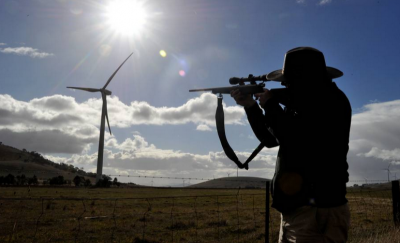
Angry Wind Farm Victims Pull the Trigger: Turbines Shot-Up in Montana and Victoria

Angry Neighbours Shoot-Up Wind Turbines; as Hosts Hit With $Millions in Developers’ Debts

And, it seems, that Community defenders aren’t about to lay down their arms, any time soon; as this story from Ontario attests.

Wind turbine shot south of Wallaceburg
Blackburn News
Matt Weverink
1 January 2016

Chatham-Kent police are investigating an apparent act of mischief at a wind turbine on Mud Creek Line in Dover Township.

Police say it appears someone shot three rounds from a rifle at the wind turbine and officers have been able to locate and seize one of the rounds for forensic examination.

The damages are estimated at $50,000.

Investigators believe the windmill was shot sometime over the past few days, but they haven’t been able to identify a suspect yet.

Anyone with information is asked to contact police or Crime Stoppers.
Blackburn News

shooting turbine

****

Citizens are bound to react against any industry quick to destroy their lawful rights to live in and enjoy their own homes. And they’re bound to react violently when that industry is devoid of any moral compass, let alone human empathy. An industry that openly displays a callous disregard for basic human rights – such as the ability to sleep comfortably in one’s own bed – using its shills to call them “wind farm wing-nuts” and otherwise dismissing or ridiculing their wholly unnecessary suffering – as the wind industry’s parasites do, on a daily basis:

Thai Turbine-Terrorist, RATCH Scores Monumental “Own Goal” during Senate’s Wind Farm Inquiry

If anybody in government still believes that the politics of “renewables” is all about blindly favouring them, then the events outlined in this post and the posts linked above should provide pause for thought.

The warm and fluffy tag “renewables” is used to garner political support for the wind industry – but there’s a distinction between giant industrial wind turbines grinding away in the next paddock at 2 in the morning and solar panels on the house next-door. STT’s yet to hear of a case of anyone unloading their grandpa’s .303 on their neighbour’s solar panels.

While the local police play CSI and investigate a crime scene, it’s clearly arguable – on moral, if not legal, grounds – that what is laid out in the story (and the posts linked above) is conduct aimed at preventing a series of greater – and wholly unnecessary – crimes.

Faced with the threat of sonic torture, smashed property values and the risk of death and injury from collapsing 290 tonne Danish Dervishes, self-igniting turbines and “uncontrolled flying blades” – from the developer’s potential victims’ viewpoint – it could equally earn the tag of community “self-defence”. And self-defence is a complete defence, to all bar murder.

People shooting up turbines and dropping MET Mast are ostensibly acting to protect their homes, families and businesses from an acoustic trespasser (see our post here); and so the “castle doctrine” clearly comes into play.

That doctrine is one of some force and antiquity – it’s been on the books for nearly 400 years, when lawyer and politician Sir Edward Coke (pronounced Cook), scratched it out in The Institutes of the Laws of England, 1628:

“For a man’s house is his castle, et domus sua cuique est tutissimum refugium [and each man’s home is his safest refuge].”

And so, if a few pro-family and pro-community activists have to drop a MET mast here and there, or plug away at the turbines that destroy their right to sleep in their very own homes, to make their point in the active defence of their homes, and the health and safety of their families, it’s action that’s probably excusable and clearly understandable.

And, all the more so, when those that are paid handsomely to protect thehealth and welfare of their citizens, do little more than spin propaganda on behalf of the wind industry – a form of malign indifference, at best.

Many a good revolution kicked off with a handful of hotheads out to make their point, with a few misdemeanors against the property of the powerful; acts quickly deemed ‘threats to civil order’, if not ‘crimes against the state’, by those under threat – with the actors just as quickly rounded up in chains.

In the main, efforts aimed at suppressing the outrage that led the offenders to act, and punishing them for their actions, only added to their fury, and encouraged other, less passionate souls, to eagerly join the fray; and, thereafter, the rest – as they say – “is history”.

storming_the_bastille1-e1318690559144

Infrasound from Wind Turbines is Harmful, in any Language!

Germans Driven from their Homes by Wind Turbine Generated Infrasound

insomnia

****

One of the myths pedalled by Australia’s self-appointed wind farm noise, sleep and health ‘expert’ (a former tobacco advertising guru) is that the known and obvious adverse health impacts from incessant turbine generated low-frequency noise and infrasound are a cooked-up “phenomenon”, exclusive to the English speaking world. Trouble with that little tale is that’s been scotched by the Danes:

Vestas’ Danish Victims Lay Out the FACTS

Denmark Calls Halt to More Wind Farm Harm

And the Germans:

German Medicos Demand Moratorium on New Wind Farms

And the Tawainese:

Winning Taiwanese Hearts and Minds?

And the Turks:

Turkish Court Shuts Down 50 Turbines: Yaylaköy Residents Delighted at 1st Chance to Sleep in Years

Now, back to Germany where – in the video below (it comes with English subtitles) – Heimke and Pieter Hogeveen lay bare their family’s daily despair at being unable to sleep in their very own home.

Ground down by incessant turbine generated low-frequency noise and infrasound, these people have constructed a ‘bedroom’ in their cellar in an attempt to escape their sonic torment; and sent their children to a boarding school in Denmark for the same reason. Clearly fighters, Hiemke and Pieter have enlisted two lawyers in an action against the wind power outfit responsible.

The video features the turbine host responsible for their daily suffering, claiming he suffers no ill-effects. Funny how gag clauses in developer/host contracts seemingly immunize those pocketing their 30 pieces of silver. However, when the hosts are touched with a little human conscience, they tend to tell an incredibly similar story to people like the Hoogevens:

SA Farmers Paid $1 Million to Host 19 Turbines Tell Senate they “Would Never Do it Again” due to “Unbearable” Sleep-Destroying Noise

The Speigel TV report covers the latest German research on turbine generated infrasound; details the tragic story of another farming family (Konrad Saum) who have also been forced to abandon their spacious family home – unable to sleep there due to incessant turbine noise and vibration; and retreating to a tiny holiday unit to escape the sonic torture dished out by 6 turbines neighbouring their farmlet.

Undermining the ‘Green’ spinner, Jaeger’s piffle about infrasound being used as a sinister plot by German ‘anti-wind’ groups (now numbering over 500) to derail his profiteering racket, is the work being done by health and acoustic experts, taking measurements inside homes that show noise and vibration way above and beyond the levels claimed to exist by the wind industry. No surprises there: Three Decades of Wind Industry Deception: A Chronology of a Global Conspiracy of Silence and Subterfuge

****

Why Industrial Wind Turbines, are a Waste of Time & Money!

11 Fatal Flaws with Wind Power

Facts

The wind industry is copping a flogging all over the World. Increasingly, as the industry’s lies and propaganda are replaced by facts, more and more are coming to the obvious conclusion: THESE THINGS DON’T WORK – on any level.

Getting there was only a matter of time.

What has surprised STT is not that journos, pundits and even Global Warming hysterics have sussed the wind power fraud for what it is; it’s that those that previously championed wind power have, instead, joined a chorus calling for serious investment in nuclear power.

Here’s a little ‘paint-by-numbers’ breakdown that reaches that very same conclusion, for much the same reasons.

Top 11 Problems Plaguing Solar And Wind Power
Daily Caller
Andrew Follett
25 December 2015

Despite President Barack Obama’s pocket veto Saturday of attempts to repeal the Clean Power Plan and recent increases in taxpayer support, solar and wind energy are in a tough spot, requiring an estimated $90 trillion of investment to meet carbon dioxide reduction goals.

The fundamental issues of solar and wind power are numerous, so let’s review the top 11.

1: Power Storage Is Incredibly Expensive On A Large Scale

It is currently impossible to economically store power for times when the sun isn’t shining and the wind isn’t blowing. Purchasing enough batteries to provide just three days of storage for an average American household costs about $15,000, and those batteries only last for about five years and are very difficult to recycle.

This is true for home power storage as well, even with the latest batteries. A Tesla power-wall capable of powering a home costs $7,340 to buy. A conservative analysis estimates that a power-wall can save its owner a maximum of $1.06 a day. Such a system would take approximately 25 years to pay for itself, according to the same analysis.

One of the world’s largest and most powerful batteries, located in Fairbanks, Ala., weighs 1,300-metric tons and is larger than a football field. It can only provide enough electricity for about 12,000 residents, or 38 percent of Fairbanks’ population, for seven minutes. That’s useful for short outages, which happen a lot in Alaska, but isn’t effective enough to act as a reserve for solar and wind.

The best way we have of “storing” power is pumping water up a hill, which actually accounts for 99 percent of all global energy storage.

2: The U.S. Power Grid Is Older, And Has Trouble Handling Solar And Wind

“Our power grid works well today. Some complain, but blackouts are rare and large-scale blackout are really rare. The power grid was set up for the [electrical] generation we have. Building a lot of new wind and solar requires much greater expenditure on the grid,” Vice President for Policy of the Institute for Energy Research Daniel Simmons told The Daily Caller News Foundation.

According to the Department of Energy, 70 percent of the transmission lines and power transformers in the country are at least 25 years old.

In order for the power grid to function, demand for energy must exactly match supply. Power demand is relatively predictable and conventional power plans, like nuclear plants and natural gas, can adjust output accordingly. Solar and wind power, however, cannot easily adjust output. They also provide power unpredictably relative to conventional power sources.

On an especially cloudy or windless day, the electrical grid can’t supply enough power from solar or wind alone. Wind and solar also run the risk of producing too much power which can overload and fry the power grid. This is why electrical companies will occasionally pay consumers to take electricity.

3: Rebuilding The Power Grid To Handle Solar And Wind Is Absurdly Expensive

The three power grids that supply the United States with energy are massive and expensive pieces of infrastructure. The power grids are valued at trillions of dollars and can’t be replaced in a timely manner. It takes more than a year to manufacture a new transformer, and transformers aren’t interchangeable, as each one must be individually built specifically for its location. At a time when the U.S. government is more than $18 trillion in debt, building power grids that can handle solar and wind may not be feasible.

Merely building a 3,000-mile network of transmission lines capable of moving power from wind-rich West Texas to market in East Texas proved to be a $6.8 billion effort that began in 2008 and still isn’t entirely finished. Building the infrastructure to move large amounts of solar or wind power from the best places to generate it to the places where power is needed would be incredibly expensive and could cost many times the price of generating the power.

4: Solar and Wind Don’t Provide Power At Useful Times

“Solar is better than wind for providing electricity when electricity is used,” says Simmons. “But during much of the year in, for example, peak electricity demand comes after dark. For example, [on December 17] in California peak electricity demand was at 6pm. But peak solar was at 12:36 and by 6pm, solar production was a zero.”

Power demand is relatively predictable. The output of a solar or wind power plant is quite variable over time and generally doesn’t coincide with the times when power is most needed. Peak power demand also occurs in the evenings, when solar power is going offline. Adding power plants which only provide power at intermittent and unpredictable times makes the power grid more fragile.

5: Solar And Wind Can’t Keep the Lights On By Themselves

Solar and wind power systems require conventional backups to provide power when they cannot. Since the output of solar and wind plants cannot be predicted with high accuracy by forecasts, grid operators have to keep excess reserve running just in case.

But natural gas, coal-fired, or nuclear plants are not simple machines. They can require days to fully turn on from a dead stop. This means that solar and wind power require conventional sources in “stand-by” mode, which means they’re still generating electricity.

Despite this, environmental groups like The Sierra Club still call for “100 percent” solar and wind power.

6: The Best Places For Solar And Wind Are Usually Far Away From Consumers

The places with the highest potential for generating solar or wind power are typically relatively far away from the people who will consume power, according to the Department of Energy. The government agency even maintains maps of how unfeasible long-range transmission can become.

The vast majority of people who use power do not live in deserts or consistently windy areas. The kind of high voltage power lines needed to transport even relatively small amounts of power cost $1.9 to 3.1 million per mile built. Additionally, the kind of “smarter” power systems which can be adjusted to varying energy production created by wind and solar power can cost up to 50 percent more.

7: Solar And Wind Are A Very Small Percent Of The Power Grid Despite Years of Subsidies

“The first 8 months of 2015 wind and solar combined to produce 2.3% of the energy the U.S. consumed. Also wind production is down this year compared to last year,” says Simmons.

Solar and wind have been heavily subsidized since at least the 1970s. In 2010, wind power alone received $5 billion in subsidies, swamping the $654 million oil and gas received in subsides. One in four wind suppliers have gone out of business in the past two years.

In 2014, solar and wind power accounted for only 0.4 and 4.4 percent of electricity generated in the United States, respectively, according to the Energy Information Administration. The total amount of energy created by solar and wind is relatively small even though both systems are heavily subsidized.

8: The Solar And Wind “Low-Hanging Fruit” Have Already Been Taken

The locations where solar and wind power make the most economic sense generally already have a solar or wind power system. Since solar and wind power are only effective in a limited number of locations, “green” power sources are difficult to expand and are simply not practical in some areas.

9: Natural Gas Prices Are Very Low In The United States

Natural gas prices are currently incredibly low in the United States, making it much more difficult for solar and wind power to become cost competitive. Natural gas is already passing coal power as the most used source of electricity. Additionally, natural gas is quite environmentally friendly.

The Department of Energy agrees with research organization Berkeley Earth that “the transition from coal to natural gas for electricity generation has probably been the single largest contributor to the … largely unexpected decline in US CO2 emissions.”

10: Nuclear Energy Has Enormous Potential

The United States just approved its first new nuclear reactor in 20 years. New nuclear reactor designs are much safer and emit less radiation than the coal plants they replace. Nuclear plants take up far less space than wind or solar and do not emit any carbon dioxide.

Recent breakthroughs in fusion could also potentially restart the atomic age when nuclear progress was lauded as a pinnacle of human achievement. Operational fusion power will put most other forms of electricity generation permanently out of business and could occur very soon. Fusion power could easily be “too cheap to meter,” meaning that the cost of generating new power would be below the cost of determining how much power an individual was using, effectively making electricity generation nearly free.

11: Encouraging Wind And Solar Creates Incentives For Massive Corruption

Attempts by governments to encourage solar and wind power have created incentives for corruption even environmentalists acknowledge. The recent Volkswagen scandal illustrates that regulatory attempts to force a specific technology, in this case the adoption of cleaner diesel engines, create incentives that lead to sophisticated cheating by companies. The main incentive of the regulatory agencies is to make rules while avoiding bad publicity, not to actually solve the problem.

The push to encourage “green” systems has already led to serious corruption, such as the Solyndra scandal. Such corruption “crowds out” investment dollars that could be better spent on more workable solutions.
Daily Caller

turbine fire 3

vestas v112

eagle 1

Government Corruption Involved in Falmouth Wind Turbine Issues!

Falmouth Turbines 6 Yrs 110 Db Noise Still Not Inputted In Studies

FALMOUTH TOWN OWNED VESTAS WIND TURBINE 110 DECIBELS OF NOISE HAS NEVER BEEN INPUT INTO A NOISE STUDY -WHY ARE THEY HIDING INFORMATION ?
Falmouth Turbines 6 Yrs 110 Db  Noise Still Not Inputted In Studies

The simple fact is the Town of Falmouth hid a noise warning letter, August 2010, from Vestas wind company that the turbines are 7 decibels over the original studies. The 7 decibels has never been inputted in any studies even now six years later !

The town hid the letter 6 years ago because they would not be able to get Special Permit 240 – 166 to build the turbines. The permit process would require additional studies and notifcations to the residents around the turbines.

The Town of Falmouth has applied for Special Permits for the two turbines that break state noise regulations.

In the following letter Vestas wind company reiterates in writing that the Town of Falmouth had been previously warned the turbine generates up to 110 decibels

The Vestas letter warning to the town in 2010 :

‘The Town has previously been provided with the Octave Band Data / Sound performance for the V82 turbine. This shows that the turbine normally operates at 103.2dB but the manufacturer has also stated that it may produce up to 110dB ‘

More from Falmouth Patch


August 3, 2010
Mr. Gerald Potamis
WasteWater Superintendent
Town of Falmouth Public Works
59 Town Hall Square
Falmouth, MA 02540

RE: Falmouth WWTF Wind Energy Facility II “Wind II”, Falmouth, MA
Contract No. #3297

Dear Mr. Potamis,

Due to the sound concerns regarding the first wind turbine installed at the wastewater treatment facility, the manufacturer of the turbines, Vestas, is keen for the Town of Falmouth to understand the possible noise and other risks associated with the installation of the second wind turbine.

The Town has previously been provided with the Octave Band Data / Sound performance for the V82 turbine. This shows that the turbine normally operates at 103.2dB but the manufacturer has also stated that it may produce up to 110dB under certain circumstances. These measurements are based on IEC standards for sound measurement which is calculated at a height of 10m above of the base of the turbine.

We understand that a sound study is being performed to determine what, if any, Impacts the second turbine will have to the nearest residences. Please be advised that should noise concerns arise with this turbine, the only option to mitigate normal operating sound from the V82 is to shut down the machine at certain wind speeds and directions. Naturally this would detrimentally affect power production.

The manufacturer also needs confirmation that the Town of Falmouth understands they are fully responsible for the site selection of the turbine and bear all responsibilities to address any mitigation needs of the neighbors.

Finally, the manufacturer has raised the possibility of ice throw concerns. Since Route 28 is relatively close to the turbine, precautions should be taken in weather that may cause icing.

To date on this project we have been unable to move forward with signing the contract with Vestas. The inability to release the turbine for shipment to the project site has caused significant [SIC] delays in our project schedule. In order to move forward the manufacturer requires your understanding and acknowledgement of these risks. We kindly request for this acknowledgement to be sent to us by August 4, 2010, as we have scheduled a coordination meeting with Vestas to discuss the project schedule and steps forward for completion of the project.

Please sign in the space provided below to indicate your understanding and acknowledgement of this letter. If you have any questions, please do not hesitate to call me.

Sincerely,

(Bruce Mabbott’s signature)
_____________________
Bruce Mabbott Gerald Potamis
Project Manager Town of Falmouth

CC: Sumul Shah, Lumus Construction, Inc.
(Town of Falmouth’s Wind-1 and Wind-2 Construction contractor)

Stephen Wiehe, Weston & Sampson
(Town of Falmouth’s contract engineers)

Brian Hopkins, Vestas
(Wind-1, Wind-2’s turbine manufacturer, and also Webb/NOTUS turbine)

More from Barnstable-Hyannis Patch
10 Amazon Deals On Accessories For Your New Smartphone
Fire Torches Car, Damages Building in Hyannis
MA Patch’s Top Stories of 2015
This May Be The Best Cape Cod Photo Ever

Click on link to download file

http://www.windaction.org/posts/41357-vestas-raises-concerns-about-turbine-noise-letter#.VDCRCrlMvIU

Windpushers are Harming Residents near Wind Turbines!

Finland: Wind Turbine Study Proves Infrasound Causing a Raft of Serious Health Problems

wind-turbine-and-house-in-Finland

****

Health problems in Finland caused by infrasound from wind turbine
Windwatch.org
4 December 2015
Source: National Wind Watch
Author:
  Tuulivoima-kansalaisyhdistys ry
From the English press release:

Tuulivoima-kansalaisyhdistys (TV-KY) ry – the National Association of Citizens Against Giant Windmills – has recently released an extensive report on the infrasound emissions from wind turbines and their impact on people’s health.

The wind turbines being built in close proximity to residential areas in Finland are the biggest in Europe. Their rotating blades generate low frequency noise and infrasound, i.e. frequent and continuous air pressure pulses that can travel for very long distances.

Low frequency noise refers to frequencies between 20-200 Hz that are audible to the human ear, and infrasound refers to frequencies between 0.1-20 Hz that can’t be picked up by the human ear.

Wind power companies, as well as some researchers, have claimed that “infrasound can’t cause adverse health effects as it is inaudible”. Similarly, we could maintain that radiation isn’t harmful as it is beyond sensory perception.

However, in the summer of 2015 the German Max Planck Institute released a study conducted using a new kind of measurement technology.

Contrary to the well-established view, the study showed that the alarm mechanisms of the human brain are sensitive to very low infrasound that is below the hearing threshold.

The need for a survey conducted by the TV-KY Association arose when a growing number of residents in areas located near wind farms started to report health problems, some of which were serious. The measurements showed that the rapidly changing low frequency noise and infrasound caused by wind turbines can indeed be measured inside Finnish homes.

Low frequencies permeate the structures of buildings and they can be disturbingly distinguishable from background noise, particularly indoors.

Infrasound, on the other hand, can’t be picked up by the human ear, but the residents complain over a great number of symptoms, some of which are serious. The emergence and degree of problems depend on the strength and length of exposure.

In Finland, large scale wind farms have only been constructed for a few years. We don’t yet have any records of the number of people who have had health problems caused by the infrasound emissions of wind turbines.

For this report, we interviewed 12 Finnish families who live in close proximity to giant wind turbines in Finland, and we collected the experiences of 55 people concerning the health impacts of industrial wind power production. Out of these 55 people, 33 suffer from sleep disturbances, 26 from ear problems, 23 from headache, 17 from nausea, 11 from heart problems and 11 from inertia.

In addition to infrasound emissions, the audible low frequency noise of the up to 230 m tall wind turbines is directed with force horizontally away from the rotating blades, both downwind and against the wind.

The massive air pressure pulse, generated by the blades, that varies with 1-2 seconds intervals, produces low frequency noise that isn’t actually directed at the foot of the wind turbine or on the side.

This partly explains why the interviewed residents in areas that are close to wind farms don’t react identically to wind turbine noise, which is at its worst during night time.

In our measurements, we used a microbarometer, an exceedingly accurate instrument for measuring atmospheric pressure. The measurements were carried out in homes that had reported adverse health effects caused by wind turbines. The report presents the noise measurements carried out inside the homes of some families interviewed in the survey. The infrasound emissions from wind turbines were clearly perceivable.

The report describes what types of well-known health problems are caused by infrasound and what kind of mechanisms are involved. In addition to this, the report contains basic information on the infrasound emissions of wind turbines and on how those emissions can be measured.

Download original document (in Finnish): “Tuulivoimaloiden infraäänen aiheuttama terveysongelma Suomessa”

Windwatch.org

insomnia

Wind Energy is NOT Suitable for Prime Time!

The Cruel Hypocrisy: West Drops Wind Power as it Forces ‘Fake Electricity’ on the World’s Poor

Eiffel Tower Night

****

After the Paris Climate Jamboree, the wind industry, its parasites and spruikers are licking their chops at the prospect of having the rich world fund the construction of millions of these things in the dark corners of the Planet. Sensible first world economies have tumbled (albeit, belatedly) to the fact the wind power is patent nonsense.

Paris, aka ‘The City of Light’ has been lit up by nuclear power for over 50 years, and that’s not about to change any time soon.

9-400

Britain has seen the light and has scrapped subsidies to wind power, with the number of threatened wind farms going from a roar to a whimper:

UK Wind Industry Collapses as David Cameron Slashes Subsidies for Wind Power

The Spanish were beguiled for a while by the wind industry’s promises of millions of jobs and free power, in exchange for the €billions in subsidies thrown in hope at the four winds. But, funnily enough, reality has eventually caught up.

Spain slashed its massive wind power subsidy scam back in 2014, with retrospective and crushing effect. Since that change, during the whole of 2014 there was a piddling 27MW of wind power installed (think nine 3MW whirling wonders) and NO new wind power installed during 2015 at all:

Spain Puts its Economy Destroying Wind Industry to the Sword: ZERO MWs Installed in 2015

The wind industry’s Nordic ‘heroes’ have followed the same trend, with ‘investment’ in wind power collapsing this year; and the ‘trend’ means nothing short of inevitable doom:

Wind Power Investment Collapses in Sweden, Denmark, Finland & Norway

nordic wind power investment

And the Germans, early and once eager wind voortrekkers, are back-pedalling fast, as this piece from the Australian shows.

German renewables revolution a ‘lesson in what not to do’
The Australian
Sid Maher
10 December 2015

As he pushes for Australia to rush towards a 90 per cent renewable energy target by 2030, Greens leader Richard Di Natale cites Germany as a “powerhouse” example.

Speaking from the Paris climate conference, his message was clear: Australia’s emissions reduction target is inadequate, coal is a fringe issue in terms of support for cutting poverty in developing countries, and renewable energy is the path to the future. Germany had “become a powerhouse because they’ve embraced the transition towards renewables. It’s jobs rich, it attracts international investment”.

Brett Hogan, the director of energy and innovation policy at the Institute of Public Affairs, says: “Yes, Australia should look to Germany — but as an example of what not to do in the electricity space.” He says Germany’s renewables revolution will cost at least €1 trillion by 2030 (after subsidies to solar and wind), but its electricity system is becoming more expensive and less reliable.

The Economist reported last week that in the first half of this year households in Germany paid €0.30 for a kilowatt hour of electricity whereas the French paid a mere €0.16. It cited a report from McKinsey that said Germany was likely to miss its self-imposed target for reducing greenhouse gas emissions because it had dropped a bid to regulate brown-coal-burning power stations out of existence.

Germany’s use of brown coal could well increase because it is phasing out nuclear power.

Other European countries that have embraced renewables are also less than economic powerhouses. Finland is finishing its fourth year of negative growth and Norway’s economy expanded its fastest pace in three years last quarter largely driven by higher petroleum exports.

One of the key problems faced by any large-scale move to renewables is wind and solar power are intermittent. This is why battery storage is a potential gamechanger. But after the cost of building them, which is subsidised by the government, the marginal cost of generating power is nearly free. This undercuts coal and gas power stations.

“Germany’s major energy companies are now losing billions of dollars each year as subsidised wind and solar power destroys returns on capital and the incentive to invest in more modern, less emissions intensive generators,” Hogan says. He also disagrees with Di Natalie on the future of coal.

“The consumption of coal, to make steel, and electricity, will continue to increase over the next 25 years,” he says.

“With 2.5 billion people expected to move from rural areas to cities in the developing world between now and 2050, coal will continue to be needed to build the homes, factories, roads, buildings and cars that these people are entitled to demand.”
The Australian

Sid Maher’s talk about battery storage being a ‘gamechanger’ and with it, the cost of wind and solar power undercutting conventional generation is childish nonsense.

As we’ve pointed out before – the wind industry’s claims about cost-effective storage of bulk electricity is pure fantasy:

The Patent Nonsense of ‘Storing’ Wind Power Smashed

Even Bill Gates has pointed to the bleeding obvious:

“There’s no battery technology that’s even close to allowing us to take all of our energy from renewables,” he said, pointing out – aswe’ve noted on these pages before – that it’s necessary “to deal not only with the 24-hour cycle but also with long periods of time where it’s cloudy and you don’t have sun or you don’t have wind.”

Germany is re-commissioning coal-fired plant and constructing new coal-fired plant as fast as it can. And, the Germans too have slashed subsidies for wind, with the same halt on wind power ‘investment’ as elsewhere:

Rocketing Power Prices see Subsidies Slashed, Bringing Europe’s Wind Industry to its Knees

By no stretch of the imagination can wind power be called a ‘system’ – it’s ‘chaos’, pure and simple. Here’s the output of Australia’s wind farms connected to the Eastern Grid (a notional capacity of 3,669MW spread over NSW, VIC, TAS & SA) during June.

June 2015 National

With Westerners a wake-up to the wind power fraud, the wind industry is praying on the Third World as its next gullible target.

The real story behind the Paris global warming hysteria is that the wind and solar industries are looking to feast on the $100 billion designed to be ripped from the rich; and purportedly destined for the poor.

But the catch is that the currently unlit homes of Africa and India are going to be stuck with “fake electricity” and deprived of “real electricity”.

poverty india

****

Bjorn Lomborg made the point in a recent piece in The Australian, ‘Politicians in pursuit of the impossible‘, which included this tale about solar power being thrust upon unwilling Indians:

“[D]ishing out solar panels is a poor use of aid money. And it’s immoral that to make up the much-vaunted $US100bn fund, many governments, including Britain and Australia, are diverting money from existing development budgets.

Let’s look at a real-life example of climate aid in eastern India — not one involving governments but the international environmental group Greenpeace. On its website Dharnai Live, we see smiling people and solar-panel-covered roofs, and we’re told that after “30 years of darkness” green energy came to the rescue.

But here’s what really happened: last year, under the slogan “Energy access simplified”, Greenpeace supplied Dharnai with a solar-powered micro-grid — not connected to India’s central grid. Greenpeace writes that “Dharnai refused to give into the trap of the fossil fuel industry”. That is a somewhat loose paraphrasing of what the people who lived there wanted for themselves.

Back in 2010, Dharnai’s inhabitants had collected $US680 in the hope of buying their way into the power grid, which in most of India is supplied by coal-fired power plants. Four years later, still with no electricity, Greenpeace swooped to the rescue with a solar system.

The day the electricity was turned on, the batteries were drained of power within a few hours.

A boy from Dharnai remembers wanting to do his homework early in the morning before leaving to work in the fields, but there wasn’t enough power for the family’s one lamp.

Today, power from the solar system costs up to three times as much as power from the central power grid, and it also requires the use of energy-efficient light bulbs, that cost 66 times more than normal light bulbs.

But fortunately for the people of Dharnai — if not for the Greenpeace narrative — the town today is connected to the central power grid. You see, Greenpeace invited the state chief minister to the inauguration of the solar system so he could meet the grateful inhabitants. When he showed up, he was met by a large crowd of people, with signs and songs demanding “real electricity” (the kind you can use to run the stove and the refrigerator) and not “fake electricity” (meaning solar energy).

A week later, a 100kWh transformer was installed, and Dharnai received modern electricity.

Today, two-thirds of the original recipient households have opted out of the solar-panel scheme, and the rest use it primarily as a backup when the central power grid fails.

This is a part of the story you won’t hear from Greenpeace — but it shows why it’s necessary to question when well-meaning people tell us that dishing out solar panels is a good way to spend development money.

And it points to a broader problem with the state of green energy.

Here in Paris, there are many well-meaning people who argue that we need strong carbon cuts and green-energy production subsidies now and for many years to come, to get the world to move towards tackling climate change.

But at the same time, these same people argue that solar and wind is already competitive and effective, or that this moment is just around the corner. The strange thing is that those two arguments are incompatible.

We are often told that green energy is competitive in developing countries, and particularly Africa. Green energy, especially wind, can indeed help African countries, for example, to get electricity to remote, rural areas.

But that is only a small part of the big picture. As we saw in Dharnai, the grid will do by far the most good for the most people. According to a 2011 World Bank study, renewable energy “will be the lowest cost option for a minority of households in Africa, even when likely cost reductions over the next 20 years are considered”.

Popular solar lights cost almost $US2 per kilowatt hour. Using hydro, gas and oil, the grid cost for the main population centres in Ethiopia, Ghana, and Kenya will likely be US16c to US25c a kilowatt hour. In South Africa, where coal powers 90 per cent of electricity, the cost is just US9c a kilowatt hour.

Green energy costs $US168bn in subsidies right now each year, and by 2040 we’ll be paying even more at $US206bn a year.

However, it is also interesting — and surprising to many — to note that even with these massive subsidies and green policies, doing everything governments are now promising, we’ll get just 2.4 per cent of our energy from green sources in 2040, according to the International Energy Agency.

You really have to put on a pair of green-tinted spectacles to see a world in which renewable energy is about to become competitive or already is.

It is for that reason that the Paris Treaty — to be signed today, if all the talking has gone to plan — will cost a fortune and do very little. Until there is a breakthrough that makes green energy competitive on its own merits, massive carbon cuts are expensive and extremely unlikely to happen.
The Australian

Greed and avarice among wind and solar power profiteers are driving the greatest wealth transfer in history. The concept of forcing electricity on impoverished nations of the kind that can’t be delivered on demand to millions of people, who have none, is not just cruel, it’s criminal.

To force taxpayers in developed Nations to fund such a monumental fiasco, only adds to the obscenity. For a handful of human-hating ideologues to determine that the poorest in the world will never have access to that which we take for granted can’t be explained as good intentions being lost in translation.

The West is abandoning wholly weather dependent wind power, for the obvious reason that it is meaningless as a power source; and, no matter how munificent the subsidies, will never have any commercial value simply because it cannot be delivered on demand.

And yet, the West’s leaders slap themselves on the back for a job well done: US Secretary of State, John Kerry calling what they’ve cynically conjured up “the most extraordinary market opportunity in the history of humankind”. Indeed it is, but for all the wrong reasons.

What Kerry and his ilk are crowing about is using other peoples’ money (ie yours) to enable wind turbine and solar panel manufacturers in America to profit to the tune of $billions, while delivering “fake electricity” to millions of people who are desperately crying out for the real stuff.

india wind farm

Ontario A Laughingstock Due to Wind Turbines & Liberals…

The Insane Cost of Ontario’s Energy Calamity: Consumers Forced to Pay $170 Billion for Pointless Wind Power

Ontario energy mix 2013

Ontario is the place where the most bizarre energy policy in the world has seen thousands of these things speared into the backyards of homes – in the most agriculturally productive part of Canada. When we say “bizarre” we mean completely bonkers.

Canada has one of the “cleanest” power generation mixes on the planet, with the vast bulk of its electricity coming from zero emissions sources such as nuclear and hydro.

Adding to the lunacy is the fact that wind power outfits are guaranteed to reap fat profits despite market conditions.

Where the wholesale market price for power in Ontario is between $30-50 per MWh, wind power generators pocket a fixed price of $135 MWh – even if there is absolutely no market for it and the Province literally has to pay neighbouring US States to take it.

Now, Ontario’s Auditor-General has run the ruler over the insane costs of susbdising an entirely meaningless power generation source, the product of which has no commercial value; save the subsidies it attracts. Not only has Ontario’s energy ‘policy’ destroyed the most productive agricultural communities in Canada, it’s cost unnecessary $billions, with the worst yet to come.

Ontarians paid $37-billion above market for electricity over eight years, Auditor-General’s report says
The Globe and Mail
Adrian Morrow
2 December 2015

Ontarians have paid $37-billion more than market price for electricity over eight years and will pay another $133-billion extra by 2032 as a result of haphazard planning and political meddling, a report from the Auditor-General says. The Liberal government has repeatedly overruled expert advice – and even tore up two long-term plans from the Ontario Power Authority for the electricity system – in favour of political decisions that drove up power costs for consumers, the report says.

What’s more, Hydro One is in rough shape, with ever-increasing numbers of power outages and aging equipment “at very high risk of failing” that needs $4.472-billion worth of repairs – even as the province is selling 60 per cent of the company to the private sector.

The revelations about Ontario’s expensive and aging electricity system were in Auditor-General Bonnie Lysyk’s annual report released on Wednesday.

“We found that the electricity power planning process had essentially broken down over the past decade,” Ms. Lysyk said at a Queen’s Park news conference. “The [energy] ministry has made a number of decisions about power generation that went against the OPA’s technical advice. In addition, these decisions did not fully consider the state of the electricity market or the cost impact on consumers.”

Ms. Lysyk’s report put 14 different government policy areas under the microscope. Among other things, she reported that the province has doled out piles of corporate welfare behind closed doors, gone $90-million overbudget on a flawed computer system for managing social assistance benefits that has resulted in $140-million worth of miscalculated payments, has $500-billion worth of infrastructure that must be fixed and failed to make sure home-care providers look after their patients properly.

But it all paled compared to her criticisms of the government’s management of the electricity system.

By law, the Ontario Power Authority (OPA), which has now merged into the Independent Electricity System Operator, was supposed to provide a long-term plan for electricity that independent regulators would vet. But Ms. Lysyk found that in 2007 and 2011, OPA produced such a plan only to have the Liberals overrule it and make ad-hoc decisions on the system by fiat.

As a result, electricity prices for consumers and small businesses jumped by 70 per cent – from 5.32 cents per kilowatt hour to 9.06 cents – between 2006 and 2014, she found.

The largest part of the reason for that is an increase to Global Adjustment Fees, which for the past decade have paid power-generating companies more than market price for their power as an incentive to set up in Ontario. Those fees amounted to $37-billion between 2006 and 2014, and are projected to add $133-billion from 2015 to 2032.

Energy Minister Bob Chiarelli defended the above-market prices as necessary. Before the Global Adjustment, he said, the government had trouble persuading private-sector generating companies to come to the province. “Wholesale market prices were not sufficient to attract much-needed investment in Ontario’s electricity generation sector. In other words, there wasn’t enough revenue coming to the generators, so they weren’t building generating capacity,” Mr. Chiarelli told reporters.

He said the draft long-term plans that the OPA created and the province killed were too “cumbersome” and did not include enough consultation. When he became minister in 2013, Mr. Chiarelli said, he changed the planning process and created a new type of plan that will manage the system in the future.

“When I arrived as a minister, there was a consensus that [the OPA’s plan] was cumbersome,” he said. “We worked aggressively, consulted aggressively and we introduced legislation that provides a good framework for consultation.”

Mr. Chiarelli also contended that some of the higher electricity prices were a cost of weaning the province off coal-fired power and onto cleaner sources.

But Ms. Lysyk said Ontario pays more for green power than other jurisdictions. Compared to U.S. prices, the cost of wind power in Ontario is double and solar power is more than triple.

The 2010 Green Energy Act, Ms. Lysyk said, failed to take advantage of low electricity prices and instead mandated higher prices for wind and solar power companies than they had received previously. This added up to $9.2-billion more in renewables costs.

In another case, when the government closed a coal-fired power plant in Thunder Bay in 2013, it decided to convert the plant to biomass to keep it going. Energy experts at the OPA told the government the conversion was not cost-effective, but the government went ahead anyway.

Power from the plant now costs $1,600/megawatts per hour, which is 25 times the cost at other Ontario biomass plants, Ms. Lysyk found. Some of the biomass burned at the plant is imported from Europe, which undercuts part of the rationale for keeping it going, which was to help Ontario’s forestry industry.

In a third situation, in January, 2010, the OPA warned the province that the Lower Mattagami hydroelectric project was $1-billion over budget, but the government allowed it to proceed. As a result, power from that plant costs $135/megawatts per hour, compared to an average cost of $46/megawatts per hour for two other recent hydro projects, Ms. Lysyk found.

The province also produces enough extra electricity to power the province of Manitoba, an excess that costs consumers, Ms. Lysyk found. For instance, the province paid $3.1-billion to power generators between 2009 and 2014 for power that was not needed, plus another $339-million not to produce power. The province also paid $32.6-million to exporters to distribute the excess power to other jurisdictions.

Mr. Chiarelli said the government opted for the Thunder Bay biomass plant because of “tremendous economic lobbying” from the mayor and the local mining industry, which wanted a source of power nearby. He said the government is also hoping to create a biomass industry in the area.

“We made a decision to proceed with this particular contract, knowing that it had economic development potential, knowing that it was a reliability issue and a very, very strong comfort level to the mining industry,” he said.

Mr. Chiarelli said the government has made numerous improvements to cut costs out of the electricity system, including a new and more competitive process for handing out green energy contracts. Future projects, he said, would be less expensive than previous ones.

Ms. Lysyk’s criticisms come at a crucial time for the government, as it seeks to privatize Hydro One. The province sold 15 per cent of the company on the stock market last month and is planning to sell 60 per cent in total over the next few years.

Progressive Conservative energy critic John Yakabuski said the government must use a lighter touch with the electricity sector.

“The Wynne Liberals often went against the advice of experts, ignoring the long-term impact of Ontario’s electricity system on its ratepayers for its own short-term political gain,” he said. “Ontario’s energy sector should involve limited intervention by government. It should primarily be left to experts in the sector to ensure a cost-efficient, effective electricity system.”

NDP Leader Andrea Horwath said: “This government has made a mess of our electricity system and a sell-off to the private sector will only make it worse.”
The Globe and Mail

Ontario april-28-protest-rally-3

Government and Wind Turbine Pushers Know They’re Harming People!

White Pines Environmental Review Tribunal update

Report on the ERT Hearing on the White Pines Wind Project – Dec. 11, 2015
By Henri Garand, APPEC

On Day 20 the Environmental Review Tribunal (ERT) on the White Pines wind project heard APPEC witness Rick James and an expert witness for developer WPD, Dr. Dale Strickland.

Mr. James, qualified previously as an acoustician, presented new evidence in reply to Denton Miller, witness for the Ministry of Environment and Climate Change (MOECC). Following new ministry guidelines and omitting disallowed wind turbines T7 and T11, he calculated that 13 “points of receptions” (i.e., homes) would suffer noise above 40 dBA.

Both MOECC counsel Andrew Weretelnyck and WPD counsel James Wilson questioned Rick James on 40 dBA as a measure of serious harm. James said the MOECC had set this compliance limit and the World Health Organization (WHO) had found health effects, specifically annoyance and sleep disturbance, start at 40 dBA.

In re-examination APPEC counsel Eric Gillespie confirmed with James that WHO had reported noise complaints during nighttime begin at 35 dBA.

Dale Strickland, Ph.D., founder and president of Western EcoSystems Technology, a Wyoming consulting firm with business and government clients, has published over 150 scientific papers and technical reports during a 40-year career. The Tribunal qualified him as “a zoologist with expertise in ecological research and wildlife management, including assessing the impacts of wind turbines on wildlife.”

WPD counsel Patrick Duffy asked Dr. Strickland about the appropriate scientific measure for serious and irreversible harm. He said it is based on the overall genetic and demographic status of a species’ population.

According to Dr. Strickland, the White Pines surveys of birds and bats are “adequate,” conform to established methods and published guidance, and are similar to those for other wind projects. Bats would not be high in number without the presence of hibernacula. Acoustical surveys are not necessary because they record bats at ground level and the results do not correlate with bat deaths at wind turbine rotor level.

Dr. Strickland also said the effects on habitat would be minimal. Loss from access roads and other construction is relatively small, and displacement from habitat would not be significant because of the project size.

Regarding collisions, Dr. Strickland predicted 5-15 bird deaths annually per turbine, the same as at other North American sites. He defended the Wolfe Island monitoring records, stating the mortality rates are reasonable for a searched radius of 50m, an area commonly used at other wind projects. Considering the project location and size, he concluded that White Pines would not cause serious and irreversible harm to wildlife.

In cross-examination Eric Gillespie confirmed that Dr. Strickland had not visited the White Pines site but had based his opinions on WPD’s reports and on Google Earth images. Although aware of Prince Edward Point National Wildlife Area and Point Petre Provincial Wildlife Area, he did not know their proximity to wind turbines. However, he dismissed the “globally significant” South Shore Important Bird Area because the IBA designation reflects convenient public access and use of the site for bird-watching.

Dr. Strickland did not know of an “activity report” by the Ministry of Natural Resources and Forests finding five threatened bird species and three bat species in the White Pines area. He agreed with Mr. Gillespie that such information might have influenced his opinions. Similarly, he conceded that if there had not been adequate surveys for karst, then one needed more information to estimate the bat population. He also admitted that the cumulative effects of wind projects must be considered to determine local impacts on birds.

When asked by ERT co-chair Marcia Valiante about a proposed 31ha compensation property, Dr. Strickland said it would have little measurable effect on the populations of displaced bobolinks and eastern meadowlarks.

‘Climate criminal’ blows whistle: ‘It’s just about the money!’


Secretary of State John Kerry told the Paris climate conference that ending all U.S. carbon emissions, or even those in all the industrialized world, would do nothing to impact the climate, leading one of the top critics of the climate-change movement to call the speech additional proof that the effort is all about wealth redistribution.

In another major development, the latest draft of the climate agreement does not include the creation of the International Climate Justice Tribunal, which would have been a U.N. agency that billed industrialized nations for the cleanup of natural disasters around the world.

In Kerry’s address to the conference, he made a push to get developing nations to make major commitments in reducing carbon emissions. However, his comments also gave considerable fuel to those who believe Kerry and others are on a fool’s errand.

“The fact is that even if every single American citizen biked to work, carpooled to school, used only solar panels to power their homes, if we each planted a dozen trees, if we somehow eliminated all our domestic greenhouse gas emissions, guess what? That still wouldn’t be enough to offset the carbon pollution from the rest of the world,” Kerry said.

He took a step further.

“If all the industrialized nations went down to zero emissions, remember what I said all the industrialized nations went down to zero emissions, it wouldn’t be enough, not when more than 65 percent of the world’s carbon pollution comes from the developing world,” Kerry added.

Christopher C. Horner is a senior fellow at the Competitive Enterprise Institute and author of multiple books challenging the basis for the climate-change movement. He is in Paris as an observer at the conference, where he has been branded a “climate criminal.”

Horner said Kerry accidentally lurched toward the truth in trying to implore global cooperation.

“What he’s doing is inadvertently pointing out that this is all pain, no gain,” Horner said. “He won’t admit to the pain. They still say that if the state uses its coercive power and forces you into energy rationing and so on … it still wouldn’t impact the climate.”

Kerry used the hypothetical of zero carbon emissions, which is a far cry even from the hotly contested Obama environmental regulations calling for major carbon reductions by 2030. Horner said the real goals go much further and are plenty frightening.

“They’re talking 70-95 percent reductions in this document,” Horner said. “They really do think that they can bring us back to the renewable age, which we left over 100 years ago because we could. Suddenly we liberated hydrocarbon energy. We didn’t have to live on hydro power or solar power.”

While going back to renewables is the stated goal of climate-change activists, Horner said there’s a good reason we moved away from it generations ago.

“We’re not going back to that,” he said. “We left it. It was a time of much-shortened lifespans, disease, drudgery and mortality, crop failures leading to catastrophe and so on.”

Meanwhile, the scrapping of the International Climate Justice Tribunal marks a win on one of Horner’s highest priorities since he envisioned the panel blaming the U.S. and other advanced nations for the severe weather events throughout the world. It’s a charge he believes would have stuck at the tribunal because signatories at the conference will be expected to confess their responsibility for climate change in any final agreement.

But while Horner is thrilled, he said many others in Paris are not.

“It’s clearly going to leave the greens upset and some countries upset because it’s kicking the can down the road on a few issues,” Horner said.

Persistent sticking points are leading some climate-change activists to call for Pope Francis to come and demand unity in advancing a climate deal. Horner said the pontiff had better be ready for a debate.

“He’s going to couch this in terms of social justice, and as I have mentioned to you, that is truly perverse,” he said. “I’m not saying the pope knows this, but social justice, as they see it, is killing tens of thousands of the most vulnerable in every country.”

Listen to the WND/Radio America interview with Christopher C. Horner:

Horner said the explanation for that charge is simple. Implementing emissions reductions places major costs on energy providers, which pass the costs on to consumers. Soaring utility rates will then impact the poor most negatively and European nations that already do this see people having to choose between buying food and paying to heat or cool their homes.

As for the logistics of the conference and any forthcoming agreement, Horner said officials are twisting themselves in legal knots to avoid this being a treaty since they know Congress won’t approve it.

“The buzz here in Paris is that the U.S. Congress is the greatest obstacle to them obtaining the treaty they refuse to call a treaty,” Horner said. “That means the democratic process. There’s nothing democratic about this. If you allow Congress to get a crack at this, it’s over.

“Under Article II, Section 2 of the Constitution, this would never fly. No free society would ever do to itself what they’re demanding of us,” he said.

Horner is one of seven activists opposed to any deal to have their face plastered around Paris on posters branding them climate criminals. After, first joking that activists could have picked a better picture of him, Horner said there is a message of intimidation involved with the posters.

“It’s getting a little long in the tooth, putting up all the bad guys’ pictures so everybody knows what they look like,” Horner said. “We can play the ‘What if Sarah Palin Did It’ game if you want, but they really want everybody here to now what we look like.”

In the end, Horner said the activists’ definition of climate criminal is really an indictment on those working to preserve freedom.

“We point out the policies, history, that it won’t effect the climate, that’s it’s about a wealth transfer, that it will kill the most vulnerable, that it’s a gesture about clearly what they’re openly acknowledging here – to redesign the global economic system,” he said. “When you point those things out, because they aren’t popular in the United States, you are a criminal.”

Copyright 2015 WND

Read more at http://www.wnd.com/2015/12/climate-criminal-blows-whistle-its-just-about-the-money/#gT60jPdzHOZ7qf8l.99

Frauds, Crooks and Criminals

Demonstrating daily that diversity is not strength!

Family Hype

All Things Related To The Family

DeFrock

defrock.org's principal concern is the environmental and human damage of industrial wind turbines on rural communities

Gerold's Blog

The truth shall set you free but first it will make you miserable

Politisite

Breaking Political News, Election Results, Commentary and Analysis

Canadian Common Sense

Canadian Common Sense - A Unique Perspective from Grassroots Canadians

Falmouth's Firetower Wind

a wind energy debacle

The Law is my Oyster

The Law and its Place in Society

Illinois Leaks

Edgar County Watchdogs

stubbornlyme.

My thoughts...my life...my own way.

Oppose! Swanton Wind

Proposed Wind Project on Rocky Ridge

Climate Audit

by Steve McIntyre

4TimesAYear's Blog

Trying to stop climate change is like trying to stop the seasons from changing. We don't control the climate; IT controls US.

Wolsten

Wandering Words

Patti Kellar

WIND WARRIOR

John Coleman's Blog

Global Warming/Climate Change is not a problem