Infrasound Can Cause Physical Distress, But Authorities Refuse to Monitor It!

Wind Turbine ‘Infrasound’ May Be Making Thousands Sick In UK, US

The windswept Scottish highlands are increasingly becoming home to thousands of wind turbines due to government policies seeking to boost green energy production and fight global warming.

But such well-intentioned policies may be having an unintended side effect: They could be making people sick.

The Scottish Express reported Sunday that the Scottish government has commissioned a study into the “potential ill effects of turbines at 10 sites across the country.” There are more than 33,500 families living within two miles of these turbines, meaning thousands could be getting sick.

Activists warn that “infrasound” emanating from nearby wind turbines are causing people to feel sick. Infrasound is noise that is at such a low frequency, it can’t be heard but can be felt by those nearby.

Former U.K. army Capt. Andrew Vivers has been looking into the issue and was surprised that local authorities were unwilling to accept that infrasound could make people sick, even though it’s a “known military interrogation aid and weapon.”

“When white noise was disallowed they went on to infrasound,” Vivers told the Express. “If it is directed at you, you can feel your brain or your body vibrating.”

“It is bonkers that infrasound low frequency noise monitoring is not included in any environmental assessments. It should be mandatory before and after turbine erection,” Vivers added.

Vivers also noted that there has been an “acknowledged and unexplained increase of insomnia, dizziness and headaches” in the town of Dundee, which is where two wind turbines been in service since 2006.

The Scottish government study has been welcomed by communities that have complained about infrasound sickness, but anti-wind farm campaigners say it doesn’t go far enough.

“On the face of it, it does look like a step in the right direction, but can we really trust it? My issue is that it is not independent enough,” Susan Croswaithe, U.K. spokeswoman for the European Platform Against Windfarms, told the Express.

“Our website is full of examples of people not being listened to,” Croswaithe said. “We have two very large wind farms near us in Ayrshire, Arecleoch and Mark Hill – 60 turbines and 28 turbines.”

“If people in my area have noticed they are feeling better at the moment but do not understand why, it may be because the turbines have been switched off while they do maintenance on the grid,”she added.

But complaints about nearby wind turbines causing sickness have not been isolated to Scotland. U.S. residents have also complained of “wind turbine syndrome” causing headaches and nausea.

A Falmouth, Massachusetts woman was diagnosed with “wind turbine syndrome” by a Harvard Medical School doctor in 2011, after complaining about “headaches, ringing in her ears, insomnia and dizziness,” ABC News reported last year.

Sue Hobart didn’t immediately blame the three wind turbines that were installed 1,600 feet from her home in 2010, but after finding her symptoms went away when she left for vacation, it all started to fall into place.

But Hobar wasn’t the only Falmouth resident to supposedly become sick from wind turbines. Dozens of residents have filed lawsuits, arguing that three 400-foot tall wind turbines have been causing them to get sick.

Before Hobart was diagnosed with wind turbine syndrome, New Jersey state lawmakers proposed legislation outlawing the construction of wind turbines within 2,000 feet of residential-zoned land. The bill was championed by some coastal communities, but derided by environmentalists who want to see more green energy generation.

State Sen. Sean Kean introduced the bill after hundreds in his district turned out to protest a “proposed 325-foot windmill by Department of Military and Veterans Affairs at the National Guard training center in Sea Girt,” which residents said could “threaten birds, cause noise, pose health risks and decrease property values,” reports NJ.com.

So can wind turbines really make people sick? Wind turbine syndrome is not recognized by the Centers for Disease Control and Prevention. An expert Medical panel in Massachusetts was reported to have found “insufficient evidence that noise from wind turbines is directly… causing health problems or disease.” However, research shows that “human response to wind turbines relates to self-reported ‘annoyance,’ and this response appears to be a function of some combination of the sound itself, the sight of the turbine, and attitude towards the wind turbine project.”

Other state health departments and medical review panels have also concluded that there are no direct health impacts from wind turbines.

But complaints of sickness from wind turbines keep cropping up across the world as government policies cause wind farms to sprout up in places where they previously were not.

Industrial Wind Projects are Falling Out of Favour, and for Good Reasons!

As the tide turns on wind farms in Northumberland, we look at what is causing the wind of change

A growing number of wind farm proposals in Northumberland are being refused amid an apparent turning of the tide…

 
Wingates in Northumberland where a wind farm community fund has not been set up as agreed with wind farm developers.

You don’t have to go back too far to a time when you couldn’t open The Journal without reading about residents Northumberland begging for mercy from an onslaught of wind turbines.

People in the county adopted a siege mentality as figures time and again proved that they were being made to live with more wind farms than elsewhere in the country. Planning application after planning application seemed to be nodded through despite their desperate pleas.

Indeed new figures from Northumberland County Council show that the authority has approved 80 out of 98 wind related proposals in the last three years.

In 2012, Dr James Lunn, who was involved in a fight to halt plans for generators near his Fenrother home, not far from Morpeth, said: “We need both a national and Northumberland policy to protect settlements, because we can’t rely on the county council planning department to protect us.

“They seem to believe there is no upper limit for the number of wind farms that can be considered.”

Back to the present and the wind of change seems to have blown through the whole vexed issue on onshore wind.

Only recently proposals for wind turbines at Dr Lunn’s village, at a site close to the Duddo Stone Circle and Flodden battlefield have been rejected or approvals quashed.

And the brakes are being applied by the Government, namely the Department of Communities and Local Government.

Another scheme at Rayburn Lake has also been recommended for refusal by council officers although a decision has been deferred.

But what is behind the turning tide? Is it a recognition that Northumberland has had enough as residents would argue?

Or is it as a growing number of commentators in the industry believe, politics at play?

Many believe that the DCLG and its boss Eric Pickles is acting out of a desire to appease rank and file Conservative voters, who rightly or wrongly are associated with an anti-wind stance.

The minister created the new planning guidance, so sought by Dr Lunn, which decreed that the importance of renewable energy should not automatically override the views of communities.

Mr Pickles himself issued the final say on appeal decisions – including Fenrother and the Flodden scheme – in order to ensure that guidance was being followed.

Those behind the wind farms are becoming used to disappointment.

Jennifer Webber, spokesman for RenewableUK, the self proclaimed voice of wind energy, said: “The vast majority of people in the North East support more onshore wind with polling last year finding that three quarters of people in the North East would support more wind farms in the area they live.

“Polling consistently shows that people are in favour of onshore wind, so it’s unfortunate that the secretary of state for communities and local government is trying to block schemes, based on a misguided belief that such an approach will be popular with voters.

“Each megawatt of installed onshore wind brings in £100,000 of income to the local community over its lifetime, and it’s a shame communities are missing out on this.”

The organisation’s claims about the popularity of wind will no doubt surprise its opponents in the wide open spaces of the North East.

The claim that Mr Pickles is seeking to appease his voters is disputed by one Conservative in Northumberland.

Longhorsley Councillor Glen Sanderson at Wingates in Northumberland where a wind farm community fund has not been set up as agreed
Longhorsley Councillor Glen Sanderson at Wingates in Northumberland


County councillor for Longhorsley Glen Sanderson, who was a vocal opponent of the Fenrother scheme, said: “I think that would be far from the truth, it is not just Conservative voters who feel strongly about the impact that wind farms have on our very sensitive parts of the country.

“It is not just Conservatives, it is visitors to our county and people who enjoy the beauty around them.

“It is not a political point at all.”

The councillor believes, not unsurprisingly, that his minister, has accepted the argument often made in Northumberland that the perceived desecration of the countryside must stop.

“It is a question of getting to grips with reality and understanding we only have one beautiful countryside and that government has a duty of ensuring that natural beauty is preserved.

“The government have listened to the people, not just Conservative voters.”

Dr Lunn feels the government is partially motivated by the desire to “win votes.” Yet he also believes the wind of change is inspired by acknowledgement that turbines are not benefiting the environment or the economy.

“I think there is a current nail in the coffin for large scale onshore wind farms both at local level and at national level.

“Both for political reasons in winning votes but also for the sheer fact is it not helping the country’s economy.

“Wind power was sold on the fact it was sustainable for the environment but it does not provide sustainable communities if not everyone likes it.

“It does not provide a sustainable economy if not everyone can afford it.

“It is no longer a sustainable green form of energy. Regardless of which political party is in power they can not argue it is a sustainable way to take the country forward.”

Dr Lunn does not fear a revival in the wind industry under a different government.

“I am not particularly concerned, it is seen as a vote winning policy. These things take five years from start to finish, regardless of who wins the next election you have got to look five years into the future.”

The Labour party has indicated it would allow decisions on planning applications to be made at local level if elected, hitting out at the Conservatives for allowing so many decisions to be made by the government.

The party believes this “reverse localism” could come back to bite Northumberland in the fracking debate.

Councillor Scott Dickinson, the new County Council Business Chair for Northumberland, at County Hall, Morpeth


Scott Dickinson, a party county councillor in Northumberland and parliamentary candidate for Berwick, said: “I’m uncomfortable that a Conservative secretary of state is making decisions about what’s best for North Northumberland rather than local people.

“Northumberland Conservatives seem to be happy to allow ‘reverse localism’ but I’m worried that this is a precursor to the ‘fracking debate.’

“If a secretary of state is intervening to halt planning applications for wind farms then what happens when communities want to stop ‘fracking’ in their backyard when its government policy to support ‘fracking’?

“Will he intervene to overrule local concerns.”

Coun Sanderson however argued the government has shown it will listen to local people on wind and would similarly do so with fracking.

Villagers from Fenrother, near Morpeth, celebrate plans for a Wind Farm at the village being refused


“You just need to go back to a recent one in Fenrother where thousands of people were prepared to put their names against that proposal.

“If the same thing happened in Northumberland about fracking, I think the government would be forced to consider their position on that as well.

“I am absolutely convinced that localism has a part to play in all planning matters and I think the government has shown they have listened in their change of line on onshore wind farms.

“Otherwise they can not be a directly responsible government.”

In addition to the potential for fracking, Dr Lunn believes the loss of momentum could see an increase in applications for solar power, with a preliminary application for 160 acres at Bellingham already lodged.

Yet he believes wind will remain in the mix through small projects of one or two generators and domestic farm turbines, which he feels will became even more prevalent as doubts grow among landowners over large schemes.

It will be Interesting to see if Student’s Results Match up with those of the Wind Industry.

Luther College studying wind turbine’s impact on local bats

 
Tuesday, August 26, 2014 8:07 AM
Luther students Mariah Crotty and Andrea Malek are working with Dawn Reding, Luther visiting assistant professor in biology, using several methods to survey bat populations and estimate bat mortality caused by the sweeping rotor blades. (Submitted photo)
 

Wind energy is becoming a prominent feature of both economic and visual landscapes across the United States. Wind turbines, like the one here in Decorah, are a sustainable energy resource, and help keep our air clean by reducing greenhouse gas emissions. But what effects do they have on the local wildlife, and how can any threats be minimized?

This summer, the Luther College Biology Department is investigating the Luther College wind turbine’s impact on bats. Dawn Reding, Luther visiting assistant professor in biology, and students Mariah Crotty and Andrea Malek are using several methods to survey bat populations and estimate bat mortality caused by the sweeping rotor blades.

Three acoustic monitoring sites have been set up around Decorah to learn more about species presence and abundance, and the researchers are conducting daily searches around the turbine to look for bat carcasses. Eight species have been detected in the area, and each detector has recorded from 50 to 600 bat calls per night this summer. Although a few carcasses have been found beneath the wind turbine, additional monitoring and analysis will be necessary to better estimate the turbine’s impact.

Bats are a very important part of the environment, and eat annoying insects, with some species eating 500 to 1,000 mosquitoes in a single hour.
With their work, the researchers aim to learn more about the bats in northeastern Iowa and provide information needed to lessen human impact on the area’s wildlife.

For more information on their research or to follow their results contact Professor Reding, redida01@luther.edu.


Residents File a “Class-Action” lawsuit, to Block Wind Turbines!

Residents File Class-Action Lawsuit to Block

Wind Turbines Near Kingfisher


p. 17


p. 18


Seven landowners filed a class-action lawsuit this week to prevent wind turbines from being built near their homes in Canadian and Kingfisher counties.

In the complaint, which is embedded above, the landowners claim that planned wind farm projects controlled by Virginia-based Apex Clean Energy would create a nuisance, devalue their property and adversely affect their health.

The landowners who brought the lawsuit all live within three miles of the planned wind farm, and, in many cases, own property within the “no-build” zone of the planned locations of the 500-foot-tall turbines. From the complaint, with bullets added for readability:An organization that opposes wind projects in the two counties, the Oklahoma Wind Action Association, brought the lawsuit on behalf of the landowners. The suit was filed Aug. 27 in the U.S. District Court for the Western District of Oklahoma.

  • … Industrial Wind Turbine manufacturers recommend a minimum setback or safety zone of three (3) times turbine height—in this case fifteen hundred (1500) feet—between any home and an Industrial Wind Turbine for safety purposes in case of catastrophic failure of one or more components, not to protect against adverse effects resulting from noise.
  • As a result, Industrial Wind Turbines, by their own safety standards, create a de facto “no-build” zone in a fifteen hundred (1500) radius surrounding the Turbine. In many instances, this “no-build” zone overlaps with the property of landowners who have no agreement with Defendants.
  • This invasion of Plaintiffs’ right to use and enjoy their property requires Defendants to obtain an easement from the landowner that restricts their ability to construct upon any property within the fifteen hundred (1500) feet of the Industrial Wind Turbine. Otherwise, Defendants’ Industrial Wind Turbines will interfere with Plaintiffs’ ability to use their property as they wish safely.
  • Defendants have undertaken no effort to obtain such easements and Plaintiffs will be left with a cloud upon their titles.

The wind energy industry is booming in Oklahoma, which was the country’s fourth-largest wind-power producer in 2013. But there has been consierable resistance to some wind farm projects, including the Apex projects planned for Canadian and Kingfisher counties.

In December 2013, officials in the nearby city of Piedmont approved an agreement with Apex to settle a heated, year-long fight to block wind farm construction near the city. Officials in Kingfisher, too, are negotioating with Apex on a similar setback agreement, according to the lawsuit.

On Sept. 11, the Oklahoma Corporation will hold its first public meeting to discuss potential statewide rules for the wind energy industry, an action requested by Sen. President Pro Tempore Brian Bingman, R-Sapulpa, which was spurred by vocal opposition to proposed wind farm projects in Osage and Craig counties.


Even the “Slower” Aussies, are catching on, to the fact that Wind Turbines are Useless!

How the Public Are Deceived About the True Cost of the Mandatory RET

sprinter_2248190b

The Australian Financial Review – as one of the lefty Fairfax stable – “drank the Kool Aid” early and happily ran with the wind industry’s narrative that having Australia bristle with giant fans is a sure-fire way of cooling mother Earth; that wind power is free; and that the mandatory RET is public policy at its best.

In short, the AFR has been a faithful outlet for wind industry spin and propaganda. Regurgitating an endless stream of Clean Energy Council (CEC) press releases; and giving the likes of Infigen (aka Babcock & Brown) free rein to spruik about the “wonders” of wind – never questioning, let alone challenging, the wild and fantastic claims made about lowering retail power prices (all while “saving” the planet, of course) – it’s been a serious media outlet of choice for the wind industry and its parasites.

Until now.

In the last few weeks there’s been a seismic shift in the AFR’s approach to the imminent demise of the mandatory RET. Faced with an increasing barrage of hysterical claims about the world ending if the RET gets the axe (by the likes of the CEC and Infigen’s Miles George) the AFR’s journos and editor have finally opened their eyes to the greatest rort of all time. And, to the horror of the CEC and its taskmasters, they’ve stopped buying the myths and mis-information pitched up by Infigen & Co.

Phil Coorey’s piece on how Tony Abbott, Joe Hockey and Mathias Cormann have joined forces to bring an end to most ludicrous policy ever devised sent the wind industry into a state of panic (see our post here).

Since then, the AFR has followed up with a terrific piece from Alan Moran and an editorial calling the mandatory RET flawed and unsustainable (seeour post here) – and a detailed analysis of the inherent flaws and failings of the RET by crack energy market economist Danny Price (see our post here).

With the AFR turning on it, the wind industry must know its days are numbered.

The AFR continues its recent trend with this fine piece of work by Ben Potter and another terrific editorial that strip away the myth that the mandatory RET is a benign piece of “climate change” policy which won’t cost power consumers a thing.

Renewable energy lobby’s shell game
Australian Financial Review
Ben Potter
25 August 2014

shell-game2009Mar06

The renewable energy lobby employs a neat trick to show that billions in subsidies for the costliest forms of electricity can lower power prices.

Wind and solar power costs between 1½ and 10 times as much to produce as power from coal and gas. But the vagaries of the National Electricity Market allow the renewables sector to claim that it lowers prices – even if it imposes costs on consumers elsewhere.

In a shell game, a conman quickly moves around three shells on a table or mat and his buddies pressure passers-by to bet which one contains a pea.

The pea under the shell is $37 billion of renewable energy certificates (RECs) that electricity retailers will buy from renewable energy generators or generate themselves between now and 2030 if the renewable energy target scheme isn’t changed.

“It’s misleading, because the subsidy is the REC, and the REC certificate is acquitted at the retail level and is included in the retail price of electricity,” Origin Energy chief executive Grant King says.

The renewable energy target has helped drive installations of 52 wind farms and 1.3 million solar roof-top systems – about one-eighth of total capacity – since 2001, Bloomberg New Energy Finance says.

The NSW Independent Pricing and Regulatory Tribunal estimated the cost of the renewable energy target to the average household in 2013-14 at $107 – about 5.3 per cent of a typical $2012 bill.

It is now under review by a panel headed by businessman Richard Warburton, who is sceptical that human activity is causing global warming.

Because the price of RECs is about the same as the electricity price per megawatt/hour, renewables generators are deriving as much revenue from selling RECs as they are from selling power to the National Electricity Market.

“All it is is a tax on existing producers which is passed onto existing consumers,” says Tony Wood, head of the energy program at the Grattan Institute.

“No one denies, when they are asked the right question, that renewable energy costs more than fossil energy.

“The only question is who pays for it? And right now it’s a combination of consumers and fossil generators who are paying for it, and you’ve got to question is that the right policy?”

The RET’s costs are buried in ACIL Allens’ modelling for the RET review and a report issued by the Climate Institute last week.

Most of the costs are REC costs. Deloitte Access Economics in a report for business groups estimates the net present value of REC transfers to the renewables industry over 2015-30 at $17 billion, compared with $8 billion to $9 billion if the RET is closed or the target is wound back to a true 20 per cent of energy supplied.

When REC costs are included, retail bills are higher until at least 2020, after which opinions diverge.

ACIL Allen and the Climate Institute find that continuing the RET on its current path lowers household power bills by as much as $80 a year from now to 2030, despite swelling bills between now and 2020. Deloitte, using different assumptions about capital costs, falling demand and market responses, finds retail bills higher after 2020 as well.

The Climate Institute report shows the high long-run marginal production costs of solar and wind power – which include capital costs – relative to coal and gas. Coal and gas power come in at about $60 to $80 a megawatt hour in the eastern states, wind at $88 to $544 a megawatt hour and solar at $128 to $1533 megawatt hour.

But when it comes to bidding in the National Electricity Market, wind and solar clean up because they have zero short-term marginal costs (in the short term, capital costs are less important). Wood argues they even have negative short-term marginal costs because they need to produce energy to sell RECs.

The rising RET target forces renewables into the NEM, even though electricity demand is shrinking and no more capacity is required. Those factors combine to suppress wholesale prices, which have dipped below $40 a megawatt hour.

That in turn squeezes profits and market share for coal and gas generators, which have to cover their fuel costs, at peak times when they used to make their profits. Retailers then have to buy or generate renewable energy certificates to cover the renewable energy target – currently about 10 per cent, rising to about 28 per cent by 2020. The REC cost goes into the retail price.

If that cost is less than the wholesale price suppression, the consumer wins. But it’s a fine call, says Wood.

The RECs subsidy costs about $29 billion in net present value economic activity, 5000 jobs and $1260 in average annual earnings. This comes from more costly investments in renewables, which Deloitte says raise power prices and suppress resources, jobs and demand in other sectors.

Erwin Jackson, deputy chief executive of the Climate Institute, says such losses are more than offset by the benefits of emissions reductions under the RET.

A Climate Institute report released last week puts a much lower $2.7 billion economic cost on the RET. It finds it lowers household power bills after 2020. It values the social benefits of emissions cuts at $19 billion, based on a $24 to $50 a tonne social cost of carbon. Mr Jackson said this was almost certainly an under-estimate but “you have to factor it in, otherwise it’s a one-sided model and you are assuming climate change doesn’t exist.”

He admitted it was only an estimate of the RET’s contribution to global climate change efforts – offset by emissions increases in large emerging economies such as China and India – rather than any quantifiable benefit to Australia.

But it was the “best tool we have” to “open up the conversation” to considering the benefits of reducing emissions.

“What they’ll talk about very carefully is the cost to consumers, and they’ll show the cost to consumers is either slightly favourable or not much different – therefore ‘isn’t this a reasonable price to pay for renewable energy?’” Wood says.

“What they are very careful not to say [is] ‘what’s the cost to the Australian economy?’ because the cost to the economy includes the negative cost to the existing generators.

“To say that the renewable energy target is a small impost to consumers is the right answer but it’s the wrong question. The right question is ‘what’s the economic impact of the RET?’ and the economic impact of the RET is negative.”

The RET is a costly way to cut greenhouse gas emissions. Its price of abatement is $54 to $186 a tonne, up to eight times the recently abolished carbon price, ACIL Allen modelling for the RET review finds.

A cheaper – but politically tricky – way to reduce emissions to would be to return to a technology neutral carbon price signal.

The difference between Deloitte’s estimate of the REC cost savings from winding back the RET to a true 20 per cent and closing it – $9 billion – is similar to the $10 billion “additional profit” for coal and gas generators – such as Origin and EnergyAustralia – claimed by the Climate Institute report.

“It’s not that they’re better off because the RET was removed. It’s that they’re worse off because the RET was introduced,” Wood says.

Tim Sonnreich, strategic policy manager at the Clean Energy Council, an industry body, accepts that there’s a substantial wealth transfer from incumbent generators to renewables generators.

“We are not denying that,” Sonnreich says. “But it’s a wealth transfer that’s in favour of consumers so we would have thought in a political sense that’s a pretty popular one.”
Australian Financial Review

A valiant effort there from the CEC, as its spin master plays the shell game and otherwise attempts to turn night into day.

The mandatory RET sets up the greatest wealth transfer in the history of the Commonwealth. However, it’s not – as the CEC asserts – one that power consumers are going to thank their political betters for. That transfer – which comes at the expense of the poorest and most vulnerable; struggling businesses; and cash-strapped families – is effected by the issue, sale and surrender of RECs. As Origin Energy chief executive Grant King correctly puts it:

“[T]he subsidy is the REC, and the REC certificate is acquitted at the retail level and is included in the retail price of electricity”.

It’s power consumers that get lumped with the “retail price of electricity” and, therefore, the cost of the REC subsidy to wind power outfits. Between 2014 and 2031, the mandatory RET requires power consumers to pay the cost of issuing 603.1 million RECs to wind power generators. With the REC price likely be at least $65 (by 2017) – and tipped to exceed $90 – the wealth transfer from power consumers to the wind industry will be somewhere between $40 billion and $60 billion, over the next 17 years (see our posts here and here).

Here’s the AFR’s editor in response to the wind industry’s latest efforts to spin its way out of trouble.

Models can’t hide true RET cost
Australian Financial Review
Editorial
25 August 2014

Studies relied on by the renewable energy lobby to justify the continuation of the Renewable Energy Target make a lot about noise about the RET’s effect on the wholesale price of energy. But as shown in this newspaper today, force feeding up to 30 per cent renewables such as wind and sun-generated electricity into the power grid may put downward pressure on wholesale prices amid weak demand by artificially boosting supply. But the effect of forcing more power into the system will then show up in other ways: by increasing retail prices through the cost of renewable energy certificates. Those increased prices will reduce gross domestic product, by depressing productivity and by pushing up prices and costs elsewhere in the economy. That is, it is a highly expensive way to reduce emissions.

As previously discussed in this newspaper, an ongoing review of the RET led by Dick Warburton to make recommendations about winding back or even ending the scheme has resulted in considerable argument over the scheme’s effect on the electricity markets. These arguments include contradictory findings by computer modelling groups, with the RET lobby relying on studies pointing to the effect of dumping a lot of additional capacity into the wholesale market at a time of stagnating demand. However, as the coverage in today’s Financial Review notes, retailers still have to buy the Renewable Energy Certificates required to meet their obligations under the RET from the renewable generators, and that is expected to cost $37 billion between now and 2030, or as much as the electricity itself. That is $37 billion that must be reflected in higher prices elsewhere.

The arguments over the Renewable Energy Target show just how deftly skilled lobbyists can distort the debate, but we should not lose sight of the fact that the RET in any form will cost many billions of dollars in return for an hypothetical social benefit of the carbon emissions being offset.
Australian Financial Review

dirtyrottenscoundrelsoriginal

The Truth About Wind Turbines….A Victim’s Testimony!

Victims of industrial wind
 

We are “Victims of Industrial Wind” (which is also the name of our open Facebook group, with members from around the world).

We are the Therriens of Sheffield. Many already know our story. We own 50 acres abutting First Wind’s Sheffield project. We have spent more than 18 years living here, cultivating a beautiful sugar bush. Yes, we live off grid. Yes, we live near the Interstate. The interstate is quiet at night, unlike the wind turbines that make noise 24/7 more often than not. The Interstate also does not make a repetitive obnoxious noise that wakes you then keeps you awake, night after night.

We did not oppose the industrial wind power plant at any stage. From proposal to construction, we had no idea what to expect so we were not about to judge.

We never once harassed any employees working on the project nor with First Wind. Not until the project began operating, only when we experienced the noise first-hand, did we begin to understand and wonder just what we were facing. About six months in, we started to realize the project was affecting us. Less than one year in, everything started to add up for us, correlating the connection between the sounds and how we felt. We hardly could believe it was true until we started reading up on wind turbine syndrome. This syndrome is real, too darn real. The exact same symptoms are echoed worldwide.

These facts about wind turbine noise and health have been known for a long time and totally ignored by our federal and state governments. These elected people who are in charge of protecting the public have chosen to blindly believe the big wind developers, while turning a deaf ear to towns and residents to be impacted for the good or bad by industrial power plants.

Health studies should have been done before big wind turbines were put close to people, but they weren’t. Instead we get literature reviews done by people with financial ties to the wind industry who claim there are no “direct” health effects. It has also been spread far and wide that anyone who opposes clean green energy (laugh) is a NIMBY (not in my back yard) or that people are only seeking financial gain by falsely claiming to being negatively impacted.

Positive outcome studies are funded by industrial wind, and they get to hand-pick their experts. The nonpositive studies are done by honest hard-working individuals who face public persecution and possibly the loss of their jobs if they go public with their negative findings.

Just ask Dr. Henrik Moller of Denmark, a highly respected academic noise researcher who was fired after exposing the Danish government’s role in covering up the health risks caused by wind turbine noise pollution. Kind of says a lot right there, doesn’t it?

Even with all this information, no precautions were taken to prepare in advance to rectify any problems that may arise. Various problems have arisen, and yet they are still largely ignored because no one knows how to solve any problems pertaining to industrial wind power plants. We hear “this is all new to us.” Well, it is old hat to us.

The Public Service Board has held hearings and workshops to hear both sides of the story. Now you would be led to believe that both sides would be given equal time to be heard. No, that couldn’t be further from the truth. The developers’ side has gotten most of the time while attending victims have to sit and be further insulted and mistreated in the process and are lucky to speak at all. We attended the PSB’s Morrisville workshop and will never participate in another unless it is to protest. It was that much of an insult.

So here we are nearly three years into this nightmare and no closer to a resolution then we were on day one. We had asked First Wind to buy us out for $150,000. This prompted a meeting where we were told of a possible option to pay us $45,000 for our house and two acres, but it was not an official offer. This is what we were told: “It’s what I think I can do so it’s not as though it’s First Wind’s thing.”

Yeah, right, the head of safety and compliance out of Boston is not about to stick his neck out with talk of a “possible option” if he hadn’t already had some kind of approval. We expected to be low-balled but not to this extreme.

It seems they are well schooled in the art of approaching a town, making promises that the project will cause no harm — while quietly buying/paying off select home/land owners because they know there will be harm. The paid-off residents have signed nondisclosure agreements so they cannot say one word against the project. The developer then sits back after construction and waits for surrounding residents to become so desperate to move they will sell at almost any price. Then try to act like a good neighbor by offering a possible option at a ridiculously low insulting price. And they wanted us to sign a nondisclosure for this pittance.

Luann Therrien lives in Sheffield.

Time to Put an End, to the Renewables Scam!!! Aussies to Axe the RET!

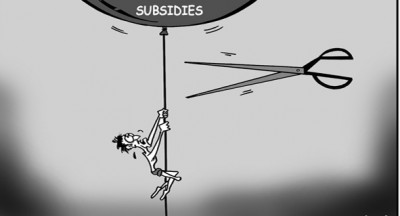
Lost In Translation: How a CO2 Abatement Scheme Became “Corporate Welfare on Steroids”

subsidies

Time to remember the original aim of the RET
Australian Financial Review
Danny Price
21 August 2014

The RET was intended to cut carbon. Opening it up to more forms of efficient generation would help get that result.

The debate over the renewable energy target has ended up exactly where you would expect a debate on subsidies to end up. The beneficiaries of the subsidy are taking the high moral ground while those adversely affected by the subsidy are crying foul.

We see similar debates in the agricultural sector. Australian farmers complain they face unfair market conditions because the international farmers they compete with have the protection of subsidies, while our government provides none.

In this case, the coal-fired generators claim they are finding it hard to recover their costs on existing investments while the renewable generators who earn a subsidised return, claim their future investments are threatened.

Both arguments are founded on the same concept – investment certainty.

What has been lost in all this debate is the original objective of the RET. The renewable industry has focused on the benefits it brings to customers by suppressing the price coal and gas generators can charge customers. But as PJ O’Rourke once observed about the US health system, “If you think healthcare is expensive now, wait until you see what it costs when it’s free.” The economic costs of lowering the wholesale price charged by thermal generators by subsidising renewable generators will be enormous.

The renewable energy sector has cleverly confused the concepts of economic costs, which are the costs of the resources used to produce renewable energy, with prices. They do this to disguise the real cost impact of the RET on the economy and to make themselves a smaller political target.

RET never about pricing

The goal of the RET was never about suppressing prices, but this is now the cause célèbre of the renewable industry because they know this will appeal to politicians looking to reduce electricity price pressure. The RET was aimed at encouraging a reduction in greenhouse gas emissions by actively promoting the, then-fledgling renewable industry.

The debate about the RET really should be re-focused on how we can achieve our environmental targets most economically. If we can minimise the costs of reducing emissions, then it follows that we are more likely to reduce emissions further, which Australia will inevitably be pressured to do at the Paris round of climate negotiations in late 2015.

More recently the renewable generators claim they are now cost-competitive with thermal generators. While these claims are probably overstating the relative economics of the thermal versus renewable generation, there is certainly less need to continue to subsidise investors in renewable generators as the RET has done its job in developing a local renewable industry. It is now time for the renewable industry to face competition and this competition should lead to lower economic costs and lower consumer prices.

This could be achieved by progressively levelling the playing field between all potential sources of electricity supply and demand so that all technologies can compete to supply emissions reductions.

Recent analysis of the opportunity to reduce the economic costs and price impacts of the RET by making it more technologically neutral, for example by allowing gas generators to compete with renewable generators and create partial credits under the scheme to reflect emissions abated, has shown that this approach can simultaneously reduce the economic cost of the RET by more than $1 billion and reduce prices for customers by more than $50 a year. This cost could fall further if other forms of cleaner generation could also compete vigorously with gas and renewable generators.

Part of the reason that this cost and price reduction occurs is that it makes use of existing gas capacity that mostly sits idle that could compete with coal under a more technologically neutral RET. This approach of broadening the RET to allow a wider range of technologies to compete to supply emissions reductions, is one of those rare no-regrets policies.

Competitive pressure

If no technology is able to compete with the renewable technologies (for example due to the risk of rising gas prices) then the worst thing that would happen is that wind generators would continue to be built. The only complaint that the renewable industry could have against such a proposal is that they would be subject to more competitive pressure.

With lower costs and prices from such a transformation of the RET, the government could afford to leave the target where it is and rely on the transformed RET to do more work to contribute towards the achievement of Australia’s emissions reduction.

Unfortunately, the only beneficiaries from such a transformation of the RET are customers and the economy and, sadly, there is nobody to advocate for these stakeholders in the current RET debate.

Danny Price is managing director of Frontier Economics.
Australian Financial Review

When Danny Price says: “The economic costs of lowering the wholesale price charged by thermal generators by subsidising renewable generators will be enormous” he’s playing as the master of understatement.

As Liberal Member for Hume, Angus “the Enforcer” Taylor has repeatedly pointed out, the mandatory RET is nothing short of “corporate welfare on steroids” (see our posts here and here and here).

Putting aside the hidden costs of providing fossil fuel back up to cover the occasions when wind power output plummets every day – and for days on end (see our post here); putting aside the need for a duplicated network to carry wind power from the back blocks to urban markets (seeour post here); putting aside the cost of running highly inefficient Open Cycle Gas Turbines to cover wind power “outages” (see our post here), the cost of Renewable Energy Certificates and their bedmate – the mandated shortfall charge will add a minimum of $39 billion, and – if the price of RECs reaches $100 (as is forecast under the current RET of 41,000 GWh) – up to $60 billion, to power consumer’s bills over the next 17 years (see our post here).

As Danny Price points out, the original purpose of (and justification for) the mandatory RET was the cost-effective abatement of CO2 emissions in the electricity sector. So Australian power punters – lumped with the task of propping up near-bankrupt outfits like Infigen (aka Babcock & Brown) via the redirection of $40-60 billion of their hard-earned cash over the next 17 years – might reasonably ask just how much CO2 abatement “bang” they’re getting for those very considerable bucks?

It’s the very question that Danny Price has been grappling with over the last few months.

STT followers will be pleased to know that Danny Price hates intermittent, unreliable and insanely expensive wind power with a passion – and that he’s been tasked by the Coalition with coming up with a workable method of achieving least-cost CO2 abatement.

Danny’s mission is to amalgamate the entirely unsustainable REC Tax – filched from unwitting power consumers and directed to wind power outfits – into the Direct Action policy, under which an Australian Carbon Credit Unit (CCU) will be issued to anyone stumping up audited proof that they’ve reduced or abated 1 tonne of CO2. The CCU will be tradeable on international markets and the equivalent of European carbon credits, which trade around A$8. Under Danny’s plan, RECs will be replaced with CCUs – and the subsidy per MWh of wind power will plummet from a projected $100 to less than $10. For a run-down on the mechanics of Danny’s plan – see our post here.

While seeing their subsidy gravy train slashed by 90% might sound a little like “bad news” for wind power outfits, earning CCUs comes with a BIG catch: CCUs will ONLY be issued where there is credible proof that the applicant has reduced or abated CO2. For wind power outfits this means coming up with actual proof (not smoke and mirrors “modelling”) that they have in fact reduced CO2 emissions in the electricity sector.

As youngsters sceptical of their peers’ more ambitious pronouncements say: “well, good luck with that”.

The need for 100% of wind power capacity to be backed up 100% of the time by fossil fuel generation sources means that wind power cannot and will never reduce CO2 emissions in the electricity sector (see our postshere and here and here and here and here and here and here).

E.ON operates numerous transmission grids in Germany and, therefore, has the unenviable task of being forced to integrate the wildly fluctuating and unpredictable output from wind power generators, while trying to keep the German grid from collapsing (E.ON sets out a number of the headaches caused by intermittent wind power in the Summary of this paper at page 4). Dealing with the fantasy that wind power is an alternative to conventional generation sources, E.ON says:

“Wind energy is only able to replace traditional power stations to a limited extent. Their dependence on the prevailing wind conditions means that wind power has a limited load factor even when technically available. It is not possible to guarantee its use for the continual cover of electricity consumption. Consequently, traditional power stations with capacities equal to 90% of the installed wind power capacity must be permanently online [and burning fuel] in order to guarantee power supply at all times.”

STT is happy to go all out and say that in Australia wind power requires 100% of its capacity to be backed up 100% of the time by conventional generation sources. As just one recent example, on 3 consecutive days (20, 21 and 22 July 2014) the total output from all of the wind farms connected to the Eastern Grid (total capacity of 2,952 MW – and spread over 4 states, SA, Victoria, Tasmania and NSW) was a derisory 20 MW (or 0.67% of installed capacity) for hours on end (see our post here). The 99.33% of wind power output that went AWOL for hours (at various times, 3 days straight) was, instead, all supplied by conventional generators; the vast bulk of which came from coal and gas generators, with the balance coming from hydro generators.

For wind power to reduce CO2 emissions in the electricity sector it has be a true “substitute” for conventional generation sources. Because it can’t be delivered “on-demand” (can’t be stored) and is only “available” at crazy, random intervals (if at all) wind power will never be a substitute for conventional generation sources (see our post here). Accordingly, wind power is simply incapable of reducing CO2 emissions in the electricity sector

The wind industry has never produced a shred of evidence to show that wind power has reduced CO2 emissions in Australia’s electricity sector. To the contrary of wind industry claims, the result of trying to incorporate wind power into a coal/gas fired grid is increased CO2 emissions (see thisEuropean paper here; this Irish paper here; this English paper here; thisAmerican article and this Dutch study here).

STT hears that Danny Price is well and truly alive to all that.

With Tony Abbott about to go on the offensive in his quest to wind up the mandatory RET (expect to hear more from the PM this week) the wind industry’s wild and unsubstantiated claims about CO2 abatement in the electricity sector provide the PM with just another reason to bring the greatest environmental and economic fraud of all time to a shuddering halt.

DannyPrice_banner1

Liberal Government Won’t Put a Wind Project Near Their Home in Toronto!!!

Ontario Place Grounds Would be Perfect For A Wind Project!

Bow Lake makes wind farm fight tough: MILLS 

By Tom Mills, Sault Star

With a government that continues to stack the procedural and legal deck against those who oppose the intrusion of wind farms on their neighbourhoods, you might expect to see turbines almost everywhere.

But it would take a sharp eye to spot one anywhere near the GTA. Wind-energy-watching is much easier in Algoma, Bruce and Chatham-Kent, which house about a third of Ontario’s turbines.

In a past column I mentioned the Toronto waterfront, where offshore wind turbines were seriously proposed. Then a Liberal government moratorium in 2011 put an end to the foolish notion of locating green energy generation where it might be consumed.

I’ve also suggested turbines be put in shopping malls, industrial parks and other places of large-scale ugliness within the bounds of the Greater Toronto Area.

One reader came up with the very feasible idea of lining Highway 400 with turbines from Barrie to Canada’s Wonderland.

Last week I found a couple of new prime locations: the Niagara Escarpment and the quaint main street of Niagara-on-the-Lake. Both seem to have wind in abundance.

Now NOTL, whose strict bylaws preserving the character of the historic village were strong enough to give a McDonalds sign fallen arches, would break out the 1812 muskets at the idea of blades whooshing o’er the fudge shoppes and inns.

And wine country doubtless would sour at the idea of blinking red lights festooning the limestone ridge like a strand of tacky Christmas lights.

But could they do much about it? I doubt it.

Preposterous, you say?

Well, a ruling last month by an environment ministry review panel on a wind farm north of Sault Ste. Marie makes it more daunting for anyone anywhere in Ontario to oppose a wind farm.

That panel shot down attempts by seasonal resident James Fata and others to block installation of turbines on a scenic hill area near the Lake Superior coast, the Bow Lake wind farm near Montreal River.

In the process, it pared down the grounds anyone could use to oppose a wind farm.

Both the approval and appeal processes set up by Ontario’s MOE already were heavily weighted against wind farm opponents.

As the tribunal’s decision notes, “An appellant is required to prove . . . that a project will cause the harm,” not just raise “the potential for harm.” No onus on the developer.

That seems akin to the government allowing pharmaceutical companies to dump drugs on the market and then requiring consumers to conduct scientific studies proving them to be unsafe.

And a tribunal is severely limited as to what reasons it can allow an opponent to use to object to a wind farm. None of that “scenic beauty” stuff for our ministry, even though this particular tribunal granted that the Superior landscape is “iconic.”

But the tribunal narrowed things even more by chopping references to property devaluation, economic impact on the tourism industry and a “prejudiced and unilateral consultation process” from the appeal.

That left Fata et al trying to prove turbines cause indisputably serious harm to human health, something many others have tried and failed, or latching on to an animal species that would be seriously and irreversibly harmed, in this case some little brown bats.

Evidence at the hearing suggested while turbines would doom a whole bunch of little brown bats, there are plenty more little brown bats where those came from.

And the tribunal rejected arguments by people such as adventurer Joanie McGuffin that the visual and social impacts of wind turbines on a natural landscape so striking as to have been featured by the historic Group of Seven artists could result in human health consequences.

So I’d say that leaves folks in Niagara with not too many weapons in their arsenal if some incentive-hungry developer proposed a wind farm.

Scenic beauty? Forget it. Historical significance? Nope. Tourist industry? Not likely.

About all that could stop a wind farm on NOTL’s Queen Street or along the escarpment is the fact that those places lie in the Greater Toronto Area’s back yard, much beloved of Kathleen Wynne’s Liberal government.

Yep. That should do it.

Email tom.mills@sunmedia.ca to contact Tom Mills. Comment at saultstar.com.


People of Scotland are Tired of Excuses, They Are Demanding Justice for Wind Turbine Victims!

Wind Farms Turn Scottish Highland Homes Into Sonic Torture Traps

when-is-wind-energy-noise-pollution

An ill wind blows as the surge of turbines stirs fears of silent danger to our health
Scottish Express
Paula Murray
 August 2014

TENS of thousands of Scots may be suffering from a hidden sickness epidemic caused by wind farms, campaigners have warned.

The Sunday Express can reveal that the Scottish Government has recently commissioned a study into the potential ill effects of turbines at 10 sites across the country.

More than 33,500 families live within two miles of these 10 wind farms – which represent just a fraction of the 2,300 turbines – already built north of the Border.

Hundreds of residents are now being asked to report back to Holyrood ministers about the visual impacts, and effects of noise and shadow flickers from nearby wind farms.

Campaigners fear that many people do not realise they are suffering from ailments brought on by infrasound – noise at such a low frequency that it cannot be heard but can be felt.

One such person is Andrew Vivers, an ex-Army captain who has suffered from headaches, dizziness, tinnitus, raised blood pressure and disturbed sleep since Ark Hill wind farm was built near his home in Glamis, Angus.

Mr Vivers, who served almost 10 years in the military, said the authorities had so far refused to accept the ill effects of infrasound despite it being a “known military interrogation aid and weapon”.

He said: “When white noise was disallowed they went on to infrasound. If it is directed at you, you can feel your brain or your body vibrating. With wind turbines, you don’t realise that is what’s happening to you.

“It is bonkers that infrasound low frequency noise monitoring is not included in any environmental assessments. It should be mandatory before and after turbine erection.”

He is raising concerns about an “acknowledged and unexplained increase of insomnia, dizziness and headaches in Dundee”, where two large wind turbines have been operating since 2006. Mr Vivers, 59, said all medical explanations of his own sudden health issues had been ruled out and it was more than 12 months before he was convinced of the link to the wind farm.

He said: “I was getting these headaches and dizziness and just not sleeping, but I was putting it all down to all sorts of other things. A couple of times I was walking on the hills around the house with my dogs and got a really bad dizzy spell.

“I actually had to sit down for a few minutes and while I was sitting down wondering what on earth was wrong with me, I did notice the wind was coming straight from the turbines.” Mr Vivers said he has also witnessed an “incredible number” of dead hares on the moors around Ark Hill and believes they may have succumbed to “internal haemorrhaging and death” as a result of the turbines.

He added: “If this coming winter is going to be anything like the last and with the plans to build a second wind farm much closer to us, I think we’ll have to sell our home and move elsewhere.”

The 10 sites under the microscope in the new survey include one in Dunfermline, where almost 23,000 households are nearby, and Little Raith near Lochgelly, Fife, where there are nearly 9,000 households.

The others are Achany in Sutherland, Baillie near Thurso, Caithness, Dalswinton in Dumfriesshire, Drone Hill, near Coldingham, Berwickshire, Griffin in Perthshire, Hadyard Hill in Ayrshire, Neilston in Renfrewshire and West Knock, near Stuartfield, Aberdeenshire.

About 2,000 questionnaires have been sent to residents in a move that is understood to have caused tension between the Scottish Government and the renewable energy industry.

The “wind farm impacts study” is being managed by ClimateXChange, which has published information about the project online.

It says: “The research will use two sources of information: how local residents experience and react to visual, noise and shadow-flicker impacts, and how the predicted impact at the planning stage matches the impact when the wind farm is operating.

“The final report is due in autumn 2014. It will inform the Scottish Government’s approach to planning policy on renewables and good practice on managing the impact of wind farms on local residents.”

One of the contractors involved in the project is Hoare Lea Acoustics, an international firm which specialises in measuring noise and vibration from wind farms.

However, Susan Croswaithe, the UK spokeswoman for campaign group European Platform Against Windfarms, said the study would be “little more than a box ticking exercise”.

She added: “On the face of it, it does look like a step in the right direction, but can we really trust it? My issue is that it is not independent enough.

“Our website is full of examples of people not being listened to.

“We have two very large wind farms near us in Ayrshire, Arecleoch and Mark Hill – 60 turbines and 28 turbines.

“If people in my area have noticed they are feeling better at the moment but do not understand why, it may be because the turbines have been switched off while they do maintenance on the grid.”
Scottish Express

Andrew Viviers

Andrew Viviers makes the following – perfectly reasonable – observation about noise testing:

“It is bonkers that infrasound low frequency noise monitoring is not included in any environmental assessments. It should be mandatory before and after turbine erection.”

The idea of “testing” for the impacts from turbine noise and vibration without including infrasound and low-frequency noise is “bonkers”, indeed. Dr Mariana Alves-Pereira – who has been studying low-frequency noise impacts with her research group for 30 years, certainly thinks so (see our post here).

The noise standards – written by the wind industry – rely on the dB(A) weighting and, therefore, deliberately ignore the vast bulk of the sound energy produced by turbines – which pervades homes as infrasound and in frequencies that cause sleep deprivation and other adverse health effects (see our post here).

The standards not only ignore infrasound, but the South Australian EPA’s noise guidelines even ludicrously assert that infrasound was a feature of earlier turbine designs that is not present at “modern wind farms”. SA’s EPA – despite being incapable of following its own guidelines when it came to noise testing at Waterloo – managed to find infrasound present inside neighbouring homes at a very modern wind farm, that started operation in 2010 (see our posts here and here). For a great little summary on wind turbine generated infrasound and its adverse affects on health, check out this video of Alex Salt, laying it out, in no uncertain terms.

blob:https%3A//www.youtube.com/5dcfb8f1-40b5-4c86-91c6-bcc4ee86c9f4

Given the work of Professor Salt (outlined in the video) and Steven Cooper’s findings at Cape Bridgewater (see our post here) “the recent unexplained increase of insomnia, dizziness and headaches in Dundee”, referred to by Andrew Viviers is not so difficult to explain at all.

The direct link between very low-frequency turbine noise, sleep disturbance and annoyance was well and truly established by Neil Kelley & Co over 25 years ago (see posts here and here and here). And the wind industry knew all about it (see our post here).

Well, Highlanders – it seems like the right time to grab your Claymores and bring your political betters to account.

brave_shield3

Why Would Any Decent Government Allow This to Happen? Our Children Deserve Protection!

Out of the Mouths of Babes

Fantasy

fantasy

Reality

Sophia, 7, wrote during school.

“You may think wind turbines are good but when you have 50 by your home…you can’t sleep in your own room and you try to sleep but you can’t because of the wind turbines (noise). I had to move into a mobile home because my mom, dad and brother plus me couldn’t sleep.”

Frauds, Crooks and Criminals

Demonstrating daily that diversity is not strength!

Family Hype

All Things Related To The Family

DeFrock

defrock.org's principal concern is the environmental and human damage of industrial wind turbines on rural communities

Gerold's Blog

The truth shall set you free but first it will make you miserable

Politisite

Breaking Political News, Election Results, Commentary and Analysis

Canadian Common Sense

Canadian Common Sense - A Unique Perspective from Grassroots Canadians

Falmouth's Firetower Wind

a wind energy debacle

The Law is my Oyster

The Law and its Place in Society

Illinois Leaks

Edgar County Watchdogs

stubbornlyme.

My thoughts...my life...my own way.

Oppose! Swanton Wind

Proposed Wind Project on Rocky Ridge

Climate Audit

by Steve McIntyre

4TimesAYear's Blog

Trying to stop climate change is like trying to stop the seasons from changing. We don't control the climate; IT controls US.

Wolsten

Wandering Words

Patti Kellar

WIND WARRIOR

John Coleman's Blog

Global Warming/Climate Change is not a problem