Here is a list of Companies Making Huge Profits, From the Physical, and Financial Fallout, Caused by Wind Turbines


CanWEA Members 2014*
 
 
3M Canada Company
 
ABB Inc.
 
Acciona Wind Energy Canada
 
Activa Environnement Inc
 
Aeolis Wind Power Corp.
 
Aercoustics Engineering Ltd.
 
Aird & Berlis LLP
 
Airway Services Canada
 
Alberta Wind Energy Corporation
 
Algonquin Power
 
ALL Canada Crane Rental Corp.
 
Alstom Power
 
AltaGas Ltd.
 
Alterra Power Corp.
 
Altus Group
 
AMEC Black & McDonald
 
American Wire Group
 
AMSOIL INC.
 
Anemos Energy Corporation
 
Ascent Solutions Inc.
 
ATCO Power
 
Atlantic Power
 
Automodular Corporation
 
Avanti Wind Systems Inc.
 
Avertex Utility Solutions Inc.
 
Avro Wind Energy Inc.
 
AWS Truepower LLC
 
Barnhart Canada LLC
 
BASF Canada
 
BBA Inc.
 
Bellemare Groupe
 
Benign Energy Canada Inc.
 
Bennett Jones LLP
 
BGB Technology Inc.
 
Black River Wind Ltd.
 
Blake, Cassels & Graydon LLP
 
Blattner Energy Inc.
 
BluEarth Renewables Inc.
 
Boralex Inc.
 
Borden Ladner Gervais LLP
 
Borea Construction
 
BowArk Energy Ltd.
 
Brookfield Renewable Energy Group
 
Brüel & Kjær Vibro
 
Bullfrog Power Inc.
 
Burndy Canada Inc.
 
BZEE Academy GmbH
 
C.H. Robinson Project Logistics Ltd.
 
Callon Dietz
 
Campbell Scientific (Canada) Corp.
 
CanACRE
 
Canadian Clean Energy Conferences
 
Canadian Copper & Brass Development Association
 
Canadian German Chamber of Industry and Commerce
 
Capital City Renewables LLC
 
Capital Power Corp.
 
Capstone Infrastructure
 
Carleton University
 
Carlsun Energy Solutions Inc.
 
Cartier Energie Eolienne Inc.
 
Challenger Motor Freight Inc.
 
Chinodin Wind Power
 
Chinook Power Corp.
 
Clark Wilson LLP
 
Consulate General of Argentina in Toronto
 
CSA International
 
CSS Wind Inc.
 
Curry & Kerlinger LLC
 
Customized Energy Solutions
 
Dale & Lessmann LLP
 
Dentons Canada LLP
 
DESSAU
 
Dialight Corporation
 
Dillon Consulting Ltd.
 
DNV GL
 
DP Energy Ireland Ltd.
 
E.ON Climate & Renewables Ltd.
 
EBC Inc.
 
EchoTrack Inc.
 
EDF EN Canada
 
EDP Renewables Canada Ltd.
 
Elemental Energy Inc.
 
Elevator One
 
Elexco Ltd.
 
EMA Electromechanics
 
Emera Inc.
 
Enbridge Inc.
 
Enel Green Power Canada Inc.
 
ENERCON
 
Enerfin Energy Company of Canada Inc.
 
Enmax Corporation
 
Enterprise Commercial Truck
 
Eolectric Inc.
 
Eon WindElectric Inc.
 
EPTCON / One Line Engineering
 
Ernst & Young
 
ESAC Inc.
 
Essar Steel Algoma
 
Exelon Wind, a Division of Exelon Power
 
F Rohmann
 
Fabrication Delta
 
Firelight Infrastructure Partners
 
Flash Technology
 
Fri-El Green Power
 
Fritz Construction Services Inc.
 
G Seven Generations Ltd.
 
G&W Electric Co.
 
Gamesa Technology Corporation
 
GasTOPS Ltd.
 
Gaz Metro
 
GDF SUEZ Canada Inc.
 
GE Power & Water
 
Gilead Power
 
Golder Associates Ltd.
 
Goldwind USA Inc.
 
Gowling Lafleur Henderson LLP
 
Graham Infrastructure Ltd.
 
Grand Valley Wind Farms Inc.
 
GRANT THORNTON LLP
 
Graybar Energy Ltd.
 
Greengate Power Corporation
 
Greenwind Global Inc
 
Groupe Delom Inc.
 
Groupe Robert
 
H.B. White Canada Corp.
 
Hatch Energy
 
Heenan Blaikie LLP
 
Hemmera
 
Hempel (Canada) Inc.
 
Henkels & McCoy Canada Inc.
 
HGC Engineering
 
Holland College
 
Honeywell Safety Products
 
Horizon Legacy Energy Corp.
 
Hydro One Networks
 
Hydro Quebec Distribution
 
Hytorc Ontario
 
IBI Group
 
Innergex Renewable Energy Inc.
 
Inspec-Sol Inc.
 
International Tower Lighting LLC
 
Invenergy Canada LLC
 
IPS Trico
 
Jones Group Engineering Ltd.
 
Joss Wind Power Inc.
 
Juwi Wind Canada Ltd.
 
K-Line Maintenance & Construction Ltd.
 
Knight Piesold
 
KPMG
 
Kruger Energy Inc.
 
Lafarge Canada Inc.
 
Lahave Renewables Inc.
 
Landstar Transportation Logistics
 
Lapp Canada
 
Le Groupe Ohmega Inc.
 
Leader Resources Services Corp.
 
LEITWIND
 
Lethbridge College
 
Lincoln Electric Company of Canada
 
Local Content Assurance Bureau
 
Longyuan Canada Renewables Ltd.
 
Mammoet Canada Western Ltd.
 
Manitoba Hydro
 
Manulife Financial
 
Maritime Electric Company Ltd.
 
Marmen Inc.
 
Mastec Renewables Construction, LTD
 
McCann Equipment Ltd.
 
McCarthy Tetrault LLP
 
McElhanney Land Surveys Ltd.
 
Michels Canada
 
Miller Thomson LLP
 
Moloney Electric Inc.
 
Morgan AM&T
 
Mortenson Construction
 
Motion Industries (Canada) Inc.
 
Moventas Ltd.
 
Myshak Crane & Rigging Ltd
 
Nalcor Energy
 
Natural Forces Wind Inc.
 
Natural Resource Solutions Inc.
 
NaturEner Canada Inc.
 
NB Power
 
NCSG Crane & Heavy Haul Services
 
Neoen North America
 
NextEra Energy Canada Development and Acquisitions, Inc.
 
Niagara Region Wind Corporation
 
Northern Lights College
 
Northland Power Inc.
 
Northwind Solutions
 
Norton Rose Fulbright Canada LLP
 
Olympus
 
Ontario Sustainable Energy Association
 
ORTECH Consulting Inc.
 
Osler, Hoskin & Harcourt LLP
 
Pattern Renewable Holdings Canada ULC
 
PCL Constructors Canada Inc.
 
PESCA Environnement
 
Power Climber Wind
 
PowerTel Utilities Contractors Ltd.
 
Prowind Canada Inc.
 
PSB Securite
 
R.J. Burnside & Associates Ltd.
 
R360 WIND INC. (A JR Group Company)
 
Rabobank
 
Rankin Construction Inc.
 
Regional Power
 
Renewable Energy Systems Canada Inc.
 
Renewable NRG Systems
 
Rigarus Construction Inc.
 
Rittal Systems Ltd.
 
Rodan Energy Solutions
 
Rombro Solar Energy Inc.
 
Rope Partner Canada, Inc.
 
Royal & Sun Alliance Insurance Co.
 
Run Energy
 
RWDI
 
S&C Electric Canada Ltd.
 
Samsung Renewable Energy Inc.
 
Samuel Son & Co. Ltd.
 
Saskatchewan Research Council
 
SaskPower
 
Saturn Power Inc.
 
Schaeffler Canada Inc.
 
Schneider Electric Canada Inc.
 
Schunk Graphite Technology
 
Scotian WindFields
 
Sea Breeze Power Corp.
 
Second Wind Inc.
 
Select Elevator Solutions Inc.
 
Sentrex Wind Services Inc.
 
Sentry Electrical (Canada) Inc.
 
Senvion Canada Inc.
 
SgurrEnergy Ltd.
 
Shell Canada Ltd.
 
Shermco Industries
 
Sherwood Electromotion Inc.
 
Siemens Canada Limited
 
Signal Energy Constructors
 
Sika Canada Inc.
 
SNC-Lavalin Environnement Inc.
 
Solas Energy Consulting Inc.
 
Spirit Pine Energy Corporation
 
SPX Hydraulic Technologies
 
Stantec
 
Stikeman Elliott LLP
 
Stoel Rives LLP
 
Stonebridge Financial Corporation
 
Suncor Energy Services Inc.
 
Surespan Wind Energy Services
 
Sussex Strategy Group
 
Suzlon Wind Energy Corporation
 
Synergy Cables USA Ltd.
 
Synergy Land Services Ltd.
 
TE CONNECTIVITY
 
TEAM-1 Academy
 
TechnoCentre Eolien
 
Technostrobe
 
Telecon Inc.
 
Terrafix Geosynthetics Inc.
 
Tetra Tech
 
Thomas & Betts Canada
 
Thunder Bay Port Authority
 
TimberWest Forest Corp.
 
Toronto Hydro Corporation
 
Torys LLP
 
TransAlta Corporation
 
TransCanada Energy Ltd.
 
Tribute Resources Inc.
 
TSP Canada Towers Inc.
 
Tulloch Engineering Inc.
 
TWR Lighting Inc.
 
Ultra Torq Hydraulic Bolting
 
Unirope Ltd.
 
Valard Construction
 
Vestas Canada
 
Virelec Ltd
 
WEB Wind Energy North America Inc.
 
Westburne
 
Williams Form Hardware & Rockbolt
 
Wind Dynamics Inc.
 
Wind Energy Institute of Canada
 
Wind Power Inc.
 
Wind Simplicity Inc.
 
Wind Systems Magazine
 
WindAxis
 
Winergy Drive System Corporation
 
Woodward Inc.
 
wpd Canada
 
WSP Canada Inc.
 
Zephyr North Ltd.


Sherri Lange Appeals to the Auditor General to Audit the Disastrous GEA

Canada’s Wind Power Disaster Laid Bare

Ontario april-28-protest-rally-3

Ontario is about to boil over, as impacted and threatened communities unite in seething rage at what their political betters have done to energy policy (see our post here).

The hard-green-left Liberals have created a wind power policy so insane as to beggar belief: sending power prices through the roof (referred to as “hydro bills”, as the bulk of their energy comes from hydro power); killing hundreds of thousands of real jobs; and destroying the lives of thousands of hard-working rural people, who’ve been left to endure a swathe of giant fans speared into the heart of the most productive agricultural country in Canada, rendering hundreds of perfectly good family homes uninhabitable.

One of those taking up the fight is Sherri Lange, who heads up the NA-PAW (North American Platform Against Wind Power), is the Founding Director Toronto Wind Action, the Executive Director Canada, Great Lakes Wind Truth and is the VP Canada, Save the Eagles International.

In this brilliant letter to Ontario’s Auditor General, Sherri lays out the disaster that is wind power in Canada and details the scale and scope of the greatest economic and environmental fraud of all time.

Ms. Bonnie Lysyk
Auditor General for Ontario
20 Dundas Street West, Suite 1530
Toronto
M5G 2C2
Fax 416 327 9862
August 11, 2014

Dear Ms Lysyk,

Please consider this letter as an urgent formal request for a complete and impartial audit for all matters pertaining to the Green Energy and Green Economy Act, 2009, and its false assertions and negative results for Ontario: these misrepresentations include vigorous job creation, suggested cleaner air space, the ability to create energy facilities, wind and solar, in particular, in a cost savings manner, or competitive manner.

The Green Energy and Green Economy Act has suggested with not a little hyperbole, that it will “spark” growth in “renewables sources in Ontario, while creating savings, and producing 50,000 jobs, direct and indirect,” and “make a positive contribution towards climate change objectives,” whereas in fact the GEA threatens to eviscerate the economy of Ontario and Canada as a whole. The factual results of the GEA are of economic chaos, massive job losses, environmental degradation of the highest order, a decay of our treasured environmental protections in law, and yet uncounted human health and productivity costs.

Under the guise of positive net growth, and climate change objectives, this Act has been used to gouge and tyrannize the province, materially and economically.

We believe that the mandate of the Auditor General to provide access to “value for money” data, within an audit, will provide even more information with respect to the waste and perhaps fraud at the highest levels; consumers are indeed not being provided with fair business practices, but are continually subjected to even more egregious attacks in their daily “energy expensive” lives due to a battered and debt ridden economy.

Jobs continue to leave Ontario. Some are relocating to Buffalo, to save, in one instance, $4 million per year in energy savings, or to Saskatchewan, for example. The bleed of jobs cannot continue, and we believe that an assertive and clear look at the funding and economic threat of the Green Energy Act will bear striking similarities to the international failure of wind power and Green Energy policies. Even information provided years ago by your office and the Fraser Institute did nothing to change the course.

We contend that none of the GEA assertions and projections have proven valid, and have in fact been a major contributor, likely THE major contributor, to the near demise of manufacturing in Ontario, to energy poverty for many Ontarians whose hydro bills have risen 30-40% with promises of more hikes, to the loss of jobs to the USA and western Canada, to the ill health of hundreds of Ontarians, some of whom have been forced to abandon homes, or been bought out by developers, or who reside in parking lots at Walmart, or at cottages, or with relatives. The energy chaos of Ontario now handily competes with that of Spain, Germany, or the UK.

All of this should be and should have been preventable, since the facts are well known. Indeed, the facts of the Green Energy failures of Europe should have been a lesson learned before this Ontario failure of a massive scale. (Ontario now has the unenviable position of having the highest cost of power in North America. The significance of this is not lost on Moody’s Credit Ratings system, with the threat of downgrades to Ontario.) The lessons of Europe have been put before the Legislature, all parties, on many occasions, without benefit or improvement.

The Fraser report of 2013 has already indicated that the assertions of the GEA are egregiously false.

“Already, the GEA has caused major price increases for large energy consumers, and we’re anticipating additional hikes of 40 to 50 per cent over the next few years,” said Ross McKitrick, Fraser Institute senior fellow and author of Environmental and Economic Consequences of Ontario’s Green Energy Act.”

“The Ontario government defends the GEA by referring to a confidential 2005 cost-benefit analysis on reducing air pollution from power plants. That report did not recommend pursuing wind or solar power; instead it looked at conventional pollution control methods which would have yielded the same environmental benefits as the GEA, but at a tenth of the current cost. If the province sticks to its targets for expanding renewables, the GEA will end up being 70 times costlier than the alternative, with no greater benefits.” (News release, April 2013)

The study goes on to indicate that returns to investment in manufacturingare “likely to decline by 29 per cent, mining by 13 per cent, and forestry by less than one per cent.”

Professor McKitrick explains in his report that wind is especially wasteful, as surplus generation occurs generally when demand is low, and the resulting “dumping” also results in net losses to Ontario.

“The Auditor General of Ontario estimates that the province has already lost close to $2 billion on surplus wind exports, and figures from the electricity grid operator show the ongoing losses are $200 million annually”, says the report.

Terrance Corcoran in the Financial Post quotes from the Auditor’s report that the cost of power is estimated to rise again another 46% in the next four years. In his analysis of the Auditor General’s 2011 report on electricity, Mr. Corcoran writes of “wilful negligence” and a “high level of fiscal negligence and abuse of process and disdain for taxpayers and electricity consumers.”

The Fraser report of 2013 has already indicated that the assertions of the GEA are egregiously false.

“Already, the GEA has caused major price increases for large energy consumers, and we’re anticipating additional hikes of 40 to 50 per cent over the next few years,” said Ross McKitrick, Fraser Institute senior fellow and author of Environmental and Economic Consequences of Ontario’s Green Energy Act.”

“The Ontario government defends the GEA by referring to a confidential 2005 cost-benefit analysis on reducing air pollution from power plants. That report did not recommend pursuing wind or solar power; instead it looked at conventional pollution control methods which would have yielded the same environmental benefits as the GEA, but at a tenth of the current cost. If the province sticks to its targets for expanding renewables, the GEA will end up being 70 times costlier than the alternative, with no greater benefits.” (News release, April 2013)

The study goes on to indicate that returns to investment in manufacturing are “likely to decline by 29 per cent, mining by 13 per cent, and forestry by less than one per cent.”

Professor McKitrick explains in his report that wind is especially wasteful, as surplus generation occurs generally when demand is low, and the resulting “dumping” also results in net losses to Ontario.

“The Auditor General of Ontario estimates that the province has already lost close to $2 billion on surplus wind exports, and figures from the electricity grid operator show the ongoing losses are $200 million annually”, says the report.

Terrance Corcoran in the Financial Post quotes from the Auditor’s report that the cost of power is estimated to rise again another 46% in the next four years. In his analysis of the Auditor General’s 2011 report on electricity, Mr. Corcoran writes of “wilful negligence” and a “high level of fiscal negligence and abuse of process and disdain for taxpayers and electricity consumers.”

A prime example of the negative impact on the Ontario jobs situation is reflected in Magna’s (the largest automotive parts manufacturer in Canada) announcement that due to the high cost of electricity in Ontario, it will not make any further investments. (Specifically, for Magna between 2013 and 2014, normal business activities resulted in an increased cost of electricity of 30 million dollars.)

The expressed primary purpose of the 2011 audit was to ensure that the OEB had sufficient and adequate systems in place to protect consumers, ratepayers. As noted also in the report, consumers are protected under the Energy Consumer Protection Act, 2010, and that under this legislation consumers shall be provided with the information they require about contracts, prices, and that they will be protected by fair business practices. This fairness has not been brought to fruition.

And the serial negligence continuing until this day, despite hearty and clear directives from the Fraser Institute and your office, has resulted merely in the advance of even more industrial wind in Ontario under Premier Wynne. Consumers are indeed not being increasingly protected, and continue to be recklessly thrown under the fiscal bus.

What we find most egregious is that the people of Ontario have warned the Premier(s) McGuinty and Wynne, and made reports to the Finance Committee, as well as reporting to these offices the results of energy chaos in Germany, Spain, the UK as well as other European states previously under the spell of “renewables.” (Please note the letter to the Editor, Financial Post, March 3, 2011: “No such thing as renewable energy.”) These abject economic failures in Europe should have provided clear warning of the folly of subsidizing inefficient non base load sources of power, particularly wind turbines.

The government and lobbying association CanWEA’s (Canadian Wind Energy Association) assertion that the wind turbine industry operates safely and without damage to human health is false and must also be examined, since the reports of ill health given to the MOE (Environment) now number in the thousands. The MOE (Ministry of the Environment) has recognized the problem, and admitted in an email obtained from an FOI that they “did not know what to do.” The costs of wind power to our medical system and human productivity have not yet been accounted for.

We remind you that with about 240,000 wind turbines worldwide, we yet only receive one half of one percent, NET ZERO, of our power needs from this source. This industry is a failure, plain and simple; does the build out then have something to do with massive subsidies deep in the pockets of developers? Who is receiving these massive double or quadruple profits?

We would like to see a chart of the major beneficiaries of the FIT program in Ontario. In Spain, the profits have been so tidy, that the Government recently asked for some retroactive repayments, understandably chilling the wind developers’ aspirations. (The lineup of crimes against consumers continues in Ontario: with 86% of Ontario’s wind power being produced on days when we are already in a surplus export mode. Another net loss for consumers is obvious.)

Please also include an environmental impacts costs study in your findings. The extreme damage to water tables, prime farm land, general ecological tragedies and killing of wildlife, has an external cost factor as well, to be borne, sadly, by our future generations.

Mr. Geoffrey Cox, a UK Conservative MP, expressed his disgust for the “gigantic machines” which are terrorizing his country:

“The reality is there is a Klondike-type gold-rush going on in rural areas where developers are anxious to get their applications through to pick up the vast profits that can be made.

“This is having a disruptive, devastating and distressing effect on dozens of small rural communities that are being torn apart by these huge industrial machines that are just yards away from their home.

“The number of applications seems to be going up rather than receding. What is going on is a stealthy, silent revolution of the most beautiful landscapes in Great Britain. “If we carry on we will have ruined this most extraordinary inheritance.”

SNAPSHOT
What we know

  • Industrial wind turbines are inefficient and pitiably useless
  • Industrial wind installations, factories, create energy sprawl and high levels of environmental pollution and toxic waste
  • Industrial wind does not work when we need it to and over performs at times to the extent that developers are sometimes paid to NOT produce
  • Huge subsidies support the industry, without which, the industry does not survive
  • The GEA suppresses all democratic opposition to wind and solar power, and the cards are stacked in favor of preferred accelerated promotion of wind turbines at the expense of Municipal and community cohesion and preferences
  • Massive amounts of base load back up power are always required; there is zero reduction in GHG’s
  • The industry (lobby) gets to sit at the table with policy makers and lay the table for the feast
  • There has been no reasonable or realistic or honest explanation for the massive outlay of wind turbines in Ontario
  • Energy poverty is abundant now in Ontario, along with massive job losses and gutting of the public purse
  • Lessons from Europe are not being acknowledged
  • IS THIS CRIMINAL NEGLIGENCE?

We look forward to your prompt reply and a rapid advancement into an impartial audit of these matters in their complete impacts on Ontario, on the economy, and on fairness, or in this case, unfairness, to each consumer and job seeker. It will be extremely useful to untangle some of the Byzantine financial and undemocratic policy arrangements that have led to this “made in Ontario” crisis. We must immediately stop this re-creation of the catastrophic results of Green Energy failures in Europe.

Please conduct an impartial and in depth assessment of all financial matters pertaining to the GEA and relay these findings to the people of Ontario at your earliest convenience. We anticipate that your report might reflect also on the medical costs to Ontario families, the loss of economic vibrancy and stability of rural Ontario which continues to bear the assault fully on its shoulders, the loss of tourism, and the loss of property values, which also contribute to economic stagnancy. Please also conduct a study on a trace of the profits to developers, kWh by kWh, if possible. We have a right to know where our hydro dollars are going.

The high octane waste of the “Green Energy and Green Economy Act”, which has been repeatedly explained to legislators, must cease immediately. It must also be retroactively remediated. Your office has the ability to further outline to the Government not only how it may alter course, but how it must immediately repair.

(We will be writing under separate cover to Commissioner Hawkes, as we fully believe the waste and apparent fraud of the GEA far overpowers the ORNGE, E-Health, and Gas Plant scandals.)

Thanking you in advance,
Sherri Lange
CEO NA-PAW (North American Platform Against Wind Power)
Founding Director Toronto Wind Action
Executive Director Canada, Great Lakes Wind Truth
VP Canada, Save the Eagles International
www.na-paw.org

C.c. Vince Hawkes, Commissioner of the OPP
C.c. Honorable Joe Oliver, MP and Minister of Finance, Canada
C.c. Interested parties

sherriwithwildasterspp

How Much Proof Do The Wind-Pushers Need, Before They Stop Harming Innocent People?

Vibroacoustic Disease, or VAD, is a chronic, progressive, cumulative, systemic disease. Exposure to high-intensity/low-frequency sound and infrasound can lead to Vibroacoustic Disease. Studies have shown that environments with high-intensity sound over 110 dB, coupled with low-frequency sounds below 100 Hz, place people at high risk for developing Vibroacoustic Disease. For example, Vibroacoustic Disease has been identified in disk jockeys, due to loud music exposure.
When exposed to high-intensity/low-frequency sound, which includes loud music, the body is subjected to powerful sound vibrations. This noise stressor leads to: homeostatic imbalance, disease, interference with behavior and performance, visual problems, epilepsy, stroke, neurological deficiencies, psychic disturbances, thromboembolism, central nervous system lesions, vascular lesions in most areas of the body, lung local fibrosis, mitral valve abnormalities, pericardial abnormalities, malignancy, gastrointestinal dysfunction, infections of the oropharynx, increased frequency of sister chromatid exchanges, immunological changes, cardiac infarcts, cancer, rage reactions, suicide, and altered coagulation parameters.

Infrasound exposure INCREASES the rate of development of Vibroacoustic Disease (VAD). “The evolution of VAD is classified by three stages based on years of noise exposure – mild (1-3 yr), moderate (4-9 yr) and severe (10-15 yr).”

“VAD is essentially characterized by a proliferation of extra-cellular matrix. This means that blood vessels can become thicker, thus impeding the normal blood flow. Within the cardiac structures, the parietal pericardium and the mitral and aortic valves also become thickened. The most recent VAD studies have been suggesting that infrasound exposure may be crucial to the rate of evolution of VAD. Occupational exposure to infrasound is suspected to cause an increase in the rate of thickening of the pericardium and cardiac valves in commercial airline pilots over that of flight attendants (Alves-Pereira et al, 1999).”
In addition, sources of low-frequency noise that place people at risk for developing Vibroacoustic Disease are rock concerts, dance clubs, “Powerful car audio equipment,” water jet skies, and motorcycles. (Source: VIBROACOUSTIC DISEASE: THE NEED FOR A NEW ATTITUDE TOWARDS NOISE, by Mariana Alves-Pereira and Nuno Castelo Branco).

“Among the most serious on-the-job consequences of untreated VAD are rage-reactions, epilepsy, and suicide. VAD patients do not have the usual suicidal profile: after the event, if unsuccessful, they remember nothing, and are confused about the entire episode (Castelo Branco et al, 1999). Similarly, patients who suffer rage-reactions also appear confused and seem to remember nothing (Castelo Branco et al, 1999). These events can have dire consequences if they occur on the job. Not only can other individuals be injured, but also costly sophisticated equipment could become irreparably damaged.” (Source – VIBROACOUSTIC DISEASE: THE NEED FOR A NEW ATTITUDE TOWARDS NOISE, by Mariana Alves-Pereira and Nuno Castelo Branco)

The stages of Vibroacoustic Disease are as follows:

Stage 1 – MILD (1-4 years) Slight mood swings, indigestion, heartburn, mouth/throat infections, bronchitis
Stage 2 – MODERATE (4-10 years) Chest pain, definite mood swings, back pain, fatigue, skin infections (fungal, viral, and parasitic), inflammation of stomach lining, pain and blood in urine, conjunctivitis, allergies.
Stage 3 – SEVERE (> 10 years) psychiatric disturbances, hemorrhages (nasal, digestive, conjunctive mucosa) varicose veins, hemorrhoids, duodenal ulcers, spastic colitis, decrease in visual acuity, headaches, severe joint pain, intense muscular pain, neurological disturbances. (Source – MONITORING VIBROACOUSTIC DISEASE, by Branco, Pimenta, Ferreira, and Alves -Pereira)

“After four years of exposure, the individual tends to recognize the existence of memory lapses, mood changes become more pronounced, and a variety of simultaneous ailments can appear. In the advanced stages, neurological disorders include epilepsy, balance disorders, and a marked increase in cognitive impairment. The palmo-mental reflex – a primitive reflex that is frequently present in several pathologies associated with cognitive deterioration – is a common feature in VAD patients. Facial dyskinesia triggered by auditory stimulus has also been identified in LFN-exposed workers.” (Note: LFN is low-frequency noise).

Psychiatric disorders, such as suicidal tendencies and rage-reactions, are some of the most tragic consequences of unmonitored LFN exposure. Respiratory disorders appear within the first four years of exposure, and can progress into shortness of breath, and focal pulmonary fibrosis. This is independent of smoking habits.” (Source – MONITORING VIBROACOUSTIC DISEASE, by Branco, Pimenta, Ferreira, and Alves-Pereira)

Studies have been done to see what effect vibrations have on the human body. As high-intensity/low-frequency sounds (extreme amplified bass) rattles a boom car, the occupants in it, secondary listeners, and structures surrounding it, this study is interesting to note. (WBV is Whole Body Vibration).

“Vibration is believed to cause a range of problems. These include:

· Disorders of the joints and muscles and especially the spine (WBV)
· Disorders of the circulation (hand-arm vibration)
· Cardiovascular, respiratory, endocrine, and metabolic changes (WBV)
· Problems in the digestive system (WBV)
· Reproductive damage in females (WBV)
· Impairment of vision and/or balance (WBV)
· Interference with activities
· Discomfort

The most frequently reported problem from all sources of WBV is low-back pain arising from early degeneration of the lumbar system and herniated lumbar disc. Muscular fatigue and stiffness have also been reported.” (Source – ATSB – ROAD SAFETY REPORTS: HEAVY VEHICLE SEAT VIBRATION AND DRIVER FATIGUE)

The SUN AND WEEKLY HERALD (Sun-Herald.com) recently interviewed Dr. Robert Fifer, the Director of Audiology and Speech Language Pathology, at the Mailman Center for Child Development at the University of Miami. He discussed Vibroacoustic Disease and its relation to infrasound and boom cars. The article states, “But the physical vibration so prized by car audio fanatics, and despised by their victims, is largely produced by sounds pitched too low to hear, called subsonic or infrasonic sounds. Medical research over the past four decades shows that exposure to infrasound can have devastating effects on the human body and mind that go far beyond mere hearing loss.”

The article goes on to discuss the fight-or-flight adrenaline response and how it is also triggered by LPALF (large pressure amplitude – low-frequency noise) or high-intensity/low-frequency sound. In other words, the fight-or-flight adrenaline response can be triggered by sounds you don’t even hear!
At loud enough volumes, infrasound can “shake an object o bits the same way a soprano’s high motes can shatter a wine class.” (Source – INFRASOUND: I’M ALL SHOOK UP! – Sun and Weekly Herald, Sun-Herald.com, 8/24/2003)

Listening to classical music, such as Mozart, can increase your IQ, heal the body, and increases brain development in babies. Classical music enhances abstract thinking. On the other hand, listening to loud, hard, grunge rock, rap, or new age music actually interferes with abstract thinking. Gansta/porno rap is a favorite choice for listeners addicted to loud, bass sounds. Gangsta/porno rap (for example, Eminem) and some acid or hard rock (Marilyn Manson) glorifies violence, suicide, illegal drug use, murder, killing police officers, rape, and promotes hatred against society, women, and the law.

Music AFFECTS and REFLECTS your state of mind. In addition, your behavior reflects your personality.

Finally…the Scam is Being Exposed! They Know They Are NOT Helping Our Environment!

It’s about something

Ms. McCarthy is now saying that the Clean Power Plan is not about climate. Ms. McCarthy’s July 23 testimony on the Clean Power Plan was that it is not about climate or pollution control.  This contradicts the June testimony, the web site and the federal register notice.  So it’s about something.  

From the Bonner Cohen, Heartland.org:

EPA’s recently announced restrictions on carbon dioxide emissions have nothing to do with reducing pollution, EPA Administrator Gina McCarthy admitted in Senate hearings. Instead, said McCarthy, EPA imposed the restrictions based on a belief imposing expensive renewable energy on the electricity marketplace will stimulate the economy.

‘Not About Pollution Control’
“The great thing about this proposal is that it really is an investment opportunity. This is not about pollution control,” McCarthy told the Senate Environment & Public Works Committee July 23. “It’s about increased efficiency at our plants. It’s about investment in renewables and clean energy. It’s about investments in people’s ability to lower their electricity bills by getting good, clean, efficient appliances, homes, rental units.”

McCarthy’s comments came as a shock to utilities facing steep costs attempting to comply with the proposed restrictions. The comments also came at a time when the Obama administration’s prior EPA restrictions have pushed U.S. electricity prices to an all-time record high.

Contradicts Prior Testimony
McCarthy’s Senate testimony represents a significant departure from the way EPA defended its proposal before lawmakers just a month earlier. At a June hearing before the House Energy and Commerce Committee, Acting Assistant Administrator for Air and Radiation Janet McCabe offered a different explanation. Citing Section 111 (b) of the Clean Air Act, which authorizes EPA to regulate certain pollutants, McCabe made that argument in her testimony:

“Chairman Upton, this is not an energy plan. This is a rule done within the four corners of 111 (b) that looks to the best system of emission reduction to reduce emission.… This is a pollution control rule as EPA has traditionally done under section 111 (d).”

McCarthy’s comment didn’t escape the attention of climatologist Roy Spencer.

“This gaffe could come back to bite the EPA,” Spencer wrote on his website. “The Endangerment Finding was all about the negative effect of ‘carbon pollution’ on the environment. Now we find out ‘this is not about pollution control’?”

In her testimony, McCarthy repeatedly emphasized EPA views its rule as an investment opportunity for the business community, while downplaying the cost it would impose on consumers.

“This is an investment strategy that will not just reduce carbon pollution but will position the United States to continue to grow economically in every state, based on their own design,” she said.

So CO2 restrictions are not about climate and all the supposed health benefits are not about pollution control, they are energy efficiency, jobs and economic programs.  Sounds like EPA is getting caught with a reg that obviously doesn’t do what they said it was designed to do and are scrambling.

Will the Liberal gov’t in Ontario, smarten up, and do the right thing? Let’s hope so!

Prospects of negative governmental action in Ontario’s energy sector

August 2014
 

By James J. Shanks

When investments are made in the private sector sophisticated financial models are developed, complete with multiple inputs, all designed to predict a range of best and worst case scenarios. If a significant model input strays beyond its originally anticipated value range for example, if customer demand for a business’s products collapses then the financial model for the business may fail. If so, stakeholders in the business will likely face a restructuring of their investments. 

The chances of a restructuring are far less likely when government is the main customer of the business, not only because governments are presumed to have deep pockets, but also because, in those businesses where government acts as an intermediary between the business and the ultimate consumers of the business’s products, the government’s intermediation tends to insulate the business from model failure and its usual consequences. Nevertheless, if model failure is severe and persistent enough, history in Canada suggests that governments may be tempted to impose a restructuring even on these sorts of businesses. 

In the years leading up to Ontario’s Feed-in-Tariff (FIT) program, it was generally accepted that Ontario was approaching a near-term shortage of electricity as surging demand threatened massive brownouts.  Government financial models, no doubt, assumed that the cost of developing renewable energy infrastructure involving long-term power purchases at prices significantly above market could be recouped by steadily increasing electricity rates over time, all without unduly reducing customer demand.1 However, subsequent experience seems to suggest that Ontario’s electricity demand may have been more elastic than anticipated, especially as many urban and rural electricity consumers have reacted to increasing prices by switching some of their electricity needs to lower-priced natural gas and propane. Moreover, as price increases in the Province have outpaced those in neighbouring jurisdictions (leaving Ontario’s electricity prices 30-60% higher than in those jurisdictions), some large commercial users have reacted by moving their operations out of Ontario, further depressing overall demand.2  In fact, far from remaining steady, electricity demand in the Province is now projected to decline until at least 2021.3

Even as electricity demand has declined, Ontario’s generating capacity has increased.  Overall generating capacity in Ontario has increased by 13% since 2003, while demand has decreased by 10% since 2005.4 The end result has been a large and continuing surplus of generating capacity, with Ontario’s generating capacity expected to exceed forecast (normal weather peak) demand this summer by 25-50%.5  Partly as a consequence, electricity spot prices in the Province have plummeted, sometimes falling to $0.025/kWh.6  Higher-priced, surplus Ontario electricity is sometimes resold to neighbouring jurisdictions at a substantial discount7 and the Global Adjustment amount charged to Ontario consumers has now risen to record levels.8

In summation, some of the model inputs in the Province’s original financial models may already have strayed beyond their initially anticipated value ranges, suggesting at least the possibility that model failure has occurred in the sector or that it may be imminent.  If so, then recent entrants into Ontario’s energy sector, otherwise dependent on the continuance of long-term government purchases, are quite right to be concerned about the possibility of a government-imposed restructuring in their sector.

Unlike private sector restructurings which typically involve a court process, government-imposed restructurings generally take the form of confiscatory legislation or some other form of negative governmental action.  It should come as no surprise that governments in Canada have from time to time engaged in various sorts of negative governmental action, invariably with the intent of modifying (or even abrogating altogether) undesirable government obligations.  Such action has even occurred previously in Ontario’s utility sector.9 For example, in the 1930’s, successive Ontario governments enacted several pieces of legislation abrogating various contractual commitments to private sector power producers, all with the intent of assisting the then-fledgling, and government-owned Ontario Hydro to become the dominant power producer and distributor in the Province.  Indeed, overall, scholarly research suggests that negative governmental action usually occurs (if it occurs at all): (a) when technological change in a given industry sector is occurring rapidly, (b) when pricing, demand or other important financial variables cannot be perfectly forecast, and (c) when governments have entered into long-term contracts that cannot easily be altered.10 In other words, the restructuring risk increases on model failure occurring within this context.  

Negative governmental action can take many forms, including specifically, the passage of legislation modifying government payables, authorizing or curing contract breaches, limiting court access, amending or cancelling contract commitments, and even expropriating completed projects. A recent, well publicized, example of negative governmental action in Canada occurred in the early 1990s when the federal government summarily cancelled several long-term contracts with private sector participants for the redevelopment of Toronto’s Pearson Airport.11 Bill C-22, passed by the House of Commons provided that: (a) all contracts relating to the redevelopment were declared not to have come into existence or to have had any legal effect, (b) all obligations, rights and interests arising out of the contracts were declared not to have come into existence, (c) no action or proceeding, including for damages for breach of contract, could be brought against the government, and (d) every action against the federal government was summarily dismissed.  Bill C-22 also authorized the relevant federal Minister, for a period of 30 days, to enter into agreements with aggrieved stakeholders to pay compensation in such amounts as the Minister considered appropriate.  Notably, compensation for lost profits was expressly prohibited under the legislation. 

Using Bill C-22 as an example, it may appear at first blush that governments in Canada hold all the cards when it comes to negative governmental action. However, stakeholders should note that there are various countervailing influences that will moderate the actual exercise of such extraordinary power. For example, government will be mindful of reputational concerns.12 Specifically, international credit rating agencies may react to negative governmental action by downgrading the subject government’s public debt due to increased “country risk”, thereby increasing future borrowing costs for the subject government. Foreign governments may impose “tit-for-tat” sanctions on projects in their jurisdictions that are intended to hurt nationals of the expropriating state. Judgments rendered by sympathetic foreign courts may be executable against the subject government’s assets located in foreign jurisdictions. And finally, equity investors in non-related sectors may avoid investment in the jurisdiction altogether for fear of falling victim to similar governmental action.

Aside from reputational concerns, some jurisdictions offer constitutional safeguards against negative governmental action without due process. The Fifth and Fourteenth Amendments to the US Constitution are good examples.  Unfortunately, no such constitutional protection currently exists in Canada.13 Specifically, Canada’s Charter of Rights and Freedoms contains no express provision for the protection of property, economic, or even contract rights.14 And based on a string of Charter cases decided by the Supreme Court of Canada, it is unlikely that any general protection of this nature will be implied any time soon.15 Instead, stakeholders in Canada will have to derive comfort from the fact that Canadian courts will generally construe confiscatory legislation very strictly against the subject government, straining if at all possible to find that the legislation does not exclude the payment of appropriate levels of compensation or review by the judiciary. Nevertheless, if the legislation is sufficiently precise, even a strict constructionist approach will be of little use to an aggrieved stakeholder.

In such circumstances, Canada’s free trade agreements may assist, but only if the stakeholder is a national of a treaty-protected country. As is well known, Canada is a signatory to a number of free-trade and foreign investment protection agreements, some of which prohibit confiscatory action without payment of appropriate compensation.  For example, under Article 1110 of the North American Free Trade Agreement (NAFTA), no federal or provincial government is permitted to “nationalize or expropriate an investment of a [US or Mexican] investor…or take a measure tantamount to nationalization or expropriation”, unless such action is: (a) for a public purpose, (b) effected on a non-discriminatory basis, (c) effected in accordance with due process, and (d) carried out upon payment of compensation equivalent to the fair market value of the expropriated investment.  

Particularly instructive here is the case of Metalclad Corporation v. Mexico16, a NAFTA case brought by an American company against the state of Mexico in 2000.  In that case, an arbitral tribunal ruled that, as a result of numerous laws and other negative governmental actions passed and undertaken by Mexican state and municipal authorities, Mexico had effectively expropriated Metalclad’s newly-constructed waste facility in Guadalcaza. The tribunal awarded Metalclad US$16,685,000 in damages representing Metalclad’s sunk costs of the investment.17 While damages awarded against Mexico did not include an amount on account of discounted lost profits, such damages are thought to be sustainable under NAFTA in certain circumstances.

Equally instructive is a 2012 NAFTA case brought against Canada by the Abitibi-Bowater group and involving certain confiscatory legislation passed by the Province of Newfoundland. In this case, the provincial legislation provided for: (a) the expropriation of significant Abitibi-Bowater properties used for hydroelectric generation and transmission, (b) the cancellation of various hydroelectric contracts between the Abitibi-Bowater group and the Province, and (c) the termination of certain timber and water rights. While the legislation provided for compensation for the expropriated properties, no compensation was to be forthcoming for the terminated timber and water rights. The Abitibi-Bowater group brought a NAFTA claim asserting that the Newfoundland legislation constituted an expropriation of its assets without appropriate compensation contrary to NAFTA Article 1110. Faced with the prospect of an uphill fight, the Canadian government opted to settle the claim for $140 million.  

Besides NAFTA, and as indicated above, several bilateral trade arrangements exist which contain similar foreign investor protection.18 Importantly, the proposed multilateral Trans-Pacific Partnership currently being negotiated with several Asia-Pacific countries and the proposed Canada-European Union Comprehensive Economic and Trade Agreement (not yet in force) will also contain similar investor protection. Once implemented, these new trade arrangements will significantly expand the list of treaty-protected countries and the range of foreign stakeholders that will be able to benefit from investor protection.  Notably however Canada’s trade agreements cannot be used by Canadian nationals to protect themselves against negative governmental action occurring within Canada in relation to their domestic investments.   

With the recent re-election of Ontario’s Liberal government, stakeholders in Ontario’s energy sector are, no doubt, breathing a little easier, as putative threats to tear up the Province’s FIT contracts are now much more clearly off the table.19 Most assuredly, the restructuring risk has subsided.  Still, the issues here are as much financial as they are political, and history in Canada suggests that negative governmental action can never truly be ruled out.  If financial model failure occurs and is considered severe and persistent enough, then negative governmental action will remain a distinct (even if remote) possibility. 


1 The comprehensiveness of the Government’s original financial models has been questioned by Ontario Auditor General in the Annual Report of the Office of the Auditor-General of Ontario.

2 Remarks of Greg Abel, Chairman, President and CEO of Spectra Energy, to Economic Club of Canada, June 24, 2014.  See also “Environmental and Economic Consequences of Ontario’s Green Energy Act”, R. R. McKitrick, Report prepared for Fraser Institute, 2013, and also “High Ontario Electricity Prices Hamper Ring of Fire Processing and Other Industry”, L. Di Matteo, February 6, 2011.

3 Ontario’s Electricity Surplus: An Opportunity to Reduce Costs”(the “Ontario Surplus”), a publication of the Ontario Clean Air Alliance Research Inc., July 2012.

4 See Ontario Surplus, supra.  See also “Eighteen Month Outlook: From March 2014 to August 2015” (the “18 Month Outlook”), a publication of the IESO, p. 4.

5 Based on 18 Month Outlook, Tables 3.1, 4.3-4.5.
 
6 See Ontario Surplus, p.3.
 
7Ontario’s Power Trip: Power Dumping, Gallant, P., Financial Post, July 20, 2011, and “Ontario’s Power Trip: Province lost $1.2-billion this year exporting power”, Gallant, P., Financial Post, December 2, 2013.
 
8 “Ontario power fee sets new record: The global adjustment — a fee added to the market price of electricity in Ontario — has reached a record high”, Walton, T., The Toronto Star, September 3, 2013.
 
9Regulatory Failure and Renewal: The Evolution of the Natural Monopoly Contract”,  J. Baldwin, Ottawa: Economic Council of Canada 1989.
 
10 See Baldwin, Chaps. 3, 10 and 12, for example.  See also “Public Accountability in the Age of Contracting Out”, E. Atwood and M.J. Trebilcock, (1996) 27 Can. Bus. L.J., v. 27, n. 1, p. 1, at p. 38.
 
11 A more recent instance occurred when in 2008 the Government of Newfoundland expropriated various power generating and transmission assets of the Abitibi-Bowater group (discussed further below in this article) pursuant to the Abitibi-Consolidated Rights And Assets Act (Newfoundland).
 
12 See for example “A Constant Recontracting Model of Sovereign Debt”,  J. Bulow & K. Rogoff (1989) Journal of Political Economy, 155.
 
13 For a contrary view regarding the government’s right to implement negative governmental action, see “Is the Pearson Airport Legislation Unconstitutional?: The Rule of Law as a Limit on Contract Repudiation by Government”, P. Monahan, (1996) Osgoode H.L.J., v. 33, n. 3, p. 411, where the author argues that where legislation like Bill C-22 purports to deny access to the courts, the legislation breaches the rule of law implicitly enshrined in the Charter of Rights and Freedoms, and therefore is unconstitutional.
 
14 While the Canadian Bill of Rights provides an explicit right to the “enjoyment of property” and the right not to be deprived thereof without due process, the Canadian Bill of Rights only applies to federal laws, may not entitle the aggrieved party to compensation if the confiscatory legislation provides otherwise, and creates rights that do not have the same status as Charter rights. 
 
15 Siemens v. Manitoba (Attorney General), 2003 SCC 3; The Attorney General of Quebecv. Irwin Toy Limited, [1989] 1 S.C.R. 927; Whitbread v. Walley [1991] 2 W.W.R. 195 (SCC);Olympia Interiors Ltd. v. R. (1999), 167 F.T.R. 165 (Fed. T.D.), affirmed (1999), 1999 CarswellNat 1978 (Fed. C.A.), leave to appeal refused (2000), 252 N.R. 393 (S.C.C.);Energy Probe et al. v. The Attorney General Of Canada et al., (1994) 17 O.R. (3d) 717 (Ont. C.J.); and Shaw v. Stein, 2004 SKQB 194. 
 
16 See Metalclad Corporation v. Mexico, ICSID Case No. ARB(AF)/97/1 (NAFTA), Award. For an unsuccessful appeal of the NAFTA award to British Columbia Supreme Court, seeUnited Mexican States v. Metalclad Corp., 2001 BCSC 664.
 
17 Damages were based on the claimant’s actual investment in the property because the facility had not been operational long enough, and thus had not established a sufficient record of profitability, such that damages for lost profits could be proven.  The tribunal suggested that a “fair market value” award of damages for a going concern with a history of profitable operations would usually be based on an estimate of future profits, subject to a discounted cash flow analysis.  See  also Biloune, et al. v. Ghana Investment Centre, et al., 95 I.L.R.183, 207-10 (1993).
 
18 See, for example, Article 9.1 of the Canada-Panama Free Trade Agreement, Article G-10 of the Canada-Chile Free Trade Agreement, and Article 8.11 of the Canada-Korea Free Trade Agreement (not yet in force), all of which provide compensation for expropriatory measures taken by the federal or any provincial government.
 
19 See, for example, the Alliance for Renewable Energy’s view of the threat in: “June 12 Provincial Election will determine the Future of Ontario FIT Programs”,  June 3, 2014.

Wind is a Really Bad Idea…..Former GE Executive, Tells All!

Former GE executive tells us why BigWind is a BAD idea

GE can’t be happy about this, but retirement can loosen the noose that limits free speech…

In a casual conversation, I was asked why wind energy is a bad idea. Once again, I realized that a one or two-word answer could not convey a readily understandable and accurate picture of wind energy.

This article will try to provide such an answer in a few hundred words, where one or two won’t suffice.

There are essentially four reasons why wind energy is a bad idea.

It is unreliable.  It is very, very expensive. It produces electricity when it isn’t needed. It has environmental issues.

Wind can only produce electricity when the wind is blowing at between 6 mph and 55 mph. Above 6 mph, it gradually increases its output until it reaches a maximum output at around 35 mph. Above 55 mph, the wind turbine is shut down to prevent damage to the turbine.

The wind can stop blowing abruptly, so backup power generation must be immediately available to replace the wind generated electricity, or the grid could collapse causing blackouts.

Typically, gas turbine generators are kept running 24/7 so they are available to be rapidly brought online.

A sufficient number of gas turbine generators must kept running at all times to be ready for when the wind stops blowing. This varies by region and on the reliability of day-ahead weather forecasts.

The electricity generated by wind has an intrinsic cost, based on leveled cost of electricity (LCOE) of around 11 cents per kWh. This compares with around 5 cents per kWh for natural gas combined cycle (NGCC) power plants and around 6 cents for coal-fired power plants.

But there are other costs for wind energy that are seldom taken into consideration, and not included in LCOE calculations….

Wind farms also produce electricity at night, when it isn’t needed.

This has resulted in the bizarre situation where the owners of wind farms have sold electricity at a loss, for example, actually paid the regional transmission organization (RTO) 1 cent per kWh, in order to collect the 2.2 cents per kWh subsidy.

More importantly, the nameplate ratings of wind turbines overstate the amount of electricity they can produce. Wind turbines in the United States have had a capacity factor of around 32%, or lower during the recent past.

Capacity factor is the amount of electricity a wind turbine, or any other power generation method, produces over a year, compared with how much it could produce using its nameplate rating.

Coal-powered and NGCC power plants typically have a capacity factor of around 85%, while nuclear power plants have a capacity factor of 90% or higher.

The American Wind Energy Association (AWEA) is constantly bragging about how many Megawatts (MW) are being installed, when wind turbine’s true ability to produce electricity is only one-third the amount claimed by the nameplate rating.

Essentially, wind turbines produce small amounts of electricity compared with the other methods….

via Why Wind Energy is a Bad Idea | Power For USA.

Wind and Solar….No More Than an Overpriced, Inefficient, Novelty

FRIDAY, AUGUST 15, 2014

Parasitic Power Producers


Another Issue of “Carbon Sense” prepared by The Carbon Sense Coalition
Please pass on. We rely on our supporters to spread the word.


www.carbon-sense.com

15 August 2014


Promoting Parasitic Power Producers

Wind and solar are parasitic power producers, unable to survive in a modern electricity grid without the back-up of stand-alone electricity generators such as hydro, coal, gas or nuclear. And like all parasites, they weaken their hosts, causing increased operating and transmission costs and reduced profits for all participants in the grid.

Without subsidies, few large wind/solar plants would be built; and without mandated targets, few would get connected to the grid.

Green zealots posing as energy engineers should be free to play with their green energy toys at their own expense, on their own properties, but the rest of us should not be saddled with their costs and unreliability.

We should stop promoting parasitic power producers. As a first step, all green energy subsidies and targets should be abolished.

 
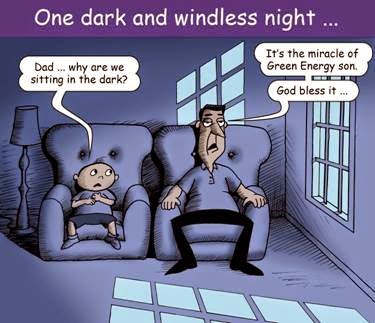
The Miracle of Green Energy – by Steve Hunter  www.stevehunterillustrations.com.au
Viv Forbes,17th July 2014

Community Opposition to Wind Farms Grows Because Wind Power is a Fraud

lies

As community and political opposition to the great wind power fraud rolls and builds across the world, the charge that opponents are red-necked climate change deniers, infected with a dose of Not In My Backyard syndrome, starts to ring hollow.

Surely that charge can’t stick to each and every one of the 1,000 who signed the petition against the Mt Emerald wind farm proposal in Far North QLD – and the 92% of locals there who are bitterly opposed to it (see our post here)?

The same level of opposition arises at the local level – wherever wind power outfits are seeking to spear turbines into closely settled agricultural communities (see our post here).

Communities across the Southern Tablelands of NSW, locals are up in arms at efforts by wind farm outfits and the NSW Planning Department to sack and stack “community consultation committees” to ensure their development applications don’t face any real scrutiny. At Rye Park, 91% of locals are opposed to the wind farm being pitched by Epuron (see our post here). And communities like Tarago have erupted in anger at plans to destroy their lives and livelihoods (see our post here).

A little while back, the usual response from those opposed to wind farms was along the lines of: “we’re all in favour of renewable energy, so long as wind farms are built in the right place”.

But that was before people understood the phenomenal cost of the subsidies directed at wind power through the mandatory RET (see our post here) – and the impact on retail power prices (see our post here).

Fair minded country people are usually ready to give others the benefit of the doubt; and, not used to being lied to, accepted arguments pitched by wind power outfits about the “merits” of wind power: guff like “this wind farm will power 100,000 homes and save 10 million tonnes of CO2 emissions” (see our post here).

Not anymore.

Apart from the very few farmers that stand to profit by hosting turbines, rural communities have woken up to the fact that wind power – which can only ever be delivered at crazy, random intervals – is meaningless as a power source because it cannot and will never replace on-demand sources, such as hydro, gas and coal. And, as a consequence, that wind power cannot and will never reduce CO2 emissions in the electricity sector. The wind industry has never produced a shred of actual evidence to show it has; and the evidence that has been gathered shows intermittent wind power causing CO2 emissions to increase, not decrease (see this European paper here; this Irish paper here; this English paper here; and this Dutch study here).

The realisation that the wind industry is built on series of unsustainable fictions has local communities angrier than ever and helps explain the remarkable numbers opposed: 90% is what’s fairly called a solid “majority” in anybody’s book.

This extract from the Mt Emerald survey captures some of the changing mood and the reasons for it.

Mt emerald survey2

These days, locals fighting wind power outfits are quick to challenge the wild and unsubstantiated environmental benefits touted by the developers; and will launch into them about the massive subsidies (ie the mandatory RET and the REC Tax) upon which the whole rort depends.

And it’s not because these people are “anti-environment” – it’s simply because they’ve woken up to the fact that wind power is pointless: both as a power source; and as a solution to CO2 emissions reduction. Here’s the Business Report with a take on the same tale from Britain and Europe.

Opposing wind generators is not anti-green
Business Report
Keith Bryer
8 August 2014

The intolerance of dissenting views by the Green Lobby is an unpleasant aspect of some of its members. They are perhaps unaware that tolerance of difference is a pillar of democracy and essential to individual freedom. But, whatever the reasons for vitriolic attacks on those against wind generators, environmentalists should take a closer look at Scottish opposition.

The most prominent in Scotland is the Windfarm Action Group. This group firmly states that everyone should take environmental responsibilities seriously. Whatever the causes of global warming and the varying views on what causes it, we must protect our earth and steward it wisely. It accepts a need to reduce carbon dioxide (CO2) emissions. It wants cleaner, reliable energy. It supports sound scientific solutions with the goal of a cleaner, greener world.

No sane, sensible person can disagree with this. Even the most rabid environmentalist should agree too.

But this green group and 300 others like in Britain, plus another 400 in four EU countries, are against windfarms. They have gone into the subject thoroughly and engineers and scientists back up their conclusions.

To those who accuse them of merely being concerned with their own backyards and not the common good, they say add up our membership and you will find an awful lot of backyards. They are simply against what does not make good sense. They are convinced that wind power:

– Is not a technically legitimate solution.

– Does not meaningfully reduce CO2 emissions.

– Is not a commercially viable source of energy

– Is not environmentally responsible.

They believe there are better solutions to Britain’s energy concerns; solutions that meet scientific, economic, and environmental tests – and they have good reasons.

They point to the massive subsidies that windfarms received initially from the British taxpayer, money that attracts multinational corporations like flies to treacle. These subsidies added to the higher price ordinary British householders pay for their electricity.

This “stealth” tax was considerable. Most consumers were unaware that it was used to make wind-generated economically feasible on the one hand, and to fill the pockets of the manufacturers on the other.

This largess allowed wind-generation companies to make generous payments to landowners for permission to use their land. Such was the temptation that some Welsh farmers trying to raise sheep in arduous and scarcely profitable areas leapt at it.

One told his local newspaper that if it were not for the payments he got, he would have given up farming long ago.

The Wind farm Action Group quotes British government documents that say each wind turbine in Britain still receives an annual subsidy of more than £235,000 (R4.3 million). Britain has about 1,120 turbines in 90 parts of the country.

Among the usual objections to windfarms – they do not work all the time, they are noisy, kill birds and bats, and so on, the group adds a few more. For example, wind generators interfere with radar; dirt and flying insects affect their performance; ice build-up on the propellers affects performance even more; and wind turbulence further reduces their power production.

Finally, there is rust. Britain is a wet place but offshore wind turbines have salt to contend with as well. One Danish offshore wind farm had to be entirely dismantled for repair when it was only 18 months old.

Yes, groups such as these exist almost everywhere there are windfarms. They are often, like this Scottish one, as caring of the environment as anyone, perhaps more so. They are not only concerned with their own backyard; they are concerned about everyone’s backyard.

Yet they say this: “We believe that in time this [windfarms] may well be the greatest environmental disaster that mankind in panic, haste, folly and greed, has ever conceived.”

Britain is an old country and its language is full of folk wisdom like this: “No one ever built a windmill, if he could build a watermill.”

A more modern version of common sense would be: “Using wind power to reduce carbon dioxide emissions is akin to trying to empty the Atlantic Ocean with a teaspoon.”
BusinessReport

The mythical claims of the wind industry and its parasites have all be hinged on a perverse notion of “green” is good. But just what being “green” means these days is a matter of politics, not reason, fact or beneficial environmental outcomes: it’s become little more than a political fashion statement.

Ben Acheson writes for the Huffington Post. He’s also the Energy and Environment Policy Adviser and Parliamentary Assistant to Struan Stevenson MEP at the European Parliament in Brussels. For a taste of Ben’s views on wind power – see our post here.

Here’s Ben taking a swipe at faux “green” politics:


Wynne’s Liberals Out to Bankrupt Ontario, for No Benefit At All!~

Achtung, Ontario! Renewables are a money pit


Brady Yauch, Special to Financial Post | August 12, 2014 

Germany’s decision to support renewable energy at all costs has, ultimately, cost the country’s ratepayers billions of dollars and led to a doubling of monthly electricity bills over the past decade. So, why is Ontario following Germany's lead?

FotoliaGermany’s decision to support renewable energy at all costs has, ultimately, cost the country’s ratepayers billions of dollars and led to a doubling of monthly electricity bills over the past decade. So, why is Ontario following Germany?

Germany, the model for Ontario’s wind and solar developments, now regrets its spending spree

Germany – the country on which Ontario modelled its approach to renewable energy development – has a $412-billion lesson for Ontario. That’s the amount the country has spent on subsidies in support of solar and wind energy, among other renewables, over the past 20 years, all in the push to wean the country off fossil fuel and nuclear generation.

On the surface – and according to many news sites – the program has been a success, and not just because of the 378,000 people renewables now employ.

By the end of 2012 (the most recent year for data), wind and solar provided about 13% of all German electricity consumption. Adding in hydro and biomass, renewables provided more than 23%. And in May, headline writers around the world proudly trumpeted that renewable energy provided 75% of the country’s total electricity consumption.

But scratch a bit below the surface and an entirely different picture emerges – one with households being pushed into “energy poverty” as renewable subsidies lead to soaring power bills, handouts to the country’s big businesses and exporters so they can avoid paying for those subsidies and a systematic bankrupting of traditional utilities. As for that one day in May when headlines celebrated that 75% of power generation came from renewables, well, it was a Sunday when demand for power is at its lowest level.

Germany’s decision to support renewable energy at all costs has, ultimately, cost the country’s ratepayers billions of dollars and led to a doubling of monthly electricity bills over the past decade. Households now pay the second highest rates for electricity in the EU – second only to Denmark, the world leader in wind turbines. The country’s feed-in tariff program – which offers renewable energy producers a guaranteed rate for their power – has already cost $412-billion, but could, according to one estimate from the former Minister of the Environment Peter, produce an $884-billion price tag by 2022. Germany will hand out $31.1-billion of renewable energy subsidies in this year alone.

The price of electricity paid by German households has increased from 14 cents (euro) per kilowatt hour in 2000 to 29 cents per kilowatt hour last year – marking a 107% increase, while inflation over that time period was about 22%. The biggest reason for that increase is the renewable energy subsidy, which amounted to 1.4% of the total bill when it was first introduced in 2000, but now accounts for 18%. That renewable levy now costs the average household in Germany more than $320 a year.

Rising electricity prices for households ledDer Spiegel, one of the country’s most respected magazines, to warn that electricity was becoming a “luxury good.” More than 300,000 households each year are being left in the dark because they can’t afford electricity.

German households are being hit particularly hard by the cost of renewable subsidies because the country’s largest businesses – many of them exporters and in energy-intensive sectors – have been exempt from paying for them. Regulators and politicians – fearing that that high electricity prices would hurt the economy and result in job losses or plant closures – gave big business a free pass and instead shifted the costs to households.

The renewable subsidies have distorted Germany’s power market to such an extent that traditional utilities are being pushed to the brink of collapse. Electricity generated from solar and wind has no relationship with the market. Because the price the producers receive is guaranteed and is not based on demand, they dump their output whenever it is produced. This glut of power has, at times, pushed the price of wholesale power below zero – meaning the utilities need to pay someone to use it. This has skewed the price to such an extent that traditional generators can’t economically produce power – they simply stop producing when the price goes too low.

While the answer would seem to be to close those uneconomic generators, that’s not possible since renewable energy is intermittent – at times it will produce no power, while at others it will produce too much – and traditional generators are needed to provide a secure, reliable source of power. Utilities are being asked to keep producing power even though the economics of it don’t make sense anymore. To prevent utilities in Germany from pulling out of the business of generation, the government now offers more than billion dollars in “balancing payments” – sometimes 400 times the price of power – to stabilize the grid.

The rise of renewable power has also led to coal making a comeback. The amount of generation from coal actually increased from 43% of all output in 2011 to nearly 45% in 2012. Electricity generation from lignite, a cheaper and dirtier form of coal, has also been on the rise because, according to one Germany utility, it’s the only thing that can compete with subsidized renewable energy.

The energy situation in Germany has become so disruptive and politically untenable that the government has recently done everything it can to pull back on subsidies and other support for renewable energy, much to the dismay of renewable producers that still can’t survive on their own.

Far from being a success, Germany’s rush into renewable energy has crushed households, taxpayers and utilities. Ontario needs a better model.

Brady Yauch is an economist and the executive director of Consumer Policy Institute.

Windweasels “Stack the Deck” for “Community Consultations”

NSW Planning Department Helps Wind Farm Developers Rig Community “Consultations”

dirtyrottenscoundrelsoriginal

As community hostility to wind farm plans erupts across the Southern Tablelands of NSW, wind power outfits have taken to sacking and stacking committees to ensure the “process” of “community consultation” is little more than high farce.

Spanish outfit, Union Fenosa didn’t like the prospect of having Tony Abbott’s key business adviser, Maurice Newman challenge its wild and fictional claims, so it did what any reasonable corporate citizen would do: it booted him off the committee at Crookwell (see our post here). What’s that you say about “shaping the debate”?

Now, EPYC – an outfit planning to spear 100 turbines into the heart of picture post-card Tarago – has adopted the same tactics: stacking the consultation committee with “friendlies” and preventing the appointment of anyone with any insight into the scope of the fraud. Here’s the Goulburn Post with a tale that sounds more like something from the old Soviet Bloc.

Windfarm group demands action
Goulburn Post
Louise Thrower
4 August 2014

OPPONENTS of a proposed wind farm near Tarago are calling on the state government to ‘do its job.’ Community consultative committees (CCCs) are mandatory under guidelines but are nothing more than a ‘fig leaf,’ says a residents’ group.

The Residents Against Jupiter Wind Farm (RAJWF) has not ruled out political action to press their point.

Last month the group met with a senior advisor to Planning Minister and Goulburn MP Pru Goward and a departmental official in Sydney.

Member and Tarago district resident Dr Michael Crawford said the government had the power to appoint CCCs but was abrogating its responsibility and letting wind farm companies decide the make-up.

“It’s not an even handed process but they want it to look as though it is by putting it in the guidelines,” Dr Crawford said.

“The Department is not doing its job to appoint community representatives and the independent chairperson and it doesn’t pull anyone up on it. We tried to get some real change.”

Instead, Dr Crawford said the Department gave him the “soft shoe shuffle.”

His comments follow Union Fenosa’s sacking of Maurice Newman from the Crookwell Three wind farm CCC. The move sparked outrage from NSW Landscape Guardians president Humphrey Price-Jones who called on Ms Goward and the Department to intervene.

Under existing draft guidelines, the director general signs off on CCC membership. But even Union Fenosa conceded that given the draft document, the state was leaving membership up to wind farm companies.

Tarago residents at least argue this is unacceptable.

“Nowhere in the guidelines is there any latitude for the wind farm developer to have a say about choosing community reps,” resident Jane Keaney stated in a letter to the editor.

“In fact, even without the guidelines, anyone with the faintest sense of fair play would recognise that allowing a developer of any sort to select the people who are going to be allowed to talk to the developer on behalf of the community, is anathema. How has the department come to tolerate this corruption of process?” The group has already asked Palerang and Goulburn Mulwaree Councils to help with election of its CCC.

In June, EPYC, which wants to build the 100 turbine wind farm southeast of Tarago, called for community representation.

In response, the group nominated seven people including Mr Crawford, who it wanted on the committee, with a further eight as alternative delegates. The Reverend Tom Frame supervised the election.

Dr Crawford said to date there has been no response from the company or the Department of Planning.

At the most recent Goulburn Mulwaree meeting, planning director Chris Stewart was appointed as Council’s representative.

While companies like Union Fenosa have defended their ability to appoint a wide cross section of views to the committees, others like Mr Price-Jones have branded them “wind farm propaganda” machines.

Dr Crawford said while all the Tarago nominees oppose the wind farm, he would welcome a variety of voices on the committee.

But he’s adamant that the state government needs to regain control.

“The government wants to paper the State with wind farms but the process is nothing more than a fig leaf,” he said.

“… At the meeting in Sydney I said they have to understand our timetable. There’s an election next year and if our members feel political action is required, we won’t sit on our hands.

It’s about government policy and the way to deal with it is through the political process.”

Ms Goward told the Post she had asked her department for a report on CCCs.

“We made it clear that we expect wind farm companies to genuinely consult with communities and the history is that they haven’t,” she said.

“We need to be sure CCCs are genuine, that they genuinely represent the community and can give unfettered advice.”

The company had not responded to requests for comment by the time of going to press.
Goulburn Post

STT is pleased to hear that Pru Goward has taken an interest in what can fairly be described as government gone rotten. The NSW Planning Department – like state planning departments around Australia – is infected with a pernicious brand of groupthink driven by the childish fantasy that wind power is a solution to “climate change” (previously known as “global warming” – until it became evident that it stopped getting warmer 17 years ago – see our post here).

Wedded to a delusion, woe betide anyone – like Maurice Newman or Dr Michael Crawford – who has the temerity to question their mantra. Hence the need to load these so-called “community consultation committees” with gullible “yes-men”.

Wind power – delivered at crazy, random intervals – requires 100% of its capacity to be backed up 100% of the time by fossil fuel generation sources and, therefore, cannot and will never reduce CO2 emissions in the electricity sector (see our posts here and here and here and here andhere and here and here).

Wind power is not a substitute for conventional generation sources and – if CO2 is the problem – presents as a solution to nothing (see our post here).

Remember that the ONLY justification for the $billions in subsidies directed at wind power (see our post here) is CO2 emissions abatement in the electricity sector. It’s the central and endlessly repeated lie that wind power outfits routinely trot out in their planning applications. You know, the guff about “powering 100,000 homes” and abating millions of tonnes of CO2 (see our post here).

Well, STT hears that the industry is about to be put to proof on its CO2 abatement claims.

The wind industry has never produced a shred of evidence to show that wind power has reduced CO2 emissions in Australia’s electricity sector. To the contrary of wind industry claims, the result of trying to incorporate wind power into a coal/gas fired grid is increased CO2 emissions (see thisEuropean paper here; this Irish paper here; this English paper here; and this Dutch study here).

Strip away that myth and the mandatory RET – upon which the entire wind industry depends – can be seen for what it is: the greatest economic and environmental fraud of all time.

pru-goward