We recalled the name D B Watson. He has written several excellent letters and, as this letter reproduced below states, he is a chartered engineer with experience in the energy industry. As we’ve said many times before, all the engineers state the same thing in the same way; there is little if any variation. So why are the politicians not listening? As Helen McDade asked at a meeting a couple of years ago – why is there no engineering-based study? – GL |
not financially feasible

Wind-weasels Run, when the Truth Begins to Surface!
US Wind Farm Operator Settles to Shut Down Neighbours’ Dynamite Damages Case
February 6, 2015 by
****
A telling-scene there, from the film A Civil Action; which is pretty much how things panned out for a US wind farm operator in Michigan recently.
STT has been following a monumental piece of litigation that blew up over the Lake Winds wind farm in Mason County, for a while now (see our posts here and here and here).
Now, finally, and as predicted by STT, the wind power outfit concerned has been forced to open its cheque book, in order to cut a settlement with the long-suffering neighbours.
Back in 2013, 17 plaintiffs sued the operator, seeking substantial damages for the health impacts, property value losses and the loss of the enjoyment and use of their properties, caused by wind turbine generated noise and vibration.
With the jury panel taking their seats – and clearly acting under the adage about discretion being the better part of valour – the wind power outfit involved, Consumers Energy threw in the towel, just as the first of their (numerous) victims, Cary Shineldecker was about to go into the witness box.
Nothing like a credible witness, heading off to tell a sympathetic jury of his peers (ie, law-abiding American citizens) about his years’ of suffering, to focus the minds of lawyers representing a wind power outfit that has shamelessly visited a sea of sonic of misery upon him (and his young family); and which has otherwise destroyed the lives of a dozen or moreinnocent young families.
The wind industry operates under a pact that its members must never, ever allow one of these cases to go to a final decision and judgment.
The usual course is to cut a deal behind closed doors; well away from the glare of the media.
Faced with mounting damages claims in Denmark (see our post here), the Danish wind industry has taken to buying up its actual and potential victims’ homes – and even whole villages – calling in the bulldozers, and flattening the lot (see our post here).
The wind industry in Australia – which is also a signatory to the “never let‘em get to judgment pact” – quietly buys out its victims’ properties, bulldozes them (see our post here) and makes damn sure they stitch up the unfortunate (soon to be homeless) family with bullet proof gag clauses (see our posts here and here) – that their lawyers enforce with the zeal and vigour of the Old GDR’s Stasi (see our post here).

STT hears that – as you might expect in a situation where the operator’s lawyers would have been working in a pool of cold sweat – the settlement in the Lake Wind’s case was very favourable to the plaintiffs.
The wind power outfit didn’t have a legal leg to stand on: along the way, it had lost every step in, and associated with, the plaintiffs’ primary action, with a judge twice declaring that the wind farm was in clear breach of its noise criteria.
It was – as they in betting circles – “on a hiding to nothing”.
So, in reality, it had no other option than to throw money at the problem and attempt to bury it. However, in full credit to the victims, they at least managed to avoid the full extent of the standard gag clause, that prevents victims from ever talking about the health impacts caused by the defendant’s operations.
Here’s Michigan Capitol Confidential with a round-up on what happened.
One Lawsuit Settled, But No Truce in Wind Energy Debate
Michigan Capitol Confidential
Jack Spencer
31 January 2015
A lawsuit in which residents living near the Lake Winds wind plant south of Ludington claimed the facility was making people sick has been settled out of court. Cary Shineldecker, one of the plaintiffs in the case, isn’t allowed to discuss details of the settlement, but is still allowed to talk about the alleged negative health effects that can be suffered by those who live near such facilities.
“What I think is different about this settlement is that, although the details of the settlement are confidential, I’m not gagged from speaking out about the problems with wind energy,” Shineldecker said. “I think everything we’ve done here has helped the community and residents. For too long, supporters of wind energy have been able to silence and discredit those who have to live with the effects of it.
“We saw how they silenced Jerry Punch and his group,” Shineldecker continued. “When his group was working on a study that refuted what wind energy supporters wanted to be reported about the health impacts of wind turbines, they (the wind energy supporters) shut them up.”
On April 1, 2013, a group of 17 residents who lived near the Lake Winds wind plant – others joined the group later – filed a lawsuit against Consumers Energy in Mason County Circuit Court.
The lawsuit alleged that people were experiencing dizziness, sleeplessness, headaches and other physical symptoms primarily due to noise generated by the wind plant’s 56 giant wind turbines, which the plaintiffs claimed had been erected too close to homes.
“We filed the lawsuit based on health impact, property value loss and loss of enjoyment and use of our property,” Shineldecker said.
Lake Winds is the first wind plant developed by Consumers Energy. The $250 million facility was constructed as part of the utility’s efforts to meet the state’s renewable energy (wind) mandate.
The lawsuit brought by Shineldecker and his co-plaintiffs was only the first one involving the Lake Winds plant. Before the end of 2013, Mason County had declared that the wind plant was not in compliance with its noise ordinance. Consumers Energy took the county to court over that determination. It lost at the Circuit Court, and that case is currently under appeal.
According to Shineldecker, the residents’ lawsuit was resolved during the late summer and autumn of 2014.
“It was just about to go to trial; in fact I was in court waiting to be the first to testify, when we were told a settlement had been reached,” Shineldecker said. “It took about two months to work out the wording; then ours was actually finalized the week of Dec. 17.
“To me, we were helping others by being willing to take a stand,” Shineldecker added. “One of these days the facts are going to come out. Twenty years from now the health impacts of living with these industrial wind turbines will be common knowledge. It will be like the way it happened with cigarettes. But right now those who know the truth are a minority.
The talking points used by AWEA (American Wind Energy Association) haven’t changed from what they were saying five years ago. I believe that in our democracy, right will win in the end, but only after a lot of sacrifices have been made.”
Shineldecker also said that his family’s property, which he is selling off in portions, is now going for 78 percent of its appraised value.
David Wand, deputy director of strategic communications for AWEA, did not respond when offered the opportunity to comment. Consumers Energy declined to comment as well.
Michigan Capitol Confidential
Just when the going was about to get a little tougher than usual for America’s highly paid wind industry spruikers, the AWEA, it’s good to see David Wand waving his namesake and disappearing into the ether; very “Harry Potter”!

Perhaps these boys should give Harry Potter a call, so they can have an invisibility cloak on stand-by, from here on in?
With a pack of jubilant plaintiffs ready to crow long and loud about just what Consumers Energy (one of the AWEA’s clients) has done to their lives, their health, their well-being and the value of their homes – no wonder Consumers Energy and the AWEA went AWOL. Funny about that.
STT predicts that the wind industry’s “run and hide” tactic (for a taste of it in action – see our post here) will fast become de rigueur for the wind industry and its parasites, as the tide finally turns on an industry that – when it comes to moral turpitude, and a general callous disregard for its victims – only has the tobacco and asbestos industries to beat.
Fine company, indeed.

When the Wind Don’t Blow, the Turbine Don’t Go….(Or if it Blows Too Much) LOL!
Wind Turbines Totally Suck, When the Wind Really Blows & When It Doesn’t
February 5, 2015 by
When the wind is “the thing”, that’s supposed to be your business – when it’s what makes the revenue (or, rather a massive pile of taxpayer and power consumer subsidies) flow – it seems a bit rich for wind power outfits to start whining about there being too much or too little.

But, in shades of Goldilocks’ nitpicking about stolen porridge having to be “just right”, so it is amongst wind weasels.
Wind turbines don’t generate a single spark until the wind hits at least 5 m/s (18km/h); don’t hit ‘rated power’ (ie, maximum output) until wind speeds reach 11 m/s (40km/h); and get shut down automatically to protect blades and bearings when wind speeds hit 25 m/s (90km/h).
Despite wind being very much their ‘business’, around the globe windpower outfits have taken to blaming the ‘absence’ of it – as if it were one of Newton’s constants, you know, like gravity – for their financial, and other troubles, as detailed in these posts:
- Texas Blames Wind Power Slump on (you guessed it) … the Wind
- Germans Blame “Missing Wind” for their Wind Power Debacle
- Brits Rumble Frightening Energy Fact: Wind Power Depends on the (ur, ahem) Wind …
Here in Australia, near-bankrupt wind cowboys, Infigen (see our post here) have just pointed the finger at – you guessed it – THE WIND, for a massive drop in revenues (see this lament from the eco-facists over at ruin-economy). Oh dear, how sad, never mind.
For their myriad sins, it appears that wind power outfits have somehow drawn the opprobrium of the wind gods at both ends of the meteorological spectrum – with that great Greek huffer and puffer of old – Aeolus – really turning it on, and flattening fleets of fans with withering effect.
This time, the story’s about the Wind Gods going crazy in Brazil.
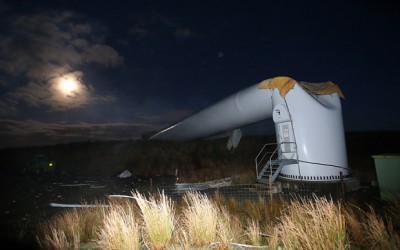
Eight Impsa turbines blown down in Brazil
Wind Power Monthly
Michael McGovern
26 January 2015

BRAZIL: Investigations are ongoing at utility Eletrobras’s 46MW Cerro Chato IV-VI wind complex in the Brazilian state of Rio Grande do Sul following the collapse of eight Impsa turbines.
The incident was caused by a freak storm hitting Santana do Livramento district on the afternoon of 22 December, with gusts reaching 250 kilometres per hour, according to an Eletrosul press statement, which appears to be its only public comment on the incident.
Neither Impsa nor Electrobras would respond to questions from Windpower Monthly while investigations are ongoing. The machines were Impsa 2MW machines with a 100-metre rotor.
Before the storm, Rio Grande do Sul’s meteorological office, MetSul, had issued an alert for winds of up to just 120km/h. Reported maximum gusts for the neighbouring town of Rivera in Uruguay, which shares the border with Santana do Livramento, were at just 130km/h.
Impsa, Argentina’s beleaguered turbine manufacturer currently tackling solvency problems, has made no public comment.
No damage was reported to Wobben turbines operating in the same district.
Local press sources state that Eletrosul’s insurers have concluded onsite investigations, although conclusions are yet to be delivered to its client.
Wind Power Monthly

Wind Power will NOT Keep the Lights, or the Heat, ON!
Wind Power Goes AWOL Right When Freezing Brits Need It Most
February 4, 2015 by 7 Comments

The hackneyed myth that wind power “powers” millions of homes with wonderful “free” wind energy is taking a beating around the globe (seeour post here).
The idea that a wholly weather dependent power generation source can ever be – as is touted endlessly by the wind industry and it parasites – an “alternative” to conventional generation is, of course, patent nonsense.
If there wasn’t already a complete power generation system built around on-demand sources, such as gas, coal, nuclear or hydro – then a country trying to run on wind power would – unless it was keen to revisit (or remain in) the stone age – would inevitably need to build one (see our post here). So far, so insanely costly, and utterly pointless.
Now, just when winter starts to bite, and the Brits are looking for some extra sparks to toast their crumpets, brew their tea, to warm their homes and keep the icicles from their noses and toes, their massive fleet ofblade-chucking, pyrotechnic, sonic-torture devices has completely downed tools – proving once and for all that wind power is the greatest fraud of all time.
Here’s The Telegraph with, yet another tale of just why it is so.
Electricity demand hits highest this winter – as wind power slumps to its lowest
The Telegraph
Emily Gosden
20 January 2015
UK electricity demand hit its highest level this winter on Monday – while wind turbines generated their lowest output, official figures show.
Cold weather saw UK demand hit 52.54 gigawatts (GW) between 5pm and 5.30pm, according to National Grid.
At the same time, low wind speeds meant the UK’s wind turbines were producing just 573 megawatts of power, enough to meet only one per cent of demand – the lowest of any peak period this winter, Telegraph analysis of official data shows.
Earlier on Monday wind output had dropped even lower, generating just 354 megawatts at 2pm, or 0.75 per cent of Britain’s needs – the lowest seen during any period this winter.

The analysis will fuel concerns that despite receiving billions of pounds in subsidies, Britain’s wind farms cannot be relied upon to keep the lights on when they are needed the most.
Britain now has about 12 GW of wind capacity installed on and offshore – meaning during Monday’s peak demand period, wind farms were generating less than five per cent of their theoretical maximum output.
Gas, coal and nuclear power plants instead provided the vast majority of the UK’s electricity needs.
A spokesman for National Grid said that Britain’s spare margins – the safety buffer between supply and demand – had remained “adequate”.
On average, UK wind farms produce about 28 per cent of their theoretical maximum power output.
But critics warn that cold snaps when demand soars can often coincide with periods when the wind doesn’t blow.
They argue that Britain’s energy security will become ever moreprecarious as old coal and gas power plants are closed and the country becomes more reliant on intermittent wind farms.
Dr Lee Moroney of the Renewable Energy Foundation, a think tank critical of wind farms, said: “Low wind speeds frequently accompany low temperatures as happened yesterday.
“The proliferation of wind farms encouraged by Government policy is misguided because a reliance on wind energy in these conditions leads to inevitable extra costs for consumers.
“Either reliable backup electricity supply from conventional sources must be provided when the wind does not blow, or extra costs in the form of constraint payments are incurred when there is too much wind on the system. It is a lose-lose situation for consumers.”
National Grid’s data, which covers the period since December 1, shows that the second highest peak demand – 50.9GW on December 4 – also coincided with the second lowest peak wind contribution, at just 1.5 per cent.
However other periods of particularly high peak demand, such as the evenings of December 9 and 10, coincided with much higher wind power output, with turbines meeting 18 per cent of demand.
The data also shows that Christmas Day was the only day when solar panels contributed anything at all to peak demand – because it was the only day when peak demand fell in daylight hours.
Demand on December 25 peaked after 12.30pm as families cooked their Christmas dinners.
On all other days demand peaked after it got dark – the vast majority between 5pm and 5.30pm.
Ministers were last year forced to approve a series of emergency powers to help prevent blackouts this winter, by firing up old power plants or paying factories to switch off.
National Grid said it had not yet needed to use any of the emergency powers.
Jennifer Webber, director of external affairs for wind industry body RenewableUK, said: “It’s wrong to cherry-pick statistics for short periods when the wind didn’t blow, as they’re unrepresentative of the full picture of the benefits wind provides for the UK.
“To get a proper idea of how well wind is performing as a vital part of our energy mix, you have to look at National Grid’s official figures over a meaningful period. In December, wind energy provided a record monthly high of 14 per cent of all the UK’s electricity needs.
“As a whole, 2014 was wind energy’s most productive year so far in this country, generating nearly 10 per cent of Britain’s electricity – equivalent to the annual demands of a quarter of all British homes.”
A spokesman for the Department of Energy and Climate Change said: “We need a diverse energy mix to reduce our reliance on imported fossil fuels and renewables, including wind, are helping us to achieve this.
“Over £10bn was invested in clean energy in 2014 and the sector could also support up to 200,000 jobs by 2020.”
The Telegraph
Another fine piece of “doublethink” and “doublespeak” from wind industry spin-kings, Renewable UK and DECCs – in the other-worldly, Orwellian tradition under which they operate; and which they deploy in their efforts to control the energy ‘game’ (see our post here).
When the hard numbers see it pressed on its central claim about “powering” millions of homes, the wind industry and its parasites start back-pedalling at a full pelt, whine about “cherry-picking data” and resort to waffle about ‘averages’, ‘overall benefits’ etc, etc (that’s if they haven’t already run off and hidden from their interlocutors – see our post here).
And, in this case – resorting to their classic “hey, quick look over there” tactic – the spinners pitch up the well-worn lie about wind power ‘investment’ creating hundreds of thousands of new jobs (see our post here); as if that will be some kind of consolation when Brits are all left freezing in the dark.
STT just loves their exhortation about the need to measure wind power output “over a meaningful period”, which, apparently, means “averaging” wind power output over a month or more.
Funny, you know, that power punters – selfish lot that they are – tend to consider having power available when they need it, as a “here and now” kind of thing. So let’s see how things are “averaging” out over at the ICU:

DECCs and Renewable UK are obsessed with the ultimate (nonsense) goal of Britain running exclusively on wind power – and every malicious move they make is aimed at seeing wind power totally ‘displace’ fossil fuel generation sources.
If their (impossible) ‘dreams’ were ever realised, it would be interesting to see how the (few) remaining businesses would manage to operate without power for hours on end, every other day; and how householders might toast their crumpets, and keep warm and well-lit homes whenever the wind does what it’s done since the dawn of time.
STT buffed up the crystal ball and conjured up this forlorn image, that might be somewhere near the mark:

Village Destroyed to Accommodate Wind Turbines.
Company’s extreme wind strategy: “Recently we bought most of a village to make a windpark.”
Kølby in northern Jutland is being bought up by the Swedish energycompany Vattenfall.
We solve the problem of unsellable properties in peripheral regions. We solve the problem of neighbours being critical of wind farms.”

The Copenhagen Post
Company’s extreme wind strategy: Towns today, turbines tomorrow
By Philip Tees
Swedish energy company Vattenfall is going to extreme lengths for the sake of its Danish windfarms – buying up whole villages in rural Denmark, razing them to the ground and replacing the buildings with wind turbines, Børsen reports.
Mette Korsager, who is responsible for Vattenfall’s onshore wind projects in Denmark, told the business newspaper that the strategy was to make it easier for the company to achieve the goal of installing 250 MW of wind turbines in Denmark by 2018-2019. “We typically buy up farms in bad condition and demolish the farmhouse,” she said.
“Recently we bought most of a village to make a windpark.”
Helps the region, according to Vattenfall
That village is Kølby in northern Jutland, and Vattenfall plans to acquire a total of 20 properties.
Korsager told Børsen the strategy served a number of purposes. “We solve the problem of unsellable properties in peripheral regions,” she said.
“We solve the problem of neighbours being critical of wind farms, and we make it easier to reach agreements about the installation of wind turbines at the municipalities because we go in and help them by developing problem areas.”

Eric Jelinski – Canadian Energy Engineer, Tells the Truth about the Wind Fraud!
Top Canadian Energy Engineer – Eric Jelinski – Slams the Great Wind Power Fraud
January 31, 2015 by

Provided they haven’t got their trotters in the wind industry subsidy trough, engineers are quicker than most, when it comes to rumbling the great wind power fraud.
Practically minded, and with heads for real numbers, engineers are able to pick apart the complete pointlessness of trying to rely on an energy source that will NEVER be available on demand (can’t be stored) – is entirely dependent upon the weather – and is, therefore, not a generation “system” at all: “chaos” and “system” are words that come from completely different paddocks; and which mean completely different things (see our post here).
And engineers, who build “systems”, don’t like “chaos”.
Google’s top engineers – Stanford PhDs, Ross Koningstein and David Fork – came out and recently tipped a bucket on the nonsense of attempting to run 21st Century economies using a ‘technology’ that was dumped way back in the 19th Century (see our post here).
Now, one of Canada’s leading energy engineers, Eric Jelinski has come out swinging too.
An Engineer Speaks
Windfarm Action
27 January 2015
The following was written by Eric Jelinski, P. Eng., a Canadian engineer who specializes in energy production. Gas plants. Nuclear plants. Wind &solar energy. He explains to his township (Clearview Township, Ontario) why wind energy is folly.

I am writing to express my objections to the installation of Industrial Wind Turbines in Clearview Township, Ontario, Canada.
My wife and I moved here to retire on 50 acres, building a house, market garden, as well as taking many other initiatives to become part of the vital social fabric.
It is bad enough that under Ontario Premier McGuinty, the social fabric in big cities like Toronto is in need of repair, as it happens, in part because those “50,000 jobs” in renewable energy have not materialized, and there is little productive activity for many of the youth in the cities. Guns and drugs are very much part of the social fabric in some neighbourhoods.
What gives McGuinty, with his Toronto constituent Members of the Provincial Parliament (MPP’s), the moral right to tell us in Clearview that we must accept wind turbines “or else”?
One way to stop the wasted energy and environmental impact of urban sprawl is for big city MPP’s to clean up their own yard and make cities safer and more habitable. While they listen to those who object to new gas plants, and cook up a new “plan of the month” for public transport, why do they ignore the issues with wind turbines?
My background is nuclear and chemical engineering, with over 30 years combined working at each of the nuclear plants in Ontario. I teach nuclear engineering at University of Toronto and Georgian College (Power Engineering) in Owen Sound for the purpose of training the next generation of staff who will design plants and work them safely.
I know nuclear reactors and how e=mc2 gets us the energy. I know chemical reactors, e.g. to make gasoline from crude oil, and refining metals. I know solar and wind energy going back to the 1970’s, as energy and exergy are my major fields of study.
The application of Ontario’s “Green Energy Act” is in violation of principles in engineering, where we teach engineers to anticipate unintended consequences and not proceed with implementation until consequences and risks are taken into account.
The Green Energy Act is an abomination that is creating a living hell for almost everybody in rural Ontario, and the provincial government is ignoring the data of emerging health issues, property value issues, setbacks and zoning, impacts on fowl, fauna, and fish, impacts on local weather such as the dew point and foliar uptake by plants that is important in particular to alleviate heat stress on biota.
I have seen firsthand one of my neighbours from the 1980’s near Ripley forced out of his farm home due to wind turbines in Huron Township. Others are putting up with the impacts.
The energy available from wind in Ontario is borderline minimal compared to other countries and areas of the world. 25% to 30% is the capacity factor.
The wind is not available when we need energy the most, i.e. summer air-conditioning and winter heating. The shoulder seasons have the most wind here, yet this is when air-conditioning and heating demands are minimal.
The power equation for wind results in 8 times the energy for a doubling of wind speed, and the excess energy has to be “dumped.” Storage systems are available, but prohibitively expensive. Hythanation is possible, but wind turbines are not economic for hydrogen production given the added infrastructure relative to the cost of natural gas.
Wind turbines use 5 to 7 times the amount of concrete and steel vs. say a nuclear plant on a per Megawatt basis. It will require some 10,000 wind turbines to replace the ~ 6000 MW of coal generation at 25% CF (capacity factor). Back-up gas fired plants have to be added like plug-ins everywhere because the wind is not reliable.
The pastoral scene of a field of wind turbines slowly turning in almost still air has environmentalists dreaming in technicolour.
The truth is that these wind turbines need about 8 km/hour of wind before they will start generating electricity. Any rotation of the blades at wind speeds below 8 km/hour is accomplished by taking power from the grid to get the wind turbine started in anticipation that the wind may pick up.
The economy of scale that has historically brought competitive energy prices in Ontario is not available, given the thousands of wind turbines, and that will also become a maintenance nightmare as machines and contracts approach end of life. Why do we not refuel Nanticoke, Lakeview, Lambton, Lennox and complete Wesleyville to run on natural gas?
What makes McGuinty et al. think they can impose industrial wind turbines on Clearview and all of rural Ontario? Is Clearview thinking of becoming part of this scheme of waste?
This scheme of waste is happening not just by government order, but it is happening because of the salacious relationship between government and the developers.
The most telling example is the head of the Federal Liberal Party is a wind developer. The activity surrounding the recent cancelled “gas plant” in order to preserve seats, and thus preserve the Green Energy Act, is also telling.
We also have the government using engineers from wind developers making recommendations on health impacts. As a P. Eng. I can say that engineers are not the authority on health. The conflict of interest between the engineer being paid for engineering work, vs. the same engineer as proponent and key advisor to the government is quite apparent.
The set-back of 550 meters has no scientific basis. Noise from wind turbines has been measured up to 10 kilometers away in some locations. Medical doctors have noted the health impacts, yet they are being ignored by the Ontario government.
The Feed-in Tariff takes billions of dollars out of communities, out of the province, and out of the country. This is money that is very much needed for healthcare, for schools and teachers, and to replace aging infrastructure and to build much needed new infrastructure such as public transit.
For the first time in decades (I don’t think it ever took place), Ontario is taking equalization payments from the Federal Government, and this points to not only the unsustainability of Ontario as an economy, it is dragging down the rest of the country. It would be different if we owned everything, did local planning, and used a process that garnered respect.
The Ontario government is following the advice of foreign countries and foreign companies to give our money away to them irrespective of the advice of many MP’s. It is most interesting to note that one of the political parties with a labour platform appears in complete agreement with giving away the work and the money and the surplus electricity.
Japan is restarting its nuclear fleet. Russia, China, India, Britain, the US, and even the United Arab Emirates are building or planning to nuclear reactors for electric generation. What is the purpose and value of Ontario energy policy? Every product we buy in Ontario that is made someplace else (most items, can you name one thing that is made here?) has a nuclear energy component in that product.
It is time to stop being altruistic or hypocritical about our energy. There is no rational reason for the 50% cap on nuclear in Ontario. Are we on some unwitting “race to the bottom” being orchestrated by some competitor countries wanting to control us? Having ample low cost energy is crucial to sovereignty, internal peace, and security.
As such, there is no respecting McGuinty, Bentley et al. for this indictment. There is also no need to respect any wind developers as they have already indicated their respect for us. I commented last year on WPD, and sent comments to their consultant as requested, and they have not replied, and their silence speaks volumes. I have sent many an e-mail to the government recommending a moratorium and have not been given the courtesy of any reply.
The purpose of the developer is to make money, i.e. take our money as allowed for by the government, and with minimum effort on their part. This speaks to the quality of the public meetings and their answers to our concerns. The public meetings are a sham.
There are quite a number of lawsuits already taking place and others pending. I thank the Federal government for the recent announcement on the health study. It is also pivotal to learn today that the Ministry of Health is being forced to testify.
My recommendation is for Clearview to take the high road and avoid complicity in matters that are before the courts, and who knows, but it is quite possible (I hope) that the renewed call for a moratorium may take hold for good reasons posted here.
A moratorium in Clearview is very appropriate.
While the WPD wind turbines west of Stayner are quite a few km from our place, they are likely the thin edge of the wedge planned for coming into Clearview. Let me remind you, we came here because this is a good place to live with good opportunities for business. All of that changes if wind turbines are allowed to disrupt the neighbourhood. And 10,000 wind turbines and solar farms are not the answer to Ontario’s energy needs.
As I said before, a province-wide moratorium is needed, and I believe this will come as a matter of time because the inconvenient truth about wind turbines is too big for McGuinty’s carpet. The track record for dictatorial governments throughout history is that all dictatorships eventually capitulate. A moratorium in Clearview would be a “made in Clearview” solution to stop the waste sooner than later.
Eric Jelinski, P. Eng.
What is interesting is that this is not only a UK or European problem and the US and Canada predates much of our wind fleet. But the problems are endemic in the industry and the political myopia of the issues and problems of wind a mystery to the other 97% of the population!
Windfarmaction
The Futility and Ridiculousness of the Windscam!
It Don’t Take Sherlock to Know; When the Wind Don’t Blow, The Power Don’t Flow
January 30, 2015 by Leave a Comment
STT has – just once or twice – smashed the myth that wind power can provide a meaningful supply of electricity (ie power “on-demand”) – and relegated to the fiction aisle the the wind industry’s “playbook”, where you’ll find, in bold print, the oft-told furphy about wind farms “powering” 10s of thousands of homes.
At STT the term “powering” means exactly what it says: that when someone – at any time of the day or night – in any and all of the thousands of homes claimed to be “powered” by wind power – flicks theswitch the lights go on or the kettle starts boiling.
The wind industry never qualifies its we’re “powering thousands of homes” mantra by saying what it really means: that wind power might be throwing a little illumination or sparking up the kettle in those homes every now and again – and that the rest of time their owners will be tapping into a system of generation that operates quite happily 24 x 7, rain, hail or shine – without which they’d be eating tins of cold baked beans, while sitting freezing (or boiling) in the dark.
Here’s a little collection of posts busting that and other wind power myths in Australia:
- South Australian Wind Power “FAILS”
- Wind Power Myths BUSTED
- More Australian Wind Power “FAILS”
- Where will you be when the lights go out for good?
- The Gambler
- The “Great Oz” has spoken: the wind will no longer be “intermittent”
- Herald Sun’s Terry McCrann: “The Climate Spectator’s a joke!”
And hammering the same myths, elsewhere around the world:
- Texas Blames Wind Power Slump on (you guessed it) … the Wind
- Germans Blame “Missing Wind” for their Wind Power Debacle
- Brits Rumble Frightening Energy Fact: Wind Power Depends on the (ur, ahem) Wind …
- Why wind power MW will never be equal
- Why Wind Power Will Never be a Serious Alternative to Conventional Power Generation
Now, Andrew Rogers of Energy Matters has done a beautiful number on the same myths, as relentlessly pedalled by the wind industry in Europe. (Oh, and if the graphs are too puny or fuzzy, click on them, they’ll pop up in a new window and you can magnify them from there.)
Wind Blowing Nowhere
Energy Matters
Roger Andrews
23 January 2015
In much of Europe energy policy is being formulated by policymakers who assume that combining wind generation over large areas will flatten out the spikes and fill in the troughs and thereby allow wind to be “harnessed to provide reliable electricity” as the European Wind Energy Association tells them it will:
The wind does not blow continuously, yet there is little overall impact if the wind stops blowing somewhere – it is always blowing somewhere else. Thus, wind can be harnessed to provide reliable electricity even though the wind is not available 100% of the time at one particular site.
Here we will review whether this assumption is valid. We will do so by progressively combining hourly wind generation data for 2013 for nine countries in Western Europe downloaded from the excellent data base compiled by Paul-Frederik Bach, paying special attention to periods when “the wind stops blowing somewhere”. The nine countries are Belgium, the Czech Republic, Denmark, Finland, France, Ireland, Germany, Spain and the UK, which together cover a land area of 2.3 million square kilometers and extend over distances of 2,000 kilometers east-west and 4,000 kilometers north-south:

We begin with Spain, Europe’s largest producer of wind power in 2013. Here is Spain’s hourly wind generation for the year. Four periods of low wind output are numbered for reference:

Now we will add Germany, Europe’s second-largest wind power producer in 2013. We find that Spanish low wind output period 4 was more than offset by a coincident German wind spike. Spanish low wind periods 1, 2 and 3, however, were not.

Now we add UK, the third largest producer in 2013. Wind generation in UK during periods 1, 2 and 3 was also minimal:

As it was in France, the fourth largest producer:

And also in the other five countries, which I’ve combined for convenience:

Figure 7 is a blowup of the period between February 2 and 15, which covers low wind period 2. According to these results the wind died to a whisper all over Western Europe in the early hours of February 8th:

These results are, however, potentially misleading because of the large differences in output between the different countries. The wind could have been blowing in Finland and the Czech Republic but we wouldn’t see it in Figure 7 because the output from these countries is still swamped by the larger producers. To level the playing field I normalized the data by setting maximum 2013 wind generation to 100% and the minimum to 0% in each country, so that Germany, for example, scores 100% with 26,000MW output and 50% with 13,000MW while Finland scores 100% with only 222MW and 50% with only 111MW. Expressing generation as a percentage of maximum output gives us a reasonably good proxy for wind speed.
Replotting Figure 7 using these percentages yields the results shown in Figure 8 (the maximum theoretical output for the nine countries combined is 900%, incidentally). We find that the wind was in fact still blowing in Ireland during the low-wind period on February 8th, but usually at less than 50% of maximum.

But even Ireland was not blessed with much in the way of wind at the time of minimum output, which occurred at 5 am. Figure 10 plots the percentage-of-maximum values for the individual countries at 5 am on the map of Europe. If we assume that less than 5% signifies “no wind” there was at this time no wind over an area up to 1,000 km wide extending from Gibraltar at least to the northern tip of Denmark and probably as far north as the White Sea:

During this period the wind was clearly not blowing “somewhere else”, and there are other periods like it.
Combining wind generation from the nine countries has also not smoothed out the spikes. The final product looks just as spiky as the data from Spain we began with; the spikes have just shifted position:

Obviously combining wind generation in Western Europe is not going to provide the “reliable electricity” its backers claim it will. Integrating European wind into a European grid will in fact pose just as many problems as integrating UK wind into the UK grid or Scottish wind into the Scottish grid, but on a larger scale. We will take a brief look at this issue before concluding.
Integrating the combined wind output from the nine countries into a European grid would not have posed any insurmountable difficulties in 2013 because wind was still a minor player, supplying only 8.8% of demand:

But integration becomes progressively more problematic at higher levels of wind penetration. I simulated higher levels by factoring up 2013 wind generation with the results shown on Figure 12, which plots the percentage of demand supplied by wind in the nine countries in each hourly period. Twenty percent wind penetration looks as if it might be achievable; forty percent doesn’t.

Finally, many thanks to Hubert Flocard, who recently performed a parallel study and graciously gave Energy Matters permission to re-invent the wheel, plus a hat tip to Hugh Sharman for bringing Hubert’s work to our attention.
Energy Matters

Interest in Wind Projects Wanes, and Prices Dropping Fast!
-
Wind auction sees low interest
Only two of four offshore MA wind areas get bids; sale prices much lower than prior sales off other states
Some Key Points on My Submission To the ERT, Re: wind turbines Check it Out!
TABLE OF CONTENTS….. (not all documents included…..more to come)


1.wpd Table of Contents ERT Jan 4.pdf
Preview attachment Presentation at the Environmental Review Tribunal.pdf
Presentation at the Environmental Review Tribunal.pdf
Preview attachment Shelley’s presentation1.pdf
Shelley’s presentation1.pdf
Preview attachment Letter to Kathleen Wynne _ SCorreia April 18, 2013.docx
Letter to Kathleen Wynne _ SCorreia April 18, 2013.docx
Preview attachment Shellie-April8 final Nuremberg.pdf
Shellie-April8 final Nuremberg.pdf
Preview attachment Request stop Health Canada experiment on Canadians March 21 2013.pdf
Request stop Health Canada experiment on Canadians March 21 2013.pdf
Preview attachment Health Canada_Risks to children Correia May 15 2013 (1).pdf
Health Canada_Risks to children Correia May 15 2013 (1).pdf
The Not-so-Great, Wind Power Fraud!!! Falling apart at the seams!
Wind Industry RUNS & HIDES as World Wakes Up to the Great Wind Power Fraud
January 28, 2015 by 5 Comments

Around the world, people are waking up to the scale, scope and magnitude of the great wind power fraud.
Rural communities are fighting back hard – in efforts to protect their homes, health and well-being. Their anger extends to the goons that lied their way to development approval – and the bent officials that rubber-stamped their applications and who, thereafter, help the operators ride roughshod over locals’ rights to live in and enjoy the peace and comfort of their own homes and properties (see our post here).
A little while back, the usual response from those opposed to wind farms was along the lines of: “we’re all in favour of renewable energy, so long as wind farms are built in the right place”.
But that was before people understood the phenomenal cost of the subsidies directed at wind power through massive corporate welfare schemes, like Australia’s mandatory LRET (see our post here) – and the impact on retail power prices (see our post here).
Fair minded country people are usually ready to give others the benefit of the doubt; and, not used to being lied to, accepted arguments pitched by wind power outfits about the “merits” of wind power: guff like “this wind farm will power 100,000 homes and save 10 million tonnes of CO2 emissions” (see our post here).
Not anymore.
Switched-on people everywhere have cottoned on to the fact that wind power – which can only ever be delivered at crazy, random intervals – is meaningless as a power source because it cannot and will never replace on-demand sources, such as hydro, gas and coal.
And, as a consequence, that wind power cannot and will never reduce CO2 emissions in the electricity sector. The wind industry has never produced a shred of actual evidence to show it has; and the evidence that has been gathered shows intermittent wind power causing CO2 emissions to increase, not decrease (see our post here; this European paper here; this Irish paper here; this English paper here; and this Dutch study here).
The realisation that the wind industry is built on series of unsustainable fictions has local communities angrier than ever and helps explain the remarkable numbers opposed: 90% is what’s fairly called a solid “majority” in anybody’s book (see our post here).
Up until now, the lies pitched up endlessly from the wind industry’s well-scripted “playbook” by wind industry parasites – like the American Wind Energy Association (AEWA) and Australia’s Clean Energy Council (CEC) – among others – have worked a treat.
Wind industry spuikers have been aided and abetted with the aid of the useful idiots that happily parrot for them in the media. You know, the usual ABC wind industry love-ins that occur with remarkable regularity on The Drum; and the sheep-like publication of the endless stream of press releases pumped out, ad nauseam, aimed at “shaping” the debate: aka “churnalism”.
Well, it seems that the wind industry’s spin-doctors are having a harder time of it these days – as real journalists get a grip on the fundamental nature of what is – without a shadow of a doubt – the greatest economicand environmental fraud of all time.
Better still – there are a growing number from the fourth estate with the temerity to call it for what it is; and equally keen to wallop those that have profited handsomely from it.
When finally rumbled by well-briefed journos with the facts of their own infelicities – like any good fraudsters – these hucksters do the only honourable thing: they run and hide.
Here’s a great little report from Michigan Capitol Confidential that shows how – when factual push comes to shove – the wind industry’s “case” turns to water; and its spruikers respond in kind, by slamming doors and slamming down phones.
****
****

Around the world, people are waking up to the scale, scope and magnitude of the great wind power fraud.
Rural communities are fighting back hard – in efforts to protect their homes, health and well-being. Their anger extends to the goons that lied their way to development approval – and the bent officials that rubber-stamped their applications and who, thereafter, help the operators ride roughshod over locals’ rights to live in and enjoy the peace and comfort of their own homes and properties (see our post here).
A little while back, the usual response from those opposed to wind farms was along the lines of: “we’re all in favour of renewable energy, so long as wind farms are built in the right place”.
But that was before people understood the phenomenal cost of the subsidies directed at wind power through massive corporate welfare schemes, like Australia’s mandatory LRET (see our post here) – and the impact on retail power prices (see our post here).
Fair minded country people are usually ready to give others the benefit of the doubt; and, not used to being lied to, accepted arguments pitched by wind power outfits about the “merits” of wind power: guff like “this wind farm will power 100,000 homes and save 10 million tonnes of CO2 emissions” (see our post here).
Not anymore.
Switched-on people everywhere have cottoned on to the fact that wind power – which can only ever be delivered at crazy, random intervals – is meaningless as a power source because it cannot and will never replace on-demand sources, such as hydro, gas and coal.
And, as a consequence, that wind power cannot and will never reduce CO2 emissions in the electricity sector. The wind industry has never produced a shred of actual evidence to show it has; and the evidence that has been gathered shows intermittent wind power causing CO2 emissions to increase, not decrease (see our post here; this European paper here; this Irish paper here; this English paper here; and this Dutch study here).
The realisation that the wind industry is built on series of unsustainable fictions has local communities angrier than ever and helps explain the remarkable numbers opposed: 90% is what’s fairly called a solid “majority” in anybody’s book (see our post here).
Up until now, the lies pitched up endlessly from the wind industry’s well-scripted “playbook” by wind industry parasites – like the American Wind Energy Association (AEWA) and Australia’s Clean Energy Council (CEC) – among others – have worked a treat.
Wind industry spuikers have been aided and abetted with the aid of the useful idiots that happily parrot for them in the media. You know, the usual ABC wind industry love-ins that occur with remarkable regularity on The Drum; and the sheep-like publication of the endless stream of press releases pumped out, ad nauseam, aimed at “shaping” the debate: aka “churnalism”.
Well, it seems that the wind industry’s spin-doctors are having a harder time of it these days – as real journalists get a grip on the fundamental nature of what is – without a shadow of a doubt – the greatest economicand environmental fraud of all time.
Better still – there are a growing number from the fourth estate with the temerity to call it for what it is; and equally keen to wallop those that have profited handsomely from it.
When finally rumbled by well-briefed journos with the facts of their own infelicities – like any good fraudsters – these hucksters do the only honourable thing: they run and hide.
Here’s a great little report from Michigan Capitol Confidential that shows how – when factual push comes to shove – the wind industry’s “case” turns to water; and its spruikers respond in kind, by slamming doors and slamming down phones.

