The Wind Scam is NOT Sustainable!!

Wind Power Costs Crushing South Australian Businesses: Firms Hit with 90% Price Hike

koutsantonis

****

South Australia embarked upon its wind power ‘experiment’ more than 15 years ago, when its Labor government climbed into bed with the boys from Babcock & Brown (aka Infigen) and a disgraced American lawyer and convicted con-man, Tim Flato (who robbed his clients of close to US$400,000, got struck-off, and scuttled off to set up the wind industry in SA and elsewhere). Clearly untroubled by Tim’s ‘colourful’ past his compatriots happily appointed him as a director of several of Babcock and Brown’s subsidiaries and, later, as a director of Infigen.

Tim, and his Babcock and Brown buddies, were all aided in their endeavour by Patrick Gibbons and his best mate, Vesta’s Ken McAlpine(back when they both worked as advisers to a Labor Minister in Victoria, Theo Theophanous) (see our post here). Patrick now runs the wind industry’s lobbying efforts as Federal Environment Minister, Greg Hunt’s staffer. It’s a stinky cologne, for sure.

But, ensuring the political wheels get properly greased to the wind industry’s advantage has other costs.

And those costs are laid bare for all to see, as the disastrous results of SA’s wind power ‘experiment’ unfold.

THE GRIDis a spark away from collapse (more, and more widespread, blackouts and power ‘interruptions’ are inevitable when Alinta’s Port Augusta plant closes in a couple of months); and power prices – already the highest in the Country (if not the world on a purchasing power parity basis) are set to double, again.

It’s vapid Premier, Jay Weatherill and his Energy Minister, Tom Koutstantonis seem oblivious to the scale of the economic calamity, that’s befallen a State that already suffers from the worst unemployment in the Nation – worse even than perpetual basket case, Tasmania.

Here’s the AFR detailing the disaster in the eyes of energy hungry businesses, that have just been hit with a 90% increase in their power bills; with far worse to come; and no end to their misery, anywhere in sight.

SA business fears years of high costs
Australian Financial Review
Ben Potter and Simon Evans
2 March 2016

Power prices in South Australia have jumped 90 per cent

Steven Mouzakis got a shock last year when he negotiated a new electricity supply deal for Brickwork’s Austral brick factory at Golden Grove, South Australia for 2016.

“The energy price increased by 90 per cent,” Mr Mouzakis, the company’s Sydney-based national energy and sustainability manager, said. “How can we operate a business with energy costs increasing at 90 per cent?”

BHP Billiton, which owns the giant copper-gold mine at Olympic Dam 572 kilometres north of Adelaide, is also suffering from South Australia’s volatile electricity market.

“Security and reliability of power, as well as price increases for electricity in the forward market, are areas of concern for Olympic Dam,” a BHP Billiton spokesman said.

The mining giant, which has cut 500 jobs at Olympic Dam in the past year, was one of several large electricity customers to attend a meeting on electricity prices hosted by the Weatherill government last Wednesday.

Prices for electricity in 2017 and 2018 are $80 to $90 per megawatt hour, which is twice the price in Victoria. SA business groups fear they will be stuck with high prices for years after the meeting heard there were no short-term fixes for the squeeze.

Austral bricks

***

An electricity price jump of 90 per cent translates into the total electricity bill for the Golden Grove brick plant – which is run by general manager David Robertson – jumping about 40 per cent with distribution and supplier margins. Mr Mouzakis doesn’t hesitate to finger the culprit: the Weatherill government’s obsession with leading the nation in renewable energy. “We have seen a massive uptake of renewable energy in South Australia, and a reduction in baseload,” he said. “That’s really impacted on the forward prices.”

There was little to lift the gloom at the government’s meeting.

“It’s unlikely there are going to be any short-term fixes, particularly for the large users. They are going to have to be more pro-active and more sophisticated in how they manage their price risk,” said Business SA senior policy adviser Andrew McKenna.

“How long do we accept that South Australia has got a forward wholesale price essentially double that of Victoria, and how long can the wider SA economy sustain that?”

The electricity squeeze is a problem for other large customers like Belgian metals group Nyrstar, which wants to buy electricity at a predictable price when it fires up the Port Pirie base metals smelter rather than take its chances in a volatileSPOT MARKET.

Supply of conventional baseload power in South Australia is tightening as wind power subsidised under the Renewable Energy Target policy is offered to the local market for very low – sometimes negative – prices.

This is driving some coal and gas generators out, leaving the state heavily dependent when the wind drops on a couple of gas turbines and a high voltage link to Victoria’s brown power stations – and vulnerable toSPOT MARKET spikes.

“We have been the state that has taken on more of the Renewable Energy Target burden than any other state and that’s coming back to bite us,” Mr McKenna said.

The meeting hosted by the government heard from consultants CQ Partners that the loss of the Northern coal-fired power station in May on top of earlier baseload power plant closures will leave the market illiquid and retailers and customers heavily dependent on AGL Energy and Origin Energy, the dominant generators still in the market. With gas prices two to three times their past prices, new gas power plants are unlikely to be built and would have a generating cost of $70 to $75 a megawatt hour.

Mr McKenna said solutions proffered at the meeting were long term – an unfunded proposal by AGL to build grid-scale battery storage, and a smart grid proposal from Siemens of Germany to store surplus renewable energy in hydrogen fuel cells.

The high voltage transmission line to Victoria’s brown coal power stations is being upgraded to 650 megawatts in two stages by March 2017.

Mr Mouzakis said the expanded capacity was unlikely to be enough since if it was “we’d have seen a reduction in forward prices and we are not seeing that”.

“We need some kind of mechanism either to rationalise capacity or to support capacity when we continue to need it and we have got to stop pretending that this is a market and it’ll just sort itself out when we have got this other massive intervention in the market.”

Mr Hyslop, whose clients have included the Energy Supply Association of Australia, the federal government’s RET review and the Queensland Competition Authority, said it would be even more important to deal with NEM design issues if Labor won government and implemented a 50 per cent renewable energy target Australia wide. The current RET target is equal to about 24 per cent of NEM capacity by 2030.
Australian Financial Review

nyrstar port pirie

****

Nice work, Ben! The lad goes from journalistic strength to strength.

At present, the AFR is the only paper that appears even vaguely interested in what a debacle SA’s power supply and market is, thanks to its attempt to rely on a wholly weather dependent power source, with NO commercial value.

The producer of a good or service for commercial sale doesn’t tend to give it away, or pay ‘buyers’ to take it: but that’s precisely what wind power outfits are doing in SA (and elsewhere), as noted above.

We dealt with the manner in which the LRET allows wind power outfits to flood the market, and to literally payTHE GRID operator to take it, when the wind is blowing – here:

SA’s Wind Farm Fiasco: $Millions in Subsidies Thrown at GDF Suez to Reopen Mothballed Gas-Fired Power Plant

In short, the penalties under the LRET for failing to purchase RECs, forced retailers to enter Power Purchase Agreements with wind power outfits at fixed rates (up to $112 per MWh), which they collect from retailers irrespective of the spot or wholesale price.

Then, when the wind stops blowing, peaking power plant operators sit back, wait untilTHE GRID is on the very brink of collapse, and then ‘offer’ to supply the shortfall at rates of more than $2,000 per MWh and up to the market cap of $13,800 (instead of the average of $70):

South Australia’s Unbridled Wind Power Insanity: Wind Power Collapses see Spot Prices Rocket from $70 to $13,800 per MWh

Cutting out the cheapest base-load plant, when Port Augusta closes, will only increase the opportunities for rampant market rorting like that. And it’s businesses and households that are left with the burgeoning bill.

As to the ‘helpful’ suggestions for “an unfunded proposal by AGL to build grid-scale battery storage, and a smart grid proposal from Siemens of Germany to store surplus renewable energy in hydrogen fuel cells”, South Australia’s few remaining manufacturers and mineral processors, like Port Pirie’s Nyrstar will be dead and buried long before those pipe dreams ever turned to commercial reality.

And, even if thought bubbles like massive batteries and hydrogen production, storage and use were technically possible (neither has been achieved on any significant scale), the cost of the electricity eventually delivered to homes and businesses would be so astronomical as to be prohibitively expensive.

No, South Australia has dug itself into an energy hole and its gormless government has no hope of digging its way out. For South Australians, it’s an economic nightmare that will last for a generation, or more.

jay weatherill

Paying Millions of Taxpayers Dollars, and Getting Nothing in Return!

Britain’s Wind Power Debacle: Wind Power Outfits Paid £200 Million a Year for Producing NO Power at All

Vestas_V112-Collapse-1_preview

****

Pinning its hopes to a wholly weather dependent power source – that requires 100% of its capacity to beBACKED UP 100% of the time by conventional generation sources – Britain’s energy ‘policy’ was never going to end well.

Already faced with an unstable grid and rocketing power prices thanks to itsGAMBLE on wind power, the scale of the folly is only beginning to reveal itself. In order to prevent total grid collapses, wind power outfits are being paid hundreds of £millions to produce nothing at all.

£4m a week not to use windfarms
Daily Express
Matthew Davis
21 February 2016

ENERGY giants have been paid a record £4million a week in subsidy this winter to turn off wind turbines.

While people struggled to pay energy bills compensation was handed to wind farm owners because the power they generate could not be used.

In November, December and January a total of £51.5million was paid to mainly Scottish-based producers.

Under a complex compensation scheme the wind farm owners are given “constraint payments” for electricity they could have generated and sold if there was a demand for it or there had not been a grid blockage.

One of the major problems with the system is that the grid link between England and Scotland has limited capacity and when all the wind turbines north of the border areSPINNING not all the power generated can be sent south.

This means that gas or coal-fired plants often have to be brought online to fill the gap.

As more wind farms sprout up in Scotland an increasing amount of subsidy is being paid.

The £51.5million subsidy paid to wind farms is more than double the £22.7million paid over the same three months last year and more than five times the £10million they received in the winter of 2013/14.

Green activists say wind farms need subsidies to tempt suppliers to take up the renewable energy technology. Critics say the system just puts consumers’ cash into the pockets of energy giants.

Dr Lee Moroney, of the Renewable Energy Foundation thinkTANK, said: “What is often overlooked is that fossil fuel plants are required to generate the shortfall when wind farms are constrained off.

“This means consumers are paying Scottish wind farms not to generate and English gas plants at the same time to provide the necessary electricity.”

Lawrence Slade, chief executive of Energy UK, said: “We support the practice of constraint payments as a method of maintaining a secure electricity system provided it remains the most cost-efficient option.”
Daily Express

studying candle

Poor Planning, on the Part of Britain’s Energy “Experts”…

Britain’s Wind Power ‘Leap of Faith’

leap of faith

The dimwits from DECCs, that coupled Britain’s energy future to wind power, are calling on Britons to trust them in an almighty ‘Leap of Faith’.

With aging, beyond their use by date, coal-fired power plants being closed this year, British power punters are being promised, by the very idiots that created the mess, that everything will be alright; that the wind will blow on cue; and that candles need only be kept for moments of pure romance.

For ‘believers’ it’s all a matter of digging deeper and matching their ‘faith’ with fat piles of cash: in other circumstances it might be called ‘tithe’, but for those in touch with reality and their wallets, it’s state-sponsored theft.

UK energy supply forecasts ‘into the red’ for first time next winter
The Telegraph
Emily Gosden
26 February 2016

Britain will be forced to rely on imports and costly emergency measures to prevent blackouts, official data suggests.

Britain’s energy supply forecasts have plunged “into the red” next winter for the first time on record, suggesting the country will be forced to rely on imports and costly emergency interventions to prevent blackouts.

Figures from National Grid show that on current plans there will not be enough power plants operating in the UK market to keep the lights on for most of December, January and February.

A separate, “last resort” reserve of back-up power plants is highly likely to be called upon to bolster supplies through much of the winter, adding tens of millions of pounds to consumer energy bills, experts have warned.

National Grid data displaying the surplus - or shortfall - in the UK energy market in megawatts for each week of the year, as of 26/02/2016.

National Grid confirmed that next winter is the first time since the published data system began in 2001 that it has not forecast a surplus margin of spare power plants in the UK market, and has instead forecast “negative margins”.

In mid-December and early January the figures show a shortfall of more than two gigawatts (GW) – roughly equivalent to the electricity needs of two million homes.

For those still inclined to ‘believe’ – no time like the present to stock up on candles, and not the holy sort.

Wind Turbines are Novelty Energy. NOT Fit for Prime Time!

MIT Study Shows Wind Power Can NEVER Compete with Conventional Sources

mythbusters2

In their sillier moments, the wind industry, its parasites and spruikers pitch the line that their pointless product is not only getting cheaper all the time, but go so far as to claim that wind power is already cheaperthan gas and coal-fired power. Risible PR antics aside, the wind industry has always had a troubled relationship with the facts.

Now, coming to their aid in that regard is a study pulled together by the heavy-hitters hailing from the hallowed halls of the Massachusetts Institute of Technology (MIT).

When pressed on the facts, the wind-cultist resorts to personal attacks on their challenger’s academic cred. Up against the best and brightest that America has to offer, STT is not so sure that strategy will offer any hope to the wind industry’s already panicked spin kings in resisting the bleeding obvious.

MIT: Green Energy Can’t Work Unless You Tax Everything
The Daily Caller
Andrew Follett
25 February 2016

Researchers at the Massachusetts Institute of Technology have confirmed what many in the energy world already knew: Without government support or high taxes, green energy will never be able to compete with conventional, more reliable power plants.

The study, announced by MIT’s News Office Wednesday, determined that conventional energy would be consistently less expensive than green energy over the next 10 years. The study concludes that the government could make green energy competitive by offering enormous amounts of taxpayer support.

The study confirms that green energy can only work when energy prices are extremely high and require government support. Projections from the International Energy Agency estimate that developing wind and solar power enough to substantially impact global warming could cost up to $16.5 trillion by 2030.

“Windmills, solar panels, and ethanol could not compete with coal, natural gas, and oil without mandates and subsidies even when the price of the conventional fuels was relatively high,” Myron Ebell, director of the Center for Energy and Environment at the Competitive Enterprise Institute, told The Daily Caller News Foundation. “Now that prices for fossil fuels have plummeted, very little new renewable energy capacity will be installed unless the mandates and the subsidies are raised even higher.  The bankruptcy this week of Abengoa’s U. S. solar unit with up to $10 billion in debt is a sign of things to come.”

The MIT study also noted that solar and wind power are more than twice as expensive as natural gas, and tax on carbon dioxide emissions could increase electricity prices enough for green sources to compete. Even environmental groups such as The Sierra Club worry increasingly cheap energy will make the case for green power weaker.

“Wind and solar can’t compete with conventional sources on their own merits,” Chris Warren, a spokesperson for the Institute for Energy Research, told The Daily Caller News Foundation. “That’s why the national environmental lobby and their allies are peddling the idea of a carbon tax. They want to punish the use of natural gas, oil and, coal to make their preferred sources appear more profitable. In practice, a carbon tax would have a devastating impact on American families already struggling in the Obama economy–hurting the poor and middle class the most.”

Critics have said carbon taxation disproportionately harms the poorest members of society. A 2009 study by the National Bureau of Economic Research found that a carbon tax would double the tax burden of the poorest households, making it effectively impossible to have both a carbon tax and a living wage. A tax on all man-made greenhouse gas emissions would make the tax burden of the poorest households three times greater than the richest households, according to the study.

Only four nations  — Ireland, Sweden, Chile, and Finland — actually have carbon taxation today. The largest economy to ever have a carbon tax, Australia, repealed it in 2014 over concerns it was harming the economy. No country taxes carbon dioxide emissions at the levels deemed necessary to substantially mitigate global warming by the Intergovernmental Panel on Climate Change (IPCC).

“You often hear, when fossil fuel prices are going up, that if we just leave the market alone we’ll wean ourselves off fossil fuels,” Christopher Knittel, an MIT energy economist who co-authored the study, said in a press release. “But the message from the data is clear: That’s not going to happen any time soon.”

Innovative new drilling techniques such as hydraulic fracturing and horizontal drilling have made conventional energy cheaper and reduced dependence on foreign oil and natural gas. America surpassed Russia last year as the world’s largest and fastest-growing producer of oil and natural gas.

High prices aren’t green energy’s only issue. Green energy sources tend to be unreliable as the amount of electricity they generate cannot be predicted in advanced. The output of a wind or solar power plant is quite variable over time. The times when green energy sources generate the most electricity don’t coincide with the times when power is most needed. Peak power demand also occurs in the evenings, when solar power is going offline.

“Cheap gas is inimical to the green energy business (and all other competitors),” William Yeatman, an economist at the Competitive Enterprise Institute, told The Daily Caller News Foundation. “But even if gas prices were through the roof, like in early 2008, intermittent wind and solar power still couldn’t compete without subsidies and mandates, for the simple reason that you can’t rely on them.”

Since the output of wind turbines or solar farms cannot be predicted with high accuracy, grid operators have to keep excess conventional reserves running just in case. Adding power plants that only provide power at intermittent and unpredictable times makes the power grid more fragile.
The Daily Caller

turbine collapse michigan3

Wind Industry Cannot Compete With Reliable Economical Energy Sources!

Killing the Wind Industry: It’s a ‘Gas’

coal-seam-gas

****

With subsidies for wind power being slashed around the Globe (or with that outcome inevitable where they remain) the wind industry is being given a chance to finally experience the opportunity to back up its endless (but empty) claims about being cheaper than gas and coal-fired power.

Until now, wind power outfits have wallowed in the massive subsidies and ideologically driven market perversion that sees them ‘earning’ guaranteed prices 3-4 times the price of conventional power, for a chaotic, weather-driven power source that – but for the subsidies it attracts – has NO commercial value.

Now, adding to their wows – and much to the horror of their parasites and spruikers – market forces are crushing what little hope they held of surviving in a world where subsidies have either disappeared or are about to. In short, it seems the wind industry is now suffering from a terminal case of ‘gas’.

Greens terrified cheap energy will kill wind and solar
Daily Caller
Andrew Follett
23 February 2016

Cheap coal, oil and natural gas are outcompeting wind and solar power despite massive government support, and environmentalists are really upset about it.

“I believe low energy prices may complicate the transformation, to be very frank, and this is a very important issue for countries to note; all the strong renewables and energy efficiency policies therefore may be undermined with the low fossil fuel prices,” Fatih Birol, the executive director of the International Energy Agency (IEA), told reporters in Brussels.

Americans are spending less on energy than they have at virtually any other point in recent history. Energy prices dropped by 41 percent in 2015 due to innovative new techniques to extract hydrocarbons, like hydraulic fracturing and horizontal drilling.

Environmentalists are also terrified that the rise of cheap conventional energy will hurt wind and solar.

“Increasing reliance on natural gas displaces the market for clean energy,” reads The Sierra Club’s website. This concern notably did not impact The Sierra Club when it took $26 million from natural gas interests to oppose coal power.

Natural gas electricity, in particular, is so cheap that it’s already passing coal power as the most used source of electricity.

Projections from the IEA estimate that developing wind and solar power to substantially impact global warming could cost up to $16.5 trillion between now and 2030. To put such numbers in perspective, the U.S. government is just under $19 trillion in debt and only produced $17.4 trillion in gross domestic product in 2014.

American taxpayers spend an average of $39 billion a year financially supporting solar energy, according to a 2015 report by the Taxpayer Protection Alliance.

The same report shows President Barack Obama’s 2009 stimulus package contained $51 billion in spending for green energy projects, including funding for failed solar energy companies such as Solyndra and Abound Solar.
Daily Caller

Here’s another take on the wind industry’s demise from Alan Moran.

Carbon abatement’s snake venom: diluted but still poisonous
Catallaxy Files
Alan Moran
25 February 2016

Motley events offer hope of a fraying of the policies stemming from climate change hysteria.

While the UN is trying to organise a reaffirmation meeting in April by national leaders of the sacred emission reduction pledges they made in Paris last December, reality is moving against it.  The UN climate change agreement was engineered and negotiated by the Obama administration which pressured the (mainly willing) OECD nations to accept 26 per cent emission reductions and allowed developing countries to emit want they want as long as they paid lip service to them levelling out at some distant time.

The Supreme Court’s stay of execution on Obama’s attempt to by-pass Congress by using regulations on electricity generators to kill coal was a blow for sanity.  The death of Antonin Scalia may still clear the way for the US to kill its coal by these means.  But the Obama administration is taking no chances.  Chief climate negotiator, Todd Stern, is touring the world proclaiming that even if that ruse by Obama fails he has other economy-crippling shots in his locker.

In this the US is faithfully supported by international appendages like the International Energy Agency (IEA).  But the collapse of energy prices is undermining the policy and shifting still further into the future the mirage of competitive renewable energy.  The disappointment of this to green advocates is a position shared by IEA chief Fatih Birol,  who regrettedly said, “all the strong renewables and energy efficiency policies therefore may be undermined with the low fossil fuel prices.”  Birol was recently in Australia promoting his economic poison to Ministers.  Why do we finance such harmful bodies?

In the UK, success of fracking is also counteracting the cost impositionsof the government’s renewable energy requirements  leading to disappointment on the part of those who prefer economic distress and their backers in the renewable energy field.

The unproductive expenditure on renewables in Australia and elsewhere is one of the reasons why we have such persistent low growth.  To combat this the IMF is calling for yet another antidote of increased pump-priming.  That would prove as counterproductive as all the previous ones – one appropriate solution of dismantling costly energy policy impositions on business and households would be plain sacrilege to the international bureaucrats.

While the American Interest view, that the Paris agreement is dead in the water, is a tad over-optimistic, boredom is setting in.  There are far fewer media mentions and an absence of mass rallies.  Moreover, aside from the innovation-driven cost reductions in fossil fuels, Japan has quietly moved to avert a self-enforced energy starvation by approving new coal fired power stations – 50 of them.  These developments make it most unlikely that Japan can meet the obligations it made in December – as it did with Kyoto, Japan will readily welch on an agreement once it realises that its costs are too great.

Unfortunately accords, like the UN Climate Change Convention in Paris last December, develop their own momentum in Australia, where governments will engage in hidden economy-sapping expropriations to please rent-seekers and the international diplomatic community.  The last time around the Howard Government cooperated with ALP state governments in a policy of regulating land use and curtailing irrigation in the Murray basin.  These measures stopped the expansion of farming.  Sadly, even the much vaunted new priority on agriculture to supply Chindia will likely prove unable to unravel the myriad environmental bulwarks that we have put in place to raise costs and limit the expansion of agriculture.
Catallaxy Files

turbine collapse fenner NY

Novelty Energy is Not Reducing CO2. No Bang for our Billions of Bucks!

Why Squander $Billions on Wind Power? If CO2 is the Threat, Nukes is the Answer


How to squander ₤4 billion of other peoples’ money.

****

If policy is driven by petulant, infantile ideology, instead of cool-headed economics, the result is, without exception, an unmitigated disaster. Here’s a nice little wrap-up based on the latter policy approach, that unpicks the falsehoods of the former.

(Guaranteed) power to the people
Scientific Alliance
12 February 2016

This week saw the opening of a massive energy project centred on Shetland. A consortium led by the French energy company Total has invested £3.5bn in extracting gas from deep undersea over 100 km west of the islands, receiving it onshore at a new complex adjacent to the existing Sullom Voe oil terminal, and then feeding it into the UK mainland gas grid. According to the report “the Shetland Gas Plant is said by its operator Total to be capable of supplying energy to two million homes”(Total turns on gas from west of Shetland Laggan and Tormore fields).

By coincidence, an article last week reported that Hornsea takes the world lead in offshore wind. Hornsea is a project which has two things in common with the Shetland gas terminal: it is offshore (120 kilometres off Yorkshire) and big (with a peak capacity of 1.2 gigawatts, nearly twice the size as the London Array, currently the world’s largest such installation). The big difference, though, is that gas supplies are guaranteed, barring a system failure, while the output of any wind farm varies uncontrollably.

The ‘peak capacity’ quoted for Hornsea would give a theoretical energy output of nearly 10.5 terrawatt-hours. If we take 80% as the actual capacity factor, comparable to an efficient conventional station, this would generate sufficient electricity to power about half a million homes (using the 2011 ONS figure of 16 MWh for total annual household consumption of energy as electricity and gas), if it was available on demand. But in reality, the capacity factor would be half that, so the figure for homes supplied would come down to 250,000.

For more background information, it’s interesting to look at the London Array, as the Engineer journal did in 2013 (Your questions answered: the London Array). This wind farm occupies 100 square kilometres in the Thames estuary. The current 630MW peak output arrangement was intended to be added to in a second phase, but this has now been dropped because of concerns about the impact on overwintering Red Throated Divers.

In response to a question about expected output, the engineering team answered “We expect a load factor of c.40%, giving output of c.2,200,000MWh – enough to meet the electricity needs of around 500,000 households.” On that basis, we can expect the claim for the planned Hornsea project to be for a million homes to be supplied with electricity. However, if we take overall household energy consumption, the output of this giant wind farm will supply only a quarter of that number over a year.

The important point is that this quarter of a million is simply the expected output of the wind array divided by the average household energy consumption. It should not be confused with a real figure; it is by no means a guarantee that this number of houses could be supplied with energy at any one time.

To continue the comparison, Hornsea is said to cover an area more than five times the size of Hull, which would make it at least 350 km2. The developers will not reveal the cost, but the London Array cost £1.9bn, so let’s assume around £4bn. The Shetland gas terminal, on the other hand, is reported to be part of an overall £3.5bn investment by Total and its partners and the biggest construction project in the UK since the London Olympics. However, it has a footprint of only about half a square kilometre (this and other facts from Building the Shetland Gas Plant on the Petrofac website).

Gas will, of course, be sold at market prices, although in practice often on long-term contract. Some will go directly to homes and commercial premises for heating, and some to power stations, which will provide electricity also at market prices. On the other hand, we read that World’s biggest offshore wind farm to add £4.2 billion to energy bills.

Under a contract agreed in 2014 with Ed Davey, Energy Secretary in the then coalition government, electricity from Hornsea will cost £140/MWh – four times the current market price – for a guaranteed 15 year period. It is estimated that this will cost domestic and commercial consumers £4.2bn in total, or an average of £280 million each year.

The National Audit Office was critical of the deal, and with good cause. In 2015, a competition for available subsidies for existing wind farms resulted in prices as low as £115/MWh being agreed. By way of comparison, the troubled Hinkley C nuclear project would attract a price of £92.50/MWh, which has been widely condemned as being unnecessarily expensive. Against the price for offshore wind, it begins to look like a real bargain.

So, what we have in the case of Laggan/Tormore and Hornsea can be summed up as follows. One is a plant with capital costs of £3.5bn, which should not increase energy bills (and may help to keep them down) and will not cost taxpayers anything over its lifetime, capable of supplying the entire energy needs of two million homes reliably (that’s 8% of national energy demand).

The other has much the same capital costs and will add an estimated £4.2bn to energy costs over 15 years (and more if it lasts longer). On a straight comparative basis, it is theoretically capable of supplying the energy needs of a quarter of a million houses, or about 1% of total UK energy use. Not factored into this are the additional costs of accommodating the fluctuating output into the grid and the need to have conventional backup to maintain a stable supply.

The simple question to ask is why a government would support a project with at best one-eighth of the output of Laggan/Tormore and costing the country at least twice as much over its (almost certainly shorter) lifetime? The answer would of course be to meet emissions reduction targets. But there is a much more reliable way of doing that, which is to build nuclear stations.

The fact that we are still so far from doing this is down to problems with finance and lengthy design approval as well as the arbitrary inclusion of targets for renewable energy to emissions reduction goals. To have a secure, affordable, low carbon energy system, we need more nuclear and gas use rather than more massive wind farms. Unfortunately, in the case of offshore wind, it seems to be a question of out of sight, out of mind, at least until the bills start ratcheting up.
Scientific Alliance

Australia’s Federal Government is, under its Large-Scale RET, set up torob power consumers of $45 billion, designed to be thrown at wind power outfits; the ‘bottom line’ of which will be laid out a decade or so from now, as thousands of these things rusting in some dimwit’s top paddock, the end of energy hungry businesses – like mineral processors – and thousands of households rubbing along with candles and kero fridges.

If a fraction of that colossal sum was directed to a couple of nuclear plants  – starting now – Australia could avoid an unmitigated energy disaster, retain a manufacturing industry, keep mineral processors operating on Australian soil; and see future generations able to enjoy lasting employment, not least in the high-end work that comes with nuclear power generation.

As an added bonus, there would still be more than $25 billion of REC Tax/Subsidy leftover in change – who know’s Greg Hunt, Patrick Gibbons & Co might even stick it in an envelope marked ‘Return to Sender’?

Oh, and if CO2 gas is really the serious threat that we’re constantly harangued about, then those plants ought to satisfy the global warming catastrophists, too.

After cold beer (with a lasting job to generate the thirst for it), hot showers and, instead of random wind power blackouts, 24 x 365 reliable power – that’s affordable and satisfies the CAGW crowd? Then it’s nukes or nothing.

nuclear-power-a

Liberated Wind Turbine Blades…..”Tourist Attraction”?

Wind Industry Claims Flying Blades & Crashing Turbines a ‘Landmark & Tourist Attraction’

BladeFailure_Spain

****

The number of cases involving collapsing turbines and flying blades (aka “component liberation”) has become so common that, if we were a tad cynical, we would go so far to suggest the possibility of some kind of pattern, along the lines proffered by Mr Bond’s nemesis, Goldfinger: “Once is happenstance. Twice is coincidence. Three times it’s enemy action”.

Turbines keep crashing back to earth in frightening numbers – from Brazilto KansasPennsylvaniaGermany and ScotlandDevon and everywhere in between: Ireland has been ‘luckier’ than most (see our posts here and here) and their luck is being enjoyed in Sweden too (see our post here).

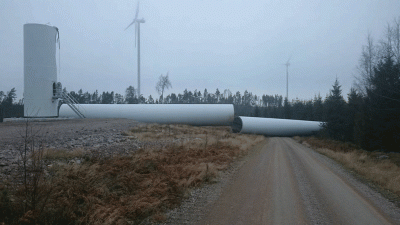
A month or so back, Swedes had the pleasure of waking up to the sound of a vertically-challenged 290 tonne, whirling Danish Dervish splattering itself across a country road, fortunately free of Volvos at the time:

vestas v112

****

Then there’s the wild habit of these little ‘eco-friendlies’ unshackling their 10 tonne blades, and chucking them for miles in all directions – see our posts here and here and here and here and here.

Adding to the list of unscheduled component ‘liberation’ events is this tale from Madison County, New York.

***

from WKTV

***

113-foot blade falls off windmill that previously toppled in Madison County
Syracuse
Elizabeth Doran
11 February 2016

blade fail

FENNER, NY – A 113-foot blade fell off a wind turbine at the Fenner wind farm off Bellinger Road in the town of Fenner in Madison County, according to Fenner town officials.

The blade appears to have fallen off at about 9:30 a.m. today, and town officials think it may have been caused by a bolt failure, said Paula Douglas, Fenner town clerk.

Town officials didn’t think the wind had anything to do with the incident.

Fenner town officials said it’s the same 187-ton windmill – No. 18 of 20 –that collapsed in December 2009. It was replaced with a new wind turbine, Douglas said.

Enel Green Power-North America officials said they are working with the turbine supplier to investigate what happened, but said it’s too early to determine the cause. EGP-NA also said there is no threat to the community, and asked that residents keep a safe distance away from the site to allow workers to conduct their assessments.

The 200-foot-plus structure is one of 20 windmills that generate electricity at the Fenner Wind Farm operated by EGP-NA.

The windmills were erected in 2001 atop a hill at a cost of $34 million. At the time, it was the largest wind-energy facility in the Eastern United States, but that’s no longer the case.

The wind farm, a landmark and tourist attraction to some, provide enough electricity for 10,000 homes.
Syracuse

blackout

****

The usual infantile ‘analysis’ from Elizabeth Doran there – with bunkum about “20 windmills powering 10,000 homes”. Unless those households are prepared to sit freezing or boiling in the dark around 70% of the time, they will, in fact, be ‘powered’ by conventional sources such as coal, gas, hydro and nuclear.

That journalists are still pushing that kind of wind industry propaganda in 2016 is not just dumb, it’s lazy. A quick glance at performance sites like,Aneroid Energy makes a nonsense of the “this wind farm powers XX homes” furphy.

And the line about these being a ‘landmark’ and providing a ‘tourist attraction’ had us giggling too; given that fact that the turbines in question seem to let loose with the regularity of Yellowstone’s Old Faithful: this is not the first time blades have busted loose or turbines have tumbled at Fenner. No, Fenner’s local wonders regularly turn-on ‘action/adventure’ shows that, no doubt, thrill visitors.

blaid fail ny pick up

****

Turbine blade falls at 30-MW wind farm in New York
SeeNews Renewables
Ivan Shumkov
12 February 2016

One of the blades of a Goldwind (HKG:2208) turbine at the 30-MW Fenner wind farm in Madison County, New York, fell off on Thursday, the Post-Standard of Syracuse reported.

Fenner town officials told the newspaper it was unlikely that the incident was caused by the wind, but rather by a bolt failure.

The North American unit of Italy’s Enel Green Power SpA (BIT:EGPW) is the operator of the wind park, which has been generating power since 2001. According to the officials, the turbine is in the same location as one that had to be replaced after crashing down in December 2009.

Representatives of Enel Green Power North America told the newspaper that they are investigating the incident in collaboration with the turbine supplier. The Fenner wind farm consists of 19 pieces of 1.5-MW turbines made by General Electric (GE) and one 1.5-MW Goldwind machine.
SeeNews Renewables

turbine collapse fenner NY

Turn off the Money Tap, and the Wind Scam will “Dry UP”!

Doomed & Desperate: UK Wind Industry Attempts to Engineer Backdoor Subsidies

panic-disorder-971

David Cameron’s Conservatives strode to outright power on the back of a ‘crystal clear’ manifesto to cut subsidies to wind power and to give locals the right to veto wind farm projects at the planning stage.

But, in a ‘never-say-die’ last ditch attempt to obtain ‘backdoor’ access to the perpetual subsidies that are the only reason it exists at all (see our posts here and here), the wind industry – along with its plants in the Department of Energy and Climate Change – have hatched a plan to get around Cameron’s pledge to permanently cut its lifeline.

Humpty Dumpty was famously (and rightly) challenged by a scornful and quizzical Alice for haughtily claiming that he – as ‘Master’ in a ‘Looking Glass’ World – could make words mean whatever he chose them to mean.

Taking its cue from that pompous and brittle egg, the wind industry – in pitching a panicked salvation package – has primed its DECC’s puppets to call a “government guaranteed fixed price for wind power” a “subsidy-free contract”, in what can be fairly described as very scrambled logic.

Revealed: the great wind farm tax ‘con’
The Telegraph
Emily Gosden
13 February 2016

Ministers may break pledge to stop funding onshore turbines with consumer subsidies

Ministers have been accused of planning a U-turn that would see consumersFUND new onshore wind farms through green levies.

The Government confirmed it was “looking carefully” at a wind industry proposal to continue public financial support for new turbines, despite a manifesto pledge to halt expansion.

Critics described the proposal as a con, and said the Conservatives’ policy had been “crystal clear” that the subsidies would stop.

Under the plan, households would still be forced to pay millions of pounds on their energy bills to fund new wind farms – but the payments would no longer be defined as subsidies.

The wind industry’s plan hinges on the fact that no new power plants are commercially viable to build at the moment without extra financial support from bill-payers.

If wind farms can be built at lower cost to consumers than alternatives, such as new gas plants, then payments toFUND them should no longer be classed as “subsidy”, the industry argues.

Andrea Leadsom, the energy minister, admitted that the proposal for so-called “subsidy-free” contracts would not in fact be “cost free” for bill-payers, but said the Government was “listening carefully to industry on how it can be delivered”.

Opponents called the plan “outrageous” and said that the proposals under consideration would still constitute subsidies.

Owen Paterson, the Tory MP and former environment secretary, said: “Hard-working energy consumers will not be conned by a change in name. The Conservative manifesto was crystal clear that public subsidies for onshore wind will stop.

“There is absolutely no place for subsidising wind – a failed medieval technology which during the coldest day of the year so far produced only 0.75 per cent of the electricity load.”

The Conservatives pledged in their 2015 manifesto to “halt the spread of onshore wind farms” and vowed to “end any new public subsidy” for the turbines.

More than 5,000 wind turbines have so far been built onshore in the UK under efforts to hit renewable energy and climate change targets.

Consumers are already estimated to pay in excess of £800 million a year in subsidies for the turbines, adding about £10 to an annual household energy bill.

David Cameron has said that Britain does not “need to have more of these subsidised onshore”.

But the proposal being considered by the Department of Energy and Climate Change (DECC) would see onshore wind farms continue to qualify for an existing subsidy scheme that guarantees developers a fixed price for electricity generated.

The most recent onshore wind farm contracts awarded under the scheme, early last year, were at prices of about £80 per megawatt hour (MWh) – more than double current market prices of about £35/MWh. Consumers willFUND the difference through green levies on their energy bills.

Under the proposals being looked at by DECC, prices of between £60/MWh and £80/MWh would be regarded as “subsidy-free” by 2020.

John Constable, of the Renewable Energy Foundation, a group critical of renewable energy costs, said it would be “outrageous” to regard the proposal DECC was considering as “subsidy free”. “It is justSPIN doctor stuff, it’s playing with words,” he said.

Glyn Davies, the Tory MP, a member of the energy select committee, said: “I don’t think we should be introducing mechanisms that continue with subsidy – just to say there’s no subsidy when there actually is.”

He said he would be “very concerned” if ministers continued payouts to new onshore wind farms.

Fellow Tory Peter Lilley said the wind industry’s proposal “wouldn’t be subsidy-free” and that wind farms should not receive the same support as gas plants, because the power they produced was not reliable and was therefore worth less.

Mr Paterson added: “If we must support energy, we should help develop combined heat and power which increases efficiency from 50 per cent to 80 per cent or we should develop new technologies which actually work.”

A DECC source insisted energy secretary Amber Rudd was “crystal clear that the manifesto commitment to end new public subsidies for onshore wind and give local people the final say is delivered to the letter”.

“Any idea that doesn’t do this is simply not going to get the green light,” the source said.

The influential think-tank Policy Exchange has said that “subsidy-free” contracts should be offered to support the construction of new onshore wind farms in Scotland and Wales, as well as replacing old turbines with new, far bigger ones.

Maf Smith, deputy chief executive of Renewable UK, said it would be “anti-competitive” to bar any technology from competing for the financial support being offered for new power plants.

A DECC spokesman said: “There is no change to our commitment to end new onshore wind subsidies. Our actions have shown that we will be tough on subsidies, in order to keep bills down for our families and businesses.”
The Telegraph

Maf-Smith

****

Maf Smith has a somewhat confused take on ‘competition’. It’s precisely what David Cameron has given the wind industry a chance to finally experience; with an opportunity toBACK UP its endless (but empty) claims about being cheaper than gas and coal-fired power. Well, Maf? What are you and your paymasters waiting for?

The only reason the UK has to offer any financial support to conventional generators is thanks to the perverse policy that, until now, has guaranteed prices 3-4 times the price of conventional power, for the chaotic, weather-driven delivery of a source that – but for the subsidies it attracts – has NO commercial value.

A rebranded wind farm subsidy is still a subsidy
The Telegraph
Telegraph View
24 February 2016

The public aren’t fools. If the Government wants them to pay for the construction of inefficient wind farms, let it admit to it

The 2015 Conservative Party manifesto took a clear and sensible stance on the issue of wind farms. It stated that while they can form part of the “energy mix”, they are “unable by themselves to provide the firm capacity that a stable energySYSTEM REQUIRES”. The manifesto pledged to “end any new public subsidy for them”. So it is more than a surprise and a disappointment to discover that the Government is considering a reversal – keeping the subsidies and simply rebranding them.

Popular opposition to wind farms is practical, not ideological. Most people recognise that we need to develop sustainable technologies and reduce pollution. But Britain also needs cheap, plentiful energy – to fuel its economic growth and provide a highQUALITY OF LIFE for all its citizens.

Wind farms often fail to meet these criteria. Some people complain that they despoil the environment by being ugly, loud and deadly to birds. Others point out that they can be desperately inefficient. Britain demands energy most in the winter, to heat our homes. But at this time of the year it is often windless, despite recent storms. The turbines stand still and useless – a complete waste of the generous subsidies that come from levies on consumers’ energy bills. To make matters worse, when the wind blows too hard, the Government actually pays the industry to turn the turbines off. Strong wind conditions in late January threatened to overwhelmTHE GRID with more power than was needed – so the National Grid offered lucrative payouts of between £58 and £115 per MWh to shut down the supply.

If the Government believes there is a case to be made for continuing to subsidise the industry then it should make it openly and honestly. What the public does not want to hear isSPIN – which is what the proposal of redefining a subsidy amounts to. Lobbyists say that any new onshore wind farms will cost less to build than the old, non-renewable plants they are replacing, so they are a fair deal. Yet not only will the new turbines be less efficient than gas or coal, but there is also no escaping the conclusion that hard-pressed consumers will still be bank-rolling the expansion of a controversial energy source through their domestic bills. We sincerely hope that the Government rejects any advice to rebrand this arrangement as subsidy-free. The public deserves transparency in this debate.
The Telegraph

SWITZERLAND-WEF-DAVOS-CAMERON

Winweasels Will Say Anything, To Try To Protect Their Scam!

Orwellian Eco-Fascist Ideology Ramming Wind Turbines Into Everyone Else’s Backyards

200355536-002

****

Those that accuse community defenders of being nothing more than self-interested ‘NIMBYs’ are hardly what you’d call ‘disinterested observers’.

No, it’s their willful ignorance and lack of human empathy that gives them away – that and the fact that they will never, themselves, have to tolerate a ‘life’, suffering incessant turbine generated low-frequency noise and infrasound.

Reminiscent of the porcine ‘elite’ that ran Orwell’s Animal Farm (with one of its central themes the promised construction of a windmill that was said by its piggy-proponents to offer ‘free electricity’, a life of leisure and wealth for the lower orders) in his obsession to carpet your patch of paradise with hundreds of whirling Danish-Dervishes, the eco-fascist is always ready to line you up to make the sacrifices that they themselveswouldn’t tolerate for a second.

Some might call it ‘green hypocrisy’: STT calls it an inexcusable form of malevolence of the very worst kind – one, long on sanctimony, and short on either scientific or economic logic. Precisely the attributes exhibited by Orwell’s selfish and mean-spirited barnyard overlords.

These days, the characters drawn by George don’t grunt, they rant – and use self-affixed titles such as “Friends of Mother Earth”. Here’s a run-down on how these characters roll, from Virgina.

Van Velzer: Botetourt ignores the hazards of wind energy
The Roanoke Times
Bill Van Velzer
15 February 2016

On Jan. 26, Botetourt County’s Board of Supervisors gave its unanimous blessing to the construction of 25, 550-foot tall wind turbines on North Mountain.

This decision has brought cheers from local environmentalists who identify themselves as “friends of Mother Earth.” As with the siting of any industrial facility, the proposed Rocky Forge project is replete with enough technical minutiae that any complete understanding of its true environmental and human impact requires tremendous attention to hours of intense study.

For this reason, Rockbridge County’s Board of Supervisors requested of Botetourt County a reasonable 90-day delay period. This delay was denied while the project was allowed to proceed.

Wind does not respect arbitrary political boundaries; neither do the impacts that industrial wind facilities have on nearby residents and wildlife. So when one of the speakers referred to a need to push wind turbines into the view sheds of “the wealthy Rockbridge elites,” one wonders if there is another agenda at work that has little to do with the facts of this issue. Unfortunately, this seems to be the world we live in nowadays.

Indeed, it seems that discussions of wind energy fit into a larger political matrix. We must avoid this. This issue — when properly vetted — should transcend political ideology and rest on factual evidence. Each of us has a right to define our own quality of life. When someone insists that their emotionally-driven opinion is more important than my factual analysis, I have to begin wondering if I’m getting too close to a larger ideological vulnerability.

Having said this, there are legitimate issues concerning both Botetourt County’s rush to judgement and the larger assumptions about wind energy. From local to global, here is where we are:

First is the issue of “unconstitutional taking of private property.” In short, your right to enjoy your private property cannot trump my right to the enjoy mine. This is an essential ingredient of American jurisprudence, originating in English common law. It is at the heart of how we define fairness. Yet the precedent set by the Botetourt Board of Supervisors allows 550’-tall wind turbines 605 feet from a neighboring property line, and 820 feet a from a neighbor’s home.

Moreover, the 60dBA noise limit “restriction” is commensurate with sound at a busy urban intersection. North Mountain is clearly a rural environment with an ambient noise level at exactly half of this figure. Will these allowances not impact neighboring property values?

Of course, these issues have everything to do with whether or not prospective purchasers of your property — should you decide to sell — would want to hear this cacophony of noise, and see spinning blades from your deck or picture window at all hours and days of the year.

Infrasound belongs to the above argument, but really deserves space of its own. The wind industry denies its existence like tobacco companies used to deny any link between smoking and lung cancer.

Not surprisingly, Botetourt County doesn’t recognize infrasound, either. This cannot and will not continue, due to the rapidly accumulating evidence that infrasound’s wave pulses are a much greater health concern than is audible sound.

Infrasound deprives people of sleep, causes irritability and loss of concentration, and general anxiety. Don’t take my word for it — scores of YouTube videos have documented the abandonment of homes due to this unforgivable negligence on the part of local government officials.

Impact on wildlife is the flip side of human impact. Infrasound impacts animals in the same way that it impacts humans; the difference is that wildlife simply leaves impacted areas.

sleep with turbines

However for avian populations, the destruction is more graphic. For this reason, wind turbines have been called “Cuisinarts of the air.”

“Windustry” denies this, while claiming that cats, windows and cars take far more birds and bats than do wind turbines. This is beyond disingenuous. How many house cats kill an eagle, a hawk, an owl annually? None other than the American Bird Conservancy documents bird and bat deaths in the U.S. as 573,000 and 888,000 respectively, as of 2012.

dead_eagle_at_base_of_turbine

The “kicker” here is that Botetourt County doesn’t require independent monitoring of bird and bat kills — even for resident eagle populations. Ditto for threatened and endangered bats. Is this prudent?

So while Rocky Forge supporters congratulate themselves, more deliberative minds ponder the future. Unbeknownst to most valley residents, Botetourt County’s master wind resource map identifies 11 ridges and mountains as potential industrial wind energy sites. I’ll leave the last assumption to you.
The Roanoke Times

lake winds

One Billion Dollars to “Fix” Mistakes that Should NOT Have Been Made!

‘Saving’ South Australia from its Self-Inflicted Wind Power Disaster Needs $1 Billion Right NOW!

head slap

****

Wind and solar create headaches for energy market operator
Australian Financial Review
Mark Ludlow
19 February 2016

State governments may have to spend billions of dollars to duplicate the electricity network to cope with the unreliability of renewable energy sources such as wind and solar, according to the national energy forecaster.

As the Australian Energy Market Operator released a report [press release here and the full report here: Joint AEMO ElectraNet Report_19 February 2016] that found there could be reliability issues for the South Australian market, which has embraced renewable technology, its chief executive, Matt Zema, said the rise of wind and solar could also create problems throughout the country.

“It is becoming more and more of a challenge. We might need to build another interconnector to the South Australian market to improve reliability and in the longer term another bigger loop across the nation to be a back-up,” Mr Zema told The Australian Financial Review.

Electricity prices spiked in South Australia late last year after problems with the Heywood interconnector to Victoria, effectively cutting off South Australia from the NEM. South Australia did not have enough of its own locally generated power to cope with demand, which significantly pushed up prices.

A joint report between AEMO and South Australia’s electricity transmission company Electranet found there will be ongoing issues with controlling reliability in the state’s power network either during or following any future loss of the Heywood interconnector and the closure of coal-fired power stations.

Interconnectors are high-voltage transmission cables connecting electricity markets.

“Measures can be taken in the short term to address some of the immediate operational effects, but as the power system continues to evolve, in the longer term there could be an increasing need for changes to market arrangements or infrastructure to continue to meet security and reliability expectations, particularly at times when SA is synchronously islanded [separated] from the remainder of the NEM,” the report found.

AEMO is conducting further studies to maintain power system security in South Australia if it becomes isolated from the NEM.

Grappling with implications

Mr Zema said state governments were still grappling with the implications of moving away from the more reliable coal and gas-fired generation. He said they may have toINVEST billions of dollars in a back-up “loop” of interconnectors to ensure there are not reliability issues which could lead to blackouts.

“South Australia is at the front end of this [renewable] curve, Tasmania is not far behind as they are finding out with Basslink connection to the mainland,” Mr Zema said.

“If you build another interconnector to Victoria you may well extend it from Victoria to NSW.”

A new interconnector between South Australia and Victoria which would cost about $1 billion.

Mr Zema said the only alternative to building back-up interconnectors or more gas-fired power stations to cover for wind and solar – when the sun isn’t shining or the wind is not blowing – would be to dismantle the NEM.

“You either strengthenTHE GRID and have more reliability and more paths or you break it up and its gets smaller and smaller and each state becomes an island,” he said.

“You either become better connected toTHE GRID or you become your own grid which would result in huge price fluctuations.”

South Australia is leading the charge towards renewable energy, especially with the closure of coal-fired power stations, including Alinta Energy’s coal-fired power stations at Port Augusta.

South Australian Premier Jay Weatherill last year said the price fluctuations would not last and the state would benefit from leading the adoption of wind and solar power.

The precarious nature of the electricity network was further demonstrated by Tasmania also being isolated due to problems with the Bass Strait undersea power cable.

Victoria’s energy market could also be facing an overhaul with Alcoa’s Portland smelter – a large energy users – close to closure. It is negotiating with AEMO about an energy subsidy for its poles and wires.
Australian Financial Review

jay weatherill

****

SA’s vapid Premier – a former worker’s compensation solicitor – wouldn’t be STT’s first pick when it came to sorting out a power market in absolute crisis and a grid on the brink of total collapse. His ‘belief’ that betting his beleaguered State’s failing ‘fortunes’ on more of the same smacks of child-like delusion, but, given more sensible (but costly) moves made recently (albeit under pressure) politically driven deception.

Contrary to Jay’s let’s all ‘hold-hands-around-a-turbine’ chanting Kumbaya – and Matt Zema’s line about “moving away from the more reliable coal and gas-fired generation” – SA’s Labor government has just signed their constituents up to throw $50 million a year in subsidies at the French owner of a mothballed CCGT plant at Pelican Point.

That panicked move is all about ensuring something like a reliable power flow (for the time being); and, at the political triage level, is an attempt to avoid any more ‘unhelpful’ wind power blackouts: like the one that plunged almost the entire State into Stone Age darkness last November; and that has businesses, like Uni SA coping with power supply ‘interruptions’ and total blackouts on a regular basis.

email ML

Once upon a time, thanks to the pragmatic vision of its longest-ever-serving Premier, Sir Tom Playford, South Australians enjoyed both energy autonomy and the cheapest and most reliable power in the Country – if not the world; and, with it, unparalleled growth in population, employment and incomes. Now, the reverse is true on all counts.

Always the mendicant State, SA’s Labor government – having willingly signed up to an economic suicide pact – will do what it does best: beg like fury for the Federal Government to bail it out, which means its neighbours will end up footing the bill for the most ridiculous power ‘policy’ ever devised.

tom playford-anzac-parade