Wind Turbines Increase the Amount of CO2 Being Produced to Make Electricity!

Why Intermittent Wind Power Increases CO2 Emissions in the Electricity Sector

lies

The central, endlessly repeated lie (upon which the great wind power fraud rests) is that increasing wind power generation results in decreases in CO2 emissions.

In Australia, the central object of the Renewable Energy (Electricity) Act 2000 is for “renewable” energy to “reduce emissions of greenhouse gases in the electricity sector” (see s3). But, somewhere along the way, what was a CO2 abatement scheme became an industry subsidy scheme which is nothing short of “corporate welfare on steroids” (see our post here).

At no point since that legislation took effect over 13 years ago has the wind industry provided any actual proof that it has in fact reduced CO2 emissions in the electricity sector. When we talk about “proof” we’re not talking about smoke and mirrors “modelling” based on long-term average wind farm output – which ignores the extra gas and coal being burnt (and wasted) in order to balance the grid to account for wild fluctuations in wind power output (see our post here); and to maintain additional “spinning reserve” (see our post here) to account for complete collapses in wind power output – as seen in this post.

As we have pointed out just once or twice – the need for 100% of wind power capacity to be backed up 100% of the time by fossil fuel generation sources means that wind power cannot and will never reduce CO2 emissions in the electricity sector (see our posts here and hereand here and here and here and here and here).

E.ON operates numerous transmission grids in Germany and, therefore, has the unenviable task of being forced to integrate the wildly fluctuating and unpredictable output from wind power generators, while trying to keep the German grid from collapsing (E.ON sets out a number of the headaches caused by intermittent wind power in the Summary of this paper at page 4). Dealing with the fantasy that wind power is an alternative to conventional generation sources, E.ON says:

“Wind energy is only able to replace traditional power stations to a limited extent. Their dependence on the prevailing wind conditions means that wind power has a limited load factor even when technically available. It is not possible to guarantee its use for the continual cover of electricity consumption. Consequently, traditional power stations with capacities equal to 90% of the installed wind power capacity must be permanently online [and burning fuel] in order to guarantee power supply at all times.”

STT is happy to go all out and say that in Australia wind power requires 100% of its capacity to be backed up 100% of the time by conventional generation sources. As just one recent example, on 3 consecutive days (20, 21 and 22 July 2014) the total output from all of the wind farms connected to the Eastern Grid (total capacity of 2,952 MW – and spread over 4 states, SA, Victoria, Tasmania and NSW) was a derisory 20 MW (or 0.67% of installed capacity) for hours on end (see our post here). The 99.33% of wind power output that went AWOL for hours (at various times, 3 days straight) was, instead, all supplied by conventional generators; the vast bulk of which came from coal and gas plants, with the balance coming from hydro.

For wind power to reduce CO2 emissions in the electricity sector it has be a true “substitute” for conventional generation sources. Because it can’t be delivered “on-demand” (can’t be stored) and is only “available” at crazy, random intervals (if at all) wind power will never be a substitute for conventional generation sources (see our post here).

Perhaps the reason that the wind industry has never produced a shred of evidence to show that wind power has reduced CO2 emissions in Australia’s electricity sector is simply because it can’t. Running counter to wind industry claims about wind power abating CO2 emissions, the result of trying to incorporate wind power into a coal/gas fired grid is increased CO2 emissions (see this European paper here; this Irish paper here; this English paper here; this American article and this Dutch study here).

This American study details just why increasing wind power capacity – and trying to incorporate its wildly fluctuating output into a coal and gas fired grid – results in increased CO2 emissions across the electricity sector.

Wind Integration vs. Air Emission Reductions: A Primer for Policymakers
Master Resource
Mary Hutzler
24 June 2010

Many claim that wind generation is beneficial because it reduces pollution emissions and does not emit carbon dioxide. This isn’t necessarily the case. The following article explains a phenomena called cycling where the introduction of wind power into a generation system that uses carbon technologies to back-up the wind actually reduces the energy efficiency of the carbon technologies. Recent studies with actual data have estimated the impact of cycling on air pollution and carbon dioxide emissions.

Energy modelers evaluating the impact of legislation such as Senator Bingaman’s American Clean Energy Leadership Act and the American Power Act proposed by Senators Kerry and Lieberman should take note for their models most likely are underestimating the cost of compliance by incorrectly modeling the integration of wind power into the electricity grid.

Wind is not a new technology. It was one of our principal sources of energy, along with wood and water, prior to the carbon era. But the use of renewables in the pre-carbon age was very different from the current use of renewables. Today, people rely on energy being available 24 hours a day, 7 days a week, 365 days a year, regardless of whether the sun shines, the wind blows, or there are high or low water levels.  We now have over 1,000 gigawatts of generating plants[1], and a large and elaborate electrical grid that requires great coordination among system operators to avoid disruptions.

Also, in the pre-carbon energy era, when renewables were the sole source of energy, there were no coal-fired or natural-gas fired power plants to provide back-up power. Studies have found that the efficiency of those carbon-based plants is affected by incorporating wind energy into the system. When a plant’s efficiency is reduced, its fuel consumption and emissions increase, causing unintended consequences that wind proponents do not disclose. Requiring even larger amounts of renewable energy through renewable portfolio standards will only exacerbate this problem.

Picture1

Background

Our various electricity generating technologies were designed and constructed to meet electricity demand based on their best operating characteristics for meeting portions of the electricity load duration curve. The load duration curve illustrates periods of constant demand that are served by base-load power versus periods of intermediate and peak demand. Owing to their high capital cost, low fuel cost, and high capacity factors, technologies such as coal and nuclear were designed to operate continuously to meet the base-load demand component. Owing to their lower capital costs but higher fuel costs, natural gas technologies, including combined-cycle and turbine plants, were designed to meet intermediate and peak electrical load.

Wind is an intermittent technology since it can generate power only when the wind blows. Its low operating cost (with no fuel component) and the mandates of state Renewable Portfolio Standards (RPS) make it practically a “must take” technology for system operators. RPSs require that a certain amount of electricity generation be produced by renewable fuels. The renewable target mandates tend to start out low but increase over time, with those of most RPS states reaching 15 to 30 percent by 2020 or 2025.[2] Wind tends to be the primary technology for meeting RPS targets, since it is lower in capital cost than solar, thermal, and photovoltaic technologies, the other politically acceptable “green” technologies.

Part of the rationale for introducing RPSs is that the substitution of “green” technologies for carbon technologies is supposed to reduce pollution emissions as well as carbon dioxide emissions. However, studies have shown that this may not be the case. As conventional generation (coal or natural gas) is reduced to make room for wind generation and is then increased as wind generation subsides, its heat rate rises. The heat rate is a measure of a generating station’s thermal efficiency commonly stated in units of Btu per kilowatt-hour. This reduction in efficiency  increases its fuel consumption and emissions. When sudden increases or decreases occur in generation output, it is referred to as “cycling”.

The Bentek Study

Bentek did a study of the results of integrating wind into the generation mix of the Public Service Company of Colorado (PSCO), using data from the company’s financial reports, the Energy Information Administration, the Federal Energy Regulatory Commission, the Environmental Protection Agency, and the National Renewable Energy Laboratory.[3] PSCO is a largely coal-fired utility with 3,764 megawatts of coal-fired generators, 3,236 megawatts of gas-fired combined-cycle and gas turbine capacity, 405 megawatts of hydro and pumped storage capacity, and 1,064 megawatts of wind generators. Colorado has an RPS that required 3 percent of the electricity generated by investor-owned utilities come from qualifying renewable technologies by 2007, and 30 percent by 2020.[4]

Colorado’s energy demand is highest during the day, peaking in late afternoon or early evening. Wind generation, however, is greatest between the hours of 9 pm and 5 am; it cannot be counted on to provide power when most needed, and so is used when available to meet the RPS. Most of the time that wind generation is available, it backs out (or replaces) natural gas. However, there are times when coal generation, which provides over 50 percent of PSCO’s base-load generation, is backed out to make room for the wind generation. When this happens, coal generation is cycled, causing its heat rate to increase and resulting in more fuel consumption and emissions. In PSCO, coal cycling predominates because of the low amount of gas generation in the system since most of its gas-fired generation is from turbines and because wind is strongest at night when coal use is even more pronounced.

Picture2

In the Denver non-attainment area, PSCO has 4 coal-fired plants: Arapahoe, Valmont, Pawnee, and Cherokee. Between 2006 and 2009, these coal-fired plants have experienced higher emissions rates ranging from 17 to 172 percent higher for sulfur dioxide, 0 to 9 percent higher for nitrous oxide, and 0 to 9 percent higher for carbon dioxide. In 2008, Cherokee even switched to a lower sulfur coal, but still ended up with sulfur dioxide emissions higher by 18 percent. And, between 2006 and 2009, these plants reduced their generation by over 37 percent, exacerbating further the increase in emissions.

Because the PSCO data are limited, Bentek checked their results against data from the Energy Reliability Council of Texas, whose utilities are required to report generation levels by fuel every 15 minutes. Texas has the most wind capacity in the country—over 9,500 megawatts.[5] Texas also has an RPS that was instituted during George W. Bush’s governorship and that pushed Texas ahead of California in wind capacity during 2006. The Texas renewable portfolio standard requires that utilities have 5,880 megawatts of renewable capacity by 2015, including a target of 500 megawatts of renewable-energy capacity from resources other than wind. The legislation also set a target of reaching 10,000 megawatts of renewable energy capacity by 2025, although it will be exceeded much earlier.[6] However, even in Texas, which has a large natural gas–fired capacity base, with over 40 percent of its generation being natural gas-fired,[7] coal-fired generation is cycled as is shown in the graph below.

Picture3

Another benefit that wind power generators get is that their forecast power generation entails no penalty if it is not available. Other generators must provide their own back-up power if their generation is suddenly unavailable. But the owners of wind generators believe that they can’t be held accountable for whether the wind blows and thus for inaccuracies in their forecasting capability. For example, on February 26, 2008, a cold front moved through West Texas and rendered wind’s output 1,000 megawatts less than promised, and that unexpectedly had to be made up by other generating technologies.[8] Only careful and extensive coordination, such as was carried out in West Texas on that cold February day, can prevent brown outs and black outs from occurring.

The Netherlands Experience[9]

Two researchers, C. le Pair and K. de Groot, found that the Netherlands government was overestimating the amount of carbon dioxide reductions associated with wind production. The government was using incorrect data because it did not correct for the reduction in efficiency of the conventional power plants once wind was introduced into the system. Using data provided by CBS, the Dutch Institute for Statistics, the researchers made an estimate of the “turning point” where the efficiency reduction of conventional power plants balances out the fuel savings from wind energy. Using data for 2007, when wind power was at 3 percent, they found the turning point to be at an efficiency reduction of 2 percent based on all the power stations serving the Netherlands. That is, when the efficiency of the back-up plants was reduced by over 2 percent due to cycling caused by the integration of wind energy into the system, fuel use and emissions of the back-up plants increased.

Heat Rate Simulations

An engineer, Kent Hawkins, evaluated several heat rate simulations to represent cycling of the plants when wind is introduced into the system.[10] One set of simulations evaluates wind energy replacing coal power with different technologies serving as the back-up power to wind, in order to evaluate their effect on fuel use and carbon dioxide emissions. He found that because of cycling, carbon dioxide emissions increase with the incorporation of wind energy if coal is the sole back-up power for wind. If coal and gas turbines or gas combined-cycle and gas turbines are used to back up the wind power, carbon dioxide emissions are reduced mainly due to the lower carbon dioxide emissions produced from natural gas generators as compared to coal generators. This is best seen by examining the last bar in the chart below where the lowest carbon dioxide emissions result when natural gas combined-cycle plants are solely used to replace coal.

Picture4

An interesting consequence of this analysis is that certain areas of the world where wind is integrated into a system that is primarily coal-based may result in an increase in total carbon dioxide emissions from using wind in their generating sector. That is, in these circumstances, wind would not be providing an offset in carbon dioxide emissions, but would actually be providing an increase in those emissions. China, for example, relies on coal for 80 percent of its generation and natural gas for only 2 percent.[11] China also added the most wind power of any country in 2009, 13 gigawatts,[12] ranking third in the world in total wind capacity, with the United States first and Germany second.[13] Since China’s wind would primarily be backed up by power from coal-fired generating units, it is no wonder that China’s carbon dioxide emissions increased by 9 percent in 2009.[14]

Conclusion

As more wind units are built and data become available regarding their integration into conventional energy systems, we will learn more about the effects of wind units on the operation of conventional plants. A few studies have been done showing that the effect of wind integration on both fuel consumption and emission reductions can in fact be negative. Further evaluation of our current wind units and their effects on fuel consumption and emissions should be done before increasing the penetration of renewable energy to the 20 and 30 percent levels currently mandated by some state renewable portfolio standards, and before a national renewable portfolio standard is considered for enactment.

[1] Energy Information Administration, Electric Power Annual,http://www.eia.doe.gov/cneaf/electricity/epa/epat1p2.html

[2] Institute for Energy Research, Energy Regulation of the States: A Wake-up Call, www.instituteforenergyresearch.org/states/

[3] Bentek Energy LLC, How Less Became More: Wind, Power and Unintended Consequences in the Colorado Energy Market,http://www.bentekenergy.com/WindCoalandGasStudy.aspx

[4] Institute for Energy Research, Energy Regulation of the States: A Wake-up Call, http://www.instituteforenergyresearch.org/states/colorado/

[5] American Wind Energy Association,http://www.awea.org/projects/projects.aspx?s=Texas

[6] Institute for Energy Research, Energy Regulation of the States: A Wake-up Call, http://www.instituteforenergyresearch.org/states/texas/

[7] Energy Information Administration, Electric Power Monthly, March 2010, http://tonto.eia.doe.gov/ftproot/electricity/epm/02261003.pdf

[8] The Wall Street Journal, Natural Gas Tilts at Windmills in Power Feud, March 2, 2010,http://online.wsj.com/article/SB10001424052748704188104575083982637451248.html

[9] The impact of wind generated electricity on fossil fuel consumption, C. le Pair and K. de Groot, http://www.clepair.net/windefficiency.html

[10] Wind Integration: Incremental Emissions from Back-Up Generation Cycling (Part V: Calculator Update), Kent Hawkins, February 12, 2010,http://www.masterresource.org/2010/02/wind-integration-incremental-emissions-from-back-up-generation-cycling-part-v-calculator-update/#more-7271

[11] Energy Information Administration, International Energy Outlook 2010, Tables H10, H12, and H13,http://www.eia.doe.gov/oiaf/ieo/pdf/ieoecg.pdf

[12] Global Wind Energy Council, Global wind power boom continues amid economic woes, March 2, 2010, http://www.gwec.net/index.php?id=30&no_cache=1&tx_ttnews[tt_news]=247&tx_ttnews[backPid]=4&cHash=1196e940a0

[13] Global Wind Energy Council, http://www.gwec.net/index.php?id=13, and Global Wind Energy Council, Global wind power boom continues amid economic woes, March 2, 2010, http://www.gwec.net/index.php?id=30&no_cache=1&tx_ttnews[tt_news]=247&tx_ttnews[backPid]=4&cHash=1196e940a0

[14] Reuters, China top carbon emitter for second year running, June 9, 2010, http://alertnet.org/thenews/newsdesk/LDE6580Y1.htm

Facts

All of the Negativities of Wind Turbines are Hidden or Denied…check this out!

Safety fears after faults found in toppled turbines

By Western Morning News  |  Posted: September 07, 2014

By Phil Goodwin

turbs

A collapsed turbine

Comments (2)

Safety concerns have been raised about the wind energy industry after reports showed two Westcountry turbines collapsed because of faults.

The giant masts crashed down on farmland amid initial rumours of sabotage and claims they had fallen victim to severe weather.

Documents obtained by the WMN on Sunday have revealed that the towers actually toppled over due to defects and mistakes in the construction process.

A 115ft (34 metre) mast at East Ash Farm, Bradworthy, in Devon, tumbled in January 2013, prompting claims of foul play from the local parish council.


Around the same time, a 60ft (18-metre) tower sited at Winsdon Farm, North Petherwin – the family farm of Liberal Democrat Cornwall Councillor Adam Paynter – also came loose from its moorings and fell.

Subsequent investigations by both manufacturers identified further defects and prompted warnings to other sites, including in Somerset, Devon and Cornwall.

Glasgow-based Gaia Wind wrote to owners and overhauled its entire first generation fleet.

Canadian firm Endurance Wind Power said it was also concerned about machines on dozens of locations.

Initial reports suggested high winds may have been responsible for the failures but restricted reports by the Healthy and Safety Executive (HSE), obtained under the Freedom of Information Act (FoI), have blamed the way the towers were secured.

Specialist inspector Darren Nash concluded that the first generation model of the turbine sited in Cornwall appeared “susceptible to fatigue failure” and said Gaia Wind had found “ten units with existing defects” out of the company’s 70 or 80 turbines.

“A plan of remedial actions is in place to address these units,” he wrote.

Endurance Wind Power, makers of the E3120 turbine which fell in Devon, identified a further 29 turbines that might have been affected by a problem with the foundations.

Mr Nash said it had fallen because Dulas – the installation company – had used “cosmetic grout” to cement the structure in place and not the “prescribed” substance.

On his visit to the site on May 8, more than three months later, he also noted that the turbine had already been “re-instated using the original anchor bolts and studs.

He added that “no evidence remained to assist investigation”, recommending that Edurance improve its quality assurance procedures.

Dr Philip Bratby, a retired nuclear scientist and spokesman for the Campaign to Protect Rural England, said several wind turbines in Devon were sited much too close to roads and factories and “pose a real threat to the public”.

“It is not the responsibility of the Health and Safety Executive at the planning stage – they can only get involved after an incident occurs,” he added.

“It has been apparent to me for a long time that most developers of wind turbines and wind farms do not do a proper assessment of safety and of the risks to the public from wind turbines and none of them have acceptable quality assurance procedures in place.”

Alan Dransfield, a campaigner based in Exeter, who visited the Devon site days after the incident and later secured the two reports, said he was “disappointed”.

He criticised the response from the HSE, which rather than publish their findings, said the documents were not available in electronic form then only released the papers after a formal FoI request.

“These wind turbines which collapsed were unsafe and unfit for purpose,” he added.

“We should not have to resort to Freedom of Information Act to find this out.

“The root causes were not high winds but poor design, inferior materials and a systemic failure through the chain of command.”

Martin Paterson, spokesman for Gaia-Wind, said:

the firm and its reselling agents inspected all “first generation” towers, which were designed to the “prevailing engineering standard of the time”.

“This standard was superseded in early 2011 and this tube tower design is no longer available for sale or installation,” he added.

“Our second generation towers are designed to current industry standards reflecting the development of more demanding design protocols in this field.”

Dulas declined to comment on the findings.

Read more: http://www.westernmorningnews.co.uk/Safety-fears-faults-toppled-turbines/story-22887067-detail/story.html#hTGPwKsugFcxR9xK.99#ixzz3Cdt98cM9

Global Warming Alarmists ….Causing Global Chaos!

Lawrence Solomon: How global warming policies have led to global insecurity

 Lawrence Solomon | September 4, 2014 7:30 PM ET
Lawrence Solomon: Over the last two decades, global warming activists succeeded in slowing the development of the oil sands, blocking major pipelines like Keystone XL, phasing out coal plants and banning shale gas and oil projects.

Nathan VanderKlippe /National Post, fileLawrence Solomon: Over the last two decades, global warming activists succeeded in slowing the development of the oil sands, blocking major pipelines like Keystone XL, phasing out coal plants and banning shale gas and oil projects.
  •  

Limits on energy production in the West enabled conflicts in the Ukraine and the Middle East

Global warming policies abet terrorism and global insecurity. If Western governments weren’t spooked by global warming, ISIS would be less of a threat to the West, the Middle East would be less of a cauldron of hate, Europe wouldn’t be held hostage by Russia and China wouldn’t be threatening its neighbours over islands in the South and East China Seas.

Over the last two decades, global warming activists succeeded in slowing the development of the oil sands, blocking major pipelines like Keystone XL, phasing out coal plants and banning shale gas and oil projects. Without their activism, the Western world would have years ago not only become self-sufficient in fossil fuels, it would have become an exporter. Even with the roadblocks, the U.S. managed a miraculous transformation — once the world’s largest energy importer, it is now becoming a major exporter. Only Europe among the Western continents remains subject to dictates from energy exporters, most of them from unsavoury and hostile areas such as the Middle East, Russia and Venezuela.

Had the West earlier become a major energy exporter, these hostile economies would have lost their chief markets and the bulk of their revenues, particularly since prices would also have collapsed in a world awash in energy. Russia, for example, relies on energy for 30% of its GDP, Venezuela for 33%, some Middle East countries for more than 50%. Their economies would have retrenched, unable to finance social services at home let alone military adventures abroad. Their regimes would have focused on self-preservation rather than spreading ideologies abroad.

Funders of Islamic terrorism would have been strapped for cash

In a world of low-cost, plentiful energy, ISIS could never have emerged as a major threat. This ultimate-Islamic-terror group largely relies on generous grants from energy-exporters like Qatar, a Muslim Brotherhood-friendly emirate, and on sales from its own oil fields, captured in battle. Without global warming dogma, neither of these revenue sources would have taken ISIS far.

Likewise Iran, Qatar’s rival for the title of No. 1 funder of Islamic terrorism, would have been strapped for cash. It would have been unable to bankroll such notables in the region’s terrorist gallery as Hamas and Islamic Jihad in Gaza, Hezbollah in Lebanon and Assad in Syria, not to mention their terror cells in the West.

Russia would also have been sapped of strength and unable to threaten its neighbours, much as occurred in the 1980s, when the USSR’s failed economy led to its breakup and the release from its grasp of Ukraine and the rest of eastern Europe. The potent Putin we created would instead have been Putin the Impotent.

China, too, would have been less belligerent with its neighbours. Its territorial disputes with Japan, Taiwan, the Philippines, Malaysia, and Vietnam often focus on barren islands — sometimes mere outcroppings — in the East and South China Seas. Their value lies mostly in the prospect that oil and gas will be found in their offshore waters. That value would greatly diminish, along with the logic of going to war for them, if energy became cheap and plentiful.

Ironically, the environmentalists who pushed global warming policies on the West thought they would be enhancing global security. Wars — particularly those in the Middle East — stemmed from the West’s desire for oil, they argued. By getting the West off oil and onto CO2-free renewables, the West would lose its lust for the Middle East’s energy resources, ushering in a new era of peace.

They were half right — it did make sense to rid the West of dependence on Middle East energy. And half wrong — the alternative to oil and gas from the Middle East was not renewable energy but oil and gas from Western countries. And they were entirely misguided — contrary to their claims, the planet has not warmed in almost 20 years now.

Today, most Western governments are reining in their global warming policies, slashing their ruinously expensive subsidies to renewables and aggressively developing fossil fuels. All that the global warming scare accomplished was to make people pay with their pocketbooks — tens of millions of Europeans now suffer “fuel poverty,” the household term in Europe for those who now can’t afford to pay their power bills — and to increase wars, terrorism and global insecurity.

Keep Roof Top Solar, (Domestic), and get rid of Wind Turbines….BRILLIANT IDEA!

Angus Taylor: Coalition set to kill the wind industry, while supporting rooftop solar

divide-and-conquer2

With the wind industry reeling after the RET review panel delivered its recommendation to slam the door shut on any more wind farms (see our post here), it’s sought to whip up support for the mandatory RET by enlisting the usual band of useful Marxist idiots (like GetUp! and 350.org) to rally a band of imaginary troops (apparently ready to die on the barricades); and to rattle cans to fund super-shrill ad campaigns. What’s that they say about “astro-turfing”?

What the wind industry has counted on (so far) in its attempt to retain the RET, is support from the solar industry; and its many satisfied customers.

The wind industry and its parasites like to shelter under the same umbrella as the solar boys: blancmanging the two very distinct animals under the “renewables” tagline.

There are, however, a number of key distinctions between the wind industry and domestic (rooftop) solar. The differences are significant, have political consequences, and the Coalition government is alive to them.

Installing rooftop solar has created a big number of specialist installers (mostly electricians and panel fitters) who way outnumber the handful of permanent jobs created in the wind industry. This band (numbering some 18,000) work for, or operate, hundreds of small businesses across Australia; and, therefore, have the potential of becoming very vocal regarding any threat to the small scale renewable energy scheme (SRES) – which doles out subsidies for rooftop solar.

The RET review panel delivered a recommendation that the SRES should be scrapped immediately. However, STT hears that (for reasons that follow) the Coalition are not going to follow that recommendation.

Unlike the wind industry, rooftop solar has lots of friends and no real enemies.

Were the Coalition to cut the SRES, thousands of solar installers would immediately face an uncertain future: no doubt, many would lose their jobs. There are thousands of panel installers who are currently employed or who own business built on the SRES – all feel threatened – and have been lobbying Coalition members for a retention of the SRES.

In suburban Australia, rooftop solar has become an aspirational good – with families planning their next home (or new home) with panels; or otherwise hoping to take up rooftop solar in order to reduce their spiralling power bills. To an extent, given the massive take-up of rooftop solar to date, getting solar panels has become a game of “keeping up with the Jones”.

So, between thousands of rooftop solar installers and tens of thousands of families who see solar panels as a right of household passage (all of them potential Coalition voters), the Coalition faces a serious loss of political capital were it to chop the SRES (as recommended by the panel).

The wind industry, on the other hand, has very few friends and lots of enemies (see our posts here and here). Its “friends” are panicky investors and died-in-the-wool Labor and Green voters (predominantly inner city trendies from the hard-green-left) who would never vote for the Coalition in a fit. Pandering to this lot has no political upside for Tony Abbott and his team.

The wind industry was brought to life by the Large-Scale RET (LRET). The RET review panel has recommended that the current target set by the LRET of 41,000 GWh be slashed and that the scheme be closed to new entrants from here on.

STT hears that the Coalition, starting with Tony Abbott, is all set to follow that recommendation. While Environment Minister, Greg Hunt has been working flat-out in the media, touting claims that the Coalition supports a real 20% target, he couldn’t be more isolated from his own party than if he were Robinson Crusoe. STT hears that, for his recent efforts, young Greg is about to have his wings clipped by the Head Boy (as soon as he returns from his trip to India).

Unlike rooftop solar and the SRES, were the LRET scaled back and closed to new entrants hardly any current wind industry jobs would face immediate threat.

In the wind industry, most of the jobs involve the fleeting work created during wind farm construction (see our post here). Australia doesn’t manufacture wind turbines: every single one of them has been imported from Denmark, India, Germany and China.

In Australia, wind farm construction is almost at a standstill: “investment” in the construction of wind farms went from $2.69 billion in 2013 to a piddling $40 million this year (see this article). So it’s not as if thousands of currently employed construction workers will lose their jobs as a result of changes to the LRET.

As to the few permanent jobs created by the wind industry, most of these involve the repair and maintenance of turbines (changing oil, changing over gearboxes, bearings etc); and these jobs are not under immediate threat – turbines put up in the last decade will continue to need repairs (and more so, as time passes).

Employment in the wind industry is all about what might be; rather than what is. With hardly any jobs under immediate threat, the Coalition has little political capital to lose and much to gain in following the panel’s recommendations regarding the LRET.

The SRES is estimated to cost a further $1.5-2 billion, which is chickenfeed compared to the future cost of the LRET. The wind industry has been, and would be, the only practical beneficiary of the LRET; and stands to reap a further $50 billion in subsidies via the REC Tax levied on all Australian power consumers (see our post here).

From a political perspective then, the options are a “no-brainer”: keep the SRES and kill off the LRET.

By closing off any threat to rooftop solar, the Coalition avoids a battle that it’s likely to lose – and also allows it to target the wind industry standing all on its lonesome.

In the battle to “win hearts and minds” over the fate of the RET, the wind industry has used the solar industry as a kind of “human shield”: avoiding political flack by hiding behind a sea of suburban solar panels; the hundreds of small businesses that install them; and the mums and dads that own (or want to own) them.

With the Coalition coming out in support of the SRES, the political “stink” being kicked up by the solar lobby will simply fade away – and the wind industry will lose its “solar shield”. Oops!

Leading the Coalition’s charge to maintain the SRES (and government support for rooftop solar); and to kill the wind industry (by following the panel’s recommendation on the LRET) is STT Champion, Angus “the Enforcer” Taylor. Here’s a piece Angus penned for the Australian Financial Review, outlining the Coalition’s shift on renewable policy.

Time to get rational about the RET (Renewable Energy Target)
Australian Financial Review
Angus Taylor
4 September 2014

Now that the renewable energy target (RET) review panel has published its findings, it is time to focus on home truths and explode some myths relating to renewables.

As politicians’ inboxes fill with carefully crafted messages from vested interests with huge dollars at stake, it is important to keep a grip on the facts.

First, we need to remember that, strictly speaking, there is no RET. In fact, there are two schemes. The large scale renewable target (LRET) focused mostly on wind, and the small scale renewable energy scheme (SRES), focused mostly on roof-top solar. Many renewables interests, particularly the wind industry, want to confuse the two, because roof-top solar has far more mainstream political support than other renewables. However, the review made quite different recommendations for the two, and the government will need to announce different policies for each scheme.

Second, the review and other recent work showed that there are many cheaper carbon abatement options than renewables. We should not forget that the purpose of the exercise is to reduce carbon emissions, not to build an industry. If an industry emerges out of our efforts to reduce emissions, then well and good, but industry pork-barrelling has not been an aspiration of this government.

Deloitte tells us that we all wear these costs, but the least well-off are hardest hit by higher retail electricity prices, as with the carbon tax. Investment is not a free lunch, and bad investment reduces productivity, wages and jobs, despite all the talk about green jobs. Deloitte’s estimate is that the cost is 5000 jobs and over $1250 in lost earnings for the average Australian.

A FLAWED TARGET

Third, it is now very clear that the 20 per cent renewable target was flawed. In an atrocious decision, the former government decided to translate the 20 per cent target into 45,000 GWh of new capacity, allocating 41,000 of the target to large-scale schemes. This was based on ridiculously optimistic views of electricity demand growth and effectively eliminated demand risk for the renewables industry – a risk that other businesses face every day. In reality, electricity demand has been going backwards, not forwards. The forecaster responsible for the current target, AEMO, has done some serious soul searching and will need to do more.

Fourth, according to the spin from the renewables sector, the schemes are costless, because of a magical impact on wholesale electricity prices. No serious economist agrees that these schemes are costless. The review estimates the cross-subsidy to be $22 billion, and the only serious work done on economy wide impacts (Deloitte again) put that at $29 billion.

The critical question is who wears these costs. In reality, they are shared between electricity consumers (via higher electricity bills), electricity generators and the broader economy. The renewables industry likes to imagine that household bills will not go up, but the review rejects that argument, particularly in the next five years. Of course, if the cost of renewables drops in the longer term – which would be a great thing – then subsidies are no longer necessary.

INVESTMENTS IN GOOD FAITH

Finally, the review panel recognised the legitimate claim from the renewables industry that past investments were made in good faith, and those investments should be protected from changes to the LRET or the SRES. At the same time, non-renewable generators invested in good faith, and have had to wear a massive increase in capacity while demand has shrunk. We shouldn’t forget that many of the shareholders in these companies are mum and dad investors.

As a result of these competing considerations, the panel rightly recognised the need to scale back the LRET to reduce the massive subsidies to the wind industry, while simultaneously protecting past investment. The review offers two options that will strengthen the economy and reduce electricity prices in time, while maintaining a commitment to large scale renewables.

The prospects for solar are quite different and are positive. The SRES is planned to be phased out in coming years and is responsible for a fraction of the renewable subsidies, but much political noise. In the absence of new hugely expensive state-based feed in tariffs, solar’s future is hitched to its ability to cash in on the excessive network charges in electricity bills. We should support that goal.

Vigilance with the facts and measured policy debate will ensure noisy vested interests don’t subvert the national interest.

Angus Taylor is the federal member for Hume.
Australian Financial Review

Angus Taylor

Parasitic Wind…..Merely a “Novelty” Source of Energy! (and the novelty has worn off)…

Wind Power: The Parasitic Power Producer

mosquito-7192_lores

Promoting Parasitic Power Producers
carbon-sense.com
Viv Forbes
17 July 2014

Wind and solar are parasitic power producers, unable to survive in a modern electricity grid without the back-up of stand-alone electricity generators such as hydro, coal, gas or nuclear. And like all parasites, they weaken their hosts, causing increased operating and transmission costs and reduced profits for all participants in the grid.

Without subsidies, few large wind/solar plants would be built; and without mandated targets, few would get connected to the grid.

Green zealots posing as energy engineers should be free to play with their green energy toys at their own expense, on their own properties, but the rest of us should not be saddled with their costs and unreliability.
We should stop promoting parasitic power producers. As a first step, all green energy subsidies and targets should be abolished.

For those who wish to read more:

Wind Power Chaos in Germany:

http://www.telegraph.co.uk/comment/9559656/Germanys-wind-power-chaos-should-be-a-warning-to-the-UK.html

The reality of green energy:

http://wattsupwiththat.com/2014/07/18/the-stark-reality-of-green-techs-solar-and-wind-contribution-to-world-energy/

Blowing Our Dollars in the Wind

Wind energy produces costly, intermittent, unpredictable electricity. But Government subsidies and mandates have encouraged a massive gamble on wind investments in Australia – over $7 billion has already been spent and another $30 billion is proposed.

This expenditure is justified by the claim that by using wind energy there will be less carbon dioxide emitted to the atmosphere which will help to prevent dangerous global warming.

Incredibly, this claim is not supported by any credible cost-benefit analysis – a searching enquiry is well overdue. Here is a summary of things that should be included in the enquiry.

Firstly, no one knows how much global warming is related to carbon dioxide and how much is due to natural variability. However, the historical record shows that carbon dioxide is not the most important factor, and no one knows whether net climate feedbacks are positive or negative. In many ways, the biosphere and humanity would benefit from more warmth, more carbon dioxide and more moisture in the atmosphere.

However, let’s assume that reducing man’s production of carbon dioxide is a sensible goal and consider whether wind power is likely to achieve it. To do this we need to look at the whole life cycle of a wind tower.

Wind turbines are not just big simple windmills – they are massive complex machines whose manufacture and construction consume much energy and many expensive materials. These include steel for the tower, concrete for the footings, fibre glass for the nacelle, rare metals for the electro-magnets, steel and copper for the machinery, high quality lubricating oils for the gears, fibre-glass or aluminium for the blades, titanium and other materials for weather-proof paints, copper, aluminium and steel for the transmission lines and support towers, and gravel for the access roads.

There is a long production chain for each of these materials. Mining and mineral extraction rely on diesel power for mobile equipment and electrical power for haulage, hoisting, crushing, grinding, milling, smelting, refining. These processes need 24/7 reliable electric power which, in Australia, is most likely to come from coal.

These raw materials then have to be transported to many specialised manufacturing plants, again using large quantities of energy, generating more carbon dioxide.

Then comes the construction phase, starting with building a network of access roads, clearance of transmission routes, and excavation of the massive footings for the towers. Have a look here at the massive amount of steel, concrete and energy consumed in constructing the foundations for just one tower: https://www.youtube.com/watch?v=KX0RhjeLlCs

Not one tonne of steel or concrete can be produced without releasing carbon dioxide in the process.

Almost all of the energy used during construction will come from diesel fuel, with increased production of carbon dioxide.

Moreover, every bit of land cleared results in the production of carbon dioxide as the plant material dozed out of the way rots or is burnt, and the exposed soil loses its humus to oxidation.

Once the turbine starts operating the many towers, transmission lines and access roads need more maintenance and repair than a traditional power plant that produces concentrated energy from one small plot of land using a small number of huge, well-tested, well protected machines. Turbines usually operate in windy, exposed, isolated locations. Blades need to be cleaned using large specialised cranes; towers and machinery need regular inspection and maintenance; and mobile equipment and manpower needs to be on standby for lightning strikes, fires or accidents. All of these activities require diesel powered equipment which produces more carbon dioxide.

Even when they do produce energy, wind towers often produce it at times when demand is low – at night for example. There is no benefit in this unwanted production, but it is usually counted as saving carbon fuels.

Every wind farm also needs backup power to cover the 65%-plus of wind generating capacity that is lost because the wind is not blowing, or blowing such a gale that the turbines have to shut down.

In Australia, most backup is provided by coal or gas plants which are forced to operate intermittently to offset the erratic winds. Coal plants and many gas plants cannot switch on and off quickly but must maintain steam pressure and “spinning reserve” in order to swing in quickly when the fickle wind drops. This causes grid instability and increases the carbon dioxide produced per unit of electricity. This waste should be debited to the wind farm that caused it.

Wind turbines also consume energy from the grid when they are idle – for lubrication, heating, cooling, lights, metering, hydraulic brakes, energising the electro-magnets, even to keep the blades turning lazily (to prevent warping) and to maintain line voltage when there is no wind.

A one-month study of the Wonthaggi wind farm in Australia found that the facility consumed more electricity than it produced for 16% of the period studied. A detailed study in USA showed that 8.3% of total wind energy produced was consumed by the towers themselves. This is not usually counted in the carbon equation.

The service life of wind towers is far shorter than traditional power plants. Already many European wind farms have reached the end of their life and contractors are now gearing up for a new boom in the wind farm demolition and scrap removal business. This phase is likely to pose dangers for the environment and require much diesel powered equipment producing yet more carbon dioxide.

Most estimates of carbon dioxide “saved” by using wind power look solely at the carbon dioxide that would be produced by a coal-fired station producing the rated capacity of the wind turbine. They generally ignore all the other ways in which wind power increases carbon energy usage, and they ignore the fact that wind farms seldom produce name-plate capacity.

When all the above factors are taken into account over the life of the wind turbine, only a very few turbines in good wind locations are likely to save any carbon dioxide. Most will be either break-even or be carbon-negative – the massive investment in wind may achieve zero climate “benefits” at great cost.

Entrepreneurs or consumers who choose wind power should be free to do so but taxpayers and electricity consumers should not be forced to subsidise their choices for questionable reasons.

People who claim climate sainthood for wind energy should be required to prove this by detailed life-of-project analysis before getting legislative support and subsidies.

Otherwise we are just blowing our dollars in the wind.

For those who wish to read more:
 
UK Wind farms will create more carbon dioxide than they save:
 
 
Wind energy does little to reduce carbon dioxide emissions:
 
 
The High Cost of reducing carbon dioxide using wind energy:
 
 
Wind power does not avoid significant amounts of greenhouse gas emissions:
 
 
and


Why Wind Won’t Work:
 
 
Energy Consumption in Wind Facilities:
 
 
Growing Problem of Grid Instability:
 
 
Contractors prepare for US81M boom in decommissioning North Sea wind farms:
 
 
Time to End Wind Power Corporate Welfare:
 

Viv Forbes
17 July 2014
carbon-sense.com

Money Wasted

Withdrawal of Wind Turbine Bid, Brings Joy and Relief, to Residents!

Withdrawal of turbines bid delights residents

Urban Wind Ltd had put forward an application to install two Northern Power Systems (NPS) structures, 35metres to blade tip, on land south-west of Watch Hill farm in the parish of Whalton.

Although smaller than other bids for turbines on the edge of Morpeth, the choice of site caused great concern among many people in the community. They were among the hundreds that had spent 18 months fighting a proposal by Wind Ventures for a windfarm at the former Tranwell Airfield, which was turned down by the county council’s planning and environment committee in December.

There were more than 25 objections to the Watch Hill bid.

Those against the plans said that the wind turbines would be visually intrusive from the road and part of the main street in Whalton, they would have a detrimental impact on tourism and the site is in one of the county council’s proposed green-belt extension areas.

Whalton Parish Council chair Penny Norton said: “We were all cock-a-hoop when we heard that the application had been withdrawn.

“We haven’t been told why but we hope that whatever the reason, it won’t be re-submitted.

“The turbines would have been on a ridge, so they would have been seen for miles and miles and this meant that there were people in nearby villages who were also concerned.

“We’re also relieved because it was completely gutting when the bid was lodged.

“We had 18 months of stress with the Tranwell windfarm plans and we were just a month away from the appeal deadline.

“We have worked well with Mitford and Stannington Parish Councils to fight these bids.

“There is a definite feeling of how we want our neighbourhoods to look.”

In its application, Urban Wind said that NPS turbines are capable of generating a significant amount of electricity despite their size.

It also said: “There are only a very small number of natural and cultural heritage assets in proximity to the proposal site and no significant negative impacts to these are predicted.

“An unobstructed view of the turbines is not anticipated from any part of the Whalton Conservation Area, owing to the mature trees that stand to the east of the village and along the village’s main street.”

As well as individuals and parish councils, the Tranwell Windfarm Action Group (set up to oppose the windfarm application for the former Tranwell Airfield site) also objected.

Its submission included the following: “Whilst the proposed turbines are lower in size than some recent applications, they would be placed on a highly prominent position along a well-used recreational route from Morpeth to Belsay through the conservation village of Whalton and they will be in a direct line to the main street of Whalton.

“The turbines will also be visually intrusive to residents within the parishes of Belsay, Stannington and Mitford.

“The cumulative impact of the proposed development on the landscape is a relevant planning consideration.

“It must include windfarms in Wingates, Cramlington, Widdrington and Lynemouth and other major development in the locality, including opencast mining at Shotton and Well Hill, flood defences at the Mitford Estate and major development taking place at St Mary’s Hospital.

“We also object to the application on the potential impact on tourism.

“Tourism in Northumberland is one of the main employers and also one of the most significant in terms of income.”

Big Wind’s Energy Has Trickled to a Light Breeze!

Big Wind’s Last Gasp?

Wind energy development in the United States has slumped.

Despite record installations in 2012, and eking out a 1-year, $12 billion extension of the wind production tax credit (PTC), new wind capacity last year fell to just 1,087 megawatts, a level not seen in more than a decade. Development in 2014 is showing signs of improvement but the year may not fare much better.

The industry blames Congress and the uncertainty surrounding the PTC for the slowdown, but such thinking is overly simplistic and ignores the fundamental challenges facing big wind. This slump, like others that plagued wind development in prior years, can be traced directly to generous government assistance, current energy prices, and the inherent limitations of wind power.


Reasons for the slowdown

The Section 1603 cash grants enacted under ARRA fueled a wind bubble as developers raced to build and qualify their sites. By the end of 2012, the industry’s project pipeline was exhausted with just 43 MW of wind under development in two states. The surge in new capacity created a glut in RPS-qualified generation and eroded demand for wind as states met and/or exceeded their renewable mandates. The shale gas boom further hampered growth by driving down energy prices and harming wind’s economic competitiveness against cheaper, more reliable fuels.

Proponents insist wind energy is a few short years away from thriving without government assistance, but the trends do not support the claim.

For wind to go it alone, average wind capacity factors need to increase dramatically and/or project construction costs must drop dramatically. But that’s not happening according to the U.S. Department of Energy’s (DOE) Wind Technologies Market Report 2013, just released.

The authors, Ryan Wiser and Mark Bolinger from the Lawrence Berkeley National Laboratory (LBNL), report that average capacity factors for projects built after 2005 have been stagnant despite advances in turbine technology. The interior region of the country covering Texas and the plains states continues to show the best capacity factors (36-38%) and lowest project costs ($/kw) but it’s also the most remote. A smaller population means miles of expensive new transmission is needed to transport the energy to higher demand centers east and west.

Turbine prices and project costs may have declined somewhat from 2012, but with only 11 projects in LBNL’s 2013 sample, drawing a firm conclusion about construction costs is premature. The same applies for average wind pricing. According to the report, the national average price for wind dropped to a surprising $25/MWh in 2013, but again, the small sample of power purchase agreements examined was skewed by projects sited in the lowest-priced interior region of the country.

We agree that wind PPAs from 2012-13 have seen some decline in prices but nowhere near $25/MWh in most areas of the country and not for the reasons cited. Wind power is not more competitive. Rather, its pricing in the U.S. is under severe pressure because of the shale gas boom and the accumulation of new wind capacityconcentrated in just twelve states, which has lowered demand.

Also, by constructing tens of thousands of megawatts of generation that produces largely off peak, wind developers actually hurt their own energy sales by driving down wholesale prices, which makes the PTC even more critical.


Subsidizing Big Wind

The PTC offsets the high price of wind energy, giving the false impression that wind is competitive with other resources, but at 2.3¢/kWh, the subsidy’s pre-tax value (3.5¢/kWh) equals, or exceeds the wholesale price of power in much of the country! The tax credit provides a significant out-of-market revenue source for developers by shifting costs to taxpayers at large. At current energy prices, we’re not convinced wind power can demonstrate sustained growth without the PTC, and this is confirmed in EIA’s latest Annual Energy Outlook 2014.

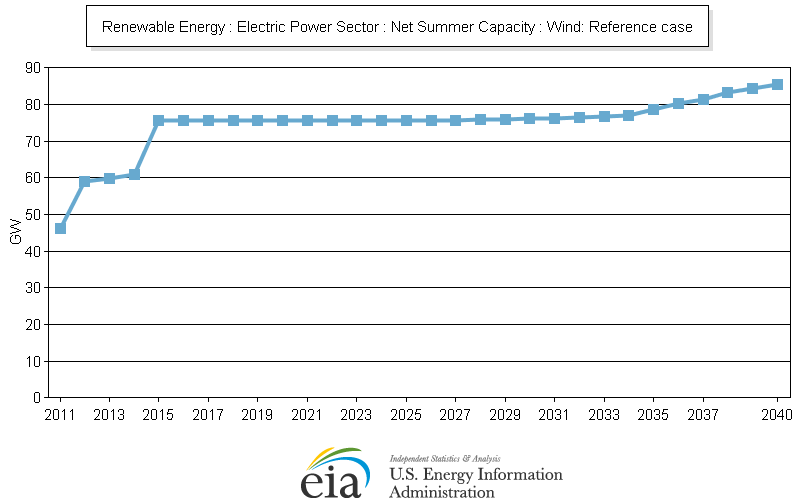
According to EIA, if the expired PTC is allowed to stay expired, their models show an expected stair-step increase in wind capacity by 2015 that flattens out for the next decade until gas prices rise and technology improvements make wind more competitive (see chart). If the PTC and the 30% ITC were made permanent EIA shows it would drive more renewables, particularly wind and solar, but at a significant cost: $4.5 billion/year from 2014 to 2040.


So what’s next

Big wind grew up on the tax credit, developed market plans and forecasts that relied on it, and now the wind PTC appears to be a required component of the industry’s economics. That was never the intent of Congress when this temporary tax credit was enacted 24 years ago. The PTC and ITC are now expired and we can expect roughly 15,000 MW of new wind to be built in response to the 1-year extension passed in 2013. After that, it’s over. It’s now time for taxpayers to consider better ways to spend their money.


Wind Turbines – “Novelty Energy”, Requires 100% back-up, for times with “no”, or “too much wind.

Reliance on Wind Power: Playing a Lethal Game

swiss winter2

A power generation system that can’t produce power on demand is no system at all. Wind power – entirely dependent on the weather – has consistently proven itself incapable of supplying meaningful power – requiring 100% of its capacity to be backed up by fossil fuel generation sources 100% of the time, both here (see our posts here and here andhere and here and here and here and here and here) and in Europe (seeour post here).

While the greentard shrugs and mumbles something about “battery technology improving” when presented with the fact that wind power can only ever be delivered at crazy, random intervals (see our post here) – those in touch with reality point to the social and economic catastrophe just waiting for the next occasion when wind power output plummets.

Here’s a great little piece from the Independent outlining the lunacy of our reliance on wind power and the potentially fatal consequences of placing faith in pure fantasy.

Energy policy based on renewables will win hearts but won’t protect their owners from frostbite and death due to exposure
Kevin Myers
Independent.ie
7 February 2012

Russia’s main gas-company, Gazprom, was unable to meet demand last weekend as blizzards swept across Europe, and over three hundred people died. Did anyone even think of deploying our wind turbines to make good the energy shortfall from Russia?

Of course not. We all know that windmills are a self-indulgent and sanctimonious luxury whose purpose is to make us feel good. Had Europe genuinely depended on green energy on Friday, by Sunday thousands would be dead from frostbite and exposure, and the EU would have suffered an economic body blow to match that of Japan’s tsunami a year ago. No electricity means no water, no trams, no trains, no airports, no traffic lights, no phone systems, no sewerage, no factories, no service stations, no office lifts, no central heating and even no hospitals, once their generators run out of fuel.

Modern cities are incredibly fragile organisms, which tremble on the edge of disaster the entire time. During a severe blizzard, it is electricity alone that prevents a midwinter urban holocaust. We saw what adverse weather can do, when 15,000 people died in the heatwave that hit France in August 2003. But those deaths were spread over a month. Last weekend’s weather, without energy, could have caused many tens of thousands of deaths over a couple of days.

Why does the entire green spectrum, which now incorporates most conventional parties across Europe, deny the most obvious of truths? To play lethal games with our energy systems in order to honour the whimsical god of climate change is as intelligent and scientific as the Aztec sacrifice of their young. Actually, it is far more frivolous, because at least the Aztecs knew how many people they were sacrificing: no one has the least idea of the loss of life that might result from the EU embracing “green” energy policies.

Frau Merkel has announced that Germany is going to phase out nuclear power, simply because of the Japanese tsunami. Well, that is like basing water-collection policies in Rhineland-Westphalia on the monsoon cycle of Borneo.

As I was saying last week, the Germans have a powerfully emotional attachment to everything that is “green”, and an energy policy based on renewables will usually win German hearts. But it will not protect the owners of those hearts from frostbite and death due to exposure, for wind can often be not so much a Renewable as an Unusable, and also an Unpredictable, an Unstorable, and – normally when it’s very cold – an Unmovable.

The seriousness of this is hard to exaggerate. The temperature in the Baltic countries last weekend was -33 degrees Celsius. The Eurasian landmass from Calais to Naples to Siberia was an icefield in which hundreds of millions of people were trapped. Without coal, oil and nuclear energy, mass deaths of the old and the young would have occurred on the first night. Three nights of such conditions, and even the physically fit would have been dying of exposure, as the temperature inside dwellings fell and began to match that of the outside, an inverse image of what happened during the French heatwave 10 years ago, when there was no escape from the heat.

Yet you will see nowhere in Dail Eireann, or Brussels, or the Palace of Westminster, a serious discussion about energy policies based on these realities, or which acknowledges that wind usually doesn’t blow when it is very cold, or that even when you have strong and steady winds blowing, you will still have to have created a parallel and duplicate energy supply to provide cover for when the wind stops. And merely to create that standby energy system will generate a zillion tons of carbon dioxide.

Wind power in Ireland actually produces only 22pc of its capacity: would you spend €100,000 on a car if it meant that €78,000 of the purchase price was wasted? It gets worse. On a really cold day, we actually need about 5,000 megawatts, but yesterday wind was producing under 50 megawatts: a grand total of 1pc of requirements.

Yet despite such appalling figures, we legally prohibit civil servants from even looking at the nuclear option. They won’t even take a phone-call on the subject. Instead, the fiction has taken hold amongst our media classes that we are close to being an exporter of renewable energy through the much-vaunted interconnector with Britain. But this is grotesquely untrue. We shall actually be exporting through the connector only 3pc of the time, and importing 86pc, with the system otherwise idle.

Mad, isn’t it? And madder still that RTE or the BBC will continue to trot out their pet wind-enthusiasts to bluster balderdash and poppycock about global warming and how renewables are the solution – and without the contrary point of view ever being given an airing.

This is dogma, as created, promulgated and enforced by the John Charles McQuaids of our time – and if sceptics are not actually anathematised from the pulpit, they are ruthlessly and systematically ignored. These dishonest, hypocritical and deceitful energy policies are now widely accepted by our political and teaching classes as being the very embodiment of environmentalist virtue. Such imbecilic virtue, if implemented as energy policy across Europe, could have brought about a human catastrophe last weekend.
Independent.ie

ICU Respiratory_therapist

Wind Turbines – “Novelty Energy”, Requires 100% back-up, for times with “no”, or “too much wind.

Reliance on Wind Power: Playing a Lethal Game

swiss winter2

A power generation system that can’t produce power on demand is no system at all. Wind power – entirely dependent on the weather – has consistently proven itself incapable of supplying meaningful power – requiring 100% of its capacity to be backed up by fossil fuel generation sources 100% of the time, both here (see our posts here and here andhere and here and here and here and here and here) and in Europe (seeour post here).

While the greentard shrugs and mumbles something about “battery technology improving” when presented with the fact that wind power can only ever be delivered at crazy, random intervals (see our post here) – those in touch with reality point to the social and economic catastrophe just waiting for the next occasion when wind power output plummets.

Here’s a great little piece from the Independent outlining the lunacy of our reliance on wind power and the potentially fatal consequences of placing faith in pure fantasy.

Energy policy based on renewables will win hearts but won’t protect their owners from frostbite and death due to exposure
Kevin Myers
Independent.ie
7 February 2012

Russia’s main gas-company, Gazprom, was unable to meet demand last weekend as blizzards swept across Europe, and over three hundred people died. Did anyone even think of deploying our wind turbines to make good the energy shortfall from Russia?

Of course not. We all know that windmills are a self-indulgent and sanctimonious luxury whose purpose is to make us feel good. Had Europe genuinely depended on green energy on Friday, by Sunday thousands would be dead from frostbite and exposure, and the EU would have suffered an economic body blow to match that of Japan’s tsunami a year ago. No electricity means no water, no trams, no trains, no airports, no traffic lights, no phone systems, no sewerage, no factories, no service stations, no office lifts, no central heating and even no hospitals, once their generators run out of fuel.

Modern cities are incredibly fragile organisms, which tremble on the edge of disaster the entire time. During a severe blizzard, it is electricity alone that prevents a midwinter urban holocaust. We saw what adverse weather can do, when 15,000 people died in the heatwave that hit France in August 2003. But those deaths were spread over a month. Last weekend’s weather, without energy, could have caused many tens of thousands of deaths over a couple of days.

Why does the entire green spectrum, which now incorporates most conventional parties across Europe, deny the most obvious of truths? To play lethal games with our energy systems in order to honour the whimsical god of climate change is as intelligent and scientific as the Aztec sacrifice of their young. Actually, it is far more frivolous, because at least the Aztecs knew how many people they were sacrificing: no one has the least idea of the loss of life that might result from the EU embracing “green” energy policies.

Frau Merkel has announced that Germany is going to phase out nuclear power, simply because of the Japanese tsunami. Well, that is like basing water-collection policies in Rhineland-Westphalia on the monsoon cycle of Borneo.

As I was saying last week, the Germans have a powerfully emotional attachment to everything that is “green”, and an energy policy based on renewables will usually win German hearts. But it will not protect the owners of those hearts from frostbite and death due to exposure, for wind can often be not so much a Renewable as an Unusable, and also an Unpredictable, an Unstorable, and – normally when it’s very cold – an Unmovable.

The seriousness of this is hard to exaggerate. The temperature in the Baltic countries last weekend was -33 degrees Celsius. The Eurasian landmass from Calais to Naples to Siberia was an icefield in which hundreds of millions of people were trapped. Without coal, oil and nuclear energy, mass deaths of the old and the young would have occurred on the first night. Three nights of such conditions, and even the physically fit would have been dying of exposure, as the temperature inside dwellings fell and began to match that of the outside, an inverse image of what happened during the French heatwave 10 years ago, when there was no escape from the heat.

Yet you will see nowhere in Dail Eireann, or Brussels, or the Palace of Westminster, a serious discussion about energy policies based on these realities, or which acknowledges that wind usually doesn’t blow when it is very cold, or that even when you have strong and steady winds blowing, you will still have to have created a parallel and duplicate energy supply to provide cover for when the wind stops. And merely to create that standby energy system will generate a zillion tons of carbon dioxide.

Wind power in Ireland actually produces only 22pc of its capacity: would you spend €100,000 on a car if it meant that €78,000 of the purchase price was wasted? It gets worse. On a really cold day, we actually need about 5,000 megawatts, but yesterday wind was producing under 50 megawatts: a grand total of 1pc of requirements.

Yet despite such appalling figures, we legally prohibit civil servants from even looking at the nuclear option. They won’t even take a phone-call on the subject. Instead, the fiction has taken hold amongst our media classes that we are close to being an exporter of renewable energy through the much-vaunted interconnector with Britain. But this is grotesquely untrue. We shall actually be exporting through the connector only 3pc of the time, and importing 86pc, with the system otherwise idle.

Mad, isn’t it? And madder still that RTE or the BBC will continue to trot out their pet wind-enthusiasts to bluster balderdash and poppycock about global warming and how renewables are the solution – and without the contrary point of view ever being given an airing.

This is dogma, as created, promulgated and enforced by the John Charles McQuaids of our time – and if sceptics are not actually anathematised from the pulpit, they are ruthlessly and systematically ignored. These dishonest, hypocritical and deceitful energy policies are now widely accepted by our political and teaching classes as being the very embodiment of environmentalist virtue. Such imbecilic virtue, if implemented as energy policy across Europe, could have brought about a human catastrophe last weekend.
Independent.ie

ICU Respiratory_therapist

This is the Result of Politicians, Thinking They are Scientists!…..Disaster!

The physics of a boiling kettle – my question to the commission!

2fa36b2
MY WRITTEN QUESTION TO THE COMMISSION:

“I understand that the Commission proposes to introduce measures to limit the power of electric kettles. Is this the case?

Does the Commission have any grasp of the basic physics of boiling a kettle?

Is the Commission aware that so far as the water itself is concerned, it takes just the same energy to boil a litre of water slowly as to boil it quickly?

Is the Commission aware that in boiling it slowly, over a longer time, more waste heat will be lost to the environment through conduction, convection and radiation?

Does the Commission therefore recognise that this proposal will increase electricity consumption, generate more waste heat, and tend to increase emissions, both of CO2 and water vapour?”


Frauds, Crooks and Criminals

Demonstrating daily that diversity is not strength!

Family Hype

All Things Related To The Family

DeFrock

defrock.org's principal concern is the environmental and human damage of industrial wind turbines on rural communities

Gerold's Blog

The truth shall set you free but first it will make you miserable

Politisite

Breaking Political News, Election Results, Commentary and Analysis

Canadian Common Sense

Canadian Common Sense - A Unique Perspective from Grassroots Canadians

Falmouth's Firetower Wind

a wind energy debacle

The Law is my Oyster

The Law and its Place in Society

Illinois Leaks

Edgar County Watchdogs

stubbornlyme.

My thoughts...my life...my own way.

Oppose! Swanton Wind

Proposed Wind Project on Rocky Ridge

Climate Audit

by Steve McIntyre

4TimesAYear's Blog

Trying to stop climate change is like trying to stop the seasons from changing. We don't control the climate; IT controls US.

Wolsten

Wandering Words

Patti Kellar

WIND WARRIOR

John Coleman's Blog

Global Warming/Climate Change is not a problem