Finally! Something Useful to do With Turbine blades, …Burn ’em for Fuel!

Finally, a way to get energy from Wind Turbines. Burn them, make cement!

Blades being chopped for transport. | Global Cement Magazine

It’s the new alternative fuel — decommissioned turbines. There are 21,000 wind turbines in Germany alone at the moment. With 15,000 tons a year of old blades expected to be dumped by 2019, it’s a real problem to get rid of them. The EU says they can’t be dumped in landfill. Here’s the perfect solution. Chop them, shred them, then deliver the fibreglass reinforced plastic to the local cement plant. The resins hold 15MJ per kilo. “One tonne of resin saves 600 kg of coal at the cement plant!”

It’s a win-win all round. Residents get rid of the bird chopping towers, the cement plant gets energy, and the windmills may, possibly for the first time, save some CO2 for the Greens. What’s not to like?

Indeed this is recycling you can like. The raw materials in old blades can even be used in the cement too.

Wind Turbines make good alternative fuels for cement production.

Global Cement Magazine Sept 2014 page 10

Since 2009 Zajons has been working with Holcim’s Geocycle division to process and recycle wind turbine blades for use as an alternative fuel and raw material in the cement industry. The Cross-Flow Shredder has been customised to effect 100% recy cling of fibreglass-reinforced wind turbine blades.

The huge number of new wind farms is one catalyst for this, coupled with the fact that decommissioned wind turbine blades can no longer be sent to landfill. This has been prohibited in Germany since 2005 on the back of EU regulations. Conventional low-temperature waste incineration is not an option as melted glass fibres would cause the blockages in the system. A wind turbine has a maximum life-span of 20 years.

“By 2019 we expect decommissioned wind turbine blades to exceed 15,000t/yr,” said Lempke. “There are major technical issues involved in recycling these huge blades, the first being transporting the blades to the reprocessing plant. We saw the blades into transport-friendly lengths of around 10m on-site at the wind farm and use a special liquid to minimise dust, thus preventing site contamination.” Sawing the blades into manageable lengths on-site significantly reduces transportation costs (Figure 4). Once at the reprocessing plant, the metal components are removed and the blades are sawn into smaller pieces.

Suction, filter and watering technologies largely prevent dust production. The blade is ground in a Cross-Flow Shredder. The resulting material, which is primarily composed of fibreglass reinforced plastic, is homogenised and delivered to a nearby cement plant. The calorific value of the resins (around 15MJ/kg) is harnessed in the cement calciner and is used to thermally degrade the lime. One tonne of resin replaces 600kg of coal at the cement plant.

Even better, the silicon dioxide in the fibreglass can be used instead of sand:

Ash constitutes >50% of the wind turbine blade, which is mixed with the raw meal in the calciner. This is where an  additional benefit comes into play. The ash contains SiO 2 from the fibreglass, which is used in place of sand in the raw material mix. In addition to wind turbine blades, other fibreglass materials can also be used once ground. Thus, valuable raw materials can be substituted and supply conserved.

Using this method, more than 1000 wind turbine blades have been processed into homogeneous refuse derived fuel (RDF) for cement kilns. Working closely with partners like Holcim has enabled Zajons to develop innovative solutions for the manufacture of alternative raw materials for cement and incineration feedstocks, thereby generating significant added value for its cement industry customers.


http://www.globalcement.com/pdf/eGCSept2014ns.pdf

Leading Scientists Warn of Vibro-Acoustic Disease, from Wind Turbines!

Are wind turbines a headache?

turbine1LEADING SCIENTISTS are concerned that a new threat may be posed by wind turbines, a threat that could damage our ears known as ‘Vibro-Acoustic Disease’. 

This new warning may come as too little too late for a local Pembrokeshire resident, Gwen Burkhardt, who it is alleged had to sell her Newcastle Emlyn farm several years ago because the of the three wind turbines that were a mile away from her home and were adversely affecting her health. Her doctor, apparently, put it down to ‘infra-sound’, that sound which is inaudible to human ears. She was suffering from headaches at home, which was on a B road near to Emlyn’s three 250 foot wind turbines. According to Gwen Burkhardt, once she sold up and moved from the area, the headaches disappeared.

The main proponent of this theory, ‘Vibro-Acoustic Disease’, is Dr Nina Pierpont, who published a book entitled ‘Wind Turbine Syndrome’ in 2001. In this book a link is alleged between low frequency noise and vibration and a range of symptoms such as tinnitus, dizziness, nausea, palpitations, sleep disturbance and migraines. Another disturbing case was reported in the Danish press who reported the story of a garden centre going out of business because of nearby wind turbines. Headaches were frequent among employees, and female workers complained of unusual bleeding and problems with their menstrual cycles.

The employers were worried that more serious illnesses may have followed after five employees resigned. The owner, Boye Jensen, closed the business for fear of being held liable should a child be born with deformities. The World Council for Nature (WCFN) is calling attention to the fact that, as occurred for tobacco, asbestos, thalidomide etc, governments are siding with private financial interests in ignoring or denying the existence of what they see as obvious health problems linked to wind turbines.

They went on to say: “In Denmark as elsewhere in the world, many rural families are suffering, particularly since the manufacture of the mega turbines, which emit more infrasound as they grow bigger. This may explain why the complaints are growing. How much longer can this suffering be ignored, or even denied by health authorities? Some countries, including Canada and Australia, have commissioned studies into the matter of noise emitted by windfarms. But the studies’ scope and methodology doom them to failure, perhaps intentionally”. Such is the concern of the potential damage caused by these turbines that the WCFN have called for an epidemiological study, and the measurement of low frequency sound (including infrasound down to 0.1 Hz), inside the homes of windfarm victims.

They suggest that as a precaution, no mega turbines should be erected less than 10 km from habitations until these studies are completed, published and analyzed. They finished by saying: “There is indeed compelling evidence that infrasound travels much farther than other noise, and tortures sensitive people in their homes at distances of 10 km and more. Shorter distances could be temporarily set for smaller turbines, in proportion with their generating capacity”. Pembrokeshire residents, many of whom may be living near to these turbines, will be hoping that this concern proves to be a false alarm.


Economic Storage of Wind Power will Never be Feasible!

The Economic Storage of Wind Power is a Pipe-Dream

giant battery 2

The wind industry is the perpetual infant of power generation: always looking for the subsidies to last that little bit longer; always promising to improve its performance; always claiming it will outdo hydro, coal and gas – provided, of course, that the subsidies keep flowing. STT for one thinks the wind industry has had ample time to grow up and stand on its own two feet.

Like the brat that it is, the wind industry can’t be told what to do and, especially, won’t ever respond to demands from power users about when its product should be delivered.

output vs demand

It’s quite happy to produce plenty of power when it’s not needed at night time; and much less during the day, when it is (as seen in the graph above); and often, none at all during periods of peak demand: as seen in the graph below, showing the entire fleet of wind farms connected to the Eastern Grid (based in SA, NSW, Tasmania and Victoria, which in July had a notional capacity of 2,952 MW) producing 20 MW or 0.67% of total capacity, just as demand starts to peak – and see our posts here and hereand here and here and here and here and here and here.

JULY20

In it’s “quick, look over there” response to any inconvenient facts, the wind industry never concedes that wind power is “intermittent” – it prefers the term “variable” – which we showed to be a monstrous abuse of both the facts and the English language (see our post here).

When challenged about its consistent failures to match output with demand, the wind industry and its parasites respond by mumbling about “battery technology improving”.

The pitch is that – one day “soon” – there will batteries big enough and cheap enough to allow huge volumes of wind power produced when it’s not needed, to be stored for the occasions when it is. That way, the “variable” output from wind farms could be delivered when there might just be a market for it.

Of course, the pitch is made so the subsidies keep flowing to allow an endless sea of giant fans to be erected now – in order to take advantage of the (so far, elusive) storage technology that’s just over the “horizon”. Except that the “soon” is more like light-years and the “horizon” is a mirage.

Even if a technology was invented (STT likens it to the chances of finding a perpetual motion machine or alchemy turning lead into gold) to store large volumes of the electricity output (in bulk) from all of the wind farms connected to the Eastern Grid, say (which now have a notional capacity of 3,342 MW) – the economic cost would be astronomical – and readily eclipse the value of the power produced. Not that the wind industry has ever made any economic sense.

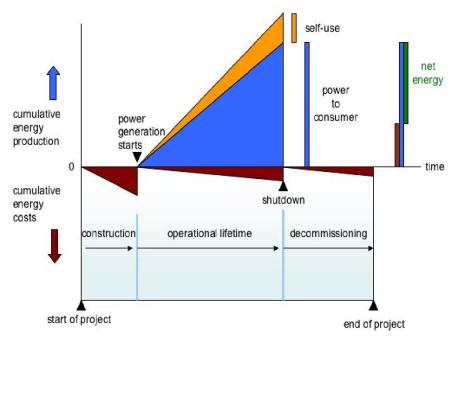
One way of analysing the economics (ie costs versus benefits) of storing, in bulk quantities, the electricity generated from wind farms is to quantify what’s called the “energy returned on energy invested” (EROEI). Put simply, that’s the amount of energy required as an input in order to return a given energy output. To be economically viable, a generation source has to produce a surplus of energy well over and above what was required to establish it.

In this article, Dr John Morgan – an Adjunct Professor at RMIT – comes up with the (not so surprising) conclusion that energy storage cannot (and will never) provide an economic solution to the intermittency of wind power.

The Catch 22 of Energy Storage
Brave New Climate
22 August 2014

Pick up a research paper on battery technology, fuel cells, energy storage technologies or any of the advanced materials science used in these fields, and you will likely find somewhere in the introductory paragraphs a throwaway line about its application to the storage of renewable energy. Energy storage makes sense for enabling a transition away from fossil fuels to more intermittent sources like wind and solar, and the storage problem presents a meaningful challenge for chemists and materials scientists… Or does it?

Guest Post by John Morgan.

Several recent analyses of the inputs to our energy systems indicate that, against expectations, energy storage cannot solve the problem of intermittency of wind or solar power. Not for reasons of technical performance, cost, or storage capacity, but for something more intractable: there is not enough surplus energy left over after construction of the generators and the storage system to power our present civilization.

The problem is analysed in an important paper by Weißbach et al. (1) in terms of energy returned on energy invested, or EROEI – the ratio of the energy produced over the life of a power plant to the energy that was required to build it. It takes energy to make a power plant – to manufacture its components, mine the fuel, and so on. The power plant needs to make at least this much energy to break even. A break-even powerplant has an EROEI of 1. But such a plant would pointless, as there is no energy surplus to do the useful things we use energy for.

There is a minimum EROEI, greater than 1, that is required for an energy source to be able to run society. An energy system must produce a surplus large enough to sustain things like food production, hospitals, and universities to train the engineers to build the plant, transport, construction, and all the elements of the civilization in which it is embedded.

morganesbox

For countries like the US and Germany, Weißbach et al. (1) estimate this minimum viable EROEI to be about 7. An energy source with lower EROEI cannot sustain a society at those levels of complexity, structured along similar lines. If we are to transform our energy system, in particular to one without climate impacts, we need to pay close attention to the EROEI of the end result.

The EROEI values for various electrical power plants are summarized in the figure. The fossil fuel power sources we’re most accustomed to have a high EROEI of about 30, well above the minimum requirement. Wind power at 16, and concentrating solar power (CSP, or solar thermal power) at 19, are lower, but the energy surplus is still sufficient, in principle, to sustain a developed industrial society. Biomass, and solar photovoltaic (at least in Germany), however, cannot. With an EROEI of only 3.9 and 3.5 respectively, these power sources cannot support with their energy alone both their own fabrication and the societal services we use energy for in a first world country.

morganesfig1

Energy Returned on Invested, from Weißbach et al.,(1) with and without energy storage (buffering). CCGT is closed-cycle gas turbine. PWR is a Pressurized Water (conventional nuclear) Reactor. Energy sources must exceed the “economic threshold”, of about 7, to yield the surplus energy required to support an OECD level society.

These EROEI values are for energy directly delivered (the “unbuffered” values in the figure). But things change if we need to store energy. If we were to store energy in, say, batteries, we must invest energy in mining the materials and manufacturing those batteries. So a larger energy investment is required, and the EROEI consequently drops.

Weißbach et al. calculated the EROEIs assuming pumped hydroelectric energy storage. This is the least energy intensive storage technology. The energy input is mostly earthmoving and construction. It’s a conservative basis for the calculation; chemical storage systems requiring large quantities of refined specialty materials would be much more energy intensive. Carbajales-Dale et al. (2) cite data asserting batteries are about ten times more energy intensive than pumped hydro storage.

Adding storage greatly reduces the EROEI (the “buffered” values in the figure). Wind “firmed” with storage, with an EROEI of 3.9, joins solar PV and biomass as an unviable energy source. CSP becomes marginal (EROEI ~9) with pumped storage, so is probably not viable with molten salt thermal storage. The EROEI of solar PV with pumped hydro storage drops to 1.6, barely above breakeven, and with battery storage is likely in energy deficit.

This is a rather unsettling conclusion if we are looking to renewable energy for a transition to a low carbon energy system: we cannot use energy storage to overcome the variability of solar and wind power.

In particular, we can’t use batteries or chemical energy storage systems, as they would lead to much worse figures than those presented by Weißbach et al (1). Hydroelectricity is the only renewable power source that is unambiguously viable. However, hydroelectric capacity is not readily scaled up as it is restricted by suitable geography, a constraint that also applies to pumped hydro storage.

This particular study does not stand alone. Closer to home, Springer have just published a monograph, Energy in Australia, (3) which contains an extended discussion of energy systems with a particular focus on EROEI analysis, and draws similar conclusions to Weißbach. Another study by a group at Stanford (2) is more optimistic, ruling out storage for most forms of solar, but suggesting it is viable for wind. However, this viability is judged only on achieving an energy surplus (EROEI>1), not sustaining society (EROEI~7), and excludes the round trip energy losses in storage, finite cycle life, and the energetic cost of replacement of storage. Were these included, wind would certainly fall below the sustainability threshold.
energy-outputs-and-energy-costs

It’s important to understand the nature of this EROEI limit. This is not a question of inadequate storage capacity – we can’t just buy or make more storage to make it work. It’s not a question of energy losses during charge and discharge, or the number of cycles a battery can deliver. We can’t look to new materials or technological advances, because the limits at the leading edge are those of earthmoving and civil engineering. The problem can’t be addressed through market support mechanisms, carbon pricing, or cost reductions. This is a fundamental energetic limit that will likely only shift if we find less materially intensive methods for dam construction.

This is not to say wind and solar have no role to play. They can expand within a fossil fuel system, reducing overall emissions. But without storage the amount we can integrate in the grid is greatly limited by the stochastically variable output. We could, perhaps, build out a generation of solar and wind and storage at high penetration. But we would be doing so on an endowment of fossil fuel net energy, which is not sustainable. Without storage, we could smooth out variability by building redundant generator capacity over large distances. But the additional infrastructure also forces the EROEI down to unviable levels. The best way to think about wind and solar is that they can reduce the emissions of fossil fuels, but they cannot eliminate them. They offer mitigation, but not replacement.

Nor is this to say there is no value in energy storage. Battery systems in electric vehicles clearly offer potential to reduce dependency on, and emissions from, oil (provided the energy is sourced from clean power). Rooftop solar power combined with four hours of battery storage can usefully timeshift peak electricity demand, (3) reducing the need for peaking power plants and grid expansion. And battery technology advances make possible many of our recently indispensable consumer electronics. But what storage can’t do is enable significant replacement of fossil fuels by renewable energy.

If we want to cut emissions and replace fossil fuels, it can be done, and the solution is to be found in the upper right of the figure. France and Ontario, two modern, advanced societies, have all but eliminated fossil fuels from their electricity grids, which they have built from the high EROEI sources of hydroelectricity and nuclear power. Ontario in particular recently burnt its last tonne of coal, and each jurisdiction uses just a few percent of gas fired power. This is a proven path to a decarbonized electricity grid.

But the idea that advances in energy storage will enable renewable energy is a chimera – the Catch-22 is that in overcoming intermittency by adding storage, the net energy is reduced below the level required to sustain our present civilization.
John Morgan
22 August 2014

John is Chief Scientist at a Sydney startup developing smart grid and grid scale energy storage technologies. He is Adjunct Professor in the School of Electrical and Computer Engineering at RMIT, holds a PhD in Physical Chemistry, and is an experienced industrial R&D leader. You can follow John on twitter at @JohnDPMorgan. First published in Chemistry in Australia.

Brave New Climate Postscript

When this article was published in CiA some readers had difficulty with the idea of a minimum societal EROI. Why can’t we make do with any positive energy surplus, if we just build more plant? Hall (4) breaks it down with the example of oil:

Think of a society dependent upon one resource: its domestic oil. If the EROI for this oil was 1.1:1 then one could pump the oil out of the ground and look at it. If it were 1.2:1 you could also refine it and look at it, 1.3:1 also distribute it to where you want to use it but all you could do is look at it. Hall et al. 2008 examined the EROI required to actually run a truck and found that if the energy included was enough to build and maintain the truck and the roads and bridges required to use it, one would need at least a 3:1 EROI at the wellhead.

Now if you wanted to put something in the truck, say some grain, and deliver it, that would require an EROI of, say, 5:1 to grow the grain. If you wanted to include depreciation on the oil field worker, the refinery worker, the truck driver and the farmer you would need an EROI of say 7 or 8:1 to support their families. If the children were to be educated you would need perhaps 9 or 10:1, have health care 12:1, have arts in their life maybe 14:1, and so on. Obviously to have a modern civilization one needs not simply surplus energy but lots of it, and that requires either a high EROI or a massive source of moderate EROI fuels.

The point is illustrated in the EROI pyramid.(4) (The blue values are published values: the yellow values are increasingly speculative.)

morganesfig2

Finally, if you are interested in pumped hydro storage, a previous Brave New Climate article by Peter Lang covers the topic in detail, and the comment stream is an amazing resource on the operational characteristics and limits of this means of energy storage.

References

(1). Weißbach et al., Energy 52 (2013) 210. Preprint available here.

(2). Carbajales-Dale et al., Energy Environ. Sci. DOI: 10.1039/c3ee42125b

(3). Graham Palmer, Energy in Australia: Peak Oil, Solar Power, and Asia’s Economic Growth; Springer 2014.

(4). Pedro Prieto and Charles Hall, Spain’s Photovoltaic Revolution, Springer 2013.

light-in-darkness

Would you Mind Waiting Till the Wind blows, if you want Electricity? (but not too much)

Of Unicorns & Pink Elephants: “Reliance” on Wind Power is Pure “Green” Fantasy

Unicorn Drinking from a River

When it comes to their demand for electricity, the power consumer has a couple of basic needs: when they hit the light switch they assume illumination will shortly follow and that when the kettle is kicked into gear it’ll be boiling soon thereafter. And the power consumer assumes that these – and similar actions in a household or business – will be open to them at any time of the night or day, every day of the year.

For conventional generators, delivering power on the basic terms outlined above is a doddle: delivering base-load power around the clock, rain, hail or shine is just good business. It’s what the customer wants and is prepared to pay for, so it makes good sense to deliver on-demand.

But for wind power generators it’s never about how much the customer wants or when they want it, it’s always and everywhere about the vagaries of the wind. When the wind speed increases to 25 m/s, turbines are automatically shut-off to protect the blades and bearings; and below 6-7 m/s turbines are incapable of producing any power at all.

Even with the most geographically widespread grid-connected set of wind farms in the world (the 3,342 MW of wind power capacity connected to Australia’s Eastern grid across SA, Victoria, Tasmania and NSW) there are dozens of occasions each year when total wind power output struggles to top 2% of installed capacity – and hundreds when it fails to muster even 5% (see our posts here and here and here).

Now, if the power consumer was given advance warning of when these total output failures were going to occur, they might simply reconsider their selfish demands of having illumination after dark or that hot cuppa in the morning. That way, they might still consider wind power a “perfect substitute” for conventional power; and plump for the (purportedly cheaper) former over the latter every time?

But, so far, power consumers remain stubbornly selfish; wedded to the idea that when they hit the switch, their power needs will be satisfied that very instant (the cheek, hey?). And that’s where claims that wind power is a “substitute” for conventional generation fall in a heap.

Power delivered at crazy, random intervals (which in practical terms means no power at all, hundreds of times each year) is NO substitute for power delivered on-demand; anytime of the day or night; every single day of the year – and in volumes sufficient to satisfy all consumers connected to the same network, at the same time.

Wind power cannot, therefore, be considered a “substitute” for power which is available on-demand. With every MW of wind power capacity matched with a MW of conventional generation capacity at all times – needed to keep the grid stable by balancing the wild fluctuations in wind power output (see our post here) and to meet demand when output collapses to nothing (see our post here) – wind power is nothing but childish nonsense.

The only reason turbines have been slung up anywhere is in order for wind power outfits and their backers to reap a fat pile of taxpayer and power consumer subsidies. Here’s a take on the greatest rort of all time from the US.

Obama’s Green Unicorn
US News
Peter Roff
25 August 2014

The true cost of renewable energy is being masked by government subsidies and bailouts.

America is about as likely to become reliant on green energy to meet its baseload power requirements as a unicorn is to stroll down the middle of Washington’s Pennsylvania Avenue during rush hour followed by a pink elephant.

It’s just not happening – but that’s hasn’t deterred the modern day snake oil salesmen and their allies inside the Obama administration from continuing to make a push for wind and solar power as an eventual replacement for energy generated from traditional sources like coal, oil and natural gas. Renewable technology has improved, no doubt, but it’s a long way away from being ready to make a substantial contribution to the heating of our homes and the powering of our businesses unless the generous tax subsidies that create the illusion of cost competitiveness continue.

There’s nothing wrong per se with the pursuit of renewable energy; it’s just that what it actually costs is being masked by taxpayer subsidies, federal loan guarantees and renewable fuels mandates at the state level that force power companies to put wind and solar into the energy mix, sometimes at two to three times what traditional power costs. Ultimately, one way or another, the taxpayers and energy consumers are footing the bill even if they don’t know it.

Congress has taken a few positive steps in the right direction. The federal Wind Production Tax Credit was allowed to expire at the end of the year, meaning new wind projects are going to have to be competitive at market rates to attract funding. Remember it was none other than billionaire Warren Buffett, the “Oracle of Omaha,” who explained recently to a group of investors that the tax credit was the only reason that any sensible person invested in wind projects in the first place.

Unfortunately, some federal agencies are trying to keep the program alive through the backdoor.

The worst offender in this regard may be the IRS, which recently issued new “guidelines” that make it even easier for wind projects currently in development to qualify for the tax credit on the basis of work already contemplated or completed. According to Politico, “The IRS says completed or in-progress facilities can be sold and the costs incurred by the seller will still count toward qualifying for the [credit], except in cases where tangible property (think equipment like wind turbines) bought for one project is sold and used at another site.”

To translate this into English, it’s a move to help keep the whole shell game alive until such time as wind power supporters can get the tax credit reauthorized. “There is a large pipeline of projects that were under development at some stage that by virtue of this guidance will be able to go forward. In that regard it is going to permit a lot of projects to be developed,” said one wind energy expert cited by Politico.

Outside groups are also weighing in, including the Sierra Club, which has targeted nine members of Congress in a pressure campaign over the August recess to push for re-authorization of the Wind Production Tax Credit. That is in addition to the online ad buys in 16 other districts that started in June.

The Democrats who run the Senate want to keep the now-expired credit alive and have, in the Senate Finance Committee, already approved a package of so-called “extenders” that would breathe new life into it. The House has thus far refused to go along – and kudos to Texas Republican Rep. Randy Weber, who deserves credit for successfully introducing an amendment to shut the whole business down permanently. But he’s not just fighting the lobbyists and green groups in favor of the credit, but the entire federal bureaucracy which, once a program has been established, is loath to let it die.

Major government investment in speculative green projects may have at one time made sense. But even if that were once the case, it is so no longer. The Obama green energy push has enriched more than a few politically well-connected liberals who used tax credits and government bailouts to enlarge their portfolios, but it has done little to make energy more abundant or lower costs to consumers, which is the justification in the first place to get the taxpayers involved.

If people want to build wind farms – on land or offshore – and they want to reap the benefits of their investments, then they should be willing to take the same risks as everyone else. The way the bureaucrats have it structured now, the taxpayers are making payments on both ends through subsidies for construction and higher rates on consumption. It’s a system only a bureaucrat could love.
US News

yacht

Look at the Kind of Nonsense, the On-Line Health and Safety Course was promoting!

Is There Anything At All, Nowadays, that Cannot be Attributed to “Global Warming”?  The Alarmists will soon resort to walking the streets, with sandwich boards, warning us, that the end is near!

VIOLENCE IN THE WORKPLACE

INTRODUCTION

Violence in the Workplace has been increasing over the last five years due to changes in both lifestyle and climate.

Lifestyles have changed in the last 20 years. People are expected to work longer hours, and there is more pressure to get more work completed with fewer workers mainly due to downsizing.

We have seen more than a 50% increase in 2006 – 2007 and 2008 due to climate change.  These companies have not taken steps to be proactive in such areas as:

  • Makeup Air Systems
  • Air Movement
  • Changes to Remove
  • Heat from Equipment
  • Companies have not Developed Policies to Deal with Climate Change
  • New Procedures and Programs to Deal with Increase in Heat and Relative Humidity (R.H%).

Industrial Wind Turbines….Not the First Time, that Sound Has Been Used As a Weapon!

A History of Using Sound as a Weapon

Written by
JOE ZADEH
July 30, 2014 

Last week, a collaborative research project known as AUDiNT (short for Audio Intelligence) released Martial Hauntology,a box set of vinyl and literature that explores the darker history of sound. It’s a journey into the lesser known realms of sonic weaponry.

The project is the latest in-depth study from Glaswegian electronic artist Steve Goodman (perhaps best know as Hyperdub label owner Kode9) and Manchester University research fellow Toby Heys. Heys describes AUDiNT as a “research cell investigating how ultrasonic, sonic and infrasonic frequencies are used to demarcate territory in the soundscape and the ways in which their martial and civil deployments modulate psychological, physiological and architectural states.”

The incorporation of sound into warfare may sound like a modern tactic, but the first reports have their roots in history. Back in 1944, as World War II slipped through Germany’s fingertips, it was rumoured that Hitler’s chief architect Albert Speer had set up research to explore his own theories of sonic warfare, with the intention of creating tools of death. An episode of the History Channel’s Weird Weapons claimed that his device, dubbed an acoustic cannon, was intended to work by igniting a mixture of methane and oxygen in a resonant chamber, and could create a series of over 1,000 explosions per second.

This sent out a deafening and focused beam of sound which was magnified by huge parabolic reflector dishes. The idea, apparently, was that by repeatedly compressing and releasing particular organs in the human body, the cannon could potentially kill someone standing within a 100-yard radius in around thirty seconds. Fortunately, the weapon was never actually used in battle.

The actual volume of sound frequency isn’t the only way sound has been used in war. In his 2009 book Sonic Warfare, a key body of research in the understanding of contemporary sonic thought, Goodman included a chapter titled “Project Jericho,” which explored the US PSYOPS campaigns during the Vietnam War.

Goodman described a particular campaign known as Operation Wandering Soul. The Curdler, a helicopter-mounted sonic device, produced the “voodoo effects of Wandering Soul, in which haunting sounds said to represent the souls of the dead were played in order to perturb the superstitious snipers, who, while recognizing the artificial source of the wailing noises, could not help but dread what they were hearing was a premonition of their own postdeath dislocated soul.”

It was these operations, Goodman wrote, that directly inspired the famous scene of Francis Ford Coppola’s Apocalypse Now, in which a fleet of helicopters fly towards their target whilst blasting Wagner’s “Ride of the Valkyries.”

And while Wagner might not exactly be a torturous sound, the use of popular music for non-lethal weaponry goes further than Apocalypse Now. In 2003, the BBC reported that US interrogators were using songs by Metallica, Skinny Puppy and, erm, Barney the Dinosaur, in a bid to break the will of Iraqi prisoners of war. As Sergeant Mark Hadsell told Newsweek at the time, “These people haven’t heard heavy metal. They can’t take it. If you play it for 24 hours, your brain and body functions start to slide, your train of thought slows down and your will is broken. That’s when we come in and talk to them.”

All this kicked off a bizarre discussion about whether music used during torture meant royalties were owed to the artists. Skinny Puppy jumped on this and filed a sizeable $666,000 royalties bill claim against the American defence department.

Jump forward to June 13, 2005, when the late Israeli president Ariel Sharon had just agreed to the disengagement from Gaza. That involved the displacement of settlers from the West Bank area, and stories soon started filtering in that the Israeli Defence Force (IDF) was trying out a new weapon on the streets. “The knees buckle, the brain aches, the stomach turns, and suddenly nobody feels like protesting anymore” reported the Toronto Star’s Middle East Bureau.

“An Associated Press photographer at the scene said that even after he covered his ears, he continued to hear the sound ringing in the back of his head,” wrote Amy Teibel for the Associated Press. This special vehicle-mounted weapon was an LRAD (long range acoustic device). They’re mostly used at sea as a defence against pirates, and can fire beams of up to 150-decibel alarm sounds at crowds.

Its victims on the streets knew it by another name: “The Scream.”

An LRAD on a ship. Image: Wikimedia Commons/Tucker M. Yates
Other sonic tactics against Palestinians were also reported, like jets breaking the sound barrier at low altitudes over settlements to cause what The Guardian described as “sound bombs.”

And sonic weapons weren’t limited to that part of the world, either. In 2004, the American Technology Corporation landed a nearly $5 million deal to supply LRADs to US troops in Iraq.

By 2011 and 2012, the use of LRADs began domestically in the US, when the government issued devices to various police forces, with their most publicised use coming during the Occupy Wall Street and G20 protests. Only seven months ago, the American-based LRAD Corporation also struck a $4 million deal with “a Middle Eastern country” for their most powerful hailing device yet: the LRAD 2000X, which gazumps previous models by beaming sound over 3,500 metres.

Despite domestic use elsewhere, the UK is yet to use an LRAD on its own civilians for crowd dispersal. How it feels about the accelerating industry, however, is confusing. When London mayor and water cannon enthusiast Boris Johnson was asked about LRADs in March, he denied knowing of their existence, responding, “Is this some sort of April fool?” Another politician pointed out that the devices were installed on the Thames during the 2012 Olympics.

In fact, London is home to one of the only non-military or police owners of LRADs in the world: Anschutz Entertainment Group, or as you probably know it, The O2. It was once left outside the venue and unattended, where it was photographed by a worried Twitter user (the O2 insisted it couldn’t have been misused).

The increased use of sonic weapons by armies and police forces around the world, and the growing stock market value of LRAD Corporation, reveal a continuing fascination with utilizing sound as a weapon, and the release of ever more in-depth studies like Martial Hauntology offers an insight into how sonic warfare is entering an age of global amplification.


“Professional” Windweasel, Mike Barnard, Tries to Defend Harm Caused by Wind Turbines

Bullying
Bullying a windfarm victim


In an article of August 22, 2014 by Lindsay Abrams, trying to discredit the claims of wind farm victims, we read: “Since 1998, 49 lawsuits in five countries have alleged that the clean energy source [wind farms] is making people sick. But according to new research published by the Energy and Policy Institute, the courts have shut those claims down in all cases but one.” http://www.suntimes.com/news/otherviews/29416340-452/wind-turbines-dont-make-people-sick.html

– I say: we could find similarly meaningless statistics if we went back in time, when the courts were absolving the Tobacco Industry.

– Most courts, like governments, have swallowed the windfarm scam hook, line and sinker. This recent judgment, evidencing a strong pro-wind bias, says it all:http://www.epaw.org/media.php?lang=en&article=pr48

– Court decisions can’t be held as the gold standard of truth and fairness. All the more in a society obsessed with political correctness, where certain ideas are arbitrarily declared “consensual”, and turned into dogmas which become ipso facto more important than the facts. Don’t we know that progress in science is almost always achieved by rejecting the “consensus”? And so it is with infrasound emitted by wind turbines: the dogma saying these emissions are benign is about to be blown apart, and this is what sparks desperate attempts at bullying and discrediting windfarm victims and the health professionals who support them.


The article proceeds to say: “The name “wind turbine syndrome” was coined by Nina Pierpont, a pediatrician who also happens to be an anti-wind activist”.

– This is the pot calling the kettle black. Mike Barnard, cited as a reference, is one of the world’s best known activists of the windfarm scam. He is in fact a professional activist, making a living from it, and receiving all kinds of help from the industry.

Mike Barnard
Mike Barnard

– Barnard, as quoted by the author of the article, criticizes people who “have declared themselves as experts”, forgetting that this includes himself. Indeed, he has no qualifications for doing what he does, yet he calls himself the “lead researcher” in the “new study” that is calling thousands of windfarm victims “liers”. The man does not know the meaning of the words “consistency” and “intellectual honesty”. He is the typical odious bully, and so appears to be Lindsay Abrams, who quotes him while adding a layer of smear of his own brew.

– Dr Nina Pierpont, on the other hand, is a courageous pediatrician who conducted field research years ago, paid with her own money, in which she found that wind farm neighbors who were complaining of sleep disruption, headaches, nauseas etc. had very consistent symptoms, which prompted her to coin a new ailment: the Wind Turbime Syndrome. She published a book on her findings, and is giving evidence in court around the world: does that make her an activist?

Dr Nina Pierpont
Dr Nina Pierpont


The propaganda piece continues: “But a review of 60 peer-reviewed articles published earlier this summer in the journal Frontiers of Public Health found only that audible noise from turbines can be annoying to some people — electromagnetic fields, low-frequency noise, infrasound and “shadow flicker” all were deemed unlikely to be affecting human health.”

– How could all these articles pretend that infrasound is “unlikely” to affect people, when we know that the military and the police have developed weapons using infrasound for debilitating enemy troops or unruly crowds? The technology is not mature yet, as a way must be found to spare friendly troops. But more devices are being patented all the time:http://www.schizophonia.com/archives/index.htm (click article: “Deadly Silence”)

– And what about the Vibro Acoustic Disease, a long-known ailment which affects people exposed to machines that produce infrasound? http://wcfn.org/2014/07/15/open-letter-to-the-danish-government/

– Then ask yourselves: if infrasound were harmless, would the wind industry and governments that promote it systematically refuse to conduct research into infrasound emitted by wind turbines? And this at the risk of being sued one day for gross negligence?
I can smell a rat, can’t you?


Finally, the author of the article resorts to personal attack: “When Dr. Pierpont attempts to appear in court as an expert witness, she is rejected outright along with her 294-page vanity press book, as happened in a tribunal related to the Adelaide wind farm in Ontario.”

– She did not “attempt to appear in Court”. Her testimony was called by windfarm victims but, abusively, the judge refused to hear their expert witness. What does that tell you about the independence of justice in Ontario, a Canadian Province thoroughly corrupted by the windfarm scam?
In other countries, she was allowed to testify, and her interventions have been very helpful, whatever the outcome.

– “rejected outright along with her 294-page vanity press book” says Lindsay Abrams.
– I say: while pro-wind litterature flourishes thanks to billions of dollars of public money spent to inundate the world with it, independent researchers must finance their own publications. Does that make these less valuable?
But Abrams could not resist bullying Dr Pierpont on this score, thereby bringing discredit upon himself.

Faux-green Energy…..No more than an Over-priced Novelty!

Obama’s Green Unicorn


The true cost of renewable energy is being masked by government subsidies and bailouts.

Wind turbines are silhouetted by the setting sun Friday, Aug. 23, 2013, near Beaumont, Kan. The turbines are part of the 100-unit Elk River Wind Farm in south central Kansas.

Propped up by the government.

By    Aug. 25, 2014 
America is about as likely to become reliant on green energy to meet its baseload power requirements as a unicorn is to stroll down the middle of Washington’s Pennsylvania Avenue during rush hour followed by a pink elephant.

It’s just not happening – but that’s hasn’t deterred the modern day snake oil salesmen and their allies inside the Obama administration from continuing to make a push for wind and solar power as an eventual replacement for energy generated from traditional sources like coal, oil and natural gas. Renewable technology has improved, no doubt, but it’s a long way away from being ready to make a substantial contribution to the heating of our homes and the powering of our businesses unless the generous tax subsidies that create the illusion of cost competitiveness continue.

There’s nothing wrong per se with the pursuit of renewable energy; it’s just that what it actually costs is being masked by taxpayer subsidies, federal loan guarantees and renewable fuels mandates at the state level that force power companies to put wind and solar into the energy mix, sometimes at two to three times what traditional power costs. Ultimately, one way or another, the taxpayers and energy consumers are footing the bill even if they don’t know it

Congress has taken a few positive steps in the right direction. The federal Wind Production Tax Credit was allowed to expire at the end of the year, meaning new wind projects are going to have to be competitive at market rates to attract funding. Remember it was none other than billionaire Warren Buffett, the “Oracle of Omaha,” who explained recently to a group of investors that the tax credit was the only reason that any sensible person invested in wind projects in the first place.

Unfortunately, some federal agencies are trying to keep the program alive through the backdoor.

The worst offender in this regard may be the IRS, which recently issued new “guidelines” that make it even easier for wind projects currently in development to qualify for the tax credit on the basis of work already contemplated or completed. According to Politico, “The IRS says completed or in-progress facilities can be sold and the costs incurred by the seller will still count toward qualifying for the [credit], except in cases where tangible property (think equipment like wind turbines) bought for one project is sold and used at another site.”

To translate this into English, it’s a move to help keep the whole shell game alive until such time as wind power supporters can get the tax credit reauthorized. “There is a large pipeline of projects that were under development at some stage that by virtue of this guidance will be able to go forward. In that regard it is going to permit a lot of projects to be developed,” said one wind energy expert cited by Politico.

Outside groups are also weighing in, including the Sierra Club, which has targeted nine members of Congress in a pressure campaign over the August recess to push for reauthorization of the Wind Production Tax Credit. That is in addition to the online ad buys in 16 other districts that started in June.

[MORE: Cartoons on Gas Prices]

The Democrats who run the Senate want to keep the now-expired credit alive and have, in the Senate Finance Committee, already approved a package of so-called “extenders” that would breathe new life into it. The House has thus far refused to go along – and kudos to Texas Republican Rep. Randy Weber, who deserves credit for successfully introducing an amendment to shut the whole business down permanently. But he’s not just fighting the lobbyists and green groups in favor of the credit, but the entire federal bureaucracy which, once a program has been established, is loath to let it die.

Major government investment in speculative green projects may have at one time made sense. But even if that were once the case, it is so no longer. The Obama green energy push has enriched more than a few politically well-connected liberals who used tax credits and government bailouts to enlarge their portfolios, but it has done little to make energy more abundant or lower costs to consumers, which is the justification in the first place to get the taxpayers involved. If people want to build wind farms – on land or offshore – and they want to reap the benefits of their investments, then they should be willing to take the same risks as everyone else. The way the bureaucrats have it structured now, the taxpayers are making payments on both ends through subsidies for construction and higher rates on consumption. It’s a system only a bureaucrat could love.

Faux-Green Terrorists, Want to Steal Our Property Rights! We Have to Fight Them!

Chemistry parable – Sustainability: The Universal Solvent of Private Property Rights

Guest essay by Charles Battig, MD | The alchemists of old were diligently ambitious in their goals. These antecedents of modern chemistry were not hindered by a lack of knowledge of atomic structure and physical chemistry when it came to setting priorities. Lacking a nuclear reactor and knowledge of atomic reactions, they postulated the existence of “The Philosopher’s Stone.” This mythical substance was thought to be able to turn base metals into gold, and endow eternal life and wisdom to its discoverer.

Another magical substance hypothesized was the “universal solvent.” Such a substance would be able to dissolve all other substances, including gold. Philosophical discussions over what container could hold this universal solvent must have been lively. Aqua regia, a mixture of concentrated nitric and hydrochloric acids, was eventually discovered, and comes close to the definition. This “royal water,” named by the alchemists because of its ability to dissolve gold and the noble metals, was also thought to have therapeutic healing properties as well.

Far from the realm of primitive physical sciences, another universal solvent has been created by the progressive social engineers. It is able to limit personal freedoms, diminish private property rights, destroy the useful products of civilization and their means of production, deprive humanity of natural resources and their access, and impose hardship on the least prosperous members of humanity. I term it “The Progressives’ Stone,” as it can do all this and more. Regrettably, it is real and not mythical. It permeates all levels of our government.

“Sustainability” is the embodiment of the planner’s “Progressives’ Stone,” a universal societal solvent… infinitely elastic and open-ended in its ability to justify most any action taken in the name of social and environmental justice. It is the societal equivalent of the ancient “royal water” in its corrosive properties when employed against our constitutionally mandated unalienable rights of ordinary free citizens.

sustainability_cloudDocumenting the origins of the “Philosopher’s Stone is a task for historians probing the Middle Ages. “The Progressives’ Stone” has a more recent and defined linage. British economist Barbara Ward’s 1966 book“Spaceship Earth” advocated for sustainable development and a new international economic order linking the global environment and social justice. Population control was an inherent part of the message.

On this side of the Atlantic, Rachel Carson’s 1962 book, “Silent Spring” laid the groundwork for a message that found a receptive audience in guilt prone readers. She put a human face on the claimed crimes against the environment. Misuse of insecticides was translated into a fear of all insecticides at any level. DDT was made the poster child for environmental destruction. Bird deaths and egg thinning were offered as evidence. Years later, many of the claims in her book were termed “lies,” once they were subject to scientific review. In the interim, millions of innocent children have suffered Malaria-related deaths in Africa from prohibition of DDT use, and the term “eco-imperialism” became a book title.

As a formalized political doctrine, “Sustainability” was introduced by the 1987 “Our Common Future” report of the United Nations World Commission on Environment and Development, authored by Gro Harlem Bruntland, VP of the World Socialist Party. The official U.N. website contains the “Sustainability” definition: “development that meets the needs of the present without compromising the ability of future generations to meet their own needs.” The capitalized “S” serves to distinguish the U.N. definition from the mundane usage indicating “lasting or continuing for a long time.” The U.N. pre-supposes an all-knowing ruling class that has unique knowledge of the present and of the future. In reality, the needs of the future are subject to change, and planning now for an unknowable future is the planner’s folly. Fredrick Hayek aptly described this as the “Fatal Conceit.” Who knew a century ago, that commonplace sand (silica) would become essential to our transistor and integrated-circuit world of today?

Much of the U.N.’s vision of “Sustainability” was eventually incorporated into official U.S. Federal policy by President Clinton. He established the “President’s Council on Sustainable Development” by executive Order No. 12852, dated June 29, 1993. It published the 1999 report “Towards A Sustainable America…Advancing Prosperity, Opportunity, and a Healthy Environment for the 21st Century.” Perhaps well intentioned in its Utopian vision of our future, it has become a weapon of mass destruction against many of the visions of our Founding Fathers, and our basic freedoms.

Professional planners have adopted these precepts, and their official organization, the American Planning Association, has a formalized policy guide. The Environmental Policy Agency has its own. Business has learned how to make a profit from it. Enthusiastic application of sustainability concepts has provided the commercial world with financial rewards. Do-more-with-less is the way to greater profits and positive public perception.

Like a Madison Avenue brainstormed advertising mantra, “Sustainability” now appears throughout the media and in governmental policy requirements. If it is not “Sustainable,” it must be stopped, altered, or mitigated, until the project has met prescribed guidelines. “Sustainability” has been elevated in governmental policy to a level higher than our Constitutional unalienable rights. Unlike the business model, “Sustainability” in the governmental sphere has uses beyond a more efficient government. Henry Lamb and others recognized the threat to personal property rights early on. Tom DeWeese has been sounding the alarm for decades.

A visit to your local governmental planning board or board of supervisors should convince you that “Sustainability” is the universal solvent able to shut down private property rights. Want to build a home on your dream location? No…it is not sustainable to the environment. Want to add on to your home…no, it imposes non-sustainable burdens on the wildlife. Nor are golf courses, ski resorts, livestock , soil tilling, fences, industry, septic fields, roads, logging, dams and reservoirs, power line and fiber optic projects “Sustainable,” if so designated by local or Federal government. Get out of “Sustainability” Jail cards are called proffers or mitigating off-sets; such extra costs make surviving projects more expensive for the increasingly poor taxpayer.

Increase your chances of living a sustainable life as envisioned by our Founding Fathers by challenging “Sustainability” as envisioned by government planners. Private property rights are an endangered species not protected by “Sustainability.”


Petition Asks For a Minimum 1 Mile Separation Between Industrial Wind Turbines, and Homes

Petition stipulates minimum distance to windmills

28-08-2014 22:01

A petition on the internet working for a minimum distance of one mile between new windmills and buildings.


The motivation: “We ask for respect between wind turbines and places where people live and / or work a minimum distance of 1,500 meters.  We are not against green energy in itself, but each technology has its own place and this must not be at the expense the quality of life of local residents. “

The initiative was taken by Annemarie Francois (Oud-Heverlee) with from the first day also signatories Outgaarden. The list is submitted to the Flemish government.

See the text.

On the proposed by Storm Elicio windmills in Overlaar, Hoksem, Outgaarden.

Raymond Buttocks

Frauds, Crooks and Criminals

Demonstrating daily that diversity is not strength!

Family Hype

All Things Related To The Family

DeFrock

defrock.org's principal concern is the environmental and human damage of industrial wind turbines on rural communities

Gerold's Blog

The truth shall set you free but first it will make you miserable

Politisite

Breaking Political News, Election Results, Commentary and Analysis

Canadian Common Sense

Canadian Common Sense - A Unique Perspective from Grassroots Canadians

Falmouth's Firetower Wind

a wind energy debacle

The Law is my Oyster

The Law and its Place in Society

Illinois Leaks

Edgar County Watchdogs

stubbornlyme.

My thoughts...my life...my own way.

Oppose! Swanton Wind

Proposed Wind Project on Rocky Ridge

Climate Audit

by Steve McIntyre

4TimesAYear's Blog

Trying to stop climate change is like trying to stop the seasons from changing. We don't control the climate; IT controls US.

Wolsten

Wandering Words

Patti Kellar

WIND WARRIOR

John Coleman's Blog

Global Warming/Climate Change is not a problem