Wind Pushers are Allowed to Slaughter Birds, With Impunity!

Bye Bye Birdie
Does the government give green-energy firms a free pass on bird deaths?

Death from Above: A wind-power tower (Dreamstime)
 
Two former U.S. Fish and Wildlife Service investigators tell National Review Online that the federal government acted with a bias, giving renewable-energy companies a pass on unlawful bird deaths while rigorously prosecuting traditional energy companies for the same infractions.

“If birds were electrocuted or in oil pits, we prosecuted those companies,” says Tim Eicher, a special agent who handled cases involving migratory birds, eagles, and endangered species until his retirement three years ago. But the Fish and Wildlife Service “has drunk the Kool-Aid on global warming,” Eicher tells NRO. When it comes to wind- and solar-energy companies, “the end, to them, justifies the means: They’re saving the planet, and if eagles die in the process, so be it.”


Dominic Domenici, a former Fish and Wildlife Service investigator who worked with Eicher in Wyoming, says the bias is obvious because, when unlawful bird deaths occur, the federal government “prosecutes everything except for wind and solar — and they give [those renewable companies] permits” for bird-killing. That bias, Domenici says, is “top-down” within the Fish and Wildlife Service.

“They have chosen to do everything they can to make wind energy look perfect,” Domenici says. He adds: “I think they just want an alternative energy so badly that they’re prepared to turn a blind eye on all the bad parts of it. And it may be the best thing in the world, and it may be the answer — but they still need to enforce the laws to put the incentives [against bird-killing in place].”

Potential bias in the enforcement and prosecution of bird deaths has piqued the interest of the House Natural Resources Committee, which in March subpoenaed the case files for all Obama-administration investigations conducted under the Migratory Bird Treaty Act or the Bald and Golden Eagle Protection Act.

But to date, the Fish and Wildlife Service has not provided all of the records, says the committee’s press rep, Michael Tadeo.

“Our subpoena has not been fully complied with,” Tadeo says. “The documents we have received have been heavily redacted, and the administration continues to stonewall us on this issue.”

Republican Kevin Cramer, a North Dakota congressman who’s on the Natural Resources Committee, tells NRO: “The Obama administration is clearly not just biased but hard-biased against fossil-fuel development, and it is willing to selectively enforce federal laws and rules to favor what they consider to be clean energy. It’s certainly not played out any clearer than it is with [the administration’s] enforcement of things like the Migratory Bird Act. . . . It’s a clear-cut bias. I think it’s hypocrisy at its worst. On one hand, they want to be environmentally clean. On the other, they don’t care how many birds they kill doing it.”

But Mike Daulton, vice president of government relations at the Audubon Society, says he’s skeptical of claims or suspicions of bias on the part of the Fish and Wildlife Service.

“I think it’s a stretch to say that the law is being applied more to oil or gas, or that it’s being disproportionately applied,” Daulton tells NRO. “This is looking for an excuse to attack the administration. In the past, [the Migratory Bird Treaty Act] has been applied in very narrow circumstances. The application of the law to wind could be broader. . . . I’ve heard that there are cases in the pipeline at the Department of Interior and Justice.”

But Bob Johns, director of public relations at the American Bird Conservancy, says, “The numbers don’t lie — and those numbers say that the wind- and the solar-energy industries have not been held to the same standards that other industries have.”

Johns noted that the Altamont Energy wind farms in California, for example, kill between 70 and 80 golden eagles a year — and have never been prosecuted. He adds that he’s not aware of any prosecutions against solar companies.

Testifying to the House committee in March, the director of the Fish and Wildlife Service said the agency was investigating 17 incidents at wind farms, along with 21 at oil and gas sites. It’s unclear whether any investigations have occurred at solar-energy sites, even as reports emerge that California’s Ivanpah solar plant alone may be responsible for up to 28,000 bird deaths annually.

Forget the Naysayers, Follow Your Own Instincts!

It’s no coincidence that brilliant creative minds are rarely witnessed. Steve Jobs, Tina Fey, Banksy. Mavericks and renegades — telling their stories, spilling their guts, and divulging themselves for our progress, our enlightenment, and our entertainment. Like us, they feel the heat of failure, defeat, humiliation, and financial ruin, but they do it anyway. They do whatever it takes to put their lives and ideals into their work. They have to. And the world loves them even more for it.

Most folks never have a chance of even knowing the power of their talents and gifts. Others lack the confidence, or possibly ignorance, necessary to share their ideas with the world — afraid to stick their heads out of the foxhole for fear of the potshots from naysayers and hole-pokers. We’re scared, so we stop trusting ourselves. This creates a bad habit — instead of looking inside for an answer, we ask “What do THEY want?”  Thus, we pander. We regurgitate standard, acceptable levels of crap — mediocrity with a laugh track.

dumb_earth_550

Like individuals, companies are risk averse. It’s in their business plan to be so. The commercial world or the larger society generally accepts greatness only AFTER witnessing it in others. One unique voice airs a beautiful work first, then it becomes socially acceptable. Case in point: Anthony Bourdain’s bestseller Kitchen Confidential was written purely out of love of his craft. His work was an expression of himself. His business model was, literally, “I don’t give a shit.”

Bourdain wrote only for cooks, and thought he would be excommunicated from the restaurant business for it. But, because he told the ugly truth, in his own voice, in his own aggressive style — on his subsequent book tour, he was received by cooks and chefs the world over with the phrase, “You wrote my life, man.”

book_550

We recognize that any truly new idea is met with fear, will never pass “marketing” or the Nielsens or Hollywood or even the Joneses. But the few brave ones, both companies and individuals, who risk comfort and safety for a chance at beauty or being able to move someone — they have a potential to gain so much more. Loyalty, respect, and awe.

And that’s why we must push ourselves to ask the harder question. Not “what do THEY want?”, but “what do WE have to say?” We must do the work of looking inside ourselves to find what is beautiful and tremendous within us and summon the courage to put this out. As James Joyce said, “in the particular lies the universal.”

The meaning of all this is that you, your opinions and intelligence and history matter. But you gotta do the work. To pull from the most personal areas of your life, your opinions, your stories, your experiences — by doing this you create something meaningful not only to yourself but to those who see it. The work, the fear and struggle, the constant worry of whether your gift is good enough, the small critics both inside and out? Fuck ‘em. The world awaits your gift. Isn’t that what life is all about?

love_550

SSE and Centrica have Cancelled Economically Unfeasible Big Wind Projects! Check this out!

Funding boost will help fuel SSE joint venture


A JOINT venture between energy giant SSE and Intelligent Energy which is developing technology to change the way domestic energy is generated and consumed has received £800,000 in fresh funding.


Bellshill-based IE-CHP will use the latest funds from its backers, which also include the Scottish Investment Bank, to develop its mini power station or smart power unit prototype.

It says the fuel cell technology, which works alongside existing heating systems, has the potential to reduce the fuel bills of millions of home owners.

The technology takes mains gas and converts it into hydrogen, which is then fed into a hydrogen fuel cell stack. The cell then acts like a mini power station by converting the hydrogen into low-cost electrical power and heat, which can be used in the home.

IE-CHP technical director Mark Bugler, who hopes to start rolling out the technology in 18 months, said the latest funds will allow it “to finish some of the development work we are doing”.

He noted: “We’ve got some political lobbying to do to get a fuller understanding really of the potential for fuel cells. Certainly on the technology side, it [the funding] helps.

“This is really the start of the journey to get the whole of the UK excited about the potential for what ultimately is the best form of using a gas in a chemical process, rather than burning it.”

The funding boost, which takes the total raised by IE-CHP to £5 million, coincides with research suggesting the installation of millions of mini power stations could transform the UK power market.

A report by Ecuity, the energy analyst, claimed the roll out of five million fuel cell smart power units across the UK by 2030 would generate annual energy bill savings of £1000 for five million consumers.

It is understood smart units are significantly more efficient than power stations, where energy is lost through production and transmission. More than 80,000 smart power units have been installed in Japan, which plans to roll out 5.3 million by 2030 as it replaces nuclear power with fuel cells.

Mr Bugler said: “We see this as part of the UK energy mix for the future. At the moment you have got centralised power stations, which generate electricity at less than 50 per cent efficiency.

“By decentralising power and putting power stations at the homes, rather than centrally in the country, you avoid all the emissions plus all the losses and extra cost of upgrading and maintaining the network.”

He added: “SSE and Centrica have announced cancellation of their big wind farms because the economics don’t stack up. There will have to be some other low carbon technology which replaces that. We think fuel cells is probably that technology.”

Aussies Determined to Scrap the Renewable Energy Targets to Save the Poor!

Senator David Leyonhjelm: “Wake Up Clive!” – It’s Time to Kill the RET & Save the Poor

clive palmer sleeping

STT hears that Tony Abbott is hard at work on his mission to kill off the mandatory RET – with the aim of bringing an end to the most expensive and pointless policy of all time. One of the cross-bench Senators the PM needs to help demolish it during this parliament is David Leyonhjelm – the Liberal Democrats Senator for NSW – and he gets it.

David has come out with a cracking piece published by The Australian – which is pitched squarely at Clive Palmer and his PUPs. The Palmer United Party’s 3 Senators – Glenn Lazarus (QLD), Dio Wang (WA) and Jacqui Lambie (Tasmania) – are the only obstacle that stands in the way of scrapping the mandatory RET during the life of this parliament. Big Clive and his Senators should consider David’s article a timely “wake up” call.

Ditch RET to set economy free
The Australian
David Leyonhjelm
27 August 2014

If Labor and Clive Palmer care about the poor they will stop subsidies for windmills.

ELECTRICITY bills are a huge worry for many Australians. In coming months a lot of people will receive the biggest household utility bills they have seen.

The latest figures from the Australian Bureau of Statistics show that in the five years to June 2012, Australia’s retail electricity prices rose by 72 per cent with even higher increases in Melbourne and Sydney.

The Queensland Competition Authority’s annual report revealed recently that 344 households were disconnected every week in the Sunshine State because of non-payment of electricity bills.

Senators and MPs, however, don’t need to worry about whether staying warm in chilly Canberra may send them broke. Perhaps if they had to pay for their own heating and airconditioning in Parliament House, it would concentrate their minds on the important discussion we need to have on the future of the renewable energy target.

The repeal of the carbon tax will help, but studies show that the RET has an even greater impact on the bottom line, reducing our living standards and the competitiveness of our entire economy.

The dramatic surge in power bills has been a major factor in the decline of our manufacturing sector and the loss of thousands of jobs. In a little more than 10 years the RET has rocketed Australia from almost the cheapest to almost the most expensive electricity in the world: Australian states occupy four of the top six spots beaten only by Denmark and Germany. These countries also are sapped pointlessly with punishing renewable energy policies producing small amounts of extremely expensive, intermittent power that has to be backed up by fossil fuel power anyway.

Contrary to claims by industry lobby groups and consultants representing Big Wind producers and merchant bankers, it is no coincidence that power prices went up so steeply when mandatory renewable energy targets were introduced. A report from the accounting firm Deloitte shows the RET will stifle the economy, cost jobs and drive up prices, and is a very inefficient means of reducing greenhouse gas emissions. It concludes that abolishing the RET would increase real GDP by $29 billion in net present terms relative to the RET continuation.

The chief beneficiary of the RET is the wind industry, which receives Renewable Energy Certificates worth about $30 for every megawatt of electricity it produces, on top of the price paid to it for electricity generated by wind turbines. The certificates are funded by electricity customers as a hidden charge on their bills. The net effect of this subsidy is to hand an additional $17bn of our money to these companies over 15 years for no measurable environmental benefit.

It is undisputed that despite being a mature technology the wind generation industry is not viable anywhere in the world without government or customer subsidies. It is just government mandated corporate welfare.

Grant King, chief executive of Origin Energy, one of Australia’s largest electricity retailers with extensive interests in gas and wind energy generation, has said that the RET would be the main driver of electricity price rises by 2020 and that renewable energy costs now accounted for 14 per cent of electricity bills, up from 2 per cent five years ago; for larger users it is 30 per cent of their bills.

If Labor, the Greens and Clive Palmer really care for social justice they will not allow working families, pensioners and the disadvantaged to be ripped off by wealthy wind generators and will back the abolition of the RET.

David Leyonhjelm is the Liberal Democrats senator for NSW.
The Australian

david leyonhjelm

When David talks about handing wind power outfits “$17bn of our money … over 15 years for no measurable environmental benefit”, he bases that figure on a REC price of $30.

While RECs are currently trading at $30, from 2017 – when the annual figure for the RET starts to increase dramatically – RECs will be worth at least as much as the mandated shortfall charge of $65 per MWh.

The total renewable energy target between 2014 and 2031 is 603,100 GWh, which converts to 603.1 million MWh (1 GW = 1,000 MW). In order for the target to be met, 603.1 million RECs have be purchased and surrendered over the next 17 years: 1 REC is issued for every MWh of renewable energy dispatched to the grid. The REC is a Federal Tax on all Australian electricity consumers.

The cost of subsiding the wind industry through the REC Tax is born entirely by Australian power consumers. As Origin Energy chief executive Grant King correctly put it earlier this week:

“[T]he subsidy is the REC, and the REC certificate is acquitted at the retail level and is included in the retail price of electricity”.

It’s power consumers that get lumped with the “retail price of electricity” and, therefore, the cost of the REC subsidy to wind power outfits.

Even at the current REC price of $30, the amount to be added to power consumers’ bills will hit $18 billion (David gets pretty close with his figure of $17 billion). However, beyond 2017 (when the target ratchets up from 27.2 million MWh to 41 million MWh and the $65 per MWh shortfall charge starts to bite) the REC price will almost certainly reach $65 and, due to the tax benefit attached to RECs, is likely to exceed $90.

Between 2014 and 2031, with a REC price of $65, the cost of the REC Tax to power consumers (and the value of the subsidy to wind power outfits) will approach $40 billion – with RECs at $90, the cost of the REC Tax/Subsidy balloons to over $54 billion (see our post here).

This massive stream of subsidies for wind power stands as the greatest wealth transfer in the history of the Commonwealth.

That transfer comes at the expense of the poorest and most vulnerable; struggling businesses; and cash-strapped families.

If Clive Palmer is serious when he says he is out to represent the poorest in society, he has a golden opportunity to put his money where his mouth is.

With thousands of Australian households living without power – having been chopped from the grid simply because they can no longer afford what used to be a basic necessity of life – and thousands more suffering “energy poverty” as they find themselves forced to choose between heating (or cooling) and eating – Australia risks the creation of an entrenched energy underclass, dividing Australian society into energy “haves” and “have-nots”.

For a taste of the scale (so far) of a – perfectly avoidable – social welfare disaster, here are articles from Queensland (click here); Victoria (click here); South Australia (click here); and New South Wales (click here).

Slapping a further $50 billion on top of already spiralling Australian power bills over the next 17 years can only add to household misery. So Clive, if you really do care about the poor? – then it’s time to muscle up and help kill the mandatory RET now.

Beyond the RET’s perverse impact on the poorest and most vulnerable is its wealth and job destroying impact on the economy as a whole.

The Australian Chamber of Commerce and Industry (ACCI) – the top body representing Australian business – came out with this press release in full support of the position taken by David Leyonhjelm – calling for the mandatory RET to be scrapped outright.

Australian Chamber of Commerce and Industry
MEDIA RELEASE
WEDNESDAY, August 27, 2014

BUSINESS WELCOMES LEADERSHIP ON RENEWABLE ENERGY TARGET

The Australian Chamber of Commerce and Industry (ACCI), Australia’s largest and most representative business organisation, welcomes the leadership of Independent Senator David Leyonhjelm in calling for the abolition of the Renewable Energy Target (RET).

The RET is a major policy failure that drives up electricity prices and is a highly inefficient means of emissions abatement. Economic modelling by Deloitte Access Economics commissioned by ACCI makes a powerful policy case for the abolition of the RET. The modelling shows that persisting with the policy in its current form will cost the economy $29bn in lost economic output and more than 5,000 jobs.

“It is a matter of deep regret that a policy with such appalling economic foundations has remained uncontested for so long”, remarked Chief Economist Burchell Wilson.

“This insidious tax needs to be taken off energy users and is important step toward restoring the competitiveness of Australian industry.”

“The business community remains hopeful that the Palmer United Party after examining the findings of the Deloitte Access Economics modelling will reconsider their support for a policy that is driving up electricity prices, sending businesses to the wall and destroying jobs”.

While options for appropriate compensation for sunk investment under the scheme will need to be considered, it is clear that abolition of the RET is the best outcome for energy users and the economy.

At the very least the target should be wound back to a level consistent with 20 per cent of demand in the wake of the collapse in actual and projected electricity consumption over the past five years.

A robust Parliamentary debate in which all the facts are on the table is the first step in achieving that objective.
Australian Chamber of Commerce and Industry
27 August 2014

kate carnell

Spain’s Failed Green Energy Experiment….Another Case Study from Institute for Energy Research

Spain’s Green Energy Experiment

AUGUST 27, 2014

The Institute for Energy Research released today a case study on Spain’s failed green energy policies. This is the second entry in a series of case studies on Europe’s green energy disaster (click here to read IER’s case study on Germany).

For years, President Obama has pointed to Europe’s energy policies as an example that the United States should follow. However, those policies have been disastrous for countries like Spain, where electricity prices have skyrocketed, unemployment is over 25 percent, and youth unemployment is over 50 percent

IER’s study found:

  • In 2000, Spain began a new program to subsidize renewable energy with the passage of its “Promotion Plan for Renewable Energies.”
  • Spain’s feed-in tariffs have created a “rate deficit” amounting to $41 billion (about $850 per person).
  • In 2011, Spain’s domestic electricity prices (including taxes) amounted to 29.46 U.S. ¢/kilowatt-hour (kWh), nearly 2.5 times more than U.S. prices.
  • Spain’s electricity prices increased by 92 percent from 2005 to 2011.
  • Rising energy costs hit low-income Spaniards the hardest–driving them into energy poverty
  • Despite myriad renewable subsidies and mandates, Spain’s CO2 emissions increased by 34.5% from 1994-2011.

Click here to read the full case study.

Click here to read IER’s previous study on Spain by Dr. Gabriel Calzada Alvarez.

The Good People of Maine have made Radio Commercials to Educate the Public about Wind Turbines!

Listen to Saving Maine’s first three radio commercials exposing wind power in Maine

Click right here and turn your speakers on. These spots are being aired as part of Saving Maine’s continuing advertising effort to counter the wind propaganda spewed by the wind industry and their sock puppets at Maine’s so called environmental groups who have sold out the people of Maine.

 
Click here and then click on each of the three :60 radio spots.


Wind power sailed into Maine on a free pass and has survived thus far based on cheer leading from the Baldacci administration which in 2008 pushed through a law written by and for the wind industry. That law, which completely stacked the deck against ordinary Mainers, will be changed and advertising will speed up the process. For the first time, through the power of paid advertising, large numbers of Mainers are learning the other side of the wind story – paid for by their fellow Mainers.
 
These wind companies are on the ropes. It is time to put them away. So make sure we keep the pressure on by clicking the DONATE button at http://savingmaine.org/ Even a small amount will add up so go ahead and click that button and ask everyone you know to do the same. Please do this today.
 
The following is from a wind industry consultant and it speaks volumes about the importance of getting our message out:


During the webinar, Justin Rolfe-Redding, a doctoral student from the Center for Climate Change Communication at George Mason University, discussed ways for wind-energy proponents to get their message out to the public.Rolfe-Redding said that polling data showed that “after reading arguments for and against wind, wind lost support.” He went on to say that concerns about wind energy’s cost and its effect on property values “crowded out climate change” among those surveyed.


The most astounding thing to come out of Rolfe-Redding’s mouth — and yes, I heard him say it myself — was this: “The things people are educated about are a real deficit for us.” After the briefings on the pros and cons of wind, said Rolfe-Redding, “enthusiasm decreased for wind. That’s a troubling finding.” 

When Will All Governments Follow the Aussies lead? Not soon enough!

Australian Wind Industry Doomed: Tony Abbott Signals the End of the Mandatory RET

wind_turbine_fire

STT followers have been delighted with news that Tony Abbott, Joe Hockey and Mathias Cormann have teamed up to axe the mandatory RET (see our post here).

In response to the PM’s mooted plan, the wind industry and its parasites have been reduced to making idle threats of “revenge” and bleating about “sovereign risk”. Despite a rear-guard effort by Environment Minister, Greg Hunt to salvage something of the mandatory RET, his boss has confirmed that his mission is to kill it outright. And that pretty much means the end of the wind industry as we’ve known and grown to despise it. Here’s the Australian Financial Review on the beginning of the end.

Coalition fails to budge on RET pruning
Australian Financial Review
Phillip Coorey
26 August 2014

Pleas by solar and wind companies to leave the Renewable Energy Target untouched have fallen on deaf ears with the government deciding to proceed with a phasing down of the scheme.

While a final position will not be announced until next month, The Australian Financial Review understands the intent is to cut the scheme harder than a compromise scenario that was being pursued by the Environment Minister, Greg Hunt.

The end result will be closer to the abolition scenario advocated by Prime Minister Tony Abbott which would end the scheme by closing it to new entrants and grandfathering existing large scale projects.

Seeking to overcome the cabinet split, Mr Hunt, Mr Abbott and Industry Minister Ian Macfarlane met on Sunday to discuss a policy position to be put to the bureaucracy for analysis and then to the cabinet for a final decision.

The government is being guided by the findings of the review into the RET conducted by businessman Dick Warburton, a person the industry has argued is ill-suited to the task because he is a climate-change sceptic.

The guiding principles of the final decision will be to balance investor risk with the impact of the RET on household and business power bills. Mr Abbott claims the RET has had a significant impact on power prices. The government’s own modelling shows while the RET has added $40 a year to average household power bill, prices will fall over the medium term as more renewable energy is produced.

The industry is ramping up its warnings that any dilution of the current scheme will not only jeopardise more than $11 billion in the renewable energy investment pipeline, but create a broader sovereign risk perception for Australia.

Close watch on outcome

Philip Green, the London-based partner of the Children’s Investment Master Fund (TCI), which has a 33 per cent stake in renewable energy company Infigen, said the issue was being watched closely. “Sovereign risk has already increased in Australia given the media coverage of the carbon debate and now the RET. Sovereign risk will increase more if the stories about cuts to the RET are confirmed,” he said in a statement.

“This comes at a cost to the nation through higher capital costs as it seeks future investment in infrastructure. The Australian RET had strong bi-partisan political support [including from the current prime minister]. It can take a long time to restore trust and in some cases this is only achieved with a change in leadership/policy/party.”

Under the RET, a policy which hitherto had bipartisan support, 20 per cent of Australian’s energy production by 2020 would come from renewable sources. Based on earlier predictions of power production in 2020, this 20 per cent target was calculated at an annual production of 41,000 gigawatt hours.

But the 2020 production total has been downgraded following the decline of the manufacturing sector, including automotive and aluminium.

Consequently, 20 per cent of the revised production target is 27,000 GWh. This is the “real 20 per cent” scenario for which Mr Hunt is advocating.

Under the push by Mr Abbott, renewable energy output would be frozen at current levels of about 16,000 GWh.

Any proposed change faces a near impossible passage through the Parliament with Labor and the Greens opposed to any alteration, while Clive Palmer says he will not allow any change unless Mr Abbott goes to the next election in 2016 and wins a mandate.
Australian Financial Review

dick-warburton

STT thinks the constant reference to Dick Warburton as a “climate-change sceptic” is just churlish bitterness from the vanquished. From STT’s viewpoint, Dick did precisely what he was supposed to do: standing up for Australian power consumers and helping to bring an end to the most costly and pointless piece of policy ever devised.

And, yet again, the wind industry – and those with shirts to lose when it collapses – trot out the furhpy about “sovereign risk”. Not only is it utter bunkum (see our posts here and here and here and here), harping on about it won’t save the wind industry from the inevitable demolition of the mandatory RET.

The AFR talks about Australia risking “$11 billion in the renewable energy investment pipeline” as if that were some kind of loss to Australian power consumers, in an already over-supplied market. As we’ve previously pointed out, the threatened “investment” is hardly a “no-strings attached-gift”. The would be investors are after annual gross returns in the order of 20% on that figure – ie, a cool $2.2 billion, every year – which can only be recouped from power consumers through higher power bills – with a fat pile of RECs underwriting the “investment” (see our post here).

As a piece of friendly advice, we wouldn’t be betting the house on Clive Palmer blocking any changes to the RET in the Senate. Horse trading is the life-blood of politics; and a week can be a very long time for anyone engaged in the political caper. As you’d expect, STT hears that Tony Abbott is already doing business with the Senate’s cross-benchers, including the PUP in order to come up with a workable solution to the debacle that is the mandatory RET, which has utterly failed as a cost-effective CO2 abatement policy.

Clive Palmer wants an Emissions Trading Scheme (albeit with the price of credits set at zero). So the Coalition’s Direct Action policy is being reworked by top energy market economist, Danny Price in a manner that will not only resemble something like what Clive is after, but in a way that will slash the value of the subsidies to wind power outfits (as promised by the RET) by around 90%. One of the cross-benchers, Nick Xenophon – who works closely with Danny Price – is in on the mission to kill off the wind industry, by introducing some tweaks of his own to Coalition policy, aimed at achieving least-cost CO2 abatement (see our posts here andhere). Another cross-bencher, David Leyonhjelm penned a piece for The Australian today (we’ll cover it shortly) setting out his eagerness to kill the mandatory RET, which he sees as “just government mandated corporate welfare” that will cost power consumers $billions “for no measurable environmental benefit”. No, STT didn’t write David’s article.

But, in the result, whether or not changes to the mandatory RET occur during the life of this parliament is a matter of passing academic interest. The wind industry is doomed simply because – from here on – NO retailer in touch with their earthly senses will enter a long-term Power Purchase Agreement with a wind power outfit – which means that those desperados still hoping to build wind farms will never obtain the finance needed to do so. Moreover, the REC price is bound to head south over the coming weeks and months, placing outfits with current wind farm operations in mortal financial jeopardy.

One of those facing an early exit from the stage is our old favourite, Infigen. These boys have just announced an $8.9 million loss for 2013/14, which follows a $55 million loss in 2011/12 and an $80 million loss for 2012/13 (see our posts here and here). Those hefty losses were all racked up at a time when the mandatory RET was set in stone, such that the regulatory cards were all firmly stacked in Infigen’s favour.

With the mandatory RET set for the chop, Infigen is preparing to emulate its predecessor (Babcock & Brown) with another spectacular financial collapse. Here’s the Australian Financial Review setting the scene for Babcock & Brown Mk II.

Infigen at risk if RET wound up
Australian Financial Review
Angela Macdonald-Smith
26 August 2014

Wind power producer Infigen Energy has warned it could fall into breach of its debt covenants within three months should the 2020 Renewable Energy Target be wound back with no compensation for affected investors.

Managing director Miles George said either of the two outcomes apparently being favoured by the government for the overhaul of the RET would be “disastrous” for both the industry and Infigen.

He said significant write-downs would follow, with the loss of value for Infigen more than its current market cap of about $185 million.

The government is thought to be considering two potential outcomes for its RET review, one involving reining the 2020 target back to represent a “real” 20 per cent of electricity use, rather than the 26 per cent to 28 per cent it is currently expected to represent.

The other involves closing off the scheme to new entrants, while honouring existing contracts only.

“Either of these scenarios is disastrous for our industry,” Mr George said, after Infigen posted an $8.9 million full-year net loss, affected by the regulatory uncertainty. “They are both death for the renewable energy industry and, to be frank, they are death for Infigen.”

He said if no compensation was provided for investors, the resulting weakness in the price of large-scale renewable energy certificates would cut cash flow for debt servicing. As a result, Infigen would be at risk of breaching its covenants within three months.
Australian Financial Review

This couldn’t be happening to a nicer bunch of lads.

dirtyrottenscoundrelsoriginal

You Cannot Trust the Climate Alarmists. They Have an Agenda & They’re Willing to Lie!

But….but….the truth won’t scare the masses!


Who’s going to be sacked for making-up global

warming at Rutherglen?

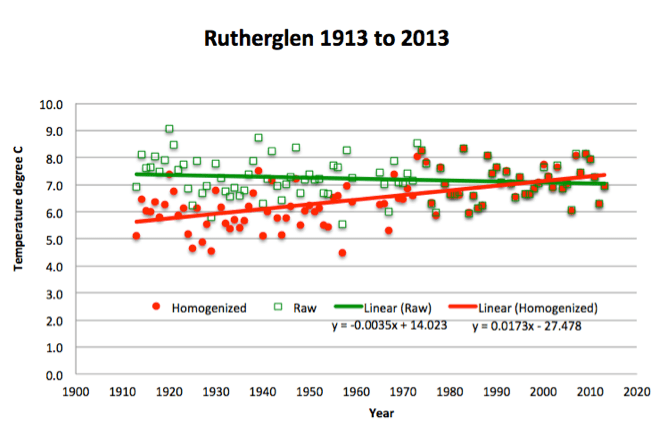
HEADS need to start rolling at the Australian Bureau of Meteorology. The senior management have tried to cover-up serious tampering that has occurred with the temperatures at an experimental farm near Rutherglen in Victoria. Retired scientist Dr Bill Johnston used to run experiments there. He, and many others, can vouch for the fact that the weather station at Rutherglen, providing data to the Bureau of Meteorology since November 1912, has never been moved.

Senior management at the Bureau are claiming the weather station could have been moved in 1966 and/or 1974 and that this could be a justification for artificially dropping the temperatures by 1.8 degree Celsius back in 1913.

Surely its time for heads to roll!

The temperature record at Rutherglen has been corrupted by managers at the Australian Bureau of Meteorology.


Some background: Near Rutherglen, a small town in a wine-growing region of NE Victoria, temperatures have been measured at a research station since November 1912. There are no documented site moves. An automatic weather station was installed on 29th January 1998.

Temperatures measured at the weather station form part of the ACORN-SAT network, so the information from this station is checked for discontinuities before inclusion into the official record that is used to calculate temperature trends for Victoria, Australia, and also the United Nation’s Intergovernmental Panel on Climate Change (IPCC).

The unhomogenized/raw mean annual minimum temperature trend for Rutherglen for the 100-year period from January 1913 through to December 2013 shows a slight cooling trend of 0.35 degree C per 100 years. After homogenization there is a warming trend of 1.73 degree C per 100 years. This warming trend is essentially achieved by progressively dropping down the temperatures from 1973 back through to 1913. For the year of 1913 the difference between the raw temperature and the ACORN-SAT temperature is a massive 1.8 degree C.

There is absolutely no justification for doing this.

This cooling of past temperatures is a new trick* that the mainstream climate science community has endorsed over recent years to ensure next year is always hotter than last year – at least for Australia.

There is an extensive literature that provides reasons why homogenization is sometimes necessary, for example, to create continuous records when weather stations move locations within the same general area i.e. from a post office to an airport. But the way the method has been implemented at Rutherglen is not consistent with the original principle which is that changes should only be made to correct for non-climatic factors.

In the case of Rutherglen the Bureau has just let the algorithms keep jumping down the temperatures from 1973. To repeat the biggest change between the raw and the new values is in 1913 when the temperature has been jumped down a massive 1.8 degree C.

In doing this homogenization a warming trend is created when none previously existed.

The Bureau has tried to justify all of this to Graham Lloyd at The Australian newspaper by stating that there must have been a site move, its flagging the years 1966 and 1974. But the biggest adjustment was made in 1913! In fact as Bill Johnston explains in today’s newspaper, the site never has moved.

Surely someone should be sacked for this blatant corruption of what was a perfectly good temperature record.

———-

Climate records contradict Bureau of Meteorology by Graham Lloyd, 27th August
http://www.theaustralian.com.au/national-affairs/climate/climate-records-contradict-bureau-of-meteorology/story-e6frg6xf-1227037936046

The story is behind a paywall. But if you don’t already have a subscription perhaps its time… this could just be the biggest story of the year.

** There are a lot of tricks that climate science managers have implemented over the years to fix the temperature record; that is fix it so it shows global warming. “Trick” was the word Phil Jones, a leading United Nation’s Intergovernmental Panel on Climate Change (IPCC) scientist, used to explain to his peers that, when constructing very long global temperature series using proxy data based on tree ring measurements that can extend back thousands of years, it was best to substitute thermometer data for this proxy data from about 1960 because the proxy data started to show cooling from about then. Indeed from about 1960 until 2002 the thermometer data mostly did show warming. But now even this instrumental record is starting to show cooling. Enter the relatively new trick of homogenization.

All This Faux-Green Nonsense does Nothing to Help our Environment!

Right argument, wrong argument

Opinions and arguments against the Clean Power Plan all stick to economics, they fail to include any opinion on whether the rule will meet it’s goals.A case in point is an opinion piece in the Durham Herald Sun, Stop the EPA’s war on North Carolina. The article stresses the potential economic damage to the state from the proposed rule.  It never mentions the doubtful benefits from the rule:  no measurable decrease in global temperatures and no evidence that the health benefits will be realized.  In fact, the air pollution data and asthma incidence data show no correlation.  People might support something that saves the planet and lives.  How much would they be willing to pay for something that does neither of these?  We now have McCarthy saying this monstrosity is a jobs plan and ignoring the supposed benefits.

Why not attack the plan on it’s merits?