Liberals Downplay the Auditor General’s Report…..As Usual.

Auditor’s look at the Province’s books: 

by lsarc

Another year, another Auditor, another Ontario Auditor General’s report – same findings of waste, mismanagement and incompetence.

Once again the Ontario Auditor General, a different one this time, in her 2013 Annual Report, looks at Ontario’s electricity sector and reveals the incompetence and lunacy of the Liberal government’s managing of the sector and the incoherence of their policies.

Unfortunately their mismanagement is not confined to the electricity sector. The Auditor found that the government has continued to spend public money on programs without setting in place any metrics to judge the effectiveness of those programs, nor at times even to ensure that the services we have paid for are even delivered. Cost/benefit analyses are still a foreign concept to this government and its bureaucrats.

This does not come as a surprise to those of us who have been pointing out (here, hereand here) that these policies are universally based on nothing more substantive than ideology, never on a cost/benefit analysis or factual data.

The costs to the Province’s ratepayers and taxpayers documented in the Auditor General’s Report 2013 are no surprise to those of us that have been decrying the lack of good government in Ontario.

According the the Ontario Auditor General, Infrastructure Ontario is an $8-billion mess and the electricity sector $50 billion dollar mess includes the $2 billion wasted on thosenot-so-smart “smart meters.”

“The total Global Adjustment charged to ratepayers has grown from $654 million in 2006 to $7.7 billion in 2013, as shown in Figure 10. With more new contracted generators, especially of renewable energy, expected to begin producing energy at higher contract prices, the total Global Adjustment is expected to grow further, to $8.5 billion in 2014 and $9.4 billion in 2015. From 2006 to 2015, the 10-year cumulative actual and projected Global Adjustment is about $50 billion—an extra charge to ratepayers over and above the market price of electricity.”

The Auditor General does not speculate on what this waste and the inflated costs means to Ontario’s economy, society and people.

As we have said in previous posts, the damage done to our economy and society is not only the needless additional cost for electricity, nor the wasted billions, which in many cases have bought us nothing more than additional liabilities.

Certainly these costs are important, but they pale in comparison with the opportunity costs incurred. What wealth and jobs for Ontario would $5 billion a year have created if invested by individuals in the economy? How many nurses and doctors, long term care facilities and other social benefits would $5 billion a year allow? How many billions in lost Gross Provincial Product from companies that leave the Province or go out of business?

Almost everyone blames Tim Hudak for losing the last election by telling people the truth. The Liberals lied and were rewarded with a majority. OPSEU’s Smokey Thomasbelieved Kathleen Wynne was lying and will cut at least 30,000 public sector jobs; he said at least Hudak is “honest and straightforward”.

The Mainstream Media helped by misrepresenting Hudak’s position and allowing the Liberals to misstate it.

The lesson our politicians learn has been re-enforced – never tell the electorate the truth. Next time we complain about politicians lying we have only ourselves to blame.

The unassailable fact remains, Ontario has an enormous debt and deficit, given the size of our population and shrinking economy. At some point in the very near future the Liberals will be forced to make much more drastic cuts and layoffs than Hudak would have because, beholden to the special interests that elected them, they will continue to ignore the problem and continue to increase spending and their trademark waste.

The longer they put the inevitable corrections off, the worse it will be for Ontario’s people. The smug belief that Ontario is too big and too important, and, being part of Canada, cannot meet the fate of Greece and Cyprus, is sadly misplaced.

The longer they wait, the greater the debt. Tax revenues will continue to decrease as the Ontario economy continues to contract, the result of uncompetitive energy prices and a corporate welfare strategy that discourages innovation and competitiveness. Inevitably they will have to increase taxes and further ‘monetize’ services to a tax base reduced by those who can moving to other Provinces for work, with more unemployed, and with a population struggling to pay ever higher electricity bills that has seen its disposable income reduced, the result of wages driven down by the competition for fewer jobs and from the cost of goods driven higher by unaffordable energy.

The problem with ideologues is that sooner or later they run out of other people’s money.

Looking at Ontario over the past 11 years of Liberal ‘government’ and being familiar with UN Agenda 21 one cannot help but think this has been a deliberate course of action chosen by ideologues believe that a socialist totalitarian state is in the best interests of Ontario’s citizens – or at least those that will rule them.

Maurice Strong, former Director of the UN Environment Program and the moving force behind the Rio Declaration and the UN’s Agenda 21 said:

“It is clear that current lifestyles and consumption patterns of the affluent middle class—involving high meat intake, consumption of large amounts of frozen and convenience foods, use of fossil fuels, appliances, home and work-place air-conditioning, and suburban housing—are not sustainable. A shift is necessary towards lifestyles less geared to environmentally damaging consumption patterns.”

“Isn’t the only hope for this planet the total collapse of industrial civilization? Is it not our responsibility to ensure that this collapse happens?”

Mr. Strong, a multi-millionaire who made his fortune from that same capitalist industrial civilization and took asylum in China as a result of his alleged links to the UN Oil-for-Food scandal, will not suffer from any collapse of industrial civilization given his wealth.

Most citizens of Ontario will though.

“Of all tyrannies, a tyranny sincerely exercised for the good of its victims may be the most oppressive. It would be better to live under robber barons than under omnipotent moral busybodies. The robber baron’s cruelty may sometimes sleep, his cupidity may at some point be satiated; but those who torment us for our own good will torment us without end for they do so with the approval of their own conscience.” – C. S. Lewis
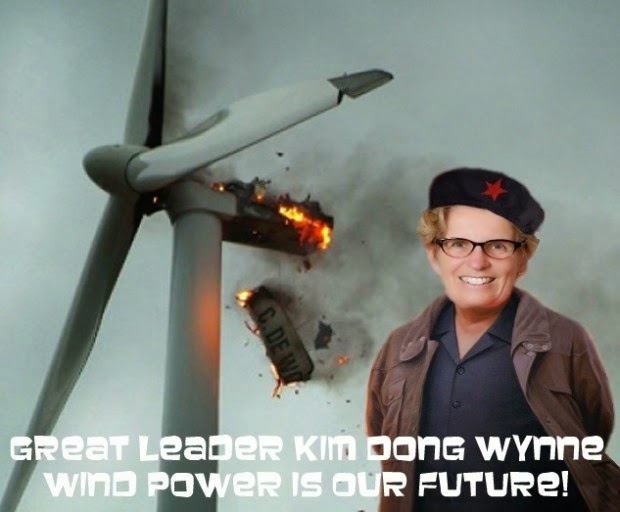
Wynne Government is Destroying Ontario, Tells Us, It Is “Good” for Us!

How green energy subsidies work: the government makes stuff up, then wastes billions of dollars while the economy bleeds jobs

Two items in the Toronto Sun caught my eye earlier this month, both written by Lorrie Goldstein about what the paper calls “the Wynne Liberals’ mad obsession with expensive and unneeded green energy.”  The first column is about a recent report published by Parker Gallant and Scott Luft of Wind Concerns Ontario, agrassroots organization that opposes wind turbines.

According to Wind Concerns Ontario, last month the provincial government spent over $1 billionmore for electricity than its market value.  The organization blames the government’s “rush to incorporate ‘renewable’ energy in the form of wind, solar, biomass, etc. into the grid, without a cost-benefit analysis” as the reason for rapidly increasing energy prices in Ontario.  And as Lorrie noted in his column the following week, whenever the “Liberals are called on the carpet over skyrocketing electricity prices in Ontario, they go into their patented, ‘but we eliminated coal’ routine.  Meaning they eliminated coal-fired electricity and replaced it with ‘clean’ energy sources such as solar and wind power.”

This makes no sense, according to Goldstein, who points out that coal-fired electricity generating stations supplied 25% of Ontario’s power needs in 2007 but wind and solar provide only 4% today.

Furthermore, according to the Fraser Institute, the 4% solar and wind provides accounts “for about 20 percent of the average commodity cost,” even though the Ontario Energy Board said last year that solar and wind would provide 7% of Ontario’s power and “their direct costs would account for about the same fraction of the average commodity cost.”

This wouldn’t be the first time that the government’s estimates were wildly off.  Dalton McGuinty promised in 2009 that the Green Energy Act would create 50,000 jobs by the end of 2012, but as Lorrie Goldstein wrote in the Sun last year, as of mid-2013 only 31,000 jobs had materialized.  Most of them were temporary (lasting only one to three years) and were “indirect” jobs, so even the claim that 31,000 jobs were created is difficult to verify.

To make matters worse, the figure of 31,000 did not take into account the jobs that would be permanently lost as a result of increased electricity prices.  A Fraser Institute report published last year found that the Green Energy Act “will not create jobs or improve economic growth in Ontario.” Lorrie Goldstein wrote that the 31,000 new jobs cost the economy 62,000 to 124,000 jobs in other sectors, as a result of high energy prices.

Such dismal results for government investments in green energy are not unique to Ontario, of course.

Consider, for example, this paper published in 2009 by researchers from the King Juan Carlos University in Spain.  The researchers found that for every “green job” created by the government, 2.2 jobs were lost elsewhere in the economy (note that this number falls into the range of Lorrie’s estimate).
The researchers also found that every green energy job created by Spain since 2000 cost the government, on average, 571,138 Euros.  The final cost of the Spanish experience with renewable energy subsidies is massive.   Between subsidies and higher electricity prices, tens of billions of Euros were lost.  The researchers also found that these enormous costs “do not appear to be unique to Spain’s approach but instead are largely inherent in schemes to promote renewable energy sources.”

It is unclear to me, therefore, what the Ontario Government expects its residents to gain in return for all the time and money poured into green energy projects.  Ontarians are paying outrageous electricity prices, jobs have been lost, and billions of dollars have been wasted – and all we have appeared to gain is a few kind words from ‘Saint’ David Suzuki, which is of no value to anyone.

There is No Reason for Them To Lie! Google Engineers Expose the Renewables Scam!

Google’s Top Engineers say: “Renewable Energy Simply Won’t Work”

google-dr-evil

Renewable energy ‘simply WON’T WORK’: Top Google engineers
The Register
Lewis Page
21 November 2014

Windmills, solar, tidal – all a ‘false hope’, say Stanford PhDs

Two highly qualified Google engineers who have spent years studying and trying to improve renewable energy technology have stated quite bluntly that renewables will never permit the human race to cut CO2emissions to the levels demanded by climate activists. Whatever the future holds, it is not a renewables-powered civilisation: such a thing is impossible.

Both men are Stanford PhDs, Ross Koningstein having trained in aerospace engineering and David Fork in applied physics. These aren’t guys who fiddle about with websites or data analytics or “technology” of that sort: they are real engineers who understand difficult maths and physics, and top-bracket even among that distinguished company. The duo were employed at Google on the RE<C project, which sought to enhance renewable technology to the point where it could produce energy more cheaply than coal.

RE<C was a failure, and Google closed it down after four years. Now, Koningstein and Fork have explained the conclusions they came to after a lengthy period of applying their considerable technological expertise to renewables, in an article posted at IEEE Spectrum.

The two men write:

At the start of RE<C, we had shared the attitude of many stalwart environmentalists: We felt that with steady improvements to today’s renewable energy technologies, our society could stave off catastrophic climate change. We now know that to be a false hope …

Renewable energy technologies simply won’t work; we need a fundamentally different approach.

One should note that RE<C didn’t restrict itself to conventional renewable ideas like solar PV, windfarms, tidal, hydro etc. It also looked extensively into more radical notions such as solar-thermal, geothermal, “self-assembling” wind towers and so on and so forth. There’s no get-out clause for renewables believers here.

Koningstein and Fork aren’t alone. Whenever somebody with a decent grasp of maths and physics looks into the idea of a fully renewables-powered civilised future for the human race with a reasonably open mind, they normally come to the conclusion that it simply isn’t feasible. Merely generating the relatively small proportion of our energy that we consume today in the form of electricity is already an insuperably difficult task for renewables: generating huge amounts more on top to carry out the tasks we do today using fossil-fuelled heat isn’t even vaguely plausible.

Even if one were to electrify all of transport, industry, heating and so on, so much renewable generation and balancing/storage equipment would be needed to power it that astronomical new requirements for steel, concrete, copper, glass, carbon fibre, neodymium, shipping and haulage etc etc would appear. All these things are made using mammoth amounts of energy: far from achieving massive energy savings, which most plans for a renewables future rely on implicitly, we would wind up needing far more energy, which would mean even more vast renewables farms – and even more materials and energy to make and maintain them and so on. The scale of the building would be like nothing ever attempted by the human race.

In reality, well before any such stage was reached, energy would become horrifyingly expensive – which means that everything would become horrifyingly expensive (even the present well-under-one-per-cent renewables level in the UK has pushed up utility bills very considerably). This in turn means that everyone would become miserably poor and economic growth would cease (the more honest hardline greens admit this openly). That, however, means that such expensive luxuries as welfare states and pensioners, proper healthcare (watch out for that pandemic), reasonable public services, affordable manufactured goods and transport, decent personal hygiene, space programmes (watch out for the meteor!) etc etc would all have to go – none of those things are sustainable without economic growth.

So nobody’s up for that. And yet, stalwart environmentalists like Koningstein and Fork – and many others – remain convinced that the dangers of carbon-driven warming are real and massive. Indeed the pair reference the famous NASA boffin Dr James Hansen, who is more or less the daddy of modern global warming fears, and say like him that we must move rapidly not just to lessened but to zero carbon emissions (and on top of that, suck a whole lot of CO2 out of the air by such means as planting forests).

So, how is this to be done?

Koningstein and Fork say that humanity’s only hope is a new method of energy generation which can provide power – ideally “dispatchable” (can be turned on and off) and/or “distributed” (produced near where it’s wanted) – at costs well below those of coal or gas. They write:

What’s needed are zero-carbon energy sources so cheap that the operators of power plants and industrial facilities alike have an economic rationale for switching over within the next 40 years …

Incremental improvements to existing technologies aren’t enough; we need something truly disruptive.

Unfortunately the two men don’t know what that is, or if they do they aren’t saying. James Hansen does, though: it’s nuclear power.

As applied at the moment, of course, nuclear power isn’t cheap enough to provide a strong economic rationale. That’s because its costs have been forced enormously higher than they would otherwise be by the imposition of cripplingly high health and safety standards (in its three “disasters” so far – Three Mile Island, Chernobyl and Fukushima – the scientifically verified death tolls from all causes have been and will be zero, 56 and zero: a record which other power industries including renewables can only envy*).

Nuclear costs have also been artificially driven up by the non-issue of “waste”. In the UK for instance, all “higher activity nuclear waste” must be kept expensively stored in a secure specialist facility and can only ever – perhaps – be finally disposed of in a wildly expensive geological vault. No less than 99.7 per cent of this “waste” is actually intermediate-level, meaning that it basically isn’t radioactive at all: you could theoretically make half a tonne of ordinary dirt into such “intermediate level nuclear waste” by burying a completely legal luminous wristwatch in it. (If you did that inside the boundaries of a licensed nuclear facility, the dirt really would then become ridiculously costly “waste”.)

The remaining 0.003 of “nuclear waste” actually is dangerous, but it can almost all be reprocessed into fuel and used again. So waste really doesn’t need to be an issue at all.

There can’t be any doubt that if nuclear power had been allowed to be as dangerous per unit of energy generated as, say, the gas industry* – let alone the terribly dangerous coal business – it truly would be too cheap to meter and Messrs Koningstein and Fork’s problem would have been solved for them decades ago: by now, nobody with access to uranium would be bothering with fossil fuels except for specialist purposes – and there’s no reason why nations “of concern” couldn’t be kept safely supplied. Would we run out of uranium? Not until the year 5000AD.

Cheap power solves a lot more problems than just carbon emissions, too. If power is cheap, so is fresh water (the fact is we’re really at that point already, though a lot of people refuse to admit it and prefer to treat fresh water as some sort of scarce and finite resource). If fresh water is cheap, an awful lot more of the planet is habitable and/or arable than is the case if it’s expensive: and that is truly game-changing stuff for the human race.

And as a side benefit we’d by now have actual useful spacecraft which could actually go to places in reasonable amounts of time carrying reasonable amounts of stuff at reasonable costs. We’d be able to establish viable bases on other planets – for instance to mine uranium there, should we ever find ourselves running low.

Even if you aren’t terribly convinced about the looming menace of carbon-driven warming, the fact that we have decided of our own free will not to have cheap, abundant energy and all the miracles it would bring with it … that’s a terrible human tragedy. Nobody knows how much misery might result from climate change in the future, but one can say with certainty that a lot of misery has been caused by the absence of cheap energy, water, food and decent places to live over the last sixty-plus years.

Anyway the truth is that the disruptive new technology which Koningstein and Fork are dreaming of already exists: but it’s been stolen from us by our foolish fears, inflated in many cases by dishonest activists. Even if someone could come up with some other way of making terrifically cheap energy, there’s no guarantee that the ignorant fearmongers of the world wouldn’t manage to suppress that too. There would almost certainly be a powerful application in weapons, just as there is in nuclear; this is, after all, energy we’re talking about.

Koningstein and Fork believe that the answer to the carbon menace is a reallocation of R&D spending, to seek out high-risk disruptive technologies. But the fact is it would probably make more sense to spend money on making sure that people don’t reach voting age without understanding basic mathematics and facts about risk and energy.

You wouldn’t need to take that money from R&D. You could instead repurpose some of the huge and growing amounts of money that are currently being diverted into the purchase of tiny amounts of ridiculously expensive renewable energy.

After all, no matter the wider issues, we now have it on the best and unimpeachably environmentalist of authorities that renewable energy can’t achieve its stated purpose. So – no matter what – there can’t be any point in continuing with it.

None of this is new, of course. These realities have been wilfully ignored by the British governing class and others for many years. But the British/American governing classes, so fatally committed to renewables, often seem willing to listen to Google even if they won’t listen to anyone else.

So, just maybe, this time the message will have some impact.

Bootnote

*The Piper Alpha gas rig explosion of 1988 on its own caused three times as many deaths as the nuclear power industry has in its entire history. Bizarrely though, no nations ceased using gas.
The Register

James Delingpole followed up on The Register’s brilliant piece of analysis with his usual dash and flair.

james-delingpole_3334

Renewable Energy: So Useless That Even Greenie Google Gave up on it
Breitbart.com
James Delingpole
22 November 2014

Some people call it “renewable energy” but I prefer to call it “alternative energy” because that’s what it really is: an alternative to energy that actually works (eg nuclear and anything made from wonderful, energy-rich fossil fuel.)

Now a pair of top boffins from uber-green Google’s research department have reached the same conclusion.

Ross Konigstein and David Fork, both Stanford PhDs (aerospace engineering; applied physics) were employed on a Google research project which sought to enhance renewable technology to the point where it could produce energy more cheaply than coal. But after four years, the project was closed down. In this post at IEEE Spectrum they tell us why.

We came to the conclusion that even if Google and others had led the way toward a wholesale adoption of renewable energy, that switch would not have resulted in significant reductions of carbon dioxide emissions. Trying to combat climate change exclusively with today’s renewable energy technologies simply won’t work; we need a fundamentally different approach.

Why is renewable energy such a total fail? Because, as Lewis Page explains here, it’s so ludicrously inefficient and impossibly expensive that if ever we were so foolish as to try rolling it out on a scale beyond its current boutique levels, it would necessitate bankrupting the global economy.

In a nutshell, renewable energy is rubbish because so much equipment is needed to make it work – steel, concrete, copper, glass, carbon fibre, neodymium, shipping and haulage – that it very likely uses up more energy than it actually produces.

Yet our political class remains committed to the fantasy that the emperor’s green clothes are perfectly magnificent. Earlier this week, for example, the British government chucked £720 million of taxpayers’ money into a cesspit labelled the Green Climate Fund.

In theory this UN-driven initiative is supposed to help Third World countries cope with the effects of climate change. In reality, all it will do is force on their struggling economies more of the costly, intermittent renewable technologies (wind turbines; solar; etc) which have proved such a disaster for the advanced Western economies.

If we really want to throw money at the developing world so it can combat climate change, then what we should really be doing is insist that it is spent on adaptation projects – not, heaven forfend, ones to do with “decarbonisation.”

As Benny Peiser and Daniel Mahoney write here, adaptation projects make a real difference and save lives.

Bangladesh’s investment in cyclone shelters, better weather forecasts, and smarter construction practices is a prime example of how effective adaptation can be. The country has learnt how to prepare for the threat of cyclones, succeeding in significantly reducing related deaths. The two deadliest cyclones in Bangladesh’s history occurred in 1970 and 1991, killing up to 500,000 and almost 140,000 respectively. Through adaptation investment, in the last two decades the country has been able to reduce deaths and injuries from such disasters 100-fold.

Instead, though, our leaders are still ideologically committed to wasting much of our foreign aid on renewables.

Take the UK’s recent contributions. Just over a quarter of UK climate aid from 2011 to the beginning of 2014 went to adaptation measures, whereas well over 50 per cent was allocated to renewables, according to the Independent Commission for Aid Impact. The World Resources Institute estimates that, between 2010 and 2012, of a total of $35bn in global climate aid, a mere $5bn was allocated to adaptation.

You know that scene right at the end of Spartacus? Well I think I’d like to recreate it, using wind turbines instead of crucifixes, and, instead of rebellious gladiators, all those lovely people – green activists, wind and solar industry parasites, idiot politicians – who’ve been telling us that renewable energy is the way forward.
Breitbart.com

Spartacus2

Wynne and Her Merry Band of Miscreants, Robbing us Blind!

One month and one billion dollars more wasted…

CleanLicencePlate_wynne_windmill

I have to ask… where is the main stream media?

Kudos to the Toronto Sun for posting the story by Parker and Lufts who run the blog Wind Concerns Ontario.  And of course Sun News for trying to get this across to the people of Ontario.

Are you aware that it only took 30 days for the Liberals to piss away yet ANOTHER ONE billion dollars (yes with a B! for Billion) in order to over pay for hydro production?

30 days and 1 billion dollars GONE!  Pfffsst gone!  If it’s any conciliation, for the previous 30 day period of September 2014, they only pissed away 800 million dollars to pay more than the actual market value of said produced electricity.

Wynne and her gang of liberal marauders have now successfully created a billion dollar a month money funnel, in order to fund their green energy scheme.

Can we predict November’s numbers?  Another billion?  Safe bet.  And December?  Another Billion?  Yep.  And on and on it will go.

Not ONE penny of that endless cycle of monthly missing billions per month will go to benefit the Ontario resident. NOT ONE PENNY!

Are you queasy yet?  Or hopefully you are angry.

No money for sick kids, no money for diabetics, no money for road infrastructure and no money for non Liberal causes.  LOTS AND LOTS of billions though for the sucking black hole of grossly expensive and unnecessary green energy projects and their owners.

We can no longer continue to give these slugs a free pass while we are being robbed blind by this Green Energy disaster.  Who’s with me?

Feel free to link or share via social media.  Please do not alter.  Thanks.

Insane Windpushers Causing Energy Poverty – People Freezing!

UK’s Out of Control Wind Power Debacle Sets Brits up for Winters of Discontent

cold lady

Homeowners face £1,000 increase in electricity bills: ‘Folly’ of relying on wind power ‘will cost homes £26bn by 2030’
The Daily Mail
Corey Charlton
15 October 2014

  • Wind farm reliance could see costly electricity bills and winterpower cuts
  • Experts claim it will lead to costs being passed on to consumers
  • Next winter’s electricity production margins are at an ‘all time low’

Homeowners are facing electricity bill increases of £1,000 and winter power cuts if the Government continues to rely on wind farms, experts warn.

A new report claims that if the Government continues to chase renewable wind power, the average household bill will soar by £1,000, costing homes £26billion by 2030.

The report, submitted to the Lords Science and Technology Select Committee, was authored by the Scientific Alliance.

By 2030, it projected the costs of meeting future energy demands using wind farms would be £26billion per year, which was a 53 per cent increase in the average consumer’s power bill.

Further to this would be increased costs coming from the industry and carbon taxes, which in total would add almost £1,000 onto the average consumer’s bill, the Daily Express reported.

The Scientific Alliance said the Government’s aims to have 35 per cent of electrical energy generated from renewable sources by 2020 will ‘not be achieved in their entirety’.

Sir Donald Miller, the former chairman of Scottish Power, said: ‘The blind reliance by successive governments on unreliable, intermittent renewable energy has reduced the margin of safety to a critical level,’ the paper reported.

‘This has brought the country to a position where power cuts could become a regular feature of cold winters for several years.’

The report, of which Sir Miller was a contributor, stated the electricity production margin for winter next winter was at an ‘all time low’ of 2 per cent.

‘It has been reported that National Grid are taking emergency measures to increase these margins by contracting with owners of small private standby generators for emergency supplies.

‘It is not known to what extent this will be helpful, but the costs per KWhr are likely to be high.’

By 2020, the supply margins will remain at a ‘critical’ level due to the planned withdrawal of conventional power generators over the next two years and the inadequate replacement of these with wind farms.

‘It should be remembered that these margins are against the background of no growth in demand and, even so, are likely to result in extended periods of loss of supply over periods of high winter demand.’

The crisis facing Britain regarding lack and surety of power supply was also acknowledged by the chair of the committee, Earl of Selborne.

In launching the inquiry, he said: ‘An investigation into the resilience of the UK’s electricity infrastructure is a timely one, given that we are set to see our safety cushion between demand and supply drop to particularly low levels over the next two winters.’
The Daily Mail

ed davey DECC

And here’s another take on Britain’s out of control wind power debacle from the Daily Express.

UK’s wind farm ‘folly’: Electric bills to soar by £1000 thanks to reliance on wind power
The Daily Express
John Ingham
15 October 2014

HOUSEHOLDERS are facing soaring energy bills and winter power cuts thanks to the “folly” of relying on wind power, experts said last night.

The green crusade of successive governments is set to double electricity bills for households and cost homes £26billion a year by 2030, it was claimed yesterday.

The cost of renewable energy and carbon taxes will put an extra £983 a year on household bills by then, compared to relying on a mix of nuclear and new gas-fired power stations, three experts told a Lords committee.

They also said the “foolhardy” green policy will do little to cut emissions of the greenhouse gases blamed for global warming.

The Scientific Alliance report highlights warnings by the regulator Ofgem that the margin for electricity production for the 2015-16 winter will be at an all-time low of 2 per cent compared to the pre-privatisation requirement of at least 20 per cent.

It means that in times of high demand, such as during very cold weather, Britain would be at risk of power cuts.

The alliance argues that wind power – which is the main renewable energy source depended on by Government – is unreliable.

One of the experts, Sir Donald Miller, former chairman of Scottish Power, said: “The blind reliance by successive governments on unreliable, intermittent renewable energy has reduced the margin of safety to a critical level.

“This has brought the country to a position where power cuts could become a regular feature of cold winters for several years.”

The written report has been submitted to the Lords Science and Technology Committee’s inquiry into the nation’s electricity infrastructure.

At the inquiry’s launch its chairman, the Earl of Selborne, said: “We are set to see our safety cushion between demand and supply drop to particularly low levels over the next two winters.”

And yesterday’s report stated: “The foolhardy policy of replacing reliable and efficient gas, nuclear and coal power stations by expensive and inefficient wind turbines and solar farms has raised energy prices while doing little to cut emissions of carbon dioxide.

“The total costs are some £12billion per year more in 2020 than an optimum programme of gas turbines and nuclear, and almost £26billion per year more by 2030.”

The alliance calls for new nuclear power plants to help plug shortfalls caused by the closure of ageing coal-fuelled power stations and rising demand.
The Daily Mail

hell-freezing-over1

No More Free Ride for Windweasels in the US!

Republican Mid-Term Victory Spells Doom for US Wind Industry

wind_turbine_fire

The US has just been through its mid-term elections, which saw sweeping gains by the Republican Party in the Senate, House, and in many gubernatorial elections, as well as state and local races.

The Republicans gained control of the Senate for the first time since 2006, and increased their majority in the House. The Republicans also gained several seats in governors’ races, defeating one incumbent Democrat and picking up three seats vacated by retiring Democrats. Counting continues with the Republicans set to pick up a number of seats in the House, and, possibly the Senate.

With Republicans firmly in control of Congress, the smooth subsidy-sailing enjoyed by the US wind industry (until now) is about to hit stormy waters.

John Boener, Mitch McConnell

Those US States that piled into wind power in a big way have seen power prices rocket, with some seeing increases of over 34% (Idaho). From 2008-2103, the top 10 wind power states saw their electricity prices rise an average of 20.7%, which is seven-fold higher than the national electricity price increase of merely 2.8% over the same period (see our post here). The cost of wind power is so uncompetitive that Nebraska has just knocked-back a long-term wind power deal because it was “just too expensive” (see our post here).

The adverse economic impacts of propping up the wind industry with exorbitant fixed priced State Feed-In-Tariffs and the Federal Production Tax Credit aren’t lost on Republicans. Here’s a wrap up on where America’s wind industry is headed.

It May be Lights Out for the Wind Industry Come the Midterms
FOXBusiness
Chris Versace
27 October 2014

The International Energy Agency recently cut its forecasts for oil demand growth for this year. Nevertheless, production in North America is exploding led by the shale oil boom. Already, the U.S. has become the world’s largest producer of oil and natural gas.

For energy products like oil and natural gas operating in the marketplace, this excess production means lower costs for consumers. Lower prices have their own consequences for the industry as well. Analysts at Sanford C. Bernstein & Co recently released a report revealing that current at prices as much as one-third of U.S. shale oil production will be “uneconomic” to harvest.

For government-backed industries such as wind energy, the relationship is directly the opposite – the more they produce, the more it costs ratepayers and taxpayers. Recent analysis shows that states with the largest use of wind power have the highest electricity bills. Such factors have caused private investors to largely bypass wind companies and leave them largely dependent upon the government for their survival.

Wind energy companies rely heavily upon a government construct known as the “Production Tax Credit” (PTC) to support their bottom lines. The PTC is a federal program that provides billions of dollars annually to subsidize renewable energy facilities such as wind farms. Generally speaking a clean technology facility receives a tax credit for 10 years after the date the facility is placed in service with the tax credit amount ranging from $0.23 per kilowatt-hour (kWh) for wind to $0.011 per kWh for qualified hydroelectric.

Looking at the International Journal of Sustainable Manufacturing, researchers concluded that “in terms of cumulative energy payback, or the time to produce the amount of energy required of production and installation, a wind turbine with a working life of 20 years will offer a net benefit within five to eight months of being brought online.” This raises the question as to why any tax credit for wind energy would span more than just a few years at most let alone 10 years after the facility is up and running.

Congressional support for the PTC is largely split along party lines. Fifty-five Members of the House led by Rep. Mike Pompeo, (R-Kan.), have written a letter to the tax writing committee demanding an end to the wind energy subsidies. The letter stated:

We offer our full support of the current process undertaken by the House Committee on Ways and Means that will allow the most anti-competitive and economically harmful tax provisions, specifically the wind energy production tax credit (PTC), to expire. Ensuring that our nation’s patchwork tax code undergoes significant reform is a noble goal and, as part of this process, we believe Congress should stop picking winners and losers and finally end the wind PTC.”

It is presumed that a GOP controlled Congress would see the PTC on the chopping block in 2015 and a Democrat-controlled Congress will fight for renewal.

It would be an understatement to say that the outcome of the 2014 elections is important for wind energy producers. In an effort to see PTC friendly Harry Reid as Majority Leader, the wind industry has essentially turned the League of Conservation Voters (LCV) into their own personal Trojan horse.

Much of the LCV leadership has deep ties to the wind energy:

  • Tom Kiernan, CEO of the American Wind Energy Association (AWEA) serves as the Treasure of the LCV.
  • Peter Mandelstam, former AWEA board member and founder of Green Sails wind energy company also serves on the LCV board.

Unsurprisingly, much of the LCV’s campaign activities have been aimed squarely at renewal of the PTC. The organization brags that it will spend over $25 million supporting pro PTC candidates and attacking their opponents before November elections.

Should LCV’s campaign fail, loss of the PTC could prove fatal to some wind companies. As Warren Buffet recently told his loyal investors, “I will do anything that is basically covered by the law to reduce Berkshire’s tax rate. For example, on wind energy, we get a tax credit if we build a lot of wind farms. That’s the only reason to build them. They don’t make sense without the tax credit.”

The outcome of the elections remain far from certain as does the fate of the PTC under any election outcome scenario and Washington D.C.’s capacity for cronyism should never be underestimated.

That said, it should leave investors holding off if not second-guessing the potential of First Trust ISE Global Wind Energy ETF (FAN) shares or its holdings that include Capstone Turbine Holdings (CPST), Otter Tail Corp. (OTTR), NextEra Energy (NEE) and others. Especially if the Republicans take control of Congress as expected, and run a full tally of their friends and enemies during this election cycle, it may well be lights out for the wind energy industry sooner than anyone expects.
FOXBusiness

storm tossed ship

Wind Turbines are NO Benefit to Anyone But the Rich Investors…

Massive Subsidies for Wind Power a Crony Capitalist “Gift”

dirtyrottenscoundrelsoriginal

Ex-Rep. Istook: Wind Energy a Crony Capitalist Gift
Newsfront
Sean Piccoli
23 October 2014

Wealthy investors in wind power are reaping profits from an expensive — and subsidized — form of green energy that is driving up the electricity bills of ordinary Americans, a former Oklahoma congressman told Newsmax TV on Thursday.

Under the guise of saving the planet from global warming, wind power has become a taxpayer ripoff and a boon to investors claiming massive federal subsidies for an industry that cannot compete on price with traditional energy sources, former Republican Rep. Ernest Istook told “MidPoint” host Ed Berliner.

Of the $40 billion annually doled out to various green energy incentives, grants and loans, one of the biggest magnets for public funds is a wind energy tax credit first enacted in 1992, said Istook.

“For every megawatt hour that [producers] generate through wind energy, they get $23 from the U.S. Treasury,” he said, “and of course you multiply that by the many thousands of megawatt hours that are generated — which is still a small fraction of what the country uses — and they’re talking about an $18 billion renewal of this.”

“Now, this was supposed to be a temporary tax credit back in 1992 to help the industry get on its feet,” said Istook. “Well, the problem is wind power is such an expensive way to generate electricity, that even with these major subsidies — plus all sorts of subsidies from different states — it still is one of the costliest forms of power. And it makes people’s electric bills skyrocket.”

Istook said a new study from the Energy Information Administration — the U.S. Department of Energy’s statistical service — finds electric ratesrising four times faster in the states that use the most wind power.

He said the arrangement continues year in and year out thanks to a classic “vicious cycle,” in which subsidy recipients use their profits to secure more subsidies.

“I want to give you a quote, though, from one individual who was a major wind energy investor and getting a lot of these tax benefits: Warren Buffett,” said Istook, citing the Nebraska-based billionaire investment guru.

“These are his words, not mine: ‘We get a tax credit if we build a lot of wind farms. That’s the only reason to build them. They don’t make sense without the tax credit.’ Those are Warren Buffett’s words,” said Istook.

“The people that are making this investment recognize that unless they can get these crony capitalism dollars, it’s a bad investment,” he said. “But government is paying them to do that. It’s paying some people to get rich at our expense while our utility bills go up.”

Istook said the public has a chance to put a stop to the tax credit, which expired last December, but is being pushed for retroactive renewal by the administration during the lame-duck congressional session that begins after the Nov. 4 midterm elections.

“They’ve got the skids greased in the U.S. Senate to do it,” said Istook.

And they will, too, he said, “unless people call their member of Congress and say, ‘Don’t vote for anything that renews this $18 billion giveaway, no matter what it’s packaged with. Don’t vote for it.’ That’s the only way we’re going to put a stop to this crony capitalism.”
Newsfront

ernest istook

Wind Company Admits That Barb Ashbee’s Home, was Uninhabitable….

Barb Ashbee: wind company “agreed that we couldn’t live there any more”

barbara-ashbees-homeI’m sure everyone reading this has had the experience of phoning some corporate entity (Hydro, Bell, Visa, etc.) and heard the pre-recorded message, “This call is being recorded for quality assurances purposes…”. Yeah right. Well, a similar act is played out in the ERT hearings. Often the wind company will engage a court reporter to provide a transcript of the testimony. Other parties will be offered copies IF they pony up a portion of the costs. Often the MOE will do so. They will use this record further down the line when final submissions are made. What they likely will not do is get the transcript certified. Why, you ask? Because certified transcripts must be submitted to the ERT and then it becomes a public document that anyone can a have access to.

There’s lots of stuff that happens in an ERT that a wind company and their helpers (MOE) wouldn’t want the public to hear. I wish we could have afforded the cost of a court reporter for Nextera’s Adelaide ERT appeal. That’s the way the game is played.

So when an actual certified transcript becomes available, it’s a rare thing indeed. Such is the case with the St.Columban and K-2 appeals and excerpts appeared in the factum submitted for the court case in London in mid-November. Of particular note is the testimony of the post-turbine witnesses for those appeals.  The first installment is Barb Ashbee’s testimony for both appeals.

Read on:

Evidence of post-turbine witnesses heard on all three appeals 

The Dixon-Ryan Appellants called the evidence of two post-turbine witnesses, Barb Ashbee and Sandy MacLeod, both of whom were forced to leave their home because of the effects that the wind turbines were having on their health. Their evidence was subsequently entered before the Tribunal by way of transcript on the Drennan and Kroeplin appeals.

In 2005, Barb Ashbee and her husband moved into a home located in Shelbourne, Ontario. The home was intended to be their retirement property. Shelbourne is home to one of the first wind power projects in Ontario, the Melancthon EcoPower Project. The project consists of two phases and is comprised of approximately 123 wind turbines.

When Ms. Ashbee first learned of the project she was excited about the prospect of wind energy. She recalled telling her family and friends about how exciting it was that they were getting turbines, and would go out in her backyard and take pictures.

Ms. Ashbee’s home was affected by phase two of the project which began commercial operation in 2008. Ms. Ashbee’s home was located 457 meters from the closest turbine. She had four more turbines located within one kilometer, and another 15 turbines within two kilometers.

She began keeping a journal to describe what the noise sounded like and any symptoms she and her husband were experiencing.

Ms. Ashbee experienced sleep deprivation, stomach aches, heart palpitations, headaches, and dizziness. In addition, she began having nosebleeds and experiencing terrible cognitive and memory problems as time wore on.

Ms. Ashbee never sought medical attention specifically for the symptoms she was experiencing but did explain to her doctors what was going on with the wind turbines. Ms. Ashbee recounted that she informed her doctors about the wind turbines “because when I had the appointment with them I was severely sleep deprived and impacted and I wasn’t my normal self and I did want to tell them about what was going on.”

Ms. Ashbee immediately reported her symptoms to the project owner and they began conducting testing. Soon thereafter the MOE became involved in the process of monitoring the turbines and of receiving complaints. After the MOE and the project owner began testing on the project, they indicated to Ms. Ashbee that the project was in compliance with the guidelines and the 40dBA level permitted by the regulatory guidelines.

To try and mitigate the effects that the Ashbees were experiencing in their home, the wind company shut down the five turbines closest to their home. Despite this, the Ashbees reported still feeling a vibration and humming in the house, and they continued to be deprived of sleep and to experience headaches.24

The Ashbees tried to adjust to the turbine noise with ear plugs, but found no relief with these because the vibration was being felt throughout the house. They moved their bed out into the detached garage to see if it would help but this did not give much relief.25

During the period from May 8, 2009 to June 25th, 2009, at which time they left their home for good, the Ashbees moved into a tent in their backyard with their animals to gain respite from the vibration they were experiencing within their home.

Q. Okay. And so during the entire period did you remain in your house?

A. Yeah.

Q. And so you slept the entire time in your bedroom?

A. No, we got to the point we started looking for a rental and because our, like, we were all affected and we started, first I started looking for a rental, but we had three dogs, two cats to move and there’s not very many people that will rent with that many pets. And plus we were paying the mortgage and would have to pay out money for rent again and it was horrible.

And we thought well, we’ll rent a trailer, like, park it on the driveway; four wheel trailer thing. And I phoned around to a few places and there was nothing. I couldn’t find anything, nobody rented them.

We moved the bed out into the detached garage hoping it would be quieter out there so we wouldn’t have the vibration and noise and it was actually out there too. So it really didn’t help anything.

The wind company offered us a house a concession over from us and we did attempt to move into it. There were problems with it, with mould in it, so we couldn’t move in. So we were stuck, again.

So we ended up moving into a tent in the backyard because the turbines were being shut down at night and the vibration wasn’t there like it was in the house. You would feel it a little bit, a little bit of it but it wasn’t resonating like it was in the house. So we bought a tent. We went through two, actually, put the tent in the backyard, put our bed out there, a little table and a heater and a light and all the animals slept out there with us and that’s how we coped.

Q. And how long did you have to do that for?

A. May until we left.

Q. And when did you leave?

A. June 25th. I think it was May, early May. It’ll be in here, actually I guess. Do you want the date?

Q. If you have it.

A. May 7 we bought the tent.

Q. Okay. So then would May 8 be your first night in the tent?

A. Yeah, that was yeah, we set it up and put the bed in.

Q. And, sorry, you said you left June 25th?

A. Twenty fifth.

Q. So for almost two months did you sleep in the tent constantly every night?

A. Pretty much. The odd night when it didn’t seem too bad we would try it in the house. We put the spare bed in the tent and we still had the bed in there but there weren’t very many nights we were able to stay in the house.

Q. So did you have some alleviation from your symptoms while you slept in the tent?

A. Oh, yeah, we could sleep again, yeah. It still wasn’t the best because we were in a tent and it was still pretty cold still, but it was better than the house.26

Once Ms. Ashbee and her husband moved from their home, they no longer experienced any of the adverse health effects they had while living in the home.

Q. And so the symptoms that you described for us earlier, do you still suffer from any of those symptoms?

A. No.

Q. Okay. And when did those symptoms stop altogether?

A. Within pretty much within weeks, a month after we moved. Like, the sleep deprivation stopped immediately. The headaches stopped and that. I mean, the other effects, the upset and anger and that lasted a little bit longer, but as far as the stomach aches, the chest pressure, that was pretty much gone.

Q. Okay. And just so that we make sure it’s on the record, can you tell us how long you were in the environment when you were exposed to the wind turbines and these adverse health effects?

A. From early December 2008 to June 25th, 2009.

During cross examination, Ms. Ashbee was vigorously questioned about the source of the noise and vibration that she experienced in her home. The questioning was directed at demonstrating that her concerns arose not from the audible noise, but rather from some low frequency sound. This low frequency sound and its impacts is the same issue that Health Canada is now investigating through their study.

Q. And how long after they became operational did you notice that you were having problems?

A. Pretty much right away, like, within the first week, two weeks.

Q. And you talked about and I know from reading through your journal that the vibration was particularly a problem for you, correct?

A. Yeah, mm hmm.

Q. Would you say that that was the bigger problem than the noise?

A. It was as big a problem. The noise was a big problem. When they started shutting them down, it alleviated that, but the vibration was just as bad. Like, it didn’t fix that part of it.

Q. And you would know that because when five of the closest turbines were down around you, you were still bothered significantly by the noise?

A. The vibration.

Q. Or by the vibration, yes.

A. Yeah.

Q. Including the fact that you were in a tent and it was better in the tent than in your home, right?

A. Yes, it was.

Q. Okay. And you think that’s because of the and I don’t mean to demean you by saying you think your belief is that that’s because there was vibrations at that time with the turbines down was the problem?

A. Well, it was in the house. Whether it was coming from the turbines or the electrical, I don’t know.

Q. Okay. So you still have never been given an answer on that?

A. No. Excuse me, there was a 160 spike measured by the wind developer, low frequency spike and so that was determined that it was in our house. It was measured. And Gary Tomlinson told me that that 160 hertz was coming off all the turbines, not just the one behind us.

Q. So when you say a spike, was that a one time thing?

A. No, it’s acoustical terminology. And I don’t know acoustics.

Q. You’re as blind as me on that.

A. They showed us the graph and it’s a spike. It’s continuous, but it shows the spike and they were outside measuring and inside measuring and a spike happened and they went oh, there’s a 160 spike and then the wind developer told us there’s definitely a problem with the low frequency in our house. So I don’t understand the rest.

Q. That was going to be my next question that you have said the wind turbine company acknowledged to you that there was a problem in your home because of the turbine, some aspect of the operation of the turbines?

A. Yeah.

Q. And to your knowledge, was that the reason for the buy out of your home?

A. They agreed that we couldn’t live there any more, yeah.

Although Ms. Ashbee and her husband suffered these adverse health effects, they did not seek medical attention. Ms. Ashbee chose not to seek medical attention because her doctors “were not very engaging with wind turbine problems” at the time she was experiencing her symptoms. Additionally, Ms. Ashbee felt that she knew that the wind turbines were what was causing her health problems.

Q. And it’s fair to say that they weren’t concerning you enough that you went to a doctor to have them checked out?

A. I knew what was causing them so.

Q. Okay, but even if you know the cause of something, it didn’t concern you enough to go to a doctor to have them check out whether or not they should be doing something, putting you on heart medication?

A. I talked to this doctor and I talked to my doctor in Toronto, and they weren’t very engaging with wind turbine problems. So I mean, I — what do you want me to do? I know what’s causing them. If they stopped them, we knew because, I mean, we were both going through the same thing, sometimes at different times it would come on.

Ms. Ashbee’s evidence is consistent with the evidence of other post-turbine witnesses that when they left the vicinity of the wind project, they no longer experienced the adverse health effects. Another witness that provided similar evidence before the Tribunal was Ms. Sandy MacLeod. Ms. MacLeod is a high school teacher and lived in Ripley, Ontario, the home of the Ripley Wind Project.

Oxford Professor Tells the Truth About Green Energy!

OXFORD PROF SHREDS GOVERNMENT’S GREEN ENERGY POLICY

An Oxford University Professor has torn the UK government’s energy policy to shreds in his appearance before the House of Lords Science and Technology Committee.

Speaking to the Lords yesterday, Professor Dieter Helm said that the “Miliband-Huhne-Davey” policy (referring to the last three energy secretaries), which is based on an assumption that fossil fuel prices would rise, was “dramatically wrong”. (h/t to Bishop Hill, where the full exchange of views can be seen).

The Lords Committee gathered to hear evidence from a range of energy experts including power companies and the National Grid to determine whether there was indeed a risk of the lights going out this winter, as has been widely reported (including on Breitbart London).

Opening the second session, Professor Helm gave his name and title, before delivering a short two minute speech lambasting the governance of energy policy in recent times.

“It is a quite extraordinary state of affairs for a major industrialised economy to find itself even debating whether there is a possibility that the margins may not be sufficient of electricity to guarantee supply,” he said.

“If it was achieving carbon objectives and if it was producing low prices there might be some consolation. The wholesale price in Great Britain is twice that of northern Europe and on a CO2 front we’ve been switching from gas to burn as much coal as possible, and our emissions are actually rising on a production basis and of course on a carbon consumption basis which is the basis that matters for decarbonisation.

“For a major industrial economy to fail on one of the three objectives is a serious problem. But to fail on security and on competitiveness of price, and on decarbonisation is a sad state of affairs. And it’s even sadder in the context of which the problem isn’t fundamentally particularly difficult.

“It’s ultimately about having enough power stations and enough wires to supply the needs of the population. It’s a problem that’s been with us for a century. Many other countries solve these problems and it’s, as I say, rather sad that we’ve got to this particular point.”

The Committee probed the professor on a range of aspects including “resilience”, which the Professor explained was a matter not just of physical capability, but also the price which people are asked to pay for the energy supplied. If prices rise above people’s desire or ability to pay, people simply “turn themselves off, as happened in California”, he pointed out.

“The kit is there. If the will is there to do it, and the expertise and capacity of the grid I think is up to it, they will manage to make supply equal demand. The question is: how much higher will the price go as a result, and how long will Britain carry on having such high wholesale prices with all the consequences there are for British industry and also consumers?” he asked.

When questioned about medium term threats to resilience, Prof Helm was particularly scathing. Pointing to the fact that “the commodity super-cycle is over” and that gas, coal and oil prices are all falling, he blasted energy secretary Ed Davey, saying “We have a policy with the secretary of state repeatedly reminds us is based on the idea that gas prices are rising and volatile. Well, they’re falling and the volatility is something that we don’t want to protect customers from. [That is, downwards volatility is good for customers who want the benefit of cheaper prices immediately].

“Should we worry about resilience of fuel supplies? No, I don’t think so. The world is awash with gas. Unconventional gas is popping up all over the place America is no longer importing, plenty of supplies around, plenty more being discovered.

“The one medium term ‘risk’ that I would pay much less attention to but clearly the government thinks they should pay much more attention to is whether or not we’ll get enough supplies of fossil fuels. We have enough fossil fuels in the world to fry the planet many times over.”

He then set his target wider, laying into the “Miliband-Huhne-Davey policy”, so called “because it’s very consistent through that period”, as a whole. Successive energy secretaries had based their policy on the assumption that fossil fuel prices would continue to rise, making renewables comparatively cheaper by the 2020s and allowing subsidies to fall away; an assumption that the professor said  “[doesn’t have] any part in energy policy.

“That fossil fuel prices are going to go up. … That’s an outcome of the market, not a policy assumption to make. … If your bet turns out to be dramatically wrong, you’re going to have lots of technologies which are ‘out of the market’ for some considerable period to come. We will have to subsidise those technologies right through the 2020s and beyond.

“This knowledge that politicians have, that politicians know what the winners are, we’ve been there so many times before.  It usually turns out badly and it has done this time.”

French Doctor Talks about Health Effects From Wind Turbines…..No More Denial!

Chevallier: wind turbines, eco sham and new drama Public Health

The Point – Published 10/24/2014 at 15:34

We swear by these symbols of environmental cleanliness. Yet the myth to reality, there is an abyss, and maybe even a scandal!

Avignonet Lauragais Midi-Pyrenees.  Studies show a link between these giant industrial facilities and health problems.
Avignonet Lauragais Midi-Pyrenees. Studies show a link between these giant industrial facilities and health problems.Gabalda © Remy / AFP 
By DR.

Ecology is still good. European companies seeking by all means to implement giant wind (we approach the 200 m high) in the French countryside, close to the houses. It is clear that wind turbines do not have anything green with the thousands of tons of concrete needed to support these steel monsters; about the energy, it is far from the account feedback from those already established.

My concern, as a physician and member of the European Association Physicians for a healthier environment being created, focus on health. A report by the National Academy of Medicine, published in 2006, concluded that the need to suspend (or prohibit) the construction of wind turbines with a capacity greater than 2.5 megawatts located within 1500 meters of housing. These are actually real industrial plants inducing nuisance, including noise.

Industrial wind turbines are in fact classified as ICPE: installations and plants that generate risks or dangers. Several scientific studies are being published, the results recommend that wind turbines are not located within 2.5 kilometers of homes. Thus, clinical observations of Dr. Michael Nissenbaum two wind farms in the state of Maine to the United States indicate that there is a correlation between the distance residential wind turbines and health problems for residents.

The responsibility of prefects engaged

A number of doctors have already identified multiple health problems related to ownership with these industrial machines. A medically defined the “wind syndrome” which includes increasing headache (noise and turbulence as triggers of migraines), ringing in the ears like tinnitus, sleep disorders, an increase of anxiety and depressive disorders, sometimes the appearance as Dr. Jean-François FERRIEU of “nausea, dizziness, palpitations, all of these chronic conditions can promote authentic depressions” said.

This dimension is not taken into account, or insufficiently, by the government, probably through lack of information. During this time, various local businesses, which more often then sell the exploitation rights to legally well structured international companies continue to put pressure on municipalities to accelerate Starts at times 500 meters of housing, wind farms, as they are never isolated wind turbines are located but the groups multiplied effects. The responsibility of prefects is committed to this day, since it is they who issue building permits.

Gel ongoing projects

On the evidence currently available, it would seem sensible in principle of responsibility to recommend minimum distances of 5 km between industrial wind turbines and homes. Ideally, it would be desirable to freeze all ongoing projects now and deepen health dimension not induce new diseases on a large scale.

It may also come to the conclusion that, for the health of humans and animals such as birds, farm animals or bats, precious “insecticides” natural which have been the subject of a report of the American Academy of Sciences (PNAS, September 29, 2014), it is sufficient to ban industrial wind turbines on land.

As noted by Nicolas Hulot , “initially, wind energy is a great idea, but upon arrival, it is a tragic realization. If we were told that at least it would close plants, but this is not the case. ”