More Information on the Mink Farm Tragedy, in Denmark!

Mink farm disaster
See our press release of June 7th 2014


Document Nº 1


Here is an article from Denmark dated 16 January 2014, together with a video, about the visit of the owner of the Vildbjerg mink farm, Kaj Olesen Bank, to the Danish Parliament, where he was received by the Parliamentary Environment Commission:http://www.tvmidtvest.dk/indhold/mink-amok-over-vindmoellestoej (see translation further down). This was regarding the 1st incident, which occurred last fall when the wind turbines first began to turn. About 100 mink had to be put down at the time, because of the wounds inflicted when they turned aggressive and attacked one another.


The Danish media are, however, auto-censoring on the second incident which occurred at the mink farm in May 2014: the 1,600 miscarriages. Such news could hurt VESTAS badly, which is arguably Denmark’s biggest employer and exporter. The company has deep pockets, and is an object of national pride. All of this, plus the pressure applied by the powerful Green lobby, motivates the Danish media to look the other way.


Free translation of the article:


Mink crazy from wind turbine noise


Mink breeder Kaj Olesen Bank’s animals are behaving in a completely crazy way. This started to happen when four giant wind turbines were erected close to his farm.


Aggressive animals and deafening mink war – this has become commonplace at Kaj Olesen Bank’s mink farm, after the erection of four giant wind turbines near his residence not far from the village of Vildbjerg.


“I could hear it perfectly from inside our room, and I was shocked when I walked around the farm – there was fighting everywhere”, says Kaj Olesen Bank.


From the day he had four giant wind turbines for neighbors, his mink completely changed behavior. They are now so aggressive… Many of them had to be put down because of the deep bites they inflicted to one another. The farmer is now fearing for his farm’s production.


“It was a nightmare. It is also a mental challenge. A whole production system, one’s livelihood is at stake. And it’s not small amounts we are talking about. We fear the worst, because we know that mink fighting – bites, trauma, fur damage – will cost us millions of kroners”, he said.


Kaj Olesen Bank has now applied for permission to move his fur farm further away from the giant wind turbines.


End of translation


Latest news: the municipality of Vildbjerg has denied him the right to move his mink farm, even though it would still be on his own land. Says our Danish correspondent: “the authorities are having a love affair with the wind industry. But we, the people, must pay the consequences.”


Document Nº 2


Report of the veterinarian from DANSK PELSDYR LABORATORIUM who was called when the second incident occurred, that of miscarriages en masse.


Original in Danish: “BESOGSRAPPORT_5-5-2014_Kaj Olesen Bank”


Translation:
“REPORT FOR CONSULTATION”

Aussies Are Talking About DownWind, & Tim Hudak, and Wishing him Well!

Sun New’s “Down Wind” sends Wind Industry Into Tail Spin

down wind

Canada’s Sun News was among the first news outfits worldwide to grasp the scale and scope of the great wind power fraud; and the associated harm inflicted on hard-working rural people. Exposing the wind industry for what it is, Sun has produced a truly ground-breaking documentary on how wind power outfits have fleeced power consumers for $billions, while happily destroying the lives hundreds of farming families across Ontario (see our post here).

The documentary, “Down Wind” went to air on 4 June and has sent the wind industry and its parasites into a panic stricken tail spin. Not used to an “untamed” media challenging their lies, treachery and deceit, the industry’s chief spin doctors have launched a bitter defence, replete with all the usual guilt-soaked waffle about giant fans “saving the planet from cataclysmic climate change”. Never mind that the wind industry has yet to produce a shred of actual data that wind power reduces CO2 emissions in the electricity generation sector – probably because the actual evidence shows just the reverse (see this European paper here; this Irish paper here; this English paper here; and this Dutch study here).

Down Wind, which runs for 96 minutes, can be purchased as a file and downloaded or as a DVD (here’s the link).

Here is a detailed synopsis of Down Wind from wolfhillblog.com.

Dirty secrets of the Ontario Liberals’ wind power scam: What you need to know from DownWind, the Sun News documentary
Wolfhillblog: Fauxgreen
8 June 2014

THE ONTARIO LIBERALS’ GREEN ENERGY ACT HAS DONE SERIOUS AND IRREVERSIBLE HARM TO PEOPLE, WILDLIFE, THE ENVIRONMENT

  • Rural people in Ontario living in the midst of 50 storey-high industrial wind turbines have been badly hurt, even seriously and irreversibly harmed, with respect to mental and physical health and safety, property values (loss of 10-48% or even 100%), livelihood, way of life, community harmony. Some families have had to leave their homes on the advice of doctors.
  • Farmers have noticed that wind turbines drive out earthworms due to electrical surge charges and vibrations. This reduces the quality of the soil. “Food production will go down.”
  • The wind turbines’ concrete bases, of which some of the material is toxic, go 50 feet down, far enough to hit aquifers.
  • Livestock productivity, such as that of dairy cattle, is adversely affected.
  • Birds are slaughtered by wind turbines.

THE LIBERALS HAVE PRESIDED OVER ABROGATION OF DEMOCRATIC RIGHTS AND BULLYING BY WIND COMPANIES

  • “The provincial government wants these things and they’re going to come no matter what we do.”
  • “(As high as) 140-50 storey buildings – you don’t even have that in Toronto. We’re talking 1,800 turbines up and down the shoreline (of Lake Huron), on some of the most productive farmland in all of Ontario. My God, what are you people thinking? Don’t tell us from your condo that the green thing is so great that we’re going to force it on you.”
  • The Liberals’ Green Energy Act supersedes/overrides 21 pieces of legislation including the Clean Water Act, acts that protect the Niagara Escarpment and Oak Ridges Moraine, the Heritage Act.
  • All Ontario government ministries have turned a deaf ear to complaints and concerns communicated to “every arm of the Ontario government when they asked for help. The wind companies do whatever they want.”
  • The Liberals’ Green Energy Act strips municipalities of their planning powers. More than 80 communities have declared themselves to be unwilling hosts.

THE SYSTEM IS RIGGED AGAINST WIND TURBINE VICTIMS

  • There have been more than 20 Environmental Review Tribunal hearings of appeals and all of them were dismissed. One was allowed but appealed in Ontario Divisional Court where the wind developer prevailed. “The process they’ve created is so imbalanced and so weighted in favour of the wind turbine companies it’s as if they wrote the legislation. It’s embarrassing.”
  • Wind turbines “are imposed on people and they are getting no choice. That begs the question of whether it’s Charter-compliant, whether it complies with constitutional principles to put these people through these things without being assured of a certain level of safety. No one should be subjected to a reasonable risk of harm.”

WIND POWER IS FAR FROM CLEAN

  • “When they talk about displacing coal-fire power plants in Ontario with wind, that’s not actually what happens. As they add wind capacity to the system, they are displacing nuclear and hydro and those are non-emitting sources. And you have to remember that whenever you see a wind turbine, there is a gas-fire power plant running in the background to balance out the load fluctuations. So it’s always a wind and gas combination. They’re replacing emissions-free hydro and nuclear with a combination of wind and gas and we’ll actually end up with higher emissions of pollution …”
  • “So you’re paying for a wind turbine to turn, and you’re paying for a gas plant to idle. You’re paying double most of the time. It’s asinine.”

THE LIBERALS HAVE USED JUNK SCIENCE TO MISLEAD THE PUBLIC

  • Air pollution levels in Ontario have declined steadily since 1974, but the Liberals claimed in 2009 when the Green Energy Act came into force that there was a rising air pollution crisis. “But they knew perfectly well that air pollution had been trending downward right across the board.”
  • Most particulate matter emissions come not from coal power generation, as the Liberals claimed, but from construction, industry, agriculture, and most of all from dust from unpaved roads.
  • “There’s no question that there’s been an effort to demonize coal.”

BILLIONS OF YOUR DOLLARS WASTED ON LIBERAL BOONDOGGLES

  • Ontario electricity costs are the highest in North America as a result of the the Liberals’ Green Energy Act.
  • “Wind turbines don’t run on wind, they run on subsidies.”
  • They replace power that costs 3-5 cents per kilowatt hour (kwh) with wind power that costs 13.5 cents per kwh to generate.
  • “Nobody was building wind turbines in Ontario until the government started throwing money at it. It’s not cost effective. Wind turbines can’t compete on a wholesale market without a lot of government support.”
  • Wind companies get 20-year contracts to sell wind power at far above market rates.
  • “The system has to buy power whenever wind companies produce it” whereas standard power producers (nuclear, hydro) have to compete on the wholesale market.
  • Ontario lost $1 billion selling excess power in 2013 to neighbouring jurisdictions – “How stupid is that?”
  • The cost of the Green Energy Act to date is $4-5 billion, or 70 times the cost of retrofits recommended in 2005, to get equivalent environmental benefits. (Some estimates say the Green Energy Act costs so far are closer to $8 billion.)
  • Before the Green Energy Act, Ontario had a few large power plants with the grid optimized to source the power. “Now we have “tiny, little unreliable” wind facilities that required a new grid, putting an “extra cost to get something we already had – it increased the costs of having what you had before.”
  • “There were far smarter ways of creating energy. If we had done nothing except put the most advanced scrubbers on our coal plants we would actually have had as clean air as we do today.”

THE LIBERALS FAILED TO PERFORM DUE DILIGENCE, OR UPHOLD ITS FIDUCIARY DUTY

  • The Liberal government has to date done no cost benefit analysis, and no health study.
  • The much-anticipated Health Canada two-year, $2 million research study of the adverse health effects of wind turbines is due in December of this year. However, it will apparently not establish causation or have conclusive results.
  • The 550-metre set-back for siting industrial wind turbines from homes, established by the Ontario government, is arbitrary and was not based on any research.

HYPOCRISY, DISHONESTY

  • In her current election campaign ads, Liberal leader Kathleen Wynne says she believes “government should be a force for good in people’s lives.” In her campaign she claims “I believe there is only one good reason to enter politics, and that is to help people,” yet the documentary showed her not to have had the basic decency to stop to listen when she was approached by industrial wind turbine victim Norma Schmidt.

FLAGRANT CONFLICT OF INTEREST – LIBERAL FRIENDS CASHING IN

  • Mike Crawley, erstwhile president of the Ontario Liberal party, a former senior aide to former premier Dalton McGuinty, was at the same time CEO of a major wind developer that was proposing four or five projects in Ontario. In 2004 he was awarded a contract worth $475 million, in addition to others.

LIBERALS GOT IN BED WITH GREEN NGOS, WIND INDUSTRY, BAY STREET LAWYERS TO WRITE THE GREEN ENERGY ACT

  • “They all sat down and worked up the language they wanted in the legislation and built a campaign around it. You got the complete package: the PR side, the legislation drafting, the program to re-educate the public service, the whole momentum going, the Toronto Star editorial page cranking out a regular drumbeat – coal bad, wind good.”

FEAR AND COWARDICE – INDUSTRY INSIDERS ARE AFRAID TO SPEAK OUT

  • People in the system have not dared to speak out.
  • “There were people in the power generation sector who understood that the government numbers were not correct and did not add up, but they were effectively muzzled. The people that work in the power sector know that this is a crazy system. These wind farms are displacing hydro-electricity, which is just a waste on every level. The hydro-electricity plants don’t generate any air pollution emissions. They give us reliable, predictable base load power and now we let (them) sit idle. So people who work in the sector, they can see what is going on and they know that this is a waste but for understandable reasons they are not about to make a big noise about it because they could lose their jobs if they do.”
  • “Our electricity system, to the people that run it, has become a joke, and they dare not raise a finger to oppose it.”
  • “The electricity industry professionals will see the wasted generation … and their response is ‘so long as we have a blank cheque to keep the lights on, it’s all good’.”

THE LIBERALS “HAVE GOT TOO MUCH INVESTED TO ADMIT THE ERROR”

In the upcoming Ontario election on June 12, any vote for the Liberals would appear to be one in favour of propping up a government that has proven itself to be working to enrich its cronies with the province’s treasure, not one that is interested in the welfare of the people it is mandated to serve, or in nurturing the economic health of the province. Progressive Conservative leader Tim Hudak has promised to repeal the Green Energy Act if elected.
Wolfhillblog.com

In Tim Hudak, Ontario has been given a choice; and a chance to redress the lunacy currently being delivered by the hard-green-left (see our post here). We wish them luck on 12 June – sanity can’t some soon enough.

tim-hudak

We’ve Known this All Along, But Now, They’re Going to Prove it!

McGuinty government changed

green energy rules

to benefit Liberal-linked firms,

court filing charges.

“The treatment of Mesa in this case is just another episode in a saga of maladministration, scandal, political interference, manipulation and contempt for the rule of law that dominated Ontario until the resignation of the Premier [McGuinty] early in 2013,” a court filing states.

Jason Kryk/Postmedia News/Files“The treatment of Mesa in this case is just another episode in a saga of maladministration, scandal, political interference, manipulation and contempt for the rule of law that dominated Ontario until the resignation of the Premier [McGuinty] early in 2013,” a court filing states.

A U.S. wind power developer that is seeking $653-million in damages under a NAFTA challenge accuses the government of Ontario of manipulating Green Energy Act rules to benefit the interests of Liberal-connected firms, according to court documents obtained by the National Post.

The court filing, recently made public in the case that pits Mesa Power, a Texas-based developer owned by U.S. financier T. Boone Pickens, against the government, alleges Ontario replaced “transparent” criteria for the selection of energy projects with “political favoritism, cronyism and local preference.”

Chip Somodevilla/Getty Images

Chip Somodevilla/Getty ImagesU.S. financier T. Boone Pickens

At issue in the NAFTA arbitration are changes made to the Green Energy Act in 2011. They allowed wind developers a brief window in which they could change the location at which their proposed projects would connect to the transmission grid. NextEra, a multinational renewables firm that was represented to the government by lobbyist Bob Lopinksi, a former senior staffer in the office of Dalton McGuinty, changed their connection points and was eventually awarded more than $2-billion worth of power contracts. Mesa Power says in its court filing that the change effectively bumped its projects out of line, costing it sunk costs and lost future profits.

“The rules were changed to suit one applicant to the detriment of another,” the court document claims.

“The rules change was also specifically designed with NextEra in mind,” says the 243-page NAFTA document called the Memorial of the Investor. It was filed last year but released publicly last month. “On a number of occasions,” the document says, “the Minister of Energy’s Office took explicit steps to ensure the process was being executed to the benefit of NextEra.”

“NextEra also gained assistance through the Ontario Premier’s office,” the filing alleges. “The Premier’s office injected itself into the [Feed-in-Tariff] program, and began expressing its political preferences for matters that where entirely within the regulatory realm of the [Ontario Power Authority].

The Mesa Power document also claims that NextEra “had direct access to the Premier’s Office.” It says that NextEra met with former McGuinty aides Jamison Steeve and Sean Mullin in October, 2010. Both men would later be involved in the negotiations surrounding the cancellation of gas-plants in the greater Toronto area and the payments to the affected firms.

Opposition critics of the Green Energy Act have long contended that the governing Liberals used explosive growth in renewable energy since 2009 to steer contracts toward favoured firms and Liberal insiders. Various companies have also taken the government to court over the frequent changes to the Feed-in-Tariff program, but the government has maintained that it is allowed to make policy changes even if they negatively impact green-energy investors. Ontario also lost a WTO ruling that found the “domestic content” requirements in the Green Energy Act discriminated against foreign-owned firms and were a violation of trade agreements.

“The treatment of Mesa in this case,” the court filing says, “is just another episode in a saga of maladministration, scandal, political interference, manipulation and contempt for the rule of law that dominated Ontario until the resignation of the Premier [McGuinty] early in 2013.”

Ontario, which is represented at the NAFTA tribunal by the government of Canada, says in its filing that “there is no evidence to support the claimant’s allegations.”

“In managing and implementing procurement processes, decision-makers are often forced to make adjustments at key junctures … to best satisfy the policy objectives of government,” the government filing says. “Such adjustments often result in winners and losers …  as changes operate to the benefit of some and detriment of others.”

The government response dismisses claims of “wrong-doing” and says the changes that impacted Mesa Power were “nothing more than a commercial consequence of legitimate policy choices.”

A decision on the NAFTA arbitration is expected in the fall.

National Post

Climate Alarmists have an Agenda. They Make the Models, Fit their Theories…..

Consensus is irrelevant in science. There are plenty of examples in history,

where everyone agreed, and everyone was wrong.

Gore and Pachauri collect their Nobel Peace Prize for the IPCC in 2007

The IPCC created a monster, or they are the Monster. Al Gore perpetuated it and continues to do so. Rajendra Pachauri is the High Priest. Strange description? Maybe, but how else do you describe something that has become a world wide cult. Climate Change is certainly not science so what can it be but a religion with fervent followers that vilify opponents with words like Deniers; as in Holocaust Deniers; and spit out the word Sceptic as though a disease. One of the key ingredients of true science is Scepticism. All part of Critical Thinking. The thorough, open-minded, logical effort to examine a claim in the light of applicable evidence. Something that is demonstrably absent from the Climate Debate. Perhaps the Nobel organisation should remove their award although of recent years many of their awards have been more politically motivated than gained by true worth.

I have pleasure in presenting an article by Richard Tol, in the Guardian no less; how did it get past the censors; that shows how the Consensus on Climate was ‘engineered’ to fulfil a prophecy. World wide cult religion has been proven to destroy critical thinking in a form of mind control that puts political control such as seen in Nazi Germany, in Stalinist Russia, in North Korea and other totalitarian states into the amateur league. Politicians and journalists became ‘infected’ with cognitive dissonance. The tendency to resist information that would conflict with an illusion that they have bought into and act in ways outside of their comfort zones, i.e. “Admit they were Wrong”. The majority of Journalists, save those in the BBC and the Guardian/Independent, have belatedly woken up to the scam but not before infecting a whole generation of the so called urban ‘elite’. The lower echelons of politicians are likewise accepting some elements are working against their best interests. When will the rest smell the coffee? An awful lot of vested interests to overturn.

Dana Nuccitelli writes that I “accidentally confirm the results of last year’s 97% global warming consensus study”. Nothing could be further from the truth.

show that the 97% consensus claim does not stand up.

At best, Nuccitelli, John Cook and colleagues may have accidentally stumbled on the right number.

Cook and co selected some 12,000 papers from the scientific literature to test whether these papers support the hypothesis that humans played a substantial role in the observed warming of the Earth. 12,000 is a strange number. The climate literature is much larger. The number of papers on the detection and attribution of climate change is much, much smaller.

Cook’s sample is not representative. Any conclusion they draw is not about “the literature” but rather about the papers they happened to find.

Most of the papers they studied are not about climate change and its causes, but many were taken as evidence nonetheless. Papers on carbon taxes naturally assume that carbon dioxide emissions cause global warming – but assumptions are not conclusions. Cook’s claim of an increasing consensus over time is entirely due to an increase of the number of irrelevant papers that Cook and co mistook for evidence.

The abstracts of the 12,000 papers were rated, twice, by 24 volunteers. Twelve rapidly dropped out, leaving an enormous task for the rest. This shows. There are patterns in the data that suggest that raters may have fallen asleep with their nose on the keyboard. In July 2013, Mr Cook claimed to have data that showed this is not the case. In May 2014, he claimed that data never existed.

The data is also ridden with error. By Cook’s own calculations, 7% of the ratings are wrong. Spot checks suggest a much larger number of errors, up to one-third.

Cook tried to validate the results by having authors rate their own papers. In almost two out of three cases, the author disagreed with Cook’s team about the message of the paper in question.

Attempts to obtain Cook’s data for independent verification have been in vain. Cook sometimes claims that the raters are interviewees who are entitled to privacy – but the raters were never asked any personal detail. At other times, Cook claims that the raters are not interviewees but interviewers.

The 97% consensus paper rests on yet another claim: the raters are incidental, it is the rated papers that matter. If you measure temperature, you make sure that your thermometers are all properly and consistently calibrated. Unfortunately, although he does have the data, Cook does not test whether the raters judge the same paper in the same way.

Consensus is irrelevant in science. There are plenty of examples in history where everyone agreed and everyone was wrong. Cook’s consensus is also irrelevant in policy. They try to show that climate change is real and human-made.   It is does not follow whether or not, and by how much,  greenhouse gas emissions should be reduced.

The debate on climate policy is polarised, often using discussions about climate science as a proxy. People who want to argue that climate researchers are secretive and incompetent only have to point to the 97% consensus paper.

On 29 May, the Committee on Science, Space and Technology of the US House of Representatives examined the procedures of the UN Intergovernmental Panel on Climate Change.

Having been active in the IPCC since 1994, serving in various roles in all its three working groups, most recently as a convening lead author for the fifth assessment report of working group II, my testimony to the committee briefly reiterated some of the mistakes made in the fifth assessment report but focused on the structural faults in the IPCC, notably the selection of authors and staff, the weaknesses in the review process, and the competition for attention between chapters. I highlighted that the IPCC is a natural monopoly that is largely unregulated. I recommended that its assessment reports be replaced by an assessment journal.

In an article on 2 June, Nuccitelli ignores the subject matter of the hearing, focusing instead on a brief interaction about the 97% consensus paper co-authored by… Nuccitelli. He unfortunately missed the gist of my criticism of his work.

Successive literature reviews, including the ones by the IPCC, have time and again established that there has been substantial climate change over the last one and a half centuries and that humans caused a large share of that climate change.

There is disagreement, of course, particularly on the extent to which humans contributed to the observed warming. This is part and parcel of a healthy scientific debate. There is widespread agreement, though, that climate change is real and human-made.

I believe Nuccitelli and colleagues are wrong about a number of issues. Mistakenly thinking that agreement on the basic facts of climate change would induce agreement on climate policy, Nuccitelli and colleagues tried to quantify the consensus, and failed.

In his defence, Nuccitelli argues that I do not dispute their main result. Nuccitelli fundamentally misunderstands research. Science is not a set of results. Science is a method. If the method is wrong, the results are worthless.

Nuccitelli’s pieces are two of a series of articles published in the Guardian impugning my character and my work. Nuccitelli falsely accuses me of journal shopping, a despicable practice.

The theologist Michael Rosenberger has described climate protection as a new religion, based on a fear for the apocalypse, with dogmas, heretics and inquisitors like Nuccitelli. I prefer my politics secular and my science sound.

• Richard Tol is a professor of economics at the University of Sussex


This is Absolutely Horrific. Just Think What it is Doing to Humans….


Danish mink farm

Above: Danish mink farm


FOR IMMEDIATE RELEASE
June 7th 2014


1,600 miscarriages at fur farm near wind turbines


Denmark: 1,600 animals were born prematurely at a mink farm last month. Many had deformities, and most were dead on arrival. The lack of eyeballs was the most common malformation. Veterinarians ruled out food and viruses as possible causes. The only thing different at the farm since last year has been the installation of four large wind turbines only 328 meters away.


still-born minks
Above: some of the 1,600 minks born prematurely


The wind farm consists of four 3 MW turbines, VESTAS model V112, reaching out to 140 meters in height at the tip of the blades. When they became operative last fall, a first mishap was reported by the mink farmer, who was heard about it at a parliamentary committee on wind farms in January this year (1). The World Council for Nature (WCFN) reported the incident earlier: “In Denmark, which is the EU’s leader in mink farming, millions of Danish kroners were lost in damaged pelts when wind turbines started to operate near a mink farm. The animals became aggressive, attacking one another, and resulting in many deaths” (2).

dead minks at Danish wind farm
Above: dead minks at Danish wind farm


mink injured  in a fight
Above: injured mink in a cage


Both incidents are alarming, as they constitute definite proof that wind turbines are harmful to the health of animals living in their vicinity. And they are not the only ones. In the letter mentioned above, WCFN quoted more of them, all leading to the conclusion that low frequency vibrations emitted by wind turbines can cause serious ill-effects on health, including altered behaviour, deformities, miscarriages and premature births (2).

deformed mink fetus

Above: a deformed mink foetus


It goes without saying that humans are exposed to the same risks. In view of this new evidence, lying to the public pretending that wind turbines are harmless to people becomes a criminal act. Politicians, and wind industry shills who, like often-quoted Mike Barnard or Simon Chapman, deny the risks to health, are now liable to be successfully sued by wind farm victims. And so are governments, as they still refuse to measure infrasound emitted by modern wind turbines.


It is indeed criminal to deny health risks where there is so much evidence, starting with official studies published in the 1980’s, which have been shelved to protect the wind industry (3). Dr Sarah Laurie, CEO of the Waubra Foundation, wrote: “Dr Kelley and his co researchers at the Solar Energy Research Institute in the US, closely connected with the US Department of Energy and NASA, identified in 1985 that the source of the annoyance for the residents living near a single downwind bladed turbine was “impulsive infrasound and low frequency noise, which resonated within the building structures” ” (4).


The wind industry, their friends in government, and self-serving professionals benefitting indirectly from the huge subventions, all have been denying any health problem linked to wind farms. But there is now sufficient evidence to warrant:

  1. A moratorium on wind farms,
  2. Comprehensive epidemiology studies,
  3. Quantification of vibrations emitted by wind turbines, as measured inside the homes of resident neighbours, at night, on windy days, encompassing all frequencies down to 0.1 Hz.


Short of taking these health-saving measures, governments will be liable to be sued for damages, and criminal charges could be laid against decision makers.


The World Council for Nature hopes that the political class will take this public health issue seriously, more so than that of wildlife conservation, for instance. We have denounced before that governments are letting over 100 million birds and bats be sacrificed annually on the altar of this expensive, intermittent energy of doubtful practical value (5). So we can only pray that human health will receive more consideration from our leaders.


Media contact:


Mark Duchamp
Chairman, WCFN
Tel: +34 693 643 736+34 693 643 736
www.wcfn.org
wcfn@live.com


References:


(1) – www.maskinbladet.dk/artikel/tidligere-miljominister-vil-aendre-vindmollebekendtgorelse


(2) – wcfn.org/2014/03/31/windfarms-vertebrates-and-reproduction


(3) – Kelley, N et al, 1985 “Acoustic Noise associated with Mod 1 Turbine; its source, impact and control”
waubrafoundation.org.au/resources/kelley-et-al-1985-acoustic-noise-associated-with-mod-1-wind…


Kelley, N 1987 “A Proposed Metric for Assessing the Potential of Community Annoyance from Wind Turbine Low-Frequency Noise Emissions”
waubrafoundation.org.au/resources/1987-problem-with-low-frequency-noise-from-wind-turbines…


Hubbard, H 1982 “Noise Induced House Vibrations and Human Perception” (1982) 19:2 Noise Control Engineering Journal 49
waubrafoundation.org.au/resources/hubbard-h-1982-noise-induced-house-vibrations-human-perception


(4) – waubrafoundation.org.au/resources/laurie-s-wind-turbine-noise-adverse-health-effects-and…


(5) – wcfn.org/2014/05/21/bullet-news-3

Wind Turbines Can’t Exist Without Extravagant handouts!

German Energy Giant E.On says: It’s Time for Wind Power to Grow Up

Peter-Pan-disney-200177_490_430

The wind industry is a lot like Peter Pan – the eternal child, who will fight, kick and scream to avoid the stark reality of adulthood.

How often have we heard the yarn about wind power needing a fat pile of subsidies (filched from taxpayers and power consumers) for just that little bit longer to help it “mature”? And how, if the subsidies are cut off just now, we will snuff out a “brilliant, clean, green” renewable energy future?

In the week just gone we’ve had Infigen’s Miles “Boy” George doing the rounds on “friendly” media outlets like the ABC and Fairfax Press.

Miles – seemingly confused about what hat he was supposed to be wearing – was out touting on behalf of the Clean Energy Council and his employer – the near bankrupt all wind-power-outfit – Infigen (akaBabcock and Brown).

The “message” was more than just a little mixed: was it a plea to the RET Review Panel for mercy?; or a veiled threat to the Coalition government?; or a pitch to garner public support for his beleaguered company? Hard to say, really.

But Miles had a couple of clear-ish “themes”. One was the current drivel about wind power being so competitive with conventional generators that it’s driving down power prices (as to which we’ll return below); the other was a desperate pitch to save the mandatory RET. The internal inconsistency in Mile’s case would be obvious to a 9 year old: if wind power is now so cheap to deliver, why does it need a mandated target to force retailers to purchase it – backed up with the threat of a $65 per MW/h fine for failing to meet the target – and the promise of a Renewable Energy Certificate that should be worth more than the fine?

Actions belie words. The wind industry – Infigen in particular – know full well that without the mandatory RET and RECs (at a price greater than $90) there will never be another wind farm built in Australia – and those that have been, will be left to rust in the paddock as a testament to the collective stupidity of our political betters. The current media blitz by Infigen is all about keeping the gravy train rolling for that little bit longer.

For Infigen, however, Mile’s media-storm is a case of too little, too late. Over the last few months, fewer than 10,000 of Infigen’s shares have beentrading on a daily basis: in the week just gone, that figure has soared to over 11 million.

Infigen trades2

Infigen trades 1

Infigen’s shares are being dumped by institutional investors – during the week, British outfit, Leo Fund Managers offloaded close to 4 million shares (see this notice); and we hear that Macquarie Bank issued a warning to all brokers and investors on Friday to keep well clear of what it sees as a looming corporate collapse.

Market insiders tell us that Infigen’s share price is being kept artificially stable (at around $0.20) by Infigen (and/or its management) buying its own shares. If the share price falls below $0.19 Infigen’s banker will consider it in breach of its lending agreement (on the basis that the company’s equity value is less than permitted under the agreement); entitling the bank to call in the loan and appoint a receiver. Remember, this is an outfit that backed up a $55 million loss in 2011/12 with an $80 million loss, last financial year (see our post here). And those considerable losses were racked up when all the regulatory cards were firmly stacked in Infigen’s favour.

Infigen’s collapse is, surely, just a heartbeat away?

Anyway, back to the perpetually “infant” wind industry. Just as here, the German renewables sector is bemoaning the fact that the subsidy stream is all set to dry up.

German energy giant, E.On has called for the infant to grow up, demanding an end to subsidies and, quite rightly, calling for wind and solar power to stand on their own two feet. Here’s the Telegraph on the German effort to wean wind power from the public teat.

Stop feeding renewable energy beast, urges E.On
The Telegraph
Emily Gosden
3 June 2014

German energy giant’s chief says technologies such as wind and solar are no longer in their infancy so must not be given special treatment.

European governments must stop handing generous subsidies to green energy technologies, the head of energy giant E.On has warned.

Johannes Teyssen said that renewable power sources, such as wind and solar, were no longer in their infancy, so to continue to hand them special treatment had a distortive effect.

Speaking in London at the annual conference of Eurelectric, the European electricity industry body of which he is president, Mr Teyssen said: “10 years ago renewables were in an immature state and needed to be nurtured.

“Today they are the biggest animal in the zoo and if you continue to treat them as imbeciles and feed them baby nutrition you will just get a sick big cat.”

He claimed the only people blocking debate about ending financial aid for renewables were those who “just want to harvest subsidies without accountability”.

Mr Teyssen has argued that Europe must scrap all “green levies” that are used to subsidise renewables. He has said he supports such technologies but that the funding model is wrong and Europe should instead install a proper carbon price to drive the market to find the most cost-effective ways of going green.

E.On, like most European utilities, is losing money from its gas-fired power plants as expansion of renewable energy and cheap coal prices mean they are only called upon to run for short periods of time. It has already mothballed some plants and experts warn more closures could leave Europe at risk of power cuts at times of peak demand when the sun doesn’t shine or the wind doesn’t blow.

In the UK, the Conservative party has pledged to end subsidies for onshore wind power if it wins the next election. However, it appears committed to offshore wind, which is a newer technology but still significantly more expensive.

The Government has already announced it is closing a subsidy scheme for large-scale solar farms two years early and take-up exceeded expectations.

Mr Teyssen also warned that the energy industry must do more to attract employees at a time when some companies were seeing “whole management teams leaving” and it was “difficult to attract young people to this industry”. “We have been under fire for years and years,” he said. “We need to rebuild confidence.”
The Telegraph 

The constant apology heard from the wind industry and its parasites challenged about the insane cost of wind power is that the wind industry won’t need subsidies for much longer, because it’s just about to “mature”.

Piffle about the wind industry being able to (one day) reach “maturity” has been peddled for over 30 years. When will it be mature? When the wind starts blowing 24 x 7? When turbines have an economic lifespan of 50 years instead of 10? When?

Of course, the wind industry and its parasites are quite happy to continue leaching from us – playing us for suckers – while telling us that “maturity” is just over the horizon.

Wind power has been wet nursed with mountains of subsidies from the beginning and requires babysitters like extra “spinning reserve” held by gas and coal thermal generators and fast start-up peaking power plants (ie Open Cycle Gas Turbines and diesel generators) just to keep the lights on.

Fortunately, the RET Review Panel isn’t the least bit interested in helping the wind industry to “mature” – its stated aim is to analyse, model and forecast “the cost impacts of renewable energy in the electricity sector” (see our post here).

With Australia’s wind industry gasping its last breath, as noted above, Miles George (as both head spruiker for the Clean Energy Council and as Infigen’s hopeful saviour) has been peddling the incredible tale that wind power has led to a REDUCTION in our power bills. A claim of such stupendous nonsense that even Humpty Dumpty would have had a hard time keeping a straight face in telling it.

Wind power generation (the product of the mandatory RET – which has been in operation since 2001) has been a key contributor to Australian household electricity costs rising 110 per cent in the past 5 years. South Australia – Australia’s wind power capital – has the highest retail power prices in the world as a result of its great wind rush (see our post here). Although, the way the Miles George plays it, it’s as if we hadn’t noticed.

But step back a moment. Let’s take Miles George at his word.

If it were true – as Miles asserts – that wind power was in fact delivering power at prices equal to or less than conventional generation sources – so as to lower retail power prices – then why the need for the mandatory RET?

Why the need for Renewable Energy Certificates? Why the need for the shortfall charge (fine) of $65 per MWh for every MW the retailer falls short of the mandated RET, which “encourages” (we mean “forces”) retailers to enter Power Purchase Agreements and, thereby, purchase RECs from wind power generators? Why the need for unsecured, taxpayer underwritten loans from the Clean Energy Finance Corporation or ARENA Fund?

If there was a shred of substance to the Mile’s story then, surely, wind power generators wouldn’t need any extra pennies from hard pressed power punters – in the form of RECs, or at all; nor would they need to have inbuilt legislative threats to retailers to purchase RECs; and there would be no need for “soft money” to back their projects.

In an unfettered market, retailers and power consumers would be knocking each other over in the rush to get the cheapest power around; and, what with all those willing customers for wind power, there wouldn’t be any need for taxpayer subsidised loans from the CEFC or ARENA Fund – commercial lenders would be piling in to wind power projects, ready to reap the returns.  But, funnily enough, that just ain’t happening; and nor will it.

Instead, we get “die in a ditch” media efforts by the likes of Infigen’s/CEC’s Miles George to ensure the government retains the mandatory RET at its current 41,000 GWh annual target – and to, therefore, preserve the REC price, at all costs.

So which is it, Miles?

Is wind power really competitive with conventional generation sources? If so, then there’s simply no need for a mandated target at all – this stuff will sell itself.

Or is wind power simply the product of ideological nonsense – a power generation source which can only ever be delivered at crazy, random intervals – requiring 100% of its capacity to be backed up 100% of the time by fossil fuel generation sources, including ridiculously expensive OCGTs (with that exorbitant, additional and unnecessary cost borne by power consumers) – and which, for wind power generation to be commercial, has to be sold to retailers at guaranteed rates 3-4 times the cost of conventional sources, as stipulated in Power Purchase Agreements with retailers?

The wind industry pitch is like the slacker school student – perpetually failing, but always promising to do better next term: full of “excuses” and always ready to cut a bargain in order to get that one, final chance at redemption.

And, like the lazy student, the wind industry’s pleas for mercy are falling on increasingly dry and barren ground; the audience has heard it all before. The only proper response to the perpetual infant is: “grow up”.

With the Coalition itching to scrap the mandatory RET, the Australian wind industry is finally about the get the chance to prove its maturity. However, from Miles George’s desperate media pleas, a chance at maturity is the very last thing the wind industry wants, now or ever.

brat

Discussion About the Parasitic Wind industry!

Exposing wind industry “vampires”: Alan Jones and James Dellingpole


263977-alan-jones

James Dellingpole was interviewed by Alan Jones on 2GB  last week about the economic, environmental and social fraud of the wind industry.

Alan has a little radio show that more than just a few Australians tune into each morning. Syndicated through over 77 Stations and with close to 2 million listeners Countrywide – AJ as he’s known – is one of those people that leads the political charge on many issues that really affect ordinary Australians and which the rest of the press ignore.

To hear the interview click on the player below. The transcript follows.

00:00
00:00


Transcript

Alan Jones: Well I told you yesterday, there’s been more damning evidence if any was needed, that this renewable energy rubbish, the Renewable Energy Target scheme, propping up the so-called “clean energy” sector (whatever that means) is sheer economic madness. Economic vandalism. Economic waste.

There’s now an economic analysis of the scheme, commissioned by the Mineral Council of Australia, but it is an independent analysis, suggests that there will be job losses as economic activity slows in the face of ever increasing power costs, caused by these ridiculous Renewable Energy Targets. Now you’ve heard me on about this for years and years. The economic analysis argues that the scheme’s opportunity cost, that is, money that could have been invested elsewhere will be more than $36 billion in six years time. That subsidies to the scheme could reach between $19 and $21 billion – your money in six years time. It finds that solar panels and wind farm subsidies will cost you, the electricity consumer, nearly $22,000,000,000 by 2020, six years time.

The Renewable Energy Target scheme of Rudd and Gillard is another ‘Building the education revolution’, another ‘Pink batts’, another ‘Broadband’, another harebrained idea of the utterly discredited Rudd and Gillard regimes, and it is now, as we warned, reeking its havoc.

Tony Abbott has an expert panel reviewing the scheme. That is compromised because the Federal Energy Minister, this bloke Macfarlane, is in bed with the wind industry. He dines with them, and that day is not far away when I will start naming some of those people and the occasions on which Mr McFarlane has been both their guest and their host. Talk about ICACs! Quite frankly, this whole renewable energy nonsense should be abandoned now.

The former Queensland Labour Treasurer Keith De Lacy, who is now a significant business figure, has said it is plain crazy to have schemes such as this-solar feed in tariffs and carbon tax that are driving up power bills. He said the Australian public keep complaining about the increases in the cost of living and this is become even more so. One of the biggest increases he said, is the price of electricity. He said it is the most fundamental of services to the Australian public. Now the most brain-dead aspect to all of this, and you’ve heard me say this a million times before, it that this wind power and solar power can only survive with massive taxpayer subsidies. And of course it is seeking to demonise coal fired power which has been the source of our international competitive advantage.

It was Terry McCrann who said to me years ago on this program, that if we de-carbonised the Australian economy, we are writing for ourselves, his words “a national suicide note, albeit by slow strangulation”. And of course it’s not just the decarbonisation that is the so-called carbon tax, well it’s not a carbon tax, that’s a lie too, its carbon dioxide tax, it’s this abject persistence with the so-called Renewable energy targets. The mistaken and dishonest view is that Australia’s energy needs can be met by sources other than coal-fired power.

And that was always the source of our international strength.

Now the fact that we have to feed solar power and wind power into the national energy grid, together with the carbon dioxide tax – are the reasons people can’t afford to have the heater on at night. It is the reason why manufacturing is locating overseas. It is the reason why thousands and thousands of jobs have been lost in the manufacturing industry. 60% of the increased cost faced by business in recent times were a direct consequence of the combination of the carbon dioxide tax and the Renewable Energy target. That wouldn’t be a bad thing, and we would most probably be prepared to cop it, if the science weren’t so obviously flawed.

It’s not just Tony Abbott who has a review and privately believes, as does Joe Hockey, that these Renewable Energy Targets are rubbish. Joel Fitzgibbon, when Labour were in government, has said that the Renewable Energy Target should be dismantled. So we have got wind farms around the country, which can’t survive unless they are subsidised to the tune of about half $1 million per turbine. Billions and billions of dollars are wasted in Renewable energy certificates for wind turbine farms that are non-compliant.

Forget the destruction that they do to the environment, to public health, and all those other things we’ve discussed, now here we got proof of the pudding that subsidies for renewable energy schemes, such as rooftop solar panels and wind farms will cost you the consumer almost $22 billion by 2020.

Well James Dellingpole-well I should just say before we go to James, how can we say, rightly as a government and as a community that we are not going to follow Holden and Toyota and SPC Ardmona down the road with an open cheque-book – yet here we are tipping billions into entities – wind power, wind turbines which are only jacking up the price of energy to you and to business, putting business and people out of work and they couldn’t survive without massive taxpayer subsidies.

Well James Dellingpole, I’ve spoken to him before, an English writer – tough bloke, and fearless broadcaster and he has expressed and written his opposition to this. It wasn’t long ago that in an extraordinary article he wrote and he said, and you’ve got to say this slowly- in Britain, every wind industry job costs the taxpayer 100, 000 pounds a year in subsidies. James Dellingpole is on the line from Northamptonshire. James -good morning.

James Dellingpole: G’day Alan, good to be back on your show.

Alan Jones: Thank you, lovely to have you. How much longer can we tolerate this nonsense?

James Dellingpole: It’s going to take a very long time to turn this oil tanker around. Because there are so many people with their snouts in the trough. And in Australia as I know from the last time I visited your beautiful country, and God knows I want to come back soon, I was astonished to discover how heavily the ALP is involved in this scam. A lot of the pension funds are heavily invested in these wind turbines. I don’t know if you caught that fantastic speech a few months ago by Senator John Madigan?

Alan Jones: I did, We talked to him at the time.

James Dellingpole: Talking presumably under Parliamentary privilege, because I know from my experience – when ever you speak out against the wind industry in Australia you get very nasty threatening lawyer’s letters. Because these guys don’t like the truth and they’ve got various tame academics supporting them, they’ve got …. It is as you’ve rightly said, it’s an industry which can only survive with heavy taxpayer subsidies. And what this kind of industry does is it attracts the very worst kind of people. People who don’t want to make an honest buck. People that just want to live like vampires off the taxpayer. So this is what is going on and John Madigan in this speech pointed out one example about the Waubra wind farm in Victoria. I mean it was an absolute disgrace

And the one thing I think you can console yourself with in Australia is that you really are ahead of the game in fighting back. I don’t know whether it’s that you Aussies don’t take it like other people do, but you are really fighting back hard. And I was looking today actually at the website of the Waubra foundation – this wonderful thing by Sarah Laurie.

Alan Jones: Just for my listeners’ sake, James, James is speaking in his Northamptonshire accent there – that is W-a-u-b-r-a and we have talked about that often here. Waubra, but might’nt have come through, but that is where it is, in Victoria. But of course, Napthine is the Premier of Victoria, and these things are all is in, many of these things are in his electorate.

James Dellingpole: Yes. I was reading the extraordinary story of a guy – he wrote – various people have written letters describing their experiences with the wind industry, and one of these guys actually was conned into having wind turbines on his land and he was told there was going to be no health consequences, no noise, etc. etc. Anyway, once he had signed the deal in blood and there was no escape from it, he discovered that on the contrary, these things ruined his life. To the point where even when he was sleeping 5 km away, 5 km away from wind turbines they were  destroying his health. I’ve spoken to loads of people who have wind turbine syndrome and I can tell you it is a miserable experience. It has all sorts of terrible effects.

And we haven’t even gone to the environmental damage these things do. The number of birds and bats they chop to pieces. I call them bat-chomping eco-crucifixes – because that’s what they are. They are just kind of a symbol of the green movement but they don’t actually do anything useful for anyone other than the rent seekers who’ve got their snouts in the trough.

Alan Jones: It’s frightening isn’t it? I mean even if it were economically viable, which it isn’t, its unpredictable, it’s inefficient, it’s intermittent, you can’t rely on it …I mean it has government protection like no other in a day and age where we are saying we are winding all of this protection stuff back so you’ve now got a large scale wind turbine developer can make nearly half $1 million in taxpayer subsidies, and they call them renewable energy certificates.

James Dellingpole: Yes. The point I think that some people don’t understand. You get some idiot, some naive idiot saying “we are just harvesting nature’s free bounty”, “wind is free”, wind energy is free”. No it is not free and there is a very simple reason for that which you can tell by the fact that wind does not blow all the time. Wind blows when it feels like it. Wind doesn’t blow when you want to take a hot shower. It doesn’t blow when you want to use your air conditioning. It blows when it wants to. So in other words the energy that the wind industry produces is essentially worthless because you can’t have a situation where the supplier decides when to supply you. I mean what kind? … How does that work in a free market?

Alan Jones: When do you think people are going to wake up to the fact that this has destroyed our once comparative manufacturing advantage because we had cheap energy and cheap electricity it has been destroyed now. We can’t compete internationally because of energy costs.

James Dellingpole: Well part of the problem of course is that apart from all these rent seeking politicos and corporations which are involved in these dodgy deals, is that also you’ve got organisations like Greenpeace, the World Wildlife Fund, you’ve got all these organisations are pumping out eco-propaganda saying that renewable energy is the only answer. These organisations are multi-nationals ….

Alan Jones: But James,that shouldn’t matter – if you’ve got a government that listens and understands what the issues our-we’ve got a federal energy Minister in bed with these people.

James Dellingpole: Yes. Well I mean at least Tony Abbott is beginning to turn the tide.

Alan Jones: Yes he knows – And so does Hockey, Hockey knows too. But you’ve got to do something about it.

James Dellingpole: Yes, when I was last there, somebody called Julia Gillard was in charge and would you prefer her back?

Alan Jones: Don’t start me there, thank you very much. But the people listening to you our funding all of this dramatically.

James Dellingpole: Yes.

Alan Jones: Maurice Newman, Maurice Newman is a man I’m sure you know him.

James Dellingpole: I love Maurice Newman – he is a hero.

Alan Jones: He is a very respected Australian businessman, and he called wind farms, quote, “an obscene wealth transfer from the poor to the rich”. He called it “a crime against the people”. Now the people listening to you James this morning are all battlers out there in Struggle Street. They’re having money ripped out of their pockets so some Thai company, or Chinese wind turbine company is going to make a big, big quid.

James Dellingpole: Yes, I know. It is an absolute obscenity. And the depressing thing is that across the world these dishonest political leaders – you know like President Obama. President Obama has built the second term of his administration on creating “green jobs”. Well you’ve seen what’s happened to America. You have the example, for example of Solyndra, this company run by his friends into which he poured $500 million dollars-half a $1 billion of taxpayer’s money down the drain. And there has been research from all over the world. The Spanish economy has pretty much been destroyed by renewable energy. In fact it was a Spanish economist who came up with the shocking statistic that for every green job created by government so called “investment”, 2.2 jobs were killed in the real economy. And in Britain they did a survey and it was even higher – 3.7 jobs killed for every “green job” created.

Alan Jones: And Germany has had a gut full of it.

James Dellingpole: Oh yes.

Alan Jones: I must say last time that you were here, you said this, and it might be a good spot to end, James, James Dellingpole said, “God I wish I could be there at the barricades with the protesters in Canberra today – if ever a cause was worth fighting for, this is the one.

James Dellingpole: Yes.

Alan Jones: It is isn’t it?

James: It is, absolutely. I mean I only wish that – no I can’t say this, I can’t say this – I wish that some Tornado would come along and blow them all down. I’m not going to advocate terrorism but sometimes it is quite tempting.

Alan Jones: Lovely to talk to you. We’ll keep in touch. Okay, there we are, so there we are. Now there is a review of this. Tony Abbott does understand that he has and Achilles’ heel here in that the Federal Energy Minister in Macfarlane is in bed with these people. How this review is objective – I don’t know. But why do you need review? There is any amount of evidence out there – the whole thing needs to be scrapped. If people can make it pay without taxpayer’s money-away you go. But not one cent of our money should be spent. Another Rudd and Gillard failure that has to be dismantled.

DIRECT Health Effects Caused by Wind Turbines!

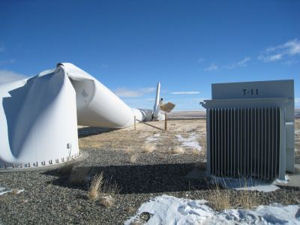
Wind turbines fall over in strong winds!!

Collapse in strong winds is one of the more amusing modes of failure for the notorious wind turbine.  Other forms such as blade throw are also hazardous.  You need to be 3000 feet away to be safe.  Yet noise, and shadow flicker require them to be kept even further away than that from habitations.  Many are being injured and some are dying.  The cost of wind power is higher than we thought.

By Miriam Raftery
April 4, 2012 (San Diego’s East County) – Today marks the “International Protest Day Against Wind Power” with 765 websites participating.
A dark side of the wind industry that many media outlets have failed to report on is the thousands of documented cases of serious accidents. These include numerous documented cases of turbines falling over, blades flying off, injuries to workers and the public, and at least 99 reported fatality accidents.
Of the deaths, 67 were wind industry and direct supporters workers or small turbine operators and 32 were public fatalities.Wind turbine fire

How many tragedies have occurred worldwide is a well-kept secret within the wind industry. In the United Kingdom alone, however, Renewables UK, an industry trade association, has admitted to 1,500 wind turbine accidents/incidents in the UK alone during the past five years, the London Telegraph reportedhttp://www.telegraph.co.uk/news/uknews/8948363/1500-accidents-and-incidents-on-UK-wind-farms.html. Those included 300 injuries and four deaths—in just one small part of the world.
A partial database of accidents , injuries and deaths through December 2011 has been compiled at the Caithness Wind Farm Information Forum:http://www.caithnesswindfarms.co.uk/page4.htm
According to the Caithness database, which estimates it represents only 9% of actual accidents (based on the RenewablesUK figures), an average of 128 accidents per year have occurred from 2007-2011, up from just 6 a year back in 1992-1996 due to the growing number of wind turbine installations.
Among the most grisly tragedies was that of John Donnelly, a worker killed in Oregon in 1989 when a lanyard that as supposed to prevent falls for turbine workers became entangled, dragging him into the spinning machinery.  According to Paul Gipe, an advocate of wind power who authored an article on fatalities, the medical examiner described Donnelly’s demise as death by “multiple amputations”, witnessed by a horrified coworker.
Another Oregon worker, Chadd Mitchell,  young father of two, was killed when a wind turbine tower he was in collapsed to the ground in Sherman County after the turbine’s rotor went into “overspeed,” the Oregonian reported on February 6, 2010. Siemens Power was fined for safety violations, and the family filed a lawsuit.
Other deaths have included electrocutions, falls, crush injuries, construction accidents, and a Minnesota man who was nearly cut in half by a chunk of ice knocked off a turbine tower in 1994. Three suicides have also been linked to turbines, including a worker who hanged himself, a parachutist, and a farmer who killed himself after neighbors protested a turbine he put on his property.
Caithness also has documented 221 separate incidences of blade failure, with pieces of blades documented to have flown over 1,300 meters—or 4,266 feet (4/5 of a mile). Blade pieces have gone through roofs and walls of nearby buildings.
At least 121 structural failures have been recorded too, including entire wind turbines that have crashed to the ground. The website www.windaction.org documents many of these. Turbines have crashed to the ground in school yards, near homes, roads and walking paths where only by sheer luck was no one underneath when the multi-ton structures collapsed. In the Palm Springs area, a turbine spinning out of control forced closure of a major highway. There are also concerns about many turbines still standing –where failures such as cracked foundations and sinkage have been observed.
Wind turbine fire, Australia, WindWatchAround 168 wind turbine fires have been documented. Some sparked brush fires and left some fire departments helpless to watch as oil in turbine components burned hundreds of feet in the air—out of reach of hoses—whirling burning debris across the landscape.
There are also many instances of ice throws hurling chunks of ice off blades—94 times in 2005 alone. Another 93 transport accidents involving turbines have been reported, including one turbine section that rammed through a house and another that knocked a utility pole through a restaurant.
Disturbingly, EnergyBiz Magazine reported in its March/April 2011 edition that “More troubling for wind fleet owners and operators is that many turbines are coming off warranty. The end of last year marked the first time in U.S. history that more wind turbines were operating out of warranty than were covered, according to Wind Systems magazine, while many more are approaching the end of their warranties. Hidden costs of maintenance have climbed sharply, though some promising technologies may help reduce those costs, Energy Biz noted.
Still the issues raise troubling questions: who will be responsible for catastrophic failures when warranties have run out? Are local boards making decisions regarding turbine placement sufficiently educated on the risks?  Farm surrounded-IllinoisHow far away from a wind turbine is a safe setback distance? Locally, some proposed industrial wind projects would place turbines within a half mile of homes, on up to three sides of the dwellings, in Ocotillo. In McCain Valley, Iberdrola’s Tule Wind proposes setbacks from roads of only 1.1 times the height of the turbine – or around 455 feet maximum.
In Kansas, Rose Bacon, a member of the Governor’s Energy Task Force, became so concerned about lack of teeth in regulations and vulnerability of inexperienced local officials in small towns facing proposals from international wind companies that she likened the scenario to the “wildcatter days in the oil business,” the McPherson Sentinel reported in 2005.
Below are some specific examples of serious incidents  documented through the above websites, where many more incidents can also be found.
A wind turbine crashed to the ground at a wind farm near The Dalles, Oregon in August 2007, killing one worker and injuring another, Associated Press reported.
  • A blade from a wind turbine at Lister Hospital in the United Kingdom flew off and hit a car just one month after becoming fully operational in September 2011, the Comet reported.
  • California Highway Patrol shut down Highway 58 for several hours to protect motorists from a runaway wind turbine in the Tehachapi area.  “The runaway wind turbine, when it deteriorates or explodes, can send scrap metal and steel up to a mile away,” CHP Officer Ed Smith said, the Tehachapi News reported.
  • A wind turbine plunged nearly 200 feet to the ground near I-10 in North Palm Springs after going into “overspeed”,  KPSP news reported on May 1, 2009.
  • An Iberdrola wind turbine caught fire on May 14, 2009 at Locust Ridge wind farm in Pennsylvania; the fire was blamed on a gear box problem.
  • A 187-ton wind turbine crashed to the ground at the Fenner wind farm in  New York after breaking off at its base. Enel shut down the entire 20-turbine wind farm in Madison, County New York in June 2010 for at least six months, the Oneida Daily Dispatch and other newspapers reported.
  • Large chunks of seven turbine blades broke off at the Allegheny Ridge Wind Farm in Pennsylvania, with pieces flying over 500 feet, the Patriot News reported in May 2007.  Spanish wind-energy company Gamesa blamed insufficient glue for the failures.
  • In Dolfor, United Kingdom, a turbine exploded and fell to the ground near walking tracks, leading the Shropshire Star to conclude In January 2012, “Turbines should be nowhere near public footpaths.”
  • At Perkins High School in Ohio, blades on a month-old turbine broke apart while spinning, sending fiberglass pieces up to 40 yards (120 feet) away in February 2009. In December 2010 a blade again detached; fortunately school was not in session.
  • A wind turbine crashed down near Western Reserve High School in Berlin Center in April 2011 in Ohio, WKBN news reported.
  • At Fakenham High School in the United Kingdom, students witnessed a 40-foot wind turbine crash onto the school’s playing field and crush a contractor’s van in December 2009, Windaction.org reported.
  • Redriven Power recalled blades after turbines therw blades onto an Ohio high school and an organic fig farm in northern California, Eastern AgriNews reported in May 2009.
  • A General Electric turbine collapsed at an Altona, New York wind farm, the Press-Republican reported, after neighbors heard explosions and the turbine caught fire.
  • In Norway, a blade from a Suez Energy North American V-90 wind turbine was hurled about 1,600 feet, landing near a home’s back door, the Journal Pioneer reported in December 2008.
  • A turbine blade crashed through the roof of a neighbor’s home in Wallaceburg, Canada, the Chatham Daily News reported in February 2009.
  • In November 2009, the Press & Journal reported that a wind turbine collapsed at Rasssay Primary School, forcing children to be sent home after it landed in their playground.
  • A damaged transformer leaked 491 gallons of mineral oil in 2007 at the Maple Ridge Wind Farm’s substation in New York; in 2009 a transformer at the same site was destroyed by fire, the Watertown Daily News reported.
  • A turbine near a highway twice lost blades, the Huron Daily Tribune reported in December 2010.
  • Offshore wind farms in the North Sea are in danger of tumbling down, Wind Energy Update reported on March 18, 2011, noting that dissolved grout had shifted turbines within their foundations at around 600 of Europe’s 948 offshore turbines.
  • Renewables UK has warned that hundreds of offshore wind turbines could be suffering from a design that makes them sink into the sea, the Times Online reported on April 13, 2010.
  • Two men were injured while constructing a wind turbine tower in Rochester, Minnesota, the Post-Bulletin reported on January 14, 2011.
  • Proven Energy told owners of over 600 smaller turbines to shut them down due to fears of catstrophic mechanical failure, the Press and Journal reported in September 2011; the manufacturer suspended sales.
  • Five U.S. wind projects owned by Australia’s Infigen Energy have been engaged in legal actions with turbine manufacturer Gamesa over repair costs and lost production due to various warranty-related disputes, Recharge News reported in December 2011. The largest of those cases involves the Kumeyaay Wind Farm in Campo, where all 75 turbine blades had to be replaced due to storm damage at a cost of over $34.5 million.  Kumeyaay has “vigorously” contested a Gemsa claim and was pursuing warranty-related claims of $10 million against Gamesa, the story added. [Note: This project is listed by Pattern Energy as a “success” story in its application to the California Public Utility Commission for the Ocotillo Wind Express project)
  • Texas state representative Susan King had a wind turbine on her ranch that caught fire and burned two acres. She described it “throwing fire balls on my property”; KTXS found that despite pledges by Next Era Energy t o support volunteer fire departments, no funds had been provided in the past four years.
  • In Hokkaido, Japan, firefighters found hoses were too short to extinguish a fire in a 66-meter-high wind turbine, which took four hours to burn itself out.
  • Huge blades from three turbines in Huddersfield, England “were blown across a busy road and could have hurt wildlife or caused damage to property as well as endangering life,” theLondon Telegraph reported in January 2012.  Gale force winds were blamed.
  • In Western Illinois in 2008, a 6.5 ton blade sailed about 150 feet away, the Associated Press reported.
  • One month earlier, a 330 foot turbine “burst into flame in Ayrshire” during a 165-mph storm on the Scottish border and crashed to the ground near a road, the Telegraph reported.Oil stains, Campo-Andy Degroot
  • A Sheffield, Vermont wind turbine spilled 55-60 gallons of gear oil, spraying it out 200 yards; each turbine generator holds about 110 gallons of hydraulic and lubricating oils, the Burlington Free Press reported.
  • An Abilene, Texas wind turbine erupted into flames and spread to grass around the tower, KTXS News reported on August 26, 2011. The turbine was owned by NextEra Energy.
  • Iberdrola, the Spanish wind energy producer, blamed falling Suzlon Energy turbine blades on a one-tie accident, the Bloomberg News in North Dakota reported in May 18, 2011, suspending operations at its wind farm in North Rugby, North Dakota. The same model, however, suffered cracked blades starting in 2007, prompting a $100 million global retrofit.
  • Three blades came off a turbine at a residence and farm in Forked River, New Jersey, causing the state to shut down its entire onshore wind turbine program in March 25, 2011, the NJ Spotlight reported.
  • A lightning fire at a wind turbine in Peterson, Iowa in August 2010 was  the “third or fourth” turbine fire that the Peterson Fire Department had put out in a dozen years, the Sioux Cit Journal reported.
  • In White Deer Texas, News Channel 10 reported oil seeping down the sides of multiple turbines.
  • In Iga Mie Prefecture, Japan, the Asahi Shimbun reported in January 2008, “malfunctions and accidents involving wind turbines have occurred repeatedly across the country, leading to suspended services and even the scrapping of one facility…Slipshod surveys of wind, flawed designs or sheer incompetence have dealt a blow to the reputatin of wind turbines…”
  • Hundreds of motorists near Sunderland in the UK witnessed a turbine fire that caused rotor blades to break off; two more turbines by Vestas later fell over in high winds in Scotland, the JournalLive reported in 2008.
  • Clipper Windpower had to spend $300 million to fix faulty blades after cracks appeared at multiple facilities, Enviornmental Finance reported in May 2009.
  • A $6 million wind turbine caught fire at the Cathedral Rocks Wind Farm, starting blazes on the ground from falling embers the Adelaide Now newspaper covering Australia/New Zealand reported in February 2009.
  • In Florida, the Desert Valley Star reported in January 2009 that FPL/NER operates 60 wind turbines—and reportedly 40% were “malfunctioning, in disrepair, or need maintenance.”
  • Windtech International reported that a survey of 75 wind farm operators in the U.S. in 2008 found that 60% of turbines may be behind in critical maintenance due largely to a shortage of qualified turbine technicians.
While there are certainly many wind turbines that have never malfunctioned, the dangers cited above are real and have led many municipalities to adopt setback requirements from homes, roads, campgrounds, walkways, playgrounds and any inhabited buildings.
The wind industry has resisted setbacks, however. In Wind Energy Comes of Age, published in 1995, wind energy advocate Paul Gipe contends that setbacks of 500-1000 feet from residences are “more than adequate to protect public safety” and notes that in Europe, windmills have often been installed in places frequented by the public. Gipe insists that despite many accidents, the odds of being injured by a wind turbine remain less than that chance of being struck by lightning.
Setback distances vary widely. Some California communities use a multiple of size, such as three times the height of the turbine. Other areas have larger setback requirements. For instance, in Victoria Precinct, Australia, the government has adopted a 2 meter (1.24 mile) setback requirement for wind turbines to protect residents from risks of mechanical collapses.
In Brown County, Wisconsin, the Board of Health in January passed a resolution seeking emergency financial aid for residents near wind turbines who suffered serious health impacts including some families who abandoned their homes due to health concerns.
The Board called for adoption of the Wisconsin Citizens Safe Wind Siting Guidelines which would require setbacks of at least 2,640 feet from property lines, with further restrictions on shadow flicker, noise and other factors. Developers would also be required to submit a report with blade and debris throw calculations to protect public safety.

http://eastcountymagazine.org/node/9238

Germany has Realized That Wind and Solar Are Not A Viable Solution!—Shale Gas is!

SHALE’S GLOBAL TOUR – Germany May Finally Be Ready to Frack

Berlin is preparing a new set of rules that will permit—with restrictions—the controversial hydraulic fracturing drilling technique. Fracking, as it’s more commonly called, allows drillers to profitably tap previously inaccessible reserves of oil and gas trapped in shale rock. Germany had imposed a de facto moratorium on fracking over the past two years, citing environmental concerns and pending new regulations, but it looks like Merkel’s coalition government is ready to get the shale ball rolling this summer. The FT reports:

Applications to carry out the controversial process for extracting the country’s estimated 2.3tn cubic metres shale gas reserves will be subject to an environmental impact assessment under new legislation to be discussed by the cabinet before the summer recess. […]

Details of the new regulations emerged in a letter from Sigmar Gabriel, German economy minister, to the head of the Bundestag’s budget committee. In the letter, Mr Gabriel wrote that permission to carry out fracking would be subject to approval from regional water authorities and that “further requirements for the fracking permit process are still being considered”.

Germany isn’t flush with gas by any means, but Russia’s meddling in Ukraine has made it clear to Berlin that it needs to exploit more of its domestic resources. Add to that the fact that German consumers already pay some of Europe’s highest electricity prices (as a result of the country’s ill-conceived Energiewende)and this decision makes even more sense.

Like every other country that has tried to replicate America’s success, Germany will still have to clear a number of hurdles as it races to catch up to the shale bandwagon. But fracking could help Berlin lower it’s dependence on the much browner coal, and in so doing become the green energy solution the country has been searching for.

Published on June 4, 2014 5:09 pm

Please Support “the Original Charter Challenge!”

United We Stand!!

Support The Original Charter Challenge legal case defending people’s rights not to be subjected to the untested effects of living too close to industrial wind turbines.

Mission

We are residents of rural Ontario who have tried our best for years to show our provincial government that living too close to industrial size wind turbines can make people sick and ruin the enjoyment of their family home.

All efforts have fallen on deaf ears as small independent groups were forced to raise money, hire lawyers and sound emission experts, all in an effort to oppose local wind projects at unwinnable environmental hearings.

The time has come to take the government policy to real court.

The Ministry of the Environment has played judge and jury with rural Ontarians’ lives for too long trapping those harmed in a circle of suffering with no remedy at law. It’s Ontario’s dirty secret and meets all criterion for social injustice.

All across Ontario there is a pent up anger as small groups watch their best efforts ignored. It’s time to fight as a big team with the right legal case that has the best shot at making a difference in real court. That’s The Original Charter of Rights case due in court within the next few months.

Sun Media showed us the untapped power we have raising $30,000 from us in 3 days for Downwind their hard hitting documentary going public June 4/14.

Let’s put fear into the eyes of the wind industry and our government by standing together and donating as one big team. Imagine what we could do in 60 days building on the momentum created by Sun Media who will support and help us reach our $300,000 goal! All other media outlets have ignored our pleas of help.

All our goal money donated will go to The Original Charter Challenge legal fund ensuring this case can be taken by Canada’s top human rights lawyer to the Supreme Court if needed.

United we stand. Don’t let the wind industry divide us.

A made in Ontario legal wedge driven into the wind scam will have ripple effects felt around the world.
Urban and rural Ontarians let’s lead this uprising!

Let’s show the world how a mad as hell unified crowd can raise funds to defend their charter rights in court where any win is a win for all.

We have all worked hard and raised money for our hometown projects and we’ve learned a lot about the David and Goliath struggle we are in.

Now it’s time to put our strength in numbers into action with the help of our partner Sun Media who will promote our fundraising efforts because we rose up and helped them and they believe in our cause.

Even if you can’t contribute we all can make noise, get our own copies of the documentary on disk to show our friends and get the word out.

The Original Charter Challenge fund raising campaign is being kick started by the release of Sun Media’s Downwind documentary on June 4, 2014.