Wind Pushers Losing Popularity!

Wind Industry Still Wailing About ‘Uncertainty’ as Construction Finance ‘Drought’ Hits

banshee

Wind power outfits have now cottoned on to the fact (slow learners that they are) that Australia’s big power retailers have turned their backs on the wind to face the Sun, instead.

The former second-hand car salesmen that front the wind industry are still coming to grips with the recalcitrance of commercial retailers (we don’t count the ACT Government) who continue to refuse entering Power Purchase Agreements with wind power outfits (holding that stance since November 2012).

The big operators have absolutely no interest in wind power; and every interest in killing off the Large-Scale RET that created, and for the time being sustains, the wind industry.

As pointed out previously, the retailers’ switch to large-scale solar is a canny, but fleeting move – designed to avoid the shortfall penalty for the few years it takes for the LRET to collapse; as the political and economic toxicity of the policy escalates over the next year or two.

It is, after all, a pointless $3 billion a year power tax that runs until 2031 – for no other reason than to subsidise the production of insanely expensive and wholly unreliable wind power; at a time when Australia’s grid is swamped with oodles of the reliable, secure and affordable stuff.

Without PPAs with retailers, wind power outfits haven’t a hope in hell of obtaining bank finance to build any new wind farm capacity, as this ‘sackcloth and ashes’ piece from the SMH confirms.

Yass Valley Wind Farm recommended for approval, but retailer’s strike persists
Sydney Morning Herald
Lucy Cormack
4 February 2016

Financiers are yet to gain confidence that the legislative underpinning for renewable energy projects is going to be stable.

The state government has recommended approval for what could be one of Australia’s biggest wind farms, but continued uncertainty in the renewables sector may see the project added to the 6000 megawatt-strong “pile of wind farms” currently approved, but stalled, industry figures say.

The recommendation for approval of the Epuron Yass Valley Wind Farm by the NSW Department of Planning and Environment clears the way for the Planning and Assessment Commission to make its final decision on the wind farm.

While industry figures say the news is positive, it does not mean the wind farm will be built.

“This approval just adds to the 6000-megawatt pile of wind farms currently stalled:” Ric Brazzale, managing director …

“This approval just adds to the 6000-megawatt pile of wind farms currently stalled:” Ric Brazzale, managing director Green Energy Trading said of the Yass Valley Wind Farm.

“We’ve lost count of these announcements,” said Ric Brazzale, managing director of Green Energy Trading.

“It’s an important part of the process, but this approval just adds to the 6000-megawatt pile of wind farms currently stalled.”

The battle for new projects is obtaining finance and power purchase agreements: contracts with energy companies to sell electricity and large-scale generation certificates (LGCs).

Large-scale generation certificates are used by Renewable Energy Target-liable entities to meet compliance obligations based on the volume of electricity they purchase each year.

Mr Brazzale said the difficulty in sealing power purchase agreements is tied to the long-embattled context of renewable energy in Australia.

“They can’t raise finance because banks and financiers don’t want to go anywhere near these contracts unless they are contracted with energy retailers,” he said.

“So, why don’t financiers do it? The reason is, they are yet to gain confidence that the legislative underpinning is going to be stable,” he said. “We’ve heard from Greg Hunt and that helps, but if you want retailers and financiers to change, you need the Prime Minister to come out and say unequivocally, ‘We are not going to reduce the target.’”

Solar Council chief executive John Grimes agreed that any “drought” in renewables investment will only be reversed with increased positive sentiment from the government.

“Large scale projects are all built on policy, stability and confidence, but the entire renewable energy market has been massively disrupted by the federal government’s review and slashing of the Renewable Energy Target.”

Mr Grimes’ concern is that, despite having a new Prime Minister, “nothing has changed”.

“No moves have been made by the federal government to ensure that certainty and policy stability is returned to the sector,” he said. “It’s a double-edged sword. If power companies don’t build projects they will be slugged with a charge equivalent, which has a real post-tax value of $93 per large-scale generation certificate.”

Mr Grimes said liable entities are using that fact to go back to the government and say they cannot build the projects to meet the target in the time permitted.

“Their argument will be, if the federal government doesn’t slash the Renewable Energy Target again, then that price will be passed through to consumers and everyone will be paying for capacity that was never built,” he said.

At its proposed capacity of 124 turbines, the Yass Valley Wind Farm would have the capacity to power more than 130,000 homes each year, however the government’s recommendation suggests a significant reduction in the project’s scale, down to 79 turbines.

Epuron executive director Martin Poole said despite the recommended reduction “attitudes everywhere have improved” towards wind energy, since Prime Minister Malcolm Turnbull took the leadership.

“It is important that NSW demonstrates its commitment to maximising the local jobs and expertise that flow from the transition to a cleaner electricity sector.”

Mr Brazzale estimates that processes contracting for large-scale generation certificates in the ACT, Western Australia, South Australia and Victoria suggest “there are probably more than 1000 megawatts of projects that could be committed over the next year or so.”

Despite being enough to power around 430,000 homes annually, Mr Brazzale said that figure is nowhere near enough to meet the large-scale renewable energy target by 2018.

“We need four times that level to ensure we meet the 2018 target, which obviously we’re not going to achieve. That’s why the LGC price is high, because it’s reflecting that the market is not going to meet the target.”
Sydney Morning Herald

The usual fawning starry-eyed ‘analysis’ from Fairfax there – with bunkum about a pie-in-the-sky wind farm one day “powering more than 130,000 homes”. Unless those households are prepared to sit freezing or boiling in the dark around 70% of the time, they will, in fact, be ‘powered’ by coal, gas and hydro (in that order).

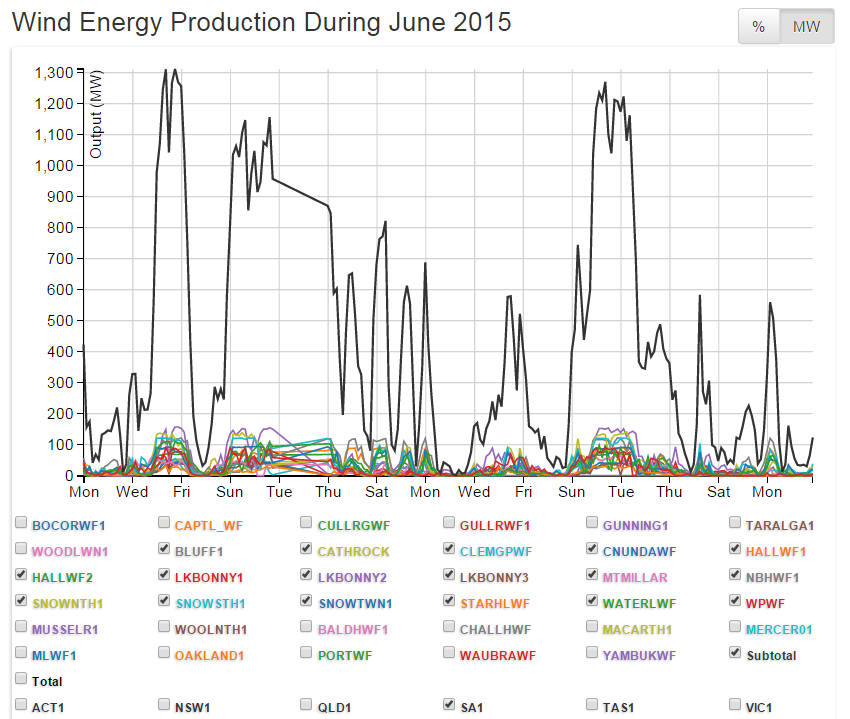
That journalists are still pushing that kind of wind industry propaganda in 2016 is not just dumb, it’s lazy. A quick glance at Aneroid Energy debunks that myth. Here’s SA’s 17 wind farms (notional capacity of 1,477MW) ‘powering’ not so much as a kettle on 3 May 2015:

3 May 2015 SA

The other line that escapes any sensible criticism from Fairfax is what John Grimes says about the looming and massive cost of the LRET

“It’s a double-edged sword. If power companies don’t build projects they will be slugged with a charge equivalent, which has a real post-tax value of $93 per large-scale generation certificate.” …

“Their argument will be, if the federal government doesn’t slash the Renewable Energy Target again, then that price will be passed through to consumers and everyone will be paying for capacity that was never built,”

The cost of the LRET to power consumers will actually be lower if further wind power capacity is NOT built, than if it is. Retailers will get hit with the shortfall penalty (what Grimes calls ‘a charge equivalent’) and the cost of the REC – from here, the combined cost of which will exceed $3 billion a year, all recovered as a Federal Tax on all power consumers:

What Kills the Australian Wind Industry: A $45 Billion Federal Power Tax

What Grimes leaves out, of course, is that the wind power capacity that Epuron, Infigen & Co are so desperate to build (in order to keep their Ponzi scheme from collapsing, as it has with Pacific Hydro) – will cost at least a further $80-100 billion, in terms of extra turbines and the duplicated network costs needed to hook them up to the grid: all requiring fat returns to investors; costs and returns that can only be recouped through escalating power bills:

Ian Macfarlane, Greg Hunt & Australia’s Wind Power Debacle: is it Dumb and Dumber 2, or Liar Liar?

In the post above we looked at the additional costs of building the wind power capacity needed to avoid the shortfall penalty – including the $30 billion or so needed to build a duplicated transmission grid.

That is, a network largely, if not exclusively, devoted to sending wind power output from remote, rural locations to urban population centres (where the demand is) that will only ever carry meaningful output 30-35% of the time, at best. The balance of the time, networks devoted to carrying wind power will carry nothing – for lengthy periods there will be no return on the capital cost – the lines will simply lay idle until the wind picks up.

The fact that there is no grid capacity available to take wind power from remote locations was pointed to by GE boss, Peter Cowling in this article, as one of the key reasons that there will be no new wind farms built in Australia (see our post here).

But let’s return to wailing about the requirement for policy ‘certainty’. What that wailing is really about, is a plea for the Federal government (read ‘taxpayer and power consumer’) to underwrite a politically toxic policy, that has already been slashed from an ultimate annual target of 41,000GWh to 33,000GWh, for precisely that reason.

In 2015, faced with the fact that the target could never be met, both Labor and the Coalition were forced to cut the target before the shortfall penalty inevitably took effect. But that was simply to stall the LRET’s ultimate collapse: the same factors Epuron moan about above are still in play. There will be no increase in wind power capacity; the shortfall penalty will apply; and the Federal government will be forced to cut the target, once again.

It’s the fact it was cut once that has bankers and retailers refusing to lend or sign PPAs. And, as with any ‘business’ that relies for its very existence on a piece of policy, what the government once did, can be just as easily undone – in full.

What kills the LRET – and the wind industry with it – is the same set of forces that led to the demise of the Australian wool industry. The lessons and parallels drawn from the implosion of its Federally mandated subsidy scheme during the 1990s – all but killing the industry and costing growers and taxpayers tens of billions of dollars – are worth repeating.

The wool industry’s “cause of death” was the Federally backed Reserve Price Support scheme (RPS), which set a guaranteed minimum price for all Australian wool.

A little background on the RPS

For over 150 years, Australia happily rode on the sheep’s back: until the 1970s the wool industry was, for the Australian economy, the “goose that laid the golden egg”; textile manufacturers from all over the world clamoured for the fibre; which was, for most of that time, the largest single commodity export by value; Australia produces over 80% of the world’s apparel wool. However, as fashions changed (the three-piece wool suit became, well, so “yesterday”) and new synthetics began to eat into its market share, the dominance of Australian apparel wool was no longer a certainty.

Against the backdrop of increasing competition, for the wool industry there was always the perennial issue, not only of fluctuating demand, but also of wildly fluctuating swings in production. Dorothea McKellar’s land of “droughts and flooding rains” meant that a few years of meagre production (and favourable, and even phenomenal, wool prices) would be soon eclipsed by sheds and wool stores overflowing with fibre ready for market (sending prices and woolgrower profits plummeting).

The response to these (often climate driven) marketing “swings and roundabouts”, was the establishment of the Australian Wool Corporation (AWC) and the RPS in 1973.

The RPS would set a minimum price for all types of wool, guaranteeing woolgrowers a minimum return; such that if supply exceeded demand, the AWC would purchase any wool being offered, if it failed to reach the minimum price set (referred to as the “floor price”).

Wool being offered at auction that failed to meet the floor price was purchased by the AWC and “stockpiled” (ie stored), until such time as either supply fell or demand conditions improved; at which point the AWC would offer stockpiled wool to the trade. The aim being the smooth and more orderly marketing of wool over the supply and demand cycle; with higher average returns to growers; and less risk for buyers and sellers along the way.

The scheme worked swimmingly (as designed and intended) until the late 1980s.

The reserve price set under the RPS was fixed in Australian dollar terms. However, with the float of the Australian dollar in 1983 (resulting in a massive 40% depreciation of the dollar between February 1985 and August 1986), maintaining the reserve price without reference to the terms of trade and fluctuations in trading currencies (particularly the US dollar) set the scheme up for a spectacular failure; simply because what goes down can just as easily go up.

During the 1980s, there was a solid increase in demand for wool, driven by demand from the USSR, a then fast growing Japan, buoyant Europeans, and a newly emergent China, as a textile manufacturer and consumer. However, that surge in demand occurred in the context of an Australian dollar trading in a range around US$0.55-75.

During the 1980s, under pressure from wool grower lobby groups, the floor price was continually increased: from 1986 to July 1988 the floor price jumped 71% to 870 cents per kilogram.

That did not, in itself, create any problems: a general surge in demand, relatively low production and a plummeting Australian dollar generated auction room sale prices well above the rising floor price, which reached their zenith in April 1988: the market indicator peaked at 1269 cents per kg, and the market continued its bull run for most of that year, well above the 870 floor price set in July.

However, as international economic conditions worsened, Australian interest rates soared (the consequence of Paul Keating’s “recession that we had to have”) and the value of the Australian dollar with it (hitting US$0.80 by early 1990), the market indicator headed south and, over the next few years, the AWC was forced to purchase over 80% of the Australian wool clip at the 870 cent per kg floor price. Adding to the AWC’s difficulties was a massive surge in production; driven by growers responding to the high and “guaranteed” floor price; and a run of exceptional growing seasons (1989 being a standout across Australia). Production went from 727 million kg in 1983/84 to over 1 billion kg in 1990/91.

Despite worsening market conditions, the AWC, under pressure from wool grower lobby groups, was forced to maintain the 870 cent per kilogram floor price.

However, from around August 1989, international wool buyers simply sat on their hands in auction sale rooms (in May 1990 the AWC bought 87.5% of the offering); and waited for the RPS to implode.

Knowing that the system was unsustainable, the last thing that buyers wanted was to be caught with wool purchased at prices above the floor price which, when the floor price was cut or collapsed, would immediately be worth less than what they had paid for it. Moreover, traders were dumping stock as fast as they could to avoid the risk of a collapse in the RPS and, therefore, a collapse in the price of any wool they happened to hold.

The RPS was ultimately backed by the Federal government. With the buying trade sitting on their hands, those responsible for maintaining the floor price ended up in a staring competition, the only question was, who would blink first: the AWC (or, rather, the government underwriting the RPS); or the buyers?

With the AWC purchasing millions of bales of wool at the floor price the cost of supporting the RPS was running into the billions of dollars: primarily the support came from a grower levy on sales, but, at the point which that soon became insufficient to support the RPS (despite upping the levy from 8% to 25%), support came from $billions in mounting government debt; the buyers had no reason to blink.

Instead, in May 1990, the government announced its decision to retreat to a new floor price of 700 cents per kilogram, and directed the AWC to fight on in support of the reduced floor price. The Minister for Primary Industry, John Kerin boldly asserting that the 700 cent floor price was “immutable, the floor price will not be reduced”.

But, having blinked once, the buyers largely continued to sit on their hands and simply waited for the government to blink again. The stockpile continued to balloon; and with it government debt: by February 1991 the stockpile reached 4.77 million bales (equivalent to a full year’s production); the accrued government debt stood at $2.8 billion; and the cost of storing the stockpile was over $1 million a day.

Faced with the inevitable, the government blinked, again: John Kerin was forced to eat his words about the floor price being “immutable”; on 11 February 1991, announcing the suspension of the floor price. The RPS had totally collapsed; the buyers had won.

The wool industry’s saga is beautifully, if tragically, told by Charles Massy in “Breaking the Sheep’s Back” (2011, UQP), which should be required reading for any of our political betters pretending to know more than the market (eg, the power market).

Which brings us to the lessons and parallels.

The LRET effectively sets the price for RECs: the minimum price is meant to be set by the shortfall charge of $65 per MWh (rising to $93 when account is given to the tax benefit), as the penalty begins to apply on the shortfall (as detailed above). That equation is based on an ultimate 33,000 GWh target.

In the event that the cost of the shortfall charge was reduced, there would be a commensurate fall in the REC price. Likewise, if the LRET target was further reduced: the total number of MWhs which would then attract the shortfall charge if RECs were not purchased would fall too; also resulting in a fall in the REC price.

In addition, any reduction in the LRET would simply result in a reduction in the demand for RECs overall: fewer RECs would need to be purchased and surrendered during the life of the LRET; again, resulting in a fall in the REC price. Of course, were the LRET to be scrapped in its entirety, RECs would become utterly worthless.

The retailers, are alive to all of this, hence their reluctance to enter PPAs for the purpose of purchasing RECs; agreements which run for a minimum of 15 years.

In December 2014, Ian “Macca” Macfarlane and his youthful ward, Greg Hunt started running around pushing for a target of 27,000 GWh; and their boss, Tony Abbott made clear that he wanted to kill it outright. There followed overtures from the Labor opposition pitching for a target around 35,000 GWh.

Whether they knew it or not – with their public debate on what an amended target should be – in the staring competition with retailers – these boys blinked.

Faced with the inevitable political furore that will erupt when power consumers (ie, voters) realise they are being whacked with the full cost (and some) of the shortfall charge (being nothing more than a “stealth tax” to be recovered by retailers via their power bills), the pressure will mount on both sides of politics to slash the LRET – once again.

That both Labor and the Coalition have already blinked (in obvious recognition of the brewing political storm in power punter land over the inevitable imposition of the shortfall charge) is not lost on the likes of Grant King from Origin, and all of Australia’s other electricity retailers.

And for retail power buyers the choice of sticking with permanent recalcitrance has been made even easier: with the previous PM Tony Abbot making it plain that he would have cut the LRET even harder, were it not for a hostile Senate; and Labor’s Bill Shorten pushing for an entirely ludicrous 50% LRET – that would require a further 10,000 of these things to be speared all over Australia’s rural heartland. Where there was once ‘bipartisan’ support for these things, the major parties are diametrically opposed.

Grant King

****

With the politics of the LRET already on the nose, like wool buyers sitting on their hands in sale rooms during 1990, waiting for the floor price to collapse, electricity retailers need only sit back and wait for the whole LRET scheme to implode.

Like wool buyers refusing to buy above the floor price and carry stock with the risk of the RPS collapsing, why would electricity retailers sign up for 15 year long PPAs with wind power outfits in order to purchase a stream of RECs over that period, knowing the value of those certificates depends entirely upon a scheme which is both economically and politically unsustainable?

However, the similarities between the wool market and the market for wind power end right about there.

There is, and always was, a natural market for Australian wool; the only issue during the late 80s and early 90s was the price that had to be paid by buyers to beat the floor price, set artificially under the RPS.

Wind power has no such market.

Available only in fits and spurts, and at crazy, random intervals, at a price which is 3-4 times that of conventional generation, retailers have no incentive to purchase it.

In the absence of the threat of the $65 per MWh fine (the stick), coupled with the promise of pocketing $93 as a subsidy in the form of a REC (the carrot), electricity retailers would not touch wind power with a barge pole: it simply has no commercial value.

Moreover, with an abundance of conventional generation capacity in Australia at present, retailers are very much in a “buyers’ market”.

Overcapacity, coupled with shrinking demand (thanks to policies like the LRET that are killing mineral processors, manufacturing and industry) means that retailers can expect to see wholesale prices decline over the next few years, at least. And, for the first time in almost 20 years, a sharply declining Australian economy is a fast looming reality: unemployed households have an even tougher time paying rocketing power bills.

With those fundamentals in mind, electricity retailers will simply opt to pay the shortfall charge and recover it from power consumers, knowing that that situation will not last for very long.

Sooner or later, the Federal government (whichever side is in power) will have to face an electorate furious at the fact that their power bills have gone through the roof, as a result of a policy that achieved absolutely nothing.

Current PM, Malcolm Turnbull might mouth platitudes about ‘renewables’ and ‘innovation’, but his chances of leading the Coalition to a second term in power are tied to fundamental ‘mum and dad’ policies like electricity costs.

Power prices matter; and in a battle between Australia’s Big 3 Retailers and the LRET, STT’s money is firmly on commercial self-interest.

STT hears that the big retailers plan to exhaust the pile of RECs that they’re sitting on at present, while building a few large-scale solar power facilities, in order to obtain the RECs needed to avoid the shortfall charge; and to wait for the politics to turn gangrenous. As soon as the LRET gets scrapped, the plan is to sell the panels back into the residential roof-top market.

The cost of the LRET – and all that comes with it – to retail customers is at the heart of what’s driving retailers’ efforts to crush the LRET; and the wind industry with it.

This might sound obvious, if not a little silly: electricity retailers are NOT in the business of NOT selling power.

Adding a $45 billion electricity tax to retail power bills can only make power even less affordable to tens of thousands of households and struggling businesses, indeed whole industries, meaning fewer and fewer customers for retailers like Origin, AGL and EnergyAustralia.

The strategy adopted by retailers of refusing to ‘play ball’ by signing up for PPAs will, ultimately, kill the LRET; it’s a strategy aimed at being able to sell more power, at affordable prices, to more households and businesses.

And it’s working a treat, so far.

The wind industry’s incessant daily whining about “uncertainty”, is simply a signal that the retailers have already won. Once upon a time, the wind industry and its parasites used to cling to the idea that the RET “has bi-partisan support“, as a self-comforting mantra: but not anymore. And it’s the retailers’ refusal to sign PPAs that’s thrown the spanner in the wind industry’s works.

While the likes of Epuron and Infigen will continue to work themselves into a lather about their inevitable fate, in the meantime, retailers, like Origin, AGL and EnergyAustralia, can simply sit back, watch the political fireworks, and wait for the inevitable and complete collapse of the LRET; and, with it, the Australian wind industry.

In this ‘drought’ only the retailers have the capacity to survive.

drought-2004

Finally….The Truth is Catching Up with the Wind Industry…

Wind Industry Loses Support of Lunatic Fringe: Green-Left Blog ‘New Matilda’ Turns Against the Wind Power Fraud

turbine-collapse-germany1

****

When the following piece crossed STT’s inbox, the editor thought it to be some kind of April fool’s joke, delivered a few months early.

But, no. Knock us down with a feather, the article that follows did, in fact, appear on ‘New Matilda’ – a politically correct, hard-‘green’-left bastion for all things cuddly and fuzzy (mostly its logic) – and, until now, a safe-haven for the dwindling wind-worship-cult.

But, not any more. The article was penned by Geoff Russell – who would blend in perfectly with the mung bean and tofu crowd, as his PC, CV attests:

Geoff Russell qualified in mathematics and has written software all of his working life. But in the past decade has devoted increasing time to writing non-fiction with a simple goal … make the world a better place. A three decade vegan and member of the Animal Justice Party, his first book in 2009 was “CSIRO Perfidy” a critique of the high-red-meat CSIRO “Total Wellbeing diet”; the most environmentally destructive diet on the planet. His concerns about climate change and the ineffectiveness of renewables led to a reexamination of his lifelong opposition to nuclear power. After considerable research he realised that the reasons people fear nuclear are built on obsolete knowledge about DNA and cancer. His second book “GreenJacked! Derailing environmental action on climate change” is an e-book available on Amazon. He has been a regular contributor to BraveNewClimate.com since 2008 and has had pieces published in “The Monthly”, “Australasian Science” and a number of Australian newspapers.

Now, pinch yourself and enjoy what must have had New Matilda regulars choking on their organic Pinot Gris. Oh, and to help Geoff get his point across we’ve added a few pics, courtesy of the boys over at Aneroid Energy.

Capacity Factors And Coffee Shops: A Beginner’s Guide To Understanding The Challenges Facing Wind Farms
New Matilda
Geoff Russell
13 January 2016

It’s still ‘all about the baseload’, writes Geoff Russell, in this simple guide to understanding the limitations of energy sources like wind farms.

Renewable-only advocates claim that we can build a reliable, clean electricity system using mostly unreliable sources; like wind and solar power. And of course we can; the theory is simple, just build enough of them.

Coffee shops operate rather like our current electricity system; there are a few permanent staff who are analogous to what are called baseloadpower stations. Additional staff are hired to cover the busy period(s) and correspond typically to gas fired generators.

The renewable alternative is like running a coffee shop with a crew of footloose narcoleptics who arrive if and when they feel like it and who can nod off with little notice. Would this work? Of course; just hire enough of them.

Any criticisms of renewable plans is typically subjected to execution by slogan: That’s soooo last millennium; baseload is a myth!

I’ve used something like this coffee shop analogy elsewhere, but it doesn’t capture other critical features of electricity sources … let’s begin with the capacity factor.

Capacity factor

When someone talks about a “100 megawatt” wind farm, this refers to its maximum power output when the wind is blowing hard. Energy is powermultiplied by time, so if it’s windy for 24 hours you’ll get 24 x 100 = 2400 megawatt-hours (MWh) of electrical energy. But actual output over the course of a year is obviously only a percentage of the maximum possible and that percentage is measured and called the capacity factor; typically about 33 percent for wind.

A rooftop solar system is also labelled according to its maximum output and also has a capacity factor… averaging 14 percent in Australia but only 9 or 10 percent in the UK or Germany.

Nuclear plants also have capacity factors because they usually need to be taken off line every year or two for refuelling. Typical percentages are 90 in the US and 96 in South Korea.

You can’t compare electricity sources without understanding capacity factors. Since the capacity factor of a nuclear plant is about 90 percent and that of rooftop solar is about 14 percent and because 90/14 = 6.429, then you’d need to install 9,000 megawatts worth of solar panels to match the amount of electricity you’d get from a 1400 megawatt South Korean APR1400 nuclear reactor over a year (6.429 x 1400 = 9,000).

Which is more than double the 4041 megawatts installed in Australia between 2007 and the end of 2014.

Matching supply and demand

But 9,000 megawatts of solar panels is still very different to 1,400 megawatts of nuclear, even if both produce the same amount of electricity annually. With 9,000 megawatts of PV panels, you don’t control the output and on any day it will range from nothing at night through to 9,000 megawatts if it’s hot, cloudless and the right time of day.

In contrast, 1,400 megawatts of nuclear power can be adjusted to match demand; turn it down, turn it up.

Below is a picture of the output of some German nuclear plants. Note that the output of one plant, KKI 1 (Isar), is pretty constant. That plant began operation in 1979, which is about the vintage of the seemingly immortal but obviously false anti-nuclear claim that nuclear plants can’t follow load; see Margaret Beavis’s recent NM article for a 2015 misstatement.

Brokdorf, on the other hand, is a little newer and has been operating since 1986 and has no trouble ramping up and down. Not only can most nuclear plants load-follow (this is the technical term), it’s increasingly necessary in Germany because of the growth of wind and solar; it’s a thankless task but somebody has to do it!

Nuclear-load-follow-graph

Now you understand why it’s silly to do what non-technical journalists like Bernard Keane have done, and compare costs per kilowatt of solar with those of nuclear without understanding the capacity factor; let alone grid costs or load-following.

But the capacity factor is also important for another deeper reason and it will take us back to that coffee shop.

First, imagine a small city with a constant electrical demand of 1,000 megawatts and a wind farm supplying, on average, 333 megawatts. Assume the rest is supplied by gas. Given the capacity factor of wind, we can infer that the peak output of that wind farm is about 1,000 megawatts.

What happens to excess electricity?

Now consider what happens if you triple the size of your wind farm.

Since you now have (a maximum of) 3,000 megawatts of wind power, you’ll be averaging 0.33 x 3,000 x 24 megawatt-hours (of energy) per day; which is 100 percent of demand; excellent.

But what happens when it’s really windy? The output is then triple the demand; so, without storage, that electricity gets dumped.

Dumping electricity on your neighbours isn’t a nice thing to do if they don’t need it at the time.

Wind farms, like any low capacity factor unreliable electricity source, are fine when they are a small contributor to a large grid, but not so fine when their surges are large relative to the demand on the grid; then they become a veritable bull in a china shop.

June 2015 National

[total output from all wind farms connected to the Eastern Grid, June 2015]

How does this look in coffee shop terms? If you run your coffee shop with a large bunch of narcoleptic staff, then some of the time they’ll all be awake and rearing to go, but there’ll be few customers and your staff will be twiddling their thumbs at best and getting in each others way at worst.

But perhaps the analogy is broken? Instead of a single wind farm, we could have multiple farms spread over a huge area and interconnected so that the wind must surely even out; never blowing hard (nor totally calm) at all sites. Certainly this sounds plausible… but what actually happens?

John Morgan looked at the Australian data on wind power in an article a couple of months ago on bravenewclimate.com.

In the 12 months to September 2015, Australia had 3,753 megawatts of wind power across the National Electricity Market (which excludes WA which isn’t connected) and the daily average output ranged from 2.7 percent (101 megawatts for 24 hours) to 86 percent (3,227 megawatts for 24 hours).

This isn’t so different from what would happen with a single 3,753 megawatt wind farm. So despite expectations, there were times when it was pretty windy almost everywhere and other times, including runs of multiple days, when it was pretty damn still almost everywhere.

The overall capacity factor was measured at 29 percent. So despite expectations, many wind farms, even in a big country like Australia, aren’t that much different to one very big one. And you really do have to worry about being becalmed.

JULY22

[total output from all wind farms connected to the Eastern Grid, 22 July 2014]

I argued in my last New Matilda article that wasting battery capacity papering over the deficiencies of wind and solar will reduce our ability to solve our clean transportation problems.

Copper plates and real networks

Clearly if many wind farms are intended to even out supply, then they need to be interconnected.

A study commonly cited in Australia supporting the feasibility of a 100 percent renewable system is that of Elliston, Diesendorf and MacGill.

One assumption of that study was that electricity can flow freely from where-ever it is generated to where-ever it is needed.

This is called the “copper plate” assumption; it assumes the continent is just one massive copper plate conducting electricity everywhere at high speed.

But real interconnectors have to be built, and how much connectivity do low capacity factor sources need? A European study found that the grid capacity to transfer electricity under a 100 percent renewable scenario needs to be ramped up by between 5.7 and 11.5 times; depending on the quality of service required.

The “flow freely” assumption occupied just one sentence of the Australian study but conceals a wealth of problems and complexity. The EU goal is that member countries provide interconnection capacity equal to just 10 percent of installed capacity… by 2020.

The need for extra national interconnections is mirrored internally within the larger countries by the need for extra internal interconnections. In Germany this is being implemented under the Power Grid Expansion Act (EnLAG) involving 3,800 kilometers of new extra-high voltage lines.

These lines aren’t being built without protest. The path of least resistance will be wildlife habitat; to avoid concerns both real and imagined over reducing property prices and health risks.

To extend the coffee shop analogy to cover distributed wind farms, we move from a single shop to a WindyBucks Chain of shops spread over the country.

The European study implies that making this work will require not just extra staff but a fleet of lightening fast taxis to shunt the staff around from shop to shop. This is so that when we have too many baristas in Cairns, we can shunt them down to cover for those having a kip in Hobart.

Again, the theory is simple; just add another layer of duct tape until it holds together.

Markets, profits and planning

There’s one not so obvious way in which the coffee shop analogy breaks down. Coffee shop staff get paid by the hour, not by the number of coffees they make; but users of electricity pay for what they use, not for what is generated.

Does anybody want to pay 10 times the going rate for a coffee just because there happen to be 10 grinning baristas twiddling their thumbs behind the Espresso machine?

If not, then consider what happens to electricity prices during our imagined tripling of wind capacity. Remember, we started by assuming wind provided about 30 percent of electrical energy, so when we triple the number of farms and the wind is blowing pretty strongly everywhere, they’ll be generating about triple what we want.

In a free electricity market where suppliers bid for electricity, the price will dive. So while it’s very profitable to build a wind farm when total wind energy is less than the capacity factor, it soon becomes very unprofitable because nobody wants your product; you also create a mess that somebody has to clean up by building extra grid magic to handle power surges.

Why didn’t people see this coming a decade ago? Probably somebody did, but they were “Sooo last millennium”!

This market failure gets worse and worse as wind penetration exceeds the capacity factor. Our whole climate mess can be viewed as one massive market failure; which is part of why I’m not a fan of using markets to solve problems of consequence.

People who build solar farms, hospitals, nuclear plants, bridges, aeroplanes, submarines, battery factories and any other bloody thing are unanimous in their use of planning; in contrast, people who love markets are people like politicians, lawyers and market traders who rarely build anything that doesn’t come in an Ikea box.

This article has tried to explain as non-technically as possible some of the problems that arise as penetration rates of intermittent electricity sources rise. I’ve used wind as a concrete example, but the same problems occur with any low capacity factor sources.

It may help people understand why Germany is burning half of her forestry output for electricity to provide some level of baseload power amid the renewable chaos. She could be, and should be, maximally expanding forests to draw down carbon, but instead, her logging and fuel crop industries are booming.

But the German use of baseload biomass to paper over renewable deficiencies isn’t just a love of lumberjacks and hatred for wildlife – when AEMO (Australian Electricity Market Operator) reported in 2013 on the feasibility of 100 percent renewable electricity, both her scenarios were “Sooo Last Millenium” and postulated a baseload system underneath the wind and solar components; either biomass (Log, Slash, Truck and Burn) like the Germans, or geothermal (ironically driven by heat from radioactive decay within the earth).

Technical readers should consult John Morgan’s articles here and here in addition to the various papers and studies he mentions.
New Matilda

What the wind industry hates most is facts: and what a bitter dish they must make, when plated up by the crowd that once loved them so dearly…

Facts

Wind Industry Goons Use Organized Crime Tactics Against Wind Farm Opponents.

Wind Industry Goons Beating Up On Women, as Furious Community Defenders Shoot Up Turbines (Again)

bouncers

****

Back in October last year we covered the antics of another foreign owned wind power outfit struggling to come to grips with the fact that Australian rural communities have had – as they say – ‘a gutful’ of the wind industry’s lies, treachery and deceit. And they’ve especially had enough of the bully-boy, stand-over tactics adopted by the thugs employed by the likes of Trustpower and Epuron:

Wind Industry Belting its ‘Message’ Home: Trustpower’s Thugs Assault 79-Year-Old Pensioner & Disabled Farmer

The vast majority of rural Australians – living with or faced the threat of these things – have worked out the scale and scope of the economic fraud behind it all.

They’re hip to the fact that the $45 billion in subsidies designed to be siphoned off to these characters over the remaining life of the LRET is being used to literally steal their homes from under them:

Potential Wind Farm Neighbour Finds Idyllic Property is Now ‘Unsaleable’ at Any Price

And they’re wise to the fact that the characters programmed to destroy every last inch of Australia’s most productive farming country, couldn’t give a flying fig about any living soul within these communities; or the laws that are purported to ‘protect’ them:

Pacific Hydro & Acciona’s Acoustic ‘Consultant’ Fakes ‘Compliance’ Reports for Non-Compliant Wind Farms

Armed with that knowledge, groups are getting organised and turning mere grumbles into a simmering rage. And the rage is not limited to Australians. Oh no, it’s an International thing.

Precisely what you’d expect where the wind industry is universally peopled by liars, bullies and thugs that – in their previous callings as second-hand car salesmen – never had to deal with people armed with enough knowledge to call them liars and enough bottled up anger to fight back.

Our first story is from upstate New York, where a wind power outfit’s goon – faced with more than just a little opposition – decided to ‘shape’ the debate by attacking and assaulting a middle-aged mother.

Enfield wind farm board member faces harassment charge
The Ithaca Voice
Michael Smith
22 December 2015

ITHACA, NY – “I want the cops here right now!” called a clearly upset woman from the back of the Enfield gymnasium.

It was approaching the end of an over two-hour-long, often heated discussion about the Black Oak Wind Farm, a proposed set of seven wind turbines to be located in Enfield. The meeting hadn’t been without its loud moments of chaotic cross-talk, but it appeared as though things had escalated.

“I haven’t been able to talk all night because I’ve had a gag clause… I’m afraid I’m gonna get sued! And then the wind people just grabbed my arm. This is the kind of shit I’m talking about!” said the woman, whom the police report identified as Theresa Guler of Enfield.

Margeurite Wells, vice president and project manager for Black Oak, has denied that the Good Neighbor Agreement signed by some residents carried a “gag clause.”

A man, who identified himself as Guler’s husband, added, “Lexie just grabbed her arm and pulled her out the door… that’s real nice representation from the board of Black Oak Wind Farm.”

The person he was referring to was Lexie Hain, who serves as secretary on Black Oak’s Board of Managers.

Details of the police report

Here is how Guler described the event to the Tompkins deputy:

“I walked out of the gym area to get a drink. When I did so, I noticed a female named Lexie staring at me. She was doing this in a way that made me feel intimidated. Lexie and I have a history because she is upset with me and Rich Teeter about the wind project.

As I was walking, Lexie grabbed onto my left arm near my elbow and squeezed. I instantly felt pain, and she wouldn’t let go. I have had nerve problems in that arm, and this has made it worse. I was scared and in a lot of pain from what Lexie did to me. I don’t get into fights, and I did not start this.”

Guler declined to have an order of protection issued.

Following an investigation, Hain was charged with “harassment in the second degree: physical contact.” She is due to appear in Enfield town court on January 4.

Hain made the following statement to the Ithaca Voice: “As reported, tensions at the meeting were high. This was certainly the case in this instance.”
Ithaca Voice

‘Tensions were high’, well, what a surprise! A band of liars prepared to attack an unarmed women, posing no threat, seems to expect all to bow down before the Wind Gods; and relinquish every hard won right, without so much as a whimper.

The wind industry routinely trots out 4 or 5 year old community surveys (where the respondents don’t and will never live within commuting distance from these things) that purport to show the ‘love’. But, when the question is put fair and square to people that know they’ll end up as wind industry “road-kill”, the results tend to come out a little differently:

1,000 Sign Petition Against Mt Emerald Wind Farm: Survey says 92% Opposed

After years of being lied to, bullied, berated and treated like fools (at best) and “road-kill” (at worst), for most, the ‘gloss’ comprising wind industry PR efforts to ‘win hearts and minds’ has well and truly worn off.

These days, the communities aren’t so gullible; they aren’t so welcoming; and they aren’t willing to take it lying down. Despite having the skills of the best spin doctors in the business at its disposal, it’s “outrage” that’s become the word synonymous with the wind industry, wherever it goes. In short, rural communities have had enough – and they’re fighting back, by fair means and foul:

Angry Wind Farm Victims Pull the Trigger: Turbines Shot-Up in Montana and Victoria

Angry Neighbours Shoot-Up Wind Turbines; as Hosts Hit With $Millions in Developers’ Debts

And, it seems, that Community defenders aren’t about to lay down their arms, any time soon; as this story from Ontario attests.

Wind turbine shot south of Wallaceburg
Blackburn News
Matt Weverink
1 January 2016

Chatham-Kent police are investigating an apparent act of mischief at a wind turbine on Mud Creek Line in Dover Township.

Police say it appears someone shot three rounds from a rifle at the wind turbine and officers have been able to locate and seize one of the rounds for forensic examination.

The damages are estimated at $50,000.

Investigators believe the windmill was shot sometime over the past few days, but they haven’t been able to identify a suspect yet.

Anyone with information is asked to contact police or Crime Stoppers.
Blackburn News

shooting turbine

****

Citizens are bound to react against any industry quick to destroy their lawful rights to live in and enjoy their own homes. And they’re bound to react violently when that industry is devoid of any moral compass, let alone human empathy. An industry that openly displays a callous disregard for basic human rights – such as the ability to sleep comfortably in one’s own bed – using its shills to call them “wind farm wing-nuts” and otherwise dismissing or ridiculing their wholly unnecessary suffering – as the wind industry’s parasites do, on a daily basis:

Thai Turbine-Terrorist, RATCH Scores Monumental “Own Goal” during Senate’s Wind Farm Inquiry

If anybody in government still believes that the politics of “renewables” is all about blindly favouring them, then the events outlined in this post and the posts linked above should provide pause for thought.

The warm and fluffy tag “renewables” is used to garner political support for the wind industry – but there’s a distinction between giant industrial wind turbines grinding away in the next paddock at 2 in the morning and solar panels on the house next-door. STT’s yet to hear of a case of anyone unloading their grandpa’s .303 on their neighbour’s solar panels.

While the local police play CSI and investigate a crime scene, it’s clearly arguable – on moral, if not legal, grounds – that what is laid out in the story (and the posts linked above) is conduct aimed at preventing a series of greater – and wholly unnecessary – crimes.

Faced with the threat of sonic torture, smashed property values and the risk of death and injury from collapsing 290 tonne Danish Dervishes, self-igniting turbines and “uncontrolled flying blades” – from the developer’s potential victims’ viewpoint – it could equally earn the tag of community “self-defence”. And self-defence is a complete defence, to all bar murder.

People shooting up turbines and dropping MET Mast are ostensibly acting to protect their homes, families and businesses from an acoustic trespasser (see our post here); and so the “castle doctrine” clearly comes into play.

That doctrine is one of some force and antiquity – it’s been on the books for nearly 400 years, when lawyer and politician Sir Edward Coke (pronounced Cook), scratched it out in The Institutes of the Laws of England, 1628:

“For a man’s house is his castle, et domus sua cuique est tutissimum refugium [and each man’s home is his safest refuge].”

And so, if a few pro-family and pro-community activists have to drop a MET mast here and there, or plug away at the turbines that destroy their right to sleep in their very own homes, to make their point in the active defence of their homes, and the health and safety of their families, it’s action that’s probably excusable and clearly understandable.

And, all the more so, when those that are paid handsomely to protect thehealth and welfare of their citizens, do little more than spin propaganda on behalf of the wind industry – a form of malign indifference, at best.

Many a good revolution kicked off with a handful of hotheads out to make their point, with a few misdemeanors against the property of the powerful; acts quickly deemed ‘threats to civil order’, if not ‘crimes against the state’, by those under threat – with the actors just as quickly rounded up in chains.

In the main, efforts aimed at suppressing the outrage that led the offenders to act, and punishing them for their actions, only added to their fury, and encouraged other, less passionate souls, to eagerly join the fray; and, thereafter, the rest – as they say – “is history”.

storming_the_bastille1-e1318690559144

Wonderful news for the Aussies!

Aussie Green Power Scheme Collapse

money_sucking_vortex

Guest essay by Eric Worrall

h/t JoNova – “The Australian” newspaper reports that a rise in costs, climate “fatigue”, and a rise in green tokenism has caused a collapse in demand for an Aussie green energy scheme.

Climate change fatigue, cost hits renewable GreenPower scheme

GreenPower, a scheme run by state governments in which people and businesses pay more for their power to buy non-fossil-fuel electricity, has been hit by up to a 40 per cent increase in cost as retailers pass on the rising price of large-scale renewable energy certificates.

Even before the price jump, the willingness of customers to pay more for renewable energy has ebbed in line with the political debate over climate change policies.

The scheme has gone from more than 900,000 customers in 2008 who bought about 1 per cent of total generation to just over 500,000 who bought just 0.6 per cent of all the electricity generated in 2013.

Since, sales have dropped a further 21 per cent.

A report by UTS’s Institute of Sustainable Futures for the NSW Department of Resources and Energy — which administers the scheme on behalf of all the states — said the rise in roof- top solar panels had contributed to the demise of GreenPower. “It seems that once customers have ‘done their bit’ by paying for solar PV, they no longer see the need to pay extra for GreenPower.”

Read more (paywalled): http://www.theaustralian.com.au/national-affairs/climate/climate-change-fatigue-cost-hits-renewable-greenpower-scheme/news-story/f539152e18a55644110c07a508415a7a

So why is the price of green power rising?

According to the Sydney Morning Herald;

“Retailers are making it more expensive than it needs to be for the consumer,” said Richie Farrell, group manager of investor relations and strategy at Infigen Energy.

“The consumer is entering into a contract with them to buy renewable energy and they are not taking action to enter into a contract with renewable energy providers to supply the electricity, they are just entering into short-term agreements on the spot market to meet the liability the customer has imposed on them through purchasing their product.”

Mr Farrell said it all comes down to supply and demand.

“For a long time the renewable energy certificate market was oversupplied. Everyone knew there was going to be an upcoming shortfall and to avoid that shortfall retailers were required to enter into long-term contracts with people like ourselves to ensure that more renewable supply came into the market.”
Unfortunately for consumers, he said, retailers have so far refused to do that.

“They have sat on their hands and not entered into these new contracts. Basically, by our projections, by 2017-18 we will have more demand than supply for renewable energy, and as such prices increase in that scenario.”

Read more: http://www.smh.com.au/nsw/why-are-green-energy-prices-going-through-the-roof-20160105-glzgva.html

You can hardly blame energy retailers for being hesitant to commit to long term contracts. There simply isn’t an upside, to taking financial risks, to try to revive the already aneamic green energy market.

Australia is facing difficult economic conditions, and the Australian government is carrying a substantial and growing debt.

If the global economic slowdown worsens, Aussie government debt could very rapidly balloon to dangerous levels. In other countries, a public debt crisis was the trigger forretroactive, uncompensated cuts to green subsidies.

When individuals, businesses and governments tighten their belts, unnecessary luxuries like expensive green energy are often top of the list of costs to be cut.

More Evidence of the Wind Scam!

Wind Power: Not ‘Cheap’, Not ‘Clean’ and Not ‘Green’

steel in turbine

The central, endlessly repeated lie upon which the wind industry seeks to ‘justify’ the colossal and endless subsidies upon which it critically depends; the destruction of wind farm neighbours’ health, wealth and happiness; and the slaughter of millions of birds and bats, is that wind power causes substantial reductions of CO2 emissions in the electricity sector.

STT has been slamming that myth since we cranked into gear nearly 3 years ago. It’s a topic that attracts plenty of interest.

Our post – How Much CO2 Gets Emitted to Build a Wind Turbine? – has clocked over 11,000 hits; and still attracts plenty of attention.

One petulant retort is that building a coal-fired power plant (or, heaven forbid, a skyscraper) using thousands of tonnes of concrete and steel adds mountains of CO2 gas (incidentally, an odourless, colourless naturally occurring trace gas, essential for all life on Earth) to a soon to incinerate atmosphere. Ah, but the distinction, lost on these ‘wits’ is that those building meaningful power generation sources (or high-rise buildings in densely packed cities) don’t make any claims to reduce/abate CO2 emissions in the electricity sector, or at all.

Out on its own, the wind industry claims – as the ‘justification’ for the $billions in endless subsidies and the excuse for the fact that it is meaningless as a power source – simply because it cannot be delivered on demand – that wind power makes very substantial reductions in CO2 emissions, when, in fact it does no such thing.

This little piece from Christine Whitaker shows that the ‘wind power is saving the planet’ mantra has lost whatever persuasive power it may once have had, save amongst infants and the intellectually lazy and/or dishonest.

Wind power as a form of “green energy” is far from green
Leader-Post
Christine Whitaker
29 November 2015

We are climbing on the wind power bandwagon just as other countries are jumping off.

As suggested by recent announcements by Premier Brad Wall and SaskPower, we are likely to see more wind farm projects in Saskatchewan in the near future.

There are many reasons why wind power has fallen into disrepute. It is not the most reliable source of electricity. Turbines are only 30 per cent efficient at best and they must be taken offline in adverse weather conditions, which cause malfunctions. At one wind farm in Britain, diesel-powered generators are on standby to cut in when the turbines are shut down.

diesel generators UK

Wind power is also extremely expensive. Governments have poured millions of dollars into the construction of wind farms, in the form of subsidies and other incentives, resulting in high power bills for consumers — as Ontario residents know well.

Turbine blades are very efficient killers of bats and birds. One British environmentalist claims that 200,000 bats are killed every year in Germany; tens of thousands of eagles in America. As Saskatchewan is on a major flight path of migrating birds, we should consider the consequences to species such as whooping cranes and many others.

eagle at waterloo

The main reason, however, is that this form of “green energy” is far from green.

The manufacture and construction of wind farms contributes more to global CO2 emissions than they will save in their useful life (which is approximately between 15 and 20 years).

turbine base1

The construction of one typical turbine involves the use of heavy equipment to create roads to the site; dig a hole 10 feet deep and 100 feet wide. Into this are deposited 53 truckloads of concrete and 96,000 lbs of steel rebar.

Then eight truckloads of components arrive: a base tower weighing 87,450 lbs; a mid-section of 115,500 lbs; a top tower of 104,167 lbs, and then the rotor assembly and blades.

The transportation and erection of these components require the use of heavy machinery and large cranes. These facts are taken from a video produced by a wind energy company. The total CO2 emissions to build one turbine is estimated at 241.85 tons.

The supreme irony is that in Baoding, China’s most polluted city, the major industry is the production of turbine towers and blades. The power for this industry is supplied by several large coal-fired plants. By attempting to cut Canadian emissions (currently 1.6 per cent of global totals), we are adding to China’s emissions, at 24.1 per cent and growing.

china rare earth toxic lake

A Leader-Post article (Nov. 21) promotes the advantages of wind power, as perceived by its supporters. One refers to all the “space” in Saskatchewan where turbines could be built. I live in rural Saskatchewan, and can look at this space through every window of my home. Rather than seeing a place for wind farms. I see land that produces essential food ingredients, such as wheat, barley, lentils and canola, and pastures where cattle graze.

Many of my rural neighbours are opposed to the destruction of our agricultural land and the desecration of our landscape by hosts of monstrous engines striding across the countryside like white giants with arms flailing wildly.

There are many other problems for those living near wind turbines. There are the emotional and physical effects of listening to the constant hum, 24/7. There is also the depreciation of property values.

lake winds

Nobody will buy a home or farm close to turbines. There are well-documented cases of rural Ontario residents who have walked away from their property because they can no longer live with the effects of the wind farms on their health — but cannot sell their homes.

Landowners who signed leases to allow turbines on their property eventually will discover that when the useful life of the wind farm is over, nobody is responsible for dismantling the turbines and hauling them away. Instead, these towers will remain as eroding monuments to the misguided energy policies that put them there in the first place.

Christine Whitaker is a freelance writer from Edgeley.
Leader-Post

Vestas turbine on fire

Speaking of the Paris Climate Conference…Spain’s Largest Solar Company goes Bankrupt!

Inconvenient timing: On eve of Paris Climate Conference, Spain’s Abengoa Solar goes bankrupt

EZRA LEVANT REBEL COMMANDER

All the fancy people are about to hop on jets and fly to the Paris Climate Conference so they can express how much they don’t like things like, uh, jet fuel.

http://cdn.embedly.com/widgets/media.html?src=http%3A%2F%2Fwww.youtube.com%2Fembed%2FA3h9BrDFsz4%3Fwmode%3Dtransparent&wmode=transparent&url=https%3A%2F%2Fwww.youtube.com%2Fwatch%3Fv%3DA3h9BrDFsz4&key=e1208cbfb854483e8443b1ed081912ee&type=text%2Fhtml&schema=youtube

And one of the things we’re going to hear is how we need to be more like Europeans when it comes to green energy.

Here’s one headline:

“Spain Got 47 Percent Of Its Electricity From Renewables In March”

There’s more:

“People visit the Santa Coloma cemetery, outside Barcelona, Spain,  The city council has installed 462 solar panels on top of the grave niches.”

Gross, right?

But they’re all getting rich off it! Abengoa, one of Spain’s wealthiest companies, has solar plants all around the world.

Yeah, why can’t we be more like them?

Except today, this is the number one news item in Spain: Abengoa is bankrupt.

Nine billion Euros in debt — that’s about $14 billion. 27,000 employees.

The largest bankruptcy in Spanish history.

And because Spain has amongst the highest power prices in Europe — about triple what we pay here in Canada — driven out a lot of manufacturing.

Do you know what the unemployment rate is in Spain now? 22%. And that’s the lowest it’s been in years.

So, yeah, Spain. That’s you’re role model.

Especially for Ontario’s Kathleen Wynne — and now Alberta’s Rachel Notley


Unreliable, Impractical Wind Turbines – When the Wind Don’t Blow, the Lights Don’t Glow!

Another Wind Power Collapse has Britain Scrambling to Keep its Lights On (Again)

turbines pylons

Nowhere near as ‘useful’ as they look …

****

There’s an old adage about ‘bad luck’ coming in threes. For the wind industry its rotten ‘luck’ seems to run in endless crashing waves. Here’s another board-snapping set from the UK.

National Grid uses ‘last resort’ measures to keep UK lights on
The Telegraph
Emily Gosden
4 November 2015

Coal plant breakdowns and low wind power output force National Grid to pay dozens of businesses to reduce their energy usage

Britain was forced to rely on new “last resort” measures to keep the lights on for the first time on Wednesday after coal power plants broke down and wind farms produced less than one per cent of required electricity.

National Grid used a new emergency scheme to pay large businesses to cut their electricity usage, resulting in dozens of large office buildings powering down their air conditioning and ventilation systems between 5pm and 6pm.

The scheme, which is paid for through levies on consumer energy bills, was introduced last year but had never been called upon before.

National Grid blamed the power crunch on “multiple plant break downs”. Several ageing coal-fired power plants had unexpected maintenance issues and temporarily shut down, experts said, reducing available supplies.

The problem was compounded by low wind speeds meaning most of Britain’s 6,500 onshore and offshore wind turbines were barely generating any power just as demand hit its highest.

UK wind farms have a theoretical maximum capacity of more than 13,000 megawatts, but produced less than 400 megawatts of power for much of the peak demand period – meeting less than one per cent of the UK’s electricity needs, published data suggests.

T1

Britain’s 8,000 megawatts of solar panel capacity would also have produced no power during the peak, because it was dark at the time.

National Grid first intervened in the market yesterday lunchtime, issuing an alert to power plants that more generation would needed between 4.30pm and 6.30pm.

T2

The alert, called a Notification of Inadequate System Margin, (NISM), was the first to have been issued since 2012.

Short-term electricity prices spiked as a result, with analysts reporting that one power plant was paid £2,500 per megawatt-hour – about 50 times average power prices.

T3

National Grid later announced that it had also had to use a scheme called “demand side balancing reserve” (DSBR) to reduce demand on the Grid by about 40 MW.

The scheme was one of two emergency schemes first introduced last year to help cope with Britain’s tightening power margins, as old coal plants are closed down and not replaced.

T4

The second emergency measure, which has so far not been used, would see a reserve of old power plants fired up.

Businesses that volunteer to take part in the DSBR scheme are paid a retainer, in return for agreeing that they will receive additional payments to cut their demand if needed. National Grid has estimated the scheme will cost consumers about 50p a year.

National Grid had previously said that the schemes would only be used “as a last resort in the event that there is insufficient supply available in the market to meet demand”. Until Wednesday it had never actually asked businesses taking part to cut their usage.

Flexitricity, one of the companies coordinating businesses to take part in the scheme, said commercial energy users had reduced power at 46 sites, mostly by “turning down building ventilation”. This was primarily air conditioning at offices, it said.

A spokesman for National Grid insisted that the measures taken on Wednesday did “not mean we were at risk of blackouts”, only that “we needed the safety cushion of power in reserve to be higher”.

Lisa Nandy, Labour’s shadow energy secretary, blamed Government policy for “creating an energy security crisis” while the GMB Union said Britain was in the “bonkers position… where National Grid is using consumer’s money to pay firms to stop work in order to avoid blackouts”.

The Department of Energy and Climate Change declined to comment.

T5

The Telegraph

Good to see the DECC – willing accomplices in implementing Britain’s energy disaster – quick to front up with reassuring words for British power punters! Maybe they were just busy rounding up truckloads of candles and blankets to secure Britons’ winter energy needs?

Earlier in the week we covered the unfolding calamity in South Australia – where a sudden wind power output collapse plunged 110,000 homes into darkness, across most of the State, without warning:

Wind Industry’s Armageddon: Wind Farm Output Collapse Leaves 110,000 South Australian Homes & Businesses Powerless

What’s become painfully clear to the general populace (although probably at times when they’re without the aid of electric light) is that attempting to ‘rely’ on a wholly weather dependent generation ‘system’ is not only fantasy, it brings with it a host of unnecessary risks to life and limb.

STT can’t wait to hear the cynical efforts from wind worshippers to explain and spin away the hundreds of avoidable deaths, that will inevitably occur, during Britain’s fast looming, dark and bitter winter – when wind power output collapses; the grid along with it; and little old ladies freeze to death in their unlit homes.

What started out as sell-able idea about ‘harnessing’ the power of the wind, has turned into an unmitigated disaster. Welcome to your wind ‘powered’ future.

blackout

Has anyone seen or heard anything from the
boys from the DECC or the Wind Energy Association?

Harvey Wrightman Explains How One Wind Company is Bilking Taxpayers for $287,040,645.00 Per Year.

Here’s how NextEra makes $287,040,645/year from Ontario wind projects

NexterasMillionsOntarioby Harvey Wrightman
Seven years ago when we first entered the fight against wind projects, everyone including myself assumed that wind companies sought to put their turbines on the sites with the most wind. Wind data was gathered and fiercely guarded by wind companies, the data being “proprietary.”  That’s how it is in the real world – performance is the goal or should be.

Well, in the alter-world that is Ontario Energy Policy, real data is undesirable. Imaginary data is much more useful. It’s almost impossible to find out how much the wind companies are getting paid. The terms of the Feed in Tariff (FiT) contracts are never released to the public – that’s also proprietary and confidential information.  However, from the minutes of the final Community Liaison Committee (CLC) meeting for NextEra’s Adelaide wind project in mid July this year, a smidgeon of real data did surface revealing how much power NextEra was claiming to have produced – it’s a lot more than anyone ever expected.


Here Operations Manager, Peter Miller, let slip how much NextEra was billing the Ontario Power Authority for power production (p 7):

“ … over 160,000 MWH of wind energy has been produced since commercial operation.”

That’s 160,000 MWh for 9 months, or 213,000 MWh/year.

Nameplate capacity for  Adelaide Wind is 60 MW which means Adelaide Wind will produce 60 MWh x 24h x 365 days = 525,600 MWh/year if at 100% of capacity.  This means that Adelaide Wind is claiming production efficiency of 41%!

At $135/MWh the Adelaide Wind project will rake in $28,755,000/year.

But, but, but… real world operational efficiency in SW Ontario rarely exceeds 25%according to the Independent System Operator (IESO) records. The windiest sites mightgenerate close to 40%, but that’s definitely the exception. It seems the Ontario government has decreed that the wind industry shall be paid what the wind industry believes it should be paid. Real numbers/data don’t matter.


Then a question is posed as to how the  Independent System operator (IESO) determines who gets to put power into the grid (p 9). Ben Greenhouse, NextEra Executive Director of Development states:

 “… our electricity system is bizarre … If we bid zero [to IESO, system operator], we would get zero from IESO but we would get compensated at the end of the month for our contract price which is 13.5 cents per kilowatt [$135/MWh].”

Greenhouse conveniently neglects to say that the grid must take renewable (wind/solar/biomass) if available over any other source, and the price for wind is 13.5 cents/KWH. He also doesn’t explain the complex calculation process used to determine the “theoretical availability” of a wind project. Whether it is operating or not doesn’t matter. It’s the theoretical or imaginary availability that does matter for payment purposes.

What the grid managers do to fill in the “theoretical” gaps is their headache. Wind companies could care less.

With payments based on an imagined capacity factor of a whopping 40%, it hardly matters where the project is sited – it could be in a cave!  A little bit of creative data and you’ll be paid close to max. No doubt this is standard industry practice.


Let’s see how much of the $28.755 million filters down to the community. NextEra presents the annual payments to the municipality and lease-signed landowners (p 5):

Property taxes                        $250,000
Lease payments                     $500,000
Community contribution         $150,000

Total:               $900,000 or 3% of earnings goes to host community. 

Estimating maintenance at ~ $2 million/year, total annual costs of Adelaide Wind come in around $3,000,000/year. This leaves NextEra Adelaide Wind with a tidy profit of $25,755,000/year.

Adelaide Wind cost ~$132 million to build.  The return on investment is 19.5%! Where else can you get that?

I haven’t included the financing costs because these projects offer so many “securities packages” that are secured by liens on the farmland.  Since the operating companies are “shell” entities lacking any real assets, attaching a lien to the leaseholder property is rather convenient.

Note also that NextEra states:

“Previous estimates included taxation on transmission line infrastructure, which we have determined is currently not being assessed.”

Once again Nexterror delights in rubbing a bit of dirt in your face.


Presently NextEra has 592 MW of nameplate capacity in its Ontario wind projects.  Using the same calculated 41% capacity factor, NextEra will earn $287,040,645/year from its Ontario wind projects. Not much wonder they want to build more!

…and on an even larger scale, Ontario has 4042 MW of nameplate wind capacity.  Using that figure from CanWEA , the yearly cost to Ontario homes and industry is about $2 billion/year for wind turbines – most of it imaginary power that has never been produced.

Southern Australians Suffering Due to Foolish Adoption of Wind Turbine Agenda…

Wind Power Disaster Unfolds: SA Facing Total Blackouts, Rocketing Power Prices & Thousands More Chopped from the Grid

jay weatherill

****

To call what South Australia’s Labor government has ‘gifted’ their constituents an energy ‘policy’, is to flatter it as involving some kind of genuine ‘design’. It’s an economic debacle, pure and simple.

The current mess started under former Premier, Mike Rann –  a former spin-doctor, whose relatives lined up at the wind power subsidy trough from the get-go.

Under its current vapid leader, Jay Weatherill, SA’s Labor government has been talking up a wind powered future for months now; swanning off to Labor’s fantasy world, where the wind blows and the sun shines 24 x 365; and the power is, of course, totally “free” – with his claims that SA can ‘enjoy’ more than 50% of its power from the sun and the wind, with just a little (more) government “help”.

Back in ‘harsh reality land’, however, Jay’s presiding over the worst unemployment in the Nation, at 8% – and soon to rocket – worse still than perpetual basket case, Tasmania. Here’s In Daily on the latest dole queue figures.

SA jobless down but still worst in nation
In Daily
15 October 2015

sa unemployment

South Australia unemployment figures experienced a slight drop of 0.2 per cent in September, but the state still has the highest jobless rate in Australia.

Date released by the Australian Bureau of Statistics on Thursday morning show the SA jobless rate fell from 7.9 to 7.7 per cent, seasonally adjusted, the second biggest fall after Tasmania (down 0.4 per cent).

However, more South Australians are also leaving the job search.

SA had the largest decrease in the seasonally adjusted participation rate (down 0.8 percentage points), followed by Western Australia (down 0.6 percentage points) and Tasmania (down 0.5 percentage points).

Seasonally adjusted figures for September show SA had 864,200 people in jobs, with 66,400 people looking for work.

Victoria was the only state with an increase in the seasonally adjusted unemployment rate, up 0.1 per cent.

The trend rate for South Australia increased to 8 per cent.

National unemployment figures remained at 6.2 per cent (seasonally adjusted).

Employment, Higher Education and Skills Minister Gail Gago said the State Government had directed its focus on struggling South Australians.

“We recognise the difficult road ahead for many workers as we transition from the old economy to the new economy.

“Last week, we saw Alinta announce it will close its coal-fired power station by March next year.

“We are also seeing a downturn in resources jobs across the nation as a result of a global collapse in commodity prices.”

Gago said diversifying the economy while investing in new and growing industries were part of the government’s long-term structural reform.
In Daily

With economics ‘maestros’ like Gail Gago focusing on ‘struggling South Australians’, they’re in for a bumpy ride on her “difficult road”; to be sure. That the road was laid by megalomaniacs like Mike Rann and ‘serviced’ by the completely ‘Clueless’ Jay Weatherill, seems to be lost on Gail Gago, much to the miserable disadvantage of those they pretend to govern.

You see, most with the slightest grip on the basics of economics pick up on the fact that producers of widgets (and the like) are driven by profits (a motive lost on Labor/Green apparatchiks), which, in turn depend upon input costs. For widget makers, butchers, bakers and the like, drive up input costs and, all things equal, their profits will fall; and their ability to invest in their business and employ people will drop off, too.

Where the item is high on the list of inputs, a jump in its cost may see that business, or even whole industries, collapse; as they end up insolvent.

As just the most glaring example, where the input is electricity, industries that use stacks of it – like manufacturers, miners and mineral processors – have been literally crushed, as power prices have skyrocketed; thanks to wind power subsidies and the additional and unnecessary costs of peaking power to back it up when it disappears every day:

Britain’s Economic Nightmare Unfolds: Wind Power Costs Killing Thousands of REAL Jobs

South Australia’s economic debacle is, in no small part, due to its diabolical wind power policy; that’s led to South Australians paying the highest power costs in the Nation – if not (on a purchasing power parity basis) the highest in the world.

The fact that SA is an economic train wreck (see our posts here and here) is clearly lost on the likes of Gail Gago, when she talks about a “transition from the old economy to the new economy” – a place where, apparently, the rules of economics are permanently suspended, with skyrocketing power prices having no effect on investment, growth in incomes or employment. Maybe Weatherill & Co’s heralded “new economy” runs on moonbeams and fairy dust?

It’s going to need to – SA ‘relies’ on 17 wind farms and their ‘notional’ installed capacity of 1,477MW. However, its faith in the Wind Gods, pixies and the like seems to disappoint more than deliver:

May 2015 SA

We covered the dismal data from SA depicted above and more besides here:

The Wind Power Fraud (in pictures): Part 1 – the South Australian Wind Farm Fiasco

That woeful missive drew focus on the pathetic performance of the 17 wind farms that have led to SA being known as ‘Australia’s wind farm capital’: it has the greatest number of turbines per capita of all States – and the highest proportion of its generating capacity in wind power by a country mile. But that tag is far more a curse than a blessing, as the following pieces attest.

SA renewables use may lead to blackouts
Australian Financial Review
Ben Potter
29 October 2015

South Australia’s rising share of renewable power could cause blackouts if the Australian Energy Market Operator doesn’t intervene, the agency’s chief executive, Matt Zema, said.

SA’s rooftop solar panels could meet electricity demands during the middle of some days by 2024-25 if uptake continued at the current rate, he said, but this would lead to more volatility and less reliability, and a greater reliance on the interconnector, with the large eastern state generators to keep power flowing on some days.

The warning is relevant for the federal Labor opposition, which has called for 50 per cent of Australia’s electricity to come from renewable sources by 2030. An interconnector is a high-capacity transmission line connecting two electricity markets.

Mr Zema said prices are becoming more volatile in SA because of the withdrawal of coal power plants and the strong uptake in solar energy.

Prices have hit the National Electricity Market limit of $13,800 a megawatt hour several times in the state in recent months. That makes industrial users uneasy and has led to speculation the government may have to pay thermal-coal generators to provide standby capacity. “The signal in that market is you actually need more thermals in reserve,” Mr Zema told a Committee for Economic Development of Australia lunch in Melbourne.

He said rather than Germany, which has a large share of renewable generation and is fretting over security of supply, SA is “more like Portugal – it’s at the end of the grid”. “So if they are going to go completely renewable, they are going to rely more and more on the interconnectors for system security.”

Mr Zema said the Energy Market Operator was intervening to balance the market to avoid blackouts in SA while the interconnector is upgraded, causing outages and complaints.

Peter Dobney, the head of energy and resources at packaging company Orora, told the lunch SA “has become a basket case for large industry energy users” and the outages were costing industry millions of dollars.

But Mr Zema said the upgrade had to be completed before the summer of 2016-17 because Alinta will close its Northern and Playford B thermal power stations in 2016, dropping 15 per cent of current capacity in SA.

He said the Energy Market Operator was purchasing frequency controlled ancillary services or FCAS “to stop SA actually going black if the interconnector drops out”. “How much do you want to pay for system security in SA? Because that’s what we are buying,” Mr Zema asked. “If we don’t buy FCAS and the system trips, we lose the whole state.”

Mr Zema said Germany, Spain and Italy were dealing with a similar problem by relying on interconnectors with France, which has a large surplus of nuclear power.
Australian Financial Review

elephant-in-the-room1

****

Hmmm… Not a single mention of SA’s wind farm fleet from the Fin Review. How curious? Could it just be the result of a little ‘group-think’ over at Fairfax?

True it is that the struggling Fairfax rags run with a maniacal cult-like veneration of wind power (see our post here).

But to head up an article as ‘SA renewables use may lead to blackouts’; and to avoid mention of wind power altogether (especially where wind power capacity in SA ‘outshines’ solar capacity by a whopping margin), smells like Ben Potter was deliberately directed to avert his eyes from the enormous, economy-destroying ‘elephant in the room’.

No, revealing that pesky-pachyderm was left to The Australian which, funnily enough, while covering exactly the same AEMO report, managed to draw reference to SA’s woefully wanting wind farms (or ‘wind’/’wind generation’) no less than 6 times (8, including the headline and the caption to its photo of a turbine: “The AEMO report will reignite debate about wind farms”); and referred to solar panels, just once.

SA ‘risks power shortfalls’ because of wind farm dependence
The Australian
Annabel Hepworth
26 October 2015

South Australia could experience electricity supply shortfalls as it becomes more reliant on wind farms and imports from Victoria, a new report finds.

The report by the Australian Energy Market Operator finds the closure of Alinta’s Northern Power Station by the end of March next year could have an impact in “extreme” conditions over the next three years.

The document, to be released today, is likely to reignite debate over wind farms just as the renewables industry hopes for more support after the change of prime minister.

Malcolm Turnbull’s backing for a carbon trading scheme contributed to him being toppled as opposition leader in 2009, while Environment Minister Greg Hunt has recently suggested that criticism of wind farms was confined to “views expressed by particular individuals”.

Under Tony Abbott the Coalition scaled back the renewable energy target, directed the $10 billion Clean Energy Finance Corporation not to invest in wind farms, and axed the carbon tax.

According to the new AEMO report, the planned closure of the Northern Power station will impact the balance of demand and supply in South Australia over the next three years, increasing the state’s reliance on wind and on imports from Victoria.

“When high demand coincides with low wind generation, plant outages, or low levels of imports, South Australia may experience supply shortfalls,” the report says.

In July, Alinta said it would close its Flinders operation in South Australia’s Port Augusta, which comprises the Northern and Playford B power stations and the nearby Leigh Creek mine, by March 2018, if not as early as March 2016.

Alinta boss Jeff Dimmery attributed the decision to policies aimed at supporting renewables and falling power demand that had led to a glut of power in South Australia. Earlier this month, the company confirmed the closure would be next year.

AEMO has produced its new report on the impacts of the Northern closure because it is considered significant enough for AEMO to update its yearly ­guidance on the adequacy of power generation in the National Electricity Market for the next decade.

Overall, the report finds the earlier withdrawal of Northern would not impact the point at which South Australia could breach the “reliability standard”, which says that just 0.02 per cent of power can go unserved in an area in a year.

AEMO has previously forecast that South Australia could breach the standard in 2019-20 and 2024-25, with the potential uptake of solar rooftop panels alleviating the situation in the years between.
The Australian

Could it be that Fairfax hacks have been engaged in a little ‘cherry-picking’, in order to keep spinning its ‘wonders-of-wind’ editorial line? Same AEMO report being covered, but an entirely different story. George Orwell generated a whole lingua franca – including terms such as “newspeak”; “doublespeak”; and “doublethink”- to capture what Fairfax considers should pass for ‘journalism’, these days (see our post here).

When the AEMO report talks about times when: “high demand coincides with low wind generation, plant outages, or low levels of imports, South Australia may experience supply shortfalls” it’s referring to data like this from June this year (the graph above is from May), showing the chaos that is wind power generation in South Australia:

June 2015 SA

In the AFR piece it talks about occasions when: “Prices have hit the National Electricity Market limit of $13,800 a megawatt hour several times in the state in recent months”.

But, for some strange reason, the AFR fails (or refuses) to join the dots: those occasions – when the spot price paid to generators goes from around $70 per MWh to the market cap of $13,800 per MWh perfectly coincide with sudden (and often, complete) wind power output collapses, as detailed here:

South Australia’s Unbridled Wind Power Insanity: Wind Power Collapses see Spot Prices Rocket from $70 to $13,800 per MWh

The cost of SA’s insane wind power policy is borne, of course, by its beleaguered (remaining) businesses; and struggling households (think old-age pensioners and the thousands of unemployed).

This is a State where some 50,000 homes have been disconnected from the grid – families simply no longer able to pay their power bills; who’ve been reduced to lighting their homes with candles, and, unable to power a fridge, using Eskies (coolers) to keep their perishables – cooking on wood stoves and trying to keep warm using barbeques.

With the fall-out from its wind power fiasco unfolding fast, hundreds of businesses will hit the wall; and thousands more households will soon get to join the tens-of-thousands, already sitting freezing (or boiling) in the dark.

SA power prices to surge by $150 a year, report warns
The Advertiser
David Nankervis
22 October 2015

POWER prices will surge up to $150 a year for hundreds of thousands of householders under controversial changes to electricity charges, an investigative report warns.

The SA Council of Social Services report also says small businesses face a 50 per cent rise in power costs and that this could force some to close.

The findings are based on a SACOSS investigation into the impact of rule changes by the Australian Electricity Market Commission.

The change is designed to shift the demand for power away from peak periods to take pressure off the network.

In response to the new rules, SA Power Networks has proposed introducing a monthly network charge calculated on a customer’s highest half-hour of energy use between 4pm and 9pm on any given day.

This will provide a “pricing signal” to customers to ration the use of appliances, SAPN spokesman Paul Roberts said.

“That means not turning on all major appliances at once during peak periods such as tea time on a hot day, instead delaying using the dishwasher or washing machine until later,” he said.

But SACOSS executive director Ross Womersley said the changes, beginning as early as 2017, would see half of all householders worse off.

“It would be madness for this to proceed and any changes should be deferred for at least a few years,” he said.

“And this new system should be introduced only on a voluntary basis, which would allow people to opt in only if they believe they will be better off.

“This is because people on low income and many other householders would be worse off.”

According to the SACOSS report, which will be submitted to SAPN as part of the network company’s consultation process:

APPROXIMATELY 50 per cent of householders would be worse off

THE biggest bill increases could reach $150 a year

THE biggest savings could be just $10 a year

HALF of small businesses would be worse off

ALMOST one-in-five small business would face a 50 per cent increase in energy costs

The report also said there was “limited (public) support” for the changes to the billing system.

SACOSS research revealed consumers were concerned about big variation in bills amounts, making it more difficult to budget for electricity costs.

The report said this would have a serious impact on low-income households over summer.

Mr Roberts said SAPN invited “consultation” on its proposed billing changes earlier this month because “we know people care about electricity prices”.

“We’re not only consulting on the detail of the changes, but also an appropriate transition that protects the interests of customers and gives them time to adjust to the changes.
The Advertiser

studying candle

The Wind Turbine Scam, in Ontario….A Financial Disaster!

Ontario’s Wind Power Disaster Sends Power Prices Into Orbit, Driving REAL Industries Offshore

industrial-decline-2

****

Ontario is the place where the most bizarre energy policy in the world has seen thousands of these things speared into the backyards of homes – in the most agriculturally productive part of Canada. When we say “bizarre” we mean completely bonkers.

Canada has one of the “cleanest” power generation mixes on the planet, with the vast bulk of its electricity coming from zero emissions sources such as nuclear and hydro.

Adding to the lunacy is the fact that wind power outfits are guaranteed to reap fat profits despite market conditions.

Where the wholesale market price for power in Ontario is between $30-50 per MWh, wind power generators pocket a fixed price of $135 MWh – even if there is absolutely no market for it and the Province literally has to pay neighbouring US States to take it.

Adding insult to injury is the fact that truly productive industries are being crushed by skyrocketing power prices, sending their activities offshore and taking thousands of (previously) stable, well-paying jobs with them. Here’s Parker Gallant on the nightmare being visited upon Ontario.

Surplus power sold at discount: the sad sad story of electricity bills in Ontario
Ontario Wind Concerns
Parker Gallant
4 October 2015

Ontario ratepayer fatigue: covering the costs of bargain basement sale of surplus power from wind and solar

When will it end?

Another month goes by and another $168 million from Ontario ratepayer’s pockets went to subsidize surplus electricity exports to our neighbours in New York, Michigan and Quebec. The month of August saw another 1,759,000 megawatts (MWh) or 1.76 terawatts of excess electricity generation exported. That cost Ontario’s electricity ratepayers $209 million—the Independent Electricity System Operator (IESO) sold it for $41 million.

The 1.76 terawatts (TWh) sold at the big discount was enough to supply 183 thousand “average” Ontario households with power for a full year. That sale brings our exports to 15.09 TWh for the first 8 months of 2015, enough to supply almost 1.6 million “average” households with power for a full year!

The costs of those export losses fall to all ratepayers; for the eight months ended August 31st, that means a “green energy tax” of $1.4 billion, or about $300 per average household. Quick math will disclose that the average monthly cost is $177 million meaning the total cost for Ontario’s ratepayers in 2015 may reach $2.1 billion or roughly $460 per ratepayer. The 23 TWh we will probably export would have provided 2.4 million ratepayers with their average annual power needs.

What about wind power in all this? In August, wind produced 3.5% (459.3 gigawatts or GWh) of total generation (13.05 TWh) and just over 26% of our exports; solar produced about 29 GWh (not including “embedded generation”). Combined, they represented 27.7% of our exports which begs the question – what benefit do they provide and why do we keep adding more generation at subsidized rates, if we lose money because we must export our surplus generation?

That question is unfortunately not going to be answered any time soon, if we look at the recently released IESO 18 month outlook (Oct 2015 to March 2017).   The IESO report notes:

“About 1,900 MW of new supply – mostly wind and solar generation – will be added to the province’s transmission grid over the Outlook period. By the end of the period, the amount of grid-connected wind generation is expected to increase by 1,300 MW to about 4,500 MW. The total distribution-connected wind generation over the same period is expected to be about 700 MW. Meanwhile, grid-connected solar generation is expected to increase to 380 MW, complementing the embedded solar generation capacity of about 2,200 MW located within distribution networks by the end of the Outlook.”

According to the IESO report, Ontario will add 1,700 MW of generation from wind and solar generation over the next 15 months, which brings wind turbine capacity to 5,200 MW and solar to almost 2,600 MW. This is clearly not needed or dependable.

The IESO report also highlights what we have been told by various business associations that have expressed concern about the effects of rising electricity costs: “For the three months, wholesale customers’ consumption posted a 5.9% decrease over the same months a year prior with Pulp & Paper, Iron & Steel and Petroleum Products accounting for most of the reductions.”

That’s evidence that our primary processors are exiting Ontario, in large part because of high electricity prices, taking jobs with them.

The Ontario Wynne government is bent on ensuring Ontario leads the way to the highest prices of electricity in all of North America; they have only a couple of jurisdictions to overtake.

Time to turn the lights off!

studying candle