Governments Finally Starting To Open Their Eyes to the Wind Scam…

2015: the Wind Industry’s ‘Annus Horribilis’; or Time to Sink the Boots In

turbine fire

Any ‘business’ model or industry that is built around endless streams of government mandated subsidies – like Australia’s REC Tax/Subsidy or the US’s Production Tax Credit – pins its hopes of long-term survival on the whims of our political betters, which tend to ebb and flow with the economics that dictate the fortunes of those they pretend to govern.  Or, more crudely, if your business can only survive when firmly nuzzled to the public tit, then at some point, with the stroke of a parliamentary pen, you can expect to see your firm’s future grind to a shuddering halt.

In Australia, successive governments threw $billions in subsidies at (and/or erected impregnable tariff barriers – a tax on consumers – to protect) manufacturers of agricultural machinery, like HV McKay; textile, clothing and footwear manufacturers; and car manufacturers.

But, eventually, the cost of propping up uncompetitive industries wears thin; governments grow tired of endless excuses as to why the recipients aren’t ready to ‘compete’,  just yet; and/or pleading for the gravy train to roll for that little bit longer, at everyone elses’ expense.

Sometimes, when the flabby firms concerned are threatened by a government out to axe mandated corporate welfare schemes, they pipe up with claims of being ‘competitive’ SOON – like the naughty boy caught for the umpteenth time stealing mum’s Tim Tams, promising to be better in future.

chocolate thief

****

One such example is from Christopher Flavin, the President emeritus of the Worldwatch Institute, when he pitched the yarn that, in a few years’ time, wind energy will not need to be subsidised at all.

But, hang on, that was 1984 – and the very same line gets reloaded and fired off ad infinitum – without a hint of irony, or shame, at begging for more, over and over and over again.

But, sensible governments are catching on: the fiction that the wind industry will SOON be competitive with conventional power generators, is being treated with the contempt it rightly deserves; and, as a consequence, wind power outfits are being threatened with that which spells their immediate demise: the chance to compete NOW!

Here’s a take from the US on what the wind industry fears most.

It is a Bad Time to be in the Renewable Energy Industry
Heartland.org
Marita Noon
27 April 2015

2015 may go down in the books as the year support for renewable energy died – and we are only a few months in. Policy adjustments – whether for electricity generation or transportation fuels – are in the works on both the state and federal levels.

While the public is generally positive about the idea of renewable energy, the reality of years-long policy implementation that offers it special favors has changed public opinions. An October 2014 report in Oklahoma’s Enid News titled: “Wind worries?: A decade after welcoming wind farms, states reconsider,” offers this insightful summary:

“A decade ago, states offered wind-energy developers an open-armed embrace, envisioning a bright future for an industry that would offer cheap electricity, new jobs and steady income for large landowners, especially in rural areas with few other economic prospects. To ensure the opportunity didn’t slip away, lawmakers promised little or no regulation and generous tax breaks. But now that wind turbines stand tall across many parts of the nation’s windy heartland, some leaders in Oklahoma and other states fear their efforts succeeded too well, attracting an industry that gobbles up huge subsidies, draws frequent complaints and uses its powerful lobby to resist any reforms.”

But, it isn’t just wind energy that has fallen from favor. 2015 state and federal legislation reflects the “reconsider” prediction. Likewise “powerful” lobbyists are resisting the proposed reforms.

Oklahoma is just one state in what has become a new trend.

About a decade ago, when more than half of the states enacted strict Renewable Portfolio Standards (RPS), Oklahoma, and a few other states, agreed to voluntary targets. Now, nearly one-third of those states are reconsidering the legislation that sounded so good in a different energy era. Back then, it was widely believed that there was an energy shortage and “dealing with global warming” was a higher public priority.

“Roughly 30 bills relating to the Oklahoma wind industry have been filed in the state legislature in the 2015 session, including at least one targeting the tax breaks and others attempting to alter regulatory policies,” reports Fox News. On April 16, the Oklahoma House voted, 78-3, to eliminate the wind energy tax credit. The measure now moves to the Senate, which will review a companion bill introduced by Senator Mike Mazzei – it is expected to pass and will likely be headed to Governor Mary Fallin soon.

Oklahoma isn’t the first state to reconsider its renewable energy policies. That distinction goes to Ohio, which in May 2014, passed legislation that paused the state’s RPS for two years. Governor Kasich signed it in June. Meanwhile, according to Eli Miller, the Ohio State Director for Americans for Prosperity: “the economic well-being of our working families and businesses can be factored in before moving forward.” The International Business Times projects that the two years a commission has to study will lead to a “permanent reduction.”

Earlier this year, West Virginia became the first state to repeal its RPS. With unanimous support in the Senate and a 95-4 vote in the House, renewable energy supporters are dismayed. Calling it “pure political theater and probably a flop,” Nick Lawton, Staff Attorney at the Green Energy Institute dismisses the move: “West Virginia’s withdrawal of its weak renewable energy policy is unlikely to significantly change that state’s energy markets.” Nancy Guthrie, one of the four Democrats who voted “No,” did so because she believes “we are running out of coal, it’s that simple” – which is, of course, totally incorrect.

Last month the Texas Senate voted to end its RPS and another program that, according to the Star Telegram, “helped fuel the state’s years-long surge in wind energy production.” The bill now moves to the House State Affairs Committee. It is expected to pass the House and be signed by Governor Greg Abbott. While Texas is known for its leadership in wind energy, the termination of the RPS will impact the solar industry as well. Charlie Hemmeline, executive director of the Texas Solar Power Association, states: “Increasing uncertainty for our industry raises the cost of doing business in the state.”

Coming up, Kansas, North Carolina, and Michigan have legislation that revisits the states’ favorable renewable energy policies.

New Mexico and Colorado had bills to repeal or revise the RPS that passed in one chamber, but not in the other.

While Louisiana doesn’t have an RPS, it does have generous tax credits for solar panel installations that have exploded the cost to the state’s taxpayers.

The credits were originally expected to cost the state $500,000 a year. In 2014 the payouts ballooned to $63.5 million according to the Baton Rouge Advocate. Repealing or revising the policy is a key priority in the current legislative session.

“Taxpayer support for wind energy is also losing momentum in Congress,” says Fox News. It points out: “Capitol Hill lawmakers at the end of last year did not extend the Federal Production Tax Credit (PTC). And in March, Sen. Heidi Heitkamp (D-ND), failed to rally support behind an amendment that would have put a five-year extension on the PTC.”

It is not just wind energy that has lost favor in Congress. The Ethanol mandates – known as the Renewable Fuel Standard (RFS) – are being re-examined, too.

On January 16, 2015, Senators Dianne Feinstein (D-CA) and Pat Toomey (R-PA) introduced the “Corn Ethanol Mandate Elimination Act of 2015.”

More recently, a “former Obama economic adviser” issued a report that calls for changes to the 10-year-old RFS. Harvard University Professor Jim Stock served on the Council of Economic Advisers in 2013 and 2014.

The Hill states: “His report comes at a time of growing angst among lawmakers, regulators and the industry over the future of the RFS, which mandates fuel refiners blend a certain volume of ethanol and biodiesel into their traditional gasoline and diesel supplies.” The Wall Street Journal(WSJ) supports the sentiment calling Stock’s report: “a key voice to a growing chorus of people who say the policy isn’t working.” It continues: “The report adds to a growing body of politicians and experts who are questioning the law’s effectiveness amid regulatory uncertainty and lower prices.”

Hawaii, uniquely, has its own ethanol mandate, but it, too, is coming under attack. KHON states: “Nine years after a major change at the gas pump was forced on Hawaii drivers, many are now calling it a failed experiment and want it gone.”

In both the case of Hawaii and the federal government, lawmakers are looking toward advanced biofuels that don’t raise food costs. However, the Environmental Protection Agency – tasked with implementing the RFS – has repeatedly waived or reduced the cellulosic biofuel requirements because, despite more than $126 billion invested since 2003, the industry has yet to produce commercially viable quantities of fuel.

Addressing dwindling investment in biofuels and growing skepticism, The Economist, on April 18, says: “Campaigners generally find it easier to fulminate against those which damage the environment or food security than to explain exactly how they ought to be grown.” It concludes: “Whether such bright ideas can be commercialised at scale is a different question. Some companies, indeed, are starting to give up. Several algae-to-fuel ventures in America are switching to the manufacture of high-value chemicals instead. Sunlight is a great source of energy. Biology may not be the best way of storing it.”

And this doesn’t include the public’s failure to embrace higher-priced electric cars – even with tens of thousands of dollars of subsidies and tax credits.

Looking at all the policy reviews, the trend is clear. As Watchdog.org, in areport titled: “Why repealing the renewable energy mandates is good for the economy,” concludes: “The best policy for the states is to leave energy consumption decisions to consumers in the market rather than legislate them.”
Heartland.org

dirtyrottenscoundrelsoriginal

Facts Like These, Put Climate Alarmists to Shame….

A Winter to Remember

In the Northeast, February 2015 was a month like no other in our lifetime; January through March Harshest since 1717?

By Joseph D’Aleo · May, 2015
 No one who has lived in many parts of the Northeast into Canada experienced a six-week and calendar month as extreme for the combination of cold and snow as we have this late winter. From this writer’s viewpoint in southern New Hampshire, February 2015 was the coldest month ever recorded in nearby Nashua with an average temperature of 12.2 degrees Fahrenheit. It beat out January 1888, which had averaged 12.9F. A record 18 days had low temperatures at or below zero (as cold as 14F below). 25 days remained freezing or below, also a record.

Not far away in Boston, where temperature records began in 1872, February 2015 was exceeded only by February 1934, which brought Boston its all-time record of -18F. Temperatures never rose out of the 30s this year in February in Boston, though it topped 40 four times in 1934.

The cold in February 2015 was not confined to the Boston-Nashua area. It was the coldest month ever in Worcester, Hartford and Portland. It was the coldest February in Chicago and Cleveland, third coldest in New York City and fifth coldest ever in Detroit and Baltimore, both with records back into the early 1870s.

Boston set a record for monthly snow with 64.6 inches in February and 100.4 inches in the 39 days following January 24th. The 110.6 inches for the entire season exceeded the 107.6 inch record from 1995/96. The snow that year was spread out over six months with thaws, not concentrated so much in less than six weeks. The snow blitz and the intense cold is why the snow piles were so high this year. College students were shown on local television jumping out second story windows onto huge snowbanks in their bathing suit.

ONLY 1717 BEAT THIS?

Looking back through accounts of big snows in New England by the late weather historian David Ludlum, it appears for the eastern areas this winter’s snow blitz may have delivered the most snow since perhaps 1717.

That year, snows had reached five feet in December with drifts of 25 feet in January before one great last assault in late February into early March of 40 to 60 more inches. The snow was so deep that people could only leave their houses from the second floor, implying actual snow depths of as much as eight feet or more.  The New England Historical Society’s account indicated New Hampshire, Massachusetts and Connecticut were hardest hit, a lot like 2015 in what was known as the year of the great snows.

“Entire houses were covered over, identifiable only by a thin curl of smoke coming out of a hole in the snow. In Hampton, N.H., search parties went out after the storms hunting for elderly people at risk of freezing to death… Sometimes they were found burning their furniture because they couldn’t get to the woodshed. People maintained tunnels and paths through the snow from house to house.”

You may hear or read that increased snow is consistent with global warming because warmer air holds more moisture. In actual fact, 93% of the years with more than 60 inches of snow in Boston were colder than normal.

During the 40 days of snowy weather this winter, we averaged over 11F below normal, and moisture content of the air in the snow region was well below the long-term average. Cooling, not warming, increases snowfall. Indeed, winter temperatures have cooled over the last two decades in the Northeast and the 10-year running mean of Boston area snowfall has skyrocketed to the highest level since snow records were first kept.

The cold continued in March here in New England. The month averaged 5.1F below in Boston and 5.8F below normal in Nashua. There were only four 50F days in March after no 40F days in February in Boston. This compares with seventeen 50F days, eleven 60F days, seven 70F days and one 80F day in March 2012.

JANUARY TO MARCH RECORD COLD

January to March average temperatures were the coldest in the entire record in Worcester, Providence, Hartford and Nashua and third coldest in Boston behind only 1885 and 1895.

In fact, it was the coldest January through March on average in the entire Northeast (the 10 Northeast states and the District of Colombia) in NOAA’s climate record, which started in 1895.

Note how from January to March temperatures in the Northeast have declined for 20 years at a rate of 1.5F/decade.

This season, most areas of central New England had the snowiest mid to late winter and many spots the snowiest winter season on record. In 2013/14, Chicago had its coldest December to March back to 1872 and third snowiest while Detroit had its snowiest back to 1880.

The Great Lakes ice in the two years was the greatest in the record back to 1973, when measurements began edging out the late 1970s, when the world was worrying about a new ice age.

The Adirondacks into southeast Canada in these years usually gets the worst of the Arctic cold. Saranac Lake in February 2015 was 13.6F below normal with 23 sub-zero days, no day reaching freezing and four record lows. March had 15 days zero or below with 10 record lows. Last March (2014), Saranac Lake was 11.4F below normal with 10 sub-zero days and seven record lows.

All of eastern Canada set all-time records for cold, and in Maritime Canada, in many locations, this winter produced more snow than any winter season on record. Charlottetown on Prince Edward Island had a record, incredible 18.1 feet of snow. These were two amazing late winters.

WHAT IS BEHIND THE EXTREMES?

I learned early in my career from the some of the giants in the field like Jerome Namias how ocean temperature pools that develop in conjunction with strong El Niño and La Niña events meander with the ocean currents determine how the jet stream sets up and how strong and persistent it is. This determines how and where extreme winters and summers are for both temperature and precipitation.

A super La Niña in 2010/11 (second strongest in 120 years by some measures) set up warm water in the central Pacific and cold water near the West Coast of North America, which lead to that record warm and droughty 2011/12 central and eastern winter, spring and summer. That warm water came east first to off of Alaska last year leading to the historic winter near the western Lakes and north-central areas (highlighted January’s so-called ‘polar vortex’). Then in 2014 the warm water was carried by the currents southeast to the entire West Coast, forcing the cold to take aim more on the eastern Lakes and Northeast that was at its worst in February.

Similar changes occurred in the Atlantic. Starting in 2007, a warm North Atlantic helped build high pressure in the polar regions and drive Siberian air west to Europe where, in December 2010, the UK had its second coldest December since 1659 in the Little Ice Age.

Though scientists had warned snow was a thing of the past, the UK and much of northern Europe had all–time record snows and cold in five of six years. The North Atlantic turned cold last year and more so this year and Europe turned milder. But a cold North Atlantic means colder and snowier winters in eastern Canada, the Great Lakes and Northeast. The Atlantic thus helped exaggerate the Pacific-driven central U.S. and Northeast cold the last two winters.

At Weatherbell.com, where we use the oceans and sun in our statistical models for long-range prediction, we successfully predicted many months in advance these historic winters. Unless we see major changes in the eastern Pacific, we expect we may make this a threepeat about the time the administration signs a treaty in Paris with other nations at the UN to disassemble our current energy policies to supposedly save the planet from the ravages of warming, which we will show you in the next story is not happening globally and hasn’t for over 18 years.


Joe D’Aleo is a certified Consulting Meteorologist, Fellow of the American Meteorological Society (AMS), former chair AMS Committee on Weather Analysis and Forecasting, co-founder and first Director of Meteorology at The Weather Channel and a former college professor of Meteorology and Climatology.

Noise From Wind Turbine Disrupting Children at School.

Fury over school turbine racket in Rhosesmor

06 May 2015, By Robert Doman

NOISE from a school wind turbine likened to a helicopter continues to cause problems – more than a year after a fight to have it removed.

High winds yesterday led to more noise coming from the blades on the 20m turbine at Ysgol Rhos Helyg in Rhosesmor – just as youngsters tried to concentrate for important exams inside.

And one man living nearby said vibrations from the turbine in high winds is making things in his kitchen shake.

The latest problems come despite the blades on the turbine being changed last year in an attempt to cut the noise problem and more than a year after parents and residents petitioned for the turbine’s removal.

At that time school headteacher Gareth Roberts said the structure, which was installed by Flintshire Council, would be taken away if the noise persisted.

Yesterday parents voiced concerns about children at the school taking national curriculum exams being disturbed by the noise.

Flintshire Council staff say the new blades are less noisy than the old ones and Mr Roberts said there was no impact on pupils taking the tests, but parents said they did not know how their children would be able to concentrate.

Julia Weigh, 53, whose 11-year-old daughter is taking the tests, said: “The turbine is making a horrendous noise.

“It is ridiculous for them to be taking important tests with that racket going on.

“People aren’t going to let this lie. It has been up for a long time now and been dogged with problems.

“The headteacher promised it would be taken down if the problem persisted, but nothing has happened.”

Resident David Wright, who lives near the school, said: “The turbine howls a lot and the ground vibrates when the wind changes direction, causing things to shake in my kitchen.

“It shouldn’t have been put up this close to houses. I can’t imagine what the children in the school are thinking when they are trying to concentrate.

“It has never been quiet but it really comes alive when the wind gets up. I can’t sit outside and enjoy my garden because it makes such a racket.”

Read more: http://www.leaderlive.co.uk/news/147610/fury-over-school-turbine-racket-in-rhosesmor.aspx

Stephen Ambrose to Canadian Council: Wind Turbine Noise is a Real Health Effect

Windpushers Continue to Deny the harm they are Causing!

Donna Quixote's avatarQuixotes Last Stand

Stephen Ambrose — Master Resource — May 5, 2015

“The Council of Canadian Academies continues to rehash selected studies to further wind turbine development–and set aside wind turbine complaints as only a nuisance for public-health officials. Dismissing white papers as ‘grey’ and neighbors’ documentation of harm just adds to the number of wind-turbine victims…. Public health studies should not appear to be performed with blind eyes and deaf ears.”

This question was posed by the Council of Canadian Academies (CAA): Is there evidence to support a causal association between exposure to wind turbine noise and the development of adverse health effects? The answer given was that only personal attitude and annoyance resulted for those in direct proximity to wind turbines.

However, real people and real studies have been ignored to reach this conclusion.  Continue reading here…..

stock-footage-rotating-medical-healthcare-symbol-over-ekg-background

View original post

Germany Buckling Under the Weight of the Wind Scam!

German Climate Physicist says: Time for Germans to Sober Up, kill their Wind Power Debacle & Save Millions of REAL Jobs

Horst_Ludecke-567x410

****

The Germans went into wind power harder and faster than anyone else – and the cost of doing so is catching up with a vengeance. The subsidies have been colossal, the impacts on the electricity market chaotic and – contrary to the environmental purpose of the policy – CO2 emissions are rising fast: if “saving” the planet is – as we are repeatedly told – all about reducing man-made emissions of an odourless, colourless, naturally occurring trace gas, essential for all life on earth – then German energy/environmental policy has manifestly failed (see our post here).

Some 800,000 German homes have been disconnected from the grid – victims of what is euphemistically called “fuel poverty”. In response, Germans have picked up their axes and have headed to their forests in order to improve their sense of energy security – although foresters apparently take the view that this self-help measure is nothing more than blatant timber theft (see our post here).

German manufacturers – and other energy intensive industries – faced with escalating power bills are packing up and heading to the USA – where power prices are 1/3 of Germany’s (see our posts here and hereand here). And the “green” dream of creating thousands of jobs in the wind industry has to turned out to be just that: a dream (see our post here).

Now, with Germany’s wind powered energy debacle clearly running completely out of control, a few sober individuals – like German physicist, climate scientist and spokesman for the European Institute for Climate and Energy (EIKE), Prof. Dr. Horst-Joachim Lüdecke – have weighed in. Prof Lüdecke has ripped into his country’s insane renewables policy; in an effort to get his compatriots to sober up, before they’re all left without a job, living on welfare and sitting freezing, in the dark.

German Climate Physicist: Alternative Energy, Climate Are A “Religious Creed”… “Miles Away” From Openness
NoTricksZone
P Gosselin
26 April 2015

german miners protest

****

Yesterday approximately 15,000 coal miners turned out to protest the German government’s energy policy.

German Economics Minister Sigmar Gabriel announced earlier he intended to levy a CO2 surcharge on older coal power plants with the aim of shutting them down.

Before yesterday’s demonstration, German physicist and climate scientist and spokesman for the European Institute for Climate and Energy (EIKE), Prof. Dr. Horst-Joachim Lüdecke, published a sharply-worded commentary here on the government’s anti-fossil fuel/nuclear power policy. As the introduction Lüdecke wrote:

“Climate protection and the switch over to renewable energies were instilled in German citizens by state propaganda, green brainwashing and with the help of all of Germany’s mainstream media. The unconditional necessity to advance into alternative energies has become a religious creed. By historical and global comparison, such a thing happens the most easily here, time after time. The logic used by the politically interested parties every time appears to be infallible. [..]

The argument goes as follows: The rescue of the planet from a death by heat and the immediate shutdown of the irresponsible German nuclear power plants are essential. The question of whether this is really true is not to be asked, let alone discussed.”

Lüdecke says, however, that public awareness over the madness of Germany’s energy policy is beginning to dawn and that he believes “now is the phase of sobering up, but unfortunately not yet one of reason.” Leading print media are beginning to soften their support for the so-called Energiewende as it now stands, he writes. As angry coal miners take to the street, and thousands of industrial jobs become threatened, it is becoming increasingly apparent something has gone awry.

Lüdecke thinks that the sobering-up process will take time because every political party has made green issues part of its platform. “Green is a very difficult color to wash away,” the German physicist writes.

Lüdecke then explains the primary disadvantage of renewable energy: their low energy density, i.e. meaning they require vast areas and that the major ones are weather-dependent. The German EIKE professor does not know how long the sobering-up process will take, citing the immense power of an array of lobbies behind the green movement.

Lüdecke also aims harsh words at Germany’s pompous and one-sided media:

“Finally a word for the German media, here especially for the public TV and radio networks. They are rightly being compared by the current contemporaries to the conditions of former East Germany or even earlier times.”

At the political level, Lüdecke blasts the atmosphere of intimidation against people who have alternative views, who often are threatened with physical violence from radical leftists groups.

When it comes to openness, such as that proclaimed by French philosopher Voltaire, the German climatologist writes “in the dark media of Germany, we are miles away.” He adds:

“Factual discourse, connected with polite listening and taking the arguments from opponents seriously, is definitely not in fashion.”

Lüdecke describes Germany as a desert when it comes to independent reporting and expression of opinions.
NoTricksZone

There, as here, a gullible and pliant media has aided and abetted the greatest environmental and economic fraud of all time. Whether it’s bone laziness, or intellectual dishonesty, modern journos have a lot to answer for.

sherlock-holmes

****

Once upon a time, the ambitious young hack was inquisitive, suspicious and had the kind of forensic zeal that would have teamed up well with Sherlock Holmes and his side-kick, Watson. Not any more.

Sadly, save for a few remarkable examples – like Graham Lloyd, Alan Jones, James Delingpole, Emily Godsen, Christopher Booker and Rodney Lohse – the press-pack simply parrot the drivel tossed out as “media releases” by the Clean Energy Council, and its wind industry funded equivalents around the globe.

But, thanks to the likes of NoTricksZone, and a few other dedicated bloggers, the unassailable facts are seeing the light of day; much to the horror and annoyance of the wind industry, its parasites and spruikers.

As the scale and scope of the fraud is steadily being revealed – despite the wind industry’s best efforts to keep a lid on it – those who are in a position to have called it a long time ago – and failed or refused to do so – are going to end up looking like either gullible dupes; or willing worshippers, in an insidious, quasi-religious cult.

remember-jonestown-small-jpg

The Inability to Sleep Due to Wind Turbine Noises…..Very Dangerous!

Wind Turbine Noise Deprives Farmers and Truckers of Essential Sleep & Creates Unnecessary Danger for All

sleep with turbines

****

Deprive someone of a decent night’s sleep and the wheels start to fall off pretty quickly.

In the absence of quality sleep, it’s not long and people start suffering mood swings, impaired mental function, lose capacity for abstract thought and – if operating heavy machinery or driving – become a danger to workmates and/or fellow road users.

Next time some tobacco advertising guru or other apologist for the harmcaused by giant fans starts mouthing off that there are no adverse health effects from turbine noise, flick them a copy of the WHO Night-time Noise Guidelines for Europe – the Executive Summary at XI to XII covers the point – and a copy of Anne Schafer’s brilliant survey of AGL’s victims at Macarthur.

STT thinks they’ll be reduced to arguing the unarguable.  The only response left is, of course, to attack the victims.  Ah, but that takes very special kind of person.

Sleep is essential for good health.  THE most prevalent adverse health impact from giant industrial wind turbines is noise related sleep deprivation.

We’ve covered the fact that Industrial Noise – is always and everywhere a public health issue and that Sleep Deprivation the Most Common Adverse Health Effect Caused by Wind Turbine Noise.

Depriving anyone of a decent night’s sleep is tantamount to cruel and unusual punishment; to inflict that punishment on people trying to sleep in their own homes is an invasion of their property rights; and, therefore, amounts to a form of theft, as well:

Wind Turbine Infrasound: an “Acoustic Trespasser” 

But stealing someone’s ability to get a solid 8 in the sack, has particular consequences for those who work with dangerous tools, machinery; or those who jump behind the wheel of a 60 tonne B-Double, and thunder off on days long treks, on Australia’s endless highways.

tired driver

****

Australian heavy vehicle drivers are all subject to very strict rules about the maximum time behind the wheel, rest intervals and sleep. The assumption is that if the driver is off the road, then he or she will be catching some ZZZs; and, thereafter, be refreshed for yet another 8 hour slog down the road, before taking another scheduled break. All of these common sense rules are aimed at road safety – the driver’s own, and every other road user. And fair enough, too.

post hole digger2

****

Farmers often jump behind the wheel of trucks in the wee-hours to get stock to markets or grain to silos; and spend endless hours on tractors during cropping activities. And there are a range of other dangerous activities that require a farmer to have their wits about them: operating post-hole diggers; and hanging onto a whirring handpiece while shearing or crutching a thumping big wether keen to avoid losing any part of its fibrous coat, to name a couple.

sheep-shearing

****

So, to deprive this class of people of a decent night’s sleep creates a health and safety problem, with the potential for some very serious impacts.

Ron and Chris Jelbart are farmers who live next door to AGL’s Macarthur wind farm disaster in Western Victoria. Chris has detailed, in graphic terms, her suffering, caused by the incessant low-frequency noise and infrasound generated by 140 3MW Vestas V112s, since they kicked into operation in October 2012, in hundreds of complaints to AGL; and as set out in this letter to the local rag:

From: Chris JelbartSent: Tuesday, September 10, 2013 7:05 PM
To: editor@thestandard.net.au
Subject: wind farm noise

Dear Sir,

I write in answer both to Nick Thies (Saturday letter), and to AGL (Tuesday Standard article). No-one who has not lived next to a wind farm can speak about the effects.

Multi-disciplinary scientific research has NOT been carried out.  Any evidence is usually produced by groups or individuals who don’t want the truth known.  Any evidence contrary to their views is ignored.

The extensive testing done by AGL by “independent” acoustic companies rely on parameters set by AGL so that full spectrum testing is not done.  Sounds or noise that they don’t want are filtered out.  Their testing could be compared with Collingwood being able to choose their own umpire on Saturday.  I am sure the result would have been to Collingwood’s advantage.

The Senate recommended TWO years ago that research should be done, but nothing has happened.  Now people surrounding the Macarthur Wind Energy Facility are suffering the consequences.

Why should we have to put up with disturbed and broken night’s sleep?  Why should I have to hang over the sink dry-retching as I get lunch organised for the day? (I am 58 and not pregnant.)  Why should my friends and neighbours suffer headaches, palpitations and head pressure?  Why should families have to leave their homes to escape the effects of both audible and inaudible noise?

Not all people suffer from these problems.  Some began experiencing symptoms immediately, for me it took at least 6 months.  Others around the district are becoming more aware of problems as time goes on.  It is NOT Simon Chapman’s nocebo effect. Some of those suffering believed we were talking utter nonsense 12 months ago.

We have to put up with the ridicule of people who live in their cities and towns with no clue of what is happening in our homes, expressing their disbelief at our suffering.

If AGL truly believes that their WEF at Macarthur is compliant, and not causing the distress that the surrounding residents are suffering, then it should encourage totally independent research to refute our suggestion to the contrary.
Chris Jelbart
Penshurst

anti wind car

****

Ron, and their son, Peter recently gave evidence to the Senate Inquiry into the great wind power fraud at Portland (see our post here) – evidence of the kind described by Senator Bob Day as “harrowing”:

Australian Senators – Day, Leyonhjelm & Canavan – Line Up to Can Big Wind

Peter also presented this submission.

Peter Jelbart
Penshurst, Victoria

This is my submission in regard to the senate enquiry to wind farms.

My name is Peter Jelbart, I am 31 years old and grew up at our home property, where mum and dad farm to this day. It was a great place to grow up and my upbringing, although it was not perfect, was very good.

I remember as a young child dad working away shearing 5 days a week and farming on weekends, to hold onto the dream of farming grandpa’s block.

I remember them having to sell land up the road, and only just holding onto the home block. I remember as a primary school age kid feeding hay and grain to sheep after school, while dad was away for, at times, weeks.

I remember sheep being pitted and being told to play while the crack of 22 bullets rang out and truck load after truck load of sheep got dumped in a pit. This was in the early 90’s, wool was bad, land was worth nothing and interest rates were running into the 20% region.

However, as bad as things were at home mum and dad did everything they could for us. Obviously education was a priority, as was being involved with local football and cricket. The farm and home means everything to us. It is my parent’s life’s work, superannuation and life savings, all in one neat block of Western Victorian dirt.

From the age of 19 I moved to Port Fairy to play football and fell into work driving trucks, which I have loved from as early as I can remember. I lived in town for 3 years, and then moved to Portland for a year before ending up in Western Australia.

Since I started driving trucks I have been very focused on firstly building a career and secondly trying to work toward financial security. I have been quite successful at this early stage.

As I sit here writing this I am financially secure, happy and healthy. But there is a big problem. I am back at home after working away and the Macarthur Industrial Wind Turbines are driving me mad. I have had disrupted sleeps since day one of operation, but only when I stay at home. I am not neurotic or psychotic, I do not suffer from “The Nocebo Effect”, I have very disrupted sleep at home.

As a truck driver I have become used to sleeping in different environments. I have worked big hours in the past. I have slept beside busy highways often, and in Western Australia I regularly slept with an “Ice Pack” running, which is basically a diesel motor that runs a refrigerated air con unit and an alternator, which is used when the truck is parked, to cool the bunk. Initially these take a lot of getting used to. They are noisy and they cycle. They cut in and out but once I’m asleep they don’t worry me. I have become very aware of the way I sleep since I started to be disrupted by the Macarthur IWF.

My parent’s farm is within a couple of kilometres from the nearest tower, not that that means anything to you or to us, as we may as well have a tower on the back lawn.

From an aesthetic point of view they are unattractive. It is not this that that worries me. The Industrial Wind Turbines are not necessarily noisy, although they are audible most days. The problem is the sleep disruption, the inaudible noise and the “un-feelable” vibration.

We are suffering a very real and serious problem at home. Dad is suffering from severe sleep disruption; I have severely interrupted sleep, mixed with lucid dreams. I have been fortunate to spend most of my time away from home since the Macarthur IWTs started.

I have recently ended up living at home again and this has only reinforced what I already knew, that there is a serious problem coming from the emissions of the IWTs next door.

As a professional heavy vehicle driver I know about fatigue. I have sat through courses related to fatigue management yearly for the last ten years. I have worked big hours, illegal hours, and I know what tired is. I know what sleep is. I know the principals of circadian rhythms, how to handle shift work, what to eat, what to drink and what to avoid.

I also know that the sleep, or lack of, that happens at home, is completely foreign. It is not a problem with my head, my mind, my body, or anything else. It is a problem from being externally stimulated by the IWTs close to home. It is a combination of infrasound and low frequency noise. “Noise” that doesn’t get measured by planners, government, hosts or acousticians. “Noise” that doesn’t exist. “Noise” that is all in our heads. “Noise” that is completely denied by wind farm companies.

For years I have dreamed of running a truck of my own. Ideally I would use home as a base. This is no longer a viable option because of the sleep issue. How can I as a heavy vehicle driver, whose fatigue is measured in 15 minute intervals, with fines starting at $600 for minor breaches, work out of a place where I can’t sleep? What am I to do when I can’t turn up fit for duty, even if I spent 8 hours in bed?

Wind is a dirty industry, built on lies, mistruths and hypotheticals. It is an unsustainable industry. It will cost Australia dearly, not just now but into the future. We at home are merely political road kill. We don’t matter. As the great green con rolls on, our lives have been disrupted to a level unimaginable to almost all. Unless you personally experience the disruption, the sleepless nights, the constant battering, you don’t get it.

I have only touched on the most personal issue to me, the disrupted sleep. There are far more qualified people out there who will hopefully make submissions outlining the political and financial failings of wind farms. I can live in the shadows of a wind farm, I can put up with the industrialisation of the landscape. The thing I can’t handle is not being able to sleep at home.

My submission is to outline purely the fact there is a real and proper concern as far as sleep deprivation and sleep disturbance go as neighbours of a wind farm. I realise there are too many people investing too much money and I realise that politicians and policy makers don’t like knowing or admitting that they have been lied to, conned and bluffed by wind energy, and as such I doubt any real outcome will be achieved by this senate enquiry, although I thank anyone who holds real concern for us.

The only thing that I can realistically relate wind energy to is asbestos, and maybe tobacco. For how long have we heard the proponents claiming all the upsides with no side effects, at all, EVER!!

Wake up to the con, the lies, the bullshit, that is wind, before more disruption to good everyday people takes place. There is a reason a senate enquiry is taking place and it is about time some real answers were heard from people affected by wind farms.

Peter Jelbart
Submission 270
Select Committee on Wind Turbines

truck crash

The Full Impact of the Damage, from the Wynned Fiasco, is being felt in increments. Greed Energy!

GWYN MORGAN

Special to The Globe and Mail

Published Sunday, May. 03 2015, 7:20 PM EDT

Last updated Monday, May. 04 2015, 7:31 AM EDT

Last month’s announcement by Ontario Premier Kathleen Wynne that her province would link up with the existing Quebec and California carbon dioxide cap-and-trade systems prompted an editorial in this newspaper headlined, “Is this Green Energy Act Round Two?”

Ontario’s Green Energy Act offered so-called “feed-in rates” almost four times existing electricity rates for wind and more than 10 times for solar power. Like bees to honey, wind and solar companies rushed in. By the time the government realized that these subsidies were driving Ontario from one of the lowest to one of the highest power cost jurisdictions in North America, the province had signed myriad 20-year-locked-in-rate-guaranteed contracts that will drive power rates up a further 40 per cent to 50 per cent in coming years. Adding salt to this self-inflicted wound is the reality that much of the green power comes on stream when it isn’t needed. This unneeded electricity is dumped into the United States at bargain-basement prices that Ontario’s Auditor-General found has already cost Ontario power consumers billions of dollars, with much bigger losses yet to come before those 20-year contracts expire.

Given these disastrous results, one would think that Ms. Wynne and her cabinet colleagues would have carefully studied experience in other jurisdictions before implementing green policy two. The first and largest carbon cap-and-trade scheme is Europe’s 10-year-old system. As in Ontario, the story begins with huge subsidies for wind and solar power that drove up electricity prices precipitously. Cap-and-trade handed wind and solar power companies a second windfall by creating a “carbon trading market” that allowed them to sell “carbon offsets” from their low-emission projects.

On the other hand, many factories and industrial plants, already struggling with high power costs, found it more profitable to shut down and sell their carbon credit allocation in the carbon trading market. As a result, the bulk of Europe’s emissions reductions have been achieved by the departure of energy-intensive industries to overseas locations. Many of the products consumed by Europeans are now produced in countries without emissions limits, demonstrating the futility of imposing local carbon cap measures without global commitments. And since European industry was already among the world’s most energy efficient, the emissions embedded in most of those imported goods are higher than when the same goods were produced domestically.

Adding irony to this job-exporting fiasco, some European countries, including Germany, have implemented subsidies in an effort to keep the remnants of their industrial sector from shutting down. German electricity consumers paid some €20-billion ($27.2-billion) in green power subsidies last year, while at the same time their government spent billions of euros to help industrial plants survive the combination of high electricity and cap-and-trade costs that made them uncompetitive in the first place.

The Ontario announcement has promulgated a debate as to whether cap-and-trade is a tax. Clearly, for those having to buy carbon credits, it amounts to a tax. But for those who have credits to sell, it amounts to a subsidy.

But what most commenters have missed is that former premier Dalton McGuinty’s Green Energy Act created what is, for practical purposes, an indirect tax on energy consumers. Now comes Ms. Wynne’s equally ill-considered cap-and-trade tax. In mirror image to Europe’s green-power-driven levy on electricity consumers followed by cap-and-trade, Ontario’s ill-considered green scheme No. 2 could strike the final blow that drives industry elsewhere.

This leaves the question as to why Quebec so warmly welcomed Ontario’s decision to join its cap-and-trade system. Quebec’s electricity comes almost entirely from cheap, emissions-free hydropower, mitigating much of the competitive impact of cap-and-trade. Quebec has just announced a massive expansion of its hydropower capacity and is looking for markets. The net effect of signing Ontario onto its cap-and-trade system may well be the export of jobs from Ontario to Quebec businesses and the export of electricity from Quebec to Ontario consumers, along with the added bonus of selling carbon credits to Ontario businesses unable to meet cap-and-trade targets.

Ontario generates just 0.5 per cent of global carbon emissions. Even a giant 20-per-cent reduction would knock just a tenth of 1 per cent off global emissions. A minuscule gain for the globe, at a potentially enormous cost to the people of Ontario, and all Canadians.

Gwyn Morgan is a retired Canadian business leader who has been a director of five global corporations

Climate “Fiction -“They are no longer Climate Scientists…they are Fiction writers….

151 Degrees Of Fudging…Energy Physicist Unveils NOAA’s “Massive Rewrite” Of Maine Climate History

Fellow New Englander, engineering physicist and energy expert, Mike Brakey has sent a summary analysis of NOAA past temperature “adjustments” for Lewiston-Auburn, Maine.
=====================================

Black Swan Climate Theory
By Mike Brakey

Here in the U.S. I have documented manipulations similar to those in Switzerland and other locations worldwide that NTZ wrote about yesterday.

Over the last months I have discovered that between 2013 and 2015 some government bureaucrats have rewritten Maine climate history between 2013 and 2015 (and New England’s and of the U.S.). This statement is not based on my opinion, but on facts drawn from NOAA 2013 climate data vs NOAA 2015 climate data after when they re-wrote it.

We need only compare the data. They cooked their own books (see numbers below).

Brakey_1

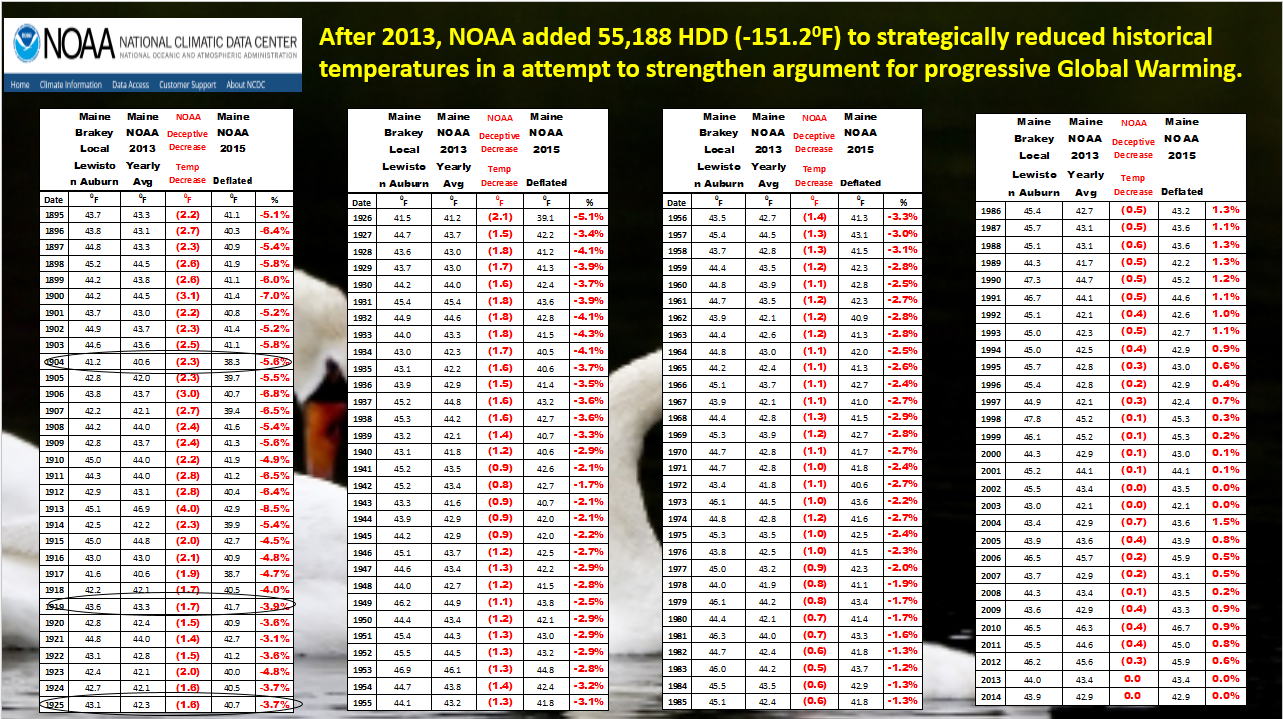
NOAA cooled the years of Lewiston-Auburn Maine’s past by an accumulated 151°F! (55,188 heating degree day units).

The last four months have been some of the coldest you might ever recall in our lifetime. So far 2015 is the fourth coldest in Maine’s history over the last 120 years. Data from 2013 confirm that so far – from January 1 to April 29 – 2015 has required 4249 heating degree days.

That rivals 1904, 1918 and 1923 over the last 120 years.

But when I recently looked at NOAA’s revised 2015 data, these last four months now would not even put us in the top twenty of coldest months. The federal government went into the historical data and lowered those earlier years – and other years in the earlier decades – so that they can keep spending $27 billion a year on pushing global warming.

They assumed no one would archive temperature data. But I did. My research indicated they used the same algorithm across the United States at the same time. Fortunately I had archived their data from 2013 for Maine and recently compared it to their 2015 data (see above table).

As an engineering physicist and heat transfer specialist, I have worked with heating and cooling degree days for forty years. It is alarming when one discovers multi-million dollar websites have been corrupted with bogus data because the facts do not match up with agendas.

It tremendously harms the industry you and I both work in. Worse, it harms the public. If the public knew the climate data facts indicated it was not getting warmer locally, and that it might actually be getting cooler, it would have all the more reason to insulate and become more energy-efficient in their homes.

I have put together a Maine history of climate temperatures in a narrated PowerPoint Presentation placed on YouTube titled, Black Swan Climate Theory.

Below is a brief sampling of my findings:

Brakey_3

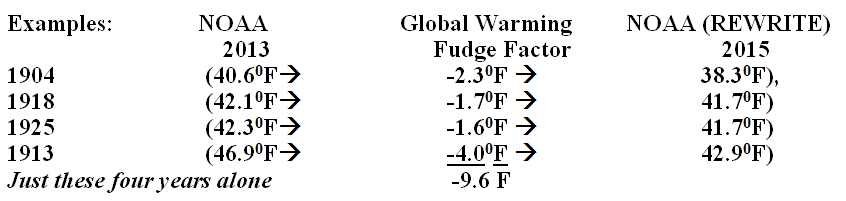
So far 2015 Maine temperatures, as of April, are running neck-and-neck with the coldest years in Maine’s history: 1904 (40.6°F), 1918 (42.1°F) and 1925 (42.3°F). These temperatures cited come right from the federal government’s own NOAA climate data (from 2013). I archived them on my computer for future reference.

2015 so far among coldest on record

A BLACK SWAN event is forming in 2015 (see chart to right). Based on the first four months of 2015, there is an excellent chance 2015 Maine temperature might average, on an annual basis, well under 43.0°F. Not only have Maine temperatures been on a decline since 1998, we are now seeing temperatures reminiscent of the bitter turn of the early 1900s.

Massive rewrite

It appears NOAA panicked and did a massive rewrite of Maine temperature history (they used the same algorithm for U.S. in general). The new official temperatures from Maine between 1895 and present were LOWERED by an accumulated 151.2°F between 1895 and 2012.

“Out-and-out fraud”

In my opinion, this is out-and-out fraud. Why did they corrupt national climate data? Global warming is a $27 billion business on an annual basis in the U.S alone.

Brakey_4

Now NOAA data revised in 2015 indicate that 1904, 1919 and 1925 in Maine were much colder than anything we experience today. (See the scorecard above comparing the NOAA data that are 18 months apart). Note how for 1913 the NOAA lowered the annual temperature a whole 4°F!

For the balance of the years, as they get closer to the present, the NOAA tweaks less and less. They have corrupted Maine climate data between 1895 and present by a whopping accumulated 151.2°F.

Unfortunately NOAA is remaining true to that old saying, “Figures don’t lie but liars figure.”

A multi-million dollar website has been corrupted. I can no longer rely on the tax-payer funded NOAA for clean, unfiltered, climate data for my ongoing research.

Conclusion

I can no longer trust the climate data and energy information ultimately drawn from the U.S. government. Locally, I now have to determine if they got their data from NOAA.

This makes research a lot tougher.

Mike Brakey

– See more at: http://notrickszone.com/2015/05/02/151-degrees-of-fudging-energy-physicist-unveils-noaas-massive-rewrite-of-maine-climate-history/#sthash.BBzJYpeL.gdGB9urs.dpuf

Climate Alarmists: They Hate Facts that Don’t Back Up Their Story, and the People Who Expose Them!

Climate Change | John Roskam
Australian Financial Review 1st May, 2015

In 1987, the American historian and philosopher Allan Bloom wrote a best-selling book, The Closing of the American Mind. It was about the mediocrity and intellectual conformity of American universities. Bloom died in 1992. If he was alive today and writing about Australian universities his book could be titled The Closed Australian Mind.

The reaction of university academics to the Abbott government’s decision to provide $1 million to fund a branch of Bjorn Lomborg’s Copenhagen Consensus Centre at the University of Western Australia demonstrates all that’s wrong with Australia’s universities. Their culture tends to be distrustful, insular and choked in unthinking intellectual uniformity. That’s why the number of Australian researchers who rival Lomborg’s global renown can be numbered on the fingers of one hand. Probably the closest any Australian comes to having anything like Lomborg’s international standing in the field of philosophy and policy is the ethicist Peter Singer now at Princeton University. (Singer who supports infanticide in some circumstances was voted one of Australia’s most outstanding public intellectuals. He’s also been awarded the Companion of the Order of Australia, the country’s second-highest honour.)

Instead of welcoming a world-class public policy thinker coming to Australia and to their university, academics and students at the University of Western Australia are outraged. The vice-president of the university’s staff association talked of having the funding revoked, while the student guild launched a ‘Say No to Bjorn Lomborg’ campaign.

Lomborg’s problem is he’s a climate “contrarian”. As the The Guardian newspaper has helpfully pointed out a climate “contrarian” is someone who is not a climate “denialist” but who nevertheless says things that “infuriate” people who believe climate change is the world’s most serious and urgent problem. And the reason we know Lomborg is not a “denialist” is because the university’s vice-chancellor says so. At a meeting last week of 150 angry academics the vice-chancellor attempted to placate his staff by reassuring them Lomborg most definitely wasn’t a “denialist” and his institution “had a history of defending its climate change research staff against the most extreme views of climate change deniers”. (There’s no record of the vice-chancellor defining what he meant by the term “denialist”. Presumably his university doesn’t employ any.)

LOMBORG’S BELIEFS

Lomborg believes humans are causing the climate to change and he believes it’s a problem. But he also believes that much of the money spent on fighting climate change would be better spent on overcoming malaria and HIV/Aids and assisting the 700 million people on the planet who don’t have clean water. These views apparently make Lomborg unfit to hold a position at the University of Western Australia. As yet it’s not clear what Lomborg would have to believe to satisfy the staff and students of the university.

In The Closing of the American Mind, Bloom examines how the teaching of humanities has been affected by postmodernism and moral relativism. For Bloom, what’s even worse is that so many academics think the same things and they won’t tolerate anyone disagreeing with them. He tells the story of what happened to him as a student.

“We are used to hearing the Founders charged with being racists, murderers of Indians, representatives of class interests. I asked my first history professor in the university, a very famous scholar, whether the picture he gave us of George Washington did not have the effect of making us despise our regime. ‘Not at all,’ he said, ‘it doesn’t depend on individuals but on our having good democratic values.’ To which I rejoined, ‘But you just showed us that Washington was only using those values to further the class interests of the Virginian squirearchy.’ He got angry, and that was the end of it.”

What Bloom said about the humanities in American universities 30 years ago is true of science in Australian universities today. Those who dare to question whether the science of climate change actually is “settled” provoke anger and name calling from many in Australia’s scientific community.

Australia’s Nobel Laureate Peter Doherty is a leader of that community. He’s another one angry Lomborg is coming to this country. Doherty’s attitude is disappointing but also perplexing. Without contrarian thinkers there wouldn’t be many Nobel Prizes to hand out.