Wind Turbine Noise–Complaints Easy to Understand

Wind Turbine Noise, is Unlike Other Noises…

windwisema's avatarWind Wise ~ Massachusetts

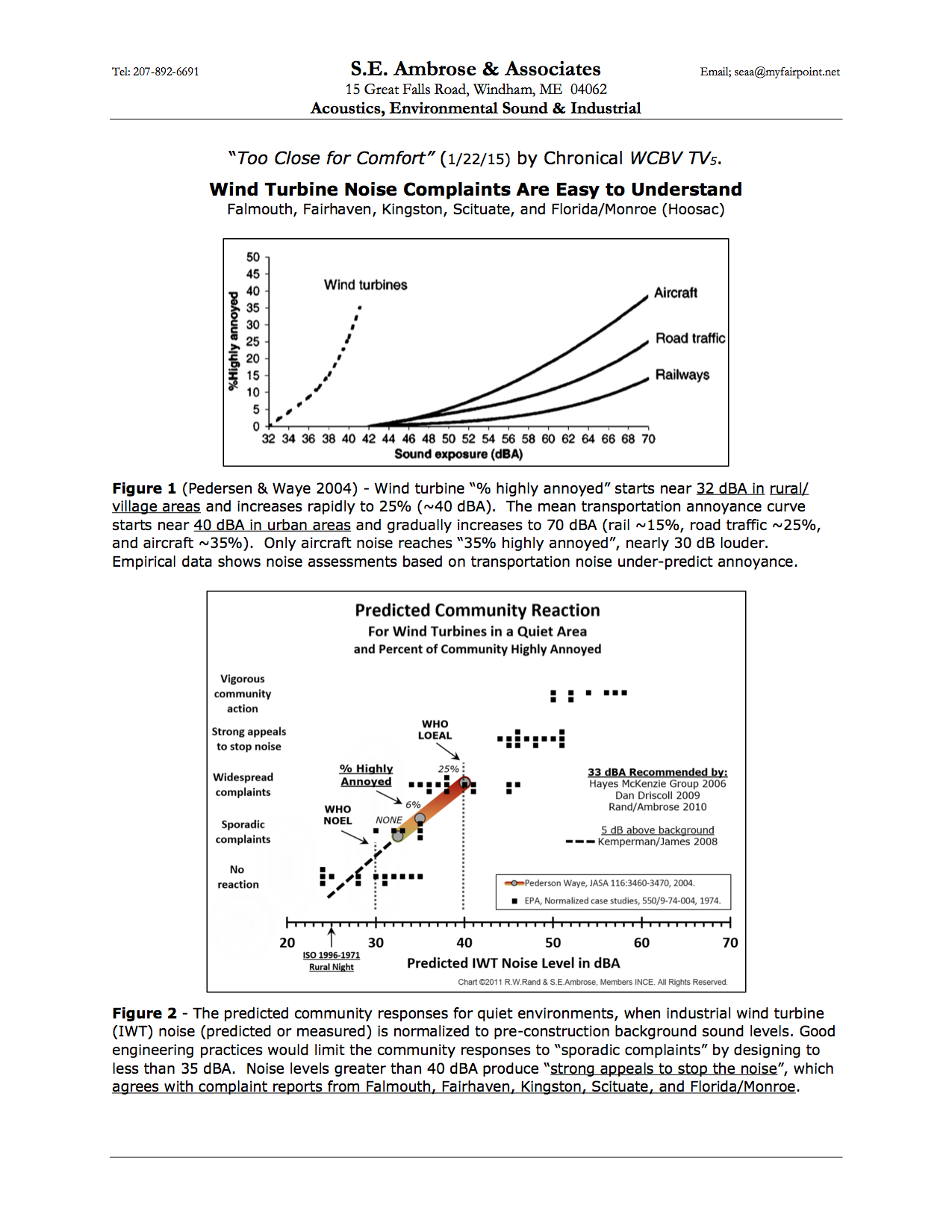
Wind turbine noise is different from other types of noise, as acoustician Stephen Ambrose explains through two charts. The first is from the study done in Sweden in 2004, when Eja Pedersen and Kerstin Waye illustrated their findings with the top graph below. In the second chart, Ambrose and Robert Rand developed a schematic to show the results of numerous studies which independently echo the lived experience of wind turbine neighbors. Too loud, which often means too close, is predictable from the volume of complaints. For more on turbine acoustics, click on Wind Turbine Noise Complaint Predictions Made Easy, or link to the “Too Close for Comfort” segment of Chronicle.

Ambrose-WindWiseMA-Chronicle-7Feb2015

View original post

Steven Cooper has Windweasels on the Run! Truth is the Windpusher’s Enemy!

A stampede to the exits

08bryce_1-popupby Harvey Wrightman
In the 6 years and 6 Environmental Review Tribunal appeals we have been appellants to, there has been a bagful of issues connected with wind projects and how they are “imposed” upon ordinary working communities without theexpress consent of the communities –  in newspeak, that would be “social license.”  Yet the one issue that drew us to actively oppose wind projects (health effect), remains at the top of the list and all other issues really come as a result of the harm to health that occurs, picking its victims at random, that one cannot say, “It won’t affect me.”

So the recent study done by acoustician Steven Cooper for Pacific Hydro has set a bomb off  amongst the….umm, the wind wankers – an all inclusive category for the acousticians, $800/hour lawyers, PR people, the smirking engineers and administrators of the MOECC and the ERT, the clueless politicians, the sleepy investment bankers.

But success leads to outrageous behaviour. Pac Hydro was assured by its “experts”  that nothing would be found; so, acting the bit of the good, green corporate citizen it agreed to have Cooper do the study, and agreed to provide the operational co-operation that is essential to producing accurate data. Curiously they refused to have the study submitted to a professional journal for peer review – perhaps an afterthought – what if he does find something??? No matter, peer review can be done by, well, peers in the field. And so two of the most respected names in the American acoustical community, Paul Schomer and George Hessler, have published their review of Cooper’s study. Hessler has done numerous noise assessments for wind companies. Schomer is Standards Director Acoustical Society of America.

None of what is published will come as a surprise to the many individuals I encountered who experienced the same sensations resulting in the same symptomatic responses and the entirely rational response of fleeing the scene. Now your observations have been validated by two of the most prominent acousticians in the US.  With an ethical obligation to protect the public, one awaits the stampede of engineers to the exits. Some have already done so.

The Results of an Acoustic Testing Program, Cape Bridgewater Wind Farm
Prepared for Energy Pacific by Steve Cooper, The Acoustic Group
A Review of this Study and Where It Is Leading

Paul D. Schomer, Ph.D., P.E.; Schomer and Associates, Inc.; Standards Director, Acoustical Society of America
George Hessler, Hessler Associates, Inc.
10 February 2015

Recently Cooper has completed a first of its kind test regarding the acoustical emissions of wind turbines. His is the first study of effects on people that includes a cooperating windfarm operator in conjunction with a researcher that does not work exclusively for windfarms. This study makes three very simple points:

  1. There is at least one non-visual, non-audible pathway for wind turbine emissions to reach, enter, and affect some people
  2. This is a longitudinal study wherein the subjects record in a diary regularly as a function of time the level of the effects they are experiencing at that time
  3. This periodic recording allows for responses as the wind-turbine power changes up and down, changes not known by the subject

The results are presented in a 218 page report augmented by 22 appendices spread over 6 volumes so that every single detail in the study has been documented for all to see and examine. The methods and results are totally transparent. The 22 appendices and the main text exhaustively document everything involved with this study.

Six subjects, 3 couples from different homes are the participants in this study. They do not represent the average resident in the vicinity of a wind farm. Rather, they are self-selected as being particularly sensitive and susceptible to wind farm acoustic emissions, so much so that one couple has abandoned their house. Cooper finds that these six subjects are able to sense attributes of the wind turbine emissions without there being an audible or visual stimulus present. More specifically, he finds that the subject responses correlate with the wind turbine power being generated but not with either the sound or vibration.

Although the very nature of a longitudinal study provides for a finding of cause and effect, some will undoubtedly argue that a correlation does not show cause and effect. In this case they must postulate some other thing like an unknown “force” that simultaneously causes the wind turbine power being generated and symptoms such as nausea, vertigo, and headaches to change up and down together. But that is the kind of “creative” logic it takes to say that this correlation does not represent cause-and-effect. So, rather than making such groundless arguments, perhaps something like an “expert statistical analysis” can be expected “proving” this is not a “valid sample” of the public at large, or proving the study does not do something else it was neverintended to do.

So it is important to sort out what, by design, this study was intended to do and does do, and what, by design, it was not intended to do and does not do. This study is not in any way a sample of the general population nor is it in any way a sample of the general population in the vicinity of windfarms. According to Cooper’s report, this study was intended to address the issue of complaints from residents in the vicinity of Pacific Hydro’s Cape Bridgewater Wind Farm. Pacific Hydro requested the conduct of an acoustic study at 3 residential properties to ascertain any identifiable noise impacts of the wind farm operations or certain wind conditions that could relate to the complaints that had been received. The study was to incorporate three houses that are located between 650 m and 1600 m from the nearest turbine. This research represents a case study at 3 houses, each with one couple, 6 people. This is one sample, and only one sample, of a small group of people who are all self-selected as being very or extremely sensitive to wind turbine acoustic emissions. A similar group could be assembled elsewhere such as in Shirley Wisconsin, USA or Ontario Canada.

This study finds that these 6 people sense the operation of the turbine(s) via other pathways than hearing or seeing, and that the adverse reactions to the operations of the wind turbine(s) correlates directly with the power output of the wind turbine{s} and fairly large changes in power output.

Attempts may be made to obviscate (sic) these simple points with such arguments as it cannot be proved that infra-sound is the cause of the discomfort. But that again is a specious argument. The important point here is that something is coming from the wind turbines to affect these people and that something increases or decreases as the power output of the turbine increases or decreases. Denying infra-sound as the agent accomplishes nothing. It really does not matter what the pathway is, whether it is infra-sound or some new form of rays or electro-magnetic field coming off the turbine blades. If the turbines are the cause, then the windfarm is responsible and needs to fix it. Anyone who truly doubts the results should want to replicate this study using independent[1] acoustical consultants at some other wind farm, such as Shirley Wisconsin, USA, where there are residents who are self-selected as being very or extremely sensitive to wind turbine acoustic emissions.[2]

Some may ask, this is only 6 people, why is it so important? The answer is that up until now windfarm operators have said there are no known cause and effect relations between windfarm emissions and the response of people living in the vicinity of the windfarm other than those related to visual and/or audible stimuli, and these lead to some flicker which is treated, and “some annoyance with noise.” This study proves that there are other pathways that affect some people, at least 6. The windfarm operator simply cannot say there are no known effects and no known people affected. One person affected is a lot more than none; the existence of just one cause-and-effect pathway is a lot more than none. It only takes one example to prove that a broad assertion is not true, and that is the case here. Windfarms will be in the position where they must say: “We may affect some people.” And regulators charged with protecting the health and welfare of the citizenry will not be able to say they know of no adverse effects. Rather, if they choose to support the windfarm, they will do so knowing that they may not be protecting the health and welfare of all the citizenry.

[1] Independent Consultants are those who have worked for both industry and communities, and or have espoused the need for research to sort out the issues of people reacting to non-audible non-visual stimuli.

[2] Cooper’s test shows cause and effect for at least one non-visual, no-audible pathway to affect people. If one only wanted to test for the ability to sense the turning on of wind turbines, and not replicate the cause and effect portion of Cooper’s study, this reduced test could be accomplished in one to two months with a cooperative windfarm where there are residents who are self-selected as being very or extremely sensitive to wind turbine acoustic emissions and who also assert that they have this sensing ability. This study, a subset of the full Cooper tests, would only prove, again, that non-visual, non-auditory pathways exist by which wind turbine emissions may affect the body and “signal” the brain.

Paul D. Schomer, Ph.D., P.E.; and George Hessler


Shut off the Subsidy Tap, and the WindWeasels Scurry! Well Done Aussies!

Wind Industry Howls & Predicts Mass Exodus from Australia as Subsidy Trough Dries Up

Piglets-Snout-2270058

Australian windfarms face $13 bln wipeout from political impasse
Reuters
Byron Kaye
9 February 2015

* PM Abbott wants to cut state support for industry

* Labor opposition won’t back cutting clean energy target

* Uncertain support regime is causing a freeze in investment

* Some predict an exodus of investment

SYDNEY, Feb 8 (Reuters) – Australia faces a A$17 billion ($13.3 billion) exodus of investment from its windfarm industry because of a political deadlock, threatening to deal the country a major economic blow and killhopes of meeting a self-imposed clean energy target.

Some 44 Australian windfarm projects, about half overseas-funded, have been shelved since a new conservative government said it wanted to cut state support for the industry a year ago, with investors and operators saying they are considering either downscaling or leaving the country altogether if it succeeds.

Even Australian windfarm companies such as Infigen and Pacific Hydro have effectively shelved their Australian operations, with Infigen saying it plans to pour all its financial muscle into the more amenable U.S. market.

“It’s a difficult time at the moment, and the policy uncertainty is the main cause of it,” said Shaq Mohajerani, an Australian spokesman for wind farm company Union Fenosa, owned by Spanish energy giant Gas Natural.

“We’re still considering all options on how to proceed. The parent company will provide us with the strategy.”

An Acciona spokesperson said the firm had an “attractive backlog” in Australia but “we are waiting for the whole development of the new framework for renewable energy and hope our presence … in the country can be maintained”.

Wind power in Australia is not the only renewable energy sector to be affected by uncertainty over government subsidies or actual cuts. In Europe, Germany has scaled back support for solar power over the past few years, leading to a flood of insolvency filings by solar firms and a shrunken market.

Italy’s plans to cut subsidies for solar power firms have prompted an investor exodus. Retroactive solar subsidy cuts have also happened in Spain, Greece, Bulgaria and the Czech Republic over the past couple of years, putting off new investors as governments try to rein in energy costs and cut debt.

Windfarms are Australia’s No. 2 renewable energy source, behind hydropower but ahead of solar, providing a quarter of the country’s clean energy and 4 percent of its total energy demand. But while households can collect rebates for installing their own rooftop solar panels, windfarms rely on “certificates”, or tradeable securities handed out by the government, to offset costs.

That support hit a roadblock a year ago when new conservative prime minister Tony Abbott ordered a review of the country’s target for clean energy use by 2020, which ultimately recommended slashing it by a third, in line with falling overall energy demand. A lower target would mean a lower certificate price.

The centre-left Labor opposition, whose support the government needs to lower the target, refused to budge on the higher target it set when in power in 2009, resulting in an impasse that has effectively seen the industry grind to a halt.

A spokeswoman for U.S. owned GE Australia & New Zealand, which has stakes in several renewable energy projects, said further investment “will only occur once investor confidence in the policy environment is restored. For this to happen, bipartisan support regarding the future of the renewable energy target is essential.”

The Australian arm of Spanish infrastructure group Acciona , the world’s largest renewable energy firm, has frozen about A$750 million of windfarm projects because of the stalemate, said local managing director Andrew Thomson.

“When you’re a subsidiary (of a global business), you’re competing for capital, you’re competing for your budget allocation next year,” he said.

“If the parent company can’t see that there’s a stable environment it becomes really difficult to get traction. For us at the moment it’s a really difficult sell.”

If the renewable energy target is cut, “it’s the type of jolt to industry that basically would create such an upheaval that you would have a mass exodus”, said Alex Hewitt, managing director of Bulgarian-Polish-U.S.-backed windfarm operator CWP Renewables, which has A$1.5 billion of projects on ice.

“I can’t say whether we’d completely exit the country, but you would be looking at such a level of reduction in the level of investment into people in the company that it would be very significant,” Hewitt said.

($1 = 1.2793 Australian dollars) (Additional reporting by Jose Elías Rodríguez in Madrid and Nina Chestney in London; Editing by Will Waterman and David Evans)
Reuters

So, all this promised (or, rather threatened) “investment” really is just about the massive stream of subsidies, after all?

Whatever happened to that piffle pitched by the wind industry, its parasites and spruikers about being competitive with conventional power generation sources?

You know, the delusional stuff where they tell us – ad nauseam – that the cost of wind power is now so low it can compete on the open market with the cheapest of them all: coal-fired power (see this trip to Disneyland and back by the shills from ruin-economy).

If there were a scintilla of substance to the eco-fascists’ fantasy about wind power being competitive (and, therefore, profitable without the need for wind power outfits to perpetually slurp from the subsidy trough), then these ‘investors’ wouldn’t be wailing about ‘uncertainty’; indeed, the story above wouldn’t be a ‘story’ at all: outfits like Acciona would be spearing giant fans all over Australia at a cracking pace.

But, when the investors’ rubber hits the investment road, cheap talk melts like snow in the Australian outback.

Or, rather, as only the Americans could put it: “money talks, and bullshit walks.”

In Australia, the “money” that the subsidy suckers are seeking is in the order of another $50 billion under the current Large-Scale Renewable Energy Target (see our post here). And want they might get it. But ‘want’, on its own, is rarely enough.

The LRET is a policy which is simply unsustainable: any policy which is unsustainable will eventually fail under its own unfathomable weight; or its creators will be forced to scrap it, in circumstances of shame and ignominy.

The massive cuts to renewable subsidies in Europe – detailed above make the point well enough. The Germans have cut wind power subsidies; the Spaniards have slashed them – retroactively (see our postshere and this story here).

In upcoming posts, STT will detail just why this whole scam is on the very brink of total collapse, which will leave many a politician red-faced; and many a wind power investor shirtless.

empty-wallet1

Irrefutable Proof, That Wind Turbine Noise Can Affect Our Health!

http://www.theaustralian.com.au/news/health-science/unseen-unheard-wind-farms-a-blow-to-health/story-e6frg8y6-1227219122344


Unseen, unheard wind farms

a blow to health

Graham Lloyd

Environment Editor

Sydney

GROUNDBREAKING Australian research has established a “cause and effect” existed between wind farms and health impacts on some nearby residents, a peer review by one of the world’s leading acoustic experts says.

The review of a study by Steven Cooper of residents living near Pacific Hydro’s Cape Bridgewater Wind Farm was undertaken by Paul Schomer, standards director of the Acoustical Society of America.

Dr Schomer’s research has been used to define the dose response and acoustic criteria for road traffic, rail traffic, aircraft traffic and shooting.

As a result of the Cooper research, Dr Schomer said wind farm developers should now say “We may affect some people”.

He said regulators charged with protecting health and welfare “will not be able to say they know of no adverse effects”.

Pacific Hydro has said previously it did accept the Cooper research had established a cause-and-effect link, a claim that was not made in the report.

The National Health and Medical Research Council this week said there was no consistent evidence wind farms caused ­adverse health effects and further research was needed.

The NHMRC did not review the Cooper research.

Dr Schomer said the Cooper work had shown clearly there was “at least one non-visual, non-­audible pathway for wind turbine emissions to reach, enter and ­affect some people”.

The six people from three households involved in the study had recorded the timing and level of effects they were ­experiencing.

Their notes had shown that impacts corresponded with wind turbine power changes. The subjects did not know what was happening with the wind turbines when they recorded their notes.

“This study finds these six people sense the operation of the turbine(s) via other pathways than hearing or seeing, and that the adverse reactions to the operations of the wind turbine(s) correlates directly with the power output of the wind turbine(s),” he said.

“The important point here is that something is coming from the wind turbines to affect these people and that something increases or decreases as the power output of the turbine increases or decreases.

“It really does not matter what the pathway is, whether it is infra-sound or some new form of rays or electromagnetic field coming off the turbine blade. If the turbines are the cause, the wind farm is responsible and needs to fix it.”

Dr Schomer said criticism that only a small number of people were involved in the study was not relevant. “One person affected is a lot more than none; the existence of one cause-and-effect pathway is a lot more than none.”

The peer review was co-signed by George Hessler, the president and principal consultant for US acoustics specialist Hessler Associates.


US Wind Industry Rallies to Prevent Research into Adverse Health Effects Caused by Low-Frequency Turbine Noise

Wind weasels do their Best, to Cover Up the Truth!

stopthesethings's avatarSTOP THESE THINGS

scott walker Wisconsin’s Governor, Scott Walker: has ears for the people.

Scott Walker’s Budget Includes $250,000 To Study ‘Wind Energy System-Related Health Issues’
Huffington Post
Kate Sheppard
2 February 2015

The two-year, $68 billion budget proposal Wisconsin Gov. Scott Walker unveiled Tuesday includes a request for $250,000 to study the health impacts of wind turbines.

Page 449 of the budget proposal includes a recommendation from the governor “directing the commission to conduct a study on wind energy system-related health issues.” The request states that a report should be submitted to the governor and legislature within a year after the budget goes into effect.

“The request for a Wind Energy Health Issues Study was included with the intent to provide the Public Service Commission with comprehensive information to consider as they receive requests for future wind energy projects,” said Laurel Patrick, Walker’s press secretary, in a statement to The Huffington Post.

Wind power…

View original post 1,008 more words

Countryfile Comment

Brilliant Letter, Wind Victims Want the Truth to be Known!

Dougal Quixote's avatarwindfarmaction

A make no apology form posting this comment that someone left on the Countryfile fb Page about their program on wind farms. It really says a great deal. Hope that urbanites that read this comment take notice.

countryfile image

  • It is good to see that maybe, just maybe, someone at the BBC has woken up and realised the depth of feeling about the wind turbine scam. Thousands of people have their lives blighted by the things, the environment is being trashed and a very few, mainly very unscrupulous, people are making fortunes on the back of an ultimately pointless waste of money.

    If the BBC actually want to do some real journalism instead of just following the official green party line dictated by RenewablesUK, why don’t they investigate the scandal of ETSU-R-97? Why is it all other industrial activities which are in contact with the general public are judged by the standard…

View original post 330 more words

Steven Cooper’s Study, has Windweasels in a Panic! The Truth is Not What they Wanted!

Steven Cooper’s Cape Bridgewater Bombshell Sends Wind Industry into Flat Panic

atomic-bomb-e1355417893840

In the three weeks or so that have passed since Steven Cooper’s Cape Bridgewater wind farm noise study hit the press (see our post here) the wind industry, its parasites and spruikers have been in absolute panic mode.

Pacific Hydro – the operator of the Cape Bridgewater disaster, which paid for the study, but deliberately limited its terms of reference – has gone into absolute “damage control” (see our post here).

Having completely underestimated Cooper’s ability and, lulled into its own sense of delusional belief that its victims are simply “making it all up”, Pac Hydro has enlisted the “help” of the usual band of useful idiots, in an effort to manipulate and control the media and its reporting of Cooper’s groundbreaking research.

The wind industry’s shills – like the Clean Energy Council and the Australian/Victorian Wind Alliance (aka Andrew Bray) – clearly haven’t bothered to read the highly technical and detailed study, which, with its six appendices, runs to nearly 800 pages and, in the unlikely event that they have, are clearly incapable of understanding it.

Or, perhaps, the predictable response from the wind industry and its baggage train of parasites is best captured by Upton Sinclair’s pithy observation that:

“It is difficult to get a man to understand something, when his salarydepends on his not understanding it.”

Moreover, as we have pointed out before, it’s not Cooper’s study they need to worry so much about but the dozens of others that – following his insights – will involve matched control groups; will involve physicians, including sleep specialists, for example; and be scaled up to include dozens, if not hundreds, of victims at wind farms, both in Australia and around the world.

Properly qualified experts (ie those with acoustic and vibration engineering qualifications, with decades of experience in that field) have identified the significance of Cooper’s study; and rightly applauded it for its rigour and insights; despite Pac Hydro’s deliberate efforts to limit the scope and reach of the study (see our post here).

What those in the know have to say contrasts pretty sharply with the shrill press releases and media comments pouring out of the wind industry cheer squad; as you’d naturally expect from people equipped with little more than self-interest, and media and marketing degrees.

But this merry band of media manipulators has well and truly lost control of the media game.

As it is with the wind industry “case” more generally, what these spruikers pitch up rarely stacks up against the true facts; and is full of internal inconsistencies, fluff, guff and good old-fashioned lies.

One of the giveaways is the Clean Energy Council’s response to the study when it started ranting that it “would not support further research” into Cooper’s findings. What on earth are they so afraid of?

It’s a style that has all the persuasive power of Little Britain’s vacillatingQueen of Darkley Noone, Vicky Pollard, whenever she’s put on the spot.

Vicky-Pollard-2136549

None of which is lost on STT Champion, Annie Gardner who came out with this crystal clear Opinion piece, published in the Hamilton Spectator. Over to Annie.

Hamilton Spectator
Opinion
7 February 2015

Study is World First Research
Ann and Andrew Gardner, Penshurst

I write in response to the article ‘Study “suggests” health and wind farm noise link’ published recently in the Hamilton Spectator.

It would appear that many adverse comments are not related to the study, but opinions proffered from the media release. The study report is very comprehensive and could not be read, absorbed and understood in a few days, let alone a few hours. The same issue of concern would also apply to the Hamilton Spectator, where the facts have unfortunately been misrepresented in the above article.

World first

This study is world first research, where the brief was to work backwards and discover what wind or noise levels agreed with the complaints made by residents at Cape Bridgewater over six years.

The measurement results show what has been known since Dr. Neil Kelley and NASA’s work, funded by the US Dept. of Energy in the 1980’s which originally identified the direct causal relationship between symptoms and sensations and impulsive Infrasound/Low Frequency noise from various sound sources which included wind turbines, gas turbines and military aircraft.

The study has a number of world first claims that are simply ground breaking. This is the first time a wind farm operator has undertaken a “transparent” study where the wind farm worked with residents and provided all the wind farm data and unlimited access to the study team.

Identified problems

The study is the first that has considered sensation as an observation by residents.

This study has identified problems with instrumentation and measurement of infrasound, and has then provided answers and suggested standardisation for other researchers.

Whilst Pacific Hydro are being cautious with their comments, other wind farm proponents or members of the wind energy consortium are being extremely mischievous with their criticism, as reported in this article, of what has been detailed scientific research.

The limitations which the wind industry are busily highlighting are those which were placed on the acoustic engineer Steve Cooper, purely by Pacific hydro, the developer of the Cape Bridgewater wind farm.

The features cited as lacking were –

  1.  Large sample size. The brief by Pacific Hydro to Steven Cooper was for ONLY THREE HOUSES to be studied.
  1. Peer review. Pacific Hydro refused to allow Steven Cooper’s study to be peer reviewed.
  1. No control group. There was no control group purely by design of Pacific Hydro.
  1. No assessment of “compliance” with the permit conditions under instructions of Pacific Hydro.

Contrary to the statement in the article (para 3) the observations from the diaries used in the study were not reporting “health complaints”.

Observations

Contrary to the statement in paragraph 10 of the article, the participants were not “made aware of what the wind farms” (there is only one) “were doing whilst their responses were being recorded”.

Contrary to comment in this article by the wind industry representatives, this study can EASILY be replicated at other wind farms, in particular the Macarthur wind farm, in this district.

The symptoms experienced at Macarthur wind farm are IDENTICAL to those which residents at Cape Bridgewater suffer from. Some families living around the Macarthur wind farm have been forced to move away, whilst others are forced to leave their homes repeatedly, in order to get a decent night’s sleep.

Hundreds of complaints

AGL and ALL levels of government and government bodies, in particular the Victorian Health Department, are in receipt of hundreds of complaints from residents at Macarthur, but are in total denial, and have done NOTHING to acknowledge, or rectify this truly unacceptable situation.

The wind farm proponent interviewed had a swipe at the residents making complaints, even when the turbines were turned off and, by not reading the report, failed to identify the qualification of some sensations (of a lower magnitude) and further investigations that showed pulsations in the turbine towers and the ground following wind gusts.

Around the Macarthur wind farm, residents suffer from infrasound emitted by the turbines, even when they’re not operating, similarly to Cape Bridgewater. Even when the turbines are turned off, we feel the same “sensation”, being headaches, ear pressure, nose pressure, heart palpitations, nausea, dizziness etc., and still cannot sleep at night.

Movement

Due to the mammoth scale of these towers, there is movement ALL the time, whether high or low winds, in addition to when they’re turned off. Due to the extreme size of the towers, they still continue to vibrate, thus emitting infrasound waves. The laws of physics show such structures exhibit natural frequencies that are associated with structural resonances in the infrasound region. Nobody with appropriate qualifications and experience can deny this. The residents at Macarthur have comprehensive evidence and noise testing, showing infrasound emitted whilst the turbines are not operating.

The truth is emerging, and will continue to be exposed as more evidence is brought to light, but for those receiving millions of taxpayer dollars, the truth is beginning to hurt, and it appears they are in damage control.
Hamilton Spectator

Annie Gardner

Paul Driessen on sugar daddy environmentalism and corruption of science

The Climate Alarmists are getting…..Boring.

john1282's avatarJunkScience.com

Paul Driessen sure does a good job on this one on incest in the enviro gov and non gov elements.

Paul, a moral humanist and humanitarian stands up for good science and against the negative impact of government agency overreach and excess regulation on the little people.

Willie Soon is a wonderful man–honest, intelligent. He is nice to little people like me who don’t understand what he knows.

View original post 3,009 more words

Greg Hunt’s “Game” of Hide and Seek: or how Australia’s most notorious wind power outfit – Infigen – hijacked Australian Energy Policy

Wind pushers set themselves up to deflect all attempts by residents, to protect themselves.

stopthesethings's avatarSTOP THESE THINGS

greg hunt Greg Hunt: Minister for Infigen?

Ian “Macca” Macfarlane and his youthful ward, Greg Hunt are the flies in the Coalition’s political ointment, when it comes to engineering anything like a sensible policy on energy. Both Macfarlane’s and Hunt’s offices are filled with wind industry plants and stooges, like Hunt’s senior adviser, Patrick Gibbons. Patrick is best mates with Vesta’s former head – and now full-time wind industry lobbyist – Ken McAlpine.

Both Macca and Hunt are still working flat-out at the minute trying to salvage the wreckage of the (completely unsustainable) Large-Scale Renewable Energy Target (LRET).

For months now, Macca has been trying to cut a deal with Labor in an effort to help his mates over at the near-bankrupt wind power outfit, Infigen (aka Babcock and Brown) stay afloat.

Meanwhile, Macca’s side-kick, Greg Hunt has been trying woo the cross-bench Senators, as part of the same last-ditch, salvage…

View original post 2,312 more words

Derek Byrne and his Family, Forced to Endure the Torture From Wind Turbines.

“It’s a disaster”: Family affected by windfarm’s turbine flicker

The family say it makes day-to-day life difficult.

DEREK BYRNE AND his family live around 330 metres from wind turbines, and say that a ‘flicker’ from energy-generating machines is causing them major problems.

They live near the wind farm in Athea in Co Limerick, and the turbines can be seen from their front window.

The wind farm was erected in August 2013, and Byrne said that they’ve been experiencing the flicker since soon after the turbines appeared.

Why it happens

The flicker occurs because when the sun is low and shining from behind the turbine, the blades block some of the light briefly.

They experience the flicker in the whole house, said Byrne, who lives there with his wife and children.

“Even if you’re in a room with closed blinds. The whole house flickers black. It’s every two seconds for about 20 minutes.”

“When the sun is low at both stages during the day the flicker is at its most prominent.”

Byrne said he has been in touch with SSE Airtricity since December 2013, and that they have told him that there is usually a programme to stop the turbines when the flicker occurs.

“After numerous complaints there is still the flicker,” he said.

Like an “airport apron”

The family have also been experiencing noise due to the turbines, with Byrne saying it is akin to “an airport apron at night time”.

He said the noise is obvious “even with all the windows closed and the TV turned up”.

Every morning I arrive home at 7.30am and it’s like arriving into Shannon airport. It is very unpleasant.

Byrne said there are four houses in the area directly affected by the turbines. “Over the Christmas period it was at its worst,” he said. “It’s been a disaster, absolutely a disaster.”

It lasts longer in the winter months, and can happen up to three times a day.

Were they warned about it? “No we weren’t warned anything about the nearest turbine to us,” said Byrne.

“We were informed about six months before it went up,” he said of the wind farm, adding: “We’re not against wind energy or renewable energy.”

“I’m blessed I work night shifts,” he concluded. “It’s very unfair on the children.”

What does Airtricity have to say?

The electricity from the wind farm is generated by Airtricity, but SSE Renewables built the Athea project.

A spokesperson for SSE Renewables said:

We are aware that some residents living close to our Athea wind farm in Co Limerick are experiencing some intermittent issues with shadow flicker.We are investigating the cause of these issues and we’re working hard to resolve them as quickly as possible. We recognise the impact these issues are having on the residents concerned and while we work on putting in place a permanent solution to resolve these issues we continue to maintain regular contact with them.

Of the noise, it added:

“We are also working to implement a noise control system at the site. We will utilise this system to ensure that all turbines at the wind farm continue to operate at industry guideline limits.”

Frauds, Crooks and Criminals

Demonstrating daily that diversity is not strength!

Family Hype

All Things Related To The Family

DeFrock

defrock.org's principal concern is the environmental and human damage of industrial wind turbines on rural communities

Gerold's Blog

The truth shall set you free but first it will make you miserable

Politisite

Breaking Political News, Election Results, Commentary and Analysis

Canadian Common Sense

Canadian Common Sense - A Unique Perspective from Grassroots Canadians

Falmouth's Firetower Wind

a wind energy debacle

The Law is my Oyster

The Law and its Place in Society

Illinois Leaks

Edgar County Watchdogs

stubbornlyme.

My thoughts...my life...my own way.

Oppose! Swanton Wind

Proposed Wind Project on Rocky Ridge

Climate Audit

by Steve McIntyre

4TimesAYear's Blog

Trying to stop climate change is like trying to stop the seasons from changing. We don't control the climate; IT controls US.

Wolsten

Wandering Words

Patti Kellar

WIND WARRIOR

John Coleman's Blog

Global Warming/Climate Change is not a problem