Wind Power is the Key to Poverty for Citizens and Insecurity in our Energy Sector.p

Robert Bryce: Want to live in Stone-Age Poverty? Then tie your future to Wind Power

robert bryce 2

Robert Bryce picked the wind power fraud for what it is from the very beginning.

In his 2010 book “Power Hungry: The Myths of “Green” Energy and the Real Fuels of the Future” (Public Affairs), Bryce skewered every one of the myths relied upon by the wind industry to peddle its wares; and went on to predict the massive benefits of the US shale gas revolution – in terms of both cheap energy – operating as a boost to a flagging economy – and as a method of reducing CO2 emissions in the electricity sector.

We’ve covered some of his recent writings on US energy policy and the wind power fraud (see our posts here and here and here). Bryce recently published another cracking book “Smaller Faster Lighter Denser Cheaper: How Innovation Keeps Proving the Catastrophists Wrong” (Public Affairs) that loads up on the nonsense that is US energy policy today: we covered a review of Bryce’s latest by the New York Times in this post.

In this video, Robert lays out the key arguments as to why cheap, reliable sparks are critical to the growth, wealth and development of Nations. While access to power is something we – in the developed world – smugly take for granted, for the billion or so at the bottom of the development heap it is the ONLY path out of poverty. And for those struggling to escape deprivation and darkness, the answer is most certainly not insanely expensive and unreliable wind power. To the contrary, reliable and affordable power is a guarantee of both wealth and freedom.

Energy policy has been over-run by “green” ideologues who are determined to ensure that the poorest remain that way by wedding the world to the fiction that wind power provides a meaningful answer to growing energy demand, while “solving” the climate change “problem”. Tune in to Robert as he skewers that – and other – wind industry myths.

crystal-ball

Climate Alarmism has been going on for a Very Long Time! (It’s never true!)

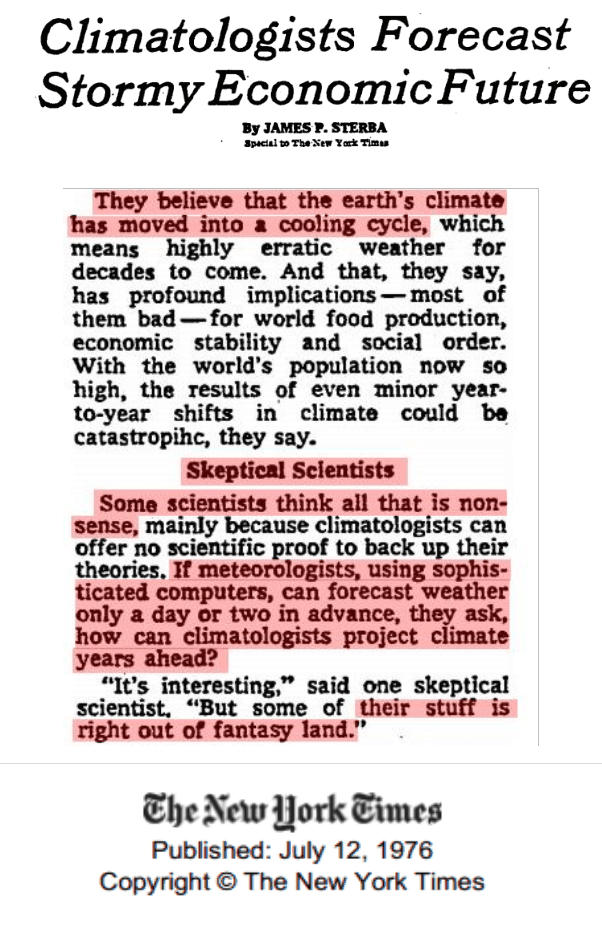
Time To Silence The Skeptics

In 1976, foolish skeptics didn’t trust official forecasts of catastrophic global cooling – doubting the ability of climate models to predict the weather years ahead. Forty years later, these same evil skeptics are blocking global warming acceptance for the same reason. Don’t the skeptics ever learn?

ScreenHunter_242 Feb. 06 08.11

Climatologists Forecast Stormy Economic Future – Climatologists Forecasting Dire Effects of Weather on World Economy and Social Order – View Article – NYTimes.com

Scrap Renewable Energy Targets! It’s all a big scam!

Terry McCrann: The Mandatory RET – It’s Only a RORT When You’re Not In On It

terry_mcrann

Follow the money trail, and RET spells rort not power
Herald Sun
Terry McCrann
8 September 2014

TWO eternal pieces of advice emerged from the Watergate saga that kneecapped Richard Nixon’s presidency and then the president himself.

The first was the observation that it’s not the crime that gets you but the cover-up; the second was the instruction to follow the money.

While we’ve seen dozens if not indeed hundreds of examples of the former in the subsequent four decades, arguably it’s the latter that has proved more absolutely durable.

That’s been the case, if for no other reason than that, all too often, neither the crime nor the cover-up gets the — usually, political — “criminal”, with or without the quotation marks.

But “the money” always, always, leads somewhere. Throw in the great and piercingly accurate quote from Australia’s larrikin entrepreneur John Singleton that it’s only a rort when you are not in on it, and we arrive at the RET.

More specifically, we arrive at the long overdue and fundamentally necessary review of the RET — Renewable Energy Target — by businessman and both economic and climate realist Dick Warburton.

Somewhere along the line, as I’ve previously noted, it lost the “M” from its original acronym of M (for mandatory) RET, even though it remained just as punitively obligatory.

Well, the release of Warburton’s punishingly rational and even-handed review has unleashed a primeval scream across the renewable energy sector as if torn from Munch’s famous painting.

Follow the money, your money — and the screams. They lead directly to all those who have been sucking on the taxpayer and consumer teat: so far, as Warburton detailed, to the tune of over $9 billion (of your money) with another $22 billion (still, of your money) to come, if the scheme is left untouched.

Those figures are in NPV (net present value) terms — which mean the total of actual dollars wasted every year through until at least 2030 will be much, much bigger.

We have seen the usual campaign of misrepresentation and outright lies to scare the Federal Government out of turning off the money flows to all the renewable energy main-chancers.

This has been done in the context of a vicious campaign to demonise Warburton as a climate sceptic, by deliberately mischaracterising and indeed simply ignoring what he recommended. If anything Warburton went too lightly on the extraordinary fraud that is so-called renewable energy.

Extraordinary, but so obvious. What part of: when the wind don’t blow the power don’t flow; and when the moon comes out the glass doesn’t glow, do assorted otherwise intelligent people and useful idiots find impossible to comprehend?

That, on a more substantive level, every single MW of installed (sic) wind and solar capacity (sic) has to be backed up by real sources of power generation, otherwise known as carbon-based coal or gas?

Even in the country which is the poster boy for wind power — Denmark — which gets close to a third of its total power from wind, there are times when it gets zero, nothing, nada, from that source.

It then has to use its own coal-fired generators or tap into the power generation of its neighbours — mostly Norway, Sweden and Germany.

That means it gets access to a mix of hydro — when the water’s flowing; nuclear; and coal, with “green” Germany building more Hazlewood-style brown coal stations because, ahem, even in Germany some times the winds don’t blow.

The bottom line with wind so-called power — for all the lazy allure of solar panels on rooftops and even massive solar “farms”, almost all future RET-imposed renewable spending will be on wind — is that its actual cost of production is two-to-three times that of coal.

We have seen an innovative form of deception with the claim that massive increases in wind will work to reduce future power prices.

The claim is true, in terms of potential prices to the power buyer, because the RET would swamp energy supply with compulsory wind. Generators of real and reliable (coal-fired) power would cut prices to buy a slice of the lower non-RET available demand.

To understand why it’s a fraud, imagine if we’d done that to “save” the car industry. The government could have mandated 20 per cent of cars bought had to be locally made. It might well have sparked a cut in prices by importers fighting over the remaining 80 per cent, but it would not be sustainable.

Whether cars or power, the market would correct. In the case of power, generators of (actual) cheap power would be forced to close, leaving us with mandatory (actual) expensive wind power.

Somebody, somewhere, would have to pay the bill for producing wildly expensive wind power.

Warburton didn’t actually go near any of these core absurdities; there wasn’t an ounce of climate scepticism in his analysis, far less the recommendations.

All he did was to arrive at the inescapable conclusion that using the RET to try to reduce emissions of carbon dioxide was grossly wasteful and inefficient. He was also very mindful of the legitimate point that, whether sane or not (my comment, not), people had invested money on the basis of the RET, and to simply scrap it would be unfair.

So he offered two alternatives. The first was to continue the scheme until 2030, but freeze it at its current level of investment, including projects that had just only been committed.

As he noted: this would “provide investors in existing renewable generation with continued access to certificates so as to avoid substantial asset value loss and retain the CO2 emissions reductions that have been achieved so far.

“Importantly, this approach avoids the costs to the community associated with subsidising additional generation capacity that is not required to meet electricity demand.”

Alternatively, to grow the RET in line with growth in electricity demand; and indeed, allocate it 50 per cent of that growth.

That is hardly the recommendation of a so-called sceptic, but of a businessman — who doesn’t think you can simply ignore both arithmetic and reality — doing the job he was asked to do.

But no, no, that was not enough for the reality-deniers sucking on the renewable target teat. They don’t want us to follow the money, just to keep it coming.
Herald Sun

dirtyrottenscoundrelsoriginal

Allegany Wind Project….Officially Dead! Wonderful news for the Community!

Allegany wind project officially dead! 

Posted: Wednesday, September 10, 2014 11:18 am

ALLEGANY — Close to eight years of legal battles, community upsets and neighbors bickering with neighbors over a proposed 29-turbine wind project in the town of Allegany came to an end Tuesday.

The final nail in the coffin of the proposed EverPower Wind LLC project in the Chipmonk and Knapp Creek areas was hammered when the Allegany Town Board unanimously voted to rescind the wind overlay district.

“It’s been a long time coming, and I’m glad this is over,” said Chipmonk resident Karen Mosman after the meeting. “But I’m in shock — is it real?”

The vote came at the beginning of Tuesday’s regular meeting in the Allegany Senior Center on Birch Run Road. The room was three-quarters full of residents who sat quietly as Town Supervisor John Hare read through a 25-page State Environmental Quality Review form and zoning map amendment to rescind the wind overlay district. The form listed a number of issues that will not be affected by rescinding the overlay district, such as geological features, air, plants and animals, agricultural resources, aesthetic resources, transportation, energy and human health. The board agreed with each of the 13 issues reviewed before voting unanimously on a “negative declaration regarding the removal of the wind overlay district.”

The action brought applause from the audience.

The board then voted unanimously on another motion to adopt an ordinance that rescinds the wind overlay district created by town board members on Aug. 29, 2011, which brought another round of applause.

When an older member of the audience asked Mr. Hare to explain exactly what had transpired the town supervisor replied, “Basically by the two actions we took tonight, this rolls back or eliminates the overlay district created approximately three years ago.”

“Thank you very much,” responded a woman in the audience before everyone got up to leave.

The board was asked to decide on the matter in June after the Allegany Town Planning Board recommended that the wind energy overlay district be rescinded. Their recommendation came three months after the New York State Supreme Court dismissed an appeal filed by EverPower against the planning board.

Following the dismissal, EverPower relinquished its rights to build a wind farm in the town of Allegany. The company had planned to build the $160 million wind farm after it was given the go-ahead for the project by the previous town board. The project fell through after three years of legal struggles with the town and Concerned Citizens of Cattaraugus County.

Residents who included Kathy Boser, president of Concerned Citizens, wanted to see the overlay district rescinded because the planning board had indicated that another developer could potentially step in and use the zoned parcel for a new wind-turbine project.

Following the meeting, Mrs. Boser said she and others in the community were grateful for the actions of the town and planning boards.

“Now that it’s rescinded, any (wind company) could come back in, but they’d have to start over again,” she said. “I think there were some lessons learned from this one and I think the boards will be better prepared.”

Concerned Citizens member Gary Abraham agreed with this thought and declared, “It’s over for any (proposed) wind farm in Allegany.”

Allegany resident and businessman Dennis Casey said he was “thrilled” with the outcome.

“We’ve had time to anticipate this,” he said in commenting on the relatively quiet response from the audience during the vote.

Others who commented included Mrs. Mosman’s husband, Ray, who said he hopes the action will help the community heal.

“I think this is done; it’s been a long haul and a heck of a burden off our shoulders,” Mr. Mosman said. “But I think now is a time of healing, because this made enemies out of friends.”


(Contact reporter Kate Day Sager at kates_th@yahoo.com)


Agenda 21, and How it Affects Rural Ontario! A MUST-READ!

Rural Ontario is certainly in the throes of a “correction”.

http://cherylgallant.com/2014/08/28/report-parliament-9/

Report from Parliament

August 28, 2014

I hope everyone had an enjoyable summer. Thank-you to all who attended the various constituency clinics that have been held throughout our Renfrew-Nipissing-Pembroke riding. Whether it was just to drop by and say hi, or to share an interest or concern, I appreciate the opportunity of you letting me know what is on your mind.

After the high cost of electricity, one of the issues that has arisen as a topic of concern is the public move by the City of Ottawa to petition the province to use its legislation to restrict growth in places like Renfrew County. That could mean no more provincial funding for roads, sewers, hospitals and other infrastructure renewal. Without infrastructure renewal, employment opportunities would leave as would residents who need services, and particularly our young people who need jobs. It has been suggested this is a result of “Agenda 21”, a United Nations’ policy the provincial government has adopted in an extreme form. This radicalized environmental version is now being pushed in Ottawa by the same liberal advisors behind the so-called “Green Energy Act” that has meant crippling electricity prices, resulting in high provincial unemployment and energy poverty.

In 2005, the liberal government in Ontario passed legislation called the “Places to Grow Act” to align its land use/planning codes and government policies to United Nations Agenda 21. Like many ideas that may sound good on paper, when it comes to implementation by individuals with no real-world experience, these ideas can become dangerous.

While many people support the United Nations for its ‘peacekeeping’ efforts, hardly anyone knows the organization has very specific land use policies they would like to see implemented in every village, town, city, county, province and nation.  The specific plan is called United Nations Agenda 21 Sustainable Development, which has its basis in Communitarianism.  Most Canadians have heard of sustainable development, but are largely unaware of the U.N. initiative Agenda 21. A non-governmental organization headquartered in Toronto called theInternational Council of Local Environmental Initiatives, ICLEI, is tasked with carrying out the goals of Agenda 21 worldwide.

In a nutshell, the plan calls for government to eventually take control of all land use removing decision making from the hands of private property owners.  It is assumed people are not good stewards of their land and “the government” will do a better job if it is in total control.  Individual rights in general are to give way to the needs of communities as determined by the governing body.

Human habitation, as it is referred to in Agenda 21, would be restricted to lands within the “Urban Growth Boundaries” of a city like Ottawa.  Only certain building designs are permitted.  Opponents of Agenda 21 also assert that rural property could be more and more restricted in what uses can be done on it.  The provincial government says it will support agricultural uses, eating locally produced food, and farmer’s markets, etc. In fact there are so many regulations restricting water and land use (there are scenic corridors, inland rural corridors, baylands corridors, area plans, specific plans, redevelopment plans, tree-cutting by-laws, endangered species legislation, huge fees, fines, etc.) that small farmers and rural landowners are struggling to keep their lands altogether.  County roads will not get paved. The push will be for people to get off of the land, become more dependent, and go into the cities.  People will have to move from private homes and into single dwellings like apartments, as homeownership will become largely unaffordable the way it is in many urban areas like Toronto today. More extreme measures like a federal liberal carbon tax will force people out of private cars and onto public transit that only exists in cities.

U.N. Agenda 21 proponents cite the affluence of North Americans as being a major problem which needs to be corrected. The document calls for a redistribution of wealth, lowering the standard of living for Canadians so that maybe the people in poorer countries will have more.  Although people around the world aspire to achieve the levels of prosperity we have in our country, and will risk their lives to get here, North Americans are cast in a very negative light for our energy consumption. Agenda 21 aims to reduce Canadians to a condition closer to average in the world.  Only then, say the promoters of Agenda 21, will there be their social justice which is the so-called cornerstone of the U.N. Agenda 21 plan.

I am pleased to thank members of County Council who are voicing their opposition to provisions of the “Places to Grow Act” ‘Agenda 21-type’ provincial legislation, and against the City of Ottawa’s position,  standing up for the people of Renfrew County. As your Federal Member of Parliament, I will oppose any effort by the liberal party in Ontario to redirect Federal Infrastructure funding away from rural or small town communities the way it takes provincial gas taxes away from rural drivers to pay for Toronto’s subways.

With your support and encouragement, I will continue to expose the hidden agenda of the merged liberal party of Toronto in Ottawa. They have condemned our children to a lifetime of debt repayment by promoting wacky social experiments like Agenda 21, the Places to Grow, Green Energy Acts and similar misguided policies.

Mike Barnard…..Windweasel – EXPOSED! A Paid Shill for the Wind Industry.

Mike Barnard’s disreputable wind industry propagandist role revealed

J A Rovensky

Vicious, grossly inaccurate and sometimes defamatory attacks on professionals and researchers are relentless from the wind industry and its vocal cheer squad. Their targets include individuals such as Dr Nina Pierpont, Professor Bob McMurtry, Dr Michael Nissenbaum, Dr Sarah Laurie, Mr Steven Cooper, Professor Colin Hansen, Mr Les Huson, Mr Rick James and numerous others, who work to uncover the truth of reported acoustic emission related adverse health impacts linked to Industrial Wind Turbines.

One of the most prolific and virulent is someone called Mike Barnard, an IBM employee. It seems he began his attacks when living in Canada, and is now physically located in Singapore. Whilst Barnard claims to be operating independently of his employer, IBM, the amount of time he spends blogging on wind power and smart grid related issues, and the business connections IBM have with the renewables industry with respect to smart grid technology and renewable energy, make his assertion that IBM are not involved and supporting his activities questionable.

When one of Barnard’s cyber bullying victims informed him what he’d written was libellous, Barnard’s comment in response was to the effect that he was laughing at them because he was untouchable by living in Singapore and utilising free blogging software in a “Cloud”? IBM has a strict policy on cyberbullying, and has been specifically made aware of Barnard’s activities. What action has IBM taken to discipline their vocal employee, who is bringing their organisation into considerable international disrepute with his behaviour?

So who is Mike Barnard, and what are his professional qualifications? On Barnard’s personal blog site he states he became interested in blogging on energy concerns several years ago, and this led:

to significant contacts, research and writing related to wind energy and its myriad societal and commercial interconnections, including the electrical grid, wind energy innovations, social license, health, noise and legal aspects.[1]

In a response to comment on one of his blogs he responded with:

For a little context on my background, I was the Business Architect responsible for delivery of the world’s first full public health surveillance system for communicable diseases, … funded by the Canadian government …

On his blog site introduction he states:

IBM was engaged to build the major technical solution which automated management of communicable disease and public health surveillance.

This related to Canada. He goes on to state he:

joined the program in the late 2000’s as the business architect, responsible for understanding policy, epidemiology and other business drivers and balancing them with what was pragmatically possible …

IBM was contracted in 2006 to design a system to be completed in 2007. They completed the design of the program in 2008, but in June 2013 the Canadian Medical Association Journal : Journal de l’Association medicale canadienne (CMAJ:JAMC) published an article which reported since then progress had been delayed because of numerous technical problems and confusion among provinces and little had been heard of the program since, “The concept has gone almost nowhere” [2].

Barnard continues to inform us how he has read through health studies and reviews related to wind power from around the world and claims:

constant and deep access and conversations related to public health management, epidemiology and the nature of medical evidence … That experience and on-the-job education has been invaluable as I’ve read through health studies and reviews related to wind power from around the world …

This has apparently also led to

recognition of my expertise … I’m pleased to say that my material is helping to shape legal defences of wind energy, advocacy programs and investments in several countries.

In addition in 2013 he was assigning a blog “debate” relating to bird flight paths through a proposed Wind Turbine site, as being his impetus to start collecting material, and creating his own personal blog saying:

A few years ago I started down a road that has led to an unexpected place.

However, blogs can be found from him on energy from around 2010 [3], his voyage into health issues seems to have begun around 2012 when he attacked Dr Nina Pierpont and Dr Nissenbaum. Barnard has been involved in blogging on wind energy issues for some time, and he considers himself to be an integral part of the wind industry’s product defence strategy, which is certainly consistent with his behaviour. This is also consistent with how he is perceived by others who are also actively engaged in the same dishonest activities of denying the known adverse health impacts of wind turbine acoustic emissions; known to the wind industry and acousticians to cause damage to health via “annoyance” symptoms including sleep disturbance and body vibrations for nearly thirty years, since the work undertaken by Dr Neil Kelley et al in collaboration with NASA and a number of research organisations and wind turbine manufacturers.

The list of “publications” following these claims relate to blog sites and/or websites which are sites supporting Renewable Energy production and blogs which repeat the misinformation. They are not peer reviewed journal articles, nor has Mr Barnard been qualified to give expert evidence in any jurisdiction on wind turbine health and noise issues.

Barnard proudly displays a list of his 50 “Skills and Expertise” which includes “Wind Energy and Health”. None of the others cover any medical or health skill or expertise, and it hasn’t been possible to locate any medical or health related training or degree, or indeed any other relevant technical, professional or academic qualifications he has achieved with direct relevance to wind turbine noise or health, as he does not provide details of them. This suggests that Mr Barnard does not have that relevant professional background, academic training or expertise.

Just what is Mr Barnard’s specific expertise in this area?

Throughout Barnard’s blogging career he has concentrated on castigating, defaming and ridiculing those who do have qualifications, research and/or authorships, and who are demonstrably independent of the wind industry and from those who benefit financially from its operations.

One person in particular he’s taken aim at is Dr Sarah Laurie from South Australia, who is the CEO of the Waubra Foundation. The Waubra Foundation was established to facilitate independent multidisciplinary research into the impacts of infrasound and low frequency noise and vibration on human health. Wind turbine noise is just one source of noise the Foundation is concerned with.

Dr Sarah Laurie is a fully trained and qualified doctor, with clinical experience as a highly regarded rural General Practitioner, but she is not currently registered to practice medicine because of personal and family health issues and caring responsibilities. In Australia, it is a requirement that to practice medicine, you must be currently registered with the Australian Health Practitioners Regulatory Agency (AHPRA). Dr Laurie is not currently practising medicine with her current work as CEO of the Waubra Foundation. She is not seeing patients, she is not diagnosing conditions, and she is not prescribing medicine. She is listening carefully to what people adversely impacted by environmental noise tell her about their health problems, and the diagnoses their treating health practitioners have given them, if they choose to share that information with her.

Claims made by Mr Barnard (and others working with the wind industry such as Infigen Employee Laura Dunphy, and VESTAS employee Ken McAlpine) that she is deregistered are deliberately false. Implying that she has been “struck off” for professional misconduct is just one example of Barnard’s regular defamatory utterances, which are then repeated by others. Further his claims that she was “forced” to stop using the title of Doctor are also false. Mr Barnard continually deliberately misleads his readers with such comments and is clearly disinterested in the truth.

Because of a spurious complaint to the regulatory authority that she was “practising medicine whilst being unregistered” Dr Laurie voluntarily offered to AHPRA not to use the title “Dr” which retired or non-practising doctors are legally entitled to do in Australia, because she did not wish to mislead anyone about her current non registered status in her work with the Waubra Foundation. There had been no complaints to AHPRA from anyone who Sarah had interacted with that she had misled them as she had always been careful to ensure that anyone contacting her directly for information about their own circumstances was well aware of her current unregistered status. Indeed anyone with any awareness of this issue would be well aware of her current unregistered status because of the wide and frequent publicity this issue was given by the wind industry and its vocal supporters, particularly Professor Simon Chapman, the ABC and Fairfax media.

There is no restriction on anyone else referring to her as “Dr”, nor is there a restriction on her using the title if she was not performing her role as the Waubra Foundation CEO. AHPRA staff expressed their gratitude to her for this offer not to use the title “Dr”, which they accepted, with the proviso that when she reregistered to practice she would resume using the title “Dr”.

This issue was specifically clarified in the Environmental Review Tribunal Decision: Bovaird v. Director, Ministry of the Environment where the judgment stated the following:

The Tribunal finds that this evidence supports Ms. Laurie’s assertion that the AHPRA did not make any finding in respect of the complaint made against her.

Why did Mike Barnard ignore this finding of the Tribunal?

It is clear that he did not mention it because his intent was to deliberately smear Dr Laurie’s professional and personal reputation. It is also clear that the original widely publicised complaint to the NHMRC and AHPRA alleging professional and research misconduct, was done for precisely the same reasons by those within public health and wind industry circles in Australia who were unhappy with the attention the issue of health damage from wind turbine noise was attracting.

Those involved in this sordid episode include senior people in the ranks of public health bodies in Australia, including the Public Health Association of Australia, whose CEO, Michael Moore made the complaint, and whose computer created the defamatory “anonymous” allegation document. Mr Moore has since apologised to Dr Laurie, and the NHMRC CEO Professor Warwick Anderson has also apologised for the NHMRC’s behaviour towards Dr Laurie in a letter to the Chair of the Waubra Foundation, Peter Mitchell. The NHMRC unnamed “spokesperson” had leaked information about the allegations to crikey journalist Amber Jamieson, specifically naming Dr Laurie. Others such as Professor Simon Chapman have admitted they “saw a draft” of the defamatory allegations document, and Infigen Energy’s propagandist Ketan Joshi is uncharacteristically silent when challenged by others on various blog sites about his knowledge and involvement in the production and distribution of this defamatory document. The format of the document was remarkably similar to the way Infigen energy prepares their responses to issues raised by objectors to their environmental assessments.

Among Dr Laurie’s credentials are her positions as a former Examiner for the Australian College of General Practitioners, a former Mid-North Division of General Practice representative and former member of the regional Mental Health Advisory Committee. She was a provider of pro bono services to the local Aboriginal community and a cofounder of the regional Rape and Sexual Assault service. She also undertook emergency care work at the local rural hospital as a visiting medical officer, in addition to her role as an employee, associate and then partner in a local medical practice.

These credentials are not confidential, and are available to Mr Barnard and anyone else who wishes to ascertain her qualifications, just by looking at the Waubra Foundation website [4], and reading the speech given in the Australian Federal Parliament about this matter, by the former Member for Hume, Alby Schultz [5].

Dr Laurie states clearly she has no expertise in acoustics, but does consult regularly and collaborates closely with those who are acousticians, to help ensure she understands what she needs to in relation to exposure levels of infrasound, audible noise and vibration and correlations with reported health symptoms. She also repeats constantly she does not undertake and is not trained to do research in an academic manner, but is actively facilitating the research being conducted by others. What she goes to great pains to explain is that she listens very carefully to the symptoms people living near environmental noise experience themselves and then try and describe. This is a core skill required by rural general practitioners, something she was specifically trained to do and was particularly skilled at. Rural doctors need excellent diagnostic skills, most of which is dependent on taking a very careful clinical history, as they do not have the luxury of specialists “next door” and easy and rapid access to a range of diagnostic facilities which city counterparts take for granted.

Dr Laurie then collects and collates pieces of information given to her by people reporting changes to their health after wind turbines and other industrial noise sources begin operating in their vicinity, looking for similarities and patterns which give important clues as to direct causation. Occasionally people provide her with some of their medical records and other health data, which is kept confidential unless the person concerned gives their permission for the information to be out in the public domain, or the information has already been reported publicly in the media or in oral or written testimony to courts, tribunals, and parliamentary inquiries.

Dr Laurie always maintains confidentiality, even when under significant and very public pressure from others demanding she release information to them for their research. One example is the repeated private and public harassment from Professor Simon Chapman, Professor of Public Health at Sydney University, and Expert Adviser to the Climate and Health Alliance, to release the names of residents forced to leave their homes and other details such as locations of their abandoned homes [6]. Much of that information had been provided to her in confidence, and some of the information could have caused significant harm to the people concerned – for example because of non-disclosure clauses in legal documents signed by people providing the information, or by their close relations. Others requested privacy because of concerns about property damage, burglary or arson to unoccupied homes. It has subsequently emerged from inquiries made by Senator Madigan’s staff, that at the time Professor Chapman conducted his inquiries, he did not have in place prior ethics committee approvals from the Sydney University Ethics Committee. Requests for information were made directly to wind turbine noise affected residents, causing them considerable distress.

Whatever the Bovaird ERT Tribunal said in Ontario, Dr Laurie cannot be objectively considered as having been “diagnosing” patients since she ceased practicing.

Examination of information consisting of health issues diagnosed by treating physicians and discussing this information with the informants does not constitute “making a diagnosis”, which is a process requiring a thorough clinical evaluation by a treating health practitioner. What Dr Laurie did in the Boviard case is no different to what she has done elsewhere, and can only be considered as evaluating the combination of specific individual clinical circumstances with respect to the available research evidence and clinical knowledge. That was precisely what Dr Laurie had been asked to do. She was not asked to diagnose patients, nor would she have done so, as she is well aware of the appropriate constraints on such activities for those who are not currently registered to practice medicine.

Irrespective of the Environment Review Tribunal’s questionable determination in the Boviard case, which is consistent with other questionable decisions made by the same Tribunal resulting in many rural Ontarians being harmed by wind turbine noise because of unsafe and continuing wind turbine development approvals, it is logically impossible for anyone to diagnose someone “before” they have symptoms.

Identifying that some people who have one or more acknowledged risk factors prior to Industrial Wind Turbines beginning to operate provides information about predictable health problems which may ensue with exposure to infrasound and low frequency noise. You don’t have to be a trained doctor or research academic to come to that conclusion, but clearly the knowledge attained from years of study and subsequent clinical practice does put a formerly registered practising medical practitioner in a position where her expertise can be utilised, as an expert witness in this field, without her currently “practising” medicine.

The complete lack of critical thinking used by members of the Ontario Environment Review Tribunal who used such irrational logic to determine whether someone has the ability to offer a hypothesis, is mind boggling at best and disturbingly suggestive of bias at worst.

There are constant references to Dr Laurie not being able to stipulate what distance she determines is a safe distance these turbines should be from people. Dr Laurie consistently states she cannot provide a fixed distance, as there are many variables to be considered and the multi-disciplinary research needs to be undertaken first. After all, not only are turbines becoming larger, and installed in greater numbers in individual projects or through extending existing project many other variables have to be taken into account, such as the geology, wind directions and speed, seasonal changes, temperatures to name some.

Professor Colin Hansen’s research group’s latest acoustic survey at Waterloo Wind Development in South Australia [7] is a good example of the sort of research Dr Laurie has been stating is required for the last four years. That acoustic survey demonstrated that there is indeed a low frequency noise problem for neighbours to Waterloo wind development, and that it can extend out even beyond 8km under certain circumstances.

This is precisely what Dr Laurie stated three years ago; when the Waubra Foundation’s explicit Cautionary Notice was issued on 29th June, 2011. The information which led to the distance of 10km being specified in that document came from adversely impacted residents at Waterloo. Professor Hansen’s team’s research findings have now supported Dr Laurie’s statement in 2011 about the distance of impact and are consistent with the residents’ consistent reports for nearly four years of a low frequency noise problem from the wind turbines at Waterloo, which severely disrupts their sleep.

Much is made by Mr Barnard and others of the “nocebo” effect, whilst they dismiss the existence of “wind turbine syndrome”. However Mr Barnard fails to disclose that British Acoustician Dr Geoff Leventhall specifically acknowledges the existence of the symptoms of wind turbine syndrome, indeed Leventhall stated in June 2011 in a presentation to the National Health and Medical Research Council [8] that he had been familiar with the identical symptoms to WTS which he calls “noise annoyance” for “years”. Leventhall further noted that Dr Nina Pierpont’s contribution to the field of environmental noise was to identify certain risk factors for developing “noise annoyance” symptoms.

For those interested, the presentation and the slide show are available on the NHMRC website, and also on www.wind-watch.org. The relevant slides are slides 42–44, and the footage is between 49 and 52 minutes of the video.

Mr Barnard has also failed to disclose that leading otologist, and Harvard Professor Steven Rauch has recently confirmed that he is seeing patients with the characteristic symptoms of “wind turbine syndrome”. Journalist Alex Halperin had this to say in a recent article [9]:

Dr Steven Rauch, an otologist at the Massachusetts Eye and Ear Infirmary and a professor at Harvard Medical School, believes WTS is real. Patients who have come to him to discuss WTS suffer from a “very consistent” collection of symptoms, he says. Rauch compares WTS to migraines, adding that people who suffer from migraines are among the most susceptible to turbines. There’s no existing test for either condition but “Nobody questions whether or not migraine is real.”

“The patients deserve the benefit of the doubt,” Rauch says. “It’s clear from the documents that come out of the industry that they’re trying very hard to suppress the notion of WTS and they’ve done it in a way that [involves] a lot of blaming the victim.”

Mr Barnard also fails to mention the opinions of rural family physicians such as Dr Sandy Reider, from Vermont, who is at the front line of clinical care for those affected by wind turbine noise, that “wind turbine syndrome” is a euphemistic description which does not sufficiently depict the clinical severity of the clinical cases he is seeing [10].

Mr Barnard fails to mention the opinion of Irish Deputy Chief Medical Officer, Dr Colette Bonner, who has also publicly acknowledged the existence of “wind turbine syndrome” and said that those affected need to be treated with understanding. A recent media report from Ireland stated the following [11]:

The Department of Health’s Deputy Chief Medical Officer, Dr Colette Bonner, has said that older people, people who suffer from migraine, and others with a sensitivity to low-frequency vibration, are some of those who can be at risk of “wind turbine syndrome”.

“These people must be treated appropriately and sensitively as these symptoms can be very debilitating,” she commented in a report to the Department of the Environment last year.”

Mr Barnard, and those whose commercial interests he is working so hard to protect, is involved in a grubby, dishonest, misinformation and vilification campaign, as part of a global defence strategy for the global wind industry. This industry has been well aware of the problems directly caused by wind turbine noise since 1987, when Dr Neil Kelley’s research [12] establishing direct causation of annoyance symptoms from infrasound and low frequency noise was presented at the American Wind Energy Association conference.

Mr Barnard and his associates’ behaviour is further eroding the personal and professional reputations of all those involved, and eroding the reputations of the companies and organisations they work for, including in this instance IBM.

However, perhaps more importantly Mr Barnard’s behaviour is further eroding the public’s confidence in the global wind industry and its social licence to operate. Such tactics in Australia will only result in the lessening of political and public support for the large subsidies from electrical consumers which are required to keep the wind industry operating.

As Professor Ross McKitrick from the University of Guelph in Ontario, Canada, recently pointed out, the wind industry runs on subsidies [13]. Without the support of the public who are funding the wind industry via their mounting electricity bills, and the politicians responsible for the legislation which forces the subsidies to be collected directly from the public, the wind industry in Australia and elsewhere around the world is doomed – a fitting consequence for such a dishonest and health damaging industry which has shattered the lives of too many rural residents and their families for too long.

It’s time, as a growing number of professionals and researchers are openly saying, for the wind industry to accept the problem, and work to eliminate it. “Shooting the professional messengers” as the Energy and Policy Institute publication by Barnard [14] has tried to do, will not stop the litigation for noise nuisance, negligence against complicit acousticians, or applications for injunctions to cease the operation of turbines, and will only further reduce the diminishing social licence for the wind industry to operate.

Footnotes:

1. http://www.barnardonwind.com

2. CMAJ 2013. DOI:10.1503/cmaj.109-4450 June 11 2013. National electronic disease surveillance: a dream delayed

3. http://www.umrscblogs.org.

4. http://www.waubrafoundation.com.au

5. http://www.stopthesethings.com May 31, 2013, Schultz Slams Simon Chapman and Mauls Michael Moore in the Big House on the Hill.

6. http://www.reneweconomu.com.au by Simon Chapman, Where are Australia’s wind farm refugees, by Simon Chapman. 3 October 2013 and Abandoning homes due to wind farm : the deep fragrance of factoid. 25 July 2014

7. Kristy Hansen, Branko Zajamesek and Colin Hansen, Noise Monitoring in the vicinity of the Waterloo Wind Farm. School of Mechanical Engineering, University of Adelaide, May 2014

8. http://www.nhmrc.gov.au Leventhalls June 2011 NHMRC presentation, Wind Farms and Human Health Scientific Forum, 7 June 2011

9. http://www.newrepublic.com/article/118138/big-wind-is-better-than-big-oil- by Alex Halperin, June 15, 2014

10. http://www.waubrafoundation.com.au Dr Sandy Reider, Testimony, Wind Noise & Adverse Health Effects PBS Hearing July 29, 2914: Wind Noise and Adverse Health Effects

11. http://www.waubrafoundation.com/2014/i-need-protect-my-child-from-wind-farms Credit: by Celine Naughton/Irish Independent/ Published 9 June 2014

12. Kelly, et al, 1898, Acoustic Noise Associated with the MOD 1 Wind Turbine. Solar Energy Research Institute, Feb 1985

13. http://www.stopthesethings.com Professor Ross McKitrick: Wind Turbines don’t run on wind, they run on subsidies, August 31 2014.

14. http://www.energyandpolicy.org Wind Health Impacts Dismissed in Court, Authors: Gabe Elsner and Matt Kasper, Forward Simon Chapman, August 2014.

Additional References:

http://waubrafoundation.org.au/resources/shepherd-k-hubbard-h-noise-radiation-characteristics- westinghouse-wwg-0600-wind-turbine-generator/
http://waubrafoundation.org.au/resources/swinbanks-m-nasa-langley-wind-turbine-noise-research/
http://waubrafoundation.org.au/resources/moller-pedersen-low-frequency-noise-from-large-wind- turbines/
http://waubrafoundation.org.au/resources/falmouth-mass-judge-muse-decision-shut-down-wind- turbines-causingirreparable-harm/
http://waubrafoundation.org.au/resources/judgement-erikson-v-min-environment-suncor-kent-breeze- case/
http://waubrafoundation.org.au/resources/cherry-tree-wind-farm-vcat-heating/
http://waubrafoundation.org.au/resources/vcat-cherry-tree-wind-farm-hearing-orders/
http://waubrafoundation.org.au NSW Planning Assessment Commission concerning Gullen Range Wind Development. 5 September 2014
https://www.wind-watch.org


Vestas Could Not Get High Court to Believe Their Lies…..Forced to Compensate Victims!

Danish High Court Orders Compensation for Wind Turbine Noise Victims

when-is-wind-energy-noise-pollution

In Denmark struggling fan maker Vestas is synonymous with the Danish wind industry.

In Australia, and elsewhere, Vestas went on a propaganda rampage last year with its “Act-on-Facts” campaign aimed at counteracting known and obvious facts (to anyone with half-a-brain – that is) with crackers such as the wind is NOT intermittent; families with young children can’t wait to have a swag of V112s go up in their back yard to help their young ones sleep; power consumers are delighted with paying 4 times the cost of conventional power for wind power; and are even happier to be paying $2,000 per MW/h and over the Moon to be paying $12,500 per MW/h for peaking power when wind power goes AWOL 100s of times each year – instead of the usual $40.

One other “fact” trotted out to excuse the criminal harm caused by Vestas and Co is that wind turbines are quieter than a fridge at 500m.  In the Clean Energy Council version – the furphy asserts that the noise measured at ANY distance from a turbine is the same as that being measured at a distance of 500m FROM an operating refrigerator.  Here’s Matt Warren – formerly of Wind Energy Australia (aka the Clean Energy Council) making it very clear he’s comparing the noise of a giant industrial wind turbine at ANY distance with the noise FROM a fridge at 500m. For a comparison with a fridge at 500m – see our post here.

It seems that Vestas pulls back on the spin in its home territory and claims that the noise from a turbine at a distance of 500m is the same as a fridge (presumably with measurements taken right next to the fridge) (see our post here).

It seems that Danish fridges must be powered by industrial diesel engines, as the Danish High Court has just slammed Vesta’s ludicrous claims about the noise generated by its turbines matching kitchen appliances, in a case brought by affected neighbours.

The Danish High Court ordered that Vesta’s victims were entitled to Dkr 500,000 (A$93,439) in compensation for the substantial reduction in the value of their home, caused by incessant turbine noise: smashing another well-worn wind industry myth that turbines don’t impact on property values.

High Court rules on compensation for noise from wind turbines
International Law Office
Søren Stenderup Jensen
1 September 2014

Legal Denmark

The judgment is significant as it granted compensation after the erection of the wind turbines. This is contrary to the main rule in the Promoting Renewable Energy Act; however, both the city court and the high court found sufficient legal authority under the act to admit the claim after the erection of the wind turbines.

Background

Depending on their location, wind turbines can cause noise, visual interference and light reflections.

These issues are governed by public and private law, including neighbour law. The main rules regarding noise from wind turbines can be found in Executive Order 1284 of December 15 2011 on wind turbine noise, issued pursuant to the Environmental Protection Act. To some extent, the order safeguards neighbours from noise inconvenience by establishing maximum noise levels from wind turbines in outdoor areas. The noise limit varies depending on the surroundings.

Wind turbines may also cause visual interference which may negatively affect the value of surrounding properties. Thus, the location of wind turbines on land has proved a difficult political issue for years. Every municipality supports the idea of more wind turbines – just not within its own borders.

In order to promote local support for wind energy projects, the Parliament passed the Promoting Renewable Energy Act, which establishes a compensation scheme for neighbours of wind turbines. Under the scheme, those who build one or more wind turbines are obliged to compensate their neighbours for any reduction in property value that the wind turbines may cause, regardless of whether the wind turbines accord with the necessary permits.

The compensation scheme departs from the court-based neighbour law in that it does not operate with a tolerance limit which the neighbour must prove has been exceeded.

The starting point is that the issue of compensation must be settled before the wind turbines are built. However, the Promoting Renewable Energy Act does allow neighbours to claim compensation in certain circumstances thereafter. The competent authority to deal with claims for compensation is the assessment authority set up by the act.

Compensation granted to neighbours under the act has been relatively low so far.

Facts

In a recent case before the High Court for Western Denmark the plaintiffs had been awarded Dkr250,000 in compensation for the erection of eight wind turbines by the assessment authority. They brought the matter before the courts seeking higher compensation.

Before the erection of the wind turbines, an environmental study had concluded that the noise level at their property would amount to 38.8 decibels at wind speeds of 12 knots and 40.9 decibels at wind speeds of 16 knots.

Before the city court, a court-appointed expert stated that the reduction in the value of the property amounted to between Dkr600,000 and Dkr800,000. The city court also arranged a visit to the property.

Where the assessment authority found that the plaintiffs’ property would be subject to limited noise pollution, the city court found the level to be more significant. The court further ruled that the plaintiffs had documented their loss of value at Dkr600,000 and thus awarded them an additional Dkr350,000.

Finally, the court held that the plaintiffs had suffered no other economic loss covered by the Promoting Renewable Energy Act. In particular, the court held that the fact that the wind turbines had been erected with all necessary permits prevented the plaintiffs from claiming compensation under neighbour rules.

The High Court for Western Denmark upheld the city court’s judgment, but fixed the compensation at Dkr500,000 because, among other things, there were certain deficiencies in the masonry of the house. However, the court also considered the findings of the court-appointed expert witness who had seen the plaintiffs’ house after the erection of the wind turbines – which the assessment authority had not done – as well as the city court’s own observation of the property. Finally, the court ruled that the Promoting Renewable Energy Act does not restrict the courts’ competence to review decisions from the assessment authority.

Comment

The judgment is significant as it granted compensation after the erection of the wind turbines. This is contrary to the main rule in the Promoting Renewable Energy Act; however, both the city court and the high court found sufficient legal authority under the act to admit the claim after the erection of the wind turbines.

Moreover, both courts paid considerable attention to the evaluation of the court-appointed expert. While this is quite normal in Danish case law, it is unusual in cases where an authority such as the assessment authority has previously dealt with the matter.

Finally, the high court paid attention to the city court’s own observations of the property. It is quite unusual to see such a reference to the observations of a lower court in a higher court’s grounds of judgment.

The judgment gives cause for optimism to those who intend to challenge decisions of the assessment authority under the Promoting Renewable Energy Act. From a procedural point of view, it seems to be important for the court to see the property at issue to form its own opinion of the level of noise pollution caused by wind turbines.
International Law Office

Wind energy in Denmark : wind turbines in Holstebro , Westjutland


Health Authorities in Ireland, Admitting Wind Turbine Syndrome is Real.

Health authorities admit ‘wind turbine syndrome’ is real.

 March 06, 2014 by: J. D. Heyes

(NaturalNews) An Irish health official has warned that people who live near massive wind turbines of the sort used to generate electricity run the risk of having their physical and psychological health compromised.

According to a report in the Irish Examiner newspaper, the official — Dr. Colette Bonner — says further that people who are at risk of the controversial wind turbine syndrome need to be treated “appropriately and sensitively as these symptoms can be debilitating.”

As the paper reported:

Following a review of international research on the health effects of wind turbine noise, the Department of Health’s deputy chief medical officer concluded that wind turbines are not a threat to public health, but “there is a consistent cluster of symptoms related to wind turbine syndrome which occurs in a number of people in the vicinity of industrial wind turbines”.

What is wind turbine syndrome?

It is supposedly a condition suffered by people living within earshot of the noise made by wind turbine blades as they spin round. The blades are known to make infrasounds, vibrations that we cannot consciously “hear” but still have an effect on the inner ear, Breitbart News reported. Symptoms include fatigue, dizziness, headache, difficulty concentrating and insomnia.

Irish official first ranking expert to give ‘syndrome’ legitimacy

A letter that reporters and editors of the paper claim to have seen tells how, in a review sent by Bonner to the country’s Department of Environment in November, “there are specific risk factors for this syndrome and people with these risk factors experience symptoms.”

“These people must be treated appropriately and sensitively as these symptoms can be very debilitating,” she added, according to the Irish daily.

Experts have disagreed on whether wind turbine syndrome is real or if it is merely a psychological concoction in response to anguish over not wanting to live near a turbine wind farm.

Bonner “has been quoted in a variety of policy proposals related to noise and set back distance, advising Minister Jan O’Sullivan regarding revisions to 2006 standards that ‘there is a consistent cluster of symptoms related to wind turbine syndrome which occurs in a number of people in the vicinity of industrial wind turbines,'” writes Hank Campbell at Science 2.0. “Well, that’s epidemiology right there. You can find almost anything if you try. We have had similar claims in the US, about self-reported mental health issues after wind turbines went up, especially among people who were against the turbines in the first place.”

Following her review, the Irish Department of Health’s Food and Environmental Health Unit wrote a letter to the Department of the Environment asking officials there to consider hiring more experts to further study the health effects of wind turbine syndrome.

The Department of the Environment, however, has dismissed Bonner’s literature review as “preliminary,” adding that it was “not a recommendation of the Department of Health.”

Not everyone is signing on just yet

The Department of Environment is currently conducting a review of the 2006 Wind Energy Development Guidelines, the Irish Examiner reported.

Meanwhile, the Department of Health has said that the deputy CMO’s comments “did not constitute expert advice” but rather were “a general overview of the literature in this area.”

The department went on to confirm that a “range of symptoms have been described by people living close to wind turbines mainly related to general environmental noise exposure.”

“These symptoms include headache, irritability, difficulty concentrating, fatigue, dizziness, anxiety and sleep disturbance, and are often described in relation to annoyance,” a spokesman, who was note named, told the paper.

“Anyone who experiences such symptoms should seek medical advice from their family doctor, who may be able to prescribe suitable medication,” the spokesman continued.

Campbell added sardonically: “They may not be great for people but they sure are terrible for bats and birds. But they can’t hire paid lobbyists, so I bet wind turbines are here to stay.”

Sources:

http://www.breitbart.com

http://www.irishexaminer.com

http://www.science20.com

Learn more: http://www.naturalnews.com/044196_wind_turbine_syndrome_health_authorities_mysterious_illness.html#ixzz3CrreQuOC