The Truth About Wind Turbines….A Victim’s Testimony!

Victims of industrial wind
 

We are “Victims of Industrial Wind” (which is also the name of our open Facebook group, with members from around the world).

We are the Therriens of Sheffield. Many already know our story. We own 50 acres abutting First Wind’s Sheffield project. We have spent more than 18 years living here, cultivating a beautiful sugar bush. Yes, we live off grid. Yes, we live near the Interstate. The interstate is quiet at night, unlike the wind turbines that make noise 24/7 more often than not. The Interstate also does not make a repetitive obnoxious noise that wakes you then keeps you awake, night after night.

We did not oppose the industrial wind power plant at any stage. From proposal to construction, we had no idea what to expect so we were not about to judge.

We never once harassed any employees working on the project nor with First Wind. Not until the project began operating, only when we experienced the noise first-hand, did we begin to understand and wonder just what we were facing. About six months in, we started to realize the project was affecting us. Less than one year in, everything started to add up for us, correlating the connection between the sounds and how we felt. We hardly could believe it was true until we started reading up on wind turbine syndrome. This syndrome is real, too darn real. The exact same symptoms are echoed worldwide.

These facts about wind turbine noise and health have been known for a long time and totally ignored by our federal and state governments. These elected people who are in charge of protecting the public have chosen to blindly believe the big wind developers, while turning a deaf ear to towns and residents to be impacted for the good or bad by industrial power plants.

Health studies should have been done before big wind turbines were put close to people, but they weren’t. Instead we get literature reviews done by people with financial ties to the wind industry who claim there are no “direct” health effects. It has also been spread far and wide that anyone who opposes clean green energy (laugh) is a NIMBY (not in my back yard) or that people are only seeking financial gain by falsely claiming to being negatively impacted.

Positive outcome studies are funded by industrial wind, and they get to hand-pick their experts. The nonpositive studies are done by honest hard-working individuals who face public persecution and possibly the loss of their jobs if they go public with their negative findings.

Just ask Dr. Henrik Moller of Denmark, a highly respected academic noise researcher who was fired after exposing the Danish government’s role in covering up the health risks caused by wind turbine noise pollution. Kind of says a lot right there, doesn’t it?

Even with all this information, no precautions were taken to prepare in advance to rectify any problems that may arise. Various problems have arisen, and yet they are still largely ignored because no one knows how to solve any problems pertaining to industrial wind power plants. We hear “this is all new to us.” Well, it is old hat to us.

The Public Service Board has held hearings and workshops to hear both sides of the story. Now you would be led to believe that both sides would be given equal time to be heard. No, that couldn’t be further from the truth. The developers’ side has gotten most of the time while attending victims have to sit and be further insulted and mistreated in the process and are lucky to speak at all. We attended the PSB’s Morrisville workshop and will never participate in another unless it is to protest. It was that much of an insult.

So here we are nearly three years into this nightmare and no closer to a resolution then we were on day one. We had asked First Wind to buy us out for $150,000. This prompted a meeting where we were told of a possible option to pay us $45,000 for our house and two acres, but it was not an official offer. This is what we were told: “It’s what I think I can do so it’s not as though it’s First Wind’s thing.”

Yeah, right, the head of safety and compliance out of Boston is not about to stick his neck out with talk of a “possible option” if he hadn’t already had some kind of approval. We expected to be low-balled but not to this extreme.

It seems they are well schooled in the art of approaching a town, making promises that the project will cause no harm — while quietly buying/paying off select home/land owners because they know there will be harm. The paid-off residents have signed nondisclosure agreements so they cannot say one word against the project. The developer then sits back after construction and waits for surrounding residents to become so desperate to move they will sell at almost any price. Then try to act like a good neighbor by offering a possible option at a ridiculously low insulting price. And they wanted us to sign a nondisclosure for this pittance.

Luann Therrien lives in Sheffield.

Windweasels Swarming US Market, After Europeans Started to “Wise Up”, and say NO!

Big Wind’s latest deceitful ad campaign

Siemens_big_wind_TV_adFacing trouble abroad, Siemens ads seek to tap into US taxpayers and wind welfare system

Guest essay by Mary Kay Barton

If you watch much mainstream TV, you’ve probably seen Siemens’ new multi-million-dollaradvertising blitz  to sell the American public on industrial wind. Why the sudden ad onslaught? Watch the video below.

The wind business abroad has taken a huge hit of late. European countries have begun slashing renewable mandates, due to the ever-broadening realization that renewables cost far more than industrial wind proponents have led people to believe: economically, environmentally, technically, and civilly.

Siemens’ energy business took a €48m hit in the second quarter due to a bearings issue with onshore turbines, and a €23m charge due to ongoing offshore grid issues in Germany – on top of subsidy and feed-in tariff cutbacks, recent articles have pointed out.

As Siemens’ tax-sheltering market dries up in Europe, its U.S. marketing efforts are clearly geared toward increasing its income and profits via wind’s tax sheltering schemes in the United States. The company stands to make millions, so Siemens ad campaign is obviously part of an overall pitch to persuade Congress to extend the hefty wind Production Tax Credit (PTC), more accurately called“Pork-To-Cronies.” As Warren Buffett recently admitted, “We get tax credits if we build lots of wind farms.  That’s the only reason to build them. They don’t make sense without the tax credit.”

Taxpayers and ratepayers, beware!

President Obama often says he intends to “close corporate loopholes,” but his PTC and other policies continue funneling billions of taxpayer dollars to his wealthy corporate insiders and campaign contributors – while we continue to rack up unconscionable debt for our children and grandchildren.

Increasing public awareness of the wind energy scam has led to increased opposition to extendingany more corporate welfare to Big Wind via the PTC and energy investment tax credit (ITC). Enter another bureaucratic end-run around once clear statutory language by this Administration.

As reported by the Wall Street Journal, the increasingly politicized IRS recently relaxed the definition of “commence construction” to the point where the definition bears no resemblance to the actual words.  During a hearing by the House Energy Policy, Health Care and Entitlements subcommittee last October, Curtis G. Wilson of the IRS admitted that developers can now game the system to the point where projects built years in the future could still meet the eligibility requirement for “commence” now.

U.S. taxpayers and ratepayers are doomed when, instead of allowing the markets to work, crony-corruptocrats are picking the winners and losers in the energy marketplace, using such nefarious tactics.

Sadly, most people don’t even know the difference between energy and power. This reality has built the framework for the biggest swindle ever perpetrated on citizens worldwide.  Many have bought into the alarmist argument that “we have to do something” to stop “dangerous manmade global warming.” Enter the wind industry sales department, primed to capitalize on public fears and alarmist hype.

Siemens also needs to convince the 80% of U.S. citizens who live in suburbia that industrial wind factories are “environment-friendly,” and everyone loves them. Thus, as usual for these disingenuous ad campaigns, a sprawling wind facility is pictured among green fields, with no homes anywhere to be seen, no birds are being slaughtered, while a happy Iowa leaseholder smiles and says she loves wind.

A drive out Route 20A in Wyoming County, western New York State, however, tells a far different story. The western side of Wyoming County – which used to be some of the most beautiful countryside in New York State, has been industrialized with 308 giant, 430-foot-tall towers, and their 11-ton, bird-chopping blades spinning overhead, only hundreds of feet from peoples’ homes and roadways. There’s no doubt that Siemens won’t be showing you this reality in any of their TV ads!

Unfortunately for the residents of Orangeville in Wyoming County, greed at the top in Washington, DC determined their fate. The sole reason Invenergy went ahead with its plan to build its 58-turbine project was that, in the early morning hours of January 1, 2013, the PTC was added as pork for companies sucking at the wind welfare teat.

Ever appreciative of the handouts, Invenergy owner Ukrainian Michael Polsky rewarded President Obama by holding a $35,000 a plate fundraiser at his Chicago mansion. Mr. Obama is so committed to Big Wind that he’s even legalized 30-year eagle kill permits just for the wind industry. Anyone else harming an eagle, or even possessing a single bald eagle feather, is penalized with an iron fist.

There you have it – corporate cronyism in all its glory, with bird murder as its crowning achievement.

Word of impending lawsuits lingers in Orangeville. It remains to be seen if disenchanted leaseholders will end up suing Big Wind, as others have. In the meantime, we’re hoping we don’t have any 11-ton blade breaks that throw shrapnel for thousands of feet, or any airplanes crashing into wind turbines during fog, as occurred in South Dakota earlier this year, killing all four on board. (I’ll bet you won’t be seeing any of these facts in Siemens’ ads, either.)

Our elected officials need energy literacy. Even a small dose would help.

What’s most frustrating, when attempting any kind of correspondence regarding these energy issues with many elected officials, is the kind of response I received from Senator Chuck Schumer (D-NY)when I wrote him a letter about ending the Wind PTC. Senator Schumer never even mentioned the PTC in his response. Instead, he rambled on about the need to “reduce foreign oil imports,” and increase “efficiency” – neither of which has a thing to do with wind-generated electricity.

Mr. Schumer recently feigned alarm following complaints by citizens about soaring electric rates – demanding answers about it, while simultaneously supporting yet another Wind PTC extension (plus other rate-increasing “renewable” projects). Senator Schumer’s hypocrisy is outrageous, and unacceptable.

Perhaps it’s time for U.S. ratepayers and taxpayers to demand that their elected officials first pass an energy literacy exam, before they pass such cost-exorbitant, “green” boondoggles on to consumers.

Congress is on vacation through Labor Day, which makes this the perfect time to approach your senators and representatives while they’re home.  Attend town hall meetings and in-district fundraisers. Remind your representatives that we put them in office, and that we can also vote them out!

Since energy plays a pivotal role in our national economy – impacting the cost of absolutely everything else – candidates should have “energy” listed on their “issues” webpage.

Good candidates will support an All of the Sensibleenergy policy, as opposed to the “All of the Above” energy policy which President Obama has been pushing on behalf of the “green” movement.“Sensible” alternative energy options are those that are backed up by scientific and economic proof that they provide net societal benefits. Industrial wind fails this test miserably!

For more information, refer friends and elected officials to Robert Bryce’s excellent book, Power Hungry: The myths of “green” energy and the real fuels of the future.

Continue to call and write their offices, and encourage them to oppose any extension of the PTC and ITC! Write letters to your local newspapers, copy their district offices, and post information on their social media pages (e.g., Face Book & Twitter).

We must demand accountability from elected officials, or vote them out! Reliable, affordable energy is what has made America great. We need to keep it that way.

Mary Kay Barton is a retired health educator, New York State small business owner, Cornell-certified Master Gardener, and is a tireless advocate for scientifically sound, affordable, and reliable electricity for all Americans.

World-wide Climate Scam is the Result of Corruption and Collusion!

AUSTRALIAN BUREAU OF METEOROLOGY ACCUSED OF CRIMINALLY ADJUSTED GLOBAL WARMING


The Australian Bureau of Meteorology has been caught red-handed manipulating temperature data to show “global warming” where none actually exists.

At Amberley, Queensland, for example, the data at a weather station showing 1 degree Celsius cooling per century was “homogenized” (adjusted) by the Bureau so that it instead showed a 2.5 degrees warming per century.

At Rutherglen, Victoria, a cooling trend of -0.35 degrees C per century was magically transformed at the stroke of an Australian meteorologist’s pen into a warming trend of 1.73 degrees C per century.

Last year, the Australian Bureau of Meteorology made headlines in the liberal media by claiming that 2013 was Australia’s hottest year on record. This prompted Australia’s alarmist-in-chief Tim Flannery – an English literature graduate who later went on to earn his scientific credentials with a PhD in palaeontology, digging up ancient kangaroo bones – to observe that global warming in Australia was “like climate change on steroids.”

But we now know, thanks to research by Australian scientist Jennifer Marohasy, that the hysteria this story generated was based on fabrications and lies.

Though the Bureau of Meteorology has insisted its data adjustments are “robust”, it has been unable to come up with a credible explanation as to why it translated real-world data showing a cooling trend into homogenized data showing a warming trend.

She wrote:

“Repetition is a propaganda technique. The deletion of information from records, and the use of exaggeration and half-truths, are �others. The Bureau of Meteorology uses all these techniques, while wilfully ignoring evidence that contradicts its own propaganda.’’

This is a global problem. Earlier this year, Breitbart reported that similarly dishonest adjustments had been made to temperature records by NASA and NOAA. Similarly implicated are the UK temperature records of the Met Office Hadley Centre and at Phil “Climategate” Jones’s disgraced Climatic Research Unit at the University of East Anglia.

One of the many disingenuous arguments used by climate alarmists against sceptics is mockingly to accuse them of being conspiracy theorists. “How could global warming possibly not be a problem when all the world’s temperature data sets from Australia to the US to the UK clearly show that it is? Are you seriously suggesting that so many different scientists and so many distinguished institutions from across the globe would collude in such a massive lie?” their argument runs.

Our answer: yes we bloody well are.

Renewable Energy Targets…the Smart Thing to do, is Get Rid of Them! It’s a scam!

Mandatory RET: An Expensive (and Unsustainable) Economic Burden

Donkey HeavyLoad

The RET is an expensive burden on the economy
Australian Financial Review
Alan Moran
19 August 2014

People and firms should be free to choose how they trade off their sources of energy and price preferences.

With the carbon tax repealed, the focus has shifted to the renewable requirements. A key component of these, the renewable energy target (RET), is under review by a panel headed by former Caltex chief Dick Warburton. The RET forces electricity retailers to buy certificates to ensure they incorporate at least 20 per cent of renewable energy within their total supply. Few other countries have renewable schemes as ambitious as Australia’s.

Compared with $40 per megawatt hour, the price of unsubsidised electricity, the cheapest source of additional renewable energy is from wind and is about $110 per megawatt hour. The renewable energy certificates are intended to fill the gap but they have been trading at low prices of around $35 due to the subsidy from the carbon tax, very attractive subsidies to roof-top installations and the fact that the build-up of renewable requirements is gradual. The subsidy price, in after-tax terms, is capped at $93 per certificate (or per megawatt hour).

Two external analyses have been undertaken as part of the RET review process. While both of them adopted conservative assumptions about the required renewable subsidy, they each arrived at very high aggregate costs to the economy as a result of the existing scheme.

The review itself commissioned ACIL Allen to estimate the future costs of the present scheme in 2014 prices. ACIL Allen put this cost at $37 billion or $6 billion if the scheme were to be closed to new entrants but existing installations continued to receive the subsidy.

The ACIL Allen estimate is based on the renewable subsidy at $70 per megawatt hour. This is equivalent to providing renewables a carbon tax subsidy of about $60 per tonne of carbon dioxide compared with the now defunct broader carbon tax at about $25 per tonne.

The other study undertaken by Deloitte was funded in part by the government’s Consumer Advocacy Panel and estimated the overall cost to the economy from maintaining the scheme is $29 billion. If it were to be immediately closed to new entrants that cost would remain in excess of $16 billion. These two cost estimates of the RET ($29 billion to $37 billion) approach the combined value of the Australian electricity transmission network.

Gains to coal-fired generators

An analysis for the Climate Institute estimates the abolition of the RET would bring gains to coal-fired generators of $25 billion by 2030. Although coal would regain market share from not facing subsidised renewables, electricity supply is highly competitive and increased revenues to coal-fired generators would not involve any form of super-profit.

In terms of the direct impact on electricity consumers, the burden of renewable requirements this year is estimated by the energy regulator to add 12 per cent to the average household’s electricity costs. That’s about $260 per year.

On current policies, these costs will rise considerably over the next six years. The annual renewable energy certificates requirements will increase from 17,000 this year to 41,000 by 2020. In addition, the price of these certificates will need to rise sharply to allow incentives for the construction of new windfarms.

As a result, the cost of renewable programs for typical households could rise as much as fourfold.

In research IPA commissioned last week from Galaxy, people were asked whether they favoured retaining the present level of support, increasing support in line with current policy or scrapping all assistance to renewable energy. Only 14 per cent favoured increasing support along the lines of current policy. Twenty-three per cent favoured scrapping the scheme entirely.

While 62 per cent said they would be content to see the subsidy costs kept at present levels, people are rarely as profligate as they say they would be when it comes to their actual spending decisions. This is readily seen in the small take-up of consumers’ voluntary top-up sales of green energy at premium prices, which amount to only 0.7 per cent of the annual sales of electricity.

Moreover, the direct costs of renewable energy through electricity prices is only half of the costs that consumers bear – the rest come about through consequent higher costs of goods and services. And for businesses, the renewable requirements are much greater, as a share of total energy costs, than they are for consumers.

The renewable energy subsidies fail all tests. Consumers resent paying for them and they represent a dead weight on industry competitiveness and economic growth.

Restoring consumer sovereignty and allowing people and firms to make their own choices about trading off their sources of energy and price preferences is the appropriate course.

Alan Moran is director of the Institute of Public Affairs’ deregulation unit.
Australian Financial Review

Alan Moran is alive to the scale and scope of the wind power fraud (see our posts here and here and here). But we think his calculator must have flat batteries in order to explain his observation in the piece above that:

“The annual renewable energy certificates requirements will increase from 17,000 this year to 41,000 by 2020.”

In fact, the “renewable energy certificate requirement” referred to by Alan will increase from 16.1 million RECs this year to 41 million RECs each and every year from 2020 to 2031.

The target figures in the legislation are set in GWh (1 GW = 1,000 MW): 16,100 GWh for 2014 (which converts to 16,100,000 MWh); rising to 41,000 GWh in 2020 through to 2031 (which converts to 41,000,000 MWh) (here’s the relevant section).

The “renewable energy certificate requirement” is that retailers purchase renewable energy (with which they receive RECs) and surrender RECs sufficient to satisfy the mandated target: 1 REC has to be surrendered for each MWh set by the target. If they fail to surrender enough RECs, they will be hit with the mandated shortfall charge of $65 per MWh for every MWh below the mandated target (see our post here).

Wind power generators are issued 1 REC for every MWh of power dispatched to the grid – and this deal continues until 2031: the operator of a turbine erected in 2005 will receive RECs (1 per MWh dispatched) each and every year for 26 years.  Retailers aiming to satisfy the target purchase RECs through a Power Purchase Agreement with a wind power generator. The rates set by PPAs see wind power generators receive guaranteed prices of $90-120 per MWh (versus $30-40 for conventional power). PPAs run from 15 and up to 25 years.

As part of the PPA deal, whenever a MWh of wind power is dispatched to the grid, the generator claims a supply under the PPA; and recovers the guaranteed price from the retailer. For the same supply, the wind power generator is issued RECs (1 REC per MWh) by the Clean Energy Regulator. In accordance with the PPA, the wind power generator transfers the REC to the retailer which can cash it in, thereby reducing the net cost of the power supplied under the PPA (RECs are currently trading around $30).

For example, if the price set under the PPA is $110 per MWh, the retailer sells the REC that comes with it – pocketing $30 – and reducing the net cost to $80 per MWh (which is still double the rate for conventional power). In this example, the retailer pays, and the wind power generator gets, $110 per MWh (or, in reality, whatever the PPA price is) irrespective of the REC price. In that respect, the value of the REC operates as a direct subsidy, designed to support the inflated (fixed) price received by wind power generators under their PPAs.

In practice, the full cost of wind power supplied to retailers (as set by PPAs) is recovered from retail customers (with a retail margin of 7-10% on top of that). As such, the REC is a Federal Tax on all Australian power consumers (see our post here). On the other side of the equation, the RECs issued to wind power generators operate as a direct subsidy for wind power; the value of which allows wind power generators to charge retailers prices under PPAs 3-4 times the cost of conventional power.

While the RECs transferred to retailers act as a “sweeteners”, the failure to purchase RECs leaves retailers liable for the $65 per MWh shortfall charge – and it was the threat of being whacked with a whopping fine (bear in mind the conventional power retailers purchase costs less than $40 per MWh) that provided “encouragement” to retailers to sign up to PPAs. Although, a number of the big retailers – like Origin and EnergyAustralia – have said they would rather pay the shortfall charge than purchase unreliable wind power and pass the full cost of the fine on to their customers.

Between now and 2031, the cost of the REC Tax/Subsidy will range between $40 billion to $60 billion; depending on the price for RECs.

The total renewable energy target between 2014 and 2031 is 603,100 GWh, which converts to 603.1 million MWh. In order for the target to be met, 603.1 million RECs have be purchased and surrendered over the next 17 years.

Even at the current REC price of $30, the amount to be added to power consumers’ bills will hit $18 billion. However, beyond 2017 (when the target ratchets up from 27.2 million MWh to 41 million MWh and the $65 per MWh shortfall charge starts to bite) the REC price will almost certainly reach $65 and, due to the tax benefit attached to RECs, is likely to exceed $90.

Between 2014 and 2031, with a REC price of $65, the cost of the REC Tax to power consumers (and the value of the subsidy to wind power outfits) will approach $40 billion – with RECs at $90, the cost of the REC Tax/Subsidy balloons to over $54 billion (see our post here).

As Liberal member for Hume, Angus Taylor – in his attacks on the cost of the subsidies directed to wind power outfits under the mandatory RET – puts it: “this is corporate welfare on steroids” (see our posts here andhere). STT thinks Angus is the master of understatement. In Australia’s history, there has never been an industry subsidy scheme that gets anywhere near the cost of the mandatory RET.

In the same edition, the AFR’s Editor chimed in with this eminently sensible piece of analysis.

Renewable target is not sustainable
Australian Financial Review
19 August 2014

The Abbott government’s moves to wind back or even scrap the Renewable Energy Target, as reported exclusively in this newspaper, would reduce a major distortion of the electricity market that has produced only a limited and expensive reduction in carbon emissions. How the RET affects the electricity market and prices is subject to much argument, including contradictory findings by computer modelling groups. But it clearly has forced considerable additional electricity supply – intermittently generated by windmills – into the market at a time of static electricity demand.

That extra capacity is pushing down wholesale prices at the expense of the margins of conventional electricity producers, as some modelling efforts have suggested. But force-feeding high-cost supply into a market of stagnating demand is likely to have some unintended consequences. One has been to short-circuit the hoped-for shift to less emissions-intensive gas plants. They have been squeezed out by the mandated high-cost windpower at one end and the sunk cost of the dirtier coal-fired power stations at the other. So the RET has restricted the expansion of an important transition fuel.

The RET scheme was conceived by the Howard government with a small initial target of 5 per cent of electricity consumption. But it took on a new life in 2010 when the Rudd government lifted the target to 20 per cent of estimated electricity consumption by 2020. That renewables target of 45 terawatt hours by 2020 assumed that the demand for electricity would continue to grow. Instead, demand has stalled due to soaring power prices and the decline of power-hungry manufacturing plants. So the absolute mandated target may amount to as much as 30 per cent of electricity consumption by 2020. That leaves the nation’s power grid heavily reliant on whether the wind blows.

Informed by a review by business leader Dick Warburton, the Abbott government is set to decide whether to wind the renewables mandate back to a “real 20 per cent” or even to end the scheme. In a world of a general carbon price, of course, a renewables target would become redundant. But, without a carbon price, Australia has been left in the worst of worlds. We have abandoned the lowest-cost mechanism for reducing emissions, adopted a budget-sapping “Direct Action” scheme that is surely no long-term answer and, so far, retained a high-cost renewables target. The government does need to be careful about the sovereign risk of changing its investment incentives. But mandating 30 per cent of our energy to come from high-cost renewables is not a sustainable energy policy.
Australian Financial Review

The mandatory RET is the most expensive and utterly ineffective policy ever devised.

As the AFR points out, the RET is simply not sustainable. Any policy that is unsustainable will either fail under its own steam; or its creators will eventually be forced to scrap it. European governments are responding to their unsustainable renewables policies by winding back subsidies and tearing up wind power contracts (see our posts here and here). And Australia won’t be far behind them.

STT hears that Tony Abbott is acutely aware that the mandatory RET is an entirely flawed piece of public policy; and is nothing more than an out of control industry subsidy scheme.

As such, it represents a ticking political time-bomb for a government that doesn’t need anymore grief from an angry proletariat. And boy, the proletariat are going to be angry when they find out that under the mandatory RET they’re being lined up to pay $50 billion in REC Tax – to be transferred as a direct subsidy to wind power outfits and added to their power bills – over the next 17 years.

For Tony Abbott to have any hope of a second term in government, the mandatory RET must go now.

abbottcover

Why are there no Industrial Wind Complexes in Toronto? Ontario Place Grounds, would be perfect!

TIME TO TURN THE TABLES ON WIND PROPONENTS WHO ACCUSE OPPONENTS OF ‘NIMBYISM’.

It’s astounding to read these days how pleased with themselves liberals are that the Wynne Ont gov’t is remaining steadfast in their refusal to amend the Green Energy Act in any meaningful way. It’s as easy as water off a ducks back for these progressives to delight in calling opponents to Industrial Wind Turbines as NIMBY’s and having democracy essentially waived to accomplish the policy goals backed by the GEA.

I only have this to say;

I want all these cheering Liberals to consider this;

Take your worst nightmare of a conservative leader. An amalgam of the very worst of Harper. Harris, throw in a little Ralph Klein and some Tea Party Timmy Hudak. I can sense your blood pressure rising as I write this. Oh the horror.
In the Legislature, a new bill is to be introduced called the “Nuclear Waste Recovery Act”

It will allow land owners to store nuclear waste on their properties until at such time facilities are available to neutralize the radioactive waste. Of course a setback of 550 metres would be required to non- participating “receptors” Land owners would negotiate 20 year contracts with the private companies running the nuclear facilities such as Bruce , Darlington and Pickering. Big time subsidies from the government ensure that developers and landowners alike are lining up out the door to cash in. Industrial Park areas sprinkled about the GTA sound like swell places to make this work.

Facilities that would eventually deal with the waste will be developed and the process of nuetralizing all that radioactive material would come online. The program would be a model to the world and create 50,000 jobs, ( Actually, this program could actually have a better shot at creating said number of jobs.) lowering the unemployment rate in the GTA which at present is above the national average.

So, developers with empty space in industrial parks in say, Scarborough, Pickering, North York or Mississauga, could apply for this and as long as they’re 550metres from residential areas, hey, it’s game on.

In addition, a special urban home owner program will be enacted. This unique initiative would allow home owners in large urban areas to sign contracts allowing a special individual-sized container of nuclear waste to be buried in their backyards. For doing this, each home owner will be paid $5,000 a year for 25 years. There will be no setback distances, because the government has done it’s homework and found numerous experts in the nuclear field who have testified that these containers are 100% safe. No neighbourhood input or objections would be allowed, since “nimbyism” will not be tolerated.

I sense it could face some opposition. Municipal governments would complain as their constituents would be going apoplectic over a nuclear waste facility in their neighborhood. Proponents, funded by Big Nuclear, would just refer to them as NIMBY’s. It would slowly dawn upon these residents that the NWR act strips away all municipalities rights to oppose this very much needed service.

Residents would come armed with health studies, but those dastardly conservatives in power have studies of their own citing that their own Medical Officer Of Health has signed off on the policy and states that there is “No significant hazard to health.” Tribunals set up to hear citizens grievances, would be stacked by the conservatives with sympathetic board members making any challenge an exercise in futility.

So now, with some facilities now open, reports of radiation leaks are ubiqutous. MoE will come to investigate and essentially find nothing since they’re not even equipped to measure anything. Wildlife , such as it is would be struggling to adapt to these conditions. Local human health could also suffer an immeasurable toll. Meanwhile, the developers and landowners are far,far away counting and folding all that taxpayer booty.

My point to all you liberal cheerleaders is that you’re all for this when it suits you. When it’s on the other foot, you’d be unspooling.  My contention is that no government, be it Liberal ,Conservative or otherwise should EVER be able to wield this kind of power over it’s citizens, urban or rural.

Paul Kuster

nuclearwaste-2

The Global Warming Hoax is a Ploy to Push Agenda 21. It’s Got to Stop!

The Debate is Over!

Global Warming Fraud Exposed

al gore climate change

The first known video promoting the scam of “Man made global warming”  showing

how they demonized the life gas CO2 and make man earth’s enemy in the process….

is from 1958!

Environment was the chosen mechanism to bring about global gov. “They” need

a global problem that required a global solution… Enjoy some early Al Gore type hype

from 1958 in this video.

According to the Club of Rome: “The common enemy of humanity is man. “In searching

for a common enemy against whom we can unite, we came up with the idea that pollution,

the threat of global warming, water shortages, famine and the like, would fit the bill.

“we came up with the idea “

Not based on any facts! They just came up with the idea.  What is the Club of Rome?

A think tank created by men and women who want a global communist system that they

control.  Who are these people? Here is a list of present and notable members from the

Green Agenda (highly recommended you spend so time on this site) Members include

David Rockefeller, George Soros, Henry Kissinger, Bill Clinton, Jimmy Carter, Mikhail

Gorbachev, Kofi Annan, Maurice Strong, Bill Gates, Ted Turner, Tony Blair, Robert Muller,

The Dalai Lama, Hassan bin Talal, Javier Solana, Javier Perez de Cuellar, Gro Harlem Bruntland,

Garret Hardin, King Juan Carlos of Spain and his wife Queen Sophia, Queen Beatrix of the

Netherlands, Prince Philippe of Belgium, and about 80 other wealthy elites, new age cultists,

former and current U.N. figures, and political figures.

First earth day 1970

Stockholm 1972 – United Nations Environment Programme (UNEP)

The (false) oil crisis of 1973-1974

United Nations Conference on Human Settlements was held at Vancouver

from 31 May to 11 June 1976

Our Common Future 1987

Rio Earth Summit 1992 which brought the world Agenda 21

The fraud and deception started long ago and is being implemented by ever level

and faction of gov. including UN NGO’s

The fraud is well documented and the peoples of the world need to take action.

Not to save us from “climate change” but the people who “came up with the idea. 

They cause the environmental crisis, the wars, famines, depressions etc. 

They are the enemy, not you and I


Now for some truth about climate Change.

The Sea Around Us by Rachel Carson shows the effects of the ocean cycles. 

Those who constructed the MMGW fraud knew when the natural ocean and sun

cycles would produce the most natural warming. They used this information for the

basis of the fraud. Those natural cycles are now moving into the cooling cycle.

The global warming lie is used to bring about UN corporate world gov. by the same

people who created the UN, Israel, Wars, Depressions, Famines etc. Their disturbing

visions are laid out in Agenda 21.

As the global warming fraudsters like to say “the debate is over.”

I agree, the debate is over and the fraud exposed!

Check and Mate!

– We have now entered the cooling cycle.

Elected officials (who represent the corporation, not the voters), teachers,

preachers, media, health etc.  (bow to their corporate masters) and law

enforcement (Policy enforcers of the corporation)  are  the useful idiots used

to spread the propaganda and implement “their” evil plan.

Some know what they are doing …  most don’t. It is our job to inform all of them

and insist they STOP immediately! They’re involved in fraud, conspiracy to commit, 

genocide and breach of trust.


Time to Put an End, to the Renewables Scam!!! Aussies to Axe the RET!

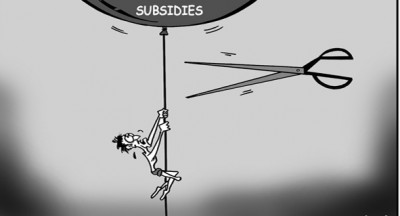
Lost In Translation: How a CO2 Abatement Scheme Became “Corporate Welfare on Steroids”

subsidies

Time to remember the original aim of the RET
Australian Financial Review
Danny Price
21 August 2014

The RET was intended to cut carbon. Opening it up to more forms of efficient generation would help get that result.

The debate over the renewable energy target has ended up exactly where you would expect a debate on subsidies to end up. The beneficiaries of the subsidy are taking the high moral ground while those adversely affected by the subsidy are crying foul.

We see similar debates in the agricultural sector. Australian farmers complain they face unfair market conditions because the international farmers they compete with have the protection of subsidies, while our government provides none.

In this case, the coal-fired generators claim they are finding it hard to recover their costs on existing investments while the renewable generators who earn a subsidised return, claim their future investments are threatened.

Both arguments are founded on the same concept – investment certainty.

What has been lost in all this debate is the original objective of the RET. The renewable industry has focused on the benefits it brings to customers by suppressing the price coal and gas generators can charge customers. But as PJ O’Rourke once observed about the US health system, “If you think healthcare is expensive now, wait until you see what it costs when it’s free.” The economic costs of lowering the wholesale price charged by thermal generators by subsidising renewable generators will be enormous.

The renewable energy sector has cleverly confused the concepts of economic costs, which are the costs of the resources used to produce renewable energy, with prices. They do this to disguise the real cost impact of the RET on the economy and to make themselves a smaller political target.

RET never about pricing

The goal of the RET was never about suppressing prices, but this is now the cause célèbre of the renewable industry because they know this will appeal to politicians looking to reduce electricity price pressure. The RET was aimed at encouraging a reduction in greenhouse gas emissions by actively promoting the, then-fledgling renewable industry.

The debate about the RET really should be re-focused on how we can achieve our environmental targets most economically. If we can minimise the costs of reducing emissions, then it follows that we are more likely to reduce emissions further, which Australia will inevitably be pressured to do at the Paris round of climate negotiations in late 2015.

More recently the renewable generators claim they are now cost-competitive with thermal generators. While these claims are probably overstating the relative economics of the thermal versus renewable generation, there is certainly less need to continue to subsidise investors in renewable generators as the RET has done its job in developing a local renewable industry. It is now time for the renewable industry to face competition and this competition should lead to lower economic costs and lower consumer prices.

This could be achieved by progressively levelling the playing field between all potential sources of electricity supply and demand so that all technologies can compete to supply emissions reductions.

Recent analysis of the opportunity to reduce the economic costs and price impacts of the RET by making it more technologically neutral, for example by allowing gas generators to compete with renewable generators and create partial credits under the scheme to reflect emissions abated, has shown that this approach can simultaneously reduce the economic cost of the RET by more than $1 billion and reduce prices for customers by more than $50 a year. This cost could fall further if other forms of cleaner generation could also compete vigorously with gas and renewable generators.

Part of the reason that this cost and price reduction occurs is that it makes use of existing gas capacity that mostly sits idle that could compete with coal under a more technologically neutral RET. This approach of broadening the RET to allow a wider range of technologies to compete to supply emissions reductions, is one of those rare no-regrets policies.

Competitive pressure

If no technology is able to compete with the renewable technologies (for example due to the risk of rising gas prices) then the worst thing that would happen is that wind generators would continue to be built. The only complaint that the renewable industry could have against such a proposal is that they would be subject to more competitive pressure.

With lower costs and prices from such a transformation of the RET, the government could afford to leave the target where it is and rely on the transformed RET to do more work to contribute towards the achievement of Australia’s emissions reduction.

Unfortunately, the only beneficiaries from such a transformation of the RET are customers and the economy and, sadly, there is nobody to advocate for these stakeholders in the current RET debate.

Danny Price is managing director of Frontier Economics.
Australian Financial Review

When Danny Price says: “The economic costs of lowering the wholesale price charged by thermal generators by subsidising renewable generators will be enormous” he’s playing as the master of understatement.

As Liberal Member for Hume, Angus “the Enforcer” Taylor has repeatedly pointed out, the mandatory RET is nothing short of “corporate welfare on steroids” (see our posts here and here and here).

Putting aside the hidden costs of providing fossil fuel back up to cover the occasions when wind power output plummets every day – and for days on end (see our post here); putting aside the need for a duplicated network to carry wind power from the back blocks to urban markets (seeour post here); putting aside the cost of running highly inefficient Open Cycle Gas Turbines to cover wind power “outages” (see our post here), the cost of Renewable Energy Certificates and their bedmate – the mandated shortfall charge will add a minimum of $39 billion, and – if the price of RECs reaches $100 (as is forecast under the current RET of 41,000 GWh) – up to $60 billion, to power consumer’s bills over the next 17 years (see our post here).

As Danny Price points out, the original purpose of (and justification for) the mandatory RET was the cost-effective abatement of CO2 emissions in the electricity sector. So Australian power punters – lumped with the task of propping up near-bankrupt outfits like Infigen (aka Babcock & Brown) via the redirection of $40-60 billion of their hard-earned cash over the next 17 years – might reasonably ask just how much CO2 abatement “bang” they’re getting for those very considerable bucks?

It’s the very question that Danny Price has been grappling with over the last few months.

STT followers will be pleased to know that Danny Price hates intermittent, unreliable and insanely expensive wind power with a passion – and that he’s been tasked by the Coalition with coming up with a workable method of achieving least-cost CO2 abatement.

Danny’s mission is to amalgamate the entirely unsustainable REC Tax – filched from unwitting power consumers and directed to wind power outfits – into the Direct Action policy, under which an Australian Carbon Credit Unit (CCU) will be issued to anyone stumping up audited proof that they’ve reduced or abated 1 tonne of CO2. The CCU will be tradeable on international markets and the equivalent of European carbon credits, which trade around A$8. Under Danny’s plan, RECs will be replaced with CCUs – and the subsidy per MWh of wind power will plummet from a projected $100 to less than $10. For a run-down on the mechanics of Danny’s plan – see our post here.

While seeing their subsidy gravy train slashed by 90% might sound a little like “bad news” for wind power outfits, earning CCUs comes with a BIG catch: CCUs will ONLY be issued where there is credible proof that the applicant has reduced or abated CO2. For wind power outfits this means coming up with actual proof (not smoke and mirrors “modelling”) that they have in fact reduced CO2 emissions in the electricity sector.

As youngsters sceptical of their peers’ more ambitious pronouncements say: “well, good luck with that”.

The need for 100% of wind power capacity to be backed up 100% of the time by fossil fuel generation sources means that wind power cannot and will never reduce CO2 emissions in the electricity sector (see our postshere and here and here and here and here and here and here).

E.ON operates numerous transmission grids in Germany and, therefore, has the unenviable task of being forced to integrate the wildly fluctuating and unpredictable output from wind power generators, while trying to keep the German grid from collapsing (E.ON sets out a number of the headaches caused by intermittent wind power in the Summary of this paper at page 4). Dealing with the fantasy that wind power is an alternative to conventional generation sources, E.ON says:

“Wind energy is only able to replace traditional power stations to a limited extent. Their dependence on the prevailing wind conditions means that wind power has a limited load factor even when technically available. It is not possible to guarantee its use for the continual cover of electricity consumption. Consequently, traditional power stations with capacities equal to 90% of the installed wind power capacity must be permanently online [and burning fuel] in order to guarantee power supply at all times.”

STT is happy to go all out and say that in Australia wind power requires 100% of its capacity to be backed up 100% of the time by conventional generation sources. As just one recent example, on 3 consecutive days (20, 21 and 22 July 2014) the total output from all of the wind farms connected to the Eastern Grid (total capacity of 2,952 MW – and spread over 4 states, SA, Victoria, Tasmania and NSW) was a derisory 20 MW (or 0.67% of installed capacity) for hours on end (see our post here). The 99.33% of wind power output that went AWOL for hours (at various times, 3 days straight) was, instead, all supplied by conventional generators; the vast bulk of which came from coal and gas generators, with the balance coming from hydro generators.

For wind power to reduce CO2 emissions in the electricity sector it has be a true “substitute” for conventional generation sources. Because it can’t be delivered “on-demand” (can’t be stored) and is only “available” at crazy, random intervals (if at all) wind power will never be a substitute for conventional generation sources (see our post here). Accordingly, wind power is simply incapable of reducing CO2 emissions in the electricity sector

The wind industry has never produced a shred of evidence to show that wind power has reduced CO2 emissions in Australia’s electricity sector. To the contrary of wind industry claims, the result of trying to incorporate wind power into a coal/gas fired grid is increased CO2 emissions (see thisEuropean paper here; this Irish paper here; this English paper here; thisAmerican article and this Dutch study here).

STT hears that Danny Price is well and truly alive to all that.

With Tony Abbott about to go on the offensive in his quest to wind up the mandatory RET (expect to hear more from the PM this week) the wind industry’s wild and unsubstantiated claims about CO2 abatement in the electricity sector provide the PM with just another reason to bring the greatest environmental and economic fraud of all time to a shuddering halt.

DannyPrice_banner1

Liberal Government Won’t Put a Wind Project Near Their Home in Toronto!!!

Ontario Place Grounds Would be Perfect For A Wind Project!

Bow Lake makes wind farm fight tough: MILLS 

By Tom Mills, Sault Star

With a government that continues to stack the procedural and legal deck against those who oppose the intrusion of wind farms on their neighbourhoods, you might expect to see turbines almost everywhere.

But it would take a sharp eye to spot one anywhere near the GTA. Wind-energy-watching is much easier in Algoma, Bruce and Chatham-Kent, which house about a third of Ontario’s turbines.

In a past column I mentioned the Toronto waterfront, where offshore wind turbines were seriously proposed. Then a Liberal government moratorium in 2011 put an end to the foolish notion of locating green energy generation where it might be consumed.

I’ve also suggested turbines be put in shopping malls, industrial parks and other places of large-scale ugliness within the bounds of the Greater Toronto Area.

One reader came up with the very feasible idea of lining Highway 400 with turbines from Barrie to Canada’s Wonderland.

Last week I found a couple of new prime locations: the Niagara Escarpment and the quaint main street of Niagara-on-the-Lake. Both seem to have wind in abundance.

Now NOTL, whose strict bylaws preserving the character of the historic village were strong enough to give a McDonalds sign fallen arches, would break out the 1812 muskets at the idea of blades whooshing o’er the fudge shoppes and inns.

And wine country doubtless would sour at the idea of blinking red lights festooning the limestone ridge like a strand of tacky Christmas lights.

But could they do much about it? I doubt it.

Preposterous, you say?

Well, a ruling last month by an environment ministry review panel on a wind farm north of Sault Ste. Marie makes it more daunting for anyone anywhere in Ontario to oppose a wind farm.

That panel shot down attempts by seasonal resident James Fata and others to block installation of turbines on a scenic hill area near the Lake Superior coast, the Bow Lake wind farm near Montreal River.

In the process, it pared down the grounds anyone could use to oppose a wind farm.

Both the approval and appeal processes set up by Ontario’s MOE already were heavily weighted against wind farm opponents.

As the tribunal’s decision notes, “An appellant is required to prove . . . that a project will cause the harm,” not just raise “the potential for harm.” No onus on the developer.

That seems akin to the government allowing pharmaceutical companies to dump drugs on the market and then requiring consumers to conduct scientific studies proving them to be unsafe.

And a tribunal is severely limited as to what reasons it can allow an opponent to use to object to a wind farm. None of that “scenic beauty” stuff for our ministry, even though this particular tribunal granted that the Superior landscape is “iconic.”

But the tribunal narrowed things even more by chopping references to property devaluation, economic impact on the tourism industry and a “prejudiced and unilateral consultation process” from the appeal.

That left Fata et al trying to prove turbines cause indisputably serious harm to human health, something many others have tried and failed, or latching on to an animal species that would be seriously and irreversibly harmed, in this case some little brown bats.

Evidence at the hearing suggested while turbines would doom a whole bunch of little brown bats, there are plenty more little brown bats where those came from.

And the tribunal rejected arguments by people such as adventurer Joanie McGuffin that the visual and social impacts of wind turbines on a natural landscape so striking as to have been featured by the historic Group of Seven artists could result in human health consequences.

So I’d say that leaves folks in Niagara with not too many weapons in their arsenal if some incentive-hungry developer proposed a wind farm.

Scenic beauty? Forget it. Historical significance? Nope. Tourist industry? Not likely.

About all that could stop a wind farm on NOTL’s Queen Street or along the escarpment is the fact that those places lie in the Greater Toronto Area’s back yard, much beloved of Kathleen Wynne’s Liberal government.

Yep. That should do it.

Email tom.mills@sunmedia.ca to contact Tom Mills. Comment at saultstar.com.


Even the Climate Alarmists are Admitting it was a Hoax!

BBC Alarmists admit the Global Warming Slowdown.
The BBC had its start as an eco-propaganda unit for the Global Warming Alarmist’s campaign after 30 key BBC staff’ and ‘30 invited guests’ attended a seminar. The Daily Mail reported that the BBC tried to hide this for 6 years:

The BBC has spent tens of thousands of pounds over six years trying to keep secret an extraordinary ‘eco’ conference which has shaped its coverage of global warming, The Mail on Sunday can reveal.
The controversial seminar was run by a body set up by the BBC’s own environment analyst Roger Harrabin and funded via a £67,000 grant from the then Labour government, which hoped to see its ‘line’ on climate change and other Third World issues promoted in BBC reporting.
At the event, in 2006, green activists and scientists – one of whom believes climate change is a bigger danger than global nuclear war – lectured 28 of the Corporation’s most senior executives. (link)
Seems like someone has taken the Kool-Aid (or is it FOOL-Aid?) from the BBC’s watercoolers because this week they not only acknowledged the warming hiatus, but have raised the possibility that the
Global warming slowdown ‘could last another decade’
The hiatus in the rise in global temperatures could last for another 10 years, according to new research.
Scientists have struggled to explain the so-called pause that began in 1999, despite ever increasing levels of CO2 in the atmosphere.
The BBC reported a peer reviewed paper published in Science in August (link) which tried to explain the warming hiatus (or as they expressed it, “global-warming slowdown”)

Varying planetary heat sink led to global-warming slowdown and acceleration
A vacillating global heat sink at intermediate ocean depths is associated with different climate regimes of surface warming under anthropogenic forcing: The latter part of the 20th century saw rapid global warming as more heat stayed near the surface. In the 21st century, surface warming slowed as more heat moved into deeper oceans.
How the heat missed the surface and went into the deep ocean has not been explained.

The ‘deep ocean’ theory has been ridiculed by IPCC expert reviewer Lord Christopher Monckton:

The warming is hiding in the bottom of the ocean. Someday it will pop out and say BOO!
They are saying that it somehow managed to go from the atmosphere into the ocean. Not into the bit of the ocean that touches the atmosphere, no, it missed that out and it’s gone down and hidden in the bottom of the ocean where we can’t measure it. And one day it’s going to come out and say boo!

Global Warming Alarmists Being Less Than Honest With The Public! Not Surprised….

This article ties in nicely, with the previous one

posted, telling Why they Lie


Are scientists cooking the books?

Warming scientists accused of adjusting temperature data to show warming

 Australian cooling turns to warming z

Can there be a valid discussion about the climate if warmist scientists are cooking the books?

The failure of climate computer models to accurately project recent temperatures is a major embarrassment for warming campaigners.   The models nearly universally call for more warming than has actually occurred.  This has left the warming crowd scrambling to explain the missing warming.  The folks who publish the Hockey Schtick blog are now up to 38 excuses for the missing warming.  Marc Morano has details at Climate Depot.

Meteorologist Anthony Watts has been documenting accusations of researchers placing their thumbs on the scale to create warming for years.

Now comes reports that the Australian Met Office has been adjusting temperature data to cool the past and create a warming trend that does not appear in the raw data.

The escalating row goes to heart of the climate change debate — in particular, whether computer models are better than real data and whether temperature records are being manipulated in a bid to make each year hotter than the last. Marohasy’s research has put her in dispute with BoM over a paper she published with John Abbot at Central Queensland University in the journal Atmospheric Research concerning the best data to use for rainfall forecasting. BoM challenged the findings of the Marohasy-Abbot paper, but the international journal rejected the BoM rebuttal, which had been prepared by some of the bureau’s top scientists. This has led to an escalating dispute over the way in which ­Australia’s historical temperature records are “improved” through homogenisation, which is proving more difficult to resolve.  (The Australian, h/t Benny Peiser).

Marc Morano is also featuring reports that NASA is erasing past Arctic warming from its records.

Nothing is more fundamental to the scientific method than the rule that we must adjust our hypotheses to fit the data.  Adjusting the data to fit the hypothesis is an academic/scientific crime no matter how plush the funding.

Accusations of global warming data manipulation demand full and unbiased investigations.

Political correctness has no place in science.  Only scientifically correct will do.

– See more at: http://www.cfact.org/2014/08/23/are-scientists-cooking-the-books/#sthash.b5UY1NzA.dpuf