The Good People of Maine have made Radio Commercials to Educate the Public about Wind Turbines!

Listen to Saving Maine’s first three radio commercials exposing wind power in Maine

Click right here and turn your speakers on. These spots are being aired as part of Saving Maine’s continuing advertising effort to counter the wind propaganda spewed by the wind industry and their sock puppets at Maine’s so called environmental groups who have sold out the people of Maine.

 
Click here and then click on each of the three :60 radio spots.


Wind power sailed into Maine on a free pass and has survived thus far based on cheer leading from the Baldacci administration which in 2008 pushed through a law written by and for the wind industry. That law, which completely stacked the deck against ordinary Mainers, will be changed and advertising will speed up the process. For the first time, through the power of paid advertising, large numbers of Mainers are learning the other side of the wind story – paid for by their fellow Mainers.
 
These wind companies are on the ropes. It is time to put them away. So make sure we keep the pressure on by clicking the DONATE button at http://savingmaine.org/ Even a small amount will add up so go ahead and click that button and ask everyone you know to do the same. Please do this today.
 
The following is from a wind industry consultant and it speaks volumes about the importance of getting our message out:


During the webinar, Justin Rolfe-Redding, a doctoral student from the Center for Climate Change Communication at George Mason University, discussed ways for wind-energy proponents to get their message out to the public.Rolfe-Redding said that polling data showed that “after reading arguments for and against wind, wind lost support.” He went on to say that concerns about wind energy’s cost and its effect on property values “crowded out climate change” among those surveyed.


The most astounding thing to come out of Rolfe-Redding’s mouth — and yes, I heard him say it myself — was this: “The things people are educated about are a real deficit for us.” After the briefings on the pros and cons of wind, said Rolfe-Redding, “enthusiasm decreased for wind. That’s a troubling finding.” 

When Will All Governments Follow the Aussies lead? Not soon enough!

Australian Wind Industry Doomed: Tony Abbott Signals the End of the Mandatory RET

wind_turbine_fire

STT followers have been delighted with news that Tony Abbott, Joe Hockey and Mathias Cormann have teamed up to axe the mandatory RET (see our post here).

In response to the PM’s mooted plan, the wind industry and its parasites have been reduced to making idle threats of “revenge” and bleating about “sovereign risk”. Despite a rear-guard effort by Environment Minister, Greg Hunt to salvage something of the mandatory RET, his boss has confirmed that his mission is to kill it outright. And that pretty much means the end of the wind industry as we’ve known and grown to despise it. Here’s the Australian Financial Review on the beginning of the end.

Coalition fails to budge on RET pruning
Australian Financial Review
Phillip Coorey
26 August 2014

Pleas by solar and wind companies to leave the Renewable Energy Target untouched have fallen on deaf ears with the government deciding to proceed with a phasing down of the scheme.

While a final position will not be announced until next month, The Australian Financial Review understands the intent is to cut the scheme harder than a compromise scenario that was being pursued by the Environment Minister, Greg Hunt.

The end result will be closer to the abolition scenario advocated by Prime Minister Tony Abbott which would end the scheme by closing it to new entrants and grandfathering existing large scale projects.

Seeking to overcome the cabinet split, Mr Hunt, Mr Abbott and Industry Minister Ian Macfarlane met on Sunday to discuss a policy position to be put to the bureaucracy for analysis and then to the cabinet for a final decision.

The government is being guided by the findings of the review into the RET conducted by businessman Dick Warburton, a person the industry has argued is ill-suited to the task because he is a climate-change sceptic.

The guiding principles of the final decision will be to balance investor risk with the impact of the RET on household and business power bills. Mr Abbott claims the RET has had a significant impact on power prices. The government’s own modelling shows while the RET has added $40 a year to average household power bill, prices will fall over the medium term as more renewable energy is produced.

The industry is ramping up its warnings that any dilution of the current scheme will not only jeopardise more than $11 billion in the renewable energy investment pipeline, but create a broader sovereign risk perception for Australia.

Close watch on outcome

Philip Green, the London-based partner of the Children’s Investment Master Fund (TCI), which has a 33 per cent stake in renewable energy company Infigen, said the issue was being watched closely. “Sovereign risk has already increased in Australia given the media coverage of the carbon debate and now the RET. Sovereign risk will increase more if the stories about cuts to the RET are confirmed,” he said in a statement.

“This comes at a cost to the nation through higher capital costs as it seeks future investment in infrastructure. The Australian RET had strong bi-partisan political support [including from the current prime minister]. It can take a long time to restore trust and in some cases this is only achieved with a change in leadership/policy/party.”

Under the RET, a policy which hitherto had bipartisan support, 20 per cent of Australian’s energy production by 2020 would come from renewable sources. Based on earlier predictions of power production in 2020, this 20 per cent target was calculated at an annual production of 41,000 gigawatt hours.

But the 2020 production total has been downgraded following the decline of the manufacturing sector, including automotive and aluminium.

Consequently, 20 per cent of the revised production target is 27,000 GWh. This is the “real 20 per cent” scenario for which Mr Hunt is advocating.

Under the push by Mr Abbott, renewable energy output would be frozen at current levels of about 16,000 GWh.

Any proposed change faces a near impossible passage through the Parliament with Labor and the Greens opposed to any alteration, while Clive Palmer says he will not allow any change unless Mr Abbott goes to the next election in 2016 and wins a mandate.
Australian Financial Review

dick-warburton

STT thinks the constant reference to Dick Warburton as a “climate-change sceptic” is just churlish bitterness from the vanquished. From STT’s viewpoint, Dick did precisely what he was supposed to do: standing up for Australian power consumers and helping to bring an end to the most costly and pointless piece of policy ever devised.

And, yet again, the wind industry – and those with shirts to lose when it collapses – trot out the furhpy about “sovereign risk”. Not only is it utter bunkum (see our posts here and here and here and here), harping on about it won’t save the wind industry from the inevitable demolition of the mandatory RET.

The AFR talks about Australia risking “$11 billion in the renewable energy investment pipeline” as if that were some kind of loss to Australian power consumers, in an already over-supplied market. As we’ve previously pointed out, the threatened “investment” is hardly a “no-strings attached-gift”. The would be investors are after annual gross returns in the order of 20% on that figure – ie, a cool $2.2 billion, every year – which can only be recouped from power consumers through higher power bills – with a fat pile of RECs underwriting the “investment” (see our post here).

As a piece of friendly advice, we wouldn’t be betting the house on Clive Palmer blocking any changes to the RET in the Senate. Horse trading is the life-blood of politics; and a week can be a very long time for anyone engaged in the political caper. As you’d expect, STT hears that Tony Abbott is already doing business with the Senate’s cross-benchers, including the PUP in order to come up with a workable solution to the debacle that is the mandatory RET, which has utterly failed as a cost-effective CO2 abatement policy.

Clive Palmer wants an Emissions Trading Scheme (albeit with the price of credits set at zero). So the Coalition’s Direct Action policy is being reworked by top energy market economist, Danny Price in a manner that will not only resemble something like what Clive is after, but in a way that will slash the value of the subsidies to wind power outfits (as promised by the RET) by around 90%. One of the cross-benchers, Nick Xenophon – who works closely with Danny Price – is in on the mission to kill off the wind industry, by introducing some tweaks of his own to Coalition policy, aimed at achieving least-cost CO2 abatement (see our posts here andhere). Another cross-bencher, David Leyonhjelm penned a piece for The Australian today (we’ll cover it shortly) setting out his eagerness to kill the mandatory RET, which he sees as “just government mandated corporate welfare” that will cost power consumers $billions “for no measurable environmental benefit”. No, STT didn’t write David’s article.

But, in the result, whether or not changes to the mandatory RET occur during the life of this parliament is a matter of passing academic interest. The wind industry is doomed simply because – from here on – NO retailer in touch with their earthly senses will enter a long-term Power Purchase Agreement with a wind power outfit – which means that those desperados still hoping to build wind farms will never obtain the finance needed to do so. Moreover, the REC price is bound to head south over the coming weeks and months, placing outfits with current wind farm operations in mortal financial jeopardy.

One of those facing an early exit from the stage is our old favourite, Infigen. These boys have just announced an $8.9 million loss for 2013/14, which follows a $55 million loss in 2011/12 and an $80 million loss for 2012/13 (see our posts here and here). Those hefty losses were all racked up at a time when the mandatory RET was set in stone, such that the regulatory cards were all firmly stacked in Infigen’s favour.

With the mandatory RET set for the chop, Infigen is preparing to emulate its predecessor (Babcock & Brown) with another spectacular financial collapse. Here’s the Australian Financial Review setting the scene for Babcock & Brown Mk II.

Infigen at risk if RET wound up
Australian Financial Review
Angela Macdonald-Smith
26 August 2014

Wind power producer Infigen Energy has warned it could fall into breach of its debt covenants within three months should the 2020 Renewable Energy Target be wound back with no compensation for affected investors.

Managing director Miles George said either of the two outcomes apparently being favoured by the government for the overhaul of the RET would be “disastrous” for both the industry and Infigen.

He said significant write-downs would follow, with the loss of value for Infigen more than its current market cap of about $185 million.

The government is thought to be considering two potential outcomes for its RET review, one involving reining the 2020 target back to represent a “real” 20 per cent of electricity use, rather than the 26 per cent to 28 per cent it is currently expected to represent.

The other involves closing off the scheme to new entrants, while honouring existing contracts only.

“Either of these scenarios is disastrous for our industry,” Mr George said, after Infigen posted an $8.9 million full-year net loss, affected by the regulatory uncertainty. “They are both death for the renewable energy industry and, to be frank, they are death for Infigen.”

He said if no compensation was provided for investors, the resulting weakness in the price of large-scale renewable energy certificates would cut cash flow for debt servicing. As a result, Infigen would be at risk of breaching its covenants within three months.
Australian Financial Review

This couldn’t be happening to a nicer bunch of lads.

dirtyrottenscoundrelsoriginal

You Cannot Trust the Climate Alarmists. They Have an Agenda & They’re Willing to Lie!

But….but….the truth won’t scare the masses!


Who’s going to be sacked for making-up global

warming at Rutherglen?

HEADS need to start rolling at the Australian Bureau of Meteorology. The senior management have tried to cover-up serious tampering that has occurred with the temperatures at an experimental farm near Rutherglen in Victoria. Retired scientist Dr Bill Johnston used to run experiments there. He, and many others, can vouch for the fact that the weather station at Rutherglen, providing data to the Bureau of Meteorology since November 1912, has never been moved.

Senior management at the Bureau are claiming the weather station could have been moved in 1966 and/or 1974 and that this could be a justification for artificially dropping the temperatures by 1.8 degree Celsius back in 1913.

Surely its time for heads to roll!

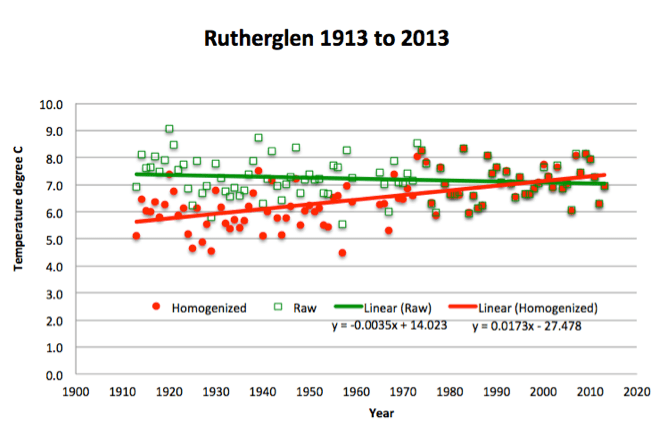
The temperature record at Rutherglen has been corrupted by managers at the Australian Bureau of Meteorology.


Some background: Near Rutherglen, a small town in a wine-growing region of NE Victoria, temperatures have been measured at a research station since November 1912. There are no documented site moves. An automatic weather station was installed on 29th January 1998.

Temperatures measured at the weather station form part of the ACORN-SAT network, so the information from this station is checked for discontinuities before inclusion into the official record that is used to calculate temperature trends for Victoria, Australia, and also the United Nation’s Intergovernmental Panel on Climate Change (IPCC).

The unhomogenized/raw mean annual minimum temperature trend for Rutherglen for the 100-year period from January 1913 through to December 2013 shows a slight cooling trend of 0.35 degree C per 100 years. After homogenization there is a warming trend of 1.73 degree C per 100 years. This warming trend is essentially achieved by progressively dropping down the temperatures from 1973 back through to 1913. For the year of 1913 the difference between the raw temperature and the ACORN-SAT temperature is a massive 1.8 degree C.

There is absolutely no justification for doing this.

This cooling of past temperatures is a new trick* that the mainstream climate science community has endorsed over recent years to ensure next year is always hotter than last year – at least for Australia.

There is an extensive literature that provides reasons why homogenization is sometimes necessary, for example, to create continuous records when weather stations move locations within the same general area i.e. from a post office to an airport. But the way the method has been implemented at Rutherglen is not consistent with the original principle which is that changes should only be made to correct for non-climatic factors.

In the case of Rutherglen the Bureau has just let the algorithms keep jumping down the temperatures from 1973. To repeat the biggest change between the raw and the new values is in 1913 when the temperature has been jumped down a massive 1.8 degree C.

In doing this homogenization a warming trend is created when none previously existed.

The Bureau has tried to justify all of this to Graham Lloyd at The Australian newspaper by stating that there must have been a site move, its flagging the years 1966 and 1974. But the biggest adjustment was made in 1913! In fact as Bill Johnston explains in today’s newspaper, the site never has moved.

Surely someone should be sacked for this blatant corruption of what was a perfectly good temperature record.

———-

Climate records contradict Bureau of Meteorology by Graham Lloyd, 27th August
http://www.theaustralian.com.au/national-affairs/climate/climate-records-contradict-bureau-of-meteorology/story-e6frg6xf-1227037936046

The story is behind a paywall. But if you don’t already have a subscription perhaps its time… this could just be the biggest story of the year.

** There are a lot of tricks that climate science managers have implemented over the years to fix the temperature record; that is fix it so it shows global warming. “Trick” was the word Phil Jones, a leading United Nation’s Intergovernmental Panel on Climate Change (IPCC) scientist, used to explain to his peers that, when constructing very long global temperature series using proxy data based on tree ring measurements that can extend back thousands of years, it was best to substitute thermometer data for this proxy data from about 1960 because the proxy data started to show cooling from about then. Indeed from about 1960 until 2002 the thermometer data mostly did show warming. But now even this instrumental record is starting to show cooling. Enter the relatively new trick of homogenization.

All This Faux-Green Nonsense does Nothing to Help our Environment!

Right argument, wrong argument

Opinions and arguments against the Clean Power Plan all stick to economics, they fail to include any opinion on whether the rule will meet it’s goals.A case in point is an opinion piece in the Durham Herald Sun, Stop the EPA’s war on North Carolina. The article stresses the potential economic damage to the state from the proposed rule.  It never mentions the doubtful benefits from the rule:  no measurable decrease in global temperatures and no evidence that the health benefits will be realized.  In fact, the air pollution data and asthma incidence data show no correlation.  People might support something that saves the planet and lives.  How much would they be willing to pay for something that does neither of these?  We now have McCarthy saying this monstrosity is a jobs plan and ignoring the supposed benefits.

Why not attack the plan on it’s merits?

Even the “Slower” Aussies, are catching on, to the fact that Wind Turbines are Useless!

How the Public Are Deceived About the True Cost of the Mandatory RET

sprinter_2248190b

The Australian Financial Review – as one of the lefty Fairfax stable – “drank the Kool Aid” early and happily ran with the wind industry’s narrative that having Australia bristle with giant fans is a sure-fire way of cooling mother Earth; that wind power is free; and that the mandatory RET is public policy at its best.

In short, the AFR has been a faithful outlet for wind industry spin and propaganda. Regurgitating an endless stream of Clean Energy Council (CEC) press releases; and giving the likes of Infigen (aka Babcock & Brown) free rein to spruik about the “wonders” of wind – never questioning, let alone challenging, the wild and fantastic claims made about lowering retail power prices (all while “saving” the planet, of course) – it’s been a serious media outlet of choice for the wind industry and its parasites.

Until now.

In the last few weeks there’s been a seismic shift in the AFR’s approach to the imminent demise of the mandatory RET. Faced with an increasing barrage of hysterical claims about the world ending if the RET gets the axe (by the likes of the CEC and Infigen’s Miles George) the AFR’s journos and editor have finally opened their eyes to the greatest rort of all time. And, to the horror of the CEC and its taskmasters, they’ve stopped buying the myths and mis-information pitched up by Infigen & Co.

Phil Coorey’s piece on how Tony Abbott, Joe Hockey and Mathias Cormann have joined forces to bring an end to most ludicrous policy ever devised sent the wind industry into a state of panic (see our post here).

Since then, the AFR has followed up with a terrific piece from Alan Moran and an editorial calling the mandatory RET flawed and unsustainable (seeour post here) – and a detailed analysis of the inherent flaws and failings of the RET by crack energy market economist Danny Price (see our post here).

With the AFR turning on it, the wind industry must know its days are numbered.

The AFR continues its recent trend with this fine piece of work by Ben Potter and another terrific editorial that strip away the myth that the mandatory RET is a benign piece of “climate change” policy which won’t cost power consumers a thing.

Renewable energy lobby’s shell game
Australian Financial Review
Ben Potter
25 August 2014

shell-game2009Mar06

The renewable energy lobby employs a neat trick to show that billions in subsidies for the costliest forms of electricity can lower power prices.

Wind and solar power costs between 1½ and 10 times as much to produce as power from coal and gas. But the vagaries of the National Electricity Market allow the renewables sector to claim that it lowers prices – even if it imposes costs on consumers elsewhere.

In a shell game, a conman quickly moves around three shells on a table or mat and his buddies pressure passers-by to bet which one contains a pea.

The pea under the shell is $37 billion of renewable energy certificates (RECs) that electricity retailers will buy from renewable energy generators or generate themselves between now and 2030 if the renewable energy target scheme isn’t changed.

“It’s misleading, because the subsidy is the REC, and the REC certificate is acquitted at the retail level and is included in the retail price of electricity,” Origin Energy chief executive Grant King says.

The renewable energy target has helped drive installations of 52 wind farms and 1.3 million solar roof-top systems – about one-eighth of total capacity – since 2001, Bloomberg New Energy Finance says.

The NSW Independent Pricing and Regulatory Tribunal estimated the cost of the renewable energy target to the average household in 2013-14 at $107 – about 5.3 per cent of a typical $2012 bill.

It is now under review by a panel headed by businessman Richard Warburton, who is sceptical that human activity is causing global warming.

Because the price of RECs is about the same as the electricity price per megawatt/hour, renewables generators are deriving as much revenue from selling RECs as they are from selling power to the National Electricity Market.

“All it is is a tax on existing producers which is passed onto existing consumers,” says Tony Wood, head of the energy program at the Grattan Institute.

“No one denies, when they are asked the right question, that renewable energy costs more than fossil energy.

“The only question is who pays for it? And right now it’s a combination of consumers and fossil generators who are paying for it, and you’ve got to question is that the right policy?”

The RET’s costs are buried in ACIL Allens’ modelling for the RET review and a report issued by the Climate Institute last week.

Most of the costs are REC costs. Deloitte Access Economics in a report for business groups estimates the net present value of REC transfers to the renewables industry over 2015-30 at $17 billion, compared with $8 billion to $9 billion if the RET is closed or the target is wound back to a true 20 per cent of energy supplied.

When REC costs are included, retail bills are higher until at least 2020, after which opinions diverge.

ACIL Allen and the Climate Institute find that continuing the RET on its current path lowers household power bills by as much as $80 a year from now to 2030, despite swelling bills between now and 2020. Deloitte, using different assumptions about capital costs, falling demand and market responses, finds retail bills higher after 2020 as well.

The Climate Institute report shows the high long-run marginal production costs of solar and wind power – which include capital costs – relative to coal and gas. Coal and gas power come in at about $60 to $80 a megawatt hour in the eastern states, wind at $88 to $544 a megawatt hour and solar at $128 to $1533 megawatt hour.

But when it comes to bidding in the National Electricity Market, wind and solar clean up because they have zero short-term marginal costs (in the short term, capital costs are less important). Wood argues they even have negative short-term marginal costs because they need to produce energy to sell RECs.

The rising RET target forces renewables into the NEM, even though electricity demand is shrinking and no more capacity is required. Those factors combine to suppress wholesale prices, which have dipped below $40 a megawatt hour.

That in turn squeezes profits and market share for coal and gas generators, which have to cover their fuel costs, at peak times when they used to make their profits. Retailers then have to buy or generate renewable energy certificates to cover the renewable energy target – currently about 10 per cent, rising to about 28 per cent by 2020. The REC cost goes into the retail price.

If that cost is less than the wholesale price suppression, the consumer wins. But it’s a fine call, says Wood.

The RECs subsidy costs about $29 billion in net present value economic activity, 5000 jobs and $1260 in average annual earnings. This comes from more costly investments in renewables, which Deloitte says raise power prices and suppress resources, jobs and demand in other sectors.

Erwin Jackson, deputy chief executive of the Climate Institute, says such losses are more than offset by the benefits of emissions reductions under the RET.

A Climate Institute report released last week puts a much lower $2.7 billion economic cost on the RET. It finds it lowers household power bills after 2020. It values the social benefits of emissions cuts at $19 billion, based on a $24 to $50 a tonne social cost of carbon. Mr Jackson said this was almost certainly an under-estimate but “you have to factor it in, otherwise it’s a one-sided model and you are assuming climate change doesn’t exist.”

He admitted it was only an estimate of the RET’s contribution to global climate change efforts – offset by emissions increases in large emerging economies such as China and India – rather than any quantifiable benefit to Australia.

But it was the “best tool we have” to “open up the conversation” to considering the benefits of reducing emissions.

“What they’ll talk about very carefully is the cost to consumers, and they’ll show the cost to consumers is either slightly favourable or not much different – therefore ‘isn’t this a reasonable price to pay for renewable energy?’” Wood says.

“What they are very careful not to say [is] ‘what’s the cost to the Australian economy?’ because the cost to the economy includes the negative cost to the existing generators.

“To say that the renewable energy target is a small impost to consumers is the right answer but it’s the wrong question. The right question is ‘what’s the economic impact of the RET?’ and the economic impact of the RET is negative.”

The RET is a costly way to cut greenhouse gas emissions. Its price of abatement is $54 to $186 a tonne, up to eight times the recently abolished carbon price, ACIL Allen modelling for the RET review finds.

A cheaper – but politically tricky – way to reduce emissions to would be to return to a technology neutral carbon price signal.

The difference between Deloitte’s estimate of the REC cost savings from winding back the RET to a true 20 per cent and closing it – $9 billion – is similar to the $10 billion “additional profit” for coal and gas generators – such as Origin and EnergyAustralia – claimed by the Climate Institute report.

“It’s not that they’re better off because the RET was removed. It’s that they’re worse off because the RET was introduced,” Wood says.

Tim Sonnreich, strategic policy manager at the Clean Energy Council, an industry body, accepts that there’s a substantial wealth transfer from incumbent generators to renewables generators.

“We are not denying that,” Sonnreich says. “But it’s a wealth transfer that’s in favour of consumers so we would have thought in a political sense that’s a pretty popular one.”
Australian Financial Review

A valiant effort there from the CEC, as its spin master plays the shell game and otherwise attempts to turn night into day.

The mandatory RET sets up the greatest wealth transfer in the history of the Commonwealth. However, it’s not – as the CEC asserts – one that power consumers are going to thank their political betters for. That transfer – which comes at the expense of the poorest and most vulnerable; struggling businesses; and cash-strapped families – is effected by the issue, sale and surrender of RECs. As Origin Energy chief executive Grant King correctly puts it:

“[T]he subsidy is the REC, and the REC certificate is acquitted at the retail level and is included in the retail price of electricity”.

It’s power consumers that get lumped with the “retail price of electricity” and, therefore, the cost of the REC subsidy to wind power outfits. Between 2014 and 2031, the mandatory RET requires power consumers to pay the cost of issuing 603.1 million RECs to wind power generators. With the REC price likely be at least $65 (by 2017) – and tipped to exceed $90 – the wealth transfer from power consumers to the wind industry will be somewhere between $40 billion and $60 billion, over the next 17 years (see our posts here and here).

Here’s the AFR’s editor in response to the wind industry’s latest efforts to spin its way out of trouble.

Models can’t hide true RET cost
Australian Financial Review
Editorial
25 August 2014

Studies relied on by the renewable energy lobby to justify the continuation of the Renewable Energy Target make a lot about noise about the RET’s effect on the wholesale price of energy. But as shown in this newspaper today, force feeding up to 30 per cent renewables such as wind and sun-generated electricity into the power grid may put downward pressure on wholesale prices amid weak demand by artificially boosting supply. But the effect of forcing more power into the system will then show up in other ways: by increasing retail prices through the cost of renewable energy certificates. Those increased prices will reduce gross domestic product, by depressing productivity and by pushing up prices and costs elsewhere in the economy. That is, it is a highly expensive way to reduce emissions.

As previously discussed in this newspaper, an ongoing review of the RET led by Dick Warburton to make recommendations about winding back or even ending the scheme has resulted in considerable argument over the scheme’s effect on the electricity markets. These arguments include contradictory findings by computer modelling groups, with the RET lobby relying on studies pointing to the effect of dumping a lot of additional capacity into the wholesale market at a time of stagnating demand. However, as the coverage in today’s Financial Review notes, retailers still have to buy the Renewable Energy Certificates required to meet their obligations under the RET from the renewable generators, and that is expected to cost $37 billion between now and 2030, or as much as the electricity itself. That is $37 billion that must be reflected in higher prices elsewhere.

The arguments over the Renewable Energy Target show just how deftly skilled lobbyists can distort the debate, but we should not lose sight of the fact that the RET in any form will cost many billions of dollars in return for an hypothetical social benefit of the carbon emissions being offset.
Australian Financial Review

dirtyrottenscoundrelsoriginal

Joe Bastardi. A Meteorologist, that Has Not Been Tainted by the Alarmists!

A Single Meteorologist Explains What $165 Billion In Government-Funded Climate Science Couldn’t

By P Gosselin on 24. August 2014

Large scale oceanic oscillations responsible for most of the post 1980 “warming”

By Joe Bastardi

I think global warming is a misnomer.

There is a distortion of the temperature pattern on the globe, brought about by the natural cyclical warming events of the warm PDO and warm AMO together. I spoke about this at Heartland a couple of years ago – how the sea ice increase in the south and the decrease in the north were the hidden message that here is no “warming” just a distortion.

http://notrickszone.com/2014/08/24/a-single-meteorologist-explains-what-165-billion-in-government-funded-climate-science-couldnt/

A combination of human identified patterns forming a greater pattern, no surprise.

I’ve been watching the north/south change for a long time, making a coherent whole of this from data eluded me, in part from the unreliable nature of older data.

Quite what Talkshop opinion will make of it given various views will I hope be good reading.

Another Cancelled Wind Project…..Wonderful News, Indeed!

A warning for Orland: Wind developer has

history of rewriting history 

A &quotconceptual turbine layout" presented to Orland residents at an informational meeting about a potential wind project in this town.

Cashman Commnications
A “conceptual turbine layout” presented to Orland residents at an informational meeting about a potential wind project in this town.

Eolian Renewable Energy of Portsmouth, New Hampshire, recently announced that it was abandoning its Seneca Mountain Wind project in Vermont’s Northeast Kingdom. Seneca joins unsuccessful Eolian wind projects in Antrim, New Hampshire, and Frankfort, Maine.

Eolian has a history of failure and a history of rewriting history. The company’s latest revision is that it dropped the Seneca project because it lacked community support. Observers in the Kingdom don’t think that Eolian gave a hoot about community support. They say that the decisive factor was a study that revealed that the Seneca project would require$86 million in transmission upgrades. They suggest that Eolian’s respect for communities is a fiction they’re promoting to impress their current target: Orland, Maine.

The Seneca project was always a bad idea. It would have industrialized and fragmented Vermont’s second-largest habitat block and degraded habitat for a number of rare, threatened, and endangered species. The project would have encroached upon thousands of acres of conservation land. It would have jeopardized the headwaters of four rivers.

Eolian showed little appreciation for the area’s ecological value. The company’s environmental evaluation appears to have been written hastily, as if to satisfy an unimportant, inconvenient requirement. When their assertions about the area’s geology, the elevation of mountains, and distances to nearby bodies of water were challenged, Eolian’s environmental consultants excused themselves by explaining that they had used old reference materials that were hard to read.

Eolian’s website says, “We are committed to engaging and listening to stakeholders.”Their track record in Vermont suggests otherwise. Eolian kept its Seneca project planunder wraps until March 7, 2012, the day after Vermont’s Town Meeting Day. They failed to notify adjoining landowners. Their surveyors intruded upon neighboring properties without permission. Their attorneys fought to prevent and limit the participation of towns and neighboring landowners in Vermont’s permit process.

Eolian committed to leave any of the three Kingdom towns that voted against their project. But, in Vermont, towns don’t get to vote on energy projects — the state’s Public Service Board makes all decisions. The voting that Eolian encouraged would have had no legal standing and they could ignore it if it went the wrong way.

Newark, Vermont, one of towns targeted for the Seneca project, adopted a town plan that clearly stated its opposition to industrial wind projects. (Vermont statute gives town plans “due consideration” in energy matters.) A special town meeting approved the plan by a vote of 169 to 59. But, where Eolian goes, litigation follows. Newark (like Frankfort, Maine) was promptly sued by the owner of land leased by Eolian.

Brighton, another of the Seneca towns, voted 544 to 320 to oppose industrial wind development. The purpose of this vote was to guide development of the next town plan.

Neither of these votes was good enough for Eolian — they would only honor a vote on their specific project proposal.

Tiny Ferdinand, the third town targeted by the Seneca project, gave Eolian its chance. Ferdinand (population 31) has more hunting camps than residences. It is part of the Unified Towns and Gores. Eolian persuaded the UTG’s board of governors to conduct a vote of residents and property owners on a 60-megawatt project that would be located entirely within Ferdinand.

Eolian campaigned energetically, promising a bonanza. For 20 years they would pay the UTG’s municipal taxes and provide each UTG property owner with an annual payment of over $900.

The UTG stunned Eolian by voting 171 to 71 against the project.

An Eolian vice president responded by saying, “It is very clear to us that there is strong support for the project.” He hinted that Eolian would try to build support for a reworked project. Perhaps they’d move each turbine 10 feet to the west.

The UTG votes were counted in January. The $86 million transmission cost was revealed in May. Eolian announced the abandonment of its Seneca Mountain Wind project in July.

Shouldn’t Eolian have known long ago that the cost of connecting to the grid would be high? They did — a Vermont transmission expert told them over two years ago that the transmission system could not accommodate another utility scale generator and that price of connecting would be prohibitive.

Why did Eolian pursue a doomed project for so long? Maybe their investors are asking the same question.

Mark Whitworth is the executive director of Energize Vermont, which advocates for renewable energy solutions that are in harmony with the character of Vermont.


Anti-Wind Protesters Take Their Issues, Right to the Pollies!

Pollies hit spot of turbulence

THE Premier and Planning Minister walked into an Indian restaurant.

One was told he “wouldn’t know if his arse was on fire”; the other urged to wear a caricature mask mockingly depicting her own face.

Anti wind farm protesters made sure Mike Baird and Pru Goward received their message loud and clear at lunchtime on Friday.

The crowd – made up predominately of members from the Residents Against Jupiter Wind Farm group – used placards, T-shirts, masks, verbal jibes and even a replica turbine to reinforce their point outside the Southern Star Inn.

Premier Mr Baird and Planning Minister Ms Goward were among those who converged on the Reynolds Street restaurant for a Liberal Party fundraiser.

Some of the very people protesting out front laid down their signs and strolled into the luncheon – at a cost of $50-a-head.

They urged Mr Baird and Ms Goward to better consider landowners’ views and ensure consumers were exempt from paying a wind farm excess that benefits operators.

One protestor pleaded with the government to consider compensation for landholders whose property values have plummeted courtesy of wind farm developments.

Both the Premier and Planning Minister handled flak diplomatically.

“Good on you,” Mr Baird said in response to banter that claimed he wouldn’t know if his own backside was alight.

Ms Goward politely refused to wear one of the many masks indicating the Member for Goulburn was being figuratively gagged by Cabinet.

“I’m not going to wear myself,” she said.

Others present at the protest and Liberal Party fundraiser included mayor Geoff Kettle, his neighbouring compatriots John Shaw from Upper Lachlan and Wingecarribee’s Juliet Arkwright, Goulburn Mulwaree councillor Sam Rowland, outspoken anti wind farm campaigner Humphrey Price-Jones, and Christian Democrat candidate from the 2013 federal election, Adrian Van Der Byl.

The protesters’ motives transcended party politics, Residents Against Jupiter Wind Farm member Michael Crawford said.

“We’re aiming to get a message across to the government in terms of the resistance here,” he said on Friday.

“Clearly the Premier is ill-advised in terms of the policy he’s following. It’s harmful to local residents, it’s awful to ordinary citizens who are the consumers of the state and it benefits no-one except the developers.”

Boro Road property owner Greg Faulkner played recordings of wind turbine noises through loudspeakers on the back of his ute.

A lack of respect for property owners most affected by the proposed Jupiter Wind Farm, east of Lake George, drove him to act.

“It takes no account of local residents who live near the developments,” he said.

“A lot of the people here are committed to renewable power, but we make the distinction between all types of renewable energy and giant wind farms.

“There’s a world of difference between having some solar panels on your roof and living with 550 wind turbines placed as close as 350 metres from your front door.”

Tamsin Hanbrook estimates she and her family will lose a potential $440,000 due to the Jupiter Wind Farm project.

“We owe more than what our place will ever be worth, we can’t sell it,” she said of their Braidwood Road property.

“The people we were going to exchange contracts with pulled out because of the wind farms.

“The other block [on the Kings Highway], we’ve been trying to sell it for six months. We can’t sell it for love or money. As soon as people find out about the wind farms, they don’t want a bar of it.”

Why Would Anyone Believe a Word These Climate Fear Mongers Say?

Embarrassing Predictions Haunt the Global-Warming Industry

Written by 

 
Embarrassing Predictions Haunt the Global-Warming Industry


It is often said that non-scientists must rely on “expert opinion” to determine whether claims on alleged “catastrophic man-made global warming” are true. Putting aside the fact that there is no global-warming “consensus” among experts, one does not have to be a scientist, or even proficient in science, to be able to review past predictions, and then form an informed opinion regarding the accuracy of those predictions.

Suppose, for example, you regularly watch a local TV weatherman forecast the weather for your area. Would you need a degree in meteorology in order to decide for yourself how reliable, or unreliable, the weatherman’s forecasts are?

Warnings have been issued for many decades now regarding catastrophic climate change that forecasted certain trends or occurrences that we should already have witnessed. Yet such predictions have turned out to be very, very wrong. This was certainly the case with the alarmist predictions of the 1960s and ’70s that man’s activities on Earth were causing a catastrophic cooling trend that would bring on another ice age. And it is also the case with the more recent claims about catastrophic global warming.


What follows is a very brief review of these predictions compared to what actually happened.

Global Cooling?

Americans who lived through the 1960s and ’70s may remember the dire global-cooling predictions that were hyped and given great credibility by Newsweek, Time, Life, National Geographic, and numerous other mainstream media outlets. According to the man-made global-cooling theories of the time, billions of people should be dead by now owing to cooling-linked crop failures and starvation.

“If present trends continue, the world will be about four degrees colder for the global mean temperature in 1990, but 11 degrees colder by the year 2000,” claimed ecology professor Kenneth E.F. Watt at the University of California in 1970. “This is about twice what it would take to put us in an ice age.” Of course, 2000 came and went, and the world did not get 11 degrees colder. No ice age arrived, either.

In 1971, another global-cooling alarmist, Stanford University professor Paul Ehrlich, who is perhaps best known for his 1968 bookThe Population Bomb, made similarly wild forecasts for the end of the millennium in a speech at the British Institute for Biology. “By the year 2000 the United Kingdom will be simply a small group of impoverished islands, inhabited by some 70 million hungry people,” he claimed. “If I were a gambler, I would take even money that England will not exist in the year 2000 and give ten to one that the life of the average Briton would be of distinctly lower quality than it is today.” Of course, England still exists, and its population was doing much better in 2000 than when Ehrlich made his kooky claims. But long before 2000, Ehrlich had abandoned global-cooling alarmism in favor of warning that the Earth faced catastrophic global warming. Now he is warning that humans may soon be forced to resort to cannibalism.

To combat the alleged man-made cooling, “experts” suggested all sorts of grandiose schemes, including some that in retrospect appear almost too comical to be real. “Climatologists are pessimistic that political leaders will take any positive action to compensate for the climate change, or even to allay its effects,” reported Newsweek in its 1975 article “The Cooling World,” which claimed that Earth’s temperature had been plunging for decades due to humanity’s activities. Some of the “more spectacular solutions” proposed by the cooling theorists at the time included “melting the arctic ice cap by covering it with black soot or diverting arctic rivers,” Newsweek reported.

Of course, the big alleged threat hyped in recent decades has been global warming, not global cooling. But the accuracy of the climate-change predictions since the cooling fears melted away has hardly improved.

United Nations “Climate Refugees”

In 2005, the United Nations Environment Programme (UNEP) warned that imminent sea-level rises, increased hurricanes, and desertification caused by “man-made global warming” would lead to massive population disruptions. In a handy map, the organization highlighted areas that were supposed to be particularly vulnerable in terms of producing “climate refugees.” Especially at risk were regions such as the Caribbean and low-lying Pacific islands, along with coastal areas.

The 2005 UNEP predictions claimed that, by 2010, some 50 million “climate refugees” would be frantically fleeing from those regions of the globe. However, not only did the areas in question fail to produce a single “climate refugee,” by 2010, population levels for those regions were actually still soaring. In many cases, the areas that were supposed to be producing waves of “climate refugees” and becoming uninhabitable turned out to be some of the fastest-growing places on Earth.

In the Bahamas, for example, according to the 2010 census, there was a major increase in population, going from around 300,000 in 2000 to more than 350,000 by 2010. The population of St. Lucia, meanwhile, grew by five percent during the same period. The Seychelles grew by about 10 percent. The Solomon Islands also witnessed a major population boom during that time frame, gaining another 100,000 people, or an increase of about 25 percent.

In China, meanwhile, the top six fastest growing cities were all within the areas highlighted by the UN as likely sources of “climate refugees.” Many of the fastest-growing U.S. cities were also within or close to “climate refugee” danger zones touted by the UN

Rather than apologizing for its undisputable mistake after being first exposed by reporter Gavin Atkins at Asian Correspondent, the global body responded in typical alarmist fashion: with an Orwellian coverup seeking to erase all evidence of its ridiculous predictions. First, the UNEP took its “climate refugees” map down from the Web. That failed, of course, because the content was archived online prior to its disappearance down the UN “memory hole.

Then the UNEP tried and failed to distance itself from the outlandish claims, despite the fact that the map was created by a UNEP cartographer, released by UNEP, and repeatedly hyped by the outfit in its scaremongering campaigns. Eventually, as more and more media around the world began picking up the story, a spokesperson for the UN agency claimed the map was removed because it was “causing confusion.”

It was hardly the first time UN bureaucrats had made such dire predictions, only to be proven wrong. On June 30, 1989, the Associated Press ran an article headlined: “UN Official Predicts Disaster, Says Greenhouse Effect Could Wipe Some Nations Off Map.” In the piece, the director of the UNEP’s New York office was quoted as claiming that “entire nations could be wiped off the face of the earth by rising sea levels if global warming is not reversed by the year 2000.” He also predicted “coastal flooding and crop failures” that “would create an exodus of ‘eco-refugees,’ threatening political chaos.”

Other UN predictions were so ridiculous that they were retracted before they could even be proven wrong. Consider, as just one example, the scandal that came to be known as “Glaciergate.” In its final 2007 report, widely considered the “gospel” of “settled” climate “science,” the UN IPCC suggested that Himalayan glaciers could melt by 2035 or sooner. It turns out the wild assertion was lifted from World Wildlife Fund propaganda literature. The IPCC recanted the claim after initially defending it.

Pentagon Climate Forecasts

Like the UN, the Pentagon commissioned a report on “climate change” that also offered some highly alarming visions of the future under “global warming.” The 2003 document, entitled “An Abrupt Climate Change Scenario and Its Implications for United States National Security,” was widely cited by global-warming theorists, bureaucrats, and the establishment press as evidence that humanity was facing certain doom. It also served as the foundation for the claim that alleged man-made “climate change” was actually a “national security concern.” However, fortunately for the taxpayers forced to pay for the study, the Pentagon report turned out to be just as ridiculous as the UN “climate refugees” forecasts.

By now, according to the “not implausible” scaremongering outlined in the report for a 10-year time period, the world should be a post-apocalyptic disaster zone. Among other outlandish scenarios envisioned in the report over the preceding decade: California flooded with inland seas, parts of the Netherlands “unlivable,” polar ice all but gone in the summers, and surging temperatures. Mass increases in hurricanes, tornadoes, and other natural disasters were supposed to be wreaking havoc across the globe, too. All of that would supposedly spark resource wars and all sorts of other horrors. But none of it actually happened.

The Pentagon report even claimed there was “general agreement in the scientific community” that the extreme scenarios it envisioned could come to pass, and reporters treated it as if it were a prophecy delivered to climate sinners by God Himself. However, when interviewed by the Washington Times for a June 1, 2014 article, consultant and report co-author Doug Randall expressed surprise at how often the now-debunked forecasts were parroted. Yet he still defended the hysterical fear peddling. “When you are looking at worst-case 10 years out, you are not trying to predict precisely what’s going to happen but instead trying to get people to understand what could happen to motivate strategic decision-making and wake people up,” Randall said. “But whether the actual specifics came true, of course not. That never was the main intent.”

The first article about the climate report appeared in early 2004, when the report was leaked to the U.K. Observer, under the sensationalistic title: “Pentagon tells Bush: climate change will destroy us.” In a bullet-point summary at the top of the Observerarticle, journalists Mark Townsend and Paul Harris added: “Secret report warns of rioting and nuclear war” and “Britain will be ‘Siberian’ in less than 20 years.” The rest of the article was just as outlandish, going even beyond what the now-discredited Pentagon report claimed. Other reporters took their cue from the Observer article, which in retrospect would have been a hilarious piece of writing if it had not been taken so seriously at the time.

No More Snow?

For well over a decade now, climate alarmists have been claiming that snow would soon become a thing of the past. In March 2000, for example, “senior research scientist” David Viner, working at the time for the Climatic Research Unit (CRU) at the University of East Anglia, told the U.K. Independent that within “a few years,” snowfall would become “a very rare and exciting event” in Britain. “Children just aren’t going to know what snow is,” he was quoted as claiming in the article, headlined “Snowfalls are now just a thing of the past.”

The very next year, snowfall across the United Kingdom increased by more than 50 percent. In 2008, perfectly timed for a “global warming” legislation debate in Parliament, London saw its first October snow since 1934 — or possibly even 1922, according to the U.K. Register. “It is unusual to have snow this early,” a spokesperson for the alarmist U.K. Met office admitted to The Guardiannewspaper. By December of 2009, London saw its heaviest levels of snowfall in two decades. In 2010, the coldest U.K. winter since rec­ords began a century ago blanketed the islands with snow.

In early 2004, the CRU’s Viner and other self-styled “experts” warned that skiing in Scotland would soon become just a memory, thanks to alleged global warming. “Unfortunately, it’s just getting too hot for the Scottish ski industry,” Viner told The Guardian. Another “expert,” Adam Watson with the Centre for Ecology and Hydrology, told the paper that the skiing industry in Scotland had less than two decades left to go. Yet in 2013, too much snow kept many Scottish resorts closed. “Nevis Range, The Lecht, Cairngorm, Glenshee and Glencoe all remain closed today due to the heavy snow,” reported OnTheSnow.com on January 4, 2013. Ironically, by 2014, the BBC, citing experts, reported that the Scottish hills had more snow than at any point in seven decades. It also reported that the Nevis Range ski resort could not operate some of its lifts because they were “still buried under unprecedented amounts of snow.”

The IPCC has also been relentlessly hyping the snowless winter scare, along with gullible or agenda-driven politicians. In its 2001 Third Assessment Report, for example, the IPCC claimed “milder winter temperatures will decrease heavy snowstorms.” Again, though, the climate refused to cooperate. The year 2013, the last year for which complete data is available, featured the fourth-highest levels on record, according to data from Rutgers University’s Global Snow Lab. Spring snow cover was the highest in a decade, while data for the fall indicate that it was the fifth highest ever recorded. Last December, meanwhile, brought with it a new high record in Northern Hemisphere snow cover, Global Snow Lab data show.

Blame Global Warming?

After the outlandish predictions of snowless winters failed to materialize, the CRU dramatically changed its tune on snowfall. All across Britain, in fact, global-warming alarmists rushed to blame the record cold and heavy snow experienced in recent years on — you guessed it! — global warming. Less snow: global warming. More snow: global warming. Get it? Good.

The same phenomenon took place in the United States just last winter. As record cold and snowfall was pummeling much of North America, warming theorists contradicted all of their previous forecasts and claimed that global warming was somehow to blame. Among them: White House Science “Czar” John Holdren. “A growing body of evidence suggests that the kind of extreme cold being experienced by much of the United States as we speak is a pattern we can expect to see with increasing frequency, as global warming continues,” he claimed.

That assertion, of course, is exactly the opposite of what the UN “settled science” IPCC predicted in its 2001 global-warming report, which claimed that the planet would see “warmer winters and fewer cold spells, because of climate change.” Ironically, perhaps, Holdren warned decades ago that human CO2 emissions would lead to a billion deaths due to global warming-fueled global cooling — yes, cooling, which he said would lead to a new ice age by 2020.

Ridiculous forecasts have been made by other “climate scientists” who, like Holdren, continue to reap huge amounts of U.S. taxpayer dollars in salaries, grants, and benefits despite being consistently wrong. James Hansen, for instance, who headed NASA’s Goddard Institute for three dec­ades before taking a post at Columbia University, is one of the best known “climatologists” in the world — despite his long and embarrassing record of bad forecasting spanning decades.

In 1988, Hansen was asked by journalist and author Rob Reiss how the “greenhouse effect” would affect the neighborhood outside his window within 20 years (by 2008). “The West Side Highway [which runs along the Hudson River] will be under water,” Hansen claimed. “And there will be tape across the windows across the street because of high winds. And the same birds won’t be there. The trees in the median strip will change…. There will be more police cars … [since] you know what happens to crime when the heat goes up.” In 1986, Hansen also predicted in congressional testimony that the Earth would be some two degrees warmer within 20 years. In recent years, after the anticipated warming failed to materialize, alarmists have cooled on predicting such a dramatic jump in temperature over such a short period of time.

Separately, another prominent alarmist, Princeton professor and lead UN IPCC author Michael Oppenheimer, made some dramatic predictions in 1990 while working as “chief scientist” for the Environmental Defense Fund. By 1995, he said then, the “greenhouse effect” would be “desolating the heartlands of North America and Eurasia with horrific drought, causing crop failures and food riots.” By 1996, he added, the Platte River of Nebraska “would be dry, while a continent-wide black blizzard of prairie topsoil will stop traffic on interstates, strip paint from houses and shut down computers.” The situation would get so bad that “Mexican police will round up illegal American migrants surging into Mexico seeking work as field hands.”

When confronted on his failed predictions, Oppenheimer, who also served as former Vice President Al Gore’s advisor, refused to apologize. “On the whole I would stand by these predictions — not predictions, sorry, scenarios — as having at least in a general way actually come true,” he claimed. “There’s been extensive drought, devastating drought, in significant parts of the world. The fraction of the world that’s in drought has increased over that period.” Unfortunately for Oppenheimer, even his fellow alarmists debunked that claim in a 2012 study for Nature, pointing out that there has been “little change in global drought over the past 60 years.”

Arctic Ice

Perhaps nowhere have the alarmists’ predictions been proven as wrong as at the Earth’s poles. In 2007, 2008, and 2009, Al Gore, the high priest for a movement described by critics as the “climate cult,” publicly warned that the North Pole would be “ice-free” in the summer by around 2013 because of alleged “man-made global warming.”

Speaking to an audience in Germany five years ago, Gore — sometimes ridiculed as “The Goracle” — alleged that “the entire North Polarized [sic] cap will disappear in five years.” “Five years,” Gore said again, in case anybody missed it the first time, is “the period of time during which it is now expected to disappear.”

The following year, Gore made similar claims at a UN “climate” summit in Copenhagen. “Some of the models … suggest that there is a 75 percent chance that the entire north polar ice cap, during some of the summer months, could be completely ice-free within the next five to seven years,” Gore claimed in 2009. “We will find out.”

Yes, we have found out. Contrary to the predictions by Gore and fellow alarmists, satellite data showed that Arctic ice volume as of summer of 2013 had actually expanded more than 50 percent over 2012 levels. In fact, during October 2013, sea-ice levels grew at the fastest pace since records began in 1979. Many experts now predict the ongoing expansion of Arctic ice to continue in the years to come, leaving global-warming alarmists scrambling for explanations to save face — and to revive the rapidly melting climate hysteria.

Gore, though, was hardly alone in making the ridiculous and now thoroughly discredited predictions about Arctic ice. Citing climate experts, the British government-funded BBC, for example, also hyped the mass hysteria, running a now-embarrassing article on December 12, 2007, under the headline: “Arctic summers ice-free ‘by 2013’.” In that piece, which was still online as of July 2014, the BBC highlighted alleged “modeling studies” that supposedly “indicate northern polar waters could be ice-free in summers within just 5-6 years.” Incredibly, some of the supposed “experts” even claimed it could happen before then, citing calculations performed by “super computers” that the BBC noted have “become a standard part of climate science in recent years.”

“Our projection of 2013 for the removal of ice in summer is not accounting for the last two minima, in 2005 and 2007,” claimed Professor Wieslaw Maslowski, described as a researcher from the Naval Postgraduate School who was working with co-workers at NASA to come up with the now-thoroughly discredited forecasts about polar ice. “So given that fact, you can argue that may be [sic] our projection of 2013 is already too conservative.” (Emphasis added.) Other “experts” quoted in the BBC article agreed with the hysteria.

In the real world, however, the scientific evidence demolishing the global-warming theories advanced by Gore, the UN, and government-funded “climate scientists” continues to grow, along with the ice cover in both hemispheres. In the Arctic, for example, data collected by Europe’s Cryosat spacecraft pointed to about 9,000 cubic kilometers of ice volume at the end of the 2013 melt season. In 2012, which was admittedly a low year, the total volume was about 6,000 cubic kilometers.

Indeed, in 2007, when Gore and others started making their predictions about imminent “ice-free” Arctic summers, the average sea-ice area extent after the summer melt for the month of September was 4.28 million square kilometers. By 2013, even on September 13, the minimum ice-cover day for the whole year, ice levels were way above the 2007 average for the month — by an area almost the size of California. The lowest level recorded on a single day during 2013 was 5.1 million square kilometers. By late July 2014, Arctic sea-ice extent was almost at its highest level in a decade, and scientists expect even less melting this summer than last year.

Despite parroting the wild claims five years ago, the establishment press has, unsurprisingly, refused to report that Gore and his fellow alarmists were proven embarrassingly wrong. No apologies from Gore have been forthcoming, either, and none of the “scientists” who made the ridiculous predictions quoted by the BBC has apologized or lost his taxpayer-funded job. In fact, almost unbelievably, the establishment press is now parroting new claims from the same discredited “experts” suggesting that the Arctic will be “ice-free” by 2016.

Antarctic Ice

Even more embarrassing for the warmists have been trends in the Southern Hemisphere. Of course, all of the “climate models” and “climate experts” and “scientists” predicted that rising CO2 emissions would increase global temperatures, which would melt the ice in Antarctica — by far the largest mass of frozen H2O on the planet. Indeed, the forecasts were crucial to many of the other predictions about surging sea levels and related gloom and doom.

The problem for global-warming theorists is that the opposite happened. Indeed, sea ice in Antarctica is off the charts, consistently smashing previous record highs on a near-daily basis. Sea-ice area in the south is now at the highest point since records began — by a lot — and the warmists are searching frantically for an explanation. Some are, incredibly, considering their past forecasts, trying to blame global warming. But the fact remains: Their predictions for Antarctica were as wrong as they possibly could be. Instead of melting as forecasted, ice levels are surging to new and unprecedented heights. As of early July, an area of the southern oceans the size of Greenland is frozen that, based on the average, should currently be open waters. If both poles are considered together, there is about one million square kilometers of frozen area above and beyond the long-term average.

Even UN warmists have been forced to concede that they do not know what is going on or why their “climate models” that predicted melting have been proven so wildly off the mark. “There is low confidence in the scientific understanding of the observed increase in Antarctic sea ice extent since 1979, due to … incomplete and competing scientific explanations for the causes of change,” the IPCC admitted in its latest report. For now, the warmists have simply been trying their best to keep the public from noticing or examining the phenomenal growth in Antarctic ice.

As The New American reported earlier this year, the desperation and denial among warmists was illustrated perfectly in December. A ship full of global-warming alarmists led by a “climate scientist” went on a mission to study how “global warming” was melting Antarctic ice. Instead of completing their mission, they ended up getting their vessel trapped in record-setting levels of sea ice.

Obama Claims

In his second-term inaugural address, Obama also made some climate claims, saying: “Some may still deny the overwhelming judgment of science, but none can avoid the devastating impact of raging fires and crippling drought and powerful storms.” Ironically, all three of the examples he provided of what he called the “threat of climate change” actually discredit his argument.

As Forbes magazine pointed out last year, the number of wildfires has plummeted 15 percent since 1950, and according the National Academy of Sciences, that trend is likely to continue for decades. On “droughts,” a 2012 study published in the alarmist journal Nature noted that there has been “little change in global drought over the past 60 years.” The UN’s own climate alarmists were even forced to conclude last year that in many regions of the world, “droughts have become less frequent, less intense, or shorter.”

Regarding hurricanes and tornadoes, it probably would have been hard for Obama to choose a worse example to illustrate the alleged threat of man-made warming. Contrary to predictions by global warmists, hurricanes and tornadoes have been hitting in record-setting low numbers. “When the 2014 hurricane season starts it will have been 3,142 days since the last Category 3+ storm made landfall in the U.S., shattering the record for the longest stretch between U.S. intense hurricanes since 1900,” noted professor of environmental studies Roger Pielke, Jr. at the University of Colorado, who last year left alarmists who had predicted more extreme weather linked to alleged global warming silent after pointing out the facts in a Senate hearing. “The five-year period ending 2013 has seen two hurricane landfalls. That is a record low since 1900.” After adjusting the data for trends such as population growth and better reporting, it appears that 2013 also featured the lowest number of tornadoes in the long-term record.

In June 2008, Obama declared: “I am absolutely certain that generations from now, we will be able to look back and tell our children … this was the moment when the rise of the oceans began to slow and our planet began to heal.” He was referring, of course, to his own election, as if he were some sort of savior here to save humanity from its carbon-climate sins. In the real world, though, despite his grandiose and bombastic view of himself as global climate messiah, Obama has no more power to stop the “climate” from changing than his legions of discredited “experts” have demonstrated to successfully predict it.

Also ironically, perhaps, is that there had been no global warming since long before he took office. Worldwide, the disastrous forecasts by climate alarmists have proven to be similarly embarrassing. By now, anybody who follows “climate” news knows that “global warming” has been on what alarmists call “pause” for 18 years and counting, despite ongoing increases in CO2 concentrations in the atmosphere. The stubborn refusal of temperatures to rise (and accelerate) as forecasted by all of the UN’s 73 “climate models” has discredited the models, the UN, and the alleged “science” behind the computer forecasts. Every single model predicted more warming than has occurred, an atrocious record that defies explanation. Even a monkey rolling the dice or a scam artist pretending to read the future from a crystal ball would have a better record, based only on the laws of probability.

Of course, alarmists have come up with at least a dozen excuses for the failure of temperatures to rise in accordance with their debunked models. The Obama administration’s favorite: the theory of “The Ocean Ate My Global Warming.” Last year, the Associated Press, citing leaked documents, reported that the U.S. government had pressured the UN IPCC to incorporate that excuse, for which there is not a scintilla of observable evidence, into its most recent global-warming report.

A Prediction

The website Watts Up With That (WUWT), run by meteorologist and climate researcher Anthony Watts, highlighted the embarrassing record in late 2013 following a particularly devastating year for “climate” predictions. “It seems like every major CAGW [Catastrophic Anthropogenic Global Warming] prediction has failed in 2013,” the article explains, citing a vast trove of scientific data debunking alarmist forecasts. “Regardless of efforts to nebulize CAGW to explain all forms of climatic and weather variation, in 2013 every loosely falsifiable prediction of the CAGW narrative seems to have failed. The apparent complete failure of the CAGW narrative in 2013 could make the most fundamentalist agnostic wonder if Mother Nature sometimes takes sides, aka the Gore Effect.” Perhaps the Almighty has a sense of humor.

Few people would make an important decision based on next week’s weather forecast. When it comes to “climate,” though, the $360 billion-per-year climate establishment is telling humanity that civilization must be reorganized from top to bottom based on failed models purporting to make predictions decades and even centuries in advance. Flawed predictions aside, a great deal of evidence suggests accuracy or truth was never the intent — generating fear to seize more money and power was (and is). Many top alarmists have admitted as much, with some responding to the implosion of their theories with calls for censorship or, more extreme still, the imprisonment, re-education, and even execution of “climate deniers.”

The Earth’s climate has always changed, and very likely will continue to change, regardless of what humans do. What is now clear, though, is that the establishment has no idea what those changes will be.

This article is an example of the exclusive content that’s only available by subscribing to our print magazine. Twice a month get in-depth features covering the political gamut: education, candidate profiles, immigration, healthcare, foreign policy, guns, etc. Digital as well as print options are available!