Industrial Wind Turbines….Far Too Close to Human habitation!

Wind Setbacks: Safety First (unless you’re a wind developer)

After years of debate there is still disagreement and uncertainty regarding appropriate safety setback distances. This uncertainty has benefited the wind industry. Thousands of turbines are erected that are dangerously close to where people live.

Last month, Ohio infuriated wind proponents by passing Senate bill 310, a bill that delays the state’s renewable electricity standard for two years and eliminates the requirement that half of the renewables mandate be met with in-state resources.

Within days of SB310 passing, Ohio Governor John Kasich approved a change to the safety setback distances for wind turbines. Under the new law, setbacks will now be measured at the property line of the nearest adjacent property as opposed to the wall of a nearby home. In practice, this will require minimum distances of at least 1,300 feet from property lines to each turbine base.

Wind developers and Ohio’s media cried foul over due process claiming the legislature gave no warning of the setback rule change or opportunity for testimony. They insisted the provision was ‘anti-wind’ driven by coal and oil interests intent on destroying the economics of large-scale wind andcalled on the governor to veto the change.

Industry Setback Recommendations

For decades, the wind industry has advanced the notion that these massive spinning structures can safely be erected a few hundred feet from where people live and gather.

The industry’s preferred setback has been 1.1x to 1.5x the height of the tower (including the blade) which was derived from the fall-zone of the tower. We saw variations on this over the years beginning in California, that measured as much as 3-4x the total tower height. In general, there was no consideration in the setback distances for noise nor did the 1.1 to 1.5x setback adequately address ice/blade throw.

In 2006, the California Energy Commission examined setback standards in the state. The conclusion of the study called for a setback distance just shy of 1000 feet to protect against turbine failure [1]. This distance was less conservative than what Vestas had recommended (although Vestas has since eliminated this standard from its documentation and claims it is not involved in siting decisions.)

Simple math describing motion shows that ice or debris from a 100-foot long blade can be thrown nearly 1700 feet from the base of the turbine [2]. Turbine manufacture, Vestas, has reported debris from its V90 turbine being thrown 1,600 feet.

Assessing Risk from Turbine Failure

In assessing risk to the public, the wind industry typically assumes a probabilistic perspective where they examine the probability of failure and the chances of an individual being present at the time of the event. If the probabilistic assessment assumes that people are infrequently present when a blade might be thrown, for example, then it’s not surprising that the industry reports a low risk of harm even at close range.

According to William Palmer, a utility reliability engineer responsible for analyzing the impact on public safety at a nuclear facility in Ontario Canada, deterministic risk assessments provide a more accurate understanding of risk and necessary mitigation measures. Deterministic risk assessments require analysts to assume that a person is permanently standing at the limit of risk (edge of the safety zone), and are considered to be there during the accident. If people are nearby all the time, their risk of being hurt is high.

Safety cannot take a back seat to statistical probabilities but that’s exactly what communities have accepted from the wind industry for years.

What About Ice Throw?

Project developers often represent that ice throw is unlikely to occur because ice generally melts gradually and slips off the blade and down to the ground below. Iberdrola Renewables made this claim in 2010 prior to receiving approval to construct its Groton Wind facility in New Hampshire. However, according to Iberdrola’s Emergency Plan written for Groton Wind employees and released this year, “shedding ice may be thrown a significant distance as a result of the rotor spinning or wind blowing the ice fragments.”

GE Wind states that rotating turbine blades may propel ice fragments up to several hundred meters if conditions are right depending on turbine dimensions, rotational speed and many other potential factors.

As more turbines are sited in cold climates, the wind industry has considered safety distances based on the level of allowable risk [3]. The figure on the right maps distances from the turbines based on the estimated annual icing events at the project site and degree of risk. In colder climates, icing can occur during non-winter months.

Very little public information is available that documents the frequency of ice throw and the distances flung from the turbines. Surveys have been conducted of large project operators in an effort to track the size and distance of ice fragments being thrown but the results are inconclusive as there is no way to assess how well the area around the turbines was searched, especially at great distances from the towers. One operator of a wind installation admitted large turbines will throw a four hundred pound chunk of ice one thousand feet.

Conclusion

After years of debate there is still disagreement and uncertainty regarding appropriate safety setback distances. This uncertainty has benefited the wind industry. Thousands of turbines are erected throughout the U.S. that are dangerously close to where people live.

In the last 5-6 years, communities have adopted setbacks at or greater than the distance codified under Ohio law. More modern ordinances include two setback protections. The first protects property owners from ice/debris flying off the turbines. This ranges from 1300 feet to 1 mile or more away. The second setback distance is implied based on noise limits that cannot be exceeded either at the property line or the wall of an occupied building. If the noise standards are correctly applied, turbines may be erected 1.25-1.5 (or more) miles from the property line/building.

According to Mr. Palmer, the goal of public safety risk assessment is to ensure that we do not impose risks on unsuspecting members of the public. We agree!

——————————————————————————–

[1] Noise and ice were not considered.

[2] Distance is dependent on the length of the blade, its angle at the time of the incident, the speed of rotation and the vertical distance from the ground.

[3] The distances in the graph are based on turbines with a 50-meter rotor diameter. Newer turbines have rotor diameters well over 100-meters.
JUL12014

Global Warming Alarmists, have Some Bitter Pills to Swallow!

Forget Global Cooling Predictions…It’s Already Happening!

Global Temperature Falling More Than A Decade!

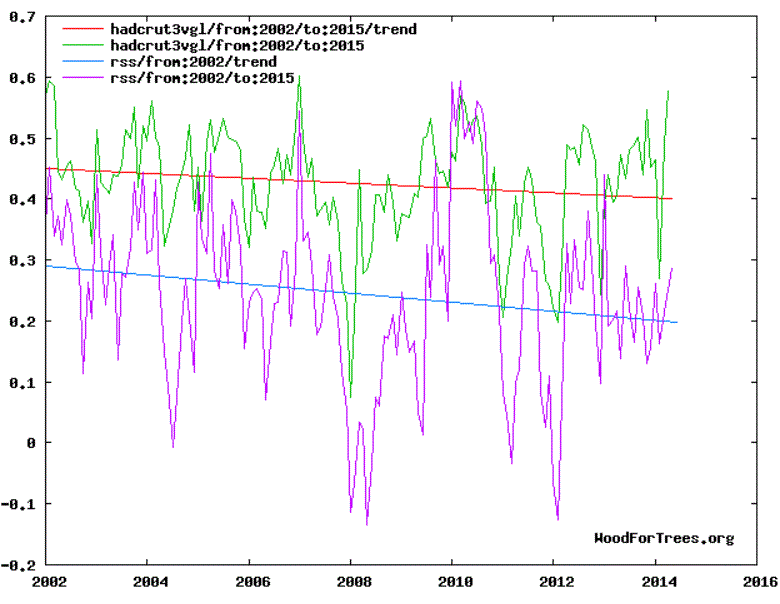
Climate scientists on both sides of the debate agree on one thing: the earth’s surface and atmosphere have (unexpectedly) stopped warming; there’s been no temperature increase in over 17 years and counting.

While global warming scientists insist the pause is only temporary and that warming will resume in earnest sometime in the future (once the missing heat comes out of hiding), other scientists are very skeptical. Today a growing number of distinguished scientists all over the globe believe the earth will be cooling due to the forces of natural cycles that have recently come into play.

Yet as many scientists are making forecasts of cooling, there’s one fact that seems to have escaped them: the datasets of the world’s leading climate data institutes clearly show that planetary cooling is already taking place and has been happening for over a decade.

2002_Cooling

Chart source: www.woodfortrees.org.

Danish solar scientist Henrik Svensmark recently declared: “Global warming has stopped and a cooling is beginning.” The cold reality, however, is that the cooling actually started 12 years ago!

There are more signs other than temperature readings that show global cooling is in full swing. Antarctica has just set a new record positive sea ice anomaly. Global sea ice has been mostly above average for a year and half, flying in the face of stunned scientists who warned just 5 years ago that the Arctic could soon be ice-free in the summertime. Moreover Asia, Europe and North America have been hard hit by a string of unexpectedly harsh winters.

So how cold is it going to get and for how long?

Although a large number of scientists agree on cooling, they differ widely on how much and for how long.

Geologist and climate researcher Sebastian Lüning of Germany in a just released video forecasts a global cooling of 0.2° by 2030, before it starts to warm up again. However, many scientists see this as too mild of a forecast. Russian solar physicist Habibullo Abdussamatov, for example, predicts another Little Ice Age by 2055. Also Russia’s Pulkovo Observatory claims we “could be in for a cooling period that lasts 200-250 years.”

Long list of experts

At his Climate Depot website, Marc Morano has a list of a number of renowned scientists who believe the data are clear on what’s ahead.

Prominent geologist Dr. Don Easterbrook warns that “global cooling is almost a slam dunk” for up to 30 years or more. The Australian Astronomical Society warns of global cooling as the sun’s activity “significantly diminishes”.

The reason for the cooling? Scientists agree that it’s natural solar and oceanic cycles overpowering the overhyped effects of greenhouse trace-gas CO2.


– See more at: http://notrickszone.com/2014/06/30/forget-global-cooling-predictions-its-already-happening-global-temperature-falling-more-than-a-decade/#sthash.iiRucSUK.dpuf

Clive Palmer Triggers the Warmist’s Scream!

Anguished cries in the global warming debate.

Anguished cries in the global warming debate.

TWO sentences neatly and completely capture the total irrationality and sheer, raging religious fervour of the global warming true, true believers.

They both came as deep primeval screams in delayed reaction to Clive Palmer’s climate change twostep with Mr Climate Hysteria himself, the man who used to be the next president of the US, until he found religion and fortune could be combined in very convenient climate untruths, Al Gore.

The initial reaction of true believers was one of almost euphoric rapture. Al and Clive had seemingly united to defeat the Climate Anti-Christ Abbott; Julia Gillard’s carbon tax and Gaia would be saved.

Nowhere was this reaction more extensive or ecstatic than at Climate Central Downunder, The Age. The paper revelled in the Anti-Christ’s coming discomfort.

Then as the truth sunk in that Gore had merely given cover to Palmer’s continued support for axing the tax, the scream erupted in The Age’s editorial on Friday. It included a delicious, utterly, if utterly unintentionally, revealing sentence.

The editorial noted that under the Palmer plan, while the scaffolding of an emissions trading scheme (ETS), would remain in place, the scheme would have no effect.

That’s actually not so, as we won’t even get that “scaffolding”. But returning to The Age, its lament was that such a scheme would have no effect because there’d be no price on carbon until Australia’s major trading partners implemented their own schemes.

Then the sentence: “That might occur next year, next decade, or never.”

A rational sentient human being would have then said; exactly, and thank you Clive. For there is absolutely no point in Australia going down the aggressive ETS path, cutting our emissions of carbon dioxide, unless precisely our major trading partners were doing the same.

To argue otherwise is to argue for Australia to unilaterally hurt both its industries and its citizens, to send industries and jobs to ‘our major trading partners,’ for absolutely no point. Our pain would have not the slightest effect on the global or even the local climate.

That lamenting sentence is so revealing; that to The Age rationality has absolutely nothing to do with the issue. It is all about religious fervour.

Quite irrespective of what the world does, quite irrespective of whether our CO2 cuts would achieve anything at all, we have to cut; we have to flagellate like a 12th century penitent, to exculpate our sins, to pay penance to Gaia.

The sentence is deeply revealing on another level. For The Age is also admitting that in its collective hearts of hearts, it really knows that the operative word in that sentence is ”never”.

Despite all the increasingly desperate propaganda nonsense pumped out that everyone else is taking big steps to cut emissions, and we are so laggard — including of course by The Age itself — the truth is the exact opposite.

Let a few more years run out, and apart from even more evidence that the planet, as opposed presumably to Gaia, ain’t warming as predicted, the emptiness of that claim will become almost undeniable.

And in its deepest, most inchoate scream, The Age is telling us that it just can’t bear that prospect.

The second primeval scream of pain and inchoate anger at Palmer assuaging the Climate Anti-Christ came from David Llewellyn-Smith on his MacroBusiness Blog.

Now LSD as we’ll call him, projects as at least a moderately intelligent human being. Yet he could come out with such a sentence, and more particularly one word, reveals an irrationality and stupidity so fundamental that it can only be explained by a religious belief. And a belief so fervent that a blinding curtain of rage isolates his brain.

LSD expressed sarcastic surprise that a hugely wealthy mining magnate would rubber stamp the end of a carbon price costing him millions of dollars per year for “tipping filth into the atmosphere”. Filth? FILTH?

Does LSD walk around all day in total self-hatred for doing exactly the same thing, pumping out his own filth with every exhaling breath?

Does he awake in complete despair every morning, at the prospect of another totally unavoidable day of exhaling filth? How many times a day does he flagellate himself, penitent-style if figuratively, or perhaps even literally?

For this is all we are talking about, whether it is Palmer’s business emissions or their shared personal emissions. CO2. Carbon dioxide. Plant food. The basis of life on Earth. And nothing else.

No, despite the best efforts of a battalion of modern day Goebbelian wannabes, from Gillard down, none of this — carbon tax or ETS — is about real pollution.

That’s the dirty bits of grit that used to come out of both power stations and home hearths and killed thousands, and will continue to kill thousands if people like The Age, LSD & Co succeed in denying Africa modern, clean, coal-fired power stations that would stop them relying on burning wood and dung.

Lamentably, the way pollution has been able to be attached to CO2 — presumably in time we’ll start renaming heavy rain as ‘water pollution’ — seems to have succeeded with people like LSD.

So when he thinks — more accurately, emotes — about emissions, cognitive dissonance, the disease of the modern intelligentsia, kicks in and he sees in his minds-eye, those dirty bits of grit, the ‘filth’ of modern civilisation.

So there you have it; the religion of global warming in two sentences.

No matter what anyone does, we must cut in self-flagellation for our sins against Gaia.

The self-hatred flowing from the original sin of personal exhalation of CO2 “filth” makes for even more aggressive warriors against business emissions of that same “filth”.

Originally published as Palmer triggers warmest screamCOMMENTS

Farmers in Sweden, Too Smart to Fall for Climate Alarmist B.S.!

Swedish farmers have doubts about climatologists

June 27, 2014 – 06:10

Farmers rely more on their own experiences with changing weather than on climatologists who have no agricultural experience, according to Swedish research.

Climatologists are not often found in the Swedish countryside. So farmers have their doubts about climate predictions. (Photo: Microstock)

Researchers the world over almost unanimously agree that our climate is changing because of the increasing amounts of carbon dioxide humankind pumps into our fragile atmosphere. But many farmers – at least Swedish ones – have experienced mild winters and shifting weather before and are hesitant about trusting the scientists.

Surprised

The researcher who discovered the degree of scepticism among farmers was surprised by her findings.  Therese Asplund, who recently presented her PhD thesis at Linköping University, was initially looking into how agricultural magazines covered climate change.

Asplund found after studying ten years of issues of the two agricultural sector periodicalsATL and Land Lantbruk that they present climate change as scientifically confirmed, a real problem.

But her research took an unexpected direction when she started interviewing farmers in focus groups about climate issues.

Asplund had prepared a long list of questions about how the farmers live with the threat of climate change and what they plan to do to cope with the subsequent climate challenges. The conversations took a different course:

“They explained that they didn’t quite believe in climate changes,” she says. “Or at least that these are not triggered by human activities.”

Used to changes

The climate of course has previously gone through natural spells, and the farmers tend to think in terms of their experiences in recent decades.

“Many have a lot of experience, for instance they recall the mild winters of the 1960s,” explains Asplund.

The farmers also distrust climatologists partly on the grounds of what they perceive of as too much concurrence.

“They think information about climate change is too uniform. Credibility would increase if more contrary perspectives were presented,” she says.

Office science

And above all: They think climatologists lack the experience they have living in keeping with the soil, weather and growth seasons.

The climate of course has previously gone through natural spells, and the farmers tend to think in terms of their experiences in recent decades. (Photo: Mary Evans Picture)

“Climate researchers also are given less credence by farmers because they think the scientists draw their conclusions from theoretical analyses rather than practical experience,” says Asplund.

She finds it hard to say how climatologists can make use of the farmers’ experiences:

“For the research of a scientifically trained climatologist, the opinions of farmers might not be all that essential.  But that does not necessarily make their views irrelevant. For a sociological approach to climate research the farmers’ opinions are highly relevant, on a par with those of other social groups,” asserts Asplund.

Information is not enough

She is concerned about understanding disparate ways of thinking and responding with regard to climate issues.

“With insufficient knowledge, we risk believing that information will readily alter human perceptions and behaviour. The example of climate communication in Swedish agriculture shows what challenges a climatological point of departure for communication can encounter,” says Asplund.

After talking with focus groups all over Sweden, she thinks that information alone cannot change attitudes and behaviour – no matter how well rooted it is in empirical science.

Does this mean it is harder than thought to get Swedish farmers to engage in climate-friendly agriculture? The researcher says both “yes” and “no”.

It will be hard as long as the implementation of improvements is voluntary. But in the discussions the farmers signal that they can adapt – if not to physical climate changes, at least to climate policy decisions. Thus it should be no harder to get them to adjust to climate measures as to other political mandates.

But there is one proviso: “This is a resistance to decrees which they think undermine competitive Swedish agricultural production,” says Therese Asplund.

————

Bad Investments in “Novelty Energy Sources” are a Burden for Ratepayers!

Power price hikes bite in Queensland

By AUSTRALIAN ASSOCIATED PRESS

Queenslanders face a dramatic hike in power bills with the start of the new financial year, and households with solar panels are also likely to take a hit to the hip pocket.

The average power bill is expected to rise by $191, or 13.6 per cent, pushed up by green policies and the increasing cost of poles, wires, and electricity generation.

However, prices will only go up by about 5.1 per cent if the federal government’s carbon tax is repealed.

Queensland’s Energy Minister Mark McArdle has blamed much of the hike on the former Labor government’s over-investment in the power distribution network.

“Every power bill that is issued, 54 per cent of that bill relates to the cost of poles and wires – the gold-plated legacy of Labor that we’re now having to unravel,” Mr McArdle told ABC radio.

Pensioners and seniors will be able to apply for an electricity rebate of $320 after the government upped concessions to $165 million for this financial year.

“The Queensland government promised to lower the cost of living wherever we could and we’re making sure that pensioners and other vulnerable Queenslanders get some relief on household costs,” Mr McArdle said.

Consumers are forking out 50 per cent more for electricity than they did three years ago, and shadow treasurer Curtis Pitt says price hikes under the Newman government total $560.

“Campbell Newman arrogantly promised to lower Queenslanders’ electricity bills, yet ever since he’s become premier they’ve just gone up and up and up,” he said.

This financial year, about 50,000 homeowners who have solar panels will no longer be guaranteed a feed-in tariff of eight cents.

Government-owned distributors will no longer be responsible for paying the tariff and households will have to negotiate directly with electricity retailers for the price they are paid for the solar power they generate.

The 44 cent tariff, paid to some 284,000 people who were first to sign up to the scheme, will remain unchanged.

Australian Solar Council chief executive John Grimes says consumers need to shop around, or join forces to negotiate as a block with electricity retailers.

“As an independent customer, with an average-size system on your roof, you really have little leverage when talking to a utility,” Mr Grimes told ABC radio.

Read more: http://www.dailymail.co.uk/wires/aap/article-2675908/Power-price-hikes-bite-Queensland.html#ixzz36B33NYym
Follow us: @MailOnline on Twitter | DailyMail on Facebook

This Article, written in May….hit the Nail, right on the head….Scary!

Warning: Reading about How the Ontario Liberals

Keep on Winning Might Make You Sick

Enough is enough.

You would think the sheer waste of taxpayer dollars through scandals and mismanagement would be enough to hang the Liberals.

Especially since, at the same time your money swirls down the toilet, the Liberals continue to run deficits (seven in a row) andIllustration: Truth and Lie pile up debt that your grandchildren’s children will still be paying off.

Yet in spite of their mistakes and outright lies (the hit parade includes: the billion-dollar gas plant cancellation and the failure to provide proper oversight of Ornge air ambulance expenses and out-of-control spending at the Ontario Lottery and Gaming Corporation and elsewhere) they’ve managed to hold onto power for 11 years. How is that?

I’ll give you three reasons. (Hold on, it’s a long explanation.)

1. They buy votes with big spending promises.

George Bernard Shaw got it right. “A government that robs Peter to pay Paul can always depend on the support of Paul.”

When even the tax-the-rich NDP recognize that Ontarians are taxed to the hilt and refuse to put up with any “new taxes, tolls or fees that hit middle-class families,” you know Ontario must be in financial trouble.

Net debt is projected to climb to $269.2 billion for 2013–14 and hit $324.5 billion by 2017–18 (nearly 40% of Ontario’s economy). In fact, Ontario’s debt has more than doubled since the Ontario Liberals came to power in 2003–04 when the provincial debt stood at $138.8 billion (or 27.5% of the economy).

Interest payments are the third largest expense in the budget. And right now interest rates are low. When rates go back up, each point will add another $3 billion to our annual interest payment, points out economist Jack Mintz.

But in spite of repeated warnings about the need for spending cuts, from former Liberal finance minister Dwight Duncan (who conveniently woke up to the Ontario’s debt problem in his last few months in office) and public servants in Ontario’s finance ministry, what did the Liberals propose in the budget that forced an election?

Big spending promises, of course. Billions for schools and hospitals, roads and bridges, billions more for corporate grants, and millions for a smorgasbord of social services.

With this budget, the Liberals are in fact driving toward a deficit $2.4 billion higher(or 24% more) than they previously projected—in spite of hiking taxes by almost $1 billion. The deficits planned for 2015–16 and 2016–17 also increased by $1.7 billion and $1.8 billion.

In other words, the Liberals forecast spending to jump by $3.4 billion this year, $900 million more than projected in the 2013 budget, with program spending expected to climb by nearly $3 billion to $119.4 billion.

With Ontario already in a fiscal mess, the NDP (yes, the NDP, a party not known for financial responsibility), criticized the budget as “a mad dash to escape the scandals by promising the moon and the stars.”

2. They pander to unions, whose members make up a big chunk of the electorate.  

The real beneficiary of the tax-and-spend Liberals has been the unions.

For starters, over half of Ontario’s program spending goes to pay public-sector workers their salaries and pension benefits.

What’s more, when the Liberals came into power in 2003, only 14,926 public-sector employees were making $100,000 or more. Today, 97,796 Ontario public-sector workers are on the so-called Sunshine List, an increase of 655% in just 10 years.

But, really, who can be surprised when about 70 percent of public-sector employees are unionized (compare this to the roughly 15 percent unionization rate in the private sector)?

The fact is the Liberals have pandered to unions, especially teacher’s unions, handing out massive, unaffordable pay hikes.

From 2003 to 2011, the McGuinty Liberals increased education spending by 45%, hiring 14,000 more teachers (up 10%) and increasing salaries by 24%—all while student enrollment actually dropped by 6%.

And teachers repaid the favour, “volunteering and voting for McGuinty’s Liberals in huge numbers during the past three elections.”

But following a narrow election win in 2011 (voters were angry over broken promises and higher taxes), McGuinty shifted direction, proposing to freeze teacher wages for two years and curb benefits to reduce the government’s alarming $14.4 billion deficit.

The teachers reacted with predictable outrage.

So despite all their talk about austerity, the Liberals just couldn’t say “no” to their vote-rich cash cow.

While the McGuinty government was calling for wage freezes publicly, it secretly negotiated a three percent wage increase with the Ontario Public Service Employees Union, which represents 35,000 voters, er, government workers.

And forget about Kathleen Wynne taking a firm stance on public-sector wages and benefits.

In a clear bid to win back union support, one of her first moves as premier was to negotiate an LCBO contract that gave 7,000 unionized workers a $1,600 signing bonus over two years—about $9 million— and wage increases of two% in 2015–16.

Her education minister also renegotiated new contracts with the province’s two biggest teachers unions, the Ontario Secondary School Teachers’ Federation and the Elementary Teachers’ Federation of Ontario, offering better maternity benefits, fewer unpaid days off, and an improved “sick-day bank.”

And the quid pro quo?

Millions of dollars spent on attack ads directed exclusively against Tory leaders in Ontario’s 2003, 2007, and 2011 elections—by a powerful coalition of special interest unions that includes the Ontario English Catholic Teachers Association, the Canadian Auto Workers, and the Ontario Secondary School Teachers’ Federation and calling itself the Working Families Coalition.

The so-called Working Families coalition first “came together in 2003 to discredit then Tory premier Ernie Eves and get Dalton McGuinty elected.” Their ad campaigns had such a big impact on the election results, they followed up with more of the same in the 2007 and 2011 elections. For this campaign, they’re just getting started, but expect a barrage of attack ads aimed squarely at Tim Hudak.

The coalition’s negative ads effectively doubles the advertising budget of the Liberals at the expense of the Tories through loose election laws around third-party advertising. Unlike political parties, third parties “can spend as much as they want, take contributions as large as they want and keep their financial backers hidden until long after the campaign is over.”

In Ontario’s 2011 general election, Working Families spent $1.6 million to help the Liberals.

Other big spenders included the Elementary Teachers’ Federation—$2.6 million—and the English Catholic Teachers’ Association, which spent $1.9 million to help defeat the PC party. For comparison’s sake, out of 21 registered political parties, only two spent more than $2 million on advertising. The Elementary Teachers’ Federation, the biggest third-party advertiser, spent more on advertising than nineteen political parties combined.

Spending records for the 2007 election (the first year third parties had to register with Elections Ontario) show a similar story. A shocking “90 per cent of the $2.3 million raised by third-party advertisers for the 2007 campaign went to organized labour or groups opposed to specific Tory policy positions.”

Plainly, Ontario’s election laws are giving Liberals with their deep-pocketed union allies an unfair advantage.

3. They reward party insiders with lucrative contracts.

In Ontario, it’s not what you know, but who you know.

From eHealth Ontario and Cancer Care Ontario to the Local Health Integration Networks, the Liberals have a history of rewarding party loyalists with “cushy, untendered contracts” and well-paid appointments.

In 2004, Mike Crawley, the then-president of the Ontario Liberals, was awarded awind power contract that guarantees his company AIM PowerGen $66,000 a day for 20 years. That’s a total of $475 million dollars.

In 2010, nearly two-thirds of the $68 million of taxpayers’ money spent on the 14 LHINs went to cover the salaries and remuneration of government-appointed board members.

Pat Dillon, the business manager of the Provincial Building and Construction Trades Council and the head of the infamous Working Families Coalition, has received a number of appointments—to Premier Wynne’s Transit Panel, the Ontario College of Trades, the WSIB Board, Infrastructure Ontario, and more.

The Globe and Mail recently reported that Ontario Liberal friends and allies were awarded millions of dollars in taxpayer-funded contracts because of loopholes in the rules surrounding government expenditures. The report goes on to say that, “while there is no indication that any of the transactions were illegitimate, the lack of transparency makes it difficult to determine what services were provided at taxpayers’ expense.”

The sad truth? It pays to be a friend of the Liberals. Ontario taxpayer, not so much.

The Ontario Liberals are long past their best-before date

After 11 years, it’s time to hold the Liberals to account.

Imagine if some pimply-faced thug robbed a gas station and got caught, he’d get what? A thousand dollars tops and some jail time.

But the Liberals who have “stolen” billions of taxpayer money through incompetence and cronyism remain unpunished.

It’s time to throw the Liberals out. They’ve inflicted enough damage on the province. It’s time they answered for their crimes against taxpayers.


Sleep Deprivation, from Wind Turbines, is Very Harmful, in Many Ways!

What Right Does the Government or the Wind Industry have,

to do this to Innocent Rural Citizens?


Sleep Deprivation: The 10 Most Profound Psychological Effects

Post image for Sleep Deprivation: The 10 Most Profound Psychological Effects

Lack of sleep may feel horrible, but what is it really doing to the mind and brain?

American Randy Gardner holds the record for the longest ever scientifically documented intentionalperiod without sleep.

Without the aid of stimulants, he managed to stay awake for 264.4 hours, or 11 days and 24 minutes.

Part of his motivation was to show that sleep deprivation wasn’t that bad for you.

He was wrong: it is bad for you.

In fact he suffered paranoia, hallucinations, moodiness and a whole host of psychological problems, many described below.

It’s just he did not notice many of the problems: that’s how sleep deprivation gets you.

Here are 10 of the most profound psychological effects of sleep deprivation, on top of the fact that it feels horrible.

1. Sleepy brains work harder

Since brains that are sleep deprived aren’t as efficient, they have to work harder.

This has been demonstrated in brain imaging studies which show the brains of the sleep deprived desperately pumping energy into the prefrontal cortex, trying to overcome the effects of sleep deprivation.

2. Short-term memory is shot

Sleep deprivation causes sharp decrements in working memory.

Without short-term memory a person can’t even hold a few digits of a telephone number in their mind, let alone perform any complex tasks.

That’s why, when you’re sleep deprived, you keep going around in circles.

On day 11 of his sleep record, Randy Gardner was asked to repeatedly subtract 7 from 100. He stopped at 65 saying he had no idea what he was doing.

3. Long-term memory is shot

Sleep plays an important role in consolidating memories.

While we sleep, our brain orders, integrates and makes sense of things that have happened to us.

Not only that, but we seem to consolidate our learning while we sleep.

Without sleep the process is badly disrupted, meaning it’s difficult to lay down long-term memories and it’s harder to learn new skills.

4. Attention is shot

At our best, humans have incredible powers of attention: we can distinguish one voice from many, track small, moving objects in a sea of visually distracting information and more.

Sleep deprivation, though, causes many of these precise powers to go downhill. Without enough sleep, we can’t pay attention to our senses as well as we would like.

This partly results in that weird distracted feeling you get when tired.

5. Planning is shot

After 36 hours without sleep, your ability to plan and coordinate your actions starts to go wrong.

Tests show that this vital ability to decide when and how to start or stop tasks quickly goes awry with lack of sleep.

Sleep deprived people easily get stuck in loops of activity or fogs of indecision.

Either way it’s bad news.

6. Habits take over

Since the sleep deprived find it difficult to make plans or control how they start or stop actions, they have to fall back on the brain’s automated systems.

By which I mean: habits.

With less sleep we rely more on repeating the same actions in the same situations.

Good news when it comes to our good habits, but bad news when it comes to the bad habits.

Hence, the sleep deprived eat more junk food.

7. Risky business

Anyone who has every played a late-night poker session will know the weird effects on your sense of risk.

Studies using card games have found that with little sleep, players get stuck in a strategic rut.

They seem incapable of changing their game plan on the basis of experience.

Sleepy people keep taking risks, even though it’s obviously not working for them.

8. Dying brain cells

All sorts of different studies are pointing to how sleep deprivation damages brain cells.

One recent study found that in mice 25% of certain brain cells died as a result of a prolonged lack of sleep.

Other studies have found lower integrity white matter in the brain, possibly as a result of sleep deprivation.

Just as lack of sleep is no good psychologically, it’s also no good physiologically.

9. Mania

If a person suffers from sleep deprivation on a regular basis, they may start to experience mania.

Symptoms include psychosis, paranoia, extremely high energy levels, hallucinations, aggression and more.

Links have been found between insomnia and mental illness. Unfortunately mental illness can also cause poor sleep.

If a person continues to find it difficult to sleep, it can become a vicious circle.

10. Car crash

One of the scary things about sleep deprivation is that it can build up over time and then creep up on you.

You miss an hour or two’s sleep each night, but don’t notice that it’s having a detrimental effect.

Studies find that people who are driving sleep-deprived don’t realise how acute the problem is.

Driving while sleep deprived can actually be worse than driving drunk — it has many of the same effects, but is way less obvious to the driver.

The cure

The good news is that the cure for most of these deficits is simple: just one good night’s sleep will often do the trick.

After staying awake for 11 days, Randy Gardner reportedly slept for over 14 hours the first night, then 10 hours the next night, thereafter he was fully recovered.

Those must have been some sweet dreams!

Image credit: EdMilson de Lima

What Sleep can do for us….and Lack of Sleep can do to us!

One of the Most Common Complaints, from Residents

near Wind Turbines, is lack of sleep!

The Miracle and Mystery of Sleep: 12 Remarkable Psychological Studies

Post image for The Miracle and Mystery of Sleep: 12 Remarkable Psychological Studies

“Sleeping is no mean art: for its sake one must stay awake all day.” ~Friedrich Nietzsche

What beautiful rewards sleep delivers– if you can get enough of it.

Sleep has profound effects on our memories, desires, self-control, learning, relationships and more.

Here are twelve studies which demonstrate some of the psychological benefits of sleep and a few of the dangers of not getting enough.

1. Placebo sleep

Sleep is slippery beast, not least in how it’s susceptible to our perceptions of its quality.

If we think we’ve had a wonderful sleep last night, we feel and perform better, even if our sleep was actually the same as usual.

This is what Draganich and Erdal (2014) found in a study which had participants hooked up to sensors which they were told were measuring the quality of their sleep.

Actually the sensors weren’t measuring anything. Instead the researchers randomly told some people they’d had better sleep than others.

When they were given a cognitive test the next day, those who’d been told they slept the best also did the best in the test.

Their self-reported sleep quality had little effect on the test results.

The researchers dubbed this ‘placebo sleep’.

2. Emotional sleep

During sleep our memories are reorganised and made stronger–in particular the emotional centres of the brain are highly active.

Psychologists have found that the mind is cataloguing our memories and deciding what to keep and what to throw away.

Sleep expert Elizabeth A. Kensinger explains:

“Sleep is making memories stronger. It also seems to be doing something which I think is so much more interesting, and that is reorganizing and restructuring memories.”

A review of studies on sleep found that we tend to hold on to the most emotional parts of our memories (Kensinger & Payne, 2010).

3. Blame bad sleep on the full moon

If your sleep wasn’t up to scratch last night, perhaps it was partly down to the phase of the moon.

People often complain of worse sleep around the full moon, but until recently scientists have been sceptical.

A study by Cajochen et al., 2013, though…

“…studied 33 volunteers in two age groups in the lab while they slept. Their brain patterns were monitored while sleeping, along with eye movements and hormone secretions.”

This is what they found:

“The data show that around the full moon, brain activity related to deep sleep dropped by 30 percent. People also took five minutes longer to fall asleep, and they slept for twenty minutes less time overall.

The researchers think it may be because we have a kind of ‘moon clock’ inside us that tracks its cycles and affects our hormone levels. This is in addition to the better known circadian rhythms which affect many bodily processes during the day.

→ Read on: Bad Night’s Sleep? Blame the Full Moon

sleeping29

4. Junk food cravings

One of the dangers of not getting enough sleep is craving junk food.

Recent research from UC Berkeley scanned the brains of 24 participants after both a good and a bad night’s sleep (Greer et al., 2013).

After disturbed sleep, there was increased activity in the depths of the brain, areas which are generally associated with rewards and automatic behaviour.

It seems a lack of sleep robs people of their self-control and so their good intentions are quickly forgotten.

Hence those junk food cravings get out of control.

→ Read on: Why the Sleep-Deprived Crave Junk Food and Buy Higher Calorie Foods

5. Learn in your sleep

It’s not possible to learn something new when you sleep, like a foreign language, but you can reinforce something you already know.

Gobel et al. (2012) found that students learned to play a series of musical notes better after listening to them during a 90-minute nap.

One of the authors, Paul Reber explained:

“The critical difference is that our research shows that memory is strengthened for something you’ve already learned. Rather than learning something new in your sleep, we’re talking about enhancing an existing memory by re-activating information recently acquired.”

→ Read on: Offline Learning: How The Mind Learns During Sleep

6. Benefits of a six-minute nap

Even tiny amounts of sleep can be beneficial.

A study by Lahl (2008) found that even a short six-minute nap was enough to measurably improve performance on a test of word recall.

Tell that to the boss the next time your caught ‘resting your eyes’ at work!

sleeping

7. Night owls have lower integrity white matter

Different neural structures have been discovered between people who are night owls and early risers.

Research on 59 participants, those who were confirmed night owls (preferring late to bed and late to rise) had lower integrity of the white matter in various areas of the brain (Rosenberg et al., 2014).

Lower integrity in these areas has been linked to depression and cognitive instability.

Unfortunately work, school and other institutions mostly require early rising, which, for night owls, causes problems.

As night owls find it difficult to get to sleep early, they tend to carry large amounts of sleep debt.

In other words, they’re exhausted all the time and their brains clearly show the consequences.

→ Read on: Like to Stay Up Late? Different Neural Structures Found in the Brains of Night Owls

8. Children’s sleep

Children are processing way more information than adults because everything is so new to them.

That is why irregular bedtimes at a young age can reduce their cognitive performance.

One study had children learning a task which had a hidden pattern. After a night’s sleep they were much more likely to guess the secret pattern without being told (Wilhelm et al., 2013).

Children also outperformed adults, suggesting that sleep was more important to them for this task.

9. Adolescents need more sleep

Adolescents typically require an hour or two more sleep than adults.

If so, why do we make them get up so early for school?

One study has delayed the waking up time of adolescents at a boarding school by just 25 minutes (Boergers et al., 2013).

They found that afterwards the number of students getting more than 8 hours sleep a night jumped from 18% to 44%.

On top of this, the students experienced less daytime sleepiness, were less depressed, and found themselves using less caffeine.

→ Read on: Later School Start Times Improve Sleep and Daytime Functioning in Adolescents

10. Consolidate motor skills

When we are learning a motor skill, like playing the piano, our brains continue to process the information after we’ve finished.

In research by Allen (2012), musicians who practised a new song had improved in speed and accuracy compared with before a night’s sleep.

Like memory, a good night’s sleep can also improve motor performance.

sleeping19

11. Relationship damage

People are usually at their worst after a bad night’s sleep, but what does that do to their intimate relationships?

A new study finds that even one bad night’s sleep can be surprisingly damaging to a relationship (Gordon & Chen, 2013).

They found that even for those who were good sleepers, just a single night’s poor sleep was associated with increased relationship conflict the next day.

→ Read on: How Just One Night’s Poor Sleep Can Hurt a Relationship

12. Hidden caves open up during sleep

If sleep has such amazing restorative powers then what is going on physiologically?

New research has discovered “hidden caves” inside the brain, which open up during sleep, allowing cerebrospinal fluid (CSF) to flush out potential neurotoxins, like β-amyloid, which has been associated with Alzheimer’s disease (Xie et al., 2013).

The flushing out of toxins by the CSF may be central to sleep’s wondrous powers.

→ Read on: Hidden Caves in the Brain Open Up During Sleep to Wash Away Toxins

Last word

Last word to the playwright Wilson Mizner who said:

“The amount of sleep required by the average person is five minutes more.”

Quite right.


Wind Turbines are Useless, and Destructive. What were they thinking? Oh ya….$$$$$

Alan Moran: Wind Power FAILS on all Scores

report-card

Renewable energy as a means of reducing emissions fails two key tests
Herald Sun
Alan Moran
26 June 2014

REGULATORY change will always disadvantage some while advantaging others. But the benefits of deregulation far outpace the costs and Australia carries a weighty regulatory burden, one that has deprived us of enjoying the world’s highest living standards.

The most costly regulations are the ever-mounting environmental red tape and Australia’s unique union-dominated controls over employment conditions. The deleterious effects of these have been somewhat offset by deregulatory progress in import tariffs, for example, and in opening up areas such as ports, travel and telecommunications to greater competition. Privatisation has also helped in this regard.

Unfortunately we have gone backwards in energy supply policy with the carbon tax and forced substitution of cheap coal-generated electricity for expensive renewables. These government measures have resulted in Australian electricity prices being transformed from among the world’s lowest into one of the highest.

This has contributed to placing intense competitive pressure on industry and commerce over the past few years; households have as a result incurred higher prices for the goods and services they buy, as well as taking a direct hit from skyrocketing electricity bills.

While the Palmer United policy remains unclear it seems that the carbon tax is likely to be removed with the new Senate. The future of the other strings to these regulatory bows is less certain. Chief among these is the Renewable Energy Target (RET) under review by a panel chaired by leading businessman Dick Warburton.

The RET forces all electricity consumers to incorporate a proportion of wind and solar energy into their electricity supply. This renewable energy is three times as costly as the energy it displaces and will soon comprise 20 per cent or more of total supply. At that stage it will add 30-50 per cent to total wholesale electricity costs. The RET alone will mean household electricity bills go up by 7 per cent and those of industrial users by 10 per cent. Other state-based measures add to this cost.

The RET review has attracted some 24,000 submissions, mostly from green zealots regurgitating slogans offered up by their leaders. This group is unaware or uncaring that the renewable energy scheme means a considerable increase in electricity costs for industry and households.

Some claim the subsidies help consumers since they drive down electricity prices. But any such price reduction is similar to that which would follow from government supplying cheap bread. The price might fall but not enough to pay for the costs involved and the price falls would result in commercial suppliers ceasing to operate, creating future shortages.

Also supporting green subsidies are a number of publicly-financed bodies. Many of these, such as the cities of Melbourne and Sydney, have no expertise on the matter but their councils’ irresponsible approach to spending involves employing green personnel for vanity purposes.

Others like Climateworks and the Grattan Institute were given taxpayer funding by Labor-Greens government to promote renewable energy.

A second group of submissions is businesses and their representatives who have made investments in subsidised renewables and are keen to protect those investments and even to create additional subsidies.

The third is specific business interests, largely in aluminium, which recognise the deadly costs of the RET scheme and seek to quarantine themselves from its effects.

The IPA mining representatives and the Australian Chamber of Commerce and Industry form a fourth group, which notes that the renewable scheme is a horrendous waste of resources, needlessly drives up electricity costs, and finances lobbying activity that pollutes the political process. These bodies argue that the scheme should be axed immediately and all subsidy payments terminated.

Twenty years ago, the two green technologies favoured by subsidies — wind and solar — were touted as being on the verge of becoming competitive with coal, gas and oil. Almost no serious analyst nowadays believes this.

That bold but discredited technological optimism was joined with a rationale that subsidies to green energy would reduce carbon emissions. As a policy, renewable energy as a means of reducing emissions fails two key tests. It founders on the shoals of adamant refusals by other countries to embark on serious carbon emission reductions and on clear evidence that renewable policies only reduce emissions at a very high cost.

To date, Australia has wasted $20 billion in worthless renewable energy investments, mainly on windfarms but also on solar, including the rooftop panels. Just to put that in perspective, $20 billion would build 100,000 new houses. According to modelling undertaken by Acil Tasman for the RET review, unless the program is stopped immediately a further cost of $13 billion will be incurred. Of course, if we also provide subsidies to new renewable facilities, many more billions will be wasted.

Beneficiaries of the subsidies argue that unless they are maintained, Australia will suffer adversely by being regarded as a nation imposing “sovereign risk” on investors. This, so it is said, will discourage future investments. Sovereign risk is where governments seize property without proper compensation.

But changing a tax or subsidy can hardly be considered an imposition of sovereign risk. Such changes happen all the time and invariably mean losses to somebody.

Moreover we have seen policy changes in recent years that have very severe repercussions on investments.

Take the automotive industry, where reductions in industry protection, changes to industrial relations laws and the energy price hikes have caused investment write-offs amounting to billions of dollars. Or the “alcopops” industry, severely impaired by a sudden and unexpected 70 per cent tax increase. Or cigarette manufacturing, hounded from Australia by tax hikes and restraints to marketing.

We also saw the former Commonwealth government, in response to claims by the ABC about animal cruelty, dramatically close the live beef trade to Indonesia. Many graziers had to shoot their stock and average prices fell by a third.

The victims of these government activities got no compensation. Importantly, nor did the measures bring a rise in investment risk.

While the less government meddling there is in the economy the better, the fact is taxes, subsidies and tax rates do change. No government can reasonably expect to bind its successors to paying a worthless subsidy for 15 years as is nominally the case with the RET. And no investor would sensibly expect this.

The renewable energy scam, alongside the carbon tax, was one of the many targets of the late Ray Evans, whose funeral is today. He was a co-founder of the Lavoisier Group established to combat misinformation about climate change. The current Shadow Resources Minister, Gary Gray, was a former member. Ray did not live to see the costly green edifices of economic self-harm dismantled. But the new Senate, in spite of resistance from the Greens and Labor’s leadership, will begin the necessary economic repairs next week.

Alan Moran is the Director, Deregulation at the Institute of Public Affairs
Herald Sun

In addition to the fine analysis above, Alan also had this to say on the Catallaxy blog:

Many governments are seeking ways of escaping the wanton cost impositions irresponsible green predecessors have bequeathed them.  None more so than Spain, the former poster child of green energy.  Following its election the current Spanish Government has wound-back previously agreed green energy subsidies.  This has prompted claims of retrospectivity and sovereign risk, including anappeal to Brussels.

The Spanish risk premium seems unaffected by this and has in fact been declining.

Australia’s renewables rort, with seemingly guaranteed high returns, has provided a bonanza for many union pension funds, but these have mainly provided the capital and sold back the forecast stream of electricity.  Those most at risk from a termination of the scheme are the electricity retailers, who have taken long-term contracts on the wind power as part of the portfolio of forward buying to cover the requirements imposed by the current legislation.

Renewables and climate change matters were among the many issues of government imposed costs and liberty curtailments addressed by the late Ray Evans whose funeral is today.
Catallaxy Files

In his Herald Sun piece, Alan refers to modelling by “Acil Tasman”. The firm is now called ACIL Allen and it produced modelling which is fundamentally flawed – grossly underestimating the impact of the mandatory RET on retail power prices – simply because it failed to consider the impact of the Power Purchase Agreements struck between wind power generators and retailers that sets the price paid for wind power at rates 3-4 times the average wholesale price for power (see our post here).

Alan refers to the risk faced by Union Super Funds and retailers. He could have also included the major banks who have lent to wind power outfits (see our post here).

Any banker, Union Super fund manager or retailer who thinks they can safely rely on Clive Palmer’s current “support” for the mandatory RET as a sound basis for their future financial health should think again. Big Clive took the Greens and their acolytes for fools over his brief brush with an Emissions Trading Scheme – which blasted like a comet across the night sky – but went straight to the political dustbin. Anyone betting the house on Clive Palmer’s next move is a very brave punter, indeed.

clive palmer sleeping

Greenpeace has Become a Corrupt Organization, that Promotes Alarmism!


Greenpeace In Decline Like The AGW Scam

They Support

by Tory Aardvark


Dr Patrick Moore “They have a whole fleet of ships, pretending the $32 million Rainbow Warrior III is powered by the wind when it has two large diesel engines for propulsion. I like to joke that when we first sailed against US hydrogen bomb testing in Alaska we did not have a nuclear weapon on board." Dr Patrick Moore “They have a whole fleet of ships, pretending the $32 million Rainbow Warrior III is powered by the wind when it has two large diesel engines for propulsion. I like to joke that when we first sailed against US hydrogen bomb testing in Alaska we did not have a nuclear weapon on board.”

Things have not been going well for environmental NGO Greenpeace in the last few months, there was the insanely stupid attempt to interfere with Gazprom operations in the Arctic, which led to the Arctic 30 enjoying the hospitality of the Russian penal system for a few months. Greenpeace also lost a ship, the Arctic Sunrise which is still impounded in the Russian port of Murmansk, and likely to be there until it rusts away and sinks, or ends life as a towed target for the Russian Navy.

In the words of Greenpeace Co-Founder Patrick Moore “I’d like to think that Greenpeace left me, rather than the other way round. I became a sensible environmentalist. Greenpeace became increasingly senseless.

Greenpeace apart from being increasingly senseless have also been caught losing millions in donations by failed currency trading, been labelled as a threat to national economic security, and one of their top executives has been caught out hypocritically commuting by air from Luxembourg to Amsterdam.

All this makes for very bad publicity for Greenpeace:

“Greenpeace has been careful to cultivate an image as intrepid defenders of the environment,” editorializes Der Spiegel, a major German newspaper. “Calling themselves the rainbow warriors, activists hang from factory chimneys, throw themselves in front of whaling ships or risk jail time in Russia by calling attention to the plight of the Arctic.”

“Now, another activity has been added: playing the financial markets,” Der Spiegel adds. “For an organization almost entirely financed by donations, the revelation is a PR disaster, endangering from one day to the next the greatest asset Greenpeace possesses: its credibility.”

Even that organ of left wing biased climate change propaganda the UK Guardian has turned against Greenpeace:

The Guardian, a left-wing newspaper, has been especially critical of Greenpeace lately. The paper even obtained internal documents detailing the disarray within Greenpeace International.

A November 2013 document obtained by the Guardian shows that Greenpeace’s executive team was for years fully aware of major problems within the group’s finance department.

“[The] international finance function at GPI [Greenpeace International] has faced internal team and management problems for several years and the situation did not improve during 2013 despite efforts and support,” says the Greenpeace document.

India’s Intelligence Bureau has come to the conclusion that Greenpeace is a threat to the countries national economic security:

The Indian Express reports that the Intelligence Bureau submitted a report to the prime minister’s office saying Greenpeace was “negatively impacting economic development” through political activism and its anti-fossil fuels agenda. The reports says that Greenpeace activities have reduced the country’s GDP by 2 to 3 percent a year.

The report mentioned other activist groups, but singled out Greenpeace for trying to “change the dynamics of India’s energy mix” and orchestrating “massive efforts to take down India’s coal fired power plants and coal mining activity.”

“It is assessed to be posing a potential threat to national economic security… growing exponentially in terms of reach, impact, volunteers and media influence,” the report warns of Greenpeace, adding the group is finding “ways to create obstacles in India’s energy plans” and to “pressure India to use only renewable energy.”

It is not just in India, but other countries as well there seems to be a shift towards curtailing the activities of Green NGO’s, in Tasmania the politicians want to remove charitable status from Green NGOs and give the status to real charities:

The government is being pressed to alter the charitable status of environmental groups after a Liberal MP successfully argued to his party that the groups are not “real charities” like the Red Cross or the Salvation Army.

A motion introduced by MP Andrew Nikolic to the Liberal federal council called for environmental groups to be stripped of charitable rights, such as the ability to receive tax-deductible donations.

Nikolic, the federal member for the Tasmanian electorate of Bass, said the groups should not be subsidised for political activism, some of it which he claimed was illegal. The conference motion passed the motion unanimously.

The news of Greenpeace’s massive loss of donations currency trading was soon followed by the revelations that Greenpeace’s international program director Pascal Husting was regularly taking the plane from his home in Luxembourg to the office in Amsterdam:

The UK Telegraph noted that Greenpeace actively campaigns against “the growth in aviation,” which the group says “is ruining our chances of stopping dangerous climate change.”

“Each round-trip commute Mr Husting makes would generate 142kg of carbon dioxide emissions,” reports the Telegraph. “That implies that over the past two years his commuting may have been responsible for 7.4 metric tons of carbon dioxide emissions — the equivalent of consuming 17 barrels of oil.

None of these antics have done much to bolster Greenpeace’s declining credibility with its life blood, the millions of people who make the small donations that keep Greenpeace functioning, instead they have been shown to be nothing more than one of those duplicitous  corporations the environmentalists so love to despise.