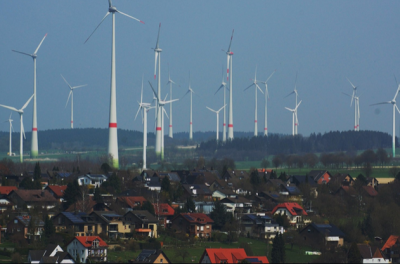
The Wind Turbine Disaster in South Australia…

Wind Power Disaster: South Australians Grapple with Rocketing Power Prices, an Unstable Grid & Rolling Blackouts

koutsantonis

****

In Australia’s wind farm capital, South Australia the terms ‘chaos’ and ‘crisis’ are used to describe the aftermath of an energy policy ‘designed’ on desktops by dimwits, who haven’t got the faintest clue about how power generation works (or much else, for that matter).

Wind power collapses and blackouts are now part of South Australian life: Wind Industry’s Armageddon: Wind Farm Output Collapse Leaves 110,000 South Australian Homes & Businesses Powerless

The Genesis of the wind power debacle was pretty well captured by Leo Smith in our recent post – Why Weather Dependent, Intermittent & Unreliable Wind Power is as ‘Useful as a Chocolate Teapot’ – and summed up as follows:

There is, above all, one salient feature that emerges across the board. Sanity and rationalism have been cast aside, and the whole arena is now a political and ideological battleground whose main protagonists understand little or nothing about the industry they seek to bend to suit their ideological (and possibly commercial) needs.

In short the world is full of people who have an opinion about power generation, who understand nothing about how it actually works or even what actually works. …

Rational scientific analysis shows conclusively that renewable energy cannot ever deliver on the very basis that it has been sold to the public. It’s not cheap, it’s anything but free, it’s not environmentally desirable, it offers no energy security, and it cannot exist in isolation from other technologies that are either even more costly than it itself is or have grave risks associated with them.

What we find when we analyse the intermittency problem, is that intermittent non-dispatchable power actually carries very little value at all. What society requires, is dispatchable power – power that can be on tap when it’s required, and turned off when it’s not, and it requires in addition a large component of cheap baseload power, that never needs to be turned off. What it does not require is wilful power that’s here today and gone tomorrow.

Just like SA’s 17 wind farms’ ‘efforts’ during May 2015:

May 2015 SA

And it’s the erratic delivery of ludicrously expensive wind power ($110 per MWh versus $40 per MWh for the reliable stuff) – and the insane cost of paying operators of highly inefficient Open Cycle Gas Turbines that their owners refuse to fire up until the spot price rockets to over $2,000 per MWh, when the wind drops – that has journos using ‘chaos’ to describe SA’s power market and ‘crisis’ to describe the economic aftermath meted out on struggling business, like Nyrstar’s Port Pirie Smelter.

The thing that kills the wind industry is the cost of attempting to integrate a wholly weather dependent power source (abandoned in the 19th Century, for obvious reasons) into a modern power system – where that cost, as it manifests in ever-rocketing power prices, simply can’t be hidden from the voting public.

Here’s another take on the South Australian wind power debacle from Richard Blandy (Adjunct Professor of Economics in the School of Management at the University of South Australia Business School) who – unlike the hacks at Adelaide’s The Advertiser – has a very solid head for numbers, due his background in that dismal science.

Oh, and to help illustrate Richard’s piece we’ve added a few pics courtesy of the boys over at Aneroid Energy – showing the output from SA’s 17 wind farms (with a notional capacity of 1,477MW) on the occasions referred to.

Crunching the numbers on SA’s high electricity prices
InDaily
Richard Blandy
19 January 2016

South Australia has set its energy sights on a renewable future but, asks Richard Blandy, at what cost?

On Christmas Day, according to the average price tables published by the Australian Energy Market Operator (AEMO), the Regional Reference Price (average spot price) for a megawatt hour of electricity in South Australia was $91.67.

SA 25 Dec 15

The corresponding prices in New South Wales, Victoria and Queensland were $37.33, $20.38 and $36.20.

SA DEC 15

The average daily spot price for a megawatt hour of electricity in December 2015 was $62.19 in South Australia, $43.37 in New South Wales, $46.84 in Victoria and $42.08 in Queensland.

SA 17 Dec 15

On December 17, the average spot price for a megawatt hour of electricity in South Australia was $259.59, while on December 26 it was only $5.06.

SA 26 Dec 15

It is clear that South Australia has the most expensive and most variable power on the eastern states grid.

The reason for the high (and extremely variable) price of electricity in South Australia is our very high dependence on solar and wind generation compared with the other states.

This results from the rapid expansion of renewable energy generation in South Australia.

According to a Deloitte Access Economics study recently released by the Energy Supply Association of Australia, South Australia’s solar and wind generation capacity per head of population is already more than three times that of any other state or territory.

A new Climate Change Strategy for South Australia was released by Premier Jay Weatherill and Minister for Climate Change, Ian Hunter, on November 29. The strategy was conveniently (if implausibly) rebadged as an economic development initiative.

In it they said to realise the benefits, we need to be bold. That is why we have said that by 2050 our state will have net zero emissions. We want to send a clear signal to businesses around the world: if you want to innovate, if you want to perfect low carbon technologies necessary to halt global warming – come to South Australia.

South Australia can be a low carbon electricity powerhouse. We have the ability to produce almost all of our energy from clean and renewable sources and export this energy to the rest of Australia.

But people want electricity to be available when they want it, and for it to stay on, with a steady current, while they want it – not just when the wind is blowing or the sun is shining.

The trouble with solar and wind generation is that it only generates electricity intermittently. Covering this intermittency is expensive in terms of idling standby plant.

Generators with the required flexibility (peaking generators using natural gas) produce expensive electricity, but are becoming more and more needed as the penetration of wind and solar in our energy generation mix increases. This is why electricity prices have risen in South Australia.

Wind farms and other renewable-energy generators also undercut the prices offered by efficient, base-load, coal and gas power plants, because they receive guaranteed, non-market, returns from selling Generation Certificates to electricity retailers under the Commonwealth Government’s Renewable Energy Target (RET) Scheme.

Under RET, electricity retailers must buy enough certificates to demonstrate their compliance with the RET scheme’s ever-increasing annual targets.

The revenue earned by each wind farm from the sale of certificates is additional to the revenue received, if any, from its sale of electricity to the electricity market.

The yearly RET targets imply significant annual investment in wind farms, while the sale of certificates to retailers is designed to guarantee a return to wind farms sufficient to justify the required investment, irrespective of the return they receive from actually selling electricity to the market. Well done, wind farm lobby.

If sales of electricity are growing only slowly (as they are in South Australia’s slow-growing economy), the subsidised market share of wind farms and other renewables will rise and the sale of electricity from conventional base-load power plants will fall.

At some point the coal and gas-fired conventional power plants will become unable to contribute towards their fixed costs, and they will go out of business. This is what has happened in South Australia.

But this is the whole point of renewables in climate change terms – to knock off CO2-producing coal and gas-fired power plants, thereby helping to save the planet from climate change.

The Port Augusta power station is closing because of Commonwealth and South Australian Government policy to expand renewable energy generation. This is not an accident. To save the planet, it was always intended to have this effect, but maybe not next year. Leigh Creek is shutting down as an unintended consequence.

Pelican Point has been mothballed and Torrens Island is also slated for closure.

If the demand for electricity is low – on a public holiday, say – while the wind is blowing and the sun is shining, the price of electricity in South Australia will be low. Conventional generators will make losses, while the market losses of the renewable generators will be covered by their sale of Generation Certificates.

If the demand for electricity is high – a heat wave on a working day, say – and it is a still, overcast day, the price of electricity in South Australia will be high, because it will be mostly produced by high-cost, back-up, peaking generators.

The high cost of maintaining back-up generation capacity (sufficient, essentially, to duplicate the generation capacity of the renewables) means that the average price of electricity produced in a system dominated by renewables will always be expensive without strong interconnection, such as in Denmark, to large, inexpensive, electricity-producing regions nearby, that produce most of their electricity from coal, gas or nuclear sources.

We are not in that fortunate position. According to Deloitte, South Australia’s interconnectors with Victoria are able to supply only 23 per cent of South Australia’s peak demand (although their capacity is presently being increased).

According to a report in the Australian Financial Review in December, South Australian Treasurer and Energy Minister Tom Koutsantonis called a meeting of energy users and suppliers to deal with the sharp rises and falls in wholesale electricity prices that, in particular, threaten the economics of the lead and zinc smelter at Port Pirie operated by Dutch company, Nyrstar.

South Australian businesses face electricity prices in 2016-18 of between $87 and $90 per megawatt hour, compared with $37-$41 in Victoria and $43-$48 in New South Wales.

South Australian irrigators are said to be facing electricity price increases of more than 100 per cent next year.

According to the AFR, forward electricity prices in South Australia are far higher than when Nyrstar signed up in May.

Further, the threat of disruption of supplies if the inter-connectors to Victoria fail, or become inadequate to meet the demand for electricity in South Australia on peak days, are of understandable concern to the company. Nyrstar is scheduled to start operations in mid-2016.

Options for the Government to stop Nyrstar quitting all look expensive.

In the short run, the Government’s main option could be to cover the extra anticipated cost of electricity and the cost of any supply disruptions with a further subsidy to Nyrstar over and above the $291 million it has already promised. This subsidy could be substantial.

In the long run, the Government’s main option could be to pay for even more interconnection to Victorian, New South Wales or Queensland coal or gas-powered electricity generators.

It will have to do so to protect the stability of the electricity grid in South Australia soon, anyway, as well as to put a cap on wholesale prices (the price of base load electricity interstate plus the cost of shipping it here through an interconnector). This will also be costly.

The high price of electricity in South Australia is eating away at our economic competitiveness. The probability that we will become, sometime in the distant future, a “low carbon electricity powerhouse” looks extremely low.

As often happens with Government initiatives in South Australia, significant Government subsidies are likely to be offered to appropriate companies to locate here, so that the Government’s aspirations appear to be vindicated.

Richard Blandy is an Adjunct Professor of Economics in the Business School at the University of South Australia.
In Daily

nyrstar port pirie

Wind Pushers Losing Popularity!

Wind Industry Still Wailing About ‘Uncertainty’ as Construction Finance ‘Drought’ Hits

banshee

Wind power outfits have now cottoned on to the fact (slow learners that they are) that Australia’s big power retailers have turned their backs on the wind to face the Sun, instead.

The former second-hand car salesmen that front the wind industry are still coming to grips with the recalcitrance of commercial retailers (we don’t count the ACT Government) who continue to refuse entering Power Purchase Agreements with wind power outfits (holding that stance since November 2012).

The big operators have absolutely no interest in wind power; and every interest in killing off the Large-Scale RET that created, and for the time being sustains, the wind industry.

As pointed out previously, the retailers’ switch to large-scale solar is a canny, but fleeting move – designed to avoid the shortfall penalty for the few years it takes for the LRET to collapse; as the political and economic toxicity of the policy escalates over the next year or two.

It is, after all, a pointless $3 billion a year power tax that runs until 2031 – for no other reason than to subsidise the production of insanely expensive and wholly unreliable wind power; at a time when Australia’s grid is swamped with oodles of the reliable, secure and affordable stuff.

Without PPAs with retailers, wind power outfits haven’t a hope in hell of obtaining bank finance to build any new wind farm capacity, as this ‘sackcloth and ashes’ piece from the SMH confirms.

Yass Valley Wind Farm recommended for approval, but retailer’s strike persists
Sydney Morning Herald
Lucy Cormack
4 February 2016

Financiers are yet to gain confidence that the legislative underpinning for renewable energy projects is going to be stable.

The state government has recommended approval for what could be one of Australia’s biggest wind farms, but continued uncertainty in the renewables sector may see the project added to the 6000 megawatt-strong “pile of wind farms” currently approved, but stalled, industry figures say.

The recommendation for approval of the Epuron Yass Valley Wind Farm by the NSW Department of Planning and Environment clears the way for the Planning and Assessment Commission to make its final decision on the wind farm.

While industry figures say the news is positive, it does not mean the wind farm will be built.

“This approval just adds to the 6000-megawatt pile of wind farms currently stalled:” Ric Brazzale, managing director …

“This approval just adds to the 6000-megawatt pile of wind farms currently stalled:” Ric Brazzale, managing director Green Energy Trading said of the Yass Valley Wind Farm.

“We’ve lost count of these announcements,” said Ric Brazzale, managing director of Green Energy Trading.

“It’s an important part of the process, but this approval just adds to the 6000-megawatt pile of wind farms currently stalled.”

The battle for new projects is obtaining finance and power purchase agreements: contracts with energy companies to sell electricity and large-scale generation certificates (LGCs).

Large-scale generation certificates are used by Renewable Energy Target-liable entities to meet compliance obligations based on the volume of electricity they purchase each year.

Mr Brazzale said the difficulty in sealing power purchase agreements is tied to the long-embattled context of renewable energy in Australia.

“They can’t raise finance because banks and financiers don’t want to go anywhere near these contracts unless they are contracted with energy retailers,” he said.

“So, why don’t financiers do it? The reason is, they are yet to gain confidence that the legislative underpinning is going to be stable,” he said. “We’ve heard from Greg Hunt and that helps, but if you want retailers and financiers to change, you need the Prime Minister to come out and say unequivocally, ‘We are not going to reduce the target.’”

Solar Council chief executive John Grimes agreed that any “drought” in renewables investment will only be reversed with increased positive sentiment from the government.

“Large scale projects are all built on policy, stability and confidence, but the entire renewable energy market has been massively disrupted by the federal government’s review and slashing of the Renewable Energy Target.”

Mr Grimes’ concern is that, despite having a new Prime Minister, “nothing has changed”.

“No moves have been made by the federal government to ensure that certainty and policy stability is returned to the sector,” he said. “It’s a double-edged sword. If power companies don’t build projects they will be slugged with a charge equivalent, which has a real post-tax value of $93 per large-scale generation certificate.”

Mr Grimes said liable entities are using that fact to go back to the government and say they cannot build the projects to meet the target in the time permitted.

“Their argument will be, if the federal government doesn’t slash the Renewable Energy Target again, then that price will be passed through to consumers and everyone will be paying for capacity that was never built,” he said.

At its proposed capacity of 124 turbines, the Yass Valley Wind Farm would have the capacity to power more than 130,000 homes each year, however the government’s recommendation suggests a significant reduction in the project’s scale, down to 79 turbines.

Epuron executive director Martin Poole said despite the recommended reduction “attitudes everywhere have improved” towards wind energy, since Prime Minister Malcolm Turnbull took the leadership.

“It is important that NSW demonstrates its commitment to maximising the local jobs and expertise that flow from the transition to a cleaner electricity sector.”

Mr Brazzale estimates that processes contracting for large-scale generation certificates in the ACT, Western Australia, South Australia and Victoria suggest “there are probably more than 1000 megawatts of projects that could be committed over the next year or so.”

Despite being enough to power around 430,000 homes annually, Mr Brazzale said that figure is nowhere near enough to meet the large-scale renewable energy target by 2018.

“We need four times that level to ensure we meet the 2018 target, which obviously we’re not going to achieve. That’s why the LGC price is high, because it’s reflecting that the market is not going to meet the target.”
Sydney Morning Herald

The usual fawning starry-eyed ‘analysis’ from Fairfax there – with bunkum about a pie-in-the-sky wind farm one day “powering more than 130,000 homes”. Unless those households are prepared to sit freezing or boiling in the dark around 70% of the time, they will, in fact, be ‘powered’ by coal, gas and hydro (in that order).

That journalists are still pushing that kind of wind industry propaganda in 2016 is not just dumb, it’s lazy. A quick glance at Aneroid Energy debunks that myth. Here’s SA’s 17 wind farms (notional capacity of 1,477MW) ‘powering’ not so much as a kettle on 3 May 2015:

3 May 2015 SA

The other line that escapes any sensible criticism from Fairfax is what John Grimes says about the looming and massive cost of the LRET

“It’s a double-edged sword. If power companies don’t build projects they will be slugged with a charge equivalent, which has a real post-tax value of $93 per large-scale generation certificate.” …

“Their argument will be, if the federal government doesn’t slash the Renewable Energy Target again, then that price will be passed through to consumers and everyone will be paying for capacity that was never built,”

The cost of the LRET to power consumers will actually be lower if further wind power capacity is NOT built, than if it is. Retailers will get hit with the shortfall penalty (what Grimes calls ‘a charge equivalent’) and the cost of the REC – from here, the combined cost of which will exceed $3 billion a year, all recovered as a Federal Tax on all power consumers:

What Kills the Australian Wind Industry: A $45 Billion Federal Power Tax

What Grimes leaves out, of course, is that the wind power capacity that Epuron, Infigen & Co are so desperate to build (in order to keep their Ponzi scheme from collapsing, as it has with Pacific Hydro) – will cost at least a further $80-100 billion, in terms of extra turbines and the duplicated network costs needed to hook them up to the grid: all requiring fat returns to investors; costs and returns that can only be recouped through escalating power bills:

Ian Macfarlane, Greg Hunt & Australia’s Wind Power Debacle: is it Dumb and Dumber 2, or Liar Liar?

In the post above we looked at the additional costs of building the wind power capacity needed to avoid the shortfall penalty – including the $30 billion or so needed to build a duplicated transmission grid.

That is, a network largely, if not exclusively, devoted to sending wind power output from remote, rural locations to urban population centres (where the demand is) that will only ever carry meaningful output 30-35% of the time, at best. The balance of the time, networks devoted to carrying wind power will carry nothing – for lengthy periods there will be no return on the capital cost – the lines will simply lay idle until the wind picks up.

The fact that there is no grid capacity available to take wind power from remote locations was pointed to by GE boss, Peter Cowling in this article, as one of the key reasons that there will be no new wind farms built in Australia (see our post here).

But let’s return to wailing about the requirement for policy ‘certainty’. What that wailing is really about, is a plea for the Federal government (read ‘taxpayer and power consumer’) to underwrite a politically toxic policy, that has already been slashed from an ultimate annual target of 41,000GWh to 33,000GWh, for precisely that reason.

In 2015, faced with the fact that the target could never be met, both Labor and the Coalition were forced to cut the target before the shortfall penalty inevitably took effect. But that was simply to stall the LRET’s ultimate collapse: the same factors Epuron moan about above are still in play. There will be no increase in wind power capacity; the shortfall penalty will apply; and the Federal government will be forced to cut the target, once again.

It’s the fact it was cut once that has bankers and retailers refusing to lend or sign PPAs. And, as with any ‘business’ that relies for its very existence on a piece of policy, what the government once did, can be just as easily undone – in full.

What kills the LRET – and the wind industry with it – is the same set of forces that led to the demise of the Australian wool industry. The lessons and parallels drawn from the implosion of its Federally mandated subsidy scheme during the 1990s – all but killing the industry and costing growers and taxpayers tens of billions of dollars – are worth repeating.

The wool industry’s “cause of death” was the Federally backed Reserve Price Support scheme (RPS), which set a guaranteed minimum price for all Australian wool.

A little background on the RPS

For over 150 years, Australia happily rode on the sheep’s back: until the 1970s the wool industry was, for the Australian economy, the “goose that laid the golden egg”; textile manufacturers from all over the world clamoured for the fibre; which was, for most of that time, the largest single commodity export by value; Australia produces over 80% of the world’s apparel wool. However, as fashions changed (the three-piece wool suit became, well, so “yesterday”) and new synthetics began to eat into its market share, the dominance of Australian apparel wool was no longer a certainty.

Against the backdrop of increasing competition, for the wool industry there was always the perennial issue, not only of fluctuating demand, but also of wildly fluctuating swings in production. Dorothea McKellar’s land of “droughts and flooding rains” meant that a few years of meagre production (and favourable, and even phenomenal, wool prices) would be soon eclipsed by sheds and wool stores overflowing with fibre ready for market (sending prices and woolgrower profits plummeting).

The response to these (often climate driven) marketing “swings and roundabouts”, was the establishment of the Australian Wool Corporation (AWC) and the RPS in 1973.

The RPS would set a minimum price for all types of wool, guaranteeing woolgrowers a minimum return; such that if supply exceeded demand, the AWC would purchase any wool being offered, if it failed to reach the minimum price set (referred to as the “floor price”).

Wool being offered at auction that failed to meet the floor price was purchased by the AWC and “stockpiled” (ie stored), until such time as either supply fell or demand conditions improved; at which point the AWC would offer stockpiled wool to the trade. The aim being the smooth and more orderly marketing of wool over the supply and demand cycle; with higher average returns to growers; and less risk for buyers and sellers along the way.

The scheme worked swimmingly (as designed and intended) until the late 1980s.

The reserve price set under the RPS was fixed in Australian dollar terms. However, with the float of the Australian dollar in 1983 (resulting in a massive 40% depreciation of the dollar between February 1985 and August 1986), maintaining the reserve price without reference to the terms of trade and fluctuations in trading currencies (particularly the US dollar) set the scheme up for a spectacular failure; simply because what goes down can just as easily go up.

During the 1980s, there was a solid increase in demand for wool, driven by demand from the USSR, a then fast growing Japan, buoyant Europeans, and a newly emergent China, as a textile manufacturer and consumer. However, that surge in demand occurred in the context of an Australian dollar trading in a range around US$0.55-75.

During the 1980s, under pressure from wool grower lobby groups, the floor price was continually increased: from 1986 to July 1988 the floor price jumped 71% to 870 cents per kilogram.

That did not, in itself, create any problems: a general surge in demand, relatively low production and a plummeting Australian dollar generated auction room sale prices well above the rising floor price, which reached their zenith in April 1988: the market indicator peaked at 1269 cents per kg, and the market continued its bull run for most of that year, well above the 870 floor price set in July.

However, as international economic conditions worsened, Australian interest rates soared (the consequence of Paul Keating’s “recession that we had to have”) and the value of the Australian dollar with it (hitting US$0.80 by early 1990), the market indicator headed south and, over the next few years, the AWC was forced to purchase over 80% of the Australian wool clip at the 870 cent per kg floor price. Adding to the AWC’s difficulties was a massive surge in production; driven by growers responding to the high and “guaranteed” floor price; and a run of exceptional growing seasons (1989 being a standout across Australia). Production went from 727 million kg in 1983/84 to over 1 billion kg in 1990/91.

Despite worsening market conditions, the AWC, under pressure from wool grower lobby groups, was forced to maintain the 870 cent per kilogram floor price.

However, from around August 1989, international wool buyers simply sat on their hands in auction sale rooms (in May 1990 the AWC bought 87.5% of the offering); and waited for the RPS to implode.

Knowing that the system was unsustainable, the last thing that buyers wanted was to be caught with wool purchased at prices above the floor price which, when the floor price was cut or collapsed, would immediately be worth less than what they had paid for it. Moreover, traders were dumping stock as fast as they could to avoid the risk of a collapse in the RPS and, therefore, a collapse in the price of any wool they happened to hold.

The RPS was ultimately backed by the Federal government. With the buying trade sitting on their hands, those responsible for maintaining the floor price ended up in a staring competition, the only question was, who would blink first: the AWC (or, rather, the government underwriting the RPS); or the buyers?

With the AWC purchasing millions of bales of wool at the floor price the cost of supporting the RPS was running into the billions of dollars: primarily the support came from a grower levy on sales, but, at the point which that soon became insufficient to support the RPS (despite upping the levy from 8% to 25%), support came from $billions in mounting government debt; the buyers had no reason to blink.

Instead, in May 1990, the government announced its decision to retreat to a new floor price of 700 cents per kilogram, and directed the AWC to fight on in support of the reduced floor price. The Minister for Primary Industry, John Kerin boldly asserting that the 700 cent floor price was “immutable, the floor price will not be reduced”.

But, having blinked once, the buyers largely continued to sit on their hands and simply waited for the government to blink again. The stockpile continued to balloon; and with it government debt: by February 1991 the stockpile reached 4.77 million bales (equivalent to a full year’s production); the accrued government debt stood at $2.8 billion; and the cost of storing the stockpile was over $1 million a day.

Faced with the inevitable, the government blinked, again: John Kerin was forced to eat his words about the floor price being “immutable”; on 11 February 1991, announcing the suspension of the floor price. The RPS had totally collapsed; the buyers had won.

The wool industry’s saga is beautifully, if tragically, told by Charles Massy in “Breaking the Sheep’s Back” (2011, UQP), which should be required reading for any of our political betters pretending to know more than the market (eg, the power market).

Which brings us to the lessons and parallels.

The LRET effectively sets the price for RECs: the minimum price is meant to be set by the shortfall charge of $65 per MWh (rising to $93 when account is given to the tax benefit), as the penalty begins to apply on the shortfall (as detailed above). That equation is based on an ultimate 33,000 GWh target.

In the event that the cost of the shortfall charge was reduced, there would be a commensurate fall in the REC price. Likewise, if the LRET target was further reduced: the total number of MWhs which would then attract the shortfall charge if RECs were not purchased would fall too; also resulting in a fall in the REC price.

In addition, any reduction in the LRET would simply result in a reduction in the demand for RECs overall: fewer RECs would need to be purchased and surrendered during the life of the LRET; again, resulting in a fall in the REC price. Of course, were the LRET to be scrapped in its entirety, RECs would become utterly worthless.

The retailers, are alive to all of this, hence their reluctance to enter PPAs for the purpose of purchasing RECs; agreements which run for a minimum of 15 years.

In December 2014, Ian “Macca” Macfarlane and his youthful ward, Greg Hunt started running around pushing for a target of 27,000 GWh; and their boss, Tony Abbott made clear that he wanted to kill it outright. There followed overtures from the Labor opposition pitching for a target around 35,000 GWh.

Whether they knew it or not – with their public debate on what an amended target should be – in the staring competition with retailers – these boys blinked.

Faced with the inevitable political furore that will erupt when power consumers (ie, voters) realise they are being whacked with the full cost (and some) of the shortfall charge (being nothing more than a “stealth tax” to be recovered by retailers via their power bills), the pressure will mount on both sides of politics to slash the LRET – once again.

That both Labor and the Coalition have already blinked (in obvious recognition of the brewing political storm in power punter land over the inevitable imposition of the shortfall charge) is not lost on the likes of Grant King from Origin, and all of Australia’s other electricity retailers.

And for retail power buyers the choice of sticking with permanent recalcitrance has been made even easier: with the previous PM Tony Abbot making it plain that he would have cut the LRET even harder, were it not for a hostile Senate; and Labor’s Bill Shorten pushing for an entirely ludicrous 50% LRET – that would require a further 10,000 of these things to be speared all over Australia’s rural heartland. Where there was once ‘bipartisan’ support for these things, the major parties are diametrically opposed.

Grant King

****

With the politics of the LRET already on the nose, like wool buyers sitting on their hands in sale rooms during 1990, waiting for the floor price to collapse, electricity retailers need only sit back and wait for the whole LRET scheme to implode.

Like wool buyers refusing to buy above the floor price and carry stock with the risk of the RPS collapsing, why would electricity retailers sign up for 15 year long PPAs with wind power outfits in order to purchase a stream of RECs over that period, knowing the value of those certificates depends entirely upon a scheme which is both economically and politically unsustainable?

However, the similarities between the wool market and the market for wind power end right about there.

There is, and always was, a natural market for Australian wool; the only issue during the late 80s and early 90s was the price that had to be paid by buyers to beat the floor price, set artificially under the RPS.

Wind power has no such market.

Available only in fits and spurts, and at crazy, random intervals, at a price which is 3-4 times that of conventional generation, retailers have no incentive to purchase it.

In the absence of the threat of the $65 per MWh fine (the stick), coupled with the promise of pocketing $93 as a subsidy in the form of a REC (the carrot), electricity retailers would not touch wind power with a barge pole: it simply has no commercial value.

Moreover, with an abundance of conventional generation capacity in Australia at present, retailers are very much in a “buyers’ market”.

Overcapacity, coupled with shrinking demand (thanks to policies like the LRET that are killing mineral processors, manufacturing and industry) means that retailers can expect to see wholesale prices decline over the next few years, at least. And, for the first time in almost 20 years, a sharply declining Australian economy is a fast looming reality: unemployed households have an even tougher time paying rocketing power bills.

With those fundamentals in mind, electricity retailers will simply opt to pay the shortfall charge and recover it from power consumers, knowing that that situation will not last for very long.

Sooner or later, the Federal government (whichever side is in power) will have to face an electorate furious at the fact that their power bills have gone through the roof, as a result of a policy that achieved absolutely nothing.

Current PM, Malcolm Turnbull might mouth platitudes about ‘renewables’ and ‘innovation’, but his chances of leading the Coalition to a second term in power are tied to fundamental ‘mum and dad’ policies like electricity costs.

Power prices matter; and in a battle between Australia’s Big 3 Retailers and the LRET, STT’s money is firmly on commercial self-interest.

STT hears that the big retailers plan to exhaust the pile of RECs that they’re sitting on at present, while building a few large-scale solar power facilities, in order to obtain the RECs needed to avoid the shortfall charge; and to wait for the politics to turn gangrenous. As soon as the LRET gets scrapped, the plan is to sell the panels back into the residential roof-top market.

The cost of the LRET – and all that comes with it – to retail customers is at the heart of what’s driving retailers’ efforts to crush the LRET; and the wind industry with it.

This might sound obvious, if not a little silly: electricity retailers are NOT in the business of NOT selling power.

Adding a $45 billion electricity tax to retail power bills can only make power even less affordable to tens of thousands of households and struggling businesses, indeed whole industries, meaning fewer and fewer customers for retailers like Origin, AGL and EnergyAustralia.

The strategy adopted by retailers of refusing to ‘play ball’ by signing up for PPAs will, ultimately, kill the LRET; it’s a strategy aimed at being able to sell more power, at affordable prices, to more households and businesses.

And it’s working a treat, so far.

The wind industry’s incessant daily whining about “uncertainty”, is simply a signal that the retailers have already won. Once upon a time, the wind industry and its parasites used to cling to the idea that the RET “has bi-partisan support“, as a self-comforting mantra: but not anymore. And it’s the retailers’ refusal to sign PPAs that’s thrown the spanner in the wind industry’s works.

While the likes of Epuron and Infigen will continue to work themselves into a lather about their inevitable fate, in the meantime, retailers, like Origin, AGL and EnergyAustralia, can simply sit back, watch the political fireworks, and wait for the inevitable and complete collapse of the LRET; and, with it, the Australian wind industry.

In this ‘drought’ only the retailers have the capacity to survive.

drought-2004

Looking Forward to WindPushers being Held Accountable!

Governments Lying About Wind Turbine Noise: Ignorance No Defence to Claims Worth $Millions

200355536-002

****

As the number of cases launched against wind power outfits and the landholders who ‘host’ these things takes off, the government agencies that continue to run the wind industry line that the incessant turbine generated low-frequency noise and infrasound and the sleep deprivation it causes is all in the victims’ heads (a former tobacco advertising gurusaid so) – are setting themselves up for liability in the hundreds of $millions. And the kind of ignorance displayed in this little piece is no defence.

Ignoring harm of noise
Rutland Herald
Sandy Reider
24 January 2016

The Vermont Health Department and the Vermont Department of Public Service persist in reassuring us that there are no significant health effects related to industrial wind turbines under Vermont’s current noise standards.

Such a blanket statement is not only incorrect, it is a disservice to the Vermonters who are already experiencing adverse health effects, such as headaches, vertigo, nausea, anxiety, ringing in the ears and, most importantly, chronic repetitive sleep disruption. There is an ongoing academic debate about the mechanisms behind these effects (direct vs. indirect, the nocebo “its all in your head” effect, audible vs. inaudible infrasound), but little disagreement that some persons living too close to these large wind turbines are suffering, whatever the mechanism.

Critical methodological shortcomings plague many of the large-scale industry or government-sponsored studies that state agencies rely upon to establish protective sound levels:

  • Failure to measure the full sound spectrum, in particular ignoring the very low frequencies that are likely responsible for many of the reported adverse health effects.
  • They assume a constant sound pressure and tone, not at all like the impulsive sound produced by large turbines, which has its own distinct signature that differs from other environmental sources (planes, trains, automobiles, wind, leaves rustling).
  • Sound levels are often averaged over an hour, or longer, making it possible for periods of very loud intrusive sound to fall within an “acceptable” calculated level.
  • Measurements are usually not taken indoors, where the sound may be more intrusive due to the well-established resonance effects of low frequency sound.
  • Most importantly, the large studies fail to focus their investigations on those households that are most severely affected.

In spite of these research design limitations, a recently released large Health Canada study found that at wind turbine sound pressure levels greater than 35 dB(A), health-related complaints will increase, and at levels greater than 40 dB(A) a significant number of persons will be “highly annoyed” (meaning adverse health effects, especially sleep disturbance).

The current Public Service Board threshold of 45 dB(A) of audible sound through an open window, averaged over an hour, has actually never been proven safe or protective. Some studies recommend that audible sound should not exceed 35 dB(A), or 5 dB(A) above normal background sound levels. (This is crucial in rural areas where background noise is minimal, particularly at night). The level should be a maximum, not an hourly average. Above 35 dB(A) there are likely to be significantly more complaints, particularly difficulty sleeping.

Several recent small, well-designed, independent clinical studies (Ambrose & Rand, Nissenbaum, Pierpont, Schomer, Cooper, Thorne) that do take the aforementioned factors into consideration, all conclude that lower, more protective noise limits for these huge industrial wind installations are needed (for more details: docs.wind-watch.org/DRSANDYREIDER_042413.pdf).

To the benefit of the wind industry, and apparently to those agencies promoting large wind installations on our ridgelines here in Vermont, the issue of infrasound has thus far been successfully suppressed and ignored. Space does not permit a detailed discussion, but consider the following:

  • The World Health Organization has definitively established (2009) that inaudible very-low-frequency infrasound is a human health hazard, that it can disturb sleep, and increase heart rate and blood pressure, leading in susceptible individuals, to permanent effects such as hypertension and cardiovascular disease, even at sound levels below 30 dB(A).
  • In the mid 1980s, Neil Kelley and his team thoroughly documented significant adverse health effects resulting from inaudible, very-low-frequency sound produced by a large wind turbine in Boone, N.C. This scientifically rigorous NASA and Department of Energy-sponsored study, in cooperation with MIT and four other prestigious universities, as well as the wind industry, has been conveniently dismissed as irrelevant by current wind developers, even though the study’s conclusions have never been disputed, and even though we now know that the large turbines being installed today do indeed generate clinically significant amounts of infrasound.
  • Three more recent preliminary studies (Ambrose & Rand’s Falmouth, Mass., 2011; Schomer, Rand, et. al., Shirley project, Brown County, Wisconsin, 2012; Cooper, Bridgewater, Australia, 2014) of projects with large modern upwind turbines have replicated and confirmed Kelley’s findings; i.e., infrasound, not audible sound, is a major contributor to the health fallout from today’s industrial wind projects.

Taken together with the thousands of case reports from around the world (I personally have seen three families here in the Northeast Kingdom that have been forced to abandon their homes due to adverse health effects from nearby wind turbines), stricter full-spectrum noise standards for these large wind projects are urgently needed. However, Vermonters should not expect meaningful change until the governor, as well as his appointees in the Health and Public Service departments, recognize the importance of being more inclusive in their selection of scientific data, and until they demonstrate a genuine willingness to take the health complaints of the neighbors of these turbines seriously.

Dr. Sandy Reider is a physician who lives in Lyndonville.
Rutland Herald

The wind industry and its pet acoustic consultants are acutely aware of the true facts – viz, that the noise ‘rules’ they wrote together are meaningless (that was the objective, after all) and, in order to spear ever larger turbines ever closer to homes – and thereafter to operate with perceived impunity – have convinced the useful idiots in planning and health departments to the contrary.

But, as with most things in life, the facts have a funny way of bubbling to the surface. Any government that continues to run with the wind industry will find itself in the dock with the principal offenders in the not too distant future.

Jury-being-sworn-in-006

Germans Gear Up to Fight the Windweasels, Politically!

German Opposition to Wind Farms Spawns New Political Party

German wind farm

Remember all the guff about Germans loving wind power to bits?

And stories about how Germany is the wind power pioneer, and that its cheerful rural volk are 100% behind having thousands of these things speared all over their bucolic homeland?

No? We’ve forgotten them too.

German wind farm neighbours suffer from incessant turbine generated low-frequency noise and infrasound – just as they do all around the World:

Germans Driven from their Homes by Wind Turbine Generated Infrasound

So, it’s no surprise that there are more than 500 well-organised groups fighting back against ‘green’/left lunancy – in an effort to protect their homes, their health and their families.

What, to date, has been a reactionary force sprouting up in regions set upon by the wind industry, has now coalesced into a full-blown system of political opposition; and has just given rise to a political party aimed at bringing the great German wind power fraud to an end. Here’s another story you won’t see in the mainstream press from NoTricksZone.

Rapidly Evolving Protest: German Wind Energy Opponents Form Political Party In Response To A Deaf System
NoTricksZone
Pierre L. Gosselin
25 January 2016

Not a single one of Germany’s established political parties officially opposes the construction of wind parks despite all the proof of their inefficiency, hazard to health and wildlife, ugliness, and lack of economy.

As a consequence, a growing number of citizens are becoming fed up with a political system that has become deaf to the concerns of citizens. Some 10 years ago what once began as a huge welcome of “green and clean” wind energy, has since turned into fierce protest – and is now developing into organized political opposition.

North Germany’s online daily nordkurier.de here reports how in the state of Mecklenburg Western Pomerania citizen initiative groups against ugly wind parks are taking their protest activity to a whole new level: the formation of a political party to be on the ballot in September’s state elections. In summary environmentalist citizens have had it with the green-preaching parties who refuse to listen and have allowed themselves to be corrupted by Big Wind.

The name of the citizens’ initiative, which comprises some 50 smaller initiatives statewide, is called “Freier Horizont” (Free Horizon) and it plans to be on the ballot under the same name in this fall’s election.

Deaf political system

The reason the Freier Horizont is forming a political party? The nordkurier.de quotes initiative’s chairman Norbert Schumacher:

Currently there is no democratic party which rejects the uncontrolled expansion of wind power that people can elect.”

The hardest hit of course will be the region’s Green Party as disenchanted environmentalist realize that the Greens have long sold out to profiteering wind energy opportunists. The movement led by the Freier Horizont is taking on formidable dimensions. The nordkurier.de writes:

“Schumacher sees voter potential foremost in the countryside. At many places citizens have had the experience that there voices against wind turbines carry no weight with the deciding committees. Last year the protest group gathered more than 22,000 signatures in a short time in support of a citizens’ initiative calling for greater distances between turbines and homes and coastlines. The state parliament rejected the initiative.”

Initiative leaders tell the nordkurier.de that it was never their intention to form a party. However, elected officials simply just don’t listen anymore.
NoTricksZone

angry german kid

Bjørn Lomborg: Why Africa Needs Fossil Fuels, Not Wind Power & Wishes

Wind power…..nothing more than “novelty energy”!

stopthesethings's avatarSTOP THESE THINGS

Bjorn-Lomborg-wsj Bjørn Lomborg: champion of the poor; enemy of wind-worshippers.

****

Why Africa Needs Fossil Fuels
Project Syndicate
Bjørn Lomborg
22 January 2016

SANTIAGO – Africa is the world’s most “renewable” continent when it comes to energy. In the rich world, renewables account for less than a tenth of total energy supplies. The 900 million people of Sub-Saharan Africa (excluding South Africa) get 80% of their energy from renewables.

While a person in Europe or North America uses 11,000 kWh per year on average (much of it through industrial processes), a person in Sub-Sahara Africa uses only 137kWh – less than a typical American refrigerator uses in four months. More than 600 million people in Africa have no access to electricity at all.

All this is not because Africa is green, but because it is poor. Some 2% of the continent’s energy needs are met by hydro-electricity, and 78% by humanity’s…

View original post 891 more words

Wind Weasels Don’t Care Who They Destroy!!

Mexican Wind Farm Madness: Wind Industry Crime & Corruption Crush an Ancient Culture

2016_0129energyIstmus-Celestino-1

***

Renata Bessi is a freelance journalist and contributor the Americas Program and Desinformémonos. She has published articles in Brazilian media: The Trecheiro newspaper magazine, Página 22, Repórter Brasil, Rede Brasil Atual, Brasil de Fato, Outras Palavras.

Santiago Navarro is an economist, a freelance journalist, photographer and contributor to the Americas Program, Desinformémonos and SubVersiones.

Together they have determined to expose the wind industry in Mexico for precisely what it is: despicable.

The dark side of clean energy in Mexico
Truthout
Santiago Navarro F. and Renata Bessi
29 January 2016

A palm hat worn down by time covers the face of Celestino Bortolo Teran, a 60-year-old Indigenous Zapotec man. He walks behind his ox team as they open furrows in the earth. A 17-year-old youth trails behind, sowing white, red and black corn, engaging in a ritual of ancient knowledge shared between local people and the earth.

Neither of the two notices the sound of our car as we arrive “because of the wind turbines,” Teran says. Just 50 meters away, a wind farm has been installed by the Spanish company Gas Natural Fenosa. It will generate, at least for the next three decades, what governments and energy companies have declared “clean energy.”

Along with this farm, 20 others have been set up, forming what has come to be known as the wind corridor of the Isthmus of Tehuantepec, located in the southern Mexican state of Oaxaca. The corridor occupies a surface area of 17,867.8 hectares, across which 1,608 wind turbines have been installed. The secretary of tourism and economic development of Oaxaca claims that they will collectively generate 2,267.43 megawatts of energy.

The Tehuantepec Isthmus stretches just 200 kilometers from the Pacific to the Atlantic Ocean, making it the third narrowest strip of land connecting the Americas, after isthmuses in Nicaragua and Panama. In this area, mountains converge to create a geological tunnel, which funnels extremely high-speed winds between the two oceans. Energy investors have focused on the region after the government of Oaxaca claimed that it’s capable of producing 10,000 megawatts of wind energy in an area of 100,000 hectares.

“Before, I could hear all the animals living in the areas. Through their songs and sounds, I knew when it was going to rain or when it was the best time to plant,” Teran said with sadness and rage in his voice. “Now though, it seems the animals have left due to the wind turbines.”

What Teran does not know is whether the turbines, built in accordance with the Clean Development Mechanism (CDM), as defined in the Kyoto Protocol, are generating alternative energy that will actually help to reduce the greenhouse gas emissions of large corporations and industrialized countries. The main objective of these polluters is to prevent global temperatures from rising 2 degrees Celsius before 2100, according to the 21st Session of the Conference of the Parties to the UN Framework Convention on Climate Change (UNFCCC), better known as the COP21, which concluded in December 2015. “I don’t know what climate change is and neither do I know about the COP. I only know that our ancestral lands are being covered by these turbines,” Teran said.

At the Earth Summit held in Rio de Janeiro, Brazil, in 1992, participating countries passed the UNFCCC in response to climate change. With this accord, states set out to maintain their greenhouse gas emissions at the levels reached in 1990. At the third Conference of the Parties (COP3), held in Japan in 1997, the Kyoto Protocol was approved by industrialized countries, with the aim of reducing national emissions to an average of 5 percent below the 1990 levels, between 2008 and 2012. In order to help reduce the costs of this reduction, three “flexibility mechanisms” were designed: emissions trading, joint implementation and the aforementioned Clean Development Mechanism (CDM), under which a large number of the wind farms in the Tehuantepec Isthmus have been constructed.

According to the Kyoto Protocol, these mechanisms are meant to permit industrialized countries and private companies to reduce their emissions by developing clean energy projects in other parts of the world where it is more economically viable, and later include these reductions into national quotas. The second period of engagement of the Protocol is 2013-2020. In this period, countries in the European Union (excluding Iceland) have agreed to a collective emission reduction of 20 percent with respect to 1990 emission levels.

The Clean Energy Extraction and Energy Transition Financing Law statesthat Mexico will install technology to generate 25,000 megawatts of clean energy by 2024. “Mexico has an obligation to limit the electrical energy generated by fossil fuels to sixty-five percent (from the current eighty percent) by 2024,” the law states.

Teran continues sowing his corn while we ask him about the benefits he’s gained from the wind corridor and, a bit irritated, he responds: “They have not provided me or anyone in my family a job, and I don’t want anything to do with these companies or the government; I just want them to leave me in peace on my land. To let me live as I did beforehand.”

Wind Farms for Sale

2016_0129energyIstmus-Corredor-2

***

The US Department of Energy and the US Agency for International Development (USAID), with the justification to help accelerate the use of wind energy technologies in the state of Oaxaca, developed an atlas published in 2003, which mapped the wind potential in the state of Oaxaca. The mapping confirms that the isthmus is the region with the largest wind potential.

“This wind resource atlas is an important element of the Mexican strategy to ensure availability of the necessary information and to define specific renewable energy projects as well as tools access to financing and development support,” according to the atlas document.

The paper organizers say they will not share specific maps related to the respective areas of wind potential due to the confidentiality required in possible contracts signed between companies and the government of Mexico. Although more than a decade later, with the arrival of more parks in this territory, it has become clear which of these sites are mainly located on the shores of Laguna Superior.

For all the good intentions the United States had to cooperate with Mexico to invest in renewable energy, USAID made another document in 2009, called “Study of Export Potential Wind Energy of Mexico to the United States,” which confirms that the greatest potential of this energy is concentrated in the states of Oaxaca (2,600 megawatts) and Baja California (1,400 megawatts). In August 2015, the government of Mexico officially announced that the wind farm “Energía Sierra Juárez” in Baja California, the first wind project between Mexico and the United States, will export energy to California. And they are waiting for an interconnection to export the energy produced in the Isthmus of Tehuantepec.

“This mapping is only one part of a series of mega-projects that are designed for this area,” said biologist and coastal ecology and fishery sciences professor and researcher Patricia Mora, of the Interdisciplinary Research Center for Integral Regional Development of Oaxaca (CIIDIR Oaxaca) based at the Instituto Politécnico Nacional.”Not only is it wind energy, but also oil and gas, and also mining, an infrastructure for the movement of goods. Therefore, this wind mapping is only a pretext to map the full potential of this whole geostrategic area, which functions as a type of catalog to offer it to businesses.”

The wind corridor was designed from the North American Free Trade Agreement (NAFTA), signed in 1994 by Mexico, the United States and Canada, subsequently given continuity with the international agreement, Plan Puebla Panama (PPP), and now remade into Proyecto Mesoamerica. The project’s main objective was to “create favorable conditions for the flow of goods, oil, minerals and energy.”

“Clean energy is part of this context. It’s part of the continuity of the exponential economic growth of capital; it is not something alternative to it. It’s another link that is painted green,” Mora said.

Not-So-Clean Energy

Two-hundred kilometers connect the Pacific Ocean with the Atlantic. Photo archive of the first consultation that occurred in the Isthmus, specifically regarding Southern wind farm.

To set the turbines, hundreds of tons of cement that interrupt water flows are used. “It is worth mentioning that they are using the cement company Cemex, who also has a wind farm in the Isthmus,” Mora said.

The population of Venta, where the first wind farm was built, was literally surrounded by turbines. Insufficient with the already installed complex, under the argument of self-sufficiency and with a capacity of 250 megawatts, the park called Eurus, built in 2009, was auctioned off with capital from the Spanish company Acciona and transnational construction materials company Cemex.

It seems that Cemex is the role model of the CDM, a clean and responsible company that has registered several projects this way. In its 2013 report, Cemex boasts of expanding their projects with the CDM model. “Six new initiatives were registered as CDM in 2013, which include four alternative fuel projects in Mexico and Panama and two wind farms located in Mexico, among those Eurus and Ventika.”

In 2015, the Eurus wind farm won the prize awarded by the Inter-American Development Bank (IDB Infrastructure 360​​°) in the category of “Impact on Population and Leadership,” which recognizes outstanding sustainability practices in infrastructure investments in Latin America and Caribbean.

In February 2015, community activists from the organization Defenders of the Earth and Sea announced, “about 150 wind turbines owned by Acciona and located in the Eurus wind farm and Oaxaca III, have spilt oil, from the blades and main coil, which has polluted the ground and the water, affecting several farmers and ranches surrounding the area.”Both wind farms have 1,500-megawatt turbines, which need 400 liters of synthetic oil, while the 800-megawatt turbines only need 200 liters of oil per turbine per year.

The Costs of Clean Energy

Archaeological remains found by farmers on their land.

***

The dominant development model in the production of electricity from wind power in the Tehuantepec Isthmus is stated as a formula in which everyone wins – the government, developers and industry. The model has been of self-supply, in which a private developer of wind power generates energy production contracts for a wide portfolio of industrial customers (Coca-Cola, Cemex, Walmart and Bimbo, for example) for a certain period. In this way, companies can set prices lower than the market for the long term, and separately they enjoy the financial benefits of carbon trading, which on one hand, allows them to continue polluting and, secondly, to speculate on the sale of these pollution permits to other companies. Developers can access financing schemes for “green” projects through organizations like the Inter-American Development Bank and the Clean Development Mechanism (CDM) of the UN.

The communities are also presented as winners in these projects for the development of self-sufficiency and the income they receive from the lease of their land.

Why the Resistance?

Community women demonstrate against the wind projects on their ancestral land.

***

In November of 2012, the consortium Mareña Renovables set out to build the largest wind farm in Latin America in the Barra de Santa Teresa, in San Dionisio del Mar, Oaxaca. The Barra is a strip of land between two lagoons that connects to the sea in the Isthmus of Tehuantepec. Here the Indigenous community of Binni Záa (Zapotec) and Ikojts (Huave), together with the community of Alvaro Obregon, opposed and blocked all access to this strip of land. In response, the state sent about 500 troops from the state police to unblock access, acting with extreme violence. The Indigenous community resisted until the government suspended construction of the wind park. In response to constant harassment and persecution,the Alvaro Obregon community created a community police force called “Binni Guiapa Guidxi” on February 9, 2013.

What was known as Mareña Renovables has changed its name and its form several times. The Spanish energy company, the Preneal Group, which had signed exploration contracts and obtained permits from the state government, sold the rights to the project for $89 million to FEMSA, a subsidiary of the Coca-Cola Company and the Macquarie Group, the largest investment bank in Australia. These companies quickly sold part of their stakes to Mitsubishi Corporation and Dutch pension fund PGGM, signing at the same time a power purchase agreement with FEMSA-Heineken for 20 years.

They also sought to speculate with the reduction of 825,707 tons of carbon dioxide a year, equivalent to the emissions of 161,903 cars.

“Mother Earth is sick; the disease is global warming. They want to profit with the same disease that they have caused to Mother Earth,” said Carlos Sanchez, a Zapotec activistwho participated in the resistance against the installation of the wind farm in Barra de Santa Teresa Park and the installation of a park by Gas Natural Fenosa in Juchitan de Zaragoza.”Under the pretext of reducing global warming, they come to our territories to control our forests, mountains, our sacred places and our water.”

Sanchez is also founder and member of the community radio station Totopo, created to report on mega-projects in the region of the Isthmus of Tehuantepec. During an intermission of his radio programming, we asked Sanchez about what the Zapotec people know about the CDM. “It is a discourse between businessmen. They are labels exchanged between companies to justify their pollution and do not explain anything to Indigenous peoples,” he said.

“Could we, with our forests, also sell carbon credits, bypassing these companies? Who will buy?” Sanchez asked. “It is no coincidence that only those who understand these mechanisms are the only ones who benefit as employers and the state.”

He added, “We do not even benefit from the energy produced. If you walk by the communities you will notice what the clean development they have brought consists of, and I challenge one of the owners of the companies to see if they want to live in the midst of these turbines.”

Following the demonstrations made by Indigenous peoples on May 8, 2013, the secretary of tourism of the state of Oaxaca, José Zorrilla Diego, announced the cancellation of the proposed Renewable Mareña in the Barra de Santa Teresa. Shortly after the announcement of the cancellation, the state government said the project would continue in other areas of the isthmus.

Human Rights Violations and Perspectives

Community organization against the wind farm in the Barra de Santa Teresa was the first major resistance against the ways in which these companies are developing their projects on the Isthmus of Tehuantepec. Sanchez reports that, not coincidentally, it is in this period that the companies began hiring hit men, with the backing of the state.”We see gunmen escorted to the state police. Some of us have been persecuted with absurd lawsuits, accusing us of kidnapping, attacks on the roads, and damage to other people’s private property. The radio station has undergone several attempts at closing, with the invasion of the federal police and Navy,” Sanchez said.

Sanchez reports that since 2013, he does not go to public places. His mobility is restricted to the community. “We endorse the protection mechanism of the Ministry of Interior. But we have realized that their task of protection has been given to the state police, the same people who attacked us. I do not know whether they have come to protect me or arrest me. So I rejected this protection mechanism and started a small personal protection protocol,” Sanchez said. “The state supports the wind companies,” he added.

The Committee for the Integral Defense of Human Rights Gobixha (CódigoDH) Oaxaca demanded the immediate intervention of the federal and state governments to stop the wave of violence against supporters of the Popular Assembly of the People of Juchitan who have been victims of threats, harassment, persecution and attacks, including the murder of one of its members. This followed the conflict rooted in the construction of the Bii Hioxo wind farm, according to CódigoDH. But there was no response.

The company Gas Natural Fenosa rejects the accusations, ensuring, “While certain groups have filed several allegations regarding violations of human rights of communities affected by the project, Gas Natural Fenosa says they are unfounded, that they lack objective justification, and are incompatible with the commitments made by the company’s Human Rights Policy.”

New Strategy, New Park, Old Problems

Many homes have been surrounded by wind farms across the Isthmus of Tehuantepec.

***

It did not take long for the government’s 2013 promise – to relocate the project from the Barra de Santa Teresa toward another zone in the Isthmus of Tehuantepec – to take shape. In 2014, the company Mareña Renovables, now called Eolica del Sur (Southern Wind), found a new place to develop clean energy and contribute to the goals of reducing greenhouse gases in Laguna Superior.

In 2016, the project foresees the installation of 132 wind turbines of three megawatts each in an area of ​​5,332 hectares, avoiding the emission of 879,000 tons of greenhouse gases per year, according to the company.

An independent report released by researchers from different fields and universities points out various inconsistencies in the environmental impact study submitted by the company and approved by the Secretariat of Environmental and Natural Resources (SEMANART).

The first contradiction is in regards to the company that made the study. The company responsible is Especialistas Ambientales (Environmental Specialists). And according to the constitutive act of the company, it was possible to determine that the founding partner is the engineer Rodolfo Lacy Tamayo, current undersecretary of planning and environmental policy of the SEMANART.

The document warned that there are many inconsistencies with respect to the surface of Baja Espinoza Forest (Selva Baja Espinosa), which is to be cleared for the construction of this project. Evaluating the information available on the environmental impact statement’s (EIS) own field research, “our analysis shows that the developer intends to cut 100% of the tree surface without proposing any measure of compensation.”

“This is particularly worrying,” according to the document. “The Selva Baja Espinoza connecting the Priority Marine Regions: Continental Shelf Gulf of Tehuantepec, and Upper and Lower Laguna; and Terrestrial Priority Regions: Northern Sierras of Oaxaca Mixe and Zoque-La Selva Sepultura.”

According to Eduardo Centeno, director of the Eolica del Sur company, the EIS is submitted in accordance with Mexican law and contains mitigation measures and preventive measures for the environment, including reforestation.

Another concern of communities is in relation to water pollution in the lagoon and sea area as a result of the oil that will drain on the beaches – 300 liters per wind turbine. Biologist Genoveva Bernal of SEMANART explains that the institution responsible for approving the EIS says the park will not affect Laguna Superior at 3.9 kilometers. “With this distance, it will not have an impact,” Bernal said.

***

***

Alejandro Castaneira, professor and researcher at the National School of Anthropology and History, who participated in the creation of the report, says the SEMANART authorized an environmental impact study that was wrongly produced. “It is announced that parks are generating clean energy. Are we going to use clean energy to produce Coca-Cola and Lay’s chips while poverty continues?” Castaneira said.

A Far From Participatory Process

There is currently no established wind farm that respects biodiversity. (Photo: Renata Bessi) There is currently no established wind farm that respects biodiversity.

***

After the events of 2013, Eolica del Sur and the state convened for the first free, prior and informed consultation, under Convention 169 of the International Labor Organization for Indigenous peoples, 22 years since the arrival of the first wind farm in Isthmus of Tehuantepec. This consultation was initiated in November 2014, and completed in July 2015, and is regarded as an essential element for the project to become effective.

On the one hand, both the federal and state governments (as well as the company) claim that the consultation fulfilled its role, which justifies the project, since most of the participants approved. On the other hand, there is enormous pressure for the cancellation of the same consultation because of the irregularities.

At a press conference, Bettina Cruz Velázquez, a member of the Assembly of Indigenous Peoples of the Isthmus of Tehuantepec in Defense of Land and Territory, said that the consultation was carried out after local and federal permits and approvals of land use had already been given by authorities. This shows the federal government’s decision to strip Binni Záa(Zapotec) of its territory. “The consultation is a simulation. They do not respect international standards,” Cruz Velázquez said.

A petition for relief was filed for the 1,166 Indigenous Binni Záa in order to protect Indigenous rights and defend their territory against the wind project. On September 30, 2015, the judge issued an order to suspend all licenses, permits, goods, approvals, licenses and land use changes granted by federal and local authorities, until the final judgment is issued.

“The state allows these projects on the one hand, allowing all the state and federal agencies to expedite permits,” said lawyer Ricardo Lagines Garsa, adviser to the community. “Yet Indigenous peoples are not aware of these legal proceedings, so that they can actually participate in decisions. The whole isthmus territory has been divided between companies [due to] the lack of awareness of the peasant and Indigenous communities who live here.”

Who Benefits From “Clean” Energy?

According to documents from the Commission for Dialogue with the Indigenous Peoples of Mexico, international experience has shown that remuneration paid by energy companies erecting wind farms on leased land oscillates between 1 and 5 percent of the gross income of the energy produced by the turbines. “However, the case of Mexico is drastically different if you take into account the much lower value compared to international standards: here, remuneration is between .025 and 1.53% [of gross income].”

The Tepeyac Human Rights Center states that “because there is no organization that regulates the value of land in Mexico, energy companies pay landowners far less than the actual value, which can provoke tension in communities in which wind farms are set up.”

The criteria that have been used to justify the implementation of wind parks in Mexico as a means of reducing greenhouse gas emissions, as well as total energy production, are insufficient to determine the benefits, risks and broader implications of wind energy production, according to the Commission for Dialogue with the Indigenous Peoples of Mexico. “The criteria ignore or underestimate the complexity and cognitivist and ethical uncertainty of the risks and impacts created by wind parks on a large scale,” the commission stated. “They cannot be seen as a viable energy alternative if they continue to reproduce and deepen socioeconomic and environmental inequalities between countries and between social groups within individual countries.”
Truthout

***

Finally….The Truth is Catching Up with the Wind Industry…

Wind Industry Loses Support of Lunatic Fringe: Green-Left Blog ‘New Matilda’ Turns Against the Wind Power Fraud

turbine-collapse-germany1

****

When the following piece crossed STT’s inbox, the editor thought it to be some kind of April fool’s joke, delivered a few months early.

But, no. Knock us down with a feather, the article that follows did, in fact, appear on ‘New Matilda’ – a politically correct, hard-‘green’-left bastion for all things cuddly and fuzzy (mostly its logic) – and, until now, a safe-haven for the dwindling wind-worship-cult.

But, not any more. The article was penned by Geoff Russell – who would blend in perfectly with the mung bean and tofu crowd, as his PC, CV attests:

Geoff Russell qualified in mathematics and has written software all of his working life. But in the past decade has devoted increasing time to writing non-fiction with a simple goal … make the world a better place. A three decade vegan and member of the Animal Justice Party, his first book in 2009 was “CSIRO Perfidy” a critique of the high-red-meat CSIRO “Total Wellbeing diet”; the most environmentally destructive diet on the planet. His concerns about climate change and the ineffectiveness of renewables led to a reexamination of his lifelong opposition to nuclear power. After considerable research he realised that the reasons people fear nuclear are built on obsolete knowledge about DNA and cancer. His second book “GreenJacked! Derailing environmental action on climate change” is an e-book available on Amazon. He has been a regular contributor to BraveNewClimate.com since 2008 and has had pieces published in “The Monthly”, “Australasian Science” and a number of Australian newspapers.

Now, pinch yourself and enjoy what must have had New Matilda regulars choking on their organic Pinot Gris. Oh, and to help Geoff get his point across we’ve added a few pics, courtesy of the boys over at Aneroid Energy.

Capacity Factors And Coffee Shops: A Beginner’s Guide To Understanding The Challenges Facing Wind Farms
New Matilda
Geoff Russell
13 January 2016

It’s still ‘all about the baseload’, writes Geoff Russell, in this simple guide to understanding the limitations of energy sources like wind farms.

Renewable-only advocates claim that we can build a reliable, clean electricity system using mostly unreliable sources; like wind and solar power. And of course we can; the theory is simple, just build enough of them.

Coffee shops operate rather like our current electricity system; there are a few permanent staff who are analogous to what are called baseloadpower stations. Additional staff are hired to cover the busy period(s) and correspond typically to gas fired generators.

The renewable alternative is like running a coffee shop with a crew of footloose narcoleptics who arrive if and when they feel like it and who can nod off with little notice. Would this work? Of course; just hire enough of them.

Any criticisms of renewable plans is typically subjected to execution by slogan: That’s soooo last millennium; baseload is a myth!

I’ve used something like this coffee shop analogy elsewhere, but it doesn’t capture other critical features of electricity sources … let’s begin with the capacity factor.

Capacity factor

When someone talks about a “100 megawatt” wind farm, this refers to its maximum power output when the wind is blowing hard. Energy is powermultiplied by time, so if it’s windy for 24 hours you’ll get 24 x 100 = 2400 megawatt-hours (MWh) of electrical energy. But actual output over the course of a year is obviously only a percentage of the maximum possible and that percentage is measured and called the capacity factor; typically about 33 percent for wind.

A rooftop solar system is also labelled according to its maximum output and also has a capacity factor… averaging 14 percent in Australia but only 9 or 10 percent in the UK or Germany.

Nuclear plants also have capacity factors because they usually need to be taken off line every year or two for refuelling. Typical percentages are 90 in the US and 96 in South Korea.

You can’t compare electricity sources without understanding capacity factors. Since the capacity factor of a nuclear plant is about 90 percent and that of rooftop solar is about 14 percent and because 90/14 = 6.429, then you’d need to install 9,000 megawatts worth of solar panels to match the amount of electricity you’d get from a 1400 megawatt South Korean APR1400 nuclear reactor over a year (6.429 x 1400 = 9,000).

Which is more than double the 4041 megawatts installed in Australia between 2007 and the end of 2014.

Matching supply and demand

But 9,000 megawatts of solar panels is still very different to 1,400 megawatts of nuclear, even if both produce the same amount of electricity annually. With 9,000 megawatts of PV panels, you don’t control the output and on any day it will range from nothing at night through to 9,000 megawatts if it’s hot, cloudless and the right time of day.

In contrast, 1,400 megawatts of nuclear power can be adjusted to match demand; turn it down, turn it up.

Below is a picture of the output of some German nuclear plants. Note that the output of one plant, KKI 1 (Isar), is pretty constant. That plant began operation in 1979, which is about the vintage of the seemingly immortal but obviously false anti-nuclear claim that nuclear plants can’t follow load; see Margaret Beavis’s recent NM article for a 2015 misstatement.

Brokdorf, on the other hand, is a little newer and has been operating since 1986 and has no trouble ramping up and down. Not only can most nuclear plants load-follow (this is the technical term), it’s increasingly necessary in Germany because of the growth of wind and solar; it’s a thankless task but somebody has to do it!

Nuclear-load-follow-graph

Now you understand why it’s silly to do what non-technical journalists like Bernard Keane have done, and compare costs per kilowatt of solar with those of nuclear without understanding the capacity factor; let alone grid costs or load-following.

But the capacity factor is also important for another deeper reason and it will take us back to that coffee shop.

First, imagine a small city with a constant electrical demand of 1,000 megawatts and a wind farm supplying, on average, 333 megawatts. Assume the rest is supplied by gas. Given the capacity factor of wind, we can infer that the peak output of that wind farm is about 1,000 megawatts.

What happens to excess electricity?

Now consider what happens if you triple the size of your wind farm.

Since you now have (a maximum of) 3,000 megawatts of wind power, you’ll be averaging 0.33 x 3,000 x 24 megawatt-hours (of energy) per day; which is 100 percent of demand; excellent.

But what happens when it’s really windy? The output is then triple the demand; so, without storage, that electricity gets dumped.

Dumping electricity on your neighbours isn’t a nice thing to do if they don’t need it at the time.

Wind farms, like any low capacity factor unreliable electricity source, are fine when they are a small contributor to a large grid, but not so fine when their surges are large relative to the demand on the grid; then they become a veritable bull in a china shop.

June 2015 National

[total output from all wind farms connected to the Eastern Grid, June 2015]

How does this look in coffee shop terms? If you run your coffee shop with a large bunch of narcoleptic staff, then some of the time they’ll all be awake and rearing to go, but there’ll be few customers and your staff will be twiddling their thumbs at best and getting in each others way at worst.

But perhaps the analogy is broken? Instead of a single wind farm, we could have multiple farms spread over a huge area and interconnected so that the wind must surely even out; never blowing hard (nor totally calm) at all sites. Certainly this sounds plausible… but what actually happens?

John Morgan looked at the Australian data on wind power in an article a couple of months ago on bravenewclimate.com.

In the 12 months to September 2015, Australia had 3,753 megawatts of wind power across the National Electricity Market (which excludes WA which isn’t connected) and the daily average output ranged from 2.7 percent (101 megawatts for 24 hours) to 86 percent (3,227 megawatts for 24 hours).

This isn’t so different from what would happen with a single 3,753 megawatt wind farm. So despite expectations, there were times when it was pretty windy almost everywhere and other times, including runs of multiple days, when it was pretty damn still almost everywhere.

The overall capacity factor was measured at 29 percent. So despite expectations, many wind farms, even in a big country like Australia, aren’t that much different to one very big one. And you really do have to worry about being becalmed.

JULY22

[total output from all wind farms connected to the Eastern Grid, 22 July 2014]

I argued in my last New Matilda article that wasting battery capacity papering over the deficiencies of wind and solar will reduce our ability to solve our clean transportation problems.

Copper plates and real networks

Clearly if many wind farms are intended to even out supply, then they need to be interconnected.

A study commonly cited in Australia supporting the feasibility of a 100 percent renewable system is that of Elliston, Diesendorf and MacGill.

One assumption of that study was that electricity can flow freely from where-ever it is generated to where-ever it is needed.

This is called the “copper plate” assumption; it assumes the continent is just one massive copper plate conducting electricity everywhere at high speed.

But real interconnectors have to be built, and how much connectivity do low capacity factor sources need? A European study found that the grid capacity to transfer electricity under a 100 percent renewable scenario needs to be ramped up by between 5.7 and 11.5 times; depending on the quality of service required.

The “flow freely” assumption occupied just one sentence of the Australian study but conceals a wealth of problems and complexity. The EU goal is that member countries provide interconnection capacity equal to just 10 percent of installed capacity… by 2020.

The need for extra national interconnections is mirrored internally within the larger countries by the need for extra internal interconnections. In Germany this is being implemented under the Power Grid Expansion Act (EnLAG) involving 3,800 kilometers of new extra-high voltage lines.

These lines aren’t being built without protest. The path of least resistance will be wildlife habitat; to avoid concerns both real and imagined over reducing property prices and health risks.

To extend the coffee shop analogy to cover distributed wind farms, we move from a single shop to a WindyBucks Chain of shops spread over the country.

The European study implies that making this work will require not just extra staff but a fleet of lightening fast taxis to shunt the staff around from shop to shop. This is so that when we have too many baristas in Cairns, we can shunt them down to cover for those having a kip in Hobart.

Again, the theory is simple; just add another layer of duct tape until it holds together.

Markets, profits and planning

There’s one not so obvious way in which the coffee shop analogy breaks down. Coffee shop staff get paid by the hour, not by the number of coffees they make; but users of electricity pay for what they use, not for what is generated.

Does anybody want to pay 10 times the going rate for a coffee just because there happen to be 10 grinning baristas twiddling their thumbs behind the Espresso machine?

If not, then consider what happens to electricity prices during our imagined tripling of wind capacity. Remember, we started by assuming wind provided about 30 percent of electrical energy, so when we triple the number of farms and the wind is blowing pretty strongly everywhere, they’ll be generating about triple what we want.

In a free electricity market where suppliers bid for electricity, the price will dive. So while it’s very profitable to build a wind farm when total wind energy is less than the capacity factor, it soon becomes very unprofitable because nobody wants your product; you also create a mess that somebody has to clean up by building extra grid magic to handle power surges.

Why didn’t people see this coming a decade ago? Probably somebody did, but they were “Sooo last millennium”!

This market failure gets worse and worse as wind penetration exceeds the capacity factor. Our whole climate mess can be viewed as one massive market failure; which is part of why I’m not a fan of using markets to solve problems of consequence.

People who build solar farms, hospitals, nuclear plants, bridges, aeroplanes, submarines, battery factories and any other bloody thing are unanimous in their use of planning; in contrast, people who love markets are people like politicians, lawyers and market traders who rarely build anything that doesn’t come in an Ikea box.

This article has tried to explain as non-technically as possible some of the problems that arise as penetration rates of intermittent electricity sources rise. I’ve used wind as a concrete example, but the same problems occur with any low capacity factor sources.

It may help people understand why Germany is burning half of her forestry output for electricity to provide some level of baseload power amid the renewable chaos. She could be, and should be, maximally expanding forests to draw down carbon, but instead, her logging and fuel crop industries are booming.

But the German use of baseload biomass to paper over renewable deficiencies isn’t just a love of lumberjacks and hatred for wildlife – when AEMO (Australian Electricity Market Operator) reported in 2013 on the feasibility of 100 percent renewable electricity, both her scenarios were “Sooo Last Millenium” and postulated a baseload system underneath the wind and solar components; either biomass (Log, Slash, Truck and Burn) like the Germans, or geothermal (ironically driven by heat from radioactive decay within the earth).

Technical readers should consult John Morgan’s articles here and here in addition to the various papers and studies he mentions.
New Matilda

What the wind industry hates most is facts: and what a bitter dish they must make, when plated up by the crowd that once loved them so dearly…

Facts

A Worthy Opponent, for the Wind-Pushers!

SA Wind Farm War: AFL CEO – Gillon McLachlan – Launches Litigation Against NZ’s Trustpower

gillon mclachlan

****

New Zealand’s Trustpower love throwing their weight around – provided the targets of their violence and thuggery are 79 Year Old Pensioners and Disabled Farmers.

Now, these delightful characters have a real fight on their hands.

Gillon McLachlan is as well-heeled as he is passionate about his beloved property, Rosebank – the magnificent range of Hills in which it nestles, and the thriving communities that surround and support it.

Back in December, Gillon pitched in with a well-delivered plea to the Mid-Murray DAP to knock back Trustpower’s ludicrous proposal to carpet 114 of these things all over the Eastern Mount Lofty Ranges:

AFL’s CEO – Gillon McLachlan Hammers the ‘Desecration of his Country’ & the ‘Extreme Community Division’ Caused by Wind Farms

With the stinky little DAP predictably rubber-stamping the application, Gillon has now thrown his considerable resources into the battle, along with a hundred or so others, with an Appeal launched in South Australia’s planning appeal court, the Environment, Resources & Development Court. Here’s SA’s local Sunday rag’s take on the unfolding war against the threatened destruction of SA’s iconic Mount Lofty Ranges and the dozen of communities that those fertile hills sustain.

AFL boss’s bid to ban wind turbines near his farm
Sunday Mail
Ben Hyde
31 January 2016

AFL chief executive Gillon McLachlan has launched court action over the approval of a massive wind farm on the doorstep of his family’s historic Rosebank property, near Mt Pleasant.

Mr McLachlan has appealed against the approval of the $700 million wind farm, to feature 114 turbines standing up to 165m high dotted along the ranges between Palmer, Tungkillo and Sanderston.

The appeal is listed against wind farm developers Trustpower, the Mid Murray Council, Environment Protection Agency, the Planning Department and the Environment Minister.

A preliminary conference is scheduled to be heard in the Environment, Resources and Development Court by Commissioner Lolita Mohyla at 3.30pm tomorrow.

Mr McLachlan’s is one of four appeals filed against the wind farm, which was approved by the Mid Murray Council’s development assessment panel on December 18. He yesterday declined to comment about the appeal.

In December, he submitted a video message to the development assessment panel opposing the wind farm being built.

“Even if it were to be conclusively established wind farms do not produce health problems, it’s annoying and affects quality of life,” he said.

“I was frankly heartbroken that this land will be forever marred by enormous man-made structures.”

Mr McLachlan also said any wind farm would cause significant damage to the land, would hinder potential tourism opportunities and “cause extreme division in the community”.

Rosebank, a prominent and historic sheep station east of Mt Pleasant, was pioneered in 1843 by Scottish-born landowner George Melrose, whose descendants include the McLachlan family.

The Eastern Mount Lofty Ranges Landscape Guardians, on behalf of up to 90 residents in the region, have also appealed against the development. They are scheduled for a preliminary conference in the ERD Court in mid-February.

During an ERD Court preliminary conference, the parties discuss how they would like the court proceedings to occur. This could include through continued negotiations, mediation or by trial or hearing.

Eastern Mount Lofty Ranges Landscape Guardians chair Tony Walker said opponents felt the approval process was unjust. “We believe that the whole process failed to give any weight to the objectors,” he said. “There is a lot of opposition — from the little man on the ground and from people with more resources.”

Numerous people living near wind farms have claimed they cause health problems, including severe headaches and disrupted sleep patterns.

However, the National Health and Medical Research Council issued a report last year that found there was “currently no consistent evidence that wind farms cause adverse health effects in humans” — but said there was a need for more in-depth research.

Mr Walker said those opposed to the development were prepared for a fight. “We’ve been fighting for almost five years (and) it’s a fight that could go on for years, depending on who blinks first,” he said. “(But) it’s worth fighting for.”
Sunday Mail

If Ben Hyde truly believes there’s nothing to complaints about living with incessant turbine generated low-frequency noise and infrasound, he should get out more.

Starting with a look at the Federal Senate Inquiry Report, that excoriatedthe corruption and bias of the NHMRC-  an outfit peopled by wind industry plants, that ignores almost every relevant piece of wind turbine acoustic research and, instead, relies on the musings of a former tobacco advertising guru, who claims noise induced sleep deprivation suffered by wind farm neighbours is all in their heads:

NHMRC Fails Science 101 in Continued Wind Farm Health Cover Up

Ben might also jump in a set of wheels and head for Jamestown, where he can meet with Clive and Trina Gare, cattle graziers in SA’s Mid-North.

Since October 2010, the Gares have played host to 19, 2.1MW Suzlon S88 turbines, which sit on a range of hills to the West of their stately homestead. Under their contract with AGL they receive around $200,000 a year; and have pocketed over $1 million since the deal began.

In a remarkable move, the Gares gave evidence to the Senate Inquiry into the great wind power fraud during its Adelaide hearing, in June 2015. Any journalist worth their salt would start by taking a look at what they told a Federal Senate Committee about ‘the worst decision of their lives’:

SA Farmers Paid $1 Million to Host 19 Turbines Tell Senate they “Would Never Do it Again” due to “Unbearable” Sleep-Destroying Noise

When farmers being paid $200,000 a year to host these things complain bitterly about sleep deprivation as a regular event, then STT is pretty much satisfied that the noise and vibration generated by turbines is causing what the World Health Organisation has considered to be an adverse health effect in and of itself (for over 60 years).

What Gillon McLachlan is about to tackle is willful ignorance and institutional corruption – of precisely the kind that resulted in the decision to approve the construction of 114 of these things, shoe-horned into hundreds of backyards, all over the prettiest and most productive part of the Adelaide Hills.

What makes the DAP’s decision all the more ridiculous is that South Australians are already paying the highest power prices in Australia (if not the World on a purchasing power parity basis) with a grid on the brink of collapse.

It’s been almost a decade since SA’s Labor Party shackled itself to wind power: a wholly weather dependent power source; that’s intermittent and unreliable, requiring 100% of it’s capacity to be backed-up 100% of the time by conventional power generators; that, accordingly, has NO commercial value (save the massive power consumer and/or taxpayer subsidies it attracts); kills millions of birds and bats; and, with the incessant low-frequency noise and infrasound it generates, drives people mad in their homes, or drives them out of them altogether.

It takes a certain kind of fool to believe that SA’s energy disaster can be improved by backing more of the same. But SA’s public institutions are drenched in deluded Labor (green/left) ideology; and peopled by lunatics who wouldn’t know the first thing about power generation (or much else, really).

Gillon McLachlan and his compatriots are about to hit them with a solid dose of common sense and a mountain of facts. The Battle has begun.

Rosebank