Southern Australians Suffering Due to Foolish Adoption of Wind Turbine Agenda…

Wind Power Disaster Unfolds: SA Facing Total Blackouts, Rocketing Power Prices & Thousands More Chopped from the Grid

jay weatherill

****

To call what South Australia’s Labor government has ‘gifted’ their constituents an energy ‘policy’, is to flatter it as involving some kind of genuine ‘design’. It’s an economic debacle, pure and simple.

The current mess started under former Premier, Mike Rann –  a former spin-doctor, whose relatives lined up at the wind power subsidy trough from the get-go.

Under its current vapid leader, Jay Weatherill, SA’s Labor government has been talking up a wind powered future for months now; swanning off to Labor’s fantasy world, where the wind blows and the sun shines 24 x 365; and the power is, of course, totally “free” – with his claims that SA can ‘enjoy’ more than 50% of its power from the sun and the wind, with just a little (more) government “help”.

Back in ‘harsh reality land’, however, Jay’s presiding over the worst unemployment in the Nation, at 8% – and soon to rocket – worse still than perpetual basket case, Tasmania. Here’s In Daily on the latest dole queue figures.

SA jobless down but still worst in nation
In Daily
15 October 2015

sa unemployment

South Australia unemployment figures experienced a slight drop of 0.2 per cent in September, but the state still has the highest jobless rate in Australia.

Date released by the Australian Bureau of Statistics on Thursday morning show the SA jobless rate fell from 7.9 to 7.7 per cent, seasonally adjusted, the second biggest fall after Tasmania (down 0.4 per cent).

However, more South Australians are also leaving the job search.

SA had the largest decrease in the seasonally adjusted participation rate (down 0.8 percentage points), followed by Western Australia (down 0.6 percentage points) and Tasmania (down 0.5 percentage points).

Seasonally adjusted figures for September show SA had 864,200 people in jobs, with 66,400 people looking for work.

Victoria was the only state with an increase in the seasonally adjusted unemployment rate, up 0.1 per cent.

The trend rate for South Australia increased to 8 per cent.

National unemployment figures remained at 6.2 per cent (seasonally adjusted).

Employment, Higher Education and Skills Minister Gail Gago said the State Government had directed its focus on struggling South Australians.

“We recognise the difficult road ahead for many workers as we transition from the old economy to the new economy.

“Last week, we saw Alinta announce it will close its coal-fired power station by March next year.

“We are also seeing a downturn in resources jobs across the nation as a result of a global collapse in commodity prices.”

Gago said diversifying the economy while investing in new and growing industries were part of the government’s long-term structural reform.
In Daily

With economics ‘maestros’ like Gail Gago focusing on ‘struggling South Australians’, they’re in for a bumpy ride on her “difficult road”; to be sure. That the road was laid by megalomaniacs like Mike Rann and ‘serviced’ by the completely ‘Clueless’ Jay Weatherill, seems to be lost on Gail Gago, much to the miserable disadvantage of those they pretend to govern.

You see, most with the slightest grip on the basics of economics pick up on the fact that producers of widgets (and the like) are driven by profits (a motive lost on Labor/Green apparatchiks), which, in turn depend upon input costs. For widget makers, butchers, bakers and the like, drive up input costs and, all things equal, their profits will fall; and their ability to invest in their business and employ people will drop off, too.

Where the item is high on the list of inputs, a jump in its cost may see that business, or even whole industries, collapse; as they end up insolvent.

As just the most glaring example, where the input is electricity, industries that use stacks of it – like manufacturers, miners and mineral processors – have been literally crushed, as power prices have skyrocketed; thanks to wind power subsidies and the additional and unnecessary costs of peaking power to back it up when it disappears every day:

Britain’s Economic Nightmare Unfolds: Wind Power Costs Killing Thousands of REAL Jobs

South Australia’s economic debacle is, in no small part, due to its diabolical wind power policy; that’s led to South Australians paying the highest power costs in the Nation – if not (on a purchasing power parity basis) the highest in the world.

The fact that SA is an economic train wreck (see our posts here and here) is clearly lost on the likes of Gail Gago, when she talks about a “transition from the old economy to the new economy” – a place where, apparently, the rules of economics are permanently suspended, with skyrocketing power prices having no effect on investment, growth in incomes or employment. Maybe Weatherill & Co’s heralded “new economy” runs on moonbeams and fairy dust?

It’s going to need to – SA ‘relies’ on 17 wind farms and their ‘notional’ installed capacity of 1,477MW. However, its faith in the Wind Gods, pixies and the like seems to disappoint more than deliver:

May 2015 SA

We covered the dismal data from SA depicted above and more besides here:

The Wind Power Fraud (in pictures): Part 1 – the South Australian Wind Farm Fiasco

That woeful missive drew focus on the pathetic performance of the 17 wind farms that have led to SA being known as ‘Australia’s wind farm capital’: it has the greatest number of turbines per capita of all States – and the highest proportion of its generating capacity in wind power by a country mile. But that tag is far more a curse than a blessing, as the following pieces attest.

SA renewables use may lead to blackouts
Australian Financial Review
Ben Potter
29 October 2015

South Australia’s rising share of renewable power could cause blackouts if the Australian Energy Market Operator doesn’t intervene, the agency’s chief executive, Matt Zema, said.

SA’s rooftop solar panels could meet electricity demands during the middle of some days by 2024-25 if uptake continued at the current rate, he said, but this would lead to more volatility and less reliability, and a greater reliance on the interconnector, with the large eastern state generators to keep power flowing on some days.

The warning is relevant for the federal Labor opposition, which has called for 50 per cent of Australia’s electricity to come from renewable sources by 2030. An interconnector is a high-capacity transmission line connecting two electricity markets.

Mr Zema said prices are becoming more volatile in SA because of the withdrawal of coal power plants and the strong uptake in solar energy.

Prices have hit the National Electricity Market limit of $13,800 a megawatt hour several times in the state in recent months. That makes industrial users uneasy and has led to speculation the government may have to pay thermal-coal generators to provide standby capacity. “The signal in that market is you actually need more thermals in reserve,” Mr Zema told a Committee for Economic Development of Australia lunch in Melbourne.

He said rather than Germany, which has a large share of renewable generation and is fretting over security of supply, SA is “more like Portugal – it’s at the end of the grid”. “So if they are going to go completely renewable, they are going to rely more and more on the interconnectors for system security.”

Mr Zema said the Energy Market Operator was intervening to balance the market to avoid blackouts in SA while the interconnector is upgraded, causing outages and complaints.

Peter Dobney, the head of energy and resources at packaging company Orora, told the lunch SA “has become a basket case for large industry energy users” and the outages were costing industry millions of dollars.

But Mr Zema said the upgrade had to be completed before the summer of 2016-17 because Alinta will close its Northern and Playford B thermal power stations in 2016, dropping 15 per cent of current capacity in SA.

He said the Energy Market Operator was purchasing frequency controlled ancillary services or FCAS “to stop SA actually going black if the interconnector drops out”. “How much do you want to pay for system security in SA? Because that’s what we are buying,” Mr Zema asked. “If we don’t buy FCAS and the system trips, we lose the whole state.”

Mr Zema said Germany, Spain and Italy were dealing with a similar problem by relying on interconnectors with France, which has a large surplus of nuclear power.
Australian Financial Review

elephant-in-the-room1

****

Hmmm… Not a single mention of SA’s wind farm fleet from the Fin Review. How curious? Could it just be the result of a little ‘group-think’ over at Fairfax?

True it is that the struggling Fairfax rags run with a maniacal cult-like veneration of wind power (see our post here).

But to head up an article as ‘SA renewables use may lead to blackouts’; and to avoid mention of wind power altogether (especially where wind power capacity in SA ‘outshines’ solar capacity by a whopping margin), smells like Ben Potter was deliberately directed to avert his eyes from the enormous, economy-destroying ‘elephant in the room’.

No, revealing that pesky-pachyderm was left to The Australian which, funnily enough, while covering exactly the same AEMO report, managed to draw reference to SA’s woefully wanting wind farms (or ‘wind’/’wind generation’) no less than 6 times (8, including the headline and the caption to its photo of a turbine: “The AEMO report will reignite debate about wind farms”); and referred to solar panels, just once.

SA ‘risks power shortfalls’ because of wind farm dependence
The Australian
Annabel Hepworth
26 October 2015

South Australia could experience electricity supply shortfalls as it becomes more reliant on wind farms and imports from Victoria, a new report finds.

The report by the Australian Energy Market Operator finds the closure of Alinta’s Northern Power Station by the end of March next year could have an impact in “extreme” conditions over the next three years.

The document, to be released today, is likely to reignite debate over wind farms just as the renewables industry hopes for more support after the change of prime minister.

Malcolm Turnbull’s backing for a carbon trading scheme contributed to him being toppled as opposition leader in 2009, while Environment Minister Greg Hunt has recently suggested that criticism of wind farms was confined to “views expressed by particular individuals”.

Under Tony Abbott the Coalition scaled back the renewable energy target, directed the $10 billion Clean Energy Finance Corporation not to invest in wind farms, and axed the carbon tax.

According to the new AEMO report, the planned closure of the Northern Power station will impact the balance of demand and supply in South Australia over the next three years, increasing the state’s reliance on wind and on imports from Victoria.

“When high demand coincides with low wind generation, plant outages, or low levels of imports, South Australia may experience supply shortfalls,” the report says.

In July, Alinta said it would close its Flinders operation in South Australia’s Port Augusta, which comprises the Northern and Playford B power stations and the nearby Leigh Creek mine, by March 2018, if not as early as March 2016.

Alinta boss Jeff Dimmery attributed the decision to policies aimed at supporting renewables and falling power demand that had led to a glut of power in South Australia. Earlier this month, the company confirmed the closure would be next year.

AEMO has produced its new report on the impacts of the Northern closure because it is considered significant enough for AEMO to update its yearly ­guidance on the adequacy of power generation in the National Electricity Market for the next decade.

Overall, the report finds the earlier withdrawal of Northern would not impact the point at which South Australia could breach the “reliability standard”, which says that just 0.02 per cent of power can go unserved in an area in a year.

AEMO has previously forecast that South Australia could breach the standard in 2019-20 and 2024-25, with the potential uptake of solar rooftop panels alleviating the situation in the years between.
The Australian

Could it be that Fairfax hacks have been engaged in a little ‘cherry-picking’, in order to keep spinning its ‘wonders-of-wind’ editorial line? Same AEMO report being covered, but an entirely different story. George Orwell generated a whole lingua franca – including terms such as “newspeak”; “doublespeak”; and “doublethink”- to capture what Fairfax considers should pass for ‘journalism’, these days (see our post here).

When the AEMO report talks about times when: “high demand coincides with low wind generation, plant outages, or low levels of imports, South Australia may experience supply shortfalls” it’s referring to data like this from June this year (the graph above is from May), showing the chaos that is wind power generation in South Australia:
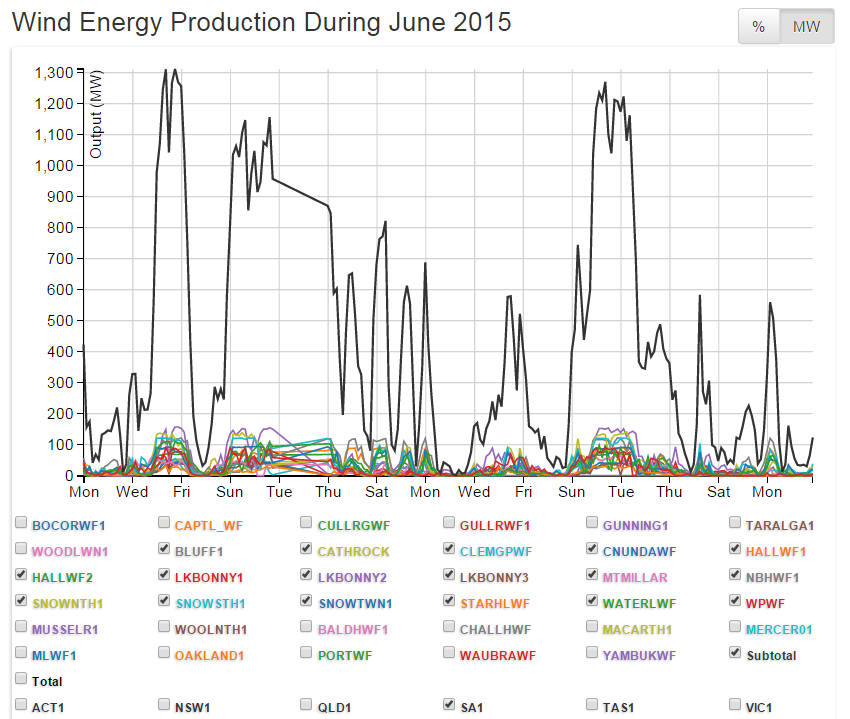
June 2015 SA

In the AFR piece it talks about occasions when: “Prices have hit the National Electricity Market limit of $13,800 a megawatt hour several times in the state in recent months”.

But, for some strange reason, the AFR fails (or refuses) to join the dots: those occasions – when the spot price paid to generators goes from around $70 per MWh to the market cap of $13,800 per MWh perfectly coincide with sudden (and often, complete) wind power output collapses, as detailed here:

South Australia’s Unbridled Wind Power Insanity: Wind Power Collapses see Spot Prices Rocket from $70 to $13,800 per MWh

The cost of SA’s insane wind power policy is borne, of course, by its beleaguered (remaining) businesses; and struggling households (think old-age pensioners and the thousands of unemployed).

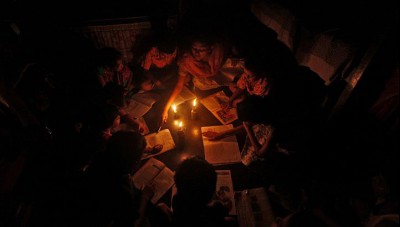
This is a State where some 50,000 homes have been disconnected from the grid – families simply no longer able to pay their power bills; who’ve been reduced to lighting their homes with candles, and, unable to power a fridge, using Eskies (coolers) to keep their perishables – cooking on wood stoves and trying to keep warm using barbeques.

With the fall-out from its wind power fiasco unfolding fast, hundreds of businesses will hit the wall; and thousands more households will soon get to join the tens-of-thousands, already sitting freezing (or boiling) in the dark.

SA power prices to surge by $150 a year, report warns
The Advertiser
David Nankervis
22 October 2015

POWER prices will surge up to $150 a year for hundreds of thousands of householders under controversial changes to electricity charges, an investigative report warns.

The SA Council of Social Services report also says small businesses face a 50 per cent rise in power costs and that this could force some to close.

The findings are based on a SACOSS investigation into the impact of rule changes by the Australian Electricity Market Commission.

The change is designed to shift the demand for power away from peak periods to take pressure off the network.

In response to the new rules, SA Power Networks has proposed introducing a monthly network charge calculated on a customer’s highest half-hour of energy use between 4pm and 9pm on any given day.

This will provide a “pricing signal” to customers to ration the use of appliances, SAPN spokesman Paul Roberts said.

“That means not turning on all major appliances at once during peak periods such as tea time on a hot day, instead delaying using the dishwasher or washing machine until later,” he said.

But SACOSS executive director Ross Womersley said the changes, beginning as early as 2017, would see half of all householders worse off.

“It would be madness for this to proceed and any changes should be deferred for at least a few years,” he said.

“And this new system should be introduced only on a voluntary basis, which would allow people to opt in only if they believe they will be better off.

“This is because people on low income and many other householders would be worse off.”

According to the SACOSS report, which will be submitted to SAPN as part of the network company’s consultation process:

APPROXIMATELY 50 per cent of householders would be worse off

THE biggest bill increases could reach $150 a year

THE biggest savings could be just $10 a year

HALF of small businesses would be worse off

ALMOST one-in-five small business would face a 50 per cent increase in energy costs

The report also said there was “limited (public) support” for the changes to the billing system.

SACOSS research revealed consumers were concerned about big variation in bills amounts, making it more difficult to budget for electricity costs.

The report said this would have a serious impact on low-income households over summer.

Mr Roberts said SAPN invited “consultation” on its proposed billing changes earlier this month because “we know people care about electricity prices”.

“We’re not only consulting on the detail of the changes, but also an appropriate transition that protects the interests of customers and gives them time to adjust to the changes.
The Advertiser
studying candle

Sleep Deprivation, and The Effects! (Wynne Gov’t Torturing Rural Residents Near Wind Turbines!)

The Spooky Effects of Sleep Deprivation
by Sara G. Miller, Staff Writer | October 27, 2015
It’s no surprise that a night without enough Zzzs can lead to a groggy morning. But bleary eyes and gaping yawns aren’t the only things that can happen when your body needs more shut-eye.

Indeed, there are more nightmarish side effects to sleep deprivation.

If a person is deprived of sleep, it can lead to “tremendous emotional problems,” said Dr. Steven Feinsilver, the director of the Center for Sleep Medicine at Icahn School of Medicine at Mount Sinai in New York City. “Sleep deprivation has been used as a form of torture,” he said. [7 Strange Facts About Insomnia]
There isn’t a clear definition of exactly how long a person must go without sleep, or how little sleep a person has to get to be considered sleep-deprived, and different people need different amounts of sleep, so there may be no universal definition of “sleep deprivation.” Rather, a person is considered sleep-deprived if they get less sleep than they need to feel awake and alert, researchers say.

But still, research over the years has shown that people can be physically and psychologically damaged from not getting enough sleep, said David Dinges, a professor of psychology and the director of the Unit for Experimental Psychiatry at the University of Pennsylvania.

In fact, the damage is so apparent that it is unethical to coercively deprive someone of sleep, Dinges said. In the studies of sleep deprivation that Dinges and his colleagues conduct in their lab, healthy volunteers are placed in medically safe environments and constantly monitored.

But studying sleep deprivation is important, according to these researchers and others who study the condition. They say that learning what happens in people who are deprived of sleep can help researchers better understand the function of sleep and its importance for both physical and emotional health.

Emotions askew

The problems can start on a somewhat minor scale.

“Clearly, your brain doesn’t work very well when you’re sleep-deprived,” Feinsilver said. Even a low level of sleep deprivation has an impact on cognitive and emotional function, he said.

Dinges explained that some of the first emotional impacts of sleep deprivation involve positive emotions. “When people get sleep-deprived, they don’t show positive emotion in their faces,” Dinges said. A sleep-deprived person may say they’re happy, but they still have a neutral face, he said.

And they won’t recognize other people as happy, either. A positive look on someone’s face can appear neutral to a sleep-deprived person, and neutral look is often interpreted as a negative look, Dinges said. The sleep-deprived brain may not be as capable of detecting positive emotions as a more rested brain, he said.

And sleep-deprived people also don’t tolerate disappointment very well, Dinges added.

Microsleeps

As little as a single night of sleep deprivation can result in a person having a phenomenon called “microsleeps,” the next day, Feinsilver said.

A person begins to fall into mini-snooze sessions, which last up to 30 seconds. Some people’s eyes remain open during microsleeps, but the disturbing thing about microsleeps is that during sleep, the person is essentially blind, even if their eyes are open, Feinsilver said. They’re not processing information, he said.

Studies show that during microsleeps, the brain goes into a sleep state rapidly and uncontrollably, Dinges said. People can force themselves awake, but they will soon fall into another microsleep, he said.

Both Dinges and Feinsilver said that this condition can be incredibly dangerous, especially if you’re behind the wheel.

Delirium

People often say they feel loopy after a night of no sleep. But in more extreme cases, losing sleep may cause delirium.

True delirium occurs when a person becomes completely disoriented, Feinsilver said. “Sleep can play a role in that,” he said. [5 Things You Must Know About Sleep]

Patients who have been hospitalized in intensive care units — where lights and sounds may continue all day and night — can develop a condition that doctors call “ICU delirium,” he said. And while it’s unclear if sleep deprivation is the cause of this delirium, doctors do think that loss of sleep is one reason people in the hospital for extended periods develop bizarre behavior, he said.

The worst thing you can do for sleep is put someone is a hospital, Feinsilver added. It’s fairly common for for hospitalized patients to develop insomnia, he said.

Hallucinations

Seeing things that aren’t there can be a side effect of chronic sleep deprivation, but whether sleep deprivations can induce true hallucinations may be up for debate.

Feinsilver said he personally experienced hallucinations due to sleep deprivation, in October of his first year out of medical school. A newly minted medical resident, Feinsilver said he had been chronically sleep-deprived for several months.

“I [knew] it was October, because I was in the ICU after a night on call,” and there was pumpkin by the nurses’ station, he said. “I had a very vivid feeling of the pumpkin talking to me,” he said.

But Dinges was more skeptical about hallucinations.

“There’s no question that misperceptions can occur,” Dinges said. When people are very sleepy and performing a task, they may see something flicker in their peripheral vision, or they may think they see blinking lights, but not be sure, he said. All of these are indications that the brain isn’t interpreting information clearly, he said.

Can you die of sleep deprivation?

In a famous series of animal experiments, researcher found that total sleep deprivation could kill lab rats.

In 2012, a Chinese man reportedly died after going 11 days without sleep. However, it’s unlikely that lack of sleep alone caused his death (other factors likely played a role, such as drinking and smoking).

Of course, studying this phenomenon in humans is difficult – even when you put aside the clear ethical dilemmas.

“Can you die of sleep deprivation? It’s not easy,” Feinsilver said. “Because you’ll fall asleep,” he added.

Dinges agreed.

“I don’t believe that people can keep themselves awake until they succumb to death,” because the drive to sleep turns on, and then continues to turn on, he said. “You can’t will yourself to stay awake that long,” he said.

Still, there’s no question that sleep deprivation has “serious adverse health effects,” Dinges said.

“Everything we know about sleep loss is harmful,” he said. But — on a more positive note — most of the effects of sleep deprivation dissipate after you sleep, he added.

Follow Sara G. Miller on Twitter @SaraGMiller. Follow Live Science @livescience, Facebook & Google+. Originally published on Live Science.

Wind Pushers Want to Evict People From Their Homes, via “Eminent domain”…

Falmouth Wind Turbines 2nd American Civil War

Falmouth Wind Turbines 2nd American Civil War

When the Town of Falmouth evicts the wind turbine neighbors and absorbs their properties through an act of eminent domain, those same townspeople will have to open their doors to their own wind power refugees. They may need to be reminded of the hard hearted turning back of the New Orleans Hurricane Katrina refugees as they tried to cross the bridge into the next parish by the Parish Sheriffs.

When civility disappears, it can get pretty brutal.

Anyone reading this needs to understand that this is the 2nd American Civil War, and it is being fought in many American communities.
The sooner the people can come to their senses about the “Falmouth Version of Climate Change BS”, the sooner they will be able to recover from this folly that is destroying them.

Already there is a significant feeling among the Town Meeting members that they are now reluctant to vote on the proposed Articles 1,2,&3 because they were not truthfully explained to them by the Select Board . (Obfuscation, anyone?)

The eminent domain presentation can be viewed on the link below Article 2 :
Board of Selectmen 10/5/15 part 2— 1:30 minute mark presentation and endorsement 2:24 minutes
http://www.fctv.org/v3/vod/board-selectmen-10515-part-2

All this erodes the people’s trust in government, and feeds anarchy. The situation in Falmouth, seized by anarchy, has behaved horribly. The very prospect, the very thought of seizing someone’s home by phony, 50% valuation, eminent domain turns one’s stomach. Some land of the free!

The noise torture :

While there are many sources of Infra-sound, most of them are generated by passing and sporadic sources, like rockets, aircraft, volcanoes, etc. Wind turbines are permanent installations. They operate at variable speeds. The kinds of noise that they produce is modulated, increases and decreases in intensity, dependent on local wind speeds. They confuse the nervous system and trigger the “fight, flight, freeze response” that all humans have hardwired into our nervous systems.

We developed this response to sense the approach of low growling lions and tigers back when we roamed the African savannah in search of food and shelter. This was a MOVING source of noise that we recognized as lethal.

Now, the wind turbines, a technological source of lethal noise, while fixed in place, produce (infra-sound and low frequency noise) in a modulated fashion, triggering the FFF response, causing a cascade of alarm hormones; adrenalin to flood the nervous system.

This may be adaptive to modern humans; case in point, some imbecile cuts you off in traffic and forces you to suddenly swerve and apply the brakes. You fuss and fume, but you are able to recover from this and continue to drive on normally.

When wind turbines sporadically impact on people in their sleep, they are aroused in a state of anxiety, and are unable to get back to sleep. This systematic sleep deprivation far exceeds any methods of interrogation so far devised, and presents these unsuspecting residents with the most exquisite form of torture yet.

When they finally seek legal redress they are met by measures of eminent domain to silence them and remove them from the state-driven wind power agenda.

Town Meeting Member Dave Moriarty discusses the upcoming Special Town Meeting concerning Wind 1
Click here to watch the youtube video : Falmouth MA Wind Turbine Fiasco 2015
https://www.youtube.com/watch?v=Vs8SwaR4KjE&feature=youtu.be

Last please view the presentation by Attorney Chris Senie

Falmouth ZBA Sept 17 with Chris Senie -This link :
Zoning Board of Appeals September 17, 2015 Senie & Associates, P.C. Representing Impacted Neighbors
https://windwisema.files.wordpress.com/2015/09/senie-to-zba-ceasedesist-2015-09-17.pdf

Wind Industry Deserves to “Collapse”, just like one of it’s Useless Turbines!

UK Wind Industry Collapses as David Cameron Slashes Subsidies for Wind Power

SWITZERLAND-WEF-DAVOS-CAMERON

****

While the wind industry, its parasites and spruikers continue to wail like banshees about dreaded ‘uncertainty’ all over the globe, there seems to be another ‘certainty’ keen to muscle up alongside the usual pair cited as examples of dead-set certainties in life: “death and taxes”.

The newest absolute certainty is that, in the absence of massive and endless subsidies, the wind industry will die a sudden, natural and inevitable death.

When David Cameron romped to absolute control of the UK Parliament, earlier this year, he did so on a promise to end subsidies to wind power outfits. Seen by delusional wind worshippers as a mere idle threat, Cameron’s election manifesto has now been realised, as the necessary amendments wind their way through Westminster.

Best deal for bill payers and investors as subsidies for onshore wind end
Department of Energy & Climate Change, Lord Bourne of Aberystwyth and The Rt Hon Amber Rudd MP
8 October 2015

The Government is pushing ahead with its commitment to end public subsidies for onshore wind farms, by closing the Renewables Obligation across Great Britain from 1 April 2016.

The Government is pushing ahead with its commitment to end public subsidies for onshore wind farms, by closing the Renewables Obligation across Great Britain from 1 April 2016.

In amendments to the Energy Bill we have set out the grace period criteria, providing further certainty for investors. We estimate that around 2.9GW of onshore wind capacity will be eligible for the grace periods, meaning that bill payers will be protected.

The projects that are eligible for the grace period will need to demonstrate either that they had planning consent as at 18 June; that they have successfully appealed a planning refusal made on or before 18 June; or that they have successfully appealed after not receiving a planning decision due by 18 June. They will also need to show that they had a grid connection and land rights in place. Projects that have met all these criteria and can demonstrate that they have struggled to secure finance from lenders since 18 June will be allowed extra time but no longer than nine months.

In total, the amount of onshore wind capacity that could be deployed by 2020 is still 12.3GW and will ensure we meet our renewable energy commitments.

Energy Minister Lord Bourne said: “We have a long-term plan to keep the lights on and our homes warm, power the economy with cleaner energy, and keep bills as low as possible for hard-working families and businesses.

“To do this we will help technologies stand on their own two feet, not encourage a reliance on public subsidies. By bringing forward these amendments we are protecting bill payers whilst meeting our renewable energy commitments.”
Gov.uk

While wind worshippers continue to make wild claims about wind power already being “free” – and, apparently, getting cheaper all the time – it appears that selling a product with no commercial value is getting tougher all the time.

Even the merest mention of a cut to subsidies has the wind industry’s parasites quaking in their boots. Follow through on the threat and big talking wind farm developers head for the hills:

Deliverance for Brits: David Cameron Empties Subsidy Trough & 250 Wind Farms Get Scrapped

In a predictably waffly piece from a wind worship blog, here’s the story of another wind farm being scrapped: this time in Wales, due to “changing market conditions” – which is wind industry code for “the subsidies have gone”.

Vattenfall ditches North Wales wind farm project that was 10 years in the making
businessGreen
Jessica Shankleman
17 August 2015

Nant Bach project has failed to keep up with changing market conditions, says developer

Swedish energy giant Vattenfall has scrapped plans for an 11-turbine wind farm near Conwy in North Wales after 10 years in development, partially blaming a shift in government policy for the decision.

In a statement today, Vattenfall said the Nant Bach wind farm, which was granted planning consent four years ago, no longer fitted with its strategy of developing and operating the “very best wind energy sites capable of delivering low-cost, competitive green power that finds a route to market”.

The developer said the 100m-high wind turbines were no longer economically viable in current market conditions. In order to use larger turbines the company would have had to refile for planning permission.

Industry insiders suggested larger turbines may have struggled to secure consent now the government has announced changes to planning policies for onshore wind farms, which effectively give locals the final say over applications.

The lodging of a second planning application may have also compromised the project’s ability to access the current Renewables Obligation (RO) subsidy scheme, which the government is preparing to close for new wind farm projects from next year.

A spokesman for Vattenfall said a range of policy changes had made the wind farm unviable, adding that the changes had created a “complex” situation for the developer.

Jonny Hewett, Vattenfall’s project manager for the Nant Bach scheme, said the market had moved on “and left Nant Bach behind”.

“It’s obviously disappointing to have to stop the Nant Bach wind energy project after 10 years of development,” he said in a statement. “We have had local support and the region’s economy would have benefited from any investment but the reality is that Nant Bach was a scheme conceived 10 years ago when energy policy encouraged the maturity of the new wind power industry.”

Vattenfall refused to disclose how much money it has spent developing Nant Bach.
businessGreen

turbine collapse 9

Government-induced Climaphobia….It’s a Huge Money-Grab!

Climate of intimidation

The idea only so-called ‘experts’ can debate global warming policies is an attack on free speech

lorrie-goldstein

BY , TORONTO SUN

FIRST POSTED: SATURDAY, OCTOBER 31, 2015 03:06 PM EDT | UPDATED: SATURDAY, OCTOBER 31, 2015 04:40 PM EDT

Climate Change protesters
A protester, wearing a Halloween mask, stands near a protest banner during a rally near the Presidential Palace to protest the country’s use of coal to power energy generation power plants which according to them has contributed to pollution Saturday, Oct. 10, 2015 in Manila, Philippines. The protesters are urging the Government to do more to reduce Greenhouse gas emissions which allegedly contributes to global climate change. (AP Photo/Bullit Marquez)

The easiest way to distinguish between a critical thinker and an ideological one is this.

When a critical thinker disagrees with you, he or she thinks you’re wrong.

When an ideologue disagrees with you, he or she thinks you’re evil.

When it comes to discussions about climate change, we have far too many ideologues and far too few critical thinkers.

Far too many self-proclaimed “environmentalists” who want to shut down all debate on the subject because their narrow and rigid ideological minds believe there is only one “correct” position — theirs — which saves them from having to think.

These are the folks who condemn anyone who disagrees with them as “climate change deniers”, a dogwhistle meant to smear anyone who deviates from climate change orthodoxy as the equivalent of a denier of the Holocaust.

I was reminded of this tactic Thursday in the lead-up to a discussion about political responses to climate change in which I was a panelist before a group of Ryerson University MBA students.

My fellow panelist was Andreas Souvaliotis, Executive Chairman of Social Change Rewards Inc. and we both appeared at the invitation of prominent Toronto lawyer Ralph Lean, who organizes a speaker series for Ryerson students.

The problem wasn’t with the students, who asked thoughtful and intelligent questions, nor with my fellow panelist, nor with Lean nor with the students’ professor, Dr. Asher Alkoby, a gracious and open-minded host.

Of course, open-mindedness should be expected in a university setting, but sadly, today that is decreasingly the case as more and more so-called institutions of higher learning replace critical thought with ideological thinking, intellectual laziness and academic decline.

Amusingly, the very mention of the idea on twitter by Ryerson’s MBA program that two non-scientists were about to discuss issues related to climate change was enough to freak out various and sundry self-proclaimed environmentalists, who have appointed themselves the arbiters of who can and who cannot discuss the issue.

Their attitudes, in and of themselves, are insignificant and unimportant.

But they speak to a wider concern that goes to the very heart of our fundamental notions of free speech, critical inquiry and indeed to the essence of the scientific method itself, which is built upon rational skepticism, not the unthinking acceptance of orthodoxy and received wisdom.

Far too often in the climate change debate, the people who will be most affected by government policies to deal with it — meaning all of us — are excluded on the basis that we are not “experts” on climate science.

I have seen this tactic used repeatedly over the years — most disgracefully by some politicians — to intimidate people into silence about expressing their views on climate change and its so-called “solutions” such as carbon taxes, cap-and-trade and wind and solar power.

This claim that climate change is the sole purview of “experts” is not only an attack on free speech and critical inquiry, it demonstrates a fundamental misunderstanding about what this debate is really all about.

Because it is not, at its essence, an environmental debate at all, but an economic one.

Governments in our own country and all over the world today are either implementing or contemplating a new tax they have never charged us for before — the emission of industrial greenhouse gases linked to climate change into the atmosphere.

It matters not whether they do it through a carbon tax or cap-and-trade, which is simply a carbon tax by another name, albeit less efficient and more open to political corruption.

What matters is that since we — all of us — are the ultimate polluters because we buy the goods and services that fossil fuel energy creates and transports, we will be the ultimate payers of what prime minister-designate Justin Trudeau vaguely refers to as “carbon pricing.”

In other words, what is actually being determined in the climate change debate is what will be our cost of living and our standard and quality of life.

Every citizen has the right to participate in that debate, without fear of being mocked or shouted down because they are not an “expert” on the science of global warming.

Which is why the dogwhistlers, with their specious comparisons of anyone who disagrees with them to Holocaust deniers and their disrespect for critical thinking, must be fought at every turn.

The Wind Turbine Scam, in Ontario….A Financial Disaster!

Ontario’s Wind Power Disaster Sends Power Prices Into Orbit, Driving REAL Industries Offshore

industrial-decline-2

****

Ontario is the place where the most bizarre energy policy in the world has seen thousands of these things speared into the backyards of homes – in the most agriculturally productive part of Canada. When we say “bizarre” we mean completely bonkers.

Canada has one of the “cleanest” power generation mixes on the planet, with the vast bulk of its electricity coming from zero emissions sources such as nuclear and hydro.

Adding to the lunacy is the fact that wind power outfits are guaranteed to reap fat profits despite market conditions.

Where the wholesale market price for power in Ontario is between $30-50 per MWh, wind power generators pocket a fixed price of $135 MWh – even if there is absolutely no market for it and the Province literally has to pay neighbouring US States to take it.

Adding insult to injury is the fact that truly productive industries are being crushed by skyrocketing power prices, sending their activities offshore and taking thousands of (previously) stable, well-paying jobs with them. Here’s Parker Gallant on the nightmare being visited upon Ontario.

Surplus power sold at discount: the sad sad story of electricity bills in Ontario
Ontario Wind Concerns
Parker Gallant
4 October 2015

Ontario ratepayer fatigue: covering the costs of bargain basement sale of surplus power from wind and solar

When will it end?

Another month goes by and another $168 million from Ontario ratepayer’s pockets went to subsidize surplus electricity exports to our neighbours in New York, Michigan and Quebec. The month of August saw another 1,759,000 megawatts (MWh) or 1.76 terawatts of excess electricity generation exported. That cost Ontario’s electricity ratepayers $209 million—the Independent Electricity System Operator (IESO) sold it for $41 million.

The 1.76 terawatts (TWh) sold at the big discount was enough to supply 183 thousand “average” Ontario households with power for a full year. That sale brings our exports to 15.09 TWh for the first 8 months of 2015, enough to supply almost 1.6 million “average” households with power for a full year!

The costs of those export losses fall to all ratepayers; for the eight months ended August 31st, that means a “green energy tax” of $1.4 billion, or about $300 per average household. Quick math will disclose that the average monthly cost is $177 million meaning the total cost for Ontario’s ratepayers in 2015 may reach $2.1 billion or roughly $460 per ratepayer. The 23 TWh we will probably export would have provided 2.4 million ratepayers with their average annual power needs.

What about wind power in all this? In August, wind produced 3.5% (459.3 gigawatts or GWh) of total generation (13.05 TWh) and just over 26% of our exports; solar produced about 29 GWh (not including “embedded generation”). Combined, they represented 27.7% of our exports which begs the question – what benefit do they provide and why do we keep adding more generation at subsidized rates, if we lose money because we must export our surplus generation?

That question is unfortunately not going to be answered any time soon, if we look at the recently released IESO 18 month outlook (Oct 2015 to March 2017).   The IESO report notes:

“About 1,900 MW of new supply – mostly wind and solar generation – will be added to the province’s transmission grid over the Outlook period. By the end of the period, the amount of grid-connected wind generation is expected to increase by 1,300 MW to about 4,500 MW. The total distribution-connected wind generation over the same period is expected to be about 700 MW. Meanwhile, grid-connected solar generation is expected to increase to 380 MW, complementing the embedded solar generation capacity of about 2,200 MW located within distribution networks by the end of the Outlook.”

According to the IESO report, Ontario will add 1,700 MW of generation from wind and solar generation over the next 15 months, which brings wind turbine capacity to 5,200 MW and solar to almost 2,600 MW. This is clearly not needed or dependable.

The IESO report also highlights what we have been told by various business associations that have expressed concern about the effects of rising electricity costs: “For the three months, wholesale customers’ consumption posted a 5.9% decrease over the same months a year prior with Pulp & Paper, Iron & Steel and Petroleum Products accounting for most of the reductions.”

That’s evidence that our primary processors are exiting Ontario, in large part because of high electricity prices, taking jobs with them.

The Ontario Wynne government is bent on ensuring Ontario leads the way to the highest prices of electricity in all of North America; they have only a couple of jurisdictions to overtake.

Time to turn the lights off!

studying candle

Say No to Climate Change CO2 Coercion at COP-21

Industrial Wind Turbines….Monuments to Greed, and Stupidity!

lsarc's avatarlsarc

LSARC no 2 CO2 Coercion

COP-21 is not about climate.

It is about destroying Western democracies, establishing an un-elected world government and redistributing wealth to third world countries, providing they agree to remain undeveloped.

COP-21 and the Climate Change movement are all about gaining total control over the human population of Earth for the benefit of the few at the expense of the majority. Never has human liberty been so threatened.

Calgary, Alberta, Canada (PRWEB) October 27, 2015

Friends of Science Society have a new billboard campaign – “Say NO to Climate CO2 Coercion” aimed at the upcoming COP-21 climate change talks that countries like Poland may agree with, as reported by Reuters, Oct. 13, 2015.

The “Conference of the Parties” (COP) to the UN Framework Convention on Climate Change are meeting for the 21st time will meet in Paris Nov. 30 to Dec. 11, 2015, to try and hash out an international agreement on…

View original post 443 more words

Wynne government reneges on the promise of the electricity act

Wynne Doesn’t Care About Promises, or Rules…

Cold Air's avatarColder Air

Ontario Premier Kathleen Wynne’s government has betrayed 15 years of debt collection from Ontario ratepayers in completely perverting the Electricity Act to increase efforts, begun with Premier McGuinty, to turn the sector into a net subsidizer of government spending.

In the 1999-2000 Annual Report of the Province of Ontario the government of the day laid out the basic principles behind electricity restructuring:

  • Keeping electricity prices in Ontario as low as possible
  • Recovering any stranded debt identified as a result of the restructuring from the electricity sector, and not from taxpayers
  • Maintaining maximum value in the electricity sector until stranded debt is retired or defeased; and
  • Creating a structure where investments are undertaken on a sound commercial basis.

The government of today is carrying on the tradition started by the McGuinty government before it. Rates for winter electricity were announced yesterday and the increase over the previous winter is the highest…

View original post 612 more words

Ontario’s financial accountability officer confirms Ontario will be worse off financially following Hydro One sale

Wynne and the Liberals….They’re Out to Destroy Ontario!

Cold Air's avatarColder Air

The Toronto Star’s Robert Benzie is reporting the Toronto Star has seen a report on the sale of Hydro One concluding:

“In the years following the sale of 60 per cent of Hydro One, the province’s budget balance would be worse than it would have been without the sale…”

I would have been surprised had he concluded anything other than that.

I’ve written extensively on the sale, recently stating this regarding the financial shenanigans driven by the head of the unelected Premier’s Advisory Council on Government Assets:

It seems the only value Ed Clark’s team has added to Hydro One has come at the expense of future government tax revenues.

The money in, money out, scheming with Hydro One is intended to provide “Deferred Tax Benefit”, and the government has stated it’s grabbing the entire “Deferred Tax Benefit” gained to pay into the Trillium Trust, which is the provincial government’s…

View original post 896 more words

Frauds, Crooks and Criminals

Demonstrating daily that diversity is not strength!

Family Hype

All Things Related To The Family

DeFrock

defrock.org's principal concern is the environmental and human damage of industrial wind turbines on rural communities

Gerold's Blog

The truth shall set you free but first it will make you miserable

Politisite

Breaking Political News, Election Results, Commentary and Analysis

Canadian Common Sense

Canadian Common Sense - A Unique Perspective from Grassroots Canadians

Falmouth's Firetower Wind

a wind energy debacle

The Law is my Oyster

The Law and its Place in Society

Illinois Leaks

Edgar County Watchdogs

stubbornlyme.

My thoughts...my life...my own way.

Oppose! Swanton Wind

Proposed Wind Project on Rocky Ridge

Climate Audit

by Steve McIntyre

4TimesAYear's Blog

Trying to stop climate change is like trying to stop the seasons from changing. We don't control the climate; IT controls US.

Wolsten

Wandering Words

Patti Kellar

WIND WARRIOR

John Coleman's Blog

Global Warming/Climate Change is not a problem