Britain’s Economic Nightmare Unfolds: Wind Power Costs Killing Thousands of REAL Jobs

Renewable Energy Costs…..A Job Killer….

stopthesethings's avatarSTOP THESE THINGS

Bill Bill Shorten: the workers’ worst nightmare.

****

A few posts back we focused on the naked malice of Labor’s Bill Shorten – as he derided Joanne Kermond on national television. Joanne is among the many victims of Pacific Hydro’s non-compliant Cape Bridgewater disaster – an outfit owned by Bill’s Labor/Union buddies, which has been defrauding the Commonwealth for nearly 7 years:

Labor’s Bill Shorten Publicly Ridicules Joanne Kermond – a Victim of Pacific Hydro’s Non-Compliant Cape Bridgewater Wind Farm

Pacific Hydro & Acciona’s Acoustic ‘Consultant’ Fakes ‘Compliance’ Reports for Non-Compliant Wind Farms

But, apart from meting out malice and contempt for law-abiding Citizens being denied their common law and human rights, Bill Shorten is also hell-bent on destroying every energy intensive business left in this Country: think mining, mineral processing and manufacturing for a start.

Make no mistake, with its 50% Renewable Energy Target, Labor is determined to kill mining…

View original post 2,277 more words

Wind Farms: Trigger ‘OUTRAGE’ When Proposed & ‘REJOICING’ When Scrapped

Rejoice!! Some Hard-working People Have Won, Fighting Against The Corrupt Wind Weasels…

stopthesethings's avatarSTOP THESE THINGS

john anderson Wheatley Energy Forum’s John Anderson and Dave Langmead can hardly disguise their justifiable glee as wind farm plan scrapped.

****

Rural communities across the Globe are fighting back against an industry with all the natural respect for property rights of Genghis Khan; and the moral fibre of Judas Iscariot.

These days, whenever a wind farm is proposed; or the developer is out in the field – literally ‘thumping’ its message home (see our post here) – the term most employed to cover the community’s response is ‘OUTRAGE’.

However, occupying the opposite end of the emotional spectrum, is the infectious, fun-filled term: ‘REJOICE’ – which is the only word powerful enough to capture the sense of victory and relief, for those who have spent thousands of relentless, unpaid hours dedicated to the defence of their communities, their homes, their farms, their businesses and their families.

Here’s an example of the…

View original post 529 more words

Aussies Not Going to Force Wind Turbines on Communities….For Real??

Angus Taylor MP: Retailer Boycott – Wind Farms will NOT be Built where there is ‘Negative Community Reaction’

Angus Taylor

****

Angus Taylor, the Liberal Federal Member for Hume gave a wind industry scorching interview on Alan Jones’ Breakfast show on 2GB last week. For Australian rural communities fighting the threat of these things, STT thinks that what Angus had to say is the best news that they will have heard, since their battles began.

Alan Jones AO: Which brings us back, thank God we’ve got some like it, to the man I’ve talk to you about many times, Angus Taylor, this bloke has ability. He is an outstanding Federal member for the seat of Hume, a Rhodes scholar. He’s from the bush. He’s got degrees in economics and law from Sydney University, a masters degree from Oxford University in economics and let me fire a warning shot here, because I now learn that the factions, remember Malcolm Turnbull said there were no factions in the Liberal party? The left are cutting loose. Just as the leader now, Tony Abbott has gone, and they’re lining up probably to have a shot at people like Angus Taylor and Craig Kelly and others, mobilising pre-selection. Malcolm Turnbull said at the Liberal party council meeting a couple of weeks ago – the party is not run by factions – Malcolm, you’re kidding us. Joe Hockey’s resigned. I’m telling you the next member for the seat of North Sydney has already been decided. You can forget about your pre-selection. The bloke the factions have decided will be Trent Zimmerman. Now as I told you last time, this gifted and talented Angus Taylor, didn’t make it amongst the 41 ministries handed out by Malcolm Turnbull. It doesn’t worry him because he is very strong on policy. He’s on the line, Angus Taylor, good morning.

Angus Taylor MP: Morning Alan.

Alan Jones AO: Where do we go on all of this? ‘Cos there is an interconnectedness isn’t there, between carbon dioxide, global warming, Paris and a a fortune being spent and then suddenly, embracing renewable energy. And you’ve got this in your electorate.

Angus Taylor MP: I certainly do, I mean I’ve probably got more wind farms planned in my electorate than anywhere else and at the end of the day Alan what we’ve got is a situation where people will move into my electorate from Sydney or Canberra. They’ll pull all of their savings into buying a block of land, a few acres, and a little farm only to discover a year or two later that a big 170 metre wind turbine is going to be overlooking them. And it’s just not on Alan when these things are getting $600,000 or more of subsidies a year …

Alan Jones AO: Each, each.

Angus Taylor MP: Each. Each turbine, each one of them.

Alan Jones AO: Stop stop Angus. Out there, remember what this man has said, this is not some dumbbell from you know out the back blocks, we’re talking to a Rhodes scholar. A bloke with masters from Oxford University in economics. $700,000 of your money per wind turbine and they’re owned by foreign interests.

Angus Taylor MP: The extraordinary thing about is that we don’t have a planning system to deal with it. This is the equivalent of a factory being built in the middle of a new suburb. That’s what’s happening here. And of course if anyone moved into a new suburb and built their house and then suddenly found, without expecting it, without knowing it, a factory was going to turn up next door, ‘cos they’d scream about it, and so they should.

Alan Jones AO: See people are writing to me Angus they’re refugees in their own homes now – they have to leave.

Angus Taylor MP: Well that’s right, practically speaking,  there’s only 2 ways that we can sort this out. One is, we need a planning system that recognises these areas that I’ve got, that are really rural residential now and zones them in a way where you can’t have these sort of industrial developments, or, and this is very important that the energy retailers who enter into long term contracts to allow these developments to be built, say look we are not going to build developments like this in areas where there’s community reaction, very negative community reaction. People like AGL and Origin, Energy Australia, and the ACT Government as well.

Alan Jones AO: But Angus, you’re trained, your academic discipline was economics, but you weren’t just academic, you then worked in that field at an international level.

Angus Taylor MP: That’s right.

Alan Jones AO: Just explain this to me why does it, when the pastry cook whose listening to you now. He’s been up making bread and pastry since 2 o’clock doesn’t get one dollar in subsidy, why should wind turbines be getting billions of dollars of tax payer’s money in subsidies? I don’t understand.

Angus Taylor MP: Well it’s extraordinary, isn’t it. So, let me give you some numbers that I think are really, really stunning. We are – and just accept for the moment, I heard your introduction. But just accept for the moment that we are going to reduce carbon emissions by some amount. We are doing it now, through the Direct Action program, a lot of which is about land use, agricultural land use, at about $15 a tonne. But we are paying these wind turbines about $50 or $60 a tonne to do it. So it’s 4 times more than we know we can do it. Greg Hunt has been able to do this for $15 and yet we are choosing to do it for 4 times that. So it doesn’t make economic sense. And I think the important point here is that if we are going to go down this path, we can not make ourselves uncompetitive, we can’t throw this sort of money at it, particularly when, particularly when we know that significant communities are being very, very negatively affected by what’s going on.

Alan Jones AO: But Angus all this environment crap about carbon and wind turbines – how much carbon dioxide, if that’s the fear, if that’s the demon, how much carbon dioxide is created by building these blasted things? What about you know, when you’re constructing the turbine? You’ve got to get iron ore to build the turbine. You’ve got to make steel to build the turbine. You’ve got to transport the turbines. You’ve got to have tens of thousands of concrete that go into each of these turbines. How much carbon dioxide is created to build these “environmentally friendly” wind turbines? This is a nonsense.

Angus Taylor MP: Well there is a light, and of course the other factor, which you mentioned earlier on, is the volatility of it. It’s unpredictable, it’s  interruptable as they say. And the important point about that is that electricity is no good to anyone unless its at the right place at the right time. And of course you can’t predict when you’re going to get electricity from wind turbines.

Alan Jones AO: And if they weren’t injurious to health, why wouldn’t you put them on Bondi beach, Queens street Brisbane, Collins Street Melbourne, Paramatta road? If they weren’t injurious to health.

Angus Taylor MP: And this is my point. What we are effectively doing is putting big factories into areas which are increasingly subdivided. Look, in my electorate between Sydney and Canberra, there’s more and more people moving in, which is great thing, a great thing. But they’re moving in and suddenly discovering that they’re next door to a cluster of wind turbines and the impact that’s having on their land values, on their peace of mind is enormous.

Alan Jones AO: Astonishing, Astonishing. Now look, we’re going to keep talking to you and I hope that you can persuade some of those people in your Caucasus to all of this because this nonsense somewhere has got to end. But well done, you continue to do terrific work, we’ll talk again soon.

Angus Taylor MP: Thanks Alan.

Alan Jones AO: It’s Angus Taylor, the Federal member for Hume.
2GB Alan Jones’ Breakfast

Angus Taylor delivering with the very substance and style that earned him the well-deserved tagline, “The Enforcer“; and, with one quibble, an exceptional effort.

Where Angus starts talking about the cost of CO2 reductions in the electricity sector purportedly attributable to wind power, he heads off into the land of myth and make believe.

The wind industry has yet to produce a single shred of credible evidence that demonstrates wind power reducing CO2 emissions in the electricity sector (to any degree; or at all). Instead, the hard evidence suggests precisely the opposite result:

Wind Industry’s Bogus CO2 Abatement Claims Smashed Again

Why Intermittent Wind Power Increases CO2 Emissions in the Electricity Sector

But, with that aside, Angus’ considered observations deliver a body blow to the wind industry, its parasites and spruikers – when he talks about how Australia’s power retailers are boycotting planned wind farms in communities that make it clear they do not want them. As the message is critical to every community defender, wherever they are in Australia, we’ll set it out again:

this is very important that the energy retailers who enter into long term contracts to allow these developments to be built, say look we are not going to build developments like this in areas where there’s community reaction, very negative community reaction. People like AGL and Origin, Energy Australia, and the ACT Government as well.

Angus delivered the same message at the recent packed-hall meeting at Yass in NSW, where 160 turned up to make it clear that more than 90% of the Yass/Rye Park communities are bitterly opposed to plans by Kiwi owned Trustpower to turn their slice of Southern Tablelands’ Heaven into an industrial wasteland:

NSW Minister – Pru Goward – Joins Forces with Community Defenders to Kill Plans for Trustpower’s Rye Park Wind Farm Disaster

Not least because the thugs employed by Trustpower and Epuron belted into a 79 year-old pensioner and a disabled farmer at an earlier meeting (see our post here), the crowd at the Yass meeting were keen for revenge (probably why, despite a cordial invitation, Trustpower’s thugs lacked the nerve to show their heads).

The communities’ attitude is pretty well captured by this letter from local STT Champion, Jayne Apps to the local rag, the Boorowa News.

A Letter to the Editor
22 October 2015

To the Editor,

On Friday, October 9 a Public Meeting organised by the Rye Park Action Group was held in Yass. The meeting was widely advertised and open to anyone who wanted more information on the large number of ‘Wind Farms’ being planned and built on the Southern Tablelands and South West Slopes.

Attendees were given information about the effects of sound, including infrasound, from people living at the Gullen Range WF near Crookwell.

Speakers also came from South Australia to tell the audience about the problems of being a WF host on their land and their inability to continue living so close to operating turbines resulting in the eventual sale of their property, and a Yass Real Estate agent gave his opinion about the difficulties he is having selling properties that will be visually impacted by the proposed Yass Valley and Rye Park WFs and the price reductions vendors are taking as a result.

A solar expert also gave a talk, and had a display, on one of the alternatives to wind power and local residents and business owners stressed the need for people to research and ask questions of the developers before agreeing to, and signing, contracts with wind power developers.

The meeting was attended by 160 people, and although the meeting was open to supporters of wind power as well as those seeking more information the majority of these people came from the villages and farming communities that will be impacted by the many developments.

When you take into account that most of these people would have been representing families and friends I think it could be said that there is a large amount of opposition to wind power development in the area.

Trustpower (Rye Park WF) tell us there is widespread community support for their development but after several years of promoting community knowledge on wind power in rural areas I have yet to see any sign of these supporters.

The only supporters I have come across are those who will be benefiting financially, and those who trespass on my land and steal signs, most recently a 760mm high x 1830 wide sign that was several metres inside my boundary fence.

I find it disturbing that a person who is supporting wind power can be offended by a ‘No Wind Turbines” sign that is less that a metre high, but will allow Rye Park to be surrounded with 109 wind turbines that will be 175 metres high and will make a lot of noise, without even taking into consideration the impact it will have on the community as a whole and the precious remnant vegetation and animal habitats that will be destroyed in the construction process.

As a matter of interest, a poll was taken on the night of the Public Meeting.

The question was asked ‘Are you in favour of wind turbines being built in Yass Valley, Boorowa, Rye Park and the surrounding villages and rural areas?.’

Of the 160 people in attendance 138 of them voted. 136 voted no and 2 voted yes.

This is in stark contrast to the survey done several years ago that the wind power companies love to quote saying 80% of people want wind power.

I would also like to note that I personally invited Trustpower representatives Michael Head, Wind Development Officer, and Rontheo Van Zyl, Development Manager, to speak at the public meeting and have a display but they were adamant they would not be attending such a meeting.

I again urge those living in Boorowa to take notice of what is going on around you, give support to your local farmers and residents of Rye Park and do some research on the impact the Rye Park WF, Bango WF and Rugby WF will have if they are approved for construction.

If you would like more information please email: ryeparkactiongroup@gmail.com or get onto Trustpower’s Rye Park Wind Farm website and look at their maps.

Also talk to your Boorowa Councillors.

They are currently deciding on the future of our roads that are to be used in the development stages of the Rye Park WF and if approved will be allowing the huge amount of oversized traffic to pass through Boorowa streets and local roads.

Jayne Apps – Rye Park

Nice work, Jayne. With that sort of response from locals, STT is happy to call the ‘community reaction’ from Rye Park and Yass, ‘very negative community reaction’ – of precisely the kind that will see power retailers refusing to sign the Power Purchase Agreements which are an essential pre-requisite for wind power outfits, like Trustpower to obtain the finance needed to build the wind farms still threatened. No PPAs; means no new wind farms – it’s a simple as that.

For every community defender, wherever you are in Australia, follow the lead set by Rye Park and Yass.

Get angry, get organised, get vocal and help prevent your community from being treated as ‘road-kill’ in the greatest economic and environmental fraud of all time. Fight them now; and they will flee – empty handed.

poster

Wind and Solar….Nothing more than Unaffordable Novelty Energy!

Top Danish Economist Bjoern Lomborg Declares Wind And Solar Energies A “Fata Morgana” …”Powerless And Expensive”!

LomborgThe German online Die Welt here has a commentary on wind energy by Danish economist Bjorn Lomborg. The title of his guest commentary: “Wind energy, powerless and expensive“.

Hat-tip Peter H at Facebook.

Wind and sun energy are often viewed by fossil fuel critics as the go-to green energies. But careful analyses show that these energies are in reality impractical due to their haphazard supply and very poor efficiency. Most wind installations fail to reach 20% of their rated capacities; sun only provides power when it’s daytime and not cloudy. The figures that Lomborg presents are sobering, inconvenient and totally discouraging for wind and sun power proponents.

Citing the International Energy Agency, Lomborg writes so far today only 0.4% of global energy comes from wind and sun, despite the tens of billions of dollars invested in the energy sources. He adds:

Even in 2040, if all governments stick to their promises, sun and wind will cover only 2.2 percent of the world’s energy by 2040.”

Lomborg says that the reason why sun and wind will be “no decisive solution against climate change” is the energies’ inability to be effectively stored. He calls the belief that the energies are cheaper than fossil fuels a “Fata Morgana”.

The problem remains that storage technologies today are cumbersome, horrendously expensive and thus unfeasible. Wind and sun remain a luxury for the rich. Lomborg explains to readers how wind energy are dependent on subsidies, and that without them they make no sense. The Danish star economist points out that not only do wind and sun need subsidies, but now also so do fossil fuel plants so that they can remain on standby when the wind and sun go AWOL. He also says that wind and sun only save about half of the claimed CO2 emissions, and that under some circumstances they actually cause greater emissions.

$131 trillion for 1°C less warming

He writes the planned expansion of green energies by the year 2040 will cost 2.3 trillion dollars and result in only in a mere 0.o175 °C less temperature rise by the end of the century (using the climate forcing figures provided by the climate models).

That means 1°C of theoretical less warming would cost 131 trillion dollars! If there ever was a new definition for insanity, that’s it.

– See more at: http://notrickszone.com/2015/10/25/top-danish-economist-bjoern-lomborg-declares-wind-and-solar-energies-a-fata-morgana-powerless-and-expensive/#sthash.BcQQl393.SHzlouYB.dpuf

97% of Climate Scientists Do NOT Agree On AGW!

The claim of a 97% consensus on global warming does not stand up
Consensus is irrelevant in science. There are plenty of examples in history where everyone agreed and everyone was wrong

Richard Tol: ‘There is disagreement on the extent to which humans contributed to the observed warming. This is part and parcel of a healthy scientific debate.’ Photograph: Frank Augstein/AP

Dana Nuccitelli writes that I “accidentally confirm the results of last year’s 97% global warming consensus study”. Nothing could be further from the truth.

I show that the 97% consensus claim does not stand up.

At best, Nuccitelli, John Cook and colleagues may have accidentally stumbled on the right number.

Cook and co selected some 12,000 papers from the scientific literature to test whether these papers support the hypothesis that humans played a substantial role in the observed warming of the Earth. 12,000 is a strange number. The climate literature is much larger. The number of papers on the detection and attribution of climate change is much, much smaller.

Cook’s sample is not representative. Any conclusion they draw is not about “the literature” but rather about the papers they happened to find.

Most of the papers they studied are not about climate change and its causes, but many were taken as evidence nonetheless. Papers on carbon taxes naturally assume that carbon dioxide emissions cause global warming – but assumptions are not conclusions. Cook’s claim of an increasing consensus over time is entirely due to an increase of the number of irrelevant papers that Cook and co mistook for evidence.

The abstracts of the 12,000 papers were rated, twice, by 24 volunteers. Twelve rapidly dropped out, leaving an enormous task for the rest. This shows. There are patterns in the data that suggest that raters may have fallen asleep with their nose on the keyboard. In July 2013, Mr Cook claimed to have data that showed this is not the case. In May 2014, he claimed that data never existed.

The data is also ridden with error. By Cook’s own calculations, 7% of the ratings are wrong. Spot checks suggest a much larger number of errors, up to one-third.

Cook tried to validate the results by having authors rate their own papers. In almost two out of three cases, the author disagreed with Cook’s team about the message of the paper in question.

Attempts to obtain Cook’s data for independent verification have been in vain. Cook sometimes claims that the raters are interviewees who are entitled to privacy – but the raters were never asked any personal detail. At other times, Cook claims that the raters are not interviewees but interviewers.

The 97% consensus paper rests on yet another claim: the raters are incidental, it is the rated papers that matter. If you measure temperature, you make sure that your thermometers are all properly and consistently calibrated. Unfortunately, although he does have the data, Cook does not test whether the raters judge the same paper in the same way.

Consensus is irrelevant in science. There are plenty of examples in history where everyone agreed and everyone was wrong. Cook’s consensus is also irrelevant in policy. They try to show that climate change is real and human-made. It is does not follow whether and by how much greenhouse gas emissions should be reduced.

The debate on climate policy is polarised, often using discussions about climate science as a proxy. People who want to argue that climate researchers are secretive and incompetent only have to point to the 97% consensus paper.

On 29 May, the Committee on Science, Space and Technology of the US House of Representatives examined the procedures of the UN Intergovernmental Panel on Climate Change.

Having been active in the IPCC since 1994, serving in various roles in all its three working groups, most recently as a convening lead author for the fifth assessment report of working group II, my testimony to the committee briefly reiterated some of the mistakes made in the fifth assessment report but focused on the structural faults in the IPCC, notably the selection of authors and staff, the weaknesses in the review process, and the competition for attention between chapters. I highlighted that the IPCC is a natural monopoly that is largely unregulated. I recommended that its assessment reports be replaced by an assessment journal.

In an article on 2 June, Nuccitelli ignores the subject matter of the hearing, focusing instead on a brief interaction about the 97% consensus paper co-authored by… Nuccitelli. He unfortunately missed the gist of my criticism of his work.

Successive literature reviews, including the ones by the IPCC, have time and again established that there has been substantial climate change over the last one and a half centuries and that humans caused a large share of that climate change.

There is disagreement, of course, particularly on the extent to which humans contributed to the observed warming. This is part and parcel of a healthy scientific debate. There is widespread agreement, though, that climate change is real and human-made.

I believe Nuccitelli and colleagues are wrong about a number of issues. Mistakenly thinking that agreement on the basic facts of climate change would induce agreement on climate policy, Nuccitelli and colleagues tried to quantify the consensus, and failed.

In his defence, Nuccitelli argues that I do not dispute their main result. Nuccitelli fundamentally misunderstands research. Science is not a set of results. Science is a method. If the method is wrong, the results are worthless.

Nuccitelli’s pieces are two of a series of articles published in the Guardian impugning my character and my work. Nuccitelli falsely accuses me of journal shopping, a despicable practice.

The theologist Michael Rosenberger has described climate protection as a new religion, based on a fear for the apocalypse, with dogmas, heretics and inquisitors like Nuccitelli. I prefer my politics secular and my science sound.

• Richard Tol is a professor of economics at the University of Sussex

Doctor Stands Up for People, that are Suffering from Wind Turbine Emissions!

Wind turbines proven to be threat to people’s health

Saint Albans Messenger; October 16, 2015

This review is intended to educate the public on the concerns and eventualities of the implementation of Wind Turbine energy on the health and welfare of those who will live close by and within the radius of that construction and the susceptibility to the impact of the noise and light levels that will have an impact Vermonters. There is clinical evidence that substantiates that there is a clear correlation between the dba levels and the distance of the effect of the noise and specifically the infrasound that will adversely affect residencies and the respective residents. This particular stance is not contrived or based on conjecture, the facts stand on the complaints of individuals who have suffered greatly to include lost sleep, severe headaches, increases in blood pressure and increased levels of stress and eventually, having had to abandon homes and properties as a result of their continued deteriorating health and welfare. Here are some responses that offer some insight and come from the study: Wind Turbines and Proximity to Homes:

The Impact of Wind Turbines Noise on Health a review of the literature I discussion of the issues by Barbara J Frey, MA (University of Minnesota) & Pater J. Hadden (Est Man), FRICS January 2012:

“Whereas, assessing the potential health impact of wind turbines has been difficult to measure but if present would be of significant concern. This is especially apparent regarding the noise level and other noise characteristics specific to industrial wind turbines.

“Therefore be it resolved that the Maine Medical Association work with health organizations and regulatory agencies to bring to the public’s attention the scientific information of known medical consequences of wind development.

“Further Resolved that the Maine Medical Association (1) encourage performance of studies on health effects of wind turbine generation by independent qualified researchers at qualified research institutions, (2) ensure that physicians and patients alike are informed of evidence-based research results.” [Maine Medical Association. Resolution Re: Wind Energy and Public Health.

MMA (USA), 2009] Here is one individual’s status: “Her symptoms came on quickly. She experienced bad headaches, dizziness, queasiness, a heart rhythm sensation and a vibration inside her body…”

[Woman Tells a Tale of Turbine Torment: Retired Pharmacist Speaks to Killaloe, Hagarty and Richards about the Effects Industrial Wind Turbines had on her. Health. Barry’s Bay This Week, 11 February 2009] “It was just like the whole room was spinning says Lisa Michaud of Thamesville, Ontario, as she recalled the weeks after the Kent Breeze wind farm began operating in May. The noise at night keeps you awake. But it’s not just the noise that you hear.

It’s something else that’s coming at you constantly that you don’t hear, but you feel. It’s just not right.”

[Seglins D and Nicol J. Wind Farm Health Risks Claimed in $1.5M Suit: Ontario Family Sues Suncor, Alleging Health Problems. CBC News, 21 September 2011http://www.cbc.ca/news/canada/ toronto/story/2011/09/21/seglins- windfarms.html; see also Seglins D and Nicol J. Ontario Wind Farm Health Risks Downplayed: Documents. CBC News, 22 September 2011 This particular study offers many more responses from individuals adversely affected by the con struction of the Wind Turbines. In addition, there is a multitude of articles that one can access and review that substantiate health risks and adverse affects from the construction of the Wind Turbines especially as that relates to a safe radius from residencies and respective residents.

Our group who opposes the construction of the Wind Turbines on Rocky Ridge by Mr. Travis Belisle’s company is not in opposition to embracing alternative energy sources and embracing renewable energy as a means of self-sustaining our economies and advancing our independence from fossil fuels. Our stance and position is that Vermont lives matter and the health and welfare of our residents in the towns of Fairfield, Swanton and St. Albans.

This is especially true for those who have young children who will be affected and the elderly.

As legislators, you need to be concerned as well and should be thinking of the heath issues and not just focusing on the return on investment for grants. When the realities of the noise and dba levels come to fruition and the respective health degradations, you cannot stand on the sidelines and state you were not aware of the consequences; this letter and many more of us who have factored this critical point in our essays have gone on the record and advised you of the facts. The call to question is this; do Vermont lives matter? Your actions will obviously answer that question.

What is the solution? First recognize there is an impact on health and welfare for those who live close to the construction sites. Second, there needs to be disciplined reviews and measurements by third party resources that trend the noise levels and if those levels exceed the recommended levels for safe operations then the turbines will be shut down until they can be successfully run or are run when the noise levels will not aversely affect those residents.

If these points are ignored, many Vermont residents will be adversely affected and we can then argue that Vermont lives do not matter. We need to learn from previous construction sites of Lowell and Georgia, Vermont and the lessons that those resident’s health and welfare and economic security to include homes and property value were adversely impacted.

Robert Perkins PhD, Fairfield

Wind Weasels Have No “Concern”, for Anything But MONEY!

Deadly Aircraft/Turbine Disaster at Highland Wind Farms ‘Just a matter of time’

plane wind-farm-scotland

****

A couple of weeks back, we looked at a report on how the RAF’s best of the best have been involved in dozens of near misses with these things in the UK, unnecessarily risking their lives every time they hit the skies:

RAF’s Top Guns Call Wind Farms a ‘Disaster in the Making’ for Flyers

The predictably glib and callous response from the wind industry and its parasites is that the risk of life and limb to flyers is just another one of those pesky “concerns” to be glossed over with a PowerPoint presentation, some soothing words and promises to fully “consult” stakeholders. Provided the consultation of “stakeholders” includes air crash investigators, paramedics and mortuary owners, then the wind industry will have truly covered the field.

You see, the risks to flyers are not merely “concerns”, they’ve become deadly reality. In the post above were referred to a pilot and his three passengers killed in a light plane in South Dakota, as it struck a turbine blade in foggy conditions; and we also referred to a highly experienced Ag pilot who was killed when his plane slammed into a wind farm MET tower.

Following on from the fears of the RAF’s Top Guns, light aircraft pilots in Scotland are predicting the obvious, inevitable and thoroughly unnecessary disaster, that’s just waiting to happen.

Pilots warn of a disaster as wind farms flourish
Sunday Express
Paula Murray
4 October 2015

Light aircraft pilots have warned it is “just a matter of time” before wind farms cause a “disastrous” accident in Scotland.

Small planes along with helicopters, gliders, microlights and other hobbyists make up the biggest user group of the UK airspace in terms of low level flying and contribute some £3billion to the economy supporting close to 40,000 jobs.

Member organisations admit the fast-growing renewables sector has created some “fairly significant” issues which they have fought hard to resolve.

Their main concerns relate to downwind turbulence from the turbine blades plus problems with visibility especially in poor conditions.

The fast pace of development mean maps and charts are often well behind of the size of existing farms and new developments with anenometer masts springing up to scout potential development sites.

Last month this newspaper revealed RAF pilots had reported a catalogue of near misses with wind farms and are making over 1,000 manual corrections to their charts every month to try and keep up with the changes.

However, general aviation industry is also struggling with the pace of development.

Last night the Light Aircraft Association (LAA) warned there was potential for a mid-air disaster.

LAA inspector Neil Geddes, of Bridge of Weir, Renfrewshire, said: “Certainly there is a risk.

“You only really understand how cluttered parts of Scotland are with wind turbines when you are flying a light aircraft – you won’t really get the picture tens of thousands of feet high on board a passenger plane.

“They cause downwind turbulence which can be an issue but at least we can spot them and take evasive action.

“It is the anenometer masts put up to measure wind speed and such like that are the real problem. They are practically impossible to see because they are so tall and slim. If you don’t know there is one on your flight path – and lets face it, it takes maps a year to catch up and by then there will be more of them – there is little you can do.

“In certain weather and light conditions they will be impossible to detect. It’s only a matter of time before we have a disastrous accident in our hands.”

Microlight aircraft instructor Colin MacKinnon, who operates Scotland’s oldest airfield in Strathaven, Lanarkshire, near to Whitelee wind farm which is among the largest in Europe, said new developments had the potential to put people out of business unless they were willing to put up a fight.

He added: “For about four years, I spent at least one day a week to respond to wind development planning applications and despite promises of community benefits we never received a penny of any funds, which is a bit frustrating.

“If Whitelee decided to expand eastward and was given the planning permission to do so we’d be out of business.

“While millions of pounds have been spent to investigate the impact and guarantee the safety of commercial aviation such as relocating radars to avoid problems with readings, very little has been done for the general aviation sector which is us.

“One of the issues is turbulence. There is no research done as to how close to a turbine it will be safe to fly. We do not have the resource to fund such studies unlike the wind industry which has millions.

“So we err in the side of caution. None of us is brave or stupid enough to be a test pilot to see how close to a turbine you can fly before your plane is ripped to shreds.

“I think we are among the most experienced in the world when it comes to flying safely in the vicinity of turbines with Whitelee so near to us.”

Over the past five years there have been around 10,000 applications to construct approximately 24,000 turbines across the UK.

With prime locations already in use developers are looking at alternative sites, many of which are closer to population and activity centres.

A UK Government report to general aviation from earlier this year admitted some airfields had their operations threatened by wind turbine developments.

The LAA also admitted some energy companies were eyeing “inappropriate” spots for their structures.

CEO Stephen Slater said: “I would say that more than 90 per cent of the turbines run no aviation issues.

“The general aviation sector is the main user of low level air space. It’s not just light aircrafts we are talking about but also helicopters, gliders, microlights, parachuters and so on.

“But we do have certain factors that have to be considered. There is the risk of potential collision especially in poor, deteriorating conditions when turbines or masts near an airfield may limit the pilot’s options of approach and we know of the radar issues with turbines interfering with readings.

“We are also aware of the concerns over turbulence with anecdotal evidence from pilots.

“But I would say that over the years we have developed a good working relationship with the wind energy industry to mitigate any problems that may occur.”

Meanwhile campaigners opposing wind farms have drawn information from abroad to highlight issues to aviation.

Christine Metcalfe, of Loch Avich, Argyll, has requested confirmation under Freedom of Information legislation from Civil Aviation Authority that turbines and turbulence from them do not impact emergency landings at airports such as Prestwick in Ayrshire and Glasgow after receiving evidence from Australia, USA and Europe on safety issues.

She raised concerns Whitelee was constructed without appropriate safeguards in place and now wants to know what sort of radar and safety impact studies were carried out prior the vast development went up.

Ms Metcalfe also wants to know why there has been no studies into the effect turbulence from wind farms has on planes when the organisation itself said in 2012 there was an “urgent need” for an assessment.

CAA has issued guidance to aerodrome operators saying a “large number of turbines in an area” will have a cumulative effect that is “of far more significant concerns” but it is yet to respond to the FoI request in more detail.

The anti-wind farm campaigner said: “I have learned that during the early 90s the management of the CAA were very supportive of the campaign involving resistance wind turbines as they had real and valid concerns even then. It is a great pity that times appear to have changed somewhat – almost certainly due to governmental pressures.

“Without the overall checks and balances in place for this technology, if such pressures were applied they are being proven to be misguided at best and at worst contributing to dangerous decisions being made.”
Sunday Express

plane_new_crop_t607-665x385

Lord Monkton Told by Climate Change ambassador in 2014 that Stephen Harper Would be Removed from Office by the U.N.

It is sad to see all of this taking place, even though we’ve known it was coming. Agenda 21

Donna Quixote's avatarQuixotes Last Stand

In an Australian interview in the fall of 2014, Lord Monkton stated that Sir David King, the Climate Change ambassador to the United Kingdom, was asked by the Environmental Committee of the House of Commons (Britain) if all the nations of the world were ready to sign the Global Warming Treaty in Paris (Fall of 2015).  To which he replied that there were two standouts — one being Stephen Harper in Canada — but not to worry because Canada was having an election in 2015 and that the U.N. will make sure that the Harper government is removed.

Listen to radio broadcast here.  The replay of Monkton’s interview is very close to the beginning, followed by an interview with Dr Jennifer Marohasy about temperature data manipulation.

View original post

Renewable Energy is Unaffordable, Unreliable, and Not Fit for Commercial Use…

Tom Steyer: Wrong on the facts, economics and morality… And “all in for 2016.”

Guest post by David Middleton

If being green was a mental illness, this guy would be the poster child…

HOME | NEWS | POLICY | ENERGY ENVIRONMENT
Dem mega-donor all in for 2016

Billionaire environmentalist Tom Steyer plans to invest at least as aggressively in the 2016 presidential election as he did last year, when he became the biggest individual donor on either side of American politics.

[…]

Steyer is undeterred by critics who say he squandered more than $75 million of his own money supporting Democratic candidates who promised tough action on climate change — half of whom lost — during the 2014 election cycle.

The California-based former hedge fund manager, who said recently that he had quit investing “cold turkey” to focus full-time on climate change, refutes this charge of failure. He points out that last year was “an absolutely terrible” one for the Democratic Party, which lost control of the Senate to Republicans.

[…]

Steyer sees the 2016 presidential election as his greatest opportunity yet to turn more Americans into climate change activists and to pressure candidates to present detailed plans to reach his target of getting 50 percent of U.S. power from clean energy sources by 2030.

[…]

Steyer has already spent at least $5 million this campaign cycle to convince voters to pressure politicians on climate change. That’s a major investment at this early stage that puts him on pace with the biggest super-PAC donors on the Republican side.

Last week he announced a “seven-figure” advertising campaign in early-voting states, and his super-PAC NextGen Climate is investing heavily in digital technology and has opened offices in four key states: Iowa, New Hampshire, Florida and Ohio.

[…]

NextGen ran ads attacking the Koch brothers in the midterm election season, but asked whether he would do so again, Steyer said he is now less interested in negativity and more concerned about telling a positive story about why people should care about climate change.

“Their influence is gigantic,” Steyer said of the Kochs.

[…]

“They’re much bigger. They have much more money,” Steyer added. “Of course that’s important. … [But] we have to rely on the fact that the facts are on our side, the morality is on our side and the economics are on our side.

“And, you know if that weren’t true, we wouldn’t have a chance in hell.”

Hey Tom! It ain’t true…

“We have to rely on the fact that the facts are on our side”…

World Surface Temperature Index -vs- Atmospheric Carbon Dioxide Concentration since 1997 to present

The facts are:

  1. There has been no global warming since the late 20th century.
  2. The climate is far less sensitive to changes in atmospheric CO2 than the so-called consensus says it is.
  3. Your “50 by 30” delusion would not affect the Earth’s climate in any statistically significant manner.

“The economics are on our side.”

The economics are on the side of natural gas and nuclear power.

“The morality is on our side.”

WSJ_Lomborg

OPINION COMMENTARY
This Child Doesn’t Need a Solar Panel
Spending billions of dollars on climate-related aid in countries that need help with tuberculosis, malaria and malnutrition.

By BJORN LOMBORG
Oct. 21, 2015 6:36 p.m. ET

In the run-up to the 2015 U.N. Climate Change Conference in Paris from Nov. 30 to Dec. 11, rich countries and development organizations are scrambling to join the fashionable ranks of “climate aid” donors. This effectively means telling the world’s worst-off people, suffering from tuberculosis, malaria or malnutrition, that what they really need isn’t medicine, mosquito nets or micronutrients, but a solar panel. It is terrible news.

[…]

http://www.wsj.com/articles/this-chi…nel-1445466967

The morality is on your side?

What Will It Take, For People to See the Truth about the Wind Scam? Trillions wasted! $$$

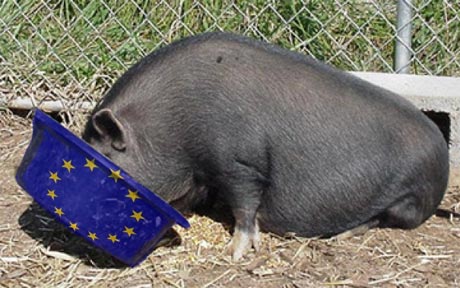
Europe’s ‘Colossal Energy Disaster’: €5.7 trillion ‘Completely Wasted’ on Wind Power ‘Wishes’

pig-trough-ey

****

When the wind industry and its worshippers start chanting their mantras about the ‘wonders’ of wind, it isn’t long before they start preaching about the examples purportedly set by the Europeans; and, in particular, the Nordic nations. The latter have seen economics hit back with a vengeance; wind power investment has thoroughly collapsed:

Wind Power Investment Collapses in Sweden, Denmark, Finland & Norway

Now, Europe as a whole is counting the costs of what is a disaster on a colossal scale. Here’s NoTricksZone detailing the magnitude of the calamity. The video is in German, helpfully translated by Pierre Gosselin. Danke, Pierre.

Europe’s € 5.7 TRILLION Climate Policy Is “Very Expensive”, “Counter-Productive” And “Does Nothing For Climate” … “Completely Wasted”!
NoTricksZone
Pierre Gosselin
8 October 2015

University of Magdeburg economics professor Joachim Weimann held a presentation in Brandenburg highlighting the shortcomings of Germany’s Energiewende (transition to renewable energies) and Europe’s climate policy earlier this year.

****

****

First Weimann calls the climate issue a debate that is emotionally and ideologically charged, and that the facts are almost always suppressed. He also believes that the real facts on climate change and energy policy are unpopular among policymakers and that they all too often “deny” them.

In the presentation Weimann makes it clear that he is an alarmist, and that he believes something needs to be done rapidly.

The thrust of his presentation, however, is about Germany’s Energiewende and Europe’s climate policies, and whether they are really effective. His assessment in a nutshell: The feed-in acts are a colossal disaster.

Coal plants pay less, consumers pay much more

Weimann says that go-it-alone national CO2 reduction programs aren’t functioning and that emissions trading schemes in combination with energy feed-in acts only result in emissions being sourced out and thus lead to no emissions reductions.

In the end the price of emission certificates falls to levels that makes them ineffective. Ironically coal power plants, he says, wind up the ones profiting the most. “Coal is indirectly being subsidized by the feed-in acts,” says Weimann.

Everything about coal suddenly becomes cheap, not only its supply, but also the costs of its emissions.

Greater consumption of resources

For the consumer, however, the price of electricity becomes far more expensive. Weimann also explains that the forced feed-in of renewable energies in fact even leads to greater consumption of resources, and not less.

At the 24:20 mark Weimann presents the costs of eliminating 1 tonne of CO2 emissions for a variety of sources: for a coal power plant 1 ton reduction of CO2 costs only 8 euros, for retrofitting a car it costs 100 euros per ton, for onshore wind 150 euros, offshore wind 320 euros and solar 400 euros a ton.

This does not include the grid costs. Clearly some CO2 reduction measures make little economic sense.

Feed-in acts lead to zero climate protection

At the 26:30 mark Weimmann slams the German EEG energy feed-in act because it promotes the installation of existing technology, rather than research and development in new technology. He says:

– “For climate protection, we do not need the Energiewende.”

– “It is doing nothing for saving resources”.

– “It is also doing nothing for jobs and new technology.”

Substituting coal and nuclear a pipe dream

Next Weimann shows why it is madness to try to replace 18 nuclear power plants (total output 20 GW) with “extremely volatile” wind energy. He says there’s no chance of accomplishing this feat without storage technology, which is still nowhere in sight.

Some 437 pump storage facilities would need to be built to ensure the supply of 18 nuclear power plants – an impossible task he says. He calls stopping nuclear energy and coal energy at the same time a pipe dream.

More coal burned today than in 1990!

Because Germany has already committed to closing its remaining nuclear power plants by 2022, the country will be forced to do 2 things: 1) burn more fossil fuels, and 2) to import more of the unpopular nuclear energy.

The stunning result, so far, Weimann points out: “We are now burning more coal than in 1990!”

Weimann summarizes, saying Germany’s Energiewende resulted in:

– “No energy independence.”

– “Negative job creation.”

– “A price tag of up to 1.2 trillion euros.”

Europe: €5.7 trillion “completely wasted”

Moreover, global greenhouse gas emissions climbed 35% from 2000-2012, clearly dwarfing Europe’s 11% reduction. He says the 5.7 trillion euros committed by all of Europe so far will be “completely wasted”. He says that what is needed is an international coalition and that here Germany is doing nothing to support it.

At the end (38:00) he hands in his final assessment. Germany’s Energiewende:

– “Is very expensive”

– “Is counter-productive”

– “Has had no effect on climate”

– “Disturbs in the decommissioning of nuclear power”

NoTricksZone

Facts