Agenda 21

How Governments are Trying to Push Agenda 21….A New World Disorder!
SCIENTIFIC PRETENSE VS. DEMOCRACY
Arrogance and intolerance in the name of superior expertise are antithetical to popular governance and the requirements of honest argument. But that hasn’t stopped them from becoming a central feature of our political life.

—Barack Obama
Unpacked, this sentence means: “Under my administration, Americans will have fewer choices about how they live, and fewer choices as voters because, rightfully, those choices should be made by officials who rule by the authority of science.”
Thus our new president intends to accelerate a trend a half-century old in America but older and further advanced in the rest of the world. There is nothing new or scientific about rulers pretending to execute the will of a god or of an oracle. It’s a tool to preempt opposition. The ruler need not make a case for what he is doing. He need only reaffirm his status as the priest of a knowledge to which the people cannot accede. The argument “Do what we say because we are certified to know better” is a slight variant of “Do what we say because we are us.”
An Old Story
THE FRENCH REVOLUTIONARY INTELLECTUALS and merchants who founded the modern state spoke of political equality. But they knew that if the masses governed, they might well have guillotined them rather than nobles and priests. And so they set up, and Napoleon perfected, a system of government that consisted of bureaucracies. In practice and in theory, the bureaucracies defined the modern state in terms of efficient administration, which they called scientific. In 19th-century France, Prussia, and their imitators, the state set standards for schools, professions, and localities. While elected assemblies might debate abstractions, they did not deal with the rules by which people lived. Political equality and self-rule were purely theoretical, while personal latitude was at the discretion of the bureaucracies. This is the continental model of the state, best explained by G. W. F. Hegel in The Philosophy of History and by Max Weber in his description of the Rechtsstaat, the “rational-legal state.” Access to this ruling class is theoretically equal, typically through competitive exams, and its rules should apply equally. Just as in the ancient Chinese imperial bureaucracy, decisions should be made by those who know and care best: the examination-qualified bureaucrats. In modern governance, in addition to embodying the state, the bureaucrats are supposed to be the carriers of the developing human spirit, of progress. Only in Switzerland and America did the theory and practice of popular government survive into the modern world. But note: they survived because they were planted on older, hybrid pre-Enlightenment roots.
Because the pretense of rare knowledge is the source of the modern administrative state’s intellectual and moral authority, its political essence is rule of the few, by their own authority, over the many. Ancient political theory was familiar with this category, distinguishing within it the rule of the moneymakers for the purpose of wealth, of the soldiers for glory, or of the virtuous for goodness. But modern thought has reduced government by the few to the rule of the experts. Expert in what? In bringing all good things, it seems. This was so when Mexico’s dictator Porfirio Diaz (1876–1911) justified his rule by claiming that he was just following the impartial advice of “los cientificos,” the scientists, about economics and public administration. Never forget that the one and only intellectual basis for Communist rule over billions of people since 1917 is the claim that Karl Marx had learned the secret formula for overcoming mankind’s “contradictions,” especially about economics. How many millions genuflected before the priests of “dialectical materialism”! To a lesser degree, the “brain trust” and “the best and the brightest” were important sources for the authority of the Franklin Roosevelt and John F. Kennedy administrations, respectively.
The scientific subject matter to which the rulers claim privileged access matters little. Three generations ago it was economics, in our time it includes everything from environmentalism to child rearing. But whether the objective be rainmaking, the avoidance of plague or falling skies, the fulfillment of fond wishes, or the affirmation of identity, the ruler’s incantations establish the presumption that he and his class know things that others do not or cannot know; that hence he and his class have the right to rule, while the rest must accept whatever explanations come from on high. In our time, such knowledge is called science, and claiming ownership of it practically negates political equality, if not human equality altogether. Claiming it is a political, not a scientific, act.
Knowledge and Equality
THE CLAIM THAT PUBLIC AFFAIRS (and as well many matters heretofore deemed private) are beyond the capacity of citizens to understand and too complex for them to administer, and hence that only certified experts may deal with them, must be cynical, at least to the extent to which those who make it realize that only theoretically does it transfer power to “the experts.” In practice, the power passes to those who certify the experts as experts. Surely, however, the polity’s ordinary members cease to be citizens.
Aristotle teaches that political relationships— that is, relationships among equals—depend on persuasion. Conversely, persuasion is the currency of politics only insofar as persons are equal. Whereas equals must persuade their fellows about the substance of the business at hand, despots, kings, or aristocrats exercise power over lesser beings by pointing to their status. But do those who rule on behalf of superior knowledge really know things that endow them with the right to rule? What might such things be? What subjects, what judgments, qualify as “science,” meaning matters so far beyond the horizon of ordinary human beings as to disqualify commonsense judgment about them? What can any humans know that the knowledge of it rightly places them in the saddle and others under it? What are the matters on which the public may have legitimate opinions, and on what matters are their opinions illegitimate, except when expressed by leave of certified experts? Moreover, how does one accede to the rank of expert? Must one possess a degree? But neither Galileo nor Isaac Newton had any, never mind Thomas Edison. Moreover, possessors of degrees do differ among themselves. Must one be accepted by other experts? By which ones? Note also that scientists are not immune to groupthink, to interest, to dishonesty, to mutual deference or antagonism, never mind to error.
The problem is patent: Because it is as plain in our America as in all places and at all times that some men do know the public business far better than others, it follows that the people in charge should be the ones who best know what they are doing. Hence, inequality of capacity argues for political inequality. To the extent that the matters to be decided rest on expertise, any nonexperts who claim a civil or natural right to refuse to follow the experts in fact abuse those rights. At most, nonexperts may choose among competing teams of experts.
But on what basis may they choose? If the questions that the experts debate among themselves are fundamentally comprehensible by attentive laymen, “science” would be about mere detail and citizens would be able to decide the big questions on the basis of equality. But if the “science” by which the polity is ruled disposes of essential questions, then citizenship in the sense of Aristotle and of the American Founders is impossible, and the masses should be mere faithful subjects. And if some voters dig in their heels or place their faith in scientists who are out of step with “what science says”—quacks, by definition— then they undermine the very basis of government that rests on expertise. Such inequalityis compatible with some conceptions of citizenship, but not with the American or democratic versions thereof.Because Americans believe that “all men are created equal,” they tend to identify the concept of citizenship with that of self-government; the American commitment to equality means equality in the making of laws. Even more, it presumes laws under which persons may live as they wish, that the people have the final say on any restriction of that freedom, and that even popular assent—never mind scientific decision-making—cannot alienate the rights to “life, liberty, and the pursuit of happiness.”
Unlike Hegel and Napoleon, who saw nations as organisms to be organized scientifically, Americans view public life as an arena of clashing interests that must be adjusted to their general satisfaction. Hence from the American perspective, removing the polity’s business from the arena of politics to the cloisters of science just restricts the competition among the polity’s factions and changes its rules. Whereas previously the parties had to address the citizenry with substantive cases for their positions and interests, now translating those positions into scientific terms expressed by certified persons means that the factions must fight one another by marshaling contrasting scientific retinues, by validating their own and discrediting their opponents’ experts. It follows then that the modern struggle is over control of the process of accreditation, and that the arguments the masses hear must be mostly ad hominem, seldom ad valorem— not least because the experts deem the masses incapable and unworthy of hearing anything else.
Franklin Roosevelt’s “New Deal” revolutionized the relationship between ordinary Americans and their government by introducing a new kind of legislation: thenceforth, the people’s elected representatives would delegate to “independent” executive agencies the “quasi-legislative” and “quasi-judicial” power to invent and administer the rules in their field by which people would live. The citizen’s recourses against these powers are mostly theoretical. The notion that they are “independent” and rule by impartial expertise is on the level of stories about tooth fairies.
Scientific Pretense Comes to America
AMERICA GOT ITS FIRST straight dose of scientific governance in the 1950s. In 1954, the U.S. Supreme Court decided the case of Brown v. Board of Education—whether schools segregated by race fulfilled the 14th Amendment’s requirement for “equal protection of the laws” to all citizens—not by reference to any legal or political principle on which the general population might pronounce themselves (one such principle was available in Justice John Marshall Harlan’s dissent in Plessy v. Ferguson, the case that Brown overturned), but rather by reference to a “study” by sociologist Kenneth Clark concluding that “separate is inherently unequal.” This was a finding supposedly of fact, not of law. Whereas ordinary citizens were supposedly competent to agree or disagree with the legal and moral principles on either side of these cases, the Court decided Brown on a basis that could be contested only by sociologists as well credentialed and funded as Mr. Clark. Debates within the Court and in society at large subsequently have been focused not so much on what is lawful as on contending studies about the effects of competing policies.
The scientization of American political life was just beginning. Between the 1950s and 2000 social policy slipped away from voter control because the courts and the “independent agencies” took them over. Beginning in the 1970s, courts and agencies began to take control of economic life through the pretense of scientific environmental management.
In Massachusetts v. EPA (2007), the Court agreed with what it called predominant scientific opinion that human emissions of carbon dioxide cause “global warming” and hence ordered it to regulate those emissions—essentially America’s economy. The American people’s elected representatives had not passed and were not about to pass any law concerning “global warming.” No matter.
It should be superfluous to point out that “scientific” briefs submitted to courts, as well as the innumerable contacts between expert “independent” agencies and the interest groups in the fields they regulate, are anything but impartial, bloodless, disinterested, apolitical. But in fact the power of scientific pretense rests largely on the thin veil it casts over clashes of interest and political identity. Let us look further.
In his 1960 Godkin lectures at Harvard, C. P. Snow, who had been Britain’s civil service commissioner, told Americans that “In any advanced industrial society…the cardinal choices have to be made by a handful of men: in secret and, at least in legal form, by men who cannot have firsthand knowledge of what these choices depend upon or what their results may be.” In short, public figures must be figureheads for scientists who are formally responsible to them but whose minds are beyond common understanding and scrutiny. Snow concluded that society’s greatest need was for change, and that scientists were “socially imaginative minds.” While scientists should not administer, he said, they should be part of the Establishment, along with administrators. He illustrated this point by contrasting the clash in Britain between two scientists, Sir Henry Tizard, innovative, progressive, and very much a member of the administrative- scientific Establishment, and F. A. Lindemann, a scientist close to Winston Churchill but outside the Establishment. According to Snow, Lindemann polluted science and administration with politics, while Tizard’s contrary scientific and administrative opinions were supra-political. Tizard’s membership in the Establishment made them that. But in the same year, President Dwight Eisenhower’s farewell to the American people after eight years in the White House and a lifetime in the U.S. Army argued that government’s embrace of science would corrupt itself and science. Whereas Snow had taken pains to identify science with public policy and to call true scientists only those who got along with colleagues and especially with administrators, Eisenhower pointed to these things as subversive. His oft-cited warning about the dangers of a “military-industrial complex” was part of the address’s larger point: the danger that big government poses to citizenship:
…a government contract becomes virtually a substitute for intellectual curiosity. For every old blackboard there are now hundreds of new electronic computers. The prospect of domination of the nation’s scholars by Federal employment, project allocations, and the power of money is ever present and is gravely to be regarded. Yet, in holding scientific research and discovery in respect, as we should, we must also be alert to the equal and opposite danger that public policy could itself become the captive of a scientific technological elite.
The prospect against which Eisenhower warned has become our time’s reality. One accedes to the rank of expert by achieving success in getting grants, primarily from the government. Anyone who has worked in a university knows that getting government grants is the surefire way to prestige and power. And on what basis do the government’s grantors make the grants that constitute the scientific credentials? Science itself? But the grantors are not scientists, and they would not be immune to human temptations even if they were. Personal friendship, which C. P. Snow touted, is not nearly as problematic as intellectual kinship, professional and political partisanship. In sum, as Eisenhower warned, politicians are tempted to cast issues of public policy in terms of science in order to foreclose debate, to bring to the side of their interests expert witnesses whose expertise they manufactured and placed beyond challenge.
Power by Pretense
TESTIFYING TO A JOINT CONGRESSIONAL committee on March 21, 2007, former vice president Al Gore argued for taxing the use of energy based on the combustion of carbon, and for otherwise forcing Americans to emit much less carbon dioxide. Gore wanted to spend a substantial amount of the money thus raised to fund certain business ventures. (Incidentally or not, he himself had a large stake in those ventures.)
But, he argued, his proposal was not political, and debating it was somehow illegitimate, because he was just following “ science,” according to which, if these things were not done, Planet Earth would overheat and suffocate. He said: “The planet has a fever. If your baby has a fever, you go to the doctor. If the doctor says you need to intervene here, you don’t say, ‘Well, I read a science fiction novel that tells me it’s not a problem.’” But Gore’s advocacy of “solutions” for “global warming” was anything but politically neutral acceptance of expertise. As vice president until 2001, and afterward, he had done much to build a veritable industry of scientists and publicists who had spent some $50 billion, mostly in government money, during the previous decade to turn out and publicize “studies” bolstering his party’s efforts to regulate and tax in specific ways. Moreover, he claimed enough scientific knowledge to belittle his opposition for following “science fiction.” But Gore’s work was political, not scientific. Not surprisingly, some of his opponents in Congress and among scientists thought that Gore and his favorite scientists were doing well-paid science fiction.
Who was right? Gore’s opponents, led by Oklahoma senator James Inhofe, argued that the substance of the two main questions, whether the Earth was being warmed by human activities, and what if anything could and should be done about it, should be debated before the grand jury of American citizens. Gore et al. countered that “the debate is over!” and indeed that nonscientific citizens had no legitimate place in the debate. Yet he and like-minded citizens claimed to know enough to declare that it had ended. They also claimed that scientists who disagreed with them, or who merely questioned the validity of the conclusions produced by countless government science commissions to which Gore and his followers had funneled government money, and which they called “mainstream science,” were “deniers”—illegitimate. Equally out of place, they argued, were calls that they submit to tests of their scientific IQ. Whatever else one may call this line of argument, one may not call it scientific. It belongs to the genus “politics.” But, peculiarly, it is politics that aims to take matters out of the realm of politics, where citizens may decide by persuading one another, and places them in a realm where power is exercised by capturing the commanding heights of the Establishment.
Thus on July 28, 2008, Speaker of the House Nancy Pelosi explained to journalist David Rogers why she was right in forbidding Congress to vote on proposals by Republicans to open U.S. coastlines to oil drilling. Using fossil fuels, she explained, causes global warming. Forbidding votes that could result in more oil being used was her duty because, she said, “I’m trying to save the planet. I’m trying to save the planet.” No one would vouch for her scientific expertise. But she was surely saving an item in the agenda of her party’s constituencies, which rightly feared defeat in open debates and votes.
In the same way, in September 2008 Secretary of the Treasury Henry Paulson and chairman of the Federal Reserve Board Ben Bernanke told Congress and the country, backed by many in the banking business, that unless Congress authorized spending $700 billion to purchase the financial assets that the banks and investment houses considered least valuable, the entire financial system would collapse and the American people would lose their savings, jobs, homes, and so on, and that authorizing that money would avert the crisis. But none of those who proposed the expenditure explained why the failure of some large private enterprises and their subsequent sale at public auction would cause any of the abovementioned catastrophes. There was no explanation of how the money would be spent, how the assets to be bought would be valued, or why. The arguments were simply statements by experts in government as well as finance—whose repeated mistakes had brought about the failures that were at the center of contention, and whose personal interests were involved in the plan they proposed. The strength of their arguments lay solely in the position of those making them. They were the ones who were supposed to know. And when, a month later, the same Paulson, backed by the same unanimous experts, told the country that the $700 billion would be spent otherwise, and as they committed some $8 trillion somehow to shore up the rest of the economy, the arguments continued to lie in the position of those making them, combined with the clamor of those who would benefit directly from the government’s outlays. In practice, expertise—or science—has come to be defined by a government job or commission. Truth and error are incidental.
The confluence of political agendas with the attempt to describe political choices as scientific rather than political, and the attempt to delegitimize opponents as out of step with science, is clear in the 2005 book by journalist Chris Mooney, The Republican War on Science. Typically, Mooney disclaims substantive scientific judgment and claims only the capacity and right to discern the “credibility” of rival scientists and their claims. Note well, however, that propositions or persons are credible—that is, worth believing—only to the extent that they are correct substantively. Arguments such as Mooney’s, Paulson’s, Pelosi’s, and Gore’s most certainly aim to convince citizens about certain substantive propositions, but—and this is key—they do so indirectly, by pretending that they find certain propositions credible and others not. Credible are the ones of which they approve, coming from persons the places of which they approve: the government bureaucracies or universities. Judgments of authoritative provenance, they argue, need not refute the opposition’s arguments, or even refer to their substance because science— meaning the Establishment—supposedly has settled the arguments intellectually to its own satisfaction, the only satisfaction that matters. Mooney writes that because “American democracy… relies heavily on scientific technical expertise to function [public officials] need to rely on the best scientific knowledge available and proceed on the basis of that knowledge to find solutions.”
Modern Republicans, he argues, have put themselves “in stark contrast with both scientific information and dispassionate, expert analysis in general.” Caught in the confluence of corporate interests and conservative ideology, primarily religion, Republicans have “skewed science” on every important question of the day, from stem cell research to “global warming, mercury pollution, condom effectiveness, the alleged health risks of abortion, and much else.” They have “cherry picked” facts and, most ominously, even cited scientists to back them up. Mooney worries: “If the American people come to believe they can find a scientist willing to say anything, they will grow increasingly disillusioned with science itself.”
Against the Grain
THAT WORRY IS SERIOUS. Convincing people that what you may teach your children, what taxes you should pay, must be decided by the “scientific” pronouncements of members of a certain class challenges the American concept of popular government all too directly. To succeed, any attempt to impose things so contrary to American life must overcome political hurdles as well as human nature itself.
Government by scientific pretense runs against the grain of politics in two ways: First, since those who would rule by scientific management eschew arguments on the substance of the things, instead relying on the cachet of the scientists whose mere servants they pretend to be, their success depends on maintaining a pretense of substantive neutrality on the issues—the pretense that if “science” were to pronounce itself in the other direction, they would follow with the same alacrity. But this position is impossible to maintain against the massive evidence that those who hawk certain kinds of social or environmental policies in the name of science are first of all partisans of those policies, indeed that these policies are part of the identity of their sociopolitical class.
Second, it is inherently difficult for anyone who fancies himself a citizen to hear from another that he is not qualified to disagree with a judgment said to be scientific. Naturally, he will ask: If I as a layman don’t know enough to disagree, what does that other layman know that qualifies him to agree? Could it be that his appeal to science is just another way of telling me to shut up because he is better than I, and that he is justifying his presumption by pointing to his friends in high places?
The most important claims made on behalf of science often run against human nature, none more so than its central claim about the nature of humanity. On December 20, 2005, deciding the case of Kitzmiller v. Dover Area School District, federal district court judge James Jones prohibited the Dover, Pennsylvania, schools from teaching the possibility that human beings are the result not of chance but of “intelligent design.” To partisan applause, he ruled that science had shown, proved, that all life, including human life, is the result of chance, that it is meaningless, that entertaining the possibility of the opposite is religion, and that doing so in a public school amounts to the “establishment of religion,” and hence is prohibited by the First Amendment.
Leave aside the absurdity of maintaining that the authors of the U.S. Constitution entertained any part of this reasoning. Consider: since everyone knows that nobody reallyknows how life, particularly human life, came about (cf. the legal meaning of the word “knowledge”), any attempt to impose as official truth the counterintuitive proposition that human life is meaningless discredits itself. It is impossible to suppress the natural reaction: “How the hell do they know?”
Human nature rebels especially violently against those who pretend to special knowledge but who then prove inept, whose prescriptions bring misery. When politicians lay out their reasons why something should or should not be done, when the public accepts those reasons, and then the ensuing measures bring grief, the public’s anger is tempered by its own participation in the decision, and is poured out on the ideas themselves as well as on the politicians who espoused them. But when the politicians make big changes in economic and social life on the basis of “science” beyond the people’s capacity to understand, when events show them to have been wrong, when those changes impoverish and degrade life, then popular anger must crash its full force only on those who made themselves solely responsible. The failed sorcerers’ apprentices’ excuse “science made me do it” will only add scorn to retribution.
Faux-Greenies Long for a New World Disorder!
A Future without Electricity
That’s what radical Greens want — and President Obama’s policies are moving us toward.

Back to the Future?: Dawn of the Planet of the Apes

Stephen Moore 
Could the radical-Green movement in America make mankind’s future resemble a science-fiction Earth ruled by apes?
This weekend I went to the see the blockbuster movieDawn of the Planet of the Apes, and an Investor’s Business Daily editorial this week got me thinking about a bleak scenario. Our future won’t have ape rulers, but, IBD points out, a world without energy might well look similar.
In the movie, bands of humans are resisting a global government of super-intelligent monkeys, gorillas and the like. The humans lack access to electricity, making their struggle — let along the normal life we know today — nearly impossible.
They are rendered powerless — literally. The simian despots understand that depriving the humans of access to electricity will keep them underfoot. (The climax of the movie, as IBDexplains, has humans in San Francisco — of all places — heroically reopening a power plant and bringing electricity back to the whole city.)
I wonder how many Americans got the subtle message here: Energy is the master resource. Without it, we return to a Stone Age existence. Life in its absence is nasty, brutish and short.
Is that where the radical Greens, one of the most influential political forces in America today, would take us? If we continue to follow their advice, electric power and fuel will become more expensive (as President Obama has admitted). TheInvestor’s Business Daily editorial noted, “as the Sierra Club, billionaire Tom Steyer and the Obama administration rage war against coal and other fossil fuel,” we could end up seeing “rolling brownouts and even blackouts in the years ahead.”
In other words, the apocalypse confronting America may not be the havoc of “climate change,” but a slow-motion return to a medieval lifestyle.
Consider the Obama administration’s ongoing war on coal, marked most recently by new Environmental Protection Agency regulations requiring dramatic reductions in carbon emissions from power plants. America gets about 40 percent of its electricity from coal-fired plants, as IBD notes.
The greens say, no problem, we will shift to renewable energy. But it’s not so simple, as IBD points out: States with onerous renewable-energy standards such as Colorado and California are still relying heavily on coal to fill in the gaps during bad weather or periods of high demand.
There is a reliable, green, economical alternative: natural gas. It’s become cheap and abundant due to new smart drilling technologies. But the environmentalists are busy devising strategies to shut down natural gas as an energy source as well, raising unsupported objections to fracking, one of the methods used to extract it. The Sierra Club says we have to move “beyond natural gas,” even though natural gas is reducing carbon emissions.
And as IBD notes, the Left has little love for other sources of electricity, either, such as nuclear and hydro. In fact, the editorial notes, we get about 90 percent of our power from sources that the Left is trying to shut down.
Sorry, for the foreseeable future, we aren’t going to get our power for our $18 trillion economy from wind turbines and solar panels. And if we begin to try, prices are going to skyrocket.
As for our major transportation fuel, the Greens think oil is a “dirty” fuel that causes global warming. They’re trying to stop domestic drilling anywhere they can. They say we should move to electric cars. Fine. But where are we going to get the electricity to power the batteries?
Last summer our suburban home in northern Virginia lost power for two days during a storm. No lights, no computers, no air conditioning, no TV, no iPods or iPhones. To my three sons, this was like hell on earth. How did people live without electricity? They wondered. Very poorly, I told them.
I wonder how many young people will be so excited about “green energy” when such outages are commonplace and they come to the realization that life without those “dirty” sources of power won’t be so wonderful.
We don’t need apes to destroy our planet. The green humans seems to be doing a fine job of it all on their own.
— Stephen Moore is chief economist at the Heritage Foundation.
Agenda 21 Means, Everything you have, is Up for Grabs…

Submitted by Phoenix Capital Research on 07/10/2014
Behind the veneer of “all is well” being promoted by both world Governments and the Mainstream Media, the political elite have begun implementing legislation that will permit them to freeze accounts and use your savings to prop up insolvent banks.
This is not conspiracy theory or some kind of doom and gloom. It’s basic fact.
When a Cyprus bank went bust in 2013, the Government SEIZED 40% of ALL SAVINGS DEPOSITS OVER €100,000.
Here’s the timeline:
· June 25, 2012: Cyprus formally requests a bailout from the EU.
· November 24, 2012: Cyprus announces it has reached an agreement with the EU the bailout process once Cyprus banks are examined by EU officials (ballpark estimate of capital needed is €17.5 billion).
· February 25, 2013: Democratic Rally candidate Nicos Anastasiades wins Cypriot election defeating his opponent, an anti-austerity Communist.
The initial stage of this took over six months to develop. But once things got hairy, the seizure took place over the course of ONE WEEKEND.
· March 16 2013: Cyprus announces the terms of its bail-in: a 6.75% confiscation of accounts under €100,000 and 9.9% for accounts larger than €100,000… a bank holiday is announced.
· March 17 2013: emergency session of Parliament to vote on bailout/bail-in is postponed.
· March 18 2013: Bank holiday extended until March 21 2013.
· March 19 2013: Cyprus parliament rejects bail-in bill.
· March 20 2013: Bank holiday extended until March 26 2013.
· March 24 2013: Cash limits of €100 in withdrawals begin for largest banks in Cyprus.
· March 25 2013: Bail-in deal agreed upon. Those depositors with over €100,000 either lose 40% of their money (Bank of Cyprus) or lose 60% (Laiki).
The most important thing I want you to focus on is the speed of these events once things hit the fan. Cypriot banks formally requested a bailout back in June 2012. The bailout talks took months to perform. And then the entire system came unhinged in one weekend.
One weekend. The process was not gradual. It was sudden and it was total: once it began in earnest, the banks were closed and you couldn’t get your money out (more on this in a moment).
Cyprus is not some freak occurrence that could never happen anywhere else. The IMF has suggested to Governments around the world that they do the same (meaning STEAL deposits).
Again, this is not conspiracy theory. Germany just passed legislation that would permit PRECISELY this.
 BERLIN–Germany’s cabinet Wednesday approved plans to force creditors into propping up struggling banks beginning in 2015, one year earlier than required under European-wide plans that set rules for failing financial institutions.
The new bail-in rules are part of a package of German legislation on the European banking union–an ambitious project to centralize bank supervision in the euro zone and, when banks fail, to organize their rescue or winding-up at a European level.
Germany “leads the way” in Europe by implementing European rules quickly and “creates instruments that allow the winding-down of big systemically relevant institutions without putting the financial stability at risk,” the country’s finance ministry said in its draft bill seen by The Wall Street Journal.
So… Germany is “leading the way” in promoting plans to do a “bail-in.” What is a “bail-in”? A “bail-in” is when bank accounts are frozen and then seized in order to prop up the bank… a “bail-in” is what happened in Cyprus. It is when savings are STOLEN.
The explanation given to those with money in the bank?
In common speak, “you can either give us 40% of your savings to keep the bank afloat or the bank collapses and you’re left with NOTHING.”
We also want to point out that the above article indicates Germany moved to implement this ayear early in 2015 instead of waiting until 2016.
Quick question…
Why would Germany want to rush in legislation that would allow it to freeze bank accounts and seize assets to prop up bankrupt financial institutions? Is it because everything is fine in Europe?
If you think this couldn’t happen elsewhere you are wrong. Canada, New Zealand and even the UK and US have proposed similar measures. The next time stuff hits the fan, savings will be on the hook, not the Central Banks.
via ZH
UK Government Intends to Lead It’s Citizens Into Poverty…Sounds familiar!
Households face higher bills to cover
£250 billion cost of upgrading UK’s
crumbling roads, railways and utilities
and poor will be hit hardest, MPs warn
- Most costs will be passed on to consumers through higher bills
- Projects costing more than £375billion planned for the next 15 years
- ‘No one seems to be sticking up for the consumers in all this,’ said committee chair Margaret Hodge
Households will be whacked with a bill of £250billlion to upgrade Britain’s crumbling infrastructure and the poorest will be hit hardest, MPs have warned.
Major energy, water and transport projects have all been planned over the next 15 years, but no regulator or government department has worked out whether households will be able to pay for them, they said.
Energy and water bills have been rising considerably faster than wages in recent years and this trend is likely to continue, the Commons Public Accounts Committee warned.


Forking out: Upgrading Britain’s energy, road and rail infrastructure will cost billions over the next couple of decades
But although pressure on cash-strapped families is likely to continue ‘no one seems to be sticking up for the consumers in all this,’ the committee’s chair Margaret Hodge said.
The MPs urged government to step in to assess whether consumers can afford years of rising bills under plans to modernise Britain’s infrastructure.
As much as two-thirds of this investment will be taken on by private companies, but paid for by consumers through utility bills and user charges such as rail fares.
This is likely to lead to higher household bills, hitting poorest families hardest as they spend a higher proportion of their incomes on bills.
Energy bills alone are predicted to be 18 per cent higher in real terms in 2030 than in 2013, MPs warned.
‘Energy and water bills have risen considerably faster than incomes in recent years, and high levels of new investment in infrastructure mean that bills and charges are likely to continue to rise significantly,’ the MPs said.
The report said that ‘no one in Government is taking responsibility for assessing the overall impact of this investment on consumer bills and whether consumers will be able to afford to pay’.
The cross-party committee said the Treasury should ensure that an assessment of the long-term affordability of bills is carried out.
Margaret Hodge added: ‘Currently, consumers rely solely on Government and regulators to protect their interests. But it doesn’t take much nous to work out that this is going to have a tough impact on the consumer.
‘This is of particular concern given that the poorest households are hit hardest by increases in bills. Poorer households spend more of their incomes on household bills relative to richer households, meaning that funding infrastructure through bills is more regressive than doing so through taxation.

Warning: MPs said household bills will have to rise to pay for the planned infrastructure projects
‘We are calling for the Treasury to produce and publish an assessment of the long-term affordability of bills across the sectors. They need to establish with departments and regulators who is responsible for what in each sector when it comes to assessing the long-term affordability of bills, and pull all the information together.
‘Crucially, they need to assess the combined impact of increased bills on different household types, including those households most vulnerable to price rises.’
The Commons Public Accounts Committee also warned that uncertainty caused by Government policies could potentially add to rising energy bills, with investment in new power stations being delayed and a ‘lack of urgency’ in replacing coal-fired plants.
The Committee said: ‘There is a challenge to the adequacy of supply which is made more difficult by current market interventions. There appears to be a lack of urgency in DECC (Department of Energy and Climate Change) when so much of our coal fired plants are being decommissioned before the end of 2015.’
The MPs said Energy Secretary Ed Davey’s department ‘needs to act quickly to give certainty and unlock much needed energy investment or the consequences for consumer bills will be worsened’.
A DECC spokesman said: ‘We’re preventing the predicted energy crunch by turning round a legacy of underinvestment and neglect. We have put reforms in place to drive up to £100billion of private sector investment in electricity between now and 2020 with £45billion invested already.
‘If we do not take action now, we are at risk of becoming over-reliant on expensive imported gas and demand for electricity could double by 2050.
‘Our analysis shows that household energy bills in 2020 are expected to be, on average, around £166 lower as a result of policies than they would have been without policies.’

Holding to account: Chair Margaret Hodge said no one was looking out for the consumer
A Treasury spokesman said: ‘The country will pay a heavy price if we don’t invest in the infrastructure essential for our future.
‘The National Infrastructure Plan provides unprecedented certainty about what those investments are and making sure they are built in a way that delivers value for consumers and taxpayers is at the centre of it. The analysis in the PAC report fails to make a proper assessment of this.
‘We uphold a robust independent regulatory regime with powers to ensure the interests of consumers are properly protected, including the establishment of a new Competition and Markets Authority this year.
‘We are cutting taxes and have taken targeted action to reduce bills. At the last Autumn Statement alone we announced a series of steps which are saving the average household around £50 on their energy bills, and a cap on rail fare increases saving quarter of a million annual season ticket holders an average of £25 this year.
‘It is only because of the Government’s credible economic plan that we have been able both to invest in infrastructure and take action on bills. The single biggest risk now would be abandoning that plan – which would mean worse infrastructure, higher bills, and a weaker economy.’
But Richard Lloyd, executive director of consumer group Which?, said that the government has not gone far enough to ensure that costs are being kept down. ‘Despite calls from Which?, the NAO and the PAC, the Government has still not published an affordability assessment of the impact on consumer bills of infrastructure costs or made a convincing case that these are being kept under tight enough control,’ he said.
‘Today’s findings show why it’s vital that the Government and regulators get a tighter grip on the massive costs that are being passed on to household bills. We need to see rigorous, independent scrutiny to ensure that these costs are affordable and provide value for money for consumers.’
Lenar Whitney calls Global Warming, “the Greatest Deception in the History of Mankind!”

Republican Congressional Candidate Lenar Whitney released a video
Friday calling global warming “the greatest deception in the history of mankind.”
While announcing her candidacy for the 6th Congressional District in Louisiana, Whitney called global warming a “hoax.” The video is a response to those she describes as “liberals in the lamestream media” who “became unglued and attacked me immediately.”
—
—
Calling Al Gore and other liberal politicians pushing global warming “delusional,” Whitney reminds viewers that “The earth has done nothing but get colder each year since the film’s release.”
Whitney then goes on to cite a litany of other scientific facts to rebut and mock global warming believers, including President Obama, whom she calls “foolish” for blaming his lousy economy on warming.
“Last summer,” Whitney reminds, “Antarctica reached the coldest temperature in recorded history. There’s record sheet ice and a 60% rise of ice in the Arctic Sea.”
Using compelling video and a relentless musical score matched only by Whitney’s relentless list of facts, the candidate, who is proud of being described as “one of the most conservative members of the Louisiana Legislature,” rebuts global warming alarmists point by scientific point before reminding voters of the thousands of hacked emails that proved the Climate Research Center of East Anglia “falsified data.”
The video closes with Whitney making a case for developing America’s energy resources and blasts global warming alarmists for using this hoax as a fear tactic to give the federal government control over every aspect of our lives.
Global Warming Alarmists, have Some Bitter Pills to Swallow!
Forget Global Cooling Predictions…It’s Already Happening!
Global Temperature Falling More Than A Decade!
Climate scientists on both sides of the debate agree on one thing: the earth’s surface and atmosphere have (unexpectedly) stopped warming; there’s been no temperature increase in over 17 years and counting.
While global warming scientists insist the pause is only temporary and that warming will resume in earnest sometime in the future (once the missing heat comes out of hiding), other scientists are very skeptical. Today a growing number of distinguished scientists all over the globe believe the earth will be cooling due to the forces of natural cycles that have recently come into play.
Yet as many scientists are making forecasts of cooling, there’s one fact that seems to have escaped them: the datasets of the world’s leading climate data institutes clearly show that planetary cooling is already taking place and has been happening for over a decade.
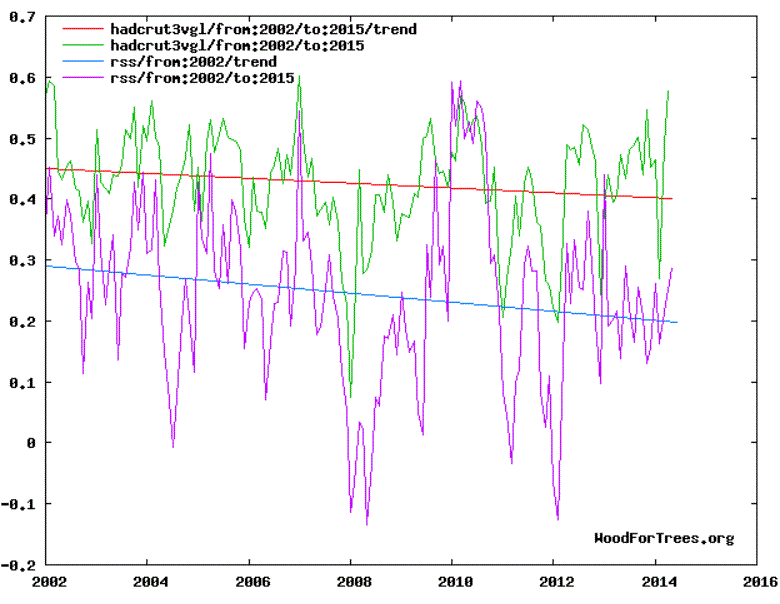
Chart source: www.woodfortrees.org.
Danish solar scientist Henrik Svensmark recently declared: “Global warming has stopped and a cooling is beginning.” The cold reality, however, is that the cooling actually started 12 years ago!
There are more signs other than temperature readings that show global cooling is in full swing. Antarctica has just set a new record positive sea ice anomaly. Global sea ice has been mostly above average for a year and half, flying in the face of stunned scientists who warned just 5 years ago that the Arctic could soon be ice-free in the summertime. Moreover Asia, Europe and North America have been hard hit by a string of unexpectedly harsh winters.
So how cold is it going to get and for how long?
Although a large number of scientists agree on cooling, they differ widely on how much and for how long.
Geologist and climate researcher Sebastian Lüning of Germany in a just released video forecasts a global cooling of 0.2° by 2030, before it starts to warm up again. However, many scientists see this as too mild of a forecast. Russian solar physicist Habibullo Abdussamatov, for example, predicts another Little Ice Age by 2055. Also Russia’s Pulkovo Observatory claims we “could be in for a cooling period that lasts 200-250 years.”
Long list of experts
At his Climate Depot website, Marc Morano has a list of a number of renowned scientists who believe the data are clear on what’s ahead.
Prominent geologist Dr. Don Easterbrook warns that “global cooling is almost a slam dunk” for up to 30 years or more. The Australian Astronomical Society warns of global cooling as the sun’s activity “significantly diminishes”.
The reason for the cooling? Scientists agree that it’s natural solar and oceanic cycles overpowering the overhyped effects of greenhouse trace-gas CO2.
Clive Palmer Triggers the Warmist’s Scream!

Anguished cries in the global warming debate.
TWO sentences neatly and completely capture the total irrationality and sheer, raging religious fervour of the global warming true, true believers.
They both came as deep primeval screams in delayed reaction to Clive Palmer’s climate change twostep with Mr Climate Hysteria himself, the man who used to be the next president of the US, until he found religion and fortune could be combined in very convenient climate untruths, Al Gore.
The initial reaction of true believers was one of almost euphoric rapture. Al and Clive had seemingly united to defeat the Climate Anti-Christ Abbott; Julia Gillard’s carbon tax and Gaia would be saved.
Nowhere was this reaction more extensive or ecstatic than at Climate Central Downunder, The Age. The paper revelled in the Anti-Christ’s coming discomfort.
Then as the truth sunk in that Gore had merely given cover to Palmer’s continued support for axing the tax, the scream erupted in The Age’s editorial on Friday. It included a delicious, utterly, if utterly unintentionally, revealing sentence.
The editorial noted that under the Palmer plan, while the scaffolding of an emissions trading scheme (ETS), would remain in place, the scheme would have no effect.
That’s actually not so, as we won’t even get that “scaffolding”. But returning to The Age, its lament was that such a scheme would have no effect because there’d be no price on carbon until Australia’s major trading partners implemented their own schemes.
Then the sentence: “That might occur next year, next decade, or never.”
A rational sentient human being would have then said; exactly, and thank you Clive. For there is absolutely no point in Australia going down the aggressive ETS path, cutting our emissions of carbon dioxide, unless precisely our major trading partners were doing the same.
To argue otherwise is to argue for Australia to unilaterally hurt both its industries and its citizens, to send industries and jobs to ‘our major trading partners,’ for absolutely no point. Our pain would have not the slightest effect on the global or even the local climate.
That lamenting sentence is so revealing; that to The Age rationality has absolutely nothing to do with the issue. It is all about religious fervour.
Quite irrespective of what the world does, quite irrespective of whether our CO2 cuts would achieve anything at all, we have to cut; we have to flagellate like a 12th century penitent, to exculpate our sins, to pay penance to Gaia.
The sentence is deeply revealing on another level. For The Age is also admitting that in its collective hearts of hearts, it really knows that the operative word in that sentence is ”never”.
Despite all the increasingly desperate propaganda nonsense pumped out that everyone else is taking big steps to cut emissions, and we are so laggard — including of course by The Age itself — the truth is the exact opposite.
Let a few more years run out, and apart from even more evidence that the planet, as opposed presumably to Gaia, ain’t warming as predicted, the emptiness of that claim will become almost undeniable.
And in its deepest, most inchoate scream, The Age is telling us that it just can’t bear that prospect.
The second primeval scream of pain and inchoate anger at Palmer assuaging the Climate Anti-Christ came from David Llewellyn-Smith on his MacroBusiness Blog.
Now LSD as we’ll call him, projects as at least a moderately intelligent human being. Yet he could come out with such a sentence, and more particularly one word, reveals an irrationality and stupidity so fundamental that it can only be explained by a religious belief. And a belief so fervent that a blinding curtain of rage isolates his brain.
LSD expressed sarcastic surprise that a hugely wealthy mining magnate would rubber stamp the end of a carbon price costing him millions of dollars per year for “tipping filth into the atmosphere”. Filth? FILTH?
Does LSD walk around all day in total self-hatred for doing exactly the same thing, pumping out his own filth with every exhaling breath?
Does he awake in complete despair every morning, at the prospect of another totally unavoidable day of exhaling filth? How many times a day does he flagellate himself, penitent-style if figuratively, or perhaps even literally?
For this is all we are talking about, whether it is Palmer’s business emissions or their shared personal emissions. CO2. Carbon dioxide. Plant food. The basis of life on Earth. And nothing else.
No, despite the best efforts of a battalion of modern day Goebbelian wannabes, from Gillard down, none of this — carbon tax or ETS — is about real pollution.
That’s the dirty bits of grit that used to come out of both power stations and home hearths and killed thousands, and will continue to kill thousands if people like The Age, LSD & Co succeed in denying Africa modern, clean, coal-fired power stations that would stop them relying on burning wood and dung.
Lamentably, the way pollution has been able to be attached to CO2 — presumably in time we’ll start renaming heavy rain as ‘water pollution’ — seems to have succeeded with people like LSD.
So when he thinks — more accurately, emotes — about emissions, cognitive dissonance, the disease of the modern intelligentsia, kicks in and he sees in his minds-eye, those dirty bits of grit, the ‘filth’ of modern civilisation.
So there you have it; the religion of global warming in two sentences.
No matter what anyone does, we must cut in self-flagellation for our sins against Gaia.
The self-hatred flowing from the original sin of personal exhalation of CO2 “filth” makes for even more aggressive warriors against business emissions of that same “filth”.
Originally published as Palmer triggers warmest screamCOMMENTS
Farmers in Sweden, Too Smart to Fall for Climate Alarmist B.S.!
Swedish farmers have doubts about climatologists
June 27, 2014 – 06:10
Farmers rely more on their own experiences with changing weather than on climatologists who have no agricultural experience, according to Swedish research.

Climatologists are not often found in the Swedish countryside. So farmers have their doubts about climate predictions. (Photo: Microstock)
Researchers the world over almost unanimously agree that our climate is changing because of the increasing amounts of carbon dioxide humankind pumps into our fragile atmosphere. But many farmers – at least Swedish ones – have experienced mild winters and shifting weather before and are hesitant about trusting the scientists.
Surprised
The researcher who discovered the degree of scepticism among farmers was surprised by her findings. Therese Asplund, who recently presented her PhD thesis at Linköping University, was initially looking into how agricultural magazines covered climate change.
Asplund found after studying ten years of issues of the two agricultural sector periodicalsATL and Land Lantbruk that they present climate change as scientifically confirmed, a real problem.
But her research took an unexpected direction when she started interviewing farmers in focus groups about climate issues.
Asplund had prepared a long list of questions about how the farmers live with the threat of climate change and what they plan to do to cope with the subsequent climate challenges. The conversations took a different course:
“They explained that they didn’t quite believe in climate changes,” she says. “Or at least that these are not triggered by human activities.”
Used to changes
The climate of course has previously gone through natural spells, and the farmers tend to think in terms of their experiences in recent decades.
“Many have a lot of experience, for instance they recall the mild winters of the 1960s,” explains Asplund.
The farmers also distrust climatologists partly on the grounds of what they perceive of as too much concurrence.
“They think information about climate change is too uniform. Credibility would increase if more contrary perspectives were presented,” she says.
Office science
And above all: They think climatologists lack the experience they have living in keeping with the soil, weather and growth seasons.

The climate of course has previously gone through natural spells, and the farmers tend to think in terms of their experiences in recent decades. (Photo: Mary Evans Picture)
“Climate researchers also are given less credence by farmers because they think the scientists draw their conclusions from theoretical analyses rather than practical experience,” says Asplund.
She finds it hard to say how climatologists can make use of the farmers’ experiences:
“For the research of a scientifically trained climatologist, the opinions of farmers might not be all that essential. But that does not necessarily make their views irrelevant. For a sociological approach to climate research the farmers’ opinions are highly relevant, on a par with those of other social groups,” asserts Asplund.
Information is not enough
She is concerned about understanding disparate ways of thinking and responding with regard to climate issues.
“With insufficient knowledge, we risk believing that information will readily alter human perceptions and behaviour. The example of climate communication in Swedish agriculture shows what challenges a climatological point of departure for communication can encounter,” says Asplund.
After talking with focus groups all over Sweden, she thinks that information alone cannot change attitudes and behaviour – no matter how well rooted it is in empirical science.
Does this mean it is harder than thought to get Swedish farmers to engage in climate-friendly agriculture? The researcher says both “yes” and “no”.
It will be hard as long as the implementation of improvements is voluntary. But in the discussions the farmers signal that they can adapt – if not to physical climate changes, at least to climate policy decisions. Thus it should be no harder to get them to adjust to climate measures as to other political mandates.
But there is one proviso: “This is a resistance to decrees which they think undermine competitive Swedish agricultural production,” says Therese Asplund.
————
Greenpeace has Become a Corrupt Organization, that Promotes Alarmism!
|
 Dr Patrick Moore “They have a whole fleet of ships, pretending the $32 million Rainbow Warrior III is powered by the wind when it has two large diesel engines for propulsion. I like to joke that when we first sailed against US hydrogen bomb testing in Alaska we did not have a nuclear weapon on board.”
Things have not been going well for environmental NGO Greenpeace in the last few months, there was the insanely stupid attempt to interfere with Gazprom operations in the Arctic, which led to the Arctic 30 enjoying the hospitality of the Russian penal system for a few months. Greenpeace also lost a ship, the Arctic Sunrise which is still impounded in the Russian port of Murmansk, and likely to be there until it rusts away and sinks, or ends life as a towed target for the Russian Navy.
In the words of Greenpeace Co-Founder Patrick Moore “I’d like to think that Greenpeace left me, rather than the other way round. I became a sensible environmentalist. Greenpeace became increasingly senseless.”
Greenpeace apart from being increasingly senseless have also been caught losing millions in donations by failed currency trading, been labelled as a threat to national economic security, and one of their top executives has been caught out hypocritically commuting by air from Luxembourg to Amsterdam.
All this makes for very bad publicity for Greenpeace:
“Greenpeace has been careful to cultivate an image as intrepid defenders of the environment,” editorializes Der Spiegel, a major German newspaper. “Calling themselves the rainbow warriors, activists hang from factory chimneys, throw themselves in front of whaling ships or risk jail time in Russia by calling attention to the plight of the Arctic.”
“Now, another activity has been added: playing the financial markets,” Der Spiegel adds. “For an organization almost entirely financed by donations, the revelation is a PR disaster, endangering from one day to the next the greatest asset Greenpeace possesses: its credibility.”
Even that organ of left wing biased climate change propaganda the UK Guardian has turned against Greenpeace:
The Guardian, a left-wing newspaper, has been especially critical of Greenpeace lately. The paper even obtained internal documents detailing the disarray within Greenpeace International.
A November 2013 document obtained by the Guardian shows that Greenpeace’s executive team was for years fully aware of major problems within the group’s finance department.
“[The] international finance function at GPI [Greenpeace International] has faced internal team and management problems for several years and the situation did not improve during 2013 despite efforts and support,” says the Greenpeace document.
India’s Intelligence Bureau has come to the conclusion that Greenpeace is a threat to the countries national economic security:
The Indian Express reports that the Intelligence Bureau submitted a report to the prime minister’s office saying Greenpeace was “negatively impacting economic development” through political activism and its anti-fossil fuels agenda. The reports says that Greenpeace activities have reduced the country’s GDP by 2 to 3 percent a year.
The report mentioned other activist groups, but singled out Greenpeace for trying to “change the dynamics of India’s energy mix” and orchestrating “massive efforts to take down India’s coal fired power plants and coal mining activity.”
“It is assessed to be posing a potential threat to national economic security… growing exponentially in terms of reach, impact, volunteers and media influence,” the report warns of Greenpeace, adding the group is finding “ways to create obstacles in India’s energy plans” and to “pressure India to use only renewable energy.”
It is not just in India, but other countries as well there seems to be a shift towards curtailing the activities of Green NGO’s, in Tasmania the politicians want to remove charitable status from Green NGOs and give the status to real charities:
The government is being pressed to alter the charitable status of environmental groups after a Liberal MP successfully argued to his party that the groups are not “real charities” like the Red Cross or the Salvation Army.
A motion introduced by MP Andrew Nikolic to the Liberal federal council called for environmental groups to be stripped of charitable rights, such as the ability to receive tax-deductible donations.
Nikolic, the federal member for the Tasmanian electorate of Bass, said the groups should not be subsidised for political activism, some of it which he claimed was illegal. The conference motion passed the motion unanimously.
The news of Greenpeace’s massive loss of donations currency trading was soon followed by the revelations that Greenpeace’s international program director Pascal Husting was regularly taking the plane from his home in Luxembourg to the office in Amsterdam:
The UK Telegraph noted that Greenpeace actively campaigns against “the growth in aviation,” which the group says “is ruining our chances of stopping dangerous climate change.”
“Each round-trip commute Mr Husting makes would generate 142kg of carbon dioxide emissions,” reports the Telegraph. “That implies that over the past two years his commuting may have been responsible for 7.4 metric tons of carbon dioxide emissions — the equivalent of consuming 17 barrels of oil.”
None of these antics have done much to bolster Greenpeace’s declining credibility with its life blood, the millions of people who make the small donations that keep Greenpeace functioning, instead they have been shown to be nothing more than one of those duplicitous corporations the environmentalists so love to despise.
 "Mothers Against Wind Turbines™" Phoenix Rising...
