When the Truth is Told, Wind Turbines Are a Wast of Time, Space & Money!

Larry Pickering: on the Quixotic Calamity of Wind

pickering

***

Larry Pickering is a four-time Walkley Award winning political commentator and Churchill Fellow, whose life’s work has been irritating the loopy-left. Here he is slaying the great wind power fraud.

It’s more than a Quixotic Calamity
Larry Pickering
The Pickering Post
20 June 2015

wind3.png

****

The European Renewable Energy Foundation, a Green body supportive of all forms of renewable energy, has carried out research at Edinburgh University involving a look at years of wind farm performance data from the UK and Denmark.

Their conclusion is this:

“Put bluntly, wind turbines onshore and offshore still cost too much and wear out far too quickly to offer the developing world a realistic alternative to coal.”

And these guys are Green renewable energy nuts!

The good news for Australia is that this highly subsidised and ineffective form of Green inspired visual pollution will be non-existent within ten years.

The report [available here] found that by 10 years of age, the output of an average wind turbine will have declined by a third … and by 12 years of age it will be uneconomic to recondition the moving parts.

The bad news for Australia, if they intend to persist with this windmill madness, is that they will all reach their maximum life span at the same time!

Bloody thousands and thousands of these hideous, noisy monstrosities will all need to be replaced at once, and guess what? Investors will have headed for the hills because all those delicious subsidies will have disappeared like Christine Milne and it will cost governments (again you and me) a motza to dismantle and dump the things in the ocean as fish reefs.

They will become worthless bits of metal and plastic no other industry can possibly use. The government of the day will no doubt keep one turbine in a museum somewhere as an artifact so schoolchildren can be shown just how stupid the Greens really are.

South Australia, which has the highest cost of electricity in the nation and the most wind turbines per capita, has saved 4% of their rated capacity in fossil fuels at a cost of $1,484 per ton. That’s roughly $1,474 per ton more expensive than Europe’s current carbon credit price.

The cost of these commercial white elephants, that must eventually be destroyed, is between a highly subsidised $350,000 and $1.3 million each…and the temperature of the globe hasn’t shifted one thousandth of a degree.

Stand underneath a wind turbine that is typically 120 metres tall and try to imagine how our beautiful countryside once looked.

But that’s a visual and noise pollution that will never disadvantage the Greens, oh no, they’ll be happily sipping their lattes in leafy green inner suburbs.

Only two forms of energy can replace the Greens’ hated coal, and neither is wind or solar.

The only freely available clean forms of energy are hydro and nuclear but the Greens refuse to allow dams to be built while frogs need protecting and uranium evokes Green paranoia. Funny eh?
The Pickering Post

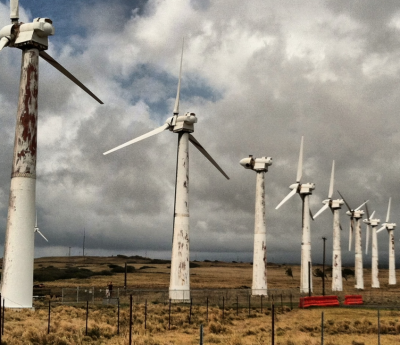
Hawaii rusting turbines

Wind Turbines Will Destroy the Economic Success of the Countries that have Them…

Germany’s Wind Power Debacle: Economic Destruction on an “Astronomical Scale”

turbine-collapse-germany1

****

STT keeps a close eye on Germany. It’s held up by eco-fascist nut jobs around the globe as the wind power “Super Model” – although, as we pointed out in this recent post, their “pin-up girl” is looking a little worse for wear:

Germany’s Wind Power ‘Dream’ Becomes a Living Nightmare

Last week – with the announcement that South Australians can look forward to skyrocketing power prices with the closure of its cheapest conventional generation source, the Port Augusta power station – we made it pretty clear that wind power is nothing but fantastic nonsense:

SA – Australia’s ‘Wind Power Capital’ – Pays the Highest Power Prices in the World and Wonders Why it’s an Economic Basket Case

South Australians are well down the track to an economic disaster – with its unemployment rate of 7.6% (and rising fast) it’s easily the worst performing State in the Nation, apparently keen as mustard to get whacked with the tag “rust-belt”. Rising power prices are punishing struggling families – 50,000 homes do without power altogether – and a raft of power hungry businesses and industries are shutting up shop for good (see this article).

STT usually wears its optimism on its sleeve, but holds grave fears, not only for South Australia, but for the Country as a whole.

For a taste of what we’re in for – in a cooking show “here’s one we’ve prepared earlier” moment – we’ll cut to Germany for another look at how its ludicrous efforts to rely upon wind power have sent power markets into chaos, and, with electricity prices skyrocketing, has left 800,000 German homes without power. Here’s Germany’s leading renewable energy expert and climate science critic Prof. Fritz Vahrenholt on the unfolding calamity.

Energy Expert Issues Warning On “Carbon-Free Society”: “Destruction On An Astronomical Scale” … “Cost Avalanche”
NoTricksZone
6 June 2015

Germany’s leading renewable energy expert and climate science critic Prof. Fritz Vahrenholt warns of an irrational and panicked rush into renewable energies.

In a penned opinion piece in Germany’s Manager Magazin titled: “Why a Phase Out of Coal Would Be Damaging”, the German professor believes the movement to divest from fossil fuels is seriously misguided and that the move to a completely carbon-free global society would lead to “destruction on an astronomical scale”. He writes:

“In order to produce the same amount of power with wind, we would see a surface area consumption and corresponding destruction of natural habitat on an astronomical scale.”

Fritz Vahrenholt was formerly responsible for the renewable energies arm of European power giant RWE, RWE Innogy GmbH. No one has overseen the installation of as much renewable energy in Europe as Vahrenholt has. In the field of wind energy he is a leading expert. He has since become a leading critic of renewable energy and climate science.

Vahrenholt, a professor of chemistry and former Environment Senator for the City of Hamburg in the SPD socialist party, asks:

“How realistic is it really to produce not only electricity but also heat and fuels for transportation worldwide from China to Brazil over the coming decades without fossil fuels? As before in China a coal power plant goes online every 14 days, and India is well on the way to do the same as its neighbor.”

“Cost avalanche of 1000 billion euros”

Vahrenholt sharply criticizes Germany’s transistion away from coal and nuclear power and over to renewables because of the enormous cost burdens that citzens will have to bear in the years ahead. He writes that German Economics Minister Sigmar Gabriel knows that “if the brakes on renewable are not applied, a cost avalanche of 1000 billion euros is headed our way”.

Uncontrollable supply

And as exorbitant quantities of wind and solar power are added to the power grid, Vahrenholt warns that during windy and sunny periods, large quantities of power will have to be “disposed of” on foreign markets.

“We will have to dispose of the power in foreign countries more often than we do today and even pay money to Austria, Holland, Poland and the Czech Republic to take the power.”

Excess power of course would be ruinous to foreign markets. Vahrenholt reminds that sun and wind energy are fraught with technical problems because they work a minimal part time. Storage technology remains nowhere in sight.

Will have near zero impact

And even if Germany were able to solve the unsolvable technical problems, the CO2 emissions savings that Germany would achieve through a shut-down of its coal power plants would be offset by growth in China in a matter of just 2 months. The result would be no “climate protection” at all and Germans would only be able to boast over a flickering mess of a power supply.

In Vahrenholt’s view, the German green energy model is so costly that “no country in the world is going to follow it”.

Exaggerated science, flawed models

He also calls the climate science “wildly exaggerated” and maintains the climate models have been false:

“There are more and more scientific findings showing that the climate effect by CO2 has been wildly exaggerated by the IPCC. There has not been any significant warming in 16 years even though one third of the historical CO2 emissions occurred in the same time period and the CO2 concentration in the atmosphere is rising year after year.”

Vahrenholt describes the climate models as a joke as they do not even take the long-known ocean and solar cycles into account.

Leaping before looking

He tells us that Germany is rushing unnecessarily into renewable energies and that the natural cycles mean we have lots of time and that we should take that time and do the transition in a sensible manner. He asks:

“Why the frenzied go-it-alone approach that is putting so much at risk? No nation on the planet is going to follow us when they see their own industrial base being destroyed and citizens financially overwhelmed.”

Vahrenholt adds:

“In addition to the destruction of capital, there is also a grand destruction of many thousands of jobs.”

But none of this seems to impress Germany’s green government authorities, who continue to overzealously pursue shutting down fossil fuels and pushing for large-scale installation of an piece-meal energy infrastructure that has been proven to be technically flawed.

Consequences “close to insurmountable”

The German energy folly is already taking its toll, Vahrenholt writes. He claims that the “insidious process of deindustrialization has already begun” in Germany because of skyrocketing energy prices and growing uncertainty.

Consequently Vahrenholt is calling for a “fundamental reform” of the country’s energy policy and a return to a more market-oriented approach. He calls Germany’s famous EEG renewable energy feed-in act an obsolete model that is “bringing no reduction in CO2 emissions” and one that is “eroding Germany as a place for industry” and whose “consequences will be close to insurmountable”.
NoTricksZone

fritz vahrenholt

Aussies Have Windweasels in Panic Mode!

Wind Farm Senate Inquiry Fallout Continues

atomic-bomb-e1355417893840

****

When the Senate Inquiry into the great wind power fraud kicked off in Portland, Victoria on 30 March, STT predicted that the wind industry was headed for a world of pain, misery and woe (see our post here). Well, not to say we told you so, but things are going from disastrous to catastrophic. Oh dear, how sad, never mind.

To say the wind industry is in a state of panic-filled hysteria is to put it mildly: this week has its parasites and spruikers turning up the dial to apoplectic.

The Senate Inquiry has just issued its Interim Report (available here) – which hasn’t helped calm their thread-bare nerves.

And the shenanigans in Canberra over moves by the Cross-Bench Senators (which includes Senators Madigan, Leyonhjelm, Day and Xenophon who sit on the Inquiry) to extract concessions from the Coalition on a better deal for all Australians – especially those currently affected and/or threatened by the incessant turbine generated low-frequency noise and infrasound – has the usual bunch of Twitter jockeys working over-time, ranting about coal-fuelled conspiracies.

Added to which is fact that two South Australian turbine hosts – who – despite pocketing over $1 million for hosting 19 turbines – gave evidence to the Senate that the “unbearable” noise has ruined their ability to sleep in their own home; so much so that they would never do it again; and that they wouldn’t live within 20km of a wind farm.

That set of damning facts has completely up-ended the rubbish about “nocebo” effects; and all the other drivel pedaled by former tobacco advertising gurus and the like.

While STT had the scoop on that story, it didn’t take long for Australia’s National Daily to pick it up. Over to STT Champion, Graham Lloyd.

Tougher scrutiny on wind farming after crossbench talks
The Australian
Graham Lloyd
18 June 2015

mary-morris

****

Mary Morris, at the Waterloo windfarm north of Adelaide, conducted one of the only studies accepted by the National Health and Medical Research Council.

Wind farms could face greater federal government scrutiny after a last-minute intervention by Tony Abbott ahead of the Senate vote on the revised ­renewable energy target today.

Yesterday, the Prime Minister met four crossbench senators concerned about the cost and possible health impacts of the renewable energy technology.

After the meeting, Environment Minister Greg Hunt was asked to write to senators David Leyonhjelm, John Madigan, Bob Day and Jacqui Lambie setting out the new protections.

A spokesman for Mr Hunt confirmed last night that a letter was being prepared.

The government is hoping a written pledge will avoid amendments to the RET legislation, which is expected to be voted on in the Senate today.

The crossbench senators have raised concerns about a range of issues regarding wind-farm developments and the fact that the revised RET will strongly favour wind.

Mr Abbott has said the reduced RET was designed to limit the number of wind farms built.

A Senate inquiry into wind farms will today release an inte­rim report into its hearings, which have taken evidence from the wind industry, acoustics experts and residents who claim to have been affected.

The wind industry maintains claims that the technology is inefficient or poten­tially harmful to nearby residents have been thoroughly investigated and discounted. But one farm couple who has been paid $1 million to host 19 wind turbines over five years told the Senate inquiry that the noise had been unbearable.

South Australian cattle grazier Clive Gare told a hearing in Adelaide he was initially excited about hosting renewable energy, but now believed “towers should not be any closer than 5km to a dwelling”.

“If we had to buy another property it would not be within a 20km distance to a wind farm. I think that says it all,” Mr Gare said.

The wind industry has said complaints about noise impacts had not been made by people who received lucrative contracts to host them. Wind farm company AGL has paid thousands to insulate the Gare property from the noise of the wind turbines, which are as close as 800m from the house, but Mr Gare and his wife, Trina, told the inquiry they were still impacted.

Mary Morris, who conducted one of the only studies accepted by the National Health and Medical Research Council, said she would welcome any undertakings by the federal government to increase supervision.

Ms Morris became involved in the wind farms initially to support people who claimed to be affected by the Waterloo wind farm in South Australia.

In a speech to the Senate on the federal government’s compromise RET bill, Senator Leyonhjelm said the revised RET would be “no more than a wind industry support fund”.

Jacqui Lambie received support from Coalition senators for a speech in which she criticised reliance on renewable energy.

“Apart from hydro, the only way to de-carbonise energy is to move very quickly to nuclear,” she said. “And it’s about time we move to that option.”
The Australian

graham-lloyd

Australian Senate Committee Recommends More Research on Infrasound, Produced by Wind Turbines!

18/06/15AustraliaAustralia

Interim Report from the Australian Senate inquiry

“This report records the committee’s concern with the issue of infrasound and low frequency noise emitted from wind turbines and the possible impact on human health.
Independent, multi-disciplinary and high quality research into this field is an urgent priority.”

Senate Committee reports

Interim report

1.1 The Senate Select Committee on Wind Turbines was established in December 2014. To date, it has received 464 submissions from a wide range of stakeholders. It has conducted public hearings in Portland in south-west Victoria on 30 March, in Cairns on 18 May, in Canberra on 19 May, in Melbourne on 9 June and in Adelaide on 10 June 2015. Further public hearings are planned in Canberra on 19 June and 23 June and in Sydney on 29 June 2015.

1.2 This represents a considerable volume of evidence relating directly to the committee’s terms of reference. The committee has received written and verbal evidence from State Governments, local councils, various federal government agencies, wind farm operators and manufacturers, country fire authorities, acousticians, medical experts and representatives from various associations and institutes. In addition, many private citizens have had the opportunity to voice their concerns with the planning, consultation, approval, development and operation of wind farms in Australia.

1.3 Access to all public submissions and public hearing transcripts can be found on the committee’s website.

The committee’s headline recommendations

1.4 This report presents seven headline recommendations. The committee believes that these recommendations are important and urgent given that legislation on the renewable energy target is due to be debated in the Senate shortly. The final report in August this year will provide supporting evidence and supporting recommendations. It will also address other terms of reference, including the merit of subsidies for wind farm operators and the effect of wind power on household power prices.

Recommendation 1

1.5 The committee recommends the Commonwealth Government create anIndependent Expert Scientific Committee on Industrial Sound responsible for providing research and advice to the Minister for the Environment on the impact on human health of audible noise (including low frequency) and infrasound from wind turbines. The IESC should be established under the Renewable Energy (Electricity) Act 2000.

Recommendation 2

1.6 The committee recommends that the National Environment Protection Council establish a National Environment Protection (Wind Turbine Infrasound and Low Frequency Noise) Measure (NEPM). This NEPM must be developed through the findings of the Independent Expert Scientific Committee on Industrial Sound. The Commonwealth Government should insist that the ongoing accreditation of wind turbine facilities under the Renewable Energy (Electricity) Act 2000 in a State or Territory is dependent on the NEPM becoming valid law in that State or Territory.

Recommendation 3

1.7 The committee recommends that the Commonwealth Government introduceNational Wind Farm Guidelines which each Australian State and Territory Government should reflect in their relevant planning and environmental statutes. The committee proposes these guidelines be finalized within 12 months and that the Commonwealth Government periodically assess the Guidelines with a view to codifying at least some of them.

Recommendation 4

1.8 The committee recommends that eligibility to receive Renewable Energy Certificates should be made subject to general compliance with the National Wind Farm Guidelines and specific compliance with the NEPM. This should apply immediately to new developments, while existing and approved wind farms should be given a period of no more than five years in which to comply.

Recommendation 5

1.9 The committee recommends that the Commonwealth Government establish aNational Wind Farm Ombudsman to handle complaints from concerned community residents about the operations of wind turbine facilities accredited to receive renewable energy certificates. The Ombudsman will be a one-stop-shop to refer complaints to relevant state authorities and help ensure that complaints are satisfactorily addressed.

Recommendation 6

1.10 The committee recommends that the Commonwealth Government impose a levy on wind turbine operators accredited to receive renewable energy certificates to fund the costs of the Independent Expert Scientific Committee on Wind Turbines—including the funding of additional research—and the costs of a National Wind Farm Ombudsman.

Recommendation 7

1.11 The committee recommends that the data collected by wind turbine operators relating to wind speed, basic operation statistics including operating hours and noise monitoring should be made freely and publicly available on a regular basis. The proposed Independent Expert Scientific Committee should consult with scientific researchers and the wind industry to establish what data can be reasonably made freely and publicly available from all wind turbine operations accredited to receive renewable energy certificates.

Wind farms and human health

1.12 Why are there so many people who live in close proximity to wind turbines complaining of similar physiological and psychological symptoms? As with previous Senate inquiries, this committee has gathered evidence from many submitters attributing symptoms of dizziness, nausea, migraines, high blood pressure, tinnitus, chronic sleep deprivation and depression to the operation of nearby wind turbines. The committee invites the public to read and consider the evidence of people who have experienced these symptoms and who attribute their anxiety and ill health to the operation of turbines.

1.13 These health affects should not be trivialised or ignored. The committee was particularly distressed by renewable energy advocates, wind farm developers and operators, public officials and academics who publicly derided and sometimes lampooned local residents who were genuinely attempting to make known the adverse health effects they were suffering.

1.14 The committee is aware of people complaining of these impacts who have since left their family home. Some now live a nomadic and uncertain existence. In one case, the now deserted home had been in the family for five generations—since the 1840s. These are not decisions taken lightly. Having left the turbine vicinity, several witnesses noted that the symptoms had faded if not disappeared.

1.15 Some submitters attribute these illnesses to a ‘nocebo effect’—a result of expectations of harm rather than exposure to turbine activity. This claim has been made by Professor Simon Chapman, a sociologist by training and a professor of Public Health at Sydney University. He has labelled wind turbine syndrome ‘a communicated disease’, claiming that it ‘spreads by…being talked about and is therefore a strong candidate for being defined as a psychogenic condition’.

1.16 However, most people recognise that noise including low frequency noise could cause these impacts and emphasise that noise standards, properly enforced, are crucial to ensuring public safety. This view acknowledges that the noise from wind turbines creates annoyances which can manifest in sleep disruption. The clear remedy is to set noise standards (such as the New Zealand Standard) and enforce these standards. This is essentially the public position of the relevant authorities in Australia.

The need to investigate infrasound and low frequency noise from turbines and its effect on human health

1.17 The committee highlights the need for more research into the impact of low frequency noise and infrasound (0–20 hertz) from wind turbines on human health. A 2014 pilot study conducted by acoustician Mr Steven Cooper found a correlation between infrasound emitting from turbines at Cape Bridgewater in Victoria and ‘sensations’ felt, and diarised, by six residents of three nearby homes. By identifying a unique infrasound ‘wind turbine signature’, recording it as present in the homes, and linking it to ‘sensations’ felt by the residents, Mr Cooper’s research has received international attention.

1.18 It is clear that the extent and nature of wind turbines’ impact on human health is a contested issue. The nocebo effect, the existing standards for measuring audible noise and the NHMRC’s 2011 literature review have all been criticised by submitters and witnesses to this inquiry. The criticisms relate both to flaws in methodology and to inaccurate and incomplete findings.

1.19 Fundamentally, the lack of detailed, reliable data does not allow for a proper scientific conclusion to be drawn. The committee is struck by the considerable gaps in understanding about the impact of wind turbines on human health. These gaps have widely acknowledged key issues, both explicitly and implicitly:

  • the NHMRC found in February 2014 that ‘there is currently no consistent evidence that wind farms cause adverse health effects in humans’. While maintaining this stance, in February 2015, the NHMRC recognised that the body of direct evidence on wind farms and human health is ‘small and of poor quality’. It concluded that ‘high quality research into possible health effects of windfarms, particularly within 1,500 metres, is warranted’;
  • In June 2015, the German Medical Assembly forwarded a motion to the board of the German Medical Association for further research into the possible side effects of wind turbines. The committee has received advice from the German Medical Association that this motion proposes that the German Government provide the necessary funding to research potential adverse effects to health. The motion also argues that wind turbines should not be erected in the vicinity of residential areas until this research has yielded results. The Board of the German Medical Association has advised the committee that it will revisit the motion in July 2015;
  • the position of several well-informed submitters that more research is needed, including;
    • criticism of the composition of the NHMRC Reference Group, and in particular the lack of acoustical expertise. One witness, who was a formal observer of the Reference Group process, noted that only one member of the panel was an acoustician, adding: ‘No-one else on the panel had any idea of acoustics. They could not tell when they were being misled or information was being withheld’;
    • criticism of the 2010 and 2015 NHMRC reviews which ignored studies in situ of people reporting serious adverse effects and the nature of the exposures to which they are subject. A submitter noted: ‘The NHMRC did examine some of these types of study but it was done as a secondary activity rather than the main focus and allowed it to base its conclusions predominantly on research settings that inevitably have weak power to detect material effects’;
    • the importance of research that has a rigorous methodology, a level of independence and the outcomes of which are peer reviewed;
    • the claim of one eminent acoustician that wind farm entities have stifled some genuine research into the possible effects of wind farms. A prominent international organisation well equipped to evaluate infrasound data and analysis declined his invitation to examine his own research into wind farm infrasound; and
    • a submitter’s proposal for a thorough noise audit of all existing wind farms, using the methodology of Mr Steven Cooper, and incorporating the objective measurement of health effects (sleep quality, blood pressure, heart rate, stress hormones, etc) on neighbours, out to 10 kilometres from turbines.

1.20 Independent scientific research is needed into acoustic matters—such as whether each wind turbine has unique ‘signature’ and the effect of that signature on neighbouring turbines—and into health matters.

The Futility of Wind, Becomes More Apparent….

Closer look: Mary Morris, at the Waterloo wind farm north of Adelaide, conducted one of t

Closer look: Mary Morris, at the Waterloo wind farm north of Adelaide, conducted one of the only studies accepted by the National Health and Medical Research Council. Picture: Kelly Barnes

WIND farms could face greater Federal Government scrutiny after a last-minute intervention by Tony Abbott ahead of the Senate vote on the revised ­renewable energy target today.

Yesterday, the Prime Minister met four crossbench senators concerned about the cost and possible health impacts of the ­renewable energy technology.

After the meeting, Environment Minister Greg Hunt was asked to write to senators David Leyonhjelm, John Madigan, Bob Day and Jacqui Lambie setting out the new protections.

A spokesman for Mr Hunt confirmed last night that a letter was being prepared.

The government is hoping a written pledge will avoid amendments to the RET legislation, which is expected to be voted on in the Senate today.

The crossbench senators have raised concerns about a range of issues regarding wind-farm developments and the fact that the revised RET will strongly favour wind.

Mr Abbott has said the reduced RET was designed to limit the number of wind farms built.

A Senate inquiry into wind farms will today release an inte­rim report into its hearings, which have taken evidence from the wind industry, acoustics ­experts and residents who claim to have been affected.

The wind industry maintains claims that the technology is inefficient or poten­tially harmful to nearby residents have been thoroughly investigated and discounted. But one farm couple who has been paid $1 million to host 19 wind turbines over five years told the Senate inquiry that the noise had been unbearable.

South Australian cattle grazier Clive Gare told a hearing in Adelaide he was initially excited about hosting renewable energy, but now believed “towers should not be any closer than 5km to a dwelling”.

“If we had to buy another property it would not be within a 20km distance to a wind farm. I think that says it all,” Mr Gare said.

The wind industry has said complaints about noise impacts had not been made by people who received lucrative contracts to host them. Wind farm company AGL has paid thousands to insulate the Gare property from the noise of the wind turbines, which are as close as 800m from the house, but Mr Gare and his wife, Trina, told the inquiry they were still impacted.

Mary Morris, who conducted one of the only studies accepted by the National Health and Medical Research Council, said she would welcome any undertakings by the federal government to increase supervision.

Ms Morris became involved in the wind farms initially to support people who claimed to be affected by the Waterloo wind farm in South Australia.

In a speech to the Senate on the federal government’s compromise RET bill, Senator Leyonhjelm said the revised RET would be “no more than a wind industry support fund”.

Jacqui Lambie received support from Coalition senators for a speech in which she criticised reliance on renewable energy.

“Apart from hydro, the only way to decarbonise energy is to move very quickly to nuclear,” she said. “And it’s about time we move to that option.”

Aussie PM, Tony Abbott, Trying To Stop The Onslaught of Wind Turbines…

Australia’s PM – Tony Abbott – Out to STOP THESE THINGS

tony abbott on 2GB

****

Australia’s PM, Tony Abbott has never had a soft spot for the wind industry (see our posts here and here). Now, he’s effectively set fire to its chances of obtaining the finance it needs to carpet Australia with another 2,500 giant fans. The match was lit on Alan Jones’ breakfast Show last Thursday.

Alan Jones Breakfast
2GB
11 June 2015

ALAN JONES: Now, you have just done a deal with the Labor Party over Renewable Energy Targets which I personally think are ridiculous. I don’t know how any Government could give a green light to wind power. You have got a Senate Inquiry into wind farms. It is an inquiry with all government and most crossbench support. It had its fifth public hearing yesterday.

Senator Leyonhjelm wrote yesterday and I have talked about this for years – quote, “it is beyond dispute that wind turbines emit infrasound and low frequency noise. It is well established that inappropriate levels of infrasound, regardless of the source, cause adverse health impacts. Since 1987,” he wrote, when Neil Kelley and I spoke about this a million times, “identified a direct cause or link between impulsive infrasound and low frequency noise had adverse effects on people.” He said, as part of the inquiry, “I have met these effected people, they tell me they mainly suffer from chronic sleep, some suffer from sinus pressure, tinnitus, pains in the chest, headaches, nausea and vertigo.”

Prime Minister, these people are refugees in their own homes. You have done a deal on Renewable Energy which includes wind power when there is a Senate Inquiry highlighting the deleterious effects these turbines are having on public health. When will someone in Government listen to these poor people and the problems they face? I mean if it didn’t effect health put them on top of parliament House, put them on Macquarie Street, put them on Parramatta Road.

PRIME MINISTER: Well, there are two issues here, Alan. One is the proximity of these things to people’s dwellings and I think that is a very important issues and the state government here in New South Wales, as I understand it, has increased the distance that these have got to be kept away from dwellings…

ALAN JONES: Not really.

PRIME MINISTER: … and the former Liberal Government in Victoria did likewise.

ALAN JONES: No.

PRIME MINISTER: Well, Alan, look, I do take your point about the potential health impact of these things. When I have been up close to these windfarms there’s no doubt not only are they visually awful but they make a lot of noise…

ALAN JONES: So, why are we allowing this? We have done a deal. Why are we allowing this? Leyonhjelm wrote yesterday, he said, “this all reminds me of big tobacco’s denials 50 years ago that cigarettes caused lung cancer.” They denied it. This is having deleterious effects on people’s health and no one, they have written to you, they have written to Sussan Ley, they don’t get an answer.

PRIME MINISTER: Well, I hope they get an answer from me because I do try to respond to the letters that I get.

ALAN JONES: So, what are you saying to these poor people?

PRIME MINISTER: The sites of these things is a matter for the state government.

ALAN JONES: It is!

PRIME MINISTER: What we did recently in the Senate was reduce, Alan, reduce capital R E D U C E, we reduce the number of these things that we are going to get in the future. Now, I would frankly have liked to reduce the number a lot more.

ALAN JONES: Good, well you are the boss.

PRIME MINISTER: We got the best deal we could out of the Senate and if we hadn’t had a deal, Alan, we would have been stuck with even more ofthese things.

ALAN JONES: Isn’t it fair to say, Prime Minister, if it such a good thing, I mean there are people listening to you now and they have got up at 5 o’clock they are only going to make $900 a week if they are lucky. They have rolled their sleeves up. You are not subsidising their little business whether they are breaking bread. Why are we subsidising China’s windfarm at Gullen Range which is illegal? Why?

PRIME MINISTER: Alan, this particular policy was a policy that was put in place in the late days of the Howard Government. Knowing what we know now I don’t think we would have gone down this path in this way. At the time we thought it was the right way forward. Sometimes you have got to deal with the situation that you have got rather than the ideal and what we have managed to do through this, admittedly imperfect but better than the alternative deal with the Senate is reduce the growth rate of this particular sector as much as the current Senate would allow us to do.
Alan Jones Breakfast, 2GB

Glad to see the PM using the correct terminology there (as highlighted)!!

But we have to pull the PM into gear over one or two furphies.

One is the claim that the impacts of the great wind power fraud are all the fault of the States. Without the Coalition’s latest $46 billion wind industry rescue package, there is no way any more of these things would be built, anywhere, FULL STOP:

Out to Save their Wind Industry Mates, Macfarlane & Hunt Lock-in $46 billion LRET Retail Power Tax

Tony Abbott’s line that the “sites of these things is a matter for the state government” is a whole lot like the bloke that sells the sawn-off shotgun to an armed robber; and who then protests his innocence for what follows.

armed robber

****

Sure, the illegal firearm vendor didn’t actually pull the trigger and send a bank teller for an unscheduled trip to the morgue. However, in the absence of the weapon supplied, there may have been no robbery – certainly not an “armed” one – and no harm done to bank tellers, in any event.

In the criminal law, the concept of liability for those who provide the arms to known bandits is picked up in the concepts of accessorial liability – the ol’ chestnuts about aiding and abetting, accessory before the fact and all that.

In this case, though, the Coalition is not only providing the weapon, from now until 2031 it will be supplying the offenders with an endless stream of ammunition – in the form of over 500 million Renewable Energy Certificates; designed to be worth over $90 – as young Gregory Hunt calls them: “a massive $93 per tonne carbon tax” – the $46 billion cost of which will be borne by all Australian power consumers.

Tony, the only way to stop “these things” is to disarm the bandits by killing the LRET now.

The other serious misconception popped up (and jumped on by AJ) is the nonsense that State governments have increased setback distances.

In South Australia – Australia’s wind power capital – it’s a derisory 1,000m. In Victoria, the lunatics from Labor recently cut theirs from 2km to 1,000m too. And Labor’s wind industry masters are pushing hard to do away with even that miniscule distance.

And if the PM thinks that 2km is a fair thing, he might like to pay attention to what Clive and Trina Gare told the Senate last week; viz.:

“towers should not be within five kilometres of residences, and I would personally not buy a house within 20 kilometres of a wind farm”.

And that’s not coming from your average “wind farm wing-nuts”. Oh no. The Gares have, so far, pocketed $1 million for hosting 19 of these things on their property since 2010:

SA Farmers Paid $1 Million to Host 19 Turbines Tell Senate they “Would Never Do it Again” due to “Unbearable” Sleep-Killing Noise

But, hats off to the PM for recognising the adverse health effects suffered by the likes of the Gares – and hundreds of other Australians – forced to live next to these things: the most common and obvious of which is sleep deprivation caused by incessant turbine generated low-frequency noise and infrasound at night-time.

And, not afraid to go on with it, Tony Abbott backed it up with comments reported in The Australian.

RET deal ‘saved windfarm explosion’
The Australian
Sarah Martin
13 June 2015

Tony Abbott claims the government was “right and proper” to scale back the renewable energy target, saying it had prevented an “explosion” of windfarms across the country.

The Prime Minister said the RET deal struck with the Senate — which resulted in the Coalition and Labor agreeing to lower the target from 41,000 gigawatt hours to 33,000GWh — was a good outcome.

“It’s right and proper that we have reduced the renewable ­energy target because, as things stood, there was going to be an explosion of these things right around our country,” he said.

“There will still be some growth, but it will be much less than it would otherwise have been thanks to measures that this government has taken.”

Mr Abbott also revealed his ­experience encountering an “ugly” wind turbine during a cycling trip on Western Australia’s Rottnest Island.

“I cycled around the island most mornings and my path took me almost directly under the big wind turbine which has been on Rottnest Island for some time,” Mr Abbott said.

“Now, up close, they’re ugly, they’re noisy and they may have all sorts of other impacts which I will leave to the scientists to study, and that’s why I think it’s right and proper that state governments should have increased the distance from habitations that these installations now need to keep.”

The comments come after the renewable energy sector and Labor reacted angrily to Mr Abbott’s claim he had wanted to further slash the growth of wind generation through negotiations on the RET scheme.

But he said what the government could achieve had been limited by a hostile Senate.

When asked if he supported Mr Abbott’s view that wind turbines were “visually awful”, Environment Minister Greg Hunt said he was “neutral” on their appeal.

“Look, I’d put it this way — beauty is in the eye of the beholder,” Mr Hunt said.

“I’m less fussed about them but I know there are many people who are concerned and they have a right to be heard and they have a right to be heard without those who don’t live with them in their backyards deriding them.”

He said he expected more wind power would be required to meet the government’s policy goal of having 20 per cent of energy production from renewable sources by 2020, but said solar was becoming “more competitive.”
The Australian

Good to see young Gregory Hunt continuing to spread the lines fed to him by the wind industry plants and stooges that people his office – like Patrick Gibbons, who just happens to be best mates with Ken McAlpine, the head spruiker for struggling Danish fan maker, Vestas. Although, as events are unfolding, Hunt’s limp efforts at wind industry advocacy are likely to fall entirely flat.

You see, in the last week or so the response by the lunatics from the hard-green-left to the PM’s comments – laid out above – and efforts by the good Senators on the Inquiry to expose the scale and scope of the great wind power fraud (including recent media forays by David Leyonhjelm) – have been little short of hysterical.

2_77

****

STT couldn’t have asked for better. There is no easier battle to win, than the one that your enemies win for you.

Every time one of the wind industry’s parasites or spruikers chimes in with a rant about there being “no evidence …” or “the NHMRC said that …”, these idiots simply highlight the fact that there is a problem.

It’s a bit like police at the scene of a multiple car pileup telling passers-by that “there’s nothing to see here, move on”. The natural human response is to stand fast and gawp at the gore.

And so it is among the wind industry’s erstwhile “helpers”. The more they rant, the more they rave the more attention they attract to the carnage.

From STT’s perspective, the more attention the better. You see, the wind industry’s ability to roll out the 2,500 giant fans needed to satisfy the latest LRET doesn’t depend upon Alan Jones, Tony Abbott or David Leyonhjelm – it depends upon commercial lending institutions (ie banks).

With all the sound, fury and bloodletting taking place in the media on a daily basis, no banker in touch with their earthly senses is going to lend so much as a penny to a wind power outfit to build any new wind farms from here on. The insurmountable obstacle to that event can be summed up in a single word: RISK.

Whether or not the wind industry’s parasites and spruikers’ “case”, about there being no adverse health impacts from wind turbine noise stacks up, is neither here nor there.

What matters is the potential for wind power outfits to be sued by wind farm neighbours; or, of governments responding with increasingly stringent regulation on the operation of wind farms – such as shutting them down at night-time to let the neighbours sleep, say. And it’s the potential realisation of those facts, that will keep bankers from even considering lending any more money to wind power outfits, from here on in.

While there may not always be fire where there’s smoke, sometimes, smoke on its own, is more than enough to signal the risk that one might just get burnt.

Turbine fire with black smoke

The Gag is Off, and This Wind Turbine Host, Tells the True Story!

SA Farmers Paid $1 Million to Host 19 Turbines Tell Senate they “Would Never Do it Again” due to “Unbearable” Sleep-Destroying Noise

gare2

****

Clive and Trina Gare are cattle graziers from South Australia’s Mid-North with their home property situated between Hallett and Jamestown.

Since October 2010, the Gares have played host to 19, 2.1MW Suzlon s88 turbines, which sit on a range of hills to the West of their stately homestead. Under their contract with AGL they receive around $200,000 a year; and have pocketed over $1 million since the deal began.

In a truly noble and remarkable move, the Gares gave evidence to the Senate Inquiry into the great wind power fraud during its Adelaide hearing, last week. Here’s their tragic story.

COMMONWEALTH OF AUSTRALIA
Proof Committee Hansard
SENATE
SENATE SELECT COMMITTEE ON WIND TURBINES
WEDNESDAY, 10 JUNE 2015

Mr Gare: Thank you for inviting me to present my submission today.

My submission deals with the impact on my health and lifestyle living in close proximity to a wind farm. Let me say from the outset that we were excited about the prospect of being part of the renewable electricity industry. I am a host to wind towers on my property, the nearest being about 800 metres away with three towers within approximately one to 1.5 kilometres away.

We were not made aware of the impacts of noise on our health or lifestyle. Fortunately, we had heard from others that they were quite noisy. Luckily, in our contracts we inserted clauses about the need for noise mitigation.

I do wonder why though the wind tower operators inserted the following clause in all the hosts’ contracts section 77C, which is on the memorandum of lease which I will table:

‘The landlord acknowledges and agrees that it is adequately compensated for any noise or inconvenience caused as a result of the permitted use of the site or the land and that it will not seek any further compensation from the tenant in relation to such matters.’

If the wind tower operators were confident of their impact studies, that clause would not be necessary.

After a short period of living with an operating wind farm, we had these products installed. I find that, because I work and reside in close proximity to the wind farm, I suffer sleep interruption, mild headaches, agitation and a general feeling of unease; however, this occurs only when the towers are turning, depending on the wind direction and wind strength.

My occupation requires that I work amongst the wind towers during the day which means I suffer the full impacts of noise for days at a time without relief. The impacts are that we are not able to open our windows because of the noise at night and we are not able to entertain outside because of the noise.

In conclusion, if we did not have soundproof batts in VLam Hush windows, our house would not be habitable. In my opinion, towers should not be within five kilometres of residences, and I would personally not buy a house within 20 kilometres of a wind farm. Thank you.

Mrs Gare: Good afternoon Senators, and ladies and gentlemen. Thank you for letting me speak to the committee today. I would like to open my statement with the following: developers and construction. In the beginning, I was excited about the wind farm and of course the financial security for our property and family.

The process began with high-pressure consultations, negotiations for weeks on end, numerous phone calls and face-to-face meetings with the developers. We seemed to be under constant pressure to agree to their wishes and, if we wanted any changes, it took a lot of negotiation.

We had to try and foresee any problems that may impact on our lifestyle for the next 25 years plus. With little or no previous information to go on, this was a very taxing time. Having gone through this, I would like to see that a person or persons – probably with a legal background and well-schooled in wind turbine information – be contactable for future wind farm hosts for advice and even to help with negotiations with the development companies.

Construction was also a very stressful and challenging time. The landowners are up against not only the power company but also all the big contractors and civil works companies. Any meetings with the above parties had to be attended by both of us with me taking notes so that we had some kind of record of what was said and what matters needed to be addressed at the time.

We had a lot of erosion problems from the pads and roadways, which we had to chase up with the power company to get them to address. During construction there were lots of problems with gates left open, boxing up mobs of cattle which then took a full day of redrafting and settling back into their paddocks.

We also had gates opening onto public roadways. We have a main bitumen road that goes past our property. This caused great angst as far as public liability is concerned, if our stock got out into the roads. We also had lots of rubbish scattered around the property. We witnessed one of our cattle eating a one metre by one metre piece of plastic sheeting.

Living with wind turbines.

Our house is solid sandstone, built for the late Charles Hawker in the 1920s, with concrete internal walls and a steel roof. The house is surrounded by a lot of vegetation and trees. I have brought some photos to show the Senate.

In the months after the towers started in October 2010, the noise was unbearable, especially when two towers became in sync. A loud thumping would radiate throughout the house. Even watching TV in the furthermost room from the towers, you could hear them. Sleeping was most difficult. I use, and still do, an earpiece radio every night, which helps block out the noise to a certain degree. If they are really going I have to up the volume.

After some time, due to a very slow installer, the house was finally insulated: sonobatts in the ceiling cavity; all our outside air vents blocked; a special American glass called Vlam Hush, which is two sheets of glass with a special gel between, were installed in every door and window of the house. This has improved the situation for me considerably, but at times the noise still penetrates into the house.

Ongoing issues.

Due to the house being sealed we have refrigerated air conditioning, because we cannot open windows because of the noise. A separate meter was installed on the wind farm operator’s advice, so that they could pay the cost of the air conditioning usage. That went in over 12 months ago and we are still chasing payment.

Another issue is the increase in our emergency services levy. The value of our property has increased by double, which has had a major increase in the levy. The power company pay council rates on the land that they lease, and we pay rates on the rest. We brought up the issue of the increased ESL with the power company, but they have not addressed it. We feel they should be responsible due to the increase in our land value. I have the value difference here: I think it is about $1.6 million increase. I quote from the contract, 6.1, rates and taxes, section B:

However, during each year of this lease the tenant must pay any increase in rates and taxes above the rates and taxes that were payable immediately before the start of the agreement to lease, if the increase is directly attributable to the works or the use of the site for the permitted use.

We also have ongoing problems with the cables which run across our property and connect into the individual towers to transport the power to a substation. There seem to be constant cable breakages, which have to be dug up and fixed. This, of course, happens all over the property. Having 19 towers, it has quite a big impact. Quite a large area is disturbed and then has to be recovered with sand or soil.

We have asked for compensation concerning this, as we have numerous cable breaks on the property with disturbance to our pastures, which interferes with our stock grazing. This was discussed at a meeting back in August 2014. We are still waiting for compensation, which is agreed by the wind operators. As you can see, they are not fast movers.

The land owners need to know their rights in regard to their property and how it is treated during and after construction of towers. Land owners with residences close to towers need to be made aware of the noise impact and there should be discussion of how close towers should be permitted to their premises. In my opinion, towers should not be any closer than five kilometres to a dwelling. If we had to buy another property, it would not be within a 20-kilometre distance to a wind farm. I think that says it all.

We have a son who will come home in a couple of years, and I have concerns for him and a family that he might have in the future, with regard to any health problems that may arise. Having lived with towers now for five years, in my opinion future hosts should glean as much information as they can and find out their rights so they can fully understand what they are taking on.

Senator XENOPHON: I would just like to ask some questions to Mr and Mrs Gare. I think the fact that you are hosts of wind turbines and you are giving evidence is significant. How many turbines are there on your property?

Mr Gare: Nineteen.

Senator XENOPHON: How long have you had them there?

Mr Gare: Five years.

Senator XENOPHON: And when did your start complaining about the turbines in terms of the adverse impacts?

Mr Gare: Straightaway.

Senator XENOPHON: Is it AGL that you are dealing with?

Mr Gare: Yes.

Senator XENOPHON: You may want to provide us with any documents in respect of this. How did they deal with the process? Once you raised the issue, what happened?

Mr Gare: We had it in our contract that if we found there was a problem they would put in noise mitigation products. We said: ‘You will have to do it. We cannot bear it.’ Because it was in the contract they went along with it, but I am sure, Nick, that they would not have if they did not have to.

Senator XENOPHON: It is a contractual relationship so it is under the terms of the contract. Are you able to say – and you may not want to – what level of payment have you been getting? If you do not feel comfortable saying how much you are being paid for the 19 turbines on an annual basis, you do not have to.

Mr Gare: All up, in total, about $200,000, so there is not a lot of advantage for us in coming here today.

Senator XENOPHON: When you experienced the noise, could you stay in the property or did you have to move out?

Mr Gare: If we did not have the noise mitigation products put in, we would have moved out.

Senator XENOPHON: Prior to the noise mitigation products being put in, how did it affect your sleep? Did you spend more time away from home?

Mr Gare: Fortunately, we have eastern rangeland country where I could go to get away from it. As I said in my submission, I am there 24 hours a day in amongst it. I had to go away to wind down. What was your question, sorry?

Senator XENOPHON: What period of time was it from the time the noise affected you until the time you had the noise mitigation – several weeks or several months? How long was it?

Mrs Gare: I reckon it took about 15 months or more. We had a very slow installer of the batts and things.

Senator XENOPHON: You are protected by parliamentary privilege when speaking out here today. Did AGL say to you: ‘Sometimes this happens. It is just one of those things’? Did they give an explanation as to the level of disruption? Did they say, ‘This has not happened before’?

Mr Gare: No. It was all glossed over right from the start. We were given no information.

One of their little tricks is to take people right up to the towers and say, ‘This is how noisy they are.’ But that is not so.

The further you get away from the tower the noisier they are. That is a funny thing, to a point I guess. When you are right underneath them and they are 80 metres up in the air there is very little noise. There is just a bit of wind noise. As you go away one or two kilometres it actually gets worse.

Senator XENOPHON: Before the noise attenuation or noise suppression in your home what was your quality of life like?

Mr Gare: Crap, to put it honestly.

Senator XENOPHON: You got a bit of sleep each night, didn’t you?

Mr Gare: With earplugs, yes. I wore earplugs constantly – only while they are turning, mind you, and providing they are in the right direction and have the right wind strength. Frosty nights are the worst because the sound tends to travel so much clearer and further on a frosty night. But earplugs.

Senator XENOPHON: Anything else, Mrs Gare?

Mrs Gare: No. Pretty much what Clive has said.

Senator XENOPHON: Do you sleep okay now?

Mrs Gare: No, they were waking me up on the weekend. You wake up to the thumping. This is with all the soundproofing in the house. As I said, I sleep with the radio on every night. If they are really cranked up I have to turn the volume up, so I will probably just go slowly deaf.

Senator DAY: I just want to clarify something. Frosty nights are normally not very windy.

Mr Gare: That is a funny thing. Our country is very hilly, and they put wind farms on top of hills. It can be blowing an absolute gale on the top of the hills and you can have frost in the valley.

Senator DAY: It is just that we have heard evidence that, even when the blades are not turning, they do have a similar infrasound impact on people because of the effect of the wind across the blades, across the aerofoil.

Mr Gare: Yes, but if there is that much wind the blades are turning, aren’t they?

Senator DAY: That is right.

Senator LEYONHJELM: If you had your time over again, would you host a wind farm?

Mr Gare: No, absolutely not. If I were a rich man, I would not have a wind farm on my property.

Senator LEYONHJELM: And you said it was $200,000 over five years approximately?

Mr Gare: No, 12 months.

Senator LEYONHJELM: Per year.

Mr Gare: Yes.

Senator LEYONHJELM: That is a fairly healthy income.

Mr Gare: Absolutely.

Senator LEYONHJELM: In spite of that, you would say that you would not have them.

Mr Gare: Absolutely, if I were a rich man, but unfortunately I am a farmer and there are not many rich farmers around.

Senator LEYONHJELM: What sort of farming?

Mr Gare: We are grazing, we can be cropping but we –

Senator LEYONHJELM: Sheep or cattle?

Mr Gare: Mostly cattle.

Senator LEYONHJELM: Has there been any effect on your cattle from the wind farms?

Mr Gare: No.

Senator LEYONHJELM: Okay, thank you.

Hansard, 10 June 2015

The evidence given by Gares will have ramifications for the wind industry, in Australia and beyond. To call it a major development in the ‘debate’ about the impact of incessant turbine generated low-frequency noise and infrasound on human health, is mastery in understatement.

You see, the shills that run propaganda for the wind industry – including a former tobacco advertising guru – run the story that it’s only “jealous” wind farm neighbours who complain about wind turbine noise, “jealous” because they’re not getting paid; and that those who get paid to host them never, ever complain (see this piece of cooked-up propaganda piffle here).

The Gares pocket $200,000 a year for the ‘pleasure’ of hosting 19 of these things; and, yet, make it very clear that it was the worst decision of their lives.

To describe the noise from turbines as “unbearable”; requiring earplugs and the noise from the radio to help them get to sleep at night; and the situation when the turbines first started operating in October 2010 as “Crap, to put it honestly” – is entirely consistent with the types of complaints made routinely by wind farm neighbours who don’t get paid, in Australia and around the world.

The Gare’s evidence is also entirely consistent with the experience of David and Alida Mortimer, also paid to host turbines for Infigen at Lake Bonney, near Millicent in SA’s South-East (see our post here).

Despite AGL spending tens of thousands on noise “mitigation” measures, the noise from turbines continues to ruin their ability to sleep in their own home, as Trina Gare put it:

No, they were waking me up on the weekend. You wake up to the thumping. This is with all the soundproofing in the house. As I said, I sleep with the radio on every night. If they are really cranked up I have to turn the volume up, so I will probably just go slowly deaf.

With the aid of their pets at the NHMRC, the wind industry continues the fluff about there being no evidence of adverse health impacts caused by wind turbines (see our post here). However, the evidence given by the Gares – as to the routine sleep disturbance caused by turbine noise – is, in and of itself, conclusive proof of adverse health effects.

The World Health Organisation has viewed “noise-induced sleep disturbance … as a health problem in itself” for over 60 years – its Night-time Noise Guidelines for Europe – the Executive Summary at XI to XII which covers the point – says:

NOISE, SLEEP AND HEALTH

There is plenty of evidence that sleep is a biological necessity, and disturbed sleep is associated with a number of health problems. Studies of sleep disturbance in children and in shift workers clearly show the adverse effects.

Noise disturbs sleep by a number of direct and indirect pathways. Even at very low levels physiological reactions (increase in heart rate, body movements and arousals) can be reliably measured. Also, it was shown that awakening reactions are relatively rare, occurring at a much higher level than the physiological reactions.

The review of available evidence leads to the following conclusions.

  • Sleep is a biological necessity and disturbed sleep is associated with a number of adverse impacts on health.
  • There is sufficient evidence for biological effects of noise during sleep: increase in heart rate, arousals, sleep stage changes and awakening.
  • There is sufficient evidence that night noise exposure causes self-reported sleep disturbance, increase in medicine use, increase in body movements and (environmental) insomnia.
  • While noise-induced sleep disturbance is viewed as a health problem in itself (environmental insomnia), it also leads to further consequences for health and well-being.
  • There is limited evidence that disturbed sleep causes fatigue, accidents and reduced performance.
  • There is limited evidence that noise at night causes hormone level changes and clinical conditions such as cardiovascular illness, depression and other mental illness. It should be stressed that a plausible biological model is available with sufficient evidence for the elements of the causal chain.

STT tends to think the World Health Organization – after more than 60 years of studying the problem – might just know a thing or two about night-time noise, sleep and health. And, after more than 5 years of suffering, so do Clive and Trina Gare.

Notwithstanding a $200,000 annual pay-cheque, and thousands spent on noise ‘mitigation’, the Gares still can’t sleep properly; or otherwise enjoy their own home – their suffering continues.

Against that backdrop, it’s to be noticed that the lunatics that pass for our political betters keep advocating for ever decreasing set-backs for turbines from residential homes: in South Australia, it’s currently a derisory 1,000m; in Victoria, it’s just been cut by the recently installed Labor government to 1,000m, too – although their wind industry masters are pushing to cut that measly distance even further.

So, it is more than just significant to hear from people who’ve had to live up close and personal with these things for over five years, especially when over that period they’ve pocketed over $1 million for doing so – Trina Gare observing, in the same terms as Clive, that:

In my opinion, towers should not be any closer than five kilometres to a dwelling. If we had to buy another property, it would not be within a 20-kilometre distance to a wind farm. I think that says it all.

The other point that arises loud and clear is the developer’s use of bullying, lies and deceit in order to get the Gares into their contract in the first place – starting with lies about the impact of turbine noise, Clive pointing out:

One of their little tricks is to take people right up to the towers and say, ‘This is how noisy they are.’ But that is not so.

The further you get away from the tower the noisier they are. That is a funny thing, to a point I guess. When you are right underneath them and they are 80 metres up in the air there is very little noise. There is just a bit of wind noise. As you go away one or two kilometres it actually gets worse.

And that type of skulduggery was being pulled amidst the usual inordinate pressure applied to unwitting farmers by developers, described by Trina as a process that:

began with high-pressure consultations, negotiations for weeks on end, numerous phone calls and face-to-face meetings with the developers. We seemed to be under constant pressure to agree to their wishes and, if we wanted any changes, it took a lot of negotiation.

All tricks; all traps; and all to the developer’s advantage.

Standard tricks, like telling the potential hosts – on a one-on-one basis – the very same story: “that all of their neighbours had already signed up”. Words usually uttered at a point in time when the developer had not signed ANY contracts in relation to its proposed development at all. Pressure often being added by telling the targets that they needed to sign up quickly, because if they didn’t they would be holding up hundreds of $millions in investment, hundreds of jobs etc, etc.

Working on the adage of “loose lips sink ships”, on each occasion, the farmers being targeted were told that they mustn’t breathe a word about the contract being offered to any living soul: so much easier to perpetuate a lie when it can’t be tested by your target with a quick phone call to their neighbours.

In order to add a little more pressure to their targets – and to get their monikers on the contract being offered – the developer’s goons would tell the target farming family that, because everyone else had signed up, they would end up with turbines right up to the boundaries of their properties (sometimes within a few hundred metres of their homes); so they “may as well sign up anyway”, because that way they would at least get paid for hosting some turbines on their own property.

The thrust of the developer’s pitch being that: your life is going to be ruined by dozens of turbines on your neighbour’s property, so you may as well receive a few grand a year for your pending troubles.

The same set of lies would be told repeatedly; until such time as ink appeared on all of the contracts needed to get the wind farm project off the ground, and on its way to a dodgy-development approval. The ruse has been used in numerous cases in Australia, in the USA and elsewhere:

Turbine Hosts’ Lament: Hammered by Wind Power Outfits; Hated by Former Friends, Relatives & Neighbours

On the strength of what the Gares have told Australia’s Senate, STT can only offer this advice to any farmer considering entering a landholder agreement with a wind power outfit: DON’T.

And, if you’re in a contract, do whatever you can to get out of it NOW. We suggest you obtain competent, independent legal advice on avoiding the kind of suffering thrust upon the Gares.

No matter how much you get paid, your home, along with those of your neighbours, will become practically uninhabitable. Moreover, you are unlikely to remain friends with your neighbours.

The Gares got into their contract at a time when nobody in South Australia knew about how noisy and disruptive giant industrial wind turbines could be in quiet rural environments  But, that’s all changed now. Plenty of rural communities are now suffering in precisely the same manner described by the Gares.

The Gares – along with plenty of others in the same position – were played by wind power outfits for dupes; as their evidence attests.

Admitting to a mistake takes honesty and personal integrity; admitting to a colossal mistake, even more so. However, to not only do so in public, but to your Parliament, exhibits moral decency – especially given the potential of that admission to operate as a sobering warning to others who have made, or who are likely to make, the very same error.

STT hears from its operatives at the hearing, that the Gares were warmly thanked for telling their story publicly. One who did so was STT Champion, Marina Teusner, from SA’s iconic Barossa Valley; and a voice of reason for the solid local group dedicated to killing off Pac Hydro’s threat of turbine terror for Keyneton (see our post here). Marina, in tears, embraced Trina Gare and gave her heartfelt thanks for what the Gares had just done.

As we said above, what the Gares have done is both remarkable and noble: these fine and decent people deserve the gratitude and sympathy of all; from those in their community, and well-beyond.

What they also deserve is that our political betters admit their mistakes; and immediately correct the errors that have led to the single greatest policy disaster in the history of the Commonwealth. After what the Gares have done, anything less is a monstrous insult.

abbottcover

“Renewable” Energy Scam….Providing Unaffordable, Unreliable Energy….No Thanks!

Wind Power – It’s ONLY an ‘Alternative’, if You’re Prepared to Freeze or Boil in the Dark

kilgore

Commentary: I love the smell of fossil fuels in the morning
Elko Daily Free Press
Chuck Muth
29 May 2015

When it comes to energy, windmills are useless when there’s no wind, solar is useless when there’s no sun, and hydro is useless when there’s no water – a condition Nevadans were recently warned about again thanks to the ongoing drought.

Indeed, the ONLY dependable sources of cheap energy remain oil, natural gas and coal. Yet all we hear are Chicken Little environmentalists screaming about global warming – oh, excuse me, “climate change” – while tax-addicted politicians in Washington are floating energy tax hike trial balloons.

Make no mistake; the cost of energy in Nevada will surely skyrocket if Congress tries to reform our insane tax code on the back of the fossil fuel industry.

Frankly, I’m tired of enviro-kooks constantly bad-mouthing affordable, dependable energy – especially as we approach the 100-degree+ dog days of Nevada’s summer.

Can you imagine sleeping at night if there was no affordable electricity to power our air conditioners and swamp coolers?

Or tourists taking horse-drawn carriages to and from Vegas or Reno instead of a petro-fueled planes, trains and automobiles?

Indeed, as the publisher of Alex Epstein’s new book, “The Moral Case for Fossil Fuels,” points out on the jacket cover, fossil fuels such as oil, gas and coal “don’t take a naturally safe climate and make it dangerous; they take a naturally dangerous climate and make it ever safer.”

Especially the desert.

Those of us in Nevada know how sky-high the ol’ electric bill can go thanks to the scorching summer heat. But can you imagine how high those bills would be if all of us were forced to pay the higher costs for solar power?

Not to mention the fact that solar can’t provide any of us with enough electricity to recharge an iPhone at night when the sun don’t shine, let alone an air conditioner!

“The only way for solar and wind to be truly useful, reliable sources of energy would be to combine them with some form of extremely inexpensive mass-storage system,” Epstein writes. “No such mass storage system exists … (w)hich is why, in the entire world there is not one real or proposed independent, freestanding solar or wind power plant.”

For that reason, Epstein argues that wind and solar are not so much power sources as power “parasites that require a host.”

The cost of abundant, on-demand energy that makes the Nevada desert not only habitable for human beings, but desirable is high enough already. The last thing Nevadans need are higher taxes on the very fossil fuels that make life here so livable and driving to Nevada from California in the summer so bearable.

Thank goodness for fossil fuels. Because life in the desert would be h-e-double-hockey-sticks without them. Literally.

And as for raising taxes on affordable energy, Congress should just chill.
Elko Daily Free Press

summer-heat2

****

STT gets its share of snippy Tweets (ignored) and comments (binned) from the dwindling band of intellectual pygmies who seem permanently wedded to the delusion that wind power is a real alternative to conventional power generation sources.

These infantile “attacks” usually kick-off with a rant that STT MUST be backed by BIG COAL or BIG OIL or BIG GAS etc – and then launch into the fantasy that our stance on the great wind power fraud is all about ‘protecting’ any or all of the former from the ‘threat’ posed by wind power – which – on the infant’s world view – will DESTROY not only fossil fuel generators, but all those who have the temerity to point out the several teensy, weensy flaws in their “analysis”.

Where their limited intellectual equipment lets them down, is on the ‘little’ things: you know, like how meaningful power is generated (on-demand) and used (in an instant); and economics, and the like.

Then there’s their failure to make even the most basic connection between the materials and resources that go into a wind turbine: like hundreds of tonnes of plastics, reinforced concrete, aluminium and steel – which all require mountains of ‘dirty’ COAL and GAS and OIL.

Far from being any kind of ‘threat’, the great wind power fraud opens up huge opportunities for fossil fuel producers, simply because wind power will never ‘displace’, let alone ‘replace’ conventional generation sources, now or ever:

Why Coal Miners, Oil and Gas Producers Simply Love Wind Power

Truth be told, STT couldn’t care less where power comes from: as long as it’s available around-the-clock, rain, hail or shine; and it’s cheap enough for every household and business to be able to use and benefit from, then the rest is ideology.

However, for the sake of argument, STT concedes the Chicken Little’s case and accepts that CO2 emissions may cause “global warming” – these days known as “climate change” (whatever that means?). But we don’t concede that wind power has made – or is even capable of making – one jot of difference to CO2 emissions in the electricity sector; principally because it is NOT – and will never be – an ‘alternative’ to conventional generation systems, which are always and everywhere available on demand (see our post here and here).

STT doesn’t bear an onus: if you think you’ve got an REAL alternative to coal, gas, nuclear or hydro, then we’ll be happy to spruik its wares.

Until then – stop pretending that wind power is an ‘alternative’ to all but permanent stone-age darkness – plug in, turn on and enjoy the cheap, dependable power delivered to your door on a daily basis, by a range of on-demand sources, like coal and gas.

plug LifeSupportSlider

Aussie Governments Pandering to the Wind Industry, and Enraging Their Own Constituents!

Time to Tune-In Tony: Coalition’s $46 Billion Wind Industry Rescue Package has Liberal Voters Seething

Tony Abbott macfarlane 18.12.13

****

A week or so back, Tony Abbott’s Coalition struck a deal with Labor involving a $46 billion electricity tax aimed at salvaging what’s left of Australia’s wind industry (see our post here).

The ‘deal’ – which has passed the House of Reps – and is on its way to the Senate – is seen by thousands of people in rural communities spread out across the country as a betrayal, not only of their interests, but of the interests of the Nation as a whole (see our posts here and here).

One line from within the ranks is that the Coalition are playing for votes by backing “renewables”. However, there’s a mighty big distinction between the shiny solar panels on a suburban rooftop, and endless seas of bat-chomping, bird slicing, blade-chucking, pyrotechnic, sonic-torturedevices. The former don’t bother anyone much; the latter drive those equipped with the full-range of earthly senses to a state just below (and sometimes above) white-hot fury:

Angry Wind Farm Victims Pull the Trigger: Turbines Shot-Up in Montana and Victoria

What Tony Abbott & Co need to pick up on (real fast) is the fact that it’s ONLY the lunatics of the hard-‘green’-left that are ready to die in a ditch to ‘save’ the wind industry – pumped up by astroturfing outfits like GetUp! – people that will never, ever vote for the Coalition.

Meanwhile – thanks to wind industry front men, Ian “Macca” Macfarlane and his youthful ward, Greg Hunt – the Coalition is pandering to a crowd they can never hope to win; and forsaking those who have – till now – loyally thrown their votes at the Liberals and Nationals.

That loyalty is being sorely tested, as this cracking little piece from STT Champion, Patina Schneider spells out. Patina quite rightly lays into the Liberal’s ‘Disappointing’ Dan Tehan (as have many others – see our postshere and here) for his switch to the dark-side.

Alarmed and Disappointed
Hamilton Spectator
Opinion
Patina Schneider
30 May 2015

I wish to relay my alarm and disappointment with Dan Tehan’s recent appearance on the ABC’s 7.30 report on Thursday 30th April, where he appeared in conjunction with Keppel Prince, Portland Aluminium and Committee of Portland representatives.

Dan Tehan broke ranks with his Coalition members, and urged that the Renewable Energy Target should be higher than the 32,000 gigawatt hours proposed by the Coalition.

He claimed he was “putting jobs before politics”. However he was putting JOBS before the HEALTH of hundreds of his constituents in the electorate of Wannon.

On behalf of the Australian Industrial Wind turbine Awareness Network I ask of Mr. Tehan, member for Wannon, what “hold” does the wind turbine industry have over you, to have steered you so far to the left?

I ask of Mr. Tehan, please declare your interests. They must be significant, given that you are the member responsible for representing the residents harmed and nuisanced by the Cape Bridgewater, Macarthur, Glenthompson and Waubra wind power stations, on a daily basis?

Are these constituents collateral damage?

No one wants to see jobs leave Portland but is the solution to blindly advocate for a Renewable Energy Target which would sanction further harm and misery in the south-west of Victoria, opening the flood gates for the construction of so many additional monster wind farms in your electorate?

The wind industry and its intermittent and acoustically toxic technology have failed Victorians, as I’m afraid, has Dan Tehan. It is simplifying matters to the point of embarrassing, that Dan Tehan is doing the bidding of the Labour Opposition, and continues to blame Keppel Prince’s woes on the Renewable Energy Target’s uncertainty.

The Australian government’s Anti-dumping Commission’s ‘Investigation 221’ tells the real Keppel Prince story. It appears to be one of the wind industry’s abject failure to support local manufacture of wind turbine and tower components.

Keppel Prince is well aware of the dumping of wind towers from China and Korea. In 2007, Keppel Prince had 182 staff employed in the production of wind towers. But in 3.6 ‘Employment numbers’, the Commission’s report reveals; ‘Keppel Prince had a total workforce of 362 at December 2012 of which 71 were employed in the production of wind towers, the number of employees in the production of wind towers had reduced to 64 by June 2013’.

Inflated numbers in tower production were gradually whittled down while the RET enjoyed bipartisan support. Only 20% or so of Keppel Prince’s employees were making wind towers in 2012 while the other 298 employees – the majority of Keppel Prince’s jobs – were largely servicing the aluminium industry which, incidentally, was also being devastated by the same RET, which resulted in exorbitant electricity prices, which Dan was advocating for!

In 2013, as a result of reported dumping and price cutting, it appears that only 64 staff remained employed at Keppel Prince in wind tower manufacture.

There were no further wind tower orders taken after the wind farm at Taralga in N.S.W. But Keppel Prince and its Clean Energy Council associates told the media that RET uncertainty had “made 100 workers redundant today, in direct response to the Abbott government’s move to lower the Renewable Energy Target”.

If Anita Rank from the Committee for Portland (appearing on the same 7.30 report with Dan Tehan) thinks that 80 jobs are the equivalent of 40,000 jobs in Melbourne, Keppel Prince, it would appear just overstated the 60 or so Portland jobs by 20,000 in Melbourne’s terms!!

‘Move to lower renewable energy target claims 100 jobs at Keppel Prince’ was published in The Australian on October 23, 2014. It reported a statement from Keppel Prince: “The continuing uncertainty over large-scale renewables (including the Renewable Energy Target) and related wind tower fabrication projects, TOGETHER with the SIGNIFICANT LOSSES SUSTAINED FROM SUCH ACTIVITIES over the PAST SEVERAL YEARS, have forced Keppel Prince Engineering to review this aspect of its business”.

The real situation is that Keppel Prince had experienced hardships as a consequence of wind tower dumping, and price cutting of wind towers, over a number of years. These hardships, significant losses and resulting job losses, occurred independent of, and irrespective of what was going on with the RET.

Portland has been dudded by the wind industry and its greedy apologists. The former Brack’s government failed to legislate laws that would protect Portland’s interests and didn’t bother to task the wind industry to hold them to their empty claims.

After your appalling display on ABC’s 7.30 Report on Thursday 14th May, we can add you to that list of disappointment, Mr. Tehan.

How about representing those loyal conservative voters who put you in office, the hundreds of your constituents whose health is severely impacted by wind farms in your electorate?

You have turned your back on your traditional Liberal voters.

By promoting Labour party policy, maintaining the Renewable Energy Target at 33,000 gigawatt hours, and putting jobs (I question accuracy of the figures) before HEALTH, you are sentencing thousands of rural Australian families to a life of ongoing pain and suffering, due to infrasound emitted by wind turbines.

You, and your government’s capitulation to the Labor party policy, are also committing millions of Australian power consumers to skyrocketing power prices in the near future.

Last year 34,000 Victorian households were cut off power, due to inability to pay their electricity bills.

What will this figure of “power poor” families, denied the basic necessity of electricity to their homes, skyrocket to as a result of the Coalition’s support for Labor’s higher figure of 33,000 gigawatt hours?
Hamilton Spectator

dan tehan2

****

Nice work Patina! We couldn’t have said it better ourselves. But it’s this observation that deserves a little further notice:

You have turned your back on your traditional Liberal voters“.

life organic

****

The Coalition are setting themselves up for a monumental electoral backlash by pumping a policy that plays well with the inner-city skinny-soy-latte crowd, but which is going to drive power prices through the roof – alienating small business owners and struggling families (see our postshere and here) – and which leaves rural communities broken, bitter and divided:

Unwilling Turbine Hosts Set to Revolt, as NSW Planning Minister – Pru Goward – Slams Spanish Fan Plans at Yass

To continue to pander to urban trendsetters (who will never vote for your team) at the expense of your natural constituents is political suicide.

Tony, keep alienating the previously faithful and they’ll turn to micro parties; or start running independent candidates of their own.  STT hears that plans are afoot to do just that in an effort to unseat Disappointing Dan Tehan. Loyalty doesn’t last so long in the face of political arrogance and contempt.

The Coalition were gifted with the perfect weaponry to bring the LRET debacle, and the great wind power fraud, to an end – in the form of the recommendations made by their own RET Review Panel (see our post here).

Instead, at the beckoning of their wind industry mates and backers, Ian Macfarlane and Greg Hunt cooked up a wind industry rescue package that will cost all Australian power consumers $46 billion: half of which will be directed to wind power outfits – like near-bankrupt Infigen (akaBabcock and Brown); with the balance being recovered as a $65 per MWh fine (aka “the shortfall charge”) – and directed to general revenue (ie a ‘stealth tax’):

Out to Save their Wind Industry Mates, Macfarlane & Hunt Lock-in $46 billion LRET Retail Power Tax

The stench attached to Hunt and Macca’s efforts to save their mates in the wind industry will easily outlast religion (see our post here); and, for their thousands of rural victims, will never be forgiven; or forgotten.

hunt macfarlane

****

Meanwhile, one of Pac Hydro’s Cape Bridgewater victims, Crispin Trist let fly with this cracking riposte to plans by Synergy Wind to spear dozens of blade-chucking monsters in the flight-path of Portland’s airport.

Collision course!
Warrnambool Standard
Letters
30 May 2015

I refer to the article in the Portland Observer dated 22nd May 2015, “New wind tower hope”.

I read with concern the proposal by wind developer Synergy Wind to build a wind facility at the Bridgewater Lakes. It is my understanding that to do so would present a clear conflict of interest to the safe operations of aircraft movements into and out of Portland airport. A quick search of any aerial satellite imagery shows that the Bridgewater Lakes are located directly under the flightpath to the western approach of runway 08, this being the main runway at Portland airport.

Wind turbines can present a real risk to aviation. Inflow turbulence up to 200 metres in front of an operating industrial scale wind turbine can suck light aircraft or microlights into the blades. Wake turbulence of up to 500 metres or more behind the spinning blades could throw an aircraft to the ground! One pilot nearly discovered this in NSW when attempting to fly a light plane behind an operating wind turbine. Fortunately in that instance the land dropped away and they were able to recover the aircraft out of the dive and fly to safety. There have even been recorded instances around the world of aircraft crashing into wind turbine infrastructure with fatalities!

Any proposal to erect wind turbines in alignment with runway 08 only 2-3 kilometres from the runway threshold would to my mind be completely irresponsible and could present a high risk of collision to approaching or departing aircraft. Add to this the risks of bad weather with reduced visibility, high winds and driving rains or flying at night and you have a recipe for disaster.

Does the Glenelg Shire Council intend to close Portland airport? The airport has already been moved once to make way for the Aluminium Smelter. To do so again would be an extremely costly exercise and many funds have already been spent upgrading the existing airport. The current operations at the airport that I am aware of include regular scheduled passenger operations, the Flying Doctor, the CFA fire fighting operations, crop dusting, the Coastguard, various light aircraft movements, and the RAAF for touch and goes, the Roulettes and runway approach practise by Orion and Globemaster aircraft. This states to me that the airport is serving its purpose well and should not be interfered with. If anything the facility should be expanded to cater for future requirements.

It has been explained to me that the current maximum aircraft type able to use the facility is the DC-9 (or Boeing 717) passenger or freighter jet. Surely upgrading to Boeing 737 or Airbus A320 standards might be a more sensible option in future. These are the most popular jets flying in the world today. Indeed the Prime Minister`s VIP transport is a Boeing 737!

Wind operator Pacific Hydro are also on record as stating to a packed community meeting at the Cape Bridgewater Kiosk back in 2008/09 that no further wind towers could be developed any further north of the current wind facility site as they would interfere with operations at the airport. Danny Halstead stated this clearly to the assembled community. So how has this proposal by Synergy Wind been allowed to progress to this stage?

A similar wind facility development has been proposed under the western flightpath into Warrnambool airport. The site is located approximately 2 kilometres to the north of Koroit on the Woolsthorpe Road. A MET mast has been erected and is visible from the road on the left when driving north. And yet the Warrnambool Council in a positive move is spending money to upgrade the airport.

Why undermine this investment by allowing a wind facility to be built under the flightpath? What is going on here? Who is in charge of these absurd and downright dangerous planning conflicts in the South West? There is a worrying trend that is occurring here in the rush to develop industrial scale wind turbines. The lives of both pilots and passengers could be put at risk if these two wind developments are built. And what do CASA the Civil Aviation Safety Authority have to say about this?
Crispin Trist
Cape Bridgewater

As Crispin points out, planes and giant fans just don’t mix:

4 killed as Plane slams into Giant Fans in South Dakota

plane_new_crop_t607-665x385

Victims of Wind Turbines Fight for Their Right to a Peaceful Life!

Angry Wind Farm Victims Pull the Trigger: Turbines Shot-Up in Montana and Victoria

shotgun

****

One of the great lines spun by the wind industry, its parasites and spruikers is just how much country people can’t wait to snuggle up next to a cuddly bunch of Vestas V112s (see our post here).

Apparently, life for rural communities just isn’t complete without a fleet of blade-chucking, pyrotechnic, sonic-torture devices.

The wind industry’s story goes that country folks’ currently miserable, downtrodden lives can only improve with the addition of a few hundred whirling, bat-chomping, bird slicing wonders.

The problem is, as with most wind industry bunkum, the facts soon separate from the myth.

Despite the spin-masters’ well-oiled claims about everybody simply “loving wind turbines to bits”, the truth is that there are plenty of wind farm victims who are keen to see them end up in bits; lots of little bits.

Just how keen is shown by these two stories: the first from Montana; and the next from Waubra in Victoria.

Wind turbine shot, NaturEner offering reward of $2,500
The Valierian
3 June 2015

shot turbine

****

NaturEner, which owns and operates the Glacier Wind wind farms in Glacier and Toole counties, is offering a $2,500 reward for information on the gunshot vandalism of one of its turbines.

One of the turbines located in the Glacier County portion of the Glacier Wind 2 farm was shot sometime in mid-April. The bullet punched through the outer shell of the turbine and damaged a major cable leading to the generator, causing more than $100,000 in damage.

“Whoever is responsible for this senseless act of vandalism endangered our employees, whom actually work inside the part of the turbine that was shot, and our neighbors, as well as damaging a valuable piece of renewable energy infrastructure,” said Gabriel Vaca, vice president of NaturEner. “Anyone with information about this incident should contact NaturEner and the Glacier County Sheriff.”

The turbine stopped generating power on the afternoon of April 17, and the bullet damage was discovered on April 23 by repair technicians, who reported the incident to law enforcement officials.

The intense heat caused by the power surging through the cable melted the bullet, and sheriff’s deputies have found no witnesses who saw or heard the gunshot.
The Valierian

Meanwhile, the trigger-men are just as active Downunder ….

Shots fired at Waubra wind farm
The Courier
Kara Irving
18 April 2015

shooting turbine

****

Maintenance workers have been put at risk by people shooting at Waubra wind turbines.

Acciona Australia has asked police to investigate incidents of people taking aim at its Waubra Wind Farm turbines over the last two months.

A company spokesman said shooting at the turbines posed significant safety risks for its workers.

“Acciona takes employee and contractor health and safety, as well as safety in the local community, very seriously,” a spokesman said.

“Any person that has knowledge or information that could assist in the police investigation should contact Crime Stoppers or Ballarat Police.”

The company could not confirm how many of its 128 wind turbines had been shot.

No workers, contractors or members of the public had been injured as a result of the incident.

Australian Wind Alliance national coordinator Andrew Bray said it was the first shooting incident he had heard of at wind farms.

“I have heard of incidents where people had vandalised property around the wind farms, but this is a first for me,” he said.

There had been no significant damage to the 80-metre-tall turbines as a result of the shooting.

All Waubra Wind Farm turbines have one narrow elevator and stairs for workers.

Acciona Australia opened the wind farm near the Sunraysia Highway in 2009.

The wind farm is located 35 kilometres north-west of Ballarat.

A Victoria Police spokesman said comment would not be available until Monday.

Anyone with information regarding the incident should contact Crime Stoppers.
The Courier

Andrew Bray – not the sharpest tool in the shed – appears to have a hard time connecting the fact that it takes something pretty serious to get ordinary, law-abiding citizens angry enough to start pumping lead into someone else’s property.

Bray – a highly paid wind industry spruiker – true to his gormless type – fails to see the irony in his very own dismay. For years now, in every utterance and every press release, Bray bubbles over, telling us how everyone, everywhere just can’t get enough of “free”, lovable wind energy.

And yet, at Waubra and in Montana, that “love” manifests with well directed shots from high powered rifles?!?

While Bray suggests it’s the first time he’s heard of shots being fired at wind turbines, STT has heard a few reports of Australian farmers letting loose on turbines with shots fired in frustration and anger. One shootist apparently decided to stop firing at the blades, because the holes made caused them to emit a ‘whistling’ sound, only adding to the acoustic torture.

The fact of the matter is that rural communities cannot abide these things. When asked fairly and squarely, more than 90% of threatened and effected communities are bitterly opposed:

Wind Industry Keeps Losing ‘Hearts and Minds’: Community Opposition Rolls & Builds

While only a few have taken up arms in response (so far), there’s been plenty of self-directed action from threatened and/or harmed communities around the world, which STT is happy to describe as acts of community “self-defence”:

Community Defenders Down MET Mast in Donegal, Ireland

More MET Mast Mayhem: Community Defenders Drop Mast in Fight to Save Homes near Bangor, Maine

MET Mast Mayhem: Scots Use Guerrilla Tactics to Stop These Things

Wave of Destruction: Ontario Wind Farm Neighbours in Open Revolt

These acts of desperation and frustration are perfectly understandable. For a taste of what’s driving this anger turned to action, cop an earful of what these folks are being forced to tolerate:

****

****

Collectively these actions can be characterised as a response to entrenched institutional corruption; such as the Clean Energy Regulator happily doling out $billions in RECs to wind farms that have never shown compliance with the noise conditions of their planning consents:

Australia’s Clean Energy Regulator Doles Out $Billions in Subsidies to Non-Compliant Wind Farms

Citizens are bound to react against any industry quick to destroy their lawful rights to live in and enjoy their own homes. And they’re bound to react violently when that industry is devoid of any moral compass, let alone human empathy. An industry that openly displays a callous disregard for basic human rights – such as the ability to sleep comfortably in one’s own bed – using its shills to call them “wind farm wing-nuts” and otherwise dismissing or ridiculing their wholly unnecessary suffering – as Andrew Bray and his ilk do, on a daily basis:

Thai Turbine-Terrorist, RATCH Scores Monumental “Own Goal” during Senate’s Wind Farm Inquiry

Sleep matters – and incessant turbine generated low-frequency noise and infrasound at night-time destroys the ability to enjoy it:

Wind Turbine Noise Deprives Farmers and Truckers of Essential Sleep & Creates Unnecessary Danger for All

If anybody in government believes that the politics of “renewables” is all about blindly favouring them, then the events outlined in this post and the posts linked above should provide pause for thought.

The warm and fluffy tag “renewables” is used to garner political support for the wind industry – but there’s a distinction between giant industrial wind turbines grinding away in the next paddock at 2 in the morning and solar panels on the house next-door. STT’s yet to hear of a case of anyone unloading their grandpa’s .303 on their neighbour’s solar panels.

Tony Abbott’s Coalition have just struck a deal with Labor involving a $46 billion electricity tax aimed at salvaging what’s left of Australia’s wind industry (see our post here).

For thousands of people in rural communities spread out across the country that “deal” – which has been passed in the House of Reps – is seen as a betrayal, not only of their interests, but of the interests of the Nation as a whole (see our posts here and here).

What Tony Abbott & Co need to pick up on (real fast) is the fact that it’s ONLY the lunatics of the hard-‘green’-left that are ready to die in a ditch to ‘save’ the wind industry – pumped up by astroturfing outfits like GetUp! – people that will never, ever vote for the Coalition.

Meanwhile – thanks to wind industry front men, Ian “Macca” Macfarlane and his youthful ward, Greg Hunt – the Coalition is pandering to a crowd they can never hope to win; and forsaking those who have – till now – loyally thrown their votes at the Liberals and Nationals.

With rural community anger about to boil over, STT predicts that turbine target practice, and the destruction of turbines and MET masts has only just begun. Are you listening, Tony?

abbottcover