Gov’t Induced “Climaphobia”…..When Will They Learn?

When Will Climate Scientists Say They Were Wrong?

Guest essay by Patrick J. Michaels

Day after day, year after year, the hole that climate scientists have buried themselves in gets deeper and deeper. The longer that they wait to admit their overheated forecasts were wrong, the more they are going to harm all of science.

The story is told in a simple graph, the same one that University of Alabama’s John Christy presented to the House Committee on Natural Resources on May 15.

michaels-102-ipcc-models-vs-realityThe picture shows the remarkable disconnect between predicted global warming and the real world.

The red line is the 5-year running average temperature change forecast, beginning in 1979, predicted by the UN’s latest family of climate models, many of which are the handiwork of our own federal science establishment. The forecasts are for the average temperature change in the lower atmosphere, away from the confounding effects of cities, forestry, and agriculture.

The blue circles are the average lower-atmospheric temperature changes from four different analyses of global weather balloon data, and the green squares are the average of the two widely accepted analyses of satellite-sensed temperature. Both of these are thought to be pretty solid because they come from calibrated instruments.

If you look at data through 1995 the forecast appears to be doing quite well. That’s because the computer models appear to have, at least in essence, captured two periods of slight cooling.

The key word is “appear.” The computer models are tuned to account for big volcanoes that are known to induce temporary cooling in the lower atmosphere. These would be the 1982 eruption of El Chichon in Mexico, and 1992’s spectacular Mt. Pinatubo, the biggest natural explosion on earth since Alaska’s Katmai in 1912.

Since Pinatubo, the earth has been pretty quiescent, so that warming from increasing carbon dioxide should proceed unimpeded. Obviously, the spread between forecast and observed temperatures grows pretty much every year, and is now a yawning chasm.

It’s impossible, as a scientist, to look at this graph and not rage at the destruction of science that is being wreaked by the inability of climatologists to look us in the eye and say perhaps the three most important words in life: we were wrong.


This article appeared in TownHall.com on May 29, 2015.  Patrick J. Michaels is the director of the Center for the Study of Science at the Cato Institute.

Tom Harris Fights for the Right to 2nd Opinions, Re: The Climate Change Debate!

Citizens’ Climate Lobby founder must rein in overaggressive volunteers

Posted: 28 May 2015

By Tom Harris
In my December 29, 2014 Augusta Free Press article, “Taming the climate debate”, I wrote about the importance of working to establish a social climate in which “leaders in science, engineering, economics, and public policy” can “contribute to the [climate change] debate without fear of retribution.”

At stake are trillions of dollars, countless jobs, the security of our energy supply, and, if people like Citizens’ Climate Lobby (CCL) founder and president, Marshall Saunders, are right, the fate of the global environment itself.

So, it is a tragedy that, because the debate is now riddled with censorship, personal attacks, and even death threats, many experts are afraid to comment publicly. Saunders should consider whether the behaviour of some of his CCL volunteers is exacerbating this problem.
In describing their “Methodology,” CCL assert on their Website that they “believe in respect for all viewpoints, even for those who would oppose us.” In his September 20, 2014 article, “Speaking Truth to Power – and to Friends,” former NASA scientist and now CCL Advisory Board Member Dr. James Hansen writes, “Founder Marshall Saunders espouses respect and love for political opponents of a carbon fee…”
In that light, let’s examine how some CCL volunteers have behaved when faced with opponents of their belief that human emissions of greenhouse gases are causing a climate crisis.
My interactions with the group started in late 2012 when CCL (Canada) spokesperson Cheryl McNamara had the following letter to the editor published in the Vancouver Sun in response to my December 26 article, ”Ottawa must get real on climate change”:
Readers Get Real About Climate Change, Vancouver Sun, December 28, 2012

Any self-respecting newspaper would not seriously consider printing an opinion piece by
someone who claimed smoking isn’t harmful to human health. The evidence on human-
caused climate change is clear, too. Tom Harris is funded by the oil industry and denies what 97 per cent of climate scientists confirm: greenhouse gases are contributing to our warming planet. The irony is that Harris also worked with the APCO, an independent communications consultancy which tried to advance the idea that tobacco isn’t harmful to human health.

Cheryl McNamara, Toronto
The points made in McNamara’s letter are completely false.
  • I have always opposed smoking; both my grandfather and aunt died miserable deaths due to smoking excessively. As an airworthiness engineer at Transport Canada, I contributed to getting smoking banned on long haul flights in our country. We found that aircraft air filters would become plugged, so pilots were exposed to so much second hand smoke that their visual acuity was significantly reduced, presenting a flight safety hazard, especially at night. My engineering peers would laugh to see me now accused of helping the tobacco industry.
  • I have never been “funded by the oil industry.”
  • I have never denied that “greenhouse gases are contributing to our warming planet.”
  • My employment with APCO had nothing to do with tobacco and I only heard about their supposed promotion of “the idea that tobacco isn’t harmful to human health” after I left the company in 2006.
CCL had made similar erroneous charges against me earlier in the year in the Edmonton Journal which I ignored. However, since the falsehoods were continuing even though they were provably wrong, I notified the Vancouver Sun about the problem. They agreed with my corrections and took the CCL letter off their site and the original URL no longer functions.
Despite my requests to representatives within both the Canadian and American CCL that they remove the offending letter from their site in their list of media triumphs, they would not. How does this fit with Saunders’ goal of “respect and love” for opponents?
This sort of thing has continued ever since, CCL representatives repeatedly attacking me with erroneous and irrelevant charges when I disagree with their stance on climate science. A recent example was CCL’s Pete Kuntz’s May 23 letter to the editor of the Union-Bulletin in Walla Walla, Washington. Kuntz is listed as writing from Northglenn, Colorado.
Besides the usual CCL accusations of ICSC receiving funding from vested interests, Kuntz wrote “Harris is a lobbyist for the fossil fuel industry.”
A quick check of the Website of the Office of the Commissioner of Lobbying of Canada shows that I am not now, nor have I ever been, a lobbyist for anyone, let alone “the fossil fuel industry.” We consider lobbying mostly a waste of time until the public better understand the science, which is why we concentrate on public education.
Kuntz also repeated CCL’s old chestnut about my supposed pro-tobacco work: “Harris used to work for Big Tobacco back in the day when it was denying smoking causes lung cancer, fake ‘doctors’ and all (DeSmog Blog).”
I never respond in kind but simply make appropriate factual corrections when possible. But it isn’t long before CCL personal repeat their bogus claims in other media outlets.
So I was not surprised to see Kuntz’s May 25 Augusta Free Press piece “Climate change denial is a scam,” this time identifying himself as hailing from Lancaster, Pennsylvania. He repeated CCL’s tall tales about my pro-tobacco work as well as ICSC’s supposed funding sources, something he could not possibly know since the identities of those who help ICSC cover its operating expenses have been confidential since I started as Executive Director in 2008.
The suggestion that my opinion is for sale is, of course, seriously offensive, and begs the question: how does this fulfil Saunders’ goal of “respect and love” for opponents?
It does not matter who funds us. All that matters is whether what we are saying is correct or not, a point we are happy to debate with anyone. If funding sources did matter, then we note that most climate scientists are employed by organizations that promote the hypothesis of dangerous anthropogenic (man-made) global warming (DAGW). These researchers obviously have a direct interest in supporting their employers’ point of view.
Perhaps most ironic in Kuntz’s Free Press piece is his criticism that I and Bryan Leyland, my co-author, are not scientists but are engineers. He does not seem to know that engineering is applied science and requires a good understanding of science and applied mathematics. With both Leyland (MSC—Power Systems) and myself (MEng—thermofluids) having advanced degrees and having spent many years studying climate science and computer modelling, we are quite capable of commenting meaningfully on the evidence for and against DAGW.
But qualifications do not prove anyone right. All that counts is the validity of what is being said. For instance, before being trained by Al Gore in 2007, Saunders’ professional career was in real estate brokerage specializing in shopping center development and leasing. Yet we never criticize him for lacking a background in the field because, once again, the accuracy of his comments is all that matters.
Kuntz directs readers to a site critical of the second year climate science course I gave to 1,500 students at Carleton University in Ottawa. He fails to mention that both the course originator and current instructor, Earth Sciences professor Tim Patterson, and I have debunked the critique as hopelessly naïve and misleading. I even went on TV (see here) to respond to the attack.
In defense of his position on the science, Kuntz proclaims, “Every climate scientist publishing in peer-reviewed science journals worldwide agrees.” Nonsense. The Nongovernmental International Panel on Climate Change reports list hundreds of peer-reviewed papers published in the world’s leading science journals that either question or refute the DAGW hypothesis that CCL holds dear.
Kuntz concludes by directing readers to the CCL Website, saying, “They’ve got a realistic plan.” Like many of CCL’s published letters, there is no mention of his affiliation with CCL.
Kuntz and McNamara are just two examples of CCL spokespeople who seem to ignore the respectful approach advocated by their founder. Saunders will soon have an ideal platform from which to remind them that their passionate belief in their cause does not give them license to abuse opponents. From June 21—23, one thousand CCL volunteers gather in Washington DC to “hear from inspiring speakers, receive lobby training and go to Capitol Hill to meet with members of Congress.” Let’s hope CCL’s president and founder uses the opportunity to rein in overly aggressive members of his team.
Tom Harris is Executive Director of the Ottawa, Canada-based International Climate Science Coalition (www.ClimateScienceInternational.org).

Government-induced Climaphobia…..Gov’t Lies, and their “useful Idiots” swear to it!

Scientific integrity versus ideologically-fueled research

by Judith Curry

The main intellectual fault in all these cases is failing to be responsive to genuine empirical concerns, because doing so would make one’s political point weaker or undermine a cherished ideological perspective. – Heather Douglas

I have spoken often and publicly about my concerns about the integrity of climate research.  When I have used the words ‘integrity of research’, I have been referring generally to the adherence of the Mertonian norms of science and a general sense of ‘trustworthiness’.

The role of values in scientific research, and whether research is value laden or should be value free, is a subject of extensive debate.  A perspective on all this that makes sense to me is that provided by philosopher Heather Douglas.

Heather Douglas

Scientific integrity in a politicized world, by Heather Douglas.  See also HD’s talk on youtube. Excerpts:

As of late, the term “scientific integrity” has been used as an overly broad slogan encompassing everything good in research ethics. In this paper, I provide a more precise and narrow account, where scientific integrity consists of proper reasoning processes and handling of evidence essential to doing science. Scientific integrity here consists of a respect for the underlying empirical basis of science, and it is this scientists are often most concerned to protect against transgressions, whether those transgressions arise from external pressures (e.g., politicization) or internal violations (e.g., fabrication of data to further one’s scientific career).

If this value of science is to be protected, evidence must be able to challenge currently held views. This requirement creates certain demands for the structure of how other values (whether ethical, social, political, or cognitive) can play a role in science.

Depending on where one is in the scientific process, values have different legitimate roles they can play, with legitimacy determined by the need to protect the value of science. Consider the following two roles values can play in our reasoning: direct and indirect. In the direct role, values are a reason in themselves for our decisions. They evaluate our options and tell us which we should choose. An indirect role for all kinds of values (political, social, ethical, cognitive) is needed and acceptable throughout the scientific process. Science is thus a value-saturated process.

This view of values in science can now provide us with a clear definition of scientific integrity. First, as described here, scientific integrity is a quality of individual scientists, their reasoning, and particular pieces of scientific work. Thus, a person, a paper, a report can all be said to have scientific integrity. The crucial requirement for scientific integrity is the maintenance of the proper roles for values in science. Most centrally, an indirect role only for values in science is demanded for the internal reasoning of science. When deciding how to characterize evidence, how to analyze data, and how to interpret results, values should never play a direct role, but an indirect role only. This keeps values from being reasons in themselves for choices when interpreting data and results. In addition, values should not direct methodological choices to pre-determined outcomes, nor should they direct dissemination choices to cherry-pick results. This restriction on the role of values, to the indirect role only at these crucial locations in the scientific process, is necessary to protect the value of science itself, given the reason we do science is to gain reliable empirical knowledge. We do science to discover things about the world, not to win arguments. Protecting scientific integrity as so defined thus protects the value of science.

What does this view of scientific integrity mean for our understanding of the politicization of science? Clearly, political forces could cause a scientist, either voluntarily or through coercion, to violate the proper roles for values in science and thus violate scientific integrity. Examples of this include scientists pressured to (or for their own political purposes deciding to) fabricate evidence, cherry-pick evidence, distort results, or stick to a claim even when known criticisms which fatally undermine the claim remain unaddressed. The main intellectual fault in all these cases is failing to be responsive to genuine empirical concerns, because doing so would make one’s political point weaker or undermine a cherished ideological perspective. It is to utilize a direct role for values and have that determine one’s results. It is to use the prima facie reliability and authority of science, which rests on its robust critical practices and evidential bases, and to throw away a concern for the source of science’s reliability in favor of the mere veneer of authority. It is to turn science into a sham. No wonder scientists get so upset when violations of scientific integrity occur.

For example, a failure to respond to criticisms raised repeatedly and pointedly is a clear indication of a problem. If a scientist, or a political leader using science, insists on making a point based on evidence even when clear criticisms undermining their use of that evidence have been raised, and they fail to respond to those criticisms, one is warranted in suspecting that the cherry-picked evidence is but a smokescreen for a deeply held value commitment serving an improper direct role, and that ultimately, the evidence is irrelevant.

Violations can also be detected in overt or covert interference with the activities of scientists. Political actors may not like the results produced by scientists, but their response should not be to declare them by fiat to be otherwise. Instead, politicians can legitimately question whether the evidence is sufficient to support certain policies, whether other policy options might be preferable, or whether value commitments should demand contrary courses of action.

In addition, one needs to assess whether a sufficiently diverse range of scientists (to ensure adequate criticisms of each other’s work are being raised) are working on a range of projects that do not just serve a narrow set of interests. If power and money draw the efforts of scientists into a narrow range of projects, society will not be well served. Even if the science being done is performed with perfect integrity, the results may be distorted and politicized simply because they are the only results available. This is a much harder problem to track and assess, and has not been the main area of concern with the politicization of science. But I suspect it will become a key area of debate in the coming decades.

JC comments: Points that I find to be particularly insightful and relevant to climate science include:

• If this value of science is to be protected, evidence must be able to challenge currently held views.  Premature declarations of ‘consensus’ and attempts to marginalize those that disagree have become institutionalized in climate science, with strong statements of advocacy being made by professional societies (e.g. AGU, APS).

• . . . failing to be responsive to genuine empirical concerns, because doing so would make one’s political point weaker or undermine a cherished ideological perspective. JC: Climate science is rife with such examples, the most notorious example being the ‘hockey stick’. Another example is Lindzen’s iris hypothesis (which is the topic of a forthcoming post).

• If a scientist, or a political leader using science, insists on making a point based on evidence even when clear criticisms undermining their use of that evidence have been raised, and they fail to respond to those criticisms, one is warranted in suspecting that the cherry-picked evidence is but a smokescreen for a deeply held value commitment serving an improper direct role, and that ultimately, the evidence is irrelevant.  JC: Well this pretty much sums up the approach being used by President Obama and his advisors with regard to climate change.

•  One needs to assess whether a sufficiently diverse range of scientists (to ensure adequate criticisms of each other’s work are being raised) are working on a range of projects that do not just serve a narrow set of interests. JC: This is an issue of key importance for climate science, which was raised recently by the post Is federal funding biasing climate research?

Joe Duarte

Of direct relevance to the concerns raised by Hayward, Joe Duarte writes aboutIdeologically-fueled research, pursuant  to a comment on his recently published research Political diversity will improve social science.  Duarte focuses on an example from the social sciences, but these ideas easily generalize to climate research.  Excerpts:

If you believe your ideology is true, but look out upon the world and see that large numbers of people don’t embrace it, it can be frustrating. You have a list of issues you think must be urgently addressed by society, yet society is not addressing them, perhaps doesn’t even see them as problems to begin with. This can create a lot of dissonance – why don’t people see what we see or think as we think? One way to resolve that dissonance is to assume that there must be something wrong those people, that there must be “causes” behind their positions other than simple disagreement, much less any wisdom on their part. So the next step is to inventory the uncharitable reasons why people don’t embrace your ideology, the ideology you just know is true and noble.

Environmentalism is a rather new political ideology, and possibly a religion or a substitute for traditional religion, and it’s alarming that social psychologists are promoting it and trying to convert people to it. Embracing new, abstract, and somewhat ambiguous values like “nature” and “the environment” is just assumed to be equivalent to rationality or something. Environmentalist values are contested by scholars all over the place (though not so vigorously within academia), but the field seems unaware of this, and unaware of their status as values, as ideological tenets, as opposed to descriptive beliefs about the world.

What’s more, we often see researchers declare outright that their motivation is to advance their ideology, to spark political action, and so forth. I think it’s impossible to argue that the field is not biased when researchers declare themselves to be political activists and that their research is an outlet for said activism.

This researcher has already decided that holding a particular position that she disfavors has a certain class of “causes”, including behavioral and neural bases. She has pre-emptively shrunk reality, the reality that she will allow herself to see. Rather, she is extremely likely to find what she is looking for.

Science requires us to be more sober than this. We can’t go in having decided already what kinds of causes must be in force.

It seems to be in the nature of ideology to convert ideological tenets and value judgments into descriptive facts/concepts in the mind of the ideologue. It’s a good protective immune system for an ideology to have, to pre-emptively marginalize and de-legitimize dissent as corrupt or ignorant and thus deter one’s members from closely examining alternative schools. In any case, a valid social science needs to immunize itself from this sort of ideological embedding.

 JC reflections

The ideology that I am concerned about is what I have termed UNFCCC/IPCC ideology.  In the way that I have defined it, there is nothing wrong per se with an ideology; the problem is with ideologues – absence of doubt, intolerance of debate, appeal to authority, desire to convince others of the ideological ‘truth’, and willingness to punish those that don’t concur.

If the community of scientific researchers was sufficiently diverse to accommodate a range of ideological perspectives,  ideology wouldn’t have much impact on the overall scientific oeuvre.  However, when a single ideology is adopted by the professional societies and enforced by the political party in power, then we have a serious problem.

As an individual scientist, navigating all this in a highly politicized environment can be a real land mine.  But the problems – with only a few exceptions – aren’t with individual climate scientists, but with the institutionalization by professional societies of a particular ideology, the general liberal bias at universities, and arguable biases in federal funding of climate research.

It is very good to see philosophers and social scientists tackling these issues; it would be even better to see non-partisans from these fields analyze the situation in climate science.

Among Non-Biased, Informed Scientists, there is No 97% Consensus. That was a “Con”.

The con in consensus: Climate change consensus among the misinformed is not worth much

Ross McKitrick: Lots of people get called “climate experts” and contribute to the appearance of consensus, without necessarily being knowledgeable about core issues. A consensus among the misinformed is not worth much.

AP Photo/Jim Cole, FileRoss McKitrick: Lots of people get called “climate experts” and contribute to the appearance of consensus, without necessarily being knowledgeable about core issues. A consensus among the misinformed is not worth much.

Not only is there no 97 per cent consensus among climate scientists; many misunderstand core issues

In the lead-up to the Paris climate summit, massive activist pressure is on all governments, especially Canada’s, to fall in line with the global warming agenda and accept emission targets that could seriously harm our economy. One of the most powerful rhetorical weapons being deployed is the claim that 97 per cent of the world’s scientists agree what the problem is and what we have to do about it. In the face of such near-unanimity, it would be understandable if Prime Minister Harper and the Canadian government were simply to capitulate and throw Canada’s economy under the climate change bandwagon. But it would be a tragedy because the 97 per cent claim is a fabrication.

Like so much else in the climate change debate, one needs to check the numbers. First of all, on what exactly are 97 per cent of experts supposed to agree? In 2013 President Obama sent out a tweet claiming 97 per cent of climate experts believe global warming is “real, man-made and dangerous.” As it turns out the survey he was referring to didn’t ask that question, so he was basically making it up. At a recent debate in New Orleans I heard climate activist Bill McKibben claim there was a consensus that greenhouse gases are “a grave danger.” But when challenged for the source of his claim, he promptly withdrew it.

The Intergovernmental Panel on Climate Change asserts the conclusion that most (more than 50 per cent) of the post-1950 global warming is due to human activity, chiefly greenhouse gas emissions and land use change. But it does not survey its own contributors, let alone anyone else, so we do not know how many experts agree with it. And the statement, even if true, does not imply that we face a crisis requiring massive restructuring of the worldwide economy. In fact it is consistent with the view that the benefits of fossil fuel use greatly outweigh the climate-related costs.

One commonly-cited survey asked if carbon dioxide is a greenhouse gas and human activities contribute to climate change. But these are trivial statements that even many IPCC skeptics agree with. And again, both statements are consistent with the view that climate change is harmless. So there are no policy implications of such surveys, regardless of the level of agreement.

More than half acknowledge that their profession is split on the issue

The most highly-cited paper supposedly found 97 per cent of published scientific studies support man-made global warming. But in addition to poor survey methodology, that tabulation is often misrepresented. Most papers (66 per cent) actually took no position. Of the remaining 34 per cent, 33 per cent supported at least a weak human contribution to global warming. So divide 33 by 34 and you get 97 per cent, but this is unremarkable since the 33 per cent includes many papers that critique key elements of the IPCC position.

Two recent surveys shed more light on what atmospheric scientists actually think. Bear in mind that on a topic as complex as climate change, a survey is hardly a reliable guide to scientific truth, but if you want to know how many people agree with your view, a survey is the only way to find out.

In 2012 the American Meteorological Society (AMS) surveyed its 7,000 members, receiving 1,862 responses. Of those, only 52 per cent said they think global warming over the 20th century has happened and is mostly manmade (the IPCC position). The remaining 48 per cent either think it happened but natural causes explain at least half of it, or it didn’t happen, or they don’t know. Furthermore, 53 per cent agree that there is conflict among AMS members on the question.

So no sign of a 97 per cent consensus. Not only do about half reject the IPCC conclusion, more than half acknowledge that their profession is split on the issue.

The Netherlands Environmental Agency recently published a survey of international climate experts. 6550 questionnaires were sent out, and 1868 responses were received, a similar sample and response rate to the AMS survey. In this case the questions referred only to the post-1950 period. 66 per cent agreed with the IPCC that global warming has happened and humans are mostly responsible. The rest either don’t know or think human influence was not dominant. So again, no 97 per cent consensus behind the IPCC.

But the Dutch survey is even more interesting because of the questions it raises about the level of knowledge of the respondents. Although all were described as “climate experts,” a large fraction only work in connected fields such as policy analysis, health and engineering, and may not follow the primary physical science literature.

But in addition to poor survey methodology, that tabulation is often misrepresented

Regarding the recent slowdown in warming, here is what the IPCC said: “The observed global mean surface temperature (GMST) has shown a much smaller increasing linear trend over the past 15 years than over the past 30 to 60 years.” Yet 46 per cent of the Dutch survey respondents – nearly half – believe the warming trend has stayed the same or increased. And only 25 per cent agreed that global warming has been less than projected over the past 15 to 20 years, even though the IPCC reported that 111 out of 114 model projections overestimated warming since 1998.

Three quarters of respondents disagreed or strongly disagreed with the statement “Climate is chaotic and cannot be predicted.” Here is what the IPCC said in its 2003 report: “In climate research and modelling, we should recognize that we are dealing with a coupled non-linear chaotic system, and therefore that the long-term prediction of future climate states is not possible.”

Looking into further detail there are other interesting ways in which the so-called experts are unaware of unresolved discrepancies between models and observations regarding issues like warming in the tropical troposphere and overall climate sensitivity.

What can we take away from all this? First, lots of people get called “climate experts” and contribute to the appearance of consensus, without necessarily being knowledgeable about core issues. A consensus among the misinformed is not worth much.

Second, it is obvious that the “97 per cent” mantra is untrue. The underlying issues are so complex it is ludicrous to expect unanimity. The near 50/50 split among AMS members on the role of greenhouse gases is a much more accurate picture of the situation. The phony claim of 97 per cent consensus is mere political rhetoric aimed at stifling debate and intimidating people into silence.

The Canadian government has the unenviable task of defending the interest of the energy producers and consumers of a cold, thinly-populated country, in the face of furious, deafening global warming alarmism. Some of the worst of it is now emanating from the highest places. Barack Obama’s website (barackobama.com) says “97 per cent of climate scientists agree that climate change is real and man-made…Find the deniers near you — and call them out today.” How nice. But what we really need to call out is the use of false propaganda and demagoguery to derail factual debate and careful consideration of all facets of the most complex scientific and policy issue of our time.

Ross McKitrick is a professor of economics at the University of Guelph, a senior fellow at the Fraser Institute and an adjunct scholar of the Cato Institute.

Climate “Fiction -“They are no longer Climate Scientists…they are Fiction writers….

151 Degrees Of Fudging…Energy Physicist Unveils NOAA’s “Massive Rewrite” Of Maine Climate History

Fellow New Englander, engineering physicist and energy expert, Mike Brakey has sent a summary analysis of NOAA past temperature “adjustments” for Lewiston-Auburn, Maine.
=====================================

Black Swan Climate Theory
By Mike Brakey

Here in the U.S. I have documented manipulations similar to those in Switzerland and other locations worldwide that NTZ wrote about yesterday.

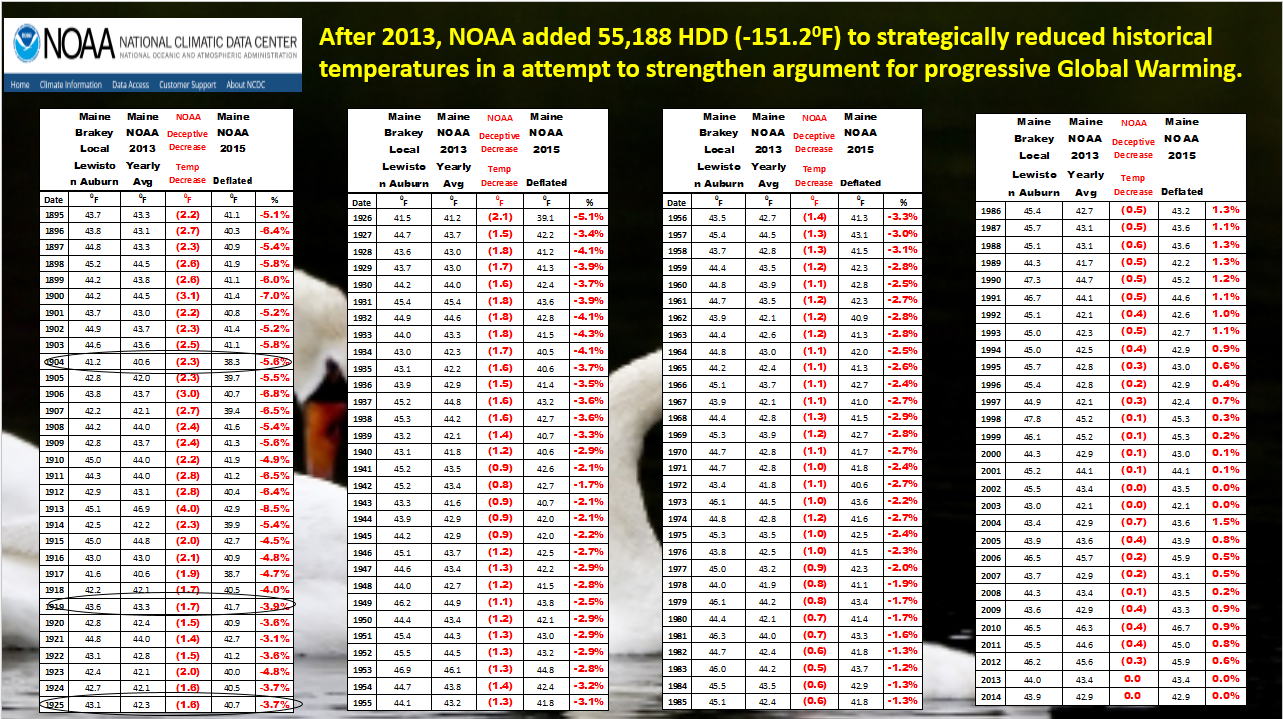
Over the last months I have discovered that between 2013 and 2015 some government bureaucrats have rewritten Maine climate history between 2013 and 2015 (and New England’s and of the U.S.). This statement is not based on my opinion, but on facts drawn from NOAA 2013 climate data vs NOAA 2015 climate data after when they re-wrote it.

We need only compare the data. They cooked their own books (see numbers below).

Brakey_1

NOAA cooled the years of Lewiston-Auburn Maine’s past by an accumulated 151°F! (55,188 heating degree day units).

The last four months have been some of the coldest you might ever recall in our lifetime. So far 2015 is the fourth coldest in Maine’s history over the last 120 years. Data from 2013 confirm that so far – from January 1 to April 29 – 2015 has required 4249 heating degree days.

That rivals 1904, 1918 and 1923 over the last 120 years.

But when I recently looked at NOAA’s revised 2015 data, these last four months now would not even put us in the top twenty of coldest months. The federal government went into the historical data and lowered those earlier years – and other years in the earlier decades – so that they can keep spending $27 billion a year on pushing global warming.

They assumed no one would archive temperature data. But I did. My research indicated they used the same algorithm across the United States at the same time. Fortunately I had archived their data from 2013 for Maine and recently compared it to their 2015 data (see above table).

As an engineering physicist and heat transfer specialist, I have worked with heating and cooling degree days for forty years. It is alarming when one discovers multi-million dollar websites have been corrupted with bogus data because the facts do not match up with agendas.

It tremendously harms the industry you and I both work in. Worse, it harms the public. If the public knew the climate data facts indicated it was not getting warmer locally, and that it might actually be getting cooler, it would have all the more reason to insulate and become more energy-efficient in their homes.

I have put together a Maine history of climate temperatures in a narrated PowerPoint Presentation placed on YouTube titled, Black Swan Climate Theory.

Below is a brief sampling of my findings:

Brakey_3

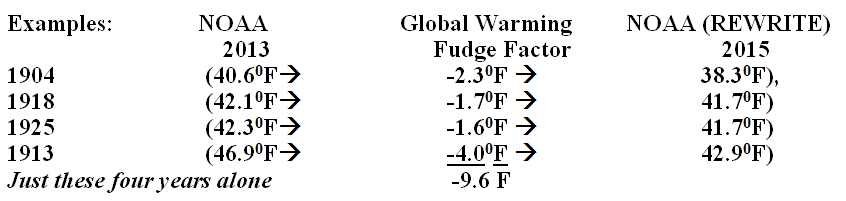
So far 2015 Maine temperatures, as of April, are running neck-and-neck with the coldest years in Maine’s history: 1904 (40.6°F), 1918 (42.1°F) and 1925 (42.3°F). These temperatures cited come right from the federal government’s own NOAA climate data (from 2013). I archived them on my computer for future reference.

2015 so far among coldest on record

A BLACK SWAN event is forming in 2015 (see chart to right). Based on the first four months of 2015, there is an excellent chance 2015 Maine temperature might average, on an annual basis, well under 43.0°F. Not only have Maine temperatures been on a decline since 1998, we are now seeing temperatures reminiscent of the bitter turn of the early 1900s.

Massive rewrite

It appears NOAA panicked and did a massive rewrite of Maine temperature history (they used the same algorithm for U.S. in general). The new official temperatures from Maine between 1895 and present were LOWERED by an accumulated 151.2°F between 1895 and 2012.

“Out-and-out fraud”

In my opinion, this is out-and-out fraud. Why did they corrupt national climate data? Global warming is a $27 billion business on an annual basis in the U.S alone.

Brakey_4

Now NOAA data revised in 2015 indicate that 1904, 1919 and 1925 in Maine were much colder than anything we experience today. (See the scorecard above comparing the NOAA data that are 18 months apart). Note how for 1913 the NOAA lowered the annual temperature a whole 4°F!

For the balance of the years, as they get closer to the present, the NOAA tweaks less and less. They have corrupted Maine climate data between 1895 and present by a whopping accumulated 151.2°F.

Unfortunately NOAA is remaining true to that old saying, “Figures don’t lie but liars figure.”

A multi-million dollar website has been corrupted. I can no longer rely on the tax-payer funded NOAA for clean, unfiltered, climate data for my ongoing research.

Conclusion

I can no longer trust the climate data and energy information ultimately drawn from the U.S. government. Locally, I now have to determine if they got their data from NOAA.

This makes research a lot tougher.

Mike Brakey

– See more at: http://notrickszone.com/2015/05/02/151-degrees-of-fudging-energy-physicist-unveils-noaas-massive-rewrite-of-maine-climate-history/#sthash.BBzJYpeL.gdGB9urs.dpuf

Wind Energy….NOT clean, NOT green, NOT affordable!

Wind Power’s Toxic Embrace

china rare earth toxic lake

Our Toxic Relationship with Wind Power
The Valley Patriot
Christine Morabito
February, 2015

If clean, safe and efficient energy is to be our standard, then why use wind power at all?

When we examine the entire process, the construction and operation of wind turbines is a dangerous and toxic affair. It begins with the mining of rare earth minerals, a collection of chemical elements manufactured mostly in China. The ill-protected workers are exposed to hazardous materials like hydrofluoric acid and radioactive particles. These substances are then exported worldwide, for use in wind turbines as well as computers, cell phones, hybrid cars and energy saving light bulbs.

The process of refining of these elements leaves death and destruction in its wake, polluting farmland, killing livestock, seeping into waterways and poisoning drinking water. Besides the devastation to the environment, nearby villagers report significant health problems, like bone, respiratory and heart diseases. Some residents suffer helplessly while their teeth fall out. But, since all this is occurring in the Far East, Western environmentalists don’t seem particularly concerned.

Meanwhile, in the United States, the massive windmills gobble up valuable habitat, as do the roads needed to access them. These eyesores ruin otherwise picturesque landscapes, and are built with little regard for the migratory paths of protected wildlife. The deadly blades can reach speeds up to 170 mph, often chopping birds into pieces. Most recent data estimates that 600,000 birds and hundreds of thousands of bats fall prey to this “green” technology every year.

Just east of San Francisco lies a 58 square mile wind farm called theAltamont Pass. The turbines have reportedly killed some 3,000 golden eagles, putting their population in serious jeopardy.

In the 30-odd years that wind energy has existed, only 2 companies have been prosecuted for illegally killing protected birds. The first was in 2013, when the U.S. Department of Justice and Duke Energy, of Wyoming, announced a $1 million settlement related to the deaths of 14 golden eagles and 149 hawks, blackbirds, larks, wrens and sparrows.

In January, 2015, Pacific Corp, also in Wyoming, was ordered to pay $2.5 million for killing 38 golden eagles and 336 other protected birds.

Under the auspices of fighting climate change, the Obama Administration is awarding wind-power companies a 30-year amnesty in the form of “take permits,” which allow the killing of endangered species. It’s ironic that our tax dollars are being used to study and protect endangered species, while simultaneously subsidizing an industry that is killing the aforementioned animals.

By working with the U.S. Fish and Wildlife Service, wind producers can avoid creating killing fields. The key is to bypass well-known migration routes.

I spoke to Bob Johns, Public Relations Director at the American Bird Conservancy. When holding energy companies accountable, Johns says, “green energy is held to a different standard.” The problem is one of selective enforcement. Fish and Wildlife Service guidelines are voluntaryand not enforced via regulation like those governing oil and electric companies. Johns stressed that “wind producers are not ‘mom and pop’ businesses, but large corporations,” with little incentive to follow mere guidelines. He believes regulations are needed to stop the egregious killing of birds and level the playing field. Deadly turbines are a worldwide problem, with wind farms in Spain, Belgium, Sweden, Germany and the Netherlands, among others.

What exactly is the up-side? Wind energy is expensive, costing about twice as much as conventional power sources. And, since wind is heavily subsidized, taxpayers fund it before and after it is produced, as evidenced by the infamous Cape Wind project in Massachusetts, which is already $10 million over budget. Wind energy is not particularly efficient, producing only between 3 to 4 percent of our country’s electricity. Like other alternative energy sources, turbines must be backed-up by fossil fuels when the wind isn’t blowing.

Like all fledgling energy sources, new technologies, combined with regulations, will make wind energy safer, cleaner and more efficient. Through innovative filtration systems, we have made great strides inremoving pollutants from fossil fuel emissions. The plastics we have come to rely on were once discarded waste products from oil refining, proving that the human race will continue to innovate – because that’s what we do.

While there is risk in producing every type of energy, the risks of using fossil fuels are greatly exaggerated; the benefits rarely mentioned. The well-funded, well-connected environmental lobby has an ideological, knee-jerk reaction to energy. In their world, fossil fuels = bad, alternative energy = good.

Massachusetts State Senator, Kathleen O’Connor Ives plans to introduce legislation to ban the practice of hydraulic fracturing (fracking) in Massachusetts. While carrying some hypothetical risk, fracking has the phenomenal ability to make America energy independent. Lower energy costs make us all richer, and we are sending billions less to our oil producing enemies – who, as we speak, are plotting our demise.

I know Senator Ives to be a reasonable legislator, and I’m hoping she and others will consider the pros and cons of every energy source at our disposal. In our quest for energy alternatives, facts should trump ideology. The earth and all its inhabitants deserve nothing less.
The Valley Patriot

christine morabito1

More on the Climate Change Scam, From a Real Climate Scientist!

Judith Curry on Mark Levin–I think she’s pissed

Who am I, but a man of experience and intelligence, to consider the reason why Judith Curry, climate scientist and Chair of Enviro Science at Georgia Tech would go on the Mark Levin Radio Show at 6:30 pm on 4-15-15 to talk about her testimony before congress in the previous 24 hours, condemning the warmer hype?

I think that Raul (the wart hog) Grijalva’s inquiries into her travel and funding and the general problem of an inquisition Boxer and others on the left in congress, have raised the lady’s hackles.

I like that. My hackles are perpetually raised because of the lies of the EPA funded junk scientists and their running dog allies in the press and the congress.

So today Dr. Curry showed up to talk to Mark Levin, not a shrinking violet as a conservative, and she told the story of why she is where she is on the warming battle.

May I remind you of what she did in testimony the past 24 hours and what she has done in the past.

It’s not like we have not noticed her courage and integrity before.

today before the Levin show:

http://junkscience.com/2015/04/15/judith-curry-moves-to-becoming-a-pariah-in-the-house-that-green-built/

In the past you might have thought I was considering sainthood for Curry–take a look:

http://junkscience.com/?s=judith+curry

POINTMAN – Always Gives Us Something to Ponder….

Pop, pop, and poppety pop.

by Pointman

A friend once turned to me on a day that had no mercy in it and said, “you’re right, there is no God.” We were both watching something slowly unfolding, something cold and just petrifying cruel which couldn’t be stopped by either of us. We couldn’t exert any control over it, we could only watch; emasculated observers at the final end of world extinction event of any residual hope about how low us human beings could really get. Pop, there they go, pop, pop, another couple of the buggers. Pop, pop, and poppety pop and yet a few more of them.

At the time and in a vague distracted sort of way, it broke my heart to see him lose his faith, because I loved him as only one man can love another and I’d always somehow relied on him to be the last unwavering believer in some sort of floor of decency that none of us could ever drop through, though I’d never quite realised that until that moment. It was a sort of good-natured buddy buddy routine we did. I’d always dissed his notions of a big G, he’d always thought I was joking as he worked on me but I wasn’t. Not really.

He did have a certain something about him and whatever that was, it became an unexamined backstop of our friendship. He was my touchstone, a glimmer of hope and my ace in the hole, someone who’d pushed through all my tough-guy BS front and taken a deep look down into me and found the little me who still wanted to be a believer. He was always confident he’d get me back into the fold and I had a sneaking hope he just might pull it off, but I should have known I couldn’t protect him from the fire, because he’d never really seen the fire. That day, he saw it and it burnt that something out of him.

It roasted the poor bastard alive.

As bad days go, the complete destruction of the steady and sure religious underpinning of his life was the cherry on top of it all. Lord help an unbeliever out here, at least spare him because I knew he’d be no bloody good wrestling with all the godless doubts that have always nagged away at a low creature like me. It was a slow, untreatable and seventy per cent, first class, New York primo steak, first degree burns injury that no amount of skin grafts could make better. In the end he became someone looking for nothing more than a meaningful way of checking out, but the reality was that he was just another casualty of that day.

It was a kind of delayed reaction thing which took a few more years of his life to play itself out. Corny but true, life has a habit of taking out the decent ones early, and again I watched and couldn’t do anything more than help see him out of the chaos his life eventually became. Hush up now, it’ll all be okay, I swear to Christ. You take your rest, I’ve got you. You just pop along now.

You stagger out of a few discos like that and it becomes clear that the common denominator, that promised basis of all religions simply doesn’t stack up with the reality – behave yourself, follow whatever scriptures you’re supposed to do and you’ll end up in Heaven, Nirvana or wherever deist carrot is being dangled. The innocents never even had the time to be bad boys or girls, so the whole idea of a life as some sort of test you run in order to earn entrance into some higher plain of existence is quite frankly open to question. The wake up message is as old as Agamemnon’s soldiers throwing Troy’s babies from the battlements of a city being sacked.

This is supposed to be a climate skeptic blog and we’re straying into areas theological, which I’m pretty sure most skeptics are uncomfortable with, but I’m afraid that atrophied appendix of a religious upbringing is the mainspring of why I blog. Relax, I’m not some born again Christian after you on the sly. Rather, anything I do here is out of a sense of fairness, which as a reason can be tinselled and tarted up to something as grand as ethics or dare I say it, morality.

Of late, notables like Andrew Montford, Peter lee and somewhat indirectly Richard Tol, have dipped their toe into those murky waters to a slightly puzzled silence from the skeptic blogosphere. Where are you Matt? Even allowing for the stiffness of the articles, it’s about time they moved out of their comfort zones and made the human case for opposition to an agenda that’s supposed to save the Earth at our expense, and I mean that not only in terms of dollars and cents but lives lost.

Lives. That’s what it’s all about. It’s not about us being proved right, about egos, about proving them wrong, but about fishing a few people out of a raging sea. We have to be focused, direct and a lot better than the stereotype we’ve always portrayed us as, so we can pull as many out as we can. The fundamental indecency of the whole thing is the widespread and unquestioned belief on both sides that it’s somehow a quasi-scientific argument, a fencing bout with supporters on sides cheering on their champions. It’s all too easy to see why the developing world see us, all of us, as totally irrelevant, if only because we behave like pampered children who’re puzzled that they don’t have any cake to eat.

I can point this very day at the harm being done to human beings by policies which are supposed to save people a century or so in the future. We don’t allow them GM crops, so they die. We don’t allow them to do coal-powered generation, so they die. We don’t allow them to DDT the arse off mosquitos that kill them with Malaria, so they die. We just don’t allow anything we think wouldn’t be good for them and they just obligingly die. It’s not a problem. Nobody sort of notices and anyway, mostly their arses aren’t white so they don’t actually count as real people.

We’ve already done the whole trip and totally ruined our own environment so there’s definitely no way we’d allow them to make the same mistakes. We’ll guide them forwards towards some medieval rustic, but yet beautiful and untainted existence skipping around the savannahs like seventeenth century French peasants and they’ll love us for doing it.

All I see are dire scientific predictions of an approaching Armageddon, which can only be prevented by throwing buckets full of money vampired out of the poor and passed on to the already rich. With a certain boring regularity, the predictions just fail to materialise and are therefore just ratcheted on a decade or two into the future. Nobody cares because it’s a feeding frenzy. Trough it baby, go for it. Get your piece of the pie while it’s still there.

I see people lining their pockets. I see greed, I see lies, mendacity, deceit and raw naked academic thuggery being used to advance a discredited theory that’s been crumbling like a sandcastle before an incoming tide for the last decade. It’s being crushed under the Everest weight of real world data that simply refuses to conform to its projections. What the hell, nobody cares anyway.

You have enough bruising encounters with ethics in the real world and I’m afraid your wonderful standards slip because you end up with the choice of being a righteous prick who’s paralysed within a dilemma of your own artificial ethical framework or someone who’s decided to do something expedient right now because you yielded to your own humanity.

If you’ve ventured to knock around the edges of our comfortable existence in the rich world, that bad day will eventually pay you a visit and it’ll be make your mind up time – and there’ll always be an urgent window on it too. Do something now, right now, because if you keep chewing it over for the next few minutes, circumstances will effectively make your decision for you.

If policies are killing people for no better reason than an unproven theory, then those policies are simply misguided, and if those policies are pursued while turning a blind eye to their impact on the most helpless ones amongst us, then anyone knowingly supporting such policies are not simply bad or ignorant people, they are immoral, if not simply evil. Their finger might not actually be on the trigger, but to my mind they’re still doing the popping.

Perhaps we’ve finally reached the stage where it’s now been recognised that it’s not about whether there actually is a legitimate moral argument which can be made by climate skeptics, but that it’s actually the argument to be made.

©Pointman

Related articles by Pointman:

Tell me why.

Is there a moral dimension to being anti-environmental?

People Fed Up With Climate Change Scam…Reality is Gaining Popularity!

The age of climate alarmism is coming to an end

JIM LAKELY| OCTOBER 19, 2013 | 12:00 AM

You can be forgiven for not noticing that the United Nations’ Intergovernmental Panel on Climate Change released a summary of its Fifth Assessment Report late last month.

The report landed with a thud, criticized and even mocked by many leading climate scientists. The distinguished science journal Nature editorialized that this should be the last report issued by the UN body.

This is just the latest signal that the age of climate alarmism is over. Given five tries to convince the world that human activity is causing catastrophic warming of the planet, runaway sea-level rise and various weather disasters, the public still doesn’t buy it.

We’re all skeptics now because the science simply does not back up the hypothesis. For starters, there’s been no rise in global temperatures for 15 years.

The IPCC’s Fifth Assessment Report concedes for the first time that global temperatures have not risen since 1998, despite a 7 percent rise in carbon dioxide (CO2) emissions.

To put that into perspective, global human CO2 emissions in the last 15 years represent about one-third of all human CO2 emissions since the start of the Industrial Revolution, and yet temperatures didn’t budge.

Nearly all of the UN-approved climate computer models were wrong. The IPCC finally admitted as much.

The IPCC also admits that the “hockey stick” it used to feature in past reports wasn’t accurate. Penn State professor Michael Mann has been dining out for years on his infamous “hockey stick,” a dread graph featured by Al Gore in his Oscar-winning documentary “An Inconvenient Truth.”

The graph looked so dramatic — like a hockey stick — only because it ignored the Medieval Warm Period, a time about a thousand years ago when temperatures were warmer than today — when wine grapes grew in England and Greenland was green.

The “hockey stick” is missing from the Fifth Assessment Report, and the IPCC admits the Medieval Warm Period was warmer and more global than it claimed in the past.

A third major admission by the IPCC: No increases in droughts, hurricanes, typhoons and other extreme weather. Every time severe weather hits the United States, you could count on IPCC-related scientists, professional climate alarmists and the media to attribute it all to man-made global warming. No more.

The latest IPCC report admits to having “low confidence” in predictions of more frequent or more extreme droughts and tropical cyclones.

While the IPCC is taking its lumps for being wrong on these and other matters, a new kid on the block of climate science is taking a victory lap: The Nongovernmental International Panel on Climate Change released its own report, Climate Change Reconsidered II: Physical Science. Packed with 1,000 pages of peer-reviewed literature — and then peer-reviewed again by NIPCC’s team of some 50 scientists from around the world — Climate Change Reconsidered II comes to the conclusions the United Nations is only now and reluctantly admitting.

The NIPCC report concludes that human impact on climate is very modest, especially when compared to natural cycles. Future warming due to human greenhouse gases is likely to be only 1-2 degrees Celsius, and be a boon for flora and fauna alike.

Higher levels of carbon dioxide will not cause weather to become more extreme, seas level rise isn’t accelerating and polar ice caps aren’t melting at alarming rates.

Global warming isn’t the crisis many people said it was a few years ago. That’s bad news for the IPCC and the many environmental groups and politicians that hooked their wagon to it. But it’s good news for the rest of us.

Jim Lakely (jlakely@heartland.org) is director of communications at The Heartland Institute, which published Climate Change Reconsidered II: Physical Science on behalf of the Nongovernmental International Panel on Climate Change. For more information, visit ClimateChangeReconsidered.org.

Leading Meterologist Tells Us What We Already Knew….Climate Alarmism is a Scam!

Climate change PROVED to be ‘nothing but a lie’, claims top meteorologist

THE debate about climate change is finished – because it has been categorically proved NOT to exist, one of the world’s leading meteorologists has claimed.

Published: Wed, October 22, 2014

climate-changeClimate change has been ‘disproved’ and polar ice is ‘increasing’ [ AP]

John Coleman, who co-founded the Weather Channel, shocked academics by insisting the theory of man-made climate change was no longer scientifically credible.

Instead, what ‘little evidence’ there is for rising global temperatures points to a ‘natural phenomenon’ within a developing eco-system.

In an open letter attacking the Intergovernmental Panel on Climate Change, he wrote: “The ocean is not rising significantly.

“The polar ice is increasing, not melting away. Polar Bears are increasing in number.

“Heat waves have actually diminished, not increased. There is not an uptick in the number or strength of storms (in fact storms are diminishing).

“I have studied this topic seriously for years. It has become a political and environment agenda item, but the science is not valid.”

climate change global warming mythMan made climate change is a myth according to Coleman, inset [AP]

I have studied climate change seriously for years. It has become a political and environment agenda item, but the science is not valid

John Coleman, co-founder of the Weather Channel

Mr Coleman said he based many of his views on the findings of the NIPCC, a non-governmental international body of scientists aimed at offering an ‘independent second opinion of the evidence reviewed by the IPCC.’

He added: “There is no significant man-made global warming at this time, there has been none in the past and there is no reason to fear any in the future.

“Efforts to prove the theory that carbon dioxide is a significant greenhouse gas and pollutant causing significant warming or weather effects have failed.

“There has been no warming over 18 years.”

The IPCC argue their research shows that man-made global warming will lead to extreme weather events becoming more frequent and unpredictable.

US News and World Report noted that many of the world’s largest businesses, including Coke, Pepsi, Walmart, Nestle, Mars, Monsanto, Kellogg, General Mills, Microsoft, and IBM, “are now engaged and actively responding to climate science and data.”

Mr Coleman’s comments come as President Barack Obama came under fire from climatologists as federal data revealed The United State’s energy-related carbon pollution rose 2.5 per cent despite the President’s pledges to decrease it.

President Obama told 120 world leaders at the United Nations climate summit last month that America had done more under his watch in cutting greenhouse gases than any other country.

Despite this, the Energy Information Administration’s Monthly Energy Review showed an increase in the use of energy from coal.
World leaders have pledged to keep the global average temperature from rising two degrees Celsius above pre-industrial levels to prevent the worst consequences of climate change.

The US, along with the UK and other developed countries, is expected to pledge furtheractions on climate change early next year.