Windweasels Will Resort to Bribery, When All Else Fails….

UK Wind Industry Turns to Bribery as it Fails to “Win Brit’s Hearts & Minds”

dirtyrottenscoundrelsoriginal

Ministers accused of trying to ‘buy off’ local discontent on wind farms
Western Morning News
Phil Goodwin
12 October 2014

Landscape campaigners have described the latest Government moves tohelp communities obtain financial benefits from wind farms as a guide to bribery.

The Department of Energy and Climate Change (DECC) has set out new standards for wind energy schemes to work with local communities.

The guidance, written by the industry body Regen South West, focuses on how communities can best obtain and use cash funds of up to £5,000 per megawatt (MW).

Opponents of turbines say windfalls under the new rules – worth £1.1 million over the life cycle of a large project up for decision in Cornwall later this month – are simply designed to “buy off” local discontent.

Campaign group Cornwall Protect said the only way the Government can achieve its renewable energy targets is to “extend the gravy train beyond developers and landowners to communities”.

Spokesman Danny Mageean said there was a danger that so-called community leaders may be keen to win “brownie points” even if they live “at the other end of the village”.

“I live five hundred metres from a 77-metre turbine so I know the problems, and I don’t think giving our parish council a few thousand would compensate for the devaluing of our property and the noise,” he added.

Ministers unveiled a raft of measures last year in response to growing anger in the rural Conservative heartlands at turbines and solar farms.

The new guidance was billed as giving more protection to the landscape and a stronger voice to locals who opposed unpopular renewable energy schemes.

In addition, the recommended community benefit package in England was increased fivefold from £1,000 per MW of installed capacity to £5,000 per MW.

DECC has published the guidance on how wind schemes should work with communities, calling for partnerships between the two.

It gives examples of different ways in which funds and other investments by developers have been used by local groups, from the provision of care services to mountain bike trails.

The guidance is expected to be followed shortly be a community “right to invest” in new renewable energy projects that will also apply to solar schemes.

Jodie Giles, communities project manager at Regen South West, authors of the document, said “We are delighted that more communities are getting involved with sustainable energy, and in particular onshore wind projects – one of the most efficient and cost effective renewables technologies available.”

Examples of how benefits have been used will soon be recorded on DECC’s new community benefits register for England.

This month, a decision will be made on plans for one of the biggest wind farms in the region – 11 turbines producing 25MW at Week St Mary in Cornwall.

Developers Good Energy are proposing a fund of £2,000 per MW, totalling more than £44,000 a year for the life of the project, available to people living within three miles of the plant.

A local electricity tariff scheme is also proposed, offering discount for locals living within the three-mile radius who sign up to receive electricity from the scheme.

The firm is also exploring the possibility of the community owning one of the turbines.

Bob Barfoot, a member of the CPRE in Devon and a planning expert who has helped prepare a report from the group Communities Against Rural Exploitation (CARE) for the planning meeting on October 23, said community benefits cannot be taken into account by councillors.

He says this point has been made by a number of planning inspectors in recent appeals, including a decision this June to uphold the refusal of a 77-metre turbine at Ladock.

In dismissing the appeal, planning inspector Paul Jackson said plans to generate about a third of the parish’s annual electricity demand were “a laudable aim”

“However, as planning permission for the scheme was refused on landscape and visual amenity grounds, which remain the main concerns, it is unclear how the intended community benefits could make it acceptable,” he added.

Environment campaigner Jeremy Varcoe, of North Cornwall, said it was wrong to lavish cash on the girl guides rather than affected locals.

“What’s so unfair is the money goes to people not affected – rather than those whose lives are blighted by the turbines – it is little more than a bribe to the local parish or town council,” he added.

“It is a dishonest device to buy off the increasing resentment among people who are against these developments. Strictly speaking community benefits are not a material planning consideration but there is no doubt that the promise of large amounts of money has affected the decision of committees and council case officers.”
Western Morning News

As community and political opposition to the great wind power fraud rolls and builds across the world, the charge that opponents are red-necked climate change deniers, infected with a dose of Not In My Backyard syndrome, starts to ring hollow.

Sprinkling a little cash – like confetti at a wedding – isn’t going to overcome the fact that anyone with an interest in the roll-out of giant fans – which obviously includes those in impacted and threatened communities – is alive to the scale and scope of the greatest economic and environmental fraud of all time (see our post here).

The level of anger is palpable and has already erupted with community defenders toppling MET masts in Scotland (see our post here); and sabotaging turbines and construction equipment in Ontario (see our post here).

True it is that everyone has a “price”. But not everyone is ready to sell their souls.

not-for-sale

Aussies Determined to Expose the Great Wind Power Fraud! Go Senator Leyonhjelm!

Alan Jones interviews David Leyonhjelm on the Senate’s Inquiry Into the Great Wind Power Fraud & Cross-Bench LRET Plan

263977-alan-jones

The wind industry in Australia is in full-scale panic because the Senate’s cross-benchers (who hold the balance of power in the Upper House) have won Coalition support for their Inquiry into the great wind power fraud: which will turn a (long-overdue) blowtorch on the biggest rort in Australian history (see our post here).

Adding to the wind industry’s mounting woes is the fact that the cross-benchers have also put together a plan that will put the wind industry out of its misery, by elevating the place of “old” hydro power and small-scale solar – especially “stand alone solar” in remote locations – under the Large-Scale Renewable Energy Target (LRET): both “old” hydro and small-scale solar are perversely excluded from the LRET  (the plan is available here).

The vast bulk of hydro capacity was built pre-1998 and is, therefore, ineligible to participate – a matter that has Tasmanian Senator, Jacqui Lambie seeing red (see our posts here and here). For a run down on the Inquiry and the cross-benchers’ plan see our post here.

STT hears that the cross-bench plan is with Tony Abbott’s office and has already won the PM’s tick of approval.

The Inquiry and the plan has been pushed along by cross-bench Senator, David Leyonhelm, who appears in this recent interview with Alan Jones on 2GB.

Alan has a little radio show that more than just a few Australians tune into each morning. Syndicated through over 77 Stations and with close to 2 million listeners Countrywide – AJ as he’s known – is one of those people that leads the political charge on many issues that really affect ordinary Australians and which the rest of the press ignore.

Alan Jones AO: A couple of weeks ago I interviewed Dr Jay Tibbetts – you might recall is an American. A medicical adviser to the Brown County Health Department in Wisconsin. He attacked the Australian Medical Association, who quite disgracefully, but not surprisingly given that the leadership of that mob now is hopelessly of the left. And the AMA virtually arguing that there was no problem with these sub-audibleinfra-sound emitted by wind turbines. And Doctor Tibbetts cited endless international evidence in relation to the health risks posed by the low-frequency noise that wind turbines generate.

Well that interview lead to an email that I received this week from eastern Europe.  Amazingly they had heard my interview, on the Internet with Doctor Tibbetts in relation to what I call the lunacy of wind farms and the sleep deprivation that they cause and my email correspondent said “I just wanted to tell you how much we appreciated your excellent interview and your courage to do it. I know how risky this is.  My emailer said he posted the interview on his website and it went ballistic. And I’m told, he says it’s spreading from Austria to Germany, and Finland and Ireland and Poland and many other countries. My emailer said ‘I can guarantee you that all people in Europe, especially in Germany were like crazy and spread your interview like crazy when they got it on my Facebook page.

Well people are waking up to the lies and deceit peddled by governments and renewable energy companies all over the world. There is a report this week by AGL energy of all outfits who found that non-solar households are paying hidden subsidies and more than $200 million a year, here in Australia to households who have solar roofing panels.  Now we know that this wind power-solar power are driving up the cost of what you pay for electricity and what business pays. And the AGL Chief economist Paul Simshauser, said the problem of wealth transfers to renewable energy sources was increasing. In other words to prop up renewable energy, you the taxpayer have money taken out of your pocket and that, in billions of dollars, goes to renewable energy companies. Most of them foreign companies.

Now people increasingly can’t hack this. We’re told 650 electricity customers are complaining to their retailer every day about electricity prices. The Australian Energy Regulator’s annual report found disconnections have surged and more than 237,000 New South Wales households, one in seven customers, has complained to their provider about pricing in the financial year ended 30 June this year.

Now we are spending billions of dollars on wind energy. It accounts for less than 2% of power generation in China, 3% in America. And this whole renewable energy thing is completely out of control. Wind power costs up to $214 per megawatt hour, coal $78 to $91. If the renewable energy mob want a set of rules that would be simple – then go ahead with your wind farm but don’t ask for taxpayers’ money. How can wind turbine companies buy off a farmer for $10,000 a turbine and then that same company be subsidised by the taxpayers? Who are you.

I have spoken to so many people, but one of them is Andrew Gardiner in Napthine’s electorate. He’s running for election this Saturday, the Premier of Victoria. Next to 140 turbines, 150 metres high, 56m blades – the biggest monsters in the southern hemisphere, some are 90 m from his property. Eight of them, 1.7 km from his home. And he’s been bullied and intimidated by AGL. I repeat – coal-fired power $78-91 a megawatt hour wind power, up to $214 per megawatt hour and solar power, over $400 a megawatt hour.

And here you’ve got this Gullen Range wind farm near Goulburn, which breaks nearly every rule that governed its application to operate. But don’t worry, it’s foreign owned. Would you believe Canberra, were meant to be spending 17,000 million dollars (17 billion), erecting between 7000 and 10,000 of these wind turbines. Yet Germany are pushing ahead with new coal-fired electricity plants because political and public concern there is increasing over the cost of energy. China is building a new coal fired power station every 10 days every year. And remember when I spoke to Angus Taylor, the new member for Hume, turbines in his electorate enjoys subsidies to $500,000,000 to a $billion a year.

Well David Leyonhjelm is a New South Wales Senator, representing the Liberal Democrats and along with Senators Madigan, Day, Xenophon and Back, David Leyonhjelm succeeded in establishing, has succeeded in establishing – and this will put a few noses out of joint – a Senate inquiry into wind turbines. This will blow the whole show open. It was a narrow vote. Because you see people like Mcfarlane, the Energy Minister, they’re in bed with wind companies. 33 to 32. The inquiry will be known as The Select Committee on Wind Turbines. It will investigate regulatory governance, or lack of it, over wind turbines, their economic impact, which can only be negative. It will examine on household power prices of wind power, we know that. The implementation of planning processes which as you can see with Gullen Range, are ignored. The integrity of national wind farm guidelines – they have none. The impact of wind turbines on firefighting – that’s another story altogether – and crop management. And the committee will have the power to send for and examine people and documents. And it will report its proceedings from time to time and make interim recommendations and it will report by June 24 next year. This is a very pioneering and important initiative and not before time.

Senator David Leyonhjelm is on the line. Senator, good morning.

Senator David Leyonhjelm: Good morning Alan.

Alan Jones AO:  Just before we go down to the guts of this, I note the notice paper and it tells us that the inquiry will look into ‘the role and capacity of the National Health & Medical Research Council in providing guidance to state and territory authorities’ and ‘the effect that wind towers have on fauna and aerial operations around wind turbines’. I couldn’t find any where in the terms of reference of the inquiry an investigation into the health impact of these wind turbines. Is that on your agenda?

Senator David Leyonhjelm:  It’s on our agenda and there is another item there that says ‘Any related matter’. So it certainly we’ll be taking that into account. The only thing is we – the emphasis of this inquiry is towards the other matters, more than health, because there have been two inquiries into health already. The problem with it is they’ve been ignored pretty much.

Alan Jones AO:   Absolutely.

Senator David Leyonhjelm:   We didn’t think – we will be going over that ground, we will be looking at that again – but there are a lot of additional complaints about wind farms. They are, I don’t know where they all are, all but certainly some of them are extremely noxious neighbours. And we are receiving just so many complaints about them.

Alan Jones AO:   Absolutely, I am to. I have a file that I couldn’t jump over here too. Incidentally, as you would be aware there is an election here on Saturday, this opposition leader, fellow, Andrews, the Labor leader, is promising to reduce the mandatory buffer zone between properties and wind farms if he wins the election. I mean it is currently 2 km the exclusion zone, which is not enough, he’s promised to reduce it to 1 km.

Senator David Leyonhjelm:   It’s amazing. And, you know that reflects the way we did this committee. We knew that there’s significant support for wind farms on both sides of the house. And what we did was a little bit sneaky to be quite frank. We’ve called it a ‘select committee’, so it’s not a reference to an existing standing committee, which are dominated by Labor and the government, so this is basically a cross-bench inquiry. There are seven official members of the committee, plus we can co-opt more, other participating members. It’s only two from the government one from Labor, one from the Greens, and three from the cross-bench. And plus, we can bring in other participating cross-bench members if if we wish to.

Alan Jones AO:  But see you’re raising a very valid point here because the public feel that they’ve got nowhere to turn because both Labor and the Coalition are in bed with this mob.

Senator David Leyonhjelm:   Yes, well that’s the point. That’s why we said this that it’s not going to be appropriate for it to go to an existing committee, because the cross-bench doesn’t have much say on those.

Alan Jones AO:   Absolutely. You see I have said many times – I am talking to Senator David Leyonhjelm from New South Wales – I’ve said many times David, that you can’t release a drug onto the market unless all the likely consequences from the drug are subjected to rigourous scrutiny. So how could you build wind farmers, or approve coal seam gas extraction, without providing the answers to the very legitimate questions about health and the impact on individuals that these things have.

Senator David Leyonhjelm:   Yes. You can never answer every single question and science is an endless pursuit, but there are some just glaring questions why, for example, does the Gullen Range wind farm, where they have put these things almost 200m away from where they’re supposed to be, and then said ‘well, we’re a renewable energy company we can do whatever we like’. And then the Clean Energy Regulator hands over money to them with no accounting.

Alan Jones AO:   Thank God for you. Thank God for you. They should be stopped in their tracks now. They are in breach of the consent application, they should be stopped, shouldn’t they?

Senator David Leyonhjelm:  We hear lots of stories, where because they are renewable energy, they think they’re above the law. They don’t think they have to comply with planning guidelines and directions and so forth.

Alan Jones AO:   This bloke’s a breath of fresh air.

Senator David Leyonhjelm:   We are not even satisfied those guidelines are particularly comprehensive and thorough anyway.

Alan Jones AO:   Or stringent, no. You have said, just for the benefit of my listeners, and I’ll just get you to comment on some of the quotes that you’re on the record as having uttered. “The dramatic surge in power bills has been major factor in the decline of our manufacturing sector and the loss of thousands of jobs. In little more than 10 years, the Renewable Energy Target has rocketed Australia from almost the cheapest to the most expensive electricity in the world”. They are your words.

Senator David Leyonhjelm:   Yes. Well in fact that brings me to another subject where also the cross-bench is also are trying to do something constructive with the government on this Renewable Energy Target. As you probably know, Labor and the government stopped negotiating a week or so back and now, it’s in our court. We are working on a plan – there’s been some media reports on it in the last couple of days. We are working on a plan in whcih we will address this issue of high prices of electricity, unachievable energy target, the penalty rates kicking in, all that sort of nonsense.

Alan Jones AO:  Well you said in August, ‘The latest figures from the Australian Bureau of Statistics show in the five years to June 2012, Australian retail electricity prices rose by 72%, with even higher increases in Melbourne and Sydney’. You said, ‘Senators and MPs, however, don’t need to worry about whether staying warm in chilly Canberra may send them broke. Perhaps if they had to pay for their own heating and air-conditioning in Parliament House it would concentrate their minds on the important discussion we need to have about the future of the Renewable Energy Target’. Good on you.

Senator David Leyonhjelm:   Well, it’s tragic. You know there are people who are suffering, genuinely suffering from energy poverty. They cannot turn on their heaters during the winter. They suffer in the cold just because they cannot afford their electricity bills. So they’re frightened of receiving a bill that they can’t afford to pay.

Alan Jones AO:  Absolutely. You … yes it is tragic. You quote a report from the accounting firm Deloittes, showing the Renewable Energy Target will “stifle the economy, cost jobs, and drive up prices and is a very inefficient means of reducing greenhouse gas emissions”. Now Terry McCrann years ago told me David, on this program, if you want to decarbonise the Australian economy, you’re writing a national suicide note. And I mean that you’re the only people focusing on this issue.

Senator David Leyonhjelm:   Yes, well somebody has to. I’m really encouraged, that the government acknowledges the problem, I just don’t like the solution, or the politics of the solution. The renewable energy industry has an awful lot of supporters. And it’s a nice warm thing motherhood type stuff to support renewable energy.

Alan Jones AO:  And have you ever noticed, when any of the MPs retires from Parliament they go and get jobs with them. Hey hey? Oh, Mr Mcfarlane will be lining one up right now. He won’t be standing at the next election don’t worry. I mean you said, and this is true, ‘the net effect of this subsidy, renewable energy subsidies, is to hand an additional 17 billion dollars of our money to these companies over 15 years for no measurable environmental benefit.

Senator David Leyonhjelm:   Yes that’s right. And it’s worse than that, I mean it’s having negative effects. In fact one of the aspects of the inquiry is to actually determine what is the energy and emission output – input and output from a whole of life. So, from the point when these turbines are made and they run, through to the other end when they are dismantled and thrown on the scrap heap – what’s the net energy and emission output.

Alan Jones AO:  Absolutely

Senator David Leyonhjelm:   I have a sneaky suspicion that a bit like the Prius car it’s not the right direction.

Alan Jones AO:  Absolutely. Finally – and we could go on forever on the things that you’ve said. And it’s very encouraging that someone at least is taking this cause up. But you’ve said, “It is undisputed that the wind generation industry is not viable anywhere in the world without government or customer subsidies”, you said “It’s just government-mandated corporate welfare”.

Senator David Leyonhjelm:   That’s exactly right – they’re just not viable without subsidies.

Alan Jones AO:  Keep at it – keep at it my friend. Keep at it. You’re the hope of the side.

Senator David Leyonhjelm:   Alright – thanks Alan.

Alan Jones AO:   Well done, there he is. Senator David Leyonhjelm. A major senate inquiry into this whole rubbish of renewable energy and wind power.
2GB
david leyonhjelm

Wynne Government is Destroying Ontario, Tells Us, It Is “Good” for Us!

How green energy subsidies work: the government makes stuff up, then wastes billions of dollars while the economy bleeds jobs

Two items in the Toronto Sun caught my eye earlier this month, both written by Lorrie Goldstein about what the paper calls “the Wynne Liberals’ mad obsession with expensive and unneeded green energy.”  The first column is about a recent report published by Parker Gallant and Scott Luft of Wind Concerns Ontario, agrassroots organization that opposes wind turbines.

According to Wind Concerns Ontario, last month the provincial government spent over $1 billionmore for electricity than its market value.  The organization blames the government’s “rush to incorporate ‘renewable’ energy in the form of wind, solar, biomass, etc. into the grid, without a cost-benefit analysis” as the reason for rapidly increasing energy prices in Ontario.  And as Lorrie noted in his column the following week, whenever the “Liberals are called on the carpet over skyrocketing electricity prices in Ontario, they go into their patented, ‘but we eliminated coal’ routine.  Meaning they eliminated coal-fired electricity and replaced it with ‘clean’ energy sources such as solar and wind power.”

This makes no sense, according to Goldstein, who points out that coal-fired electricity generating stations supplied 25% of Ontario’s power needs in 2007 but wind and solar provide only 4% today.

Furthermore, according to the Fraser Institute, the 4% solar and wind provides accounts “for about 20 percent of the average commodity cost,” even though the Ontario Energy Board said last year that solar and wind would provide 7% of Ontario’s power and “their direct costs would account for about the same fraction of the average commodity cost.”

This wouldn’t be the first time that the government’s estimates were wildly off.  Dalton McGuinty promised in 2009 that the Green Energy Act would create 50,000 jobs by the end of 2012, but as Lorrie Goldstein wrote in the Sun last year, as of mid-2013 only 31,000 jobs had materialized.  Most of them were temporary (lasting only one to three years) and were “indirect” jobs, so even the claim that 31,000 jobs were created is difficult to verify.

To make matters worse, the figure of 31,000 did not take into account the jobs that would be permanently lost as a result of increased electricity prices.  A Fraser Institute report published last year found that the Green Energy Act “will not create jobs or improve economic growth in Ontario.” Lorrie Goldstein wrote that the 31,000 new jobs cost the economy 62,000 to 124,000 jobs in other sectors, as a result of high energy prices.

Such dismal results for government investments in green energy are not unique to Ontario, of course.

Consider, for example, this paper published in 2009 by researchers from the King Juan Carlos University in Spain.  The researchers found that for every “green job” created by the government, 2.2 jobs were lost elsewhere in the economy (note that this number falls into the range of Lorrie’s estimate).
The researchers also found that every green energy job created by Spain since 2000 cost the government, on average, 571,138 Euros.  The final cost of the Spanish experience with renewable energy subsidies is massive.   Between subsidies and higher electricity prices, tens of billions of Euros were lost.  The researchers also found that these enormous costs “do not appear to be unique to Spain’s approach but instead are largely inherent in schemes to promote renewable energy sources.”

It is unclear to me, therefore, what the Ontario Government expects its residents to gain in return for all the time and money poured into green energy projects.  Ontarians are paying outrageous electricity prices, jobs have been lost, and billions of dollars have been wasted – and all we have appeared to gain is a few kind words from ‘Saint’ David Suzuki, which is of no value to anyone.

Big wind Pressing Congress, For More Money! $$$$$$$$ It’s a money-pit!

Via. Greenie Watch    30 November 2014

Big Wind is pressing Congress for yet another bailout

By Mary Kay Barton

Taxpayers beware! While you were sleeping, enjoying your family and eating turkey,

Congress has been busy.

Congressional Republicans are negotiating with Senate Democrats to extend the infamous wind energy Production Tax Credit through to

2017, after which it will supposedly be phased out, just as was supposed to happen in the past. This sneaky, dark-of-night “lame duck”

session tactic should be flatly rejected.

While you’ve been busy just trying to make ends meet, wondering why the cost of everything is going up, and agonizing over how your

children and grandchildren will ever pay the mounting $18 TRILLION dollar national debt – the wind industry lobbyists’ group, the

American Wind Energy Association (AWEA), just sent Congress a letter seeking to extend the federal, taxpayer-funded wind Production Tax

Credit (PTC).

The list of signers to AWEA’s letter include rent-seeking industries and “green” groups who’ve all benefitted by tapping into

taxpayers’ wallets via the Big Wind PTC (aka: Pork-To-Cronies). It certainly isn’t hard to figure out why these corporations pay many

millions of dollars to hire lobbyists and run national TV advertising campaigns geared at convincing crony-politicians to vote to

continue these TAXES and higher energy prices on American citizens.

AWEA’a letter is typical of wind industry propaganda. It makes specious claims about creating jobs and reducing pollution, without

providing a shred of evidence to PROVE any of their claims. AWEA apparently hopes Congressional officials are “too stupid” to

understand what energy-literate citizens nationwide know: Industrial wind can NEVER provide reliable power. It raises electricity

costs, even after subsidies are factored in. It kills more jobs than it creates. It defiles wildlife habitats and kills eagles, hawks,

other birds and bats – with no penalties to Big Wind operators.

Here’s the reality: After 22+ years of picking U.S. taxpayers’ and ratepayers’ pockets, industrial wind has NOT significantly reduced

carbon dioxide emissions. It has not replaced any conventional power plants, anywhere. However, the $Trillions spent on these “green”

boondoggles to date have significantly added to the $18+ TRILLION dollar debt that our children and grandchildren will have to bear.

AWEA’s own statements from years and decades past can be used against them. To cite just one example, 31 years ago, a study coauthored

by the AWEA stated:

The private sector can be expected to develop improved solar and wind technologies which will begin to become competitive and self-

supporting on a national level by the end of the decade if assisted by tax credits and augmented by federally sponsored R&D.

[American Wind Energy Association, et al. Quoted in Renewable Energy Industry, Joint Hearing before the Subcommittees of the Committee

on Energy and Commerce et al., House of Representatives, 98th Cong., 1st sess. Washington, DC: Government Printing Office, 1983, p.

52.]

In other words, the PTC should have ended 20 years ago, because wind energy would be self-sustaining by then. It wasn’t. It still

isn’t. It never will be. We need to pull the PTC plug now!

Here are some details about the bill that is currently being negotiated during the lame duck session –before the newly elected,

Republican majority Senate takes office and can do much about it.

In 2016, wind developers would be eligible for 80% percent of the PTC’s value. They could also claim 60% of its value through the first

nine months of 2017, after which it would supposedly expire.

The proposed congressional deal also seems to continue basing PTC eligibility on when project construction project begins. That opens

huge doors for abuse.

The last time Congress extended the PTC, as part of its “fiscal cliff” deal in 2013, it said “eligibility” for taxpayer largesse

covered projects “under construction,” rather than requiring that they be “placed in service” by a certain date. In practice, this

means just a shovelful of dirt has to be moved by that date.

Remember too that the Production Tax Credit supposedly expired last year. But this clever language has allowed construction and

expansion in the meantime. Meanwhile, Lois Lerner’s Internal Revenue Service has helpfully said projects that were started or “safe-

harbored” prior to the PTC’s most recent pseudo-expiration can claim tax credits if they are in service by 2015. And then they can

claim the $23-per-MWh credit for ten more years!

What a wonderful holiday gift for Big Wind and its political sponsors – at your expense.

Our government should NOT be in the business of picking and choosing the winners and losers in the energy marketplace – while

assaulting and harming the very citizens they are forcing to pay for this “green” energy scam. It’s time for government to get out of

the way and let the markets work!

The best solutions will rise to the top of their own accord because they will provide modern power at the best prices – thereby

maintaining the reliable, affordable power that has made America great.

Citizens nation-wide have awakened to this massive “green” energy scam. Many have sent letters to Congress like the one below. You can

join the fight by contacting your representatives and urging them to do the right thing: Protect American consumers, taxpayers and

ratepayers. END Wind Welfare (#EndWindWelfare)!

Data Tampering the Cause of Much Global Warming…

The End Game In US Data Tampering

A lack of transparency is a huge political advantage

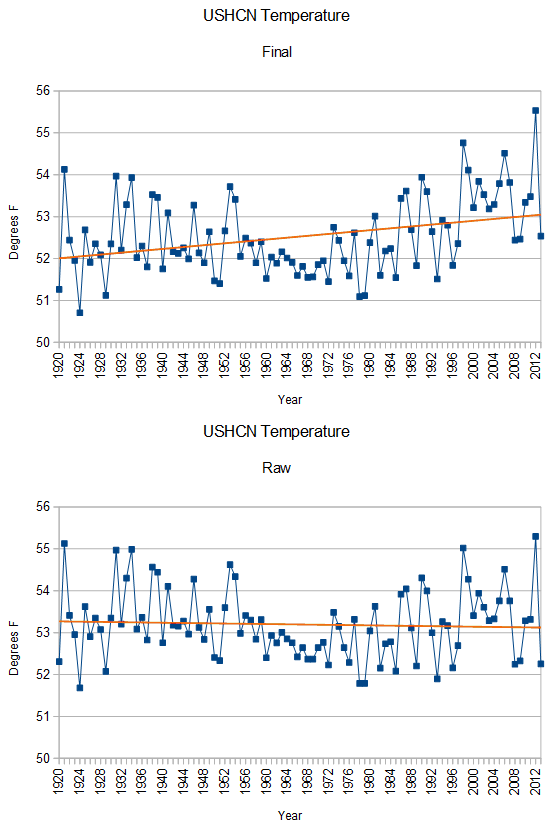
The animation below flashes between raw (measured) US thermometer data, and the final version which is reported to the public. The thermometers show no warming over the past 95 years – all of the reported warming is Mann-made by government employeestampering with data.

USHCNRawVFinal

A big part of this data tampering is implemented by making up monthly temperatures at stations where USHCN says they have no thermometer data. The amount of fabricated data is increasing exponentially, and at current rates of fabrication 100% of the data will be fake by the year 2035 – i.e. there will be no actual thermometer data used after that date. NCDC says that their software which does this, is working “as expected.”

ScreenHunter_4791 Nov. 25 09.21

The next graph shows the total adjustments NCDC are making to the US temperature record. They knock about one degree off of older temperatures, and add a few tenths of a degree on to recent temperatures. Extrapolating out to the year 2035 when 100% of reported temperatures will be fake, the total upwards adjustment will be about one degree, making for a total adjustment of about two degrees.

ScreenHunter_4802 Nov. 25 09.49

The global warming agenda depends on a belief that temperatures are warming, so the fake graphs and press releases released by government agencies about warming and “record temperatures” are critical for perpetuating the big lie about climate.

Aussies Set to Hold an Inquiry Into the “Great Wind Power Fraud”!!!

Australian Wind Industry in a Tailspin as Senate Sets Up Inquiry Into the Great Wind Power Fraud & Cross-Benchers Lay Out Plans for the LRET

tailspin spiraling

STT recently covered a motion proposed by cross-bench Senators Leyonhjelm, Madigan, Day, Xenophon; with the support of the Coalition, through their Deputy Government Whip in the Senate, STT Champion, WA Senator, Chris Back to establish a wide-ranging inquiry into the wind industry in Australia (see our post here).

It gives us much pleasure to report that the Senate voted to establish the inquiry, as moved by David Leyonhjelm on Monday.

THE SENATE
PROOF
COMMITTEES
Wind Turbines Committee Appointment
SPEECH
Monday, 24 November 2014

SPEECH Speaker Leyonhjelm, Sen David

Senator LEYONHJELM (New South Wales) (16:46): I, and also on behalf of Senators Madigan, Day, Xenophon and Back, move:

(1) That a select committee, to be known as the Select Committee on Wind Turbines be established to inquire into and report on the application of regulatory governance and economic impact of wind turbines by 24 June 2015, with particular reference to:

(a) the effect on household power prices, particularly households which receive no benefit from rooftop solar panels, and the merits of consumer subsidies for operators;

(b) how effective the Clean Energy Regulator is in performing its legislative responsibilities and whether there is a need to broaden those responsibilities;

(c) the role and capacity of the National Health and Medical Research Council in providing guidance to state and territory authorities;

(d) the implementation of planning PROCESSES in relation to wind FARMS, including the level of information available to prospective wind farm hosts;

(e) the adequacy of monitoring and compliance governance of wind farms;

(f) the application and integrity of national wind farm guidelines;

(g) the effect that wind towers have on fauna and aerial operations around turbines, including firefighting and crop management;

(h) the energy and emission input and output EQUATIONS from whole-of-life operation of wind turbines; and

(i) any related matter.

(2) That the committee consist of 7 SENATORS, 2 to be nominated by the Leader of the Government in the SENATE, 1 to be nominated by the Leader of the Opposition in the Senate, 1 to be nominated by the Leader of the Australian Greens in the Senate, and 3 to be nominated by other parties and independent senators.

(3) That:

(a) participating members may be appointed to the committee on the nomination of the Leader of the Government in the Senate, the Leader of the Opposition in the Senate or any minority party or independent senator;

(b) participating members may PARTICIPATE in hearings of evidence and deliberations of the committee, and have all the rights of members of the committee, but may not vote on any questions before the committee ;and

(c) a participating member shall be taken to be a member of the committee for the purpose of forming a quorum of the committee if a majority of members of the committee is not present.

(4) That 4 members of the committee constitute a quorum of the committee.

(5) That the committee may proceed to the dispatch of business notwithstanding that all members have not been duly nominated and appointed and notwithstanding any vacancy.

(6) That the committee elect as chair and deputy chair a member nominated by the minority PARTIES and independent senators.

(7) That the deputy chair shall act as chair when the chair is absent from a MEETING of the committee or the position of chair is temporarily vacant.

(8) That the chair, or the deputy chair when acting as chair, may appoint another member of the committee to act as chair during the temporary absence of both the chair and deputy chair at a meeting of the committee.

(9) That, in the event of an equality of voting, the chair, or the deputy chair when acting as chair, has a casting vote.

(10) That the committee have power to appoint subcommittees consisting of 3 or more of its members, and to REFER to any such subcommittee any of the matters which the committee is empowered to examine.

(11) That the committee and any subcommittee have power to send for and examine persons and documents, to move from place to place, to sit in public or in private, notwithstanding any prorogation of the Parliament or dissolution of the House of Representatives, and have leave to report from TIME to time its proceedings, the evidence taken and such interim recommendations as it may deem fit.

(12) That the committee be provided with all necessary staff, facilities and resources and be empowered to appoint persons with specialist knowledge for the purposes of the committee with the approval of the President.

(13) That the committee be empowered to print from day to day such documents and evidence as may be ordered by it, and a daily Hansard be published of such proceedings as take place in PUBLIC.

I seek leave to make a SHORT statement.

The PRESIDENT: Leave is granted for one minute.

Senator LEYONHJELM: I understand that Senate resources are limited in relation to select committees. We acknowledge that. And I understand that at least one other select committee will need to be wound up in order for this to have the full amount of resources. We accept that that is the case. The worst case is that this will operate on limited resources until March, when the inquiry into the activities of the Queensland GOVERNMENT is concluded. Furthermore, if Senator Day is appointed chairman of the committee, he has suggested he may consider relinquishing his fees as chairman to contribute to the committee’s costs.

DIVISION
Ayes 33
Noes 32
MAJORITY 1

Here’s how the SENATORS voted:

AYES, 33

Back Fawcett Madigan Ronaldson
Bernardi Fierravanti-Wells McGrath Ruston
Birmingham Fifield McKenzie Ryan
Bushby (Teller) Heffernan Nash Seselja
Canavan Johnston O‘Sullivan Sinodinos
Cash Lambie Parry Smith
Colbeck Leyonhjelm Payne WILLIAMS
Day Macdonald Reynolds Xenophon
EDWARDS

NOES, 32

Bilyk Gallacher McLucas Siewert
BROWN Hanson-Young Milne Singh
Bullock Ketter Moore Urquhart (Teller)
CAMERON Lazarus O‘Neill Wang
Collins Lines Peris Waters
Dastyari Ludlam Polley Whish-Wilson
Di Natale Ludwig Rhiannon Wong
Faulkner McEwen Rice Wright

Hawthorn v Geelong 1989

Sure, it was a close-run thing, but many a grand final has been won by a single kick.

Predictably, the wind industry, its PARASITES and spruikers have gone into a tailspin – wailing about the dreaded malady of “uncertainty” – of the kind that everyone else gets to face on a daily basis in every aspect of life and business – but from which the wind industry must be protected at all times.

But the Senate INQUIRY is just the beginning of the wind INDUSTRY’s many woes.

Crossbench working on RET plan
Sky News
24 November 2014

A key Senate crossbencher is warning household ELECTRICITY PRICEScould skyrocket unless a political impasse over the renewable energy target is resolved.

Liberal Democrat David Leyonhjelm is in discussion with other crossbenchers about a plan to scale back the RET after talks between the government and LABOR failed.

He fears for households if parliament can’t reach a compromise.

“The record high energy bills that people have been experiencing will seem tame by comparison,” he told AAP.

The government wants to slash the target of 41,000 gigawatt hours to around 27,000, claiming that figure will represent 27 per cent of energy use by 2020 instead of bipartisan level of 20 per cent.

Labor quit negotiations over a new target which has led to further industry uncertainty.

While the Palmer United Party opposes any CHANGES to the RET, Senator Leyonhjelm believes PUP defector Jacqui Lambie may be open to a compromise.

“If the hydro industry was given the ability to generate RENEWABLE ENERGY CERTIFICATES, it would give a badly needed economic boost to Tasmania to the tune of around $120 million per year,” he said.

Senator Lambie has pledged to vote against all government legislation until a defence force pay deal is reconsidered.

However, she could SUPPORT a private bill initiated by one of her crossbench colleagues.

Fellow independents Nick Xenophon and John Madigan both have concerns about wind turbines and have joined forces with other senators to set up an inquiry into the industry.
AAP

STT hears that the cross-benchers are acutely aware that if radical changes aren’t made to the Large-Scale RET pronto, then Australian power consumers will be walloped with fines (the $65 per MWh “shortfall charge”) for every MWh that retailers fall short of the escalating annual LRET target – a figure that will reach more than $1 billion by 2020 and continue at that level until 2031 – simply because the LRET target will never be met (see our posts here and here).

STT also hears that the cross-benchers are currently thrashing out a plan that will avoid that politically disastrous PROSPECT (for a copy of the plan click here).

One aspect of the plan is to include “old” hydro (hydro generation built prior to 1998 that is excluded from the LRET and which is ineligible to receive RECs) and use that output to help SATISFY the shortfall (see our post here).

Another is to bring in rooftop solar output generated in excess of the 4,000 GWh annual “expectation” set by the Small Scale Renewable Scheme (SRES): small-scale SOLAR GENERATION is currently between 8,000-9,000 GWh annually and still growing fast. By 2020, rooftop solar is expected to GENERATE more than 14,000 GWh annually, blitzing the original 4,000 GWh annual expectation. The plan being thrashed out now would use all of that “excess” solar generation to satisfy the LRET.

Bear in mind that all rooftop SOLAR INSTALLED under the SRES gets a fat pile of subsidies by way of “small-scale technology certificates” (STCs), which are paid up front at a guaranteed price of $40. The cost of issuing STCs is paid for by the Federal government to solar installers and recouped from all taxpayers. So it only seems fair that solar does its bit to avoid power consumers being whacked with $billions in fines for failing to meet the LRET: thus avoiding a power and tax bill “double-whammy”.

STT hears Jacqui is working very closely with her fellow cross-benchers to ensure that Tasmania’s “old” hydro gets included in the LRET, with RECs GOING to Tasmanian hydro generators (for a taste of Jacqui’s fury, seeher press release here). In that event, Tasmania would SATISFY the target in a heartbeat.

STT hears that Jacqui’s PLAN to use “old” hydro – along with the plan to use rooftop solar – to satisfy the LRET gets is fast gaining traction amongst the cross-bench Senators.

Including “old” hydro and solar in excess of the SRES “expectation” in order to satisfy the LRET and avoid $billions in fines under the shortfall charge sounds like a common sense outcome to STT – and just the kind of thing one might EXPECT to come from members of a group now known as the Coalition of Common Sense.

muir, xenophon and lambie

John Madigan

Windweasels Torture Residents Living Near Industrial Wind Projects!

Wind Farm Victims – Ocotillo, California: Wind Turbine Noise is a “Horror Beyond Words”

when-is-wind-energy-noise-pollution

Ocotillo RESIDENTS say Wind Turbine Noise Creates “LIVING HELL”
eastcountymagazine.org
14 November 2014

“It’s a HORROR beyond words; something you have to live to understand. Something must be done to stop the noise.” – Ocotillo RESIDENT PARKE Ewing

November 14, 2014 (Ocotillo) – Residents in Ocotillo say that during windy conditions in early November, noise from wind turbines is making their LIVES unbearable.

Jim Pelley captured the loud noise on videotape (see below), juxtaposed with footage of Pattern Energy’s Glenn Hodges SELLING the project to supervisors in Imperial Valley by claiming that noise would not be an issue due to setbacks. “The project was sold on the understanding to be five miles from the community of Ocotillo,” Pelley wrote on a Youtube post. “We have turbines as close as 1/2 mile, we are now forced to live with the horrible noise of 112 turbines when the wind blows.”

****

 ****

His neighbor, Parke Ewing, says his COMPLAINTS to Imperial County and Bureau of Land Management officials, as well as Pattern Energy, have fallen on deaf ears, with no meaningful responses.

“The turbines have created a living hell to us as we try to CONTINUE on with our lives after the Ocotillo Wind Facility was constructed over our objections,” he wrote in a November 1st letter sent to officials at those entities.” Turbines 176 and 169 and others are so loud when the wind blows that they disrupt everything. We can’t enjoy our property. The turbines are even more disruptive to our lives than even we could have IMAGINED. It’s a horror beyond words; something you have to live to understand.

Something must be done to stop the noise. We are one of several families that have homes obviously too close to the turbines. The turbines located near my home need to be removed or relocated. We can’t go on trying to live our lives around the turbine noise. No body, including people that have OBJECTED to Ocotillo Wind, should have to live with the noise when the wind blows. We just can’t do it any longer…”

Ewing asked the County, BLM and Pattern to mitigate the problem, noting that the sound is much louder than Pattern’s description of a DISHWASHER in the next room. “Whoever’s idea of using that term as an adequate description of the noise we would experience has obviously never lived near a turbine in their life.. Let alone 112 “dishwashers” all running at the same time in the next room,” Ewing observed, adding that no officials have taken steps to measure the decibels, let alone measurements such as low-frequency infrasound.

“The turbine noise is creating a high degree anxiety in our lives. We don’t believe it is lawful for this to continue,” the beleaguered Ocotillo resident concluded. “I invite any of you to visit our property when the wind blows and stay awhile. Live the experience as we do- try to talk across your yard over the crashing sound of 336 blades turning and listening to the turbines as they generate their very irritating noise, nobody should be forced to endure this torture.”

Update November 15, 2014: After our story ran, we received this UPDATE from Parke Ewing the next morning, which reads in part:

“Believe it or not, of all days, after I contacted the site manager for Ocotillo Wind today, two representatives visited my HOME today for the first TIME. They listened for awhile, as today was one of those very loud turbine days, their only comment after I asked was, TBD (To Be Determined). Still no return calls or letters from the County of Imperial or BLM. A general manager for Pattern Energy, a Samuel Tasker, quit returning generic answers to me and Jim’s questions and concerns. Carrie Simmons at BLM turned us over to him after we questioned one of her comments regarding the oil leaks and a few other issues. (not noise)

Interestingly, I stood a hundred feet or so in front of a wind turbine yesterday and the noise was very much greater than standing underneath a turbine or even behind the turbine. I assumed that the noise would blow away from me, not into me against the wind, just the opposite of what we would expect. So since our home is in front of turbines 176 and 169 when the wind is coming from the WEST south west, we hear the turbines much more loudly than Jim Pelley, which is down wind. Then when wind is coming from the east we hear turbine 174 more, because we are in front of that one, weird how that works.”
eastcountymagazine.org

kurtz_thth_anr_101220_460w

Why Do Global Warming Alarmists Want to Scare us, and Why Are They Lying To Us?

People Starting To Ask About Motive For Massive IPCC Deception

Guest Opinion: Dr.Tim Ball

Skeptics have done a reasonable JOB of explaining what and how the IPCC created bad climate science. Now, as more people understand what the skeptics are saying, the question that most skeptics have not, or do not want to address is being asked – why? What is the motive behind corrupting science to such an extent? Some skeptics seem to believe it is just poor quality scientists, who don’t understand physics, but that doesn’t explain the amount, and obviously deliberate NATURE, of what has been presented to the public. What motive would you give, when asked?

The first step in understanding, is knowledge about how easily large-scale deceptions are achieved. Here is an explanation from one of the best proponents in HISTORY.

“All this was inspired by the principle – which is quite true in itself – that in the big lie there is always a certain force of credibility; because the broad masses of a nation are always more easily corrupted in the deeper strata of their emotional nature than consciously or voluntarily; and thus in the primitive simplicity of their minds they more readily fall victims to the big lie than the small lie, since they themselves often tell small lies in little matters but would be ashamed to resort to large-scale falsehoods. It would never come into their heads to FABRICATE colossal untruths, and they would not believe that others could have the impudence to distort the truth so infamously. Even though the facts which prove this to be so may be brought clearly to their minds, they will still doubt and waver and will continue to think that there may be some other explanation. For the grossly impudent lie always leaves traces behind it, even after it has been nailed down, a fact which is known to all expert liars in this world and to all who conspire together in the art of lying. These people know only too well how to use falsehood for the basest purposes.”

————————–

Do these remarks explain the comments of Jonathan Gruber about legislation for the AFFORDABLE CARE ACT, aka Obamacare? Do the remarks fit the machinations of the founders of the Intergovernmental Panel on Climate Change (IPCC) and the activities of the Climatic Research Unit (CRU) disclosed in their 6000 leaked emails? It is instructive to know that Professor Gruber’s health care models are inaccessible, protected as proprietary.

The author of the quote was a leader whose lies and deceptions caused global disaster, including the deaths of millions of people. In a complex deception, the IPCC established a false result, the unproven hypothesis that human CO2 was causing global WARMING, then used it as the basis for a false premise that justifies the false result. It is a classic circular argument, but essential to perpetuate the phony results, which are the basis of all official climate change, energy, and environmental policies.

They successfully fooled the majority and even though many are starting to ask questions about contradictions, the central argument that CO2 is a demon gas destroying the planet through climate change, remains. There are three phases in countering what most people understand and convincing them of what was done. First, you have to explain the SCIENTIFIC METHOD and the hypothesis they tried to prove, instead of the proper method of disproving it. Then you must identify the fundamental scientific flaws, in a way people understand. Third, you must anticipate the next question, because, as people grasp what is wrong and what was done, by understanding the first two stages, they inevitably ask the basic question skeptics have not answered effectively. Who did it and what was the motive? You have to overcome the technique so succinctly portrayed in the cartoon (Figure 1).

The RESPONSE must counteract all the issues detailed in Adolf Hitler’s cynical comments, but also the extremely commendable motive of saving the planet, used by the IPCC and alarmists.

clip_image001

Figure 1

There are several roadblocks, beyond those Hitler identified. Some are inherent to individuals and others to society. People want to believe the best in people, especially if they have certain positions in society. Most can’t imagine scientists would do anything other than honest science. Most assume scientists avoid politics as much as possible because science is theoretically apolitical. One argument that is increasingly effective against this CONCERN is funding. Follow the money is so basic, human greed, that even scientists are included.

Most find it hard to believe that a few people could fool the world. This is why the consensus argument was used from the start. Initially, it referred to the then approximately 6000 or so involved directly or indirectly in the IPCC. Later it was converted to the 97 percent figure concocted by Oreske, and later Cook. Most people don’t know consensus has no relevance to science. The consensus argument also marginalized the few scientists and others who dared to speak out.

There were also deliberate efforts to marginalize this SMALL GROUP with terminology. Skeptics has a different meaning for science and the public. For the former they are healthy and necessary, for the latter an irritating non-conformist. When the facts contradicted the hypothesis, namely that temperature stopped rising while CO2 continued to INCREASE, a more egregious name was necessary. In the latter half of the 20thcentury, a denier was automatically associated with the holocaust.

Another form of marginalizing, applied to minority groups, is to give them a unique label. In climate, as in many other areas where people keep asking questions for which they receive inadequate answers, they are called conspiracy theorists. It is why I prefer the term cabal, a secretive political clique or faction, named after the initials of Clifford, Arlington, Buckingham, Ashley and Lauderdale, ministers to Charles II. Maurice Strong referred to the cabal when he speculated in 1990,

What if a small group of these world leaders were to conclude the principal risk to the earth comes from the actions of the rich countries?…In order to save the planet, the group decides: Isn’t the only hope for the planet that the industrialized civilizations collapse? Isn’t it our responsibility to bring this about?

The motive emerged from the cabal within the Club of Rome around the themes identified by their founder, scientist Alexander King, in the publication The First Global Revolution. They took the Malthusian argument that the population was outgrowing food resources and said it was outgrowing all resources. The problem overall was bad, but was exacerbated and accelerated by industrialized nations. They were later identified as the nations in Annex 1 of the Kyoto Accord. The objective to achieve the motive was to reduce industrialization by identifying CO2 as causing global warming. It had to be a human caused variable that transcended national boundaries and therefore could only be resolved by a world government, (the conspiracy theory). Two parallel paths required political control, SUPPORTED by scientific “proof” that CO2 was the demon.

All this was achieved with the political and organizational skills of Maurice Strong. Neil Hrab explains how Strong achieved the goal.

How has Strong promoted concepts like sustainable development to consume the world’s attention? Mainly by using his prodigious skills as a networker. Over a lifetime of mixing private sector career success with stints in government and international groups, Strong has honed his networking abilities to perfection. He can bring presidents, prime ministers and potentates from the world’s four corners to big environmental conferences such as the 1992 Rio Summit, an environmental spectacle ORGANIZED by Strong and attended by more than 100 heads of state.

Here is a simple FLOW CHART of what happened at Rio.

clip_image003

The political structure of Agenda 21 included the environmental catch-all, the precautionary PRINCIPLE, as Principle 15.

In order to PROTECT the environment, the precautionary approach shall be widely applied by States according to their capabilities. Where there are threats of serious or irreversible damage, lack of full scientific certainty shall not be used as a reason for postponing cost-effective measures to PREVENT environmental degradation.

What reads like a deep concern for doing good, is ACTUALLY a essentially a carte blanche to label anything as requiring government intervention. The excuse for action is the unassailable “protect the environment”. Who decides which State is capable? Who decides what is “serious” or “irreversible”? Who decides what “lack of full scientific certainty” means?

Maurice Strong set out the problem, as he saw it, in his keynote speech in Rio in 1992.

“Central to the issues we are going to have to DEAL with are: patterns of production and consumption in the industrial world that are undermining the Earth’s life-support systems; the explosive increase in population, largely in the developing world, that is adding a quarter of a million people daily; deepening disparities between rich and poor that leave 75 per cent of humanity struggling to live; and an economic system that takes no account of ecological costs or damage – one which views unfettered growth as progress. We have been the most successful species ever; we are now a species out of control. Our very success is leading us to a dangerous future.”

The motive was to protect the world from the people, particularly people in the industrial world. Measure of their damage was the amount of CO2 their industry produced. This was required as scientific proof that human CO2 was the cause.

From its inception, the IPCC focused on human production of CO2. It began with the definition of climate change, provided by the UNFCCC, as only those changes caused by humans. This effctively sidelined natural causes. The computer models produced the pre-programmed results and everything was amplified, and exaggerated through the IPCC Summary for Policymakers. The deception was very effective because of the cynical weaknesses Hitler identifies, the natural assumption that nobody could deceive, on such an important issue, and on such a scale, but also because most didn’t know what was being done.

People who knew, didn’t think to question what was going on for a variety of reasons. This situation makes the statement by German meteorologist and physicist Klaus-Eckert Puls even more important.

“Ten years ago I simply parroted what the IPCC told us. One day I started checking the facts and data – first I started with a sense of doubt but then I became outraged when I discovered that much of what the IPCC and the media were telling us was sheer nonsense and was not even supported by any scientific facts and measurements. To this day I still feel shame that as a scientist I made presentations of their science without first checking it.”

Puls commented on the scientific implications of the deception when he said,

“There’s nothing we can do to STOP it (climate change). Scientifically, it is sheer absurdity to think we can get a nice climate by turning a CO2 adjustment knob.”

Now, as more and more people learn what Puls identifies, they WILL start to ask, who did it and what was the motive. When you understand what Adolf Hitler is saying in the quote from “Mein Kampf” above, you realize how easy it was to create the political formula of Agenda 21 and the scientific formula of the IPCC. Those responsible for the formation, structure, research, and FINAL Reports, easily convinced the world they were a scientific organization making valid scientific statements. They also quckly and easily marginalized skeptics, as the leaked CRU emails exposed.

Do you have another or better explanation of a motive?

More Negative Critiques on Health Canada Study! It was a farce!

Report avoids wind turbine health woes

Health Canada Wind Turbine Noise “Statistics” Avoid Real Health Problems

Tim Matheson (Nov. 11, 2014) tells us he has had enough of wind turbine health effects. I am sure that the many people living near Ontario’s wind turbines who are still suffering from pounding in the chest and head, dizziness, headaches, ringing in the ears and sleep deprivation have had enough too. However, the serious inaccuracies in Mr. Matheson’s letter must not go without comment. It is entirely untrue, as he claims, that “every peer-reviewed study world-wide has consistently shown the same” as the Health Canada key findings.

Our Grey-Bruce Medical Officer of Health, Dr. Hazel Lynn found 18 peer-reviewed studies that “provide reasonable evidence . . . that an association exists between wind turbines and distress in humans”. Instead of disparaging Dr. Lynn we should admire and respect her for taking the trouble to listen to her constituents and speaking the truth. The Brown County (Wisconsin) Board of Health has taken the growing peer-reviewed evidence seriously enough to declare its industrial wind turbines a “public health nuisance” and a “human health hazard for all people (residents, workers, visitors, and sensitive passers-by) who are exposed to Infrasound/Low Frequency Noise and other emissions potentially harmful to human health”.

There are now dozens of peer-reviewed acoustical and medical research reports that contradict the key findings of the Health Canada study (which has not been peer-reviewed) warning that wind turbines, have a significant potential to cause adverse impacts on the people living nearby. Krough et al (2011), Shepherd (2011), Phillips, (2011), Hanning &. Evans (2012), Nissenbaum (2012), Walker (2012), Ambrose (2012), James (2013), Cooper, (2013), Schomer (2013), Enbom (2013); Kugler 2014, are just a few of the more recent ones.

So how did Health Canada manage to come up with findings so out of line with much of the most recent peer-reviewed research? Could this industry-led, government-supported study have been intended to pacify growing public concern and promote federal government policy– its “Wind Technology Roadmap”?

Already, epidemiologists, physicians and scientists have pointed out grave shortcomings and inconsistencies with the study’s conclusions as well as gaps and errors in methodology.

  • Contradictions and biases affect its credibility. Unmentioned in the key findings: “The study did find wind turbine noise to be “statistically related to severalself-reported health effects including blood pressure, migraines, tinnitus, dizziness, and disturbed sleep”. — Epidemiologist Joan Morris, Robarts Research Institute, London, Ontario.
  • The noise “measurements” were in fact only “calculations”, “estimates” and “assumptions”, based on “predictive modeling” obtained from the turbine manufacturers. “It is known that calculated turbine noise is a poor predictor of measured turbine noise. There are other variables that influence the actual turbine noise such as wind-speed gradient, turbulence, upwind or downwind of the wind turbine, [and] temperature gradient. An average has no meaning”. —Dr. John Harrison, Emeritus Professor of Physics, Queen’s University.
  • The low responder rate of only 1234 out of the 2004 dwellings selected “could easily compromise the validity of any conclusions drawn by the researchers as a result of selection bias”. — Denise Wolfe, professional auditor for drug trial analysis.
  • Only 20% of the homes studied were “near” turbines; 434 dwellings were excluded as “not valid” (without follow up) because people were not at home, had abandoned their houses, or been bought out—possibly the ones most likely to report serious health effects.
  • Homes up to 10 kilometres away were included, diluting the results from those nearby. “The choice of the circle size plays a major role in the result obtained and speaks volumes about the motivation of the author”.  — Dr. Alex Salt, Professor of Otolaryngology at Washington University School of Medicine.

No, Mr. Matheson, the wind turbines did not shut down coal-fired generation. Nuclear units back on line, decreased consumption, and new natural gas plants (another fossil fuel) made it possible. When fossil-fuelled back-up is factored in, there are no appreciable CO2 savings from wind energy. Meanwhile, consumer subsidies for renewables in Ontario are pushing up hydro costs at an alarming rate, forcing more manufacturers (and jobs) to leave the province.

Canadian taxpayers will not be pleased to learn that Health Canada has spent over $2 million of our money without first making professional clinical observations based on the histories of actual sufferers.

                                                                                                                        Keith Stelling, Southampton

References:

Ambrose S.E, Rand, R.W (December 2011), Adverse Health Effects Produced By Large Industrial

Wind Turbines Confirmed, The Bruce McPherson Infrasound and Low Frequency Noise Study.

Arra I, Lynn H, Barker K, et al. (2014-05-23 11:51:41 UTC) Systematic Review 2013: Association

Between Wind Turbines and Human Distress. Cureus 6(5): e183. doi:10.7759/cureus.183.

Bray W and James R. (2011). “Dynamic measurements of wind turbine acoustic signals, employing sound quality engineering methods considering the time and frequency sensitivities of human perception”. Proceedings of Noise-Con 2011, Portland, Oregon, 25-27 July 2011. Curran Associates, 2011.

Cooper, S. The Measurement of Infrasound and Low Frequency Noise for Wind Farms (amended version). 5th International Conference On Wind Turbine Noise Denver 28-30 August 2013. Steven Cooper The Acoustic Group Pty Ltd, Sydney, NSW, 2040.

Enbom H & Enbom I (2013) “Infrasound from wind turbines: An overlooked health hazard,”

Läkartidningen, vol. 110 pp. 1388-89.

Hanning C & Evans A (2012) “Wind turbine noise”, British Medical Journal 344, e1527.

James R. Opening Statement Nov 18, 2013 hearing. BluEarth Project, Bull Creek, Alberta.

Krogh C, Gillis L,  N. Kouwen N, and Aramini J. (2011) “WindVOiCe, a self-reporting survey: adverse health effects, industrial wind turbines and the need for vigilance monitoring.” Bull. Sci. Tech. Soc. 31 334-339.

Kugler K, Wiegrebe L, Grothe B, Kössl M, Gürkov R, Krause E, Drexl M. 2014 Low-frequency sound

affects active micromechanics in the human inner ear. R. Soc. open sci. 1: 140166.

Nissenbaum M, Armani J & Hanning D. (2012) “Effects of industrial wind turbine noise on sleep and health”, Noise and Health 14, 237-243.

Phillips C. (2011) “Properly interpreting the epidemiologic evidence about the health effects of industrial wind turbines on nearby residents”, Bull. Sci. Tech. Soc. 31 303-315.

Salt, Alec N. and Lichtenhan, Jeffery T. “How Does Wind Turbine Noise Affect People? The many ways by which unheard infrasound and low-frequency sound from wind turbines could distress people living nearby are described”. Acoustics Today, A publication of the Acoustical Society of America, Vol. 10, Issue 1, Winter, 2014.

Wind Energy makes NO Sense…No Gain, Only Pain!

The Economics of WIND ENERGY
Local Business & Economics Professor Urges Huntington County Plan Commission to Not Allow Wind Farms


James O'Donnell The following are the remarks of Jim O’Donnell, Professor Emeritus of Business and Economics, Huntington University.  This presentation on “The Economics of WIND ENERGY” was given to the Huntington County Planning Commission, on Wednesday, November 12, 2014.  His remarks are published here, in their entirety, with his permission.


“Greetings and thanks.”

“I’m speaking tonight as an adopted son of Huntington Co. But as that adopted son, I have struggled to understand why my chosen homeland would develop WIND ENERGY in the southeast part of the county. I guess it’s for the tax revenue, the few jobs that will come with it, and the lease payments to the severalfarmers who will permit turbines on their land. But as an investor and economist, I feel a little like the auto mechanic who’s being shown a car that a good customer wants to buy. Mechanically and economically, the purchase makes no sense to me, the mechanic, at all, but the buyer insists that he’ll get so many credits for buying the car that even if it never starts, he’ll make a bundle.”

Warren Buffett is no auto mechanic or USED CAR salesman, but his name is known by many as a great investor. He’s chairman of Berkshire Hathaway and makes enormous bets on companies we all know, companies like Coca Cola, Wells Fargo, GEICO INSURANCE, Fruit of the Loom, Heinz Ketchup, Dairy Queen, and many more. He’s very smart and is, arguably, the most successful investor alive, maybe of all time.”

“He’s made about $15 billion dollars of investments in wind and solar energy in Iowa and Wyoming, according to financial publisher Bloomberg. He’s planning on INVESTING $15 billion more elsewhere in America. Soon.”

“His wind investments, he says, have treated him especially well. But they’ve treated his tax liabilities even better.”

“The June 4th, The Wall St. Journal quoted him before an audience in his hometown of Omaha, Nebraska. He said, “I will do anything that is basically covered by the law to reduce Berkshire’s tax rate. For example, on wind energy, we get a tax credit if we build a lot of wind farms. That’s the only reason to build them. They don’t make sense without the tax credit.””

“Those are not the words of, say, Sally and Joe living in Huntington County. No, Buffett is one of the richest men in the world, one of the shrewdest investors in the world, too, whose team has analyzed wind energies economic and investment possibilities with a fine-toothed comb. And he finds WIND ENERGY, essentially, an economic wasteland, save for the tax credits. Now if Buffett thinks that, why would Huntington be making investments in WIND ENERGY? Because the county will increase its tax revenues, even if only by benefiting from tax breaks to the very rich, paid for my ordinary taxpayers. It simply does not make sense. I don’t even think it’s right. But it makes sense for Buffett and for Huntington County because their bottom line is increased.”

“Let’s try to understand Buffett’s and other very wealthy people’s attitudes towards “the tax credits” from wind energy? If we understand, then we’ll understand why Huntington Co. might be willing to help rich people take more from the government breast at taxpayers’ expense.”

“Back in 1992, Congress created the Wind Production Tax Credit, or the “PTC,” a small tax credit of about 2c per kilowatt hour that today is an even smaller $23 per megawatt of wind electricity generated, to nurture energy production in the then-infant wind energy industry. Earlier, government supported those who build structures, not energy production. Today, at least the incentive is the production of energy. Government incentives, like the PTC, are often used to promote young but crucial industries. That’s not the problem with the PTC.”

“The history of the PTC has been an off and on credit, renewed since 1992 by Congress for a year or two at a time. Then, it expires and fans of wind [no pun intended] get it renewed. It expired again last Dec. 31st. If we were to look at an honest graph of investments made in wind, we would see that it rises with the credit and collapses with its expiration. Moreover the infant industry it is meant to encourage is now more than 30 years old, kept alive by U.S taxpayers who keep paying to make it attractive for rich investors.”

“It’s important, too, to realize that the PTC can only be taken against “passive income” – that is, income from other investments by rich people and big companies. Wall St. bankers put together investors who want tax write-offs, which are provided by the PTC. Recall Buffett’s words: “we get a tax credit if we build a lot of wind farms. That’s the only reason to build them.””

“Approximately $24 billion of Federal subsidies have poured into wind energy since its beginning over 30 years ago. These credits limit funds that might help find really viable sources of alternative energy. In other words, as an investor myself, I’m saying the PTC is a misplaced bet. The PTC actually blocks funding for other green energy technologies that hold more promise. Rather than helping another infant, but worthy technology, the PTC is a handout to rich people and WALL STREET.”

“But government largesse does NOT end with the PTC. Not by a long shot. Not in a government as friendly to green energy and as hostile to fossil fuels as the Obama administration is. In fact, rarely has a multi-decade old infant industry enjoyed such disproportionate favoritism. Even though the wind industry produces currently only about 3.5 to 4% of the country’s electricity, it receives 42% of the federal government’s electrical financial support.”

“Combined with other targeted incentives, the federal government, in fact, gives wind producers $56.29 per megawatt-hour, according to the federal government’s own Energy Information Administration – the “EIA”. By comparison, natural gas, oil, and coal power generation only get 64 cents per megawatt, while nuclear power receives $3.14.”

“Seemingly innocuous, the PTC gives wind companies $23 in subsidies for each megawatt-hour of electricity they produce. This money adds up quickly; it costs taxpayers billions of dollars every year; while wind energy also creates huge problems, too, with sound, noise, landscape blight, bird kill, bat kill and intermittentcy. On average, wind turbines are SPINNING only about 30% of the time and, ironically, can’t spin at all in high winds (Detroit Edison, DTE, to cite only one utility, turns their turbines off when winds exceed 45 mph.)”

“In addition to the support that wind power gets at the federal level, it gets huge support at many state levels, too. Currently, 30 state governments enforce mandatory purchases of wind, solar, or other green energies under so-called Renewable Portfolio Standards that require utilities to buy a certain percentage of their electricity from green sources, whatever the cost. This, of course, jacks up consumer’s electric rates.”

“We’ve all heard the saying, “there is no such thing as a free lunch,” and that APPLIES to government subsidies, too. When lawmakers give special tax breaks to their friends and favorite industries, they shift the tax burden onto everybody else left in the tax base. While subsidies may allow wind turbine makers to pump up their payrolls, such as putting a few people to work in Huntington Co., the rest of the economy suffers. Government subsidies divert labor and capital away from more productive areas of the economy, to those where cronies get richer, which slows overall economic growth – something I would think Hoosiers don’t like.”

“The PTC, when combined with federal and state benefits gives wind producers a great advantage over other energy producers. In fact, it exceeds half of electricity’s wholesale price in many areas of the country. True, more wind energy is being produced each year, and its cost, relative to other forms of electricity is becoming more competitive. But only because of massive subsidies and higher rates for consumers.”

“Federal and state subsidies are so high that they lead many wind farms to sell their electricity at a substantial loss, just to collect the tax credits. Many wind producers are literally paying utilities to buy their product — and yet they’re still turning a profit because the taxpayer foots the bill by providing credits and subsidies.”

“I have no ax to grind against the rich, but I don’t think their gains should come as a loss to great numbers of Americans through higher energy costs.”

“While wind’s tax credits may be great for Warren Buffet and his bottom line, it’s harmful for American taxpayers and very expensive to America’s energy consumers.”

“I really wish wind energy worked better. Many people, including me, think alternative energy, in time, will offer huge environmental benefits for our children and those who come after us. But right now, wind is a museum specimen of a government boondoggle, a monument to crony capitalism’s, a favor to the rich and powerful over the little guy or the average person.”

“Huntington Co. can MAKE MONEY on this, no doubt. We’ll get tax revenue, a few jobs, and a few farmers get lease payments for turbines on their property. Living off the government breast is just not how I want to make money and I think such activities fly in the face of Indiana’s character and Huntington’s, too, as a place that favors freedom and honest work. It’s won a reputation of late for free markets, low taxes, and for encouraging growth in the private sector. Indiana is and Hoosiers are enemies of senseless, wasteful spending. And Warren Buffett sees wind energy as senseless right now, except for the tax benefits it offers its investors. As conscientious, publicly-minded citizens of Huntington Co. who give of your own time and talents to consider what’s best for our county’s land, its people and its future, please don’t allow wind energy’s horrible economics to find a place to make a home.”

James O'Donnell James O’Donnell
Executive-in Residence, emeritus standing

James M. O’Donnell received his UNDERGRADUATE DEGREE from Brown University and his MBA from Columbia University. Professor O’Donnell is a certified public accountant and spent many years as an executive in the FINANCIAL SERVICES INDUSTRY with such firms as Fidelity Investments and the Dreyfus Corporation in Boston and New York, respectively.