If Supplying Clean, Dependable, Electricity, is the Problem, Wind is NOT the solution!

Greens clueless on energy
The Australian
Brendan Pearson
16 January 2015

DURING his formative years, the legendary 20th-century American journalist Walter Lippman spent a lot of time with revolutionaries, radical intellectuals and others with a weak grip on reality.

But Lippman soon grew tired of “dilettante rebels, he who would rather dream 10 dreams than realise one; he who so often mistakes a discussion in a cafe for an artistic movement, or a committee meeting for a social revolution”. It was, he complained, “a form of lazy thoughtlessness to suppose that something can be made of nothing; that the act of creation consists of breathing upon the void”.

It is a description that is apt for activists, the Greens and related vested interests who argue blithely that fossil fuels can and should be phased out in the next few decades. No thought of the practicality of the goal or consideration of the consequences. No evidence is presented on whether such a transition is possible, or at what cost, including to the world’s poorest people. Nothing is allowed to interrupt the addiction to the pleasures of intellectual condescension.

Certainly no reference is made to the lessons of recent history. Between 1990 and 2010, 1.7 billion people secured access to electricity for the first time. More than 1.27 billion people secured access to electricity powered by fossil fuels. By comparison, 65 million people secured access to electricity for the first time from renewable energy sources. Put another way, 19 gained access to energy from fossil fuels for every one person who secured access via renewable energy sources.

Now let’s consider the plausibility of the challenge. Within a generation, can non-fossil fuel sources provide reliable, affordable electricity to 1.3 billion people who have no access to energy and another two billion people who have only limited access, while also replacing the 82 per cent of global primary energy that is currently supplied by fossil fuels?

According to the International Energy Agency, non-fossil-fuel energy sources (nuclear, hydro and other renewables) accounted for 18 per cent of energy in 2013. Let’s test this proposition using the IEA’s most aggressive emissions reduction scenario, consistent with the goal of limiting the global increase in temperature to 2C. Even under this scenario, fossil fuels will still provide 59 per cent of primary energy in 2040.

In short, if campaigners get their wish and fossil fuels are phased out by 2040, the world will face an energy gap of at least 9.2 billion tonnes of oil equivalent. That is the equivalent of 147 countries with no energy.

To illustrate, an energy gap like that would mean that the 56 nations of Africa, the 44 nations of Latin America, the 12 nations of the Middle East and 35 nations in Asia, including China, would have to exist without energy.

It would be a neo-medieval existence for most of the world’s population — much lower life expectancy and much higher levels of infant mortality, poverty and abject misery.

If nuclear and hydropower are off limits — the Greens are hostile to both — the situation is even worse. You can add the US and Japan to the list of 147 countries with no access to energy.

It is a point that demonstrates the farcical nature of the anti-fossil-fuel movement’s central proposition.

But why can’t renewables fill the gap? Independent analysis has shown that replacing existing fossil fuel-powered electricity with solar power by 2030 would take 470 years at the current rate of deployment. To do so with wind energy would take 270 years and require 3,460,000 wind turbines. (Incidentally that would be good news for the coal sector — every offshore wind turbine uses 250 tonnes of coking coal in its manufacture.)

What’s more, back-up power storage would be necessary for when the sun didn’t shine and the wind didn’t blow. That would mean 4600 new hydro projects — 13 times the number of large dams operating globally today.

The simple reality is that fossil fuels will continue to be indispensable if the world is to meet rapidly growing energy demand.

The good news is that continued fossil fuel use and lower emissions are not mutually exclusive. In addition to good progress on carbon capture and storage, conventional technologies are slashing carbon dioxide emissions from coal-fired generation by as much as 50 per cent.

The bottom line is that all energy sources will be needed. To pretend otherwise is to substitute an ideological prejudice for empirical evidence. In Lippman’s words, it is simply “breathing upon the void”.

Brendan Pearson is chief executive of the Minerals Council of Australia.
The Australian

Not a bad little wrap-up there by Brendan, but his line “that all energy sources will be needed” – if taken to include wind power – represents the kind of wooly-headed thinking that got the great wind power fraud going in the first place.

The wind industry parades as an “alternative” energy source. Which begs the question: “alternative” to what?

When it comes to their demand for electricity, the power consumer has a couple of basic needs: when they hit the light switch they assume illumination will shortly follow and that when the kettle is kicked into gear it’ll be boiling soon thereafter. And the power consumer assumes that these – and similar actions in a household or business – will be open to them at any time of the night or day, every day of the year.

For conventional generators, delivering power on the basic terms outlined above is a doddle: delivering base-load power around the clock, rain, hail or shine is just good business. It’s what the customer wants and is prepared to pay for, so it makes good sense to deliver on-demand.

But for wind power generators it’s never about how much the customer wants or when they want it, it’s always and everywhere about the vagaries of the wind. When the wind speed increases to 25 m/s, turbines are automatically shut-off to protect the blades and bearings; and below 6-7 m/s turbines are incapable of producing any power at all.

The basic terms of the wind power “deal” break-down like this:

  • we (“the wind power generator”) will supply and you (“the hopeful punter at the end of the line”) will take every single watt we produce, whenever that might be;
  • except that this will occur less than 30% of the time; and, no, we can’t tell you when that might be – although it will probably be in the middle of the night when you don’t need it;
  • around 70% of the time – when the wind stops blowing altogether – we won’t be supplying anything at all;
  • in which event, it’s a case of “tough luck” sucker, you’re on your own, but you can try your luck with dreaded coal or gas-fired generators, they’re burning mountains of coal and gas anyway to cover our little daily output “hiccups” – so they’ll probably help you keep your homeand business running; and
  • the price for the pleasure of our chaotic, unpredictable power “supply” will be fixed for 25 years at 4 times the price charged by those “evil” fossil fuel generators.

It’s little wonder that – in the absence of fines and penalties that force retailers to sign up to take wind power (see our post here) and/or massive subsidies (see our post here) – no retailer would ever bother to purchase wind power on the standard “irresistible” terms above.

If you think we’re joking – or you’re suffering the kind of mental incapacity for which greentards are renowned – we’ll spell it out in pictures.

Here’s a little hard data from July and August last year for the entire Eastern Grid  – which covers every wind farm in Victoria, Tasmania and New South Wales, as well as including the 1,329 MW of installed capacity that comes from Australia’s “wind power capital” – South Australia. All of these wind farms are connected to the Eastern Grid and, back then, had a total installed capacity of 2,952 MW. Oh, and if our data looks a little fuzzy, click on the image, it will pop up in a new window, use your magnifier and it will look crystal clear.

JULY20

Entire Eastern Grid – 20 July 2014 – from 12 noon to 6.30pm (6.5hrs):

Total wind farm output: never more than 140 MW; generally less than 70 MW; collapsing to less than 20 MW for 2hrs.  (Note the collapse of over 600 MW between 4.30am and 3pm).

Output as a percentage of total installed wind farm capacity: 12 noon to 6.30pm – 4.7%, generally less than 2.3%, falling to 0.67%.

Total demand (average): 22,000 MW.

Contribution to total demand as a percentage: 12 noon to 6.30pm – never more than 0.64%, generally less than 0.32%, falling to 0.09%.

JULY21

Entire Eastern Grid – 21 July 2014 – from 11am to 8.30pm (9.5hrs):

Total wind farm output: never more than 120 MW; generally less than 60 MW; collapsing to less than 20 MW for 2hrs.  (Note the collapse of 580 MW between 3am and 3pm).

Output as a percentage of total installed wind farm capacity: 11am to 8.30pm – 4.1%, generally less than 2%, falling to 0.67%.

Total demand (average): 24,000 MW.

Contribution to total demand as a percentage: 11am to 8.30pm – never more than 0.5%, generally less than 0.25%, falling to 0.08%.

JULY22

Entire Eastern Grid – 22 July 2014 – from 3.30am to 6.30pm (15hrs):

Total wind farm output: never more than 140 MW; generally less than 70 MW; collapsing to less than 20 MW for 5hrs.

Output as a percentage of total installed wind farm capacity: 3.30am to 6.30pm – 4.7%, generally less than 2.3%, falling to 0.67%.

Total demand (average): 24,000 MW.

Contribution to total demand as a percentage: 3.30am to 6.30pm – never more than 0.58%, generally less than 0.29%, falling to 0.08%.

AUGUST2

Entire Eastern Grid – 2 August 2014 – from 4.30am to 9pm (16.5hrs):

Total wind farm output: never more than 165 MW; generally less than 140 MW; dropping to 80 MW.

Output as a percentage of total installed wind farm capacity: 4.30am to 9pm – 5.6%, generally less than 4.7%, falling to 2.7%.

Total demand (average): 22,000 MW.

Contribution to total demand as a percentage: 4.30am to 9pm – never more than 0.75%, generally less than 0.63%, falling to 0.36%.

Bear in mind that the 30 wind farms covered by the data above are spread over 4 States.

Eastern grid3

On the Eastern Grid Australia’s wind farms are spread from: Jamestown in the Mid-North, west to Cathedral Rocks on lower Eyre Peninsula and south to Millicent in South Australia; down to Cape Portland (Musselroe) and Woolnorth (Cape Grim) in Tasmania; all over Victoria; and right up to Cullerin on the New South Wales Tablelands.

Those wind farms have hundreds of fans spread out over a geographical expanse of 632,755 km². That’s an area which is 2.75 times the combined area of England (130,395 km²) Scotland (78,387 km²) and Wales (20,761 km²) of 229,543 km².

One of the wilder claims made by the wind industry is that if you erect thousands of giant fans over a large enough area wind power will produce base-load power and replace on-demand sources such as hydro, gas and coal: the “distributed network” myth.

Nowhere else in the world are so many interconnected wind farms spread over such a large geographical expanse. If there was a shred of substance to the distributed network myth, then it would be just jumping out of the pictures above, but – surprise, surprise – it just ain’t there.

When you have 2,952 MW of installed capacity – connected and spread over an area more than twice the size of Great Britain – producing less than 140 MW for hours on end – and, on plenty of occasions, less than half that figure – the idea that wind power is providing (or could ever provide) “base-load” power – or even power “on demand” – by having wind farms spread far and wide is pure, infantile nonsense.

For a solid debunking of that and other wind industry myths see our post here.

Oh, and if you think the data we’ve picked represents a few “unlucky” days for wind power generators see our posts here and here and hereand here and here and here.

On the FACTS laid out in the pictures above, STT is happy to go all out and say that in Australia wind power requires 100% of its capacity to be backed up 100% of the time by conventional generation sources.

Where the TOTAL output from all of the wind farms connected to the Eastern Grid was a derisory 20 MW (or 0.67% of installed capacity) for hours on end (see our post here), the 99.33% of wind power output that went AWOL for hours (at various times, 3 days straight) HAD to come from somewhere.

And that somewhere was from conventional generators; the vast bulk of which came from coal and gas plants, with the balance coming from hydro.

Now and again we get comments which query the comparative costs of wind power and conventional power. But there is simply NO comparison: the question is patent nonsense.

Conventional generation – is available 24 x 7 – ON DEMAND – and doesn’t depend on the weather – therefore, comfortably earning the tag “generation system”.

Wind power will NEVER be available on demand (can’t be stored) – is entirely dependent upon the weather – and is, therefore, not a generation “system” at all: “chaos” and “system” are words that come from completely different paddocks; and which mean completely different things.

If an economy started out with a power generation “system” that was entirely based upon the inherent chaos of wind power generation – in order for its people to enjoy a meaningful power supply (ie, one available around the clock and every day of the year) so as to live, thrive and survive – that economy would inevitably need to build an entire conventional power generation system based on coal, gas, hydro, geo-thermal or nuclear power – with enough capacity to supply 100% of the predictable needs of all power consumers in that economy.

In other words, if an economy with no power generation system at all built a “system” based on wind power alone, it would inevitably need to build a conventional generation system – capable of supplying every last MW of power used by homes, business and industry – of the kind enjoyed by first world economies, like Australia, in any event.

The pictures tell the story.

Rod-Stewart-Every-Picture

We are being Misled by Many of the World’s Climate Scientists….Here’s Why!

Global Temperatures

January 18th, 2015 by Roy W. Spencer, Ph. D.

OR: Why I Should Have Been an Engineer Rather than a Climate Scientist

I’ve been inundated with requests this past week to comment on the NOAA and NASA reports that 2014 was the “hottest” year on record. Since I was busy with a Japan space agency meeting in Tokyo, it has been difficult for me to formulate a quick response.

Of course, I’ve addressed the “hottest year” claim before it ever came out, both here on October 21, and here on Dec. 4.

In the three decades I’ve been in the climate research business, it’s been clear that politics have been driving the global warming movement. I knew this from the politically-savvy scientists who helped organize the U.N.’s process for determining what to do about human-caused climate change. (The IPCC wasn’t formed to determine whether it exists or whether is was even a threat, that was a given.)

I will admit the science has always supported the view that slowly increasing carbon dioxide levels in the atmosphere from burning of fossil fuels should cause some warming, but the view that this would is any way be a bad thing for humans or for Nature has been a politically (and even religiously) driven urban legend.

I am embarrassed by the scientific community’s behavior on the subject. I went into science with the misguided belief that science provides answers. Too often, it doesn’t. Some physical problems are simply too difficult. Two scientists can examine the same data and come to exactly opposite conclusions about causation.

We still don’t understand what causes natural climate change to occur, so we simply assume it doesn’t exist. This despite abundant evidence that it was just as warm 1,000 and 2,000 years ago as it is today. Forty years ago, “climate change” necessarily implied natural causation; now it only implies human causation.

What changed? Not the science…our estimates of climate sensitivity are about the same as they were 40 years ago.

What changed is the politics. And not just among the politicians. At AMS or AGU scientific conferences, political correctness and advocacy are now just as pervasive as as they have become in journalism school. Many (mostly older) scientists no longer participate and many have even resigned in protest.

Science as a methodology for getting closer to the truth has been all but abandoned. It is now just one more tool to achieve political ends.

Reports that 2014 was the “hottest” year on record feed the insatiable appetite the public has for definitive, alarming headlines. It doesn’t matter that even in the thermometer record, 2014 wasn’t the warmest within the margin of error. Who wants to bother with “margin of error”? Journalists went into journalism so they wouldn’t have to deal with such technical mumbo-jumbo. I said this six weeks ago, as did others, but no one cares unless a mainstream news source stumbles upon it and is objective enough to report it.

In what universe does a temperature change that is too small for anyone to feel over a 50 year period become globally significant? Where we don’t know if the global average temperature is 58 or 59 or 60 deg. F, but we are sure that if it increases by 1 or 2 deg. F, that would be a catastrophe?

Where our only truly global temperature measurements, the satellites, are ignored because they don’t show a record warm year in 2014?

In what universe do the climate models built to guide energy policy are not even adjusted to reflect reality, when they over-forecast past warming by a factor of 2 or 3?

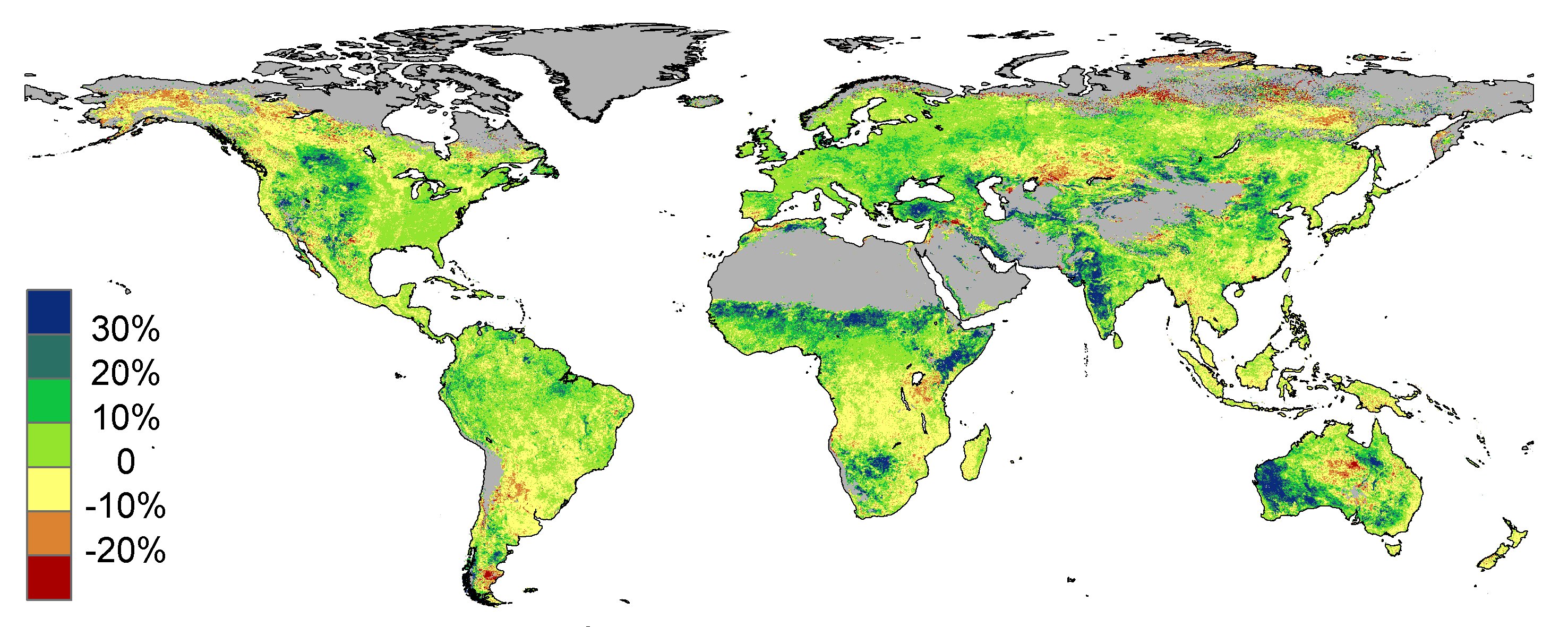
And where people have to lie about severe weather getting worse (it hasn’t)? Or where we have totally forgotten that more CO2 is actually good for life on Earth, leading to increased agricultural productivity, and global greening?:

Estimated changes in vegetative cover due to CO2 fertilization between 1982 and 2010 (Donohue et al., 2013 GRL).

It’s the universe where political power and the desire to redistribute wealth have taken control of the public discourse. It’s a global society where people believe we can replace fossil fuels with unicorn farts and antigravity-based energy.

Feelings now trump facts.

At least engineers have to prove their ideas work. The widgets and cell phonesand cars and jets and bridges they build either work or they don’t.

In climate science, whichever side is favored by politicians and journalism graduates is the side that wins.

And what about those 97% of scientists who agree? Well, what they all agree on is that if their government climate funding goes away, their careers will end.

Faux-Green EPA is Not a Friend of the People….

EPA CO2 rules will make make people poorer — and then kill them

Statistician Stan Young shows how the real costs and imaginary benefits of the EPA CO2 rule are a deadly combination.

Are there mortality co-benefits to the Clean Power Plan? It depends.
S. Stanley Young, genetree@bellsouth.net

Some years ago, I listened to a series of lectures on finance. The professor would ask a rhetorical question, pause to give you some time to think, and then, moreoften than not, answer his question with, “It depends.” Are there mortality co-benefits to the Clean Power Plan? Is mercury coming from power plants leading to deaths? Well, it depends.

So, rhetorically, is an increase in CO2 a bad thing? There is good and bad in everything. Well, for plants an increase in CO2 is a good thing. They grow faster. They convert CO2 into more food and fiber. They give off more oxygen, which is good for humans. Plants appear to be CO2 starved.

It is argued that CO2 is a greenhouse gas and an increase in CO2 will raise temperatures, ice will melt, sea levels will rise, and coastal area will flood, etc. It depends. In theory yes, in reality, maybe. But a lot of other events must be orchestrated simultaneously. Obviously, that senerio depends on other things as, for the last 18 years, CO2 has continued to go up and temperatures have not. So it depends on other factors, solar radiance, water vapor, El Nino, sun spots, cosmic rays, earth presession, etc., just what the professor said.

So suppose ambient temperatures do go up a few degrees. On balance, is that bad for humans? The evidence is overwhelming that warmer is better for humans. One or two examples are instructive. First, Cox et al., (2013) with the title, “Warmer is healthier: Effects on mortality rates of changes in average fine particulate matter (PM2.5) concentrations and temperatures in 100 U.S. cities.” To quote from the aYoung1 Means CIsbstract of that paper, “Increases in average daily temperatures appear to significantly reduce average daily mortality rates, as expected from previous research.” Here is their plot of daily mortality rate versus Max temperature. It is clear that as the maximum temperature in a city goes up, mortality goes down. So if the net effect of increasing CO2 is increasing temperature, there should be a reduction in deaths.

I have a very large California data set. The data covers eight air basins and the years 2000 to 2012. There are over 37,000 exposure days and over two million deaths. The data forYoung2 LA O3 PM DeathLos Angeles for the year 2007 is typical.

The number of Heart or Lung deaths for people 65 and older are given on the left, y-axis. The moving 21-day median number of deaths are given with blue diamonds as time marches to the right. Deaths are high during the winter, when temperatures are lower; the number of deaths are lower during the summer, when the temperatures are higher. These plots are typical. It is known that higher temperatures are associated with lower deaths.

A purported co-benefit of lower CO2 is that there will be lower levels of PM2.5. (PM2.5 is not chemically defined, but is partially made up of combustion products.) It is widely believed that lower levels of PM2.5 will lead to fewer deaths. Here is what Cox et al. (2013) have to say, “Unexpectedly, reductions in PM2.5 do not appear to cause any reductions in mortality rates.” And here is their supporting figure below.

Chay et al. (2003) looked at Young3 Death v PM25a reduction in air pollution due to the Clean Air Act. Counties out of compliance were given stricter air pollution reduction goals. This action by the EPA created a so called natural experiment, Craig et al. (2012). The EPA selected counties did reduce air pollution levels, but there was no reduction in deaths after adjustments for covariates. Chay et al. (2003) say, “We find that regulatory status is associated with large reductions in TSPs pollution but has little association with reductions in either adult or elderly mortality.” So Cox et al. (2013) confirm the finding of Chay et al. (2003) that a reduction in PM2.5 does not lead to a reduction in deaths. Young and Xia (2013) found no assocation of PM2.5 with longevity in western US. Enstrom (2005) and many others have found no association of chronic deaths with PM2.5 in California.

Many claim an assocation of air pollution with deaths, acute and chronic. How can the two sets of claims be understood? Well, it depends. Greven et al. (2011) say in their abstract, “… we derive a Poisson regression model and estimate two regression coefficients: the “global” coefficient that measures the association between national trends in pollution and mortality; and the “local” coefficient, derived from space by time variation, that measures the association between location-specific trends in pollution and mortality adjusted by the national trends. …Results based on the global coefficient indicate a large increase in the national life expectancy for reductions in the yearly national average of PM2.5. However, this coefficient based on national trends in PM2.5 and mortality is likely to be confounded by other variables trending on the national level. Confounding of the local coefficient by unmeasured factors is less likely, although it cannot be ruled out. Based on the local coefficient alone, we are not able to demonstrate any change in life expectancy for a reduction in PM2.5.” (Italics mine) In plain words, associations measured from location to location, which are likely to be affected by differences in covariates, show an association. Examination of trends within locations, which are less likely to be affected by covariates, show no association. In short, the claims made depend on how well covariates are taken into account. When they are taken into account, Chay et al. (2003), Greven et al. (2011), Cox et al. (2013), Young (2014), there is no association of air pollution with deaths. Chay controls for multiple economic factors. Greven controls for location. Cox controls for temperature. Young controls for time and geography.

Note well: The analysis of Young (2014) uses a moving median within a location (air basin). This analysis is much less likely to be affected by covariates. This analysis finds no assocation of air pollution (PM2.5 or ozone) with deaths. Several figures are instructive. The figures are for LA, but are typical for the other California air basins. First ozone:

Young4 Bivariate

The figures were constructed as follows. From the daily death total was subtracted a 21-day moving median. This calculation corrects for the time trend in the data. From the daily air pollution level the 21-day moving median for the air pollution was subtracted. The daily death “deviation” was plotted against the pollution “deviation”. If air pollution was causing deaths, then the density in these three figures should go from lower left to upper right. To examine if previous air pollution, e.g. yesterday or the day before, was associated with current deaths, lags of 0, 1, and 2 days were used, hence the three figures. Plots like these were computed for all eight air basins; the figures for LA are typical. Next we give the same sort of figures, but for PM2.5. Again, LA.

Young5 Bivariate 21

Again, the density is concentrated at zero PM2.5 and zero deaths, and, the important point, there is no tilt of the density from lower left to upper right. And again the plots for LA are typical of the other seven air basins.

Can we say more? Many authors have noted “geographic heterogeneity”, the measured effect of air pollution is not the same in different locations. There is overwhelming evidence for the existence of geographic heterogeneity. See for example, Krewski et al. (2000), Smith et al. (2009), Greven et al. (2011) and Young and Xia (2013). Multiple authors have not found any association of air pollution with acute deaths in California, Krewski et al. (2000), Smith et al. (2009), Young and Xia (2013) and Jarrett et al. (2013). Enstrom (2005) found no association with chronic deaths in California. A careful consideration of of this “geographic heterogeneity” is a key to understanding why it is unlikely that air pollution is causing deaths. Given that geographic heterogeneity exists, how should it be interpreted? First, statistical practice says that if interaction exists, then average effects often are misleading. Any recommendations should be for specific situations. In the words of the finance professor, it depends. In this case it makes no sense to regulate air pollution in California more severely than current regulations.

We can consider the question of interactions of air pollution with geography more deeply. Greven et al. (2011) state in their abstract, “Based on the local coefficient alone, we are not able to demonstrate any change in life expectancy for a reduction in PM2.5.” and they go on to say differences in locations (geographic heterogeneity) is most likely due to differences in covariates, e.g. age distributions, income, smoking. Indeed when Chay et al. (2003) corrected their analysis for an extensive list of covariates, they found no effect of the EPA intervention to reduce air pollution.

There is empirical evidence and a logical case that air pollution is (most likely) not causally related to acute deaths. Heart attacks and stroke were recently removed as a possible etiology, Milojevic et al. (2014).

Economics on the back of an envelope

The EPA claims saving 6,600 deaths per year due to CPP. They value each death at nine million dollars giving a co-benefit of $59.4B. But analysis that takes covariates into consideration finds no excess deaths due to ozone or PM2.5. The $59.4B co-benefit is the result of flawed analysis. And what is the cost of the regulation? The EPA says CPP is the most costly regulation it has considered and puts the cost at up to $90B/yr. The National Manufacturers Association puts the cost at $270B/yr, $900/person/year in 2020.

Consider Figure 4b of Young and Xia (2013). The data used in this figure is that used in Pope, Ezzati, and Dockery (2009) and was kindly provided by Arden Pope III. Change in income and air pollution from ~1980 to ~2000 wasYoung6 LE v incomeused. Income in thousands of dollars increase over that time period, but differed in magnitude from city to city, the x-axis. Life expectancy increased as well, y-axis. The general trend is very clear, increased income is associated with increased life expectancy. The income-life expectancy relationship is well-known. See the dramatic video by Hans Rosling (2010). To the extent that regulations are expensive, they should move people down and left in this figure with life expectancy less than it would have been. For example, $900 less income is expected to reduce life expectancy by two months.

So, do you want the EPA CPP regulations to extend your life not at all, costing you $900/yr or do you want to have use of your own money and save two months of your life? It depends. EPA decides or you decide.

Summary

  1. Increased CO2 is good for plants as plants grow better with increased CO2.
  2. Increases in temperature, however caused, are good for humans as they are less likely to die.
  3. The science literature, when covariates are controlled, is on the side that increased ozone and PM2.5 are not associated with increased deaths.
  4. On balance, the costs of reducing CO2, PM2.5 and ozone are expected to lead to reduced life expectancy.

Big wind Pressing Congress, For More Money! $$$$$$$$ It’s a money-pit!

Via. Greenie Watch    30 November 2014

Big Wind is pressing Congress for yet another bailout

By Mary Kay Barton

Taxpayers beware! While you were sleeping, enjoying your family and eating turkey,

Congress has been busy.

Congressional Republicans are negotiating with Senate Democrats to extend the infamous wind energy Production Tax Credit through to

2017, after which it will supposedly be phased out, just as was supposed to happen in the past. This sneaky, dark-of-night “lame duck”

session tactic should be flatly rejected.

While you’ve been busy just trying to make ends meet, wondering why the cost of everything is going up, and agonizing over how your

children and grandchildren will ever pay the mounting $18 TRILLION dollar national debt – the wind industry lobbyists’ group, the

American Wind Energy Association (AWEA), just sent Congress a letter seeking to extend the federal, taxpayer-funded wind Production Tax

Credit (PTC).

The list of signers to AWEA’s letter include rent-seeking industries and “green” groups who’ve all benefitted by tapping into

taxpayers’ wallets via the Big Wind PTC (aka: Pork-To-Cronies). It certainly isn’t hard to figure out why these corporations pay many

millions of dollars to hire lobbyists and run national TV advertising campaigns geared at convincing crony-politicians to vote to

continue these TAXES and higher energy prices on American citizens.

AWEA’a letter is typical of wind industry propaganda. It makes specious claims about creating jobs and reducing pollution, without

providing a shred of evidence to PROVE any of their claims. AWEA apparently hopes Congressional officials are “too stupid” to

understand what energy-literate citizens nationwide know: Industrial wind can NEVER provide reliable power. It raises electricity

costs, even after subsidies are factored in. It kills more jobs than it creates. It defiles wildlife habitats and kills eagles, hawks,

other birds and bats – with no penalties to Big Wind operators.

Here’s the reality: After 22+ years of picking U.S. taxpayers’ and ratepayers’ pockets, industrial wind has NOT significantly reduced

carbon dioxide emissions. It has not replaced any conventional power plants, anywhere. However, the $Trillions spent on these “green”

boondoggles to date have significantly added to the $18+ TRILLION dollar debt that our children and grandchildren will have to bear.

AWEA’s own statements from years and decades past can be used against them. To cite just one example, 31 years ago, a study coauthored

by the AWEA stated:

The private sector can be expected to develop improved solar and wind technologies which will begin to become competitive and self-

supporting on a national level by the end of the decade if assisted by tax credits and augmented by federally sponsored R&D.

[American Wind Energy Association, et al. Quoted in Renewable Energy Industry, Joint Hearing before the Subcommittees of the Committee

on Energy and Commerce et al., House of Representatives, 98th Cong., 1st sess. Washington, DC: Government Printing Office, 1983, p.

52.]

In other words, the PTC should have ended 20 years ago, because wind energy would be self-sustaining by then. It wasn’t. It still

isn’t. It never will be. We need to pull the PTC plug now!

Here are some details about the bill that is currently being negotiated during the lame duck session –before the newly elected,

Republican majority Senate takes office and can do much about it.

In 2016, wind developers would be eligible for 80% percent of the PTC’s value. They could also claim 60% of its value through the first

nine months of 2017, after which it would supposedly expire.

The proposed congressional deal also seems to continue basing PTC eligibility on when project construction project begins. That opens

huge doors for abuse.

The last time Congress extended the PTC, as part of its “fiscal cliff” deal in 2013, it said “eligibility” for taxpayer largesse

covered projects “under construction,” rather than requiring that they be “placed in service” by a certain date. In practice, this

means just a shovelful of dirt has to be moved by that date.

Remember too that the Production Tax Credit supposedly expired last year. But this clever language has allowed construction and

expansion in the meantime. Meanwhile, Lois Lerner’s Internal Revenue Service has helpfully said projects that were started or “safe-

harbored” prior to the PTC’s most recent pseudo-expiration can claim tax credits if they are in service by 2015. And then they can

claim the $23-per-MWh credit for ten more years!

What a wonderful holiday gift for Big Wind and its political sponsors – at your expense.

Our government should NOT be in the business of picking and choosing the winners and losers in the energy marketplace – while

assaulting and harming the very citizens they are forcing to pay for this “green” energy scam. It’s time for government to get out of

the way and let the markets work!

The best solutions will rise to the top of their own accord because they will provide modern power at the best prices – thereby

maintaining the reliable, affordable power that has made America great.

Citizens nation-wide have awakened to this massive “green” energy scam. Many have sent letters to Congress like the one below. You can

join the fight by contacting your representatives and urging them to do the right thing: Protect American consumers, taxpayers and

ratepayers. END Wind Welfare (#EndWindWelfare)!

Data Tampering the Cause of Much Global Warming…

The End Game In US Data Tampering

A lack of transparency is a huge political advantage

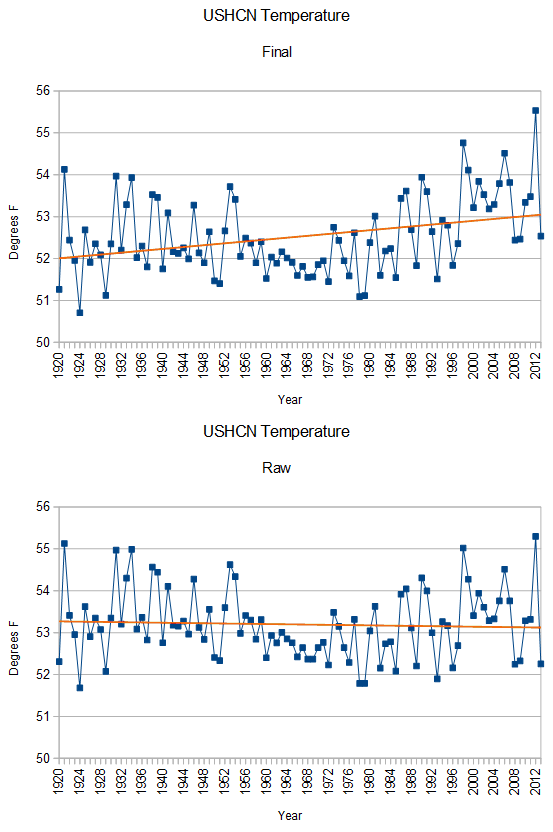
The animation below flashes between raw (measured) US thermometer data, and the final version which is reported to the public. The thermometers show no warming over the past 95 years – all of the reported warming is Mann-made by government employeestampering with data.

USHCNRawVFinal

A big part of this data tampering is implemented by making up monthly temperatures at stations where USHCN says they have no thermometer data. The amount of fabricated data is increasing exponentially, and at current rates of fabrication 100% of the data will be fake by the year 2035 – i.e. there will be no actual thermometer data used after that date. NCDC says that their software which does this, is working “as expected.”

ScreenHunter_4791 Nov. 25 09.21

The next graph shows the total adjustments NCDC are making to the US temperature record. They knock about one degree off of older temperatures, and add a few tenths of a degree on to recent temperatures. Extrapolating out to the year 2035 when 100% of reported temperatures will be fake, the total upwards adjustment will be about one degree, making for a total adjustment of about two degrees.

ScreenHunter_4802 Nov. 25 09.49

The global warming agenda depends on a belief that temperatures are warming, so the fake graphs and press releases released by government agencies about warming and “record temperatures” are critical for perpetuating the big lie about climate.

Insane Windpushers Causing Energy Poverty – People Freezing!

UK’s Out of Control Wind Power Debacle Sets Brits up for Winters of Discontent

cold lady

Homeowners face £1,000 increase in electricity bills: ‘Folly’ of relying on wind power ‘will cost homes £26bn by 2030’
The Daily Mail
Corey Charlton
15 October 2014

  • Wind farm reliance could see costly electricity bills and winterpower cuts
  • Experts claim it will lead to costs being passed on to consumers
  • Next winter’s electricity production margins are at an ‘all time low’

Homeowners are facing electricity bill increases of £1,000 and winter power cuts if the Government continues to rely on wind farms, experts warn.

A new report claims that if the Government continues to chase renewable wind power, the average household bill will soar by £1,000, costing homes £26billion by 2030.

The report, submitted to the Lords Science and Technology Select Committee, was authored by the Scientific Alliance.

By 2030, it projected the costs of meeting future energy demands using wind farms would be £26billion per year, which was a 53 per cent increase in the average consumer’s power bill.

Further to this would be increased costs coming from the industry and carbon taxes, which in total would add almost £1,000 onto the average consumer’s bill, the Daily Express reported.

The Scientific Alliance said the Government’s aims to have 35 per cent of electrical energy generated from renewable sources by 2020 will ‘not be achieved in their entirety’.

Sir Donald Miller, the former chairman of Scottish Power, said: ‘The blind reliance by successive governments on unreliable, intermittent renewable energy has reduced the margin of safety to a critical level,’ the paper reported.

‘This has brought the country to a position where power cuts could become a regular feature of cold winters for several years.’

The report, of which Sir Miller was a contributor, stated the electricity production margin for winter next winter was at an ‘all time low’ of 2 per cent.

‘It has been reported that National Grid are taking emergency measures to increase these margins by contracting with owners of small private standby generators for emergency supplies.

‘It is not known to what extent this will be helpful, but the costs per KWhr are likely to be high.’

By 2020, the supply margins will remain at a ‘critical’ level due to the planned withdrawal of conventional power generators over the next two years and the inadequate replacement of these with wind farms.

‘It should be remembered that these margins are against the background of no growth in demand and, even so, are likely to result in extended periods of loss of supply over periods of high winter demand.’

The crisis facing Britain regarding lack and surety of power supply was also acknowledged by the chair of the committee, Earl of Selborne.

In launching the inquiry, he said: ‘An investigation into the resilience of the UK’s electricity infrastructure is a timely one, given that we are set to see our safety cushion between demand and supply drop to particularly low levels over the next two winters.’
The Daily Mail

ed davey DECC

And here’s another take on Britain’s out of control wind power debacle from the Daily Express.

UK’s wind farm ‘folly’: Electric bills to soar by £1000 thanks to reliance on wind power
The Daily Express
John Ingham
15 October 2014

HOUSEHOLDERS are facing soaring energy bills and winter power cuts thanks to the “folly” of relying on wind power, experts said last night.

The green crusade of successive governments is set to double electricity bills for households and cost homes £26billion a year by 2030, it was claimed yesterday.

The cost of renewable energy and carbon taxes will put an extra £983 a year on household bills by then, compared to relying on a mix of nuclear and new gas-fired power stations, three experts told a Lords committee.

They also said the “foolhardy” green policy will do little to cut emissions of the greenhouse gases blamed for global warming.

The Scientific Alliance report highlights warnings by the regulator Ofgem that the margin for electricity production for the 2015-16 winter will be at an all-time low of 2 per cent compared to the pre-privatisation requirement of at least 20 per cent.

It means that in times of high demand, such as during very cold weather, Britain would be at risk of power cuts.

The alliance argues that wind power – which is the main renewable energy source depended on by Government – is unreliable.

One of the experts, Sir Donald Miller, former chairman of Scottish Power, said: “The blind reliance by successive governments on unreliable, intermittent renewable energy has reduced the margin of safety to a critical level.

“This has brought the country to a position where power cuts could become a regular feature of cold winters for several years.”

The written report has been submitted to the Lords Science and Technology Committee’s inquiry into the nation’s electricity infrastructure.

At the inquiry’s launch its chairman, the Earl of Selborne, said: “We are set to see our safety cushion between demand and supply drop to particularly low levels over the next two winters.”

And yesterday’s report stated: “The foolhardy policy of replacing reliable and efficient gas, nuclear and coal power stations by expensive and inefficient wind turbines and solar farms has raised energy prices while doing little to cut emissions of carbon dioxide.

“The total costs are some £12billion per year more in 2020 than an optimum programme of gas turbines and nuclear, and almost £26billion per year more by 2030.”

The alliance calls for new nuclear power plants to help plug shortfalls caused by the closure of ageing coal-fuelled power stations and rising demand.
The Daily Mail

hell-freezing-over1

No More Free Ride for Windweasels in the US!

Republican Mid-Term Victory Spells Doom for US Wind Industry

wind_turbine_fire

The US has just been through its mid-term elections, which saw sweeping gains by the Republican Party in the Senate, House, and in many gubernatorial elections, as well as state and local races.

The Republicans gained control of the Senate for the first time since 2006, and increased their majority in the House. The Republicans also gained several seats in governors’ races, defeating one incumbent Democrat and picking up three seats vacated by retiring Democrats. Counting continues with the Republicans set to pick up a number of seats in the House, and, possibly the Senate.

With Republicans firmly in control of Congress, the smooth subsidy-sailing enjoyed by the US wind industry (until now) is about to hit stormy waters.

John Boener, Mitch McConnell

Those US States that piled into wind power in a big way have seen power prices rocket, with some seeing increases of over 34% (Idaho). From 2008-2103, the top 10 wind power states saw their electricity prices rise an average of 20.7%, which is seven-fold higher than the national electricity price increase of merely 2.8% over the same period (see our post here). The cost of wind power is so uncompetitive that Nebraska has just knocked-back a long-term wind power deal because it was “just too expensive” (see our post here).

The adverse economic impacts of propping up the wind industry with exorbitant fixed priced State Feed-In-Tariffs and the Federal Production Tax Credit aren’t lost on Republicans. Here’s a wrap up on where America’s wind industry is headed.

It May be Lights Out for the Wind Industry Come the Midterms
FOXBusiness
Chris Versace
27 October 2014

The International Energy Agency recently cut its forecasts for oil demand growth for this year. Nevertheless, production in North America is exploding led by the shale oil boom. Already, the U.S. has become the world’s largest producer of oil and natural gas.

For energy products like oil and natural gas operating in the marketplace, this excess production means lower costs for consumers. Lower prices have their own consequences for the industry as well. Analysts at Sanford C. Bernstein & Co recently released a report revealing that current at prices as much as one-third of U.S. shale oil production will be “uneconomic” to harvest.

For government-backed industries such as wind energy, the relationship is directly the opposite – the more they produce, the more it costs ratepayers and taxpayers. Recent analysis shows that states with the largest use of wind power have the highest electricity bills. Such factors have caused private investors to largely bypass wind companies and leave them largely dependent upon the government for their survival.

Wind energy companies rely heavily upon a government construct known as the “Production Tax Credit” (PTC) to support their bottom lines. The PTC is a federal program that provides billions of dollars annually to subsidize renewable energy facilities such as wind farms. Generally speaking a clean technology facility receives a tax credit for 10 years after the date the facility is placed in service with the tax credit amount ranging from $0.23 per kilowatt-hour (kWh) for wind to $0.011 per kWh for qualified hydroelectric.

Looking at the International Journal of Sustainable Manufacturing, researchers concluded that “in terms of cumulative energy payback, or the time to produce the amount of energy required of production and installation, a wind turbine with a working life of 20 years will offer a net benefit within five to eight months of being brought online.” This raises the question as to why any tax credit for wind energy would span more than just a few years at most let alone 10 years after the facility is up and running.

Congressional support for the PTC is largely split along party lines. Fifty-five Members of the House led by Rep. Mike Pompeo, (R-Kan.), have written a letter to the tax writing committee demanding an end to the wind energy subsidies. The letter stated:

We offer our full support of the current process undertaken by the House Committee on Ways and Means that will allow the most anti-competitive and economically harmful tax provisions, specifically the wind energy production tax credit (PTC), to expire. Ensuring that our nation’s patchwork tax code undergoes significant reform is a noble goal and, as part of this process, we believe Congress should stop picking winners and losers and finally end the wind PTC.”

It is presumed that a GOP controlled Congress would see the PTC on the chopping block in 2015 and a Democrat-controlled Congress will fight for renewal.

It would be an understatement to say that the outcome of the 2014 elections is important for wind energy producers. In an effort to see PTC friendly Harry Reid as Majority Leader, the wind industry has essentially turned the League of Conservation Voters (LCV) into their own personal Trojan horse.

Much of the LCV leadership has deep ties to the wind energy:

  • Tom Kiernan, CEO of the American Wind Energy Association (AWEA) serves as the Treasure of the LCV.
  • Peter Mandelstam, former AWEA board member and founder of Green Sails wind energy company also serves on the LCV board.

Unsurprisingly, much of the LCV’s campaign activities have been aimed squarely at renewal of the PTC. The organization brags that it will spend over $25 million supporting pro PTC candidates and attacking their opponents before November elections.

Should LCV’s campaign fail, loss of the PTC could prove fatal to some wind companies. As Warren Buffet recently told his loyal investors, “I will do anything that is basically covered by the law to reduce Berkshire’s tax rate. For example, on wind energy, we get a tax credit if we build a lot of wind farms. That’s the only reason to build them. They don’t make sense without the tax credit.”

The outcome of the elections remain far from certain as does the fate of the PTC under any election outcome scenario and Washington D.C.’s capacity for cronyism should never be underestimated.

That said, it should leave investors holding off if not second-guessing the potential of First Trust ISE Global Wind Energy ETF (FAN) shares or its holdings that include Capstone Turbine Holdings (CPST), Otter Tail Corp. (OTTR), NextEra Energy (NEE) and others. Especially if the Republicans take control of Congress as expected, and run a full tally of their friends and enemies during this election cycle, it may well be lights out for the wind energy industry sooner than anyone expects.
FOXBusiness

storm tossed ship

Great Election! Republicans Are More Likely to Be Co-operative With Canada!

Lawrence Solomon: Democrats’ loss is Canada’s gain

(November 6, 2014) It’s too late now for Obama and the Democrats to impose policies harmful to Canada.

This article, by Lawrence Solomon, first appeared in the National Post on November 6, 2014

Democrats lost big in the U.S. mid-term elections this week. Republicans won big. And Canada also won big, as in big sigh of relief. Canada is a winner less because of what Republicans will now do than because of what a president in search of a legacy-with-the-left can’t do.

Number One on the Obama Can’t-Do list involves carbon taxes or other global warming measures that could set back Canada’s economy. In a far-sighted move the day after Obama won the presidency six years ago, a prescient Prime Minister Harper tied Canada’s global warming policies to those of the United States. This stratagem — justified by the need to harmonize policies with our largest trading partner — extricated Canada from economically harmful pledges to cut back on our own emissions, unburdening our economy and helping us storm past the 2008 financial crisis better than any other G8 country.

Harper — thought to be a closet climate skeptic — took a calculated risk that paid off in spades. The Obama administration failed to pass global warming legislation while it controlled Congress and by 2010, when the Democrats lost the House of Representatives, it was too late — climate skeptic Republicans wouldn’t saddle America, and by extension, Canada, with global warming legislation. Now it is also too late for Obama to otherwise bind Canada. Though Obama may follow through on threats to act on climate change through regulatory decrees, these would be temporary scattershots from a diminished lame duck that Canada could slough off. Canada has dodged the climate change bullet.

Number Two on the Obama Can’t-Do List is trade protectionism, a favourite among many Democrats including Obama, who first won election on a pledge to reopen NAFTA on environmental and labour grounds. Various “Buy American” trade bills recently introduced in Congress, such as the “Made in the U.S.A. Act” sponsored by Democratic Senator Mark Pryor of Arkansas, are now dead. Pryor is among the Democrats that voters just tossed out of Washington.

Number Three: Canada can also breathe a big sigh of relief that free spending Democrats are now reined in. Obama’s exploding of the national debt — by the time he’s done, it may have doubled to $20-trillion — has destabilized Western economies, making everyone fearful of inflation and curbing the private sector investment needed for economic growth. Republicans not only took the Senate, they so bolstered their majority in the House of Representatives, where spending bills originate, that Democrats have likely lost the ability to spend federal dollars for decades to come — gerrymandered House districts make it difficult for incumbents to lose.

More welcome sighs come in at the state level, where the mid-term elections toppled several governors in traditionally Democratic states. Restraint-minded Republican governors are now in charge in more than 30 states, good augers for pro-growth policies in our largest trading partner.

Canada could benefit from more than relief from Democratic harms. Republicans are likely to pursue policies that would positively help our economy, most notably by passing legislation that would force Obama to accept, or veto, the Keystone XL Pipeline, a project that has been under review longer than the Second World War.

Pundits are betting that Obama will finally approve Keystone, both to chalk up an accomplishment for what is now an almost non-existent legacy and to please the unions, the many Democrats and the general public that favour it. To give Obama a fig leaf, the pundits expect Harper to throw in a concession on climate change.

But the pundits could be wrong. Obama has betrayed most of his constituents through broken promises — unions for his failure to deliver jobs and, ironically, because Obamacare is destroying the 40-hour work week; youth for the NSA spying on them; Latinos on his failure to implement immigration reform; peaceniks for his drone attacks and America’s reentry into Iraq. Approving Keystone would add to this string the one cause he has served passably well — environmentalism, whose backers include the Hollywood crowd that mostly remains in his thrall. His legacy with those who count to him could only be kept by chucking Keystone.

But even chucking Keystone could now be too late for Obama. He has become such a liability to his party that few Democratic politicians have a strong allegiance to him and many would fear losing their seats in the next election if they were seen to side with him. If Obama vetoed a bill to proceed with Keystone, the two-thirds majority required to override his veto might materialize.

Lawrence Solomon is the executive director of Energy Probe.

Wonderful News! Powerful (Faux) Green Lobby defeated in US Mid-term Elections!

The day ‘climate change’ became irrelevant in politics – Powerful Green Lobby Defeated In US Midterm Elections

Republicans Win Control Of US Senate

For Tom Steyer and other environmentalists, $85 million wasn’t enough to help Democrats keep the Senate blue or win more than a single governor’s mansion in Tuesday’s toughest races. The billionaire’s super PAC and other green groups saw the vast majority of their favored candidates in the battleground states go down to defeat, despite spending an unprecedented amount of money to help climate-friendly Democrats in the midterm elections. The outcome brought gloating from Republicans and fossil-fuel supporters even before the results rolled in — and raised questions about whether greens can fulfill their pledge to make climate change a decisive campaign issue in 2016. –Andrew Restuccia, Politico, 5 November 2015

Climate Change: This was one of the dogs that didn’t bark in the 2014 election, even after liberal billionaire Tom Steyer spent an estimated $70 million to promote the issue and a new U.N. report Sunday warned of “severe, pervasive, and irreversible” global warming that will worsen without environmental policy changes. Robert Brulle, professor of sociology and environmental science at Drexel University, said a GOP-led Congress is more likely to try to stop Obama’s Environmental Protection Agency from imposing new regulations on power plants than endorsing any additional steps to reduce U.S. carbon pollution. Said Brulle: “I am not an optimist about us doing anything – I think it looks bad for political action on climate change in any way.” –Will Bunsch, Philadelphia Daily News, 5 November 2014

The $12 million that the United States Senate has allocated to UN climate agencies is expected to be among the first casualties [after] Republican take control of the chamber following Tuesday’s midterm elections. The current Senate bill on funding for state and foreign operations includes $11,700,000 for the Intergovernmental Panel on Climate Control (IPCC) and the UN Framework Convention on Climate Change (UNFCC). However, the House version of the bill passed by a Republican-controlled sub-committee, states that “none of the funds in this Act may be made available for the Intergovernmental Panel on Climate Change/United Nations Framework Convention on Climate Change.” –Denis Fitzgerald, UN Tribune, 4 November 2014

The Keystone XL pipeline won big Tuesday night. Following an election night that saw anti-Keystone Democrats replaced by pro-Keystone Republicans, the oil-sands pipeline project now appears to have at least 60 supporting votes. That means legislation forcing approval of the long-delayed project may be headed to President Obama. Before the election, at least 57 senators could be counted on to support pro-Keystone legislation, but that was never enough to beat a filibuster from the project’s opponents. Tuesday night’s results appear to change that. –Clare Foran, National Journal, 5 November 2014

The expected Republican majority in the U.S. Senate after Tuesday’s mid-term elections is likely to seek to roll back federal regulations on power-plant emissions, approve the Keystone XL pipeline, expand oil and gas development on federal lands and work toward ending the 40-year ban on U.S. crude oil exports, energy experts said. “The Republicans will go to Obama and say, look, ‘We’ve got to get this done; your own government is saying this is fine. The election is over so you don’t have to worry,’” Lynch said. –Jon Hurdle, The Street, 4 November 2014

President Obama will continue to take action on policies to fight climate change whether or not Republicans take control of the Senate, the White House said. White House press secretary Josh Earnest told reporters Tuesday that Obama plans to keep using his executive powers to mitigate greenhouse gas emissions that cause climate change. “The president will use his executive action to take some additional steps.” –Timothy Cama,The Hill, 4 November 2014

soon-politicians-wont-be-able-to-avoid-the-issue

Thanks to Dr. Benny Peiser and The GWPF for this summary

Nuclear…..Reliable, Efficient, and our Best Option for Green Energy!

Psst, Wanna “Save” the Planet? Then it’s Time to Go Nuclear

nuclear-power-a

The nuclear option must be high on agenda of energy green paper
The Australian
Gary Johns
4 November 2014

THE Abbott government is finalising an energy green paper (not to be confused with a green energy paper). Submissions are due today. Every group is in there pitching, including nuclear engineers.

China has under construction, planned or proposed 207 new nuclear reactors, tripling nuclear capacity by 2020. Our little green friends love to tout China as huge in windmills and solar panels, but China is really powered by coal, hydro and nuclear power. Stick that in your windmill and twist it!

Australia has an overcapacity in electricity generation, which is not forecast to disappear until 2023-24. Unless we cut the renewable energy target, it will force expensive renewables into an oversupplied market and strand existing assets.

Following the abolition of the carbon tax and touted adjustments to the RET, it should be clear there is no certainty in government support for future generators that are reliant on subsidies.

In this context, small modular nuclear reactors, which can deliver up to 100 megawatts base load, low-emission power, are ready now. They are most likely to be deployed in remote areas where other sources of power are expensive or where steam is required in addition to electricity.

If SMRs can make it in this market, without the level of subsidies that applies to renewables, then good luck to them. Last year, the Bureau of Resources and Energy Economics found that, across the projection period to 2050, nuclear would remain cost-competitive with renewable and non-renewable technologies on a level cost of electricity generated basis (capacity of a plant divided by its energy output and cost).

A recent paper by Charles Frank of the Brookings Institution uses a methodology based on avoided emissions and avoided costs, rather than comparing levelised costs. The key finding was that nuclear, hydro and combined cycle natural gas have far greater net benefits than wind and solar, which suffer from a very high-capacity cost per megawatt, very low-capacity factors and low reliability, resulting in low avoided emissions and low avoided energy cost per dollar invested. Avoided emission calculations may become less relevant, however, as political support for climate abatement strategies wane.

The main safety concern regarding nuclear power is the possibility of an uncontrolled release of radioactive material, leading to contamination and radiation exposure off-site. In fact, the Three Mile Island (1979) and Chernobyl (1986) “disasters” were not only less disastrous than imagined, but comparing these reactors to current models is to compare the Model T to any recent car. Even the reactors involved in the Fukushima (2011) disaster were 1960s design and no one died from nuclear exposure at Fukushima.

Advanced reactors are inherently safer. Generation IV full-scale reactors, and SMRs under development, incorporate passive safety features that require no active controls or operational intervention to avoid accidents in the event of malfunction.

The major impediments to building SMRs in Australia are not safety or science, environment or economics but the law.

The Environment Protection and Biodiversity Conservation Act 1999, for example, states that the minister must not approve the construction or operation of a nuclear power plant. Such prohibition is unwarranted.

In its green paper, the Abbott government has promised to “review the current regulatory framework that governs nuclear and waste facilities to remove any duplication and streamline regulations”. This is not good enough. The ban on nuclear power must be lifted. These laws are based on old politics and old science. It is time that prohibition was repealed so all sources of power are on the table and assessed according to commercial and environmental risks.

Nuclear politics is hard. The commonwealth has still not secured a site for Australia’s low-level radioactive waste, following the failure to secure Muckaty Station, north of Alice Springs.

Nevertheless, community attitudes are changing to one aspect of the nuclear cycle, the export of uranium. In 2012, the Queensland government repealed a ban on uranium mining and the NSW government repealed a ban on uranium exploration. In South Australia — the main source of uranium exports — 48 per cent of the community support nuclear power while 33 per cent oppose it.

The white paper on energy should be neutral; any source of energy should be allowed to compete in the marketplace on its merits. Nuclear should be subject to the same stringent regulations as apply to coal and gas — no more, no less.
The Australian

For more detail on Charles Frank’s study on how nuclear power wins by a mile on CO2 abatement costs see our post here.

Let’s assume (as STT does, for the sake of argument) that the global warming/climate change Chicken Littles are right: the sky really is falling and it’s all CO2’s fault.

So what the HELL are we doing pouring hundreds of billions of dollars into subsidies for wind power? (see our posts here and here)

STT has always thought that if man-made CO2 emissions really were destroying the planet, then sensible governments would have moved to build nuclear power plants from the moment the Chicken Littles started wailing about the heavens collapsing.

The French generate over 75% of their sparks using nukes – and have used nuclear power – without any serious incident – for over 50 years: the first plant kicked off in 1962.

Nuclear power is the only stand-alone thermal power source that is base-load and which does not emit CO2 emissions when generating power.

It’s true that geothermal falls into the same category, but away from volcanic zones (think New Zealand and Iceland) depends on accessing “hot-rocks” deep underground – which tends to limit its scope for operation. Although STT thinks – as a “base-load” generator – it’s a source worth pursuing, with more funds directed at research and development (see our post here and this article).

STT readers know that we are a big fan of hydro power, the development of which stalled after the Greens “No Dams” mantra shot them to political power (and see our post here).  The perversities of our renewable energy legislation mean that the cleanest and most reliable source of renewable energy – hydro – does not benefit from the incentives given to ludicrously expensive and completely unreliable wind power.  That’s right, the “Waterboys” don’t get RECs (only hydro generating capacity built after 1998 is eligible – the 99% of total hydro capacity that was built before then gets nothing).

Although, as STT has predicted, the “old” hydro-snub may not last for much longer (see our post here).

Recent comments by PUP leader, Clive Palmer on ABC’s Lateline have sent the wind industry into a tail-spin. Big Clive (following the lead from Tasmania’s PUP Senator, Jacqui Lambie) made it plain that the PUP wants to include “old” hydro’s massive contribution to renewable energy generation (around 16,000 GWh annually) in the calculations that go to satisfying the annual targets set by the Large-Scale RET – that escalates to 41,000 GWh from 2020 through to 2031. This is what’s got the wind industry in a flap:

CLIVE PALMER: Well, why don’t you listen to what Clive Palmer says, Tony? I’m on the program, you’re interviewing me. If you want to interview Jacqui Lambie, invite her on. But I’m just telling you that electricity in Tasmania is generated by hydro. Hydro is clean energy. There’s an anomaly in the bill that doesn’t recognise that. So we think – same with the Snowy Mountain Scheme, if you’ve got hydroelectricity, it’s clean energy, it’s something that shouldn’t be categorised the same as you would a coal-fired power station, for example. But on the current legislation, that’s how they deal with it. That’s an anomaly which is not in the country’s interest and we think it should be rectified.

snowy hydro

There is huge potential for further investment in hydro power in Australia (upgrades of existing plants and new schemes) – all up and down the Great Divide: bringing with it the ability to harvest huge volumes of water in times of flood; and to beneficially manage that water during periods of drought. However, the perverse nature of the mandatory RET provides every advantage to unreliable and costly wind power at the expense of hydro power: the former takes a matter of months to construct and begin earning revenue (ie RECs); whereas the latter takes years and sometimes decades to complete and for investors to start earning a return (see this video). Investors looking for a quick return on their cash have simply plumped for the soft option and piled in to wind power, with disastrous results on every level (see our post here).

The nuclear power debate has revved up in recent times, with numerous leaders of green groups coming out in favour of nukes as the only sensible answer to generating CO2 free sparks.  These boys have been rounded on by their own kind as “heretics” in a style more befitting of the Spanish Inquisition.

The nuke debate is one that STT will leave to others (see our post here). But if the ever-more hysterical Chicken Littles are to retain any vestige of credibility, it’s high time they got serious about tackling the CO2 emissions they claim to dread so much – starting with a grown-up discussion about the merits of nuclear power.

chicken-little-poster