Another Expose` on the Corrupt Wind Industry, and Their Government Enablers!

‘Follow the Money’: Hard-Hitting Danish Drama Documents Wind Industry Corruption, Australian Sequel Promised

follow the money

STT has just gorged on two episodes of what is presented as well crafted drama, but which to STT followers will play out like a hard-hitting documentary.

Australia’s SBS started screening ‘Follow the Money’ a couple of weeks ago, the plot-line for Episode 1 is described as follows:

Mads, a police detective, is called out to investigate a body washed ashore near a wind farm. At first, it merely looks like an industrial accident, but the case implicates the upper echelons of Energreen – one of Denmark’s most successful and leading energy companies. The CEO is charismatic Sander, and a young lawyer, Claudia, is working hard to advance in the company. Nicky, a former car thief and mechanic, has put his life of crime behind him for his girlfriend’s sake, but his new colleague Bimse tempts Nicky with a chance to make a quick buck.

From the creators of Borgen, Follow the Money is as slick as any of the recent crop of Nordic Noir crime dramas.  While the wind-cult Weekly,The Guardian gave it a critical pasting when the BBC aired it in Britain back in March (probably something to do with it being just a tad inconsistent with green-left groupthink) –  STT gives it five stars.

Indeed, Follow the Money comes with an STT consumer warning: “this TV series is more addictive than crack cocaine”.

For our Australian followers, Follow the Money screens on Thursday nights at 9:30pm.  For our many international followers, the series is available at SBS On Demand, which will also allow our local followers to catch up on the first two episodes: for episode one click here and episode two here. You can view it on a PC, Smart TV or iPad etc.

The site adds a new episode after it goes to air, so return to SBS On Demand to Follow the Money. For a taste, here’s the trailer:

****

****

Without giving too much away, the company at the centre of the story, Energreen, is filled with cocksure and arrogant types, of the kind that you might find swanning around with wind power outfits like, Infigen andPacific Hydro.

follow the money peter

Keep an eye out for one character who STT is certain was modelled on Vesta’s Australian pinup boy, Ken McAlpine (the physical resemblance to Ken is good, but the character’s similarly channelled arrogance and narcissism is uncanny).

The lone wolf detective, Mads finds roadblocks being thrown up at every turn by his superior officers, which smack of wind industry corruption and interference.

Of course Denmark, the birthplace of Vestas, is no stranger to wind industry sleaze, corruption and fraud.

Vestas and its slick financial dealings have, no doubt, provided Follow the Money’s scriptwriters with plenty of material to work with.

The plot-line reads a whole lot like the trouble that Vesta’s Chief Financial Officer, Henrik Nørremark and a band of its executives found themselves in back in 2013, having engaged in a run of fraudulent transactions that cost the company around 140 million kroner.

Just like Follow the Money, the boys from Vestas found themselves under police scrutiny; and, thereafter, the company did everything it could to quarantine itself from a PR nightmare – cutting the former corporate heroes loose and leaving them for dead (see our post here).

Now, turning closer to home let’s take a sneak peek at Australia’s own Follow the Money documentary sequel.

The Pilot for the Series kicks off in Australia’s Federal Parliament during Senate Estimates held on 5 May 2016 (the last session of play before Parliament was dissolved ready for an election in July).

Chris Back

****

WA Liberal Senator, Chris Back starts off with a little probing of the Clean Energy Regulator, Chloe Munro (keep a lookout for her doppelgänger in the Danish version of Follow the Money) on the topic of around $100 million worth of Renewable Energy Certificates pocketed by Babcock and Brown (aka Infigen or Energreen), which were paid out based on a signature that the CER has, despite some effort, been unable to verify. Here’s the Script for ‘Follow the Money, Downunder’, Scene 1 (taken from Hansard):

Senator BACK: Thanks Ms Munro and thank you for the information before lunch, it was very interesting. Again, I appreciate you correcting the answer—217, I think it was. At the end of stage 1 of your explanation you mentioned that on July 7 2004 Babcock and Brown lodged a new application for registry to accredit a power station showing Lake Bonney Wind Farm Pty Ltd as the applicant.

What concerned me, and I am asking for your response, is that you said it is not clear who signed the declaration on behalf of the company on that form; the signature is illegible. That is of enormous concern to me. The CER would have issued certificates to that organisation since then, probably of values—of what?—of $100 million?

Ms C Munro: I could not estimate that on the run.

Senator BACK: My guestimate is somewhere between $70 million and $160 million, based on a document the signature on which was not able to be verified. What action can be taken?

Ms C Munro: Perhaps to set your mind at rest with respect to that: first of all we were retrieving records from our predecessor organisation, the Office of the Renewable Energy Regulator, so I cannot speak about the precise processes they would have followed at the time. But I think they would have been in a position to verify that the signature was the signature of somebody they had probably been dealing with, because usually there is an exchange of correspondence and so on before the actual accreditation. I think the fact that at this stage we cannot make out the signature does not mean to say that it was unknown to them.

To be honest, my own signature, on its own, is not always decipherable. What I think was missing was that the block where the person’s name was written separately had not been filled in. But taken with the other information that would have been there at the time, I do not think it suggests an impropriety in that regard.

Going to the question that you asked before, the point is that the legal person is the ‘entity’. This person is an authorised officer. Clearly, it is important to verify that the signature is from the authorised officer. But at this stage I do not think that we have any reason to believe there was a problem in that regard.

Senator BACK: Sure. Can I have an assurance then that as a result of the Renewable Energy Regulations regulation 3L coming into effect in December 2012 that an omission of that nature would not be repeated?

Ms C Munro: No. I think that generally we have tightened up a lot of our standing operating procedures. I think that in terms of verifying who signatories are and that the authorised officers are the appropriate people across all our schemes, we probably have some more consistent processes there.

Senator BACK: Thank you. I will just go back to question 222 from the previous estimates. I asked you about the membership of the Clean Energy Council. Are you able to give the committee an assurance—if not now, then take it on notice—that members of the board, when there has been a matter involving an organisation with which they have an association, have in fact excluded themselves from any decisions regarding that particular entity? I would imagine that, with good governance, the board minutes would indicate that a person has excluded themselves from the debate.

Ms C Munro: I cannot give you that assurance on behalf of the Clean Energy Council, although I absolutely agree with you that that is normal governance. What I can say for background is: the Clean Energy Council board is a representative body, as many industry associations are, and board members are drawn from amongst participants in the industry. The chair revolves fairly frequently. Until recently it was Michael Fraser, who was the predecessor of the current chief executive of AGL, for example.

But I think, more significantly, the co-regulation takes place between ourselves and the Clean Energy Council is on matters that relate to the small-scale scheme—things like accreditation of installers, listing of components like panels and so on. So, those matters I think, generally, would not be decided by the council; they would be decided at the executive level. The council members are more likely to be participants in the large-scale renewable energy targets, in which the Clean Energy Council does not have a regulatory role. That is a long way of saying: I cannot advise you on how the Clean Energy Council conducts its meetings, because we are not a member of it. I think it is unlikely that there are occasions in its deliberations for the kind of conflicts that you might be apprehensive about.
Hansard 5.5.16

Hmmm… a former wind industry exec turned government bureaucrat, brushing aside obvious conflicts of interests, deflecting enquiries about fictitious applicants for hundreds of $millions in REC Tax/Subsidy, paid to a wind power outfit that disintegrated in a $10 billion insolvency in 2009 and Phoenixed as Infigen, starts to sound very Danish Noir.

But the drama didn’t end there.

STT champion, John Madigan followed up on the story we covered back in September last year (see our posts here and here) about Pacific Hydro and Acciona presenting fabricated wind farm noise reports (claiming compliance at non-compliant wind farms – Waubra and Cape Bridgewater), allowing them to continue pocketing hundreds of $millions in RECs.

The CER is well aware that both outfits have been relying upon ‘made-to-measure’ noise reports from Marshall Day, but have steadfastly refused the act or investigate.

Now, in classic Follow the Money style, it appears that the Australian Federal Police are hot on the trail of Chloe and her gang.

sen john madigan close

****

Senator MADIGAN: Thank you, Chair. Last year, Ms Munro, I met with the Prime Minister and the Attorney-General to alert them to my concerns surrounding false wind farm noise reporting. As a result of that meeting I was led to believe that the Attorney-General had referred these allegations to the Australian Federal Police for formal investigation. Are you able to confirm whether the AFP has held any discussions with anyone from the office of the Clean Energy Regulator in relation to the CER-accredited Cape Bridgewater and/or Waubra wind farms?

Ms C Munro: Yes, Senator, I am able to confirm that. We were approached in February by the Australian Federal Police, who were making initial inquiries relating to the matters that you put.

They had a meeting with members of my staff in order to understand the way that our schemes worked and how those entities would be accredited.

Following that, and on our advice, they made an information request. I authorised the disclosure of information relating specifically to Cape Bridgewater, and that was done. We have not heard anything further from them, so I am not aware whether they proceeded to a formal investigation—this was their preliminary information gathering. We have had no further contact from them since then.

Senator MADIGAN: Thank you, Ms Munro.

Stay tuned for Episode Two: ‘Feds Skewer CER’

chloe munro

Wind Energy…..VERY Little Bang, for your Buck!

The Colossal Cost of Intermittent & Unreliable Wind Power

yacht

****

There are 3 electricity essentials – that the power source and its delivery to homes and businesses be: 1) reliable; 2) secure; and 3) affordable. Which means that wind power – a wholly weather dependent power source, that can’t be stored and costs 3-4 times the cost of conventional power – scores NIL on all three counts.

Here is a brilliant analysis of just why wind power cannot be (and will never amount to) a meaningful power generation source.

Renewable Energy: The Question Of Capacity
Principia Scientific
Ed Hoskins
5 April 2016

Introduction
This article is concerned with the two main forms of weather dependent Renewable Energy, Wind Power (Onshore and Offshore) and Photovoltaic solar power.  In the UK this amounts to ~75% of all installed Renewable Energy.  The other renewable energy  inputs are traditional Hydro power ~8% and the remainder are other sources such as biomass, waste and landfill gas amounting to ~17%.

Capacity1

The capacity percentage of any power generating installation is calculated as the actual electrical output achieved divided by the nominal Nameplate output.  This article uses both stated estimates from the USA  EIA and real measures of capacity in Europe as of 2014. It thus provides reasonably correct comparisons of the efficacy of Renewable installations.

When announcements are made about Renewable Energy developments they are presented as the full Name Plate capacity usually in Megawatts and also often disingenuously as the number of homes that could be supplied at the full level of electrical output.  So such announcements are always on the optimistic side, because they only state the maximum operating electrical output that can be achieved from the installation rather than the amount of useable energy that is actually produced.

In addition because Renewable Energy output is crucially dependent on the vagaries of the weather (for wind) and the weather in combination with the season and the time of day (for solar), the actual electrical output achieved by Renewables is inevitably substantially less that the Name Plate capacity of the installation.   Peak electricity demand usually occurs on winter evenings when Solar power is non-existent and weather patterns can reduce wind speeds to virtually nil across the country.  There can be no coordination between the timing to the wind energy production and a Nation’s demand for electricity.

Traditional methods of electricity generation using fossil fuels are not subject to these vagaries and can produce electricity whenever needed to match customer demand.

Crucially traditional forms of electricity generation are

  • non-intermittent
  • dispatchable

to meet demand when needed.

Reporting on Renewable Energy actually generated after installation is commonly presented as annual Gigawatt Hours (GWhrs), thus noting the amount of electrical power actually supplied to the grid by the installation over the previous year.

Annual Gigawatt hours are easily converted to the equivalent output in Gigawatts by dividing by the number of hours in the year (365*24)=8760.  This output value  can be compared with the original Nameplate capacity to calculate the capacity percentage of any generating installation for comparative purposes.  Thus the absolute efficacy of a Renewable Energy installation can be judged as the percentage ratio of actual electricity production divided by the stated Nameplate Capacity.

Importantly however this percentage factor does not account for the usefulness of the electrical power that is produced at any particular time to match electrical demand, because of the inevitable intermittency and non-dispatchability of Renewable Energy power sources.  It is therefore a generous measure when used here for comparative purposes of efficacy, capital and running costs, when comparing renewable and traditional forms off electricity generation.

The Renewable Energy industry could not exist without the Government mandated subsidies and preferential tariffs.  Without Government subsidies and consumption mandates the Renewable Energy industry is not a viable business.

Without its Government mandate, Government subsidies and Government interference weather dependent Renewable Energy would never be a chosen part of the generating mix, especially when viewed from the needs for the engineering viability of a nation’s electrical supply grid.

In summary weather based Renewable Energy is both very expensive and unreliable.

These substantial extra costs and the potential for supply failure, although mandated by Government, are in fact serious cost burdens on Electricity consumers, both domestic and industrial.  As the part played by Renewables grows in the Electrical grid so those cost burdens will increase.

Sources Of Renewable Capacity Measures

The following data sources are used here:

US government Energy Information Administration

www.eia.gov – see table 1

Table 1 above gives the following values for USA installations:

  • Natural Gas Advanced Combined Cycle     87%
  • Onshore Wind                                                     36%
  • Offshore Wind                                                     38%
  • Solar PV on grid                                                  25%
  • Advanced Coal                                                    85%
  • Advanced Nuclear                                              90%

Capacity2

EurObservER

EurObservER-Wind-Energy-Barometer-2015-EN-2.pdf

EurObservER-Photovoltaic-Barometer-2015-EN.pdf

These publications give an up to date indication of the current scale of Renewable installations in Europe country by country and overall for Europe.  The following capacity percentage for solar and wind power are reported in Europe.

Capacity3

So it can be seen that Renewable Energy performance throughout Europe is very substantially less that the published levels of achievement stated by the US  EIA.

Capacity4

When the effectiveness of Wind power and Solar are combined the comparison in effectiveness is clear.

Germany with a commitment to ~37% of all European Renewable installations by 2014 had the least performant Renewable industry in Europe, (an overall capacity 13.2%).  This is mainly because of the huge commitment in Germany to Solar power, 42% of all European installations.  This has to be driven by a misconception simply because Germany is a cloudy Northern European country.  Spain, the UK and Denmark have much better performance rates, but they have  much lower commitments to Solar power and in the case of the UK a higher commitment to Offshore wind power.

The impact of measured Renewable Energy capacity achievements can be seen in the EorObser’ER from data across Europe in 2014.

Capacity5

For more detailed analysis see:

European Renewable Energy performance and costs: 2014

The Renewable Energy Foundation time series data from the UK 

The Renewable Energy Foundation in the UK has provided comprehensive data on the progress of Renewable Installations in the UK since 2002.  This included Gigawatt Hour estimations of electrical output.  In addition it also provides a drill down database of all Renewable installations in the UK.

http://www.ref.org.uk/generators/group/index.php?group=yr

The UK progress in the development of Renewable installations since 2002 is shown below.

Capacity6

The capacity progress over time can be seen below.  It seems that 2015 was a particularly unproductive year for Renewables, especially Windpower.  For further comparative purposes the average percentage capacities achieved since 2002 are taken rather than the recent results.

Capacity7

The comparative outcome from these three sources of capacity information is set out below.

Capacity8

The USA data from EIA has more generous expectations of Renewable capacity than can be measured and reported both for Europe overall and for the UK.  Unfortunately  the EurObser’ER data does not distinguish currently between the values of electrical outputs from Onshore and Offshore Wind installations.  The overall capacity figure at 21.8% should have defined a higher efficacy for Offshore wind power.  The order of the differential can be seen in the UK data where there is a very substantial commitment to Offshore wind power.

There is an “urban legend” that Offshore wind power has a capacity value of ~45%.  This is entirely contradicted not only by the USA estimated data but also by the lower values measured from overall European data and the direct time series measurements from the UK.  The capacity values shown for the UK are the average values since Renewable installations started in 2002 rather than the current values from 2015.  In 2015 at 16.4% overall, this was a particularly non-performant year for weather based Renewables in the UK.

Comparative Renewable Costings And Effectiveness

The US EIA also publish comprehensive comparative costing data for different electrical generation technologies in the USA. The US EIA also provides percentage capacity estimates for the various generation technologies above.

http://www.eia.gov/forecasts/aeo/electricity_generation.cfm (see table 1)

In summary this table assembled in 2013 can be condensed into the following graphic for comparative cost purposes showing the capital and running cost implications measured as $/MWhr.

Capacity9

However these costs contain estimate fuel costs as from 2013, since that time the prices of both natural gas and coal have dropped substantially and those prices are now expected to remain relatively low for the foreseeable future.   The US EIA also publishes indicative costs of different electrical generation technologies as Base Overnight Costs in 2014 at:

http://www.eia.gov/forecasts/aeo/assumptions/pdf/table_8.2.pdf

This makes a realistic estimate of Gas Fired generation costs at approximately ~$1000,000,000/GW.  This value can be used for comparative valuations of the other generation technologies.  In addition it is important to note that the time taken to install a gas fired installation is only about 2 years from inception to production.

Capacity10

The capital costs are substantially higher ~7 times higher for  solar power more than 10 times higher for offshore wind power and even ~3.5 times higher for Onshore wind.  Gas Fired power running costs even accounting for fuel costs are about equivalent to Offshore power installations.  Solar and Onshore wind power installation cost about  60% of Gas fired electrical production even including current fuel costs.

Renewable comparative cost effectiveness

Using the following assumptions:

  • the US EIA levelled cost data is adjusted for current gas and coal prices
  • the assumption that the capital cost of a 1GW gas fired plant running with 90% capacity is about €1 billion, €1,000,000,000
  • that the US$ and the Euro provide roughly equivalent value in their respective continents.

Those estimated capital expenditures throughout Europe are as follows:

Capacity11

Conclusions

The combination of the capacity along with factors and the US  EIA costing comparisons, along with  the EurObseER data in the following table summarises the situation of Renewables in Europe.

Capacity12

Accordingly it can be seen that Solar energy can cost about 63 times as much as Gas Fired generation for the amount of power it is capable of generating.  Offshore Windpower is about 45 times as much.  Whereas Onshore Windpower is more effective at only about 16 times as much as gas fired generation for the power it can generate.

When the weather dependent Renewables across Europe are assessed in overall combination, their capital cost in-effectiveness is about 30 times more than conventional Gas Fired electricity generation.

These comparative ratios still do not account for the inevitable intermittency and non-dispatchability inherent in the poor performance of Renewables.

If the objectives of using Renewables were not confused with “saving the planet” from the output of Man-made CO2, their actual cost in-effectiveness and inherent unreliability would have always ruled them out of any consideration as means of electricity generation for any developed economy.
Principia Scientific

Here’s Ed Hoskin’s point in a nutshell: the chaos produced by South Australia’s 17 Wind Farms (nameplate capacity of 1,477MW) during November last year.

SA nov 15

More on the Nightmare…. Wind Turbines

Wind turbines = animal deaths and deformities?

Credit:  By Lindsey Harrison | The New Falcon Herald | Volume No. 13, Issue No. 5, May 2016 www.newfalconherald.com
The Golden West Wind Energy Center in Calhan, Colorado, which consists of 145 453-foot tall industrial wind turbines, has been fully operational since October 2015. Residents living within the wind farm project’s footprint have reported negative physical and psychological effects from the turbines. Concern has now shifted to the suspected effects the turbines are having on the animals in the area.
According to the September 2015 issue of “The New Falcon Herald,” the effects on humans range from dizziness and nausea to concerns about dirty electricity and the potential for the electromagnetic waves to cause an irregular heartbeat, or atrial fibrillation.
Domestic animals are in grave danger, too, based on worldwide accounts.
According to an article published on the World Council for Nature’s website June 7, 2014, a mink farm in Denmark suffered a huge hit when 1,600 mink cubs were born prematurely following the installation of four industrial wind turbines less than 1,600 feet away. “Many had deformities, and most were dead on arrival,” the article states. “The lack of eyeballs was the most common malformation. Veterinarians ruled out food and viruses as possible causes. The only thing different at the farm since last year has been the installation of four large wind turbines only 328 meters away.”
C.C. (she requested the NFH use only her initials), a resident within the wind farm project’s footprint, said the aforementioned incident does not surprise her. Since Sept. 17, 2015, she and her family have lost 12 animals. Most recently, her horse gave birth to a stillborn foal.
She knew her horse was going to give birth soon but was not expecting it so suddenly, C.C. said. “I went out there to see that the mama had lost weight, and then I saw the baby out there on the ground,” she said. “The placenta and the baby were both lying there. Usually, with any animal like that, the placenta stays connected internally (to the mother) for about 30 minutes or so after the baby is born.”
Her vet examined the foal and determined that the baby had never taken a breath, she said. The baby was fully developed and just a bit premature, but what was notable was the unusual thickness of the placenta, C.C. said. “The vet’s notes say that she was stillborn and premature, due to placental thickening, but the cause is undetermined,” she said.
Aside from the stillborn foal, C.C. said she has noted multiple animals with various deformities or abnormalities. “We have one goat that is six weeks old and has four teats instead of two,” she said. “The gestational period for a goat is only five months so she was developing in her mother’s womb while the turbines have been going. We had a duck go totally blind. We had a rooster that was healthy one day and then dead the next. Our dog ended up with mastitis but she has not had puppies in eight years so the vet said there was no reason for that. The same dog developed a swollen liver and fluid around her heart so she was in congestive heart failure. Seventy-nine days after they turned these turbines on, she died.”
Sandy Wolfe, another resident living within the wind farm project’s footprint, said she has experienced many physical ailments since the turbines became operational, and noticed that her animals were experiencing some of the same ones. “My dog Hank was so strong, and everybody was amazed at how strong and agile and competent he still was,” she said. “When I started having nosebleeds in September, he did, too. Mine subsided because I started sleeping in my truck, but his never really stopped. When my ears started hurting, his ears starting hurting.”
Wolfe said Hank died this past winter. He was one of three dogs that has died since September, she said.
Psychological effects of wind turbines on animals have also been documented. In an open letter to the Australian Medical Association that was posted on the World Council for Nature’s website on March 31, 2014, the WCFN wrote about an episode at another mink farm in Denmark that occurred three months prior to the other mink farm incident. “The animals became aggressive, attacking one another, and resulting in many deaths,” the letter states.
Pam Phillips, another resident living within the Calhan wind farm’s footprint, said she has a turbine about 502 yards outside her front door and has noticed a marked change in the demeanor and behavior of some of her animals. “Our huge 135-pound Newfoundland dog will not go outside anymore unless we literally drag him out,” she said.
Phillips said she has a bull that she puts into the pasture with her cows, and he no longer seems to have any interest in interacting with them, which is unusual. He was always very active when the turbines were not around, she said.
Most disturbing is the sudden change in her 19-year-old mare, which she has had since the mare was 6 years old, Phillips said. “She is calm one minute and then, out of nowhere, she will blow up and take off, or buck or duck her head and dump me off the side,” she said.
Phillips said she used to let kids ride the horse but cannot any longer because it is not safe. “I have never had issues with her before,” she said. “It is not like I just bought her and she is trying to get used to me. It is completely out of character for her.”
Wolfe and C.C. both said it feels like their lives are falling apart around them. “I have lost all these pets since these things (the turbines) have turned on,” C.C. said. “Prior to that, we lost maybe one pet per year, if that.”
Gavin Wince, another Calhan resident who lives within the wind farm project’s footprint, said,”Several acoustic and medical studies are being conducted. Infrasound pulses emanating from the Golden West wind turbine array have been confirmed by measurements made in several neighboring homes and along public roads. The soon-to-be-released infrasound health study findings are expected to vindicate many Calhan residents’ claims about health impacts.”
Source:  By Lindsey Harrison | The New Falcon Herald | Volume No. 13, Issue No. 5, May 2016 | The New Falcon Herald

Prof Sir David MacKay’s Last Interview, Tells of the Futility of Wind Turbines!

Prof Sir David MacKay
The late Prof Sir David MacKay ,  GEOFFREY SWAINE/REX SHUTTERSTOCK

Wind turbines and solar panels are a waste of money if Britain wants reliable low carbon electricity supplies through the winter, the late Professor Sir David MacKay said in his final interview.

Prof MacKay, who served as chief scientific advisor to the Department of Energy and Climate Change for five years until 2014, died from cancer last month.

In an interview with the science writer Mark Lynas, filmed 11 days before his death and released posthumously, Prof Mackay said the “sensible thing” for the UK to do was to focus on nuclear and on carbon capture and storage technology, which traps the emissions from power stations.

He criticised the “appalling delusion” that renewable sources of power could simply be scaled up and paired with battery storage to provide all the UK’s energy needs, citing the high costs and large areas of land that would be required.

Wind turbines
Prof Sir David MacKay said there was no point building wind turbines if the country had enough low-carbon energy to cope with periods of no wind  ADRIAN DENNIE/AFP/GETTY

Prof MacKay was renowned in the energy world for his bookSustainable Energy – Without the Hot Air, which examined the potential limitations of renewable power, but said he had “always tried to avoid advocating particular solutions”.

However in his final interview – in which he stressed he would be “content with any plan that adds up” – he set out for the first time his own recommendation for “the rational thing to do in the UK”, explaining: “Maybe [as] the time is getting thinner, I should call a spade a spade.”

“For the UK, I think we want a zero carbon solution and it has to work in the winter,” he said.

The British public also seemed to care about the cost of energy, he said, so “we should be looking for a low carbon solution that is low cost”.

Prof MacKay said: “If you just cost-optimise and say it has to keep working in the winter, even if there’s no wind for seven days at time and obviously no sun… the sensible thing to do for a country like the UK, I think, is to focus on carbon capture and storage (CCS), which the world needs anyway, and nuclear.

“Then if you ask, what is the optimal amount of wind and solar to add in as well? The answer is going to be almost zero.”

Prof MacKay said he loved wind turbines, describing them as “the cathedrals of the modern age”, but said that if the country managed to build enough low-carbon supplies to get it through periods of no wind or sun in winter, then there was “actually no point in having any wind or solar”.

Wind turbines were a “waste of money” in that scenario since “when the wind blows you are going to have to either turn those wind turbines down or something else down that you have already paid for like the nukes or the CCS”, he said.

While advocates of renewable technologies often cite the potential for electricity storage to deal with their intermittency, Prof MacKay said that balancing wind-based power supplies would require “hundreds of flooded valleys” for hydroelectric storage.

Powering the UK from solely solar and batteries would require “absurdly large” batteries, while the cost of battery technology would need to come down “by a factor of 100” for it to be a realistic option, he said.

He alleged that solar panels had been subsidised in the UK against the advice of civil servants, due to their popularity with MPs and the work of solar lobbyists.

However, Prof MacKay emphasised that the best energy solutions would vary from country to country depending on their demands and political priorities.

Solar panels were a “really good idea” in hot countries where solar power supplies correlated with times of high demand, he said, while a combination of wind and storage might make sense in a country where “price doesn’t matter”.

Professor Sir David MacKay, physicist – obituary

Please Contribute to Dr. David Lawrence, for his Study on Adverse Human Effects, from Wind Turbines!

April 25, 2016Connecticut

Important: Support for Research on wind turbines

Dr David Lawrence, Internal Physician from Connecticut, USA:
This is about trying to scientifically establish a cause and effect relationship of IWTs and adverse human effects.

Waubra Foundation CEO Sarah Laurie wrote today:

I have got to know David, and he is completely genuine, understands the global nature of the problem and the urgent need to gather evidence of direct causation, and he and his family and some of his neighbors are badly impacted already from a short duration.

He has the perfect clinical background to be able to convince his medical colleagues that there is a serious problem and I think it is well worth supporting this field research which could help to establish direct causation in someone who is clearly badly impacted.

Dr. David R. Lawrence

Hello to those in receipt of the message:

I am hoping to raise money to study the impact of Industrial Wind Turbines on human health.

My expectations are modest. Small donations from the many affected might be enough to meetMY GOAL. I am a doctor, not a researcher. I am feeling my way through this. I hope this will work.

If you believe in this project, please circulate this to any interested people.

My GoFundMe campaign: https://www.gofundme.com/IWTResearch

Respectfully,

David R Lawrence, MD

Industrial Wind Turbine Research

My GoFundMe campaign: https://www.gofundme.com/IWTResearch

I am Dr. David R. Lawrence. I practice Primary Care in Internal Medicine in a small town in Northwestern Connecticut. On October 17, 2015, two Industrial Wind Turbines (IWTs) began operation as close as 1600 feet from my house. My wife became so severely affected by the turbines that we moved into our basement the next morning to shield us from Infrasound and whatever else caused the physical effects, possibly including “dirty electricity.”

Most people cannot feel the effects of IWTs. If they do, they do not often realize that something is going on or they do not know it is from the turbines. But for those who are highly sensitive-like my wife-the symptoms start almost immediately. Head pressure, posterior head pain, dizziness, loss of balance with falls, palpitations, the thumping of the blade in her chest. Sleep disturbance is prominent and has a significant adverse health impact. The clinching factor is that everything goes away when the turbines are not operational or the person leaves the area. Not just my wife, but people around the globe. I have interviewed people with similar problems in Connecticut, Massachusetts (Falmouth) and Wisconsin (Shirley Wind Farm). I have heard from people from around the globe.

The developers of wind power tell us there is not a problem. They hire “experts” who agree. Many say it is mind over matter, so called “nocebo.” They are not scientists and they are not clinicians. They cannot argue the truth, but they can hide the truth.

Physical disturbances are happening to my wife and to a substantial number of other people. What is happening to those of us who don’t feel anything and to the very young who cannot well express what they feel is to be determined. And so it is with the possible long term effects.

I m looking for funds to tie IWT infrasound to changes in human physiology. I need sound monitoring equipment, data logging equipment andSOFTWARE to interpret it, as well as funds for the help of an acoustics expert to get the data to make sense. For monitoring of human physiology, I am hoping to purchase a heart monitor, a portable EEG and sleep monitoring equipment.

This is not about me or my wife. We need to leave our house for her sake. This is about trying to scientifically establish a cause and effect relationship of IWTs and adverse human effects.

“Many hands make light work.” A small contribution from a number of people is meaningful and makes a statement. I would like to think that anyone who contributes believes that there is a problem because they have a problem or know someone who does, or even because they believe in what I say.

Read more:

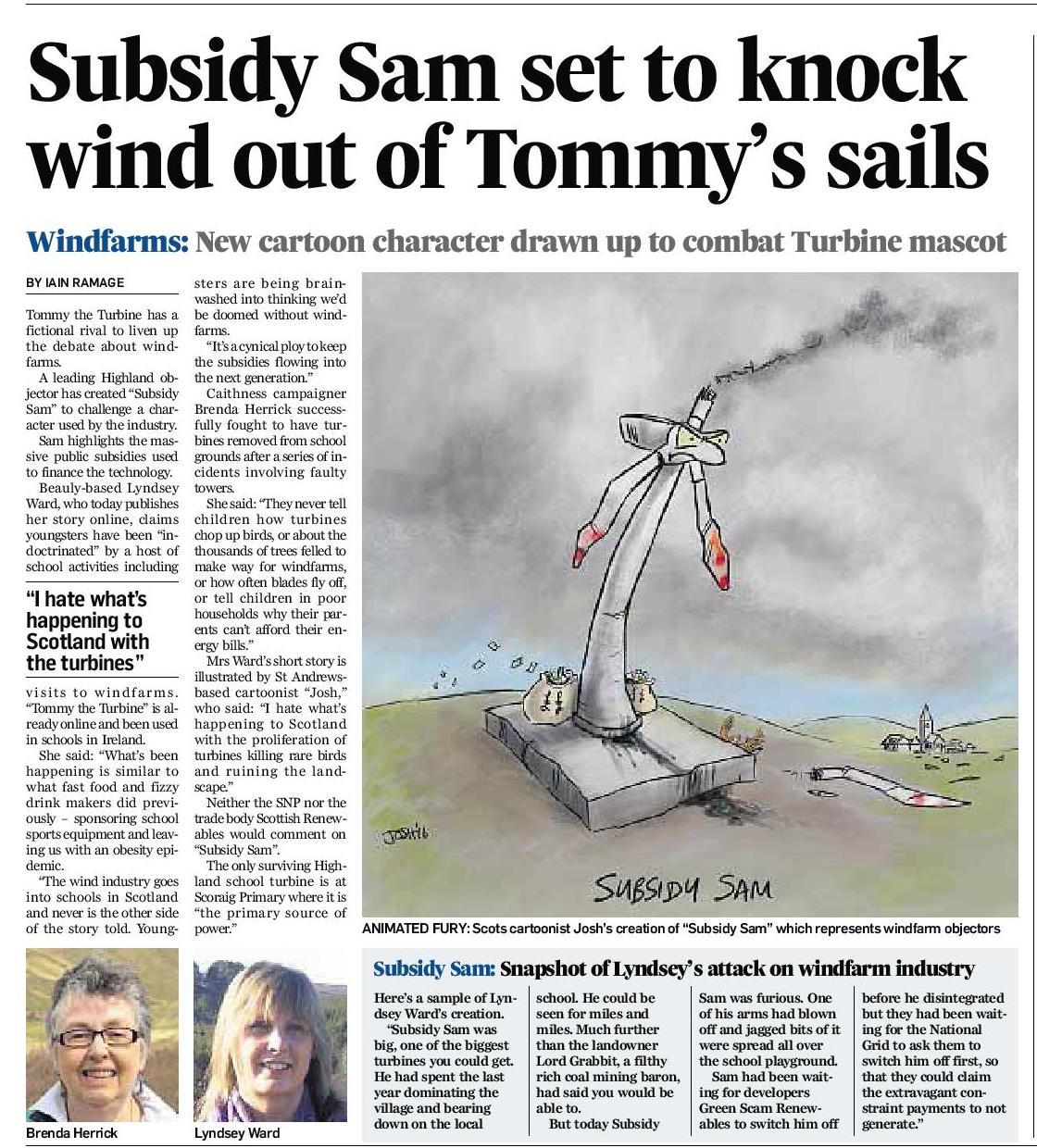
Subsidy Sam…..Hero of the WindScam!

April 2016Scotland

Subsidy Sam the Turbine

This short story has been written to counter the shameless wind propaganda that is allowed into our schools to influence young minds with no effort to show the other side.

At Wind Energy’s Absurd, they write:

Here at Wind Energy’s Absurd we have repeatedly challenged the wisdom and morality of allowing multinational companies into the classroom to put their side of a story that is designed to cultivate acceptance of their industry into future generations.
You will remember Tommy the Turbine – a tale told to children in Ireland about the wonders of wind power:
www.tommytheturbine.net and tommytheturbine.com
Well now Tommy has a rival – and ourMONEY is on Subsidy Sam getting the message out there.
It is time the indoctrination of our children was stopped.
We have been requested to post this story and are delighted to oblige.
Please share it as many times as you want and send it wherever you want.
We have been asked to give thanks to Josh for creating the fabulous cartoon to go with the story.

Subsidy Sam

Subsidy Sam was big, one of the biggest turbines you could get.

He had spent the last year, since being built, dominating the village and bearing down on the local school, its pupils and staff. Sometimes you could even see him flailing his arms about but a lot of the time he didn’t. He was huge. So big he could be seen for miles and miles. Much further than the land owner, Lord Grabbit, a filthyRICH coal mining baron, had said you would be able to. He, with the developers Green Scam Renewables, had even shown pictures to the worried villagers of what Subsidy Sam would look like but it was really hard to see him in the misty distance in the developer’s photomontages.

But today Subsidy Sam was furious. One of his arms had blown off and jagged bits of it were spread all over the school playground. It was so windy. Perhaps even a Force 9 gale. Sam had been waiting for Green Scam Renewables to switch him off before he disintegrated but they had been waiting for the National Grid to ask them to switch him off first, so that they could claim the extravagant constraint payments to not generate.

Green Scam Renewables had misjudged it today and now Subsidy Sam stood broken with one arm missing and the other two hanging forlornly at his side.

It was a good job it wasn’t break time when the children would have been outside playing. With no enforced safety zone around this huge piece of industrial machinery and its whirling blades, it was very dangerous to be anywhere near him but no-one was telling the children that. Subsidy Sam was their friend and would help save the world. The nice wind developer man who owned Green Scam Renewables, Mr McWeasel, had told them that. He had come to the school with the jolly round man from the government who was wearing a tie with turbines all over it. They told the children that Subsidy Sam would save them and had frightened them all into thinking without him they were all doomed and the planet would die and so would they.

It was scary stuff. It gave them nightmares.

Thank goodness for Subsidy Sam.

The French Head Mistress, Madame de Gaulle, was pleased to see Sam’s blade fly pass her studyWINDOW at such speed and smash into a thousand pieces. She was relieved that none of the children had been hurt but she was glad to see the broken turbine. ‘Good riddance’ she thought. She knew a waste ofMONEY when she saw it. She hated Subsidy Sam, or SS as she preferred to call him, and had put up strong resistance to him being built but to no avail. It made no difference that she objected when they pretended Sam was a community turbine. No-one in the community wanted Sam but deceiving the local authority into thinking he was one was the only way they would be allowed to build him. She’d heard of burly men going round the village telling people not to object or else.

People were frightened so they didn’t.

Now when the sun shone she had to close the blinds in her study to stop the strobing from Sam’s blades hitting her desk and giving her throbbing headaches.

The compensation that was offered to the community by Green Scam Renewables was offensive. How can they pay anyone enough to make up for not being able to sleep at nights because of the incessant thumping when Sam was having a party and waving his arms in the air?

Nothing could make up for that.

Even the people who want to sell up and move away can’t because when the potential buyers see Subsidy Sam they don’t even get out of their cars. They just speed away without a backward glance.

The tourists have stopped coming. They see Sam and ask, ’Why did you build that huge ugly thing near your pretty village? We won’t stay here. We will spend our money in places we like the look of and that’s not here.’

Once the foreign workers who built Subsidy Sam had left, the B&Bs and guest houses stayed empty, many people lost their jobs in the tourism industry because no-one came to visit any more.

The birds were happy to see Subsidy Sam immobilised because it meant they no longer had to take their lives in their wings to feed at the nature class bird table every time they passed him when he was having one of his Edward Scissorhands on acid moments.

The caretaker was pleased because he wouldn’t have to keep sweeping up all their feathers and body bits when they misjudged it. However, all the oil that was leaking down Subsidy Sam’s leg and seeping across the playground was hard to scrub off.

The caretaker could never understand how a wind turbine so full of fossil fuels could ever be classed as clean and green.

Still, the oil was a greenish black colour – perhaps that is what people meant. He was just a simple caretaker on minimum wage struggling to pay his energy bill with all these ‘green’ levies on them. What did he know?

He had wanted to object to Subsidy Sam being built but he lived in a cottage on Lord Grabbit’s estate. It had been suggested to him that he shouldn’t object in case his home became no longer available to rent. Without his little cottage he wouldn’t have anywhere to live near where he worked, so he didn’t object.

Mr McWeasel wasn’t pleased because since Subsidy Sam’s arm had been liberated he was unable to get the juicy subsidy for any energy the turbine might have managed to produce or the very lucrative constraint payments. He got those when he was told to switch Subsidy Sam off when there was low demand for electricity, too much wind and the grid was in danger of being overloaded and plunging everyone into darkness.

Why should he care that Subsidy Sam was intermittent and unreliable and didn’t give any energy security? He got paid whatever.

Mrs McWeasel wouldn’t be pleased either as she was expecting her usual two months holiday in the Bahamas, new top of the range set of wheels and that stunning diamond necklace she had set her heart on.

Mr McWeasel would have a lot of explaining to do when he got home. After all he had guaranteed his lovely young wife a life ofRICHES and leisure all paid for by the spoils from Subsidy Sam. It was no matter to him that fuel poverty had increased because the supplements to pay Sam’s subsidies had been added to the energy bills of everyone, even the poor, the elderly and the sick.

No matter to him either that the children and staff were in danger every day from Subsidy Sam’s flying components, that the birds were being sliced and diced, the bats were exploding, the leaking oil was polluting the school yard or that the lights were frequently going out so that the caretaker had to crank up the polluting diesel generator. None of that concerned Mr McWeasel or the politicians he had hoodwinked into believing his windy propaganda. They were so stupid even Mr McWeasel couldn’t believe he had got away with the wind con for so long.

Still, that looked like it had all come to an untimely end with Subsidy Sam now broken and useless. No more subsidies available for new Sams because that pesky government over the border had stopped filling the subsidy trough.

‘Ah well,’ sighed Mr McWeasel. It was time to move onto other things. He had heard that there were good returns and subsidies operatingBANKS of noisy toxic fume-belching diesel generators now. All needed because the politicians had over-deployed on the weather-dependent subsidy suckers and under-deployed on reliable generation. He would need to speak to Lord Grabbit and see if he could build them where Sam was, near the school.

Mrs McWeasel would still get her holiday, herNEW CAR and her diamonds. Mr McWeasel might even treat himself to that yacht he had always wanted as well.

Saving the planet was no longer a priority – was it ever, Mr McWeasel?

© LW Anti Wind Activist April 2016

Story written by Lyndsey Ward | April 2016

The Press and Journal – April 22, 2016

Subsidy Sam set to knock wind out of Tommy’s sails

Testimony of a Wind Turbine Sufferer…

It is finally time

This very sad, but now all too common letter discussing wind turbine impacts is published here with the permission of the author.

After being awakened for the ump-teenth time by these grinding, screeching, humming, squealing, house vibrating, jet sounding, phone interrupting, television disturbing, internet interfering, shadow flickering, environmental impacting, property value lowering, aesthetic degrading, red light blaring obtrusive monsters, known as Industrial wind  turbines, (IWT),  thrust upon us without our permission.

It is finally time to thank the uninformed, seemingly uncaring, self-serving, publicly elected officials, for having the audacity to vote in favor of a project that they knew so little about which would forever change the lives of so many people that they are supposed to work to protect, all because a smooth tongued, representative from a less than ethical company, (which person admitted he would not live near turbines), was able to pull the wool over their eyes by making promises of untold booty with undoubtedly, falsified studies of sound, resident acceptance and environmental impact.

I would hope that these publicly elected officials are realizing how their actions have affected the residents of northeastern Tipton County, IN. Thanks to them our lives have changed forever, not for the better but for a lifetime of interruptions, inconveniences not only in the daytime but 24 hours a day. This is not an issue that you can spend an hour or two or a day in the area and comprehend the negative impact it is having upon our lives.

You have to be here for extended periods of time because there will be instances that the wind doesn’t blow yet the humming and screeching will continue as the IWTs search for wind. It was stated that residents would adjust, getting used to these monsters but alas this is not happening when you are awakened at two or three AM by something that sounds as if it is in your house and upon investigating you find that it is an IWT. It has been suggested that we move, however finding anyone to purchase our property for the true value it had before the IWTs were present is impossible.

As I realize this will serve no purpose to alleviate the situation in Tipton County, IN

I would hope it could inform others of the irritating intrusions of IWTs, these monsters have absolutely no place in a community as populated as Tipton County.

Also hoping it would lead elected officials to better investigative procedures before signing on the dotted line.

Although I have not read nor have I seen it, I understand that one of those responsible officials has written some form of apology or regret about their actions. This would show the great character and respect of that person to the citizenry, however it does nothing to alleviate the intrusions.

Respectfully,
Fred McCorkle
Windfall, IN


APR212016

Environmentalists Finally Catching on to the Windscam!

German Greens Turn Against Wind Power Too

Protest poster against the construction of wind turbines in Hamburg, Germany, Europe

****

German opposition to these things grows by the day. And, just like everywhere else, criminals, shysters and chancers cloak themselves in groovy ‘green’ credentials and help themselves to $billions in subsidies filched from power consumers and/or taxpayers: all for the ‘good of the planet’ –  or, perhaps, not.

Corruption, lies treachery and deceit are the benchmark for the wind industry and Germany is no different.

Now, the less gullible among Germany’s Greens have worked out that wind power is the greatest economic and environmental fraud of all time.

Spiegel Puts Spotlight On Germany’s “Green Sleaze” … Wind Industry’s “Corruption Of Greens, Environmental Groups, Local Pols…”
No Tricks Zone
Pierre Gosselin
7 April 2016

The latest hardcopy issue of flagship news magazine Der Spiegel reports how Germany’s green energy revolution has bitterly divided the country’s environmental movement.

Enoch zu Guttenberg, one of Germany’s most prolific environmentalists has become an outspoken critic of wind energy in Germany, and believes children in the future will be able to see Germany’s idyllic landscape only in paintings as developers clear hill-top forests to make way for skyscraper-size industrial wind turbines.

Guttenberg, a symphony conductor, told Spiegel the movement against wind turbines has exploded over the past months and years and that his speeches against wind turbines are attracting ever larger crowds: “When I started 60 or 70 would come, now there are more than 1000.”

Moreover Guttenberg talks of “hundreds of local citizens’ initiatives” that are now mobilizing against wind projects. Spiegel writes of a whole “new quality” of resistance that governments now need to confront as many traditional environmentalists now rail against what they view as a “corruption of green party members, environmental groups, local politicians and city councils“.

So divided the environmentalists have become that Germany’s powerful BUND (Friends of the Erath Germany) launched a slander lawsuit against Guttenberg after he accused the organization of having “merged” with the Wind Lobby. BUND later dropped the suit.

Since then Guttenberg has compared the BUND directors to Judas and accused them of having sold out the environmental philosophy for a “dish of lentil”. Leading environmental activists today are now saying: “The color of sleaze is no longer black, rather it is green.”

The environmental movement has become so disunified, Spiegel writes, that once diehard nuclear energy opponents have now switched to protesting wind turbines, as many planning boards ignore concerns of the citizens and attempt to steamroll projects through against the public will.

Often the projects are politically explosive, involving a good old boys network. A typical pattern, Spiegel writes:

Town mayor, local pols, city directors, who at the same time happen to be the managing directors of wind parks and whoPROFIT from them. A dubious mesh of community and electricity interests.”

This is how it works at many communities, Spiegel describes. Often the nearby residents and citizens pay heftily through lost property values, health issues from infrasound, and high electricity prices. Invariably only very fewBENEFIT at all.

Planners often shoot back and claim nothing is illegal about the business deals. But the public is not having it. Spiegel adds:

Indeed in the meantime resistance is growing. ‘The mood has flipped because people are noticing that it is all about business,’ says anti-wind activist [Manfred] Knake”

At the end of the article Guttenberg, Spiegel writes, calls it the “capitialistic injustice of the Energiewende“.

TheMONEY of the little guy, who has to pay billions for renewables, is diverted into the pockets of some large property owners.”

No Tricks Zone

dirtyrottenscoundrelsoriginal

Wind Turbine Projects, a Breach of Human Rights!

March 2016Australia

Human Rights and Wind Energy Projects

This document is a review of the possible breaches by wind energy projects of various of the human rights of people living in the vicinity of a wind project.

It identifies and considers a number of potential breaches of varying impact and of differing ease or difficulty of establishing. In this context the rights to health, safe working conditions and property may be the simplest to establish whether breaches have or have not occurred.

Readers of this document need to understand that it is not in any way a legal argument and that whilst all reasonable steps have been taken in its construction the author makes no representation that the information is complete nor that the analysis and conclusions are correct.

Those interested in the subject should obtain their own advice before proceeding with a formal complaint.

Prepared by:
Peter R Mitchell AM, BChe
March 2016

Index

  1. Summary
  2. Introduction
  3. The Relevant Facts
  4. Has the Wind IndustryPROVEN Its Machines Are Safe?
  5. Level of Disturbance
  6. Human Rights Legislation
  7. Major Breaches of Human Rights
    1. Cruel, Inhuman and Degrading Treatment
    2. Discrimination
    3. Arbitrary Interference
    4. Working Conditions
    5. Family
    6. Children
    7. Physical and Mental Health
    8. Homes and Other Assets
  8. Obligations of Civil Servants

Appendices

Each Appendix repeats relevant articles from the Declaration and Convenants with comments in italics on their applicability to the problems discussed in the memorandum.

  1. Universal Declaration of Human Rights (UDHR)
  2. International Covenant on Economic, Social and Cultural Rights (ICESCR)
  3. International Covenant on Civil and Political Rights (ICCPR)
  4. Covenant on the Rights of the Child (CRC)
  5. Convention Against Torture and other Cruel, Inhuman and Degrading Treatment or Punishment (CAT)

A. Summary

IndustrySPIN and uncritical but determined admirers of wind energy have encouraged the political and public view of the wind industry as beyond criticism and critical analysis. In contrast people living in the vicinity of Wind Energy Projects (WEPs) have been suffering both mentally and physically since turbines have appeared in their previously quiet, peaceful and healthy environments.

Some high quality work by US scientistsi in the 1980s uncovered a wind turbine sound profile (signature) that included infrasound and low frequency sound (ILFN). This signature was unlike that of any other source of sound. ILFN at very low and specific frequencies was identified as the cause of health problems in humans. The industry and their favoured acousticians “forgot” this work; but recent field workii in Australia has confirmed the unique sound profile and the cause and effect. Advances in instrumentation are allowing more work to be undertaken in victims’ homes by privately funded acousticians independent of the wind industry.

Characteristically the victims have no funds to seek legal relief or advice but that may become easier as the findings are repeated. Meanwhile the victims continue to endure what they claim are intolerable bodily impacts with their personal sensitivity increasing with timeiii.

Whilst the industry currently feels secure against court action, it has occurred to some that the industry and government regulatory authorities are quite possibly causing major breaches of certain of the victims’ human rights; and that this is an avenue that should, and can, be diligently pursued with a minimum outlay of scarce funds.

Matching of thePROVEN impacts with defined and accepted human rights is the purpose of this document.

Matching shows that rights involving:

  • Cruel, Inhuman and Degrading Treatment
  • Discrimination
  • Arbitrary Interference
  • Working Conditions
  • Family
  • Children
  • Physical and Mental Health
  • Homes and Other Assets

are seemingly being both ignored, and breached.

It is not necessary that every one of the above identified rights is breached. One alleged breach against one person at one wind project is enough to trigger the obligations of the Human Rights Commission.

B. Introduction

The Clean Energy Council website states that: “Australia had 1866 wind turbines spread across 71 wind farms at the end of 2014. Three wind farms with a combined power generation capacity of 566.7 megawatts (MW) were completed in 2014 and a further five wind farms remained in progress early in 2015 and are expected to be completed in 2015”.

Individual turbine size (rated capacity) ranges from less than 1MW to about 3.3MW.

Changes to the Renewable Energy Target will require additional renewable energy capacity to be built, most of which can be expected to be wind derived.

There are a variety of problems with wind energy that are unlikely to be rectified soon. This document is concerned solely with the physiological and psychological impact on families and farm workers living within 10km of a WEP.

The purpose of WEPs is to produce power from a sustainable source without producing carbon dioxide. It may or may not be that the planet is facing disastrous global warming; it may or not be that carbon dioxide produced from fossil fuels is a, or perhaps the, major cause. Many believe (but may not actually know) the answers to the above options are in the affirmative. Political parties and members of State and Federal parliaments have, with some exceptions, accepted the affirmative view. The Commonwealth, through the Renewable Energy Act, has directed that power consumers pay large subsidies for renewable energy in order for wind energy and some other renewable energies to become viable. Thus the wind industry operates with aGUARANTEED PROFIT at a level which is very attractive to some investors who increasingly are foreign.

The wind industry’s interest is to protect and enhance its cash flows. Capitalism has a poor record if its product or service is damaging to the public and the environment. In these circumstances it commonly does not seek to change its product but to defend its continuation. Unfortunately this reaction includes tactics of denial and dissembling, refusing to undertake sufficient research on its own products, delaying research by others and attacking those who see problems with the product and are prepared to say so. An expensive campaign of denial andSPINis progressively developed and practised.

Those convinced of the need to reduce carbon dioxide emissions see wind energy as a win-win solution (both sustainable and reducing carbon dioxide). However, in the matter of its more carefully defined purpose, that being the net reduction of carbon dioxide per unit of power produced, it is a failure.iv This is mentioned here so that readers may realise that wind energy is not the saviour first thought, and that there is no question of “wind power or we perish”.

However this document does not make the argument about wind being not fit for purpose. Others have done and continue doing that. The purpose here is to consider whetherPROVEN impacts on residents constitute transgression of their human rights.

The following facts relating to the generation of power from wind are drawn from published research and unpublished field work, much of which is available on websites such as the Waubra Foundation, National Wind Watch, etc. website. These are discovered and researched facts, not unfounded assertions nor the output of “post modern” science.

Matching of these facts with defined and accepted human rights is the purpose of this document.

C. The Relevant Facts

An understanding of the nature of the sound pressure wavesv emitted by turbines and the impacts of that energy upon neighbours is essential to any assessment of the possible breaching of human rights. Facts vital to this evaluation follow.

  • Wind turbines produce sound (airborne pressure waves) across the infrasound, low frequency and audible ranges.
  • Sound in the very low frequency spectrum (0.1 hertz to 20 hertz) characterised as infrasound, as well as excessive low frequency noise (20 to 200 Hz) causes serious physiological and psychological impacts on some or all of the residents in a significant number of houses up to at least 10 km from the nearest turbine.
  • Residents do not become accustomed to these pressure waves, but become sensitised, so that the impact becomes increasingly damaging with ongoing exposure.(See Endnote ii)
  • A major impact of these sound waves is chronic sleep deprivationvi often associated with waking suddenly and regularly in a panicked state; but other primary or secondary health problems such as tinnitus, vertigo and balance problems, tachycardia, nausea, migraine, exacerbation of chronic medical conditions such as heart disease, and concentration problems, as well as physiological and psychological stress are also common.(See Endnote ii) Chronic sleep deprivation is classified by the World Health Organisation as a contributor to diseasevii.
  • Many residents find their formerly peaceful homes are rendered sonically toxic and ultimately uninhabitable and, on full disclosure to possibly interested buyers, unsaleable.
  • Young children are unable to understand or express their discomfort, which is often extreme, old people are unable to move for various reasons including financial; and all ages suffer declining health and cognitive power and are increasingly at risk in operating farm machinery, fixed machines and even cars and trucks.

D. Has the Wind Industry Proven Its Machines Are Safe?

The information to support the above facts is readily available and mounting. Whilst the wind industry and its variously motivated supporters deny any evidence exists, and discredit the motives and background of the whistleblowers, the industry has never been inclined or required to prove that their ever larger turbines are safe, or to prove another source that has any scientific credibility for the health impacts that arise around wind turbineINSTALLATIONS.

E. Level of Disturbance

Please read on

Prepared by Peter R Mitchell | March 2016

Wind Projects Destroy Farming Communities!

Want Hate-Filled Communities? Then Just Add Wind Farms

farm protest

The wind industry, its parasites and spruikers keep telling us that rural communities are falling over themselves to get in on some wind farm action. However, as usual, theirSPIN and the reality on the ground are miles apart.

Nancy Tips details how wind farms destroy the trust and faith that make vibrant and prosperous rural communities tick.

Lessons about community from Windham
Burlington Free Press
Nancy Tips
7 April 2016

It has become a cliche to say, towns targeted for industrial wind installations are torn apart by the experience. If it’s an experience you haven’t had, you might well wonder what’s behind the cliche. If you really want to understand, you might start by asking the question, what is the nature of the bonds that hold a community together in the first place?

I don’t know about your small town, but in ours, neighborly bonds tend to be of the feel-good type: I do you a kindness and we both benefit. You break your leg? I plow your drive. Your weed whacker is in the shop? I lend you mine. Your brother dies? I go to the funeral, even if I didn’t know him. What a dandy fellow I am, and everyone knows it.

These small acts of kindness do indeed build a sense of community. But as with other relationships, you don’t really know your community until the chips are down.

You don’t know what “for better or for worse” means until you get to the “worse” part. You quickly find out, when a wind developer comes knocking on your community door.

It’s very bad times, at least for some people. And the fact that people are differently affected depending on where they live is, it turns out, at the heart of what you learn about “community.”

You learn when the friend from over the way regards you with a steely gaze when you tell him, “My home, and my family’s home, are a half mile from five 500-foot tall wind turbines.” “I feel for you,” says your friend, quickly changing the subject.

You learn when you try to explain that your fear and sadness are keeping you awake. “All my family’s wealth is in our family farm, which would lie less than 3,000 feet from five 40-story wind turbines. We won’t be able to live here, and the land owner and developer have said they wouldn’t compensate anyone for lost use of their property.” “Please,” chuckles your friend, “it won’t be that bad.”

You learn when you look at the people who are fighting as hard as you are to stop the wind turbine project and realize that the project will probably not affect them so personally, but that they care about their neighbors who will be harmed. And you know they will be next to you, blocking the road, if the day comes when the unimaginably huge trucks arrive with wind turbine parts.

In our little town, we’ve spent nearly four years watching the company reps of the wind developer, an immense multi-national, mosey about on our ridgeline, trying to answer their precious question, is the “wind resource” on your pristine ridgeline enough for us to make lots of money by putting turbines here?

But we have a question too, and although we’ve looked equally hard for the answer, we can’t find it.

Our question is, what will happen to us, as individuals and as a community, if the developer does decide we’re good enough to “host” their project? Who will care for our tattered community, and our damaged lives?

That there is no answer to, or even interest in, our question does not feel good – it feels abusive, unjust. It feels vicious, violent. It feels as if Vermont, my entire family’s beloved adopted home, were the most dangerous place in the world for me and my family to live.

So the days go on, lessons abounding. I learn  about mercy, for instance, when I hear my husband on the phone with a “friend,” explaining that turbine noise at a distance of less than half a mile stands a good chance of affecting the development of my infant grandson’s brain. Then I hear my husband, suddenly fierce, say, “I’m not asking you to feel sorry for me!”

Well you know what, my friend? I am asking you to feel sorry for me. I am asking you, god forbid, to have pity on me. I am asking for your mercy. Your answer will tell me something very important about “community.”
Burlington Free Press

protesters