Not a Tear is Shed, When Windweasels Bite the Dust!

Ponzi Power: US Wind Power Company – Sun Edison – Implodes

share traders

****

STT has likened it to the great corporate Ponzi schemes, pointing out, just once or twice, that the wind industry is little more than the most recent and elaborate effort to fleece gullible investors, in a list that dates back to “corporateinvestment classics”, like the South-Sea Bubble and Dutch tulip mania.

In the wind industry, the scam is all about pitching bogus projected returns (based on overblown wind “forecasts”) (see our posts here andhere and here and here); claiming that wind turbines will run for 25 years, without the need for so much as an oil change (see our posts hereand here and here); and telling investors that massive government mandated subsidy schemes will outlast religion (see our posts here andhere and here).

In Britain, Wind Prospect Group stopped paying dividends to its bond holders and prevented them from cashing them in to recover their capital outlay:

Got Money in the Great Wind Power Ponzi Scheme? Then, Grab it & Get Out Now!

In Australia, one of the wind industry’s BIG players – Pacific Hydro – managed to rack up an annual loss of $700 million, in 2014; in circumstances where the subsidy scheme – on which its profits depend – hadn’t changed at all (see our post here).

Following that well-established trend is US wind power outfit, Sun Edison; whose shares have plummeted from US$32 to a faction of a single greenback, is on the verge ofbankruptcy. Oh dear, how sad, never mind.

Share Price Plunges for Operator of Maine Wind Farms Amid Bankruptcy Concerns
MPBN News
Fred Bever
29 March 2016

sunedison2

The operator of several wind energy facilities in Maine could be headed for bankruptcy. But Sun Edison officials say the turbines will keepspinning, and providing taxes and other benefits [read misery ed.] to host communities.

Since hitting a high of $32 per share last June, Sun Edison’s stock has been on a downward spiral, and has now dipped well below $1 a share following reports that it faces a substantial risk ofbankruptcy while securities regulators investigate itsbusiness practices.

But even if Sun Edison does file for bankruptcy or is restructured, company spokesman John LaMontagne says that does not pose a risk for host communities in Maine.

That’s because the plants themselves are actually owned by separate entities.

“All of those projects have existing contracts to deliver wind energy to utilities around New England,” he says. “So therefore they have certain revenues which ensure the projects will be able to meet their obligations in terms of community benefits, taxes and whatever else.”

Sun Edison operates six wind plants in Maine, including one under construction in Bingham. It has also proposed two new big projects as part of a major effort to ship new renewable energy to southern New England.

But LaMontagne said he could not comment on how those might be affected by Sun Edison’s financial issues.
MPBN News

Sun edison strengths

****

SunEdison’s Subsidy-Fueled Collapse
National Review
Robert Bryce
4 April 2016

The company burned no fossil fuels but plenty of taxpayer dollars.

Even $1.5 billion in subsidies andloan guarantees can’t save a “clean” energy company frombankruptcy.

That’s the takeaway from the looming failure of SunEdison, a company that touts itself as the “largest global renewable energy development company.” Once a darling of Wall Street and the green Left because of SunEdison’s portfolio of wind and solar projects, the company’s stock is now in free fall. Furthermore, two related companies that were spun off from SunEdison — TerraForm Global and TerraForm Power — also appear to be in financial distress. On March 30, Brian Wuebbels, the CEO of both TerraForm companies, resigned effective immediately. If all that weren’t enough, the company is also under investigation by both the Justice Department and the Securities and Exchange Commission about its finances and the disclosures it made to investors.

Last summer, SunEdison’s shares were selling for more than $30, and famous Wall Street investors, including David Einhorn and Daniel Loeb, were holding the stock. But by Friday afternoon, the company’s shares were trading for about 49 cents apiece, and Bloomberg writer Brian Eckhouse was reporting that the company was “teetering on the verge of bankruptcy.”

Why is SunEdison on the verge of failure? The short explanation is simple: It tried to grow too big, too fast. Over a 19-month period it went on a $2.6 billion acquisition binge. It paid too much for the companies it bought and now it can’t pay back its creditors. SunEdison has twice delayed the release of its 2015 annual report and appears to be intechnical default on at least $1.4 billion inloans and credit facilities.

To be sure, this isn’t a new story. The annals ofbusiness history are filled with companies that failed because they borrowed too heavily and didn’t have enough cash to pay back their creditors. But the remarkable thing about SunEdison is how much cash it was able to get from state and federal taxpayers during its low-emissions trip to bankruptcy court.

Before getting to the subsidies, a quick history. SunEdison was founded in 2003 by solar-energy promoter Jigar Shah, who is no longer an officer or board member at SunEdison. Shah was an early entrant in the domestic solar market, which has since grown at an astonishing rate. In 2003 the U.S. had about 73 megawatts of solar-energy capacity. By 2014, that figure had increased to 18,280 megawatts. During his time at SunEdison, Shah helped the company grow through the implementation of 20-year power-purchase deals that assured investors and buyers of long-term electricity delivery from renewable-energy projects.

Shah deserves some credit as a promoter. He also deserves a smidgen of credit for his new-found belief that solar subsidies should be eliminated. That said, it’s abundantly obvious that his company’s growth was fueled by hefty federal and state subsidies. That can be seen by looking at Subsidy Tracker, a project of Good Jobs First, a Washington, D.C.–based nonprofit that promotes “corporate and government accountability in economic development.” According to Subsidy Tracker, SunEdison has garnered some $650 million in federalgrants and tax credits. SunEdison ranks number 13 on Good Jobs First’s list of the top 100 recipients of grants and tax credits doled out by federal authorities since 2000.

The biggest federal handouts — two of them totaling $200 million — were made in 2010 and 2011 to a subsidiary of SunEdison, First Wind, for the Milford Wind project in Utah. In addition to the federal subsidies, SunEdison got $30 million in subsidies from various state authorities, including $21 million from governmental entities in New York. On top of that, SunEdison also received $846 million in federal loans,loanguarantees, tax-exempt federal bonds, and federal insurance. The total government support for SunEdison comes out to $1.5 billion.

That’s a figure worth considering, given that on Friday, the market capitalization of SunEdison — that is, the value of all of its outstanding stock — was about $176 million. Thus, federal and state taxpayers have shelled out roughly eight times as much money in subsidies andloanguarantees as SunEdison is now worth.

Alas, SunEdison isn’t the only example of how federal taxpayers have helped prop up poor management in the “clean energy” sector. Earlier this week, the Spanish energy company Abengoa SA filed for Chapter 15 protection in U.S.bankruptcy court in Wilmington, Del., claiming some $16.5 billion in debt. Like SunEdison, Abengoa has been a leading promoter of solar projects in the U.S. According to Subsidy Tracker, Abengoa has received $986 million in federalgrants and tax credits, as well as another $7.8 million in state and local subsidies. The bulk of that sum — about $841 million — was for solar projects. But the company has also collected about $122 million in federal grants for biofuel projects in Kansas, Illinois, and Nebraska. Several of Abengoa’s biofuel plants have already been shuttered, including a plant in Hugoton, Kans., that was supposed to be making cellulosic ethanol (that is, alcohol made with non-food feedstocks). Abengoa was able to build the Hugoton plant thanks to a $97 million federal grant and a $132 million federal loan guarantee.

In all, Abengoa got some $2.6 billion in federal loans and loan guarantees as well as $986 million in federal grants and tax credits. Thus, between the collapse of Abengoa and the looming bankruptcy of SunEdison, federal taxpayers have shelled out some $5 billion in direct grants and loan guarantees to lousy management teams in subsidy-dependent businesses that would never have grown to their current size had they not been able to binge on taxpayer cash.

Critics of the federal government’s support for “clean energy” companies have repeatedly claimed that the government shouldn’t be “pickingwinners.” To that, I can only say that the evidence — from the failed solar company Solyndra and failed battery companies like Ener1 and A123 to SunEdison and Abengoa — proves that the government hasn’t in fact, been pickingwinners. Quite the opposite.
National Review

exitsigns

Amperage Affected By Proximity to Wind Turbines…


Ontario Farmer   Tuesday, April 6, 2016 Edition  Pg. 7


WIND TURBINES AFFECT AMPERAGE?


Dear editor:

After reading your article on wind turbine health, I felt compelled to pass on something I have observed with the wind turbines.


Whenever I am driving on the 401 between Chatham and Windsor I notice that the amperage needle moves from 15 amps to about 12 amps.  As soon as I get to an area where the turbines are further from the road the amp gauge returns to a normal reading of 15 amps.  It also seems that wind direction and speed has more effect on the amp gauge.  I don’t know whether this information is of any use or value but it’s something I’ve paid attention to every time I travel that route.  The first time I noticed was during a rain; my wipers almost came to a stop.  When I looked at the gauge it was almost into the discharge area and I thought I was having alternator trouble.  When I got home the gauge was reading normal.  This observance may be nothing but I have no other explanation why this happens.

Robert Stewart

More Evidence of Harm From Wind Turbine Noise

Tonic tensor tympani syndrome (TTTS)

There has been a suggestion that this condition is actually part of what some people chronically exposed to wind turbine noise might be experiencing.

Tensor tympani muscle
Tensor tympani and stapedius muscles contract reflexively in response to loud sounds to prevent damage to the hearing receptors.
Noise & HealthApril 9, 2013Australia

Tonic tensor tympani syndrome in tinnitus and hyperacusis patients: a multi-clinic prevalence study

Myriam Westcott et alter

Abstract

Tonic tensor tympani syndrome (TTTS) is an involuntary, anxiety-based condition where the reflex threshold for tensor tympani muscle activity is reduced, causing a frequent spasm. This can trigger aural symptoms from tympanic membrane tension, middle ear ventilation alterations and trigeminal nerve irritability. TTTS is considered to cause the distinctive symptoms of acoustic shock (AS), which can develop after exposure to an unexpected loud sound perceived as highly threatening. Hyperacusis is a dominant AS symptom. Aural pain/blockage without underlying pathology has been noted in tinnitus and hyperacusis patients, without wide acknowledgment.

This multiclinic study investigated the prevalence of TTTS symptoms and AS in tinnitus and hyperacusis patients. This study included consecutive patients with tinnitus and/or hyperacusis seen in multiple clinics. Data collected: Symptoms consistent with TTTS (pain/numbness/burning in and around the ear; aural “blockage”; mild vertigo/nausea; “muffled” hearing; tympanic flutter; headache); onset or exacerbation from exposure to loud/intolerable sounds; tinnitus/hyperacusis severity. All patients were medically cleared of underlying pathology, which could cause these symptoms. 60.0% of the total sample (345 patients), 40.6% of tinnitus only patients, 81.1% of hyperacusis patients had ≥1 symptoms (P < 0.001). 68% of severe tinnitus patients, 91.3% of severe hyperacusis patients had ≥1 symptoms (P < 0.001). 19.7% (68/345) of patients in the total sample had AS. 83.8% of AS patients had hyperacusis, 41.2% of non-AS patients had hyperacusis (P < 0.001). The high prevalence of TTTS symptoms suggests they readily develop in tinnitus patients, more particularly with hyperacusis. Along with AS, they should be routinely investigated in history-taking.

Introduction

The tensor tympani reflex is a startle reflex, which is exaggerated by high stress levels. The tensor tympani muscle contracts immediately preceding the sounds produced during self-vocalisation, suggesting it has an established protective function to loud sounds, assists in the discrimination of low frequency sounds, and is involved in velopharyngeal movements.

Tonic tensor tympani syndrome (TTTS) was originally described by Dr. I. Klockhoff. TTTS is an involuntary condition where the centrally mediated reflex threshold for tensor tympani muscle activity becomes reduced, so it is continually and rhythmically contracting and relaxing. This appears to initiate physiological reactions in and around the ear without objectively measurable dysfunction or pathology. Symptoms consistent with TTTS can include: tinnitus; rhythmic aural sensations such as clicks and tympanic membrane flutter; alterations in ventilation of the middle ear cavity leading to a sense of aural blockage or fullness, a frequent aural “popping” sensation and mild vertigo; minor alterations in middle ear impedance leading to fluctuating symptoms of “muffled” and/or “distorted” hearing; irritation of the trigeminal nerve innervating the tensor tympani muscle, leading to pain, numbness and burning sensations in and around the ear, along the cheek, neck and temporomandibular joint (TMJ) area.

The specific and consistent cluster of physiological symptoms of acoustic shock (AS) is consistent with TTTS, without underlying aural or TMJ pathology. AS can occur involuntarily after exposure to a sudden unexpected loud sound perceived as highly threatening (acoustic incident). AS becomes an acoustic shock disorder (ASD) if symptoms persist. AS was originally identified in call center staff, who arevulnerable to AS because of the increased likelihood of exposure near the ear(s) to an acoustic incident transmitted via a telephone headset. The research on AS has focused on this cohort, however acoustic incidents can occur anywhere.

Symptoms such as aural pain and a sensation of aural blockage/fullness, with no underlying aural or TMJ pathology, have been observed in tinnitus and hyperacusis patients. These symptoms have been linked to TTTS by Jastreboff and Hazell and Westcott. However, these symptoms have not been widely acknowledged or investigated in this patient population. TTTS has been more intensively investigated in temporomandibular disorder (TMD) research, with TTTS considered to be a secondary consequence of TMD and/or TMJ dysfunction, predominantly responsible for referred tinnitus, ear pain and other symptoms in and around the ear.

This multiclinic study aimed to investigate in a sample of tinnitus and hyperacusis patients the prevalence of:

  • Symptoms consistent with TTTS
  • Symptoms consistent with TTTS developing or being exacerbated by intolerable sound exposure
  • AS aetiology triggering the onset of their tinnitus and/or hyperacusis.

[…]

Conclusion

The high prevalence of symptoms consistent with TTTS in this sample suggests they can readily develop as a primary phenomenon in patients with tinnitus, and more particularly in those with hyperacusis. These results support a central relationship between tinnitus, hyperacusis and TTTS, with further research indicated to explore this relationship and the efferent pathway triggering TTTS.

TTTS offers an explanation for the aural pain reported by many hyperacusis patients, often triggered or aggravated by intolerable sound exposure. Symptoms consistent with TTTS are subjective and can cause high levels of anxiety. This can lead to tinnitus escalation, the development and escalation of hyperacusis, and limit the efficacy of tinnitus/hyperacusis therapy. These symptoms should be routinely evaluated in history taking, de-mystified to patients to provide reassurance, and treated accordingly.

These results indicate that AS is a world-wide phenomenon, with significant clinical, medico-legal and military diagnostic/rehabilitation implications. It is recommended that evaluation of an acoustic incident at the time of tinnitus/hyperacusis onset is routinely carried out in history taking with tinnitus and hyperacusis patients.

→ Please read on

Energy Poverty Killing Thousands in Europe…

Europe’s Wind Power Suicide Pact Killing 40,000 a Year

europe power prices 2

Green Europe is killing 40,000 poor a year
Breitbart
Jame Delingpole
30 March 2016

Europe’s suicidal green energy policies are killing at least 40,000 people a year.

That’s just the number estimated to have died in the winter of 2014 because they were unable to afford fuel bills driven artificially high by renewable energy tariffs.

But the real death toll will certainly be much higher when you take into account the air pollution caused when Germany decided to abandon nuclear power after Fukushima and ramp up its coal-burning instead; and also when you consider the massive increase in diesel pollution –  the result of EU-driven anti-CO2 policies – which may be responsible for as many as 500,000 deaths a year.

But even that 40,000 figure is disgraceful enough, given that greenies are always trying to take the moral high ground and tell us that people who oppose their policies are uncaring and selfish.

It comes from an article in the German online magazine FOCUS aboutEnergiewende (Energy Transition) – the disastrous policy I mentioned earlier this week whereby Germany is committed to abandoning cheap, effective fossil fuel power and converting its economy to expensive, inefficient renewables (aka unreliables) instead.

According to FOCUS around ten percent of the European population are now living in ‘energy poverty’ because electricity prices have risen, on average, by 42 percent in the last eight years. In Germany alone this amounts to seven million households.

The article is titled: The grand electricity lie: why electricity is becoming a luxury.

The reason, of course, is that green energy policies have made it that way. Many of these have emanated from the European Union, which in turn has taken its cue from the most Green-infested nation in Europe – Germany.

Germany has long been obsessed with all things environmental. Besides having invented the dodgy ‘science’ of ecology in the 1880s it was also, of course, between 1933 and 1945 the home of Europe’s official “Greenest government ever” – the first to ban smoking on public transport, an enthusiastic supporter of organic food, national parks and population control.

The Greens have also since the early Eighties been arguably the most influential party in Germany. Though their percentage of the vote has rarely risen above the 10 percent mark, they have punched above their weight either as a coalition partner in government or as a pressure group outside it.

For example, the reason that after Fukushima, Chancellor Angela Merkel completely changed Germany’s policy on nuclear power was her terror of the Greens who were suddenly polling 25 percent of the national vote.

It was the Greens too who were responsible for Energiewende – the policy which is turning Germany into the opposite of what most of us imagine it to be: not the economic powerhouse we’ve been taught to admire all these years, but a gibbering basket case.

This becomes clear in an investigation by the German newspaperHandelsblatt, which reports the horrendous industrial decline brought about by green energy policies.

Hit hardest, of course, are the traditional utilities. After all, the energy transition was designed to seal their coffin. Once the proverbial investment for widows and orphans because their revenue streams were considered rock-solid — these companies have been nothing short of decimated. With 77 nuclear and fossil-fuel power plants taken off the grid in recent years, Germany’s four big utilities — E.ON, RWE, Vattenfall and EnBW — have had to write off a total of €46.2 billion since 2011.

RWE and E.ON alone have debt piles of €28.2 billion and €25.8 billion, respectively, according to the latest company data. Losses at Düsseldorf-based E.ON rose to €6.1 billion for the first three quarters of 2015. Both companies have slashed the dividends on their shares, which have lost up to 76 percent of their value. Regional municipalities, which hold 24 percent of RWE’s shares, are scrambling to plug the holes left in their budgets by the missing dividends.

Thousands of workers have already been let go, disproportionately hitting communities in Germany‘s rust belt that are already struggling with blight. RWE has cut 7,000 jobs since 2011. At E.ON, the work force has shrunk by a third, a loss of over 25,000 jobs. Just as banks spun off their toxic assets and unprofitable operations into “bad banks” during the financial crisis, Germany’s utilities are reorganizing to cut their losses.

Why are the Germans enacting such lunacy? Aren’t they supposed to be the sensible ones?

Well yes, up to a point.

As a seasoned German-watcher explains to me, it’s with good reason that one of Germany’s greatest contributions to the world’s vocabulary is the word Angst.

The Germans are absolutely riddled with it – always have been – and it explains the two otherwise inexplicable policies with which Germany is currently destroying itself.

One, of course, is Energiewende caused by a misplaced, but deeply-held neurosis about stuff like diminishing scarce resources and “global warming” and the evils of Atomkraft (Nuclear power).

The other are its similarly insane immigration policies – the result of the neurosis that if it doesn’t replace its declining population with a supposedly healthy influx of immigrant workers, then it will wither and cease to be the great force it was under people like Frederick the Great, Bismarck and that chap in the 1930s and that no one will know or care where Germany is any more.

Ironically, though, if national decline is what the Germans most fear then the two policies they are pursuing to avoid it happening to be the ones most likely to hasten it.

This is sad. Sad for Germany which, for all its faults, has produced some pretty impressive things over the years: Beethoven; Kraftwerk; Goethe; Porsche; autobahns; those two girls on Deutschland 83.

And even sadder for those of us who, through absolutely no fault of our own happen to be shackled politically and economically to a socialistic superstate called the European Union, most of whose rules are decided by Germans over whom we have no democratic control.

Oh and by the way, Greenies: as I never tire of reminding you, you insufferable tossers, not a single one of the “future generations” you constantly cite in your mantras as justification for your disgusting, immoral and anti-free-market environmental policies actually exists.

But the people you’re killing now as a result of those environmental policies DO exist.

Or rather they did, till you choked or froze them to death, you vile, evil, eco-Nazi scumbags.
Breitbart

Fuel-poverty-activi-005

Wind Scam Always Results in “Energy Poverty”….Heat, or Eat!

Wind Power Costs Crush the Poor

German power prices

The rush to ‘power’ modern economies with a Medieval ‘technology’, abandoned Centuries ago for pretty obvious reasons, has brought with it a banquet of consequences: not least, ‘energy poverty’.

That term is one that has only come into common parlance with the soaring cost of electricity, caused by throwing $billions at a wholly weather dependent power source which, but for those massive subsidies, has NO commercial value whatsoever: wind power operators in Australia’s wind power capital, South Australia, literally pay the grid operator to take their chaotically produced power, andmake a profitfrom the RECs they receive.

There’s an irony in there somewhere, as the ‘policies’ that have wrecked power markets and left grids on the brink of collapse, have been pedalled by so-called political ‘progressives’. However, the only ‘progress’ is towards thoroughly avoidable social and economic misery.

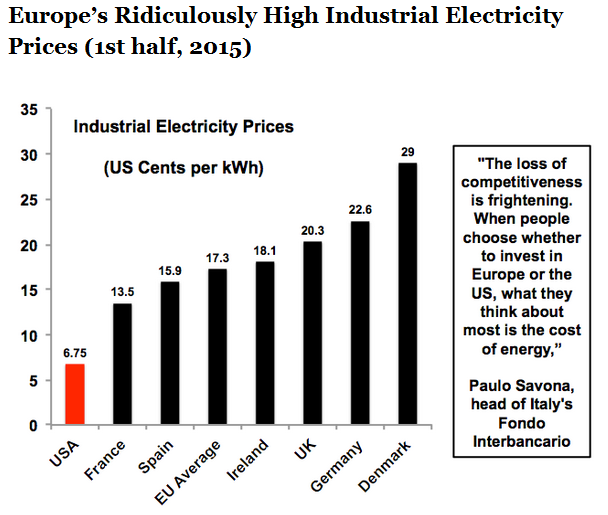
The graph above tells of Germany’s self-inflicted catastrophe, the graph below shows the cause as the wind rushes that broke out, not only in Germany, but in Denmark too.

400fig 1europeelectricprice

Now, here’s a piece from Andrew Follett that tallies up the cost for those who can least afford it.

How the poor bear the brunt of Europe’s obsession with global warming
The Daily Caller
Andrew Follett
25 March 2016

European global warming policies are hurting the continent’s poor, according to a Manhattan Institute study published Thursday.

Europe has tried to fight global warming with cap-and-trade schemes and lucrative financial support to green power since 2005. Though well-meaning, the continent’s environmental efforts have only made life harder for Europe’s poor.

“The European Union’s renewable-energy policies have had one very clear result: they’ve dramatically raised electricity prices,” Robert Bryce, a senior fellow at the Manhattan Institute who authored the study, told The Daily Caller News Foundation.

Between 2005, when Europe adopted these policies, and 2014, residential electricity rates on the continent increased by 63 percent according to the study. Over the same period, residential rates in the U.S. rose by 32 percent. Germany, Spain and the U.K, which intervened the most in their energy markets, saw their electricity bills rise the fastest,according to the study.

The poor tend to spend a higher proportion of their incomes on electricity, gasoline, food and other basic needs. Furthermore, when the price of electricity increases, the cost of producing goods and services that use electricity increases too. Thus, high electricity prices effectively increase the price of most basic goods.

European-style global warming policies hurt the poor 1.4 to 4 times more than they hurt the rich, according to a study by the National Bureau of Economic Research.

“Environmental advocates like to claim that Germany is the role model we should emulate, even though Germany’s residential customers are now paying about 40 cents per kilowatt-hour for their electricity,” Bryce continued. “That’s more than three times the average cost of electricity here in the US.”

Brits alone paid a whopping 54 percent more for electricity than Americans in 2014 while energy taxes cost residents roughly $6.6 billion every year. Green energy subsidies in the U.K regularly exceed spending caps and account for roughly 7 percent of British energy bills, according to government study released last July.

Polling indicates that 38 percent of British households are cutting back essential purchases, like food, to pay for high energy bills. Another 59 percent of homes are worried about how they are going to pay energy bills.

“Policymakers in New York and California, as well as more recently, Oregon, have decided to emulate the EU’s mandates,” Bryce concluded. “If they are concerned about poor and low-income constituents, they should be rethinking those mandates.

The study also illustrates that between 2005 and 2014, Europe reduced its carbon-dioxide emissions by 600 million tons per year. Over that same period, the combined emissions of China, India, Indonesia, and Brazil increased by 4.7 billion tons per year, or nearly eight times the reduction achieved in Europe.
Daily Caller

bread and water for dinner

It Should Never Have Taken This Long, to Stop the Windscam!

08/04/16

German Government ‘Plans To Stop

And Reverse Wind Power’

China Plans To Export

Cheap Energy To Europe

If the green energy plans by the German Federal Government are implemented, the expansion of onshore wind energy will soon come to a standstill and then go into reverse. In early March, German Economy Minister Sigmar Gabriel presented a draft for the amendment of the Renewable Energies Act (EEG). The new rules regulate the subsidy levels for renewable energy. The new regulations are to be adopted in coming months. A study by consultants ERA on behalf of the Green Party’s parliamentary group concludes that under these provisions the development of wind energy will collapse fairly soon. –Frank-Thomas Wenzel, Berliner Zeitung, 7 April 2016

China’s proposed investments in long-distance, ultra-high voltage (UHV) power transmission lines will pave the way for power exports as far as Germany, the head of the national power grid said on Tuesday as he launched an initiative for cross-border power connections. Talk of exporting power is a reversal for China, which as recently as 2004 suffered rolling blackouts across its manufacturing heartland. But huge investments in power in the decade since, and the construction of a number of dams, nuclear reactors and coal-fired plants due to begin operating in the next 10 years, mean the country faces a growing surplus. –Lucy Hornby, Financial Times, 31 March 2016

Report the Harm Caused by Wind Turbines…

The Wind Industry’s Malicious & Unjustified Harm to Public Health

Wisconsin sign sick and tired

Wind power is a public health problem
Cape Cod Times
Lilli-Ann Green
7 March 2016

Wind turbine projects have previously been rejected in Wellfleet, Eastham, Orleans, Harwich, Dennis, Brewster, Barnstable and Bourne. Health concerns have been a major issue.

A Superior Court judge, hearing neighbor’ complaints that wind turbine noise constituted an intolerable “nuisance” that was causing “irreparable harm,” issued an injunction to curtail operations.

The “Falmouth experience” is not unique. Residents in at least 21 communities in Massachusetts (and hundreds of locations all over the world) have reported significant health problems as the result of living too close to wind turbines. Those problems include sleep disruption and deprivation, headaches, ear pressure, dizziness, nausea, problems with concentration and memory, fast heart rate, high blood pressure and panic episodes.

In a 2011 peer-reviewed journal article, Harvard-trained epidemiologist Carl Phillips wrote, “There is overwhelming evidence that wind turbines cause serious health problems in nearby residents … at a nontrivial rate. The bulk of the evidence takes the form of thousands of adverse event reports. … The attempts to deny the evidence cannot be seen as honest scientific disagreement, and represent either gross incompetence or intentional bias.”

Ambrose and Rand’s 2011 peer-reviewed journal article, presented at the InterNoise international conference, concluded there was “a strong correlation with wind speed, power output and health symptoms.” Research was conducted at one homeowner’s dream home in Falmouth, which was abandoned after wind turbines became operational nearby and cause health problems.

There is plenty of additional scientific and medical evidence of harm caused by wind turbines globally. This is not a “he said, she said” issue. The health impacts are real, and people report they become worse over time. It’s a dose response.

Affected people report not experiencing symptoms before wind turbines started operating near their home. The symptoms go away when they leave their homes. The conclusion is that wind turbines are causing their problems.

Many people living in the proximity of wind turbines are not informed about the potential health impacts of wind turbines by wind developers. Some people report they don’t start experiencing the symptoms until much after wind turbines begin operating. They don’t connect the symptoms they started to experience with wind turbines nearby, perhaps because of the dose response.

Approximately 13 wind turbines operate on Cape Cod and the Islands where people living nearby (over 1.25 miles away in several cases) have reported health problems.

What steps can one take?

It is important for those affected to report and create a record of the problem with their town health board and with Wind Wise Massachusetts (email lgreen@windwisema.org). Town health boards have the responsibility to residents and their families and to take action if there is a health problem in town.

Certainly most Barnstable County citizens don’t want to directly or indirectly cause harm to others. Furthermore, common sense dictates it shouldn’t be legally proper for one town to approve an industrial machine at its border with another town while knowing there is a potential to harm the health of residents of that town nearby.

The Cape’s state legislators have filed several bills to study health problems, educate health care providers and the public and to help people who have been adversely affected by wind turbines. It would be helpful if readers and local media supported the passage of these bills. Honest and unbiased research is needed so we can understand how to do no harm to people in the proximity of wind turbines by determining how close is too close. Only then could a regional comprehensive energy plan that does not harm the health and safety of people living and working nearby be drafted.
Cape Cod Times

Lili-Ann Green’s evidence to the Australian Senate Inquiry is available here: Lilli-Anne Green – no ‘Green’ Dupe – tells Senate: Wind Farm Health Impacts ‘Universal’

insomnia

The Fightin’ Irish are Defending Their Home Turf!

Ireland’s Battle Against Wind Farm Rollout Escalates: Vestas Workers Receive Death Threats

Easter Rising 1916 Irish Soldiers

On the Centenary of the 1916 Easter Uprising – its causes and consequences – soon became the hot topic in Ireland: for the Irish, deliberating and celebrating its underdog status (whether at arms, through its history, or trade) is almost a National pastime.

Underdogs or not, let there be no doubt about it: the Irish know how to fight.  And their fighting spirit is no more evident when the threat faced is one to Irish homes and hearts.

True it is that hard-working, decent, rural people throughout the world are fighting back – to obtain sensible energy policies that support growth, development and vibrant, prosperous rural communities – against an industry with all the natural respect for property rights of Genghis Khan; and the moral fibre of Judas Iscariot.

Outfits like struggling Danish turbine maker, Vestas have ridden roughshod over communities across the globe.  While Vestas might be able to bully and placate Danes on their home turf (thanks to theinstitutional corruption it conjured up for its own mercenary benefit), the Irish are a different mark.  From the tactics employed, it’s clear that the Irish play for keeps.

A while back we covered the story of how a group of (probably) IRA Volunteers put the frighteners on a wind farm developer in Ulster, whose workers quickly responded to the message and fled: Irish Gunmen Raise Arms & Kill Off Threatened Ulster Wind Farm

While that event might have been seen as an aberration, it seems that Irish ‘Volunteers’ have no intention of bowing down to an industry as selfish and vindictive as any distant or internal political tyrant. In that vein, the stakes in terms of freedom from oppression, and autonomy of action, are not so different from what went before during the Irish ‘Troubles’.

With just as much fury and passion, the boys from Fermanagh have delivered a stern message to Vestas & Co: leave or be prepared for a bullet.

Denmark raises issue of death threats at ex-Quinn windfarm
The Independent
Gavin McLoughlin
27 March 2016

The Danish Ambassador to Ireland is set to meet Justice Minister Frances Fitzgerald following the receipt of death threats against workers in Vestas, a Danish company operating a windfarm formerly owned by the Quinn Group.

The meeting between Carsten Sondergaard, the Danish Ambassador, Vestas and the Department of Justice officials is scheduled for Thursday.

Ms Fitzgerald, who is expected to attend the crisis meeting, had already sought a report on the matter, which has seen workers receive three bullets and a threatening letter, warning them to stay away from the Slieve Rushen windfarm.

Vestas told the Sunday Independent that the purpose of the meeting was to raise concerns and discuss possible solutions.

Representatives of Mantlin, which owns the windfarm and whose parent company is Europeaninvestment firm Platina Partners, will also attend.

Mantlin has said it is very concerned about the message the incidents have been sending out aboutinvestment in Co Fermanagh.

Senior executives at Quinn Industrial Holdings (QIH), the company that bought the old Quinn packaging and building businesses, have also faced threats.

QIH has said the incidents will not “distract us from our drive to ensure that the company continues the strong growth which we have demonstrated”.

Sean Quinn Snr, who formerly led the Quinn Group, and who was appointed as a consultant to QIH in late 2014, has repeatedly spoken out against acts of intimidation in the region.
The Independent

When your entire business ‘model’ is to treat rural people with haughty disdain and merciless contempt, being presented with an ultimatum of the kind delivered in Fermanagh should come as no surprise.

cartridges

Renewables….Never More than “Novelty Energy”!

Renewables are useless: The Evidence is Overwhelming

de-icing-wind-turbine

Guest essay by Eric Worrall

Al Gore has a problem. He seems to want people to believe that only climate skeptics oppose renewables. The truth is, a small but growing number of prominent greens, openly acknowledge that renewables in their current form are not a scalable replacement for fossil fuels.

In Al Gore’s announcement of a climate witch hunt, titled “AGs United for Clean Power”, Al Gore said the following;

I really believe that years from now, this convening by attorney general Eric Schneiderman and his colleagues today, may well be looked back upon as a real turning point, in the effort to hold to account those commercial interests that have been, according to the best available evidence, deceiving the American people, communicating in a fraudulent way, both about the reality of the climate crisis and the dangers it poses to all of us, and committing fraud in their communications about the viability of renewable energy and efficiency, and energy storage, that together are posing this great competitive challenge to the long reliance on carbon based fuels.

Does Al Gore plan to prosecute James Hansen, Kerry Emanuel, Ken Caldeira and Tom Wigley for Fraud?

To solve the climate problem, policy must be based on facts and not on prejudice. The climate system cares about greenhouse gas emissions – not about whether energy comes from renewable power or abundant nuclear power. Some have argued that it is feasible to meet all of our energy needs with renewables. The 100% renewable scenarios downplay or ignore the intermittency issue by making unrealistic technical assumptions, and can contain high levels of biomass and hydroelectric power at the expense of true sustainability. Large amounts of nuclear power would make it much easier for solar and wind to close the energy gap.

Read more: http://www.theguardian.com/environment/2015/dec/03/nuclear-power-paves-the-only-viable-path-forward-on-climate-change

Will the green believers at Google Corporation join James Hansen in the dock, when Al Gore prosecutes people who think renewables are not up to the job?

At the start of RE<C, we had shared the attitude of many stalwart environmentalists: We felt that with steady improvements to today’s renewable energy technologies, our society could stave off catastrophic climate change. We now know that to be a false hope … Renewable energy technologies simply won’t work; we need a fundamentally different approach.

Read more: http://wattsupwiththat.com/2014/11/22/shocker-top-google-engineers-say-renewable-energy-simply-wont-work/

Will Al Gore prosecute Rob Parker, president of the Australian Nuclear Association, for claiming renewables aren’t up to the job?

“My concern is that renewables won’t get us across the line in terms of emissions reduction,” said Rob Parker, the president of the ANA. “Nuclear is more reliable and it has a smaller resources footprint than renewables.

Read more: http://wattsupwiththat.com/2015/09/29/aussie-nuclear-industry-renewables-wont-get-us-across-the-line/

How about the British Government, whose relentless pursuit of renewables has utterly messed up the British energy market?

The second phase of modern energy policy began when Tony Blair signed the Renewable Energy Target in 2007.

What has this left us with?

We now have an electricity system where no form of power generation, not even gas-fired power stations, can be built without government intervention.

And a legacy of ageing, often unreliable plant.

Perversely, even with the huge growth in renewables, our dependence on coal, the dirtiest fossil fuel, hasn’t been reduced.

Read more: https://www.gov.uk/government/speeches/amber-rudds-speech-on-a-new-direction-for-uk-energy-policy

If Al Gore succeeds in using government bullying, to silence critics of renewables, the same disaster could easily occur in the United States.

Perhaps Al Gore’s real target are the practitioners of the “strange new form of denial”, the growing green schism which opposes the push for 100% renewables, as vigorously as any climate skeptic.

There is no evidence that renewables in their current form are a viable replacement for fossil fuels. But there is plenty of evidence that nuclear power delivers results. Nuclear power, the zero emission alternative to renewables, has been economically supplying 75% of France’s power since the 1970s. Nuclear power works, and works well. France demonstrated by doing, that mass production and economies of scale makes nuclear power affordable.

If the whole world copied what France did in the 1970s, by 2030 the world could cut billions of tons of CO2 emissions, without destroying the global economy.

If you are someone who cares about CO2 reductions, you should listen to scientists like James Hansen, who plausibly claim that nuclear power is the route to decarbonisation, not to scientific illiterates like Al Gore.

Are Birding Societies Finally Waking Up???

National bird advocacy group targets Niagara County wind turbine project

Geese
FILE – In this Wednesday, Feb. 15, 2012, file photo, migratory birds fly over Mad Island, Texas. Energy companies blamed for the deaths of migratory birds may be harder to prosecute under a century-old law that a federal court in September 2015 ruled applies only to intentional killings. (AP Photo/Pat Sullivan, File)

SOMERSET, N.Y. (WIVB) — A project by Apex Clean Energy to erect wind turbines in Niagara County has fallen under the radar of the American Bird Conservancy.

According to the group, a vast number of migratory songbirds and raptors rely on the area to breed and find food. The group says putting up 570-foot-tall structures will see many birds die when they collide with the new turbines.

The group suggests it’s one of the top 10 worst locations for a planned turbine site in the nation currently, and has urged Apex Clean Energy to look elsewhere.

It’s not yet clear if their voices have been heard, or if the allure of the breeze off Lake Ontario is simply overwhelming it.

The American Bird Conservancy says Apex continues to move forward with its studies as it makes a case to build.